


Overview
Overview by William Brawley
Posted: 02/11/2014
Updates:
06/13/2014: Performance page posted!
06/26/2014: Field Test: A lot of camera for the money, by Jason Schneider
02/25/2015: Image & Print Quality Analysis and Conclusion
12/01/2015: Canon T5 paired with the Canon 50mm f/1.8 STM

Canon's previous entry-level DSLR offering, the Rebel T3, has decidedly become a bit long in the tooth after being released all the way back in March 2011. Thankfully, Canon hasn't forgotten about its beginner and entry-level DSLR users with the introduction of the Canon Rebel T5.
Sitting below the Rebel T5i in their product lineup, the aptly-named Canon T5 provides some notable upgrades to the T3 both inside and out. While not as significant an upgrade as when Canon jumped from the Rebel XS to the Rebel T3 in 2011, the T5 does offer improvements to both still imaging and HD video recording capabilities.
Image Quality. The most significant upgrade to the Canon T5 is the boost in resolution thanks to an 18-megapixel CMOS sensor, up from 12.2 megapixels. Combined with the same DIGIC 4 image processor as the T3, the T5's improved sensor is said to produce better images in low-light situations. The ISO range has been expanded from 100-6400 with a new extended high ISO of 12,800. In contrast, the Rebel T3 topped out at ISO 6400.
HD Video Recording. The second significant upgrade to the T5 are the improved HD video recording capabilities that now include Full HD 1920x1080 resolution at a variety of frame rates (30p, 24p and 25p), while the T3 was limited to 1280x720 at 30p or 25p. The T5 also has 720p HD video at the faster 60/50p frame rates for better fast action videos. And unlike the T3, the Canon T5 allows for manual control of aperture, shutter speed and ISO for video recording.
Like the Rebel T3, continuous autofocus during video recording is not supported (you'll need to step up to the T5i or SL1 for that), however the Canon T5 can refocus on command during recording, and of course, manual focus is available.
Get a grip. The last notable change to the T5 is an exterior upgrade. Unlike the T5i (and the other Rebel Txi models before it), the T3 did not have a rubberized grip covering on the handgrip or thumbrest. This has now been rectified with the Canon T5, and should make the camera all the more comfortable and secure in your hand.
Other features. The other specs and features of the Canon Rebel T5 remain largely unchanged from its predecessor, although there are a few minor button placement tweaks in this newer camera. The T5 carries over a similar 9-point AF system with one central cross-type AF point, and a 3fps continuous shooting burst performance spec. According to Canon, the T5 is capable of continuous shooting for up to approximately 69 JPEGs or 6 RAW files. The Canon T5 does however provide both a size and resolution boost to its LCD monitor with a 3.0-inch 460K-dot panel, up from the 2.7-inch 230K-dot LCD in the Canon T3.

Like other Rebel-series cameras, the Canon T5 also includes a number of scene modes for photos, as well as some special effects such as Grainy B/W, Soft Focus, Fisheye, Toy Camera and Miniature that can be applied to previously captured images. And the Canon T5 helps guide novice shooters with shooting mode guides that explain certain features and camera settings.
Availability. The Canon Rebel T5 began shipping from March 2014 as part of a kit configuration only with the EF-S 18-55mm f/3.5-5.6 IS II lens at a suggested retail price of US$549.99 (about $50 less expensive than the T3's initial MSRP), though it's currently readily available for around US$450-500.
Place your order with a trusted Imaging Resource affiliate now:
In the Box
The Canon T5 retail kit w/18-55mm IS II lens package (as reviewed) contains the following items:
- Canon Rebel T5 camera body
- EF-S 18-55mm f/3.5-5.6 IS II Lens
- Eyecup Ef for Digital Rebel Cameras
- RF-3 Camera Cover
- LC-E10 Battery Charger
- LP-E10 Lithium-Ion Battery Pack
- E-58 II 58mm Lens Cap
- Lens Dust Cap E (Rear)
- Battery Cover
- IFC-130U Interface Cable
- EOS Digital Solution Software
- Macro Booklet
- Flash Booklet
- Strap
- Limited 1-Year Warranty
Recommended Accessories
- Large capacity SDHC/SDXC memory card. 16GB Class 10 should be a minimum.
- Extra battery pack LP-E10 (~US$45)
- Canon Speedlite flash
- Small/Medium DSLR bag
Optics
The Canon T5 ships with the same kit lens as the T3, the Canon EF-S 18-55mm f/3.5-5.6 IS II, which performed quite well for a kit lens. Since we've already fully tested that lens on SLRgear, please refer to our Canon EF-S 18-55mm IS II review there. We do however present Canon T5 viewfinder accuracy test results below.
Viewfinder Test Results
Accuracy
Fair accuracy from the optical viewfinder, but excellent from the LCD in Live View mode.


The Canon T5's optical viewfinder accuracy is fair, providing about 95% coverage along with minor vertical and horizontal offsets and even a bit of tilt, which is about par for an entry-level DSLR. Live View mode accuracy when using the LCD monitor to frame is excellent, though, with essentially 100% coverage and of course no offset or tilt.
The images above were taken from our standardized test shots. For a collection of more pictorial photos, see our Canon EOS Rebel T5 (EOS 1200D) Photo Gallery .
Exposure
Color
Saturation & Hue Accuracy
Fairly typical saturation levels with excellent hue accuracy.
 |
|||
|
ISO Sensitivity
|
|||
| 800 | |||
| In the diagram above, the squares show the original color, and the circles show the color that the camera captured. More saturated colors are located toward the periphery of the graph. Hue changes as you travel around the center. Thus, hue-accurate, highly saturated colors appear as lines radiating from the center. Mouse over the links above to compare ISOs, and click to load a larger version. | |||
Saturation. The Canon EOS Rebel T5 produces images with saturation levels that are a little lower than most cameras, but not by much. Strong reds, oranges, dark greens, dark brown and dark blues are pushed by minor to moderate amounts, while yellow and cyan are just slightly muted. The mean saturation of 108.5% (8.5% oversaturated) at base ISO is just a bit lower than average, but saturation varies moderately with ISO, from a low of 100.9% at ISO 12,800 to a peak of 108.8% at ISO 6,400. Still, good overall results here. Most consumer digital cameras produce color that's more highly saturated (more intense) than found in the original subjects. This is simply because most people like their color a bit brighter than life.
Skin tones. The Canon T5 produced pleasing, natural-looking Caucasian skin tones in our simulated daylight tests when Auto white balance setting was used. Interestingly, Manual white balance produced skin tones that were a bit too warm and yellow for our tastes. Where oversaturation is most problematic is on Caucasian skin tones, as it's very easy for these "memory colors" to be seen as too bright, too pink, too yellow, etc.
Hue. The Canon Rebel T5's hue accuracy is excellent, much better than average. There are the usual shifts in cyan toward blue (actually quite small), red toward orange, and orange toward yellow, but all are fairly minor. (The cyan to blue shift is very common among the digital cameras we test; we think it's a deliberate choice by camera engineers to produce better-looking sky colors.) Average "delta-C" color error at base ISO is only 3.6, which is excellent. Delta-C color error increases with sensitivity, but remains better than average across the ISO range. Hue is "what color" the
color is.


Sensor
Exposure and White Balance
Indoors, incandescent lighting
Auto and Incandescent white balance settings both struggled with household incandescent lighting, though Manual white balance worked well. Slightly higher than average exposure compensation required.


Indoors, under incandescent lighting, the Canon EOS Rebel T5's Auto and Incandescent white balance settings struggled, both producing very warm red/orange color casts. Unfortunately, this is still fairly common among cameras we've tested, but disappointing nonetheless. The Manual setting however produced very good white balance here. Note that the Rebel T5 doesn't offer a Kelvin temperature setting like its more expensive siblings, but like all recent Canon DSLRs, you can shift color balance toward more or less green vs magenta or blue vs amber, using a +/-9 step grid format display. The Canon Rebel T5 required +0.7 EV exposure compensation for this shot, which is slightly higher than the +0.3 EV average among the cameras we've tested. (Our test lighting for this shot is a mixture of 60 and 100 watt household incandescent bulbs, a pretty yellow light source, but a very common one in typical home settings here in the U.S.)
Outdoors, daylight
Color and saturation are very good, though a tendency towards slightly cool color balance and somewhat high contrast under harsh lighting. About average exposure accuracy.
Outdoors, the Canon EOS Rebel T5 tended toward a slightly cool color balance, though overall color was generally very pleasing. The Canon Rebel T5 required +1.0 EV exposure compensation to keep our mannequin's face bright, a little more than the typical +0.7 EV we're accustomed to needing for our "Sunlit" Portrait shot. The Canon T5's default contrast is a little high, producing some washed-out highlights and dark shadows under the deliberately harsh lighting of our portrait test shown above left, though the camera's contrast can always be adjusted, and more advanced features like Auto Lighting Optimizer and Highlight Tone Priority do help with high contrast scenes like these. See below for examples of this. The Far-field shot (above right) is also a touch cool, and exposure a tad dim, though the camera did a good job of avoiding blown highlights at default exposure. Deep shadows are however noisy, as we've seen from other Canon DSLRs.
See full set of test images with explanations
See thumbnails of all test and gallery images
Resolution
Very high resolution, ~2,400 to 2,500 lines of strong detail from JPEGs, about the same from RAW.

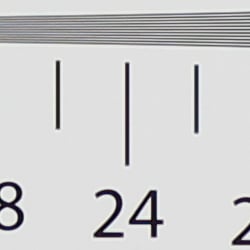


Our laboratory resolution chart showed the Canon T5's images with sharp, distinct line patterns down to about 2,500 lines per picture height horizontally and about 2,400 lines vertically. Some may argue for higher numbers, but aliasing and sharpening artifacts start to interfere at this resolution. Extinction of the pattern occurred just past 3,200 lines horizontally and at about 3,000 lines vertically. Adobe Camera Raw converted .CR2 files do not show any higher resolution than the in-camera JPEG, however complete extinction of the pattern was extended to the limit of our chart (4,000 lines) in the horizontal direction, and to about 3,400 lines in the vertical direction. ACR also produced more moiré and false colors than in-camera JPEGs, especially in vertical lines. Use these numbers to compare with other cameras of similar resolution, or use them to see just what higher resolution can mean in terms of potential detail.
See full set of test images with explanations
See thumbnails of all test and gallery images
Sharpness & Detail
Very good sharpness and detail with a sharp lens, though with moderate sharpening artifacts. Some minor detail loss to noise reduction processing even at low ISOs.


Sharpness. The Canon EOS Rebel T5's 18-megapixel sensor and processor capture sharp images with very good detail when coupled with a sharp lens, though some edge-enhancement artifacts are visible around high-contrast edges such the halos around the lettering and border in the crop above left. (The above left crop shot was taken with Canon's very sharp 16-35mm f/2.8L II USM lens at f/8.) This is pretty typical, though, especially for consumer-oriented models from Canon. Edge enhancement creates the illusion of sharpness by enhancing colors and tones right at the edge of a rapid transition in color or tone.
Detail. The crop above right shows some detail loss due to noise suppression in darker areas and in areas with low contrast, but that's to be expected at these resolutions. Typical performance for an 18-megapixel APS-C sensor. (The image above right of the hair was taken with our very sharp Sigma 70mm f/2.8 reference lens.) Noise-suppression systems in digital cameras tend to flatten-out detail in areas of subtle contrast. The effects can often be seen in shots of human hair, where the individual strands are lost and an almost "watercolor" look appears.
RAW vs In-Camera JPEGs
As noted above the Canon T5 produces sharp JPEG images with very good detail. With a good RAW converter, additional detail can often be extracted with fewer sharpening artifacts. See below:
|
Base ISO (100)
|
|
 |
 |
 |
 |
 |
 |
|
Camera JPEG, defaults
|
RAW via Adobe Camera Raw
|
In the table above, we compare a best quality in-camera JPEG taken at base ISO using default noise reduction and sharpening (on the left) to the matching RAW file converted with Adobe Camera Raw 8.5 using default noise reduction with some strong but tight unsharp masking applied in Photoshop (300%, radius of 0.3 pixels, and a threshold of 0).
Looking closely at the images, we can see ACR extracts additional detail that isn't present in the JPEG from the camera, particularly in the red-leaf swatch where the fine thread pattern is likely treated as noise by the JPEG engine. Fine detail in the mosaic crop is also improved, but as is often the case, more noise can be seen in the bottle crop. You can of course apply stronger noise reduction (default ACR NR used here) to arrive at your ideal noise versus detail tradeoff. And, as expected, sharpening haloes aren't nearly as strong as default camera output. Still, not bad in-camera default JPEG processing, but as usual you can do noticeably better by shooting in RAW mode and using a good RAW converter.
ISO & Noise Performance
Very good detail versus noise up to ISO 1,600, though detail suffers at higher ISOs.
|
Default High ISO Noise Reduction
|
||
 |
 |
 |
| ISO 100 | ISO 200 | ISO 400 |
 |
 |
 |
ISO 800 | ISO 1,600 | ISO 3,200 |
 |
 |
ISO 6,400 | ISO 12,800 |
The Canon T5's high ISO performance is fairly good, very similar to its more expensive sibling, the Canon T5i. Images are quite clean at ISOs 100 through 400, with just a tiny amount of luminance noise seen in the shadows, as well as what looks to be chroma noise in the darker areas. Noise "grain" is slightly more evident at ISO 800, but detail remains very strong despite stronger blurring due to noise reduction. ISO 1,600 is of course noisier, but fine detail is still quite good. At ISO 3,200 noise grain becomes coarser, blurring stronger, and chroma noise more apparent, resulting in a more noticeable drop in image quality. ISO 6,400 is quite grainy with obvious chroma blotching in dark to mid tones, but there is still some fine detail left. Noise and the effects of noise reduction working hard to keep it under control really become apparent at ISO 12,800, with strong blurring and obvious chroma blotching even in the brighter areas of the mannequin's face. There are also some very bright pixels scattered throughout darker areas at the highest ISO.
Overall though, not a bad performance for an entry-level model, similar to the Canon T5i's except at the highest ISOs where the T5i's noise reduction appears to be a little more refined. See the Print Quality section below for our evaluation of maximum print sizes at each ISO setting.
A note about focus for this shot: We shoot this image at f/4, using one of three very sharp reference lenses (70mm Sigma f/2.8 macro for most cameras, 60mm f/2.8 Nikkor macro for Nikon bodies without a drive motor, and Olympus Zuiko 50mm f/2.0 for Four Thirds and Micro Four Thirds bodies). To insure that the hair detail we use for making critical judgements about camera noise processing and detail rendering is in sharp focus at the relatively wide aperture we're shooting at, the focus target at the center of the scene is on a movable stand. This lets us compensate for front- or back-focus by different camera bodies, even those that lack micro-focus adjustments. This does mean, though, that the focus target itself may appear soft or slightly out of focus for bodies that front- or back-focused with the reference lens. If you click to view the full-size image for one of these shots and notice that the focus target is fuzzy, you don't need to email and tell us about it; we already know it. :-) The focus target position will simply have been adjusted to insure that the rest of the scene is focused properly.
Extremes: Sunlit, dynamic range and low light tests
Very high resolution with strong overall detail, but somewhat high default contrast and unremarkable dynamic range. Highlight Tone Priority and Auto Lighting Optimization options help with tough lighting. Good low-light performance, but autofocus struggles at lower light levels.


The Canon Rebel T5 struggled a bit here, producing moderately high contrast with some washed-out highlights and deep shadows under the deliberately harsh lighting of the test above. Our mannequin's face was too dim at the +0.3 EV and +0.7 EV settings, so we preferred the image with +1.0 EV exposure compensation here. This resulted in more clipped highlights in the shirt and flowers than we're used to seeing from an APS-C sensor lately, indicating mediocre dynamic range compared to the best of recent competitors. Despite the +1.0 EV compensation, there are still some dark shadows and very deep shadows are on the noisy side. Bottom line: Dynamic range isn't as good as some competing models, at least not without features such as HTP and ALO enabled (see below).
Because digital cameras are more like slide film than negative film (in that they tend to have a more limited tonal range), we test them in the harshest situations to see how they handle scenes with bright highlights and dark shadows, as well as what kind of sensitivity they have in low light. The shot above is designed to mimic the very harsh, contrasty effect of direct noonday sunlight, a very tough challenge for most digital cameras. (You can read details of this test here. In actual shooting conditions, be sure to use fill flash in situations like the one shown here; it's better to shoot in open shade whenever possible.)
Face Detection
Just like most point & shoot cameras these days, the Canon EOS Rebel T5 has the ability to detect faces in Live View mode, and adjust exposure and focus accordingly.
| Face Detection | ||
 |
 |
 |
| Aperture Priority Face Detect: Off 0 EV |
Aperture Priority Face Detect: On 0 EV |
Auto Mode 0 EV |
As you can see from the examples above, face detection works well, as the center image with it enabled is better exposed for the face than the left image where face detection was not employed, but that forced the camera to drop shutter speed from 1/50s to only 1/25s (since ISO was fixed at 100). Full Auto mode (right) was also an improvement over Aperture Priority without face detection, selecting a larger aperture than we normally use for this shot (f/3.5 vs f/8) while selecting a reasonably fast shutter speed of 1/160s. Good performance here in Auto mode, which is important for an entry-level model.
Highlight Tone Priority
The Canon T5's Highlight Tone Priority (HTP) option did a great job of preserving highlight detail, as shown below. (Mouse over the Off and On links to load the corresponding thumbnail and histogram, and click on the links to load full resolution images.)

Both shots above were captured at the same exposure (+0.7 EV), the only difference being that HTP was enabled for the second shot which necessarily increases the ISO to 200; part of how HTP works. The result is evident in the histograms and thumbnails above, clearly showing the superior highlight preservation when HTP is enabled, although shadows were slightly affected as well. If you look closely at shadows in the full resolution images, though, you'll notice an increase in noise is the price you pay when ISO is boosted from 100 to 200. Except in the very deepest shadows, though, overall noise is low enough at ISO 200 that this is really a negligible trade-off for all but the most critical applications.

Here, you can see HTP also toned-down bright highlights with very little effect to shadows and midtones in our Far-field shot.
Automatic Lighting Optimization
Like previous EOS models, the Canon T5 offers three selectable levels of Automatic Lighting Optimization (ALO), plus Off. In fully automatic and Creative Auto exposure modes, ALO is automatically enabled. Again, mouse over the links below to load the associated thumbnail and histogram, and click on the links to load full resolution images.
|
Automatic Lighting Optimization (+0.3 EV)
|
|
 |
|
 |
|
As you can see above, ALO has the effect of shifting shadows and midtones in the histograms to the right, brightening shadows and indeed most of the image without clipping too many additional highlights. ISO is not boosted for ALO so increased noise is not an issue, though it may be slightly more visible in shadows that have been boosted significantly.


As you can see above, this time ALO had very little effect on our Far-field shot.
Dynamic Range Analysis (RAW mode)
While we once performed our own dynamic range measurements based on in-camera JPEGs as well as converted RAW images (when the camera was supported by Adobe Camera Raw), we've switched to using DxO Labs' results from their DxOMark website. As technology advanced, the dynamic range of modern high-end cameras in some cases exceeded the range of the Stouffer T4110 density scale that we used for our own measurements. DxO's approach based on RAW data before demosaicing is also more revealing, because it measures the fundamental dynamic range of the sensor, irrespective of whatever processing is applied to JPEGs, or to RAW data by off-the-shelf conversion software.
In the following, we use DxO's "Print" dynamic range results, which are scaled based on camera resolution. As the name suggests, this scaling corresponds to the situation in which you print at a given size, regardless of how many megapixels the camera might have. (In other words, if you've decided to make a 13x19 inch print, that's the size you're printing, whether the camera's resolution is 16 or 300 megapixels.) For the technically-minded, you can find a discussion of the reasoning behind this here on the DxOMark website. Also note that DxO Labs uses a signal-to-noise (SNR) threshold of 1 when defining the lower boundary of acceptable luminance noise in their dynamic range measurements, which corresponds to the "Low Quality" threshold of the Imatest software we used to use for this measurement.

Here, we decided to compare the Canon T5's dynamic range to its predecessor, the T3, and also to Nikon's entry-level DSLR, the D3300, though the Nikon is a little more expensive (street price is ~US$50 higher than the T5 at time of writing). You can always compare other models on DxOMark.com.
As you can see from the above graph (click for a larger version), the Canon T5's dynamic range is very similar to the T3's despite the increase in resolution and decrease in photosite size, ranging from about 11.3 EV at base ISO, down to about 7.0 EV at maximum ISO. Compared to the Nikon D3300, though, the T5 offers about 1.5 EV less dynamic range at base ISO (11.3 vs 12.8 EV). The Nikon D3300 continues to offer significantly higher dynamic range to about ISO 800, above which the gap is much smaller (less than 1/2 EV), which may just be discernible in real-world images. Bottom line? The T5 (like most Canons) offers less dynamic range than most competing models, meaning shadows are noisier and/or highlights are more easily clipped compared to peers, at least at lower ISOs. Click here to visit the DxOMark page for the Canon T5 for more of their test results and additional comparisons.
| 1 fc 11 lux |
1/16 fc 0.67 lux |
1/16 fc Minimum NR |
|
|---|---|---|---|
| ISO 100 |
 2s, f2.8 |
 32s, f2.8 |
 32s, f2.8 |
| ISO 3200 |
 1/16s, f2.8 |
 1s, f2.8 |
 1s, f2.8 |
| ISO 12800 |
 1/64s, f2.8 |
 1/4s, f2.8 |
 1/4s, f2.8 |
Low Light. The Canon T5 performed well in our low-light imaging test, capturing bright images at the lowest light level we test (1/16 foot-candle), even with the lowest sensitivity setting (ISO 100). As expected, noise is visible at ISO 3,200, but it's quite fine grained, and not at all objectionable. Noise is high at ISO 12,800 particularly when noise reduction is minimized (extreme right column in the table above), though not too bad.
A few bright pixels can be seen at ISO 12,800 that may also appear at ISO 6400. We didn't see any significant banding (pattern noise) or heat bloom, though.
Color balance is pretty neutral with Canon Rebel T5's Auto white balance setting (just a touch cool), though white balance took on a slightly reddish or magenta tint at lower light levels.
When using the optical viewfinder and dedicated phase-detect AF system, the Canon Rebel T5's autofocus system was able to focus on our test subject down to just below the 1/4 foot-candle light level unassisted with an f/2.8 lens, which is only fair performance, however it was able to focus in complete darkness with AF assist enabled. In Live View mode, the Canon T5 was able to focus down to just above the 1/2 foot-candle light level, which is poor for a DSLR in Live View mode with an f/2.8 lens.
As always, keep in mind that the longer shutter speeds here demand the use of a tripod to prevent any blurring from camera movement. (A useful trick is to just prop the camera on a convenient surface, and use its self-timer to release the shutter. This avoids any jiggling from your finger pressing the shutter button, and can work quite well when you don't have a tripod handy.)
How bright is this? The one foot-candle light level that this test begins at roughly corresponds to the brightness of typical city street-lighting at night. Cameras performing well at that level should be able to snap good-looking photos of street-lit scenes.
NOTE: This low light test is conducted with a stationary subject, and the camera mounted on a sturdy tripod. Most digital cameras will fail miserably when faced with a moving subject in dim lighting. (For example, a child's ballet recital or a holiday pageant in a gymnasium.) Digital SLRs like the Canon T5 do much better than point & shoots, but you still shouldn't expect a quick autofocus lock with moving subjects.
Built-in Flash Test Results
Coverage, Exposure and Range
Narrow coverage with average exposure compensation required for our standard Indoor Portrait shot; Somewhat weak flash but not a surprise given its size.


Coverage. Flash coverage from the T5's built-in flash is uneven at wide angle (18mm), leaving corners and edges in our flash test image a little dim. Narrow coverage at wide angle isn't unusual, though, and some of the corner fall-off is from the lens itself. We no longer test coverage at telephoto, as wide angle is always worst-case.
Exposure. Indoors, under incandescent background lighting, the Canon Rebel T5's flash performed well, requiring an average amount of positive exposure compensation of +0.7 EV for a bright image, and the camera chose a fairly typical 1/60s shutter speed. The camera's slow-sync flash mode only required +0.3 EV exposure compensation for bright results, though the longer shutter time (1/15s) results in a warmer orange/yellow cast from the ambient background lighting.
| Manufacturer-Specified Flash Range |
|---|
 5.4 feet ISO 100 |
Manufacturer Specified Flash Range Test. The Canon Rebel T5's built in flash has a rated Guide Number of 9.2 meters or 30.2 feet at ISO 100. That works out to about 5.4 feet at f/5.6 at ISO 100. In the shot above, we can see that the Canon Rebel T5's built-in flash did not quite perform to specification, producing a slightly underexposed target at the rated distance and aperture, though the exposure is still very usable.
Output Quality
Print Quality
Good 24 x 36 inch prints at ISO 100 and 200; a nice 11 x 14 at ISO 1,600; a reasonable 5 x 7 at ISO 6,400.
 ISO 100 and 200 yield good prints up to 24 x 36 inches. 20 x 30's are very nice, rendering sharper fine detail, and 30 x 40's are fine for wall display prints at arm's length.
ISO 400 prints are quite good at 20 x 30 inches, and 24 x 36's here are suitable for wall display and less critical applications.
ISO 800 images at 20 x 30 inches have a bit too much noise in flatter areas of our target to merit our "good" grade, but the prints are not bad by any means and the noise is reminiscent of film grain. We can safely call the 16 x 20's good at this setting, as noise is well-controlled here and fine detail is quite good.
ISO 1,600 produces a 13 x 19 inch print that almost passes our good standard, and is certainly usable for less critical applications. 11 x 14's are good here for most all applications, with nice detail and full color reproduction.
ISO 3,200 prints tend to start taking their toll for noise levels on most APS-C cameras, and the T5 is no exception. We can call 8 x 10's good here, but there is still a bit of noticeable noise in a few areas of our test target, and the typical softening of certain areas in the red channel.
ISO 6,400 yields a 5 x 7 inch print that just passes our good seal of approval, though overall colors are beginning to look just a bit muted.
ISO 12,800 does not yield a good print and is best avoided except for less critical applications.
The Canon T5 stands up in the print quality department in most regards to its pricier sibling the T5i, falling behind it at only a couple of higher ISOs by one print size. It prints at lower ISOs up to 24 x 36 inches, quite a common size for APS-C cameras at these settings, and still delivers a good 5 x 7 at ISO 6,400. And all this while priced at just MSRP US$550, including a good kit lens. Due to the amazing price/performance ratio, we certainly give the Canon T5 an overall "good" rating in our print quality assessment.
The images above were taken from our standardized test shots. For a collection of more pictorial photos, see our Canon EOS Rebel T5 (EOS 1200D) Photo Gallery .
Not sure which camera to buy? Let your eyes be the ultimate judge! Visit our Comparometer(tm) to compare images from the Canon EOS Rebel T5 (EOS 1200D) with those from other cameras you may be considering. The proof is in the pictures, so let your own eyes decide which you like best!
Performance
Timing and Performance
Mixed performance from the Canon T5.
| Startup/Shutdown | ||
|---|---|---|
|
Power on |
~0.5 second
|
Time it takes to turn on and capture a shot. |
|
Play to Record, |
~0.2 second
|
Time until first shot is captured. |
The Canon Rebel T5 turned in a fast startup time of about half a second, and switching from Play to Record and taking a shot was even faster at only about 0.2 second.
| Shutter Response (Lag Time), Optical Viewfinder, 18-55mm IS II | ||
|---|---|---|
|
Full Autofocus |
0.308 second
|
Time from fully pressing shutter button to image capture. |
|
Full Autofocus |
0.163 second
|
Time from fully pressing shutter button to image capture. |
|
Full Autofocus |
0.274 second
|
Time to capture while forcing flash to fire. Metering pulses from flash often slow shutter response. |
|
Manual Focus |
0.122 second
|
For most cameras, shutter lag is less in manual focus than autofocus, but usually not as fast as when the camera is "prefocused". |
|
Prefocused |
0.113 second
|
Time to capture, after half-pressing and holding shutter button. |
| Shutter Response (Lag Time), Live View, 18-55mm IS II | ||
|
Full Autofocus |
1.240 seconds
|
Time from fully pressing shutter button to image capture. This is phase-detect autofocus, the camera drops the mirror to focus, then raises it to grab the shot. |
|
Full Autofocus |
1.617 seconds
|
Time from fully pressing shutter button to image capture. This is using contrast-detect AF. |
|
Prefocused |
0.093 second
|
Time to capture, after half-pressing and holding shutter button. |
The Canon Rebel T5's full autofocus shutter response was a touch slower than average these days when using our standard single-point AF test, at 0.308 second. Interestingly, allowing the camera to choose the focus point reduced AF shutter lag to only 0.163 second, which is very fast for an entry-level DSLR. Enabling the built-in flash resulted in full AF lag of 0.247 second on average, which pretty good. Shutter lag with Manual focus was good, at 0.122 second, but "Prefocusing" the camera by half-pressing and holding down the shutter button before the final exposure resulted in a lag time of 0.113 second, a little slow for a consumer DSLR.
As expected, the Canon Rebel T5's AF lag time in Live View mode was quite a bit longer than using the optical viewfinder, and not as fast as models with Canon's newer hybrid AF systems. We measured about 1.2 seconds using "Quick Mode" (phase-detect AF). The T5's FlexiZone AF mode (contrast-detect) was noticeably slower than "Quick Mode" at about 1.6 second. Prefocused shutter lag in Live View mode was surprisingly quick though, at only 0.093 second, which is faster than with the optical viewfinder.
To minimize the effect of different lens' focusing speed, we test AF-active shutter lag with the lens already set to the correct focal distance.
| Cycle Time (shot to shot) | ||
|---|---|---|
|
Single Shot mode |
0.36 second
|
Time per shot, averaged over 12 shots, 5 seconds to clear. |
|
Single Shot mode |
0.36 second
|
Time per shot, averaged over 6 shots, 8 seconds to clear. |
|
Single Shot mode |
0.48 second
|
Time per shot, averaged over 4 shots, 9 seconds to clear. |
|
Early shutter |
No
|
Some cameras don't snap another shot if you release and press the shutter too quickly in Single Shot mode, making "No" the preferred answer. |
|
Continuous mode |
0.33 second (3.00 frames per second);
12 frames total; 5 seconds to clear* |
Time per shot, averaged over 125 shots, then slowed to an average of 0.67s or 1.5fps when buffer was full. |
|
Continuous mode |
0.33 second (3.01 frames per second);
6 frames total; 8 seconds to clear* |
Time per shot, averaged over 6 shots, then slowed to an average of 1.33s or 0.75fps when buffer was full. |
|
Continuous mode |
0.38 second (2.61 frames per second);
4 frames total; 10 seconds to clear* |
Time per shot, averaged over 4 shots, then slowed to an average of 2.44s or 0.41fps when buffer was full. |
|
Flash recycling |
1.7 seconds
|
Flash at maximum output. |
|
*Note: Buffer clearing times measured with a SanDisk Extreme Pro 95MB/s UHS-I SDHC card. Slower cards will produce correspondingly slower clearing times. Slow cards may also limit length of bursts in continuous mode. ISO sensitivity and noise reduction settings can also affect cycle times and burst mode performance.
|
||
Shot-to-shot cycle times in the Canon T5's single-shot mode were quite good for a entry-level DSLR, at 0.36 second for large/fine JPEGs, 0.36 second for RAW mode and 0.48 second for RAW + large/fine JPEGs.
Continuous mode speeds were however quite slow even for an entry-level model these days, at about 3.0 frames-per-second when shooting JPEGs or RAW files, falling to 2.6 frames-per-second when shooting RAW+JPEG files. That's not a lot faster than single-shot mode.
Measured buffer depths in continuous mode were fair for an entry-level model when shooting large/fine JPEG frames at 12 frames, but quite shallow when RAW files were included. We were only able to capture 6 RAW frames or 4 RAW + large/fine JPEGs before the frame rate slowed. (Note that in our cycle time testing we shoot a target consisting of a fine-grained digital noise pattern, designed to be very hard to compress. This gives us worst-case buffer capacity numbers for compressed files: You're likely to see greater buffer capacity when shooting more normal subjects.) Buffer clearing was fairly quick for its class, though.
The Canon T5's flash took an average of 1.7 seconds to recharge after a full-power discharge, which is very good.
Bottom line, the Canon Rebel T5 offers mixed performance. Startup time, mode switching, single shot cycle times and autofocus speeds when using the optical viewfinder were quite good, however autofocusing in Live View mode was sluggish, and burst mode was slow with shallow buffers, especially when shooting RAW.
Battery
Battery Life
Mediocre battery life for a lithium-ion DSLR design.
| Operating Mode | Number of Shots |
|---|---|
|
Lithium-ion Rechargeable Battery,
(CIPA standard, Optical Viewfinder) |
500
|
|
Lithium-ion Rechargeable Battery,
(CIPA standard, Live View LCD) |
180
|
The Canon T5 uses a custom rechargeable lithium-ion battery for power, and ships with a charger. Battery life is not too bad for an entry-level model, but still a bit below average when using the optical viewfinder, and of course Live View mode draws more power reducing battery life to less than half. We recommend you pick up a spare battery and keep it freshly charged and on-hand for extended outings.
The table above shows the number of shots the Canon T5 is capable of (on a fully-charged rechargeable battery), based on CIPA battery-life and/or manufacturer standard test conditions.
(Interested readers can find an English translation of the CIPA DC-002 standards document here. (180K PDF document))
Image Quality
The crops below compare the Canon T5 to the Canon T3, Canon T5i , Nikon D3300, Pentax K-500 and Sony A5100.
NOTE: These images are best quality JPEGs straight out of the camera, at default settings including noise reduction and using the actual base ISO (not extended ISO settings). All cameras in this comparison were shot with our very sharp reference lenses. Click any image to bring up the full test shot.
Canon T5 vs Canon T3 at Base ISO
 |
 |
 |
 |
 |
 |
Canon T5 at ISO 100 | Canon T3 at Base ISO |
It's clear that the higher-resolution 18MP sensor captures more fine detail than the older 12MP sensor found in the predecessor. The T5 also handles the often-difficult red and pink fabric swatches slightly better. | |
Canon T5 vs Canon T5i at Base ISO
|
 |
|
 |
|
 |
Canon T5 at ISO 100 | Canon T5i at ISO 100 |
Given that both cameras here share the same 18MP sensor, it's no surprise that the images look quite similar -- both capture excellent fine detail. The T5i, however, has a newer DIGIC 5 image processor, which could account for slight differences, such as the T5i's better handling of the red and pink fabric. |
|
Canon T5 vs Nikon D3300 at Base ISO
|
 |
|
 |
|  |
Canon T5 at ISO 100 | Nikon D3300 at ISO 100 |
Not only does the D3300 have a higher-resolution 24.2MP sensor, it also omits the optical low-pass filter, which helps it capture finer, sharper detail than the T5. | |
Canon T5 vs Pentax K-500 at Base ISO
|
 |
|
 |
|  |
Canon T5 at ISO 100 | Pentax K-500 at ISO 100 |
The Canon and Pentax share a more similar sensor resolution (18 vs. 16.3, respectively). The Pentax produces some very sharp images (at default settings for in-camera JPEGs) compared to the Canon. Both here display very good fine detail, however, the Pentax does really well with fine detail in the red fabric, while it struggles with the pink fabric. | |
Canon T5 vs Sony A5100 at Base ISO
|
 |
|
 |
|
 |
Canon T5 at ISO 100 |
Sony A5100 at ISO 100 |
Again, we're dealing with a higher-resolution sensor over the Canon, as the Sony's 24.3MP sensor does well capturing very fine detail. The Canon still does well, but small items like the handling of the pink fabric tip in Sony's favor. |
|
Moving onto ISO 1600 now, where noise processing starts to show its character.
Canon T5 vs Canon T3 at 1600 ISO
 |
 |
 |
 |
 |  |
Canon T5 at ISO 1600 | Canon T3 at ISO 1600 |
Bumping up the ISO to 1600, we start to see high ISO noise and in-camera noise reduction (at default levels) taking its toll on fine detail in both the T5 and T3 cameras -- which share the same DIGIC 4 image processor. The shadow noise and the fine detail in the mosaic still looks quite good from the T5, but both cameras struggle with detail in the fabric swatches. | |
Canon T5 vs Canon T5i at 1600 ISO
|
 |
|
 |
|  |
Canon T5 at ISO 1600 | Canon T5i at ISO 1600 |
Despite the newer image processor of the T5i, images here look very similar once again. Noise is well-controlled and fine detail looks good, while both models have a tough time resolving the leaf details in the red fabric. | |
Canon T5 vs Nikon D3300 at 1600 ISO
|
 |
|
 |
|  |
Canon T5 at ISO 1600 | Nikon D3300 at ISO 1600 |
At ISO 1600, the Nikon tones down the noise reduction more compared to the Canon, which in turn helps it capture more fine detail, especially in the mosaic, but at the expensive of more visible noise and grain. The Nikon also does ever-so-slightly better wiith the red fabric compared to the Canon. | |
Canon T5 vs Pentax K-500 at 1600 ISO
|
 |
|
 |
|  |
Canon T5 at ISO 1600 | Pentax K-500 at ISO 1600 |
The Canon does really well here compared to the Pentax, which displays rather strong, harsh noise reduction processing. NR artifacts are visible in the Pentax crops, and it really takes its toll on the red fabric, which is almost entirely smoothed out. | |
Canon T5 vs Sony A5100 at 1600 ISO
|
 |
|
 |
|
 |
Canon T5 at ISO 1600 |
Sony A5100 at ISO 1600 |
While some fine detail areas, such as the bottle crop, are softer from the Sony, the T5 does well at controlling visible noise here at ISO 1600. The red fabric is also slightly more detailed in the Sony image, though the detail in the leaf pattern is rather distorted. |
|
And below at ISO 3200, the stakes really start to show in today's cameras.
Canon T5 vs Canon T3 at 3200 ISO
 |
 |
 |
 |
 |  |
Canon T5 at ISO 3200 | Canon T3 at ISO 3200 |
At ISO 3200, noise and the subsequent noise reduction processing is becoming very apparent. Both cameras, however, are still able to capture and resolve some fine detail, such as the mosaic tile pattern. Fabric details have become quite soft and mushy though. | |
Canon T5 vs Canon T5i at 3200 ISO
|
 |
|
 |
|  |
Canon T5 at ISO 3200 | Canon T5i at ISO 3200 |
Like the previous comparisons with these two models, image quality performance at ISO 3200 is strikingly similar. Both are able to resolve detail in the mosaic, but display visible noise in the shadows and struggle with detail in the fabric swatches. | |
Canon T5 vs Nikon D3300 at 3200 ISO
|
 |
|
 |
|  |
Canon T5 at ISO 3200 | Nikon D3300 at ISO 3200 |
Again, we see the Nikon's trade off for sheer detail resolution over noise reduction. The Nikon displays more visible grain than the Canon here at ISO 3200, but the detail is crisper, in all three crops -- especially in the mosaic and the bottle label. | |
Canon T5 vs Pentax K-500 at 3200 ISO
|
 |
|
 |
|  |
Canon T5 at ISO 3200 | Pentax K-500 at ISO 3200 |
The Canon takes the edge over the Pentax here, with a good balance of noise reduction and fine detail. The Pentax displays very strong noise reduction, which unfortunately hurts overall fine detail in the image. | |
Canon T5 vs Sony A5100 at 3200 ISO
|
 |
|
 |
|
 |
Canon T5 at ISO 3200 |
Sony A5100 at ISO 3200 |
The Sony's default NR processing does very well at smoothing out and removing noise, but at the expense of some fine detail here at ISO 3200. The Canon is able to resolve a bit more fine detail in the bottle and mosaic crops, though it still struggles more with the red fabric. |
|
Canon T5 vs. Canon T3, Canon T5i, Nikon D3300, Pentax K500 and Sony A5100.
 |
 |
 |  |
 |
 |
 |
 |
 |  |
 |
 |
 |
 |
 |  |
 |
 |
| Canon T5 ISO 100 ISO 3200 ISO 6400 |
Canon T3 ISO 100 ISO 3200 ISO 6400 |
Canon T5i ISO 100 ISO 3200 ISO 6400 |
Nikon D3300 ISO 100 ISO 3200 ISO 6400 |
Pentax K-500 ISO 100 ISO 3200 ISO 6400 |
Sony A5100 ISO 100 ISO 3200 ISO 6400 |
| Detail comparison. The Canon T5 does well with very fine, high contrast detail at base ISO and shows a marked improvement over its predecessor, the T3. However, the higher resolution sensors of the Nikon and Sony unsurprisingly do better at base ISO, as does the Pentax. However, as the ISO rises, the Nikon D3300 takes the crown here by keeping fine detail crisp and clean with little degradation from noise and noise reduction processing compared to the other cameras. | |||||
Canon T5 Print Quality
Good 24 x 36 inch prints at ISO 100 and 200; a nice 11 x 14 at ISO 1,600; a reasonable 5 x 7 at ISO 6,400.
ISO 100 and 200 yield good prints up to 24 x 36 inches. 20 x 30's are very nice, rendering sharper fine detail, and 30 x 40's are fine for wall display prints at arm's length.
ISO 400 prints are quite good at 20 x 30 inches, and 24 x 36's here are suitable for wall display and less critical applications.
ISO 800 images at 20 x 30 inches have a bit too much noise in flatter areas of our target to merit our "good" grade, but the prints are not bad by any means and the noise is reminiscent of film grain. We can safely call the 16 x 20's good at this setting, as noise is well-controlled here and fine detail is quite good.
ISO 1,600 produces a 13 x 19 inch print that almost passes our good standard, and is certainly usable for less critical applications. 11 x 14's are good here for most all applications, with nice detail and full color reproduction.
ISO 3,200 prints tend to start taking their toll for noise levels on most APS-C cameras, and the T5 is no exception. We can call 8 x 10's good here, but there is still a bit of noticeable noise in a few areas of our test target, and the typical softening of certain areas in the red channel.
ISO 6,400 yields a 5 x 7 inch print that just passes our good seal of approval, though overall colors are beginning to look just a bit muted.
ISO 12,800 does not yield a good print and is best avoided except for less critical applications.
The Canon T5 stands up in the print quality department in most regards to its pricier sibling the T5i, falling behind it at only a couple of higher ISOs by one print size. It prints at lower ISOs up to 24 x 36 inches, quite a common size for APS-C cameras at these settings, and still delivers a good 5 x 7 at ISO 6,400. And all this while priced at just MSRP US$550, including a good kit lens. Due to the amazing price/performance ratio, we certainly give the Canon T5 an overall "good" rating in our print quality assessment.
Field Test
A lot of camera for the money
by Jason Schneider | Posted: 06/26/2014


In the hand. The Canon EOS Rebel T5 is an entry-level DSLR being offered at the enticingly low street price of a whisker under US$500 to appeal to first-time DSLR buyers and casual shooters, but with sufficient tech, features, and overall street creds to motivate some enthusiasts as well. Size-wise it's on the compact side for an APS-C-format DSLR (5.1 x 3.9 x 3.1 inches body only) and its polycarbonate body with stainless steel lens mount weighs in at only 16.9 ounces (the standard Canon EF-S 18-55mm f/3.5-5.6 IS II, 29-88mm equivalent zoom kit lens adds another 2.8 inches in depth and 7.1 ounces in weight). The lightweight T5 is comfortable and beautifully balanced in your hands with sufficient heft to feel like a real camera, and its nicely rounded contours and perfectly shaped ergonomic handgrip contribute to that impression. Controls are clearly labeled and where you'd expect to find them and experienced shooters will have no problem operating this camera without referring to the clear, comprehensive printed instruction manual.

Features. The T5's image capture system is based on Canon's proven 18-megapixel APS-C CMOS sensor noted for delivering commendably crisp low-noise image quality even up to ISO 6400 in previous T-series Canons, coupled to an advanced (but not the latest) DIGIC 4 image processor. Other key features and specs include a fixed 3-inch, 460k-dot LCD, ISO settings from 100-6400 (up to 12,800 in extended mode), impressive manufacturer-rated start-up and shutter lag times of 0.1 second and 0.12 second respectively, continuous shooting at up to three frames per second, a 9-point AF system with a single central cross-type sensor, Full HD 1080p video capture at 30, 25, and 24 fps with video clips up to 29 minutes, 59 seconds, and Scene Intelligent Auto Mode that analyzes the image based on built-in algorithms and chooses the "optimum" exposure and enhancements. In addition, the T5 provides a Feature Guide to aid novices, a Creative Auto mode that lets newbies adjust background blur without having to understand how aperture works, a set of five built-in Creative Filters consisting of Grainy B/W, Soft Focus, Fisheye, Toy Camera and Miniature Effect that are applied in Playback mode, and GPS compatibility (with optional GP-E2 GPS receiver).


Canon T5's optical viewfinder
Design. Like all DSLRs with penta-mirror finders the Rebel T5's viewfinder exhibits something of the "tunnel effect" not present on more expensive DSLRs with larger, all-glass pentaprism viewfinders, but the T5's finder is nevertheless clear and relatively bright, showing good detail, and 95% of the image-capture area at a reasonably high magnification of about 0.8x.
Fortunately the optical viewfinder is complemented with an excellent 3-inch LCD that is generally bright (at the normal midpoint brightness setting) and provides good color accuracy, contrast, and color saturation. While the LCD's resolution (460k dots) isn't as high as some competing models which sport 921k-dot panels, it provides surprisingly good detail for the dot count, even when you zoom in using the magnification function to assess your captured images, or shoot stills or videos in Live View mode.
Unlike more recent designs that put the LCD panel closer to the protective glass surface, the Canon T5's LCD is more recessed with a larger air gap, and is consequently more prone to glare and reflections in bright sunlight. In fact, at the right angle in direct sun, the screen is practically impossible to read; completely blanked out with glare. In most sunny conditions though, while glare is certainly an issue, you can still see the screen well enough to use the camera and adjust settings with the on-screen menus. Canon gives you the option of four different UI color schemes, including black-text-on-silver background, that I thought would do better in bright light, however, I found the standard white-text-on-black scheme to be the easiest to read in bright conditions.


The angled shutter release is perfectly positioned atop the right-hand grip and its action is smooth and predictable. My only personal minor gripe is that the shutter/mirror release sound is a bit high pitched and "clattery" for my taste and I don't think the camera is ideal for discreet shooting at close range.

Tabbed main menu
UI. Setting the Canon T5's menus is logical and intuitive. Just press the MENU button on the back of the camera to display the tabbed main menu, and use the 4-way controller to select the tab or sub-menu entry you want and enable it by pressing the SET button.

Quick menu when using optical viewfinder
There's also a clever Q (Quick Control) setting menu that's faster, very useful for rapid access to more frequently adjusted settings, especially those settings that don't have a dedicated button. For example, you can adjust flash exposure compensation by pressing the Q button, navigating to the flash exposure compensation field displayed on the LCD with the 4-way controller, and selecting the value you want by turning the main dial. You can then half-press the shutter button to quickly get back to shooting. You can also press the SET button after selecting a function to display a standalone screen for that function with a usage hint displayed below, and you can optionally press SET to confirm a selection.
Clearly labeled buttons on the back of the camera provide direct access for setting the ISO, drive/self-timer mode, AF mode (One Shot, AI Focus or AI Servo), White Balance (including AWB and Custom White Balance) and exposure compensation which doubles as an aperture select button in manual exposure mode. Not so clearly labelled (at least to those not familiar with Canon DSLRs) is the AE lock/FE lock button (labeled with an asterisk) and the AF point select button just to the right of the thumbrest. The main mode dial atop the camera's right-hand shoulder lets you set the usual M (Manual exposure), Av (aperture value, more commonly known as Aperture Priority), Tv (time value or Shutter Priority), and P (Programmed) exposure modes, plus Scene Intelligent Auto mode, Flash Off, Creative Auto, five scene modes (Portrait, Landscape, Close-up, Sports, and Night Portrait), and Movie mode (denoted by a movie camera icon). There's also a handy flash pop-up button behind the main dial. There's nothing particularly original about this control array but it's well executed and very logical.

Performance. Shooting still pictures with the Canon T5 is very pleasant and satisfying. The camera achieved focus rapidly in the vast majority of shooting situations even in dim light and with low-contrast subjects, when using the optical viewfinder. I mostly used One Shot AF (AF-S) with Multi-point AF (auto area) mode which acquitted itself admirably for a wide variety of subjects, however the T5 also allows for manual selection of the focus point in PASM modes when you need more control. Live View with a choice of Face Detection, FlexiZone (contrast-detect) or Quick focus (phase-detect) AF is preferable for some subjects, though as expected, focusing was a lot slower than with the OVF. At any rate, using evaluative (multi-pattern) metering, One Shot AF and Multi-point AF mode with the optical viewfinder, I achieved crisp, accurate exposures well over 95% of the time under a wide variety of shooting conditions including a few 3 fps burst sequences of badminton players and kids frolicking in a fountain pool at a park.

In terms of actual real world performance, this camera flat out delivers in my opinion, and performance in low light at high ISOs (to 6400) and in backlit situations, is exemplary and would do credit to a mid-range Canon DSLR. The images are clean and clear, while color accuracy and color differentiation in the reproduction of subtle color variations in a single hue is outstanding. Some of the credit goes to the EF-S 18-55mm IS II lens, which delivers surprisingly sharp and detailed images over its entire range for a kit lens, and provides very effective image stabilization in conjunction with the camera's circuitry. As for the T5's 3 fps maximum burst rate, it's admittedly on the slow side these days even for an entry-level model. For capturing high-speed action and extreme sports 5 fps is really the threshold of satisfying performance.
Canon T5 18-55mm IS II Kit Lens Wide & Telephoto Comparison |
|
 |
 |
18mm, f/8, 1/100s, ISO 100 |
55mm, f/8, 1/100s, ISO 100 |
In low-light situations, the T5 uses its pop-up flash for focus assist (though not in Live View unless using Quick AF), which can be extremely disruptive to your subjects as it emits a burst of flashes to help achieve focus. In PASM modes, you'll have to manually raise the pop-up flash, but in full Auto mode or various scene modes, the camera will automatically pop the flash and fire off the focus assist burst as it sees fit, unless disabled in a Custom Function menu.


Quick menu in Live View mode
Live View. Canon's Live View mode is one of the better implementations found on true DSLRs, and I found the exposure simulation to be quite accurate for stills, doing a good job of previewing what the final image will look like by including the effects of Picture Style, white balance, aspect ratio, Auto Lighting Optimizer, and Peripheral Illumination Correction. Even depth of field can be previewed (when enabled), and there is also an optional grid display to help with composition and keeping your horizons level. The Quick Control menu overlays the live preview as shown at right.
Prefocused shutter lag times were very short in Live View mode (the IR lab measured it at only 0.092s), but as mentioned previously, autofocus was quite slow, at least with the kit lens (the lab measured 1.24s using "Quick AF" (phased-detect) and 1.62s using "FlexiZone AF" (contrast-detect). You'll definitely want to stick to using the optical viewfinder in situations where autofocus speed is important.

Movies. I did shoot a few video clips with the T5, and it's easy and intuitive. Just set the camera to video (movie camera icon) mode, the mirror flips up with an extended click, and you're in Live View mode. An exposure compensation scale and (if enabled) other image data appear below the viewing image and a rectangular AF box appears in the center of the frame that you can move up and down and side to side by using the 4-way controller (when FlexiZone AF is selected). Center your main subject in the frame, press the shutter button partway in to focus, and the box will turn green when AF has been achieved. Now press the live view/movie record button to the right of the eyepiece and your video will begin recording. A stationary red circle appears in the upper right-hand corner of the frame to indicate that the video is being captured, and the red LED on the lower right-hand corner of the back of the camera flashes until you press the record button to stop the video.
You can also take photos during video recording -- both RAW and JPEGs -- but the sounds of the shutter will be picked up by the microphone, and the resulting video will have brief pauses at the moments the photos were captured. However, once the images are taken, video recording resumes automatically. The resulting images are high-resolution, although the JPEGs are cropped to a 16:9 aspect ratio (5184 x 2912) while RAW images maintain their full 5184 x 3456 resolution and 3:2 aspect ratio.
Full HD Sample Video. The Canon T5 can shoot 1920x1080 video at 30p, 25p or 24p, 1280x720 at 60p or 50p, and 640x480 at 30p or 25p, but sound is mono and continuous autofocus is not supported unlike some of its rivals.
1920 x 1080, H.264/MOV, Progressive, 30 fps Download Original (267.3MB MOV). |
Full HD Moiré Sample Video. Although video quality is generally excellent, the T5 's videos are susceptible to aliasing artifacts, as is true of video from a lot of DSLRs.
1920 x 1080, H.264/MOV, Progressive, 30 fps Download Original (240.7MB MOV). |
Video image quality is excellent when you set video recording for 1080p/30 fps as I did for all of my video shooting, though moiré patterns can appear when shooting subjects with repeating detail. Sound quality using the built-in monaural microphone is good but not spectacular, and there's an optional electronic wind filter. Sadly, there is no jack for an external stereo mic, which some competitors even at this price point are starting to provide. Although the T5 does not provide continuous AF while shooting video, you can reframe your subject at any time and press the shutter release partway in to activate contrast-based AF while shooting, which is a reasonable workaround for most purposes, however the focusing noise made by the AF motor in the kit lens was quite evident in the recording. You can, of course switch to manual focus which is exactly what many serious videographers do when shooting video with DSLRs that are a lot more expensive than the T5.

Movie menu options
Exposure in movie mode defaults to fully automatic, but provisions for manual control of ISO, shutter speed and aperture control as well as the option to shoot 720p at 60 fps are included, impressive for a camera in this price class. As mentioned, the T5 does not provide continuous AF when shooting video, though. This is the chief drawback in shooting video with the T5 for most consumers -- too bad because video image quality is generally excellent. And in case you're wondering, the quiet-focusing Canon STM 18-55mm lens included in the Canon EOS Rebel T5i kit will work on the T5, providing virtually silent AF. However, since the T5 is sold only as a kit with standard Canon EF-S 18-55mm IS II lens, and the camera does not have continuous AF capability when shooting video, acquiring it isn't a very practical proposition. In short, If you want quiet, continuous AF when shooting video, by all means opt for the T5i.

Summary. Overall the Canon EOS Rebel T5 is a terrific, fun camera and certainly an amazing value for the money. However before more serious enthusiasts plunk down five C-notes for this engaging camera, they should take a close look at its main competition, which is, ironically enough, Canon's very own Rebel T5i. Granted, the T5i has a street price of US$750 versus $500 for the T5, a hefty $250 or 50% price premium. However, what you get is a camera with the following upgrades: An 18-55mm IS STM kit lens with quiet and smooth AF when shooting video, a better-performing, state-of the art DIGIC 5 image processor, a higher-res, tilting 3.0-inch Vari-Angle 1,040k-dot touch screen, Full HD 1080p video with continuous AF as you shoot, an external mic jack, a 5.0 fps continuous shooting burst rate, a 9-point all-cross-sensor AF system, and Multi-Shot Noise reduction. If that isn't enough, it also has ISO settings expandable to ISO 25,600, a slightly higher magnification viewfinder (about 0.85x vs. 0.8x), and a slightly wider eyepiece diopter adjustment range (-3 to +1 as opposed -2.5 to +0.5). Is all that worth an extra $250? As they say, it's your call, but if you do a lot of serious video or action shooting the choice is clear. (Editor's Note: You may also want to consider the Canon SL1 which has a street price of about US$600, is smaller than the T5 & T5i, and is even more adept at continuous autofocus during videos than the T5i, thanks to its more advanced hybrid AF system.) However, if you're not really into those things, or you're buying this as a family or backup camera to complement your high-zoot Canon DSLR, by all means go for the simple, unassuming, very competent T5 and chuckle all the way to the bank.
Conclusion
| Pro: | Cons: |
|---|---|
|
|
After a long time in the making, the Canon T5 comes as a very welcomed upgrade over 2011's Canon Rebel T3 DSLR. Sporting a newer, higher-resolution, 18-megapixel sensor as opposed to the 12MP one in its predecessor, the T5 provides not only larger, higher-res images, but also an increased ISO range up to 12,800. The T5 also provides a substantial upgrade in HD video recording capabilities, now going up to Full HD at 30p and 24p (25p for PAL), whereas the T3 maxed out at only 720p video. The T5 still has 720p recording, of course, but now offers a faster 60p (50p PAL) frame rate for better fast-action videos. Also, for more advanced control in video mode, it offers full manual exposure control for the first time in this entry-level EOS camera category.
In our lab tests as well as in our Field Tests, the Canon T5 produced very good, high quality images. The older DIGIC 4 image processor, brought over from the T3, helps capture highly-detailed images, as well as provides fast single-shot cycle times, for quick shot-to-shot performance in single-shot mode. However, the camera struggles with a slow burst speed and a shallow buffer, making sports, action or anything rapid-fire a bit frustrating.
Despite the increased ISO range of this new model, we did find that while higher ISO images looked decent, the dynamic range and overall high ISO performance was not up to the level of some competing models. Additionally, low-light autofocus was underwhelming, and the camera struggles to focus without the AF assist light (which, awkwardly, is performed by the pop-up flash instead of a dedicated, smaller AF assist lamp).
One should keep in mind that the Canon T5 is an entry-level model DSLR, and it will not have all the bells and whistles of its higher-end -- and more expensive -- siblings. For instance, while the T5 bumps up in video resolution, it still lacks continuous AF in movie mode, records only mono audio, and has no external mic jack, unlike the higher-priced Canon T5i. The T5 also lacks an in-camera HDR mode or any kind of in-camera creative effects -- so keep that in mind if those sorts of things interest you.
All in all, though, the Canon T5 is a solid DSLR with a great bang-for-your-buck ratio, even with its various limitations. The camera does get a more thorough covering of rubberized grip material for a more secure hold, and yet it maintains a traditional yet simplistic DSLR design with comfortable ergonomics and easy to use controls. While the T5 may lean more toward the basic side of things, the image quality is very good when it's all said and done. If you're looking for a low barrier of entry into the Canon DSLR world, the Canon Rebel T5 is a great place to start.
For the entry-level buyer wanting to step up to an SLR for the first time, the Canon T5 offers a pretty compelling package that earns it 4 out of 5 points and a Dave's Pick.
Follow Imaging-Resource.com on Twitter!
Pros
- Very good image quality with great color accuracy
- Lightweight and compact design
- Great value for the money
- Canon EF-S mount provides access to a vast array of lens options
- Feature Guide and Creative Auto helps new users.
Cons
- Slow burst mode
- Shallow buffer
- Without AF assist from flash low-light AF can struggle
- Dynamic range and high ISO performance not as good as some competing models
- No continuous AF in movie mode
- Mono sound
- No external mic jack.