
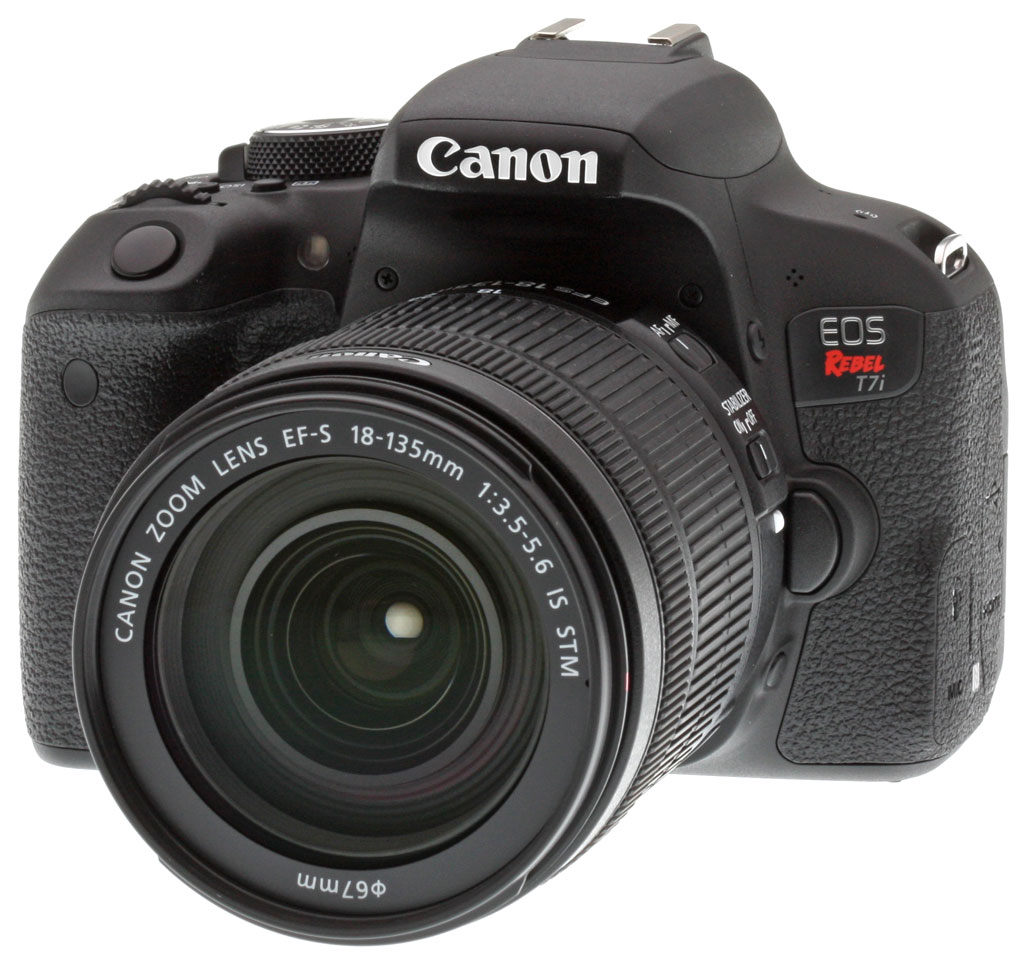

Overview

Almost three years ago, Canon launched its new Rebel T6i and T6s DSLRs, a duo which shared many features with each other. They also blurred the line between the top end of Canon's entry-level EOS Rebel lineup, and the bottom end of the enthusiast and pro-oriented EOS lineup. With the 24-megapixel Canon Rebel T7i, that division between entry-level and enthusiast DSLRs blurs even further.
The Rebel T7i slots into Canon's lineup directly above the earlier T6s (which remains on sale) and T6i (which, now that the T7i is here to follow in its footsteps, is no longer current). The next rung up the ladder from the T7i, meanwhile, is the simultaneously-launched EOS 77D. Take a look at the specs of the T7i and compare them to that camera, and you'll find it's much quicker to list the features which differ between the two, rather than those that they share. These two cameras are very closely related indeed, even if only one bears Rebel branding.
And since it shares so liberally with the higher-priced EOS 77D, the T7i marks a number of firsts for the Rebel line. It's the company's first Rebel model to feature a 45-point all cross-type autofocus system, as well as its first with Dual Pixel CMOS autofocus. It's also the first Rebel model to feature Canon's DIGIC 7 image processor.

Some important differences between the T7i and its EOS sibling
Of course, the T7i has a Rebel-class pricetag as well, where the EOS 77D is a little bit pricier (at least when first announced). That being the case, Canon has not surprisingly reserved some features for the more expensive model. If you opt for the Rebel T7i, for example, you'll find that it lacks the top-deck status LCD found on the EOS 77D, with its Mode dial instead assuming this location on the top deck.
The T7i also lacks the AF-ON button of its EOS sibling, as well as that camera's Quick Control dial and locking switch. And in the absence of a top-deck status display, it uses what would be the LCD illumination button as a display control for the rear-panel LCD instead. The rear-panel button layout is also a little different from that of the EOS 77D, since the Rebel T7i has a bit more room to spare as it lacks its sibling's Quick Control dial and switch.

The T7i actually has one more custom function than does the EOS 77D because of its fewer buttons, but it offers fewer options to re-assign the function of controls, and so isn't quite as customizable as its higher-end sibling. It's also just a touch lighter, though, which may prove handy if you want to keep your load to a minimum, especially when traveling. (The difference in weight isn't huge, but if you've got a lot of gear to bring along on a trip, every little bit helps.)
In other respects, the T7i offers most of its sibling's features
Beyond those main points (see below for a summary table), the T7i gives you most of what's offered by the EOS 77D. Both cameras share the same 24.2-megapixel, APS-C sized image sensor, for example, and use the same DIGIC 7 image processor.

This provides an identical sensitivity range of ISO 100 to 25,600 (expandable to 51,200) for the pair, and also yields the same burst capture performance for both. Like the EOS 77D, the Canon Rebel T7i can shoot at six frames per second in single-servo AF, while enabling continuous-servo AF provides for a choice of either 3.5 or 4.5 fps burst capture.
Both cameras also rely on the same pentamirror viewfinder design as each other, and feature the same 45-point, all cross-type autofocus system complete with viewfinder indications. The pair also both feature Canon's Dual Pixel CMOS AF system, allowing a manufacturer-claimed minimum time to focus lock of just 0.03 seconds.
On their rear panels, both the Canon Rebel T7i and EOS 77D share the same 3.0-inch, vari-angle, touch-screen LCD monitor. And both models also share the same selection of in-camera Wi-Fi, Bluetooth and Near-Field Communications radios for quick and simple image sharing.

They also share a friendly new guide system which offers both text and visual confirmation of what the effect on your photos of different camera modes and features will be. One slight difference here, though, is that the guide system is enabled by default on the T7i, but disabled by default on the 77D. Incidentally, you can separately enable or disable the system in two parts: One for the Mode guide, and another for the Feature guide.
As well as stills, the T7i can also shoot movies at up to Full HD (1,920 x 1,080-pixel) resolution with a maximum frame rate of 60 fps. In addition, the T7i can record HDR and time-lapse movies at Full HD resolution with a fixed 30 fps frame rate.
Both siblings use the same LP-E17 lithium-ion battery pack, the same model used earlier in the T6i and T6s. Battery life is now rated at 600 shots on a charge when using the optical viewfinder or 270 shots in Live View mode, a significant improvement over the 440 and 180 ratings respectively for the T6i/T6s.

Canon T7i vs. Canon 77D
Here's a table summarizing the differences between the two siblings:
| Feature | Canon T7i | Canon 77D |
| Top Status LCD | No | Yes |
| Locking Mode Dial | No | Yes |
| Dedicated AF-ON Button | No | Yes |
| Second Control Dial (Quick Control Dial) | No | Yes |
| Multi Function Lock Switch | No | Yes |
| Display-off Sensor (Eye Sensor) | No | Yes |
| Built-in Stills Intervalometer | No | Yes |
| Bulb Mode Timer | No | Yes |
| Customizable Buttons | 2 | 4 |
| Weight (body-only) | 485g / 17.1 oz | 493g / 17.4 oz |
| Body-only Price (as of May 9, 2018) | US$699 | US$649 |
| Everything else is the same... | ||

Canon T7i Price and Availability
When the Canon T7i first started shipping in April 2017, it had a street price of around US$749 body-only, approximately US$150 less than the EOS 77D at the time. Two kit versions were also introduced: One with the new, smaller Canon EF-S 18-55mm f/4-5.6 IS STM lens for US$899, and the other with the EF-S 18-135mm f/3.5-5.6 IS STM lens for US$1,299.
Prices have since been reduced, though, with the body available for US$699 and the two kits available for only US$749 and US$999 respectively as of this writing. Interestingly, the 77D's price has dropped more significantly to US$649 for body-only, however the 77D's 18-55mm kit is $50 higher at US$799. The 77D is offered with the more expensive EF-S 18-135mm f/3.5-5.6 IS USM lens, but it too is currently offered for only $50 more than the T7i and EF-S 18-135mm f/3.5-5.6 IS STM bundle.
Note: Since the Rebel T7i uses the exact same sensor and processor as the Canon 77D, we decided not to fully test it. Please see our 77D test results and additional review pages: Image Quality Comparison, Print Quality, Optics, Exposure, Flash and Video. And if you're considering the T7i, be sure to read our entire Canon 77D review first, especially since the price difference is negligible at time of writing.
In the Box
The Canon T7i with 18-135mm lens retail kit as tested contains the following items:
- Canon EOS Rebel T7i body
- Eyecup Ef
- Body cap RF-3
- Canon EF-S 18-135mm f/3.5-5.6 IS STM lens
- Front and rear lens caps
- Battery pack LP-E17
- Battery charger LC-E17
- Neck strap EW-400D
- Limited 1-Year Warranty
Performance
Timing and Performance
Very good performance for a consumer DSLR.
| Startup/Play to Record | ||
|---|---|---|
|
Power on |
~0.5 second
|
Time it takes to turn on and capture a shot. |
|
Play to Record, |
~0.2 second
|
Time until first shot is captured. |
Powering on and taking a shot was quite good for a DSLR at about 0.5 second and a noticeable improvement over the T6i's 0.9 second. Switching from Play to Record mode and taking a shot was very fast, at about 0.2 second.
| Shutter Response (Lag Time) | ||
|---|---|---|
|
Full Autofocus |
0.092 second
|
Time from fully pressing shutter button to image capture. (All AF timing tested with the Canon 18-55mm f/3.5-5.6 IS STM kit lens at ~50mm.) |
|
Full Autofocus |
0.259 second
|
Time to capture while forcing flash to fire. Preflash metering pulses from flash often slow shutter response. |
|
Manual Focus |
0.079 second
|
For most cameras, shutter lag is less in manual focus than autofocus, but usually not as fast as when the camera is "prefocused". |
|
Prefocused |
0.068 second
|
Time to capture, after half-pressing and holding shutter button. |
|
Prefocused |
0.069 second
|
Time to capture, after half-pressing and holding shutter button. |
In terms of the Canon T7i's ability to determine that it's properly focused when shooting the same target multiple times using the optical viewfinder and the 18-55mm IS STM kit lens, its full autofocus shutter response was very fast for a consumer DSLR. We measured only 0.092 second for full AF lag using single point (center) AF, which is close to pro DSLR speeds. Enabling the flash added considerable delay for the pre-flash metering, though, resulting in a capture lag of about 0.26 second, though that's still pretty fast.
Shutter lag with manual focus was good at 0.079 second. "Prefocusing" the camera by half-pressing and holding down the shutter button before the final exposure resulted in a lag time of only 0.068 second, also good for a consumer DSLR.
The Canon T7i's prefocused shutter lag time in Live View mode was almost as fast as using the optical viewfinder, measured at 0.069 second, which is excellent. Note that we no longer test full AF lag in Live View mode for DSLRs, because the lens used makes such a huge difference that comparing is pointless. We'll try to comment on real-world Live View AF performance in our field tests.
To minimize the effect of different lens' focusing speed, we test AF-active shutter lag with the lens already set to the correct focal distance.
| Cycle Time (shot to shot) | ||
|---|---|---|
|
Single Shot mode |
< 0.3 second
|
Time per shot, averaged over a few frames. |
|
Single Shot mode |
< 0.3 second
|
Time per shot, averaged over a few frames. |
|
Early shutter |
No
|
Some cameras don't snap another shot if you release and press the shutter too quickly in Single Shot mode, making "No" the preferred answer. |
|
Continuous High |
0.17 second
(5.99 fps); 148 frames; 2 seconds to clear* |
Time per shot, averaged over 148 shot buffer capacity, then slowed to an average of 0.19s or 5.15 fps when buffer was full. |
| Continuous High |
0.17 second
(5.99 fps); 24 frames total; 7 seconds to clear* |
Time per shot, averaged over 24 shot buffer capacity, then slowed to an average of 0.42s or 2.37 fps when buffer was full. |
|
Continuous High |
0.17 second
(5.99 fps); 21 frames total; 10 seconds to clear* |
Time per shot, averaged over 21 shot buffer capacity, then slowed to an average of 0.60s or 1.66 fps when buffer was full. |
| Flash recycling |
3.0 seconds
|
Flash at maximum output. |
|
*Note: Buffer clearing times measured with a SanDisk Extreme Pro 95MB/s UHS-I SDHC card. Slower cards will produce correspondingly slower clearing times. Slow cards may also limit length of bursts in continuous mode. ISO sensitivity and noise reduction settings can also affect cycle times and burst mode performance.
|
||
Single-shot cycle times were so fast that they were difficult to accurately measure as they depend on the tester's nimbleness and ability to maintain an optimum rhythm. (Note that we no longer test single-shot mode with just RAW files, as the results are usually somewhere in between JPEG and RAW+JPEG modes.)
Full-resolution continuous high mode speeds were quite good the class and resolution, at about 6.0 frames-per-second, no matter the file type. That's above average for a consumer-level 24-megapixel APS-C DSLR. The Canon T7i also has a low-speed continuous mode rated at 3.0 fps, however we did not test that mode.
Buffer depth for best quality JPEGs was excellent 148 frames before slowing down to a still-good 5.2 frames per second. When shooting RAW files, buffer depths pretty good for its class at 24 frames for RAW and 21 frames for RAW+JPEG. This is a massive improvement over the T6i's 6 frames.
Buffer clearing times were quite good considering the resolution, ranging from 2 seconds after a long burst of best quality JPEGs, to 10 seconds after a max length burst of RAW+JPEG frames.
The Canon T7i's flash took an average of 3.0 seconds to recharge after a full-power discharge, which is good.
Bottom line, the Canon T7i offers very good performance for its class, with a noticeable improvement in power-up to first shot, burst speed and RAW mode buffer depth over its predecessor.
Battery
Battery Life
About average battery life for a consumer DSLR.
| Operating Mode | Number of Shots |
|---|---|
|
Still Capture,
Optical Viewfinder, CIPA standard |
600
|
|
Still Capture,
Live View LCD, CIPA standard |
270
|
The Canon T7i uses a custom LP-E17 rechargeable lithium-ion battery for power, and ships with a dedicated battery charger. Battery life is about average for a consumer DSLR using the optical viewfinder, rated at 600 shots with 50% using flash, and of course live view mode draws more power reducing battery life considerably. While this is much improved over the T6i's 440 and 180 shot ratings with the same battery, we still recommend you pick up a spare battery and keep it freshly charged and on-hand for longer outings or if you plan on using Live View mode or shoot movies a lot.
The table above shows the number of shots the Canon T7i is capable of (on a fully-charged rechargeable battery), based on CIPA battery-life and/or manufacturer standard test conditions.
(Interested readers can find an English translation of the CIPA DC-002 standards document here. (180K PDF document))
Field Test
Big improvements in autofocus and performance compared to T6i

The Canon Rebel T7i was announced alongside the EOS 77D and shares many features with its larger, more expensive sibling. It offers the same 24.2-megapixel APS-C sensor as its predecessor, however, the T7i is the first DSLR in Canon's Rebel lineup to include the DIGIC 7 image processor, which allows the new camera to offer a wider ISO range than the T6i. This new Rebel camera is straddling the line between being an entry-level or enthusiast DSLR more than ever. How does the new T7i handle in the real world?
Key Features and Info
- 24.2-megapixel APS-C CMOS sensor
- DIGIC 7 image processor
- Tilt/swivel 3-inch touchscreen LCD
- Native ISO range of 100-25600
- Dual Pixel CMOS AF
- Full HD video at 30 frames per second
- Built-in Wi-Fi, NFC and Bluetooth
- US$750 for body only

Camera Body and Ergonomics: Good handling for an entry-level DSLR
An aspect of the T7i that makes it feel more entry-level than enthusiast is its handling: no twin dial controls. That is not to say that the T7i doesn't feel good to use because it does. Its front grip is chunky and comfortable and the buttons and dials all feel nice and responsive. The Canon Rebel T7i has a normal DSLR design, although it isn't a big DSLR. It weighs 17.1 ounces (485 grams) body only and has dimensions of 5.2 x 3.9 x 3.0 inches (131 x 100 x 76 millimeters).

The T7i has an interesting command dial set-up, with the sole command dial being located on the top deck of the camera. The dial has a toothed, grippy texture and rotates well, offering distinct feedback and allowing precise settings changes. When you want to shoot in manual mode and control both shutter speed and aperture, the dial controls shutter speed unless you press the Av/exposure compensation button on the back of the camera while rotating the dial, which then adjusts aperture.
Other buttons on the top deck of the camera include autofocus area mode, ISO and display buttons. The ISO button has a raised bump on it, so you can tell which button it is (and thereby the buttons on either side of it as well) without having to look; I like this a lot. Having the ISO button there is great, in general, because it places all exposure controls within reach of your right hand.

On the rear of the camera, there is an excellent articulating touchscreen display. The 1,040,000-dot touchscreen LCD is very versatile and works well even in bright light thanks to its tilt/swivel design. The viewfinder offers 95 percent coverage and 0.51x magnification (35mm eq.). It's a bit disappointing that the viewfinder doesn't offer full frame coverage, but that is not unusual for an entry-level DSLR.
Overall, the T7i feels nice to use and has a good design. Its button layout is generally user-friendly and the touchscreen is particularly excellent.
Canon T7i Shooting Features and Experience
With its 24.2-megapixel APS-C CMOS sensor (1.6x focal length multiplier), the Canon Rebel T7i can capture good images right in the camera. Its sensor produces images with good detail, although there is some noise reduction being applied even at low ISOs that can reduce very fine details.

Dynamic range has not always been a strong suit for Canon cameras, but the T7i performs well in this regard. The RAW files have good flexibility when recovering highlight and shadow detail. I was also impressed by its color reproduction at default settings. One aspect of the image quality that I don't like is how much contrast is applied to JPEG images in-camera at default settings -- it is excessive and removes some shadow detail. This can be adjusted, of course, so it is not a big deal. It's also a matter of personal taste.
The T7i records images from ISO 100 to 25600 natively, but it can expand to ISO 51200. Unsurprisingly, given its sensor size, ISO 51200 is basically useless, I feel. However, the camera still performs well at other high ISO settings. While I was going to mention it later, now is as good a time as any to point out that the T7i's auto white balance tends toward bluer tones, as you can see in the ISO charts below. It's not a big issue, especially if you shoot RAW, but it is worth pointing out.
Canon T7i ISO Comparison 100% center crops from RAW images processed in Adobe Camera Raw with default settings and lens corrections applied. (Click to access the .CR2 RAW files.) |
|
 |
|
ISO 100 Full Scene |
|
 |
 |
ISO 100 |
ISO 200 |
 |
 |
ISO 400 |
ISO 800 |
 |
 |
ISO 1600 |
ISO 3200 |
 |
 |
ISO 6400 |
ISO 12800 |
 |
 |
ISO 25600 |
ISO 51200 |
RAW images look good at ISO 100, as expected. Minimal processing can bring out quite a bit of fine detail here. In fact, through ISO 800, the T7i produces nice, easy to work with RAW files. The visible noise becomes much more apparent at ISO 1600, but it is manageable. ISO 3200 sees the sensor introduce quite a bit more noise, and ISO 6400 will require careful noise reduction processing and selective sharpening to bring out the best the file can offer. Beyond ISO 6400, the noise is excessive, shadow detail is lost, and the camera fails to capture much detail. Like most cameras, the extended ISO 51200 setting is not useful.
Canon T7i ISO Comparison 100% center crops from JPEG Fine images with default settings. (Click for full-size images.) |
|
 |
|
ISO 100 Full Scene |
|
 |
 |
ISO 100 |
ISO 200 |
 |
 |
ISO 400 |
ISO 800 |
 |
 |
ISO 1600 |
ISO 3200 |
 |
 |
ISO 6400 |
ISO 12800 |
 |
 |
ISO 25600 |
ISO 51200 |
When considering JPEG images straight from the camera, images at ISO 100 and 200 are similarly sharp and detailed. At ISO 400, when viewing the images at full size, you can see a very slight drop in detail, but this wouldn't impact image quality unless making large prints. At ISO 800, detail drops a bit again, but images still look good. ISO 1600 is where noise starts becoming noticeable, but images still look quite good and have sufficient detail for many uses. ISO 3200 is considerably softer, but still usable for smaller prints. Noise is very visible in JPEGs shot at ISO 6400 and fine details are lost due to noise reduction. Beyond ISO 6400, images get very soft as the camera must perform a lot of noise reduction. ISO 25600 and 51200 are particularly bad with no visible fine detail and considerable blotchiness; they're not worth using, in my opinion.
Overall, despite some aggressive contrast using the default automatic Picture Control setting, the T7i produces nice images straight from the camera. Images are detailed and sharp through ISO 800 and quite good through ISO 3200, allowing for considerable flexibility while shooting in different situations.

The Canon Rebel T7i is the first Rebel camera to include a 45-point, all-cross-type autofocus system. Of the 45 AF points, 27 of them support f/8 (9 cross-type), the rest support f/5.6 aperture lenses. This means that 27 points would work well even when using teleconverters on slower lenses, which is great for wildlife and sports shooters looking for extra reach.
Overall, I found that when shooting through the optical viewfinder, phase-detect autofocus was quick and accurate. I had no complaints with how the autofocus system worked, although on the usability side of things, changing the autofocus point location is slightly tedious on the T7i. To change the AF point, you must press the dedicated AF select button to the right of the thumb grip and then use the directional buttons to move the point around. If you want to change the autofocus area mode itself, there's a dedicated button on the top deck of the camera you can press to cycle through modes. It's not a bad setup, but it isn't quite as fast or as direct as some other DSLRs I've used.

When using Live View, autofocus changes and the camera utilizes Canon's excellent Dual Pixel CMOS AF system. The T7i is the first Rebel camera to offer this focusing system. By default, it is set to Face + Tracking and you can also use Smooth Zone AF or Live 1-Point AF, and you change these settings through the Q menu on the touchscreen rather than using the dedicated focus buttons. Using the touchscreen for moving focus points is great -- really quick and convenient. Live View autofocus performance is impressive for a DSLR, proving to be fast and accurate, much faster than non-Dual Pixel CMOS AF cameras have been in my experience.
Speaking of the touchscreen, it should be noted that if you press the autofocus buttons while shooting through the viewfinder, the display will come on and you can use the touchscreen to move focus points around.
Overall, the Rebel T7i, thanks to its new autofocus features, is a quick-focusing DSLR and certainly faster and more sophisticated than either the T6i or T6s cameras I tested last year.
Relying on a 7,560-pixel RGB+IR metering sensor divided into 63 segments, the T7i meters exposure quite well most of the time. I found that it tended to underexpose, but that isn't unusual. Exposure compensation is available up to +/- 5 EV, and there's a dedicated button you can hold while rotating the top command dial to quickly adjust compensation. Metering modes include evaluative (linked to all autofocus points), center-weighted, partial and spot. However, the spot metering is not linked to the active autofocus point.
The T7i has a shutter speed range of 30 seconds to 1/4000s. It has an Auto ISO mode as well, which works pretty well but isn't customizable beyond selecting a maximum allowable ISO.

Canon T7i's DIGIC 7 brings nice performance gains over the T6i
Continuing their DIGIC 7 rollout, the Canon Rebel T7i is now the first Rebel-series model with this latest-generation chip. The faster processor results in very good overall performance for a consumer DSLR with notable improvements over its predecessor, the T6i.
Looking first at continuous shooting speeds, the T7i can record RAW and JPEG images at about six frames per second. Compared to the T6i, this is over a frame per second faster. While that gain is good, the increase in buffer depth is more impressive. The T6i topped out at just six RAW frames. The T7i quadruples that with a 24-frame buffer depth. The buffer is only three seconds slower to clear despite capturing four times the number of RAW images.
The T7i is also faster to start up to first shot, about a half second improvement over its predecessor -- great for a consumer DSLR. Focus speeds are very good for an entry-level DSLR as well, nearing professional DSLR speeds.

In addition to the standard program auto, aperture priority, shutter speed priority and full manual shooting modes, the T7i offers a good Scene Intelligent Auto mode and a variety of creative shooting options. There's also a Creative Auto mode which allows you to create ambience-based shots by selecting one of the following settings: Standard, Vivid, Soft, Warm, Intense, Cool, Brighter, Darker and Monochrome. On the mode dial, there are also specific portrait, landscape, close-up and sports modes. There is a scene mode, which includes: Group photo, Kids, Food, Candlelight, Night Portrait, Handheld Night Scene and HDR backlight control. Further, there's a Creative Filter mode. The filters available are: Grainy B/W, Soft focus, Fish-eye effect, Water painting effect, Toy camera effect, Miniature effect, HDR art standard, HDR art vivid, HDR art bold and HDR art embossed.
In all its modes, the T7i does a lot of handholding by default, which could be redundant for experienced shooters, but very useful for beginners. For example, when shooting in aperture priority (Av) mode, the camera shows a diagram for your aperture. On the left, there's an illustration showing a blurred background and on the right, where the aperture is smaller, it shows the background being sharper. When shooting shutter speed priority mode, the illustrations show blurred versus frozen motion as you move your shutter speed from a slower speed to faster. This information is overkill for someone who has shot in these modes a lot, but are nice and illustrative for new photographers or those trying manual modes for the first time. The camera also warns you when manual settings won't deliver what it considers to be the intended results. If there isn't enough light for your current settings, the camera will warn you that the image will be underexposed.


Using the Canon Camera Connect app on a compatible smart device, you can connect to the Canon Rebel T7i via Wi-Fi, NFC and Bluetooth. The connection process is straightforward. Once connected, you can transfer images and remotely control the camera.

The remote control functionality itself is impressive. Not only can you adjust a lot of settings on the smart device, the app recognizes changes made on the camera body itself without requiring you to reestablish the connection. The live view image sometimes freezes for a short time before starting back up, but this is a minor annoyance in the grand scheme of things.
The Rebel T7i can capture nice video, but its resolution does top out at 1920 x 1080. It can record at up to 60 frames per second in normal video recording modes, which is good, although additional fast or slow-motion video recording would be welcome.
I like that the camera has a dedicated movie record button and that the touchscreen display can be used quietly and quickly to move the focus point. The Dual Pixel CMOS AF pays dividends as well -- the autofocus performance is impressive.
Canon T7i Video Sample: Autofocus Testing (Servo AF, touchscreen used) 1920 x 1080, 60 fps, Manual, ISO 100, 18-135mm lens Download Original (292MB .MP4 File) |
The T7i can record video in a variety of modes, including full manual mode, which is nice. But the camera also includes a few special video recording modes. There is an in-camera time-lapse movie mode, which produces a 30fps output, and there's an HDR movie mode. The HDR movie mode doesn't offer the stark difference that an HDR photo does compared to a single image, but it could be useful in high-contrast scenes. The way that the HDR movie mode works is that the camera records at 60 frames per second, but combines every two frames into a single frame, leading to a final output of 30fps.
The Rebel T7i includes a microphone jack, which is nice for users looking to capture better audio than the built-in stereo mic can record. There is also composite video out and an HDMI connection.
Overall, video quality from the T7i is good thanks to generally reliable automatic exposure, autofocus performance and a useful array of video recording modes.

What I like:
- Comfortable, user-friendly camera body
- Awesome articulating touchscreen
- Good autofocus performance
- Dual Pixel CMOS AF for live view and video
- DIGIC 7 processor contributes to very good overall performance
What I dislike:
- Image quality is fine, but not great
- Optical viewfinder doesn't offer full frame coverage
The Canon Rebel T7i brings several improvements over its predecessor, including better autofocus and higher overall performance. The camera can capture nice images, and it is very user-friendly, making the Rebel T7i is an appealing option for photographers looking for a good entry-level DSLR.

Technical Info
by Mike Tomkins
Posted: 02/14/2017
The Canon Rebel T7i is based around a 24.2-megapixel APS-C CMOS image sensor, the same resolution as used in the previous-generation camera. The image sensor is overlaid with a low-pass filter that subtly blurs the finest details to help fight moir and false-color effects, a sensible choice in a camera aimed at consumers. Total resolution of the 22.3 x 14.9mm sensor is 25.8 megapixels, and it has a 3:2 aspect ratio. The pixel pitch is approximately 3.72µm, and an RGB Bayer color filter is used.
Output from the Canon T7i's image sensor is handled by the company's current-generation DIGIC 7 image processor.
Together, this pairing of sensor and processor are able to provide a wide sensitivity range encompassing everything from a minimum of ISO 100-equivalent to a maximum of ISO 25,600-equivalent by default, with the ability to expand this range to a maximum of ISO 51,200-equivalent if image quality isn't your primary concern.
An auto sensitivity function is provided, and able to span the entire standard sensitivity range when shooting without flash in Program, Priority or Manual exposure modes. In most other modes, auto sensitivity is capped at a maximum of ISO 6400-equivalent.
At its fastest, the Canon T7i can capture some six frames per second with single-servo autofocus, meaning that focus is not being adjusted after the first frame has been captured. Enabling continuous autofocus reduces this rate to a maximum of 4.5 fps, while a low-speed continuous mode can shoot at 3.0 fps.
The buffer depth for JPEG images is essentially limited only by available card space and power, presuming you're shooting with a UHS-I compliant flash card. If you're a raw shooter, Canon predicts a UHS-I burst depth of 27 raw frames, while raw+JPEG shooters should be able to manage around 23 frames in a burst.
As in the company's other recent APS-C DSLR offerings, the Canon T7i features a Canon EF / EF-S compatible lens mount that can use either full-frame or sub-frame optics. Note, though, that (again as in other Canon DSLR models) the Rebel T7i cannot use EF-M lenses designed for Canon's mirrorless cameras.
For the second generation running, the Canon T7i has received a big upgrade in the autofocus department. (And that's true whether we're talking about shooting through the viewfinder, or in live view mode.)
Let's start with viewfinder-based shooting. Here, the Canon T7i relies on a dedicated phase detection autofocus sensor to provide a total of 45 autofocus points across much of the image frame, with all of them being cross-types that are sensitive to detail on both the horizontal and vertical axes. Of these, 27 points work to f/8 (although only nine of them on both axes), and the central point is a dual cross-type supporting either f/2.8 or f/5.6.
The dedicated PDAF sensor has a working range of -0.5 to 18 EV, while the centermost point can manage -1 to 18 EV at f/5.6, or -3 to 18 EV at f/2.8. Focus points can be selected automatically, manually, or grouped as either three or nine AF zones. Autofocus assist illumination is provided with intermittent firing of the T7i's built-in, popup flash strobe.
Returning to the live view mode, meanwhile, the Canon T7i uses Canon's Dual Pixel CMOS AF technology to focus using phase-detection autofocus pixels on the image sensor, a system which works with all EF and EF-S lenses to date. Contrast-detection autofocus isn't provided, but you can of course focus manually, with an optional 5x or 10x focus magnification function to help you get your chosen subject tack-sharp.
Like the T6i before it, the Canon T7i uses a 7,560 pixel RGB+IR metering sensor that's sensitive to red, green, blue and infrared light. This helps both with exposure metering of difficult subjects, and with determining the location of skin tones (and thereby, the locations of people, allowing the exposure to be tweaked for the most attractive results.)
Like most consumer DSLRs, the Canon T7i features a pentamirror optical viewfinder, as opposed to a brighter, heavier and more expensive pentaprism. Coverage is approximately 95%, which is again typical for consumer DSLRs, and magnification is about 0.82x, unchanged from the T6i.
Eyepoint is approximately 19mm (at -1m-1 from the eyepiece lens center) and there's a dioptric adjustment with a range of -3.0 to +1.0m-1. An LCD overlay in the viewfinder allows a generous range of information to be provided to you without the need to switch to the main LCD monitor, including AF points and AF area frames, spot metering circle, electronic level, grid, aspect ratio lines and flicker detection.
Unlike the viewfinder in the simultaneously-launched EOS 77D, that used in the Rebel T7i lacks a proximity sensor adjacent to the viewfinder eyepiece. That difference means you'll need to manually toggle the display mode using a dedicated button on the top deck to disable the LCD, if you want to prevent glare and improve battery life when shooting through the finder.
On the rear of the Canon T7i is a side-mounted, tilt/swivel LCD monitor similar to that of the earlier Rebel T6i. As in that camera, it's based around a 3.0-inch LCD panel with a total dot count of around 1.04 million dots, and is overlaid with a touchscreen that allows it to be used as an input device. Coverage is a manufacturer-claimed 95%, and the monitor features Canon's Clear View II coatings, which aim to prevent smudges but not reflections. A seven-step brightness control is provided to help improve indoor / outdoor visibility.
And thanks to the articulation mechanism, which allows viewing from a wide range of angles, it's both selfie-friendly (assuming you're using an appropriate lens, of course), and can be closed inwards for a modicum of protection against smudges or minor bumps and scrapes.
The Canon T7i lacks the secondary, monochrome LCD panel of the EOS 77D, which sits on the top deck and provides a quick at-a-glance indication of basic camera settings.
To help throw a little more light on nearby subjects, the Canon T7i includes a built-in, popup flash that sits in the traditional position above the viewfinder pentamirror housing. The built-in flash has a guide number of 12 meters at ISO 100, and it can also be used as a master in an optical wireless flash setup.
Of course, there's also a flash hot shoe on the top deck for use with external strobes. E-TTL II flash metering is used, and +/-2 EV of flash exposure compensation is available in 1/3 or 1/2 EV steps.
The Canon Rebel T7i offers all of the usual creative options, just as you'd expect from a DSLR camera.
You can, of course, opt for Program (with Program Shift), Aperture-priority, Shutter-priority or fully Manual exposure modes. There's also a choice of Scene Intelligent Auto or Creative Auto modes, a Flash Off mode, plus a choice of four Scene modes with their own positions on the Mode dial: Portrait, Landscape, Close-up and Sports. In addition, there's a Scene position which provides access to a further seven scene modes, plus a Creative Filters position which offers up a total of ten filter types.
Canon's Picture Style function, meanwhile, provides for seven preset picture styles, plus both an auto style selection function and three user-defined styles. A total of eight white balance modes are provided, including auto (with ambience or white-priority controls), custom and six presets. Color temperature can also be tweaked within +/- nine steps on the blue/amber and magenta/green axes.
Movie
The Rebel T7i provides the ability to record high-definition movies at up to Full HD (1,920 x 1,080 pixels) resolution with a rate of up to 60 frames per second, double the 30p maximum of the T6i. 30p and 24p rates are also available at Full HD, but not the 25p rate which was available in the earlier camera. At HD resolution (1,280 x 720 pixels), a choice of 30p or 60p rates is offered, while VGA (640 x 480) mode is now fixed at 30 fps.
Recording time per clip is limited to 29 minutes and 59 seconds. The maximum movie file size is 4GB unless you're using an exFAT file system, but the T7i will automatically create subsequent files without interruption up to the aforementioned time limit.
Like the Canon T6s before it, the Canon T7i can also shoot high dynamic range movies, a feature that will likely pay dividends in difficult lighting situations. It can also shoot time-lapse movies, a new addition since the Rebel T6s and T6i.
Audio comes courtesy of a built-in stereo microphone, or via a 3.5mm microphone jack which can be found beneath an access panel on the left side of the camera's body. Movies are recorded using MPEG-4 AVC / H.264 compression with a variable bit-rate, an MP4 container and AAC stereo audio.
The Canon T6s brought in-camera Wi-Fi and NFC to the flagship Rebel camera, and now the Canon T7i adds Bluetooth into the mix. And not only can this all be used to get your photos onto your smartphone or tablet -- and from there, to social networks -- just as quickly as possible, but the Bluetooth radio in particular can be used with a new BR-E1 Bluetooth wireless remote control. This has a range of 16 feet, and does not require line-of-sight access to the camera body, potentially making it more useful in certain situations.
Wired connectivity in the Canon T7i includes a USB 2.0 High Speed data port and a Type-C HDMI high-definition video output. Unlike the earlier T6i, there's no longer any support for standard-definition displays.
A second flap covers a wired remote jack and a 3.5mm stereo microphone jack, but there's no headphone jack. Of course the Rebel T7i includes a dedicated hot shoe for external flash units and other shoe-mount accessories.
Images and movies are stored on Secure Digital cards, courtesy of a single SD card slot that is compatible with SDHC, SDXC and UHS-I cards. The Canon T7i also supports Eye-Fi cards, although given the in-camera Wi-Fi connectivity, there would seem to be little reason to use one.
Still images can be stored in raw or JPEG formats, or both simultaneously. Movies are stored in MP4 format, using an MPEG-4 AV/H.264 codec for video compression, and AAC stereo for audio.
Power comes courtesy of a proprietary LP-E17 lithium-ion battery pack, the same model used earlier in the T6i. Battery life is now rated at 600 shots on a charge when using the optical viewfinder or 270 shots in live view mode, both figures having been recorded at 73°F and with 50% flash usage. That's a healthy step upwards from the 440 and 180 shots on a charge, respectively, for the T6i and T6s in viewfinder and live view shooting.
Tech2
Canon's first DIGIC 7 Rebel-series DSLR makes its way to our testing lab
The latest Rebel-series camera, the Canon T7i (aka the EOS 800D for Europe or the Kiss X9i for Japan) is the first EOS DSLR model, along with simultaneously-announced EOS 77D, to feature the latest DIGIC 7 image processor. We now have our review unit in our hands and are ready to share our signature Cano T7i First Shots series of lab test images for your discerning eyes.
Although the T7i gets an upgrade in the processing horsepower department, it's nevertheless paired to a similar 24.2-megapixel APS-C image sensor as housed in the earlier T6i and T6s models from 2015. However, thanks to the updated processing, the ISO range has been expanded, going from a native ISO 100-25,600, with an expanded high ISO sensitivity of 51,200. By contrast, the Canon T6i/T6s top out at ISO 12,800 as their highest native ISO, and ISO 25,600 as the maximum expanded ISO.
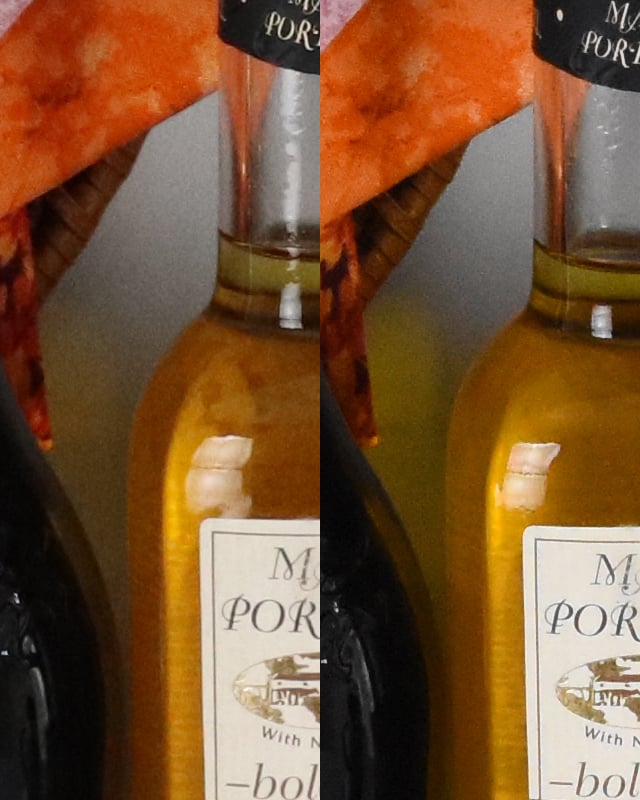
The question now is, with our First Shots series offering straight-from-camera JPEGs and RAW images across the full ISO range, how has the image quality performance changed or improved from the earlier DIGIC 6-based DSLRs, and how does it stack up against major competitors. We have a couple of quick comparisons ready for you down below, but to compare the Canon T7i First Shots against any other camera we've tested, please visit our handy Comparometer.
Canon T7i vs. Canon T6s


Canon T7i vs. Nikon D5600

Conclusion
Though not a huge technological jump from its predecessor nor its competitors, the Rebel T7i continues Canon's tradition of producing reliable, easy-to-use, consumer-friendly and affordable DSLRs for the masses. It's a solid camera that doesn't do anything special, but it doesn't have to. However, it is basically the same camera as the Canon 77D, save for some body, control and feature deletions. For consumers who do their research, this can lead to some confusion as to what makes the 77D or the T7i the right choice for them.
And unfortunately, that's not an easy question to answer.
Canon would argue that the T7i is for the more basic consumer, while the 77D is for a more "advanced" amateur photographer. It's an odd distinction for two reasons. One, there are only the slightest of differences between those two groups of photographers. Two, the differences between these two cameras have nothing to do with technical performance or image quality, but rather the exterior design of the two bodies and a few firmware features. Performance, actual photographic image capturing performance, is more critical, and both cameras perform extremely similarly in this regard. Yet, the additions the 77D brings to the experience, such as a top-facing status LCD, dedicated AF-ON button and a second control dial, don't really muddle or confuse the camera experience, which would be one reason to simplify the camera body on the T7i. No, instead, the additions actually make the camera easier to use.
Given that today the price difference between the T7i and the 77D is negligible (in fact, as of this writing the 77D body is selling for $50 less than the T7i), it doesn't even seem like Canon deems the additions to the 77D as much of an upgrade. It also puts the T7i in an awkward position: for roughly the same amount of money, why would you choose the inferior T7i?
That said, looking specifically at the T7i and evaluating it on its own, the camera does a lot right and is perfectly serviceable as the entry-level DSLR that Canon has positioned it.
Image Quality
The T7i's 24.2-megapixel APS-C CMOS sensor bucks some expected Canon-centric trends in a good way. Firstly, while dynamic range has generally not been a strong point for Canon sensors, the T7i actually does pretty well compared to the T6i. In our field testing, we found that RAW files have good flexibility when recovering both highlight and shadow detail, a huge plus. Additionally, the camera does well even in low-light conditions. Though the max ISO of 51,200 is pretty much useless (as is the case with many cameras), for most situations, the T7i will perform quite well. Even ISO 12,800, two tops from the highest, looks quite good.
That said, it's not perfect. First, despite the dynamic range and high ISO improvements over the T6i, these qualities still lag behind some competing models from other manufacturers somewhat. We also found that while the sensor produces images with good detail, you can see that even at low ISOs there is some detrimental noise reduction being applied to JPEGs. This phenomenon only increases with higher ISOs. Additionally, there is a lot of contrast applied to JPEGs with the in-camera default settings, and it can be so excessive that it crushes shadow details.
Performance
As far as features and performance, Canon's autofocus is a standout success with the T7i. The 45-point, all-cross-type autofocus system employed in the T7i is a first for a Rebel series camera, and the result is a camera that feels quick, snappy and accurate. Additionally, Canon put their lauded Dual Pixel CMOS AF system into the T7i as well, which means that in Live View mode, you get one of the best overall autofocus systems currently available. So whether you like to look through the optical viewfinder or use the rear LCD, the T7i does not let you down. In this respect, the T7i absolutely feels like an upgrade over the T6i.
Speaking of upgrades over predecessor, the T7i's DIGIC 7 processor and memory allows it to gain an extra frame per second over the T6i and quadruples its buffer depth to 24 RAW frames. Additionally, the buffer is only three seconds slower to clear despite capturing four times as many images as the T6i. It's faster to start up to first shot and focus speeds are very fast, rivaling that of higher-end DSLRs. In short, that processor, the first Rebel to feature that generation, makes a big, positive difference in how the camera feels and performs.
Add in several nice-to-have features like Wi-Fi, NFC and Bluetooth, and you have yourself a camera that works well on location for instant-sharing of images as well as one that does nicely when you're at a computer manipulating RAW files.
Though it doesn't feature 4K video, a common theme with most Canon cameras, it does a decent job with video all the same. It can capture as high as Full HD at up to 60 frames per second, while offering a few other options in both 1080p and 720p. And, as mentioned, the inclusion of Dual Pixel CMOS AF makes video AF wonderfully fast. The T7i is not a serious video camera by any means, but it does an alright job, especially for an entry-level DSLR.
Summary
As confusing as the T7i's market positioning is, if we pretend the 77D doesn't exist, it's a really nice camera for those just getting started in image-making. As mentioned though, it's problematic that the camera shares so much in common with an objectively better camera that is similarly priced. Everything that we like about the T7i is in the 77D, but also accompanied by a better housing, more tactile options and a few extra firmware features. So while the T7i would normally be worthy of praise for the number of improvements it made over the T6i, it's constantly weighed down by these caveats. Thus if you're considering the T7i, it behooves you to checkout the 77D, especially since it's currently selling for less than the T7i. That said, on its own, the Canon T7i is a reliable, no-fuss, entry-level DSLR and certainly joins the ranks among our Dave's Picks.
Pros
- Improved dynamic range over its predecessor
- Slightly improved high ISO performance
- Supports Fine Detail Picture Style for better JPEG sharpening than default settings
- "White Priority" Auto White Balance options helps avoid overly warm colors in incandescent lighting
- Quick power-up
- Swift cycle times
- Fast AF speeds
- Low shutter lag
- Good 6 fps burst speed for its class
- Decent RAW buffer depths, much improved over its predecessor
- 45 cross-type AF points
- Dual Pixel CMOS AF provides excellent live view/movie autofocus
- Full HD video up to 60p
- Tilt-swivel touchscreen LCD
- In-camera time-lapse movies
- In-camera HDR modes
- Pop-up flash can act as remote flash commander
- Built-in Wi-Fi, NFC and Bluetooth
- Comfortable ergonomics
- User-friendly design
Cons
- Dynamic range and high ISO performance still not as good as competitors
- Default JPEGs a bit soft
- Small and inaccurate pentamirror viewfinder
- Mediocre battery life for a DSLR (but still much improved over T6i)
- Auto ISO only offers max setting
- No 4K video
- No headphone jack
- No intervalometer for stills
- Body-only price is similar to 77D which offers more features