


Overview
UPDATES:
06/08/2015: Field Test
08/14/2015: Test results posted. See: Optics, Exposure, and Performance tabs.
08/17/2015: Review Conclusion added

Oh, a 30x travel zoom? That's cute. A 50x superzoom? Hmm, quaint. A DSLR with an 800mm lens? A 1200mm lens? How's your back? All of these zoom cameras and telephoto lenses pale in comparison to Nikon's latest creation, as they take the all-in-one superzoom category to the next level, following closely on the heels of the previously announced P610 60x zoom camera, with the introduction of the Nikon Coolpix P900.
Indeed, the Nikon P900 goes way beyond the standard 50-65x superzoom category with a new, massive 83x optical zoom lens. Yes, optical. This means a lens that reaches as far as 2000mm(!) in 35mm-equivalence. And if for some reason 2000mm just doesn't cut it, the P900 offers a total maximum equivalent of a whopping 8000mm when you factor in full 4x digital zoom (or 4000mm equivalence with Nikon's 2x Dynamic Fine Zoom)!
In all seriousness, though, having a powerful and versatile zoom capability on your camera -- especially telephoto reach -- is an attractive feature for many people. Long telephoto lenses and powerful zoom cameras allow you to capture a variety of subjects, such as wildlife and sports, that could otherwise be very difficult or even potentially dangerous if you had to get physically closer with a shorter lens. High-powered superzoom cameras -- those with optical zoom lenses around in the 40-60x magnification have maintained a steady popularity in the marketplace with those looking for an all-in-one camera solution with a extremely versatile lens, and the new P900 is the next evolution in this popular, versatile camera category.

With a lens this powerful, reaching to never-before-seen magnifications in a compact, fixed-lens digital camera, it's not surprising that the Nikon P900 is far from a svelte, pocketable camera. The lens is absolutely massive -- especially when zoomed in to 83x -- however, the camera still felt very comfortable to hold and relatively lightweight, which the specifications indicate to be just shy of two pounds (or around 899g) with battery and memory card included. (We weighed it at 916g in the lab.)
Not only does the lens provide an enormous amount of zoom range, it's also quite bright at wide angle. With a 24mm-equivalent focal length at the widest, its aperture is a bright f/2.8, which is a nice step up from the f/3.3 aperture offered at the P610's widest, 24mm-equivalent focal length. As you zoom, though, the maximum aperture of the P900's lens falls to rather dim f/6.5, which isn't unexpected for such a long zoom lens in a relatively compact design. The lens configuration makes use of aspherical and ED elements, including a single Super ED element, which help reduce chromatic aberrations and other optical abnormalities.

As lenses get longer and longer, having of some form of image stabilization becomes more and more crucial. Keeping shots blur-free or even just maintaining a view on your subject at full telephoto -- especially at 83x in this case -- can be difficult without stabilization. Thankfully, Nikon has introduced an impressive, all-new VR system for the P900. The new Dual Detect Optical VR system, which utilizes accelerometers in the lens as well as analyzing image motion on the sensor, provides a claimed five stops* of stabilization -- the highest level vibration reduction ever included in a Nikon Coolpix camera. (*Rated at an approximate 350mm-equivalent focal length according to CIPA standards.)
Behind the powerful lens, the P900 sports a 16-megapixel 1/2.3-inch type CMOS sensor. Standard ISO range starts at a base sensitivity of 100 and rises to a maximum of 1600 in scene or other automatic shooting modes. The P900 does include full PASM exposure modes for more advanced shooting, and within those modes, ISO range is increased to 3200 and 6400. There is also a special boosted Hi 1 setting for ISO 12,800, however this is reserved solely for a High ISO Monochromatic special effects mode.

Like its less expensive sibling, the P610, the new P900 is able to fire off a burst of seven still images at up to seven frames per second at full resolution. According to Nikon, shooting lag for single-shot performance is approximately 0.12 seconds at the wide-end and 0.75s at full telephoto, and we measured even faster in our lab test results. As with Nikon's other superzoom cameras, they keep things simple on the P900 with only JPEG image recording; no RAW support, unfortunately.
For video, the Nikon P900 offers a standard, modern set of features including Full HD recording (1920 x 1080) at 60 frames per seconds, as well as 30fps (or 50p and 25p in PAL mode). 720p resolution is also available at 60p/30p (50p/25p) as is a neat slow-motion video mode that captures at up 120 frames per second at VGA (640 x 480) resolution. Videos are recorded using the H.264 standard in an MPEG-4 container with stereo audio.
As with many of the Nikon's recent cameras, the new P900 includes both Wi-Fi and NFC connectivity for use with Nikon's Snapbridge smartphone companion app. The Nikon P900 allows for wireless transfer of images for quick and easy sharing or mobile post-processing, however the Snapbridge app can also be used as a wireless remote control for even more creative possibilities. (Nikon's optional ML-L3 infrared remote is also supported.) The Coolpix P900 also includes a built-in GPS receiver to geo-tag your photos during your travels.
See our Nikon P900 Walkaround page for a closer look at the design and physical features of the new Nikon P900.
The Nikon P900 began shipping from April 2015 for a suggested retail price of US$599.95 and comes in black.
In the Box
The Nikon P900 retail box includes:
- Nikon Coolpix P900 digital camera
- EN-EL23 lithium-ion rechargeable battery
- EH-71P charging AC adapter
- EC-E21 USB cable
- AN-CP21 camera strap
- LC-67 lens cap
- Warranty card
Recommended Accessories
- Extra EN-EL23 battery pack for extended outings
- Large capacity SDHC/SDXC memory card. These days, 16GB is a good tradeoff between cost and capacity. Speed Class 6 or higher is recommended for movies.
- Camera case
Comparison Shopping?
While the Nikon P900 is the undisputed king of superzooms in terms of zoom ratio at the time of writing, you're probably wondering what other manufacturers have to offer in the category. Below are some links you can use to compare the P900 to a few other superzooms including its smaller sibling, the Nikon P610. Clicking on any of them will take you to our Compare Cameras tool, where you can see features, specs, pros and cons listed for virtually any pair of cameras you'd like to compare.
Optics
Lens Test Results
Zoom
A massive 83x optical zoom, with decent performance for its class.


The Nikon P900 is equipped with a 4.3-357mm lens, offering a whopping optical zoom ratio of about 83x, translating to a 35mm-equivalent focal range of about 24-2000mm. The lens is fairly fast (bright) at wide angle with a maximum aperture of f/2.8, but at the telephoto end, maximum aperture falls to only f/6.5, which is rather dim. The following table reflects the maximum and minimum apertures as reported by the camera at popular focal lengths:
|
Focal length
(mm eq.) |
24
|
30 |
50
|
85
|
150 |
300
|
650 | 1400 |
2000
|
|
Max. aperture
|
f/2.8
|
f/3.2 |
f/3.5
|
f/4.0
|
f/4.5 |
f/5.0
|
f/5.6 | f/6.3 |
f/6.5
|
|
Min. aperture
| f/8 at all focal lengths | ||||||||
The above set of images was taken from the same location as an illustration of the enormous amount of optical zoom offered by the P900. Optical performance is pretty good considering the range and the P900's price, however the lens isn't terribly sharp at maximum telephoto. On top of the 83x optical zoom, there's up to 4x digital zoom for an incredible 8000mm equivalent focal length, though as you can see, that much digital zoom produces a very soft image. See below for lab results on macro performance, geometric distortion, sharpness, etc.
Macro
A smaller than average sized minimum coverage area, with very good detail. Flash is blocked by lens at closest distance.


The Nikon P900 captured a smaller than average sized minimum area measuring only 1.93 x 1.44 inches (49 x 37 millimeters). Sharpness over much of the frame is good, but corners show quite a bit of softness (most lenses show some softening in the corners at macro distances), and you can also see fairly strong pincushion distortion and chromatic aberration. The lens focuses so close in macro mode (~1cm from the front element) that it's difficult to get even illumination from ambient lighting, though note that our subject isn't flat. The lens casts a shadow when using the flash, blocking much of the light and resulting in a dim, unevenly lit image.
Geometric Distortion
Very low geometric distortion in camera JPEGs.
| Complex distortion at wide angle is less than 0.1 percent |
 |
| Complex distortion at telephoto is less than 0.1 percent |
 |
Thanks to in-camera distortion correction, there's almost no geometric distortion in the P900's JPEG files at normal distances. At full wide angle, we measured well under 0.1% pincushion distortion, though it was wavy (complex) in nature. At full telephoto, distortion was difficult to accurately measure with the target we use for superzooms, but it's also under 0.1% and complex pincushion distortion This is the tendency for the lens to bend straight lines outward (like a barrel -- usually at wide-angle) or inward (like a pincushion -- usually at telephoto).
The Nikon P900 does not support RAW capture, so we can't see how much distortion correction is taking place during JPEG processing, though we suspect there's a lot given the size and range of the lens.
Chromatic Aberration and Corner Sharpness
Low to very low chromatic aberration in JPEGs. The lens produces some soft corners wide-open, though corner sharpness improves stopped-down.
|
Aperture: Maximum
|
|
 |
 |
| Wide at f/2.8: Lower right C.A.: Low Softness: Very soft |
Wide at f/2.8: Center C.A.: Very low Softness: Sharp |
 |
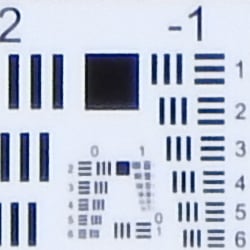 |
| Tele at f/6.5: Upper left C.A.: Low Softness: Moderately soft |
Tele at f/6.5: Center C.A.: Low Softness: Slightly soft |
Chromatic Aberration. Thanks to effective in-camera chromatic aberration suppression, there's fairly low C.A. seen in the corners at either wide angle or telephoto in JPEGs, and there's virtually none in the center at wide angle. At full telephoto, some chromatic aberration can be seen, but it's fairly low.
Corner Softness. Wide-open at full wide angle, the lens showed a little de-centering, with the lower right corner producing softer results than the rest, and softness extended fairly far into the frame. Corner sharpness is actually pretty good in the other three corners, and the center is sharp. At full telephoto, all four corners are moderately soft, but corner performance isn't bad for a lens with such a range. The center is slightly soft though, and not as sharp as at wide angle. (Note that the target above we use for superzooms at telephoto is at a different scale than our standard target used for wide-angle and shorter zooms, so resolution cannot be directly compared.)
Vignetting. There is some vignetting (corner shading), as indicated by the darker corner crops above than those from the center particularly at the wide-angle end, but it's fairly minor.
|
Aperture: f/4 (W), f/8 (T)
|
|
 |
 |
| Wide at f/4 Lower right C.A.: Low Softness: Improved, but still soft |
Wide at f/4: Center C.A.: Very low Softness: Sharp |
 |
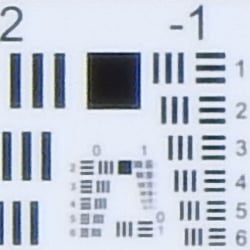 |
| Tele at f/8: Upper left C.A.: Low Softness: Moderately soft |
Tele at f/8: Center C.A.: Low Softness: Fairly sharp |
Stopped-down: As is often the case, stopping down a few clicks improved corner performance at wide angle, however the same lower-right corner was still softer than the others due to de-centering. Stopping down to f/8 at maximum telephoto improved sharpness in some corners a bit but made others slightly worse, and the center became slightly softer than wide-open due to diffraction. Oddly, overall contrast was lower at telephoto. Vignetting was reduced at both ends, though.
Overall, pretty good performance from the P900's lens considering the phenomenal range it offers.
Viewfinder Test Results
Coverage
Very good accuracy from the electronic viewfinder and LCD monitor.


The Nikon P900's EVF and LCD monitor both provide about 99% coverage at full wide angle. (Note that the P900's lens is too long to test viewfinder coverage at full telephoto in our lab.) This is very good performance, especially considering the amount of geometric distortion correction that must be taking place.
The images above were taken from our standardized test shots. For a collection of more pictorial photos, see our Nikon Coolpix P900 Photo Gallery .
Exposure
Color
Saturation & Hue Accuracy
Fairly typical saturation levels and hue accuracy.
 |
| In the diagram above, the squares show the original color, and the circles show the color that the camera captured. More saturated colors are located toward the periphery of the graph. Hue changes as you travel around the center. Thus, hue-accurate, highly saturated colors appear as lines radiating from the center. Click for a larger image. |
Saturation. The Nikon P900 pushes some colors likes strong reds and dark blues by quite a bit, but it actually undersaturates yellow and aqua tones moderately. The P900's mean color saturation at base ISO is 111.8% (11.8% oversaturated) which is typical, perhaps just a touch higher than average. We found the P900 generally produces attractive colors in its images. You can of course tweak saturation to your liking, or choose a different color mode, including two custom options. Most consumer digital cameras produce color that's more highly saturated (more intense) than found in the original subjects. This is simply because most people like their color a bit brighter than life.
Hue. The Nikon P900 shifts cyan toward blue by a moderate amount, but other shifts such as orange toward yellow, and yellow toward green are very minor. The cyan to blue shift is very common among the digital cameras we test; we think it's a deliberate choice by camera engineers to produce better-looking sky colors, and we don't find the resulting color objectionable. With a mean "delta-C" color error of 5.95 after correction for saturation, hue accuracy is about average these days. Hue is "what color" the color is.
Sensor
Exposure and White Balance
Indoors, incandescent lighting
Auto and Incandescent settings produced overly warm results, though Manual white balance was pretty accurate, just slightly cool. Average exposure compensation required.


Indoors, under normal incandescent lighting, color balance is warm and reddish with the Auto white balance setting. Results with the Incandescent setting are also too warm, with more of a yellow/green cast. The Manual setting is the most accurate, just slightly on the cool side. The Nikon P900 required +0.3 EV exposure compensation for this scene, which is about average for the cameras we've tested. (Our test lighting for this shot is a mixture of 60 and 100 watt household incandescent bulbs, a pretty yellow light source, but a very common one in typical home settings here in the U.S.)
Resolution
~2,300 lines of strong detail.


In camera JPEGs of our laboratory resolution chart revealed sharp, distinct line patterns down to about 2,300 lines per picture height in the horizontal direction, and to about 2,300 lines per picture height in the vertical direction, though some aliasing artifacts can be seen as low as 1,400 lines. Complete extinction of the pattern didn't occur until about 2,700 lines in both directions. Use these numbers to compare with other cameras of similar resolution, or use them to see just what higher resolution can mean in terms of potential detail.
Sharpness & Detail
Slightly soft images with only moderate sharpening artifacts. Strong default noise reduction reduces detail even at base ISO.


Sharpness. The P900 produces slightly soft images with only minor sharpening haloes as shown in the crop above left. Still, not a bad performance given the sensor size, resolution and massive lens. Edge enhancement creates the illusion of sharpness by enhancing colors and tones right at the edge of a rapid transition in color or tone.
Detail. The crop above right shows significant softening due to noise reduction, even at base ISO, smudging or merging many of the individual strands of hair together. This is typical of small sensors, though, and the P900 did a good job at removing color noise here. Noise-suppression systems in digital cameras tend to flatten-out detail in areas of subtle contrast. The effects can often be seen in shots of human hair, where the individual strands are lost and an almost "watercolor" look appears.
ISO & Noise Performance
Typical high ISO performance for a camera with a small 1/2.3" sensor.
|
Default High ISO Noise Reduction, Incandescent Lighting
|
 |
 |
 |
| ISO 100 | ISO 200 | ISO 400 |
 |
 |
 |
| ISO 800 | ISO 1600 | ISO 3200 |
 |
||
| ISO 6400 | ||
As mentioned previously, ISO 100 already shows significant smudging in areas of low contrast as in the above crop, though fine detail is still good and both luma and chroma noise are well-controlled. There's slightly stronger smudging at ISO 200, but fine detail is still pretty good. At ISO 400, there's a more significant drop in image quality as noise reduction works harder, though fine detail is still fairly good. ISO 800 is noticeably softer and starts to show some objectionable chroma blotching in the hair and darker areas while flatter areas start to take on a watercolor painting effect. Image quality drops off quickly at ISO 1600 and above, with strong blurring, higher luminance noise and visible noise reduction artifacts, though ISOs 1600 and 3200 actually exhibit lower chroma noise than ISO 800.
Overall, not a bad performance for such a small sensor, but you won't want to use the Nikon P900 at ISOs above 400 or 800, except for small prints or web images.
We're of course pixel-peeping to an extraordinary extent here, since 1:1 images on an LCD screen have little to do with how those same images will appear when printed. See the Print Quality section below for our evaluation of maximum print sizes at each ISO setting.
Noise Reduction
We normally compare a base ISO in-camera JPEG to a converted RAW file here, but since the P900 does not support RAW capture, we decided instead to compare the lowest noise reduction setting ("Low") to the default ("Normal") setting in our Still Life ISO series. Note that P900 also offers a "High" NR setting, however we did not test that setting.
|
High ISO Noise Reduction Comparison, Simulated Daylight
|
|
| Lowest NR ("Low") | Default NR ("Normal") |
 |
 |
| ISO 100 | |
 |
 |
| ISO 200 | |
 |
 |
| ISO 400 | |
 |
 |
| ISO 800 | |
 |
 |
| ISO 1600 | |
 |
 |
| ISO 3200 | |
 |
 |
| ISO 6400 | |
As you can see, there isn't a huge difference between the Low and Normal noise reduction settings as the minimum amount of NR is still pretty strong. The Low NR setting does however do a little better in terms of detail retention at the expense of slightly higher noise levels, enough so that we'd probably opt to shoot with the Low setting in most cases.
Low Light
Limited low-light capabilities.
The Nikon P900 is not a camera meant for low ambient light shooting, which is no surprise given the sensor size. There's no Bulb mode, and exposure times are limited based on ISO selected. At ISO 100, the maximum exposure time is 15 seconds and the maximum exposure halves each time ISO sensitivity is doubled so that at ISO 200 the maximum is 8 seconds, at ISO 400 the maximum is 4 seconds, and so on, even in full manual exposure mode.
The P900's Night Landscape scene setting is limited to a maximum exposure of 2 seconds when the scene is set to tripod mode and ISO is locked at 100. In handheld mode, ISO can increase to 1600 but the shutter speed cannot be slower than 1/15 second.
In addition, the Nikon P900 really struggled to autofocus in low light, requiring almost two foot-candles of light to successfully autofocus without AF assist in our tests (most cameras we've tested can autofocus in less than 1/2 a foot-candle). And the AF assist lamp sometimes made things worse instead of better, overwhelming the AF system and preventing it from focusing at all.
See below for test results with the built-in flash.
Flash Test Results
Coverage, Exposure and Range
A fairly powerful flash with narrow coverage. About average exposure compensation required.

Coverage. Flash coverage was uneven at wide angle, leaving dim corners and edges in our flash coverage test image. Narrow coverage at wide angle isn't unusual, though, and some of the corner darkening is likely from the lens itself. We no longer test flash coverage at telephoto, as it is invariably better, making wide angle the worst case scenario.


Exposure. Flash exposure was bright in our Indoor Portrait test scene using normal flash mode at f/4 and ISO 200 with +0.7 EV flash compensation (+0.3 EV was too dim), which is about average for this scene. Slow-sync mode was fairly bright without any exposure compensation, with its slow shutter speed of 1/6s capturing more of the warm, ambient light.
| Manufacturer-Specified Flash Range |
|---|
| Telephoto |
 22 feet ISO 640 |
Manufacturer Specified Flash Range Test. The Nikon P900's flash range is rated 11.5m or 37 feet at wide angle, and 7.0m or 22 feet at telephoto, with ISO sensitivity set to Auto. 37 feet is too long for our lab but at the 22 ft. range specified at full telephoto above, the Nikon P900 produced a somewhat underexposed flash target, and it boosted ISO to 640 to achieve that result. The camera's metering system may have been influenced by the relatively large area taken up by black and white target at full telephoto, though, so this result is somewhat inconclusive. We shoot this test shot using the manufacturer-specified camera settings, at the range the company claims for the camera, to assess the validity of the specific claims.
Output Quality
Print Quality
A very good 13 x 19 inch print at ISO 100; a nice 8 x 10 at ISO 800; a good 4 x 6 at ISO 3200.
 ISO 100 prints are very good at 13 x 19 inches, which is a typical maximum size for a 16-megapixel sensor this small. 16 x 20 inch prints are useful for wall display images and less critical applications.
ISO 200 images also look good at 13 x 19 inches, with just a minor additional amount of noise in a few flatter areas of our target, but still within acceptable range for a good print.
ISO 400 yields a good 11 x 14 inch print, with similar but minor issues as we saw with the 13 x 19 inch print at ISO 200.
ISO 800 produces a solid 8 x 10 inch print, which is not bad at all for this sensor size at ISO 800, and gives you a reasonable benchmark for the highest usable gain setting for this camera if you intend to make 8 x 10 inch prints.
ISO 1600 prints are good at 5 x 7 inches. Contrast detail is now lost in our tricky red-leaf fabric swatch, which is typical for most all cameras as ISO rises, but it's still a nice print.
ISO 3200 makes a good 4 x 6 inch print, similar to the 5 x 7 at ISO 1600, and again with typical softness in some areas but still retaining good color and overall detail for this sensitivity and sensor size.
ISO 6400 images are not usable and this setting is best avoided.
The Nikon P900 delivers print sizes that you'd expect from a 16-megapixel 1/2.3" sensor size. At the lowest two ISO settings you can look forward to up to 13 x 19 inch prints, which is the largest size most anyone generally needs from a consumer-oriented camera, and the P900 can even deliver a good 4 x 6 inch print at ISO 3200. For anyone who routinely makes 8 x 10 inch prints, it would be advisable to limit your sensitivity setting to ISO 800 and below. Obviously for smaller prints and most online usage it's OK to let it go a stop or two higher, up to ISO 3200 if needed.
The images above were taken from our standardized test shots. For a collection of more pictorial photos, see our Nikon Coolpix P900 Photo Gallery .
Not sure which camera to buy? Let your eyes be the ultimate judge! Visit our Comparometer(tm) to compare images from the Nikon Coolpix P900 with those from other cameras you may be considering. The proof is in the pictures, so let your own eyes decide which you like best!
Performance
Timing and Performance
Good performance overall in the lab, though single-shot cycle time is slow and continuous mode buffer is shallow.
| Startup/Play to Record | ||
|---|---|---|
| Power on |
~1.2 seconds
|
Time it takes for LCD to turn on and lens to deploy and capture a picture. |
|
Play to Record, |
~0.9 second
|
Time until first shot is captured. |
Excellent startup to first shot time for its class. Switching from Play to Record and taking a shot was also fast.
| Shutter Response (Lag Time) | ||
|---|---|---|
|
Full Autofocus |
0.103 second
|
Time from fully pressing shutter button to image capture, zoom lens at wide angle position. |
|
Full Autofocus |
0.172 second
|
Time from fully pressing shutter button to image capture, zoom lens at telephoto position. |
|
Full Autofocus |
0.356 second
|
Time to capture while forcing flash to fire, zoom lens at medium focal length. |
|
Manual Focus |
0.105 second
|
For most cameras, shutter lag is less in manual focus than autofocus, but usually not as fast as when the camera is "prefocused". |
| Prefocused |
0.033 second
|
Time to capture, after half-pressing and holding shutter button. |
The Nikon P900's full autofocus shutter lag when shooting the same target multiple times from a tripod in the lab was very fast, especially for a superzoom. The P900's full AF shutter lag clocked in at only about 0.1 second at wide angle using center-area AF. Full AF shutter lag was a little slower at full telephoto, at about 0.17 second, but that's still very fast, especially for its class. Enabling the flash raised shutter lag to about 0.36 second, to account for the metering preflash. Interestingly, manual focus shutter lag wasn't any faster than full AF lag at wide angle, clocking in at about 0.11 second, but when prefocused, shutter lag dropped to 33 milliseconds which is quite fast.
Note that autofocus speed varies with lighting conditions, distance, subject and whether the camera is hand-held or stabilized, but we test all our cameras the same way in the lab on a tripod for valid comparisons.
| Cycle Time (shot to shot) | ||
|---|---|---|
| Single Shot mode |
1.36 second
|
Average time per shot. |
| Single Shot mode |
N/A
|
RAW files not supported. |
| Early shutter |
Yes
(Sometimes) |
Some cameras don't snap another shot if you release and press the shutter too quickly in Single Shot mode, making "No" the preferred answer. |
|
Continuous H mode |
0.14 second
(7.06 fps); 7 frames total; 6 seconds to clear* |
Time per shot, averaged over 7 frame buffer. Camera is unresponsive during clearing. |
|
Continuous H mode |
N/A
|
RAW files not supported. |
|
Continuous H mode |
N/A
|
RAW files not supported. |
| Flash recycling |
4.0 seconds
|
Flash at maximum output. |
| *Note: Buffer clearing times measured with a SanDisk Extreme Pro 95MB/sec UHS-I SDHC memory card. Slower cards will produce correspondingly slower clearing times. Slow cards may also limit length of bursts in continuous mode. ISO sensitivity also affects cycle times and burst mode performance, with higher ISOs generally increasing cycle times and reducing burst performance. |
||
Shot-to-shot cycle time was a bit sluggish in single-shot mode, at about 1.4 seconds for Large Fine JPEGs. The P900 does not support RAW capture.
The P900's full-resolution Continuous H shooting mode rate was decent, averaging about 7.1 frames per second for Large/Fine JPEG files. Buffer depth was limited to only 7 frames when shooting in Continuous H mode, though, and buffer clearing took 6 seconds with our fast SDHC card, during which the camera was unresponsive.
A full-res Continuous L mode rated at 2 fps with a much deeper buffer available (Nikon says up to 200 Normal JPEGs), however we did not test that mode. There is also a pre-shooting cache mode which captures about 20 1280x960 JPEGs at 15 fps including 5 frames before fully depressing the shutter button, as well as Continuous Hi 120 and Continuous Hi 60 modes, which capture up to 60 640x480 JPEGs at 120 fps or 60 1920x1080 JPEGs at 60 fps respectively.
The built-in flash took an average of 4 seconds to recharge after a full-power discharge,which is fair, but the delay was very irregular, varying from 2.7 to 6.5 seconds in our tests.
Bottom line, the Nikon P900's timing performance was good for its class with quick startup, fast autofocus, low shutter lag, and a decent 7 fps full-res burst speed, however single-shot cycle time was a bit sluggish and the buffer is quite shallow at only 7 JPEGs in Continuous H burst mode.
Battery
Battery Life
Mediocre battery life for its class.
| Operating Mode | Number of Shots |
|---|---|
|
Still Capture
(CIPA standard) |
360
|
The Nikon P900 uses a custom EN-EL23 rechargeable lithium-ion battery for power, and it's charged in-camera via USB (a dedicated battery charger is optional). CIPA battery life is a little below average for its class at 360 shots per charge, and Nikon doesn't state if that's with the LCD or EVF. As is often the case, we recommend you pick up a spare battery for extended outings.
The table above shows the number of shots the camera is capable of (on a fully-charged rechargeable battery as appropriate), based on CIPA battery-life and/or manufacturer standard test conditions.
(Interested readers can find an English translation of the CIPA DC-002 standards document here. (180K PDF document))
Field Test
Great value and versatility trump a few obvious limitations
By Jeremy Gray | Posted: 06/08/2015
The Nikon Coolpix P900 has a 16 megapixel 1/2.3-inch BSI-CMOS sensor and a 24-2000mm (35mm equivalent) f/2.8-6.5 lens. As of this writing, the P900's MSRP is $600 USD. Considering the 83x optical zoom and its numerous features, the P900 proposes to be an excellent value.

Body and Handling
The Nikon P900 is a moderately large bridge camera, especially when the lens is fully extended. Weighing in at just under 900 grams with the battery inserted, the P900 is not lightweight either. However, it balances well and has a deep grip. When using the camera, it doesn't feel large or heavy. On the back of the camera is a 3” fully-articulating LCD with 921,000 dots. The display moves smoothly throughout its articulation range and the mechanism feels sturdy. The display itself is sharp, although it is difficult to use in bright light. Unfortunately the display isn't a touch screen, which might have allowed for quick access to more controls that don't have dedicated buttons, such as ISO and white balance adjustments.

Despite its size, the P900 does not have many buttons. On the top of the camera there are power and function buttons, a mode dial, and the shutter release and zoom control switch. The power button is close to the function button, but the function button is slightly raised from the camera body to ensure that the power button isn't accidentally pressed when shooting. The shutter release feels good and responsive. Around the shutter release button is a toggle switch for the lens' focal length (in addition to a switch on the lens body itself). The switch around the shutter works very well because it offers some control over the speed at which the lens changes focal length. Likewise, the mode dial is excellent. There is no locking mechanism, but it stays in place well and it is difficult to accidentally switch modes. Beyond the standard P, S, A, and M modes, the P900 also includes a User Settings mode on the dial, which is really nice. There is also an ‘Effects' mode on the dial. When the camera is set to ‘Effects', you have to press the ‘menu' button to select the desired effect. Similarly, in ‘Scene' mode you press the ‘menu' button to bring up the scene options.

To the right of the display are Movie Record, Wi-Fi, Playback, Menu, and Delete buttons. There is a command dial above the thumb grip. Making fine adjustments with the command dial is difficult because there isn't a distinctive click. Rather than a secondary command dial for making additional shooting adjustments, there is a rotary multi selector below the thumb grip. The dial has slight clicks as you rotate it so that it can be useful for making adjustments, such as adjusting aperture in Aperture Priority mode. The rotary multi-selector also has four controls mapped to it. By pressing ‘up', you access the flash mode menu. Pressing ‘right' brings up exposure compensation, which can be controlled using the rotary multi-selector or the command dial. ‘Down' brings up the focus mode menu, which includes AF, macro, and infinity focus options in all shooting modes and a manual focus option in some shooting modes. Finally, pressing ‘left' brings up self-timer options, including an option to have the camera record an image when it detects a smiling face. The self-timer options only apply to the next image captured, however, which is inconvenient when doing repeated long exposure images.
The menu system is generally similar to that of a Nikon DSLR although simpler and more dependent upon the shooting mode that the camera is set to. A big improvement to the P900 would be a quick menu button that would give easy access to important camera settings because adjusting important settings like ISO and white balance requires working through a couple of menus.

Wireless Features
The P900 has built-in Wi-Fi, NFC, and GPS. To connect my smartphone to the camera, I had to use Wi-Fi. However, NFC can be used with certain smartphones. To connect my iOS device to the P900, I pressed the ‘Wireless' button on the back of the camera and then selected the camera in my phone's Wi-Fi settings menu. I found that when the camera said that it was negotiating the signal and that I should wait, the only way to get the wireless functionality was to at this point leave the settings menu on my phone and go to the application itself. Unfortunately, Nikon's Wireless Mobile Utility app offers little functionality. You cannot change camera settings from the phone except for lens focal length and self-timer and lens focal length adjustments are very slow. The live view from the camera on the app has only a minor delay but the frame rate is low. The information on the phone's display is minimal, showing only shutter speed, aperture, remaining images, and battery life. Not all adjustments to the camera body register when using the application. For example, when the camera is in aperture priority mode, you cannot change the aperture on the camera or through the application. You have to go to the application's settings and select ‘camera shoot' to make adjustments on the camera body. However, these adjustments are not saved when you go back to having the application control the camera. On the plus side, you can remotely download images to your phone as you are using the camera to shoot. Overall, the WMU application with the P900 is highly limited in its applications, but it can still offer functionality for certain uses.
On the other hand, the built-in GPS is good. The GPS was quick to gain a signal and was able to maintain the signal throughout my testing. The P900 has a neat ‘point of interest' option in its GPS settings that will display the name of the nearest landmark on the display. In and around Acadia National Park in Maine, this feature worked very well at identifying where in the park I was and what interesting features were nearby. The P900 can log GPS for a set period of time even when the camera is powered off. When the camera is done logging GPS information, a .LOG file is saved to the SD card. The GPS was able to accurately log my movement during testing. However, battery life was drained quickly with GPS logging turned on.
Lens
The most interesting feature of the P900 is its 83.3x optical zoom lens. With a 35mm equivalent focal length of 24-2000mm and a maximum aperture of 2.8-6.5, the lens has an incredible range. The actual focal length of the lens is 4.3-357mm but the small sensor provides a large cropping factor. With a lens this long, vibration reduction is of critical importance. The P900 features a new dual-detect optical VR system which uses accelerometers. The new system provides 5 stops of shutter speed increase and works very effectively and quietly. With VR enabled, getting sharp images at long focal lengths while shooting handheld can be done, even at shutter speeds less than 1/100s.
 |
| 1/400s / f/6.5 / ISO 400 / 2800mm eq. |
Dynamic fine zoom: While sharpness at and beyond 2000mm is decreased, the P900 can still deliver images with good detail using dynamic fine zoom. This image was taken at nearly 2800mm equivalent. |
Turning on the camera and extending the lens to 2000mm takes about five seconds. The camera can be set to start at up to 135mm, but this does not drastically reduce the speed from ‘off' to 2000mm. When the lens reaches 2000mm, you can continue to zoom in to 4000m using dynamic fine zoom. When in the dynamic fine zoom range, the focal length indicator on the display turns blue. Beyond this, there is also digital zoom up to 8000mm. When zooming from 4000 to 8000mm, the focal length indicator turns yellow.
There is a plastic grip on the body of the lens. The zoom control switch on the left side of the lens works well. The zoom control can also be set to control manual focus as well. The lens also has a zoom snap-back button on the barrel next to the zoom control. This button is very useful when shooting at long focal lengths and temporarily zooms the lens out to allow easier framing of a subject. There is a black rectangle in the viewfinder that shows the area that will fill the frame when you let go of the button and the lens zooms back in. This button is excellent to have as it can become quite difficult to keep track of a subject when at 2000mm and beyond. Less practical, however, is the P900's lack of a lens hood. The lens has a 67mm filter thread and the end of the lens does not rotate as you change focal length.
The P900's lens can focus very closely while at the wide end of the lens, with an effective close focus to 1cm. Close focusing distance drops off dramatically as the lens zooms, and at 2000mm the close focusing distance is 5 meters. When taking macro images there is dramatic loss of sharpness around the edges of the images. With such a small sensor, getting separation between the subject and background is difficult, even when shooting very close subjects.
 |
| 1/80s / f/2.8 / ISO 100 / 24mm eq. |
Close focus: The ability to close focus to 1cm is impressive, although extreme close-up images with the P900 comes with a big trade-off as sharpness around the edges decreases dramatically when focused closely. |
At 24mm, there is a loss in sharpness around the edges of the frame, but at 2000mm, there is a dramatic decrease in sharpness across the frame, particularly in the corners. When you need to zoom in to 2000mm and beyond to capture an image of a distant subject, there are also atmospheric conditions to deal with. In between the two focal length extremes, the lens is excellent. For telephoto work, I found myself using focal lengths less than 1500mm for optimal sharpness when possible rather than zooming in all the way to 2000mm. With that said, the lens is still capable of producing good images at 2000mm and even into the fine zoom range.

Shooting Experience
Image Quality
Despite having a small sensor, the P900's images are good, particularly at low ISOs. Unfortunately, the P900 cannot capture RAW files. Not recording RAW files does not matter as much as it would if the camera had a large sensor because there just isn't as much depth of information being captured. However, it would still be nice to have the option to record RAW files. Given the camera's slow processing of JPEG files, I'm not sure what sort of performance could be expected with RAW files, however.
In my opinion, the P900's image files don't have excellent dynamic range nor detail. There are always trade-offs to be made, especially when the camera has the immense optical zoom that the P900 has. Taken in the context of a bridge camera with a class-leading optical zoom, the P900 delivers acceptable images. Colors look good with standard picture controls, although the P900 can only capture images in the sRGB color space. With the P900 capturing only JPEG files, there is not a lot of post-processing that can be done beyond minor basic adjustments. Fortunately, in my experience, image files straight from the camera rarely needed adjustment. Taking everything into account, from the camera's sensor size, its optical zoom capabilities, and its price point, the image quality is impressive.
EVF
The P900 uses a 921,000 dot electronic viewfinder that has 100% viewfinder coverage. The electronic viewfinder works well enough, although it is not excellent. The viewfinder is quite small, but it does have a sharp display and the text around the frame is easy to read. There is a good variety of information shown along with some degree of customizability too.
There is an eye-detection sensor that attempts to switch the camera between the EVF and the main display depending on whether or not you're looking through the viewfinder. In my experience, this sensor was unable to consistently determine which of the viewfinder or display I was using to shoot.
When half-pressing the shutter, there is a slight stutter that can be a bit jarring. When shooting in bursts, the EVF shows the images as you capture them, which can make it more difficult to track fast motion. Further, you do not get to view the scene while the camera is processing images, the display just shows the image processing screen. Overall, the EVF is fine, although its occasional stuttering is unfortunate.

Scene Modes and Effects
The P900 has a wide variety of scene modes. Three of these scene modes are on the mode dial itself, night portrait, night landscape, and landscape scene mode. Beyond these three scene modes and the camera's scene auto selector scene mode, there is easy panorama, pet portrait, moon, bird-watching, time-lapse movie, portrait, sports, party/indoor, beach, snow, sunset, dusk/dawn, close-up, food, museum, fireworks show, black and white (copy), and backlighting (HDR) available through the menu system. In scene auto selector mode, the camera attempts to determine the scene you are shooting and then selects the appropriate scene mode. The scene modes work fine, but many of them do not add any additional functionality. Many of the scene modes simply augment camera settings and prevent the user from making certain adjustments. However, a few of them are very useful. I found that the panorama, moon, and backlighting modes are all particularly useful and work well.
 |
| 1/400s / f/3.5 / ISO 100 / 28mm eq. |
Easy panorama: Panorama scene mode offers 180 and 360-degree panorama options, although you can capture a panorama anywhere from 90 to 360 degrees by not moving the camera beyond the point you want the panorama to stop. Panorama mode locks the lens at 28mm. Unfortunately, the panoramas captured appear to be similar quality to stills from a video. Nonetheless, the mode is easy to use and does a reasonable job. |
The P900 also has an Effects mode on the mode dial. The available special effects are soft, nostalgic sepia, high-contrast mono, high key, low key, selective color, high ISO monochrome, and cross process.
Metering
The P900 has matrix, center-weighted, and spot metering options. Unfortunately spot metering is not tied to the AF point, but rather uses a small, stationary spot in the center of the frame. With that said, the camera meters very well, particularly in matrix metering mode. There were few situations where exposure compensation was necessary. When necessary, exposure compensation is available by pressing right on the directional pad and offers +/- 2 stop compensation.
White Balance
Without the ability to capture RAW images, the lack of white balance bracketing on the P900 is unfortunate. On the plus side, the camera's auto white balance and auto white balance warm settings work very well outdoors. In addition to these two auto white balance settings, there are all your standard white balance presets. You can also customize white balance settings when additional fine-tuning is desired. Auto white balance is not quite as good when shooting overcast scenes, sometimes reducing natural color in overcast scenes slightly and making images seem almost black and white. It's impressive that the camera can consistently get neutral whites and grays, but to preserve an overcast scene's natural color, the cloudy white balance preset is optimal.

Autofocus Performance
Autofocus performance is generally good, although it struggles in situations of low contrast and scenes with small subjects. The P900 uses contrast detection AF, so focusing speed and accuracy decreases dramatically when a subject does not stand out from its environment. Additionally, the P900's autofocus struggles when there is a light-colored background. For example, when trying to photograph a bird perched in a tree with the sky as the background, the P900 regularly failed to focus on the bird even when it filled a large portion of the frame. There were numerous situations where I had to reframe an image to get the subject in focus, but without a dedicated AF-L button on the camera to lock autofocus, getting the image I wanted occasionally proved problematic. Autofocus and exposure can be locked by maintaining a half-press on the shutter, but this is not as convenient as dedicated AF-L/AE-L buttons
The autofocus is not consistently fast, but in ideal conditions it is fairly quick and very accurate. In low light, autofocus performance is decent although very inconsistent in its speed and accuracy. The orange AF assist lamp helps some when a subject is quite close. Provided that a subject contrasts well and is mostly unobstructed, the camera accurately autofocuses the desired subject most of the time using Target Finding AF. Target Finding AF is a fully automatic AF area mode where the camera attempts to determine and focus on the subject. When it works well, it works really well and this mode proved to be my favorite to use. With other cameras, I often use manually controlled spot AF, but that mode with this camera was not as quick to use as I would like. There are three manual AF area modes: spot, normal, and wide. When any of these three modes is selected, you're in control of an autofocus point (or area) that can be moved around the frame with the rotary multi-selector. After this initial point selection, you have to press ‘OK' to be able to move the AF point around the frame again. This is cumbersome when shooting due to the ‘OK' button being small and the rotary multi-selector not having distinct directional movement. Further, the autofocus points cannot cover as much of the frame as I expected given the small image sensor.
In addition to the above AF area modes, the P900 has face priority and subject tracking AF. Face priority is essentially target finding AF except that it searches for and prioritizes faces in the scene. When you select Subject Tracking AF, the camera attempts to determine the subject, when it does you press ‘OK', and then the subject is tracked throughout the frame. This works quite well when the subject fills a moderate portion of the frame and contrasts the rest of the scene well. There was an instance when I set the camera to track a black duck and then it picked up a light brown duck that swam into the frame and followed the brown duck instead despite the original black duck remaining in the frame. Subject Tracking AF does not seem particularly sophisticated, although it can work well in favorable conditions.
The P900 offers single AF (AF-S) and full-time AF (AF-F) modes. Autofocus modes are selected for photo and video shooting separately. In good conditions, AF-F adjusts focus quickly and accurately. With AF-L being tied to half-pressing the shutter release, in AF-F mode the camera is constantly focusing when the shutter is not depressed. In conditions that are not good, either for a lack of light or a lack of contrast between the subject and its environment, the camera regularly loses focus and reacquires it slowly. With that said, the small image sensor provides a relatively wide depth of field, so minor focus inaccuracies are not as problematic as they are on a camera with a large sensor.
 |
| 1/200s / f/5.6 / ISO 400 / 700mm eq. |
Automatic: With the P900 metering both exposure and white balance very well and autofocus performance being generally good, the camera works well in fully automatic shooting modes. |
Manual Focus
The P900 can manually focus. You have to set the camera to manual focus by pressing down on the directional pad and then choose MF. Once you've chosen MF, you can control focus with the zoom control on the lens body if you have chosen this option in the menu system, or you can rotate the rotary multi-selector to scroll through the focus range. By pressing left on the directional pad, you can toggle through 1x, 2x, and 4x magnification. By pressing right on the directional pad, you can override the manual focus and have the camera autofocus in the center of the frame. You can then continue to manually focus. By pressing the ‘OK' button, you can reset the display to 1x magnification. There is a basic focus scale on the display that shows infinity and macro (a flower icon) at the top and bottom, respectively, with a changing distance in the middle of the scale depending on the focal length of the lens. There is also focus peaking. The default control method of using the wheel to scroll through the focus scale is not precise. By setting the camera to use the focal length toggle as a focus ring of sorts of is a slight improvement, although it means that you have to control focal length on the top of the camera body. By pressing up and down on the directional pad, you can adjust the amount of focus peaking.

Speed
Shutter speed maxes out at 1/4000s on the P900. Considering the maximum aperture at longer focal lengths, 1/4000 is fine and the camera will rarely reach this limit at anything but wide focal lengths in considerably bright conditions. According to Nikon, shooting lag (including AF) at 24mm is 0.12 seconds. At 2000mm, shooting lag is 0.75 seconds. This lag at telephoto focal lengths is problematic for shooting moving subjects.
The P900 can shoot at about 7 fps, but only for a 7 frame burst. After up to 7 images are captured, the P900 processes the files and doesn't allow the camera to be used in any capacity until it completes the task. When shooting fine JPEG files, the P900 can take upwards of 10 seconds to finish processing a 7 frame burst. This is unfortunate and limits the camera's usability for shooting action in bursts using continuous high. Continuous low, on the other hand, captures images at 2 fps but has a much larger buffer. With the 30MB/s SD card I was using, the buffer in continuous low was 57 images.
Additionally, the P900 can capture images at 60 and 120fps. At 60fps, the P900 can capture images with a resolution of 1920 x 1080. At 120fps, images are 640 x 480 resolution. These images are basically stills from different video capture modes. There is also pre-shooting cache mode. This mode records images at 15fps before the shutter release is fully pressed. The camera starts recording images when the shutter is pressed halfway and starting to focus. In this mode, the camera keeps the last five frames before the shutter is fully pressed. Any images taken before the last five are automatically deleted. This mode sounds great, but the images captured before the shutter is pressed are small files, they're only 1280 x 960 resolution.
The P900 uses an Expeed C2 processor, which is found in some of Nikon's other Coolpix cameras. The Expeed C2 is not a powerful processor and the P900 suffers because of it. On top of image processing taking a long time, the camera slows down regularly during use. Menus are sluggish and occasionally the camera is slow to activate. While the P900 is a fairly slow camera, it is important to keep its performance in the context of its price and its place in Nikon's camera lineup.
High ISO Performance
The P900 can shoot from ISO 100-6400 in color. In a special black and white effects mode, the camera can shoot at ISO 12,800. When in fully automatic shooting modes, the camera is limited to ISO 1600 or lower. The camera's ISO sensitivity setting affects the camera's maximum exposure times. Only at ISO 100 can the camera shoot at its maximum shutter speed of 15”. At ISO 200, the maximum shutter speed is 8”. At ISO 400, the maximum shutter speed is 4”. At ISO 800, it's 2”. At ISO 1600, it's 1”. At ISO 3200 and 6400, it's ½”. Even in full manual mode, these limits remain. Unfortunately, this means that the P900 cannot be used for any night landscape work that doesn't feature a lot of artificial light. The camera's built-in night landscape scene setting is limited to a maximum exposure of 2” when the scene is set to tripod mode. ISO is locked at 100 in tripod mode. In handheld mode, ISO can increase to 1600 but the shutter speed cannot be slower than 1/15”.
There are three noise reduction settings for the camera, NR low, NR normal, and NR high. There is no option to turn noise reduction off entirely. Although the camera can go up to ISO 6400, I didn't want to shoot past ISO 800 if possible. Fine details start to be lost at ISO 800 and are essentially gone at ISO 1600. This is not a camera designed for low-light photography. On top of the exposure time limitations, the sensor is too small and the autofocus is not sophisticated enough.
 |
| 1/60s / f/6.3 / ISO 800 / 850mm eq. |
Cranking the gain: Even at ISO 800 there is a fair amount of noise in image files. |
Built-in Flash
The P900's built-in flash extends quite high over the camera body to be able to get light past the lens. The flash never pops up automatically, you must press the button on the side of the camera. In some modes, the flash is required to be up, such as in the night portrait scene mode. Auto white balance works well when using the flash, although the flash white balance preset works better and is customizable. There is no control over the flash's power but there are different flash modes that are accessible by pressing up on the rotary multi-selector. There is standard, red-eye reduction, slow sync, and rear-curtain sync flash modes available. There is also a fill flash option when the camera is in close-up scene mode. At Auto-ISO, the flash is rated for an 11.5m range. The flash works well for fill flash and can overpower moderate natural light. There is no hot shoe on the camera for an external flash, so it's good that the built-in flash is adequate for many situations.

Video
The Nikon P900 records good quality video files. There is a dedicated ‘record' button on the back of the camera and the camera is always ready to record video. The P900 can record video at a variety of resolutions and frame rates up to 1080p/60 video. Video is recorded in MOV files with MPEG-4 (H.264) compression. There is also slow motion video recording at 480p resolution. There is a built-in stereo mic but audio recording quality is not impressive. Additionally, the sound of the lens zooming is picked up by the mic and can overpower a scene's natural sound. With the zoom microphone setting enabled, the mic picks up the sound of the lens zooming even more. When recording video, there is an additional electronic VR mode option beyond the lens shifting optical VR that is used during still photography. There is no microphone port, although there is a micro-HDMI port.
Video quality is generally impressive, although the continuous autofocus performance when recording video is occasionally poor. Video can be shot with either single or continuous autofocus and the autofocus setting for video is set through the independent movie settings menu. Continuous autofocus (AF-F) works well in good conditions, but it is slow to acquire focus in lower light and complicated scenes. The lens is also moderately noisy when attempting to focus, which is picked up by the camera's stereo mic. Overall, the P900 delivers good video for the price of the camera, although there are definitely some frustrating aspects of its video recording capabilities. However, the camera having a dedicated record button on the back rather than a separate mode switch is an excellent feature.
Conclusion
- What I like:
- The 24-2000mm lens provides incredible versatility and provides opportunities to capture images that no other camera can.
- Vibration reduction performance is excellent.
- The P900 is a great value.
- Metering performance is good.
- What I don't like:
- No RAW file recording.
- Autofocus performance struggles in low light and low contrast scenes.
- While the lens is generally very impressive, sharpness does decrease quite dramatically at 2000mm.
- Camera processes burst images very slowly and does not allow operation during processing.
- It is impossible to shoot at night without artificial light because the maximum allowable shutter speed is greatly restricted by ISO settings.
The Nikon Coolpix P900 is an interesting camera. It often toes the line between being excellent and being frustrating. The lens is the primary reason this camera stands out. However, the burst shooting performance is limited, the EVF struggles with action, and the autofocus performance can be slow. With a plethora of features, the P900 is a jack of all trades, but a master of none.
With that said, the P900 is ultimately an immensely fun camera to use. If I had to pick just one camera to pack before heading out the door, I wouldn't hesitate to grab the P900. Perhaps I would regret not having a camera that can shoot RAW, or a camera with more sophisticated autofocus and faster performance. But ultimately the P900 allows me to capture images that I cannot capture with any other single piece of gear. This creation of new shooting opportunities has immense value and more than outweighs any of the drawbacks of the P900's performance.

There are many more images to check out in our Nikon P900 gallery!
[Quick links: Nikon P900 Overview • Gallery]
Walkaround
The Nikon P900 takes styling cues from existing superzoom cameras with a large, protruding lens paired with a DSLR-esque body design with fuller, extended hand-grip and a variety of external buttons and control dials. However, in the case of the P900, the lens is definitely front-and-center; taking up a huge proportion of the camera's overall size and shape.

Starting from the top-view, you can see just how massive the lens assembly is in comparison to the rest of the camera. The lens barrel does, however, provide substantial real estate for a balanced, secure grip.
In terms of top-deck controls and dials, the P900 follows very closely to that of the new P610, with the majority of camera controls clustered around the handgrip. Out front, on the contoured handgrip, the zoom rocker lever surrounds the shutter release button, and behind that sits a function button and the on/off button. Like a DSLR, the P900 features a main command thumb dial for quick and easy settings adjustments. The mode dial, with PASM modes and an array of scene modes, presets and special effects modes, is placed next to the side of the EVF housing. And sitting on top of the EVF itself is a built-in pop-up flash as well as left and right microphones for stereo audio capture and the covering of the GPS unit. Unfortunately, like the P610, there's no hot shoe for mounting an external flash.
The front view is quite simple. The handgrip area and most of the front panel is covered in a grippy, rubberized material for a comfortable and secure grip. Near the top between the handgrip and lens is the small self-timer/red-eye reduction/AF assist lamp. Small windows in the grip itself and on the back are for infrared receivers for Nikon's optional ML-L3 wireless remote control.
The lens has a 67mm filter thread, but the company warns that attaching anything other than Nikon's lens cap or their 67mm screw-on filters could cause a malfunction.

Moving to the back side of the camera, again we see a very similar control layout and design to that of the P610 superzoom. The primary control is the 4-way, rotational dial cluster as well as your typical assortment of buttons, including menu, delete, and playback buttons. The camera also features a Wi-Fi shortcut button to quickly setup and connect to a smart device, a video record button -- conveniently placed right next to the textured thumb-rest area -- plus the display information and LCD/EVF toggle buttons.

Also on the rear of the camera is a large, 3.0-inch, 921K-dot RGBW vari-angle LCD screen complete with anti-reflective coating and 6-level brightness adjustment. The EVF also shares the same 921K-dot resolution, and includes diopter adjustment and a built-in eye/proximity sensor to automatically activate the EVF when placed up to the eye.
Along the sides of the camera, you get another view of just how dominating the lens on the P900 is. On the left side of the camera, the body itself lacks any buttons or controls, except for the pop-up flash button. However, on the left side of the lens barrel, there's a secondary zoom toggle switch as well as "snap-back" zoom button. The side zoom toggle button helps maintain a secure grip and control camera shake while providing a convenient thumb-controlled way to zoom the lens. The snap-back zoom button helps re-frame or reacquire your subject, which can be difficult when composing a shot at long telephoto focal lengths. The snap-back button quickly zooms back out to a full wide-angle view and then snaps back to the previous focal length once you're ready and you let go of the button.


The right side of the camera and lens is devoid of any switches or controls, except the covering for the USB and Type-D Micro HDMI ports as well as the proximity connection area for the NFC chip.
For storage, the P900 uses Secure Digital flash memory cards and is compatible with SD, SDHC and SDXC cards, but there's no mention of UHS-I support. Speed Class 6 or faster cards are recommended for recording movies.
For power, the Nikon P900 shares the same rechargeable 3.8v 1850mAh EN-EL23 lithium-ion battery pack as the P610, which is CIPA-rated for this camera to provide about 360 shots per charge, though Nikon doesn't state if that's with the LCD or EVF. The P900's battery is charged in-camera via USB, and a charging EH-71P AC adapter is included. An MH-67P dedicated battery charged is optional. The camera is compatible with the EH-67A AC Adapter (also sold separately) for tethered, constant power using a dummy battery connector.

Conclusion
When the Nikon P600 was unveiled in early 2014, it sported the farthest-reaching available zoom length at that time for a fixed lens camera at 1440mm (in 35mm terms). It also ended up taking top honors in our Best Superzoom of 2014 competition. So when Nikon announced the P900 in early 2015, promising a whopping 2000mm-equivalent optical zoom reach at the tele end and listing for a mere $100 more than the P600, we knew a good portion of our enthusiast readers would be eager to find out if this model would live up to its promise.

The short answer to that question is an emphatic and wholehearted YES! Given what this camera offers for the $600 price tag, we consider it to be a terrific value, offering a feature set that no other camera can currently match while at a price that's quite frankly causing the production lines to virtually buckle. (Nikon just a few months ago officially apologized for not being able to keep up with the overwhelming demand for this camera.)
It was difficult to focus on the task of fully reviewing this camera because the enticement of a 2000mm optical reach is so compelling for those of us who enjoy wildlife photography, and most everyone who was involved in this review does. Our reviewer Jeremy Gray was the obvious candidate to get the nod for reviewing based on his affinity for wildlife shooting and given his picturesque surroundings in Maine, USA. If you've not yet read his in-depth P900 Field Test, make sure and do so if you're interested in a comprehensive overview from the field. Also, for anyone who craves details about image quality and performance testing you'll want to read our Optics, Exposure and Performance pages to get the full scoop.
What we loved about the P900...
Boiled down, if you're shooting in conditions with plenty of ambient light and can keep the zoom reach to roughly 1800mm and shorter, the P900 can really deliver the goods. We found that the onboard Vibration Reduction system works very well and is a great benefit when shooting at longer focal lengths. And while the camera is fairly large and bulky out of necessity, it has a nice balance and a very secure feel in the hands -- both the weight and balance work to the shooter's advantage when trying to remain stable during handheld shooting.

Image quality and video quality are both good for this class of camera, and it's quick to start up and fire off the first shot from being powered down. We found the matrix metering setting to perform well, and also found auto white balance to be effective and reliable outdoors. The built-in GPS works well for those of you needing that feature, and the overall build quality of the camera is also quite good.
And a few things we didn't like...
But you come to us for both sides of the story, and the Nikon P900 suffers from many of the traditional limitations of a smaller-sensored camera. It doesn't record RAW files, which will be a drawback to many from our enthusiast community, and the EVF can struggle at times with action sequences. Autofocus performance also struggles in most low-light situations, and images above ISO 400, or thereabouts, begin to look noisy due the camera's smaller sensor size, making the camera effective only in ample lighting conditions unless using the built-in flash.

Perhaps most important to us in the "not-so-good department" is that the lens is not overly sharp at its full optical 2000mm equivalent reach. Backing off to around 1800mm and less improves sharpness significantly, and that's still a farther reach than any other fixed lens camera currently offers, but it's important to know for anyone wanting critically sharp images and expecting them at full optical telephoto reach.
The bottom line: A great value for its class!
All told, this camera is simply a great value. Yes, it has obvious limitations and trade-offs that accompany any long-zoom fixed lens camera as of this writing, but it does enough well at this price to warrant the "great value" seal from us here at IR. If you're shooting wildlife or similar outdoor subject matter and need the best zoom range currently offered in an all-in-one package at a great price, this is the best option out there and certainly earns a Dave's Pick.

Pros
- Great value for the price
- Phenomenal zoom range from 24mm wide-angle to 2000mm super-telephoto
- Fast f/2.8 maximum aperture at wide-angle
- Good optical performance for its class, especially when not fully zoomed
- Low geometric distortion
- Very good vibration reduction
- Fast AF speeds in certain conditions
- Can focus very close in macro mode
- Decent image quality at low ISOs
- Quick startup
- Low shutter lag
- Decent 7fps burst mode (but see Con regarding buffer size)
- Accurate metering in Matrix setting
- Reliable Auto white balance outdoors
- Very good coverage accuracy from EVF and LCD
- Built-in GPS, Wi-Fi & NFC
Cons
- Lens not as sharp at 2000mm eq.
- Limited low-light capabilities
- Autofocus really struggles in low light
- Not much flexibility in NR settings (3 settings, but lowest still too strong)
- ISO settings above 400 are prone to noise
- Lens is quite dim at telephoto (but no surprise given the range)
- No RAW file support
- Shallow buffer in Continuous H mode
- Camera locks up while clearing buffer
- Overly warm results with Auto and Incandescent white balance indoors
- No hot shoe
- Mediocre battery life