


Overview

Panasonic intensifies the battle for the top pocket digital camera with the Lumix LX7, a camera they've carefully improved with new external controls, Full HD 60p video, and an 11-frame-per-second full-resolution still mode. Most notable, though, is the new lens: At 24-90mm equivalent, it's still a conservative focal range, but is one stop faster, at f/1.4. Quality optics and great low light performance are incredibly important to enthusiast buyers, so Panasonic has definitely come out swinging with the Lumix LX7.
Many will cheer to learn that the resolution is still 10.1 megapixels, while others might be ready for an upgrade to at least 12, but Panasonic says that even though the sensor is slightly smaller it's improved for better low light performance, which again is the Grail of the pocket camera market.

Fans of the LX series of pocket digital cameras will find the design of the Panasonic LX7 familiar, with mostly cosmetic tuning. Thinner than before, the grip rises as a single pillar with a textured rubber grip. The narrower shape offers a little more comfortable room for the pads of your fingers between the grip and lens.
The new lens looks a little larger from the front, but not dramatically so.
The first real dramatic difference in the Panasonic LX7's controls appears in the top view. Whereas many competitors have adopted a moving ring around the lens, Panasonic is the first to lock it to controlling aperture, a function users of manual cameras will find familiar. This creates an unusual dilemma when you zoom the lens, because the aperture is not constant, so f/1.4 is only available at wide angle, and the maximum aperture available changes to f/2.3 at 90mm. You can physically set it to a lower aperture, but the LCD will display the maximum available aperture for that focal length. The ring's movement is stiff, with firm detents and loud clicking sounds at 1/3 stop increments.

Still available via a switch on the top of the Panasonic LX7's lens barrel is the aspect switch, a popular feature. The switch's smaller size makes it less likely to change accidentally while in a bag or pocket, something I experienced with the LX5; I still managed to change it accidentally, though, while carrying it by the lens barrel. Supported aspect ratios haven't changed, including 1:1, 4:3, 3:2, and 16:9. Left of the lens is the Autofocus Mode switch, selecting from AF, Macro AF, and Manual Focus.
Stereo mics appear in front of the hot shoe, which has taken up a position a little further back from where it was on the LX5. The flash still opens the same, though, with a sliding switch, and the Power switch, Shutter button, Zoom ring and Movie Record button are all in the same positions. Though it's not shown above, the Panasonic LX7 comes with a hot shoe and accessory port cover with a push-button lock that releases with a press from the top. The Mode dial is essentially unchanged; it's good and stiff, unlikely to turn in a bag.

One strange thing about some Panasonic cameras is that their LCDs often seem to not fit the space carved out for them. It's almost as if someone changed the size at the last minute and they just made a mask to shoehorn in the available display as an afterthought or make-good. Still, the LCD is arranged and framed nearly the same as it was on the LX5, so they probably meant for it to look this way. The good news is the LCD is gorgeous, with a 920K-dot resolution and great color and contrast that gives your images a sense of depth and beauty; ideal for an enthusiast camera.
The control clusters on the back look the same, but unfortunately for upgraders many of the buttons are remapped. The Q.Menu and Display buttons swap places, the ISO button moved from the right nav button to the top, and the Function button moved from the bottom nav button to the left. The latter can be programmed for: Photo Style, Quality, Metering Mode, AF Mode, Focus Area Set, One-shot AF, I. Dynamic, Level Gauge, Guide Line, Video Recording Area, Remaining Display, Flash, Flash Adjust or Aspect Bracket.
One good change: the Focus button now has its own toggle control. You can see it there popping out from under the Mode dial. In Manual focus mode, just toggle left or right and the camera zooms to let you focus manually, with a horizontal scale appearing on the bottom of the LCD. Pressing the toggle in activates the ND filter, a nice place to put it for quick access on bright days when you want to take advantage of the camera's wide aperture. Another good change is White Balance now has a dedicated button.

The lens really is the story with the Lumix LX7, and our tests show it to be remarkably sharp corner-to-corner at both wide and telephoto. Panasonic says it's their first camera to use dual-sided aspherical surface ED glass, and it has nine aspherical surfaces. The lens also receives a Nano Surface Coating to reduce lens flare.
The Panasonic LX7's lens is also fast, one stop faster than the LX5 and Canon S100, but only 2/3 stop faster than the Olympus XZ-1. In addition to improved low-light performance, that gives you a little better bokeh than you see in most small cameras, but it's only with very close subjects that you'll see reasonable background blurring when shooting wide-open.
Lumix LX7 Field Test
by Shawn Barnett

Corners. The Panasonic LX7's corners are very sharp, which let me compose my images without worry.
In its latest iteration, the Panasonic Lumix LX7 premium pocket camera fulfills more of the promise made by the line's retro, manual rangefinder appearance. Many who've asked me to help them choose between the Canon S100 or S95 and the Lumix LX5 leaned heavily toward the LX5 thanks to its handsome, serious appearance. I think that'll remain true with the LX7, and I think the end-user satisfaction with the overall experience will increase. The Panasonic LX7 just has more of what you want when you buy a premium pocket camera.
Not only does the Panasonic LX7 look serious and capable, it has good heft. Its metal body is tight and its grip feels great, with just the right amount of tack to the rubber to enhance hold. One of my favorite aspects of any camera is its lens. I love cameras with substantial lenses. In some cases it goes beyond their ability to capture a great image; in this case, it's deep admiration of the beauty of its glass, the engineering and careful processing required, and the way light reflects from its many surfaces. Though the LX7's lens isn't particularly large, it doesn't disappoint in the aesthetic department. Optical quality, as you'll see in the test results and images like the one at right, is also quite good.

Wide. f/2.3 was the best I could do at telephoto to demonstrate the kind of bokeh available when shooting close up. Not bad.
Control. Other premium pocket cameras led the way with a control ring around the lens, offering multi-faceted control over many camera aspects, ultimately giving the user a mechanical interface to the digital controls. On cameras starting with the Canon S90 and now including the Sony RX100, the ring is programmable, setting everything from ISO to scene modes to aperture, depending on the model; but Panasonic kept the ring limited to a more traditional role: that of adjusting the aperture alone. They even marked the ring with f/stops and limited its range of motion. Click-stops are firm and make a satisfying sound, bringing to mind cameras of the past.
Two other switches, controlling focus mode and aspect ratio, also lie on the lens barrel. They're a little more firm, and mounted close to the camera body making accidental activation less likely. I really like having access to focus and aspect ratio via a switch rather than a menu setting. With the Panasonic LX7's new Focus toggle on the back, switching to Manual focus is also really quick: Just feel for the switch on the left of the lens barrel and pull down to enter Manual mode. Move the toggle left or right and the image zooms so you can rapidly adjust focus on the 920K-dot screen. I find it starts adjusting a little slowly, but can then zoom past focus too quickly. It will take some getting used to. I wish there were a peaking function; because once it's close it becomes harder to pinpoint exact focus.
 |
 |
| Program | HDR |
The built-in HDR mode evened out the high-contrast situation here. |
|
Those desiring to shoot in Aperture priority mode will enjoy the Aperture ring. At first I tried turning the rear dial to control aperture via visual feedback on the LCD. But that did nothing. Instead, I could ignore the nifty scrolling scale on the LCD, going only by the numbers etched into the ring. Of course, that's not entirely true. When the lens is zoomed to its widest 24mm-equivalent setting, the full range of apertures shown on the ring is available, but once you zoom even a touch, the largest available aperture changes to 1.5. Then 1.6. All the way up to 2.3, even if you have the dial set to 1.4. It's a minor nuisance, bug, anomaly, call it what you like. The simple truth is that you can't force a mechanical ring to move when you zoom the lens, but at least its maximum aperture value can change digitally, something you can check on the LCD as you compose your image. If you want to make sure you're always shooting wide-open, just set the ring to 1.4 and it'll remain at the widest setting as you zoom in and out.
Advanced features. As I tried out a few of the Panasonic LX7's more advanced features at a US Open tennis match, I found some of them more fun than usual, like the miniature mode. I'm not often in stadiums or on tall buildings, so my first thought when I found myself high up in the bleachers was: Let's make this look like a diorama. Because the camera's refresh rate goes way down in this mode, I had to frame the image, then look over the camera to watch the action so I could better time the shutter release.

Next, while on a court with a lower-angle view, I switched to the 40 and 60fps modes to capture a swing or two. It's amazing how long that ball hangs in the air as they draw their arm back for the serve, and the buffer frequently ran out before the racket connected with the ball. Eventually I got the timing down and captured a few sequences. I was also shooting the Panasonic G5 at the same time, and it offers similar features, so I switched between the two cameras with ease.

Serve. Check out the English on that ball, captured at 40fps, 1/1,600 second, f/2.8. Click to see first image in the sequence; see the Gallery for all of the images.
With the G5 hanging around my neck, I just slipped the LX7 into my slacks pocket as we moved to the next venue. I had to remind myself it was there, not because it's not a great camera, but because it rode along so naturally. I'd have been plenty happy to just have the LX7, around my neck or in my pocket. Its features nearly matched the G5, and with the 12-35mm lens mounted, even the focal lengths were similar. Autofocus was also sufficiently fast with both cameras.

Lens. Zoom the Panasonic LX7's lens all the way out to telephoto and look into its lovely glass: You won't be disappointed. It'll mesmerize you with its apparent depth. Though its diameter is somewhat small, it's a real beauty, not just any postage-stamp optic. It's the stuff of camera-lover dreams. My only concern is how small and unsupported the barrel seems as it zooms to full length. It's probably better and more stable than a multi-stage barrel design, but it seems vulnerable.
Speaking of stable, holding up a camera in a crowd intent on watching the game is delicate business. I tried to minimize my intrusion into the view of others while yet avoiding heads that were in my way. I also moved the camera a lot to adjust my perspective. The Panasonic LX7's image stabilization is so good, though, that sometimes my minor adjustments--even more major ones--were resisted by the image stabilization system. It's so rock solid that micro-adjustments disappear as if they were illicit motion. That makes for incredibly stable shots, which really builds confidence. Panasonic's Power O.I.S. remains the most impressive I've seen.


You can see the stabilization in my video shots above (click to download; you'll require an AVCHD player and a fast computer). Image stabilization is pretty amazing in a few when you consider they're totally handheld. The one where I zoom from wide to tele is pretty rocky, but the others are impressively solid. Helpful in shooting shots of buildings, the Panasonic LX7 includes a built-in Level gauge as well, a feature I relied upon quite a bit to get straight shots as I walked around.
Overall, my brief time with the Panasonic LX7 was better than I've experienced with any of its predecessors. Panasonic made a great camera even better.
Panasonic LX7 Technical Info
by Mike Tomkins
The Panasonic LX7 is based around a ten megapixel 1/1.7-inch MOS image sensor. That's approximately the same resolution as used in the LX5, but it's actually a brand-new design that's said to offer a 1.5 dB improvement in noise levels versus the previous sensor. Total resolution is 12.7 megapixels, providing high pixel count at multiple aspect ratios.

Output from the LX7's sensor is processed by an updated Venus Engine image processor. ISO sensitivity varies from 80 to 6,400 equivalents at full resolution, and can be boosted to 12,800 at reduced resolution. There's also an Auto ISO mode, and an Intelligent ISO function. The latter detects subject movement, and boosts ISO as needed to freeze motion.
Venus Engine has an Intelligent NR function varies noise reduction levels depending on scene detail, while Multi-process NR determines noise reduction levels based on subject brightness. The new sensor and Venus Engine processor combine to allow full-res burst shooting at 11 frames per second, for as many as 12 frames. If tracking autofocus is enabled, after the first frame this falls to five frames per second. High-speed Burst mode captures 5-megapixel frames at 40 frames per second, or 2.5-megapixel frames at 60 frames per second.
The sensor and processor are only part of the story, though. On the front panel is the other big news: a really bright zoom lens that bests even the recently-announced Samsung EX2F for both maximum aperture and zoom range. Where Samsung managed a 3.3x zoom with f/1.4 to f/2.7 maximum aperture, the Panasonic LX7 triumphs on the spec sheet with a 3.8x zoom. At the 24mm-equivalent wide-angle, maximum aperture starts from f/1.4 max. aperture at wide angle, but it only falls to f/2.3 at telephoto.
So... the same wide angle, but Panasonic's lens is brighter at telephoto, despite the extra reach. It also bears LEICA DC VARIO-SUMMILUX branding.

Panasonic notes that this new lens is its first ever--not only for a compact, fixed-lens camera, but even including interchangeable lenses--to include a double-sided aspheric extra-low dispersion lens element. The design features 11 elements in ten groups, five of them aspheric, and all but one of the aspherics double-sided. A Nano Surface Coating minimizes reflections.
The lens has both an aperture control ring, and an optional neutral density filter controlled with a lever on the camera's rear panel. The lens design also includes Panasonic's Power O.I.S. image stabilization system, retained from the previous LX5 model. The Panasonic LX7's contrast detection autofocus system offers a 23-point autofocus system, which can also operate in a single-area mode with adjustable point size. Face detection and tracking functions are included, and there's an AF-assist lamp to help out in low light.

Like the LX5 before it, the Panasonic LX7 can accept an external, hotshoe-mounted electronic viewfinder. It's the same DMW-LVF2 model available for the Panasonic GX1 system camera, rather than the earlier DMW-LVF1 model. It still has a 100% field of view, but with a much higher resolution of 480,000 pixels, and 1.4x magnification. (By way of comparison, the earlier LVF1 model had somewhere in the region of 67,000 pixel resolution, and 1.04x magnification.) As with the LVF1, the DMW-LVF2 has adjustable tilt angle (0 to 90 degrees). Eyepoint is 17.5mm from the eyepiece lens, and there's a diopter adjustment with a generous -4.0 to +4.0m-1 range.
The LX7's LCD monitor, meanwhile, is a new design since that of the LX5. Resolution increases significantly from 460k to 920k dots, with the same three-inch diagonal. The panel has a 3:2 aspect ratio, approximately 100% coverage, and a wide viewing angle (although Panasonic doesn't specify the actual horizontal / vertical viewing range).

On the top deck are both a built-in popup flash, and a flash hot shoe for external strobes. The built-in flash has a range of 8.5 meters using Auto ISO, at wide angle. By telephoto, this falls to 5.2 meters.
The Lumix LX7's exposure modes include Program (shiftable), Aperture-priority, Shutter-priority, and Manual, plus two Custom modes. There's also an Intelligent Auto mode, a Scene position, and a Creative Control mode that tweaks the look of images by automatically adjusting variables such as color, saturation, contrast, brightness, and tone curve. Multi-shot modes such Handheld Night Shot, Panorama, and 3D photo mode are also offered.
The LX7's uses Intelligent Multiple metering by default, and you can also opt for Center-weighted or Spot modes. Exposure compensation is available within a range of +/-3.0EV, in 1/3 EV steps. There's also a bracketing function, providing for three frames with a step size of 1/3 to 3 EV.
The fastest shutter speed for the Panasonic LX7 is 1/4,000 second, and the slowest shutter speed varies depending upon ISO sensitivity. At ISO 1,600 or below, you can shoot images with exposures as long as 250 seconds. At ISO 2,000 to 3,200, this falls to just 30 seconds. At ISO 4,000 or above, it falls still further to the minimum of just eight seconds.

There are nine white balance modes on offer in the Panasonic LX7: Auto, Daylight, Cloudy, Shade, Flash, Incandescent, two Manual modes, and a direct color temperature setting. White balance settings can also be fine-tuned on two axes.
Compared to its predecessor, the LX7 offers expanded creative options. There are also more than twice as many filter effect functions. New filter effects include High Key, Low Key, Sepia, Cross Process, Toy Effect, Soft Focus, Star Filter, One Point Color, Radial Defocus, and Smooth Defocus. A few modes have been removed: Pure, Elegant, Silhouette, Film Grain, and Custom Filter. There's also a time lapse function, multiple exposure support, and several photo style choices.
There are both Intelligent Auto and Intelligent Auto Plus modes, the latter of which allows control over background defocus, exposure compensation, and white balance. Also new is the Panasonic Lumix LX7's level gauge, which helps you get level horizons and prevent converging verticals.

The LX7's video capabilities have had a pretty radical overhaul since the LX5. Most significantly, it's now possible to record AVCHD movie clips at up to 60p frame rate at Full HD (1,920 x 1,080) or HD (1,280 x 720) resolution, and that's using 60 frames per second sensor data. You can also opt for 30p capture at either resolution, as well as at VGA (640 x 480), in MPEG-4 mode. (PAL cameras replace 60p with 50p, and 30p with 25p.)
Additionally, there's a high-speed video mode which captures 720p MPEG-4 video at 120 fps, and this plays back at about 1/4 speed for slow-motion effects. Audio is recorded with a stereo microphone located in front of the hot shoe, using Dolby Digital Stereo Creator technology. Another interesting feature is built-in zoom noise reduction, and there's also a wind cut filter. Unusually for a compact, it's possible to control both shutter and aperture for videos manually.

Connectivity options include a combined USB 2.0 / AV port, and a Mini HDMI (Type-C) port with VIERA Link support.
Images and movies are stored in 70MB of built-in memory or on Secure Digital cards, including both the higher-capacity SDHC and SDXC types. Images are stored in JPEG or raw file formats.
Power comes from a 3.6 volt, 1,250 mAh lithium-ion battery pack, said to be good for 330 shots on a charge to CIPA testing standards. An optional AC Adapter (DMW-AC5) and DC Coupler (DMW-DCC7) are available.
Panasonic LX7 Creative Effects
Below are a subset of Creative Control effects, compared to Program and iAuto modes. Not shown are High Key, Low Key, Soft Focus, Star Filter, One Point Color, Smooth Defocus, and Radial Defocus.


Panasonic LX7 Image Quality
The crops below compare the Panasonic LX7 to the LX5, Canon S100, Canon G1 X, Nikon J1, and Sony RX100. Though we normally start with ISO 1,600 here, we thought we'd start with base ISO to show the best each camera can do.
Note that these images are best quality JPEGs straight out of the camera, at default settings including noise reduction.
Panasonic LX7 versus Panasonic LX5 at base ISO
 |
 |
 |
 |
 |
 |
|
Panasonic LX7 at ISO 80
|
Panasonic LX5 at ISO 80
|
|
Overall, the LX7's image quality is slightly improved over the LX5, with a little less noise and a bit more sharpness. The red leaf fabric looks a little softer, but also brighter, and the pink swatch beneath looks more pink and shows hints of thread patterns. The mosaic image is also noticeably sharper. |
|
Panasonic LX7 versus Canon S100 at base ISO
|
 |
|
 |
|
 |
|
Panasonic LX7 at ISO 80
|
Canon S100 at ISO 80
|
|
Compared with the S100, the difference in resolution creates a larger image, but the Panasonic LX7 may have an edge here, with more fine detail. There are a few more artifacts in the LX7's shadow image, but both show residual noise. |
|
Panasonic LX7 versus Canon G1 X at base ISO
|
 |
|
 |
|
 |
|
Panasonic LX7 at ISO 80
|
Canon G1 X at ISO 100
|
|
The advantage to the larger sensor in the Canon G1 X is crystal clear here, with more detail overall, including threads in the pink swatch. Still, the LX7 looks good, with surprisingly better color, particularly that pink swatch, which is not supposed to look purple. |
|
Panasonic LX7 versus Nikon J1 at base ISO
|
 |
|
 |
|
 |
|
Panasonic LX7 at ISO 80
|
Nikon J1 at ISO 100
|
|
It's a different aspect ratio that affects the image size when comparing to the Nikon J1. Although I like the quality of the J1's image overall, it's hard to deny that the Panasonic LX7 shows more detail and less noise. |
|
Panasonic LX7 versus Sony RX100 at base ISO
|
 |
|
 |
|
 |
|
Panasonic LX7 at ISO 80
|
Sony RX100 at ISO 125
|
|
Further proof that a larger sensor helps comes in the Sony RX100, a fact driven home by the significantly larger image of the mosaic label. The RX100 just has a lot more pixels on the job. |
|
Most decent cameras produce very good results at base ISO, so we like to see what they can do at higher settings. Recent advances in sensor technology have made ISO 1,600 look a lot more like ISO 100, but there are still cameras whose quality starts to fall apart at this setting. We also choose 1,600 because we like to be able to shoot at least at this level when indoors and at night.
Panasonic LX7 versus Panasonic LX5 at ISO 1,600
 |
 |
 |
 |
 |
 |
|
Panasonic LX7 at ISO 1,600
|
Panasonic LX5 at ISO 1,600
|
|
ISO 1,600 looks very different, but it's easy to see that the LX7 is using less noise suppression, presumably because less is required as Panasonic claims. We prefer the approach of leaving more luminance noise, particularly in the shadow areas, mostly because it still looks photographic, whereas noise-suppression blur just looks like blur. |
|
Panasonic LX7 versus Canon S100 at ISO 1,600
|
 |
|
 |
|
 |
|
Panasonic LX7 at ISO 1,600
|
Canon S100 at ISO 1,600
|
|
The Canon S100 struggles too, though its higher res retains just a tad more detail in the mosaic image. But I can't really pick a winner here, as they're both pretty soft. |
|
Panasonic LX7 versus Canon G1 X at ISO 1,600
|
 |
|
 |
|
 |
|
Panasonic LX7 at ISO 1,600
|
Canon G1 X at ISO 1,600
|
|
The larger sensor in the G1 X again shows its mettle, with greater detail overall. |
|
Panasonic LX7 versus Nikon J1 at ISO 1,600
|
 |
|
 |
|
 |
|
Panasonic LX7 at ISO 1,600
|
Nikon J1 at ISO 1,600
|
|
Though it's not larger by as much, the Nikon J1's larger sensor captures more detail in the mosaic image, and retains more color information (it is slightly pumped in some areas, but it's there). |
|
Panasonic LX7 versus Sony RX100 at ISO 1,600
|
 |
|
 |
|
 |
|
Panasonic LX7 at ISO 1,600
|
Sony RX100 at ISO 1,600
|
|
They both badly blur the red leaf swatch, but the RX100 has a lot more detail in the mosaic image. |
|
Today's ISO 3,200 is yesterday's ISO 1,600 (well, almost), so below are the same crops at ISO 3,200.
Panasonic LX7 versus Panasonic LX5 at ISO 3,200
 |
 |
 |
 |
 |
 |
|
Panasonic LX7 at ISO 3,200
|
Panasonic LX5 at ISO 3,200
|
|
ISO 3,200 reveals a bit more about the improvements to the LX7's sensor. Some of what you see can be achieved by just pumping up the sharpening, but there's noise-suppression blur in the LX5 image that's probably indelible. |
|
Panasonic LX7 versus Canon S100 at ISO 3,200
|
 |
|
 |
|
 |
|
Panasonic LX7 at ISO 3,200
|
Canon S100 at ISO 3,200
|
|
Two strategies at work here. Though the Canon S100 retains the smallest bit more detail (notice the face on the character in the mosaic image), the LX7's hyper-sharpening will likely print quite well, with a more snappy appearance than the S100's image. |
|
Panasonic LX7 versus Canon G1 X at ISO 3,200
|
 |
|
 |
|
 |
|
Panasonic LX7 at ISO 3,200
|
Canon G1 X at ISO 3,200
|
|
Not much to say that the images don't show clearly: the G1 X produces a smoother image with more detail. |
|
Panasonic LX7 versus Nikon J1 at ISO 3,200
|
 |
|
 |
|
 |
|
Panasonic LX7 at ISO 3,200
|
Nikon J1 at ISO 3,200
|
|
The image from the Nikon J1 would be easier to clean up, with better color retention overall. |
|
Panasonic LX7 versus Sony RX100 at ISO 3,200
|
 |
|
 |
|
 |
|
Panasonic LX7 at ISO 3,200
|
Sony RX100 at ISO 3,200
|
|
It suffers from Sony's over-aggressive image sharpening, but the RX100's image comes out on top. |
|
Detail: Panasonic LX7 vs. LX5, Canon S100, Canon G1 X, Nikon J1, and Sony RX100
 |
 |
 |
 |
 |
 |
 |
 |
 |
 |
 |
 |
 |
 |
 |
 |
 |
 |
| Panasonic LX7 ISO 80 ISO 3,200 ISO 6,400 |
Panasonic LX5 ISO 80 ISO 3,200 ISO 6,400 |
Canon S100 ISO 80 ISO 3,200 ISO 6,400 |
Canon G1 X ISO 100 ISO 3,200 ISO 6,400 |
Nikon J1 ISO 100 ISO 3,200 ISO 6,400 |
Sony RX100 ISO 125 ISO 3,200 ISO 6,400 |
| Detail comparison. High-contrast details are often sharper as ISO rises, so they're worth a look as well. The Panasonic LX7 is indeed improved over its predecessor the LX5, and offers a healthy challenge to the Canon S100, but the larger sensors manage to pull out more detail at ISO 6,400; even the Nikon J1 edges just a bit with a smoother rendition of the red letters in the bottle label. Overall, the Canon G1 X wins at ISO 6,400. Still, the LX7 holds its own, maintaining consistent high-contrast detail as ISO rises. | |||||
Panasonic LX7 Print Quality
 ISO 80 shots look great at 13 x 19 inches. Prints made at 16 x 20 are fine for wall display.
ISO 100 shots look about the same as ISO 80, with the same 13 x 19 recommendation.
ISO 200 images have a little less contrast, and low contrast reds are slightly soft, but not bad, still printing just fine at 13 x 19 inches.
ISO 400 images are softer at 13 x 19 inches, looking better at 11 x 14.
ISO 800 are usable at 11 x 14, but given the softness of many colors in the scene, 8 x 10 inch prints look better, although most all contrast is lost in our target red swatch.
ISO 1,600 prints look good at 5 x 7.
ISO 3,200 are usable at 4 x 6 for less critical applications, but are not clean enough to meet our standard for "good".
ISO 6,400 prints are only usable at 4 x 6 inches. I think a night scene would be acceptable at this size, but a more brightly lit scene might be off-putting, particularly for face detail.
ISO 12,800 prints are not usable at 4 x 6 inches. Prints look like you spilled water on the image, so this ISO setting is best avoided altogether.
Overall, the Panasonic LX7 does about the same as its predecessor at higher ISOs. Remember the Panasonic LX7 is capable of more if you process images from raw, which is an option, so use the above information as a general guideline.
In the Box
The retail package contains the following items:
- Panasonic Lumix DMC-LX7 digital camera
- Shoulder strap
- Lithium-ion battery DMW-BCJ13
- Battery charger
- USB cable
- Lens cap
- Cap retaining strap
- Hot shoe cover
- CD-ROM
- 34-page basic manual
Recommended Accessories
- Extra battery pack for extended outings
- Large capacity SDHC/SDXC memory card. These days, 8GB is a good tradeoff between cost and capacity, but if you plan to capture many movie clips, 16GB Class 6 should be a minimum
- Medium camera case
Panasonic LX7 Conclusion
| Pro: | Con: |
|---|---|
|
|
Sometimes you don't want to carry a big SLR to get quality images, and that's why cameras like the Panasonic LX7 were born. Small enough to fit into a biggish pocket, the Lumix LX7 has an excellent lens and a good quality image sensor, both tuned to capture good images even in reasonably low light. Though its highest ISO of 12,800 is a bit too optimistic, its other settings turn out good quality images that are surprising for the camera's size. And the Panasonic LX7's fast lens -- a full stop faster than the LX5. Optical quality is also better, and the lens itself is gorgeous to behold. Given that so many lean toward the LX-series cameras, it doesn't hurt that the lens is pretty too.
But it's important to remember, the Panasonic LX7 isn't a good-looking point-and-shoot camera, but a serious photographer's camera in a small package. Those who know their way around shutter speed and aperture will feel right at home here, and they'll quickly start to have fun with the LX7. Many photographers I know carry cameras in this category for their personal photographs, and show off their work with pride.
New enhancements like the level gauge, Full HD video with stereo recording, panorama, HDR and other special modes make the Panasonic LX7 that much more interesting as a travel camera, or even when you're just out and about and get a creative idea.
Overall, the Panasonic LX7 stands as the best iteration of the LX-series, putting its emphasis on two critical factors: Lens quality and Control access. After just a short time, I was as at home with the LX7 as I was with the larger Panasonic G5. Most photographers would be pleased to have the LX7 along on any trip; those shooting raw will also get greater image quality from the new sensor, important to remember when looking at our JPEG samples and crops. All of these factors add up to an easy Dave's Pick.
Follow Imaging-Resource.com on Twitter!
Optics
Lens Test Results
Zoom
Excellent performance from the 24-90mm equivalent lens.
 |
 |
| 24mm eq. @ f/5.6 | 50mm eq. @ f/5.6 |
 |
 |
| 90mm eq. @ f/5.6 | 4x digital zoom |
The Panasonic LX7 is equipped with a 4.7-17.7mm lens, offering a somewhat limited optical zoom ratio of about 3.8x for a compact, with a 35mm equivalent focal range of about 24-90mm. The beauty of this lens is its speed (brightness), offering a very fast f/1.4-2.3 maximum aperture which is excellent for low-light and also provides reduced depth-of-field for better subject isolation. The following table reflects the minimum and maximum apertures versus focal length as reported by the camera:
|
Focal length
|
24mm
|
28mm
|
35mm
|
50mm
|
70mm
|
90mm
|
|
Min. aperture
|
f/1.4
|
f/1.5
|
f/1.6
|
f/1.9
|
f/2.1
|
f/2.3
|
|
Max. aperture
|
f/8 at all focal lengths | |||||
Far-field lens performance in general is excellent at f/5.6 and wide-angle, medium and telephoto, with very good sharpness and contrast across the frame, low chromatic aberration (the LX7 suppresses it), and good resistance to flare. The LX7 also offers up to 4x digital zoom, though with the usual loss of detail and visible noise that high digital magnification produces.
Overall, this is an excellent lens. It’s also fast (bright) and optically stabilized, making it great for low-light shooting as well. See below for comments on macro performance, geometric distortion, corner softness, etc.
Macro
A very small minimum coverage area, with very good detail. Flash is almost completely blocked at minimum distance.
 |
 |
| Macro, f/8 | Macro with Flash |
The Panasonic LX7 captures a very small minimum area measuring 1.13 x 0.85 inches (29 x 22 millimeters) in macro mode. Detail is very good in the center, though corners show moderate softening (most lenses show some softening in the corners at macro distances). The flash seems to throttle down well, but is almost completely blocked by the lens at minimum distance, producing a mostly black image. You’ll want to use external lighting for the closest LX7 macro shots.
Geometric Distortion
Higher than average barrel distortion at wide-angle in JPEGs, much higher in uncorrected raw files. Very low distortion at telephoto.
| Camera JPEGs |
| Barrel distortion at wide-angle is about 0.9 percent |
 |
| Complex pincushion distortion at telephoto is less than 0.1 percent |
 |
| Uncorrected Raw |
| Barrel distortion at wide-angle is about 4 percent |
 |
| Complex pincushion distortion at telephoto is less than 0.1 percent |
 |
Panasonic LX7 JPEG images show about 0.9% barrel distortion at wide-angle which is a little higher than most and noticeable in some images, but less than 0.1% complex (wavy) pincushion distortion at full telephoto, which is very low. This is the tendency for the lens to bend straight lines outward (like a barrel — usually at wide-angle) or inward (like a pincushion — usually at telephoto).
To see how much correction is taking place in the camera, we converted raw files of the above shots with DxO Optics Pro 7 with corrections disabled. As you can see, at wide-angle, barrel distortion is extremely high at about 4%, while distortion at telephoto is essentially unchanged at less than 0.1%.
It’s not at all unusual these days to see fairly significant distortion in uncorrected raw files, so it’s nothing to be concerned about unless you are using a raw converter which does not understand the embedded “opcodes” to perform distortion corrections automatically. Most raw converters these days (including Adobe Camera Raw and SilkyPix)Â are capable of applying distortion correction automatically, as specified by the manufacturer. There is however going to be some loss of resolution in the corners as a result of such correction, because pixels in the corners of the frame are being “stretched” to correct for the distortion. Obviously, a lens that doesn’t require such correction, and is also sharp in the corners to begin with would be preferable, but relaxing constraints on distortion brings other benefits in the lens design, such as a very compact design.
Chromatic Aberration and Corner Sharpness
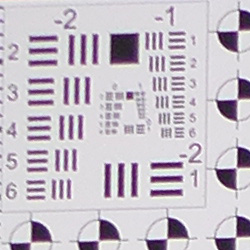
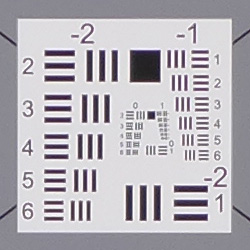
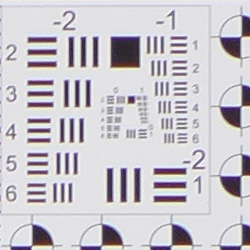
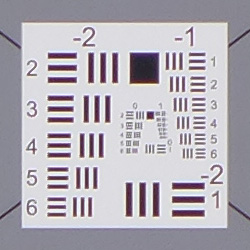
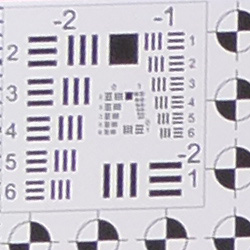
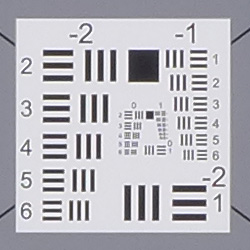
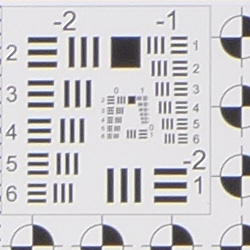
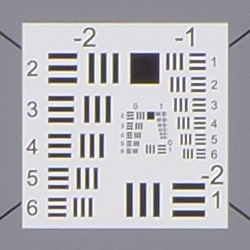
Low to moderate chromatic aberration at wide-angle; moderately low levels at full telephoto. Corner sharpness is quite good even wide-open, which is remarkable for such a fast wide-angle lens.
|
Aperture: Maximum
|
|
 |
 |
| Wide at f/1.4: Upper left C.A.: Moderate Softness: Slightly soft |
Wide at f/1.4: Center C.A.: Very low Softness: Sharp |
 |
 |
| Tele at f/2.3: Upper left C.A.: Moderately low Softness: Slightly soft |
Tele at f/2.3: Center C.A.: Moderately low Softness: Sharp |
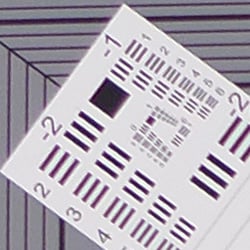
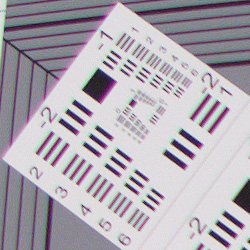
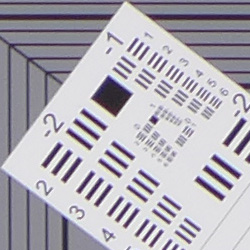
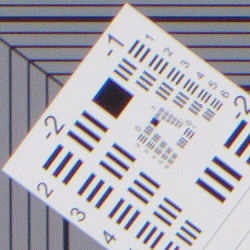
Chromatic Aberration. Thanks to in-camera chromatic aberration suppression, there are very low (center) to moderate (corners) levels of chromatic aberration from the LX7’s lens at wide-angle when wide-open. At wide-open full telephoto, chromatic aberration is moderately low, though you can see some lateral or transverse C.A. even in the center if you look closely, however it’s quite dim. See below for C.A. in uncorrected raw files.
Corner Softness. Wide-open at full wide-angle, the lens shows only slight blurring in the corners, which is quite remarkable given the speed of the lens as well as the extreme distortion correction taking place. (Much of the softness is due to the “pixel stretching” required to reduce distortion, and you can see some artifacts such as jagged edges along horizontal and vertical lines as well.) The center at wide-angle is quite sharp. At full telephoto, corner sharpness is a little better than at wide-angle with no distortion correcting artifacts, though still a touch soft, while the center remains quite sharp. Excellent performance.
Vignetting. There’s no vignetting (corner shading) to be seen which is unusual for such as fast lens, likely corrected during processing.
|
Aperture: f/5.6
|
|
 |
 |
| Wide at f/5.6: Upper left C.A.: Low Softness: Slightly soft |
Wide at f/5.6: Center C.A.: Very low Softness: Sharp |
 |
 |
| Tele at f/5.6: Upper left C.A.: Low Softness: Slightly soft |
Tele at f/5.6: Center C.A.: Very low Softness: Sharp |
Stopping down to f/5.6 improves corner sharpness at both wide-angle and telephoto, though they still aren’t quite as sharp as the center, while also reducing chromatic aberration. Vignetting is again not an issue.
Chromatic Aberration Correction
Much higher levels of C.A. at wide-angle and telephoto in uncorrected raw files.
| In-camera JPEG | Uncorrected Raw |
 |
 |
| Wide at f/1.4: Upper left C.A.: Moderate |
Wide at f/1.4: Upper left C.A.: High |
 |
 |
| Tele at f/2.3: Upper left C.A.: Moderately low |
Tele at f/2.3: Upper left C.A.: Moderately high |
As you can see from crops above comparing camera JPEGs on the left to raw files converted with DxO Optics Pro 7 with corrections disabled on the right, levels of chromatic aberration are much higher in uncorrected raw files, particularly at wide-angle.
Panasonic LX7 Viewfinder
Viewfinder Test Results
Coverage
Excellent accuracy from the LCD monitor.
 |
 |
|
Wide Angle
|
Telephoto
|
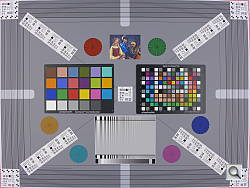
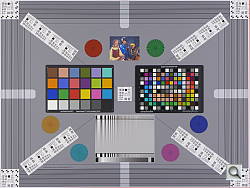
The Panasonic LX7’s LCDÂ monitor shows essentially 100% coverage at full wide-angle and telephoto. This is excellent performance, especially considering the amount of geometric distortion correction taking place at wide-angle.
The images above were taken from our standardized test shots. For a
collection of more pictorial photos, see our
Panasonic Lumix DMC-LX7 Photo Gallery
.
Exposure
Color
Saturation & Hue Accuracy
Typical mean saturation levels, with slightly below average hue accuracy.
 |
|||
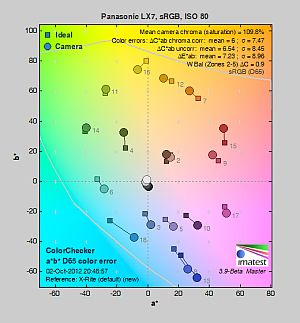
| In the diagram above, the squares show the original color, and the circles show the color that the camera captured. More saturated colors are located toward the periphery of the graph. Hue changes as you travel around the center. Thus, hue-accurate, highly saturated colors appear as lines radiating from the center. Click for a larger image. |
Saturation. The Panasonic LX7 produces typical saturation levels at default settings. Like many cameras, the LX7 pushes dark red and dark green very slightly, and darker blues a fair bit, while slightly undersaturating yellow and cyan. Average saturation is 109.8% ( 9.8% oversaturated) at base ISO. That’s about average for current cameras we’ve tested. Most consumer digital cameras produce color that’s more highly saturated (more intense) than found in the original subjects. This is simply because most people like their color a bit brighter than life.
Skin tones. Here, the Panasonic LX7 does fairly well, producing healthy-looking Caucasian skin tones with a noticeable push towards pink. Darker skin tones are nudged toward orange and red, but overall results are still pretty good. Where oversaturation is most problematic is on Caucasian skin tones, as it’s very easy for these “memory colors” to be seen as too bright, too pink, too yellow, etc.
Hue. The Panasonic LX7 struggles a bit with hue accuracy, pushing cyan toward blue, red toward orange, orange toward yellow and yellow toward green. As is often the case with Panasonic models, the yellow through orange shifts were especially apparent in the yarn of our Still Life test image. The camera’s average “delta-C” color error after correction for saturation is 6.0 for JPEGs at ISOà 80, a bit below average. As we’ve seen with other Panasonic models, the orange-yellow shifts are significantly mitigated by shooting in raw format and using a good-quality raw converter. Click here to see a Adobe Camera Rawà conversion of the same Still Life shot and compare the yarn to see what we mean. Hue is “what color” the color is.
 |
 |
 |
| See full set of test images with explanations See thumbnails of all test and gallery images |
||
Sensor
Exposure and White Balance
Indoors, incandescent lighting
Cool color balance with Auto white balance, very warm with the Incandescent setting. Very good color balance with the Manual and 2,600K settings. Average positive exposure compensation required.
 |
 |
| Auto White Balance +0.3 EV |
Incandescent White Balance +0.3 EV |
 |
 |
| Manual White Balance +0.3 EV |
2,600 Kelvin +0.3 EV |
Indoors, under normal incandescent lighting, color balance is cool with the Auto white balance, setting exhibiting a slight magenta tint, though the Panasonic LX7 does better than most cameras in this regard. Results with the Incandescent setting are much too warm for our tastes, with a strong orange-yellow cast. The Manual setting produces neutral white balance with good color, though greens are pushed a bit. Color balance in the 2,600 Kelvin shot is also pretty good, just slightly cool. The Panasonic LX7 required +0.3 EV exposure compensation here, which is about average for this shot. (Our test lighting for this shot is a mixture of 60 and 100 watt household incandescent bulbs, a pretty yellow light source, but a very common one in typical home settings here in the U.S.)
Outdoors, daylight
Slightly cool colors overall, with a tendency toward high contrast under harsh lighting. About average exposure accuracy.
 |
 |
| Auto White Balance, +0.7 EV |
Auto White Balance, Auto Exposure |
Outdoors, the Panasonic LX7 performs well, with good though slightly cool color. Skin-tones are fairly realistic in our “Sunlit” Portrait shot, with a healthy-looking pink tint. Exposure accuracy was about average, as the camera required +0.7 EVÃ compensation for our “Sunlit” Portrait shot to keep facial tones reasonably bright. That’s average for this shot, but it led to some blown highlights, though not as many as we’re used to seeing from a compact. The default exposure is very good Far-field shot, with very few blown highlights, though some shadows are very dark and plugged. Default contrast is on the high side, but that’s how most consumers prefer their photos. Color is pleasing, just slightly cool.
See full set of test images with explanations
See thumbnails of all test and gallery images
Resolution
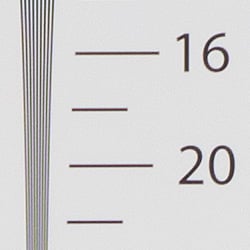
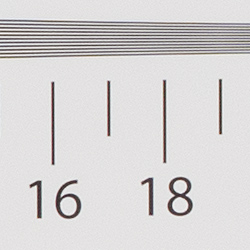
High resolution, 1,700 ~ 1,800 lines of strong detail in JPEGs, about 1,800 ~ 1,900 lines in converted raw files.
 |
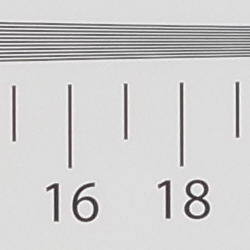 |
| Strong detail to ~1,800 lines horizontal Camera JPEG |
Strong detail to ~1,700 lines vertical Camera JPEG |
 |
 |
| Strong detail to ~1,900 lines horizontal ACR converted raw |
Strong detail to ~1,800 lines vertical ACR converted raw |
In JPEGs, our laboratory resolution chart reveals sharp, distinct line patterns to about 1,800 lines per picture height horizontally, and about 1,700 lines in the vertical direction. (Some might argue for higher, but aliasing artifacts begin to interfere at those limits.) Complete extinction of the pattern doesn’t occur until just over 2,400 lines in both directions. An Adobe Camera Raw conversion yields slightly higher numbers (about 100 lines more in both directions), though the ACR conversion also shows significantly more color moiré than the camera JPEG.
Use these numbers to compare with other cameras of similar resolution, or use them to see just what higher resolution can mean in terms of potential detail.
See full set of test images with explanations
See thumbnails of all test and gallery images
Sharpness & Detail
Very good sharpness and detail for its class, though some visible edge-enhancement artifacts on high-contrast subjects. Moderate noise suppression visible in the shadows even at base ISO.
 |
 |
| Good definition of high-contrast elements, though some visible sharpening artifacts. |
Subtle detail: Hair Noise suppression tends to blur detail in areas of subtle contrast. |
Sharpness. The Panasonic Lumix DMC-LX7 captures sharp images with a lot of fine detail, though edge enhancement artifacts are visible on high-contrast subjects such as the sharpening halos around the branches and pine cones in the crop above left. Still, pretty good performance here for its class. Edge enhancement creates the illusion of sharpness by enhancing colors and tones right at the edge of a rapid transition in color or tone.
Detail. The crop above right shows moderate noise suppression, as the darker areas of hair and regions of low contrast show less distinct detail. However, individual strands remain fairly well defined in higher contrast areas. The pine needles in the crop above left show some very fine detail, though, so performance is actually pretty good in good light. Noise-suppression systems in digital cameras tend to flatten-out detail in areas of subtle contrast. The effects can often be seen in shots of human hair, where the individual strands are lost and an almost “watercolor” look appears.
Raw vs In-Camera JPEGs
As noted above, the Panasonic LX7 produces sharp in-camera JPEGs with good detail for its class. Because small sensors like the LX7’s are quite a bit noisier than Micro Four Thirds or larger, processing raw images for better detail than in-camera JPEGs can be tricky. Sure, more detail can be preserved, but often at the cost of higher visible noise. Take a look below, to see what we mean:
|
|
|||
In the table above, mousing over a link at the bottom will load the corresponding crop in the area above, and clicking on the link will load the full resolution image.
The first image on the left is an in-camera Fine JPEG taken with default settings. The second was a raw file processed using the included SilkyPix converter at default settings. The third was also converted with SilkyPix, but sharpening was turned off in the editor, and strong unsharp masking of 300% with radius 0.6 was applied on the output. Finally, the fourth was converted with Adobe Camera Raw (using default noise reduction), then sharpened by the same amount as the third image.
As you can see, SilkyPix at default settings produces results that are softer than the in-camera JPEG. Sharpening does help, but SilkyPix tends to smudge fine detail in the pine needles, giving them an almost watercolor look. The Adobe Camera Raw version preserves the most detail, but also shows quite a bit more noise. You can increase the noise reduction settings in ACR, but you’ll probably want to use a good third-party noise reduction program such as Neat Image, Noise Ninja or Noiseware to perform more advanced noise reduction for best results.
ISO & Noise Performance
Very good detail versus noise performance to ISO 200, though detail drops off quickly at higher ISOs.
|
Default Noise Reduction
|
||
 |
 |
 |
| ISO 80 | ISO 100 | ISO 200 |
 |
 |
 |
| ISO 400 | ISO 800 | ISO 1,600 |
 |
 |
 |
| ISO 3,200 | ISO 6,400 | ISO 12,800 |
The Panasonic LX7 performed well for its class here, holding on to fine detail and keeping noise in check up to ISOÃ 200. ISOÃ 400 is a little softer than 200, but fine detail is still quite good and chroma noise better controlled. ISO 800 shows further softening to noise reduction, as well as more chroma noise, but performance here is still pretty good for a compact. At ISOÃ 1,600, detail retention is fair with more obvious luminance noise, though chroma noise is still well controlled. Noise is quite strong at ISO 3,200, and combined with the LX7’s default sharpening, it produces a noticeable peppering effect, though some detail is still intact. At ISOÃ 6,400, much stronger noise reduction kicks in, blurring out most detail. Chroma noise is also a lot stronger. ISOÃ 12,800 is so noisy the LX7 drops resolution down to 3-megapixels, but images are still very soft and chroma noise very strong.
Compared to the LX5, the Panasonic LX7’s default noise reduction appears more sophisticated, holding on to better detail while avoiding the demosaicing artifacts its predecessor produced, though it does leave behind a little more noise. We prefer this over the more aggressive and less sophisticated noise reduction the LX5 applied, at least in these indoor shots.
We’re of course pixel-peeping to an extraordinary extent here, since 1:1 images on an LCD screen have little to do with how those same images will appear when printed. See the Print Quality section below for our evaluation of maximum print sizes at each ISO setting.
Extremes: Sunlit and low light tests
Somewhat high default contrast and limited dynamic range. Very good low-light performance for its class.
 |
 |
 |
| +0.3 EV | +0.7 EV | +1.0 EV |
Sunlight. The Panasonic Lumix DMC-LX7 struggled a bit with the deliberately harsh lighting of this test, though not as much as most compacts. Contrast is a little high at its default setting, with some blown highlights in the mannequin’s shirt and flowers, and deep, somewhat noisy shadows. Although skin tones around the eyes are still a bit dark at +0.7 EV exposure, we preferred it to the +1.0 EV exposure overall, because there are fewer clipped highlights. It’s really the photographer’s choice here as to which direction to go in. For those Panasonic LX7 owners that are going to want to just print an image with little or no tweaking, the +1.0 image would probably produce a better-looking face uncorrected. The bottom line though, is that while the Panasonic LX7 had difficulty with the wide dynamic range of this shot, it performed fairly well for a compact.
Because digital cameras are more like slide film than negative film (in that they tend to have a more limited tonal range), we test them in the harshest situations to see how they handle scenes with bright highlights and dark shadows, as well as what kind of sensitivity they have in low light. The shot above is designed to mimic the very harsh, contrasty effect of direct noonday sunlight, a very tough challenge for most digital cameras. (You can read details of this test here.)
|
Outdoor Portrait Intelligent Dynamic Range
|
|
|
|
iD-Range Setting: |
Panasonic’s Intelligent Dynamic Range
The above shots are examples of Panasonic’s Intelligent Dynamic Range Control (or iD-Range) at work, with no exposure compensation. Note that the camera does not take multiple shots and merge as some cameras’ high dynamic range modes do. It’s a system that adjusts local contrast and exposure more akin to Nikon’s Active D-lighting, Canon’s Automatic Lighting Optimization or Sony’s Dynamic Range Optimization.
There are three levels of iD-Range available on the Panasonic LX7: Low, Standard and High, plus Off. It’s automatically invoked in iAuto and some scene modes and manually selectable in PASM modes. Mouse over the links to compare images and histograms, and click on them to get to the full resolution images.
As you can see from the image and histogram, the Low setting worked mainly on shadows and darker midtones, essentially leaving lighter tones alone. The Standard and High settings also boosted shadows, though not quite as much as the Low setting. The two upper settings however boosted highlights significantly, improving overall exposure but clipping more highlights than the Off and Low settings. All three settings were however an improvement over the default exposure.
Oddly, changing i-D-Range had no effect on our Far-field shot.
The Panasonic LX7 also offers a high dynamic range mode (iHDR) which combines multiple images taken at different exposures, however the lab did not test that mode. See the examples in the shooter’s report.
| Face Detection | ||
 |
 |
 |
| Aperture Priority, 0 EV, f/5.6 Face Detection Off |
Aperture Priority, 0 EV, f/5.6 Face Detection On |
iAuto, 0 EV, f/2.8 |
Face Detection
Like most cameras these days, the Panasonic Lumix DMC-LX7 has the ability to detect faces (up to 15 in a scene), and adjust exposure and focus accordingly. The LX7 does it automatically in Intelligent Auto (iAuto) mode, when a Portrait scene mode is selected, or when Face Detection AF mode is enabled. As you can see from the examples above, it made a difference in Aperture Priority mode, but iAuto mode performed even better where the camera had control over aperture.
| Ã | 1 fc 11 lux |
1/2 fc 5.5 lux |
1/4 fc 2.7 lux |
1/8 fc 1.3 lux |
1/16 fc 0.67 lux |
1/16fc No NR |
|---|---|---|---|---|---|---|
| ISO 80 |
 2 s f2.8 |
 4 s f2.8 |
 8 s f2.8 |
 15 s f2.8 |
 30 s f2.8 |
 30 s f2.8 |
| ISO 100 |
 1.6 s f2.8 |
 3.2 s f2.8 |
 6 s f2.8 |
 13 s f2.8 |
 25 s f2.8 |
 25 s f2.8 |
| ISO 200 |
 0.8 s f2.8 |
 1.6 s f2.8 |
 3.2 s f2.8 |
 6 s f2.8 |
 13 s f2.8 |
 13 s f2.8 |
| ISO 400 |
 0.4 s f2.8 |
 0.8 s f2.8 |
 1.6 s f2.8 |
 3.2 s f2.8 |
 6 s f2.8 |
 6 s f2.8 |
| ISO 800 |
 1/5 s f2.8 |
 0.4 s f2.8 |
 0.8 s f2.8 |
 1.6 s f2.8 |
 3.2 s f2.8 |
 3.2 s f2.8 |
| ISO 1600 |
 1/10 s f2.8 |
 1/5 s f2.8 |
 0.4 s f2.8 |
 0.8 s f2.8 |
 1.6 s f2.8 |
 1.6 s f2.8 |
| ISO 3200 |
 1/20 s f2.8 |
 1/10 s f2.8 |
 1/5 s f2.8 |
 0.4 s f2.8 |
 0.8 s f2.8 |
 0.8 s f2.8 |
| ISO 6400 |
 1/40 s f2.8 |
 1/20 s f2.8 |
 1/10 s f2.8 |
 1/5 s f2.8 |
 0.4 s f2.8 |
 0.4 s f2.8 |
| ISO 12800 |
 1/80 s f2.8 |
 1/40 s f2.8 |
 1/20 s f2.8 |
 1/10 s f2.8 |
 1/5 s f2.8 |
 1/5 s f2.8 |
Low Light. The Panasonic Lumix DMC-LX7 performed fairly well in our low light test, capturing bright images down to the lowest light level we test at, at all ISO settings. This darkest level equates to about 1/16 the brightness of average city street lighting at night, so the Panasonic LX7 should be able to take well-exposed photos in almost any environment in which you can see well enough to walk around in.
Using default noise reductionà setting, noise is well-controlled up to ISOà 800, which is very good for a compact. ISO 1,600 isn’t bad, but low light performance drops off quickly at higher ISOs. Some minor horizontal banding was visible in the shadows at higher ISOs and lower light levels, but nothing unusual. We didn’t see any issues with hot or stuck pixels.
Automatic color balance was pretty good (just slightly cool), something that’s not a given at such low light levels.
The camera’s autofocus system was able to focus on the subject down to below the 1/16 foot-candle light level unassisted, which is excellent, especially for a camera with contrast-detect autofocus. We can thank the Panasonic LX7’s very bright lens for that. The LX7 does have a focus-assist light option which allows it to autofocus in total darkness, as long as the subject is within range and has sufficient contrast.
How bright is this? The one foot-candle light level that this test begins at roughly corresponds to the brightness of typical city street-lighting at night. Cameras performing well at that level should be able to snap good-looking photos of street-lit scenes.
NOTE: This low light test is conducted with a stationary subject, and the camera mounted on a sturdy tripod. Most digital cameras will fail miserably when faced with a moving subject in dim lighting. (For example, a child’s ballet recital or a holiday pageant in a gymnasium.) Thanks to their phase-detect AF systems, digital SLRs tend to do much better than point & shoots, but you still shouldn’t expect a quick autofocus lock with moving subjects. The LX7 uses contrast-detect autofocus, as is found in most point & shoot cameras, so its low-light focusing ability is less than that of some SLRs with phase-detect systems. (A useful trick is to just prop the camera on a convenient surface, and use its self-timer to release the shutter. This avoids any jiggling from your finger pressing the shutter button, and can work quite well when you don’t have a tripod handy.)
Output Quality
Print Quality
Great 13 x 19-inch prints from ISO 80-200; ISO 1,600 shots look good at 5 x 7; ISO 12,800 prints, however, are not usable even at 4 x 6.
ISO 100 shots look about the same as ISO 80, with the same 13 x 19 recommendation.
ISO 200 images have a little less contrast, and low contrast reds are slightly soft, but not bad, still printing just fine at 13 x 19 inches.
ISO 400 images are softer at 13 x 19 inches, looking better at 11 x 14.
ISO 800 are usable at 11 x 14, but given the softness of many colors in the scene, 8 x 10 inch prints look better, although most all contrast is lost in our target red swatch.
ISO 1,600 prints look good at 5 x 7.
ISO 3,200 are usable at 4 x 6 for less critical applications, but are not clean enough to meet our standard for “good”.
ISO 6,400 prints are only usable at 4 x 6 inches. I think a night scene would be acceptable at this size, but a more brightly lit scene might be off-putting, particularly for face detail.
ISO 12,800 prints are not usable at 4 x 6 inches. Prints look like you spilled water on the image, so this ISO setting is best avoided altogether.
Overall, the Panasonic LX7 does about the same as its predecessor at higher ISOs. Remember the Panasonic LX7 is capable of more if you process images from raw, which is an option, so use the above information as a general guideline.
Testing hundreds of digital cameras, we’ve found that you can only tell just so much about a camera’s image quality by viewing its images on-screen. Ultimately, there’s no substitute for printing a lot of images and examining them closely. For this reason, we now routinely print sample images from the cameras we test on our Canon Pro9000 Mark IIÃ studio printer, and on the Canon Pixma MP610 here in the office. (See the Canon Pixma Pro9000 Mark II review for details on that model.)
Panasonic LX7 Flash
Flash Test Results
Coverage and Range
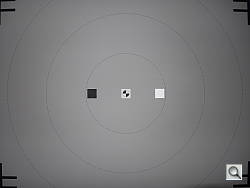
Good range for a small flash thanks to the bright lens, but with uneven coverage at wide angle. Auto flash produced a bright exposure.
 |
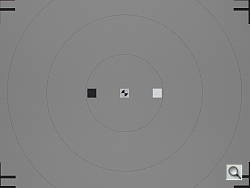 |
| 24mm eq., f/1.4, ISO 200 | 90mm eq., f/2.3, ISO 200 |
 |
|
| Auto Flash | |
Coverage. Flash coverage is uneven at wide-angle, leaving the corners of our flash target image darker at 24mm equivalent, thought that’s not unusual. Coverage is more uniform at full telephoto (90mm eq.).
Exposure. Indoors under incandescent background lighting, the Panasonic LX7’s Auto Flash mode produced a bright, slightly overexposed image. You can adjust flash output +/- 2 EV in 1/3 EVÃ steps.
| Flash Range: Wide Angle | |||||
|---|---|---|---|---|---|
| 6 ft | 7 ft | 8 ft | 9 ft | 10 ft | 11 ft |
 1/60 sec f1.4 ISO 200 |
 1/60 sec f1.4 ISO 200 |
 1/60 sec f1.4 ISO 200 |
 1/60 sec f1.4 ISO 200 |
 1/60 sec f1.4 ISO 200 |
 1/60 sec f1.4 ISO 200 |
| 12 ft | 13 ft | 14 ft | 15 ft | 16 ft | |
 1/60 sec f1.4 ISO 200 |
 1/60 sec f1.4 ISO 200 |
 1/60 sec f1.4 ISO 200 |
 1/60 sec f1.4 ISO 200 |
 1/60 sec f1.4 ISO 200 |
|
| Flash Range: Telephoto | |||||
|---|---|---|---|---|---|
| 6 ft | 7 ft | 8 ft | 9 ft | 10 ft | 11 ft |
 1/60 sec f2.3 ISO 200 |
 1/60 sec f2.3 ISO 200 |
 1/60 sec f2.3 ISO 200 |
 1/60 sec f2.3 ISO 200 |
 1/60 sec f2.3 ISO 200 |
 1/60 sec f2.3 ISO 200 |
| 12 ft | 13 ft | 14 ft | 15 ft | 16 ft | |
 1/60 sec f2.3 ISO 200 |
 1/60 sec f2.3 ISO 200 |
 1/60 sec f2.3 ISO 200 |
 1/60 sec f2.3 ISO 200 |
 1/60 sec f2.3 ISO 200 |
|
ISO 200 Range. At wide-angle, our flash target is quite bright out to 10 feet, then exposure decreases at 11 feet, but increases at 12 feet. Exposure decreases gradually with distance from there, so we’ll call the wide-angle range 12 feet. At full telephoto, flash exposures are bright out to about 9 feet, and brightness falls off from there.
| Manufacturer-Specified Flash Range | |
|---|---|
| Wide Angle | Telephoto |
 28.0 feet Auto ISO 200 |
 17.0 feet Auto ISO 500 |
Manufacturer-Specified Flash Range Test. Panasonic rates the LX7’s built-in flash range as 8.5m or about 28 feet at wide-angle, and 5.2m or about 17 feet at telephoto, using Auto ISO. In the shots above, the Panasonic LX7 produced a dimly exposed target at wide-angle, despite using spot metering mode. However at full telephoto, the target is just slightly underexposed, so we conclude the flash rating is credible but perhaps slightly optimistic. Our standard test method for flash range uses either a fixed setting of ISO 200, to provide a fair basis of comparison between cameras. We’ve now also begun shooting two shots using the manufacturer-specified camera settings, at the range the company claims for the camera (at Auto ISOÃ if so specified), to assess the validity of the specific claims.
The images above were taken from our standardized test shots. For a
collection of more pictorial photos, see our
Panasonic Lumix DMC-LX7 Photo Gallery
.
Not sure which camera to buy? Let your eyes be the ultimate judge!
Visit our Comparometer(tm)
to compare images from the Panasonic Lumix DMC-LX7 with those from other
cameras you may be considering. The proof is in the pictures, so let
your own eyes decide which you like best!
Performance
Timing and Performance
Excellent autofocus, shutter lag and burst speeds, though slow startup and buffer clearing.
|
Startup/Shutdown
|
||
|
Power on |
3.7 seconds
|
Time it takes for LCD to turn on |
|
Shutdown |
1.2 seconds
|
How long it takes to retract lens. |
|
Buffer clearing time |
7 seconds
(after 12 LF JPEG)* 20 seconds (after 12 RAW)* 32 seconds (after 12 RAW+LF JPEG)* |
Worst case buffer clearing time. |
| *Note: Buffer clearing times measured with a SanDisk Extreme Pro 95MB/s UHS-1 SDHC memory card. Slower cards will produce correspondingly slower clearing times. | ||
Slow startup time, though shutdown is not bad. Buffer clearing is sluggish even with a very fast card. The Panasonic LX7 does not appear to be UHS-I compliant so it doesn’t take advantage of the faster bus interface mode UHS cards offer.
| Mode Switching | ||
|---|---|---|
|
Play to Record, |
~0.8 second
|
Time until first shot is captured. |
|
Record to Play |
~0.6 second
|
Time to display a large/fine file |
|
Display |
~1.6 seconds
|
Time to display a large/fine file |
Mode switching is pretty fast, though displaying a previously captured image is a bit slow.
| Shutter Response (Lag Time) | ||
|---|---|---|
|
Full Autofocus |
0.241 second
|
Time from fully pressing shutter button to image capture. |
|
Full Autofocus |
0.228 second
|
Time from fully pressing shutter button to image capture. |
|
Full Autofocus |
0.246 second
|
Time from fully pressing shutter button to image capture. |
|
Full Autofocus
Flash enabled |
0.451 second
|
Time to capture while forcing flash to fire.
|
|
Manual focus
|
0.255 second
|
For most cameras, shutter lag is less in manual focus than autofocus, but usually not as fast as when the camera is “pre-focused.” |
|
Pre-focused |
0.010 second
|
Time to capture, after half-pressing |
Full autofocus shutter response is very fast for a compact, at 0.24s using 1-area center AF, and 0.23s using 23-area AF mode. The Quick AF option made little difference in our tests. As expected, enabling the flash did add some delay for the preflash metering, resulting in 0.45s lag. Manual focus wasn’t any faster than autofocus, surprisingly, at 0.26s. “Prefocusing” the camera by half-pressing and holding down the shutter button before the final exposure results in a lag time of only 0.010s, very fast.
| Cycle Time (shot to shot) | ||
|---|---|---|
|
Single Shot mode
Large Fine JPEG |
0.77 second
|
Time per shot, averaged over 20+ shots. |
|
Single Shot mode |
0.75 second
|
Time per shot, averaged over 16 shots. |
|
Single Shot mode |
0.79 second
|
Time per shot, averaged over 14 shots. |
|
Early shutter |
Yes
(after buffer fill) |
Some cameras don’t snap another |
|
Fastest full-res Continuous mode |
0.09 second (11.10 frames per second);
12 frames total; 7 seconds to clear |
Time per shot, averaged over 12 shots (set at 12). |
|
Fastest full-res |
0.09 second (11.11 frames per second);
12 frames total; 20 seconds to clear |
Time per shot, averaged over 12 shots (set at 12). |
|
Fastest full-res |
0.09 second (11.11 frames per second);
12 frames total; 32 seconds to clear |
Time per shot, averaged over 12 shots (set at 12). |
|
Flash recycling |
3.1 seconds
|
Flash at maximum output. |
|
*Note: Buffer clearing times measured with a SanDisk Extreme Pro 95MB/s UHS-1 SDHC memory card. Slower cards will produce correspondingly slower clearing times. Slow cards may also limit length of bursts in continuous mode. ISO sensitivity also affects cycle times and burst mode performance, with higher ISOs generally increasing cycle times and reducing burst performance. |
||
Shot-to-shot cycle times are good, at 0.77s for LF JPEGs, 0.75s for RAW and 0.79s for RAW+JPEG.
The Lumix LX7 offers very fast continuous modes. The fastest full resolution burst mode is rated at 11 frames per second for 12 frames, and that’s what we measured. Focus, exposure and white balance are locked at the first frame, though. The fastest rate with autofocus, exposure and white balance is 5 frames per second, however we didn’t test that mode. We also didn’t test the 40 and 60 fps modes which capture lower resolution images (5 and 2 megapixels respectively).
Buffer depths are good, set a 12 frames in the 11 fps mode. Lower speed burst modes (5 and 2 fps) claim up to 100 frame bursts. Buffer clearing is quite slow, though, taking 7 seconds after a burst of 12 JPEGs, 20 seconds after 12 RAWs and 32 seconds after RAW+JPEG. As mentioned previously, the Panasonic LX7 does not appear to take advantage of faster UHS-I cards.
Flash recycle after a full-power discharge is good, at 3.1 seconds.
| Download Speed | ||
|---|---|---|
|
Windows Computer, USB 2.0 |
7,251 KBytes/sec
|
Typical Values: |
Connected to a computer or printer with USB 2.0, download speeds pretty good.
Bottom line, the Panasonic LX7’s performance is generally very fast, with a few slow areas. Startup is slow, autofocus speeds and shutter lag are faster than average, burst modes are very fast, but buffer clearing is slow.
Battery
Battery Life
About average battery life for a lithium-ion design.
| Operating Mode | Number of Shots |
|---|---|
|
Lithium-ion Rechargeable Battery,
(CIPA standard) |
330
|
The Panasonic LX7 uses a custom rechargeable lithium-ion battery for power, and ships with a charger. Battery life isn’t as good as the LX5 which managed 400 shots per change, but fairly typical for its class these days. We recommend you pick up a spare battery and keep it freshly charged and on-hand for extended outings.
The table above shows the number of shots the camera is capable
of (on a fully-charged rechargeable battery as appropriate), based on CIPA
battery-life and/or manufacturer standard test conditions.
(Interested readers can find an English translation of the CIPA DC-002 standards document here. (180K PDF document))
Pricing and availability
Available now, the Panasonic LX7 comes in black and white and has a suggested retail price of US$500.