



Overview
Updates:
02/05/2019: Initial Gallery shots posted
02/06/2019: First Shots posted
02/11/2019:
Field Test Part I posted
05/02/2019: Performance posted
06/24/2019: Field Test Part II posted
Click here to jump to our detailed Sony A6400 Overview
Boring, unexciting, and probably the perfect camera for most
by Jaron Schneider | Posted 06/24/2019

Even though it introduced Sony's most impressive autofocus technology in some time, the Sony A6400 is not an exciting camera. There is not much on the specifications sheet that makes you say "wow," and it could even be argued it wasn't what fans were expecting when it was announced (though what they were expecting was a bit outlandish).
But as blasé as the A6400 might seem, I argue that it is probably the best camera from Sony for a good majority of those looking to buy a camera.
What photographers and perhaps the readers of Imaging Resource often overlook are the facts surrounding who the people are who want to take photos, and what those photos are used for. You as a consumer are constantly bombarded with images on a daily basis, and unless you're in the mindset to be looking critically at a photo, these everyday photos you see work only to provide tidbits of information, whether they be advertisements for products of interest, or photos from your family showing off the dog doing something silly, or your cousin graduating from college.
To satisfy the commodity that the camera has become, it only has to do a few things correctly in order to meet and exceed the expectations of the buyer.

To review the A6400, I tried to take myself out of the professional photographer mindset and instead put myself into the frame of mind that my friends might find themselves. One of them is a nurse who enjoys a hike on the weekends. One is a scientist who does triathlons as a hobby. One is a marketer for a local brewery. Each of these people has the desire to make images, and for these images their baseline reason to acquire a standalone camera is to just get photos that look better than they can make on their phones.
That means that the enhanced features you and I probably look for in a camera are far and away unimportant to whom the A6400 is made. Those eye-catching specifications on a new camera's data sheet are meaningless numbers to them.
My friends would only care that it was easy to use, that it achieved focus correctly and with little effort, and that it made "good" images. It helps if it's small, and maybe if it takes some video, too, that would be helpful. Oh, and it can't be too expensive.
Honestly, it's a pretty short list and one that's easy to satisfy. But when I look at the cameras that get all the attention, like the Nikon Z6, the Sony A7 III, or the Canon EOS R, for example, do any of these actually aim to satisfy what my friends want in a camera?
I argue that they over-deliver on these simple wants. The Sony A6400, however, in its unassuming and honestly boring package, is a perfect fit.

Overall Design and Ease of Use
Of all the places the A6400 excels, I will say that the usability of it is actually its weakest point. That's not to say it isn't easy to use, once you get the hang of it, it's that it requires getting the hang of it.
It's no secret that at the time of this article's publication in mid-2019, Sony's camera menus are far and away the worst in the industry. That doesn't change on the A6400. If any of the three friends I mentioned above were to buy this camera, at least two of them would call me and ask me to help set it up, because it's absolutely not user friendly. Even me, a guy who has used almost every camera currently on the market, struggled for a few minutes to remember how to change from Program mode to Manual mode for shooting video. I had to remember that the option to adjust this isn't on any button or dial, and also wasn't in the Fn (Function) menu. You actually have to go into the camera's main menu, second camera tab, and change it from there.

By default, almost none of the features you want as a shooter are active, such as AF Tracking, touchscreen functionality or 4K video, and that's common on Sony cameras. Once you get past this major hurdle, the camera works really well. It's just an annoying mountain to ascend that Sony insists on placing in front of every new user.
But once you get the camera set up and your basic preferences are in place, it's so easy to use. Sony's autofocus is as good as it always is, and user feedback in the EVF or rear LCD, such as the ability to see all the active AF point during tracking, is probably my favorite among any camera manufacturer.
The organization of the buttons and dials is as good as I could expect, with a majority of the higher-level features easily accessible through the Fn button, and that menu can be customized as well (provided you can figure out how to navigate the aforementioned bad menu). For the most part, taking a photo with the A6400 is easy, with most of the day-to-day photo-taking features available within the range of a single button press.
The compact size of the A6400 makes it ideal for quickly adding to just about any small backpack or shoulder bag. It's the smallest camera I have around my office next to the Fujifilm X-T30, and yet the Sony manages to actually add a somewhat functional grip to the equation. I say "somewhat" because if your hands are even slightly large, this camera is going to be almost painful to hold correctly, so scrunched up will your fingers be. This isn't a new problem for Sony, and since my hands are somewhat small/medium-sized for a guy, it's never been a problem for me personally. I just know that it will be a complaint for others.

Sure, the EVF itself is pretty small and fairly low resolution (in fact, I am never absolutely certain I got a photo in focus when looking through the EVF), but after I got used to it, I learned to just trust the camera. For a vast majority of my shots, the images I had back at my computer rewarded that trust.
The A6400 doesn't use a particularly high-capacity battery, so it's important that the camera can startup quickly since I made sure to turn it off any time I was not actively shooting. I'm happy to report that it does, and I never found myself missing a shot even when starting with the camera fully off. If you do not turn the camera off constantly or if you shoot video, you'll find the battery life to be pretty sub-par though.
There are other lower-end consumer cameras that try and combine all your settings management into one dial, which can be frustrating if you want to have manual control over shots. I'm happy to report that the A6400 bucks that trend and offers two control dials to manipulate shutter speed, aperture and ISO. There is a dial on the top of the camera as well as one on the rear, to the right of the LCD.
Some other minor complaints:
The SD card slot is in the same compartment as the battery, which I'm never the biggest fan of since that compartment is easily blocked by many tripods.
Sony did institute touch operation to the A6400, albeit limited. I am not sure why they put so many hamstrings on touch operation on their cameras, but Sony would serve themselves to make it as much a part of the operating system as Canon and Nikon have.
It does have a flip-up "selfie" screen, which as obnoxious as that is to write, is lovely to have on the device, honestly. That said, it's not very well implemented since the EVF blocks a good portion of the LCD when it's flipped up. So while it's good that it has this feature at all, it seems haphazardly added.

It's either the processor or the writing speed of the single memory card slot, but the A6400 is not fast to save images. If you shoot a burst of full resolution photos in RAW, expect to have to wait a bit in order to cleanly browse those images in the Playback mode. This is again not a complaint limited to the A6400, as this is relatively common even on Sony's highest end cameras, it's just not rectified here.

Image Capture and Quality
I think it's safe to say that what the average camera consumer cares about the most is "does it take good pictures?" While I like to say that pretty much every camera that comes to market these days takes great images, Sony floats up above the competition when it comes to autofocus performance, feedback and therefore the number of "keepers" you can get for a given session. So before I talk about the image quality itself, let's briefly discuss the autofocus.
Basically our entire first field test is dedicated to talking about autofocus on the A6400, and specifically the new Tracking autofocus feature that Sony debuted on the A6400 but has since found itself on the a9 as well. There is more to the A6400 than just the new Tracking feature, but there is nothing "new" about those features.
It may not be new, but it is the culmination of years upon years of advancement on Sony's part, and the result is a pleasant experience.

When you shoot with the A6400, it just feels right. When I'm looking in the EVF, I'm not thinking about the aforementioned lower quality EVF LCD, or the irritation I have with the menu design of the camera, or even the small grip. No, I'm immediately locked in to the shot I'm getting, and the immerse feedback of the Sony autofocus system. The blinking green AF points that adapt to my every shot (I like Wide AF mode by the way) show me what the camera sees, how the camera sees it, and how the photo will be captured.
And then I just get the photo. From the second my eye goes to the EVF to when my finger hits the shutter button, I'm all about taking the photo.
This is the kind of experience that will really appeal to the average user. When you look through the EVF, you can pretty much already tell how your photo is going to come out, despite the less than great EVF viewing experience. It feels connected, advanced, and like it's a camera that will "take good photos." It even feels like it's worth the somewhat more elevated price that the A6400 commands among the entry-level cameras available.
As far as pure image quality goes, it's just above middle of the road for APS-C cameras. You'll find dynamic range to be somewhat limited, and the camera's metering seems to want to bring shadows in line more than highlights, meaning photos with mixed lighting will tend to have more blown highlights than I expected.

In even light, both darker or overly bright, the camera is going to be more consistent. I found that my favorite images came from either bright, daytime sun or lightly-diffused bright light. Backlighting also looks good. This isn't entirely surprising as most all cameras will do better in situations like this.
So let's look at one of my example friends, for whom I said this camera is ideal. Let's say you need to take product photos, and you just need them to stand out on your Instagram or website. There isn't a reason I can think of as to why the A6400 wouldn't be great at this. Colors pop, the details are crystal clear, and the camera is so easy to use on aperture priority that you can just trust that the photo is going to come out sharp and beautiful.
Honestly, this camera, despite being considered a somewhat entry-level camera, is almost overpowered for this kind of work. But it's kind of nice to say that this camera has more features than the average shooter is going to need, because it makes you feel like you're getting a lot for your dollar.
So what if you want to take this out and shoot your friends at a triathlon or other sporting event? I hope our prior field test shows it's great for that too, with the eye-AF working to make sure you get just the right person in focus.
Alright, what about getting solid photos from a hike? The A6400 is great here too, with good dynamic range in the shadows to really make forested areas look beautiful, and the colors of flowers shine.

What about video?
I mentioned that for my friends, it would "be nice" if their ideal camera also captured good video, and I think it's safe to say that's exactly what the A6400 offers. It's not outstanding, high quality video by any means, and there are limitations to video capture, but overall it's much more than enough for the average enthusiast.
Sony obviously put the idea of vlogging into the A6400, you can look at that flip-up selfie screen as evidence of that as well as the marketing choices Sony made at the launch of the camera. For that purpose, it is in my opinion solidly "OK" at it. You only get four 4K options, a lower-data rate and a higher data rate capture for both 24p and 30p, with up to 120 frames per second in 1080p. These are the same, rather standard video options that Sony has paraded out in all their cameras for the past few years. As unexciting as they are, they work.
Sony A6400 Sample Video #1 3840 x 2160, 24 fps - Download Original (704.7MB MP4) |
If you've seen video taken from a consumer Sony mirrorless camera any time in the last three years, you've seen the footage from the A6400. There is no innovation here, but on the flip side it's not worse, which is good.
What makes the A6400 only "OK" for video when I said the A7 III is an example of a good video camera comes down to one feature left out on the A6400: image stabilization.
Sony really pushed the envelope when it came to full frame sensor-shift image stabilization, but in this APS-C sized sensor, they opted to leave it out entirely. Not every lens available for the A6400 offers optical stabilization, and combining that with the lack of on-sensor stabilization means that unless you've got a very steady hand or a tripod, you will end up with shaky, perhaps even jello-y footage. For example, I was shooting a video for Instagram (which I shot vertical because of the intended final publishing location) where I hand held the camera while seated. There was very little movement other than my natural shaking hands, yet looking at the footage in post, there is clear "jello" shaking in the corners, which doesn't look like only shaking, but wobbling of the subjects in the frame. It's the kind of vibration that can't be corrected in post very easily.
Sony A6400 Sample Video #2 3840 x 2160, 24 fps - Download Original (1.06GB MP4) |
So if the camera struggled with hand-held footage without much motion, I can't imagine footage taken in a vlogging format, especially while walking, would look particularly good either.
And that's a shame, because the camera itself is very light, has a screen that flips up and works well for the vlogging format, and because it has a smaller sensor, the size of the lenses available is also similarly smaller. The whole thing would work well for a high-quality small camera, if not for leaving out image stabilization.
A final note: there is no headphone jack on the A6400. It's a bit of a perplexing omission for me, since Sony did make sure to mention video capability and aim it for a traveling video shooter. Though sure, vloggers probably won't notice this since they will rarely monitor their own sound, it's still something that should be included by default for anyone shooting video.

Summary: Dull, unexciting, but perfect
Look, there isn't anything shiny, new and exciting about the A6400 that the average consumer is going to be excited about. Even the Tracking AF feature, which was added to this camera in what I consider to be one of the larger head scratchers of the last year, isn't even enabled by default for new users, meaning the vast majority of new A6400 users will not a) know it exists or b) know how to turn it on. You can't even use it in video without first enabling it, and then next making sure touch features are on (which isn't fun by the way, as that's way deep in the menu).
But I argue that as unexciting as the A6400 is, it's exactly the camera the average consumer camera owner (or soon-to-be owner) needs. Nay, wants! It has very good image quality, is fun to use once you spend half an hour initially setting it up, is small and lightweight, and can play a host of different roles for a ton of different shooting situations -- most of which consumers will only ever attempt a fraction. It is, however, a rather expensive consumer camera, but that price may be worth it. Though the Canon EOS RP is full-frame, which gets a lot of attention and commands headlines, it can't do a whole lot other than capture a photo at a time. The A6400 is far more versatile thanks to considerably more options in video, and it can shoot 11 fps which is more than double that of the RP's 5 fps. The A6400 can also shoot 1080p120 slow motion video, the body is smaller, and it has smaller lens options than the RP.
I think the crux of my opinion on this camera lies in its shooting experience, and especially with the continuous autofocus: it's just so pleasing to use. If making sure that every shot you take with your camera is in focus, and the experience of getting that shot takes a low skill ceiling and isn't fiddly with how it gets you there, then yeah, the A6400 is one of the best options you can pick up.
Sometimes a camera doesn't have to be "exciting" or "dazzling" in order to be a good camera. Sometimes, it just has to do the job, and the Sony A6400 fits that bill to the nose.
Sony A6400 Review -- Product Overview
by Mike Tomkins

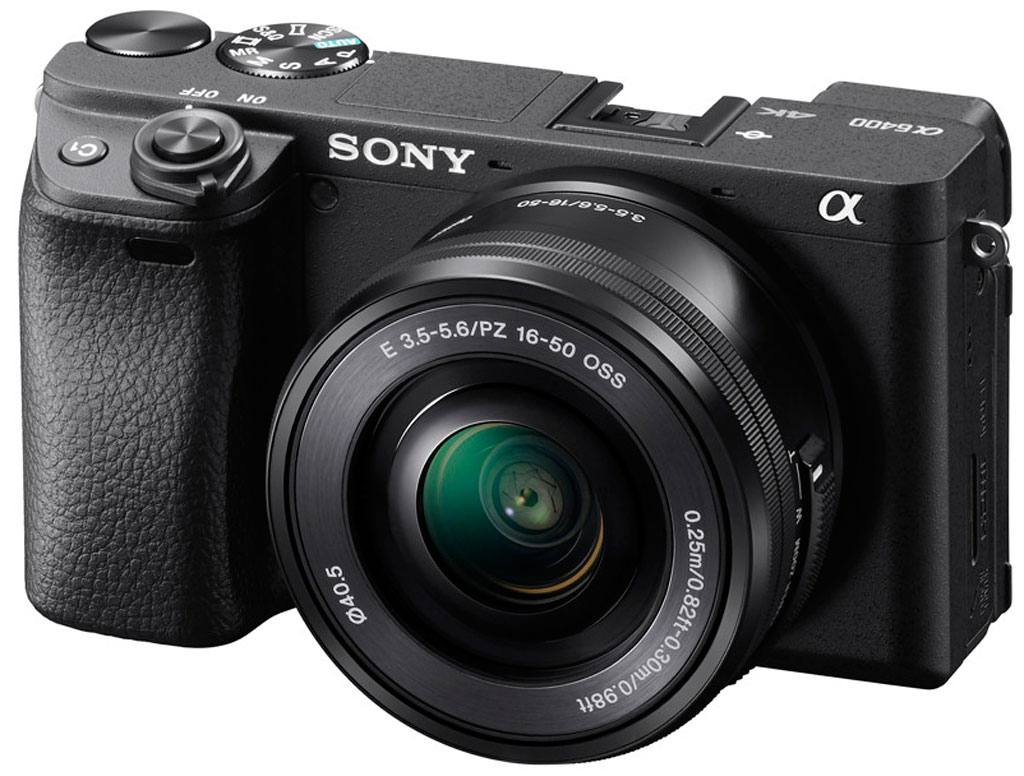
It's been close to three years since Sony launched its award-winning A6300 mirrorless camera, itself a followup to the A6000 and, even earlier, the NEX-6. All three models proved to be very popular, which certainly bodes well for the latest entry in the lineup, the Sony A6400.
Featuring almost the same body as in the previous couple of generations, the A6400 will be immediately familiar to anyone who's shot with the A6000 or A6300. So, too, will its 24.2-megapixel resolution from an APS-C image sensor, and its top burst capture rate of a swift 11 frames per second with autofocus tracking.
So what's new in the A6400? There are improvements to be found in a few key areas, most of them related to either autofocus or ease-of-use.

An overhauled LCD monitor with touch screen and selfie-friendly articulation
Firstly, Sony has improved the tilting articulation mechanism which allows the LCD monitor to be raised or lowered over a much greater range, sufficient not just for shooting from the hip or over your head, but also for selfies or vlogging. (In the A6300, the screen could flip upwards 90 degrees, or downwards by 45 degrees. It can now flip upwards a full 180 degrees to allow viewing from in front of the camera, or downwards by around 74 degrees.)
The LCD monitor has also been gifted a new touch-screen overlay, allowing it to serve double duty as an input device. Sony takes good advantage of this new feature with Touch Pad, Touch Focus, Touch Shutter and Touch Tracking functionality, the latter of which is a new addition to the roster which allows for real-time tracking of a user-selected subject as it moves around the image frame.

"World's fastest" autofocus with real-time tracking
Perhaps the most significant change for users beyond the new touch-screen user interface and selfie compatibility will almost certainly be in the autofocus department. Here, the earlier cameras were already extremely good performers. The most recent A6300 had a 425-point hybrid autofocus system, and was capable of achieving a focus lock in 0.15 seconds in our in-house testing, or of shooting with continuous AF between frames at up to 11 frames per second.
The Sony A6400, though, promises even better autofocus performance than its predecessors in several ways. Firstly, Sony says it has updated its autofocus tracking algorithms for what it's calling "real-time tracking". Courtesy of artificial intelligence techniques that help to recognize subjects based on distance, color and brightness, Sony is promising a noticeable improvement in its tracking capability.

Automatic Eye AF in all autofocus modes
And not just that, it's also given the Eye AF technology which we've praised in past reviews an important promotion. Previously accessed as an option through the menu system, it's now available in all autofocus modes. Yes, you read that right: If your chosen subject has a human face, the A6400 will automatically focus on your subject's eyes.
The camera can either choose which eye automatically, or be set to default either to the left or right eye alone. A custom function will allow you to quickly switch between the latter two options at will. And from summer 2019, the function should also allow for detection of not just human eyes, but also those of certain animals, as well. (Sony has yet to state which, but we'd hazard a pretty safe guess that cats and dogs will likely be on the list.)

Better low-light focusing and a variety of other AF tweaks, too
Those are the headline changes for autofocus, but there are a fair few other miscellaneous tweaks made, too. For example, the A6300 used to have a lower focus point count (169 points) for contrast-detection AF than for phase-detection (425 points). But the A6400 instead has the same count of 425 AF points regardless of which of the two AF detection mechanisms is in use. (Incidentally, the autofocus points cover some 84% of the overall image frame.)
The AF system also works even better in low light, with a working range of EV -2 to 20, expanded from the earlier EV -1 to 20 range. (That's likely due to improved sensitivity for the main image sensor, on which contrast-detection AF can be performed, but we'll come back to imaging pipeline changes in a moment.)
Other notable changes in the focusing department include smoother and more accurate autofocus for video capture (another topic we'll be returning to shortly), and a new blue color option for focus peaking. Our press materials also suggest that when shooting with the optional LA-EA3 A-mount adapter attached, the A6400 will now only use phase-detection AF instead of the full hybrid system.

A new-generation BIONZ X image processor
Sony has further honed the imaging pipeline of the A6400, which is still based around the same 24.2-megapixel APS-C sized image sensor as in the A6300. Output from the sensor is handled by a new image processor chip which, while it's still branded as a Bionz X chip just as in the previous couple of generations, is now a "new-generation" chip.
When we asked if this meant it was the same chip as used in the recent flagship Sony A9 (whose processor also carries BIONZ X branding), company reps couldn't comment beyond telling us that the A6400 had borrowed "systems" from the A9.

A modest improvement in sensitivity / noise levels, and a much bigger buffer
The new processor and updated algorithms within allow a modest increase in the upper sensitivity limit, which was ISO 25,600 by default in the A6300, but now roams as high as ISO 32,000 by default in the A6400. With expanded sensitivity enabled, we see an increase from the A6300's ISO 51,200 upper limit to a maximum of ISO 102,400 in the A6400. At the bottom end of the range, the lower limit of ISO 100 (regardless of ISO expansion) is unchanged.
The updated internals also bring with them a significant increase in buffer capacity, with the Sony A6400 now able to capture roughly twice as many frames in a burst as was its predecessor. Per Sony's figures -- we've yet to perform our own in-house testing on this new model as of press time -- you can now expect to capture around 99 Extra Fine JPEGs, 46 raw files or 44 raw+JPEG pairs in a burst.
Of course, with no major improvement in card speed simultaneously, since the A6400 remains UHS-I only, you can expect a longer wait for the buffer to clear, as well.

Some new options for still-imaging creatives
Sony has taken the A6400 as an opportunity to tweak its creative options in a few areas. Firstly, there are two new metering mode options: entire-screen average or highlight metering. You can also now adjust the spot metering area to either standard or large sizes. And at the same time, Sony has also added a new 1:1 aspect ratio mode to the A6400.
Lots of love for video shooters, too
Sony was clearly thinking of videographers in launching the A6400, as well. The new camera has some very worthwhile upgrades over its predecessor in this area. It can still record 4K video at 3,840 x 2,160 pixel resolution with full-pixel readout and no pixel binning, just as did the A6300. However, you now get goodies like support for HD proxy recording, so the camera can simultaneously save a low-bitrate and relatively low-res version of your footage for use in editing. Then, once your edits are complete, you can swap in the high-quality, full-res footage instead.
There's also a new Slow & Quick Motion mode in place of the earlier high frame-rate mode. This still allows up to a 5x slow-motion effect, but now adds up to a 60x quick-motion effect to the feature list, as well. And in addition, you can now shoot with hybrid log gamma, S-Log2 or S-Log3 picture profiles, catering to HDR and color grading needs.
One subtraction is that the MP4 file format is gone, with only XAVC S and AVCHD options on offer in the A6400.

No more PlayMemories Camera Apps; intervalometer goes standalone
Another more significant subtraction is the PlayMemories Camera Apps with which we've long had a love-hate relationship in past models. In some respects, they were a nice idea, allowing your camera functionality to be extended somewhat to meet your evolving needs post-purchase. However, in other respects they could be infuriating, especially in their use of a siloed menu system which duplicated -- and yet totally ignored -- identical options available in other camera modes.
And many of these apps were also payware costing anywhere from $5 to as much as $30 apiece. Sure, we're used to paying for small apps on our phones nowadays, but we also expect to take those apps with us between new phones and perhaps even between different phone manufacturers, seamlessly. Sony's Camera Apps had to live within a much smaller ecosystem of just Sony's standalone cameras, which made paying for them feel spendier than it really was.
All of which is to say that we won't really miss the PlayMemories Camera Apps, even if in some respects they were a nice idea. The most commonly-requested of the bunch, the intervalometer function, has now been built into the A6400, rather than remaining a standalone, payware app.

A Bluetooth radio to supplement the existing Wi-Fi and NFC
The Sony A6400 retains the built-in Wi-Fi and NFC radios of its predecessor, the former of which was used for high-speed data transfer, and the latter for quick-and-easy pairing and bump-transfers with Android phones. And alongside them, there's now a Bluetooth 4.1 radio for a low-power, low-bandwidth data connection which can be left on in the background, so the camera and phone can communicate as needed, then raise the Wi-Fi connection automatically for large data transfers.
The Bluetooth connection can also be used to sync location data from your smartphone.
In other respects, the A6400 will prove familiar to owners of its predecessors
And that's very close to it for the changes. Sony does spec a very slightly higher battery life of 360 frames on the electronic viewfinder, or 410 frames on the LCD monitor, both figures being increased by 10 frames from the A6300. The camera body is also a millimeter or so deeper, and about a gram lighter than before. Sony has also upped the EXIF revision to version 2.31, and now includes its AC-UUD12 USB charger in the product bundle, where previously it just supplied a USB cable and expected users to supply their own chargers.

Sony A6400 pricing and availability
The Sony A6400 will ship in February 2019 for a suggested retail price of US$900. It will also be offered as a kit with the 16-50mm f/3.5-5.6 OSS PZ lens for a suggested price of US$1,000, or in a kit with the 18-135mm f/3.5-5.6 OSS lens for a suggested price of US$1,300.
Performance
Timing and Performance
Improved AF speeds and buffer depths compared to the A6300, though buffer clearing is still slow.
| Startup and Play to Record | ||
|---|---|---|
|
Power on |
~1.8 seconds
|
Time it takes to turn on and capture a shot. |
|
Play to Record, |
~1.0 second
|
Time until first shot is captured. |
The Sony A6400's startup time (power on to first shot) of 1.8 seconds was a bit slower than average for a mirrorless, and oddly tested slower than the A6300's 1.4 seconds in our tests. Switching from Play to Record mode and taking a shot was also slightly slower at 1.0 versus 0.7 second.
| Shutter Response (Lag Time) | ||
|---|---|---|
|
Full Autofocus, |
0.115 second
|
Time from fully pressing shutter button to image capture, with the lens already at the proper focal distance setting. |
|
Full Autofocus, |
0.171 second
|
Time from fully pressing shutter button to image capture, with the lens already at the proper focal distance setting, TTL Auto flash enabled. |
|
Manual Focus |
0.111 second
|
For most cameras, shutter lag is less in manual focus than autofocus, but usually not as fast as when the camera is "prefocused". |
|
Prefocused |
0.021 second
|
Time to capture, after half-pressing and holding shutter button. |
The Sony A6400's full-autofocus shutter lag (with the subject at a fixed distance) was very fast, measuring only 0.115 second in Single-area (Center) AF mode with the FE 35mm f/2.8 lens. That's a significant improvement over the A6300's already fast 0.160 second.
Enabling the flash added a slight delay for preflash metering, increasing lag to about 0.171 second, but that's much improved over the 0.437 second we measured for the A6300.
When manually focused, the Sony A6400's shutter lag was 0.111 second, just slightly slower than the A6300's 0.107 second. The A6400's prefocused shutter lag was incredibly fast at only 0.021 second, very similar to the A6300's 0.020 second result.
Note that our tests were performned using the default Electronic First Curtain Shutter (EFCS) mode. Mechanical and electronic shutter modes were slower but still pretty fast.
To minimize the effect of different lens' focusing speed, we test AF-active shutter lag with the lens already set to the correct focal distance.
| Cycle Time (shot to shot) | ||
|---|---|---|
|
Single Shot mode |
0.41 second
|
Time per shot, averaged over a few frames (we no longer test for buffer depths in single-shot mode). |
|
Single Shot mode |
0.42 second
|
Time per shot, averaged over a few frames (we no longer test for buffer depths in single-shot mode). |
|
Early shutter |
No
|
Some cameras don't snap another shot if you release and press the shutter too quickly in Single Shot mode, making "No" the preferred answer. |
|
Continuous Hi+ |
0.09 second
(11.0 fps); 87 frames total; 56 seconds to clear* |
Average time per shot; slowed to an average of about 0.67s or 1.49 fps when buffer was full. |
|
Continuous Hi+ |
0.09 second
(11.1 fps); 42 frames total; 26 seconds to clear* |
Average time per shot; slowed to an average of about 0.59s or 1.69 fps when buffer was full. |
|
Continuous Hi+ |
0.09 second
(11.1 fps); 42 frames total; 48 seconds to clear* |
Average time per shot; slowed to an average of about 1.11s or 0.90 fps when buffer was full. |
|
Continuous Hi |
0.12 second
(8.1 fps); 98 frames total; 56 seconds to clear* |
Average time per shot; slowed to an average of about 0.62s or 1.62 fps when buffer was full. |
|
Continuous Hi |
0.12 second
(8.1 fps); 42 frames total; 26 seconds to clear* |
Average time per shot; slowed to an average of about 0.54s or 1.84 fps when buffer was full. |
|
Continuous Hi |
0.12 second
(8.30 fps); 42 frames total; 47 seconds to clear* |
Average time per shot; slowed to an average of about 1.07s or 0.94 fps when buffer was full. |
|
Flash Recycling |
2.3 seconds
|
Flash at maximum output. |
|
*Note: Buffer clearing times measured with a 64GB Lexar Pro 2000x UHS-II SDXC memory card. Slower cards will produce correspondingly slower clearing times. Slow cards may also limit length of bursts in continuous mode. ISO sensitivity and noise reduction settings can also affect cycle times and burst mode performance.
|
||
Single-shot cycle times were very good, at about 0.4 second for Large/Extra Fine JPEGs and RAW + Large/Extra Fine JPEG frames, a little faster than the A6300. (Note that we no longer test single-shot mode with just RAW files, as the results are usually somewhere in between JPEG and RAW+JPEG modes.)
The Sony A6400's fastest Continuous Hi+ mode was very fast at about 11 frames per second no matter the file type, and very closely matching the A6300's top speed. Note that continuous AF is supported in this mode, but unlike the A6400's other continuous modes, Hi+ mode displays the previously captured image which can make tracking a moving object difficult during a burst.
Continuous Hi burst mode performance also closely mirrored the A6300 at just over 8 frames per second There are also Continuous Mid (6 fps) and Continuous Lo (3 fps) settings, however we did not test those options in the lab. With these modes, tracking a moving subject is easier than Hi+ mode since the real-time preview is updated between captured frames.
Buffer depths were almost double what the A6300 managed. When shooting best quality JPEGs, buffer depth ranged from 87 frames in Hi+ mode to 98 frames in Hi mode, compared to 44 and 46 for the A6300. Of course, when shooting RAW or RAW+JPEG files, buffer depths are lower at 42 frames for RAW or RAW+LEF JPEGs, compared to between 21 and 24 frames for the A6300 depending on the file type. Also be aware that the A6400 can shoot Extra Fine JPEGs along with RAW files, while the A6300 dropped JPEG quality down to Fine when shooting RAW+JPEG pairs.
Buffer clearing after max-length bursts was quite slow with a fast card (the A6400 is UHS-I compliant, but our Lexar Pro UHS-II SDXC card's UHS-I mode is fast), ranging between 26 seconds after a max-length burst of RAW files, to 56 seconds after a max-length burst of Large / Extra Fine JPEGs. This is even slower than the A6300, but that's because the buffer is much deeper. Unlike the A6300, though, the A6400 lets you adjust settings or view just-shot photos while the buffer is clearing, however it's still a shame Sony didn't add faster UHS-II support.
The built-in flash was able to recycle from a full discharge in 2.3 seconds, which is good.
Bottom line, the Sony A6400's performance is generally excellent for its class, with improved autofocus speed and almost double the buffer depth compared to the A6300, but buffer clearing is still very slow after long bursts. At least the A6400's UI doesn't freeze up while the buffer is clearing, though.
Battery
Battery Life
Good battery life for a mirrorless camera.
| Operating Mode | Battery Life |
|---|---|
|
Still Capture,
(EVF, CIPA standard) |
360 shots
|
|
Still Capture,
(LCD Monitor CIPA standard) |
410 shots
|
The Sony A6400 uses a custom NP-FW50 rechargeable lithium-ion battery pack for power and ships with a single battery, AC/USB adapter, and a Micro USB cable for in-camera charging. A dedicated battery charger is optional. While CIPA-rated battery life is good for a mirrorless camera, it's well below most DSLRs, especially when using the electronic viewfinder. We strongly recommend purchasing an additional battery or two for extended outings.
The table above shows the number of shots the camera is capable of (on a fully-charged rechargeable battery), based on CIPA battery-life and/or manufacturer standard test conditions.
(Interested readers can find an English translation of the CIPA DC-002 standards document here. (180K PDF document))
Field Test Part I
Sony A6400 Field Test Part I
Amazing achievement, abject failure or just a pretty good camera?

We had the opportunity to shoot with the new Sony A6400 at an event Sony put on in San Diego a couple of weeks ago. It’s taken us until now, though, to digest our thoughts and experiences with it.
Sony’s new subject-tracking technology is pretty incredible, particularly on the A9, based on a firmware update that will be coming in April 2019 (Read our article about Sony’s amazing Real-Time Tracking AF). Our experience on the A6400 was quite a bit different though. On the one hand, it fell drastically short of what we’d been led to expect, and relative to the implementation on the A9. Does that mean the A6400 is a failure, though? That’s the difficult question we had to answer, and that’s taken us this long of inspecting literally thousands of shots we took with the camera to sort out. Read on to see where we stand on the camera currently. (As we write this, we’re still waiting for a production sample to put through more rigorous tests in our lab and the real world; we’re told one will be forthcoming soon.)
The Sony A6400 is definitely not “entry-level”
The Sony A6400 is the latest iteration in the A6xxx product line, and Sony says it will become their new “entry level” model, with the A5100 going away entirely. The A6000 will apparently continue to be sold for a while yet, but Sony was clear that going forward, the A6400 will represent the bottom end of their APS-C line.
The terminology puzzles us, though, because neither the price nor its features are remotely entry-level. Relative to their current lineup, the A6400 is listed for $900 body-only or $1,000 for the kit with a 16-50mm zoom lens. By comparison, the A6000 is currently selling for only $390 body-only, or $648 with a 16-50mm zoom. That’s a huge gap between the two!! Comparing to other brands, $1,000 is way beyond an entry-level price, with cameras like the Nikon D3500 and Canon T6 both selling for just $400 for kit versions(!)
Field Test Part II
Amazing achievement, abject failure or just a pretty good camera?

We had the opportunity to shoot with the new Sony A6400 at an event Sony put on in San Diego a couple of weeks ago. It's taken us until now, though, to digest our thoughts and experiences with it.
Sony's new subject-tracking technology is pretty incredible, particularly on the A9, based on a firmware update that will be coming in April 2019 (Read our article about Sony's amazing Real-Time Tracking AF). Our experience on the A6400 was quite a bit different though. On the one hand, it fell drastically short of what we'd been led to expect, and relative to the implementation on the A9. Does that mean the A6400 is a failure, though? That's the difficult question we had to answer, and that's taken us this long of inspecting literally thousands of shots we took with the camera to sort out. Read on to see where we stand on the camera currently. (As we write this, we're still waiting for a production sample to put through more rigorous tests in our lab and the real world; we're told one will be forthcoming soon.)
The Sony A6400 is definitely not "entry-level"
The Sony A6400 is the latest iteration in the A6xxx product line, and Sony says it will become their new "entry level" model, with the A5100 going away entirely. The A6000 will apparently continue to be sold for a while yet, but Sony was clear that going forward, the A6400 will represent the bottom end of their APS-C line.
The terminology puzzles us, though, because neither the price nor its features are remotely entry-level. Relative to their current lineup, the A6400 is listed for $900 body-only or $1,000 for the kit with a 16-50mm zoom lens. By comparison, the A6000 is currently selling for only $390 body-only, or $648 with a 16-50mm zoom. That's a huge gap between the two!! Comparing to other brands, $1,000 is way beyond an entry-level price, with cameras like the Nikon D3500 and Canon T6 both selling for just $400 for kit versions(!)

All we can figure is that Sony plans to bring down the price of the A6400 dramatically over time, but for now it should be viewed as much more of a midrange model, competing both on price and features more with models like the Canon 80D, Nikon D7500 and Panasonic GX9 than either company's lower-end cameras.
Confused expectations
The A6400 is a complicated camera to evaluate, not just because it wasn't the camera the rumor mill had promised to avid Sony fans (and therefore was somehow a disappointment for not living up to the manufactured /fake hype), but also because it was shown with a brand new "AI" autofocusing feature side-by-side with the same feature on the top-of-the-line A9 (coming via future firmware).
Sony can hardly be held responsible for unreasonable expectations set by the rumor mill, but the language and presentation videos they used to describe the A6400's new AF tracking system seemed to place the small, "entry-level" $900 camera in the same league as the much larger and more robust $4,500 A9. Watching the presentation, we were left with the impression that the new camera would have similar tracking performance to the A9, and it could even have been construed that the A6400 was better than the A9 when it came to subject acquisition speed, because we were told that the A6400 has "the world's fastest autofocus acquisition." This ability was said to be thanks to "a new generation BIONZ X processor borrowed from the Alpha 9." The hype all added up to amazing performance in the AF world.
After using the camera and speaking to engineers about its design and purpose, the reality just didn't measure up to the initial billing. In fact, when asked after the fact whether the A6400 and the A9 did indeed share the same processor, the official Sony answer was, "we cannot say." So it seems that the statement in the rollout presentation that the processor was "borrowed from" the A9 was more in the sense of "yeah, the general architecture is the same" than "it's the same chip."

For those unaware of how the different parts of a camera come together to create a whole system, saying that the camera shares a processor with the A9 and stating that it's autofocus acquisition speed is unrivaled by any other camera ever made, makes it sound like its performance is equal. But the processor is only one part of the A9's equation. It has a whole lot more going on, including its dual layer BSI sensor, it s markedly faster sensor readout speed, and its memory layer on the sensor itself. Even if the A6400 had exactly the same processor as the A9 (which as mentioned was not even verified by Sony), that's not enough to make the camera actually perform like the A9. But it sets that expectation with users, and it's a great way to sell a camera.
That expectation of the highest-end level of performance was set before we even touched the camera. And that's a shame, because if were we to use the A6400 in the right context and without the marketing posturing placed in front of us prior to handling the camera, we would have come into our testing with a much more leveled view. This is a $900 "entry level" camera (although as noted above, that price bracket isn't quite "entry-level"), and is the lowest-end mirrorless that Sony will make going forward. Our expectations should be in that zone, but the presentation and simultaneous rollout with the A9 firmware upgrade had us comparing it to the A9, and justifiably so.

Sony A6400 Real-Time Tracking: Stills
The A6400 has a lot of features worth mentioning, but the number one most-hyped feature is its autofocus and the latest technological breakthrough in that arena from Sony: Real-Time Tracking.
Real-Time Tracking is Sony's first attempt at autofocus recognition that goes beyond just eyes or faces and includes patterns, textures, distances and shapes. Rather than having to rely on just recognizing eyes or faces, Sony's new technology is able to identify whole objects and, in theory, track them indefinitely across multiple planes of focus and despite interruptions within the frame (that is, other objects passing in front of the tracked subject). Though strong on its own, the technology is vastly superior when combined with Eye-AF, and in stills-shooting the two features cannot be separated. Starting with the A6400, Eye-AF combines with Real-Time Tracking to continuously calculate the optimum autofocus point, whether or not an eye is in view. Now, the side or back of a subject's head no longer interrupts Eye-AF, and through a full spinning motion (like a basketball, football or ice skating action, for example), a subject can be perfectly tracked and no shots will be out of focus.
Sony calls this "AI" technology, but we'd stop short of going that far. The concept certainly does a more complete job of evaluating a scene and a subject than we've seen in most previous cameras, but it's still short of being able to think for itself, learn and get more powerful through use, or even implement the kind of "deep learning" object recognition we saw recently in Olympus' new E-M1X. In short, using the term"AI" in this instance seems a bit deceiving.
So how well does the tracking work? Our short answer is, it depends. Let's start with the best possible scenario and move backwards from there.
According to the Sony engineers, the best situation for Real-Time Tracking is with a high shutter speed and lots of light. This makes sense: the more light, the better the result, as this is generally the case for photography overall. So our test in this scenario involved following a volleyball player outside in the late afternoon, shooting at high shutter speeds and low ISO.
 |
We used a mixture of Wide AF with Tracking (and therefore Eye-AF) active simultaneously. In the next few examples, take note of where the A6400 is showing where its focus is in relation to the finished image. In this case, it's accurate. (Click for a larger view.) |
We went over all the volleyball shots in one particular sequence with a fine-toothed comb and rated the focus from 0 (truly out of focus) to 1.0 (fully tack-sharp on the face/eyes), and counted any that we rated 0.7 or higher as being keepers. On that basis, the keeper rate was about 75%. If we relaxed our standards a bit, the keeper rate was 82%. That result is absolutely not bad for an entry-level model, especially considering it was shooting 11 frames per second. That's a lot of photos for a beginner or amateur shooter to end up with, and keeping 80% of them is pretty darned good.


 |
...just two frames more and you can see that even the combination of Wide AF, Tracking AF and Eye-AF all failed to maintain the subject as the point of focus. Though the A6400 did a good job with a motionless subject, the second action took place, the autofocus failed. This entire action sequence was lost because of this, and as the shooter this was the only reason I was shooting to begin with. That is disappointing. (Click for a larger view.) |
But Sony set the expectation in their presentation that the A6400 would compete with the A9, a camera that typically gives 95% or more keepers per the same number of images. It's no surprise that a camera costing only 1/5th the cost of the A9 would perform at a lower level, but our expectations were set a lot higher going in.
During shooting we noticed something, though: the camera seemed to be giving us conflicting information. While looking through the viewfinder, we noticed that when we were just tracking a subject, half pressing the shutter button or using a custom back button to activate tracking, everything would look great. Beyond great, in fact. The green autofocus indicator had very little trouble perfectly following a subject.
But the second we started taking photos, that green autofocus indicator would wander all over the frame relative to the subject's motion. When looking through the viewfinder, it appeared that the autofocus was not properly tracking.
 |
In this image, the final result is sharp on the two players, but the feedback through the viewfinder shows us a different story. This is an example of a shot we thought we missed, but we in fact hit. (Click for a larger view.) |
When we went back and looked at our images, though, we saw that in many cases the camera was in fact still tracking the subject perfectly well. So... what was happening? It seemed that the camera wasn't able to process tracking, capture, image storage and proper display all at the same time. It seemed to be too much of a workload for the small camera, so the engineers (rightly) prioritized focus and image acquisition, only updating the display when there was time, once the most critical operations had been taken care of.
We decided to record what we were seeing in the camera during image capture and compare that to what the camera was writing to the memory card, to see if there was some kind of lag.
In hindsight, we realized that we really needed to have had a second camera that could record both the viewfinder display and the live action at the same time, to properly show the lag. We couldn't determine after the fact just which images were being recorded at any given point in our video recording of the viewfinder display. (This is something hope to test properly, whenever we can get an evaluation sample at IRHQ to work with.) The video does show accurately, though, the way the AF point would wander from the main subject, and its sometime preference for the net as the AF target.
Subjectively, it seemed like the viewfinder image followed the subject fairly well (we didn't feel like there was a huge amount of viewfinder lag), but the displayed AF tracking box was often way behind where the subject actually was in the frame. Based on what we were seeing in the viewfinder, it seemed like the A6400's Real-Time Tracking was failing almost completely. As noted above, though, the actual focus tracking in bright-light situations was better than what was displayed in the viewfinder.
This problem was, as expected, most noticeable when shooting at the maximum frames per second in High+ drive mode. In lower speed continuous modes, the problem became less noticeable, as the camera had to process much less information. At the lowest continuous shooting speed (about 3 frames/second), the problem went away entirely, but 3fps is a pretty slow continuous shooting rate these days.

When shooting in darker or dim situations, however, it's clear this technology has lot of room to improve. Shooting again at high burst speeds, I captured a 23-image sequence of a man juggling bowling pins. In that image sequence, using the same parameters for deciding if an image was in focus or not as before, the keep rate plummeted to 43%. Over half the images captured were either completely out of focus (as if the AF on the A6400 totally hunted off subject for a couple frames) or mostly out of focus.
Under those conditions, it seemed that the camera was smart enough to know where the subject was, but somehow lacked the capability to capture those subjects cleanly a majority of the time.
These were admittedly somewhat low-light conditions (but they were the ones Sony presented us with to experience the camera's AF prowess), but even for an entry level camera like the A6400, that is a very low keeper rate. I'm glad that it was able to capture any images crisply at all, but I have a hard time recommending the A6400 if you plan to try and capture action in a dimly lit environment on a regular basis. Again, this was a lighting scenario they chose themselves, and the subject was in clear view.
Sony A6400 Real-Time Tracking: Video
When we spoke to engineers regarding the performance of the A6400 in low light, they informed us that it would certainly perform better in bright light (as we confirmed), but also let us know that specifically with the A6400, AF tracking during video capture should be a superior experience to stills capture.
Unlike regular Eye-AF, which is not available on any Sony camera during video capture, Real-Time Tracking is able to be harnessed while capturing even 4K video on the A6400. (As a note, when asked why Eye-AF was not able to be used in video, the response was one we've come to expect from most manufacturers when asking about technical details: "We cannot say.") Real-Time Tracking in video sounded outstanding. The idea of being able to capture a moving subject and track them as they move around a scene is normally quite the challenge, especially with a telephoto lens and if their distance from the camera varies wildly in any particular scene.
We decided to test it in a couple different scenarios. In one, I went back to the juggler and tracked his face while he was stationary. As I zoomed in and out, the tracking did waver slightly as it attempted to keep track of the subject, but it did a very respectable job and I wouldn't say that it ever truly lost focus. It dipped in and out of perfect, but it stayed on task.
In the second test, I had my friend Micah from NoFilmSchool just walk towards me with a mixed lighting background. In the video, the tracking holds on Micah for a bit before freezing up and holding steady on the background. That was a poor result.
Sony Real Time Tracking AF video example Download Original (593MB MP4) |
Additionally, I had Micah start on my right and move from my right to my left and walk behind someone else. The AF tracked him right up until the moment he walked behind another person, and the focus then jumped to that person and lost track of Micah altogether. This was another poor result, albeit in the same dim indoor lighting mentioned earlier.
Remembering what the Sony engineers told me about light, we tried more autofocus testing in video outside at a basketball game. The result was... mixed. If a subject moved in a straightforward manner or did not go behind or around any other people, the camera tracked just fine. However, once he made a particularly erratic motion (common in basketball), focus would dip off and I would have to manually reacquire. For what it's worth, it seemed that if the subject passed behind another object and there was a sufficiently large difference in distance between them, the camera did a better job of not jumping to the foreground object. We weren't able to determine just where the threshold in terms of difference between subject and intervening-object distance lay, but a very rough guess would be that if the interfering object was less than 60% of the distance to the subject itself, the camera would track fine. If it was more than 80% of the main-subject distance, it would jump nearly every time.
In the final test, I tracked volleyball players in very bright light. In this case, even with a net between me and the subjects, the autofocus was far more reliable, though still not 100% perfect. There were plenty of instances where the Real-Time Tracking accurately captures the players for nice, long sequences. But there are others where the focus would get distracted on a background or foreground element, specifically the net.
Real-Time Tracking: Final Notes
Because we were able to test the A6400 as well as the A9 with beta firmware that also implemented Real-Time Tracking, I am aware of what the technology can do. The A9 was a wholly different experience than the A6400: it's much, much better and more consistent. So knowing that the technology is sound helps me formulate opinions on it as implemented on the A6400.
In stills, it's slightly more powerful in straight-up tracking because it combines with Eye-AF. When the camera is able to mix the power of Eye-AF with Real-Time Tracking, the result is a very well tracked subject.
But that's just tracking.
When it comes to actual capture. It is a mixed bag. The camera is far from being an A9 and doesn't seem to have the horsepower to process all the data it is being asked to deal with. The result is an autofocus experience that sometimes misses a moving subject in bright light, mostly misses moving subjects in low light, and provides an inaccurate representation of reality to the shooter due to some pretty bad lag in the viewfinder.
All that said, though, as an "entry-level" camera, it's still pretty good. (Just without an entry-level pricetag.)
In video, the lack of Eye-AF assisting the Real-Time Tracking is more evident. Though Eye-AF isn't necessary for Real-Time Tracking to do its best (we saw excellent results from the A9, so we know what is possible), the A6400 has difficulty locking on to subjects when there are foreground or background elements that could distract.
In bright light such as a volleyball game, results improved. Just be aware that any foreground elements might distract the focus point, and you may lose your subject. It did better here than anywhere else, but it was still far from infallible.

In a basketball game, it's hard to recommend the tracking in video. There are too many similar shapes and depths that the camera cannot differentiate them. It would often jump to different subjects, jump to the background, or lose track of any subject altogether. Though it's possible with a better camera system like the A9 to use Real-Time Tracking without the benefit of Eye-AF, the A6400 just feels underpowered to do so properly.
I wanted to make note of two other bits of information regarding this feature:
1) Sony engineers showed us examples of Real-Time Tracking working well in video in a demonstration they put on for us the day after we shot with the camera for the first time. They pointed out how well it tracks, and noted that higher shutter speeds resulted in better tracking performance. During this presentation, one of the journalists in the room asked why they were shooting at such high shutter speeds (over 1/200 second) when demonstrating video. If you shoot video, you get why he asked this. No videographer who knows what he or she is doing would ever shoot at that high of a shutter speed outside of slow motion. It results in bad, jittery-looking footage. The Sony engineers didn't specifically answer this question, and it seemed that this was a factor they had not fully considered.
2) The only way to activate Real-Time Tracking while in video mode is to use the touch screen. By default, touch is either limited in function or off altogether, and then you also have to tell the camera to enable touch during autofocus. Both those toggles are located in wildly different locations in the menu, which makes them hard to find and activate. To those who don't read the instructions or are not told ahead of time, attempts to use Real-Time Tracking either by the menu option or via a custom button will be greeted with an error message that inaccurately diagnoses the problem as your shooting mode. If you are in Manual mode, it will say you cannot use the feature because you're in Manual mode. If you're in Program, it will say it's because you're in Program. Same with Shutter Priority and Aperture Priority. If you were to just go on what the camera was saying, it's effectively stating that you cannot use Real-Time Tracking because the camera is a camera and it's in a camera mode. That was frustrating.
Additionally, the touch screen isn't the best user experience for selecting a subject. It's hard to pinpoint exactly the person or object you want to track, especially if they are moving. It felt clumsy and inaccurate. Overall, it was not the best user experience. I'm not sure why they removed the ability to use buttons while shooting video and trying to use Real-Time Tracking, but doing so resulted in a lackluster shooting experience.

Bottom line: Who's it for?
If you're a little confused by the above, welcome to the club; honestly, we need more time with the camera back at IRHQ to fully understand how it stacks up against the competition. At its core, though, it's a very capable camera, and for single-shot stills, its tracking AF works extremely well in bright lighting conditions. Likewise, its video AF is sure-footed and smooth, as long as it's not being asked to deal with rapid motion or objects passing closely in front of your subject. So here's a quick breakdown of how we think the A6400 will work out for different groups:
Vloggers
This is a major market Sony seems to be aiming this camera at. And it can be a great fit here, with great video quality and accurate, smooth autofocus. (A perfect example would be a vlogger talking about a product, with the camera focusing on the product when s/he holds it up to the lens, and then smoothly transitioning back to their face when the product is lowered. The rear panel LCD is either great or awful for watching yourself, depending on whether you're using a hot-shoe mounted mic or not. Mounting a mic on the shoe blocks the LCD, making it useless for watching yourself. Use an external mic and you'll be golden.
Family picture- and video-taking
The A6400 would be a great camera to get, to grow up with a new baby. The Real-Time Tracking feature would work great for any kind of single-shot usage, even with a highly active toddler. (Half-press the shutter button to activate the tracking, fully-press when you want to snap the picture.) Autofocus works pretty well with moving subjects as well, in both still and video modes, but you'll need to pay attention to tracking your subject manually as well, not letting their position within the frame change too quickly. It won't be a good choice if you're trying to pick your kid out from a crowd of others running back and forth, though.
Not for sports
Pretty much forget about it, if you're dealing with rapid action and multiple players that you want to capture with either continuous shooting or in video. If the subject moves around the frame too quickly, or if other players cross between you and your subject, with not a lot of distance between the two, focus is going to be spotty, jump to other players or to the background. Depending on the sport, and given the A6400's fairly high continuous-shooting rates, you might end up with enough keepers to satisfy you. You could also get pretty frustrated though.
Landscape, still life, portraits, etc.
No problem here, but then you don't need an advanced AF system for these subjects anyway. You'd likely be quite happy with the much cheaper and more truly entry-level A6000.
There is a lot more to discuss
As you probably noticed, we only discussed one feature on the A6400 in this field test, and spent over 4000 words doing so. The reason being that 1) this was the most hyped feature of the camera from Sony marketing and 2) there was a lot to dissect about it.
There has been a lot of talk regarding the AF performance of the A6400, and we hope we added to that conversation with this breakdown of just Real-Time Tracking. We have so much more to discuss, like the build, image quality, ISO performance and video quality. Stay tuned for more on that as our review continues, particularly now that a production sample has finally arrived in our lab for testing.