
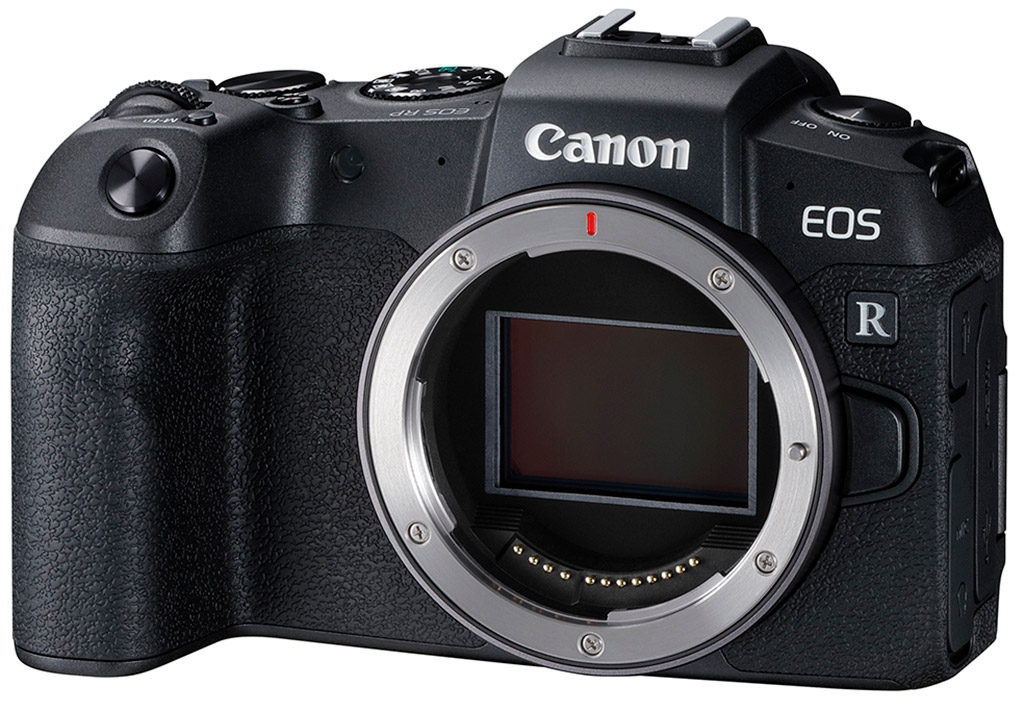

Overview
by William Brawley
Originally posted: 02/13/2019
Revised: 04/15/2020

Well, folks, we've got ourselves another one, another full-frame mirrorless camera. However, unlike the recent deluge of models, this Canon full-frame mirrorless camera sits towards the entry-level side of the spectrum for cost. Interesting times!
Now, when it comes to the history of digital cameras, especially full-frame digital cameras, the terms "full-frame" and "entry-level" have never really gone together. Historically, full-frame cameras are spec'd for the enthusiast- and professional-level photographer markets, with tough-as-nails construction, high-res sensors, fast burst rates and more, and with high price points to match. Both Canon and Nikon have made lower-tier full-frame DSLRs, with the 6D Mark II and D610 lines, respectively. However, despite being their least expensive full-frame cameras, they each started at $2,000 body-only. That's a serious chunk of change, and by and large out of the price range of most "entry-level" photographers.
The Canon EOS RP, however, bucks this trend. The EOS RP is small and lightweight yet keeps some degree of weather-sealing and comes in at a very affordable $1,299 body-only price point. And it has that ever-enticing full-frame sensor. If memory serves, this is the most affordable, new full-frame digital camera released to date.

Now, for the caveats. Does the Canon EOS RP have all the bells and whistles? No, of course not. It doesn't have an ultra-high-res sensor, it doesn't have insane continuous shooting rates, it doesn't have every video format under the sun, nor does it have nifty features like IBIS, High-Res multishot mode, or A.I.-powered AF tracking. But it was never designed to have such features. It's an entry-level camera, one designed for new full-frame users, stepping up from a smartphone, point-and-shoot or crop-frame camera. It offers a healthy but more simplified feature set all packed into a compact and lightweight camera that doesn't obliterate your budget.
On paper, it's a solid little camera that appears both fun and easy-to-use. If you've been planning to step into the world of full-frame cameras, the Canon EOS RP makes a compelling starting point.
Let's dive into the details...

Sensor & Image Quality
Much like Canon's "entry-level" full-frame DSLR, the 6D Mark II, the EOS RP is based around a similar 26.2-megapixel full-frame CMOS sensor. It's not precisely the same sensor assembly, however, but is indeed extremely similar. According to our technical interview with Canon engineers, the EOS RP's sensor has redesigned micro lenses due to the shorter flange back distance used by the RF-mount compared to EF-mount.
Paired with its 26MP sensor, the RP utilizes a newer, faster DIGIC 8 image processor (the same one as in the EOS R) compared to the DIGIC 7 seen in the 6D Mark II. Despite the newer sensor, however, the ISO range of the EOS RP is identical to that of the 6D II; the native sensitivity range is 100-40,000, but is expandable to a low ISO of 50 and a high sensitivity up to ISO 102,400.

Though many advanced full-frame cameras offer higher-resolution sensors, such as the 30MP EOS R and 42MP Sony A7R III for example, 26MP strikes a pleasing balance of detail resolving power and manageable file sizes. The EOS RP, despite the entry-level design, offers a couple more megapixels than a number of other "base model" (yet still more expensive) full-frame cameras, such as the Sony A7 III and new Panasonic S1, both of which use 24MP sensors, though such a small difference in pixel count is hardly worth mentioning.

One of the EOS RP's all-new shooting features is a built-in focus bracketing mode. With this easy to use mode, you can capture shots with deep depths of field without resorting to narrow, often sharpness-reducing apertures like f/22. In the menus, you specify the number of shots captured (between 1-999) as well as the degree of focus shift between each frame. Then, you need to put the camera on a tripod, focus on your "starting point" and fire away. The camera will automatically capture the image sequence. Now, unlike some camera from other manufacturers that have similar modes, the EOS RP will not composite the shots in-camera. You'll need to use Canon's Digital Photo Professional 4 desktop software to create the final image.

On the video side of things, despite the more or less same 26MP sensor as the 6D Mark II, the new Canon EOS RP now offers 4K video recording, in addition to the 4K Timelapse mode seen in the 6D2. It seems the new image processor now has the horsepower to support 4K video capture, which isn't surprising seeing as both the EOS R and EOS M50 utilize the DIGIC 8 chip and also offer various flavors of 4K recording. Unlike its bigger brother, the EOS R, the Canon EOS RP only offers 4K video at 24p (23.98 fps) and 25p (PAL mode). There is no 4Kp30 or higher frame rate options, though there are multiple frame rate choices for Full HD video, up to 60fps. It's also worth pointing out that 4K video on the EOS RP has a noticeable crop (about 1.6-1.7x), and the camera's maximum continuous recording time is limited to 29:59, for 4K and other resolutions. Also, unlike the EOS R, the RP does not support Dual Pixel CMOS AF for 4K video; focusing is contrast-detect only. Dual Pixel CMOS AF is available, however, for Full HD and HD video resolutions.

It might seem a little odd that an entry-level camera offers 4K solely in a more cinema-focused frame rate, an option that more advanced video shooters would appreciate. According to Canon, higher frame rate options for 4K video might have necessitated a larger body design to deal with additional heat dissipation as well as increase in price. In order to prevent that, Canon capped 4K at just 24p/25p. For more casual video shooters, wanting smoother video of faster-moving subjects and less blurring, you'll need to dip down to 1080p for faster frame rates. However, if you're looking for a full-frame video camera that shoots cinema-friendly 4Kp24, the EOS RP could be a great choice at a low price point.

Autofocus & Performance
Not surprisingly, much like the EOS R, the autofocus system on the EOS RP is powered by Canon's Dual Pixel CMOS AF technology, which uses phase detection pixels on the imaging sensor. The result is a fast, responsive autofocusing experience without any hunting or wobbling that's typical of contrast-detect AF systems. Using the RF 24-105mm f/4L IS lens, Canon claims a CIPA-rated 0.05s single-shot AF speed with the EOS RP. We've had a great experience with Canon's previous cameras with Dual Pixel CMOS AF, and the Canon RP is no exception. AF is quick and accurate, and an overall similar experience to what we see with the EOS R. However, the AF system is slightly different than the EOS R's, not only due to using a different sensor, but also because there's a few new features as well.

For starters, the number of AF points is slightly less, however AF point coverage across the sensor is the same as the R. With the RP's 26MP sensor, there are 4,779 selectable AF point positions, whereas the EOS R's 30MP sensor offered a maximum of 5,655 manually selectable AF points. In total, the EOS RP has 143 AF areas divided across the sensor. Like the EOS R, AF coverage on the EOS RP spans about 88% of the frame horizontally and 100% vertically. Another slight difference is low light focusing; Canon's spec for the low-light limit for AF functionality is -5EV on the EOS RP, which is slightly less than the -6EV rating for the EOS R (both with an f/1.2 lens at ISO 100).
Despite the entry-level designation of the RP, there are few new AF features on this camera that don't (yet) appear on its higher-end sibling. For one, both the EOS R and the new EOS RP offer Eye-detection AF functionality, but whereas the EOS R was limited to just Eye AF in single-shot AF mode, the EOS RP allows for Eye AF with Servo AF (C-AF) mode as well, and with video! Sony cameras have long had this feature in a number of their cameras, and it's really great seeing this type of AF functionality appear in other brands. When it comes to portrait photography, especially on a full-frame camera like the RP, depth of field can get insanely thin. Having reliable Eye-detection AF modes will help make sure your portrait shots will be sharp, and sharp where you want them, the eyes.
 |
The EOS RP's Eye Detection AF functionality worked well, and quickly found the subject's eye. The ability to use Servo AF alongside Eye AF helps maintain focus if you or the subject moves, which is really helpful when using shallow depths of field. |
RF 35mm f/1.8 Macro: 35mm, f/2, 1/640s, ISO 100 |
Once the camera does lock onto the eyes, and if it can see both of the eyes, you'll see two small triangles appear on the screen/EVF on either side of the AF point. You can then manually tell the camera which eye to track focus on, which is rather neat and helpful. If the camera can't detect eyes, it'll default back to the broader Face Detection. Upon intial release, Eye AF on the EOS RP worked rather well, though it seemed to require faces be somewhat close or large in the frame for it to lock onto the eye(s) itself. Canon later refined Eye AF performance, with better detection sensitivity, in a subsequent firmware update.
The other new focusing feature is a new AF point mode called Single-Point Spot AF. Unlike the standard single-point AF mode, which offers a single yet relative large AF area, the new Spot AF option enables a significantly smaller AF point, making it a better choice for critical focusing.
 |
For this photo, I used the new Spot AF option for the AF Area Mode setting, manually placed the AF point on the woman's eye, and used Servo AF to maintain focus through a burst of shots. |
RF 35mm f/1.8 Macro: 35mm, f/1.8, 1/80s, ISO 400 |
When it comes to performance specs, it's very clear that the EOS RP is not a sports- or action-centric camera by any means. (Again, it's not designed to be.) For continuous shooting, the EOS RP can shoot up to 5fps in single-shot AF mode, or just 2.6fps with continuous AF in Tracking Priority (it'll do up to 4fps with Servo AF in "shooting speed priority" mode). Admittedly, those are rather measly burst rate by today's standards, but for a full-frame camera designed for entry-level users, it's not all that surprising. Is this going to be a go-to camera for the serious action shooter? No. But the camera should be quick enough for the mom or dad who wants to capture some action shots of their kid running around or playing sports. The EOS RP should be more than capable of handling those photographic tasks with ease.
While the continuous shooting speeds aren't anything to write home about, the EOS RP's claimed buffer depths are rather impressive, especially if you use a UHS-II memory card. With this high-speed SD card type, the EOS RP's buffer is basically unlimited (until the SD card fills) regardless of image quality setting. The only limit is when using simultaneous RAW + JPEG modes (either RAW + Large/Fine JPEG or C-RAW + Large/Fine JPEG) in which case, the EOS RP will capture up to 130 RAW+JPEG images or about 210 C-RAW+JPEG images.

Design & Ergonomics -- Hands-On Experience
The design of the Canon EOS RP is, not surprisingly, similar to the EOS R, with a matte black color, angular lines and contours and an altogether compact design with a protruding handgrip. In terms of its size, the EOS RP is noticeably smaller than the EOS R. The body is thinner, the grip is smaller and the entire camera can easily rest in the palm of your hand. In fact, it's rather amazing that Canon's managed to cram a full-frame sensor in there. The length of the camera body is, for example, quite similar to that of the Canon T7i!

However, despite the smaller size, the camera is still amazingly comfortable to hold. The grip is still large enough to comfortably wrap your hand around, and the contours fit the hand nicely. The camera body isn't as tall as the EOS R, so those with larger hands will likely find their pinky finger having to rest underneath the camera. Canon has thought of this issue, though, and will sell a small screw-in grip accessory that adds a bit of height to the camera and grip, while retaining access to the SD card and battery compartment and providing a 1/4-20 tripod socket.


When it comes to controls, the EOS RP doesn't offer much surprises. It features a pretty standard array of buttons and controls for an entry-level camera, including front and rear command dials, a 4-way directional pad on the rear, a touchscreen display, and a few dedicated (yet customizable) buttons on the top and rear. Overall, the array of controls are similar to those of the EOS R and are situated around the camera body in similar locations.
There are a few notable differences between the RP and R when it comes to external features. On the top-deck, you'll notice the EOS RP lacks a secondary OLED status display screen, but perhaps most notably, the EOS RP features a standard PASM mode dial in place of the EOS R's odd Mode Button control setup. For users of most other DSLRs, Canon or otherwise, a standard PASM dial is a much more familiar control, and so it makes sense to have this command mode dial on the entry-level EOS RP. The Mode Button on the EOS R works fine, but as we found, it takes at least two operations to change shooting modes, whereas it would be much simpler and faster to use a traditional PASM mode dial.


Looking at the rear of the camera, those familiar with the EOS R will notice the lack of the somewhat controversial Touch Bar control. Given the smaller size of the camera body and the large LCD screen, perhaps there simply wasn't room to fit that Touch Bar on there. However, given the lukewarm reception to that control on the EOS R, we're not going to fret too much over its absence on the EOS RP. The Touch Bar felt underutilized and frankly a little awkward to operate. The EOS RP camera, therefore, works just fine without it.

As mentioned, in the hand, the camera feels really nice. It feels solid and well built, much like we've experienced with most other Canon cameras. Despite its "entry level" designation, the EOS RP does feature some degree of weather sealing, more or less on-par with the 6D Mark II from what we were told. The camera body is constructed out of sturdy polycarbonate with a machined magnesium alloy chassis on the interior; it's not a full mag-alloy body. Regardless, the camera feels light, comfortable and very robust in its build quality, and it's great to have a little reassurance that you needn't worry about a bit of dust or rain.

The electronic viewfinder on the EOS RP is not as large nor as high-res as the EVF on the EOS R, but it is quite nice. The EVF here is only a 0.39-inch OLED screen with 2.36-million dots of resolution, whereas the EOS R used 0.5-inch OLED display with 3.69 million dots. The EVF on the RP isn't extremely large (0.70x magnification), but it's large enough and crisp and generally works very well. By default, the EOS RP sets the refresh rate to 60fps or "Smooth" as the menu says. This uses more battery power, but offers a smoother, more lag-free, more real-time shooting experience. You can, however, set the EVF to a power saving mode, but that drops the refresh rate significantly, creating a noticeably laggy, stuttering experience. Unless you're in dire need of saving battery life, we'd recommend keeping it on the "Smooth" EVF setting.

While we're on the subject of battery life, it should be noted that the EOS RP does not use the same LP-E6N battery pack as the EOS R and many other Canon DSLRs. Instead it uses a smaller, less powerful LP-E17 like that of the EOS M cameras and a number of the Rebel-series DSLRs. This is likely a cost-saving or space-saving measure (or both), but needless to the say, the battery life on the EOS RP isn't fantastic. The CIPA rating is around 250 shots per charge with the LCD and 210 with the EVF, using default modes and not the "ECO" LCD or "Power-saving" EVF mode. Real-world use, however was better than the CIPA rating, and we were able to get about 300 or so shots with a single battery in addition to spending a lot of time diving into the menus. For casual shooting, the battery life is likely just fine, but we'd recommend getting an extra battery or two if you plan on extensive or longer shooting periods. On the other hand, the Canon EOS RP supports USB charging, which is fantastic and lessens the "range anxiety" of the smaller battery packs if you're going to be out for a long time away from the battery charger. The caveat being that you then need to bring a portable battery pack with a USB port.

Connectivity, Power & Storage
Like the EOS R, the new RP offers only a single SD card slot, though this isn't all that shocking given its entry-level placement. The card slot is also UHS-II compatible like its higher-end sibling.
As mentioned earlier, the EOS RP supports in-camera charging via USB using the optional PD-E1 USB Power Adapter. And with an AC adapter and DC coupler the EOS RP can be continuously powered. (The PD-E1 USB Power Adapter cannot power the camera.) The RP uses a newer reversible USB-C terminal, but it's a USB 2.0 Hi-Speed port. A Mini Type-C HDMI port, 3.5mm microphone input and headphone jacks, as well as a remote control terminal for wired remotes are also provided.
When it comes to wireless connective, the EOS RP features the standard combo of built-in Wi-Fi and Bluetooth Low Energy. With the Wi-Fi connection, users can remotely operate the camera as well as transfer media to a paired smartphone or tablet. The BLE technology also helps facilitate not only an easy Wi-Fi connection between devices but also can maintain a constant paired connection allowing for quicker, easier transferring of images.

Canon RP Pricing & Availability
The Canon EOS RP went on sale in March 2019, with an initial body-only retail price of US$1,299 -- the price has since dropped to $999 body-only. Two kit versions are also available: 1) an RF 24-105mm f/4L IS USM lens kit with an original retail price of $2,399 (dropped to $1,899), and a kit with an RF 24-240mm f/4-6.3 IS USM lens that sells for $1,899 (reduced to $1,499).
• Canon EOS RP Gallery •
In The Box
The Canon EOS RP body-only retail box (as reviewed) includes the following items:
- Canon EOS RP Mirrorless Digital Camera (Body Only)
- Canon LP-E17 Lithium-Ion Battery Pack
- Canon LC-E17 Charger for LP-E17 Battery Pack
- Canon R-F-5 Camera Cover
- ER-EOSRP Strap
- Limited 1-Year Warranty
Performance
Timing and Performance
Good entry-level performance, with very generous buffer depths.
| Startup/Play to Record | ||
|---|---|---|
| Power on |
~1.1 seconds
|
Time it takes to turn on and capture a shot. |
|
Play to Record, |
~0.6 second
|
Time until first shot is captured. |
Powerup to first shot was sluggish compared to DSLRs, and a bit faster than most mirrorless cameras we've tested at about 1.1 seconds. Switching from Play to Record mode and taking a shot was faster, at about 0.6 second, but also slower than most DSLRs.
| Shutter Response (Lag Time) EFCS (default) / Electronic Shutter |
||
|---|---|---|
|
Full Autofocus |
0.218 / 0.462
second |
Time from fully pressing shutter button to image capture. All AF timing measured with a Canon RF 24-105mm f/4 kit lens at ~50mm. |
|
Manual Focus |
0.174 / 0.198
second |
For most cameras, shutter lag is less in manual focus than autofocus, but usually not as fast as when the camera is "prefocused". |
|
Prefocused |
0.055 / 0.159
second |
Time to capture, after half-pressing and holding shutter button. |
In terms of the Canon R's ability to determine that it's properly focused when shooting the same target multiple times (with no change of focus setting between iteration, to remove the impact of lens AF speed), its full autofocus shutter response was about average for a mirrorless camera. Using the Canon RF 24-105mm f/4 kit lens, we measured 0.218 second for full AF lag using single point (center) AF-S with the default electronic first curtain shutter (EFCS) mode.
Shutter lag using manual focus was a bit faster at 0.174 second. When "prefocusing" the camera by half-pressing and holding down the shutter button before the final exposure, the EOS RP's shutter lag was quite low, at only 55 milliseconds.
As you can see, switching to the all-electronic shutter (Silent mode) yielded slower lag times. Unlike the EOS R, the RP doesn't offer a fully mechanical shutter mode.
To minimize the effect of different lens' focusing speed, we test AF-active shutter lag with the lens already set to the correct focal distance.
| Cycle Time (shot to shot) | ||
|---|---|---|
|
Single Shot mode |
0.29 second
|
Time per shot, averaged over a few frames. |
|
Single Shot mode |
0.34 second
|
Time per shot, averaged over a few frames. |
|
Early shutter |
No
|
Some cameras don't snap another shot if you release and press the shutter too quickly in Single Shot mode, making "No" the preferred answer. |
|
Continuous High |
0.20 second
(5.0 fps); Unlimited frames; 1.3 seconds to clear* |
Averaged time per shot, with no apparent limit other than card capacity. |
| Continuous High |
0.20 second
(5.0 fps); Unlimited frames; 1.5 seconds to clear* |
Averaged time per shot, with no apparent limit other than card capacity. |
|
Continuous High |
0.20 second
(5.0 fps); 130 frames; 10.4 seconds to clear* |
Averaged time per shot, then slows down to an average of 0.26s or 3.9 fps when buffer is full with a lot of variation. |
|
Continuous High |
0.20 second
(5.0 fps); Unlimited frames; 1.2 seconds to clear* |
Averaged time per shot, with no apparent limit other than card capacity. |
|
Continuous High |
0.20 second
(5.0 fps); 210 frames; 13.4 seconds to clear* |
Averaged time per shot, then slows down to an average of 0.26s or 3.9 fps when buffer is full with a lot of variation. |
| Flash recycling |
N/A
|
Flash at maximum output. |
|
*Note: Buffer clearing times measured with a 64GB Lexar Pro 2000x UHS-II SDXC card. Slower cards will produce correspondingly slower clearing times. Slow cards may also limit length of bursts in continuous mode. ISO sensitivity and noise reduction settings can also affect cycle times and burst mode performance.
|
||
Single-shot cycle times were quite fast on average at about 0.3 second for best quality JPEGs or RAW+JPEG files, but cycle times for RAW+JPEG varied a lot. (Note that we no longer test single-shot mode with just RAW files, as the results are usually somewhere in between JPEG and RAW+JPEG modes.)
Continuous High mode speed was typical for an entry-level mirrorless camera. We measured a consistent 5.0 frames-per-second for all file types, matching Canon's specifications. With Servo AF enabled (continuous autofocus), Canon claims the EOS RP's max burst speed is 4.0 fps with Shooting Speed Priority, however we didn't test that in the lab. In low-speed continuous mode (Tracking Priority), the burst rate was 2.6 fps.
Buffer depths were excellent with our fast Lexar Pro 2000x UHS-II card, at unlimited frames for best quality JPEG, RAW or C-RAW files. With RAW+JPEG the buffer depth was 130 frames and C-RAW+JPEG it was 210 frames, which is still excellent.
Buffer clearing times were pretty good for the class, ranging from just over a second when shooting JPEGs, RAW or C-RAW, to up to 13.3 seconds after a max-length burst of C-RAW+JPEG files. The camera lets you adjust settings while the buffer is clearing, but you can't view just-shot photos until after the buffer clears.
Bottom line, the Canon RP offers decent performance for its class, with fast startup, reasonably quick autofocus, low shutter lag, decent burst speeds and very generous buffer depths.
Battery
Battery Life
Poor CIPA-rated battery life.
| Operating Mode | Number of Shots Default / Power Saving modes |
|---|---|
|
Still Capture
(CIPA standard, EVF) |
210 / 250
|
|
Still Capture
(CIPA standard, LCD Monitor) |
250 / 270
|
The Canon RP uses a custom LP-E17 rechargeable lithium-ion battery for power, and ships with a dedicated battery charger though in-camera charging is also supported with the optional PD-E1 USB Power Adapter.
CIPA-rated battery life is poor even for a mirrorless camera, at 210 shots per charge with the EVF and 250 shots with the LCD monitor using default settings, however Power Saving mode can boost the EVF figure to 250 by reducing the refresh rate and Eco mode can boost the LCD monitor figure to 270 shots by dimming and turning off the LCD faster. Still, we strongly recommend you pick up a spare battery.
The table above shows the number of shots the Canon RP is capable of (on a fully-charged rechargeable battery), based on CIPA battery-life and/or manufacturer standard test conditions. While real-world battery life tends to be much better for mirrorless cameras, CIPA-rated battery life is still very useful for comparison purposes.
(Interested readers can find an English translation of the CIPA DC-002 standards document here. (180K PDF document))
Image Quality
Editor's Note: Fear not! Our EOS RP print quality analysis is coming. Due to the current pandemic situation, we've had to limit our time at IR's Galagtic HQ. Rest assured that once we are able to return to HQ, we'll fire up the printer once more.
Below are crops from our laboratory Still Life target comparing the Canon EOS RP's JPEG image quality to a number of competing cameras featuring either similar resolution sensors or price points. Unlike most Image Quality Comparisons, there is no predecessor to the new Canon EOS RP. For this comparison set, we're showing it up against the similar Canon 6D Mark II , the higher-end Canon EOS R, the Fujifilm X-T30, Nikon Z6, and the Sony A7 III.
NOTE: These images are from best quality JPEGs straight out of the camera, at default settings including noise reduction and using the camera's actual base ISO (not extended ISO settings). All cameras in this comparison were shot with our very sharp reference lenses. Clicking any crop will take you to a carrier page where you can click once again to access the full resolution image as delivered straight from the camera.
Canon EOS RP vs Canon 6D Mark II at Base ISO


Canon EOS RP vs Canon EOS R at Base ISO


Canon EOS RP vs Fujifilm X-T30 at Base ISO


Canon EOS RP vs Nikon Z6 at Base ISO


Canon EOS RP vs Sony A7 III at Base ISO


Canon EOS RP vs Canon 6D Mark II at ISO 1600


Canon EOS RP vs Canon EOS R at ISO 1600


Canon EOS RP vs Fujifilm X-T30 at ISO 1600


Canon EOS RP vs Nikon Z6 at ISO 1600


Canon EOS RP vs Sony A7 III at ISO 1600


Canon EOS RP vs Canon 6D Mark II at ISO 3200


Canon EOS RP vs Canon EOS R at ISO 3200


Canon EOS RP vs Fujifilm X-T30 at ISO 3200


Canon EOS RP vs Nikon Z6 at ISO 3200


Canon EOS RP vs Sony A7 III at ISO 3200


Canon EOS RP vs. Canon 6D Mark II, Canon EOS R, Fujifilm X-T30, Nikon Z6, Sony A7 III


Field Test
The compact, well-priced EOS RP is a great entry-level full frame camera

When looking at the Canon EOS RP, it's important to first frame your reference of judgment around what this camera is, and perhaps more importantly, who it was designed for. Upon its release, there was a flurry of YouTube videos and written editorials lambasting Canon for its choices in a mirrorless camera, and how it was a bad launch of a bad camera for uninformed buyers.
A cheap shot. A choice for easy sales over innovation. A lame duck.
But while there are some issues with the camera that of course should be noted, these over-the-top claims of the RP's ineptitude are largely overstated. They are based on expectations set far too high and on rumored specifications and wanton hopes (on that note, I've already gone on the record citing the poison that are rumor sites, so I won't go into that here).
When you look at the RP for what it is, what it is designed to do, and who it is designed for, it's hard to be upset with it. It produces high-quality images, has a pretty reliable autofocus system, makes good looking video for those just interested in having it as a feature, and is, of course, a full frame camera.
That last bit, full frame, is especially important. For just about every entry-level photographer who has some knowledge about cameras, their wish list of features these days will pretty much always include "full frame." It's the one feature of cameras that gets the most attention nowadays, I might argue even more so than megapixels. The idea is, if it's full frame, it's better.
And while that statement is unequivocally false, it's a strong belief that exists. And as false as that statement is, having full frame does indeed have advantages.

Canon has a pretty straightforward plan when it came to mirrorless, and I'm not just saying that with reference to the R and RP. Even before those two cameras, Canon's choices with mirrorless ring with the same two goals in mind: 1) Let's accentuate the kits of our DSLR shooters, not replace their equipment. 2) Let's focus on the low end before we fill out the high end.
Goal number one and goal number two are intrinsically linked. In order to accentuate a full frame, high-end DSLR, you don't want to replace it, but fill in some gaps. That strategy allows Canon to build equipment that has a few features that their DSLRs may not have, while also allowing them to cut corners in other places that the DSLRs already fulfill. Simultaneously, while providing equipment for current owners designed to fill gaps, these cameras that are obviously overall lower end have a lower price point, lower skill gap, and therefore appeal to new or newer shooters. So instead of coming out of the gate with a strong, expensive, high-end camera with a limited customer base, they instead release cameras that are more aimed at pleasing the masses.
This, of course, gives the high-end shooter a lot to complain about, but the average consumer photographer won't see a problem. What they will see is "Canon" on the front of the camera, and we cannot undervalue how important that is. Canon has a huge amount of power just in their name alone given their success over the last nearly two decades. Never underestimate how strong their brand recognition still is thanks to that.
So with a full understanding of where Canon stands and why they make the decisions they do, the RP starts to make a lot of sense. It's the most affordable full-frame mirrorless camera released so far, and it has the word "Canon" emblazoned on the front. For many, many consumers that's going to be more than enough to get their attention. And for that kind of a consumer, the RP does a lot right.

Build Quality and Design
The second time I took the RP out to test, I went to a large garden with my parents and their friend. When I met up with my dad, who has been a hobbyist photographer for over 50 years, he immediately commented on the RP which was strapped across my body.
"Oh wow, is that a new camera? I love the size!" He said. And to that note, I agree with my dad. The size of the RP is really nice. Is it unique in that regard? Of course not, Sony has been making small full frame cameras for years.

But those cameras don't have the word Canon on them, and that's one of the features my dad gravitated towards as he has been shooting Canon since the 90s.
With the EOS RP, Canon did an excellent job of making the camera look and feel familiar, a fact that absolutely cannot be overstated. Though much smaller than Canon's full-frame DSLRs, the grip feels robust enough for even somewhat large hands. The rest of the body design feels far more compact than other full frame cameras, but nothing feels particularly cramped. There aren't too many buttons, but just enough. Even the finish of the plastic feels right, as it's the quintessential matte black plastic that just feels like a Canon. If you put the RP in a Canon shooter's hand while they are blindfolded, they would instantly tell you it feels like a Canon.
Remember, this has power.
The top of the RP is very minimalist, with only a power switch, main control dial, record button, M-Fn button and two control dials used for shutter and aperture. There is no topside LCD, but it doesn't feel like that was a huge sacrifice since the rear articulating LCD can offer so many different view options. Though I personally am not a fan of how Canon changed the power switch design and stills/video toggle switch from their DSLRs, I have gotten used to it since the EOS R and it did not bother me as much on the RP. Change takes time, and I'm adjusting.
Speaking directly to the topside main command dial, I am very happy that Canon ditched the unintuitive "Mode" button on the EOS R and opted for the tried-and-true PASM mode dial of their DSLRs on the RP. Changing settings on the EOS R was completely redesigned for some reason, and it was not fun to have to relearn how to use my camera. The RP feels like a much better transition camera from DSLR to mirrorless because it doesn't force me to relearn old habits.

I am happy to report that the maligned Touch Bar control on the EOS R did not find its way to the RP. The RP is a better camera for not having that additional piece of technology.
Overall, it's as if Canon immediately learned from their mistakes on the EOS R design and addressed them with the RP. I say "as if" there since it's pretty likely the RP was already designed when the R came out, but I like to pretend that media and consumer feedback helps frame new products this quickly. I'll continue to lie to myself.
Except for the Touch Bar, the rear of the RP looks strikingly similar to the EOS R, with no rear command dial around the menu selector and an identical layout in every way.

The left side of the camera is also almost identical, with basically the same layout of the many ports including a mic and headphone jack, mini HDMI, USB-C port and intervalometer/remote port. The only change is the size of the rubber flap covering the USB/HDMI area, and the orientation of those two ports (the RP flips the design of the R for some reason, with the USB port below the HDMI port).

The RP is similar enough to the R and Canon DSLRs of the past that it's immediately familiar and easy to use for a Canon shooter, but different enough that you can immediately see and feel a difference between the RP and the R, which I argue is a very good thing (unlike with the Lumix S1 and S1R or the Nikon Z6 or Z7 which in both cases feel identical and are hard to even visually discern from one another).

The Menu of the RP is, while absolutely not revolutionary in any way, easy to navigate and operate. Canon has for years managed to distill their menu system in such a way that it's not very hard to find the specific items you're looking for. Items that are related to each other are located in near proximity, and the layout of the menu itself has changed little over the many years. Take notes Sony and Nikon, please.
Two obvious changes to the RP over the R involve the battery and the location of the SD port, and the expectation of what happens when you change lenses.
Rather than a dedicated SD slot door on the right side of the camera like the EOS R and a number of Canon DSLRs, the RP goes with the old point-and-shoot design of housing the card slot under the same door as the battery. This isn't my favorite place for memory card location as you cannot operate the camera and also swap the card. Because the door opens, the camera will turn off during the card swapping phase. Additionally, some tripod mounts will block the battery door from being able to open, which means sometimes you will have to fully remove the camera from a tripod just to change the memory card, which is an obvious annoyance. Not a huge deal, but I do prefer a dedicated memory card door.
On this same note, the battery for the RP is the LP-E17, a much smaller battery than the pretty ubiquitous LP-E6 (or in the case of the R, the better, newer LP-E6N). This battery has a considerably lower capacity than the LP-E6N but takes pretty much the same amount of time to charge from empty. When shooting stills, you can probably get about a half day of continuous shooting, and in video much, much less. It's absolutely not ideal, and since the RP only ships with one battery, you are going to have to spend the additional $50 to pick up at least one more if you want to have a good full day experience with the RP.
When speaking about battery life, you also have to consider the RP's auto shut off settings. By default, the RP will sleep after one minute, but you can set it as low as 15 seconds. If you're worried about battery life, I recommend setting it to that 15 seconds.
But on that note, the RP doesn't actually just "sleep" here, it actually fully turns itself off. You even get the "sensor cleaning" vibrations and visual indication on the rear LCD. I am going to reference this later, as a glitch occurs because of this function and I have successfully reproduced it repeatedly — more on that in the next section.
Overall, the design both externally and internally of the RP feels pretty clean and well thought out, perhaps more so than even the EOS R. If there are any problems to be had with the RP, they happen in its functionality.

Using the EOS RP
I think it's pretty much universally agreed upon that the Canon EOS RP feels underpowered for a full frame camera, and it is... if you're looking at it from the reference point of other full frame cameras. As an entry-level mirrorless camera that also happens to be full frame, well it's pretty much what I expected.
Here is a quick overview of what the RP does right:
- 26.2-megapixel full frame sensor
- Solid 2.36M-dot EVF
- Shoots 4K, albeit limited in scope but also...
- Shoots in Full HD
- Shoots 5 FPS stills
- Has pretty fast and reliable Eye-AF/tracking AF
- Has pretty good image quality overall
If you're the RP's target market, these are the only features you really care about with a camera. But there are a few more that buyers may not even realize they want:
- Has a feature that allows you to drag your thumb across the back of the LCD to change focus point while looking through the EVF
- Has the new Canon Fv shooting mode
- Has fully enabled, well-designed touch screen access to an assortment of features
I will say that by default, the RP does have some odd choices programmed into it. For example, that absolutely excellent touch-and-drag AF point adjustment feature isn't on by default. Additionally, the rear directional button around the Q/Set button doesn't act like it does on every other Canon camera I've ever used, which is to immediately change my focus point. However, on the RP, by default, it's only used for adjusting settings in Fv Mode, even if you're not currently in Fv Mode. The directional buttons simply do nothing while in other shooting modes. This means that if you're using the camera right out of the box, your default AF setting is going to be single point mode, and then you're either forced to pull the camera away from your eye and use the touchscreen to move the AF point, or press the "AF Point" button next to the thumb grip and then use the directional buttons. This strikes me as extremely weird, it's certainly not intuitive for a seasoned Canon shooter, and even if this was my first Canon camera ever it still isn't how I would expect the camera to function.

Luckily, these strange choices can be overridden in the settings, and it's not hard to find those settings either (as previously mentioned, the menu is pretty easy to get the swing of).
The EOS RP feels pretty good to use. The camera is very responsive, turns on and off about as quickly as you can possibly expect, and captures photos in a nice, intuitive way.
I only ran into one "major" problem with the RP, and it's a weird one. I mentioned earlier that the RP doesn't actually "sleep" so much as it turns itself off completely. Well, under this specific circumstance, you may have a problem:
- Allow the camera to put itself to sleep/power off without toggling the on/off switch
- Wait 15-30 seconds while the camera is off
- Press the shutter button to wake the RP
Instead of turning back on as expected, the RP will indeed awaken but you will have no autofocus points at all and the camera won't focus and you will not be able to capture a photo. The only way to wake it out of this weird state is to toggle a switch; I've gotten it to wake by changing the shooting mode or toggling the AF/MF switch on the lens, but there are probably other ways to do this as well.
This glitch doesn't always happen (in fact, it's more likely that it does not happen as I've personally only experienced it four times while shooting, and a fifth time when specifically trying to recreate the bug), but when it does it always feels like the most inopportune time. Consider being on a nature hike and seeing a bird you want to photograph. This actually happened to me, and I missed the shot of course. This could also pose a problem if you're trying to take photos of your kid's soccer game.
Frustrating, though somewhat predictable, the best way to avoid this glitch is to just always use the physical power switch until Canon patches it.

Other than that though, I have to say that the Canon EOS RP is just about exactly what I was expecting. It feels like a Canon, works pretty darn well in just about every shooting capacity I tried that a novice to intermediate shooter would do, and didn't really cause me any other issues. Image quality is also pretty great, with solid dynamic range (not market leading, but by no means a slouch either) up to ISO 1600.

That ISO performance is the only weak spot in the camera's overall capability for its audience, as even for a full frame sensor, it lags behind other cameras. Though quality is, as expected, pretty clean from ISO 100 to 3200, ISO 6400 has what I perceive to be pretty obvious noise. From that point and higher, the RP just doesn't look great. ISO 6400 used to be the standard for "good" ISO performance, but technology has advanced considerably and I generally expect pretty clean images at least to that point now, especially when we're talking full frame sensors that lack in-body image stabilization (if I can't drag the shutter with IBIS's help, I definitely expect the sensor's ISO to aid me in low light).
So while we can cut the RP a lot of slack for being made for a more entry-level audience, the fact still remains that it is a full frame sensor, and I expect high performance from a full frame sensor regardless of its target audience. Here, the RP just doesn't quite cut it.
Here is a sample of images taken at different ISOs to illustrate how the RP performs:


On this note, the dynamic range of the RP isn't the best, with a lot of color noise hiding in the shadows. Though yes, we can pull detail what may appear like fully black areas of an image, it's not usable detail.


The last thing I want to mention is the lack of in-body image stabilization on the RP. Well, it's not just the RP, but all of Canon's cameras. None of them have it, and it's becoming noticeable to me. Because most other ILC cameras on the market feature IBIS, including all other latest-generation full-frame mirrorless cameras currently available, not having body-based stabilization after getting used to it being there is a really large mental hurdle for me to overcome.
I understand that IBIS is not necessary to capture great images, and with the advancements in ISO, we can certainly bump ISO up to compensate for low light rather than getting much faster lenses or using slower shutter speeds. But there are cases where I really wish IBIS existed. Take for example a food festival I went to with EOS RP in hand. With the limited lens selection currently available for the RP (more on that later), the best option available to me was the 24-105 F/4 RF lens, which has lens stabilization in it. I went from walking around outside in the sun (where my ISO was set to 100) to going inside what my eyes perceived to be a well-lit tent. Because I was focused on being at the festival and not wholly thinking about capturing amazing photos, I didn't remember to change my ISO to AUTO, which would normally be my move here. I was taking photos all afternoon at ISO 100, and because I wasn't focused on shooting as much, I didn't notice a problem until I was about ready to leave. Unfortunately, my shutter speed was just a bit too slow in Aperture Priority (even at f/4) to get crisp shots. Therefore, every photo I had taken to that point was blurry. I didn't even think about it because I was so used to getting crisp shots even as low as 1/15 second on my other cameras with IBIS, and was crestfallen when I realized my error.

And yes, this was definitely my error. I messed up, but I feel like I still have room to cast some blame on the camera. It's 2019. All your competitors have built some kind of on-sensor stabilization. Optical stabilization just doesn't cut it anymore, Canon, and leaving it off your cameras despite seeing competitors and hearing the words of your users is becoming an un-ignorable "con" when evaluating your equipment.
Video Performance
I'm only going to briefly talk about video here because our video reviews are standalone, but I do want to address this because video is the one area where most of the complaints online have surrounded.
Right off the bat, let's address the elephant in the room: the EOS RP can only capture 4K at 23.98p, and only offer Full HD capture at 29.97p and 29.97 (Light) and 59.94p.
Yeah, that's super weird. If you want to shoot at 24p, you have to capture in 4K. But if you want to shoot in 30p, you have to shoot in Full HD.
Canon EOS RP 4Kp24 Sample Video #1 Download Original (185.6 MB MP4) |
Canon EOS RP 1080p30 Sample Video #1 Download Original (64.2 MB MP4) |
There are no further slow motion options available. In fact, there are no other movie settings at Full HD quality and above except those three (there are is also 720p capture at 29.97p and 59.94p, but 720p is ludicrously low quality by 2019 standards and you don't even gain additional framerates for choosing to go that low).
It's hard to defend these choices. Even for an entry-level camera, these are woefully incomplete video capture options, and the criticism Canon has faced due to these settings is warranted. There were creators looking to use the EOS RP as a video camera, and this just doesn't have the capability necessary for that job. The message Canon is sending here is... buy an EOS R.
And that's somewhat fair. If you want more robust video features like a wider array of capture settings, internal and external C-Log capture, and even external 4:2:2 10-bit, get the EOS R. It's a more complete camera that honestly gets a lot right. It's just disappointing that there isn't a strong video contender from Canon that is also lower priced. And it's weird, since you see many video capabilities coming out of someone like Sony with their A6400, but that camera isn't full frame. If Canon offered the strong EOS R video features on the RP, the RP would eat the A6400's lunch. I guess Canon doesn't think that way, because as it stands the RP just doesn't compete well against something like the Sony A6400 because of these really limited video features, despite the fact the RP uses a larger sensor.
Canon EOS RP 4Kp24 Sample Video #2 Download Original (200.4 MB MP4) |
Canon EOS RP 1080p30 Sample Video #2 Download Original (56.3 MB MP4) |
As far as quality goes, the 4K video is pretty sharp and high quality, visually speaking. However, the Full HD video in comparison is far less sharp and a bit "muddier" overall. This is normally not as big of a deal as it is with the RP though since usually, shooters have their choice of more framerate options between both 4K and Full HD. Unfortunately, in this case, the RP limits your choice so much that the fact the Full HD is noticeably worse is especially bad given you cannot choose to shoot in 30p in 4K, should that be your preference.
There is also some pretty atrocious rolling shutter that's immediately obvious in 4K, though it's less of an egregious situation when shooting in Full HD. I generally don't care that much about rolling shutter, but even slow panning motion showed it when in 4K and that's not good.
One other note on video: there is a significant 1.6x crop factor when shooting 4K video on the EOS RP, which is becoming a tradition with Canon hybrid cameras. There is no crop when shooting in Full HD, but as discussed your capture options are rather limited there as well.
The crop in 4K is quite severe, as you can see here:


The whole package
There is one final note I would like to make about the EOS RP, and it doesn't have to do with the RP by itself specifically. Instead, it's the market the RP finds itself in. I am not referring to the landscape of digital hybrid cameras, but instead the wholly-controlled Canon situation. Canon launched the RP into an environment where it has released four lenses at the launch of the RF mount and announced one more after. The 28-70mm f/2, the 24-105mm f/4, the 50mm f/1.2 and the 35mm f/1.8. The cheapest of those lenses is the last one, coming in at $500. The rest? They're very expensive and are all higher-end L-series lenses. The RF 24-105 is $1100 and the other two are hugely expensive, pro-tier optics.
Canon has no pro-level RF body.
I understand that Canon wanted to put emphasis on its lens-making prowess, and that's why three of the four lenses that kicked off the RF line were their L-series, pro-level glass. But the two bodies they released, and especially the RP, are not bodies that will attract customers who are going to spend that kind of cheddar. The only two native RF-mount Canon options are a $500 35mm, and an $1100 24-105mm. So even though the RP is the cheapest full-frame mirrorless on the market, it is not supported by enough optics that keep it there.

That's my strongest beef with the RP. If you're going to make a solid, quality, low-end mirrorless camera, don't throw it into a market where you as the maker have put more time into the highest-end optics you could make. It makes the RP feel unsupported.
I understand Canon will be releasing more lenses as time goes on, but that's not the point. The point is a camera that came onto the market a couple of months ago and the environment that camera was, and still is, it just isn't a good one for a product aimed at the lower end.

What I liked:
- Great overall image quality
- 26.2-megapixel full frame sensor
- Flip-out vari-angle articulating touch screen is easy to operate and feels good to use
- The RP features a return of the original design of Canon top command dials, and doesn't have the touch bar that the EOS R has
- Allows you to drag your thumb around the rear LCD while using the EVF to change focus points intuitively
- Pretty fast processor is able to handle the workload of much more data thanks to a full frame sensor
- Has reliable tracking, including Eye-AF
- The cheapest full-frame mirrorless camera on the market
What could use improvement:
- ISO performance lags behind other full frame cameras from competitors
- Lacks image stabilization on the sensor, which is a huge weak point of Canon's entire mirrorless system to date
- Yet again, Full HD video quality is a noticeable downgrade compared to 4K
- Video features are seriously sub-par
- Underwhelming battery life due to the smaller LP-E17 battery pack
- Lacks strong lens support for the consumer market the RP was designed for
- Unlike the EOS R, the RP doesn't cover the sensor with the shutter when removing lenses (like most mirrorless cameras)

Looking at the RP, I understand it is not the camera certain Canon users wanted. It's very clearly aimed at the low-end of the interchangeable lens market, and that is Canon's strategy. But just because you disagree with their strategy doesn't mean it's a bad camera. For who it is designed for, it's actually pretty great. It's a good still image-focused camera that is very responsive, is easy to operate, and has just enough customization to it to satisfy even intermediate level shooters. It's not going to win any technical achievement awards, but it is going to move units to an industry more and more dominated by general consumers than professional photographers. For a big business like Canon, their decision making makes sense from that perspective.
Video
by Jaron Schneider | Posted: 06/04/2019
Canon EOS RP 4Kp24 Sample Video #1 Download Original (185.6 MB MP4) |
You could argue that many of the mirrorless and DSLR cameras on the market today are not video cameras, and you wouldn't be wrong. Though every camera released in the last several years has the capability of capturing movies, only a select few of them do it well enough to be labeled as a "video camera." So while a camera like the Sony A7 III is less of a "video camera" than, say, the Nikon Z6, they're both usable as such.
Where am I going with this? When looking at the Canon EOS RP, though it is a camera capable of video capture, its overall video features, or lack thereof, do not make it a compelling option if you're primary focus is video. The RP brings a lot to the stills capture area for entry-level photographers who want access to full frame, but most will find that it's best to pretend the RP cannot capture video, so disappointing you will find the experience.
The EOS RP doesn't take bad-looking video for the most part, but the problems with the camera are rooted in the perplexing choices Canon made in the implementation of its abilities. In our Field Test of the RP, I mentioned the most irritating design choice on the camera when looking at its video capabilities lies in limited frame rate options:
- 4K (UHD, 3840 x 2160)
- 23.98, 25 fps / IPB: 120Mbps // 869 MB/min
- Full HD
- 59.94p/50.00p / IPB: Approx. 60 Mbps // 440MB/min
- Full HD
- 29.97p/25.00p / IPB: Approx. 30 Mbps // 225MB/min
- Full HD
- 29.97p/25.00p / IPB Lite: Approx. 12 Mbps // 87MB/min
- 720p HD
- 59.94p/50.00p / IPB: Approx. 26 Mbps // 196MB/min
The EOS RP can only capture 4K video at 23.98p (or 25p for PAL) and only offers Full HD capture at 29.97p and 59.94p.
Canon EOS RP 1080p30 Sample Video #1 Download Original (64.2 MB MP4) |
For a novice, frame rates are generally either ignored or not understood at all, so it's possible that the target market for this camera would not care about any of this. But from the perspective of an informed user, what Canon has chosen to do here is baffling. I understand if the RP's processor isn't capable of managing the extra 6 frames per second in 4K to offer 30p, but that doesn't excuse not offering 24p from being available in the 1080p option. It just doesn't make sense.
The problem is made worse by comparing the quality of footage captured on the RP.
If you care about the quality of your footage, shooting in 4K is the only way to go on the RP. Like most Canon cameras released in the last five or so years, the 1080p footage looks pretty drab. On the RP, I can't say it looks the worst out of what Canon has released in recent years (the 80D has been my least favorite 1080p footage captured in recent memory), but it is noticeably lesser in quality than 4K captured footage. When you see how rich the colors look and how much sharper details are in 4K compared to 1080p, it's hard not to wonder why that happens. I can't personally explain it, but I do know that it bothers me. I am usually able to forgive it and know that I'll later scale down 4K footage for 1080p use, but with the RP your options here are minimal thanks to the frame rate exclusivity between 4K and Full HD capture.
Canon EOS RP 4Kp24 Sample Video #2 Download Original (200.4 MB MP4) |
If you prefer the look of 30p, you can't have that with the upgraded visual quality of the RP's 4K. If you don't really care about the loss in quality to 1080p, but like the look of 24p motion, you're also out of luck as you will be forced to capture 4K.
It's disappointing.
Canon EOS RP 1080p30 Sample Video #2 Download Original (56.3 MB MP4) |
All of this is unfortunate given that besides these glaring issues, the RP actually looks like it could have been a great video camera. Unlike many other entry-level cameras from across the board, the RP actually features both a headphone jack and mic jack. Because it's a mirrorless camera, there is focus peaking as well. Though you can't customize each of the view options, one of them includes a histogram and another is fully clean of any visual/text-overlay distractions (the latter being something that not even offered on the Nikon Z6, an arguably video-focused camera).
The RP comes packaged with a time-lapse movie feature, excellent touch-and-drag autofocus capability, the nearly-always awesome Dual Pixel CMOS AF* that features Eye-AF and Face-detection. There's even clean 4K 4:2:2 8-bit HDMI out, which is rather nice.
These all sound great! If the RP only offered better frame rate options, this actually would be a pretty easy recommendation for a run-and-gun or vlogging camera.
Other notes:
- *No Dual Pixel CMOS AF functionality with 4K video; 4Kp24 uses contrast detect for AF.
- There is no in-body image stabilization, and the I.S offered in Canon RF lenses right now is limited and doesn't seem to help reduce vibration much even in lenses where it is present. So while the RP is small and light, shooting without a gimbal will result in shaky, jittery footage.
- There is no Log profile available in the RP, though this shouldn't come as much of a surprise as Canon seems reticent to offer C-Log as a standard feature.
- There is a large crop factor between 4K and 1080p footage, and as annoying as this is, it's par for the course when it comes to Canon cameras.
- The RP launched in an environment where it was the cheapest full frame camera ever, but at the same time had few native lenses that allowed it to stay that affordable. Most RF-mount lenses currently available are high-end L-series lenses, and those will be very much beyond the price point of those interested in this entry-level camera.
Summary
Consistent frame rate options are kind of the base of a good video camera. If you don't get that right, then it's hard to say the camera can do its job well. In the case of the RP, the disappointing core of the camera is surrounded by what should have been seen as great video-making features, but instead will be ignored thanks to Canon's perplexing choice offer only a few frame rates options. Having both a headphone and mic jack, 4K capture, internal timelapse capture, clean HDMI out, great autofocus performance and good ISO performance all don't do anything for a video creator who doesn't have full access to basic frame rate choices. It doesn't help that Canon has yet to figure out how to make their Full HD footage look as crisp and rich as their 4K footage, and in 2019, it's becoming expected that cameras worth their salt also offer enhanced high-frame rate capture in Full HD at the very least, and 4Kp60 if they want to really get attention. Sadly, the RP doesn't do either of these things.
So while the Canon RP is a good entry level stills camera, given its price point, it's not a particularly good video camera. Sure, you can probably capture video you'll be hapy with on the RP, but it won't be doing you any favors in the capturing experience.
Conclusion
"Full-frame" and "entry-level" are two qualities that you'd never really expect to see describing the same camera, and yet, here we are with the Canon EOS RP. Canon's second full-frame mirrorless camera aims to lower the level of entry into the world of full-frame cameras, opening up this style of camera for more and more photographers. While the number of full-frame cameras on the market has expanded dramatically over the past decade or so, and the prices, too, have decreased over time, most are still fairly expensive, with prices typically starting at $2,000 or higher.
The Canon EOS RP bucks that trend, though it's not the first to do so technically. Sony's Alpha series of full-frame mirrorless cameras debuted with higher price tags well above the$1000 mark. Yet Sony cleverly continues to make and sell new, older-generation models at discounted prices, with one older A7 model at times dipping below the $1000 barrier.
But with a brand-new starting price of just $1,299 -- that is now even lower at only $999 (yes, $1000 for a new full-frame camera) -- the Canon EOS RP is a fantastic bang-for-your-buck camera. Sure, it doesn't have all the bells and whistles, but it's not designed as such. What it does have is a nice big sensor inside a relatively small body! If you're looking for a compact, affordable and easy to use camera that has a full-frame image sensor, the Canon EOS RP should be right near the top of your list.
So, with that, let's get the rundown on how this little Canon full-frame mirrorless camera performed in our testing...
Design & Handling
As we just mentioned, the "little Canon full-frame mirrorless camera" is an apt description of the EOS RP. Despite its large sensor, it's a very small and compact camera, yet still has a decently-sized handgrip and solid, sturdy build quality that we've come to expect from Canon cameras over the years.
While there are still a fair amount of physical controls and dials around the camera, the RP is much more minimal than Canon's usual full-frame DSLRs. With the small-sized body comes obvious trade-offs for space and button options. Still, the camera does feature front and rear control dials, a 4-way directional button, and a large, articulating display with a responsive touchscreen panel. The 2.36M-dot OLED EVF is also quite good, though not as large nor as high-res as the one found on the EOS R.
The RP, however, does lack several key buttons typically seen on Canon DSLRs, such as dedicated ISO, White Balance, AF Drive mode buttons, for example -- but those are all lacking on the R as well. Pleasingly, however, the EOS RP does away with the unique Touch Bar control that debuted on the EOS R. It was an interesting experiment, in a way, but the response was pretty lackluster to this new control, and we don't miss it on the RP. In the same vein, the RP sticks with a traditional PASM mode dial, which we prefer over the Mode button system of the EOS R. The classic mode dial is faster to operate, and is simply more straightforward and easier-to-operate control.
While the EOS RP is undoubtedly smaller, lighter and perhaps a bit more stripped down compared to a typical full-frame Canon DSLR, the little RP still has the characteristic look and feel of a Canon camera. The button layout, the labeling of controls, the menus, and simply the handling characteristics will be familiar to those photographers who are used to Canon cameras. And even if you've never picked up a Canon before, we think the RP is intuitive, comfortable and easy to use while still offering a fair amount of physical controls to please those more advanced shooters who may opt for one as well.
Image Quality
On the image quality front, the EOS RP is essentially a mirrorless equivalent to the 6D Mark II (whereas the EOS R was similar to the 5D Mark IV). The imaging pipeline isn't exactly the same, but the RP and the 6D II share a similar (though not technically identical) 26.2-megapixel full-frame sensor. The image processors are also different, with the RP using a newer DIGIC 8 chip while the 6D II uses a DIGIC 7. Nonetheless, both cameras offer the same ISO range: a native range of ISO 100-40,000 and an expandable range down to ISO 50 and up to 102,400.
Overall, image quality from the RP is very good and indeed very similar to that from the 6D Mark II, despite the newer processor. Although, like most Canon cameras, the EOS RP's sensor features an optical low-pass filter, which helps fend off ugly moiré and aliasing artifacts, it does rob the sensor of capturing a bit more fine detail. Nevertheless, at lower ISOs, EOS RP images are pleasingly sharp with lots of detail and vibrant colors that we're used to seeing from Canon images. High ISO performance is quite good, and again, we see similar noise performance to that from the 6D Mark II. Noise is quite well controlled, and images are very pleasing up until around ISO 6400, after which noise becomes a bit more problematic. Like the 6D II, high ISO performance isn't outstanding, but it's nothing to scoff at either; it is a full-frame camera, so expect better performance nonetheless compared to most other smaller-sensored cameras out there.
The dynamic range is decent though not outstanding, with the best performance up until around ISO 800-1600. The 6D II was also knocked for relatively lackluster dynamic range, especially since it was slightly worse than the original, and according to DXO, the EOS RP offers a similar level of dynamic range performance to the 6D II. For most users, however -- and especially considering the class of this camera -- the dynamic range will be fine for most purposes and situations, providing a good amount of tonal range and raw file flexibility.
One notable feature lacking on the EOS RP, compared to many modern mirrorless cameras nowadays, is in-body image stabilization. It's not a necessary feature, of course, to capture great images, but it's so commonplace these days that the lack of it can feel notable. It's beneficial for handheld shooting, helping to keep your ISO setting low, and also almost a necessity for good handheld video recording. If you're coming from another mirrorless platform or camera system with IBIS, the lack of it on the RP might an issue. However, until the forthcoming EOS R5 debuts, no Canon EOS camera has ever had IBIS -- stabilization for their systems has always been lens-based. If you're already used to the Canon way of doing things in this regard, the lack of IBIS might not a big issue.
Autofocus & Performance
Like the EOS R, the RP features Canon's fast and reliable Dual Pixel CMOS AF system, which uses on-sensor phase-detect pixels for swift, wobble-free focusing. Overall, the RP autofocus performs admirably, with both excellent single-shot and continuous AF performance. AF is quick and accurate, and an altogether similar experience to what we've experienced with the EOS R. With the lower-res sensor compared to the 30MP EOS R, there are less individual AF points in the EOS RP, but the coverage across the sensor is the same -- 88% horizontal and 100% vertical. In short, there's excellent AF point spread across the frame, which provides fantastic versatility for getting the AF point right where you want it. (Though with the RP lacking a joystick control, it's a bit more cumbersome to move the AF point around with the 4-way control, but then there's always the speedy tap-to-focus functionality on the touchscreen.)
The RP also includes Eye AF like the R and many other modern mirrorless cameras. In use, we found eye AF worked both quickly and reliably. At launch, the RP's eye AF did indeed work well, but it wasn't as sensitive as some competing cameras and needed the subject to be more prominent in the frame before the system recognized a subject's eyes. However, Canon has released firmware updates for both the RP and the R, which substantially increases the detection precision and performance of eye AF when tracking moving subjects.
Performance-wise, the EOS RP offers generally good performance considering it's an entry-level camera. It's not a speed-demon camera by any means, with continuous shooting speeds only going as high as 5fps with single-shot AF. If you want burst shooting with AF tracking, speeds will drop to 4fps in Speed Priority (the camera will fire shots even if the focus isn't 100%) or to just 2.6fps in Tracking Priority (low speed continuous). Those are pretty meager burst specs, but the RP, obviously, isn't designed as a sports and action camera. For general shooting situations that a typical beginner- or intermediate-level photographer will encounter, the RP is more than capable.
On the other hand, perhaps thanks to the slower burst rates, the camera has ample time to crank through your shots and as such, the RP's buffer depths are very good, as are clearing times. The RP supports fast UHS-II cards in its single SD card slot, and the buffer capacity is basically unlimted when using just JPEG or RAW quality modes. RAW+JPEG buffer depth is 130 frames from our testing, while compressed RAW (C-RAW)+JPEG is over 200 frames. Buffer clearing times, while not groundbreaking, are quite good for this class of camera, taking a bit over one second for JPEG or RAW shooting, though it can take over 10s or so to clear a full buffer of C-RAW+JPEG pairs.
Lastly, a bit about battery life, which is unfortunately a bit underwhelming. A consequence of its smaller, more compact size, the EOS RP uses the tinier LP-E17 battery packs -- the same lower-capacity Li-ion battery as in several APS-C EOS M models and Rebels series DSLRs. The higher-end EOS R could take advantage of its larger size and use the popular LP-E6-style batteries seen in a lot of EOS DSLR cameras. According to CIPA ratings, the RP only manages 210 shots with the EVF or 250 with the rear LCD (this can be extended slightly with the camera's Power Saving mode). For very casual shooting, one battery will likely work fine, but for any serious, day-long outings (or if you plan to shoot video at all) we recommend picking up a couple of spare batteries. It's worth mentioning, too, that the RP supports in-camera charging, which is handy as an alternative charging method while away from your battery charger. However, you'll need to buy the optional PD-E1 USB Power Adapter or make sure you use a power source that supports USB-C Power Delivery.
Video
Finally, let's talk about video shooting on the EOS RP. As expected, the camera, of course, shoots video, but it's nowhere near as full-featured in this regard as higher-end hybrid cameras. There are only three video resolution choices, only IPB-based video compression, a single file format choice, not fast/slow-motion video modes and, of course, no in-body image stabilization. Oh, and yes, there's still an unfortunate 29:59 recording limit. The camera does offer mic and headphone jacks though -- which is rare to see on a more beginner-focused camera.
It does, however, shoot 4K video as well as Full HD at up to 60p, which is on-par for today's modern mirrorless cameras. However, there's no 4K/30p or anything at 120fps, so there are some creative limitations. 4K mode also has a heavy crop on the sensor, at about 1.6x, whereas 1080p uses the full width. Oddly, when the RP debuted, it only offered 4K recording at 24p, while Full HD was limited to 30p and 60p. If you wanted 24p at were forced to shoot in 4K, but if you wanted or needed any other kind of higher frame rate, you'd have to go down in resolution. However, a firmware update released back in October 2019 added the option for 1080p at 24fps.
Quality-wise, the RP shoots nice video, particularly at 4K. Here the footage is sharp with lots of detail as well as great colors. However, we found 1080p footage to be a bit lackluster, with noticeably less fine detail. If you need your final video projects to be in 1080p (and you're okay with 24p), we recommend shooting in 4K and then down-res to 1080p after the fact.
In other respects, the EOS RP performed nicely when shooting video. The ISO performance is good, and the autofocus with Dual Pixel CMOS AF was just as fantastic as we've seen with other Canon Dual Pixel-based cameras. However, Dual Pixel CMOS AF isn't available when shooting 4K, which is disappointing, particularly since the EOS R does support this. For 4K, the RP resorts to contrast-detection.
For serious videographers, the limitations on features and performance, such as the lack of Dual Pixel CMOS AF with 4K, might be too much to bear. A camera like the EOS R or the upcoming EOS R5, if you can wait, will be much better options if you want to stay with Canon. For more casual video shooters, the EOS RP will likely make a fine choice.
Summary
All in all, the Canon EOS RP is not without its limitations and compromises. Still, at the end of the day, you're getting a surprisingly portable yet durable camera with that classic Canon look and feel and a big sensor, for a shockingly not-so-big price. The RP is one of, if not the most, affordable full-frame camera on the market today, selling right at $999. That's an impressive entry point into the expansive Canon ecosystem. For most photographers simply looking for that "full-frame look" or for better image quality and higher ISO performance that comes with a larger sensor, the Canon EOS RP offers a lot of good without breaking the bank.
Pros
- 26MP full-frame sensor offers very good overall image quality
- Very good high ISO performance
- Good entry-level performance
- Fast single-shot AF speeds
- Great C-AF with Dual Pixel CMOS AF
- Generous buffer depths with swift clearing times
- Eye AF tracking (plus improvements via firmware)
- Shoots 4K video (but see related Cons)
- Full HD up to 60p using full sensor width
- In-camera 4K timelapse movie
- Clean HDMI out
- Compact & lightweight yet still solidly built
- Weather-sealed (to a degree; like 6D II)
- Easy to use with Canon familiarity
- Comfortable ergonomics
- No Touch-bar control like EOS R
- Responsive, articulated touchscreen
- Sharp OLED EVF
- 3.5mm microphone & headphone jacks
- UHS-II compatibility
- Fantastic price for a full-frame camera
Cons
- No IBIS
- Underwhelming dynamic range
- High ISO is good, but not stellar
- Fastest burst rate only 5fps
- Single card slot (though understandable for this class of camera)
- SD card slot located in battery compartment
- 4K video only offered in 24p due to small size & heat issues
- Dual Pixel CMOS AF not available with 4K
- ~1.6x crop factor with 4K video
- No ALL-I compression option
- Single video file format choice
- 29:59 video recording limit
- Poor battery life