

Overview
Canon EOS Rebel T3i Review
by Shawn Barnett, Dave Etchells, Zig Weidelich, and Mike Tomkins
Hands-on Preview Posted: 02/07/2011
Test shots from production sample (with updated crops): 03/30/2011
Review Posted: 08/11/2011
Just as the Canon 60D was aimed squarely at the Nikon D90 and D7000, the new Canon Rebel T3i has the D5000 and D5100 in its sights. We've now spent quite a lot of time with the Canon T3i, which sports a swiveling LCD screen and a slightly heftier build, and both looks and feels a little more serious than past models. Bundled with a new 18-55mm IS II kit lens, or the 18-135mm IS lens that's also available with the 60D, the new T3i looks and feels like its prosumer sibling, except for the grip spacing. It'll be ideal for those with small to medium hands, but those with larger hands might be more comfortable with the 60D.
Indeed, the major differences between the T3i and 60D are few. It's down to frame rate (3.7 vs. 5.3 fps), maximum shutter speed (1/4,000 vs. 1/8,000), AF sophistication (only one cross-type vs. all nine cross-type), viewfinder size (0.85x vs. 0.95x), buffer depth, battery type, and grip size. There are other, more minor differences, but those are the big items. As such, the T3i seems like a pretty good deal.
Compared to the T2i, the T3i adds the swivel screen, the new lens, more reduced-resolution JPEG options, and an Auto Picture Style mode. The Canon T3i (body with battery and card) also weighs a little more than the T2i, coming in at 20.6 ounces (583g) compared to the T2i's 18.5 ounces (525g). As mentioned, it's a few millimeters larger in all dimensions: 133.1 x 99.5 x 79.7, compared to 128.8 x 97.5 x 75.3. Some of those differences will matter, and I think many fans of swivel screens will opt for the T3i, while those who don't like them can settle happily into a T2i without feeling like they're missing a lot.
Walkaround. At a glance, the Canon T3i looks very much like the 60D. That's especially true when I have the 18-135mm lens mounted, which feels quite at home on the T3i. Even picking it up, though the grip is smaller, the texture is very much like the 60D's, which is very grippy with a good leather feel.

With the new 18-55mm lens attached, the T3i is much lighter. On the front we find the usual fare: an aggressively canted shutter button, an IR remote port on the front, and a self-timer lamp all in close proximity. On the right there's the flash release button, a four hole microphone grill, the lens release button, and the depth-of-field preview button. Not too different from the T2i at this point.

The top of the Canon T3i, too, is pretty similar to the T2i, with changes on the Mode dial and a new Display button just left of the ISO button. The purpose for this seems to be to turn off the rear LCD display when you're approaching the optical viewfinder, preventing night blindness, since the infrared switch is now missing from the rear of the camera.

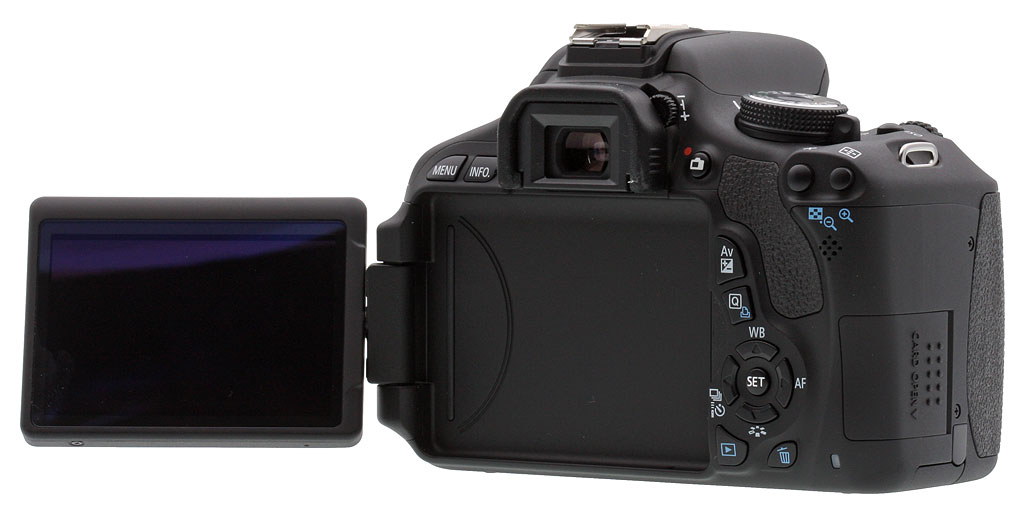
The IR proximity sensor was displaced, of course, by the addition of the Canon T3i's 3-inch Vari-angle screen, whose specs match those of the 60D's LCD: 3:2 aspect ratio, 1,040,000-dot resolution, scratch-resistant fluorine coating, and the ClearView display technology that sandwiches a layer of optical elastic material between the coverglass for a remarkably crisp image both indoors and out. Controls on the back are a little smaller compared to those on the T2i, as they've had to move over a bit to make room for the hinge and frame around the LCD. The Menu button is off to the left for thumb actuation, and the Info. button is where the old Display button used to be. Otherwise, buttons are in the generally same position, a bonus for those upgrading from a T2i. There's also a little less of a thumbpad, but the design still allows for a secure hold.

When in all but Movie mode, the small round button just right of the viewfinder serves as the Live View activation button; when in Movie mode, you use this button to start and stop recording. You cannot start recording a movie when in still capture modes, but you can capture a still image while shooting a movie. You can also autofocus while shooting a movie. More on Movie mode below.
The Canon T3i isn't necessarily a compelling upgrade for T2i owners, but it does offer a lot for those who might have been considering a 60D for its swivel screen and more advanced Movie mode. It feels a little more substantial in the hand than the T2i.
Sensor and processor. There's little new about the Canon T3i's sensor and processor combination. Representatives mentioned that they've again reduced the gap between the microlenses, as they've said many times in the past, but they were declared gapless a few versions back, so it's tough to know how much more gapless they can get. We're guessing that it's the same four-channel readout as is found in the T2i's sensor, as the frame rate is the same 3.7 frames per second rating. (We measured 3.6 fps for L/F JPEG or RAW, 3.3 for RAW+L/F JPEG.) Maximum image size in pixels is 5,184 x 3,456, with a pixel pitch of 4.3µm.
According to Canon, the Rebel T3i's DIGIC 4 processor and buffer enables capture of about 34 large/fine JPEG images, six RAW frames, and four RAW+JPEG frames. With our tough compression target, we measured only nine, five, and three frames respectively. DIGIC 4 also allows capture of 14-bit RAW images, and the 8-bit JPEGs are created from 14-bit data.

Peripheral illumination correction. Vignetting, a darkening of the corners produced by some lens designs, is reduced via Peripheral Illumination Correction in the Canon T3i. Using a database of lenses, the amount of correction is customized for each lens mounted. Selecting the item from the menu brings up a screen where you can see which lens the camera detected, and whether correction data is available. You can then choose to disable the correction if the wrong lens is showing (as sometimes happens with non-Canon lenses), or else re-enable it.
Autofocus. The Canon T3i offers nine-point focusing with a central cross-type f/2.8 focus point and eight single-axis points. Though the number of AF points is the same as the 60D, the later has a significant advantage in that all of its AF points are cross-type, which are sensitive to both horizontal and vertical detail. The focusing screen is of the etched variety, with boxes surrounding dots, which light up red to confirm focus.
Metering. The Canon T3i inherits Canon's latest metering system, previously seen in the EOS 7D, T2i, and 60D. It's a 63-zone iFCL sensor, which stands for Intelligent Focus, Color, and Luminance metering. The name hints at how the sensor works: the iFCL chip has a dual-layer design with each layer sensitive to different wavelengths of light, allowing subject color to be taken into account when determining exposure. Information on focusing points is also taken into account in metering calculations. In this area, the Canon T3i, T2i, and 60D's iFCL chip differs from that of the EOS 7D.
ISO Expansion. The Canon T3i has an expanded sensitivity range, from a minimum of ISO 100 to a maximum of ISO 12,800. You have to enable ISO Expansion via a Custom Function setting. Instead of offering EV compensation from -2.0 to +2.0 as do some cameras, the T3i offers a much wider +/-5.0EV exposure compensation range.
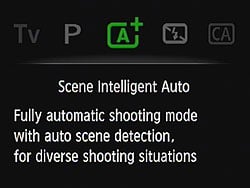
CA and A+. CA mode is relatively familiar, giving the more novice user an easy way to adjust the exposure, flash, resolution, drive mode, and Picture Style. Setting aperture and shutter speed are converted to simpler concepts of background blur (blurred or sharp), and exposure level (darker or brighter) with a slider that's adjusted with the Main dial. The more complex exposure decisions remain under the Canon T3i's control in CA mode. The exposure slider is the more useful, standing in as a more comprehensible EV adjustment.
What's new is the Auto+ mode (A+ on the Mode dial), which is similar to Smart Auto on Canon PowerShot cameras. Employing what Canon calls EOS Scene Detection Technology, the new setting replaces the old "Green Zone" Auto icon. Auto+ combines information from five of the Canon T3i's systems, including Auto Exposure, Autofocus, Auto White Balance, Auto Lighting Optimizer, and Picture Style Auto into one smart exposure mode, according to Canon.
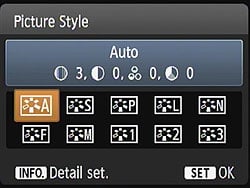
Picture Style Auto is a separate setting of its own, naturally selected as one of the Picture Styles, which you can bring up either via the down arrow on the back of the camera or through the Quick menu, or even the main menu. With this new setting, the camera will consider the scene and change the Picture Style accordingly.
Live View. Of course, the Canon T3i offers Live View mode, a fairly mature mode at this point, with contrast-detect focus as well as Quick AF focus, which uses the camera's phase-detect autofocus system. It seems pretty full-featured as Live View modes go. You can move the AF point around, you can switch between Contrast-detect and Phase-detect (Quick AF) modes, and you can even zoom in to 10x. Activating it is as easy as pressing the Live View/Record button on the back.
The Canon T3i has the best excuse for using Live View mode: its swiveling LCD screen, which allows you to compose images from odd angles. You won't want to use it all the time, because both autofocus methods are slower than autofocusing through the optical viewfinder, but when you need it, both the swiveling LCD and Live View mode are ready for action. Be aware that Live View mode also burns through battery life, typically cutting the number of shots per charge by more than half.
Movie mode. While the T2i included significant upgrades to Movie mode, the Canon T3i receives only a few, as the former's offering was pretty complete. We're talking Full HD 1,920 x 1,080 pixels at 24, 25, and 30 frames per second. 720p is available at 50 and 60 fps and VGA video is recorded at 30 and 25 fps.


Movie Crop mode has been enhanced from the T2i's offering, now called Video Digital Zoom, which allows a cropped zoom from between three and 10x magnification in 1080p resolution at all frame rates. You have to enable it from the Movie Record Size menu option, and when you do, it starts out zoomed to 3x. From there, you can zoom in to 10x and back out smoothly, with no steps in-between. (Note that camera shake can be quite an issue when in Video Digital Zoom mode, particularly as you get out to 10x. A tripod definitely makes sense.)
Video Snapshot. A new video mode imported from the PowerShot line is designed to help you shoot and create very simple videos in short segments. Set the mode to shoot 2, 4, or 8-second snapshots during the day, and the Canon T3i will splice the snippets into a movie. You can also add a soundtrack. Just set the mode in the Quick menu screen, or on the Movie Record Menu 2. Select among Disable, or 2, 4, or 8 seconds. When enabled, pressing the Movie Record button records a fixed-length segment, rather than the normal toggle on/off behavior. Clips of the same length will be combined by the camera into albums. After shooting each clip, you have the option to add to the existing album, save to a different album, playback the latest snapshot, or delete without saving to an album. You can also edit the Video Snapshot albums on the included Video Snapshot Task software included on the software disk.
Choose among five standard background music tracks, or you can import your own music to the SD card via the EOS utility.

Audio level control. Omitted from Canon's early video-capable SLRs, an audio level control is included on the Canon T3i. Users can adjust levels with very fine-grained control (the scale has 5 tic marks on it for reference, but the record level varies smoothly), and apply a wind filter, or they can opt for letting the camera adjust the levels automatically. The level-indicator bar graph shows levels for both stereo channels, and operates like a standard VU meter, with an indicator for the peak level that persists for a few seconds. You can see the peak level indicated in the screenshot at right by the pair isolated dots towards the right of the bar. The two frames show the result of dialing down the sensitivity with roughly the same sound level presented.
Creative filters. First introduced on the 60D are a series of Creative Filter functions, similar to those seen previously in the company's PowerShot compact camera models, and fairly common in digital SLRs from rival manufacturers. The Canon T3i's creative filters include Soft Focus, Grainy Black & White, Toy Camera effect (which has strong vignetting and some color shift), Miniature Effect (which simulates shallow depth of field by applying a graduated blur near opposite edges of the image), and a new Fisheye mode for simulating the distortion seen through a fisheye lens. The strength of each effect is adjustable, as is the angle of the Miniature effect. Unlike filters available from other companies, Canon's creative filters are only applied after capture, and are not available for videos.
Multi Aspect. The Canon T3i also offers a selection of aspect ratio settings in-camera, allowing photographers to shoot their images with a specific print format in mind, avoiding the need to manually crop images in post-processing. Called Multi Aspect mode, the Canon T3i can shoot in the native 3:2, or 4:3, 16:9, and 1:1.

Flash. Like all Canon consumer SLRs, the T3i has a pop-up flash, with an X-sync of 1/200 second and a guide number of 43 feet (13m) at ISO 100. It lacks a PC Sync terminal, a feature that mostly studio photographers use for their lighting setups, something we really don't expect from a Rebel, but did miss on the new 60D. What the Canon T3i's pop-up flash does have for those interested in experimenting with lighting is the ability to function as a wireless flash controller, or as Canon calls it, an Integrated Speedlite Transmitter.
The mode is new to the Rebel line, and includes the ability to control up to two groups of flashes, selecting from among four channels, using a ratio spread from 8:1 and 1:8. It's not quite as thorough as the mode found on the Canon 7D, which can control up to three groups with considerably more nuance, but it's nice that it's there all the same. There's also an Easy Wireless mode that gives you just one channel and one group and the ability to adjust flash power via exposure compensation. Attach a 580EX II and you can set up wireless control for up to three groups right from the back of the camera, which works a whole lot better than using the confounding interface on most Canon flashes.

New flashes. Canon also announced two new flashes designed to appeal to the Rebel T3i user, with size and functions to match. The 270EX II is an upgrade to the 270EX introduced with the T1i. The new design still zooms and tilts vertically for bounce flash, and includes a more prominent LED ready lamp on the back, as well as a Slave setting, so it can serve as a small slave flash, activated by the Canon T3i's built-in flash, or by any other compatible flash in the Canon wireless flash system. When used in wireless mode, the Canon 270EX II can only serve in A group, and responds to all channels. It comes with a small foot to hold the flash, as well as attach it to a tripod. But wait, there's more: the Canon 270EX II can also serve as a remote control for the camera. Just put the T3i into remote mode, press the button on the right side of the flash, and the camera fires in two seconds. With the Canon T3i in wireless flash mode, we were able to get the 270EX to both trigger the shutter and fire as a flash under command of the Integrated Speedlite Transmitter, a potentially handy trick. It's a nice touch for a small pocketable flash, making it twice as useful, and twice as important to bring along. It runs on two AA batteries and retails for US$169.99.

The second new flash, the Canon 320EX, takes a retro approach to flash design, while simultaneously acknowledging a new need among the latest digital SLRs: It includes a very bright LED for shooting video. The LED covers the area of a 50mm lens on a full frame sensor, or 32mm on an APS-C sensor camera like the T3i. The color temperature range of the LED varies from 4,500 to 6,500 Kelvin, at 75 lux. It offers up to 3.5 hours of continuous shooting and has a range of 1 meter at ISO 3,200 with the lens at f/5.6.

The 320EX bridges the gap between the 270EX II and the 430EX II above it by also offering a manually zooming flash head that swivels and tilts for bounce flash. On the back, instead of a convoluted digital interface, you'll find analog switches for setting up the 320EX as a wireless slave flash. Just like the 270EX II, the 320EX can also serve as a wireless infrared remote trigger. The Canon 320EX runs on four AA batteries and retails for US$249.99.

HDMI output. The Canon T3i has a the same HDMI-CEC compatibility as the T2i, which not only allows you to play back your images on your HDTV, it also allows you to control the camera's Playback functions via the Consumer Electronics Protocol (CEC). Be aware, though, that you'll need to purchase a separate HDMI to mini-HDMI (Type C) adapter or cable. The cables are about $50 at retail stores, though much cheaper online; the adapters are cheaper too, but harder to find.
The Canon T3i also includes a 3.5mm stereo mic jack, a wired remote port, and a combined AV Out / USB port.
Lenses. Canon's EF-S 18-55mm lens included in the less expensive T3i kit is a revision of the last image-stabilized version. Now called the EF-S 18-55mm f/3.5-5.6 IS II, the new lens claims up to four stops of stabilization effectiveness, and has a "leathertone" texture. The new lens will be available for sale separately, and has a suggested retail price of US$200.
Opting for the more expensive kit gets you the more versatile EF-S 18-135mm f/3.5-5.6 IS lens, equivalent to a 29-216mm lens on a full-frame 35mm camera. Note that the lens is not USM (ultrasonic motor) drive, so it makes a little noise while focusing, but it's really not bad. We tested the lens on SLRgear.com, so check out our EF-S 18-135mm review if you'd like to know more, as well as read reviews from other users.

Storage and battery. The Canon T3i can accept SD, SDHC, and SDXC memory cards, as well as Eye-Fi wireless cards.
The camera uses the same LP-E8 battery pack used by the T2i which is CIPA rated for 440 shots in the T3i. And though the Canon T3i is slightly larger than the T2i, it uses the same battery grip, model BG-E8.
Availability. The Canon Rebel T3i started shipping in early March 2011, priced at US$799.99 body-only, US$899.99 with the 18-55mm IS II kit lens, and US$1,099.99 with the 18-135mm IS kit lens.
Shooting with the Canon T3i
by Shawn Barnett

I'm one of the potential customers who would struggle deciding between a Canon T3i and 60D. Having just wrapped up the Canon 60D review a week before, I had more than a few deja vu moments while working with the T3i on our first encounter. Though the grip size is quite a bit smaller, it's so grippy it felt similar. The appearance of the two cameras is also similar thanks to the T3i's larger profile.
Where I noticed a bigger difference was in the tell-tale sound of the shutter when it fired: The Rebel T3i still makes a loud winding sound, while the 60D just clicks. Mirror blackout time is also shorter on the 60D. Since I shot the Canon T3 at the same time, its longer blackout time of 150ms and comparatively sluggish winding sound was also a stark contrast to the quicker T3i at 130ms. I was happy with the T3i, but still prefer the 60D with its even faster 100ms blackout time.


Wide and Tele. The 18-135mm image-stabilized lens is equal to a 29-216mm lens on a 35mm camera.
The viewfinder of the Canon T3i is also quite a bit tighter than the 60D, and technically should appear dimmer than the 60D, as it uses a pentamirror rather than a pentaprism to bring the light to your eye, but I'm so used to shooting with small viewfinders I really didn't even notice.
I liked the Canon T3i's swivel screen, though I confess that I forgot to use it more often than not; indeed, shooting in Live View mode still doesn't often occur to me, even though I use mirrorless cameras about half the time these days. When I feel an SLR in my hand, I naturally want to bring it to my eye to compose images. I came to find the LCD essential for videos, though.
Autofocus is good and fast on the T3i when shooting through the viewfinder in its normal phase-detect mode, 0.16 second according to our test of a production model, which is smokin' fast, especially for auto-select autofocus. Choose an AF point, and you're actually penalized somewhat, with a reduction to 0.28 second. Shooting in Live View is a little slower. Contrast-detect is about 0.83 second, and "Quick" AF, ironically, is the slowest at 1.18 seconds. Not great, if not uncommon, so bear that in mind when choosing which to use.
I shot with both the 18-55mm and the 18-135mm kit lenses and liked them both. The 18-135 really makes the camera quite heavy, but it's more versatile, equivalent to an 29-216mm lens, which is excellent for most photographic situations. The 18-55mm is quite a bit lighter, though, with a slightly improved build and appearance. Its new image-stabilization engine also seems more stable. Canon claims it's capable of four stops of correction, and can now automatically tell when the camera is panning. Neither lens uses an ultrasonic motor (USM), by the way, so they do make a slight buzzing noise when focusing; it's not bad, though.

ISO 3,200 was an excellent choice for the Kindergarten concert, giving me a fidget-freezing 1/160 second while holding the camera above the crowd.
Family activities. After receiving the shipping version, I found the Canon EOS T3i an excellent companion on a great many family outings. Combined with the BosStrap, I was able to sling the T3i comfortably at my hip much of the time, which I found more convenient than my usual backpack or handheld carry. Since I've suffered a little nerve damage in my arms, my grip is not as sure as it once was with cameras, so I've gravitated to some kind of strap, and sling designs eliminate neck strain, allowing me to carry my youngest when necessary, while keeping the relatively light T3i at the ready. It's also less showy than having the camera strung around your neck.

Video sample. This 15-second 1080p30 clip shows how well the T3i does in relatively low light. (86.3MB download.)
School events. Normally I bring a longer lens and a big flash for school concerts, but the T3i promised more resolution, better low-light performance, and video capability, all in a smaller, less pretentious package, so I was happy to have it along. A man of average height, I was still able to get a good shot thanks to the swivel screen, which I nearly forgot about until I found myself envying a nearby camcorder user who was getting the whole show with her arm held high. I flipped out the T3i's handy 3-inch LCD and found I was able to get a more firm hold with my fingers under the camera's base and my thumb pressing against the LCD from the side.
Activating the Record button was easy, as it's in just the right place. There's just enough plastic surrounding the button where you can place the main part of your thumb and gently rock it forward to slowly press the button without shaking the camera too much. The resulting video is clean and of good quality.

The dark background gave the meter some difficulty, with many of my shots appearing too bright. This one was reasonably good, though.
Many of my videos, especially those taken of nearby subjects, are out of focus. They looked quite in-focus as I shot them, so I too often didn't find out until long after the event was over. As I test it here at my desk, it's very easy to assume that the camera has a greater depth of field than it does. I can focus on an object and three feet away and the objects six inches closer and six inches further appear to be in focus as well on the LCD, but when viewing the resulting video, it's clear that both near and far subjects are quite badly out of focus. Moving the camera just an inch or two this way or that throws the main subject out of focus too. This is especially problematic at close distances.
As for stills, which I shot from both the swiveling LCD and the optical viewfinder, the quality is excellent, good enough to shoot at ISO 3,200 with confidence that I'd get a low-noise image. Autofocus in contrast-detect mode, however, was not as fast as I needed, so I switched to the optical viewfinder.

Almost missed this giraffe portrait; good thing I was shooting RAW to resurrect this image from the shadows.
I spent a day wandering around the local zoo with the family, and I brought along the tripod in hopes of getting a chance to study a cool animal. Unfortunately, there were very few cool animals on that hot Atlanta day, and most were in hiding. The few I did get, though, required a little work to capture well. While shooting a giraffe in full sunlight, I found I had to adjust the EV by minus two-thirds stop. This happened in several circumstances, so watch your exposure.
Unfortunately, when another giraffe moseyed right in front of me in the shade and stopped about 10 seconds for his portrait, I couldn't change the EV back to zero fast enough. Instead I just made what shots I could, relying on the RAW file, which I processed afterward with the included Digital Photo Professional software. The giraffe's head was in an uneven tree shadow, with the bulk of that shadow in the center of its face, so I had to do some dodging in Photoshop as well, but my quick edit made a decent shot for the kids' walls.

Continuous Self-timer made the most of the few crowd-free moments at the zoo.
Self-timer. I also brought the tripod in hopes of getting a family portrait. I wasn't sure where, but surely there had to be a good place to get everyone in. As we left the Panda section, I noticed an interesting circular archway, and shuffled the family off to the side so people could walk by while I set up the T3i. Pressing the Drive mode button on the back brings up five options, the last of which is Self-timer Continuous, which will focus, then shoot between two and 10 images. When you have four kids, this is the way you want to go, because getting everyone with a decent expression and no blinks is tough, and they tend to get restless when you run back and forth to press the shutter too often. I also had my 580EX flash mounted, which I knew would probably fire for all ten shots, given the overall brightness of the image. I had the tripod open low with its legs set wide to minimize the damage should someone accidentally bump it.
Since people leave the Panda enclosure in surges, I just had to wait for the right moment. When I saw a group hanging back, I quickly organized the crew and pressed the shutter. "Okay, it's going to take 10 shots one after the other, just be ready!" Slick as you please, all 10 shots went off without delay. We were a little short to have the opening frame us as well as I wanted, without including too much foreground, but a square crop helps convey the message and makes for a decent impromptu family portrait at the zoo.

Handheld. This 0.4-second exposure caught the sparks as they trailed off toward the fire buckets and the moon shone in the distance.
When I set up other shots, one of them in shade, the flash had to work a little harder, making it through five shots quickly, then having to pause to recharge for the remaining shots. I think it was a combination of worn batteries and shadows. All the shots turned out okay, but shot shown above right was the better.

The T3i is an excellent family camera. I was happy I got the kids more in-focus than the fish.
Night. Between skits at a campfire, I noticed some moonlight coming off the water, and sparks were rising from the fire in just the right way, so I tried ISO 3,200 and handheld the shot for several 0.4-second exposures. I managed to capture the ambience of the evening reasonably well. I'd have liked to capture the moon as well, but it would have required a smaller aperture and a longer exposure, and there was no way I'd do better than this with dozens of kids jumping around in all directions. I was surprised how much detail came up in the trees. Everything's a little soft, but that's more thanks to shooting wide open and noise suppression than focus.
File sizes. As Spring cameras kept rolling in, this review was delayed again and again, so I racked up quite a library of images with the Canon T3i, such that just moving the main review folder from one computer to another took a long time. That's what you get when you shoot RAW+LF JPEG with an 18-megapixel camera, one that also shoots Full HD video. It's hard to argue with the level of detail you get, but just be aware that you should invest in a hard drive or two to store the images and movies you'll gather.

Bright. Here's another example of slight overexposure in bright light. I made another shot of this same dragonfly with the Olympus E-P3 just moments before and it was better exposed.
Overall, I was more pleased with the stills than the videos I got with the Canon T3i. The narrow depth of field that you want with still images becomes a problem when trying to shoot video of rapidly moving children. I tend to move as I shoot video, and it's more difficult to do that when shooting indoors, where you're more likely to be shooting wide-open where depth of field can be a problem. That's not necessarily a problem with the T3i, but it is a caution I should give to anyone hoping to shoot video with an SLR, as it requires at lot more than just pressing the record button as you would on a digicam. When it's in focus, though, the T3i's video is excellent. And still images from the Canon T3i are stunning, so it's an easy camera to recommend with enthusiasm.
For photography enthusiasts: Like the Canon 60D, the T3i is a great choice for family to enthusiast photographers. If you're happy shooting natural light and have no intention of tuning your lenses, you won't notice that neither the T3i nor 60D has the Microfocus adjustment or an X-sync terminal (if you have no idea what those are, again, you probably won't miss them). The 3.7 fps frame rate on the T3i is also a little slower than the 60D, as is the maximum shutter speed, which is limited to 1/4,000 second, all of which we said at the outset. If those are issues for you, you'll be happier with the Canon 60D's 5.3 fps and 1/8,000 second for about $200 more. If I were looking to do a little more of what I like to do, namely shoot sports and studio pictures, I would save a little longer and get the Canon 7D, bypassing the 60D altogether. Since both cameras would work with studio lights via a hot shoe, it's not a huge distinction, and both cameras can also remote control a limited set of EX flashes, so my complaints will not apply to most hobbyist photographers. For them, the T3i is a bargain.
For the family shooter: As a family camera, I'd go for the Canon T3i. It was an excellent companion, and offered enough of what I shoot an SLR for that I really didn't miss my more capable cameras until I needed to shoot in the studio. The slightly larger grip and articulating LCD are great to have, and the main high points over the slightly cheaper T2i. As for the video qualifiers I mentioned, they're the pitfalls you'll encounter with any digital SLR, especially when shooting indoors, so unless you're going to start a hobby shooting video carefully and methodically, please discount video as a major feature of any digital SLR you're considering, but you needn't avoid the T3i for that reason. For the money, the Canon T3i is one of the best cameras on the market.
Canon T3i Image Quality
Most digital SLRs will produce a reasonable ISO 100 shot, so we like to push them and see what they can do at ISO 1,600 at their default noise reduction settings. Recent advances in sensor technology have made ISO 1,600 look a lot more like ISO 100, but there are still cameras whose quality starts to fall apart at this setting. We're also comparing ISO 3,200 shots below, as well detail shots at ISO 100, 3,200, and 6,400. Be sure to check our Thumbnail and Gallery pages for more image quality samples.
Canon T3i versus Canon T2i at ISO 1,600
 |
 |
 |
 |
 |
 |
|
Canon T3i at ISO 1,600
|
Canon T2i at ISO 1,600
|
|
As expected, results from a production model T3i are very similar to the T2i, though the T3i's images seem just a little bit softer in low-contrast areas, suggesting more aggressive noise suppression is at work. |
|
Canon T3i versus Canon 60D at ISO 1,600
|
 |
|
 |
|
 |
|
Canon T3i at ISO 1,600
|
Canon 60D at ISO 1,600
|
|
The T3i's ISO 1,600 performance is pretty much a toss-up compared with the Canon 60D. |
|
Canon T3i versus Nikon D5100 at ISO 1,600
|
 |
|
 |
|
 |
|
Canon T3i at ISO 1,600
|
Nikon D5100 at ISO 1,600
|
|
There are some noticeable differences between the T3i and D5100. First, of course, is resolution, with the T3i coming in at 18-megapixels and the D5100 at 16.2-megapixels, so that explains the slightly different size of elements. Looking at the top tile, chroma noise in the shadows is a little more pronounced on the D5100, but the Canon employs more aggressive sharpening, leaving halos around the letters in the label. In the middle tile, the Canon does better with the mosaic tile, retaining more of the detail in the beige tiles in particular, but the Canon also removes some of the hints of color between the dark tiles, which the Nikon retains. The D5100 also does better with the red leaf swatch. Neither does a stellar job with it, but Nikons tend to do better than all other manufacturers with this element of our test suite. |
|
Canon T3i versus Nikon D7000 at ISO 1,600
|
 |
|
 |
|
 |
|
Canon T3i at ISO 1,600
|
Nikon D7000 at ISO 1,600
|
|
Against the D7000, the T3i does fairly well, rendering most detail a little more crisply, though the Canon applies a bit more sharpening by default. Again, more of the variability of the tan tiles is retained in the T3i. Nikon wins again on the red swatch, though, doing slightly better than the D5100. |
|
Today's ISO 3,200 is yesterday's ISO 1,600 (well, almost), so below are the same crops at ISO 3,200.
Canon T3i versus Canon T2i at ISO 3,200
 |
 |
 |
 |
 |
 |
|
Canon T3i at ISO 3,200
|
Canon T2i at ISO 3,200
|
|
The Canon T3i seemed only marginally improved over the T2i at ISO 1,600, but the T3i retains more color at ISO 3,200, though detail and noise suppression are about the same. |
|
Canon T3i versus Canon 60D at ISO 3,200
|
 |
|
 |
|
 |
|
Canon T3i at ISO 3,200
|
Canon 60D at ISO 3,200
|
|
It's very close, and could come down to a difference in focus between the two, but the Canon 60D seems to have slightly more detail than the T3i. |
|
Canon T3i versus Nikon D5100 at ISO 3,200
|
 |
|
 |
|
 |
|
Canon T3i at ISO 3,200
|
Nikon D5100 at ISO 3,200
|
|
Here again, it is Nikon this time that has chosen to leave a little more chroma noise in the shadows to maintain a more photographic appearance (a few years ago, it was Canon that took this approach). As such, the Nikon image appears to have more detail -- quite a change from the ISO 1,600 image. Nikon's red swatch rendering is also still better than the T3i's, which is a blur. |
|
Canon T3i versus Nikon D7000 at ISO 3,200
|
 |
|
 |
|
 |
|
Canon T3i at ISO 3,200
|
Nikon D7000 at ISO 3,200
|
|
As we saw with the D5100, the Canon T3i has less detail than the Nikon D7000 at ISO 3,200, quite different from the result at 1,600. The D7000 still has a little chroma noise in the shadows, but more detail. And the red swatch is much closer to reality than the T3i can manage. |
|
Detail: Canon T3i vs. T2i, 60D, Nikon D5100, and D7000
 |
 |
 |
 |
 |
 |
 |
 |
 |
 |
 |
 |
 |
 |
 |
|
Canon T3i
ISO 100 ISO 3,200 ISO 6,400 |
Canon T2i
ISO 100 ISO 3,200 ISO 6,400 |
Canon 60D
ISO 100 ISO 3,200 ISO 6,400 |
Nikon D5100
ISO 100 ISO 3,200 ISO 6,400 |
Nikon D7000
ISO 100 ISO 3,200 ISO 6,400 |
|
Detail comparison. When it comes to the detail shot, the Canon T3i does well. These five are so close to one-another, there's not really much to say. They all manage to render the lines between the letters, though the Canons may have an advantage here over the Nikons thanks to their higher resolution; but at ISO 6,400 I really don't have a preference. They're all five top-notch cameras and their image quality attests to that.
|
||||
Canon T3i Print Quality
 ISO 100 images are excellent, with sharp detail when printed at 20x30 inches, with good color and no trouble with noise. ISO 200 and 400 shots are essentially identical, with excellent detail across the board.
ISO 800 shots also look good at 20x30, though the slightest softening occurs in very low-contrast areas. Color and detail, though, are good.
ISO 1,600 images start to show some of the noise in shadow areas, and detail begins to soften as well. Yet the print size is still 20x30. Low-contrast reds, especially our red leaf swatch, starts to show the first signs of "creative interpretation" of what the fabric looks like.
ISO 3,200 shots are usable at 20x30, luminance noise is noticeable in the shadows, and the red swatch continues to deteriorate. Even higher-contrast detail softens from the noise suppression, so reduction to 16x20 is warranted, where all these elements improve.
ISO 6,400 images are usable printed at 13x19 inches, though at this setting the red leaf swatch is very soft and would look so even at 4x6 inches. (Many cameras have this problem, so we'll stipulate it from here on.) Better image quality is obtained at 13x19 inches.
ISO 12,800 files print surprisingly well at 8x10, though close inspection reveals dark grain in shadow areas. 11x14-inch images would be usable provided the subject background was dark enough (a setting in which you'd expect a little more noise).
Overall, the Canon EOS T3i does just about as well as its 18-megapixel brothers, and fares very well against the competition. Safely shooting at ISO 800 and still expecting to produce a 20x30-inch print really opens up some possibilities for a photographer. Finding excellent usability at even its highest ISO setting is comforting.
See below for our conclusion; be sure to check the other tabs for details and test results.
In the Box
The retail package contains the following items:
- Canon EOS Rebel T3i digital camera
- EF-S 18-135mm f/3.5-5.6 IS lens or EF-S 18-55mm f/3.5-5.6 IS II lens (if bundled)
- Front and rear lens caps (with lens kit)
- Body cap
- Eyecup Ef
- Wide strap EW-100DBIII
- Battery charger LC-E8E
- Battery pack LP-E8
- USB Interface cable IFC-130U
- AV cable AVC-DC400ST
- Software CD-ROMs
- Warranty card and manuals
Recommended Accessories
- Extra battery pack
- Protective case
- Large capacity, high-speed SDHC/SDXC memory card. 8-16GB or larger makes sense if you plan on shooting lots of HD video. Look for a speed grade of at least Class 6 for HD video capture.
Canon T3i Conclusion
| Pro: | Con: |
|---|---|
|
|
As it stands, the Canon T3i is the flagship Rebel, with the T3 and T2i beneath it in features. Its still image quality is among the best in its price range, and its video modes are quite complete, offering excellent quality, provided you can handle shooting video more carefully than you would with a digicam or camcorder.
Taken as a whole, the Canon T3i is an excellent digital SLR, with just about every feature we've been longing for in a sub-$1,000 camera. The articulating screen stands out in particular as a very useful feature, and with the Nikon D5100 having the same side-swiveling design, it was important that a Rebel have one too. The LCD is gorgeous and very high resolution, excellent in sunlight, and the only problem we had with it was that it was harder to notice out-of-focus areas while shooting video.
Either kit lens option is a good one, with the 18-55mm keeping the overall package light and nimble, and the 18-135mm lens taking care of most photographic needs with aplomb. Optically, both are better matches to the 18-megapixel sensor than past offerings, and both include optical image stabilization.
Prints made from ISO 100 to 3,200 look quite good at 20x30 inches, which is very impressive; and even ISO 12,800 images make a good 8x10-inch print.
The only problem Canon has on its hands is having three excellent 18-megapixel digital SLRs that are priced within a few hundred dollars of each other. The T2i was already excellent, then the 60D came along with its articulating screen and a decided lean toward the Rebel line, and then the T3i entered the scene. The good news is that you can't go wrong with any of them, especially in terms of overall image quality. They're all excellenity. They're all excellent. It's then just a question of which features you'd like your excellent digital SLR camera to have. If you're looking for the best compromise between the three, the Canon EOS Rebel T3i is it, and a certain Dave's Pick.
Design
Canon EOS Rebel T3i Design

(Illustration courtesy Canon USA, with modifications © Imaging Resource)
1 |
Power switch
|
16 |
EF-S lens mount index |
2 |
Display button
|
17 |
Flash sync contacts |
3 |
ISO speed setting button |
18 |
Hot shoe |
4 |
Main dial
|
19 |
Focal plane mark |
5 |
Shutter button |
20 |
Strap mount |
6 |
Red-eye reduction lamp |
21 |
Microphone |
Self-timer lamp |
22 |
Flash button |
|
7 |
Remote control sensor |
23 |
Terminal cover |
8 |
Grip |
24 |
Lens release button |
9 |
Mirror |
25 |
Depth-of-field preview button |
10 |
Contacts |
26 |
Audio/video out |
11 |
Lens mount |
Digital terminal |
|
12 |
Lens lock pin |
27 |
Remote control terminal |
13 |
Mode dial |
28 |
External microphone in terminal |
14 |
Built-in flash |
29 |
HDMI mini out terminal |
AF-assist beam |
30 |
Body cap |
|
15 |
EF lens mount index |
The Canon T3i's body design is quite similar to that of the preceding T2i, although a number of changes have been made to accomodate its new rear-panel articulate LCD. Size has increased by one or two tenths of an inch (a few millimeters) on each axis, and body-only weight has increased by around 1.4 ounces (40 grams).
Seen from the front, there's a slight reprofiling at the top of the handgrip, with a softer curve from the angled area around the shutter button, round to the camera's right-hand side. On the left-hand side, the small padded area at the base of the camera body is gone, replaced by a textured rubber panel that extends all the way up to the model number plate, and wraps around to the side of the camera. This new trim piece is textured similarly to the hand grip, where the T2i's smaller trim piece on this side was smooth.
On the top deck, the most obvious change is the Display button, relocated from the rear panel in the T2i. The Canon T3i's Display button now sits just in front of the Mode dial, and to the left of the ISO button. The only other changes are subtle: the Creative Auto mode has been moved between the Flash Off and Portrait positions on the Mode dial, and a new Scene Intelligent Auto mode added between the Program and Flash Off positions.
Changes are more significant on the left-hand side. As mentioned previously, the new textured rubber panel that wraps around from the front of the camera is a new addition, and this covers most of the left-hand side as well. There's a slight bulge at the rear of the left-hand panel, as well, made to accomodate the hinge mechanism for the articulated LCD. The single, vertical connector compartment cover from the T2i is gone, replaced by two separate compartment covers on the T3i, located one in front of the other. The selection of ports is unchanged, just their locations differing, likely as part of the repackaging to accomodate the LCD hinge. The remote control and microphone ports sit under the front cover, and the standard-def AV Out / USB and HDMI ports under the rear cover. Both covers are made of fairly soft rubber, and attached to the camera body by a short molded strap at the front edge, preventing loss but allowing them to be easily pushed out of the way of even bulky connector cables.

(Illustration courtesy Canon USA, with modifications © Imaging Resource)
1 |
Eyecup |
12 |
Dioptric adjustment knob |
2 |
Viewfinder eyepiece |
13 |
Live view shooting button |
3 |
Info button |
Movie shooting button |
|
4 |
Menu button |
14 |
AE lock / FE lock button |
5 |
LCD monitor |
Index / reduce button |
|
6 |
Aperture button |
15 |
AF point selection button |
Exposure compensation button |
Magnify button |
||
7 |
Tripod socket |
16 |
Speaker |
8 |
Quick control button |
17 |
Card slot cover |
Direct print button |
18 |
DC cord hole |
|
9 |
Playback button |
19 |
Access lamp |
10 |
Setting button |
20 |
Battery compartment cover release lever |
11 |
Cross keys |
21 |
Battery compartment cover |
▲ White balance selection button |
22 |
Erase button |
|
▼ Picture style selection button |
23 |
Card slot |
|
◄ Drive mode selection button |
|||
►AF mode selection button |
Moving to the rear of the Canon T3i, the changes are at their most obvious. As mentioned earlier, the T3i now has an articulated LCD, specifically a side-mounted tilt/swivel type. Fitting in the mechanism while keeping the increase in size and weight to a minimum has necessitated some repositioning of the controls, although in general the layout is very similar to that used previously. There's a new Info button, taking up the location previously occupied by the Display button that's now located on the top panel. The shape of this and the Menu buttons have been changed, and they've moved a little higher up the camera's top left corner.
The cluster of controls to the right of the LCD is somewhat more densely packed in, and moves right a little, but the basic arrangement is unchanged. The shape of the Aperture / Exposure Compensation, Quick Control / Direct Print, and Delete buttons has changed, though, along with that of the small textured rubber trim piece that serves as a thumb grip. Finally, the infrared eye sensor beneath the viewfinder, which was used to automatically disable the LCD panel when the camera was brought to your eye, has been removed. In other respects, the T3i's rear panel is similar to that of its predecessor.
The Canon T3i's 3.0-inch LCD display, has the same size and high 346,000 pixel (1,040,000 dot) resolution as that of the T2i, but increases the viewing angles by another 10 degrees, to 170 degrees. The optical viewfinder has the same 95% coverage, 19mm eyepoint, and -3.0 to +1.0m-1 diopter correction as found in the T2i, but the T3i has just ever so slightly lower 0.85x magnification.
The right-hand end of the Canon T3i body is almost unchanged from that in the T2i, being smooth except for the flash card door, and a small flap covering the cutout for the AC adapter kit's dummy battery. The T3i's base is also near-unchanged, with the only noticeable difference being the removal of the rubber trim piece that previously wrapped around from the front left corner of the camera body.
Operation
Canon EOS Rebel T3i Operation
Like the Rebel T2i before it, the Canon T3i relies on its high-res 3.0-inch color LCD screen for all user interaction, although it's now articulated, and hence can be viewed from far greater angles than was previously the case. The T3i's display makes for a clear, highly visible user interface, but probably does contribute to slightly shorter battery life, since the LCD has to be fired up any time you want to change anything beyond the most basic settings. (Exposure mode, aperture, shutter speed, exposure compensation, and exposure lock are the only things that can be configured without using the rear-panel display). One feature we miss from from the T2i that's absent in the T3 is the infrared proximity sensor, which was previously used to turn off the LCD screen when you held the camera up to your eye. It not only conserved battery life, but also reduced glare from the LCD when using the optical viewfinder. The Rebel T2i instead disables the LCD while the shutter button is half-depressed. (You can also disable it with the Display button, configure it to remain on at all times, or configure it to stay switched off after the shutter button is released, requiring you to press the Display button to turn it back on again.)
Overall, the control layout places a few main controls (Power switch, Shutter button, Main dial, Mode dial, Display button, and ISO button) on the right side of the Canon T3i's top panel, with most of the other controls on the back of the camera. Let's take a closer look at some of the user-interface elements:
Canon EOS Rebel T3i Rear-Panel LCD Display
The image below shows callouts for all the information shown on the Canon T3i's rear-panel display, by default. (Illustration courtesy Canon USA.)


There are four Screen color options on the Status display, adjustable in the first Settings menu, under Screen Color. The information layout on the Canon T3i is somewhat different from that on the T2i, although the color choices are unchanged. I found myself preferring the default color scheme (top left in the group of shots above) in the daytime, thanks to its strong contrast. Color scheme 4 (bottom right) was similarly useful for shooting at night, reducing the contrast just slightly so as not to tire my eyes.

Whatever exposure parameter is currently being controlled by the Canon T3i's Main Dial is highlighted with arrows in the corners of its box, to indicate that it can be changed by rotating the dial. Here, we're adjusting the aperture, marked by the outlined box. Note the arrows. (They're pretty subtle; we would have liked to see them a bit more prominent.)

The rear-panel display on the Canon T3i is also used for Canon's Quick Control menu system, first introduced in the Rebel T1i. As with the T2i, there's a Quick Control button dedicated to entering the Quick Control menu. Regardless of whether the LCD display was active or disabled, pressing the Quick Control button on the Canon T3i while in capture mode will take you to the Quick Control menu system, where you can adjust various settings shown on the rear-panel display. You navigate between the various setting options with the arrow keys, and the chosen setting will be highlighted as shown above. Once a setting has been selected, you can change it either by rotating the Canon T3i's Main Dial, or by pressing the SET button, and then using the arrow keys to choose from the available options. The Quick Control menu is dismissed with a second press of the Quick Control button.

Pressing any of the arrow keys to the right of the Canon T3i's LCD screen (if available in the current exposure mode), or the Set button while making changes in the Quick Menu, immediately brings up a screen for the exposure parameter associated with that button. Once the option screen is displayed, you can use either the arrow keys or the Main Dial to scroll the cursor highlight through the options presented. You can continue to press the same arrow-key button, or turn the Main Dial in the same direction, and the highlight will scroll through all the options, wrapping around when it gets to the end of the list. When you've made the choice you want, pressing Canon T3i's Set button confirms it and returns you to the main shooting display or Quick Menu, as appropriate.
Canon EOS Rebel T3i Playback & Record Review Displays
Like the Rebel T2i, the Canon T3i shows each image as it's captured, though you can turn off this function through the Record menu. The display mode in Record Review defaults to the same as was last used in Playback mode, or you can hit the Display button to cycle to a different mode. Likewise, in Playback mode, you can cycle between the available display options by pressing the Canon T3i's Display button repeatedly. (Display mode selection is persistent across both record and playback modes, no matter which mode you make the selection in.) You can also select between the normal luminance-based histogram and the RGB histogram option via a Playback-mode menu item. The screenshots below show the various displays and options available.
| Canon T3i Image Display Options | |
 |
 |
Pressing the Info button cycles through the four available displays. The default display in playback mode is image with no overlay. |
This is the second option, which shows the folder and file number at upper right, and the shutter speed, aperture, and exposure compensation (if applicable) in the upper left, while the file sequence number and total number of images on the flash card are shown below left. |
 |
 |
The Canon T3i's third playback display option shows a histogram and more detailed exposure information. A setting in Playback Menu 2 lets you choose between a conventional luminance-only histogram, or the separate red, green, and blue displays. If there are any blown highlights, they'll blink in this mode. |
The final playback display option shows both RGB and luminance histograms side by side, along with an intermediate level of exposure information. If there are any blown highlights, they'll blink in this mode. |
 |
 |
If you press the Zoom Out button while viewing a single image on the LCD screen, it'll take you first to a 4-image thumbnail display, and then to a 9-image one, if you press it once again. The arrow keys let you navigate among the thumbnail images. Pressing the Info button in this mode overlays the same information as in the second playback display mode, for the currently selected image. |
You can also zoom in on an image, up to 10x at the highest resolution. Pressing the Info button in this mode overlays the same information as in the second playback display mode. The small navigator window in the lower right-hand corner shows you what part of the larger image you're currently viewing. The arrow keys let you navigate around the full image, and the zoom in / zoom out keys increase or decrease the magnification level. We like that you can step between images with the main dial while maintaining the zoomed display. This makes it easy to compare focus or other fine details from one shot to the next. |
 |
 |
By turning the Main dial on the Canon T3i in Playback mode, you can "jump" through images in a variety of ways. An option on the Playback menu sets options of jumping through images 1, 10, or 100 images at a time, between shots captured on different dates or stored in different folders, between groups of movies, or groups of still shots. You can also jump between images by rating, either viewing only unrated images, or only those with a specific rating. The jump menu setting only applies when you're in single-image playback mode. In thumbnail display mode, the Main Dial always jumps ahead one screen of thumbnails at a time, regardless of the menu setting for the Jump option.
|
Pressing the Delete button brings up this display, giving you the option to erase the current image, or cancel out of the delete option. The Delete display will show either the full image, a thumbnail plus histogram, or a screen of thumbnails with border highlighting the selected thumbnail, depending on the playback mode you've selected. |
Optics
Canon EOS Rebel T3i Optics
Kit Lens
The Rebel T3i kit is available with two lens choices. One is an updated variant of a lens first introduced with the Rebel XS, now known as the EF-S 18-55mm f/3.5-5.6 IS II, which also ships with the Rebel T3 and T2i. Compared to the earlier EF-S 18-55mm f/3.5-5.6 IS version, that lens has cosmetic changes and uprated stabilization algorithms said to be good for a four stop improvement, but we believe it to be optically similar to the earlier model. The lens has a 3.1x zoom ratio, and a 35mm equivalent focal range of 29-88mm due to the T3i's 1.6x "focal length crop" (see below). This lens is constructed of 11 elements in 9 groups, and extends during both focus and zoom operation. The EF-S 18-55mm II uses a micro DC motor for autofocus, instead of the ultra-sonic motor found on models with the USM designation, and includes both an AF/MF switch and a Stabilizer On/Off switch on the lens barrel. Other specifications include a 6-bladed (rounded) diaphragm, minimum aperture of f/22-f/32, maximum magnification ration of 0.28x (or 1:3.6), and 58mm filter threads. Dimensions are 84.5mm long with a 68.5mm diameter (3.3 x 2.7 inches), and weight is 200g (7.1 ounces). The lens has a MSRP of US$199.99 if bought separately, but costs significantly less when purchased bundled with the camera. A lens hood and soft case are optional accessories. While we've yet to run this newer version through our testing process over at SLRgear.com, the preceding lens was quite impressive when compared to those bundled with Rebel cameras preceding the XS, yielding improved sharpness and reduced chromatic aberration.
The second lens option is the Canon EF-S 18-135mm f/3.5-5.6 IS lens, which has a 7.5x zoom ratio, and a 35mm equivalent focal range of 29-216mm. The lens is constructed of 16 elements in 12 groups. Focusing is internal, and the 18-135mm uses a DC focus motor. An AF/MF switch is provided. The lens features built-in image stabilization (IS) that is capable of up to four stops of correction. A Stabilizer On/Off switch is also provided. Other specifications include a 6-bladed (rounded) diaphragm, minimum aperture of f/22-f/38 (or f/36 if using 1/3 stop increments), maximum magnification ration of 0.21x (or 1:4.8) at 135mm, and 67mm filter threads. Dimensions are 101mm long with a 75.4mm diameter (4.0 x 3.0 inches), and weight is 455g / 16.0 oz. The lens has a MSRP of US$499.99 if bought separately, and again, costs significantly less when purchased bundled with the camera. A lens hood and soft case are optional accessories. See below for our test results with this lens mounted on the Canon T3i, and see our full review of this lens on SLRgear.com.
Lens Compatibility
 Like other Canon DSLRs with sub-frame sensors (currently, the Canon Rebel XS, Rebel XSi, Rebel T1i, T2i, T3, EOS 50D, 60D, and EOS 7D), the Canon Rebel T3i will work with pretty much any EF-mount lens ever made, as well as with the special EF-S lenses designed for cameras with APS-C size sensors. Designed with a smaller image circle (the area covered by the image on the film/sensor plane), EF-S lenses tend to be smaller and lighter than full-frame models with the same focal length and maximum aperture. EF-S lenses can't be used on full-frame Canon cameras, nor on their APS-H models with 1.3x crop factors, like the EOS-1D Mark III or Mark IV, but small-sensor cameras like the Canon T3i can use any full-frame lenses in Canon's arsenal.
The sub-frame sensor on the Canon Rebel T3i means that it has a smaller angle of view (by a factor of 1/1.6) than a full-frame camera with any given lens. While most properly called a "crop factor," the 1.6x ratio is more commonly referred to as the "focal length multiplier" since that's how it works in practice. Any lens used on the Canon T3i will have the same field of view as one with a 1.6x greater focal length would when attached to a 35mm camera. (For example, a 100mm lens on the T3i will show the same field of view as a 160mm lens on a camera with a 35mm frame size.) This means that the 18-55mm kit lens for the T3i has a coverage roughly equivalent to that of a 29-88mm lens on a 35mm camera, while the alternate 18-135mm kit lens has a coverage roughly equivalent to a 29-216mm lens on a 35mm camera.
The Canon T3i offers Lens Peripheral Illumination Correction, which corrects for lens shading (commonly called "vignetting"), producing uniform exposure across the frame by compensating for the light falloff seen with some lenses in the corners of the frame. Lens Peripheral Illumination Correction first appeared in the Canon 5D Mark II, and has since appeared across Canon's lineup, all the way from entry level to professional models. This setting is enabled by default, but can be disabled if desired.
Image Stabilization
The "IS" in both kit lenses' names stands for "Image Stabilization." This is a handy and increasingly common feature of both lenses and some camera bodies. The idea for lens-based IS systems is that a motion sensor, computer chip, and movable optical element are built into the lens barrel. The motion sensor detects camera movement that could lead to blurred images with long exposure times. This data is processed by the computer chip, which in turn moves the floating optical element in such a way as to counteract the motion of the lens, thereby keeping the image stationary on the camera's image sensor. The net result is that you can shoot at much slower shutter speeds than you'd otherwise be able to, without getting blurred images as a result.
Image stabilization technology generally works very well, and Canon says that either kit lens should be good for around a four-stop correction. The net result is that the Canon T3i's IS-enabled kit lens does a great job of delivering sharp photos under dim lighting, and you should be able to shoot at shutter speeds up to 16x slower than you can normally hand-hold without IS.
As mentioned above, some manufacturers have begun building sensor-shift image stabilization capability into their camera bodies, rather than their lenses. The advantage of this is obvious: Every lens you put on a camera with body-based stabilization is, effectively, an IS lens. A body-based IS system makes for a much less expensive lens collection, since you don't have to pay for IS technology in every lens you buy. There is a downside to body-based IS, though. Because their IS systems only affect the captured image, body-based systems don't stabilize the image seen in the optical viewfinder. (Of course, this limitation doesn't apply when using a Live View camera that captures its viewfinder image from the camera's main sensor.) In extreme cases, having a stabilized view through the viewfinder, like you get with the Canon T3i, can be a great aid to accurate framing and improving your own stability for sharper pictures.
So neither IS technology (lens-based or body-based) wins over the other on all points. If you plan on assembling a large collection of lenses, body-based IS will save you money, but at some possible cost in performance, and without the benefit of a stabilized view through the viewfinder. Lens-based IS can work better (not all IS systems are created equal), but will cost you more if you end up buying a lot of lenses. For the casual user who doesn't plan on acquiring a large lens collection, either approach will work, now that IS-enabled kit lenses are common as part of consumer-level SLR bundles.
Canon T3i Autofocus
 The Rebel T3i uses the same AF sensor as the previous XSi, T1i, and T2i, which features enhanced precision at the center point. This AF sensor design achieves more precise focus when used with lenses with apertures of f/2.8 or larger.
SLR autofocus accuracy is governed in part by how far apart you can space the sensor elements for a single AF point from each other. The wider this "baseline," the more accurately the AF point can determine focus. What limits the AF baseline spacing in a camera system is the lens aperture. You can build sensors with wider baselines, but that also restricts the range of lenses they can be used with. By and large, camera manufacturers have set f/5.6 as the minimum aperture their AF systems will work with. Lenses with wide-open apertures smaller than f/5.6 just won't focus. But once the baseline spacing is set, using a faster lens doesn't improve focus accuracy any. That is, unless you add a larger baseline sensor, as is built into the Canon T2i's center AF point. (Note that only the center AF point shows this increased accuracy at f/2.8: The surrounding AF points are all conventional f/5.6 ones.)
Autofocus modes include One-shot (also known as single-shot), Predictive AI Servo AF (continuous), and AI Focus AF, which automatically selects between the One-shot and AI Servo modes. Of course, there is also a manual focus mode.
AF-Assist Illuminator
Like previous digital Rebels, the Canon T3i uses the built-in flash head as its AF-assist illuminator, rather than a bright light built into the camera's body. This works well because the flash is quite bright, and probably has a greater range than do typical on-body incandescent illuminator bulbs. Following the lead of the T1i, you can disable the internal flash, yet still have the benefit of the flash-based AF-assist illuminator. You do this via the Flash Control menu, but note that this AF-illuminator-only setting for the flash head means you lose flash exposure capability until you explicitly turn it back on. If you attach a 320EX, 430EX II, or 580EX II external flash unit to the Rebel T3i, their internal AF-assist illuminator can be used instead of the flash head itself, providing a good working range with a less obtrusive light source. For non-flash photography, Canon's ST-E2 wireless sync transmitter can also be used for AF assist, a handy trick. The ST-E2's AF-assist light has a useful range of about 25 feet. (Note though, that we haven't tested the ST-E2 ourselves, so we can't verify this performance independently.)
Dust Reduction
 The Rebel T3 digital SLR camera includes Canon's EOS Integrated Cleaning System, first introduced on the EOS Rebel XTi camera. The camera's Self-Cleaning Sensor Unit shakes dust particles off of the low-pass filter in front of the sensor. The dust is then trapped by an adhesive along the base, preventing it from causing further nuisance. Cleaning is engaged each time the camera is powered up or shut down, or manually through the "clean now" function.
The second part of the cleaning system involves post processing with a compatible personal computer and the supplied Digital Photo Professional software. Here (via a menu option) the camera maps any spots that may remain on the sensor, saving it as Dust Delete Data and subsequently subtracting dust spots from the final image during post processing. A third option includes a manual sensor cleaning function which raises the mirror and allows users to clean dust that may have stuck to the low-pass filter.
We haven't yet seen an automatic system capable of removing all dust, but with the T3i lacking even a basic cleaning system, it's users are even more likely to have to either learn how to clean their sensor, or send the camera in for cleaning.
Everyone understands that lenses sometimes get dust on them and need to be cleaned, and there are a lot of lens-cleaning cloths, solutions and other accessories on the market that work well. But what do you do when your sensor gets dusty? Dust specks on the sensor tend to show up when shooting at very small apertures, appearing as dark blobs on your images. They're distracting at best, a terrible nuisance at worst, if you end up having to retouch every image to be rid of them.
Most of us are naturally leery of the idea of poking around inside the delicate innards of our DSLRs to wrestle with recalcitrant dust specks. Gently blowing the sensor surface (actually, the surface of the anti-aliasing filter) with compressed air gets rid of some dust, but there's invariably a lot that just stays stuck, no matter what. So what do you do?
If you've got dust specks on your sensor (and sooner or later you will), you're going to need to clean it. There are a lot of products out there intended to address this need, but a distressing number of them work poorly (if at all), and many are grossly overpriced. Advertising hype is rampant, with bogus pseudo-scientific jargon and absurd product claims. And prices - Did we mention prices? How about $100 for a simple synthetic-bristle brush?
So how do you know which product to use?
We don't pretend to have used everything currently on the market, we but can tell you about one solution that worked very well for us. The "Copper Hill" cleaning method is straightforward and safe, and in our routine usage here at Imaging Resource, very effective. Better yet, the products sold by Copper Hill Imaging are very reasonably priced. Best of all, Nicholas R (proprietor of Copper Hill) has put together an amazingly detailed tutorial on sensor cleaning, free for all.
Sensor cleaning is one of the last things people think about when buying a DSLR, but it's vital to capturing the best possible images. Take our advice and order a cleaning kit from Copper Hill right along with your DSLR, so you'll have it close at hand when you need it: You'll be glad you did!
(While they've advertised on our sister site SLRgear.com from time to time, we receive no promotional consideration from Copper Hill for this note. We just think their sensor cleaning products are among the best on the market, and like their way of doing business. -- We think you will too. Check them out.)
Canon EOS Rebel T3i Optical Test Results
The Canon Rebel T3i is available body-only, or bundled with either the Canon EF-S 18-55mm f/3.5-5.6 IS II lens, or the Canon EF-S 18-135mm f/3.5-5.6 IS lens. Below are the results of our optical tests with a Canon EF-S 18-135mm f/3.5-5.6 IS lens.
Kit Lens Test Results
Zoom
The Canon EF-S 18-135mm IS (Image Stabilized) lens performed very well overall.


The Canon EOS Rebel T3i is available bundled with the EF-S 18-135mm f/3.5-5.6 IS lens. This lens has a generous (for a kit lens) and versatile optical zoom ratio of 7.5x with a 35mm equivalent range is about 29-216mm, because of the T3i's ~1.6x crop factor. Sharpness and contrast were pretty good across most of the frame at 18mm and f/8, though there's moderately high chromatic aberration and some coma distortion visible in the corners and along the edges. Corners were also just a little soft. At 26mm and f/8, sharpness across much of the frame was superb, though extreme corners were still a touch soft and a moderate amount chromatic aberration was still visible. Sharpness at 135mm and f/8 was quite good, with very good detail and contrast across much of the frame. Chromatic aberration was still a little high in the extreme edges and corners, and some blurring was noticeable in the corners. However, results were still quite good overall for the type of lens, and the image stabilization will come in handy for handheld telephoto shots or in poor light.
Macro
A fairly large macro area with soft detail. Flash throttled down well.


The Canon EOS Rebel T3i's macro performance will of course depend entirely on the lens in use. With the 18-135mm IS lens set to 135mm, the Canon Rebel T3i captured a fairly large (even for an SLR lens) minimum area measuring 3.64 x 2.43 inches (93 x 62 millimeters). Details were somewhat soft in the center of the frame, and softer still in the corners and edges. (Most lenses have some softening in the corners at macro distances.) Some noticeable vignetting (corner shading) was also present. Both the softness and vignetting would likely improve by stopping down a bit more, though. (The above macro shots were taken at f/5.6.) The Canon T3i''s flash throttled down for the macro area very well. There was no detectable shadow from the lens barrel, only the same vignetting as in the non-flash exposure.
Geometric Distortion
Higher than average barrel distortion at wide-angle and moderate pincushion distortion at telephoto with the 18-135mm IS kit lens.
| Barrel distortion at 18mm is 1.1 percent |
 |
| Pincushion distortion at 135mm is 0.4 percent |
 |
The Canon EF-S 18-135mm IS lens produced images with about 1.1 percent barrel distortion at wide-angle, which is higher than average and noticeable in some shots. At the telephoto end, there was about 0.4% pincushion distortion, which is also higher than average though not quite as noticeable. The Canon T3i does not appear to be correcting for any geometric distortion in its JPEGs, as uncorrected RAW files have identical amounts. Geometric Distortion is the tendency for the lens to bend straight lines outward (like a barrel -- usually at wide-angle) or inward (like a pincushion -- usually at telephoto).
Chromatic Aberration and Corner Sharpness
Moderately high chromatic aberration at wide-angle and telephoto with the 18-135mm IS lens. Some minor softening in the corners.


Chromatic Aberration. Chromatic aberration in the corners with the Canon 18-135mm IS lens is moderately high at both wide-angle (18mm) and telephoto (135mm) settings. The amount and intensity of the color fringing reduces as you move toward the center of the image, but is still slightly evident in the center at wide-angle. CA is much lower in the center at full telephoto. The Canon T3i does not appear to be correcting for CA in its JPEGs, as uncorrected RAW files exhibit similar amounts.
Corner Softness. The Canon Rebel T3i and 18-135mm lens produced some slightly soft corners in a few shots. At full wide-angle, corners on the right side of our test targets were somewhat softer than the center, but the blurring didn't extend very far into the frame. The left side, however, showed slightly less softening in the corners. The center of the image was quite sharp. At full telephoto, all four corners were only slightly soft with the top right being the softest. The image was pretty sharp in the center. Corner sharpness in general was pretty good for the type of lens, and somewhat better than expected compared to far-field (house) results.
Overall, a good performance here, especially for a wide-angle lens a 7.5x zoom ratio. Also keep in mind the above lab target shots are taken with the lens wide-open and sharpness and corner shading generally improve when a lens is stopped-down a couple of f-stops from maximum aperture.
Peripheral Illumination Correction
Like other recent Canon DSLRs, the T3i features Peripheral Illumination Correction feature to reduce vignetting or lens shading with Canon lenses.
 |
 |
||
| 18mm @f/3.5 | 135mm @f/5.6 | ||
| Peripheral Illumination Correction: | Off | On | |
The Canon T3i provides what the company calls Lens Peripheral Illumination Correction, which corrects for lens shading (commonly called "vignetting"), producing more uniform exposure across the frame by compensating for the light fall-off seen with some lenses in the corners of the frame. Mouse over the Off and On links above to see the effect on the 18-135mm kit lens at wide-angle and telephoto at maximum aperture.
Peripheral Illumination Correction works with over 85 different Canon lens models, in both RAW and JPEG workflows. For JPEG shooting, the correction is made at capture time, while RAW shooters can access the function in Canon's Digital Photo Professional software, although Canon shooters should note that the latter approach offers the highest degree of correction. In-camera correction of JPEGs operates with somewhat reduced strength, especially when shooting at higher ISO sensitivities, given that the correction can make image noise more pronounced. From the factory, the T3i body ships with correction data for about 25 lens models. Canon's EOS Utility software allows correction data for lenses (including models as-yet unreleased) to be uploaded to the Canon T3i.
Canon EOS Rebel T3i Optical Viewfinder
Viewfinder Test Results
Accuracy
Fair accuracy from the optical viewfinder, excellent accuracy from the LCD in Live View mode.


The Canon EOS Rebel T3i's optical viewfinder was a little tight, showing just under 94% coverage. The resulting image also appears to be vertically shifted slightly compared to the sensor, though there is no noticeable tilt which is unfortunately quite common with this type of optical viewfinder. Accuracy is a little lower than the 95% coverage that is typical for consumer digital SLRs. Live View mode coverage using the LCD monitor on the other hand was very accurate, at about 100%.
The images above were taken from our standardized test shots. For a collection of more pictorial photos, see our Canon EOS Rebel T3i (EOS 600D) Photo Gallery .
Exposure
Canon EOS Rebel T3i Exposure
 The Canon T3i adopts the same exposure system which debuted in the company's flagship APS-C format digital SLR, the EOS 7D. Dubbed IFCL -- which stands for Intelligent Focus, Color, Luminance -- the new metering system takes into not only account subject luminance, but also both color information and focus distance. Because silicon light sensors are significantly more sensitive to longer-wavelength light, unless an exposure sensor's response is substantially tweaked via a filter system of some sort (which naturally decreases sensitivity), it will tend to underexpose red-colored objects or scenes, and overexpose ones dominated by blue or green hues. To prevent this issue, the T3i takes advantage of color information provided by its dual-layer autoexposure sensor, with the upper layer being sensitive to Blue/Green light, and the lower layer to Green/Red light. The Canon T3i should hence be able to markedly improve exposure accuracy compared to earlier models, in situations where the subject is dominated by colors at one end or the other of the color spectrum.
 The Canon T3i's autoexposure sensor divides the frame into 63 separate zones, the data from which can be evaluated in a variety of ways, depending on the AE mode you're operating in. AE and AF zones are aligned, allowing exposure information to be associated with specific AF sensors and the area around them.
The T3i's AE system also integrates distance information from the autofocus system into the exposure metering process, thanks to a rather clever assumption: If you've identified the subject as being located a certain distance away from the camera, nearby objects that are close to the same distance are most likely part of the subject, too. Thus, rather than simply relying on a spot AE reading centered on the primary AF point, or blindly combining exposure information from a cluster of AE points in some arbitrary geometric grouping around the active AF point, the Canon T3i instead gives stronger weighting to exposure sensor segments that lie beneath adjacent AF points showing a similar distance reading.
Although we've not had confirmation of this from Canon, we suspect that the color-sensitive capability of the new AE sensor plays a role here too: It seems highly likely that the T3i's exposure system takes color into account and considers contiguous areas of similar color to be an indication of the extent of the subject as well.
Metering Options
The Canon T3i's exposure metering options include 63-zone Evaluative, Center-weighted Average, Partial (9% of viewfinder at center), and Spot (4% of viewfinder) options. Metering sensitivity range is specified at 1-20 EV (at 23°C/73°F, with EF 50mm f/1.4 USM lens, ISO 100).


The Canon T3i's Exposure Compensation setting allows the user to increase or decrease the metered exposure by up to five stops positively or negatively, in one-third or one-half EV increments. Note that although Evaluative metering is linked to the active AF point (whether automatically or manually selected), Spot metering is fixed to the center of the viewfinder (unlike Nikon SLRs, which can spot meter at any selected AF point).
In Live View mode, evaluative metering is always used, however Canon does not specify how many zones. The sensitivity range for Live View metering is specified at 0-20 EV (again, at 23°C/73°F, with EF 50mm f/1.4 USM lens, ISO 100).When Face Detection AF is enabled in Live View mode, the Canon T3i biases the exposure in an attempt to properly expose for a detected face.
ISO Sensitivity Options
 The Canon T3i offers regular ISO equivalents of 100, 200, 400, 800, 1,600, 3,200 and 6,400. The T3i also offers a high-range ISO setting enabled when ISO Expansion (Custom Function I-2) is turned on, which is equivalent to ISO 12,800. An Auto ISO mode adjusts the ISO as the camera deems necessary, from 100 to 6,400. When shooting in Creative Zone modes, it's possible to set an upper limit on the Auto ISO range. This upper limit can be set to any sensitivity between ISO 400 and ISO 6,400, but you can't specify the minimum shutter speed the camera should use before raising the ISO. For flash photography the sensitivity is fixed at ISO 400 when set to Auto, but will throttle down as low as ISO 100 to prevent overexposure, and will range as high as ISO 1,600 for bounce flash. Bulb exposures are fixed at ISO 400 equivalent when using Auto ISO.
Automatic Exposure Bracketing
 An automatic exposure bracketing feature lets you set the Canon T3i's total exposure variation (across three shots) at anywhere from +/- one-third or one-half EV, up to +/- 2 EV. The nice part is that the automatic variation is centered around whatever level of manual exposure compensation you have dialed in. Thus, you could manually set a positive exposure compensation of 0.7 EV, and then have the camera give you a variation of +/- 2/3 EV around that point. (This also means that the bracketed exposures can go outside of the standard exposure compensation range, allowing one shot as far as 7 EV from the metered exposure.) The number of shots in a sequence is fixed to three, and the sequence order also can't be changed from 0, -, + (default, under, over).
AE/FE Lock (" * " button)
 The Canon T3i has the simplified AE Lock button from more recent models, which unbundles the AF Lock feature from the old button on the older EOS cameras like the 20D and 30D. Marked with an asterisk (*) symbol, the AE Lock button simply holds the exposure at one setting while you recompose the image. It's very useful when spot metering, but also when dealing with subjects where you want to draw your exposure from one place, while autofocusing on another. You may hold the AE Lock button down while depressing the shutter release multiple times to maintain the same exposure across multiple shots. Pressing the button with the pop-up flash activated or with an external flash mounted activates the FE Lock (Flash Exposure) function, which fires the flash and locks the proper exposure for the following frame.
Through the Custom Functions menu, the behavior of the AE / FE lock button can be changed. By default, a single press locks exposure until the shutter is released, or the T3i's metering system powers down, while focus is locked with a half-press of the shutter button. There are three alternatives to this behavior. The first swaps functions so that the AE / FE lock button locks focus, and a half press of the shutter button locks exposure. The second alternative uses the AE / FE lock button to cancel continuous autofocus in AI servo mode, with the shutter button starting autofocus operation, but not locking exposure. Finally, you can opt to dedicate the AE / FE lock button to start autofocus operation while depressed, and the shutter button meters, but doesn't lock the metered value.
In Movie mode, there is similar functionality set through the Movie menu, but the last two options are subtly different, since continuous autofocusing isn't available for movies. Instead of canceling continuous autofocus in the second option, the AE / FE lock button pauses a single AF operation triggered by pressing the shutter button before movie capture starts, and focusing isn't possible during recording. In the final option, the AE / FE lock button performs a single AF operation and locks focus when pressed, rather than operating autofocus continuously.
White Balance Options
 As you'd expect, the Canon T3i offers a full range of White Balance settings, including an Auto setting, six presets, and a Custom setting. There is however no direct temperature setting as there is on higher models like the EOS 7D. The six presets include Daylight (5,200K), Shade (7,000K), Cloudy (6,000K), Tungsten (3,200K), White Fluorescent (4,000K), and Flash. The Custom setting bases color balance on a previous exposure, meaning you can snap an image of a white card and then base the color temperature on that image.
A White Balance bracketing option snaps only one image, but then writes three successive files from that single capture. Bracketing steps are from +/- 3 steps. (Each step corresponds to five mireds of a color conversion filter, for a total range of +/- 15 mireds. This corresponds to about a +/- 500K shift at a normal daylight color temperature of 5,500K.)
 The Canon T3i's WB Bracketing is set on the same grid as the now familiar White Balance Correction control. Fairly sophisticated, the white balance correction tool lets you shift the color balance toward more or less green vs magenta or blue vs amber, using a +/-9 step grid format. You move a highlighted square through the grid to adjust the color balance, and bracketing adjustments spread the single square into a cluster of three.
Picture Styles
 As with other recent Canon DSLRs, the Canon T3i offers a Picture Style option through the LCD menu, although there's one new option. As well as the Standard, Portrait, Landscape, Neutral, Faithful, Monochrome, and three User Defined settings found on earlier models, there's also a new Auto setting which selects an appropriate Picture Style depending on the scene being photographed. In each of the preset modes, the Contrast, Saturation, Sharpness, and Color Tone are set for specific conditions. For Monochrome, Saturation is replaced with Filter effect (options are: None, Yellow, Orange, Red or Green), and Color Tone is replaced with Toning Effect (None, Sepia, Blue, Purple or Green). The three User Defined options let you manually adjust each variable, based on any existing picture style, then save it as a custom style. Of course, you can also set the camera's color space to sRGB or Adobe RGB.
Auto Lighting Optimizer (ALO)
First seen on the Rebel XSi, Canon's Auto Lighting Optimizer (ALO) function lets you expose for the highlights, preserving detail there, while the camera adjusts the image to open up the shadows. This happens on the fly, as the files are being written to the memory card, so there's no post-capture intervention by the user required to take advantage of this function. We weren't terribly impressed with ALO on the XSi, however newer Canon models including the T3i offer four different settings for it, and the control on the T3i seems quite effective. The ALO setting is made via Record Menu 2, where you can select options of Disable, Low, Standard (the default), or Strong.
Highlight Tone Priority (HTP)
 Also included on the Canon T3i is Highlight Tone Priority (HTP for short), a feature that's been on Canon SLRs for some time now, and it's one that works quite well when dealing with subjects with important detail in strong highlights. (Think of the standard wedding dress shot, and you'll get the idea.) Digital cameras normally expose more like slide film: Once you hit a certain exposure level, detail just vanishes. This really becomes an issue when you're dealing with contrasty lighting and a subject with lots of highlights in it.
HTP's action is pretty subtle, but the results are very evident when dealing with strong highlights under harsh lighting. The way it works is to set the camera's base ISO up one notch, to 200, so it's only half-filling the sensor's pixels with charge during the exposure. The Canon T3i then alters its tone curve, basically compressing the top half (that would normally be blown out) into a smaller range, thereby preserving the highlight detail. You can do this yourself when working from RAW files, you just need to significantly underexpose most of the scene, and then fiddle with the tone curve to drastically reduce the contrast, but only in the extreme highlights. If that sounds difficult, it is; it can be a real time-sink, and very difficult to make the end result look natural. Canon's HTP does this for you automatically, though, and the results look just great: You have no sense that the camera has been making radical adjustments to its tone curve; you just see all the detail in the highlights that otherwise would be missing. HTP is controlled via Custom Function setting II-6, giving you options to Disable (the default) or Enable it.
Noise Reduction Options
 The Canon T3i offers two types of adjustable noise reduction. Long Exposure noise reduction can be performed for exposures one second or longer, and works by taking a second "dark frame" of equal duration with the shutter closed, and then subtracting it from the first frame. This reduces or eliminates most noise generated by the sensor during long exposures at low ISOs, but can make noise worse at higher ISOs (at ISO 1,600 and above). Available settings are Off, Auto and On, and are accessed from Custom Function II-4. The Off setting is the default.
The T3i also offers the user four levels of high ISO sensitivity noise reduction. Options are Disable, Low, Standard and Strong, with Standard being the default. Though the name implies this noise reduction is only applied at high ISOs, the Canon T3i applies it to all ISOs. This explains why the T3i exhibits minimal chroma noise in shadows and darker tones at low ISOs, when using the default Standard setting. These settings are accessed in Custom Function II-5. High ISO noise reduction is not applied to RAW files, and if set to Strong, reduces the T3i's burst shooting speed and depth whenever JPEG images are being recorded.
Continuous Shooting Mode and Self-Timer
 The Canon T3i's Continuous Shooting mode is rated by Canon at 3.7 frames per second in high speed mode, for a total of 34 Large/Fine JPEG shots, six raw shots, or three raw+JPEG shots before the buffer fills. When shooting JPEGs of a very complex scene with a lot of sharp, fine detail may also compress less and result in lower buffer capacities.
The Canon T3i's Drive setting also accesses three Self-Timer modes, which open the shutter 10 or 2 seconds after the Shutter button is pressed, giving you time to dash around in front of the camera. The third mode will take a programmable amount of shots (2 to 10 shots), after a 10 second delay. The 10-second mode also serves as a Remote Control mode, which works with either the tethered RS-60E3 Remote Switch (which simply replicates the functionality of the camera's own shutter button, albeit with an additional plastic latch that can be used to lock the button down for longer bulb exposures), or with the RC-6 infrared remote control. Either remote control unit is an optional extra.
The images above were taken from our standardized test shots. For a collection of more pictorial photos, see our Canon EOS Rebel T3i (EOS 600D) Photo Gallery .
Not sure which camera to buy? Let your eyes be the ultimate judge! Visit our Comparometer(tm) to compare images from the Canon EOS Rebel T3i (EOS 600D) with those from other cameras you may be considering. The proof is in the pictures, so let your own eyes decide which you like best!
Performance
Canon EOS Rebel T3i Performance
Timing and Performance
Average to slower than average speed for consumer digital SLR these days.
| Startup/Shutdown |
||
| Power on |
~1.5 seconds
|
Time it takes to turn on and capture a shot. |
| Shutdown |
~0 seconds
|
How long it takes camera to turn off. |
|
Buffer clearing time
|
6 seconds
after 9 large/fine JPEGs* |
Worst case buffer clearing time. -- This is the delay after a set of shots before you can remove the card.
|
|
11 seconds
after 5 RAW files* |
||
|
11 seconds
after 3 RAW+L/F JPEG files* |
||
|
*Note: Buffer clearing times measured with a SanDisk Extreme III 30MB/sec 8GB SDHC card. Slower cards will produce correspondingly slower clearing times. Slow cards may also limit length of bursts in continuous mode. ISO sensitivity and noise reduction settings can also affect cycle times and burst mode performance.
|
||
The Canon Rebel T3i turned in a sluggish startup time, though shutdown was super fast and difficult to measure. (Automatic sensor cleaning was enabled, by default.) The Canon Rebel T3i's buffer clearing times were a little long, especially considering the shallow buffers.
| Mode Switching | ||
|---|---|---|
| Play to Record, |
~1.2 seconds
|
Time until first shot is captured. |
| Record to Play |
~1.2 seconds
|
Time to display a large/fine file immediately after capture. |
| Display |
~0.6 second
|
Time to display a large/fine file already on the memory card. |
The Canon Rebel T3i's Play to Record mode switching time was quite sluggish for an SLR, though Record to Play and displaying a recorded image are about average.
| Shutter Response (Lag Time) | ||
|---|---|---|
| Full Autofocus |
0.283 second
|
Time from fully pressing shutter button to image capture. (All AF timing measured with Sigma 70mm f/2.8 Macro lens.) |
|
Full Autofocus |
0.160 second
|
Time from fully pressing shutter button to image capture. |
|
Full Autofocus
Auto Selection AF TTL flash enabled Optical Viewfinder |
0.260 second
|
Time to capture while forcing flash to fire. Metering pulses from flash often slow shutter response.
|
| Prefocused |
0.087 second
|
Time to capture, after half-pressing and holding shutter button. |
|
Continuous AF Optical Viewfinder |
0.129 second
|
This mode usually shows no speed increase with our static subject; we have no way to measure performance with moving subjects. |
|
Manual Focus Optical Viewfinder |
0.114 second
|
For most cameras, shutter lag is less in manual focus than autofocus, but usually not as fast as when the camera is "prefocused". |
| Live View | ||
|
Full Autofocus
Live View "Quick Mode" (Phase Detect) |
1.176 seconds
|
Time from fully pressing shutter button to image capture. This is phase-detect autofocus, the camera drops the mirror to focus, then raises it to grab the shot.
|
|
Full Autofocus
Live View "Live Mode" (Contrast Detect) |
0.826 second
|
Time from fully pressing shutter button to image capture. This is contrast-detect autofocus, the camera reads Live View data from the image sensor to determine focus.
|
|
Prefocused
Live View |
0.084 second
|
Time to capture, after half-pressing and holding shutter button..
|
The Canon Rebel T3i's full autofocus shutter response was a touch slow using our standard single-point AF test, at 0.283 second. Interestingly, switching to Auto Selection AF and allowing the camera to choose the focus point reduced shutter lag to 0.160 second, which is very good. As expected, enabling the built-in flash increased full AF lag a bit, to 0.260 second. (The camera emits flash metering pulses and analyses the results before taking the final flash exposure.) "Prefocusing" the camera by half-pressing and holding down the shutter button before the final exposure resulted in a lag time of only 0.087 second which is good for a consumer SLR. Shutter lag in Manual focus was a bit slower than prefocused, at 0.114 second, which is still quite fast. In Continuous focus mode, shutter lag was 0.129 second, very good.
The Canon Rebel T3i's AF lag time in Live View mode was longer than using the optical viewfinder (as expected). We measured 1.176 seconds using "Quick Mode" (phase-detect AF) which is a bit slow for PD AF. Surprisingly, Live Mode (contrast-detect) AF was faster at 0.826 second, but keep in mind we don't defocus the lens between trials, so phase-detect AF will likely be faster in most real-world situations. Prefocused, the Canon Rebel T3i's shutter lag was pretty fast in Live View mode, at 0.084 second.
To minimize the effect of different lens' focusing speed, we test AF-active shutter lag with the lens already set to the correct focal distance. We also use the same Sigma 70mm f/2.8 macro with every camera (on all platforms except Four Thirds/Micro Four Thirds and Nikon consumer models lacking an in-body focus motor), to further reduce variation, and because our tests showed that focus-determination time with this lens was close to the fastest, across multiple camera bodies from different manufacturers. Being an older design with a non-ultrasonic motor, it wouldn't be the fastest at slewing from one focus setting to another, but that's exactly the reason we measure focus determination speed, which is primarily a function of the camera body, vs focus adjustment speed, which is primarily a function of the lens.
| Cycle Time (shot to shot) | ||
|---|---|---|
| Single Shot mode |
0.44 second
|
Time per shot, averaged over 11 shots, 6 seconds to clear. |
|
Single Shot mode |
0.46 second
|
Time per shot, averaged over 6 shots, 7 seconds to clear. |
|
Single Shot mode
RAW + Large/Fine JPEG |
0.39 second
|
Time per shot, averaged over 4 shots, 11 seconds to clear. |
| Early shutter |
No
|
Some cameras don't snap another shot if you release and press the shutter too quickly in Single Shot mode, making "No" the preferred answer. |
|
Continuous mode |
0.28 second (3.64 frames per second);
9 frames total; 6 seconds to clear* |
Time per shot, averaged over 9 shot buffer capacity, then slowed to an average of 0.83 second or 1.20 frames per second when buffer was full. |
| Continuous mode |
0.28 second (3.64 frames per second);
5 frames total; 11 seconds to clear* |
Time per shot, averaged over 5 shot buffer capacity, then slowed to an average of 1.77 seconds or 0.56 frames per second when buffer was full. |
|
Continuous mode |
0.30 second (3.33 frames per second);
3 frames total; 11 seconds to clear* |
Time per shot, averaged over 3 shot buffer capacity, then slowed to an average of 2.61 seconds or 0.38 frames per second when buffer was full. |
| Flash recycling |
3.2 seconds
|
Flash at maximum output. |
|
*Note: Buffer clearing times measured with a SanDisk Extreme III 30MB/sec 8GB SDHC card. Slower cards will produce correspondingly slower clearing times. Slow cards may also limit length of bursts in continuous mode. ISO sensitivity and noise reduction settings can also affect cycle times and burst mode performance.
|
||
Shot-to-shot cycle times in the Canon T3i's single-shot mode were about average for an SLR, at 0.44 second for large/fine JPEGs, 0.46 second for RAW and 0.39 second for RAW + large/fine JPEGs.
Continuous mode speeds are also about average for a consumer model, at about 3.6 frames-per-second for large/fine JPEGs or RAWs, and 3.3 frames-per-second for RAW + large/fine JPEGs. Measured buffer depths in continuous mode were low at 9 frames for large/fine JPEGs, 5 frames for RAW mode and only 3 frames for RAW+ L/F JPEG. (Note that in our cycle time testing we shoot a target consisting of a fine-grained digital noise pattern, designed to be very hard to compress. This gives us worst-case buffer capacity numbers: You're likely to see greater buffer capacity when shooting more normal subjects.)
The Canon Rebel T3i's flash took an average of 3.2 seconds to recharge after a full-power discharge, which is pretty fast.
| Download Speed | ||
|---|---|---|
| Windows Computer, USB 2.0 |
7,602 KBytes/sec
|
Typical Values: |
Connected to a computer or printer with USB 2.0, the Canon Rebel T3i's download speeds are quite fast.
Bottom line, the Canon Rebel T3i is average to slower than average in most aspects of its operation for a consumer SLR. While continuous mode speeds aren't state-of-the-art, they are fast enough for most moving subjects, and shutter lag and cycle times are fair. Buffer sizes are small, and clearing times are sluggish with our 30MB/s SDHC card.
Battery and Storage Capacity
Battery
Below average battery life for a lithium-ion SLR design.
| Operating Mode | Number of Shots |
|---|---|
|
Lithium-ion Rechargeable Battery,
(CIPA standard, Optical Viewfinder) |
440
|
|
Lithium-ion Rechargeable Battery,
(CIPA standard, Live View LCD) |
180
|
The Canon T3i uses a custom rechargeable lithium-ion battery for power, and ships with a charger. Battery life is bellow average when using the optical viewfinder even for a consumer SLR, and of course Live View mode draws more power reducing battery life. We recommend you pick up a spare battery and keep it freshly charged and on-hand for extended outings. The Canon T3i is compatible with an optional BG-E8 battery grip, which can double capacity with two rechargeable lithium-ion battery packs. The grip also accepts AA batteries.
The table above shows the number of shots the Canon Rebel T3i is capable of (on a fully-charged rechargeable battery), based on CIPA battery-life and/or manufacturer standard test conditions.
(Interested readers can find an English translation of the CIPA DC-002 standards document here. (180K PDF document))
Storage
The Canon Rebel T3i accepts SD/SDHC/SDXC memory cards, and does not ship with a card. Canon recommends a Class 6 card or faster for recording HD movies. UHS-I compliant cards are supported, but the camera does not take advantage of their increased bus speeds.
| Image Capacity with 1GB Memory Card |
Fine | Normal | RAW (14-bits) |
RAW + L/F JPEG |
|
|---|---|---|---|---|---|
|
5,184 x 3,456 |
Images (Avg Size) |
142
7.2MB |
280
3.7MB |
37
27.3MB |
27
37.2MB |
|
Approx.
Comp. |
8:1
|
15:1
|
1.1:1
|
-
|
|
|
3,456 x 2,304 |
Images (Avg Size) |
267
3.8MB |
525
2.0MB |
-
|
-
|
|
Approx.
Comp. |
6:1
|
12:1
|
-
|
-
|
|
|
2,592 x 1,728 |
Images (Avg Size) |
417
2.5MB |
795
1.3MB |
-
|
-
|
|
Approx.
Comp. |
6:1
|
10:1
|
-
|
-
|
|
|
1,920 x 1,080 |
Images (Avg Size) |
695
1.5MB |
-
|
-
|
-
|
|
Approx.
Comp. |
4:1
|
-
|
-
|
-
|
|
|
720 x 480 |
Images (Avg Size) |
2,695
380KB |
-
|
-
|
-
|
|
Approx.
Comp. |
3:1
|
-
|
-
|
-
|
|
We strongly recommend buying a fast, large capacity SDHC/SDXC memory card for the Canon Rebel T3i: at least a 4GB card, preferably a 8 or 16GB one, to give yourself extra space for extended outings, or when shooting RAW files or video. Check the shopping link above, cards are really cheap these days, so no reason to skimp.)
Imaging
Canon EOS Rebel T3i Image Quality
Color
Saturation & Hue Accuracy
Very good saturation and excellent hue accuracy.
 |
| In the diagram above, the squares show the original color, and the circles show the color that the camera captured. More saturated colors are located towards the periphery of the graph. Hue changes as you travel around the center. Thus, hue-accurate, highly saturated colors appear as lines radiating from the center. Click for a larger image. |
Saturation. The Canon EOS Rebel T3i produces images with near accurate saturation, particularly in the bright yellows, greens and cyans. Strong reds, oranges, dark brown, some greens and dark blues are pushed a little though. The overall saturation of 108% (8% oversaturated) is not too pumped yet not too dull. Most consumer digital cameras produce color that's more highly saturated (more intense) than found in the original subjects. This is simply because most people like their color a bit brighter than life.
Skin tones. Lighter flesh tones shot with the Canon Rebel T3i appeared quite natural, with appropriate saturation levels and accurate color, though slightly on the cool side. Darker skin tones show a small shift toward orange. Good results here as well. Where oversaturation is most problematic is on Caucasian skin tones, as it's very easy for these "memory colors" to be seen as too bright, too pink, too yellow, etc.
Hue. The Canon Rebel T3i's hue accuracy is very good, actually much better than average. There were the usual shifts in cyan toward blue (actually quite small), red toward orange, and orange toward yellow, but all are fairly minor. (The cyan to blue shift is very common among the digital cameras we test; we think it's a deliberate choice by camera engineers to produce better-looking sky colors.) Average "delta-C" color error was only 3.39, which is outstanding, being one of the best scores to date. Hue is "what color" the
color is.
Picture Style
The Canon EOS Rebel T3i offers six preset "Picture Style" options, plus Auto and three user defined ones. You can adjust Sharpness (0-7), Contrast (+/-4), Saturation (+/-4) and Color Tone (+/-4) for any of the settings. For Monochrome images, you can adjust Filter Effect and Toning Effect instead of Saturation and Color Tone.
| Picture Style Options | ||
 |
||
Mouse over the links above to see the effect of the presets on our Still Life target. Click on a link to load the full resolution image.
Saturation Adjustment
As mentioned above, Canon EOS Rebel T3i offers a total of nine saturation settings, four above and four below the default saturation. This covers a very wide range of saturation levels, about as wide a range as you're likely to find photographically useful, apart from special effects that are arguably better achieved in software. As it should, the Canon T3i's saturation adjustment affects only the saturation, leaving the contrast of the image more or less unaltered. (In some cameras, saturation tends to affect contrast, and vice versa.) The fine steps between settings mean you can program the camera to just the level of saturation you prefer. Well done.
| Saturation Adjustment Examples | ||||
 |
 |
 |
 |
 |
| -4 | -2 | 0 | +2 | +4 |
The table above shows alternate settings including the default as well as the two extreme saturation settings. Click on any thumbnail above, then click again to see the full-sized image.
Sensor
Exposure and White Balance
Indoors, incandescent lighting
Auto and Incandescent settings both struggle with household incandescent lighting, though Manual white balance produced a much more neutral image. Slightly higher than average exposure compensation required.


Indoors, under incandescent lighting, the Canon EOS Rebel T3i's Auto and Incandescent white balance settings both struggled, resulting in very warm color casts. Unfortunately, this is quite common among cameras we've tested, but disappointing nonetheless. The Manual setting produced the most accurate results, though just slightly cool overall. The Canon Rebel T3i required a positive exposure compensation of 0.7 EV for this shot, which is slightly higher than the +0.3 EV average among the cameras we've tested. (Our test lighting for this shot is a mixture of 60 and 100 watt household incandescent bulbs, a pretty yellow light source, but a very common one in typical home settings here in the U.S.)
Outdoors, daylight
Color and saturation are very good, though a tendency towards slightly cool color balance and slightly high contrast under harsh lighting. About average exposure accuracy.


Outdoors, the Canon EOS Rebel T3i tended toward a slightly cool color balance, as you can see by the skin tones in the above left shot, though overall color was generally very good. The Canon Rebel T3i performed about average in terms of exposure, requiring the typical amount of positive compensation we're accustomed to seeing among digital cameras. The Canon T3i's default contrast is a little high, producing some washed-out highlights and dark shadows under the deliberately harsh lighting of our "Sunlit" portrait test shown above left, though the camera's contrast and Highlight Tone Priority settings do help tame the highlights quite a bit. See below for examples of this. The Far-field House shot (above right) was also a touch cool, though exposure was fairly accurate, with some blown highlights in the white trim but very few lost shadows.
See full set of test images with explanations
See thumbnails of all test and gallery images
Resolution
Very high resolution, 2,000 ~ 2,100 lines of strong detail.


Our laboratory resolution chart showed the Canon Rebel T3i's images with sharp, distinct line patterns down to about 2,000 lines per picture height horizontally and about the same vertically. Extinction of the pattern occurred just past 3,200 lines horizontally and at about 3,000 lines vertically. Adobe Camera Raw converted .CR2 files show slightly more resolution than the in-camera JPEGs, perhaps 100 lines, though complete extinction of the pattern was extended well past 3,200 lines in both directions in the converted files. While ACR was able to extract more detail, it also produced more color moire than JPEGs from the camera, especially in vertical lines. Use these numbers to compare with other cameras of similar resolution, or use them to see just what higher resolution can mean in terms of potential detail.
See full set of test images with explanations
See thumbnails of all test and gallery images
Sharpness & Detail
Good sharpness and loads of detail with a sharp lens. Some detail loss to noise reduction processing even at low ISOs.


Sharpness. The Canon EOS Rebel T3i's 18-megapixel sensor captures an excellent level of image detail when coupled with a good lens, though some minor edge-enhancement artifacts are visible around high-contrast edges, as shown in the crop above left. (The above crop of our Far-field House shot was taken with Canon's very sharp 16-35mm f/2.8L II USM lens at f/8.) Edge enhancement creates the illusion of sharpness by enhancing colors and tones right at the edge of a rapid transition in color or tone.
Detail. The crop above right shows some detail loss due to noise suppression, but less than we're accustomed to seeing at this resolution. Very impressive for an 18-megapixel APS-C sensor. (The crop above of the hair taken with our very sharp Sigma 70mm f/2.8 reference lens.) Noise-suppression systems in digital cameras tend to flatten-out detail in areas of subtle contrast. The effects can often be seen in shots of human hair, where the individual strands are lost and an almost "watercolor" look appears.
RAW vs In-Camera JPEGs
As mentioned above, the Canon T3i does an excellent job of capturing sharp, detailed JPEGs when coupled with a sharp lens, but as is usually the case, slightly more detail can be preserved by carefully processing its RAW files.
 |
|||
In the table above, mousing over a link at the bottom will load the corresponding crop in the area above, and clicking on the link will load the full resolution file. Examples include in-camera Fine JPEG, RAW file processed through Canon's Digital Photo Professional (DPP) software using default settings, another DPP processed RAW file with additional sharpening in DPP, and finally, a RAW file processed through Adobe Camera Raw (ACR) version 6.4, then sharpened in Photoshop using 300% unsharp masking with an 0.3 pixel radius.
Canon's DPP software produced images similar to in-camera JPEGs, though at default settings, images were a touch softer than JPEGs from the camera. DPP converted images do however contain a touch more detail as well as fewer sharpening artifacts even when sharpening is turned up to the maximum of 5. Images processed through ACR show even more fine detail than the DPP conversions, but also show more noise at default settings, which is not unusual. You may want to experiment with ACR's noise reduction settings to find the detail vs noise trade-off you're looking for. Regardless, the Canon T3i is clearly a camera that carries a lot of data in its RAW files.
ISO & Noise Performance
Low noise and very good detail at the lower ISO settings, with excellent results up to ISO 800. Noise versus detail performance very good for the resolution.
|
Default High ISO Noise Reduction
|
||
 |
 |
 |
| ISO 100 | ISO 200 | ISO 400 |
 |
 |
 |
ISO 800 | ISO 1,600 | ISO 3,200 |
 |
 |
ISO 6,400 | ISO 12,800 |
The Canon EOS Rebel T3i's high ISO performance is pretty good, very similar to the Canon 60D's. Images are quite clean at ISOs 100 and 200, with just a tiny amount of luminance noise seen in the shadows, as well as what looks to be chroma noise in the darker strands of hair. We start to see a very fine, tight "grain" pattern at ISO 400, though detail is hardly affected. (There is some subtle, blotchy chroma noise in deep shadows though.) The grain is slightly more evident at ISO 800, but detail remains very strong despite some minor blurring due to noise reduction. At ISO 1,600 we begin to see some moderate detail loss as noise reduction blurs subtly contrasting detail, as well as more evident chroma noise in darker areas, but results are still quite good. At ISO 3,200 noise grain becomes coarser, blurring stronger and chroma noise more apparent, resulting in a more noticeable drop in detail. Noise and the effects of noise reduction really become apparent at ISO 6,400 and especially at ISO 12,800, with strong blurring, bright noise pixels and obvious chroma blotching.

There are also what look to be demosaicing errors in areas of fine vertical detail and high local contrast, such as the strange horizontal bands in the strands of hair on the model's forehead at lower ISOs (see ISO 100 crop at right). We've seen these errors in our indoor portrait JPEG images from other Canon SLRs, as well as hints of it in JPEGs from other manufacturers, so they're not that unusual. The aberrations are very subtle to be sure, but they're something to be aware of if you plan to make very large prints of similar subject matter from JPEGs. They don't appear in RAW files processed with a good converter such as Adobe Camera Raw.
Overall, though, a very good performance. See the Print Quality section below for our evaluation of maximum print sizes at each ISO setting.
A note about focus for this shot: We shoot this image at f/4, using one of three very sharp reference lenses (70mm Sigma f/2.8 macro for most cameras, 60mm f/2.8 Nikkor macro for Nikon bodies without a drive motor, and Olympus Zuiko 50mm f/2.0 for Four Thirds and Micro Four Thirds bodies). To insure that the hair detail we use for making critical judgements about camera noise processing and detail rendering is in sharp focus at the relatively wide aperture we're shooting at, the focus target at the center of the scene is on a movable stand. This lets us compensate for front- or back-focus by different camera bodies, even those that lack micro-focus adjustments. This does mean, though, that the focus target itself may appear soft or slightly out of focus for bodies that front- or back-focused with the reference lens. If you click to view the full-size image for one of these shots and notice that the focus target is fuzzy, you don't need to email and tell us about it; we already know it. :-) The focus target position will simply have been adjusted to insure that the rest of the scene is focused properly.
Extremes: Sunlit, dynamic range and low light tests
Very high resolution with strong overall detail, but somewhat high default contrast and unremarkable dynamic range. Highlight Tone Priority and contrast adjustment options do a great job of dealing with tough lighting. Very good low-light performance.


The Canon EOS Rebel T3i produced moderately high contrast with some washed-out highlights and deep shadows under the deliberately harsh lighting of the test above. The mannequin's face was too dim at the default and +0.3 EV settings, so we preferred the image with +0.7 EV exposure compensation. This resulted in more clipped highlights in the shirt and flowers than we're used to seeing from an APS-C sensor lately, indicating only average dynamic range compared to the best of recent competitors. Shadow detail was however pretty good. While some shooters may prefer the image with exposure compensation of +1.0 EV for its brighter skin tones, it resulted in far too many clipped highlights for our tastes. Bottom line: while dynamic range isn't bad, the Canon T3i struggled a bit with this difficult shot compared to recent state-of-the-art peers.
Because digital cameras are more like slide film than negative film (in that they tend to have a more limited tonal range), we test them in the harshest situations to see how they handle scenes with bright highlights and dark shadows, as well as what kind of sensitivity they have in low light. The shot above is designed to mimic the very harsh, contrasty effect of direct noonday sunlight, a very tough challenge for most digital cameras. (You can read details of this test here. In actual shooting conditions, be sure to use fill flash in situations like the one shown here; it's better to shoot in open shade whenever possible.)
Dynamic Range
A key parameter in a digital camera is its Dynamic Range, the range of brightness that can be faithfully recorded. At the upper end of the tonal scale, dynamic range is dictated by the point at which the RGB data "saturates" at values of 255, 255, 255. At the lower end of the tonal scale, dynamic range is determined by the point at which there ceases to be any useful difference between adjacent tonal steps. Note the use of the qualifier "useful" in there: While it's tempting to evaluate dynamic range as the maximum number of tonal steps that can be discerned at all, that measure of dynamic range has very little relevance to real-world photography. What we care about as photographers is how much detail we can pull out of the shadows before image noise becomes too objectionable. This, of course, is a very subjective matter, and will vary with the application and even the subject matter in question. (Noise will be much more visible in subjects with large areas of flat tints and subtle shading than it would in subjects with strong, highly contrasting surface texture.)
What makes most sense then, is to specify useful dynamic range in terms of the point at which image noise reaches some agreed-upon threshold. To this end, Imatest computes a number of different dynamic range measurements, based on a variety of image noise thresholds. The noise thresholds are specified in terms of f-stops of equivalent luminance variation in the final image file, and dynamic range is computed for noise thresholds of 1.0 (low image quality), 0.5 (medium image quality), 0.25 (medium-high image quality) and 0.1 (high image quality). For most photographers and most applications, the noise thresholds of 0.5 and 0.25 f-stops are probably the most relevant to the production of acceptable-quality finished images, but many noise-sensitive shooters will insist on the 0.1 f-stop limit for their most critical work.
JPEG. The graph at right (click for a larger version) was generated using Imatest's dynamic range analysis for an in-camera Canon Rebel T3i JPEG file with a nominally-exposed density step target (Stouffer 4110). At default camera settings and base ISO, the graph shows 9.95 f-stops of total dynamic range, with 7.31 f-stops at the "High" Quality level. These are decent numbers, though somewhat lower than some recent competitors. Compared to the Canon 60D which uses the same or very similar sensor, the T3i scored slightly lower at the High Quality level (7.31 vs 7.46 f-stops), and also lower in total dynamic range (9.95 vs 10.5 f-stops). Note though that this measurement has a margin of error of about 1/3 f-stop, so differences of less than 0.33 can be ignored.
 RAW. The graph at right is from the same Stouffer 4110 stepchart image captured as a RAW (.CR2) file, processed with Adobe Camera Raw using the Auto setting. The Canon T3i's RAW file scored 0.75 f-stop more in total dynamic range (10.7 vs 9.95 f-stops) but the score at the highest quality level increased only 0.32 f-stops from 7.31 to 7.63, which is not much of an improvement and below average these days. Results are similar to those of the Canon 60D at the High Quality level (7.63 vs 7.75 f-stops), though the total dynamic range score was lower like the JPEG, at 10.7 vs 11.9 f-stops. These numbers are below average for an APS-C sensor these days. It's worth noting here is that ACR's default noise reduction settings reduced overall noise somewhat (see the plot in the lower left-hand corner) relative to the levels in the in-camera JPEG, which would tend to boost the dynamic range numbers for the High Quality threshold. Also, the extreme highlight recovery being performed by ACR here would likely produce color errors in strong highlights of natural subjects.
Contrast Adjustment
We really like it when a camera gives us the ability to adjust contrast and saturation to our liking. It's even better when those adjustments cover a useful range, in steps small enough to allow for precise tweaks. As was the case with its saturation adjustment, the Canon T3i's contrast setting meets both challenges very well.
|
Minimum Contrast
|
|
 |
 |
| Contrast set to lowest, +0.7 EV |
Contrast set to lowest, 0 EV |
At its lowest contrast setting, the Canon T3i did an excellent job of preserving highlight detail, maintaining fairly natural-looking skin tones, and holding nice detail in the shadows. Overall, very good results here, especially when the contrast setting is tweaked.
| Contrast Adjustment Examples | ||||
|
 |
 |
 |
 |
| -4 | -2 | 0 | +2 | +4 |
The Canon Rebel T3i's contrast-adjustment control offers a very broad range of control in usefully fine gradations, and does a good job of adjusting contrast without affecting color saturation in the process. (As noted earlier regarding saturation adjustment, something that not all cameras manage to do.)
Highlight Tone Priority
The Canon EOS Rebel T3i's Highlight Tone Priority (HTP) option did an excellent job of preserving highlight detail, as shown below. (Mouse over the Off and On links to load the corresponding thumbnail, histogram and crops.)
|
Highlight Tone Priority
|
|
 |
|
|
Highlights
|
 |
|
Shadows
(Levels boosted to reveal noise.) |
 |
 |
|
Both shots above were captured at the same exposure, the only difference being that HTP was enabled for the second shot which necessarily increases the ISO to 200; part of how HTP works. The result is evident in the histograms and crops above, clearly showing the superior highlight preservation when HTP is enabled, while shadow brightness is left relatively untouched. As you can see from the shadow crops, an increase in noise is however the price you pay when ISO is boosted from 100 to 200. (Note that levels were significantly boosted in the shadow crops to reveal the increase in noise.) Except in the very deepest shadows, though, overall noise is low enough at ISO 200 that this is really a negligible trade-off for all but the most critical applications.
Automatic Lighting Optimization
Like the EOS 60D and Rebel T2i, the Canon Rebel T3i offers three selectable levels of Automatic Lighting Optimization (ALO), plus Off. In fully automatic and Creative Auto exposure modes, ALO is automatically enabled. All four shots below were taken with the same default exposure settings. Mouse over the links below to load the associated thumbnail and histogram, and click on the links to load full resolution images
|
Automatic Lighting Optimization
|
|
 |
|
 |
|
As you can see above, ALO has the effect of shifting shadows and mid-tones in the histograms to the right, brightening shadows and indeed most of the image without clipping too many additional highlights. ISO is not boosted for ALO so increased noise is not an issue, though it may be slightly more visible in shadows that have been boosted significantly.
| Face Detection | ||
 |
 |
 |
| Aperture Priority Face Detect: Off 0 EV |
Aperture Priority Face Detect: On 0 EV |
Portrait Scene Mode 0 EV |
Face Detection
Just like most point & shoot cameras these days, the Canon EOS Rebel T3i has the ability to detect faces in Live View mode, and adjust exposure and focus accordingly. As you can see from the examples above, it works well, as the center image with face detection enabled is better exposed for the face (though still slightly dim) than the left image where face detection was not employed. Portrait Scene mode (right) did even better, producing the best overall exposure. Portrait mode also selected a much wider aperture, making the depth of field shallower to help isolate the subject from the background, and the camera also rendered skin softer, presumably to mask imperfections.
Because digital cameras are more like slide film than negative film (in that they tend to have a more limited tonal range), we test them in the harshest situations to see how they handle scenes with bright highlights and dark shadows, as well as what kind of sensitivity they have in low light. The shot above is designed to mimic the very harsh, contrasty effect of direct noonday sunlight, a very tough challenge for most digital cameras. (You can read details of this test here.)
| 1 fc 11 lux |
1/2 fc 5.5 lux |
1/4 fc 2.7 lux |
1/8 fc 1.3 lux |
1/16 fc 0.67 lux |
1/16fc No NR |
|
|---|---|---|---|---|---|---|
| ISO 100 |
 2 s f2.8 |
 4 s f2.8 |
 8 s f2.8 |
 15 s f2.8 |
 30 s f2.8 |
 30 s f2.8 |
| ISO 200 |
 1 s f2.8 |
 2 s f2.8 |
 4 s f2.8 |
 8 s f2.8 |
 15 s f2.8 |
 15 s f2.8 |
| ISO 400 |
 0.5 s f2.8 |
 1 s f2.8 |
 2 s f2.8 |
 4 s f2.8 |
 8 s f2.8 |
 8 s f2.8 |
| ISO 800 |
 1/4 s f2.8 |
 0.5 s f2.8 |
 1 s f2.8 |
 2 s f2.8 |
 4 s f2.8 |
 4 s f2.8 |
| ISO 1600 |
 1/8 s f2.8 |
 1/4 s f2.8 |
 0.5 s f2.8 |
 1 s f2.8 |
 2 s f2.8 |
 2 s f2.8 |
| ISO 3200 |
 1/15 s f2.8 |
 1/8 s f2.8 |
 1/4 s f2.8 |
 0.5 s f2.8 |
 1 s f2.8 |
 1 s f2.8 |
| ISO 6400 |
 1/30 s f2.8 |
 1/15 s f2.8 |
 1/8 s f2.8 |
 1/4 s f2.8 |
 0.5 s f2.8 |
 0.5 s f2.8 |
| ISO 12800 |
 1/60 s f2.8 |
 1/30 s f2.8 |
 1/15 s f2.8 |
 1/8 s f2.8 |
 1/4 s f2.8 |
 1/4 s f2.8 |
Low Light. The Canon EOS Rebel T3i performed reasonably well on the low-light test, capturing bright images at the lowest light level (1/16 foot-candle), even with the lowest sensitivity setting (ISO 100). As is often the case, the T3i's auto exposure system struggled to produce a good exposure the lowest light levels, so we used manual mode for these shots. As expected, noise increases as ISO goes up and light levels go down, but noise remains fairly low up to ISO 1,600. At ISO 3,200 and above, noise is higher and a few bright pixels appear. Color balance was pretty neutral with Canon Rebel T3i's Auto white balance setting (just a touch cool), even at high ISOs, though at lower light levels white balance became a little warm with a reddish tint. There were a few hot pixels at low ISOs and low light levels with noise reduction turned down, as well as some bright pixels at higher ISOs, but nothing unusual. Some faint horizontal banding can be seen in darker areas at very high ISOs, but that's not unusual either and shouldn't be a problem for properly exposed subjects.
When using the optical viewfinder and phase-detect AF, the Canon Rebel T3i's autofocus system was able to focus on the subject down to below the 1/16 foot-candle light level unassisted with our Sigma f/2.8 lens, and in complete darkness with the AF assist enabled. In Live View mode using contrast-detect AF, the Canon T3i was able to focus down to between the 1/4 and 1/8 foot-candle light level, which is fair.
As always, keep in mind that the longer shutter speeds here demand the use of a tripod to prevent any blurring from camera movement. (A useful trick is to just prop the camera on a convenient surface, and use its self-timer to release the shutter. This avoids any jiggling from your finger pressing the shutter button, and can work quite well when you don't have a tripod handy.)
How bright is this? The one foot-candle light level that this test begins at roughly corresponds to the brightness of typical city street-lighting at night. Cameras performing well at that level should be able to snap good-looking photos of street-lit scenes.
NOTE: This low light test is conducted with a stationary subject, and the camera mounted on a sturdy tripod. Most digital cameras will fail miserably when faced with a moving subject in dim lighting. (For example, a child's ballet recital or a holiday pageant in a gymnasium.) Digital SLRs like the Canon T3i do much better than point & shoots, but you still shouldn't expect a quick autofocus lock with moving subjects.
Output Quality
Print Quality
Excellent print quality from ISO 100 to 400; ISO 3,200 shots still make good 16x24 prints; ISO 12,800 produces good 8x10s.
 ISO 100 images are excellent, with sharp detail when printed at 20x30 inches, with good color and no trouble with noise. ISO 200 and 400 shots are essentially identical, with excellent detail across the board.
ISO 800 shots also look good at 20x30, though the slightest softening occurs in very low-contrast areas. Color and detail, though, are good.
ISO 1,600 images start to show some of the noise in shadow areas, and detail begins to soften as well. Yet the print size is still 20x30. Low-contrast reds, especially our red leaf swatch, starts to show the first signs of "creative interpretation" of what the fabric looks like.
ISO 3,200 shots are usable at 20x30, luminance noise is noticeable in the shadows, and the red swatch continues to deteriorate. Even higher-contrast detail softens from the noise suppression, so reduction to 16x20 is warranted, where all these elements improve.
ISO 6,400 images are usable printed at 13x19 inches, though at this setting the red leaf swatch is very soft and would look so even at 4x6 inches. (Many cameras have this problem, so we'll stipulate it from here on.) Better image quality is obtained at 13x19 inches.
ISO 12,800 files print surprisingly well at 8x10, though close inspection reveals dark grain in shadow areas. 11x14-inch images would be usable provided the subject background was dark enough (a setting in which you'd expect a little more noise).
Overall, the Canon EOS T3i does just about as well as its 18-megapixel brothers, and fares very well against the competition. Safely shooting at ISO 800 and still expecting to produce a 20x30-inch print really opens up some possibilities for a photographer. Finding excellent usability at even its highest ISO setting is comforting.
Testing hundreds of digital cameras, we've found that you can only tell just so much about a camera's image quality by viewing its images on-screen. Ultimately, there's no substitute for printing a lot of images and examining them closely. For this reason, we now routinely print sample images from the cameras we test on our Canon Pro9000 Mark II studio printer, and on the Canon Pixma MP610 here in the office. (See the Canon Pixma Pro9000 Mark II review for details on that model.)
Viewfinder
Canon EOS Rebel T3i Viewfinder
 The Canon T3i features a digital SLR design, so the optical viewfinder offers a true, through-the-lens (TTL) display. A dioptric adjustment dial accommodates eyeglass wearers, letting them adjust the viewfinder optics between -3.0 to +1.0 diopters. Coverage is rated the same as the preceding Rebel T2i model at 95%, but magnification is just a touch lower, at 0.85x for a 50mm lens and -1 diopter, versus the T2i's 0.87x magnification. The viewfinder eyepiece has an eyepoint of approximately 19mm from the eyepiece lens center, a little tighter than we'd like for eyeglass wearers, but unchanged from the T2i.
One feature removed since the T2i is the pair of horizontal infrared sensors that lay just below that camera's viewfinder. These were used to detect your eye as it approached the viewfinder, thereby allowing the T2i to deactivate its LCD information display automatically. The T3i lacks this capability, and so the display must either be disabled manually, or can be automatically disabled when the shutter button is half-pressed.
Like the Canon T2i, the T3i viewfinder uses a pentamirror design. The advantage of a pentamirror is that it is lighter and less expensive; however, it also delivers less light to the viewfinder eyepiece, thanks to less efficient internal reflection than can be achieved with an all-glass pentaprism design. As a result, the Canon T3i's viewfinder image is not as bright as the EOS 50D, which at around $1,100 is Canon's lowest-priced model to use a true pentaprism.
The illustration below (courtesy Canon USA) shows all the elements in the Canon T3i's viewfinder. The extensive information available appears beneath the image area in a small strip, and reports all of the major camera settings, such as shutter speed, aperture, flash mode, EV compensation, etc. The information display is unchanged from that of the Rebel T2i.

Live View
Canon EOS Rebel T3i Live View
 Like most SLRs these days, the Canon T3i features a Live View mode for its rear-panel LCD monitor. The Live View mode lets you use the LCD monitor as a large viewfinder, and offers an exposure simulation function which attempts to display the expected outcome of your chosen exposure settings. A dedicated Movie / Live View button is used to activate or disable Live View mode on the Rebel T3i, and the function is available in all still image shooting modes. (In Movie mode, the live view feed cannot be disabled, and the same button instead acts to start or stop movie recording.)
The Canon T3i's Live View mode feature set is comprehensive, and the display offers a lot of information such as current settings, exposure, and composition aids (see illustration below, courtesy of Canon USA). As compared to the T2i's overlay, the T3i offers much the same information, with the only addition being an Eye-Fi card transmission status indicator. Some indications have been rearranged, however.
The Canon T3i groups settings related to Live View shooting in Record Menu 4, a much more logical location that that used by older Rebel-series models such as the T2i, which hid these options in a separate Live View / Movie menu accessed through Setup Menu 2. There's still a little possibility of confusion though, since several options are duplicates of those in the Movie menus, and so if they're changed in one menu, the equivalent variable will have changed on return to the other menu. The Live View mode also includes a greatly abbreviated equivalent of the Quick Control menu screen that's available when shooting using the viewfinder, accessed using the rear-panel Quick Control button. Instead of filling the screen, it is shown as a single column of icons at the left of the LCD display, and allows adjustment of AF mode, Drive mode, White Balance, Picture Style, Auto Lighting Optimizer, Image Quality / Size, and Built-in Flash Function settings, as well as selection of the active AF point if using Quick mode autofocus.
A nice feature of Canon's Live View mode is that it doesn't immediately stop the live view feed when you enter the camera's menu system, or switch between operating modes. Some rival cameras will immediately terminate the live view stream and drop the camera's mirror in either instance, causing unnecessary wear and tear on the mirror and shutter mechanisms if you were intending to immediately continue live view shooting.
The T3i's Live View mode offers three autofocus modes, selected through the Live View function settings screen or Quick Control menu: "Quick mode," which employs the camera's dedicated phase-detection sensor, as it would when using the optical viewfinder, plus two contrast-detection autofocus types--"Live mode" and "Face Detection Live mode"--which both operate on data streamed from the image sensor itself. Face Detection Live mode can detect multiple faces in the frame, but only selects (and indicates) one face on which the camera will set focus and exposure. The selected face can be changed by pressing the left and right arrow keys to jump through the detected faces in either direction. The contrast detection modes are slower than phase-detection focusing, but don't require the mirror briefly drop to redirect light to the phase-detection AF sensor, which interrupts the live view display in Quick mode. The contrast detection modes can also be more accurate, and allow the AF point to be positioned anywhere within the image frame (except for the extreme edges), rather than being limited to the T3i's nine fixed AF points. On the flip side, Quick mode AF can be noticeably faster, even when taking account of the time to cycle the mirror, especially when shooting in low-light or with low-contrast subjects. Quick mode is also better suited to moving subjects, which can make it challenging to achieve a focus lock using contrast detection AF.
The point(s) at which a focus lock was achieved in Quick mode AF are indicated on the live view feed with a green focus point indication immediately after the live view feed resumes, since the feed must be briefly interrupted during focusing. Alternatively, you can bring your eye to the viewfinder during the AF operation. Even though you're framing images using the LCD display, the viewfinder becomes visible with the mirror dropped for focusing, and the active AF point(s) are still indicated for the brief time that the optical view is available, perhaps letting you judge whether to trip the shutter just slightly earlier. Manual focus is also supported in live view mode, and includes either 5x or 10x image magnification to assist.
In Live View mode, evaluative metering is always used to determine correct exposure, though exposure compensation is available. The Exposure Simulation function will attempt to recreate the exposure level that would be obtained with your current settings on the LCD display. This may raise noise levels of the live view feed beyond what could be expected in the final image, since it must operate with a fast enough shutter speed to achieve its required refresh rate. The aperture also remains open by default, and so the exposure simulation doesn't indicate the areas in focus unless you configure the Set button to provide depth-of-field preview, and then hold it down during live view. Exposure Simulation will attempt to continue even with depth of field preview active, though this may raise the live view noise levels even further. If you pass outside the range where the live view feed can simulate your exposure, the "Exp. Sim" icon near the bottom right of the LCD will blink, as a warning. Unlike in more sophisticated Canon SLRs, you can't disable exposure simulation, and so there's no way to obtain a clear live view feed with which to judge focus and framing, without being shown the effect of your exposure variable choices.
You can enable one of two different overlays, which divides the screen with either a 2x2 grid, or a 5x3 grid, useful for precise image framing. You can also select one of four different aspect ratio settings for JPEG still images through the menu. (Raw images are also tagged with the aspect ratio, but the original aspect can be accessed if desired, and not all software will necessarily recognize the aspect ratio tag.) Available aspects include the native 3:2, plus 4:3, 16:9, and 1:1. Blue lines on the LCD specify the edges of the crop area, but the full live view feed is shown, so you can use this area to assist in framing your image.
You can also specify how long the camera's metering system should remain active without user interaction, within a six-step range from four seconds to thirty minutes. It's overruled by the Auto Power Off function, so whichever timer is shorter will apply. Also, Live View shooting can be disabled altogether if you don't use it, preventing the mode being accidentally triggered by bumping the Movie / Live View button.
The EOS Utility software (included with the camera) allows you to shoot remotely via USB connection while viewing the Live View image on your computer. You can also display the Live View image on an HDTV with an optional HDMI cable, or on standard-def displays via the included composite video output cable.
The Canon T3i comes equipped with a temperature sensor, and if the internal temperature exceeds an undisclosed threshold, Live View will be disabled to protect internal circuitry from overheating. A high temperature icon is displayed on the LCD monitor to warn the user that image degradation may be occurring, and that the camera may disable Live View until normal operating temperature is restored.

Like a larger version of the optical viewfinder display, the Live View display reports the exposure information along the bottom of the screen, with additional settings and information overlaid to the left and right, as well as the selected focus area(s). The amount of information displayed can be varied by pressing the INFO button, toggling through four display modes -- image only, image plus basic exposure information, image plus detailed exposure information, and finally image plus detailed exposure information alongside either an RGB or luminance histogram.
| Canon T3i Live View options | |
 |
 |
|
The Canon T3i offers a comprehensive set of options for Live View mode, enough to warrant its own page in the Record menu.
|
Varying amounts of information can be displayed in Live View mode. Pressing the INFO button adds information in stages, starting with no information, a display with minimal information across the bottom, another with more info overlaid on the left and right sides, and finally one with an added RGB or luminance histogram, depending on which is selected in Playback Menu 2. (Unfortunately the histogram isn't movable, and so obscures most of the top right quadrant of the display.)
|
 |
 |
|
A 2x2 grid can be overlaid to aid composition or alignment.
|
An alternate 5x3 grid overlay option (Grid 2) is also available.
|
 |
 |
|
The T3i's Live View mode offers an abbreviated equivalent of the Quick Control menu, accessed using the same Quick Control button as when shooting with the optical viewfinder. The vertical arrow keys select which option to adjust, while the Main dial or the horizontal keys makes the adjustment. The set key will call up a menu showing all available selections for one specific option.
|
Here, the effect of changing exposure by adjusting the shutter speed is simulated.
|
 |
|
|
A white box at the center of the live view feed. indicates the area that can be enlarged to aid in manual focusing or confirmation of precise autofocus, and can be moved around the image frame (except to extreme edges). Pressing the zoom button magnifies what's in the magnifying frame by 5x. Pressing the zoom button again zooms in to 10x, great for checking critical focus, or for manually focusing. Once zoomed in, you can move the magnified area around in the box, using the legend at bottom right as a guide. If "Face Detection Live AF" mode is enabled, magnifying the image is not possible, though you can always check critical focus by magnifying the captured image, or temporarily switching to Manual focus mode.
|
|
Video
Check out the links below for more sample images, videos and image quality analysis:
- Canon EOS Rebel T3i (EOS 600D) Optics page (Crops from images shot with the camera's kit lens, if sold as a kit)
- Canon EOS Rebel T3i (EOS 600D) Sample Images page (Index to all standard test shots, with explanations)
- Canon EOS Rebel T3i (EOS 600D) Thumbnails page (Thumbnails of all shots, including RAWs, with EXIF data)
- Canon EOS Rebel T3i (EOS 600D) Gallery page (Regular photos taken with the Canon EOS Rebel T3i (EOS 600D))
Canon EOS Rebel T3i Video Recording
High-definition video capture has become a must-have feature in this year's digital SLRs, with essentially all the major manufacturers now providing some form of video capture in their DSLRs, and for a relatively affordable camera, the Canon Rebel T3i offers a fairly comprehensive video feature set. Although it doesn't provide full-time AF or priority-mode exposure control, nor variable frame rate options except at the highest resolution, it checks more boxes than do many SLRs thus far, especially at this price point.
The few omissions are easily forgiven. While the T3i lacks continuous autofocus capability during video capture, that's still relatively uncommon as an SLR feature, albeit one that's attractive for consumer videographers not accustomed to manually pulling focus. While there's no priority-mode exposure control, the T3i does offer full manual exposure control, which is arguably of greater utility, even if the videographer needs to pay more attention to correct exposure. While capture frame rate is fixed at all but the highest resolution, the T3i does at least provide all three most commonly-desired frame rates here, as well.
Add in features such as an external microphone jack, manual audio levels control, single-servo AF during video capture, and a video-only digital zoom function, and you have a feature set that offers something to appeal to both pros and consumers alike.
Canon EOS Rebel T3i Basic Video Specs
- 1080p (1,920 x 1,080) HD recording at 29.97, 25, or 23.976 fps
- 720p (1,280 x 720) HD recording at 59.94 or 50 fps
- VGA (640 x 480) SD recording at 29.97 or 25 fps
- MPEG-4 AVC / H.264 compression, .MOV container
- Single-servo contrast detection autofocus is optionally available during recording, albeit with actuation noise levels depending on the lens used
- Phase detection or contrast detection AF are available before capture starts
- Manual focus also possible
- AF point position can be manually controlled
- Programmed-auto or manual exposure (no shutter / aperture-priority)
- Exposure compensation and lock are available both before and during recording
- Picture style selections provide creative options
- Monaural audio recording via built-in microphone
- Stereo audio recording via external 3.5mm mic jack
- Microphone levels can be manually adjusted
- Optional wind filter function
- Image stabilization during video capture, if offered by lens
- 3-10x digital zoom (available at 1080p only)
- 2, 4, or 8-second video snapshot function creates "album" videos in-camera
Canon EOS Rebel T3i: Video Image Size, Frame Rate, and Encoding

Video capability. The Canon Rebel T3i offers only three resolution choices, but the frame rate is only variable in the highest-res mode.
Individual movie clips captured by the Canon Rebel T3i are limited to a maximum of 29 minutes, 59 seconds, thanks to European tax regulations, although as it turns out, the 4GB limit on video file sizes will in practice restrict you to shorter movie clips anyway . The Canon T3i records its movies as MOV files using variable bitrate MPEG-4 AVC / H.264 compression, which is much more conservative of memory card space than the Motion JPEG format used by some cameras, and avoids some of the severe image quality loss suffered by AVCHD cameras when faced with significant amounts of change in image content between frames. (AVCHD uses a subset of the H.264 standard, among other things mandating a limit in recording bandwidth, which translates into a lesser ability to convey rapidly-changing detail.) The choice of H.264 comes with the requirement of greater processing power, though -- not only from the camera when recording, but also when playing back or editing videos. The more sophisticated encoding used in the H.264 standard requires quite a bit of processor power to pull it apart and put it back together again, so frame-accurate editing of H.264 requires a fast processor and capable editing program.
Here's a list showing what to expect for file sizes with the Canon Rebel T3i's video recording:
|
Canon T3i Video Options |
||||
|---|---|---|---|---|
|
H.264 Format (.MOV file container) |
||||
|
Resolution |
Encoding |
Frame Rate |
Max. Clip Length |
File Size
|
|
1,920 x 1,080 |
NTSC |
30p (29.97 fps) |
29 min, 59 sec or 4GB |
~320-360 MB/min
|
|
PAL |
25p (25 fps) |
~200-360 MB/min | ||
|
NTSC or PAL |
24p (23.976 fps) |
~190-360 MB/min | ||
|
1,280 x 720 |
NTSC |
60p (59.94 fps) |
29 min, 59 sec or 4GB |
~220-360 MB/min |
|
PAL |
50p (50 fps) |
~190-360 MB/min |
||
|
640 x 480 |
NTSC |
30p (29.97 fps) |
29 min, 59 sec or 4GB |
~40-90 MB/min
|
|
PAL |
25p (25 fps) |
|||
Canon recommends using an SD card with at least a Class 6 rating to capture and playback movies.
Here are some examples of video from the Canon Rebel T3i, showing typical results under daylight conditions.
|
Canon T3i: Video Samples
(shot with EF-S 18-135mm f/3.5-5.6 IS kit lens) |
|
|---|---|
 |
 |
 |
 |
 |
 |
 |
 |
Canon EOS Rebel T3i: Video-Mode Focusing
Unlike some other video-capable digital SLRs, the Canon Rebel T3i offers autofocusing during video recording -- but only in single servo mode. You can trigger either a phase-detect or contrast-detect AF cycle either before recording, or a contrast-detect AF cycle during recording, by half-pressing the shutter button. When focusing during video capture, depending on the lens and microphone in use, and the degree of focus adjustment required, AF noise is likely to be picked up on the audio track. (With the 18-55mm or 18-135mm kit lenses, and the T3i's internal microphone, AF noise is picked up very clearly as a high-pitched whine.) You can also manually focus the lens during a recording, and the true manual operation of AF on Canon's lenses means you can do this more or less silently, simply by being careful about turning the focus ring. (Some interchangeable-lens cameras we've tested use "fly by wire" focusing, whereby the focus ring only instructs the camera to move the lens elements rather than moving them directly via a mechanical coupling, which can mean that small clicks can be heard on the audio track every time the focus setting is changed, regardless of how slowly you turn the focus ring. With true manual operation of its lenses, the Canon Rebel T3i doesn't have this problem, although it's possible that a third-party or older Canon lenses might produce audible noise while their focus was adjusted.)
As we've noted in other SLR reviews, the good news with focusing for video is that you can get surprisingly good depth of field in video mode if the lens is stopped down, thanks to the relatively low resolution of the video image. With a pixel resolution of only 2.1 megapixels even in the Canon Rebel T3i's 1080p Full HD video mode, images that would be unacceptably blurred as 18 megapixel still shots look perfectly fine as video frames. This not only provides greater depth of field at any given aperture, but is also more forgiving of diffraction limiting at very small lens apertures. Diffraction at small apertures means you'd usually want to avoid f/16 or f/22 for still images, but again, the results generally look perfectly fine at video resolutions. Given that you can manually specify the aperture, you may be surprised by how little focus adjustment is required when using a higher ISO sensitivity and slower shutter speed.
Canon EOS Rebel T3i: Video Exposure Control
| Canon T3i: Aperture Control / Depth-of-Field
(shot with EF-S 18-135mm f/3.5-5.6 IS kit lens) |
|---|
|
Manual exposure, f/5.0 |
 |
Manual exposure, f/22.0 |
 |
Many video-capable SLRs are still limited to offering only automatic exposure control in their movie mode, but the Canon Rebel T3i goes a step further, offering full manual exposure. This means that instead of allowing the camera to adjust the shutter speed, aperture, and ISO sensitivity as needed for a correct exposure, you can manually set these variables before capture starts. However, there's no priority modes, so it's an all-or-nothing proposition: if you want to control any specific exposure variable, you must also set the others manually as well. Manual exposure control can be very useful, allowing you to bias the camera towards a wide aperture for shallow depth of field effects in bright lighting conditions, or to trade off noise levels to gain more depth of field in low light. In addition, even when letting the T3i control exposure automatically, there's a generous 5.0EV of exposure compensation available in 1/3 or 1/2 EV steps, to ensure exposure is as intended, and you can use the T3i's autoexposure lock function to prevent exposure levels changing as you pan across a scene with varying ambient light levels.
Canon EOS Rebel T3i: Video Snapshot
| Canon T3i: Video Snapshot
(shot with EF-S 18-135mm f/3.5-5.6 IS kit lens) |
|---|
 |
Perhaps the most unusual feature of the T3i's movie capture capabilities is its Video Snapshot function. In essence, this allows the videographer to make short edited movies in camera, which Canon refers to as Video Snapshot Albums, although there are a few provisos. Rather than letting you edit and combine video clips post-capture, Video Snapshot Albums are made up of short clips of predetermined length, filmed and joined together sequentially. Each component Video Snapshot can be approximately two, four, or eight seconds in length, and the clip length must be chosen before capturing the initial clip. All subsequent snapshots in a given album must have the same length, resolution, and audio settings as the initial one, with the sole exception of the last snapshot. If you stop capture of a snapshot before the predetermined clip length, then the album is closed, and subsequent snapshots will be captured as a new album. The same applies if you change the movie resolution or clip duration, enable or disable audio capture, open the flash card or battery compartment covers, disconnect the AC adapter kit (if connected), or update the firmware. You can, however, switch to playback mode to review images and movies (including partially completed Snapshot Albums), power the camera off and back on, or capture still images between snapshots. Once a Video Snapshot Album is completed, it can be played back with accompanying music in-camera, and sample music which can be uploaded to the camera is included on the accompanying EOS Digital Solution Disk CD-ROM.
In all, it's an interesting function. The ability to gradually build edited movies in-camera in a relatively straightforward manner will make it attractive to amateurs, but the inability to edit already-existing clips together after the fact may prove frustrating, as will the requirement that all clips in an album have the same length. It's also not possible to create an album that doesn't have a strictly chronological order. An example showing three clips joined in camera can be seen above.
Canon EOS Rebel T3i: Video Digital Zoom
| Canon T3i: 3x - 10x Digital Zoom
(shot with EF-S 18-135mm f/3.5-5.6 IS kit lens) |
|---|
 |
The preceding Canon T2i SLR had an unusual feature called VGA Movie Crop, which allowed a fixed 7x digital zoom when recording movies at VGA resolution only. Essentially, this cropped the video stream from the centermost portion of the image frame, and saved it at 1:1 pixel resolution. The Rebel T3i drops this feature, and instead replaces it with a new Video Digital Zoom function.
Where VGA Movie Crop was available only at the lowest video resolution, Video Digital Zoom is curiously only available at the highest Full HD (1080p) resolution, and offers only a minimum of 3x zoom -- there's no way to obtain a zoom level between 1x and 3x. It's also a variable zoom, ranging from a minimum of 3x to a maximum of 10x equivalents, rather than a fixed zoom like the earlier mode. A little back-of-the-napkin math suggests that even at the lowest zoom level, there's a little interpolation going on to yield a 1,920 x 1,080 pixel video with 3x zoom from the sensor resolution of 5,184 x 3,456 pixels. By the time you reach the maximum 10x zoom, almost three quarters of the image data must be interpolated.
Where the VGA Movie Crop mode made some sense in that it didn't involve interpolation, and took its video feed from what's typically the sharpest, least aberration-prone area of the image frame, the new Video Digital Zoom function seems to make rather less sense. There's a clear degradation in video quality by the time you reach the maximum zoom level, and much the same effect could be achieved simply by interpolating the data post-capture, with either a huge savings in flash card space by recording at a lower resolution, the ability to change the crop area to provide stabilization and follow your subject around the frame, or to a lesser extent both. However, with that said, consumers shooting with camcorders have happily put up with digital zoom functions with much greater strength than this for many years, and there's no need to use the function if image quality or storage space is a concern.
Canon EOS Rebel T3i: Video Audio recording
Like most competing SLRs with video recording capability, the Canon T3i sports an internal monaural microphone that can record an audio track. Canon doesn't publish specs for the T3i's audio recording capability, though video players report monaural 16-bit PCM audio at 48 kHz. Subjectively, audio recorded with the camera's internal mic seemed clear, although we don't currently test frequency response or sensitivity, and wasn't particularly directional, picking up noise from behind the camera as well as in front. While we noticed some audible hiss in audio tracks recorded with the in-camera mic in quiet environments, it didn't seem as significant as in some cameras we've tested, and fortunately, we didn't hear any audible "breathing" from the auto-gain system adjusting sensitivity as sound levels got louder or softer.
Internal mics are somewhat problematic, though, in that they're prone to picking up noise produced by autofocus operation, control actuation, or even just moving your hands while recording. While we haven't noticed pronounced differences in how much camera-handling noise various models' internal mics pick up, they do vary significantly in terms of how much noise there is during autofocus operation, and with the kit lens, the Rebel T3i's autofocus motor noise is extremely clear indeed. Thankfully, the T3i also provides for an external mic, courtesy of a 3.5mm stereo input jack under a flap on the left side of the camera's body. Simply switching moving to a shoe-mount mic with some form of shock mount can do wonders for your DSLR audio, while moving the mic off camera at a distance can completely resolve the issue.
Another feature that can help resolve audio problems -- and one that's still relatively rare in consumer-oriented cameras -- is the adjustable sensitivity for the microphone. There are no less than 64 sensitivity levels to choose from, along with an Auto gain function, and the ability to disable audio capture altogether. The settings apply both to the built-in microphone, and to external mics. There's also an optional wind filter function which dials back low-frequency sounds, squashing wind noise, but also potentially doing the same for bass levels in captured audio.
Canon EOS Rebel T3i: Video User Interface
The Canon Rebel T3i's video mode is accessed via a dedicated position on the camera's mode dial. A dedicated Live View / Movie button to the right of the optical viewfinder is used to start and stop recording when the Mode dial is in the Movie position, and acts as a Live View button in other modes. Setting adjustments in movie mode are made via three dedicated Movie menus, which are only available when the camera is in Movie mode, although some items are shared with the Live View menu in other modes. Optionally, half-pressing the Shutter button can be configured to trigger a single autofocus cycle during movie capture. Pressing the shutter button also shows exposure variables, so if you have enabled autofocusing during video capture but want to check these variables, an option in the Movie menu allows autofocusing to be temporarily disabled by holding the the * button.
In Playback mode, the Canon T3i allows you edit out or trim the first and/or last scenes of a movie, in one second increments. You can save the trimmed movie to a new file (if there is space on the card), or choose to overwrite the original. Movies can be played back at normal speed, or in slow-motion, with adjustable playback frame rate. There are "VCR" like controls for advancing to the next or last frame, or playing from the previous or first frame.
Rolling Shutter Artifacts ("Jello Effect")
|
Canon T3i: Rolling Shutter Artifacts
(shot with EF-S 18-135mm f/3.5-5.6 IS kit lens) |
|
|---|---|
 |
 |
 |
 |
640 x 480, 30fps View on Vimeo | Download Original (4.3 seconds, 5.8 MB) (Note: The voiceover for this video incorrectly states '424' rather than '480'; apologies for the error.) |
|
Essentially every video capable digital SLR currently on the market exhibits motion-related distortions called rolling shutter artifacts. These are caused because the image data is captured and then read off the chip sequentially by rows, rather being captured all at once. In the case of the Canon T3i, with its variable frame rate, this means that image data for the last row of a given frame is captured and read out anywhere from 1/60th to 1/24th second after the data for the top row was captured. The effect on moving objects is similar to that of a focal plane shutter in an SLR, but more pronounced, because the video frame is read out much more slowly than the slit of a focal plane shutter moves across the sensor.
For a camera that scans video frames vertically (as all do that we're aware of), rolling shutter artifacts will be most noticeable for subjects that are moving rapidly side to side, or when the camera itself is being panned horizontally. Verticals in the scene will appear tilted to the right or left, depending on the direction of camera motion. As an example, consider the case of a camera being panned from left to right, with a flagpole or other vertical object in the middle of the scene when recording for a particular frame begins: If the top of the object was centered horizontally when the first line of the video frame is acquired, by the time the last line of the frame has been captured, the bottom of the object will have shifted to somewhere left of center: As a result, the vertical object would appear to be leaning to the right.
Computer Requirements for Viewing HD Video
A typical computer these days has little trouble dealing with still images, but high-definition video can be another matter. Depending on the file format involved, it can take a pretty beefy computer to handle HD-resolution video playback without stuttering or dropping frames. The AVC / H.264 image compression used by the Canon Rebel T3i is one of the more compute-intensive formats, and its high maximum 1,920 x 1,080 pixel (1080p) resolution means there's potentially a lot of data in each frame to deal with. The net result is that you'll need a fairly recent computer to play the T3i's high-def video files, and will certainly need a quite powerful machine for video editing.
You can of course view your movies on a high definition TV via the HDMI output, or on a standard-def TV via the NTSC / PAL video output connectivity.
Flash
Canon EOS Rebel T3i Flash

The Rebel T3i's built-in flash has a guide number rating of 43 feet (13 meters) at ISO 100, translating to a range of about 12 feet at ISO 100 with either kit lens at wide-angle (at f/3.5) and about 7.5 feet at telephoto (at f/5.6) . The Canon T3i gives you a lot of control over flash exposure, allowing you to adjust flash and ambient exposure independently of each other, in one-half or one-third EV increments. This makes it easy to balance flash and ambient lighting for more natural-looking pictures. The Rebel T3i also uses E-TTL II control for both the built-in and compatible external flashes, a standard that promises and seems to deliver better, more balanced exposures. (TTL refers to "Through The Lens" metering.) Both evaluatative and average E-TTL II metering modes are available, and the flash can be timed to fire immediately after the first curtain opens, or right before the second curtain closes, allowing for motion trails that lead or follow the subject position at the moment the flash fires.
Another nice touch is the Canon T3i's Flash Exposure Lock function, which fires the flash under manual control before the actual exposure, to determine the proper exposure setting. This struck us as very handy, akin to the more conventional autoexposure lock function for handling difficult ambient lighting conditions. A Flash Exposure Compensation feature controls the flash exposure +/- 2 stops in 1/2 or 1/3-stop increments.
As you'd expect, there is a dedicated flash hot-shoe on the Canon T3i's pentamirror housing, for use with external flash units. Like most consumer SLRs, the Canon T3i offers no PC-Sync connector for triggering studio strobes, etc. Maximum flash x-sync speed is 1/200-second.
 The EOS 7D and 60D were the first Canon SLRs to support wireless flash control using the built-in flash, and the Canon T3i follows suit. That is, the T3i's built-in flash can act as a controller or commander to one or more remote wireless flashes. You can have the built-in flash contribute to the exposure, or just command the remote flashes. Like that of the 60D, the Canon T3i's wireless flash capability supports four channels and defines two groups (the 7D defines three groups). Exposure compensation and flash ratio of 1:8 to 8:1 can be set on a per-group bases, allowing a lot of control over how multiples flashes contribute to the final exposure. Additionally, there's an Easy Wireless Flash mode, which simply fixes the flash strobes to all operate as one group with a 1:1 flash ratio.
Canon's Speedlite 270EX, 270EX II, 320EX, 430EX II, and 580EX II (as well as certain of its historic flash models) enable advanced features such as true FP (focal plane, referred to as HS) flash sync, flash exposure bracketing with external flash units, flash modeling, and E-TTL II exposure control. FP sync requires a flash unit to provide uniform light output for a relatively long period of time, long enough for the focal plane shutter curtain to fully traverse the sensor plane. Uniform, long-duration flash pulses like this permit use of shutter speeds as high as the 1/4,000-second maximum that the Canon T3i is capable of. This can be invaluable when you want to exclude ambient light from the exposure.
Flash Test Results
Coverage and Range
A fairly powerful built-in flash, with somewhat limited coverage and inconsistent exposure. Average positive exposure compensation required.


Coverage. Canon rates the EOS Rebel T3i's internal flash coverage at approximately 17mm, though as you can see in the top left shot, we've found manufacturers' coverage ratings are usually quite optimistic. Some of the light fall-off is due to the lens itself, though. We measured about 2/3 EV at wide-angle when wide-open when we tested the 18-135mm lens on SLRgear.com. Still. that's no where near the amount of darkening in extreme corners we see here. Coverage is more even at full telephoto but very dark, though again some of the fall-off is due to the lens itself (about 1/2 EV at 135mm and f/5.6).
Exposure. Indoors, under incandescent background lighting, the Canon Rebel T3i's flash performed well, requiring an average amount of positive exposure compensation of +0.7 EV for a bright image. The camera's slow-sync flash mode only required +0.3 EV exposure compensation for bright results, though the longer shutter time results in a warmer cast from the ambient background lighting.
| Flash Range: Wide Angle | |||||
|---|---|---|---|---|---|
| 6 ft | 7 ft | 8 ft | 9 ft | 10 ft | 11 ft |
 1/60 sec f3.5 ISO 100 |
 1/60 sec f3.5 ISO 100 |
 1/60 sec f3.5 ISO 100 |
 1/60 sec f3.5 ISO 100 |
 1/60 sec f3.5 ISO 100 |
 1/60 sec f3.5 ISO 100 |
| 12 ft | 13 ft | 14 ft | 15 ft | 16 ft | |
 1/60 sec f3.5 ISO 100 |
 1/60 sec f3.5 ISO 100 |
 1/60 sec f3.5 ISO 100 |
 1/60 sec f3.5 ISO 100 |
 1/60 sec f3.5 ISO 100 |
|
| Flash Range: Telephoto | |||||
|---|---|---|---|---|---|
| 6 ft | 7 ft | 8 ft | 9 ft | 10 ft | 11 ft |
 1/60 sec f5.6 ISO 100 |
 1/60 sec f5.6 ISO 100 |
 1/60 sec f5.6 ISO 100 |
 1/60 sec f5.6 ISO 100 |
 1/60 sec f5.6 ISO 100 |
 1/60 sec f5.6 ISO 100 |
| 12 ft | 13 ft | 14 ft | 15 ft | 16 ft | |
 1/60 sec f5.6 ISO 100 |
 1/60 sec f5.6 ISO 100 |
 1/60 sec f5.6 ISO 100 |
 1/60 sec f5.6 ISO 100 |
 1/60 sec f5.6 ISO 100 |
|
ISO 100 Range. The Canon Rebel T3i's flash was fairly powerful, though its output was sometimes inconsistent. With the 18-135mm lens' maximum wide-angle setting, the flash range test shots showed bright results out to about 10 feet, though brightness varied somewhat from there, with 12 feet brighter than 11 feet. Flash exposures were still usable to about 15 feet, though. At full telephoto (135mm), flash intensity started out a little dim at six feet, then got quite bright at seven and eight feet before falling off rapidly after 10 feet.
| Manufacturer-Specified Flash Range | |
|---|---|
| Wide Angle | Telephoto |
 12.3 feet ISO 100 |
 7.7 feet ISO 100 |
Manufacturer Specified Flash Test. The Canon Rebel T3i's built in flash has a rated Guide Number of 13 meters or 43 feet at ISO 100. That works out to 12.3 feet at f/3.5 and 7.7 feet at f/5.6, the maximum apertures of the 18-135mm lens. In the shots above, we can see that the Canon Rebel T3i's flash doesn't quite perform to specification at wide-angle, producing a slightly dim image underexposed by about 0.3 EV. At full telephoto however, results were very bright, actually overexposed slightly by about 0.1 EV compared to the ideal exposure.
Note: Our standard test method for flash range uses a fixed setting of ISO 100, to provide a fair basis of comparison between cameras. We've now also begun shooting two shots using the manufacturer-specified camera settings, at the range the company claims for the camera, to assess the validity of the specific claims.
High ISO Noise Reduction
Canon Rebel T3i Noise Reduction
The Canon Rebel T3i's four noise-reduction settings provide good flexibility in choosing how you want to make the trade-off between subject detail and noise levels. The Canon Rebel T3i applies NR to its JPEGs at all ISOs, so we've included crops at all ISOs in the tables below. The combination of shooting high ISO images with NR turned down to the "Disable" setting and using a good noise-filtering program after the fact can produce very clean images with lots of fine detail in them.
The crops below show the effects of the Canon Rebel T3i's four levels of noise reduction available, under the studio HMI lighting we use to simulate daylight. See for yourself how the noise reduction works under daylight-balanced lighting. Click on any of the crops below to see the corresponding full-sized image.
| Noise Reduction Comparison Daylight-balanced illumination |
||||
|
NR = Disable
|
NR = Low
|
NR = Standard
|
NR = High
|
|
| I S O 1 0 0 |
 |
 |
 |
 |
 |
 |
 |
 |
|
 |
 |
 |
 |
|
|
NR = Disable
|
NR = Low
|
NR = Standard
|
NR = High
|
|
| I S O 2 0 0 |
 |
 |
 |
 |
 |
 |
 |
 |
|
 |
 |
 |
 |
|
|
NR = Disable
|
NR = Low
|
NR = Standard
|
NR = High
|
|
| I S O 4 0 0 |
 |
 |
 |
 |
 |
 |
 |
 |
|
 |
 |
 |
 |
|
|
NR = Disable
|
NR = Low
|
NR = Standard
|
NR = High
|
|
| I S O 8 0 0 |
 |
 |
 |
 |
 |
 |
 |
 |
|
 |
 |
 |
 |
|
|
NR = Disable
|
NR = Low
|
NR = Standard
|
NR = High
|
|
| I S O 1 6 0 0 |
 |
 |
 |
 |
 |
 |
 |
 |
|
 |
 |
 |
 |
|
|
NR = Disable
|
NR = Low
|
NR = Standard
|
NR = High
|
|
| I S O 3 2 0 0 |
 |
 |
 |
 |
 |
 |
 |
 |
|
 |
 |
 |
 |
|
|
NR = Disable
|
NR = Low
|
NR = Standard
|
NR = High
|
|
| I S O 6 4 0 0 |
 |
 |
 |
 |
 |
 |
 |
 |
|
 |
 |
 |
 |
|
|
NR = Disable
|
NR = Low
|
NR = Standard
|
NR = High
|
|
| I S O 1 2 8 0 0 |
 |
 |
 |
 |
 |
 |
 |
 |
|
 |
 |
 |
 |
|
To our eyes, the default "Standard" level of noise reduction strikes a good balance between noise and subtle subject detail, although the red fabric swatch presents a real challenge at higher ISOs, as it does for virtually all cameras we test. Cranking the noise reduction setting up to "Strong" produces very smooth-looking images, while still maintaining good detail in areas of high local contrast (as seen in the circular scale), but a lot of detail is lost in areas of subtle contrast (the red fabric swatch is a particularly challenging subject, and the detail loss there is worse than you'd find in most real-world examples). At the other end of the scale, the "Disable" noise reduction setting (which obviously doesn't disable all noise reduction) leaves more noise in the image, but also leaves a lot more subject detail: Use this setting if you have good third-party noise reduction software; with appropriate processing, the result could be quite good. You should be able to do even better working from the RAW files.
RAW Files
Canon EOS T3i High ISO RAW
We've recently started looking at RAW files converted with dcraw, an excellent freeware raw converter. dcraw usually offers timely support for the latest cameras, but more importantly, it does not apply any noise-reduction, sharpening or other corrections such as geometric distortion correction to the output files. (We found that Adobe Camera Raw still applies some limited noise-reduction when its NR settings are set to zero, and it also applies other corrections depending on the make and model of the camera). There will always be differences between RAW converters, in terms of the sort of de-mosaicing algorithms they use (the processes by which they convert the separate Red, Green, and Blue data sets to an array of full-color RGB pixels), but dcraw seems to use a fairly generic algorithm that delivers good sharpness with relatively few artifacts, and can be counted on to not apply any noise reduction if you don't want it to. (That said, looking at the ISO 6,400 and above examples below, it's clear that dcraw's de-mosaicing approach does have some tendency to produce rectilinear artifacts in response to high noise levels.)
Below are crops from Canon T3i's 14-bit RAW files compared to RAW files from other consumer SLRs, converted with dcraw.
| High ISO RAW Comparison with Nikon D5100, Pentax K-r and Sony A580 RAW files converted with dcraw, no NR, no sharpening Daylight-balanced illumination |
||||
|
Canon T3i
|
Nikon D5100
|
Pentax K-r
|
Sony A580
|
|
|
I
S O 8 0 0 |
 |
 |
 |
 |
 |
 |
 |
 |
|
 |
 |
 |
 |
|
|
Canon T3i
|
Nikon D5100
|
Pentax K-r
|
Sony A580
|
|
|
I
S O 1 6 0 0 |
 |
 |
 |
 |
 |
 |
 |
 |
|
 |
 |
 |
 |
|
|
Canon T3i
|
Nikon D5100
|
Pentax K-r
|
Sony A580
|
|
|
I
S O 3 2 0 0 |
 |
 |
 |
 |
 |
 |
 |
 |
|
 |
 |
 |
 |
|
|
Canon T3i
|
Nikon D5100
|
Pentax K-r
|
Sony A580
|
|
|
I
S O 6 4 0 0 |
 |
 |
 |
 |
 |
 |
 |
 |
|
 |
 |
 |
 |
|
|
Canon T3i
|
Nikon D5100
|
Pentax K-r
|
Sony A580
|
|
|
I
S O 1 2 8 0 0 |
 |
 |
 |
 |
 |
 |
 |
 |
|
 |
 |
 |
 |
|
|
Canon T3i
|
Nikon D5100
|
Pentax K-r
|
Pentax K-7
|
|
|
I
S O 2 5 6 0 0 |
N/A
ISO 25,600 Not Supported |
N/A
ISO 25,600 Not Supported |
 |
N/A
ISO 25,600 Not Supported |
|
N/A
ISO 25,600 Not Supported |
N/A
ISO 25,600 Not Supported |
 |
N/A
ISO 25,600 Not Supported |
|
|
N/A
ISO 25,600 Not Supported |
N/A
ISO 25,600 Not Supported |
 |
N/A
ISO 25,600 Not Supported |
|
The crops above compare the Canon T3i's RAW noise performance to that of other similarly priced consumer models. All cameras were equipped with our Sigma 70mm f/2.8 EX DG Macro reference lenses, stopped down to f/8 for maximum sharpness. As you can see, the Pentax K-r produced RAW files with the lowest noise, though it also has the largest pixels (lowest resolution), giving it a slight edge in light gathering capability per photosite. The K-r also applies some subtle noise reduction at ISOs above 1,600 that can't be disabled, which leads to cleaner images but also to some blurring. The Nikon D5100 comes in a close second, while the Sony A580 arguably comes in third. Of these four, the Canon T3i produced high ISO images with the most noise, but at 18 megapixels and a slightly smaller sensor, it's at a slight disadvantage with smaller photosites. It's pretty close between the Canon T3i and Sony A580, though.
Here's a comparison with the T3i's two immediate siblings in the current Canon SLR lineup:
| High ISO RAW Comparison with Canon T2i and 60D RAW files converted with dcraw, no NR, no sharpening Daylight-balanced illumination |
|||
|
Canon T3i
|
Canon T2i
|
Canon 60D
|
|
|
I
S O 8 0 0 |
|
 |
 |
|
 |
 |
|
|
 |
 |
|
|
Canon T3i
|
Canon T2i
|
Canon 60D
|
|
|
I
S O 1 6 0 0 |
|
 |
 |
|
 |
 |
|
|
 |
 |
|
|
Canon T3i
|
Canon T2i
|
Canon 60D
|
|
|
I
S O 3 2 0 0 |
|
 |
 |
|
 |
 |
|
|
 |
 |
|
|
Canon T3i
|
Canon T2i
|
Canon 60D
|
|
|
I
S O 6 4 0 0 |
|
 |
 |
|
 |
 |
|
|
 |
 |
|
|
Canon T3i
|
Canon T2i
|
Canon 60D
|
|
|
I
S O 1 2 8 0 0 |
|
 |
 |
|
 |
 |
|
|
 |
 |
|
Here, noise performance is very similar, though again the Canon T3i seems to be slightly noisier than both the Canon T2i and 60D.
Menus
Canon EOS Rebel T3i Modes and Menus
 The Mode dial on the right side of the Canon T3i's top panel lets you select various exposure modes, and most options are the same as on the earlier Rebel T2i model, although the order has been changed slightly, and the Full Auto mode replaced with a new Scene Intelligent Auto mode. Canon divides the dial into "Creative" and "Basic" zones. The Creative zone includes settings for Program Auto-Exposure, Shutter Priority AE (Tv), Aperture Priority AE (Av), full Manual exposure, and Automatic Depth-of-Field AE. The Basic range includes the Scene Intelligent Auto, Flash Off, and Creative Auto modes, plus the five Scene modes in what Canon refers to as the "Image" zone Finally, there's one Mode dial position that's not considered part of either the Basic or Creative zones: the Movie mode.
Here's a description of each of the shooting modes:
 Program AE: This is the first mode in the Creative Zone of the Mode dial. Using Program AE works, the camera selects both aperture and shutter speed (from
1/4,000 to 30 seconds) are automatically selected by the camera, but you can bias the exposure to larger apertures and faster shutter speeds (or vice versa) by turning the Main dial. This function, known as Program Shift, will change the combination of aperture and shutter speed so as to maintain the same exposure value, but with a different combination of aperture/shutter speed. While the overall exposure is controlled automatically, Program AE mode allows quite a range of functions such as white balance, focus servo mode, ISO sensitivity, exposure compensation / bracketing and the like to be accessed, unlike the full Auto modes.
Program AE: This is the first mode in the Creative Zone of the Mode dial. Using Program AE works, the camera selects both aperture and shutter speed (from
1/4,000 to 30 seconds) are automatically selected by the camera, but you can bias the exposure to larger apertures and faster shutter speeds (or vice versa) by turning the Main dial. This function, known as Program Shift, will change the combination of aperture and shutter speed so as to maintain the same exposure value, but with a different combination of aperture/shutter speed. While the overall exposure is controlled automatically, Program AE mode allows quite a range of functions such as white balance, focus servo mode, ISO sensitivity, exposure compensation / bracketing and the like to be accessed, unlike the full Auto modes.
 Shutter-Priority
AE: This mode allows you to manually set the shutter speed anywhere from
1/4,000 to 30 seconds, while the camera chooses the best corresponding aperture
setting. You have control over all other exposure variables.
Shutter-Priority
AE: This mode allows you to manually set the shutter speed anywhere from
1/4,000 to 30 seconds, while the camera chooses the best corresponding aperture
setting. You have control over all other exposure variables.
 Aperture-Priority
AE: The opposite of Shutter-Priority mode, Aperture-Priority AE allows you
to set the lens aperture (with available apertures depending on the lens in
use), while the camera selects the most appropriate shutter speed. Again, you
have control over all other exposure variables.
Aperture-Priority
AE: The opposite of Shutter-Priority mode, Aperture-Priority AE allows you
to set the lens aperture (with available apertures depending on the lens in
use), while the camera selects the most appropriate shutter speed. Again, you
have control over all other exposure variables.
 Manual Exposure:
This mode provides the same range of exposure control as the other Creative
Zone exposure modes (except for exposure compensation), but lets you control
both shutter speed (from
1/4,000 to 30 seconds) and lens aperture independently. A display in the viewfinder
reports whether the camera thinks your settings will result in under, over,
or correctly exposed photos. Manual exposure mode also provides access to the T3i's bulb shutter function, which keeps the shutter open for as long as the shutter release button is held down. Bulb exposures are best controlled with an external remote release, to prevent camera shake.
Manual Exposure:
This mode provides the same range of exposure control as the other Creative
Zone exposure modes (except for exposure compensation), but lets you control
both shutter speed (from
1/4,000 to 30 seconds) and lens aperture independently. A display in the viewfinder
reports whether the camera thinks your settings will result in under, over,
or correctly exposed photos. Manual exposure mode also provides access to the T3i's bulb shutter function, which keeps the shutter open for as long as the shutter release button is held down. Bulb exposures are best controlled with an external remote release, to prevent camera shake.
 Automatic Depth of Field AE: This is the final mode in the Creative Zone, and is meant for taking pictures of large groups of people, landscapes with foreground detail, or any subject with elements of interest at varying distances from the camera. This mode puts the camera in control of both the shutter speed and aperture values, but you can adjust the other exposure variables. (If the lens focus mode is set to manual, A-DEP mode acts similarly to Program AE, but without the Program Shift function.) When shooting in Automatic Depth of Field AE, the camera sets both the lens aperture and focus distance to achieve a sharp focus over a wide depth of field. It uses the autofocus system to measure the distance to the subjects covered by each of the nine autofocus zones, and then attempts to set the focusing distance and lens aperture so as to render all subject areas in sharp focus. Areas that should be in focus in the final image are indicated with a red AF point, and if a focus lock can't be achieved, the shutter release won't fire.
 Scene Intelligent Automatic
Mode: The first mode in the Canon T3i's Basic Zone, Scene Intelligent Automatic replaces the T2i's Full Auto mode. Compared to that function, the Scene Intelligent Auto mode can now control one additional feature as the camera deems appropriate to the scene: the Picture Style. In Auto mode, the camera makes all exposure decisions with the exception of image quality. Autofocus mode is set to AI Focus. Drive mode choices are Single Shot, 10-second Self-timer, and Continuous Self-timer. ISO is set to Auto with High ISO Noise Reduction enabled, the white balance mode is set to Auto, and the metering mode is set to Evaluative. The flash pops up and fires automatically if needed.
Scene Intelligent Automatic
Mode: The first mode in the Canon T3i's Basic Zone, Scene Intelligent Automatic replaces the T2i's Full Auto mode. Compared to that function, the Scene Intelligent Auto mode can now control one additional feature as the camera deems appropriate to the scene: the Picture Style. In Auto mode, the camera makes all exposure decisions with the exception of image quality. Autofocus mode is set to AI Focus. Drive mode choices are Single Shot, 10-second Self-timer, and Continuous Self-timer. ISO is set to Auto with High ISO Noise Reduction enabled, the white balance mode is set to Auto, and the metering mode is set to Evaluative. The flash pops up and fires automatically if needed.
 Flash Off
Mode: Flash Off mode disables both the
internal flash head and any external flash unit connected. Focus is set to AI
Focus mode, the AF assist lamp disabled, drive mode choices are Single or 10-second Self-timer, or Continuous Self-timer, and metering is set to Evaluative.
The camera controls ISO sensitivity and white balance automatically, as well.
Flash Off
Mode: Flash Off mode disables both the
internal flash head and any external flash unit connected. Focus is set to AI
Focus mode, the AF assist lamp disabled, drive mode choices are Single or 10-second Self-timer, or Continuous Self-timer, and metering is set to Evaluative.
The camera controls ISO sensitivity and white balance automatically, as well.

 Creative Auto Mode: This mode is something of a cross between the Program and Full Automatic modes. When set to Creative Auto, the Canon T3i allows the user to select from a subset of the flash and drive modes. You can also choose from nine Ambience styles, with user-friendly names such as "Vivid", "Intense, or "Monochrome". All but the Standard and Monochrome ambience styles have a three-step control over the strength of the effect, while Monochrome allows either black and white, blue-tinted, or sepia-tinted images.
Unlike in earlier models with a CA mode, exposure compensation is not available in the T3i's CA mode. Program Shift is available, but with a friendlier name -- "Background: Blurred <-> Sharp". You can also select between Raw, JPEG (including several image size/quality options), or Raw + Large JPEG file formats. Through the menu system, you can also enable or disable Peripheral Illumination Correction. The rest of the more complex features remain under automatic control. The Canon T3i's rear-panel LCD display offers text help for each setting while in CA mode, for example prompting the user as to whether they want to blur the background with program shift, etc.
 Portrait
Mode: The first mode in a subset of Basic Zone modes dubbed the Image Zone, this mode uses a large aperture setting to decrease the depth of field,
which blurs the background to emphasize the subject. ISO and white balance are set to Auto, metering
to Evaluative, and AF mode to One Shot. You can, however, coax the look of images in your desired direction using ambience and lighting / scene type selections. Drive mode choices are Continuous
Shooting, 10-second Self-timer, and Continuous Self-timer, and the flash pops up and fires automatically as necessary.
Portrait
Mode: The first mode in a subset of Basic Zone modes dubbed the Image Zone, this mode uses a large aperture setting to decrease the depth of field,
which blurs the background to emphasize the subject. ISO and white balance are set to Auto, metering
to Evaluative, and AF mode to One Shot. You can, however, coax the look of images in your desired direction using ambience and lighting / scene type selections. Drive mode choices are Continuous
Shooting, 10-second Self-timer, and Continuous Self-timer, and the flash pops up and fires automatically as necessary.
 Landscape Mode: Landscape mode combines slower shutter speeds with smaller aperture settings to increase the depth of field when shooting broad vistas and sweeping landscapes. This mode is also good for night scenes without people in them. The Canon T3i's built-in flash is automatically disabled, even if it's already raised. Because this mode uses slower shutter speeds, a tripod may be needed in less-bright lighting conditions. Focus is set to one shot, the AF assist lamp is disabled, and drive mode choices are Single, 10-second Self-timer, and Continuous Self-timer. Metering is again set to Evaluative, both white balance and ISO are set to Auto, and ambience / lighting selections are available.
 Close-up Mode
(Macro Mode): Turning the Mode dial to the macro flower symbol sets the camera for capturing smaller subjects such as flowers, jewelry, and other small details. The autofocus mode is automatically adjusted to One Shot, the drive mode choices are Single, 10-second Self-timer, and Continuous Self-timer, and the metering mode is set to Evaluative. ISO and white balance are set to Auto, and ambience / lighting selections are available. Close-up mode takes advantage of the current lens' minimum focal distance. However, an EOS-dedicated macro lens and the Macro Ring Lite MR-14EX are recommended for better close-up photography. Note that unlike the macro mode on most consumer digital cameras, Macro mode on the Canon T3i has no effect on lens focusing range, as that parameter is entirely determined by the lens being used.
Close-up Mode
(Macro Mode): Turning the Mode dial to the macro flower symbol sets the camera for capturing smaller subjects such as flowers, jewelry, and other small details. The autofocus mode is automatically adjusted to One Shot, the drive mode choices are Single, 10-second Self-timer, and Continuous Self-timer, and the metering mode is set to Evaluative. ISO and white balance are set to Auto, and ambience / lighting selections are available. Close-up mode takes advantage of the current lens' minimum focal distance. However, an EOS-dedicated macro lens and the Macro Ring Lite MR-14EX are recommended for better close-up photography. Note that unlike the macro mode on most consumer digital cameras, Macro mode on the Canon T3i has no effect on lens focusing range, as that parameter is entirely determined by the lens being used.
 Sports Mode:
This mode uses a faster shutter speed to capture fast-moving subjects. The autofocus
mode is automatically set to AI Servo. Drive mode choices are Continuous
Shooting, 10-second Self-timer, and Continuous Self-timer, white balance and ISO are set to Auto, and metering mode is set to Evaluative. Ambience / lighting selections are available. The onboard
flash isn't available in this mode (since it can't cycle fast enough to keep
up with the continuous exposure mode).
Sports Mode:
This mode uses a faster shutter speed to capture fast-moving subjects. The autofocus
mode is automatically set to AI Servo. Drive mode choices are Continuous
Shooting, 10-second Self-timer, and Continuous Self-timer, white balance and ISO are set to Auto, and metering mode is set to Evaluative. Ambience / lighting selections are available. The onboard
flash isn't available in this mode (since it can't cycle fast enough to keep
up with the continuous exposure mode).
 Night Portrait
Mode: This mode is for taking pictures of people at sunset or at night,
letting the flash illuminate the subject, while the longer exposure provides
a brighter view of the surroundings. The autofocus mode is automatically set
to One Shot. Drive mode choices are Single, 10-second Self-timer, and Continuous Self-timer, white balance is Auto, and metering mode is set to Evaluative.
Ambience selections are available, but not lighting / scene type selections, since they're implied in the choice of a night mode. Since slower shutter speeds will be used, a tripod is recommended to prevent
movement from the camera. The built-in flash is automatically enabled and synched
with the slower shutter speed, so subjects will need to remain still for a few
moments after the flash fires to avoid ghost-like after-images. ISO is automatically
adjusted by the camera. (For night exposures without the flash, Canon recommends
shooting in Landscape mode.)
Night Portrait
Mode: This mode is for taking pictures of people at sunset or at night,
letting the flash illuminate the subject, while the longer exposure provides
a brighter view of the surroundings. The autofocus mode is automatically set
to One Shot. Drive mode choices are Single, 10-second Self-timer, and Continuous Self-timer, white balance is Auto, and metering mode is set to Evaluative.
Ambience selections are available, but not lighting / scene type selections, since they're implied in the choice of a night mode. Since slower shutter speeds will be used, a tripod is recommended to prevent
movement from the camera. The built-in flash is automatically enabled and synched
with the slower shutter speed, so subjects will need to remain still for a few
moments after the flash fires to avoid ghost-like after-images. ISO is automatically
adjusted by the camera. (For night exposures without the flash, Canon recommends
shooting in Landscape mode.)
 Movie
Mode: When Movie mode is selected, the camera's mirror and shutter open, as in Live View mode, but the Live View / Movie button on the camera's back functions as the start/stop button for movie recording. The Canon T3i can perform single autofocus operations during movie operation, albeit with focusing noise very clearly picked up on the audio track with either of the available kit lens choices. (Like many digital SLR video modes, continuous autofocus isn't available in Movie mode, though.) Unlike some cameras, the T3i's movie mode allows fully manual control over aperture, shutter speed, or ISO sensitivity, although this must be set before capture starts. Exposure compensation and lock are also available. The T3i's internal microphone is monaural, but the T3i can also accept external stereo microphones. Movie recording capacity varies based on the size of memory card you're using, but is in all cases limited to a maximum of 29 minutes and 59 seconds. (That's thanks to European tax regulations, but as it turns out, the 4GB limit on video file sizes will in practice restrict you to shorter movie clips anyway.)
Movie
Mode: When Movie mode is selected, the camera's mirror and shutter open, as in Live View mode, but the Live View / Movie button on the camera's back functions as the start/stop button for movie recording. The Canon T3i can perform single autofocus operations during movie operation, albeit with focusing noise very clearly picked up on the audio track with either of the available kit lens choices. (Like many digital SLR video modes, continuous autofocus isn't available in Movie mode, though.) Unlike some cameras, the T3i's movie mode allows fully manual control over aperture, shutter speed, or ISO sensitivity, although this must be set before capture starts. Exposure compensation and lock are also available. The T3i's internal microphone is monaural, but the T3i can also accept external stereo microphones. Movie recording capacity varies based on the size of memory card you're using, but is in all cases limited to a maximum of 29 minutes and 59 seconds. (That's thanks to European tax regulations, but as it turns out, the 4GB limit on video file sizes will in practice restrict you to shorter movie clips anyway.)
 Playback Mode:
This mode is entered by pressing the Play button on the back panel. Playback
mode lets you erase images, protect them, or set them up for printing on DPOF
compatible devices. You can also view images in an index display, enlarge images
to 10x, view a slide show of all captured images, rotate or resize an image, or apply one of several creative filters. The Info
button activates an information display, which reports the exposure settings
for the image and graphs the exposure values on a small histogram.
Playback Mode:
This mode is entered by pressing the Play button on the back panel. Playback
mode lets you erase images, protect them, or set them up for printing on DPOF
compatible devices. You can also view images in an index display, enlarge images
to 10x, view a slide show of all captured images, rotate or resize an image, or apply one of several creative filters. The Info
button activates an information display, which reports the exposure settings
for the image and graphs the exposure values on a small histogram.
Canon EOS Rebel T3i Menu Details
Below are T3i menu options and their descriptions. The precise selection of menus and their available options varies depending on the camera's operating mode. Click on the image to see a matrix of screen shots showing the full menu layout.
Movie Menu 1:

| Movie Menu Options: Screen 1 | |||
Top-Level Selection |
Second-Level |
Third-Level |
Notes |
Movie exposure |
- Auto - Manual |
Available shutter speeds when set to Manual mode are from 1/4,000 second to the (approximate) frame rate of the video capture. At a rate of 50-60fps, the longest movie shutter speed is 1/60 sec. At 24-30fps, the longest shutter speed is 1/30 sec.
|
|
AF mode |
- Live mode - Face Detect Live mode - Quick mode |
"Live" mode uses contrast-detect AF from image sensor data, "Face detect" mode adds face-detection, while "Quick" mode uses the dedicated phase-detect AF module. This is a duplicate of the option in Record menu 4, so if the setting is changed there, the value here will also change.
|
|
AF w/ Shutter Button During Movie |
- Disable - Enable |
||
Shutter / AE Lock Button |
- AF/AE lock - AE lock/AF - AF/AF lock, no AE lock - AE/AF, no AE lock |
Determines the function of the Shutter and * (AE-Lock) buttons in Movie mode |
|
Remote control |
- Enable - Disable |
Allows the optional RC-6 Remote Controller unit to be used to start and stop video capture when the release mode switch is set to '2', and stills to be captured when the switch is set to '●'.
|
|
Movie Highlight Tone Priority |
- Disable - Enable |
||
Movie Menu 2:

| Movie Menu Options: Screen 2 | |||
Top-Level Selection |
Second-Level |
Third-Level |
Notes |
Movie Rec. Size |
- Movie rec. size |
- 1920 / 30 (1,920 x 1,080, 30 fps) - 1920 / 24 (1,920 x 1,080, 24 fps) - 1280 / 60 (1,280 x 720, 60 fps) - 640 / 30 (640 x 480, 30 fps) |
Selects the video resolution and frame rate, and enables or disables the digital zoom function. |
- Digital zoom |
- Off - 3 ~ 10x |
||
Sound Recording |
- Sound rec. |
- Auto - Manual - Disable |
As well as the ability to enable or disable audio capture, the T3i offers a rarer capability: it lets you manually adjust the recording levels. There's a helpful audio levels display during adjustment, with separate display of left and right channels. (When using the internal, monaural mic this still shows two channels, but they don't differ.) In addition, you can enable or disable a wind filter function that reduces low-frequency noise levels. |
- Rec. level |
Slider control, -48 to +16 arbitrary steps on either side of default position |
||
- Wind filter |
- Disable - Enable |
||
Metering Timer |
- 4 sec. - 16 sec. - 30 sec. - 1 min. - 10 min. - 30 min. |
Determines how long the camera's metering system should remain active without user interaction. This is a duplicate of the option in Record menu 4, so if the setting is changed there, the value here will also change. |
|
Grid display |
- Off - Grid 1 (3x3) - Grid 2 (6x4) |
Allows one of two different grids to be overlaid on the LCD before movie recording, to aid in precise alignment. (The 3x3 grid would also be useful in rule-of-thirds composition). The grids disappear as soon as movie recording starts. This is a duplicate of the option in Record menu 4, so if the setting is changed there, the value here will also change.
|
|
Video snapshot |
- Disable - 2 sec. movie - 4 sec. movie - 8 sec. movie |
As well as regular movies, the T3i can also capture short movie clips of two, four, or eight seconds length, and several clips can be saved in-camera as a single, combined video file, and the audio can optionally be replaced with several music selections.
|
|
Movie Menu 3:

| Movie Menu Options: Screen 3 | |||
Top-Level Selection |
Second-Level |
Third-Level |
Notes |
Exposure Compensation |
- 5 to +5 EV in 1/3 EV steps
|
Does not obey the exposure step size set in the Custom Function menu from still image modes, so it isn't possible to set exposure compensation in 1/2 EV steps for movie capture. |
|
Auto Lighting Optimizer |
-Disable -Low -Standard -Strong |
Sets the ALO level. |
|
Custom WB |
-Choose existing image for reference, then set white balance. Only compatible images are shown. |
||
Picture Style |
-Auto -Standard -Portrait -Landscape -Neutral -Faithful -Monochrome -User Def. 1 -User Def. 2 -User Def. 3 |
-Sharpness (arbitrary units from 0 to 7) -Contrast (9 units from - to +) -Saturation (9 units from - to +) -Color Tone (9 units from - to +) - Filter effect - Toning effect - Default set. |
Monochrome has Filter and Toning effect instead of Saturation and Color Tone. Filter effect options are None, Yellow, Orange, Red, or Green. Toning effect options are None, Sepia, Blue, Purple, or Green. User settings can be based on any of the preset modes. |
Record Menu 1:

| Record Menu Options: Screen 1 | |||
Top-Level Selection |
Second-Level |
Third-Level |
Notes |
Quality |
- Large / fine (18 megapixels, 5,184 x 3,456) |
Select image size and quality combination. You can also select to save in Raw format instead of JPEG, or to save both formats simultaneously. |
|
Beep |
- Enable - Disable |
Turns all camera beep sounds on or off |
|
Release Shutter Without Card |
- Enable - Disable |
If enabled, the camera will fire the shutter even without a memory card installed. |
|
Image Review |
-Off -2 sec. -4 sec. -8 sec. -Hold |
If off, the camera does not display the captured image after capture, otherwise the image appears for the designated time.
Hold setting displays the image until the auto power off time elapses, or a button other than Info is pressed. |
|
Peripheral Illumination Correction |
Attached lens details and correction data status shown.
-Enable |
If on, the camera corrects for corner shading "vignetting" in JPEGs, depending on which lens is detected (therefore, probably won't work with third-party lenses). |
|
Red-Eye Reduction |
- Enable - Disable |
If On, Red-eye reduction lamp illuminates with every flash exposure. |
|
Flash control |
-Flash Firing |
- Enable
- Disable |
Controls a vast array of flash settings for both the internal flash and any attached external flash unit. Although the flash mode is listed for the built-in flash, it is confusingly greyed out and cannot be changed from the default E-TTL II setting. |
- E-TTL II meter. |
- Evaluative - Average |
||
- Built-in Flash Func. Setting |
- Built-in flash - Flash mode - Shutter sync - Flash exp. comp. |
||
- External Flash Func. Setting |
(if flash is attached, powered on, and supports function)
- Flash mode - Shutter sync. - FEB - Wireless flash - Channel - Flash group - Flash exp. comp. - Zoom |
||
- External Flash C.Fn. Setting |
If external flash is attached and powered on, each custom function and its options are listed, one function per page. |
||
- Clear Ext. Flash C.Fn. Set |
(If flash is attached and powered on)
Clear all Speedlite C.Fn settings - Cancel |
||
Record Menu 2:

| Record Menu Options: Screen 2 | |||
Top-Level Selection |
Second-Level |
Third-Level |
Notes |
Exposure Comp. / AEB (Auto Exposure Bracketing) |
-Select EV variable |
Left and right arrows adjust exposure compensation in 1/3 EV steps from -5 to +5 EV. Main Dial adjusts exposure bracketing around this point in 1/3EV steps up to a +/-2 EV range. Compensation and bracketing are additive, so it is possible for one bracketed shot to range as far as +/-7EV from the metered exposure. Step size can be changed to 1/2 EV using Custom Function I-1. |
|
Auto Lighting Optimizer |
-Disable -Low -Standard -Strong |
Sets the ALO level. |
|
Metering Mode |
- Evaluative metering - Partial metering - Spot - Center-weighted average |
Sets the metering mode. This can also be changed through the Quick Control menu. |
|
Custom WB |
-Choose existing image for reference, then set white balance. Only compatible images are shown. |
||
White Balance Shift/BKT |
-Set the color shift on a two-dimensional grid (Green/Magenta, Blue/Amber) - Choose bracket (+/-3 Magenta or Green, +/-3 Blue or Amber) |
||
Color Space |
-sRGB -Adobe RGB |
||
Picture Style |
- Auto -Standard -Portrait -Landscape -Neutral -Faithful -Monochrome -User Def. 1 -User Def. 2 -User Def. 3 |
-Sharpness (arbitrary units from 0 to 7) -Contrast (9 units from - to +) -Saturation (9 units from - to +) -Color Tone (9 units from - to +) - Default set. |
Monochrome has Filter and Toning effect instead of Saturation and Color Tone. Filter effect options are None, Yellow, Orange, Red, or Green. Toning effect options are None, Sepia, Blue, Purple, or Green. User settings can be based on any of the preset modes. |
Record Menu 3:

| Record Menu Options: Screen 3 | |||
Top-Level Selection |
Second-Level |
Third-Level |
Notes |
Dust Delete Data |
Obtain data for removing dust using software. Refer to manual for details.
Last updated: (date / time) -Cancel |
Captures a reference image for the dust reduction system, showing where dust is present on the sensor. Dust shadows can then be automatically removed from the images when they're processed through Canon's software. |
|
ISO Auto |
- Max.: 400 - Max.: 800 - Max.: 1600 - Max.: 3200 - Max.: 6400 |
Sets a maximum limit for the ISO Auto function. The limit only applies in Creative Zone modes. Basic Zone modes except Portrait will allow Auto ISO as high as ISO 3,200, unless flash is used, regardless of this setting. Portrait mode is fixed at ISO 100. When direct flash is used, Auto ISO is set to 800, unless this would result in overexposure, in which case Auto ISO can range as low as ISO 100. When external bounce flash is used, Auto ISO will ordinarily range as high as ISO 1,600, but will obey a lower limit from this setting. |
|
Record Menu 4:

| Record Menu Options: Screen 4 | |||
|
Top-Level
Selection |
Second-Level
|
Third-Level
|
Notes
|
Live View shoot |
- Enable - Disable |
||
AF mode |
- Live mode - Face Detect Live mode - Quick mode |
"Live" mode uses contrast-detect AF from image sensor data, "Face detect" mode adds face-detection, while "Quick" mode uses the dedicated phase-detect AF module. This is a duplicate of the option in Movie menu 1, so if the setting is changed there, the value here will also change.
|
|
Grid display |
- Off - Grid 1 (3x3) - Grid 2 (6x4) |
Allows one of two different grids to be overlaid on the LCD before movie recording, to aid in precise alignment. (The 3x3 grid would also be useful in rule-of-thirds composition). The grids disappear as soon as movie recording starts. This is a duplicate of the option in Movie menu 2, so if the setting is changed there, the value here will also change.
|
|
Aspect ratio |
- 3:2 - 4:3 - 16:9 - 1:1 |
Automatically crops JPEG images shot in Live View mode. Raw images are tagged with the aspect ratio, and may be cropped when processed if compatible software is used, but the original aspect remains available in the raw file. |
|
|
Metering timer
|
- 4 sec.
- 16 sec. - 30 sec. - 1 min. - 10 min. - 30 min. |
|
Determines how long the camera's metering system should remain active without user interaction. This is a duplicate of the option in Movie menu 2, so if the setting is changed there, the value here will also change.
|
Playback Menu 1:

| Playback Menu Options: Screen 1 | |||
|
Top-Level
Selection |
Second-Level
|
Third-Level
|
Notes
|
|
Protect Images
|
-Select images
|
- Set
|
Sets or removes protection mark. Protected images can only be deleted by reformatting the memory card.
|
-All images in folder |
- Select folder |
||
- All images on card - Unprotect all images on card |
Protect all images on card
- Cancel |
||
|
Rotate
|
Select image -Set |
|
Rotates selected image clockwise, either 90 or 270 degrees
|
|
Erase Images
|
-Select and erase images
|
-Select image(s)
|
Erases images.
|
|
-All images in folder
|
- Select folder |
||
|
-All images on card
|
Erase all images on card (except protected images)
- Cancel |
||
|
Print Order
|
- Sel. image
|
- Count
|
Marks images on the memory card for later printing on a DPOF (Digital Print Order Format) compatible printer.
|
- By Folder |
- Mark all in folder - Clear all in folder |
||
- All Image |
- Mark all on card - Clear all on card |
||
- Set up |
- Print type - Date - File no. |
||
Creative Filter |
Select image -Set |
- Grainy B/W - Soft focus - Fish-eye effect - Toy camera effect - Miniature effect |
Applies one of five different effects to images, post-capture. The Grainy B/W filter offers Low, Standard, or Strong contrast. Soft-focus and Fish-eye effect offer three-step effect strength. Toy camera effect offers standard, warm, or cool tone. Miniature effect offers selectable horizontal or vertical modes, and adjustable position for the in-focus area. |
Resize |
Select image -Set |
- M (8.0M; 3,456 x 2,304) - S1 (4.5M; 2,592 x 1,728) - S2 (2.5M; 1,920 x 1,280) - S3 (0.3M; 720x480) |
You can resize images in-camera, but only to a smaller size than to a lower size than the current image, and only for JPEG files. |
Playback Menu 2:

| Playback Menu Options: Screen 2 | |||
|
Top-Level
Selection |
Second-Level
|
Third-Level
|
Notes
|
|
Histogram
|
-Brightness
-RGB |
|
RGB option displays individual histograms for each color channel, brightness shows only a single graph.
|
Image Jump w/ Main dial |
-1 image -10 images -100 images -By date -By folder - Display movies only - Display stills only - Display by image rating |
Selects how image jump works using the Main Dial.
|
|
|
Slide Show
|
-Select images
|
- All images
- Date - Folder - Movies - Stills - Rating |
Sets up Slide Show feature. Users can choose to play all folders, one folder, just photos taken on a particular date, just movies, just stills. or by image rating. The Menu button stops playback. Background music is provided on an accompanying CD, and must be uploaded to the camera before use.
|
-Setup |
- Display time |
||
-Start |
|||
Rating |
- Select Image |
- Off - 1 star - 2 star - 3 star - 4 star - 5 star |
Allows in-camera rating of images. A separate count of the number of images with each rating is shown on the selection screen, up to 999 images max. for each count. Images can be and panned during rating. The rating is stored in the EXIF header, and can be seen with compatible software. |
Bass boost |
- Disable - Enable |
Emphasises low-pitched tones when playing movies or slideshow background music. Applies only in-camera, and doesn't alter captured data. |
|
Ctrl Over HDMI |
- Disable - Enable |
If enabled, certain playback functions of the Canon T3i, such as selecting images and initiating a slideshow, can be controlled using the remote control of an attached HDMI CEC-compatible display. |
|
Setup Menu 1:

| Setup Menu Options: Screen 1 | |||
|
Top-Level
Selection |
Second-Level
|
Third-Level
|
Notes
|
|
Auto Power Off
|
- 30 sec.
- 1 min. - 2 min. - 4 min. - 8 min. -15 min. - Off |
|
|
|
Auto Rotate
|
-On (Record, Display)
- On (Display) -Off |
|
Record, Display - vertical images are rotated on both the camera's LCD and on the computer. (In applications that understand "Rotate" tags in the files' EXIF headers.)
Display - vertical images are only rotated on the computer. |
|
Format
|
-Cancel
-OK |
- Low level format
|
Erases all files on card, even protected ones
|
|
File Numbering
|
-Continuous
-Auto Reset -Manual Reset |
|
Continuous numbers image files sequentially.
Auto Reset resets the numbering every time a card is formatted or a new card inserted. Manual Reset resets numbering at any time to 0001. |
|
Select Folder
|
-Select folder
-Create folder |
|
Selects which folder images and movies should be stored in, and creates new folders. The folder name is automatically generated.
|
Screen Color |
- 1 - 2 - 3 - 4 |
Selects the color scheme for the shooting settings screen. Options are dark grays, light grays, reds, or greens. |
|
Setup Menu 2:

| Setup Menu Options: Screen 2 | |||
|
Top-Level
Selection |
Second-Level
|
Third-Level
|
Notes
|
|
LCD Brightness
|
-Set brightness level from dark to bright in seven steps
|
|
|
LCD Off/On Button |
- Shutter btn - Shutter / DISP - Remains on |
When set to shutter button, the LCD will automatically switch off with a shutter button half-press, then turn back on when the shutter button is released. The second option is similar, except that the LCD won't turn back on until the display button is pressed. The third option keeps the LCD active during exposure. |
|
|
Date/Time
|
-Set Date
-Set Time -Set Display Format |
|
|
|
Language
|
-English
-German -French -Dutch -Danish -Portuguese -Finnish -Italian -Ukrainian -Norwegian -Swedish -Spanish -Greek -Russian -Polish -Czech -Hungarian -Romanian -Turkish -Arabic -Thai -Simplified Chinese -Traditional Chinese -Korean -Japanese |
|
|
Video System |
- NTSC |
||
|
Clean Manually
|
Mirror will go up. Clean the sensor. - Cancel |
|
|
Feature Guide |
- Enable - Disable |
Enables or disables the feature guide, which displays information when the exposure mode is changed, and in the Quick Control menu. |
|
Setup Menu 3:

| Setup Menu Options: Screen 3 | |||
|
Top-Level
Selection |
Second-Level
|
Third-Level
|
Notes
|
| Custom Functions (C.Fn) |
Opens the Custom Functions menu.
|
||
Copyright information |
-Display copyright info -Enter author's name -Enter copyright details -Delete copyright information |
Copyright info can be embedded into image files.
|
|
|
Clear Settings
|
- Clear all camera settings
- Clear all Custom Func. (C.Fn) - Cancel |
|
Resets either camera settings or custom functions to default.
|
|
Firmware Version
|
-Update firmware version
|
|
Updates firmware version if a properly-prepared SD card is in place
|
Custom Functions Menu:

| Custom Function Menu Options | |||
|
Top-Level
Selection |
Second-Level
|
Third-Level
|
Notes
|
|
C.Fn. I-1 Exposure Level Increments
|
-0: 1/3-Stop
-1: 1/2-Stop |
|
|
C.Fn. I-2 ISO Expansion |
-0: Off -1: On |
When set, a maximum ISO sensitivity of 12,800 equivalent is possible. When disabled, the upper limit is ISO 6,400 equivalent.
|
|
C.Fn. I-3 Flash Sync. Speed in AV Mode |
-0:Auto -1: 1/200-1/60 sec. auto -2: 1/200 sec. (fixed) |
Auto: Shutter speed may vary from 1/200 to 30 seconds, and high-speed sync is possible. May induce blur from camera shake.
1/200 to 1/60 sec auto: Shutter speed may vary from 1/200 to 1/60 second, reducing blurring, but potentially causing dark backgrounds. 1/200: Shutter speed is fixed at this setting, reducing blur further, but potentially making the background even darker. |
|
C.Fn. II-4 Long Exposure Noise Reduction |
-0: Off -1: Auto -2: On |
Controls additional noise-reduction processing for exposures 1 second and longer. When set to On, Canon notes that noise may be higher than with Auto or Off options when using ISO 1,600 or higher. |
|
C.Fn. II-5 High ISO Speed Noise Reduction |
-0: Standard -1: Low -2: Strong -3: Disable |
Enables additional noise-reduction. Applied at all ISOs, but particularly effective at reducing chroma noise at higher ISOs, or shadow noise at lower ISOs. When set to Strong, maximum burst depth will be greatly reduced. |
|
C.Fn. II-6 Highlight Tone Priority |
-0: Disable -1: Enable |
Enables Highlight tone priority, which helps retain highlight detail in JPEGs by expanding dynamic range in highlight areas above 18% grey. When enabled, ISO 100 position is disabled, and the ISO range is 200 - 6400. Cannot be used together with Auto Lighting Optimizer or ISO expansion functions. May increase image noise when in use. |
|
C.Fn. III-7 AF-Assist Beam Firing |
-0: Enable |
Turns AF assist beam on or off, and determines whether it comes from the built-in flash or from an external strobe unit. IR AF assist beam only prevents the built-in flash or less expensive external strobes from firing a burst of low-power flashes to assist autofocusing. |
|
C.Fn. III-8 Mirror Lockup
|
- 0: Disable - 1: Enable |
||
C.Fn. IV-9 Shutter/AE Lock Button
|
- 0: AF/AE lock -1: AE lock/AF -2: AF/AF lock, no AE lock -3: AE/AF, no AE lock |
Determines the function of the Shutter and * (AE-Lock) buttons for still image shooting. |
|
C.Fn. IV-10 Assign SET Button |
-0: Normal (disabled) -1: Image Quality -2: Flash exposure compensation -3: LCD monitor on/off -4: Menu display -5: ISO speed |
Selects a function for the Set button during still image shooting. |
|
C.Fn IV-11 LCD Display When Power ON |
-0: Display on -1: Previous display status |
Selects whether the LCD should be active when the camera is first powered on. |
|
My Menu:

| My Menu Options | |||
|
Top-Level
Selection |
Second-Level
|
Third-Level
|
Notes
|
|
Register to My Menu
|
-(Full list of options that can exist in My Menu)
|
|
|
|
Sort
|
|
|
Changes the order of registered items in My
Menu
|
|
Delete Item / Items
|
|
|
|
|
Delete All Items
|
|
|
|
|
Display from My Menu
|
-Enable
-Disable |
|
When Enabled, the My Menu tab is
displayed first when pressing the Menu button
|
Comparison
EOS 600D / Rebel T3i vs other Canon consumer SLRs
The chart below compares the Rebel T3i with other recent Canon cameras. What we've done below is presented something of a hybrid comparison between these three models. A red cell means that a given camera performs below the other two, a green cell means that it performs better than the other two, and a yellow cell means it falls between the other two. In cases where two cameras share a capability, both cells will be colored green or red as appropriate.
Click here for a comparison with several prosumer models.
| EOS 600D / Rebel T3i vs other Canon consumer SLRs | ||||
|
Manufacturer
|
Canon |
Canon |
Canon
|
|
|
Model
|
EOS 550D Digital Rebel T2i |
EOS 1100D Digital Rebel T3 |
EOS 600D
Digital Rebel T3i |
|
| Imaging System |
Sensor
Manufacturer |
Canon |
Canon |
Canon
|
| Sensor Type |
CMOS |
CMOS |
CMOS
|
|
| Color Filter
Array |
RGB |
RGB |
RGB
|
|
|
Total Megapixels
|
18.7 |
12.6 |
18.7
|
|
Effective
Megapixels |
18.0 |
12.2 |
18.0
|
|
|
Effective Sensor Size (mm)
|
22.3 x 14.9 |
22.0 x 14.7 |
22.3 x 14.9
|
|
|
Focal Length Multiplier (approx.)
|
1.6x |
1.6x |
1.6x
|
|
|
Image Processor
|
DIGIC 4 |
DIGIC 4 |
DIGIC 4
|
|
|
A/D Resolution
|
14-bit |
14-bit |
14-bit
|
|
| Viewfinder |
Type
|
Eye-level pentamirror |
Eye-level pentamirror |
Eye-level pentamirror
|
|
Coverage
|
95% |
95% |
95%
|
|
|
Magnification (-1 diopter with 50mm lens at
infinity)
|
0.87x |
0.80x |
0.85x
|
|
|
Eyepoint (mm)
|
19 |
21 |
19
|
|
Viewfinder Blackout (ms) |
130 |
150 |
130 |
|
|
Dioptric Adjustment Range (diopters)
|
-3.0 to +1.0 |
-2.5 to +0.5 |
-3.0 to +1.0 |
|
|
Focusing Screen
|
Fixed, precision matte screen |
Fixed, precision matte screen |
Fixed, precision matte screen
|
|
|
Viewfinder
Info Display |
AF information (AF points, focus confirmation light), exposure information (shutter speed, aperture, AE lock, exposure level, ISO speed, exposure warning), flash information (flash ready, high-speed sync, FE lock, flash exposure compensation), monochrome shooting, white balance correction, Highlight Tone Priority (D+), maximum burst, SD memory card information |
AF information (AF points, focus confirmation light), exposure information (shutter speed, aperture, AE lock, exposure level, ISO speed, exposure warning), flash information (flash ready, high-speed sync, FE lock, flash exposure compensation), monochrome shooting, white balance correction, Highlight Tone Priority (D+), maximum burst, SD memory card information |
AF information (AF points, focus confirmation light), exposure information (shutter speed, aperture, AE lock, exposure level, ISO speed, exposure warning), flash information (flash ready, high-speed sync, FE lock, flash exposure compensation), monochrome shooting, white balance correction, Highlight Tone Priority (D+), maximum burst, SD memory card information
|
|
|
Depth of Field Preview
|
Enabled with depth-of-field preview button |
Enabled with depth-of-field preview button |
Enabled with depth-of-field preview button
|
|
| Recording System |
Recording Media / Quantity / Slot Type
|
SD / SDHC / SDXC including Eye-Fi |
SD / SDHC / SDXC including Eye-Fi |
SD / SDHC / SDXC
including Eye-Fi |
|
Compatible File System
|
FAT 16 / FAT 32 |
FAT 16 / FAT 32 |
FAT 16 / FAT 32
|
|
|
Recording Formats
|
RAW (14-bit CR2), JPEG |
RAW (14-bit CR2), JPEG |
RAW (14-bit CR2), JPEG
|
|
|
Maximum Resolution
|
5,184 x 3,456 |
4,272 x 2,848 |
5,184 x 3,456
|
|
|
Reduced Resolutions (JPEG only)
|
2,456 x 2,304 2,592 x 1,728 |
3,088 x 2,056 M |
3,456 x 2,304 M |
|
|
RAW + JPEG Recording
|
Yes, JPEG large/fine only |
Yes, JPEG large/fine only |
Yes,
JPEG large/fine only |
|
| Color
Space & White Balance |
User-Selectable Color Space
|
Yes sRGB + Adobe RGB |
Yes sRGB + Adobe RGB |
Yes
sRGB + Adobe RGB |
|
Processing Parameters
(Contrast, Sharpness, Saturation, Color Tone) / # of Increments |
8 options for sharpness, 9 options for contrast, saturation, and color tone. 6 Picture styles (Standard, Portrait, Landscape, Neutral, Faithful, Monochrome), plus 3 user defined |
8 options for sharpness, 9 options for contrast, saturation, and color tone. 6 Picture styles (Standard, Portrait, Landscape, Neutral, Faithful, Monochrome), plus 3 user defined |
8 options for sharpness, 9 options for contrast, saturation, and color tone.
7 Picture styles (Auto, Standard, Portrait, Landscape, Neutral, Faithful, Monochrome), plus 3 user defined |
|
|
Preset WB settings
|
6 (Daylight, Cloudy, Shade, Incandescent, Fluorescent, Flash) |
6 (Daylight, Cloudy, Shade, Incandescent, Fluorescent, Flash) |
6 (Daylight, Cloudy, Shade, Incandescent, Fluorescent, Flash)
|
|
|
Manual Color Temperature Setting Range
|
Not available |
Not available |
Not available
|
|
|
WB Adjustment Range
|
±9 steps in 1-step increments 5 mireds per step |
±9 steps in 1-step increments 5 mireds per step |
±9 steps in 1-step increments
5 mireds per step |
|
| Autofocus System |
Type
|
TTL-CT-SIR with a CMOS sensor (TTL secondary image registration, phase detection) |
TTL-CT-SIR with a CMOS sensor (TTL secondary image registration, phase detection) |
TTL-CT-SIR with a CMOS sensor
(TTL secondary image registration, phase detection) |
|
# of Focusing Points (Focusing Point Type)
|
9 points (1 enhanced cross-type, 8 single-axis) |
9 points (1 cross-type f/5.6, 8 single-axis) |
9 points
(1 enhanced cross-type, 8 single-axis) |
|
| Superimposed
Focus Point Display |
Yes |
Yes |
Yes
|
|
|
AF Working Range
|
EV -0.5 ~ 18 |
EV 0 ~ 18 |
EV -0.5 ~ 18
|
|
|
AF-assist Beam
|
Yes, stroboscopic flash (Range: Approx. 4.0m / 13.1ft. at center, approx. 3.5m/11.5ft. off-center) |
Yes, stroboscopic flash (Range: Approx. 4.0m / 13.1ft. at center, approx. 3.5m/11.5ft. off-center) |
Yes, stroboscopic flash (Range: Approx. 4.0m / 13.1ft. at center, approx. 3.5m/11.5ft. off-center)
|
|
|
AF Servo Modes
|
One-shot, AI Servo, AI Focus |
One-shot, AI Servo, AI Focus |
One-shot, AI Servo, AI Focus
|
|
|
AF Area Modes
|
Single area, Auto area, tracking (in AI Servo mode) |
Single area, Auto area, tracking (in AI Servo mode) |
Single area, Auto area, tracking (in AI Servo mode)
|
|
|
Fine-tune Focus Adjustment
|
No |
No |
No
|
|
| Exposure Control |
Shooting Modes
|
14 - Program AE (Creative Auto, Full Auto, Portrait, Landscape, Close-up, Sports, Night Portrait, Flash Off, Program), Shutter-priority AE, Aperture-priority AE, Depth-of-field AE, Manual exposure, ETTL-II autoflash, Movie |
14 - Program AE (Creative Auto, Full Auto, Portrait, Landscape, Close-up, Sports, Night Portrait, Flash Off, Program), Shutter-priority AE, Aperture-priority AE, Depth-of-field AE, Manual exposure, ETTL-II autoflash, Movie |
14 - Program AE (Creative Auto, Auto+, Portrait, Landscape, Close-up, Sports, Night Portrait, Flash Off, Program), Shutter-priority AE, Aperture-priority AE, Depth-of-field AE, Manual exposure, ETTL-II autoflash, Movie
|
|
Metering Zones
|
63 (iFCL with dual layer sensor) |
63 (iFCL with dual layer sensor) |
63
(iFCL with dual layer sensor) |
|
|
Metering Modes
|
Evaluative (linked to any AF point), center
weighted average, 9% partial, 4% center spot |
Evaluative (linked to any AF point), center
weighted average, 10% partial |
Evaluative (linked to any AF point), center
weighted average,
9% partial, 4% center spot |
|
|
Metering System Working Range
|
EV 1 ~ 20 |
EV 1 ~ 20 |
EV 1 ~ 20
|
|
|
ISO Range / Extended
|
100 ~ 6400 / 12800 |
100 ~ 6400 |
100 ~ 6400 / 12800
|
|
|
Exposure Compensation
|
±5 EV in 1/2 or 1/3 EV increments |
±5 EV in 1/2 or 1/3 EV increments |
±5 EV in 1/2 or 1/3 EV increments
|
|
|
Automatic Exposure Bracketing
|
±2 EV in 1/2 or 1/3 EV steps, ±4 EV offset, 3 shots |
±2 EV in 1/2 or 1/3 EV steps, ±5 EV offset, 3 shots |
±2 EV in 1/2 or 1/3 EV steps, ±5 EV offset, 3 shots
|
|
|
Shadow Correction
|
Yes, Auto Lighting Optimization (4 levels) |
Yes, Auto Lighting Optimization (4 levels) |
Yes, Auto Lighting Optimization (4 levels)
|
|
|
Highlight Correction
|
Yes, Highlight Tone Priority |
Yes, Highlight Tone Priority |
Yes, Highlight Tone Priority
|
|
| Shutter
Speeds, Frame Rate, Shutter Lag |
Shutter Type
|
Mechanical, all speeds electronically controlled |
Mechanical, all speeds electronically controlled |
Mechanical, all speeds electronically controlled
|
|
Shutter Speed Range
|
1/4,000 ~ 30 sec. (1/2 or 1/3EV increments) and bulb |
1/4,000 ~ 30 sec. (1/2 or 1/3EV increments) and bulb |
1/4,000 ~ 30 sec. (1/2 or 1/3EV increments) and bulb
|
|
|
Maximum Frames Per Second / Buffer depth
|
3.64 fps / 10 large/fine JPEG frames or 6 RAW frames or 3 RAW + JPEG frames |
2.94 fps / 17 large/fine JPEG frames, 1.96 fps / 3 RAW frames, 1.35 fps / 1 RAW + JPEG frame |
3.64 fps / 9 large/fine JPEG frames or 5 RAW frames, |
|
|
Shutter lag, full AF (sec.)
|
0.21 |
0.19
|
0.16
|
|
|
Shutter lag, prefocus (sec.)
|
0.096 |
0.113
|
0.087
|
|
|
Startup time (sec.)
|
~0.4 |
~0.3
|
~1.5
|
|
| Flash |
Built-in Flash / Guide Number at ISO 100.
|
Yes (13 meters / 43 feet) |
Yes (9.2 meters, 30 feet) |
Yes (13 meters / 43 feet)
|
|
Max flash x-sync speed. (sec.)
|
1/200 |
1/200 |
1/200
|
|
|
Flash Exposure Compensation
|
±2 EV in 1/2 or 1/3 EV increments |
±2 EV in 1/2 or 1/3 EV increments |
±2 EV in 1/2 or 1/3 EV increments
|
|
|
Slow-sync flash
|
1st or 2nd curtain |
1st or 2nd curtain |
1st or 2nd curtain
|
|
|
PC Sync Terminal
|
Hot shoe only |
Hot shoe only |
Hot shoe only
|
|
| Playback System |
LCD Size / Pixel Count
|
3.0 in. LCD / 1.04M dot |
2.7 in. LCD / 230K dots |
3.0 in. LCD / 1.04M dots
|
|
LCD Aspect Ratio
|
3:2 |
4:3 |
3:2
|
|
LCD Viewing Angles |
160 degrees |
170 degrees |
160 degrees |
|
Enlarged Playback / Scroll |
1.5~10x / Yes |
1.5~10x / Yes |
1.5~10x / Yes |
|
|
LCD Monitor Brightness Adjustment Range
|
7 steps |
7 steps |
7 steps
|
|
|
Automatic Rotation for Vertical Shots
|
Yes |
Yes |
Yes
|
|
| Other Features |
Computer Connection
|
USB 2.0 High-Speed |
USB 2.0 High-Speed |
USB 2.0 High-Speed
|
|
Direct Printing (PictBridge-compliant printers)
|
Yes |
Yes |
Yes
|
|
|
Menu Languages
|
25 (English, German, French, Dutch, Danish, Portuguese, Finnish, Italian, Ukrainian, Norwegian, Swedish, Spanish, Greek, Russian, Polish, Czech, Hungarian, Romanian, Turkish, Arabic, Thai, Simplified Chinese, Traditional Chinese, Korean, Japanese) |
25 (English, German, French, Dutch, Danish, Portuguese, Finnish, Italian, Ukrainian, Norwegian, Swedish, Spanish, Greek, Russian, Polish, Czech, Hungarian, Romanian, Turkish, Arabic, Thai, Simplified Chinese, Traditional Chinese, Korean, Japanese) |
25 (English, German, French, Dutch, Danish, Portuguese, Finnish, Italian, Ukrainian, Norwegian, Swedish, Spanish, Greek, Russian, Polish, Czech, Hungarian, Romanian, Turkish, Arabic, Thai, Simplified Chinese, Traditional Chinese, Korean, Japanese)
|
|
|
Camera Default Reset
|
Yes |
Yes |
Yes
|
|
|
Custom Functions (Quantity)
|
Yes (12) |
Yes (12) |
Yes (12)
|
|
|
Remote Control
|
Compatible with Remote Switch RS-60E3; Remote Controller RC-6 , RC-5, RC-1 |
Compatible with Remote Switch RS-60E3 No Wireless Support |
Compatible with Remote Switch RS-60E3; Remote Controller RC-6 , RC-5, RC-1
|
|
|
Info LCD Panel / Illumination
|
No / n/a |
No / n/a |
No / n/a
|
|
|
Ultrasonic sensor dust-removal function
|
Yes |
No |
Yes
|
|
|
In-Body Anti-Shake
(sensor shift) |
No |
No |
No
|
|
Electronic Level |
No |
No |
No |
|
|
Live View
|
Yes,
Phase Detection or Contrast Detection: Quick Mode, Live Mode, Face Detect Live Mode AF |
Yes,
Phase Detection or Contrast Detection: Quick Mode, Live Mode, Face Detect Live Mode AF |
Yes,
Phase Detection or Contrast Detection:
Quick Mode, Live Mode, Face Detect Live Mode AF |
|
|
Movie Mode
|
Yes (MPEG-4) 1920x1080@30/25/24fps, 1280x720@60/50fps, 640x480@60/50fps |
Yes (MPEG-4) 1280x720@30/25 fps |
Yes (MPEG-4)
1920x1080@30/25/24fps, 1280x720@60/50fps, 640x480@30/25fps |
|
|
Dedicated Movie/Live View Button
|
Yes |
Yes |
Yes
|
|
|
Manual Exposure during Movies
|
Yes (Aperture, Shutter-speed, ISO) |
No |
Yes
(Aperture, Shutter-speed, ISO) |
|
|
Stereo Mic Jack
|
Yes |
No |
Yes
|
|
|
HDMI Output
|
Yes (HDMI-CEC) |
Yes (HDMI-CEC) |
Yes
(HDMI-CEC) |
|
|
Lens Defect Correction
|
Yes, Peripheral Illumination Correction |
Yes, Peripheral Illumination Correction |
Yes, Peripheral Illumination Correction
|
|
| Body Structure |
Body Cover/Chassis
|
Largely plastic / stainless steel frame |
Largely plastic / stainless steel frame |
Largely plastic / stainless steel frame
|
| Power System |
Battery Compatibility
|
Main: LP-E8 Backup: Built-in |
Main: LP-E10 Backup: Built-in |
Main: LP-E8
Backup: Built-in |
|
Rated Shooting Capacity at 20°C/68°F (CIPA test, 50% flash usage)
|
440 |
700 |
440
|
|
| Dimensions & Weight |
Dimensions (WxHxD, mm)
|
128.8 x 97.5 x 75.3 |
129.9 x 99.7 x 77.9 |
133.1 x 99.5 x 79.7
|
|
Weight (body only)
|
475 g / 16.8 oz. |
495 g / 17.5 oz. |
570 g / 20.1 oz.
|
|
| Operational Environment |
Operating Temperature Range
|
0 ~ 40°C / 32 ~ 104°F |
0 ~ 40°C / 32 ~ 104°F |
0 ~ 40°C / 32 ~ 104°F
|
|
Operating Humidity Range
|
< 85% |
< 85% |
< 85%
|
|
| Kit Lens |
Focal length/aperture
|
EF-S 18-55mm f/3.5-5.6 IS |
EF-S 18-55mm f/3.5-5.6 IS II |
EF-S 18-55mm f/3.5-5.6 IS II
|
| Lens Compatibility |
Lens Mount / Compatibility
|
EF / All EOS lenses, plus EF-S lenses |
EF / All EOS lenses, plus EF-S lenses |
EF / All EOS lenses, plus EF-S lenses
|
Pricing and availability
The Canon Rebel T3i shipped from early March 2011, priced at US$799.99 body-only, US$899.99 with the 18-55mm IS II kit lens, and US$1,099.99 with the 18-135mm IS kit lens.