


Overview
Fuji F100fd
Overview
by Stephanie Boozer
Review Date: 06/24/08
It seems like digital cameras these days can do just about anything. Smile detection, face detection, image stabilization, intelligent preset scene modes...you name it and most digital cameras can at least attempt to handle it. The Fujifilm FinePix F100fd definitely aims to be a crowd-pleaser, featuring a nice bevy of options and modes to compensate for just about any shooting problem or complexity. The Fujifilm F100fd boasts sensitivities as high as 12,800 ISO, an extremely useful Dynamic Range adjustment tool, a smart Face Detection system that recognizes moving faces at any angle, well-thought-out Scene modes, Dual Image Stabilization (CCD-shift to reduce camera shake, high ISO for subject motion), and even technology so new (IrSimple wireless connectivity) that there are few devices out there to complement it. It's also small, pocketable, and nice to look at.
With so many advanced features, Fujifilm didn't neglect the basics. The FinePix F100fd has a 12-megapixel CCD that captures very high resolution images with excellent detail. There's also a 5x optical zoom lens with a maximum wide angle of 28mma good deal wider than average. The FinePix F100fd's images are sharp and well-defined, with good overall color and exposure. There's a healthy selection of preset Scene modes that address common shooting concerns, and Auto and Manual (Program AE) modes as well. The FinePix F100fd is perfect for novices, as its useful Scene modes let the camera do all the work (such as Portrait Enhancer mode for more flattering portraits and Night mode with exposures as long as 8 seconds). You can also switch over to "Manual", which keeps the camera in charge of the exposure but lets you adjust exposure compensation, metering mode, white balance, ISO, etc. With its capable features and great performance, the FinePix F100fd is sure to win over novices and more advanced users alikeread on for all the details.
Fuji F100fd
User Report
by Stephanie Boozer
At first glance, the Fujifilm FinePix F100fd looks a lot like most other compact consumer digital cameras: sleek, silver, and thin enough for a pocket. What the casual observer may not immediately realize is that the F100fd has a few impressive tricks up its sleeve. For starters, its 5x optical zoom lens covers a range equivalent to a 28-140mm lens on a 35mm camera. That's a much wider maximum wide-angle setting than most consumer digital cameras offer. Also impressive is the F100fd's available maximum ISO of 12,800, making it one of the most sensitive digital cameras on the market. There are also loads of other features like a Dynamic Range adjustment, an intelligent Face Detection system that can detect even partially-turned or upside-down faces, a host of preset Scene modes and IrSimple technology for wireless connection.
Look and feel. The FinePix F100fd features what Fujifilm calls "Slim Arc" styling, meaning that the camera body bows out slightly on the sides to fit more comfortably to the hand. Indeed, the Fujifilm F100fd is comfortable to hold one-handed, as the gently-curved side arc does feel more natural in the hand than an angular design. Most of the F100fd's minimal controls are all easily accessible with a one-handed grip, though the lower control buttons on the rear panel were a little awkward to reach without resorting to a two-handed grip. Though there are no true finger grips either on the front or back panels, the Fujifilm F100fd does have a slight bump near the top of the back panel that helps secure your thumb. It's a tiny feature, but a useful one that's gracefully incorporated into the design.

Virtual Wheel Dial.
A new design feature on the Fujifilm F100fd is the Wheel Dial on the rear panel. This rotating dial not only turns to access LCD menu options, but can also be pressed up, down, left or right, like a traditional multi-controller on other digital cameras. Only a few controls are accessible outside of the menu screens, such as Image Stabilization, flash mode, macro mode, self-timer and Face Detection. The remaining exposure options and modes are accessed either through the Fujifilm F100fd's Function or Shooting menus. The Wheel dial also controls a virtual dial that appears on-screen whenever the Menu/OK button is pressed.
For framing images, the Fujifilm F100fd features a large and bright 2.7-inch color LCD monitor, which dominates the rear panel. In our testing, the LCD monitor showed about 104% frame accuracy at full wide angle, and about 98% at telephoto, which is pretty good. Results are a little loose at wide angle, though, meaning less of the image area makes it into the final frame. Though its surface is highly reflective (which translates into easily smudged), the F100fd's LCD monitor is bright outdoors. If needed, you can boost the LCD brightness via an option on the camera's Setup menu. The Fujifilm F100fd also offers a Gridline display mode through the Display button, which divides the image into thirds, horizontally and vertically, to help you line up shots. In any exposure mode, half-pressing the Shutter button displays the camera's selected aperture and shutter speed settings in the LCD display. So, while you can't directly control the exposure, you can at least see what the camera will do, and either adjust the EV compensation or enable the flash.

Wide. The Fujifilm F100fd's 28mm maximum wide angle lens setting helps you get more in tight spaces, such as architectural and interior shots.
The FinePix F100fd offers a 5x optical zoom lens, equivalent to a 28-140mm zoom on a 35mm camera. Not only do you get a 5x optical zoom, but you also get a much wider maximum wide-angle setting at the 28mm equivalent setting. An additional maximum of 8.2x digital zoom is also available. And though the Fujifilm F100fd's digital zoom did a nice job of holding on to detail despite its losses in resolution, we always like to remind readers that digital zoom trades resolution and detail for digital enlargement, because the camera is simply cropping the center of the frame and making it bigger. Still, the Fujifilm F100fd's digital zoom performance is better than average, and the 5x optical zoom lens appears to be of high quality.
Interface. With 16 preset Scene modes, Auto and Manual (really a Program AE mode) exposure modes, and a nice selection of exposure tools such as ISO, white balance, EV compensation and metering options, the Fujifilm F100fd can handle a variety of shooting conditions very well. Accessing these modes and options is fairly uncomplicated, as the Fujifilm F100fd offers very few external controls and two LCD menus containing the remaining functions. All of the exposure modes are available by pressing the Menu/OK button in the center of the Fujifilm F100fd's Wheel dial. A virtual dial appears on the Fujifilm F100fd's LCD display, and turning the Wheel dial lets you select from the available exposure modes, or access the Shooting menu. Access to the camera's Setup menu is a little buried, as you have to first press the Menu button, then select the Shooting menu and then scroll down to the Setup option.
The Fujifilm F100fd's Shooting menu is limited to only a handful of options, such as Exposure Compensation and White Balance modes. Additionally, the available options change depending on the exposure mode you're in, which can be a little convoluted at first. For example, if you're in one of the preset Scene modes and want to change the White Balance, you activate the virtual dial and select the Shooting menu. Once you see that White Balance isn't available, you have to back out via the Back button. This does not take you back to the Fujifilm F100fd's virtual dial, but closes down the menu display altogether so you have to re-access the virtual dial and select the Manual exposure mode. To get back to the Menu, you have to press the Menu button a third time and select the Shooting Menu option. It would be a little easier if Fujifilm had designed the F100fd to return you to the virtual dial after accessing modes and menus so that you can make several changes within the interface without going in and out so much.

Shooting mode.

Playback mode.
The rest of the Fujifilm F100fd's exposure tools are accessed through the Function menu, which again limits choices depending on the shooting mode selected. Options like ISO, Dynamic Range, Color, Resolution, etc. are available here. Face Detection, Image Stabilization, Macro, Self-timer, and flash mode all have external controls available. It would be nice to have EV compensation available through a control button rather than a menu option, as I usually use it more frequently than the Self-timer or Macro mode.
In shooting mode, the camera's LCD display reports a lot of exposure information, including shutter speed and aperture settings with a half-press of the Shutter button. The Fujifilm F100fd's Display button on the rear panel can disable the information display, as well as enable a gridline display that divides the area into thirds horizontally and vertically for framing assistance. Through the Setup menu, you can enable a Guide display, which shows short descriptions of each mode available as you scroll through the virtual dial options. In Playback mode, the Fujifilm F100fd's LCD also reports a lot of the exposure information, and there are a host of thumbnail display modes, including a Microthumbnail display that shows 100 images at a time. They're tiny, but it's an interesting display.
Modes. The Fujifilm FinePix F100fd's available exposure modes are accessed through the virtual dial, displayed with a press of the Menu/OK button. Normal shooting modes are Auto and Manual, with the Manual option really more of a Program AE mode, since the camera maintains control of aperture and shutter speed. No less than 16 preset Scene modes are also available, and include Natural Light, Natural Light & With Flash, Portrait, Portrait Enhancer, Landscape, Sport, Night, Fireworks, Sunset, Snow, Beach, Underwater, Museum, Party, Flower, and Text modes. Of note are the Fujifilm F100fd's Natural Light modes, which optimize the camera for better images without flash or artificial lighting. Natural Light & With Flash mode captures two images continuously, one with flash and one without, so you're covered either way. Portrait Enhancer mode smooths skin tone and softens the image slightly for more flattering portraits.


Both images above were taken in Natural Light & With Flash mode, in front of a north-facing, large window on a very overcast day. Even though lighting wasn't great, the Fujifilm F100fd actually captured a much brighter image than expected without the flash. And with the flash, results are almost too bright in some areas. This is an interesting mode I can see being useful for low-light portraits as well.
In just about all of the exposure modes except those intended for low-light shooting, the Fujifilm F100fd has a maximum shutter time of 1/4 second. Though the camera is capable of longer shutter times of up to 8 seconds, you have to be in Night or Fireworks mode to access them. Hidden in the Setup menu is a Long Exposure mode option, which must be enabled to get to the maximum 8-second shutter time. If Long Exposure mode isn't enabled, the Night mode automatically chooses shutter speeds, but only as long as 3 seconds. I'm not sure why Fujifilm decided to separate Long Exposure mode and bury it in the Setup menu instead of making it more accessible in the normal Shooting menu, but my guess is that many consumers will miss this option entirely unless they thoroughly read the manual. On the upside, in Fireworks mode, you do have the option of manually controlling the shutter time up to 4 seconds, regardless of whether Long Exposure mode is enabled or not.

Renoir effect. Cropped from our new Indoor test shot, the ISO 12,800 is extremely soft, but the proper subjects can take on a very painting-like appearance.
When shooting in Manual exposure mode, the Fujifilm F100fd offers a lot of useful tools for controlling exposure parameters. Though you can't directly control aperture and shutter speed, you can see what the camera has selected by half-pressing the Shutter button. In addition to exposure compensation, you can also control the camera's metering mode, which offers Multi, Spot, and Average options. The camera's White Balance setting not only offers an Auto mode, but also features six presets and a Custom option. You can also enable Standard, Chrome or Black & White color modes. But the ISO option is where the Fujifilm F100fd beats a lot of its competition. With an available ISO range extending from 100 to 12,800, the F100fd offers exceptional sensitivity. Noise and noise suppression definitely become issues at the highest sensitivities, making them all but useless, unless you want to turn your world into a Renoir painting; which isn't all bad.
In addition to its still image recording modes, the Fujifilm F100fd also offers a Movie mode and a range of Continuous Shooting options. In Movie mode, the camera captures movie files with sound at either 640 x 480 or 320 x 240 pixels at 30 frames per second. Zoom is not supported for movies though. The camera's Continuous Shooting options are a little dizzying, and include Top-3, High-Speed Top-12, Final-3, High-Speed Final 12, and Long Period. Really, the only two of note are the High-Speed modes, as the other modes aren't much faster than standard shooting cycle times. Fujifilm claims that the High-Speed modes capture frames at about 5 frames per second, though we measured about 4.87 frames per second in High-Speed Top 12 mode. You should also note that the High-Speed modes limit resolution to 2,048 x 1,536 pixels, which helps timings considerably.
The difference between the modes is really in how many frames can be captured per burst. The "Top"modes only save the top 3 or 12 frames in the series, meaning the camera captures only 3 or 12 frames respectively. In the "Final" modes, the camera can capture as many as 40 frames consecutively, but only saves the last 3 or 12 images. Long Period mode will capture as many frames as the memory has capacity for while the Shutter button is held down, and saves all captured files.
Special Features. The Fujifilm FinePix F100fd has a handful of features worth singling out here. For starters, the camera's Dynamic Range setting is a very useful tool for correcting problems with high contrast images. Accessed through the Function menu in Manual exposure mode, Dynamic Range offers Auto, 100%, 200% and 400% options, increasing the overall dynamic range of the image. It's a tool we found quite useful when shooting under harsh lighting. Not only did it help with high contrast, but it also helped bring out detail that was previously difficult to see. To use the 200 and 400% options, however, you have to raise the ISO to 200 or 400, respectively, since that's how the Fujifilm F100fd gets its greater latitude.


The FinePix F100fd also features enhanced Face Detection 3.0, which claims to detect faces at any angle and even upside down, at a faster pace than competitors. The Fujifilm F100fd can recognize as many as 10 faces in one frame, and can also detect faces on moving subjects. Face Detection is enabled via a button on the rear panel, and works either with or without Red-eye Removal. The images above were taken in bright shade, and though the sun popped behind the clouds in the Face Detection image, results are still more favorable toward the girl.
Included in the Fujifilm F100fd's design is IrSimple technology for high-speed, wireless infrared connection to other IrSimple-enabled devices. Currently available from Fujifilm are IrSimple printers and photo service kiosks in retail stores. Expected in the future are IrSimple televisions and mobile phones. You can also share images between IrSimple-enabled digital cameras.
 Storage and battery. The Fujifilm FinePix F100fd accepts both xD-Picture Cards and SD/SDHC memory cards, but does not come with a card. The camera does, however, include about 57MB of internal memory, which can hold about 11 full resolution images. Of course, we always recommend picking up a large capacity xD memory card or SD/SDHC memory card. These days, 2 GB is a good tradeoff between cost and capacity, but if you plan to capture many movie clips, 4 GB should be a minimum. A 2 GB xD-Picture Card will hold about 431 full-resolution images, and a 2 GB SD card should hold about 418.
For power, the Fujifilm FinePix F100fd uses a single, custom rechargeable lithium-ion battery, and ships with both the battery and a charger. You can purchase an AC adaptor as a separate accessory, and we highly recommend picking up a spare battery and keeping it freshly charged and on-hand for extended outings. Battery life is a bit below average with the F100fd's battery. A fully charged cell should last about 230 shots according to the CIPA standard. (Interested readers can find an English translation of the CIPA DC-002 standards document here. (180K PDF document))
Shooting. Though the Fujifilm FinePix F100fd is a fairly straightforward camera with only a handful of external controls, shooting with it was a bit of a mixed bag. Overall, the camera was pretty user friendly, as there are few controls to twiddle with and a fairly short LCD menu to scroll through. What became a little tedious was having to constantly go in and out of the virtual dial called up by the Menu button, as I already mentioned.
Otherwise, the FinePix F100fd is easy to get to know. Anything that doesn't have an external control is accessed either through the Function or Shooting menus, and each menu screen is limited to just a few options. In terms of timing, the FinePix F100fd ranged from good to a bit sluggish, depending on what you're trying to do. Startup time was quite slow, at 3.5 seconds, and shutter lag was average at wide angle to slower than average at telephoto (0.50 and 0.85 second respectively). Shot-to-shot cycle times also dragged at 3.27 seconds for large/fine JPEGs, but keep in mind that file sizes are quite large here. Where the camera performed best was in its Top 12 Continuous Shooting mode, which captured 12 frames at 4.87 frames per second (though at the 2,048 x 1,536-pixel size). The camera's other continuous modes really weren't much faster than normal shooting. The flash took a long 7.8 seconds to recycle, but download speeds were fast at 2,172 KB per second. Bottom line here, the camera is a little on the slow side in general, but should be able to handle normal photo opportunities just fine. For fast-paced action, you'll definitely want the Top 12 Continuous mode.
Image quality. The Fujifilm FinePix F100fd performed very well overall, generally producing good color and overall exposure. Strong reds were just a little oversaturated, but still quite pleasing. Hue accuracy was pretty good, with only minor shifts in color (such as cyan toward blue), and we found pleasing results across a broad range of subjects.


The Fujifilm FinePix F100fd's 12-megapixel CCD captured excellent detail. In the crop above left, many digital cameras have trouble distinguishing the subtle mosaic details, but the F100fd did a great job here. Not only is the mosaic pattern distinct in the darker areas, but it's even still visible in the more subtle areas of the gray shirt. This is also a good place to look for noise suppression, but the F100fd performs well in this regard also. The crop above right is another area where subtle detail can often get lost, but the F100fd again produced very good fine detail in the peppers and reflections.


The FinePix F100fd has an impressive offering in terms of sensitivity. You can manually select ISO equivalents from 100 to 12,800. The crops are just a few from the larger ISO series in the Exposure section, showing noise levels at the mid-range and highest ISO settings. When it comes to the hair crops, noise isn't high, but detail is quite soft, never achieving a truly sharp appearance. At ISO 12,800 (which limits resolution to the 3M size), it's hardly recognizable as hair. Higher contrast areas are slightly better, but not sufficient that we can recommend shooting in this mode unless you only want a rough representation of the scene.
|
Dynamic Range Settings
|
|||
 |
 |
 |
 |
Auto |
100% |
200% |
400% |
The FinePix F100fd's adjustable Dynamic Range adjustment helped in harsh lighting as in the portrait shots above. You can see that highlight detail in the white shirt is off the chart in the first two images, but increasing the dynamic range helped to bring out more detail in this area, as well as in the shadows and midtones. Unfortunately, that detail is marred by the increase to ISO 400, and again appears like a painting on close inspection. Still, it will certainly survive printing up to about 8x10 without noticeable smudging.
Appraisal. Despite its slightly sluggish cycle times, the Fujifilm FinePix F100fd is a good overall performer. Color and exposure were both good, and helpful automatic tools like Face Detection, Dynamic Range, and the preset Scene modes proved useful and responsive to a variety of situations. The camera's very high maximum ISO settings are helpful in darker conditions, but we recommend sticking to ISO 800 or below. The 5x optical zoom lens is of good quality with low to average distortion levels, and the maximum 28mm wide angle setting gives you better coverage. The Fujifilm FinePix F100fd is definitely worth considering.
Fuji F100fd Basic Features
- 12.0-megapixel, 1/1.6-inch Super CCD HR delivers image resolutions as high as 4,000 x 3,000 pixels
- 5x optical zoom lens, equivalent to 28-140mm
- As much as 8.2x digital zoom
- 2.7-inch color LCD monitor
- Face Detection and Continuous AF modes
- Auto and Program AE exposure modes
- Shutter speeds from 1/1,500 to 8 seconds, depending on mode
- Aperture range from f/3.3 - f/11.0, depending on zoom position
- Built-in flash with four modes plus Red-eye Removal
- 57MB internal memory
- Power from custom rechargeable lithium-ion battery pack
- Multi-connector for A/V television connection and USB 2.0 connection
- PictBridge compatible
Fuji F100fd Special Features
- 16 preset Scene modes
- Movie mode with sound
- Voice Memo option for still images
- Dual Image Stabilization
- Dynamic Range adjustment
- Macro and Self-Timer modes
- Shared xD-Picture Card and SD card memory slot
- Adjustable ISO from 100 to 12,800 equivalents, plus an Auto setting
- Adjustable white balance with eight settings, including a Custom adjustment
- IrSimple for wireless communication to other IrSimple-enabled devices
Recommended Accessories
- Soft carrying case
- Backup rechargeable lithium-ion battery pack for extended outings
- Large capacity xD memory card or SD/SDHC memory card. These days, 2 GB is a good tradeoff between cost and capacity, but if you plan to capture many movie clips, 4 GB should be a minimum.
- Waterproof case
Fuji F100fd Conclusion
| Pro: | Con: |
|---|---|
|
|
The Fujifilm FinePix F100fd is capable in a variety of situations, typically getting good color and exposure even under harsh lighting conditions. Its performance is limited indoors, however, with poor low light results and limited flash range. Still, as an outdoor camera, the FinePix F100fd records some amazing resolution for such a small camera. I'd like to see the maximum shutter time in the Auto modes extended beyond the 1/4-second limit (the camera can go as long as 8 seconds in Night mode with Long Exposure mode enabled), but the availability of high ISOs and the Dynamic Range option definitely push the Fujifilm F100fd up a notch for enthusiasts wanting a little more from a consumer digital camera. That it can output ISO 400 shots at 13x19 inches makes the Fujifilm F100fd a unique pocket camera, regardless of its shutter speed limitations. Though we don't give it a full recommendation for consumers for its insufficient low light performance, we think it's a good enough option if you agree to use flash indoors. Those sharp corners are worth the effort of bringing a small tripod to avail yourself of the quarter-second shutter speed and that 12-megapixel resolution. With its 5x optical zoom lens, wide 28mm lens setting, 12-megapixel resolution, Face Detection, and host of well-apportioned shooting tools, the Fujifilm FinePix F100fd is a pretty good choice for the enthusiast, and a Dave's Pick in that category, with the qualifier that you should take care to use flash in low light.
Optics
Fuji F100fd Optics
Lens
Zoom
A 5x optical zoom lens with an impressive 28mm maximum wide angle setting
and very good overall performance. Digital zoom performance is better than
average these days.
 |
 |
 |
| 28mm | 140mm | 8.2x Digital Zoom |
The Fujifilm FinePix F100fd’s 5x optical zoom range covers the equivalent
of a 28-140mm zoom on a 35mm camera, with a much wider maximum wide angle
setting than normal. Performance at full wide angle is very good, with sharp
details throughout most of the frame, little blurring in the corners, and
only moderate coma distortion. Results at full telephoto are also quite
good, with well-defined detail. The camera’s 8.2x digital zoom actually
performs pretty well also, maintaining a good level of detail despite some
losses in resolution and quality. Overall, very good results.
Macro
A small macro area with good detail and high resolution. Flash has trouble
up close though.
 |
 |
| Standard Macro | Macro with Flash |
The Fujifilm FinePix F100fd’s macro setting performed about average, capturing a small minimum area of 2.06 x 1.54 inches (52 x 39 millimeters). Detail and resolution were both very good throughout most of the frame, though there’s a moderate amount of softening in the corners from the lens. (Most cameras have some softening in the corners in macro mode.) The Fujifilm F100fd’s flash had trouble throttling down for the macro area, however, and was also partially blocked by the lens, resulting in a very uneven exposure. Plan on using external lighting for any macro shots with the F100fd.
Distortion
Moderate barrel distortion and pincushion.
| Barrel distortion at 28mm is 0.7% |
 |
| Pincushion at 140mm is 0.3% |
 |
The Fujifilm FinePix F100fd’s 0.7% barrel distortion at wide angle is about average, and actually quite noticeable in some images. However, given the camera’s wide 28mm maximum wide angle setting, results here aren’t bad. At the telephoto end, the Fujifilm F100fd’s 0.3% pincushion distortion is moderate. This is the tendency for the lens to bend straight lines outward (like
a barrel — usually at wide angle) or inward (like a pincushion — usually
at telephoto).
Chromatic aberration
A moderate amount of distortion at both zoom settings, pixels at wide
angle are quite bright.
 |
 |
| Wide: Moderate but bright, top left @ 200% |
Wide: Moderate,
top right @ 200% |
 |
 |
| Tele: Moderate and less bright, top left @200% |
Tele: Also moderate, top right @200% |
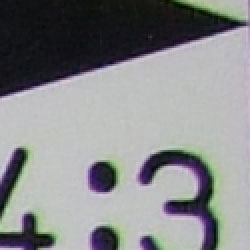
Chromatic aberration is moderate at both wide angle and telephoto, showing about 5-7 pixels of coloration on either side of the target lines. At full wide angle the effect is more noticeable because of the brighter pixels. Distortion is not quite as bright at telephoto, but is still noticeable. The result is rather moderate considering the Fujifilm F100fd’s large 12-megapixel image size. Chromatic aberration is visible as a slight colored fringe around the objects at the edges of the field of view on the resolution target.
Corner Sharpness
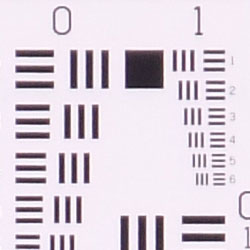
Very slight blurring in the corners of the frame at wide angle and telephoto.
 |
 |
| Wide: Minimal blurring in the corners (upper right). |
Wide: Sharp at center. |
 |
 |
| Tele: Slightly soft in the corners (upper right). |
Tele: Sharp at center. |
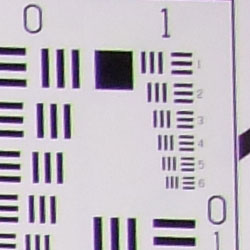
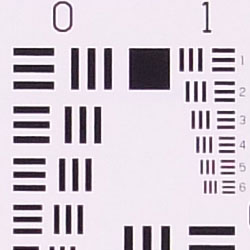
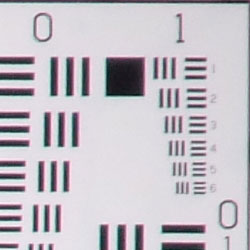
The Fujifilm FinePix F100fd produced only minimal blurring in the corners of the frame at both zoom settings. Very good performance here, especially for a 28mm equivalent wide angle lens that reaches to 5x telephoto.
Viewfinder
Coverage
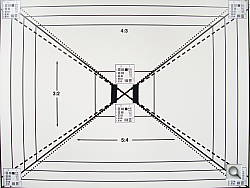
Very good accuracy from the F100fd’s LCD monitor.
 |
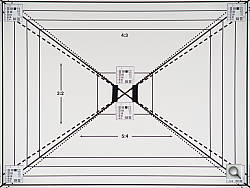 |
| 28mm eq., LCD | 140mm eq., LCD |
The Fujifilm FinePix F100fd’s LCD monitor showed about 104% coverage accuracy at wide angle, and about 98% at telephoto. Pretty good results here, though a little loose at wide angle (this could be due to the difficulty of framing the image with more pronounced pincushion distortion, however).
The images above were taken from our standardized test shots. For a
collection of more pictorial photos, see our
Fujifilm FinePix F100fd Photo Gallery
.
Exposure
Fuji F100fd Exposure
Color
Saturation & Hue Accuracy
Very good overall color and hue accuracy, with minor oversaturation and undersaturation of some colors.
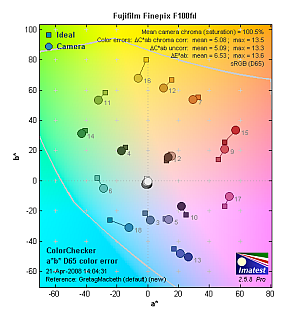 |
| In the diagram above, the squares show the original color, and the circles show the color that the camera captured. More saturated colors are located towards the periphery of the graph. Hue changes as you travel around the center. Thus, hue-accurate, highly saturated colors appear as lines radiating from the center. |
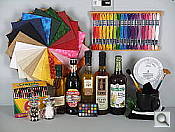
Saturation. The Fujifilm FinePix F100fd oversaturates some red and blue tones slightly, which is typical of consumer digital cameras. However, bright yellows and greens are actually a little undersaturated. Overall saturation still looked good and pleasing throughout most of our test subjects. Most consumer digital cameras produce color that’s more
highly saturated (more intense) than found in the original subjects. This
is simply because most people like their color a bit brighter than life.
Skin tones. Here, with the color balanced properly for the light source, the Fuji F100fd’s skin tones were a little pinkish, though still believable. Where oversaturation is most problematic is on Caucasian skin tones,
as it’s very easy for these “memory colors” to be seen as too
bright, too pink, too yellow, etc.
Hue. The Fujifilm FinePix F100fd showed some minor color shifts relative to the correct mathematical translation of colors in its subjects. Notably, it pushed cyan toward blue (presumable for stronger blue skies), magenta toward red, and yellow toward green. Still, overall color was pleasing. Hue is “what color” the color is.
 |
 |
 |
| See full set of test images with explanations See thumbnails of all test and gallery images |
||
Sensor
Exposure and White Balance
Indoors, incandescent lighting
Good color with the Manual white balance setting, though slight color shifts with Auto and Incandescent options. Default exposure is slightly dim requiring a jump to ISO 200 and +0.7EV adjustment.
 |
 |
 |
| Auto White Balance ISO 200, +0.7 EV |
Incandescent White Balance ISO 200, +0.7 EV |
Manual White Balance ISO 200, +0.7 EV |
Color balance indoors under incandescent lighting was quite reddish in Auto white balance mode, while the Incandescent setting had a stronger warm cast. Manual mode was the most accurate overall, though just a hint cool. The FinePix F100fd’s default exposure setting at ISO 100 produced just slightly dim results, and EV adjustments did not work because the F100fd’s lowest automatically controlled shutter speed is 1/4 second. Getting a properly exposed shot required a switch to ISO 200, and an adjustment to +0.7 EV. Our test lighting for this shot is a mixture of 60 and
100 watt household incandescent bulbs, a pretty yellow light source, but
a very common one in typical home settings here in the U.S.
Â
Outdoors, daylight
High contrast under harsh lighting, but good overall color.
 |
 |
| Auto White Balance, +1.0 EV |
Auto White Balance, Auto Exposure |
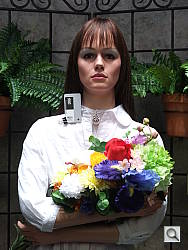
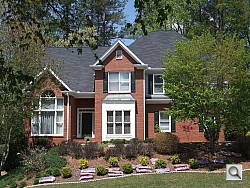
Outdoors, the Fujifilm FinePix F100fd produced high contrast under very harsh lighting, a common struggle for many digital cameras. On the portrait shot, the shirt is just about completely blown out at +1.0 EV, but any less exposure compensation resulted in unnaturally dark skin tones. The FinePix F100fd does have a useful Dynamic Range adjustment, which actually helped even out the exposure on the portrait at its 400% setting (see Sunlight test below). On the house shot, detail is actually pretty good in the shadows and highlights, though obscured slightly by image noise. Definitely consider the camera’s Dynamic Range adjustment under conditions like these.
See full set of test images with explanations
See thumbnails of all test and gallery images
Resolution
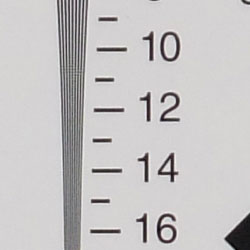
Very high resolution, 1,800 lines of strong detail.
 |
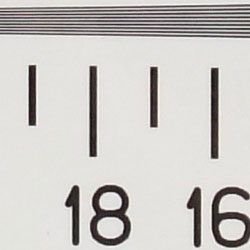 |
| Strong detail to 1,800 lines horizontal |
Strong detail to 1,800 lines vertical |
 |
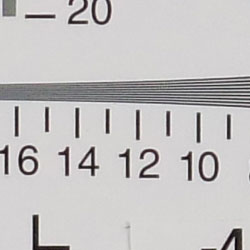 |
| Extinction occurs at around 3,000 lines horizontal (This is the 2x target, so multiply numbers by 2) |
Extinction occurs at around 3,000 lines vertical (This is the 2x target, so multiply numbers by 2) |
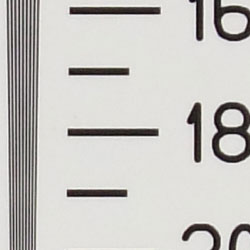
Our laboratory resolution chart revealed sharp, distinct line patterns down to about 1,800 lines per picture height in both directions. Extinction didn’t occur, and though artifacts begin to cloud the lines slightly at 2,000 lines, detail actually remains pretty good. Switching to the 2x target roughly verifies the 1,800 number, and sets extinction at about 3,000 lines. Use these numbers to compare with other cameras of similar resolution, or use them to see just what higher resolution can mean in terms of potential detail.
See full set of test images with explanations
See thumbnails of all test and gallery images
Sharpness & Detail
Sharp images with strong detail except in low contrast areas. Minor evidence of edge-enhancement on high-contrast subjects, and noise suppression in the shadows.
 |
 |
| Good definition of high-contrast elements, with only minor edge enhancement. |
Subtle detail: Hair Overall good detail in the shadows, with a moderate level of noise suppression blurring detail. |
Sharpness. The Fujifilm FinePix F100fd captured sharp details, with good definition. Slight edge enhancement artifacts are visible on high-contrast subjects, but the camera does a good job here; shadow areas lose detail, as seen in the bricks. Edge enhancement creates
the illusion of sharpness by enhancing colors and tones right at the edge
of a rapid transition in color or tone.
Detail. The crop above right shows fairly heavy noise suppression in the hair, softening more area overall than is normal. Noise-suppression systems in digital cameras tend to flatten-out
detail in areas of subtle contrast. The effects can often be seen in shots
of human hair, where the individual strands are lost and an almost “watercolor”
look appears.
ISO & Noise Performance
Low to moderate noise at the normal sensitivity settings, with moderate noise suppression. Higher noise suppression and blurring at the higher settings.
 |
 |
 |
| ISO 100 | ISO 200 | ISO 400 |
 |
 |
 |
ISO 800 | ISO 1,600 | ISO 3,200 |
 |
 |
 | ISO 6,400 (2,048 x 1,536 pixels) |
ISO 12,800 (2,048 x 1,536 pixels) |
The Fujifilm FinePix F100fd produced fairly low noise at its normal sensitivity settings, with good results at ISO 400 as well; however, noise suppression is clearly at work, softening fine detail in most of the model’s hair. At ISO 400, a lot of fine detail is gone. At ISO 800, the effects of noise suppression are much stronger with blurred detail throughout the frame. At the 1,600 and 3,200 settings, the noise pattern is more pronounced. The highest ISO settings of 6,400 and 12,800 are limited to the 2,048 x 1,536-pixel image size, and results at both settings definitely appear more like a Renoir.
Extremes: Sunlit and low light tests
Very high resolution and strong detail, though high contrast under harsh
lighting. Poor low-light performance in normal shooting mode, but much better
results with Night mode.
 |
 |
 |
| +0.7 EV | +1.0 EV | +1.3 EV |
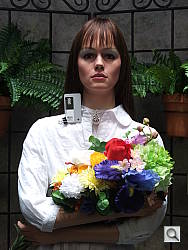
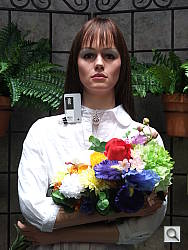
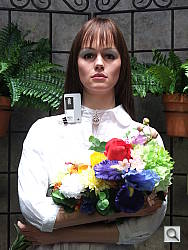
Sunlight. The Fujifilm FinePix F100fd produced very high contrast under the deliberately harsh lighting in the test above, with blown-out highlights and very deep shadows. Detail remains fairly strong in the shadow areas, though the hot highlights lose a considerable amount. At +1.0 EV, the highlights are definitely a little too bright, but this was the best exposure for the subject’s face. At +0.7 EV, the highlights are a little more tame, but the face is quite dark. The camera’s Dynamic Range adjustment did help out quite a bit here (see below), and at the higher settings produced a much more even exposure. Consider adjusting the Dynamic Range in situations like these with the F100fd, though shooting with a fill flash or in the shade may be better options under harsh lighting.
| Dynamic Range Settings | |||
 |
 |
 |
 |
| Auto | 100% | 200% | 400% |
As mentioned previously, the FinePix F100fd’s adjustable Dynamic Range settings helped in harsh lighting as in the portrait shots above. You can see that highlight detail in the white shirt is blown-out in the first two images, but increasing the dynamic range setting helped to bring out more detail in this area, as well as in the shadows and midtones. Unfortunately, that detail is marred by the increase in noise and noise reduction at 400%, which used ISO 400.
Because digital cameras are more like slide film than negative film (in that they tend to have a more limited tonal range), we test them in the harshest situations to see how they handle scenes with bright highlights and dark shadows, as well as what kind of sensitivity they have in low light. The shot above is designed to mimic the very harsh, contrasty effect of direct noonday sunlight, a very tough challenge for most digital cameras. (You can read details of this test here.)
| Â | 1 fc 11 lux |
1/2 fc 5.5 lux |
1/4 fc 2.7 lux |
1/8 fc 1.3 lux |
1/16 fc 0.67 lux |
|---|---|---|---|---|---|
| ISO 100 |
 1/4 sec f3.3 |
 1/4 sec f3.3 |
 1/4 sec f3.3 |
 1/4 sec f3.3 |
 1/4 sec f3.3 |
| ISO 200 |
 1/4 sec f3.3 |
 1/4 sec f3.3 |
 1/4 sec f3.3 |
 1/4 sec f3.3 |
 1/4 sec f3.3 |
| ISO 400 |
 1/4 sec f3.3 |
 1/4 sec f3.3 |
 1/4 sec f3.3 |
 1/4 sec f3.3 |
 1/4 sec f3.3 |
| ISO 800 |
 1/4 sec f3.3 |
 1/4 sec f3.3 |
 1/4 sec f3.3 |
 1/4 sec f3.3 |
 1/4 sec f3.3 |
| ISO 1600 |
 1/5 sec f3.3 |
 1/4 sec f3.3 |
 1/4 sec f3.3 |
 1/4 sec f3.3 |
 1/4 sec f3.3 |
| ISO 3200 |
 1/10 sec f3.3 |
 1/6 sec f3.3 |
 1/4 sec f3.3 |
 1/4 sec f3.3 |
 1/4 sec f3.3 |
| ISO 6400 |
 1/20 sec f3.3 |
 1/12 sec f3.3 |
 1/7 sec f3.3 |
 1/4 sec f3.3 |
 1/4 sec f3.3 |
| ISO 12800 |
 1/42 sec f3.3 |
 1/20 sec f3.3 |
 1/12 sec f3.3 |
 1/7 sec f3.3 |
 1/4 sec f3.3 |
| ISO 100 (Night mode) |
 3 sec f3.3 |
 6.5 sec f3.3 |
 8 sec f3.3 |
 8 sec f3.3 |
 8 sec f3.3 |
Low light. The Fujifilm FinePix F100fd had trouble on the low-light test. Images were quite dark even at the brightest light level until ISO 800. The slowest shutter speed available in auto modes is 1/4 second. However, switching over to Night mode produced much better results, with shutter times as long as 8 seconds available. In Night mode, the camera kept the ISO at 100, and images were bright down the the 1/8 foot-candle light level, though there were quite a few “hot pixels” visible (likely not a problem for normal sized prints). So, for the best results, use Night mode in dark conditions like these. Color balance was a hint cool with the Auto setting, but still pretty good. The camera’s autofocus system worked well also, as it was able to focus on the subject beyond the 1/16 foot-candle light level unassisted. Keep in mind that the longer shutter times here demand a tripod to prevent any blurring from camera movement. (A useful trick is to just prop the camera on a convenient surface, and use its self-timer to release the shutter. This avoids any jiggling from your finger pressing the shutter button, and can work quite well when you don’t have a tripod handy.)
How bright is this? The one foot-candle light level
that this test begins at roughly corresponds to the brightness of typical
city street-lighting at night. Cameras performing well at that level should
be able to snap good-looking photos of street-lit scenes.
NOTE: This low light test is conducted with a stationary subject,
and the camera mounted on a sturdy tripod. Most digital cameras will
fail miserably when faced with a moving subject in dim lighting. (For
example, a child’s ballet recital or a holiday pageant in a gymnasium.)
For such applications, you may have better luck with a digital SLR camera,
but even there, you’ll likely need to set the focus manually. For information
and reviews on digital SLRs, refer to our SLR
review index page.
Flash
Coverage and Range
A weak flash, though coverage is fairly uniform for a 28mm equivalent lens.
 |
 |
| 28mm equivalent | 140mm equivalent |
 |
 |
| Normal Flash Default Exposure |
Slow-Sync Flash +0.3 EV |
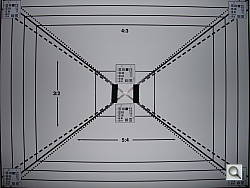
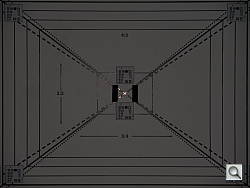
Coverage. Flash coverage was slightly uneven at wide angle, with a small amount of falloff in the corners and at the edges of the frame. At full telephoto, the target was almost too far for the flash to illuminate it. In the Indoor test, the F100fd’s flash underexposed our subject at its default setting, and raising the exposure value had no effect. The camera’s Slow-Sync flash mode produced slightly brighter results at +0.3 EV, though with a stronger pinkish-orange cast from the background room lighting.
| Flash Range: Wide Angle | |||||
|---|---|---|---|---|---|
| 6 ft | 7 ft | 8 ft | 9 ft | 10 ft | 11 ft |
 1/60 sec f3.3 ISO 100 |
 1/60 sec f3.3 ISO 100 |
 1/60 sec f3.3 ISO 100 |
 1/60 sec f3.3 ISO 100 |
 1/60 sec f3.3 ISO 100 |
 1/60 sec f3.3 ISO 100 |
| 12 ft | 13 ft | 14 ft | 15 ft | 16 ft | |
 1/60 sec f3.3 ISO 100 |
 1/60 sec f3.3 ISO 100 |
 1/60 sec f3.3 ISO 100 |
 1/60 sec f3.3 ISO 100 |
 1/60 sec f3.3 ISO 100 |
|
| Flash Range: Telephoto | |||||
|---|---|---|---|---|---|
| 6 ft | 7 ft | 8 ft | 9 ft | 10 ft | 11 ft |
 1/125 sec f5.1 ISO 100 |
 1/125 sec f5.1 ISO 100 |
 1/125 sec f5.1 ISO 100 |
 1/125 sec f5.1 ISO 100 |
 1/125 sec f5.1 ISO 100 |
 1/125 sec f5.1 ISO 100 |
| 12 ft | 13 ft | 14 ft | 15 ft | 16 ft | |
 1/125 sec f5.1 ISO 100 |
 1/125 sec f5.1 ISO 100 |
 1/125 sec f5.1 ISO 100 |
 1/125 sec f5.1 ISO 100 |
 1/125 sec f5.1 ISO 100 |
|
ISO 100 Range. At wide angle, flash shots at ISO 100 were bright
at 6 feet, but began decreasing gradually in brightness from there. At telephoto,
results were already dim at 6 feet, and continued to darken.
| Manufacturer-Specified Flash Range | |
|---|---|
| Wide Angle | Telephoto |
 14.1 feet Auto ISO 400 |
 9.2 feet Auto ISO 400 |
Manufacturer Specified Flash Test. The Finepix F100fd performs close to Fujifilm’s stated flash range, though the camera had to boost ISO to get bright results. At wide angle, the camera produced a bright exposure at the rated distance with its ISO set to Auto (which selected ISO 400). At telephoto, the image is slightly dim, despite the boost ISO 400. Our
standard test method for flash range uses a fixed setting of ISO 100, to
provide a fair basis of comparison between cameras. We’ve now also begun
shooting two shots using the manufacturer-specified camera settings, at
the range the company claims for the camera, to assess the validity of the
specific claims.
Output Quality
Print Quality
Good print quality, good color, sharp 13×19-inch prints. ISO 400 images are soft but usable at 13×19, ISO 800 shots are still good at 8×10.
Testing hundreds of digital cameras, we’ve found that you can only tell just so much about a camera’s image quality by viewing its images on-screen. Ultimately, there’s no substitute for printing a lot of images and examining them closely. For this reason, we now routinely print sample images from the cameras we test on our Canon i9900 studio printer, and on the Canon iP5200 here in the office. (See the Canon i9900 review for details on that model.)
The images above were taken from our standardized test shots. For a
collection of more pictorial photos, see our
Fujifilm FinePix F100fd Photo Gallery
.
Not sure which camera to buy? Let your eyes be the ultimate judge!
Visit our Comparometer(tm)
to compare images from the Fujifilm FinePix F100fd with those from other
cameras you may be considering. The proof is in the pictures, so let
your own eyes decide which you like best!
Performance
Fuji F100fd Performance
Timing and Performance
Average to somewhat slow speed for a consumer camera.
|
Startup/Shutdown
|
||
|
Power on |
3.5 seconds |
Time it takes for the LCD to turn on, the lens to deploy, and capture a shot. |
|
Shutdown |
1.7 seconds |
How long it takes to retract lens. |
|
Buffer clearing time |
8.0 seconds in LF JPEG, 12.0 seconds in Top 12 mode |
Worst case buffer clearing time. |
Startup time is a little sluggish and buffer clearing time is longer than
average.
| Mode Switching | ||
|---|---|---|
|
Play to Record, |
0.5 second |
Time until first shot is captured. |
|
Record to Play |
0.9 second |
Time to display a large/fine file immediately after capture. |
|
Display |
1.9 seconds |
Time to display a large/fine file already on the memory card. |
Mode switching times aren’t too bad, though 1.9 seconds to display a recorded image may seem a little long out in the field.
| Shutter Response (Lag Time) | ||
|---|---|---|
|
Full Autofocus Wide |
0.50 second |
Time from fully pressing shutter |
|
Full Autofocus Tele |
0.85 second |
Time from fully pressing shutter |
|
Full Autofocus |
0.66 second |
Time from fully pressing shutter button to image capture, zoom lens at wide angle position, flash enabled. |
|
Prefocused |
0.019 second |
Time to capture, after half-pressing |
|
Continuous AF
|
0.51 second
|
This mode usually
shows no speed increase with our static subject; we have no way to measure performance with moving subjects. |
Shutter response is on the slow side of average for this class of camera, at 0.50s and 0.85s respectively. Enabling the flash increases lag slightly, as expected. “Prefocusing” the camera by half-pressing and holding down the shutter button before the final exposure results in a lag time of only 0.019 second, which is super fast.
| Cycle Time (shot to shot) | ||
|---|---|---|
|
Single Shot mode
Large Fine JPEG |
3.27 seconds |
Time per shot, averaged over 20 |
|
Single Shot mode |
1.93 seconds |
Time per shot, averaged over 20 |
|
Early shutter |
Yes |
Some cameras don’t snap another |
|
Continuous mode |
1.16 seconds (0.86 frames per second); 2 frames total; 8 seconds to clear |
Time per shot, averaged over 2 shots, then slowed to 3.13 seconds or 0.32 frames per second. |
|
Continuous mode |
0.58 second (1.72 frames per second); 3 frames total; 1 second to clear |
Time per shot, averaged over buffer length |
|
Continuous mode |
1.90 seconds (0.53 frames per second); 20 frames total; 4.5 seconds to clear |
Time per shot, averaged over buffer |
|
Continuous mode |
0.58 second (1.72 frames per second); 3 frames total; 1 second to clear |
Time per shot, averaged over buffer |
|
Continuous mode |
0.21 second (4.87 frames per second); 12 frames total; 12 seconds to clear |
Time per shot, averaged over buffer length |
|
Flash recycling |
7.8 seconds |
Flash at maximum output. |
|
*Note: Buffer clearing times measured with an Olympus Type-H xD-Picture card. Slower memory cards will produce correspondingly slower clearing times. Slow cards may also limit length of bursts in continuous mode. ISO sensitivity and other settings may also affect cycle times and burst mode performance. |
||
Shot-to-shot cycle times are also on the slow side, at about 3.27 seconds average for large/fine JPEGs. The camera actually captures the first two images with a 1.18 second cycle time before dropping to the longer 3+ second timing afterwards. A consideration here is the very large 4,000 x 3,000 resolution, which is a lot of data to handle and write to the memory card for every shot. The FinePix F100fd also drags a little in its Continuous modes, with nearly identical timings in its Long Period option. The Top Three mode is much faster however, capturing at a 1.72 frame rate for large/fine JPEGs, but for only three frames. That said, the F100fd does offer a Top 12 Continuous mode, which drops the resolution down to 2,048 x 1,536 pixels, but captures at a much faster frame rate of 4.87 frames per second. The flash takes 7.8 seconds to recharge after a full-power shot, which is fairly slow.
| Download Speed | ||
|---|---|---|
|
Windows Computer, USB 2.0 |
2,172 KBytes/sec |
Typical Values: |
Connected to a computer or printer with USB 2.0, download speeds are good.
Bottom line, the Fujifilm FinePix F100fd isn’t the most responsive consumer
digital camera on the market, but it should handle most average conditions
well. Its standard Continuous modes aren’t zippy enough for very fast action,
but the Top 12 mode is fast enough for running children as well as sporting
events. Overall though, the FinePix F100fd should fare pretty well in most
situations.
Battery and Storage Capacity
Battery
Slightly below average battery life for a Lithium-ion design.
| Operating Mode | Number of Shots |
|---|---|
|
Lithium-ion Rechargeable Battery,
(CIPA standard) |
230
|
The Fujifilm FinePix F100fd uses a custom rechargeable lithium-ion battery for power, and ships with a charger. Battery life is slightly below average, so we recommend you pick up a spare battery and keep it freshly charged and on-hand for extended outings.
The table above shows the number of shots the camera is capable of (on either a fresh set of disposable batteries or a fully-charged rechargeable battery as appropriate), based on CIPA battery-life and/or manufacturer standard test conditions.
(Interested readers can find an English translation of the CIPA DC-002 standards document here. (180K PDF document))
Storage
The Fujifilm FinePix F100fd accepts xD-Picture Cards and SD cards, and also has 57MB of internal memory.
| Image Capacity with 57MB Internal Memory |
Fine | Normal | |
|---|---|---|---|
|
4,000
x 3,000 |
Images
|
11
|
19
|
|
File Size
|
4.8 MB
|
3.0 MB
|
|
|
2,848
x 2,136 |
Images
|
18
|
37
|
|
File Size
|
3.0 MB
|
1.5 MB
|
|
|
2,048
x 1,536 |
Images
|
69
|
–
|
|
File Size
|
817 KB
|
–
|
|
|
1,600
x 1,200 |
Images
|
86
|
–
|
|
File Size
|
657 KB
|
–
|
|
|
640
x 480 |
Images
|
356
|
–
|
|
File Size
|
160 KB
|
–
|
|
Though the Fujifilm F100fd includes approximately 57MB internal memory, we strongly recommend buying a large capacity xD memory card or SD/SDHC memory card – at least a 2GB card, preferably a 4GB one, to give yourself extra space for extended outings and video. (Check the shopping link above, cards are really cheap these days, so no reason to skimp.)