

Overview
Overview by Roger Slavens and Mike Tomkins
Posted: 10/08/2013

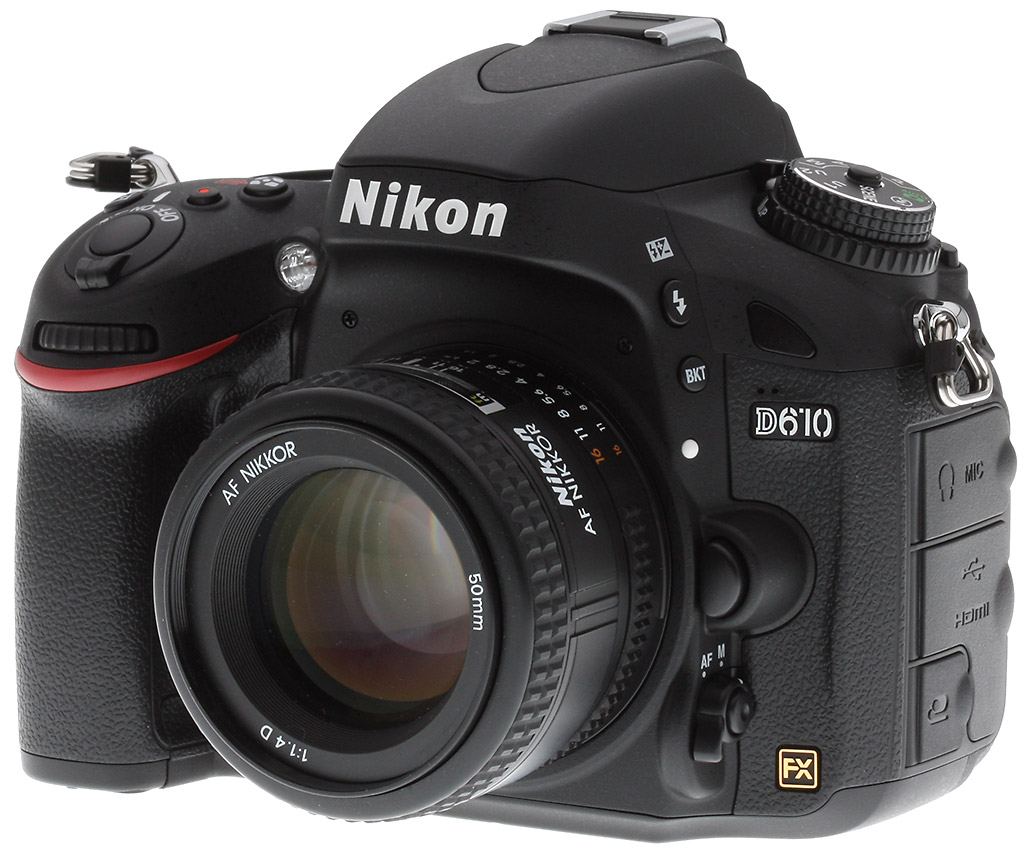
Last fall, Nikon made full-frame photography more affordable than ever with the introduction of the D600 prosumer DSLR. Now, the company is back one year later with a slightly upgraded model -- the Nikon D610 -- featuring a new shutter mechanism that not only boosts the camera's continuous shooting speed, but also eliminates the persistent oil-on-sensor problem that marred the D600's otherwise high quality images.
Boasting the same 24.3-megapixel FX-format CMOS sensor, optical viewfinder with 100% coverage, and 3.2-inch, 921K-dot LCD monitor as its predecessor, the D610 also features a new quiet continuous shutter mode and improved auto white balance. But arguably the best feature is that the Nikon D610 is $100 cheaper at launch than the D600, listing at US$2,000 body only or US$2,500 paired with the AF-S NIKKOR 24-85mm f/3.5-4.5G ED VR lens.
What's new. While the upgrades to the Nikon D610 may seem like relatively minor tweaks, at least one of them puts to rest a serious issue that many owners reported with the D600, which we investigated in our review of the camera last year. We found the same dust and oil spots in our D600 images that others found, most likely from the shutter mechanism splattering the sensor with oil, and perhaps even flaking paint.

The dust and oil were not noticeable in most images -- at least, not unless you really looked for them -- but Nikon acknowledged that there was indeed an issue with the D600. The company, however, did not issue a recall or a fix, instead urging owners who discovered the problem with their units to contact Nikon to have camera serviced. According to anecdotal evidence from owners, the problem seemed to go away after a few thousand shutter activations.
Despite this oil-on-sensor issue, we still highly recommended the D600 for its considerable imaging prowess and great overall performance, so we're very excited that Nikon has designed a new shutter mechanism for the D610. Although Nikon would not go on record to say that the new shutter was employed to fix the problem, we're confident that this is the case.
In addition, this new shutter is a shade faster, allowing the D610 to achieve a claimed 6 frames-per-second continuous shooting burst rate at full resolution, where the D600 maxed out at 5.5fps. The D610 also features a new Quiet Continuous Shutter mode -- found on the Mode dial as position "Qc", between the pre-existing "Q" single-shot Quiet Shutter mode and the self-timer -- that allows for more discreet burst shooting at 3fps.
The third and final upgrade to the D610, according to Nikon, is improved Auto White Balance. The company says that this uses an advanced algorithm designed to reproduce more natural-looking color, even from artificial light sources.

What's the same. All the advanced photographic features and functions that we loved about the Nikon D600 return for the D610. First and foremost is the 24.3-megapixel full-frame, FX-format CMOS image sensor, which delivers very high resolution with superb detail, a wide dynamic range and excellent low-light, high ISO performance. Normal sensitivity ranges from a base of ISO 100 up to a healthy ISO 6,400, with extended 12,800 and 25,600 equivalents at the Hi-1 and Hi-2 settings.
The D610 incorporates the same 39-point autofocus system as its predecessor, which in our review of that earlier model we found to focus very well in low light. The AF system also employs nine cross-type sensors, including seven which keep AF ability up to f/8.
Other key features that return in the Nikon D610:
- Pentaprism optical viewfinder with 100% coverage
- 3.2-inch LCD monitor with 921,000 dots of resolution
- High dynamic range mode
- Time-lapse mode
- Interval timer
- Built-in lens corrections
- Built-in flash with wireless commander mode
- Dual Secure Digital memory card slots
- Full HD (1080p) video at 24p/30p frame rates, with manual control in video mode
- Built-in monaural microphone and external stereo mic input jack
- Stereo headphone jack
- Optional Wi-Fi wireless networking with WU-1b Wireless Mobile Adapter
- Sealed and gasketed construction for dust and moisture resistance
In the Box
The Nikon D610 retail package contains the following items:
- Nikon D610 body
- BF-1B body cap
- AF-S NIKKOR 24-85mm f/3.5-4.5G ED VR and/or AF-S NIKKOR 28-300mm f/3.5-5.6G ED VR lens (if bought as a kit)
- Front and rear lens caps (if bought as a kit)
- EN-EL15 lithium-ion battery 7v 1900mAh
- MH-25 quick charger
- UC-E15 USB cable
- BM-14 LCD monitor cover
- DK-21 rubber eyecup
- AN-DC10 strap
- DK-5 eyepiece cap
- BS-1 accessory shoe cap
- Nikon ViewNX 2 CD-ROM
- HB-63 lens hood (for 24-85mm or twin-lens kit)
- CL-1118 soft lens case (for 24-85mm or twin-lens kit)
- HB-36 lens hood (for 28-300mm or twin-lens kit)
- CL-1022 soft lens case (for 28-300mm or twin-lens kit)
- Large laptop bag (for 28-300mm lens kit)
- WU-1b wireless mobile adapter (for twin-lens kit)
- Advanced amateur bag (for twin-lens kit)
- 32GB Class 10 Secure Digital card (for 28-300mm or twin-lens kits)
- Nikon Guide to SLR Photography book (for 28-300mm or twin-lens kits)
Recommended Accessories
- Large capacity SDHC/SDXC memory card. These days, 16GB is a good tradeoff between cost and capacity for a consumer DSLR, but if you plan to capture HD movie clips or shoot in RAW format, look for larger cards, and Class 6 ratings should be a minimum. We recommend a UHS-I compliant card for best burst-mode performance.
- Camera case
- A selection of sharp lenses
- Accessory flash
- Extra EN-EL15 battery
- MB-D14 Battery grip
Performance
Note: Apart from updated continuous mode results, D600 timing has been repeated here after spot checks to verify other timing has remained essentially the same.
Timing and Performance
Improved burst speeds over its predecessor.
| Startup/Shutdown | ||
|---|---|---|
| Power on |
~0.3 second
|
Time it takes for camera to turn on and take a shot. |
| Shutdown |
~0.2 second
|
How long it takes to turn off. |
Startup and shutdown times are good for a prosumer SLR.
| Mode Switching | ||
|---|---|---|
|
Play to Record, |
~0.3 second
|
Time until first shot is captured. |
|
Record to Play |
~0.7 second
|
Time to display a large/fine file immediately after capture. |
|
Display |
~0.3 second
|
Time to display a large/fine file already on the memory card. |
Mode switching is quite fast, difficult to measure accurately.
| Shutter Response (Lag Time) | ||
|---|---|---|
|
Full Autofocus |
0.260 second
|
Time from fully pressing shutter button to image capture. (All AF timing measurements taken with Sigma 70mm f/2.8 prime, unless otherwise noted.) |
|
Full Autofocus |
0.295 second
|
Time from fully pressing shutter button to image capture. Auto Flash enabled. |
|
Full Autofocus |
0.335 second
|
Time from fully pressing shutter button to image capture. |
|
Continuous AF |
0.054 second
|
This mode is release priority so subject may be out of focus; we have no way to measure performance with moving subjects. |
|
Manual focus |
0.054 second
|
For most cameras, shutter lag is less in manual focus than autofocus, but usually not as fast as when the camera is "pre-focused." |
|
Pre-focused |
0.054 second
|
Time to capture, after half-pressing and holding shutter button. |
| Live View | ||
|
Full Autofocus |
1.78 seconds
|
Time from fully pressing shutter button to image capture with Sigma 70mm f/2.8 prime. |
|
Full Autofocus |
1.54 seconds
|
Time from fully pressing shutter button to image capture with Nikkor AF-S 24-85mm f/3.5-4.5G VR kit lens. |
|
Pre-focused |
0.218 second
|
Time to capture, after half-pressing and holding shutter button. |
The first set of numbers above using the optical viewfinder measure shutter lag with the lens already set to the correct focal distance. This largely removes the issue of differences in lens focusing speed, and measures how fast the camera can measure and act on focus information. In this metric, the Nikon D610 is slightly slower than average for a prosumer SLR. The D610 required 0.260 second for full AF when using Single-point (center) AF mode (our default full AF lag test). Enabling the flash increased lag a bit to 0.295 second. The D610 required 0.335 second when using the 39-point Auto-area AF mode, also slower than average. Continuous AF, manual focus, and prefocused shutter lag times were all 0.054 second, though, quite fast for a prosumer SLR.
As expected, the Nikon D610's Live View mode adds considerable shutter lag. The D610's Live View mode uses contrast detection autofocus, from data streaming off the image sensor. Using the gear-driven Sigma 70mm f/2.8 prime, full autofocus lag was a rather lengthy 1.78 seconds. That's slower than average these days, but faster than some earlier Nikons we've tested. With the AF-S 24-85mm kit lens, full AF lag was a bit faster at 1.54 seconds, but that's still pretty sluggish. Prefocused, the D610's Live View shutter lag was reasonably quick at 0.218 second, but that's still much slower than using the optical viewfinder.
To minimize the effect of different lens' focusing speed, we test AF-active shutter lag with the lens already set to the correct focal distance. We also use the same Sigma 70mm f/2.8 macro with every camera (on all platforms except Four Thirds/Micro Four Thirds and Nikon consumer models lacking an in-body focus motor), to further reduce variation, and because our tests showed that focus-determination time with this lens was close to the fastest, across multiple camera bodies from different manufacturers. Being an older design with a non-ultrasonic motor, it wouldn't be the fastest at slewing from one focus setting to another, but that's exactly the reason we measure focus determination speed, which is primarily a function of the camera body, vs focus adjustment speed, which is primarily a function of the lens.
| Cycle Time (shot-to-shot) | ||
|---|---|---|
|
Single Shot mode |
0.50 second
|
Time per shot. |
|
Single Shot mode |
0.51 second
|
Time per shot. |
|
Single Shot mode |
0.58 second
|
Time per shot. |
|
Early shutter |
No
(YES with flash) |
Some cameras refuse to snap another shot if you release and press the shutter too quickly in Single Shot mode, making "No" the preferred answer. |
| Continuous mode |
0.17 second
(5.92 fps); 30 frames total; 9 seconds to clear* |
Time per shot, averaged over the buffer length of 30 shots, then slows to an average of 0.36 second (2.77 fps) for subsequent shots. |
|
Continuous mode |
0.17 second
(5.93 fps); 15 frames total; 9 seconds to clear* |
Time per shot, averaged over the buffer length of 15 frames, then slows to an average of 0.60 second (1.66 fps) for subsequent shots. |
|
Continuous mode |
0.17 second
(5.94 fps); 13 frames total; 12 seconds to clear* |
Time per shot, averaged over the buffer length of 13 frames, then slows to an average of 0.95 seconds (1.06 fps) for subsequent shots. |
| Flash recycling |
4.0 seconds
|
Flash at maximum output. |
| * Note: Buffer clearing times measured with a SanDisk Extreme Pro 95MB/s UHS-1 SDHC card. Slower cards will produce correspondingly slower clearing times. Slow cards may also limit length of bursts in continuous mode. ISO sensitivity and noise reduction settings can also affect cycle times and burst mode performance. |
||
Shot-to-shot cycle times are about average for an SLR, at 0.50 second for Large/Fine JPEGs, 0.51 second for 14-bit RAW, and 0.58 second for RAW+JPEG.
Continuous mode is slightly improved over it predecessor, at about 5.9 frames per second versus 5.4 frames per second for the D600, no matter the file type.
The Nikon D610's buffer depths are good for a high-res prosumer SLR, just slightly improved over the D600. The D610 managed to capture 30 L/F JPEGs, 15 RAW frames, or 13 RAW+JPEG frames before slowing down. (You'll likely do better with real-world subjects, as the target image we use for our tests is designed to be difficult to compress.) Buffer clearing is relatively quick with a fast card.
The D610's flash takes 4.0 seconds to recharge after a full-power shot, a bit slower than average for an SLR.
Bottom line, the Nikon D610's performance varies from very good to a little slow. Startup and mode switching are quite fast. Autofocus speeds are slightly slower than average for a prosumer SLR, but still reasonably fast except in Live View mode. And continuous mode speeds have improved by about half a frame per second, which is quite good for its class.
Battery
Battery Life
Excellent battery life for a lithium-ion design.
| Operating Mode | Number of Shots |
|---|---|
|
Still Capture,
Optical Viewfinder (CIPA standard) |
900
|
|
Still Capture,
LCD Live View (CIPA standard) |
Unknown
|
The Nikon D610 uses a custom rechargeable lithium-ion battery for power, and ships with a charger. Battery life is the same as the D600, which is excellent with the optical viewfinder, but if you plan to use Live View or shoot movies much, you'll want to have a spare to bring along as those modes are a much larger drain on the battery.
The table above shows the number of shots the camera is capable of (on either a fresh set of disposable batteries or a fully-charged rechargeable battery as appropriate), based on CIPA battery-life and/or manufacturer standard test conditions.
(Interested readers can find an English translation of the CIPA DC-002 standards document here. (180K PDF document))
Image Quality
As the Nikon D610 is nearly identical to the D600 with the same sensor and processor, we thought it unnecessary to do an extensive image quality comparison with the D610 versus a range of competing cameras. Instead, we've made a one-to-one comparison between the D610 and D600 to show that the image quality is extremely similar between these two cameras. For a comparison against other competing cameras, head over to our Nikon D600 review.
Note that between the time we shot the D600 sample images to when we shot the D610, our test target was adjusted ever-so-slightly, and as such you may notice a very slight difference in focus and shadows between these two cameras' Still Life sample images in the comparisons below. Please check out the Comparometer™ with these two cameras to compare other areas of the images.
NOTE: These images are best quality JPEGs straight out of the camera, at default settings including noise reduction. Both cameras were shot with the same very sharp reference lens (Sigma 70mm f/2.8 EX DG Macro).
Nikon D610 versus Nikon D600 at ISO 100
 |
 |
 |
 |
 |
 |
Nikon D610 at ISO 100 |
Nikon D600 at ISO 100 |
Barring the slight shadow and focus shift between these two images, the D610 and D600 look unsurprisingly similar. Noise levels, fine detail and color reproduction look nearly identical. You can also see the D610 continues to produce moiré in the red leaf fabric as we noted in our D600 review, thanks to a weak optical low pass filter. |
|
Most digital SLRs and CSCs will produce an excellent ISO 100 shot, so we like to push them and see what they can do compared to other cameras at ISO 1600, 3200, and 6400. Recent advances in sensor technology have made ISO 1600 look a lot more like ISO 100, but there are still cameras whose quality starts to fall apart at this setting. We also choose 1,600 because we like to be able to shoot at least at this level when indoors and at night.
Nikon D610 versus Nikon D600 at ISO 1600
 |
 |
 |
 |
 |
 |
Nikon D610 at ISO 1600 |
Nikon D600 at ISO 1600 |
Like the previous comparison, results are practically the same between these two cameras. The very slight differences can also be chalked up to focus and shadow differences. |
|
Today's ISO 3200 is yesterday's ISO 1600 (well, almost), so below are the same crops at ISO 3200.
Nikon D610 versus Nikon D600 at ISO 3200
 |
 |
 |
 |
 |
 |
Nikon D610 at ISO 3200 |
Nikon D600 at ISO 3200 |
Both cameras here show a very high amount of fine detail at ISO 3200 in the mosaic and fabric areas, for example. Again, like we saw with the ISO 1600 comparisons, the slight differences are due to slight focus and shadow changes. Nevertheless, both the D610 and D600 do very well at higher ISOs, with minimal image degradation from high ISOs. |
|
Great 30 x 40 inch prints at ISO 50-400; makes a nice 24 x 36 inch print at ISO 800 and a good 5 x 7 at ISO 25,600.
 ISO 50/100/200 produces excellent 30 x 40 prints when viewed from a normal distance, with an amazing amount of fine detail and pleasing colors. Looking very closely at the prints at this size you can see a hint of pixelation. However, there's sufficient detail in these files to make wall-mounted prints at 36 x 48 and even up to 40 x 60 inches.
ISO 400 also allows for great prints at 30 x 40 inches, and 24 x 36 inch prints look outstanding from a normal viewing distance, which would do great wall-mounted. There's lots of fine detail and nice color reproduction at these sizes, and noise is definitely not an issue.
ISO 800 images look good at 24 x 36 inches, with very little noise and a lot of fine detail and excellent colors at this sensitivity.
ISO 1600 makes a nice 16 x 20 inch print, and noise is still pretty sparse. Some luminance and chroma noise can be seen, but it's quite minor. A wall-mounted 20 x 30 inch print will look just fine.
ISO 3200 prints look good up to 13 x 19 inches. High ISO noise is a bit more visible at larger sizes, but at 13 x 19 inches it's more than acceptable. In fact, 16 x 20 renders a very usable wall display print, and we don't usually discuss that size at this ISO. The "grain" here is very similar to what we saw with the D7100: film-like, very finely-grained noise.
ISO 6400 images show some noise at 13 x 19, but the D610 is able to make prints up to 11 x 14 inches with no problem. Fine detail and color still look quite good and pleasing to the eye.
ISO 12,800 prints look nice up to a surprisingly large 8 x 10 inches. The D610's full-frame sensor is really showing what it's made of! There's minor fine-grained noise in the shadows, but overall it doesn't affect fine detail or colors much at this size.
ISO 25,600 images normally yield pretty mediocre prints, but the D610 makes a fairly good 5 x 7. It's pretty amazing at this high ISO that detail looks great at this size and colors still seem so vibrant.
The Nikon D610, like the D600 before it, is able to produce spectacular printed images. Lower sensitivities are able to make some very large prints, up to wall-mountable 40 x 60 inch prints! Even at higher ISOs, the D610 is able to handle them with ease and relatively low noise, lots of fine detail and vibrant colors all the way up to ISO 25,600. There is a slight trace of moiré in the red leaf swatch, like we saw with the D600 and suggesting Nikon has continued to use a weaker low pass filter, but it also handles that swatch as well or better than most of the cameras we have tested (many of which tend to render it quite soft). Keeping in mind the budget-conscious price point for a full-frame DSLR, the Nikon D610 is a stellar performer in the image quality department.
Field Test
Improved in more ways than one
by William Brawley | Posted: 12/03/2013

The Nikon D610 is an interesting addition to the company's DSLR lineup, in that it's not really a new camera per se, but rather just an incremental update to the D600. The primary difference between the new and old models is the D610's new shutter mechanism, plus a couple minor tweaks.
Dust-and-oil problem cleared up. The unofficial reason for the updated model is to fix a particularly troublesome problem that plagued many D600 owners since the introduction of that camera back in 2012 -- dust and oil spots on the sensor, caused by the shutter mechanism. Nikon won't say specifically that the D610 fixes this issue, or that the D600 problem was the impetus for the update, but thankfully the issue does appear to be resolved with the D610's redesigned shutter.

Our colleague and friend Roger Cicala at LensRentals did a thorough evaluation of the Nikon D610 to see if the dust-and-oil issue persisted with the new model. He and his team tested 25 sample units of the D610, checking them three separate times, including after they came back from rental, and found no evidence of the problem.
 |
This composite image from LensRentals shows the accumulated dust found on sensors from 25 different Nikon D610 bodies, after they've been subjected to in-house testing. As Roger Cicala notes, this is a slightly better result than most cameras his company tests. Consider the D600's oil-and-dust problem resolved! |
That's great news for those who wanted a D600, but were dissuaded when the reports of dust-and-oil splatter cropped up late last year. It's perhaps a little disappointing for those who already bought the D600; Nikon has to this point offered no trade-in opportunities for D600 owners. Still, user feedback suggests that the problem resolves itself within the first few thousand shots anyway, so perhaps a trade-in would be a bit much to expect.

So, now that the sensor dust and oil issue is out of the way, what else is new with this camera, and what's it like to shoot with? The primary new features of the Nikon D610 are a Quiet Continuous shutter release mode, and a half frame-per-second increase in capture rate when using the Continuous High burst mode. Both come thanks to the new shutter mechanism. Our lab testing confirms the increase in performance, incidentally -- more on that in a moment.

Quiet Continuous mode. The Quiet Continuous (Qc) mode is a nice addition, and, in fact, quite a rare one at that. The D610 is the first Nikon DSLR to feature it. I thought the Nikon D7100 that I reviewed a while back included it as well, but I remembered incorrectly. (It just has the single-shot quiet mode.) The Qc mode setting has been wedged into the D610's drive mode dial between the standard Quiet Shutter Release mode and the Self-Timer mode. Qc mode allows for a 3fps continuous shooting speed, but with a much quieter shutter actuation sound.
Interestingly, I found the default, single-shot shutter release sound of the D610 to be fairly soft and quiet already, even when not in Quiet mode. It's much quieter than my Canon 5D Mark II and 7D bodies, or the 5D Mark III and D800E we have here at Imaging Resource headquarters. Be that as it may, the single-shot Quiet Shutter release and Quiet Continuous modes really make the shutter sound on the D610 even quieter. I can see either of these near-silent shutter modes being very useful to certain kinds of photographers, especially photojournalists, wedding or street shooters, or even wildlife and nature enthusiasts who don't want to scare off the critters they're photographing or simply want to be more conscientious and respectful of their surroundings. I could definitely imagine a photojournalist at a press conference or event, for example, using either of these quiet shutter release modes to help avoid getting in the way of the proceedings.

The single-shot quiet shutter release mode lets you choose when to release and lower the mirror rather than the standard "raise mirror, open-and-close-shutter, lower mirror" process that a DSLR normally goes through. With the D610, you simply keep the shutter release button pressed to keep the mirror raised. (The shutter will already have closed according to your exposure settings) You're free to lower the shutter at an opportune moment by releasing the button. In the new Qc mode, the D610 does reduce the top continuous shooting speed from 6fps to 3fps, but it allows for a better chance to quietly capture fleeting moments -- or those easily frightened animals -- than do the standard continuous modes.

Continuous high burst mode. The D610 improves upon the burst shooting speed of the D600, and Nikon notes that it allows for six frames per second, up from the 5.5fps of the D600. I found the claim to be quite accurate and our lab results confirmed this. In our tests, the D610 achieved just over 5.9 frames per second for best quality JPEG, RAW and RAW+JPEG frames, versus around 5.4fps for the D600. And buffer depths actually improved by one or two frames, despite the slight increase in burst rate. See the Performance page for details.
Although still not a speed demon -- professional sports photographers will surely look elsewhere for their high-speed cameras -- the D610 is quite capable, especially considering the resolution and sensor size. For the majority of users, a solid 6fps is nice and quick for lots of fast action scenarios, like sports or wildlife.
Auto white balance. The last minor change to the D610 is a tweak to its Auto white balance algorithms. The adjustments supposedly help create a more natural look, especially when shooting under artificial light sources.
| Auto White Balance in Incandescent Lighting Compared | |
 |
 |
Nikon D610 |
Nikon D600 |
In our Indoor Portrait scene shown above, the Nikon D610's Auto white balance setting performed similarly to that of the D600 in incandescent lighting, producing overly warm results, though skin tones looked slightly improved and greens were rendered a little warmer. It's possible the improvements were targeted at other types of artificial lighting, but for accurate white balance under tungsten lighting, I still recommend using Manual white balance. Of course, if you shoot RAW, then adjusting white balance to your tastes in post-processing takes just a few, simple clicks.
Shooting experience. Overall, I found the Nikon D610 to be a pleasure to use. The large, FX-format, full-frame sensor with 24.3 megapixel resolution allows for fantastic fine detail, great noise control at higher ISOs, and lets you really go wide with ultra-wide angle lenses. It's perfect for landscape photography or low-light shooting.
I reviewed the Nikon D7100 a while back, and this camera feels very similar; it's almost like Nikon shoved a full-frame sensor inside that camera's body. Nevertheless, it does feel a bit heftier than the D7100, which is to be expected. The ergonomics of the D610 feel comfortable and well thought out, although it still has the same quirky problem that I first experienced with the D7100 -- the eyepiece is almost flush with the back of the camera. Since I'm left-eye dominant, the flatter eyepiece makes my thumb press up against my forehead when using back-button focusing. Furthermore, the lack of a dedicated AF-ON button (hey, the D800 has one!) also seems like a minor annoyance. They're just that, though: relatively minor annoyances.
On all other fronts, the D610 carries over the same design and advanced features of the D600 like dual, locking mode dials, dual Secure Digital card slots, Full HD video at multiple frame rates (no 1080/60p though, just 720/60p), full-time AF for videos, and a headphone jack.

Who should buy it? If you're a Nikon user who's ready to make the jump to a full-frame camera, and you don't need all the bells and whistles and 36 megapixel images of the D800, the D610 is a fantastic, feature-packed camera that produces amazing image quality at an affordable price. Those who are brand-agnostic should also consider the D610, or its close competitor, the Canon 6D.
If you're an existing D600 owner, however, I'm not quite sure the D610 is worth the switch. Unless you're particularly fed up with the sensor dust-and-oil problems (and many accounts indicate that these go away after a certain number of shutter actuations -- not a great excuse, but still), or you're really excited about 3fps quiet continuous shutter mode and an extra 0.5fps from the high-speed continuous burst shooting mode, the D610 is not hugely different from the D600.

Bottom line. The D610 is, for all intents and purposes, the same camera as the Nikon D600. Instead of repeating the information and analysis here, please see our in-depth Nikon D600 review for a full recounting of our experiences with that camera. Simply ignore our dust-and-oil commentary, and remember that the D610 can shot slightly faster and more quietly. Despite its flaws, when we reviewed it last year we liked the D600's image quality and performance -- as well as its excellent value proposition -- enough that we still gave it a Dave's Pick. Suffice to say, the Nikon D610 gets an even higher recommendation from us. It's truly a great camera and a tremendous value, perfect for the advanced enthusiast longing to step up to a full-frame model.
Technical Info
by Mike Tomkins | Posted: 10/08/2013

Sensor. The D610 digital SLR is based around a 35mm full-frame CMOS image sensor (FX-format in Nikon parlance) that was originally designed for the D600. Effective resolution is 24.3 megapixels.
It can also operate at 10.5 megapixels in an APS-C crop mode for use with DX lenses.
Nikon says that the chip has a similar pixel pitch to that used in the professional D3X SLR, along with a broad dynamic range and high signal-to-noise ratio.
Nikon notes that it has chosen an optical low-pass filter that optimizes sharpness for HD video. (More on that later.)

Output from the FX-format sensor is handled by Nikon's proprietary EXPEED 3 image processor. Together the combination provides up to 6fps burst shooting for full-res JPEGs or RAW files.
Sensitivity ranges from ISO 100 to 6,400 equivalents, expandable to a range of ISO 50 to 25,600 equivalents.
Construction. The Nikon D610's construction consists of magnesium alloy top and rear panels, as well as in the handgrip of the optional portrait grip, with plastic elsewhere.
The D610 is said to feature moisture and dust-resistant seals and gaskets throughout, providing a similar degree of weather sealing to that offered by the D800.

Lens mount. The Nikon D610 provides a Nikon F-mount with screw-drive autofocus coupling and electrical contacts. As you'd expect, it's compatible with almost every F-mount lens made since 1977. (Currently, there are over sixty lenses in the system; over 80 million F-mount lenses have now been sold worldwide.)
Note that some lens types will have a few limitations with regard to availability of individual focus, metering, and exposure modes.
Optical viewfinder. The Nikon D610's eye-level pentaprism viewfinder has ~0.7x magnification, and an eyepoint of 20.6mm.
In FX-format mode, coverage is approximately 100% horizontally and vertically. For DX-format shooting, a framing guide indicates the active area with 97% coverage on both axes.
A diopter adjustment provides correction from -3 to +1 m-1.
Displays. On the rear panel of the Nikon D610 is an LCD panel with a 3.2-inch diagonal, wide viewing angles, and a total resolution of 921,600 dots. (That works out to be a 640 x 480 array, with each pixel comprised of separate red, green, and blue dots.)
It's likely the same panel featured in the Nikon D600, D4 and D800, and the horizontal / vertical viewing angles are 170 degrees.
Of course, no enthusiast DSLR worth its salt relies on a color LCD alone. The D610 is no different, with a roomy, backlit monochrome status LCD that helps you quickly confirm settings without wasting battery life on the main panel.

Autofocus. The Nikon D610 features a 39-point, wide-area phase detection autofocus system, of which nine points feature cross-type sensors, sensitive to both horizontal and vertical detail.
Seven of these points at the center of the frame work all the way down to f/8, allowing use with teleconverters and longer lenses.
When using live view mode, full-time contrast detection autofocus is used for both still and video imaging.
Shooting modes. As well as the Program, Aperture-priority, Shutter-priority, and Manual exposure modes that are the go-to options for enthusiasts and pros, the Nikon D610 also offers consumer-friendly Auto and Scene modes. There's also a Flash Off Auto mode, and two User modes that save settings groups for quick recall.
Beneath the locking Mode dial is a locking Drive mode dial, which offers a choice of Single, Continuous Low, Continuous High, Quiet Shutter Release, Quiet Continuous Shutter, Self-timer, Remote and Mirror-up modes.

Exposure metering. The D610 features Nikon's 3D Color Matrix Metering II exposure metering system, operating on data from a dedicated 2,016 pixel RGB sensor. The system has a working range of 0 to 20 EV.
If not supported by the lens, this falls back to Color Matrix Metering II, and both center-weighted (75% weight for 8mm circle) and spot (4mm circle) modes are available.
Exposure compensation is available within a range of +/- 5.0 EV, in steps of 1/3, 1/2, or 1 EV.
In addition, you can bracket either two or three frames, in steps of 1/3, 1/2, 2/3, 1 or 2 EV.
Shutter. The new shutter mechanism Nikon has selected for the D610 DSLR has a rated lifetime of approximately 150,000 cycles.
Available shutter speeds range from 1/4,000 to 30 sec., plus a bulb mode. The new shutter also enables up to 5.9 frames per second in continuous shooting mode, an improvement over 5.4fps for the D600. Additionally, the shutter allows for 3fps shooting in quiet continuous shutter mode.

Flash. Although it's aimed at enthusiast use, the Nikon D610 does include a popup flash, and it supports wireless Commander mode. It's a worthwhile addition -- sure, external or off-camera flash is better, but we can't all carry a full camera bag everywhere we go.
The guide number of the built-in flash is 39 feet (12m) at ISO 100.
There's still a hot shoe on top of the viewfinder prism, of course. The Nikon D610 does lack a PC sync terminal, but that's easily solved with a hot shoe adapter, if you're a studio photographer.
Flash exposures are determined using i-TTL metering, and -3 to +1 EV of flash exposure compensation is available.
You can also bracket flash exposures with either two or three frames, in steps of 1/3, 1/2, 2/3, 1 or 2 EV.
X-sync is at 1/200 second.

Video. The Nikon D610 is, says the company, capable of shooting cinema-quality video. Capture is possible at either Full HD (1,920 x 1,080) or 720p (1,280 x 720) pixel resolution.
At Full HD, you can choose from frame rates of 30, 25, or 24 fps. For 720p, meanwhile, rates of 60, 50, 30, or 25 fps are on offer. Bit rate choices are 24Mbps, or 12Mbps at 1080p with 720p adding an 8Mbps option, and you can shoot in FX- or DX-format at either resolution.
Full manual exposure control is possible, so you can tweak aperture, shutter speed and ISO to match your creative vision.
Video capture is started and stopped with a dedicated Movie button, or you can also do so from a remote cable release.
Videos are recorded in a .MOV container with H.264/MPEG-4 AVC compression.

Audio. Audio is taken from a built-in monaural microphone, or an external stereo microphone, plugged into a 3.5mm jack on the left side of the camera body. There's also another jack into which you can attach a pair of headphones, letting you monitor audio levels.
You can adjust levels with a fairly fine-grained twenty-step control, and the Nikon D610 provides a levels display with peak audio indication to help you in making your adjustment.
The audio portion of your videos is stored as Linear PCM.

Memory/storage. The Nikon D610 caters to storage with dual Secure Digital card slots, located in the right side of the hand grip.
Both slots are compatible with the higher-capacity SDHC and SDXC card types, as well as the higher-speed UHS-I types. Eye-Fi cards are also supported.
Storage management options include "Overflow", "Backup", and "RAW primary, JPEG secondary" that lets you record NEF and JPEG files separately to each card. You can also copy images between the two cards. When shooting movie clips, you can select the slot according to the remaining capacity.

Connectivity. Connectivity options include USB 2.0 data and Type-C Mini HDMI video, 3.5mm stereo microphone and headphone jacks, and an accessory terminal. The latter is compatible with Nikon's MC-DC2 remote cord, as well as the GP-1 GPS unit. You can also use the ML-L3 infrared remote with the D610.
The Nikon D610 lets you output uncompressed video via the HDMI port, helpful if you prefer to record on an external device. Should you choose to do so, it's possible to have both the LCD panel and HDMI port active at the same time, letting you frame from the camera.
Wireless accessories. Among the accessory options for the Nikon D610 are the WU-1b Wireless Mobile Adapter and UT-1 Communications Unit.
Both devices attach via USB on the left side of the Nikon D610's body. The WU-1b is a tiny dongle, where the UT-1 is a taller and has its own power source.

The WU-1b lets you transfer photos and video from storage (or at capture time) to your smartphone or tablet via 802.11b/g/n Wi-Fi. Both Android and iOS devices are supported.
The WU-1b is priced at a very reasonable US$60, making it a no-brainer to accompany your camera.
The UT-1, meanwhile, lets you connect to the D610 over Ethernet networks, or via Wi-Fi through the WT-5a wireless transmitter. Images and video can be sent at capture time or manually from a memory card, via FTP.
You can also control many camera functions such as exposure mode, shutter speed, aperture, white balance, and shutter remotely, and even view a live preview, using Camera Control Pro 2.
The UT-1 can be purchased separately or in a bundle with the wireless transmitter, and it mounts on the D610's accessory shoe.
The UT-1 is priced at US$380 alone, or US$1,000 with the WT-5a wireless transmitter.

Battery/power. The D610 draws power from a proprietary EN-EL15 lithium ion battery pack, as used by the D7000, D7100, D600, D800, and D800E SLRs, as well as the V1 compact system camera. CIPA-rated battery life is 900 shots per charge, the same as the D600.

There's no DC input jack on the body, but an optional EP-5B dummy battery adapter is available for about US$50 to connect to an optional EH-5b AC adapter (US$80).
The optional MB-D14 battery grip doubles battery life when using another EN-EL15, or you can use six Ni-MH, Alkaline or Lithium AA batteries. The grip is equipped with a shutter-release button, AE/AF lock button, multi selector, and main- and sub-command dials, and costs about US$260.
Walkaround
by Roger Slavens | Posted: 10/08/2013
The Nikon D610 is the same size and weight as the D600, measuring 5.6 x 4.4 x 3.2 inches, and weighing 26.8 ounces (760g) without lens or battery. Comparing it to a D800, it's a bit smaller and about five ounces lighter. We like this more compact, ergonomic build, especially for an enthusiast DSLR.
The Nikon D610 may seem tall to some, probably due to its big, bright pentaprism behind the Nikon logo. The control layout is very similar to that of the D7100, particularly the position of the two function buttons, one just left of the grip (as viewed from the back), and the other to the lower-right of the lens mount. (On Nikon's professional cameras, these two buttons are inline with one another between the grip and lens mount). The latter button, by default a Depth-of-field preview button, can also be programmed to serve other functions. The inclusion of the Sub-command dial on the front indicates that this is a prosumer camera. The shiny lens to the left of the shutter button houses the autofocus assist lamp. The upper left corner has an infrared port, holes for the monaural microphone, and the flash release button. Down beneath the lens release button is the Focus mode selector, with an AF-mode button in the center.

Unlike the company's consumer DSLRs, the Nikon D610 still includes support for legacy lenses, with both a screw drive to handle old, body-driven AF lenses and the Meter coupling lever for reading the aperture settings of even older lenses.

Except for the missing Effects setting, the Nikon D610's Mode dial on the left could be lifted from the D7100. Professional cameras like the D800 and up have a cluster of buttons in this position, instead. Beneath the Mode dial is the Drive Mode dial, with its new Quiet Continuous option. On the right, the D610's status LCD is the same size as that of the D7100, and the controls are the same, with the Metering mode, Movie Record and exposure compensation buttons, as well as the Power switch surrounding the Shutter button. The only major difference on the top is that the D7100 has a stereo microphone, located in front of the hot shoe.

From the back, you get a better view of the Drive Mode dial. A press on the far left button releases the dial's lock. To the left of the LCD monitor, Nikon's dropped the D7100's "i" button, shifted three of the buttons down, and inserted a Picture Control/Retouch button below the Menu button. On the right side of the LCD, below the locking 8-way Multi-selector, Nikon placed the Still/Movie switch and Live view button, borrowing the design from the D7100 and D800. The Info button and speaker are below that, along with the rear infrared port and card access lamp. Unlike the D7100, just below the 8-way Multi-selector there's an ambient light sensor which is used to control the LCD monitor's brightness automatically.
Overall, controls are almost identical to those found on the D7100, and they're generally laid out comfortably. The Rear status display has most of what you'd want within easy reach, including quick access to the 39 autofocus points, white balance, resolution and compression, ISO sensitivity, basic exposure information and battery status, among other things.

The view from the bottom is similar to the D7100's and identical to the D600's, except for the label of course.
Conclusion
| Pro: | Con: |
|---|---|
|
|
The Nikon D610 is a fantastic, budget-conscious, full-frame camera that's packed with features and produces outstanding image quality. Although it's not a dramatic upgrade over the D600 by a long shot, it does fix the oft-lamented sensor dust and oil spots issue that plagued that camera, thanks to the D610's new shutter mechanism. Other upgrades are quite minor, including a modest speed boost to burst shooting, from a tested 5.4fps on the D600 to 5.9fps on the D610. The all-new Quiet Continuous shutter release mode is a nice feature that's sure to please a variety of users from wedding and event shooters to nature photographers. Lastly, Nikon claims the improved Auto white balance algorithm helps keep colors looking natural under artificial light sources, though there wasn't much of an improvement over the D600's overly warm response under incandescent lighting in our tests.
In all other aspects, the D610 is a clone of the D600, with virtually identical image quality, comfortable controls and the same relatively lightweight, sturdy construction. While it might not be enough of an upgrade to sway current D600 users into running out and grabbing a D610, if you're a current Nikon shooter -- or just a brand-agnostic advanced enthusiast -- looking to make the leap to a full-frame camera, the Nikon D610 is definitely the way to go. And this time, we make this recommendation without any reservations. That, of course, means it scores a high Dave's Pick!
Follow Imaging-Resource.com on Twitter!
Pros
- Eliminated sensor dust-and-oil spot issue from D600
- Great controls for amateur or pro
- Comfortable ergonomics and weight
- Excellent image quality and low-light performance
- Very good dynamic range
- Excellent battery life
- Built-in lens correction.
Cons
- Not drastically different from D600
- Moire with certain subjects
- Auto WB still too warm in incandescent light
- Slow AF in live view mode
- Aliasing in videos.