
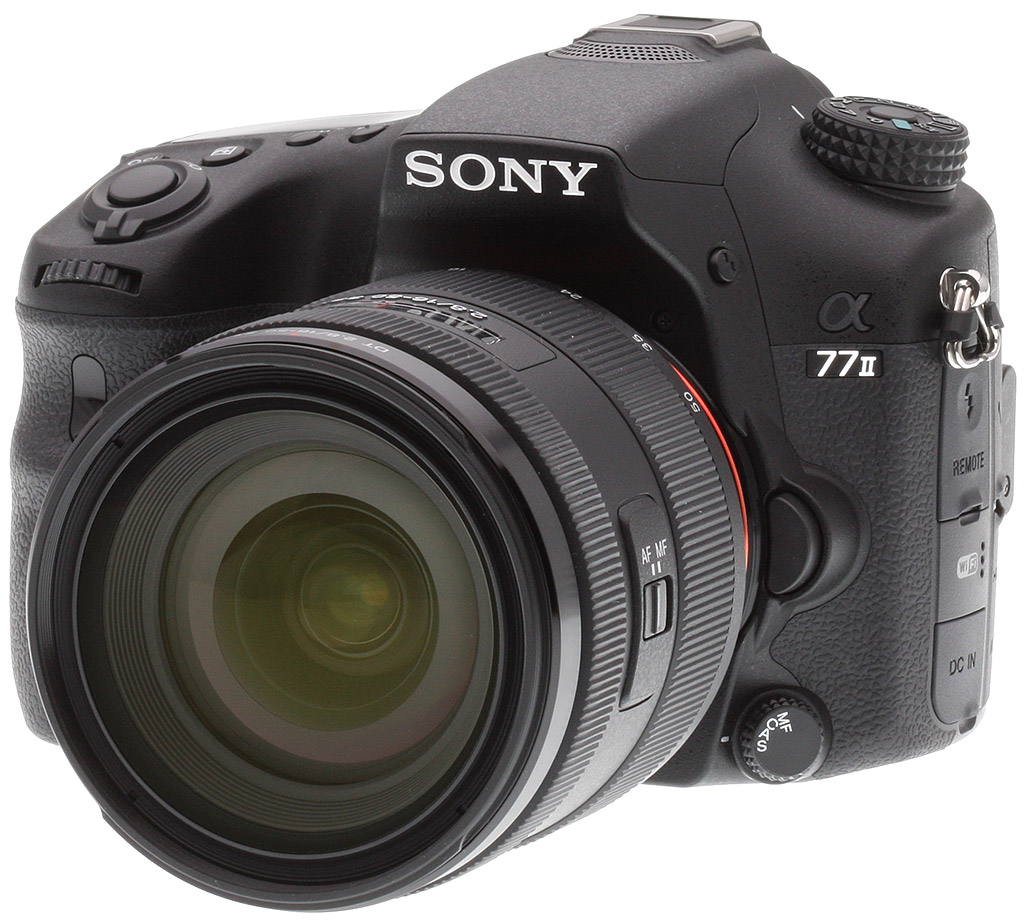


Overview
Tech Info by Mike Tomkins | Posted 05/01/2014

The Sony A77 II provides an upgrade pretty much across the board compared to the original "Mark I" model, especially with regards to the sensor, image processor and autofocus system. The A77 II keeps the same 24-megapixel resolution as the original A77, but the Mark II borrows the updated, well-regarded sensor from the Sony A6000. Coupled with a faster BIONZ X image processor, the newer model has a wider ISO range up to ISO 25,600.
The A77 II gets a substantial upgrade to its autofocus system, going from 19 points to a whopping 79, which cover about 40% of the frame. Couple that with some blazing performance specs, including a special 12fps continuous burst mode with continuous AF, and the A77 II is shaping up to be very well-rounded camera, with a particular nod to sports and action photographers.
So, how does the Sony A77 II perform? We've completed our full review of this flagship A-mount APS-C camera, and the results are rather interesting. To get the lay of the land with regard to all of the A77 II's new features and technological prowess, head over to our Tech Info section first, or you can jump right into John Shafer's in-depth hands-on Field Test. Of course, we put the camera through the paces here at IR as well, so check out our Optics, Exposure and Performance test results, as well as our Image Comparisons and Print Quality Analysis. And of course, for our IR verdict, jump over to our Sony A77 II Conclusion for our final thoughts.
In the Box
The Sony A77 II retail kit w/16-50mm f/2.8 package (as reviewed) contains the following items:
- Sony Alpha a77 II DSLR Body
- 16-50mm f/2.8 DT SSM Zoom Lens
- NP-FM500H InfoLithium Battery (7.2V, 1650mAh)
- BC-VM10 Battery Charger
- ALC-B55 Body Cap
- Shoulder Strap
- Accessory Shoe Cap
- Eyepiece Cup
- Micro USB cable
Recommended Accessories
- Large capacity SDHC/SDXC memory card. 16GB Class 10 should be a minimum.
- Extra battery pack NP-FM500H (~US$42.95)
- Sony Vertical Battery Grip for Alpha SLT-A77 Camera (~US$298)
- Sony external flash (~US$150-US$550)
- Large DSLR bag
Optics
The A77 Mark II is available body-only, or bundled with the Sony DT 16-50mm f/2.8 SSM lens. For a full review of this lens, please see our review on SLRgear.com. See below for our Sony A77 Mark II viewfinder coverage test results.
Viewfinder Test Results
Coverage
Excellent coverage from the EVF and LCD monitor.


The Sony A77 Mark II's electronic viewfinder and LCD monitor both showed essentially 100% coverage in record mode in our tests. This is excellent performance, though expected given the preview is derived from the imaging sensor.
The images above were taken from our standardized test shots. For a collection of more pictorial photos, see our Sony Alpha ILCA-A77 II Photo Gallery .
Exposure
Color
Saturation & Hue Accuracy
Slightly lower-than-average saturation levels, with good hue accuracy.
 |
|||
|
ISO Sensitivity
|
|||
| In the diagram above, the squares show the original color, and the circles show the color that the camera captured. More saturated colors are located toward the periphery of the graph. Hue changes as you travel around the center. Thus, hue-accurate, highly saturated colors appear as lines radiating from the center. Mouse over the links to compare ISOs and click on links for larger images. | |||
Saturation. The Sony A77 II's mean default color saturation is oversaturated by 6.8% at base ISO, which is a little lower than average these days. Mean saturation increases slightly as ISOs rise up to 3200, then falls off as ISO is increased further to a minimum of 95.6% (undersaturated by 4.4%) at ISO 25,600. Reds and dark blues are boosted the most, but not as much as we often see. Most other colors are pushed just a bit or pretty close to ideal, though yellow, light green and cyan are slightly undersaturated at base ISO. However yellows and greens are quite muted at the highest ISOs. Most consumer digital cameras produce color that's more highly saturated (more intense) than found in the original subjects. This is simply because most people like their color a bit brighter than life.
Skin tones. The Sony A77 Mark II does fairly well with Caucasian skin tones when using Auto white balance in simulated daylight. Brighter flesh tones have a healthy pinkish tint, though darker areas are nudged toward orange. With Manual white balance, results are still good, though slightly more pinkish. Where oversaturation is most problematic is on Caucasian skin tones, as it's very easy for these "memory colors" to be seen as too bright, too pink, too yellow, etc.
Hue. Like many cameras, the Sony A77 Mark II shifts cyan toward blue, red toward orange, orange toward yellow and yellow toward green, however shifts are minor to fairly moderate. (The cyan to blue shift is very common among the digital cameras we test; we think it's a deliberate choice by camera engineers to produce better-looking sky colors.) With an average "delta-C" color error of 5.59 after correction for saturation at base ISO, overall hue accuracy is about average, with only minor fluctuations across the ISO range. Hue is "what color" the color is.


Sensor
Exposure and White Balance
Indoors, incandescent lighting
Warm, reddish cast with Auto, but good color with Incandescent and Manual white balance. Average amount of exposure compensation required.


Indoors, under normal incandescent lighting, color balance was too warm and reddish with the Auto white balance setting. Results with the Incandescent setting were better but still a touch warm and yellow. The Manual setting was quite accurate, just slightly on the cool side. The Sony A77 Mark II required +0.3 EV positive exposure compensation here, about average for this shot. (Our test lighting for this shot is a mixture of 60 and 100 watt household incandescent bulbs, a pretty yellow light source, but a very common one in typical home settings here in the U.S.)
Outdoors, daylight
Excellent results under harsh lighting, with good handling of contrast, color, along with above average exposure accuracy.
Outdoors, the Sony A77 Mark II performed very well. +0.3 EV exposure compensation was required to keep the mannequin's face bright in our "Sunlit" Portrait shot, which is better than average among the cameras we've tested. (Most cameras require about +0.7 EV here.) Contrast is a little high as you might expect under such harsh lighting, but despite the bright appearance, only a few highlights were blown, even without the help of Dynamic Range Optimization (DRO -- see below). Both Auto and Manual white balance produced decent skin tones, but we preferred Auto for its slightly more realistic response. Default exposure is very good for our Far-field shot (above right), just a touch underexposed but with almost no highlights blown (just a few specular highlights) or shadows lost, again with DRO disabled. The Far-field shot with Auto white balance has very good color, just a touch on the cool side. Overall, excellent performance in harsh lighting, especially considering DRO was off for these shots.
See full set of test images with explanations
See thumbnails of all test and gallery images
Resolution
Very high resolution, ~2,800 to ~2,850 lines of strong detail from both JPEGs and RAW files.

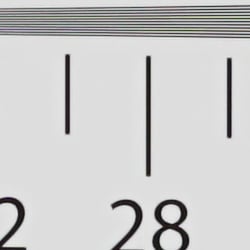


In-camera JPEGs of our laboratory resolution chart reveal sharp, distinct line patterns down to about 2,850 lines per picture height in the horizontal direction, and to about 2,800 lines in the vertical direction. Some may argue for higher numbers, but aliasing artifacts and false colors start to interfere with definition at these resolutions. Complete extinction of the pattern doesn't occur until about 3,500 to 3,700 lines. Some color moiré is evident in JPEGs, though that's not uncommon. Adobe Camera Raw wasn't really able to extract more lines of resolution here from a matching RAW file, and it generated stronger color moiré (different colors as well), so the Sony A77 Mark II does a good job with high contrast detail at base ISO in its JPEGs. Use these numbers to compare with other cameras of similar resolution, or use them to see just what higher resolution can mean in terms of potential detail.
See full set of test images with explanations
See thumbnails of all test and gallery images
Sharpness & Detail
Very good default sharpness, with minimal sharpening artifacts. Mild to moderate noise suppression visible in the shadows and areas of low contrast.


Sharpness. The Sony A77 Mark II captures sharp, crisp images at lower ISOs, with few visible edge enhancement artifacts. We often see some fairly bright or thick sharpening halos around high-contrast elements such as the lettering and lines in our bottle labels (above left), but the A77 Mark II's default sharpening is very good at making details pop without introducing strong sharpening artifacts. Very good results here, at least at low ISO. Edge enhancement creates the illusion of sharpness by enhancing colors and tones right at the edge of a rapid transition in color or tone.
Detail. The crop above right shows mild to moderate noise suppression in the darker areas of the mannequin's hair. A number of low-contrast strands are smudged together, though higher contrast strands are still distinct. Overall, pretty good results here especially for a 24-megapixel APS-C sensor, though noise reduction takes its toll on fine low-contrast detail. Noise-suppression systems in digital cameras tend to flatten-out detail in areas of subtle contrast. The effects can often be seen in shots of human hair, where the individual strands are lost and an almost "watercolor" look appears.
RAW vs In-Camera JPEGs
As noted above, the Sony A77 Mark II produces in-camera JPEGs with very good detail and few sharpening artifacts, at least at low ISOs. Additional detail can often be obtained from carefully processing RAW files with a good converter, though. Let's see how base ISO compares here:
| Base ISO (100) | |
 |
 |
 |
 |
 |
 |
|
Camera JPEG, defaults
|
RAW via Adobe Camera Raw
|
In the table above, we compare a best quality in-camera JPEG taken at base ISO using default noise reduction and sharpening (on the left) to the matching RAW file converted with Adobe Camera Raw 9.0 using default noise reduction with some strong but tight unsharp masking applied in Photoshop (250%, radius of 0.3 pixels, and a threshold of 0).
Looking closely at the images, we can see that ACR extracts additional detail that isn't present in the JPEG from the camera, particularly in the red-leaf swatch where the fine thread pattern is likely treated as noise by the JPEG engine. Fine detail in the mosaic is also better and more refined looking, but as is often the case, more luminance noise can be seen in the bottle crop, though the in-camera JPEG shows more chroma noise in the shadows. You can of course apply stronger noise reduction (default ACR NR used here) to arrive at your ideal noise versus detail tradeoff.
That being said, the Sony A77 Mark II's in-camera JPEG processing (at least at low ISOs) is very good with generally excellent detail and very few sharpening artifacts.
ISO & Noise Performance
Good high ISO performance, though default noise reduction is heavy-handed at higher ISOs.
|
Default High ISO Noise Reduction
|
 |
 |
 |
| ISO 50 | ISO 100 | ISO 200 |
 |
 |
 |
| ISO 400 | ISO 800 | ISO 1600 |
 |
 |
 |
| ISO 3200 | ISO 6400 | ISO 12,800 |  |
| ISO 25,600 | ||
Image quality is excellent at ISOs 50 through 400, with only a slight drop in fine detail at 400 where stronger noise reduction kicks in. (Note that ISO 50 is an extended low sensitivity and although we doubled exposure time compared to ISO 100, the image came out overly bright indicating actual sensitivity is higher than 50.) ISO 800 still shows very good detail, but default noise reduction becomes quite strong starting at ISO 1600. ISO 3200 has a fair amount of fine detail intact, but flatter areas start to take on a hammered look. Fine detail rapidly deteriorates from ISO 6400 on, though, with strong blurring and blotchy purple or yellow chroma noise. ISO 25,600 is also plagued with strong noise reduction and sharpening artifacts giving it an almost crystalline effect.
Overall, high ISO performance in JPEGs has improved over its predecessor though as mentioned, default noise reduction is a little heavy-handed and clumsy at higher ISOs. As always, see the Print Quality section below for maximum recommended print sizes at each ISO, as printed performance often doesn't correlate well to what's seen on-screen at 100%, and check out our Comparometer to see how the Sony A77 Mark II's JPEGs compare to other cameras we've tested.
A note about focus for this shot: We shoot this image at f/4, usually using one of our very sharp reference lenses. To insure that the hair detail we use for making critical judgements about camera noise processing and detail rendering is in sharp focus at the relatively wide aperture we're shooting at, the focus target at the center of the scene is on a movable stand. This lets us compensate for front- or back-focus by different camera bodies, even those that lack micro-focus adjustments. This does mean, though, that the focus target itself may appear soft or slightly out of focus for bodies that front- or back-focused with the reference lens. We know this; if you click to view the full-size image for one of these shots and notice that the focus target is fuzzy, you don't need to email and tell us. :-) The focus target position will have been adjusted to insure that the rest of the scene is focused properly.
Extremes: Sunlit, dynamic range and low light tests
Very high resolution with excellent highlight and shadow detail. Very good low-light performance, capable of focusing and capturing bright images in near darkness.


Sunlight. The Sony A77 Mark II handled the deliberately harsh lighting in the test above very well. We preferred the +0.3 EV exposure here as the mannequin's face is bright while very few highlights were clipped in the white shirt. The default (0 EV) exposure is just a tad dim in the face, while the +0.7 EV exposure is definitely too bright. As mentioned previously, contrast is a little high, but both highlight and shadow detail is very good at +0.3 EV, though deep shadows do contain moderate amounts of chroma noise. Overall, very good results here.
For best results, be sure to use fill flash in situations like the one shown above; it's better to shoot in the shade when possible. See below for results with Dynamic Range Optimization and High Dynamic Range features enabled.
Because digital cameras are more like slide film than negative film (in that they tend to have a more limited tonal range), we test them in the harshest situations to see how they handle scenes with bright highlights and dark shadows, as well as what kind of sensitivity they have in low light. The shot above is designed to mimic the very harsh, contrasty effect of direct noonday sunlight, a very tough challenge for most digital cameras. (You can read details of this test here. In actual shooting conditions, be sure to use fill flash in situations like the one shown here; it's better to shoot in open shade whenever possible.)
|
Outdoor Portrait DRO Comparison (0 EV)
|
|
 |
DRO Setting: Auto (Default) Off Level 1 Level 2 Level 3 Level 4 Level 5 |
 |
|
Dynamic Range Optimization is Sony's name for their dynamic range enhancement technology. DRO divides the image into small areas, analyzes the range of brightness of each area, and adjusts the camera's tone curve and other processing parameters accordingly to make the best use of the available dynamic range. DRO does not boost ISO for the entire image like some systems, so increased noise is less of an issue, though existing noise may be more visible in raised shadows. Auto DRO is enabled by default on the Sony A77 Mark II. You can also set the level manually, from 1 ("weak") to 5 ("strong"), or turn it off. As one would expect, DRO is only applied to JPEG files however RAW files are tagged for similar processing by Sony's IDC software.
The above thumbnails and histograms show the effects of the available levels of DRO on our "Sunlit" Portrait shot with no exposure compensation. Mouse over the links to load the associated thumbnail and histogram, and click on the links to visit the full resolution image. As you can see from the thumbnails and histograms, DRO worked as expected, boosting shadows and mid-tones without blowing additional highlights, yielding more balance exposures. The Auto DRO setting did a good job here, and the five manual levels give quite a bit of control over the effect.

Above, you can see the effects of DRO settings on our Far-field shot. The default Auto setting produced a nicely balanced exposure, despite the harsh lighting. A useful feature. (Apologies for the change in framing for the Off setting.)


High Dynamic Range. The Sony A77 Mark II's HDR mode takes three images in rapid succession, one nominally exposed , one underexposed, and one overexposed, then combines them into one high dynamic range JPEG automatically (RAW images are not supported). Lighter areas from the underexposed image are combined with darker areas from the overexposed image to produce an image with compressed tonal range. The camera then saves a single composite image, as well as the nominally exposed image. The overlaid images are micro-aligned by the camera, but it can only correct for so much movement. If it can't micro-align successfully, an icon indicating HDR capture failed will appear. For best results, the subject should not move or blink, so it's not really intended for portraits. There is also a manual mode where you can select 1 EV ("weak") to 6 EV ("strong") difference in exposures.
Mouse over the links to load the associated thumbnail and histogram, and click on the links to visit the full resolution image. As you can see, the Auto setting did a decent job boosting shadows and mid-tones while reigning back highlights, however we prefer the lower manual settings for this subject. The higher the manual setting, the more highlights are toned-down and shadows opened up, but higher settings can produce flat and unnatural results with this scene. Still, it's nice that Sony provides six manual levels, giving quite a bit of control over the effect.
Above, you can see the effects of HDR settings on our Far-field shot. Watch out for ghost images from movement within the scene during the capture sequence, though, as can be seen in some of the shots above. Oddly, noise is excessive at the 3 EV setting for which we have no explanation.
Sony has one of the more flexible in-camera HDR implementations we've seen making it a useful feature for those that don't want to bracket and combine images in post.
Dynamic Range Analysis (RAW mode)
While we once performed our own dynamic range measurements based on in-camera JPEGs as well as converted RAW images (when the camera was supported by Adobe Camera Raw), we've switched to using DxO Labs' results from their DxOMark website. As technology advanced, the dynamic range of modern high-end cameras in some cases exceeded the range of the Stouffer T4110 density scale that we used for our own measurements. DxO's approach based on RAW data before demosaicing is also more revealing, because it measures the fundamental dynamic range of the sensor, irrespective of whatever processing is applied to JPEGs, or to RAW data by off-the-shelf conversion software.
In the following, we use DxO's "Print" dynamic range results, which are scaled based on camera resolution. As the name suggests, this scaling corresponds to the situation in which you print at a given size, regardless of how many megapixels the camera might have. (In other words, if you've decided to make a 13x19 inch print, that's the size you're printing, whether the camera's resolution is 16 or 300 megapixels.) For the technically-minded, you can find a discussion of the reasoning behind this here on the DxOMark website. Also note that DxO Labs uses a signal-to-noise (SNR) threshold of 1 when defining the lower boundary of acceptable luminance noise in their dynamic range measurements, which corresponds to the "Low Quality" threshold of the Imatest software we used to use for this measurement.

Here, we decided to compare the Sony A77 Mark II's dynamic range to its predecessor, the A77 as well as to the Nikon D7100, a competing DSLR with a similar 24MP APS-C sensor. You can always compare other models on DxOMark.com.
As you can see from the above graph (click for a larger image), the Sony A77 Mark II does a little better than the A77 in terms of dynamic range, offering a maximum of 13.44 EV at the lowest ISO, versus 13.15 EV. And the A77 II does significantly better at higher ISOs as well, offering up to about 0.8 EV advantage at ISO 6400. The A77 Mark II does not do as well as the Nikon D7100 at most ISOs, though, with the Nikon producing about one stop better dynamic range at ISOs 200, 400 and 3200, though at very high ISOs, the two cameras perform similarly.
Overall, though, very good dynamic range performance from the Sony A77 Mark II. Click here to visit the DxOMark page for the Sony A77 Mark II for more of their test results and additional comparisons.
| 1 fc 11 lux |
1/16 fc 0.67 lux |
1/16fc No NR |
|
|---|---|---|---|
| ISO 100 |
 2s, f2.8 |
 30s, f2.8 |
 30s, f2.8 |
| ISO 3200 |
 1/15s, f2.8 |
 1s, f2.8 |
 1s, f2.8 |
| ISO 25600 |
 1/125s, f2.8 |
 1/8s, f2.8 |
 1/8s, f2.8 |
Low Light. The Sony A77 Mark II was able to capture bright images down to the lowest light level we test at (1/16 foot-candle) even at base ISO. Noise is very low at base ISO and fairly well-controlled at ISO 3200, though as expected noise and noise reduction artifacts are quite high and objectional at the highest ISO setting of 25,600.
Auto white balance did a very good job here, producing a fairly neutral, just slightly cool color balance across ISOs and light levels.
We didn't detect any significant banding (pattern noise) or hot pixel issues, though some heat blooming can be seen emanating from the bottom of the frame at the highest ISO.
The Sony A77 Mark II's autofocus system was able to focus on our test subject down to below the 1/16 foot-candle light level unassisted with an f/2.8 lens, which is excellent. And the A77 II was able to focus in complete darkness with its flash-based focus assist feature enabled.
How bright is this? The one foot-candle light level that this test begins at roughly corresponds to the brightness of typical city street-lighting at night. Cameras performing well at that level should be able to snap good-looking photos of street-lit scenes.
NOTE: This low light test is conducted with a stationary subject, and the camera mounted on a sturdy tripod. Most digital cameras will fail miserably when faced with a moving subject in dim lighting. (For example, a child's ballet recital or a holiday pageant in a gymnasium.) Thanks to their larger pixels and in the case of the A77 Mark II, its Hybrid AF system, compact system cameras like the Sony A77 Mark II tend to do much better than point & shoots, but you still shouldn't expect a quick autofocus lock with moving subjects. (A useful trick is to just prop the camera on a convenient surface, and use its self-timer to release the shutter. This avoids any jiggling from your finger pressing the shutter button, and can work quite well when you don't have a tripod handy.)
Built-in Flash Test Results
Coverage and Range
A fairly powerful flash for a built-in, but with very narrow and uneven coverage. Our standard indoor portrait shot required less than average exposure compensation.

Coverage. Flash coverage is very narrow and uneven at wide angle (16mm), leaving very dark corners in our flash coverage test image. We no longer test at full telephoto is coverage is invariably better, making wide angle the worst case.


Exposure. Our Indoor Portrait test scene came out well exposed with +0.3 EV flash exposure compensation at ISO 200. The average amount of flash exposure compensation required for this scene is +0.7 EV, so the A77 Mark II's built-in flash performed above average here. The camera's Slow-Sync flash mode produced very bright results with no flash exposure compensation, though with a strong orange cast from the ambient room lighting because of the slow shutter speed.
| Manufacturer-Specified Flash Range |
|---|
 7.0 feet, ISO 100, f/5.6 |
Manufacturer Specified Flash Test. The Sony A77 Mark II's built-in flash is rated with a Guide Number of 12 meters or 39.4 feet at ISO 100. That works out to about 7.0 feet at f/5.6, the maximum aperture of the kit zoom lens at full telephoto. In the test shot above taken at the aforementioned distance and settings, the A77 Mark II's flash produced a bright (though slightly reddish) flash exposure, which indicates Sony's flash power rating is credible.
Our standard test method for flash range uses a fixed setting of ISO 200, to provide a fair basis of comparison between cameras. We also shoot two shots using the manufacturer-specified camera settings, at the range the company claims for the camera, to assess the validity of the specific claims.
Output Quality
Print Quality
Overall, impressively large 36 x 48 inch prints at ISOs 50 and 100; ISO 1600 is capable of a nice 16 x 20; ISO 6400 prints an acceptable 8 x 10.
 ISO 50 and 100 images produce impressive prints at 36 x 48 inches, with accurate colors and excellent fine detail, which is very impressive from a 24MP APS-C sensor. Better yet, the Sony A77 II is easily able to print as large as 40 x 60 inches for wall display, and while those will show some minor pixelation upon close inspection (and the 36 x 48 prints, as well, to a lesser extent), at normal, comfortable viewing distances these prints look very crisp and detailed.
ISO 200 prints are quite close to ISO 50/100 with only a slight drop in fine detail, making still-large 30 x 40 inch prints look great. With crisp detail and great colors, 36 x 48 inch prints would also be usable for wall-mounted display.
ISO 400 images make great 24 x 36 inch prints with very crisp, clean detail and nice colors, and practically zero visible noise.
ISO 800 yields a nice 20 x 30 inch print. Colors still look accurate, and while there's still a lot of fine detail, you can start to see the effects of noise reduction processing in the shadow areas (very low noise, if any, is visible, though). Troublesome, low-contrast areas like the red fabric of our test Still Life image begin to show lower detail at this ISO.
ISO 1600 is capable of a good 16 x 20 inch print. The troublesome red fabric swatch in our test target loses more fine detail, and noise reduction processing is even more apparent, but there's very little visible noise in the entire image -- even in the shadows. Nevertheless, there's still a lot of fine detail and accurate color rendition.
ISO 3200 prints are good at 11 x 14 inches, with some noticeable softness in the shadows due to the heavy default noise reduction. Colors still look vibrant and fine detail, especially high-contrast detail, like in the "Pure" bottle of our test image, is still impressive.
ISO 6400 produces an acceptable 8 x 10 inch print. While colors still remain pleasing to the eye, noise reduction processing is taking its toll on fine detail.
ISO 12,800 prints are acceptable at 4 x 6 inches, and although colors look fine, noise reduction is producing some splotchiness as it tries to combat the high ISO noise.
ISO 25,600 does not produce a usable print and is best avoided.
The updated Sony A77 II is an impressive camera when it comes to print quality and resolution, especially at lower ISOs. At expanded ISO 50 and base ISO 100, the A77 II's 24.3MP APS-C sensor is able to produce prints all the way up to 36 x 48 inches and wall-mountable at 40 x 60. With a very high amount of fine detail and fantastic color reproduction, the prints at these low ISOs are excellent. Even at mid-range higher ISOs, like 1600, the A77 II produces a very good 16 x 20, and while the default level of noise reduction is quite strong and visible primarily in the shadow areas, it works very well as removing noise, while leaving most of the fine detail intact, especially high-contrast fine detail. It's only at very high ISOs levels that noise and heavy NR take their toll on fine detail, making ISO 12,800 the maximum sensitivity with an acceptable print at 4 x 6 inches.
The images above were taken from our standardized test shots. For a collection of more pictorial photos, see our Sony Alpha ILCA-A77 II Photo Gallery .
Not sure which camera to buy? Let your eyes be the ultimate judge! Visit our Comparometer(tm) to compare images from the Sony Alpha ILCA-A77 II with those from other cameras you may be considering. The proof is in the pictures, so let your own eyes decide which you like best!
Performance
Timing and Performance
Very good to excellent performance, though buffer clearing is slow.
| Startup/Play to Record | ||
|---|---|---|
| Power on |
~0.8 second
|
Time it takes to turn on and capture a shot. |
|
Play to Record, |
~0.9 second
|
Time until first shot is captured. |
The Sony A77 Mark II's startup time (power on to first shot) was fairly quick. Switching from Play to Record mode and taking a shot was also good.
| Shutter Response (Lag Time) | ||
|---|---|---|
|
Full Autofocus, |
0.087 second
|
Time from fully pressing shutter button to image capture, with the lens already at the proper focal distance setting. (All AF timing performed with the Sony DT 16-50mm f/2.8 SSM kit lens.) |
|
Full Autofocus, |
0.212 second
|
Time from fully pressing shutter button to image capture, with the lens already at the proper focal distance setting, TTL Auto flash enabled. |
| Manual Focus |
0.095 second
|
For most cameras, shutter lag is less in manual focus than autofocus, but usually not as fast as when the camera is "prefocused". |
|
Prefocused |
0.051 second
|
Time to capture, after half-pressing and holding shutter button. |
The Sony A77 Mark II's full-autofocus shutter lag (with the subject at a fixed distance) was very fast, measuring only 0.087 second in Single-area (Center) AF mode with the 16-50mm f/2.8 kit lens at a medium focal length. That's definitely pro-level DSLR quick.
Enabling the flash added a noticeable delay for preflash metering, increasing lag to about 0.212 second.
When manually focused, the Sony A77 Mark II's shutter lag was about 0.095 second, which is pretty good, though oddly a bit slower than with autofocus. The A77 Mark II's prefocused shutter lag was only 0.051 second, very fast.
To minimize the effect of different lens' focusing speed, we test AF-active shutter lag with the lens already set to the correct focal distance.
| Cycle Time (shot to shot) | ||
|---|---|---|
| Single Shot mode |
0.36 second
|
Time per shot, averaged over a few frames (we no longer test for buffer depths in single-shot mode). |
|
Single Shot mode |
0.37 second
|
Time per shot, averaged over a few frames (we no longer test for buffer depths in single-shot mode). |
| Early shutter |
No
|
Some cameras don't snap another shot if you release and press the shutter too quickly in Single Shot mode, making "No" the preferred answer. |
|
Continuous Advance Priority AE mode |
0.09 second
(11.52 fps); 26 frames total; 18 seconds to clear* |
Time per shot, averaged over 26 frames, then slowed to an average of about 0.66s or 1.52 fps when buffer was full. |
|
Continuous Advance Priority AE mode |
0.08 second
(11.98 fps); 28 frames total; 10 seconds to clear* |
Time per shot, averaged over 28 frames, then slowed to an average of about 0.38s or 2.61 fps when buffer was full. |
|
Continuous Advance Priority AE mode |
0.08 second
(11.98 fps); 24 frames total; 16 seconds to clear* |
Time per shot, averaged over buffer length of 24 frames, then slowed to 0.62s or 1.62 fps when buffer was full. |
|
Continuous Hi mode |
0.13 second
(7.97 fps); 56 frames total; 37 seconds to clear* |
Time per shot, averaged over 56 frames, then slowed to an average of about 0.76s or 1.31 fps when buffer was full. |
| Continuous Hi mode |
0.13 second
(8.00 fps); 32 frames total; 10 seconds to clear* |
Time per shot, averaged over 32 frames, then slowed to an average of about 0.41s or 2.46 fps when buffer was full. |
|
Continuous Hi mode |
0.13 second
(7.97 fps); 27 frames total; 17 seconds to clear* |
Time per shot, averaged over buffer length of 27 frames, then slowed to 0.71s or 1.42 fps when buffer was full. |
|
Flash Recycling |
3.1 seconds
|
Flash at maximum output. |
|
*Note: Buffer clearing times measured with a SanDisk Extreme Pro 95 MB/sec UHS-I SDHC card. Slower cards will produce correspondingly slower clearing times. Slow cards may also limit length of bursts in continuous mode. ISO sensitivity and noise reduction settings can also affect cycle times and burst mode performance.
|
||
Single-shot cycle times were very good, at 0.36 second for Large/Extra Fine JPEGs and 0.37 second for RAW + Large/Fine JPEG frames. (Note that we no longer test single-shot mode with just RAW files, as the results are usually somewhere in between JPEG and RAW+JPEG modes. Also note that the A77 II cannot capture highest quality "Extra Fine" JPEGs together with RAW, dropping to "Fine" quality JPEGs when shooting RAW+JPEG.)
The Sony A77 II's Continuous Advance Priority AE mode was very fast at about 11.5 frames per second for Extra Fine JPEGs, and about 12 frames per second for RAW or RAW+JPEG files. Be aware that if you want continuous AF in this mode the aperture is locked at either f/3.5 or the maximum aperture of the lens, whichever is smaller.
Continuous Hi burst mode performance matched Sony's specification of about 8 frames per second regardless of file type. There is also a Continuous Lo (3 fps) setting, however we did not test that option.
In Continuous Advance Priority AE mode, buffer depths were quite good considering the speed and resolution, at 26 Extra Fine JPEGs, 28 RAW frames and 24 RAW+JPEG frames before the camera slowed. Note that our test target for this was designed to be difficult to compress, so burst lengths should be longer with typical subjects.
Buffer depth for Large/Extra Fine JPEGs in Continuous Hi mode was excellent, at 56 frames before the camera slowed. When shooting RAW files, buffer depth dropped to 32 frames, and to 27 frames with RAW+L/F JPEG files, both still quite generous.
Buffer clearing after max-length bursts took some time even with a fast UHS-I SDHC card, though, ranging between 10 seconds after a max-length burst of RAW files, to a rather lengthy 37 seconds after a max-length burst of Large / Extra Fine JPEGs in Continuous Hi mode.
The built-in flash was able to recycle from a full discharge in 3.1 seconds, which is about average.
Bottom line, the Sony A77 Mark II's performance was generally excellent for its class in our tests, with extremely fast AF speed, quick prefocused shutter lag and very fast burst modes. Buffer depths were very good, however clearing after a max-length burst of 24-megapixel images can take some time even with a fast UHS-I SDHC card.
Battery
Battery Life
Below average battery life for a DSLR.
| Operating Mode | Battery Life |
|---|---|
|
Still Capture,
(EVF, CIPA standard) |
410 shots
|
|
Still Capture,
(LCD Monitor CIPA standard) |
480 shots
|
The Sony A77 Mark II uses a custom NP-FM500H rechargeable lithium-ion battery pack for power, and comes with both a single battery and a dedicated battery charger. While CIPA-rated battery life isn't bad for an EVF-equipped camera, it's well below average compared to traditional prosumer DSLRs, especially when using the electronic viewfinder. We strongly recommend purchasing a second battery and consider getting the optional battery grip which doubles battery life with a second battery installed.
The table above shows the number of shots the camera is capable of (on a fully-charged rechargeable battery), based on CIPA battery-life and/or manufacturer standard test conditions.
(Interested readers can find an English translation of the CIPA DC-002 standards document here. (180K PDF document))
Image Quality
Below are crops from our laboratory Still Life target comparing the Sony A77 II against the Sony A77, Canon 70D, Fujifilm X-T1, Nikon D7100 and Pentax K-3. All of these models sit at relatively similar price points and/or categories in their respective product lineups. The only exception might be the Canon 70D, which sits below Canon's current flagship APS-C DSLR, the 7D. We chose the 70D in this comparison, however, due to its newer, high-resolution sensor and updated image processor.
These comparisons were somewhat tricky to write, as the cameras vary a great deal in resolution, so bear that in mind as you're reading and drawing your own conclusions. (We generally try to match cameras in these comparisons based on price, given that most of us work to a budget, rather than setting out to buy a given number of megapixels.)
NOTE: These images are best quality JPEGs straight out of the camera, at default settings including noise reduction and using the camera's actual base ISO (not extended ISO settings). All cameras in this comparison were shot with our very sharp reference lenses. Clicking any crop will take you to a carrier page where you can click once again to access the full resolution image as delivered straight from the camera. For those interested in working with the RAW files involved: click these links to visit each camera's respective sample image thumbnail page: Sony A77 II, Sony A77, Canon 70D, Fujifilm X-T1, Nikon D7100 and Pentax K-3 -- links to the RAW files appear beneath those for the JPEG images, wherever we have them. And remember, you can always go to our world-renowned Comparometer to compare the Sony A77 II to any camera we've ever tested.
Sony A77 II versus Sony A77 at Base ISO
 |
 |
 |
 |
 |
 |
Sony A77 II at ISO 100 |
Sony A77 at ISO 100 |
Despite the same 24MP resolution, the new sensor and BIONZ X image processor of the A77 II manage to noticeably outdo the predecessor with outstanding image quality at base ISO: finer, crisper details in all three crops. The A77 II really shows its chops with the mosaic and fabric swatches. |
|
Sony A77 II versus Canon 70D at Base ISO
|
 |
|
 |
|
 |
Sony A77 II at ISO 100 |
Canon 70D at ISO 100 |
Again, the Sony A77 II easily bests its competitor in this comparison. The Sony shows noticeably more fine detail, especially in the mosaic and fabric crops. While the Canon 70D certainly does well here, the Sony A77 II is impressive with its ability to capture fine, crisp detail, despite the translucent mirror in the light path. The fabric swatches, especially the lower pink one, really showcase the marked difference in fine detail. |
|
Sony A77 II versus Fujifilm X-T1 at Base ISO
|
 |
|
 |
|
 |
Sony A77 II at ISO 100 |
Fujifilm X-T1 at ISO 200 |
While there is quite a bit of difference in resolution -- 24MP vs. 16 -- both cameras do extraordinarily well for their respective number of megapixels. Both are great with fine detail, especially in the mosaic crop (hard to pick a definite winner there given the difference in resolution). However, in the fabric crop, the Fuji does especially well with the red fabric, rendering the fine, low-contrast leaf pattern more clearly than the Sony, while the Sony itself does noticeably better with the pink fabric. |
|
Sony A77 II versus Nikon D7100 at Base ISO
|
 |
|
 |
|
 |
Sony A77 II at ISO 100 |
Nikon D7100 at ISO 100 |
With both cameras here sporting 24 megapixels, both are able to produce clean, high-resolution images at ISO 100. Despite the fact that the D7100 lacks an optical low-pass filter, the A77 II still manages to out-resolve it in some areas. The Nikon D7100 does better with very fine detail in the red fabric, while the Sony A77 II is noticeably better with the mosaic and pink fabric swatches. |
|
Sony A77 II versus Pentax K-3 at Base ISO
|
 |
|
 |
|
 |
Sony A77 II at ISO 100 |
Pentax K-3 at ISO 100 |
A very tough comparison here between two 24MP cameras, one SLT with a translucent mirror and one SLR without an OLPF. Both manage to do very well with fine detail, but the A77 II slightly edges out the Pentax K-3 in the mosaic crop -- it's just a hair crisper. The Sony also takes the prize for the pink fabric, while the K3 wins with the red fabric. |
|
Most digital SLRs and CSCs will produce an excellent ISO 100 shot, so we like to push them and see what they can do compared to other cameras at ISO 1600, 3200, and 6400. Recent advances in sensor technology have made ISO 1600 look a lot more like ISO 100, but there are still cameras whose quality starts to fall apart at this setting. We also choose 1600 because we like to be able to shoot at least at this level when indoors and at night.
Sony A77 II versus Sony A77 at ISO 1600
 |
 |
 |
 |
 |
 |
Sony A77 II at ISO 1600 |
Sony A77 at ISO 1600 |
The new BIONZ X image processor of the A77 II is showing its performance compared to the original A77 at ISO 1600. The new model easily bests its predecessor in all three areas, with the A77 showing some heavier artifacting from its default noise reduction processing. |
|
Sony A77 II versus Canon 70D at ISO 1600
|
 |
|
 |
|
 |
Sony A77 II at ISO 1600 |
Canon 70D at ISO 1600 |
While the Canon 70D shows a bit of luminance noise in the shadows (compared to a relatively clean Sony A77 II), both cameras here are fairly evenly matched. The slight difference in resolution makes it tough to call one or the other in the mosaic comparison; the 70D actually looks a bit better in the red fabric's leaf pattern, while the A77 II gets the edge in the pink fabric. |
|
Sony A77 II versus Fujifilm X-T1 at ISO 1600
|
 |
|
 |
|
 |
Sony A77 II at ISO 1600 |
Fujifilm X-T1 at ISO 1600 |
Barring the big resolution disparity here, the Fuji shows slightly more grain, but overall an impressive amount of fine detail and more contrast. The Fuji especially does much better with the fabric swatches over the Sony, and most notably the red leaf pattern. |
|
Sony A77 II versus Nikon D7100 at ISO 1600
|
 |
|
 |
|
 |
Sony A77 II at ISO 1600 |
Nikon D7100 at ISO 1600 |
Another tough comparison. The Nikon shows a bit more luminance noise, while the Sony's default noise reduction is a bit more aggressive. As such, fine detail reproduction is slightly different. While they both look nearly identical in the fine detail of the mosaic crop, the Nikon is able to handle the red and pink fabric swatches better. |
|
Sony A77 II versus Pentax K-3 at ISO 1600
|
 |
|
 |
|
 |
Sony A77 II at ISO 1600 |
Pentax K-3 at ISO 1600 |
The default noise reduction processing of both cameras do well to reduce noise, with the Sony's being slightly cleaner and the Pentax showing a bit of luminance noise. Interestingly, the mosaic crop from the Pentax is the winner here with ever-so-slightly crisper detail. However, the Sony is the clear winner in the fabric swatches, as the Pentax's red fabric is very smeared. |
|
Today's ISO 3200 is yesterday's ISO 1600 (well, almost), so below are the same crops at ISO 3200.
Sony A77 II versus Sony A77 at ISO 3200
 |
 |
 |
 |
 |
 |
Sony A77 II at ISO 3200 |
Sony A77 at ISO 3200 |
Like we saw at ISO 1600, the A77 II's new sensor and processing power clearly out-perform the older A77 with much better noise reduction and fine detail reproduction at ISO 3200 in all three comparison crops. |
|
Sony A77 II versus Canon 70D at ISO 3200
|
 |
|
 |
|
 |
Sony A77 II at ISO 3200 |
Canon 70D at ISO 3200 |
Here's another comparison where you can see the more aggressive noise reduction processing of the A77 II. The Sony does great at lessening noise at the expense of some fine detail. The Canon, however, does show more noise in the shadows while still maintaining a lot of fine detail. The mosaic crop, in fact, looks slightly better from the Canon, while both struggle with the fabric swatches. |
|
Sony A77 II versus Fujifilm X-T1 at ISO 3200
|
 |
|
 |
|
 |
Sony A77 II at ISO 3200 |
Fujifilm X-T1 at ISO 3200 |
The high ISO performance of the Fujifilm X-T1 is impressive, with ISO 3200 images looking extremely close to ISO 1600. At ISO 3200, the Fuji crops remain crisper and with a light, even grain in the shadows. By comparison, the Sony A77 II crops show some heavy-handed NR processing that impacts fine detail. |
|
Sony A77 II versus Nikon D7100 at ISO 3200
|
 |
|
 |
|
 |
Sony A77 II at ISO 3200 |
Nikon D7100 at ISO 3200 |
While the Nikon displays noticeably more noise in the shadows, other areas of the image remain highly detailed, especially in the mosaic tile pattern. And while far from perfect, the Nikon also does better with producing a more accurate representation of the leaf pattern in the red fabric. |
|
Sony A77 II versus Pentax K-3 at ISO 3200
|
 |
|
 |
|
 |
Sony A77 II at ISO 3200 |
Pentax K-3 at ISO 3200 |
|
Similar to the previous comparison above, the Pentax shows more noise, particularly in the shadows, but has the edge in fine detail over the Sony -- at least with the mosaic crop. The Sony clearly takes the prize in the fabric crops, as the Pentax struggles with the red fabric, producing practically zero detail here at ISO 3200. |
|
Detail: Sony A77 II vs. Sony A77, Canon 70D, Fujifilm X-T1, Nikon D7100 and Pentax K-3
 |
 |
 |
 |
 |
 |
 |
 |
 |
 |
 |
 |
 |
 |
 |
 |
 |
 |
| Sony A77 II ISO 100 ISO 3200 ISO 6400 |
Sony A77 |
Canon 70D ISO 100 ISO 3200 ISO 6400 |
Fujifilm X-T1 ISO 200 ISO 3200 ISO 6400 |
Nikon D7100 ISO 100 ISO 3200 ISO 6400 |
Pentax K3 ISO 100 ISO 3200 ISO 6400 |
| Detail comparison. This lettering allows us to really examine fine, high-contrast detail. At base ISO, all cameras do an excellent job, though the original Sony A77 is noticeably the weakest performer, followed by the Nikon D7100. The Sony A77 II shows nice detail, with crisp edges and excellent contrast. As the ISO rises, the Sony A77 II continues to do well, especially compared to its predecessor. Other cameras like the D7100 and K-3 hold up nicely through higher ISO levels, but the Sony A77 II stays ahead with clean, crisp fine detail. | |||||
Overall, impressively large 36 x 48 inch prints at ISOs 50 and 100; ISO 1600 is capable of a nice 16 x 20; ISO 6400 prints an acceptable 8 x 10.
ISO 50 and 100 images produce impressive prints at 36 x 48 inches, with accurate colors and excellent fine detail, which is very impressive from a 24MP APS-C sensor. Better yet, the Sony A77 II is easily able to print as large as 40 x 60 inches for wall display, and while those will show some minor pixelation upon close inspection (and the 36 x 48 prints, as well, to a lesser extent), at normal, comfortable viewing distances these prints look very crisp and detailed.
ISO 200 prints are quite close to ISO 50/100 with only a slight drop in fine detail, making still-large 30 x 40 inch prints look great. With crisp detail and great colors, 36 x 48 inch prints would also be usable for wall-mounted display.
ISO 400 images make great 24 x 36 inch prints with very crisp, clean detail and nice colors, and practically zero visible noise.
ISO 800 yields a nice 20 x 30 inch print. Colors still look accurate, and while there's still a lot of fine detail, you can start to see the effects of noise reduction processing in the shadow areas (very low noise, if any, is visible, though). Troublesome, low-contrast areas like the red fabric of our test Still Life image begin to show lower detail at this ISO.
ISO 1600 is capable of a good 16 x 20 inch print. The troublesome red fabric swatch in our test target loses more fine detail, and noise reduction processing is even more apparent, but there's very little visible noise in the entire image -- even in the shadows. Nevertheless, there's still a lot of fine detail and accurate color rendition.
ISO 3200 prints are good at 11 x 14 inches, with some noticeable softness in the shadows due to the heavy default noise reduction. Colors still look vibrant and fine detail, especially high-contrast detail, like in the "Pure" bottle of our test image, is still impressive.
ISO 6400 produces an acceptable 8 x 10 inch print. While colors still remain pleasing to the eye, noise reduction processing is taking its toll on fine detail.
ISO 12,800 prints are acceptable at 4 x 6 inches, and although colors look fine, noise reduction is producing some splotchiness as it tries to combat the high ISO noise.
ISO 25,600 does not produce a usable print and is best avoided.
The updated Sony A77 II is an impressive camera when it comes to print quality and resolution, especially at lower ISOs. At expanded ISO 50 and base ISO 100, the A77 II's 24.3MP APS-C sensor is able to produce prints all the way up to 36 x 48 inches and wall-mountable at 40 x 60. With a very high amount of fine detail and fantastic color reproduction, the prints at these low ISOs are excellent. Even at mid-range higher ISOs, like 1600, the A77 II produces a very good 16 x 20, and while the default level of noise reduction is quite strong and visible primarily in the shadow areas, it works very well as removing noise, while leaving most of the fine detail intact, especially high-contrast fine detail. It's only at very high ISOs levels that noise and heavy NR take their toll on fine detail, making ISO 12,800 the maximum sensitivity with an acceptable print at 4 x 6 inches.
Field Test
Field Test Part II
A tough, solid, pro-like DSLR with image quality and features to rival the competition.
By John Shafer | Posted: 09/23/2014
 |
Mountain bikers riding through an alpine meadow on the Wasatch Crest Trail, above Salt Lake City, Utah. Sony Alpha A77 Mark II + DT 16-50mm f/2.8 SSM lens: 30mm, f/6.3, 1/1250s, ISO 400. |
Introduction
Let me start this report by disclosing that I'm a long-time Canon SLR owner. I've been using Canon EOS SLR cameras since the mid-nineties. However, I'm also a big Sony fan. I love their out-of-the-box approach to camera design -- especially the SLT camera family, to which the new A77 Mark II DSLR belongs. I like it so much I was considering buying an A77 II, sight-unseen, to replace my Canon EOS 7D. The second-gen A77 features and specs make it look like an excellent replacement for my aging EOS 7D. The A77 II is a serious threat to non-Canon APS-C DSLR owners as well. With a crazy fast 12 frames per second burst rate, more AF points than any other DSLR (79), and improved continuous autofocus performance, it looks like an excellent choice for amateur sports shooters and professional action sports photographers on a budget. So when Imaging Resource offered me the opportunity to do an A77 II Field Test, how could I say no? A free test ride before I spend my hard-earned money? Yes, please!
Why I'm Excited About the Sony Alpha A77 Mark II
There are lots of reasons to be excited about the A77 II -- especially if you're an action sports photographer. In many ways the performance -- at least on paper -- is closer to $5000+ pro bodies like the Canon EOS-1D X and the Nikon D4S than other APS-C prosumer DSLRs. It has a 79-point phase detect autofocus system with 15 cross-type points in the center of the array, a center point that works down to -2 EV (that's dark!), and an improved algorithm for predicting and tracking subjects in motion. It captures full-resolution RAW files at a blistering 12 frames per second, making it as fast as the most expensive professional DSLRs available now. It records 1920 x 1080 full HD video at 60 frames per second and with the EVF, you don't have to buy an accessory viewfinder for video recording.
The built-in Wi-Fi is a big deal, too. It's becoming more and more important for working photographers to be able to share on the spot. If I'm on the trail or shooting an event with the A77 II, I can just transfer a photo to my phone via the camera's Wi-Fi and Sony's PlayMemories Mobile app, process the photo with Snapseed, and share it with my Instagram and Facebook followers. Between the speed, price, autofocus, sensor, EVF and built-in Wi-Fi, the A77 Mark II has the potential to be one heck of a budget action sports camera. And I am a budget action camera kind of guy. As awesome as $5000-plus pro DSLRs are, I've found I can usually get great action photos with APS-C sensor DSLRs -- as long as the continuous autofocus is good.

The Sony Alpha A77 II also benefits from Sony's SLT Translucent Mirror design. Technically, the A77 II and other Sony SLT cameras aren't actually DSLRs since they replace the traditional optical viewfinder with an electronic viewfinder (EVF). For all intents and purposes they behave like a digital SLR, though. When you look through the viewfinder, you see what's coming through the lens - but with the added benefit of also being able to view the histogram, and anything else you can see on the LCD display, in the eye-level viewfinder. That includes live exposure adjustments, replaying photos, videos, and even using the EVF to record video, which you can't do with a traditional digital SLR. I'm sure there are a lot of DSLR users who don't believe me, but I assure you, EVFs have come a long way. I now prefer them to traditional optical viewfinders. The A77 II EVF is one of the best I've used, too. Chances are, if you picked up the A77 II and put it to your eye, it would take you a few minutes to even realize you weren't actually looking through a traditional optical viewfinder. It's that good.

Other notable features included in the A77 II are built-in sensor-shift image stabilization, 1920 x 1080 60p full-HD video, a 3-inch tilting LCD display, and arguably one of the best in-camera panorama mode in the business. Compare the features and performance to similarly-priced APS-C sensor DSLRs like the Canon EOS 7D and the Nikon D7100 and it's clear that Sony has a take-no-prisoners attitude about the A77 II.

Sony Alpha A77 II Size, Feel & General Usability
I've used a lot of DSLRs over the years and the A77 II feels like a serious, professional body to me. It's on-par with my own Canon EOS 7D, the Canon EOS 5D Mark III, Sony's flagship Alpha A99, or the Nikon D800. It's got a solid magnesium alloy body underneath the grippy exterior, weatherproof seals at all buttons, dials and inputs, and if you use the right lenses, it's also weather-sealed at the mount. The camera controls are pro-level, as well. There are dual exposure adjustment dials for discreet shutter speed and aperture control -- something die-hard manual exposure photographers like myself demand.

For focusing, there's a switch to the left of the lens mount that allows you to choose various autofocus options or manual focus. A joystick on the rear of the camera makes AF point selection a quick, one-touch affair. It works really well and I was able to move the focus point around very quickly. The only problem was sometimes I would accidentally press the joystick, therefore re-centering the focus point.
The A77 II give you lots of focus area options including Wide, which uses all the points and determines best focus for you; Zone, which divides the 79-point array into nine selectable areas; Center, which only uses the center point; Flexible Spot, which allows you to manually select one single point from the 79-point array; and Expanded Flexible Spot, which expands to the four points around your selected point and to help with trickier subjects. I mostly used the Flexible Spot and Expanded Flexible Spot settings. I did have problems with it sometimes focusing on something in front of or behind what I actually wanted -- always the problem with wider area focus systems. For increased accuracy, I limited the AF system to just the fifteen cross-type points -- an option that's available in the A77 II's Custom Settings menu.
There are dedicated controls for critical functions and an Fn button that pulls up a customizable Function Menu that provides quick access to other important functions like Metering Mode, Focus Area, Flash Mode, DRO (Dynamic Range Optimizer), etc. You can even access and use the Function Menu while you're using the viewfinder -- something that you would not be able to do if the A77 II didn't have an electronic viewfinder. Nearly every important function can be reached with no more than two clicks. Actually, that's a hidden benefit of a DSLR compared to a mirrorless camera. All that extra surface area means more room for dedicated controls.
And speaking of "more room," the A77 II is certainly not a small camera -- especially when paired up with Sony's DT 16-50mm f/2.8 SSM zoom lens. The body is a bit larger than Nikon's D7100, but quite comparable to my Canon EOS 7D with Canon's EF-S 17-55mm f/2.8 IS zoom. You can't really feel the difference when you're holding the cameras, but if you check the specs, the A77 Mark II with the 16-50mm f/2.8 lens is actually about half a pound lighter than the Nikon and Canon equivalents. And compared to the Nikon D4S and Canon EOS 1D X, the only other DSLRs that offer the same kind speed as of this writing, it's much, much smaller and lighter.

Backpackers, travelers and others who count each and every gram that goes in their camera bag or backpack will appreciate that weight savings over professional DSLRs such as the 1D X or D4S. I know I do when I take the A77 II out on the mountain bike. It's still much heavier than a mirrorless camera, though, but the extra performance is worth it when money is on the line and I need a camera that really excels at capturing fast action.

I'm still testing the A77 II's autofocus and video so you'll have to wait for part two of this report for my findings on those functions. Continuous autofocus for fast-moving subjects will be the challenge there. There's no denying the A77 II's groundbreaking and impressive autofocus specs. But Nikon and Canon really have DSLR autofocus so refined that their cameras are nearly flawless in that respect. I can tell you that the single-shot autofocus performance on the A77 II is excellent. The AF is super quick and predictable in single shot mode and even works really well in very low light and with low-contrast subjects. It remains to be seen whether it can compete with Nikon and Canon with high-speed moving subjects, though. I'll also explore the benefits of using the A77 II for video in the next part of my report. But right now, let's dig into the image quality provided by Sony's 24-megapixel APS-C CMOS sensor.
Sony Alpha A77 Mark II Image Quality

I currently own two Canon APS-C sensor DSLRs (EOS 7D and 70D) that I'm generally very happy with. Frankly, it's been frustrating, though, watching other manufacturers' APS-C image quality improve while Canon has seemingly made fewer strides. So one of the primary things I was hoping for from the A77 II is better image quality than I'm getting from my Canon APS-C cameras -- especially at or above ISO 1600.

I understand everyone reading this isn't a Canon owner and may not care how the A77 II's image quality compares to Canon's DSLRs. So, to put the A77 II in context, we need to take a look at other comparable APS-C sensor cameras, as well: Sony's original A77, the Nikon D7100, and Fujifilm's X-T1 mirrorless camera. I've used all of these sensors in one form or another, but not all at the same time. So for comparison, I'll refer to the samples in Imaging-Resource's Sony Alpha A77 Mark II image quality comparison report, which includes JPEG samples made with the aforementioned Sony, Nikon and Fujifilm cameras, as well as Canon's most recent APS-C sensor camera, the EOS 70D, and the Pentax K-3. For the complete analysis, please read the report, compare the tests, and judge for yourself.

For those readers who want my personal opinion, here's some quick analysis. Original A77 owners who have the urge to upgrade will be pleased to know the A77 Mark II shows noticeable image quality improvement over the original A77. Sony's new BIONZ X processor delivers much more detail at low sensitivity settings and they claim a 20% improvement in sensitivity. Sony's claim of a 20% sensitivity increase seems fair when I look closely at the ISO 1600 and 3200 samples. The most obvious improvement is at low sensitivity settings, though. Look closely and you'll see significantly more detail in the low ISO A77 II samples.

The A77 II also holds up well against the Nikon D7100, Pentax K-3, Fujifilm X-T1, and the Canon EOS 70D -- at ISO 100, anyway. It either matches or exceeds the other cameras' ability to render fine details -- except in dark red areas, where it's a little rougher and more heavy-handed than all but the Canon. At ISO 1600 and higher the A77 II is about equal to the Canon, better than the Pentax, and not quite as good as the Nikon or Fujifilm. The D7100 and A77 II are actually quite close in terms of noise and detail at ISO 3200. The A77 II has less noise than the Nikon, but trades some detail for a smoother look. The Fujifilm X-T1 has the best high ISO image quality of all the cameras in the Imaging Resource comparison, with good detail rendering and low noise.

All of the analysis above is, for JPEG images at default camera settings, though. And I don't shoot JPEGs. When you shoot in JPEG mode there's a lot of in-camera adjustment and processing, including color, contrast, saturation, sharpening, and noise reduction. I prefer to shoot RAW and make my images look the way I want, not the way a camera company software engineer decided they should look. Shooting in RAW also means I get all the data the sensor captures. That gives me a lot more dynamic range so I can massage my image file into the work of art I envisioned when I originally took the picture. The photo above would not be possible working from just one JPEG file.

The first thing I did when the A77 Mark II arrived was a low light comparison with my own Canon EOS 70D. I set up a studio scene with a classic camera against a dark background and shot it with both cameras in RAW mode at ISO 1600, 3200 and 6400. Looking at the images on the computer at 100%, aside from slight differences in zoom ratio and white balance, the general image quality is very similar, with noise from both cameras looking pretty much the same. But pixel peeping doesn't take the resolution difference into account. With a higher resolution image, noise becomes less visible when you shrink the images down to a web- or print-sized image. The question is, does the A77 II's extra resolution make any real difference?

To add the Sony's 20% resolution advantage into the mix, I resized the Sony ISO 6400 photo to the same dimensions as the Canon photo and then set them both up side-by-side on a 13 x 19-inch print. Even then, the two images looked pretty much the same, though. Only after I pushed them about a stop in Photoshop did I start to see a difference -- and it was pretty subtle. However, when pushed hard, the Sony image did hold up better with a bit less noise and slightly better detail.

To the average photographer, these subtle differences probably won't make a matter. But for photographers like myself who shoot RAW and do a lot of post-processing, that edge counts. It's not uncommon for me to make selective adjustments of a stop or more to get the overall exposure balance I want in my outdoor photos. And even though I'm having a hard time quantitatively locking down a dramatic difference between my Canon cameras and the A77 II, I have a general impression of better high ISO performance and better detail from the Sony. I certainly have more confidence using it at ISO 1600 and 3200. Case-in-point -- this photo below of my wife mountain biking in Park City was shot in very low light at ISO 3200, and it's been pushed really hard in Lightroom and Photoshop. It still looks great though, if I do say so myself. Just to be sure, I made a 13 x 19-inch print. Noise was visible if I looked for it, and I noticed that I pushed the area around my wife a bit too much. But overall, I was very impressed -- especially considering it was shot at ISO 3200 and pushed about a full stop. That's not something I ever would have considered doing with either of my Canon APS-C cameras.

Of course, if image quality was all that mattered, I'd just use a full-frame camera. But it's important to remember the A77 II was built for action. You won't get the 12 frames per second in RAW format from comparably-priced full-frame cameras. And you can't find that kind of speed at all in competing APS-C cameras. So if you're a serious action photographer on a budget, the A77 II really is the best bang for the buck -- at least if your criteria are image quality and speed. The next question is autofocus -- can the Sony Alpha A77 II keep with Canon and Nikon when it comes to continuous autofocus? For me, that's the most critical test for any action camera -- does the continuous autofocus work for high-speed moving subjects? We'll explore that and video performance in the next part of this A77 Mark II Field Test.
Field Test Part III
Great performance, but does it hit the mark on continuous AF?
By John Shafer | Posted: 01/28/2015
 |
Don't try this at home! Professional mountain biker Lance Canfield, in Moab, Utah. Sequence assembled in Photoshop CC using every other frame from an 8 FPS 12-shot burst. |
Introduction
When I first saw Sony's Alpha A77 Mark II announcement, I thought it might finally be time to invest in a Sony DSLR system. I've been a big fan of their camera design and features for a long time, but there hadn't really been a camera that was a good fit for me -- until now. The A77 II looked like it was designed just for me -- an original Canon EOS 7D owner looking for better image quality, more speed, better video quality, and unique Sony features like an electronic viewfinder and sensor-shift image stabilization.
Speed, autofocus & Action Performance
With an updated autofocus system and lots of horsepower, the Sony Alpha A77 Mark II looks like an action shooter's dream camera. That's especially true for those of us who don't have a budget for $5000+ cameras like the Canon EOS 1D X and Nikon D4s. We can't all drive Ferraris, though -- the rest of us need something more along the lines of a Subaru WRX -- an affordable, working man's performance car. Like the WRX, the A77 Mark II offers more performance than most of us actually need, in a very affordable, user-friendly package. There's no doubt the A77 II is a heck of a camera, but is it enough to compete with other cameras in the same category?
 |
Fall mountain biking in the La Sal Mountains, near Moab, Utah. |
Although they stopped short of calling it a professional sports camera, Sony made a big deal about the A77 II's action shooting capabilities -- especially its new, "unprecedented focusing system." And the A77 II's spec sheet is impressive -- especially when compared to other comparably-priced DSLRs. With a 79-point phase detect AF system that includes 15 cross-type sensors, the A77 II has more AF points than any other DSLR. The A77 II is also very fast. It can shoot up to 12 frames per second in Continuous Priority AE mode, and 8 frames per second in manual exposure modes. To help manage the sophisticated autofocus system, the A77 II has a competitive array of AF settings, including five focus area options that can be used with or without Lock-on AF tracking. To fine-tune autofocus performance, the AF drive speed can be set to fast or slow, and there's a five-level AF Track Duration setting that controls how long the Lock-on AF tracking "sticks" to a subject.
 |
Professional freeskier Hannah Follender, on a very wet powder day at Alta Ski Area. By the time we finished shooting and got back to the lodge, the camera was completely soaked -- but it worked like a champ! This photo took a lot of post-processing due to the excessively flat light. |
To find out how the A77 II's fancy autofocus system performs in the real world, I put it through the wringer. I shot loads of mountain bike trail and dirt jump photos and literally thousands of cyclocross racing photos. I even shot some skiing and snowboarding, once we started getting snow in the mountains. For subjects where I could use single-shot autofocus to pre-focus, the A77 II was excellent. But my initial impressions of the continuous autofocus weren't as good. Although I did get some sharp photos, it wasn't consistent enough to give me the confidence I need when there's money on the line. As a professional outdoor and action sports photographer, continuous autofocus performance is critical -- especially when I'm shooting unpredictable races and freeride events. So last summer, when I shot a couple of world-class mountain bike competitions with paying clients (Colorado Enduro World Series and Red Bull Rampage), I decided I'd better stick with my tried and true Canon gear. I just couldn't afford to take any risks.
The Sony A77 II is too important of a camera to be judged on mere impressions, though. I needed data to back up my experience. I started my controlled testing of the A77 II's continuous autofocus by shooting some mountain bike dirt jumping and the results were promising. With the 70-200mm f/2.8 G SSM II lens, shooting with a large aperture and relatively non-distracting backgrounds, I got some very nice photos.
 |
My Sony A77 II dirt jump continuous autofocus test results were promising. |
I followed up by shooting a cyclocross race -- one of my favorite sports to shoot and an excellent action photography testing laboratory because racers do multiple laps on a relatively short, closed course. Cyclocross is also one of the most difficult subjects I photograph -- focus has to be spot on, depth-of-field is usually pretty shallow, and the motion is often very fast and somewhat erratic. At the first race, I shot 1154 photos and ended up with 531 keepers -- a success rate of just 46%. That confirmed my initial impressions of the A77 II's continuous autofocus performance. It works, but not nearly as well as my own Canon EOS cameras or Nikon DSLRs I've used. I've learned to expect a 70% to 95% keeper rate from those cameras, depending on conditions, the specific camera model, lens choice, etc. Because of those disappointing results, I decided I needed to talk to the Sony camera team to make sure there wasn't anything wrong with the camera, and that I wasn't making any mistakes.


During a conference call with the Sony Alpha crew, we talked about the camera's autofocus settings, action technique, and what kind of results I should expect. I described my action photography technique -- mostly old-school single-point continuous autofocus, where you select a single AF point and keep it on your subject while you shoot -- a method that's worked very well for me and other sports photographers I know, for decades. They basically told me I was doing it all wrong. It turns out the A77 II's autofocus system was designed for best results using the Lock-on AF option, which combines object recognition and tracking with continuous autofocus. They suggested I use the Lock-on AF with focus area set to Wide, and let the camera identify and track the subject. In my experience, object recognition, tracking and any other form of "intelligent" autofocus are a crapshoot at best. But they were so confident I said I'd give it a shot.
So the next weekend I shot a full day of cyclocross racing with the A77 II, using only the Lock-on AF. I started out using the wide-area setting, as suggested, but quickly realized it wasn't going to work for me. If I'm shooting two riders coming toward me, I always choose one to focus on. But with the wide area setting, the camera may or may not choose the rider I want in focus. If I'm shooting a larger group of riders, that's an even bigger problem. Even worse, if I'm shooting a specific racer for a paying client, I can't take a chance on the camera choosing the wrong rider. That's a recipe for disaster.
 |
This is from my first day testing Sony's Lock-on AF system. Although I almost always choose to focus on the riders in the front, the camera chose to focus on the rider in red. |
I continued using the AF tracking and experimented with all the Lock-on focus area options: Wide, Zone, Center, Flexible Spot, and Expanded Flexible Spot. I found I had the best chance of getting usable results when I used the Flexible Spot and Expanded Flexible Spot areas. But all too often, the AF system chose the rider behind the one I wanted, or worse, some unimportant background area. I ended up shooting 1141 photos that day, with just 403 acceptably sharp keepers. That's only a 35% success rate -- not good at all. I can't afford to gamble with those odds.
 |
This should have been a relatively easy continuous autofocus challenge – simply keep the focus point on the rider and you get a sharp photo. However, if you look at the full-size image you'll see it’s focused on the tents in the background and not even close to the rider. That was a very common problem for me with the A77 II's Lock-on AF. I shot a lot of photos of this barrier at this angle and got very few keepers. |
Since the follow-up autofocus test didn't improve my results, I made arrangements to visit the Sony Alpha team at their San Diego headquarters. I wanted to make sure there were no misunderstandings or overlooked details. I was really hoping there'd be some epiphany about settings or technique, and I'd start getting perfect results from the A77 II's AF tracking system. We discussed the autofocus system and spent a couple of hours experimenting with settings and taking pictures of cars as they drove by the Sony building. Although we didn't make any big discoveries about my A77 II test camera, the autofocus settings or the way I shoot, I left confident that my testing method was sound. I was also impressed by how the Sony folks addressed my concerns. Instead of blowing me off and assuming my low keeper rate was due to user error, we had what I consider a very productive exchange. The Sony Alpha team has impressed me from the start, and this experience just reinforced my respect for them. When I left, I promised to shoot one more cyclocross race to see if anything we'd talked about during my visit could improve my the A77 II's autofocus performance.
 |
My Lock-on AF results did improve a bit after I met with Sony. The A77II’s autofocus did exactly what I wanted in this photo of the pro men’s start at the final race of the Utah cyclocross season. |
 |
Here’s another example of the Lock-on AF working well. |
I did shoot another race when I got back home to Utah, but with just a 50% keeper rate (out of over 1700 photos), I didn't see any significant improvement. Ultimately, the A77 II's continuous autofocus didn't perform well enough for me with the sports I shoot. It might be better for slower subjects or motor sports, where the subject is larger and more isolated from the background (we did have pretty good results shooting cars at the Sony office). But the tracking system just isn't reliable enough for action sports, and I got way too many photos that were focused on the rider behind the one I wanted, some background detail, or nothing at all. Even when it did work, I usually only got one or two sharp images from a burst of five or more. With that kind of performance, you're better off just pre-focusing.
 |
One more example of how good the Sony Alpha A77 II’s Lock-on AF can be. I had a lot of problems with the system getting stuck on that sage brush next to the rider. But in this photo, everything worked perfectly. |
Although the A77 II's continuous AF performance isn't as good as I've come to expect from Canon and Nikon DSLRs, it is an improvement over what I've experienced with previous Sony DSLRs. And even though it didn't work as well as I'd hoped for my cycling photos, Sony's Lock-on AF tracking is pretty cool. When it works right, you see the highlighted AF points in the viewfinder follow the subject around the frame. Although it's not yet reliable enough for professional-level action photography, I'm looking forward to seeing what they're able to do with the next generation of this technology. I think it's right on the edge of being awesome, and I'd really love to have a camera where it works well.
 |
The A77 II's Lock-on AF really came through for me in this shot. This skier was going *really* fast but the system still managed to lock on and deliver this razor-sharp image. The A77 II's wide dynamic range also helped me recover tons of snow detail from the RAW file in Lightroom and Photoshop. |
Video Quality & Performance
The Sony Alpha SLT DSLRs have always been a good choice for video. The A77 II records 1920 x 1080 full-HD video at 60 FPS in the AVCHD format, and a recent firmware update also adds Sony's new proprietary high bit rate XAVC S video format for even better quality. Audio specs are very good, with adjustable audio levels, a stereo mic input, and a built-in stereo mic. To record, you can select the video icon on the mode dial or just press the dedicated video button on the back of the camera. For serious videographers, video-specific PASM manual modes are available within movie mode. And if the 50 Mbps XAVC S quality isn't enough, you can also record uncompressed video to an external recorder via the camera's HDMI port.
A few features that set them apart from the competition are the built-in electronic viewfinder (EVF), sensor-shift image stabilization, and their transparent mirror design. The EVF means you can actually use the eye-level viewfinder while recording video. With other digital SLRs, you'd need to add an expensive accessory viewfinder/loupe on the LCD display if you want to hold it up to your eye. This isn't just a convenience feature, either. Using an eye-level viewfinder adds a third point-of-contact with the body and that means smoother, steadier video -- with or without image stabilization. And with the A77 II's built-in Steadyshot image stabilization, you get camera shake correction with any lens you use. You don't have to buy image-stabilized lenses like you do with some other camera brands.
Sony A77 II Sample Video (EDITED MONTAGE) 1,920 x 1,080, H.264, Progressive, 30 fps, MP4 Download Original (86.6MB MP4) |
||||
| Download unedited, straight-from-camera .MTS videos below: | ||||
| Skiing #1 (66MB .MTS) |
Skiing #2 (87.2MB .MTS) |
Biking #1 (34.8MB .MTS) |
Biking #2 (44.6MB .MTS) |
Landscape (119MB .MTS) |
Sony's transparent mirror design is one of the main things that sets their SLT DSLRs apart from other manufacturers. Because the mirror is transparent, it doesn't have to move out of the way when you're shooting photos or recording video. That's given Sony's SLT cameras a real autofocus edge for video. It means the A77 II can use its full 79-point phase detect AF system for movies. Other camera makers are catching up, but I was very impressed with the A77 II's tracking abilities in movie mode. Watch the clip of my dad skiing in the sample video (above) to judge the tracking for yourself.
How Does It Compare to the Competition?
Overall, the Sony Alpha A77 II compares very well to the competition (qualification: I have not had a chance to use the new Canon EOS 7D Mk II yet). In terms of price, features and performance, it competes with cameras like the Canon EOS 7D, EOS 70D, EOS 7D Mk II, the Nikon D7100 and D5300, and flagship mirrorless cameras from Olympus, Panasonic and Fujifilm. It also competes with its own sibling, the Sony Alpha A6000 mirrorless camera, which packages the same sensor and similar features in a much smaller package. The size, build and controls are comparable to Nikon and Canon's best prosumer cameras and general performance is as good or better. Sony's 24-megapixel APS-C sensor has more resolution and better dynamic range than Canon's pre- EOS 7D Mk II APS-C sensor cameras. I do think Nikon and Fujifilm's APS-C sensor cameras have a bit of an image quality edge over the A77 II. But it's not enough of a difference for me to really care -- especially not when you factor in the Sony's price and all the other benefits of the A77 II. Price-wise, it really doesn't have any competition.
 |
Tracked powder on a bluebird day is easy work for the A77 II. Just plan your shot, pre-focus, shoot a high-speed burst, and pick the frame with the best body position. |
What are the special benefits of using a Sony SLT DSLR? For me, the built-in electronic viewfinder and sensor-shift image stabilization are huge. There are definitely photographers who don't like EVFs. However, I can't help but wonder if they've put in any serious time using one. I've been using them on and off for years now, and I absolutely prefer a good EVF to an optical viewfinder. Once you get used to making menu changes, reviewing photos and videos, and using the eye-level viewfinder to record video, it's really hard to go back. The built-in Wi-Fi is also very important to me. Of course, Wi-Fi is available in most competing cameras now. But in my opinion, Sony's Wi-Fi system is one of the easiest to set up and use.
 |
The main reason for a fast burst rate is so you can pick the best moment from a trick or play in the action. Faster is generally better with a sports camera. But I've found that 8 FPS -- the fastest the A77 II can do in manual exposure modes – is almost always all I need. |
Although the A77 II is capable of shooting at 12 FPS (in Continuous Advance Priority Auto-Exposure mode), if you're a manual exposure shooter like me, it slows down to 8 FPS (Continuous HI) -- see more info here. That's still plenty fast, though. It's faster than any other APS-C sensor DSLR, except for the Canon EOS 7D (also 8 FPS) and 7D Mk II (10 FPS). Although faster is nice for a sports camera, I never felt like the A77 II lacked speed.
The only real issue I have with the A77 II is the continuous autofocus performance. Although it's not as good as Nikon and Canon DSLRs, it's still better than any mirrorless camera I've used. And if you don't depend on continuous autofocus, then the A77 II delivers a hell of a lot of camera for the money. The Nikon D7100 has a considerably slower burst rate and tiny buffer; and the original Canon EOS 7D image quality doesn't compare. For the price, I think the only camera that compares is the Canon EOS 70D. But the 70D's sensor isn't as good, it's one frame slower in manual modes, and you also give up the EVF and built-in image stabilization. Ultimately, I really think the value of the A77 II comes down to how important continuous autofocus performance is for you.
Conclusion
Before Imaging Resource sent me an A77 II to test, I was seriously considering buying one, sight-unseen. There are a lot of things I love about Sony's approach to camera design, and my Canon APS-C DSLRs have been giving me a serious case of sensor envy. The real question for me was whether the A77 II's continuous autofocus performance would be up to snuff. Although the A77 II's action performance looks great on paper, and it's an upgrade compared to previous Sony cameras, it's still not up to the same standard as Canon and Nikon. That doesn't mean it's a bad camera, though -- not at all. The truth is, I have to explain continuous autofocus to most people because they don't actually use it. And photographers who don't depend on continuous autofocus to pay the bills shouldn't worry about it. The only reason I put so much energy into testing the camera's tracking AF performance is Sony advertised the A77 II as "a perfect choice for fast-action photography." As a fast-action photographer and camera reviewer, it's my job to put that claim to the test. And unfortunately, it fell a little short.
In every other way, the Sony A77 II is an excellent DSLR body, and I preferred it to my own cameras. In fact, with few exceptions, I loved using it. For an APS-C sensor camera, the image quality is great, as is video performance. And there's no arguing with the speed. Even at 8 FPS in manual exposure modes, it's plenty fast. The A77 II is built great with a solid feel, good ergonomics and well laid-out, intuitive controls.
If you're an original A77 owner looking for an upgrade, the A77 II is an obvious and smart move. If you're a Canon or Nikon owner, it's a tougher call. If you're like me and you've been waiting to make the move to Sony, it might be smart to wait just a little bit longer -- at least if you're a sports photographer.

High ISO Noise Reduction
Sony A77 II High ISO Noise Reduction
The Sony A77 II offers only three High ISO Noise Reduction settings: "Off", "Low" and "Normal" (default). The user manual doesn't say at what sensitivity High ISO Noise Reduction begins to be applied, so we've included crops from ISO 50 on up to find out.
See for yourself how the the default and lowest noise reduction settings compare to RAW files with no noise reduction or sharpening applied. Click on any of the crops below to see the corresponding full-sized image.
| High ISO Noise Reduction Comparison In-Camera JPEGs vs RAW Simulated Daylight |
|||
|
Normal
|
Off
|
RAW (No NR)
|
|
| I S O 5 0 |
 |
 |
 |
 |
 |
 |
|
 |
 |
 |
|
|
Normal
|
Off
|
RAW (No NR)
|
|
| I S O 1 0 0 |
 |
 |
 |
 |
 |
 |
|
 |
 |
 |
|
|
Normal
|
Off
|
RAW (No NR)
|
|
| I S O 2 0 0 |
 |
 |
 |
 |
 |
 |
|
 |
 |
 |
|
|
Normal
|
Off
|
RAW (No NR)
|
|
| I S O 4 0 0 |
 |
 |
 |
 |
 |
 |
|
 |
 |
 |
|
|
Normal
|
Off
|
RAW (No NR)
|
|
| I S O 8 0 0 |
 |
 |
 |
 |
 |
 |
|
 |
 |
 |
|
|
Normal
|
Off
|
RAW (No NR)
|
|
| I S O 1 6 0 0 |
 |
 |
 |
 |
 |
 |
|
 |
 |
 |
|
|
Normal
|
Off
|
RAW (No NR)
|
|
| I S O 3 2 0 0 |
 |
 |
 |
 |
 |
 |
|
 |
 |
 |
|
|
Normal
|
Off
|
RAW (No NR)
|
|
| I S O 6 4 0 0 |
 |
 |
 |
 |
 |
 |
|
 |
 |
 |
|
|
Normal
|
Off
|
RAW (No NR)
|
|
| I S O 1 2 8 0 0 |
 |
 |
 |
 |
 |
 |
|
 |
 |
 |
|
|
Normal
|
Off
|
RAW (No NR)
|
|
| I S O 2 5 6 0 0 |
 |
 |
 |
 |
 |
 |
|
 |
 |
 |
|
As you can see, the Sony A77 II's High ISO Noise Reduction already has a noticeable effect at sensitivities as low as ISO 50, and the "Off" setting really isn't off, which is usually the case for all cameras. (Apologies for the overexposure in ISO 50 JPEGs as the A77 II's ISO 50 setting is actually closer to ISO 100.)
The A77 II's high ISO performance in RAW files is noticeably improved over the A77 though it still slightly trails the best of recent APS-C competitors, likely in part due to the approximately 0.5 EV light loss incurred by the translucent mirror. The A77 II's JPEG noise reduction has also improved over its predecessor but it's still overly aggressive at higher ISOs. Moiré is also slightly more visible than its predecessor indicative of a weaker OLPF, or perhaps the Mark II's translucent mirror has less of an impact to sharpness.
Overall, though, the Sony A77 II offers a welcome improvement in image quality over the A77.
Technical Info
by Mike Tomkins | Posted: 05/01/2014

Record-breaking autofocus. And my, what upgrades they are! From its previous 19-point autofocus sensor, the Sony A77 II has jumped to a record-breaking 79 autofocus points. No other dedicated AF sensor to date has offered this many autofocus points, and Sony is quick to point out that they span around 40% of the image frame, providing more coverage than in many competitors.
Of these 79 points, a total of 15 points are cross-types. Of these, only the center point works up to f/2.8. The new sensor is also more sensitive than before, able to work within a range of -2 to 18EV, where the A77's sensor stopped at -1EV. We're guessing the absence of a dedicated AF assist lamp is a mark of Sony's confidence in that figure, but if you do need to help things out, you can raise the built-in, popup strobe for a burst of assist flash.
Note that upgrading the A77 Mark II's firmware to version 2.00 is said to improve autofocus speed over previous versions, and also adds video features (see below).
Improvements beyond the sensor. As well as the new AF sensor, Sony has tweaked autofocus in other areas for improved performance and versatility. There's a new Eye AF function that recognizes and focuses on your subject's eyes. You can also specify a distance range within which the AF system will operate, and have five-step control over the speed with which the A77 II will react to sudden changes in focus distance.
And you can configure the camera to roam to eight adjacent focus points if you slip off your subject, or choose one of four Lock-on AF modes -- Wide, Zone, Flexible Spot or Expanded Flexible Spot -- which track your subject using color information from the main image sensor. You can even allow the A77 II to choose a balance between focus-priority and release-priority shooting automatically.

The Translucent Mirror advantage. And just like its Translucent Mirror predecessors, the Sony A77 II can take advantage of this sensor not just for still imaging, but also for movies. The partially-reflective Translucent Mirror redirects only a portion of incoming light to the autofocus sensor, with the remainder available for capture by the image sensor. The camera can thus continue to focus at all times, even during live view or movie capture. The downside is that you have to rely on an electronic viewfinder, as there's not sufficient light for an optical viewfinder.
Image sensor. Although its 24.3-megapixel resolution is unchanged, the Sony Alpha A77 II actually sports a new sensor, inherited from the Sony A6000 mirrorless camera. Compared to that in the original A77, the new chip's improvements include gapless microlenses. Sony says its tweaks allow 20% lower noise levels than those of the earlier camera.
Processor. The new sensor is accompanied by the latest-generation BIONZ X image processor, which Sony tells us is three times faster than its previous-generation BIONZ design.
Sensitivity. Together, the upgraded sensor and processor yield a wider sensitivity range of ISO 100 to 25,600 equivalents, where the Sony A77 topped out at ISO 16,000 equivalent. As in that camera, the lower end of the range can be extended to ISO 50, but you can also now opt for ISO 64 and ISO 80 extended settings.
The A77 II's high ISO noise reduction options are now Off, Low and Normal, revised from the A77's Low, Normal and High settings. But please note the new Off setting doesn't disable noise reduction entirely at high ISOs as the name implies.

And you can double the upper ISO limit by shooting in Multi-Frame NR mode, which combines multiple exposures to average out some of the noise. As well as allowing you to shoot at ISO 51,200 equivalent, the upgraded Multi-Frame NR mode now allows you to choose a longer burst of shots for a greater effect -- so long as your subject is reasonably static, anyway. Instead of the "Normal" four-shot burst, you can choose a "High" 12-shot burst setting.
Performance. We've already alluded to the fact that the Sony A77 II is an exceptionally quick-shooting camera. That's actually something it inherits from its predecessor, the A77. Like that camera, the A77 II can shoot a full eight frames per second with autofocus ordinarily.
And if you switch to Continuous Advance Priority autoexposure, you'll get a stunning 12 fps with autofocus. The tradeoff in this mode is that the aperture is locked at either f/3.5, or the maximum aperture of the lens, whichever is smaller. This removes the delay that would otherwise be required to set and reset the aperture between shots.

Greatly improved burst depth. But while the burst performance is unchanged despite the more powerful image processor, the burst depth has seen a radical improvement. Previously, Sony said the A77 could shoot just 13 large/extra fine JPEG, 17 large/fine JPEG, 13 raw, or 11 raw+JPEG frames in a burst.
The Sony A77 II absolutely demolishes its predecessor, capturing 53 large/extra fine JPEG, 60 large/fine JPEG, 26 raw, or 25 raw+JPEG frames in Continuous Advance Priority AE mode (12 fps). That means raw shooters can shoot for twice as long, and JPEG shooters will get almost four times as many shots in a burst. Spray and pray shooters, your chances of capturing the crucial moment just increased greatly! In Continuous Hi mode (8 fps), those figures increase to 56 large/extra fine JPEG, 75 large/fine JPEG, 28 raw, or 26 raw+JPEG frames.
Optics. The Sony A77 II sports a Sony Alpha lens mount for which the company currently offers a selection of 32 Alpha mount interchangeable lenses, all compatible with the A77 II. The camera will also accept historic Minolta or Konica Minolta Maxxum lenses.
Stabilization. As with its predecessors, the Sony A77 II includes the company's SteadyShot sensor-shift image stabilization system. The current iteration of the system is said to be good for a 2.5 - 4.5 stop correction, and is available with any mounted lens, regardless of focal length.
Dust reduction. The Sony A77 II takes a two-pronged approach to dust abatement and removal. First, a charge-protection coating on the low-pass filter aims to prevent dust adhering in the first place. Second, the sensor shift mechanism that's used to provide SteadyShot image stabilization also doubles as a shake mechanism to try and free stubborn dust particles that settle on the sensor cover glass. (But at much lower frequencies than the vibration induced by cameras using a piezoelectric element.)
Even better viewfinder. We mentioned previously that the main limitation of Sony's Translucent Mirror design -- beyond the fact that it steals a little light from the image sensor, thereby slightly increasing noise levels or exposure times -- is the fact that it's not possible to include a true optical viewfinder, despite the SLR-like form factor. There's simply not enough light to provide a reasonable viewfinder image, and so like its Translucent Mirror predecessors, the Sony A77 II relies on an electronic viewfinder.
It's a development of the viewfinder used in the original Sony A77, which so impressed us that we devoted almost 3,000 words to its coverage in our review of that camera. It's based around a 0.5-inch Organic LED panel with an extremely high 1,024 x 768 pixel (2,359,296 dot) resolution, 1.09x magnification, 100% coverage, and an eyepoint of 22mm from the eyepiece frame.
Sony says it has further honed the design to increase contrast and resolving power by a factor of three. The company has also added a finer-grained brightness adjustment, as well as the ability to tweak the viewfinder's color temperature.

And an improved monitor. As well as the new viewfinder, Sony also showed some love to the A77 II's LCD monitor. It's still mounted on a double-hinged articulation mechanism that allows viewing from most angles, and is selfie-friendly, able to be seen from in front of the camera. (So long as you don't use the popup flash or hot shoe, anyway.)
Resolution is still 640 x 480 pixels, but the dot count has increased by one-third to 1,228,800 dots. The reason for the increase is that this is a Sony WhiteMagic LCD panel, supplementing the red, green and blue dots of most LCD panels with an additional white dot. This extra dot can be used to increase brightness for better outdoor visibility, or to allow the backlight strength to be reduced for better power consumption when shooting indoors.
Info LCD. As well as its built-in color LCD panel, the Sony ILCA-A77 also retains its predecessor's top-deck info display, a small monochrome LCD info panel that provides camera setup information. An adjacent button enables its backlight, so you can read the display without a flashlight.
A new shoe for you. We mentioned the Sony A77 II's flash hot shoe blocks visibility of the articulated LCD monitor from in front of the camera, and that was true of the A77 as well. However, it's not the same proprietary shoe as in that camera, and so you're more likely than ever to want to use it.

The reason? Sony has switched to its newer Multi-Interface Shoe design. Although it looks a lot like a standard ISO hot shoe, it's still proprietary, adding 21 data contacts. These allow it to provide compatibility not only with external strobes including non-dedicated units, but also with accessories such as electronic microphones, monitors and more.
More flash improvements. Sony has also increased the range of flash exposure compensation available to Alpha A77 II shooters. Where the earlier camera was limited to a +/- 2EV range, the A77 II now allows +/- 3EV of flash exposure compensation. And flash exposure lock is now possible, too.
The fastest flash sync speed is still 1/250 second.
Exposure. Sony has tweaked its selection of exposure modes in the A77 II. Gone are the Auto+ and 3D Sweep Panorama modes from the Mode dial, replaced by two additional User modes for quick recall of settings groups. These substitutions are likely to be welcomed by most enthusiast photographers.
The Auto+ mode is replaced by a Superior Auto mode accessed through the menu system, while 3D functionality is gone altogether.
Metering. Just like its predecessor, the Sony A77 II meters exposures using a 1,200-zone evaluative metering system that operates from the image sensor. Metering modes include Multi-segment, Center-weighted and Spot. The Metering system operates from -2 to +17 EV at ISO 100 with an f/1.4 lens.

Shutter. The A77 II offers shutter speeds from 1/8,000 second to bulb, just as did its predecessor. An optional electronic first curtain shutter function is available; ordinarily exposures are started and stopped with a vertical-traverse focal plane shutter. The shutter mechanism has an expected life of around 150,000 cycles, just as in the A77.
Creative. The Sony A77 II adds several new picture effects and effect options not found in its predecessor. These include Rich Tone Monochrome, Watercolor, Illustration (Hi / Mid / Low), and Toy Camera (Warm/ Green/Magenta). These last supplement the previous Toy Camera (Normal / Cool) settings of the A77.
The A77 II also adds Sony's Auto Object Framing function, a development of the Auto Portrait Framing feature of earlier models, which crops and resamples a duplicate of your photo based on rule-of-thirds algorithms.
Also new are a Smart Zoom function providing a 1.4x zoom at 8.4 megapixels, or 2.0x at four megapixels. And finally, there's a pattern-matching 2x Clear Image Zoom function, available both for still and movie capture.

Wireless connectivity. Another very important change in the Sony A77 II is the addition of built-in Near Field Communications and Wi-Fi wireless networking.
NFC is used to establish a connection with a compatible smart device automatically, simply by touching the two devices to each other briefly. Once paired via NFC, the camera and phone / tablet will negotiate a much faster Wi-Fi connection automatically, without the need to manually select a network or enter security information.
Once connected, you can control your A77 II remotely from Android or iOS devices, which shows a remote live view stream courtesy of a free app. The same app is also capable of transferring images and video to get them on their way to social networks and more.
If your smart device doesn't support NFC -- which is sadly true of all Apple devices, as well as older or less expensive Android devices -- you'll still be able to pair via Wi-Fi manually. But you're missing out: NFC really couldn't be much simpler to use. You're liable to break out in a silly grin at the sheer technological wizardry of it the first time you try it. (Or maybe that was just our reaction. We're a bit geeky like that!)

Video. While the Sony A77 II's basic video features are unchanged -- you can still shoot MPEG-4 AVC / H.264 (AVCHD v2.0)-compressed, .MP4-contained Full HD video at up to 60 frames per second with AC3 Dolby Digital stereo audio, there are a couple of important changes. For one thing, there's now a zebra stripes function that helps you ascertain whether or not your exposure is correct. There's also a finer-grained volume adjustment with 16 steps, and the A77 II can also output clean, uncompressed footage over its HDMI connection.

Firmware version 2.00 adds higher-bitrate XAVC S format support at 60p/30p/24p (NTSC mode) and 50p/25p (PAL mode), but requires the use of an SDXC card with Class 10 or faster speed.
Connectivity. Speaking of its wired connectivity, the Sony A77 II sports some changes in this area, too. The HDMI port now supports 4K displays, and the camera is also compatible with Sony's Triluminos displays. It also changed from a Mini (Type-C) to Micro (Type-D) connector.
And the data port -- still a USB 2.0 High Speed type -- now uses a Micro-B connector, rather than the Mini-B connector of the earlier camera. And it can now be used now only for data transfer, but also remote control of the camera.

Power. The Sony A77 II still draws power from a proprietary NP-FM500H InfoLithium rechargeable battery pack, just as did its predecessor. However, battery drain has increased, leading to around 10% shorter battery life from the lithium-ion cell. You should be able to manage 480 shots with the LCD monitor, or 410 frames with the electronic viewfinder, to CIPA testing standards. Movie battery life is 120 minutes of capture with the LCD, or 110 minutes with the EVF.
The optional VG-C77AM vertical battery grip that was released for the A77 is compatible, doubling battery life with a second battery installed.

Other sacrifices. A couple of features didn't make the cut in the Sony A77 II's design. Most notably, it no longer includes a built-in GPS receiver, and so isn't location-aware. Also gone is the 3D sweep panorama mode, which compared subjects as they passed across the frame while panning, then used some clever math to generate a pseudo-3D effect that could, with the right subject, be reasonably convincing. Only the standard, two-dimensional sweep panorama mode remains in the A77 II.
Storage. Just like its predecessor, the Sony A77 II accepts Sony's proprietary Memory Stick PRO Duo and Memory Stick PRO-HG Duo flash cards or Secure Digital cards. The latter include not only the higher-capacity SDHC and SDXC types, but also the higher-speed UHS-I compliant cards. Eye-Fi's Wi-Fi capable Secure Digital cards are also compatible, although there's no real reason to use these given the camera's built-in Wi-Fi connectivity.
Images can be saved either in Sony ARW 2.3 12-bit raw format, or as standard JPEG files (DCF Ver. 2.0, EXIF Ver. 2.3, MPF Baseline compliant).
Conclusion
| Pro: | Cons: |
|---|---|
|
|
The Sony A77 II provides an upgrade pretty much across the board compared to the original "Mark I" model, especially with regards to the sensor, image processor and autofocus system. Other tweaks and improvements include an improved EVF, higher-res multi-angled rear LCD and built-in Wi-Fi & NFC.
With regards to the APS-C sensor, the A77 II keeps the same 24-megapixel resolution as the original A77, but the Mark II borrows the updated, well-regarded version from the Sony A6000. Coupled with a faster BIONZ X image processor, the newer model has a wider ISO range up to ISO 25,600. In our testing, we found the image quality is excellent at lower ISOs, displaying a noticeable improvement over its predecessor. High ISO image quality is also visibly improved especially if you shoot RAW, however we felt the default high ISO noise reduction applied to in-camera JPEGs is still too heavy-handed.
Full HD video image quality also looks very good, and with the v2.00 firmware update, Sony's added its higher quality 50Mbps XAVC S video format. The camera includes full exposure controls for its Movie mode, full-time AF and uncompressed HDMI output as well as a mic jack, though it does lack a headphone jack for monitoring audio.
One of the headline features of the A77 II is its beefed-up autofocus system, which gets a substantial upgrade from 19 points to a whopping 79, covering about 40% of the frame and in which 15 of those points are cross-type. Couple that with some blazing performance specs, including a special 12fps continuous burst mode with continuous AF, and the A77 II was shaping up to be a hit camera for sports and action photographers. But unfortunately, the A77 II just doesn't hit the mark with regards to continuous AF performance. With single-shot autofocus, on the other hand, the A77 II is a stellar performer with excellent AF speeds, even in very low light situations. But with continuous autofocus, the A77 II struggled somewhat to get consistent, in-focus shots in comparison to competing DSLR cameras.
In his Field Test, pro photographer John Shafer, using firmware v1.01, averaged around a 40-50% keeper rate for challenging, fast-moving cyclists, though the camera did fare better with single-object, more clearly-isolated subjects. However, compared to his experience with other prosumer DSLRs, the A77 II just didn't meet his expectations -- though it was better than other Sony SLTs he'd used in the past. Soon after John's review of the camera, Sony released v2.00 firmware which was said to improve AF performance. However, when we here at IR re-tested the updated camera on a relatively fast-moving subject using a variety of autofocus modes, including standard center-point AF and the new Zone AF mode, as well as factoring in other focus-optimizing settings, we unfortunately didn't find the keeper rate to be much-improved compared to what John Shafer experienced with the older firmware.
Of course, there are multitudes of various sports, action and other moving subjects to photograph, all with varying lighting conditions, backgrounds and a number of other factors (not to mention differing AF performance based on the lens* used), that a 100% definitive score on AF performance is difficult to ascertain. However, from our testing of the camera, the A77 II's continuous AF performance did not live up to our expectations, unfortunately. (*We used the Sony 70-200mm f/2.8 SSM II lens for our real-world AF testing.)
On other fronts, the Sony A77 II is quite impressive. The burst shooting speeds are excellent, especially with the special 12fps burst mode, though there are some tradeoffs with the "Continuous Priority AE" mode, such as the inability to adjust aperture while in C-AF mode or manually adjust shutter speeds. Buffer depths were very good, with about 28 RAW frames in the 12fps mode and 32 frames in Continuous Hi (8fps) mode before the camera slowed. For JPEGs, the A77 II could chew through an impressive 56 Extra Fine JPEGs in 8fps mode. However, clearing a full buffer after a long burst of shots can be frustratingly slow (even with a very fast card), and playback mode becomes unavailable while the camera finishes writing to the memory card.
As for its physical features and design, the Sony A77 II is very comfortable in the hand, with a really nice contoured handgrip and grippy rubberized texture. The camera looks rather bulky and voluminous, but it's actually surprisingly lightweight, while still sporting a sturdy, weather-sealed build. Both the EVF and rear LCD display are very nice. The EVF is large and bright, with crisp text and no RGB rainbow effects. The rear LCD, with its vari-angle design, is nice for shooting at awkward angles and is easy to see, for the most part, out in bright sunlight. Glare is not completely unavoidable, but the vari-angle design makes is easy to adjust the screen if glare becomes too much of an issue, and of course, there's always the EVF.
The control layout is well thought out for the most part with lots of external controls and dials, as one would expect on an enthusiast-class DSLR. The one frustration with the controls lies with the multi-directional joystick control. The joystick itself also doubles as a selection button, however the integrated button presses inwards rather easily, which can lead to accidental presses, especially if you're trying to jog through various menus quickly.
All in all, the Sony A77 II hits most things right on target for a solid, high-performance, enthusiast-level "DSLR." Image quality is very good, especially at lower ISOs and at higher ISOs with RAW files, burst shooting performance is top-notch, single-shot AF is blazingly fast, and it's a feature-packed camera at a great price. Unfortunately, for one of its biggest features -- continuous autofocus performance -- the camera stumbles a bit when it comes to capturing fast action and other moving subjects, which is quite unfortunate for a high-framerate, high-performance flagship APS-C camera.
While it may not win an award for C-AF performance, the Sony A77 II gets top marks in most other areas. Given all the bells and whistles it offers as well as the fantastic, affordable pricepoint compared to competing models, the A77 II gets a nod from us as a Dave's Pick.
Follow Imaging-Resource.com on Twitter!
Pros
- Excellent image quality, especially lower ISOs
- Improved high ISO performance when using RAW
- Very good dynamic range
- High-resolution images
- Very fast single-shot autofocus
- 12fps burst mode with C-AF
- Good value for its class.
Cons
- Lackluster continuous AF performance
- Strong NR processing in high ISO JPEGs
- Sluggish buffer clearing
- Short battery life compared to most DSLRs
- Joystick control easy to press accidentally.