


Overview
Field Test by Dan Havlik
Posted: 12/27/2013
In the summer of 2012, the debut of the Sony RX100 answered the prayers of enthusiast shooters looking for a capable yet compact second camera. More than a few photographers who'd resisted trading up to an interchangeable lens-camera due to the size, even for mirrorless models, also found much to love in the Sony RX100, which punches above its weight thanks to a much larger sensor than can be found in the majority of fixed-lens cameras. The RX100 also sports a handy optical zoom lens, something that's absent from the majority of its large-sensor compact camera competitors. (And it's far smaller than the rare models which pair a large sensor with a fixed zoom.) Not surprisingly, the RX100 was a big seller for Sony, and we loved it too, awarding it our Pocket Camera of the Year for 2012. The Sony RX100 II has repeated that performance, winning our Camera of the Year award for Pocket Camera of the Year for 2013.

Happy family. As you'd expect from its name, the Sony RX100 II builds upon its predecessor, but it's important to note that it doesn't replace it. Both will continue to be sold side-by-side for the time being, and Sony has indicated to us that it sees the new model as being more attractive to photographers wanting a system within which to grow -- in other words, step-up buyers from a compact camera. The original RX100, meanwhile, is expected to remain attractive as a second camera alongside an interchangeable-lens model, being slightly smaller and quite a bit lighter than the new camera.
As it happens, Imaging Resource News Editor Mike Tomkins bought the original Sony RX100, so we put his camera back in the studio to shoot the side-by-side comparisons below. Click each image to see a (much) larger version in a new window.
Sony RX100 vs Sony RX100 II -- Body Comparison |
 |
 |
 |
 |
New sensor. A key difference between the Sony RX100 II and its sibling is the presence of a backside-illuminated image sensor, instead of a standard CMOS chip. It's still a 1"-type, but it's nonetheless ground-breaking: To date no other manufacturer has commercialized a BSI sensor this large. Previous BSI chips have typically been 1/2"-type or smaller, with only a little more than 1/4 the surface area of the RX100-series camera sensors.

That's partly because the advantages of BSI technology -- increased sensitivity and an improved signal-to-noise ratio -- are felt more strongly with the higher pixel densities common on small compact camera sensors. The lower the pixel density, the lower the proportion of circuitry to light-gathering area on the chip's surface, and the less the advantage in moving that circuitry to the rear of the sensor.
Still, Sony clearly believes there's enough of an advantage over a standard 1"-type chip to make the reduced yield and additional manufacturing complexity of a BSI chip at this size worthwhile. The company is claiming a one-stop improvement over the original RX100, with ISO 3200 on the RX100 II predicted to yield similar noise levels to ISO 1600 on the RX100. Our lab testing showed that this claim was actually slightly conservative for JPEGs.
Sensitivity. The base sensitivity has been increased from ISO 125 to ISO 160 equivalent, and the upper limit has jumped from ISO 6400 to ISO 12,800 equivalent. The expanded range of the original camera allowed shooting at ISO 80 equivalent, and this has been raised slightly to ISO 100 equivalent. The range in Multi-Frame NR mode is unchanged, though, still topping-out at ISO 25,600 equivalent.
The improved sensitivity and noise characteristics of the sensor will likely show themselves in other respects, as well. In particular, Sony claims a 10% improvement in the time taken to achieve an auto-focus lock when shooting in low light when compared to the RX100, since the contrast detection system should have higher-quality data from the new image sensor to work with. The company also promises a "profound impact" on low-light video. Big words, indeed!
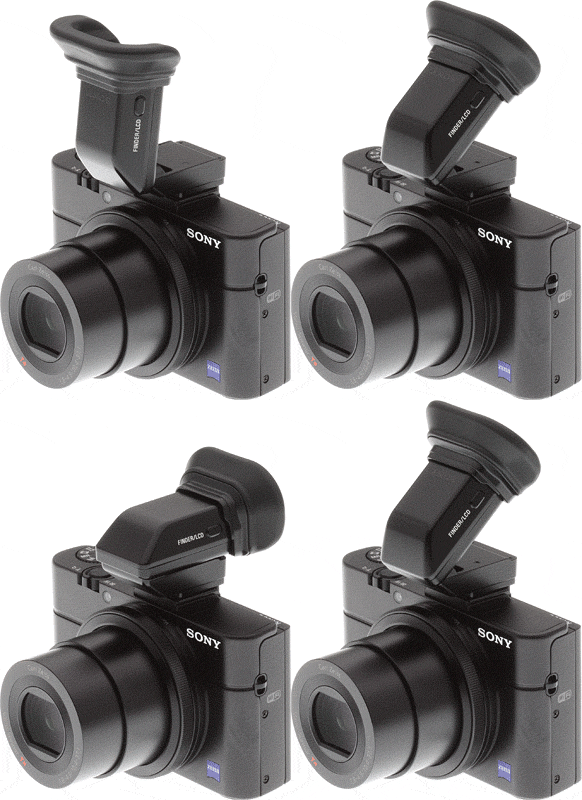
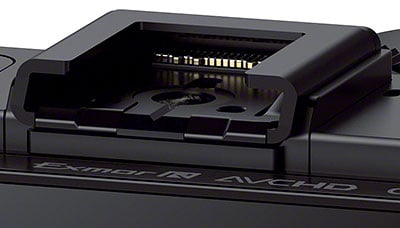
Expandability. Another important change is aimed at turning the RX100 II into something of a system camera, albeit one with a fixed lens. Unlike the RX100, the new camera now sports a flash hot shoe. Specifically, it's the same Multi Interface Shoe that debuted in last fall's flagship Sony A99 and RX1 cameras, integrating 21 data contacts that provide compatibility not only with external strobes, but also with accessories such as an electronic viewfinder, clip-on LCD monitor, or external microphone adapter.
And that's not all for the expandability: The Sony RX100 II's USB port has also been updated to become what Sony calls the Multi Terminal. This provides not only for USB data transfer and battery charging, but also adds compatibility with a wired remote control unit.
Wireless connectivity. Another very important change is the addition of built-in Near Field Communications and Wi-Fi wireless networking. NFC is used to establish a connection with a compatible phone or tablet automatically, simply by touching the two devices to each other briefly. Once paired via NFC, the camera and smart device will negotiate a much faster Wi-Fi connection automatically, without the need to manually select a network or enter security information. And when connected, you can control your RX100 II remotely from the smart device, including a remote live view stream on the screen of your Android / OS device, using a free app. The same app is also capable of transferring images and video to get them on their way to social networks and more.
If your smart device doesn't support NFC -- which is true of all Apple devices, and many older or less expensive Android devices, you'll still be able to pair via Wi-Fi manually. (But you're missing out: using NFC couldn't be simpler, and typically puts a silly grin on people's faces the first time they try it.)
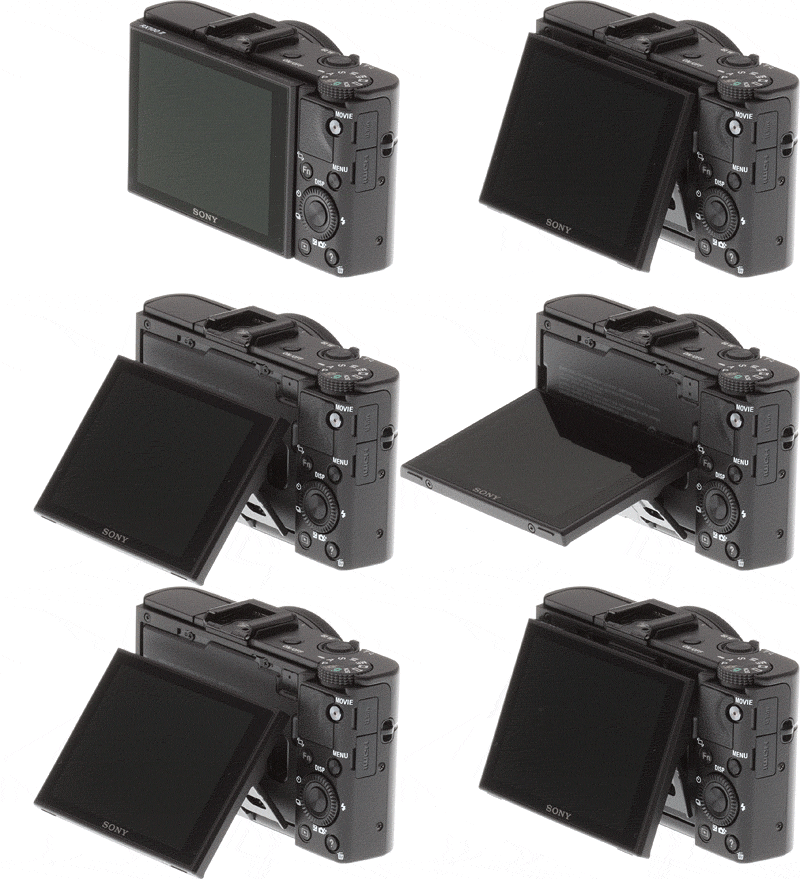
Tilting display. And in case the ability to connect an external, electronic viewfinder to the Sony RX100 II wasn't exciting enough, there's now an articulated LCD display, as well. It's solely a tilting type, rather than a tilt-swivel, and it doesn't provide for framing images from in front of the camera, but it nonetheless makes the RX100 II much more versatile when framing shots low to the ground, or over your head. And impressively, it adds barely anything to the camera's thickness -- there's only a scant 0.1 inch (2.4mm) increase over the original model.
That's still just enough to stop the RX100 II from fitting in the optionally-available leather jacket case for the original RX100, though, so Sony simultaneously released an updated jacket case. The new case will entirely replace the original one in Sony's inventory, and is listed as compatible with both cameras.
And more besides. There are a few other tweaks since the RX100 II, but they're not as significant as those mentioned so far. You can now shoot Full HD movies at a movie-like rate of 24 frames per second, in addition to the previous 60 frames / fields per second options. There's also a new step zoom function for the ring encircling the lens, which allows quick access to predefined focal lengths of 28, 35, 50, 70, and 100mm without the need to adjust the dial precisely. Sony has also added the Auto Object Framing function seen previously in the Sony A58 and NEX-3N cameras, supplementing the RX100's Auto Portrait Framing.
Accessories. The company will also be offering a couple of new accessories. There's a new AG-R1 finger rest grip, mirroring those available from third-parties for the RX100. This attaches to the camera body with adhesive, so if you later decide you prefer the unadorned body, it should be removable without damaging the camera. While the Sony grip is only $14.99, we personally like the beautiful anodized aluminum grips from Richard Franiec, which you can see attached to an RX100 below.

If you like playing with filters -- another way in which to build something of a system around your camera -- you should appreciate the new filter kit, which will also be compatible with the RX100.
Keeping the good stuff. In other respects, the Sony RX100 II is largely similar to its predecessor. Notably, the very good lens from the original RX100 -- offering lengths of 28-100mm equivalent, and a maximum aperture of f/1.8-4.9 across the zoom range -- is retained, and so is the bright, attractive Sony White Magic LCD panel.
Buy the Sony RX100 II from one of Imaging Resource's trusted affiliates:
(Your purchases help keep reviews like this one coming)
- Adorama: Sony RX100 II - US$698 with free shipping
- Amazon: Sony RX100 II - US$698 with free shipping
- B&H: Sony RX100 II - US$698 with free shipping
Sony RX100 II Review -- Video Tour
Video tour of the Sony RX100 II large-sensor compact camera. |
Sony RX100 II Review -- Walk-around
by Mike Tomkins
When we reviewed last year's Sony RX100, we felt its compact body to be one of the highlights of its design. Sure, it looked a whole lot like the Canon S90 and its successors, but that didn't detract from the fact that it was clean, attractive, reasonably pocket-friendly, and yet packed in a good number of controls including both a lens ring and rear dial.
With the Sony RX100 II, that basic design has been retained and expanded upon. That's good news indeed, as far as we're concerned. Let's take a quick trip around the RX100 II's body, and see what's new.

Seen from the front, the Sony RX100 II is almost indistinguishable from its sibling. From the Carl Zeiss Vario-Sonnar branded 3.6x optical zoom lens to the styling, all remains unchanged, with but one notable exception. The presence of a flash hot shoe projecting from above the lens (and just slightly despoiling the otherwise almost rectangular front profile) tips you off to the fact that you're looking at the RX100 II, and not the RX100.

From above, there are a few more clues to tip you off to which camera you're dealing with, although the basic layout is largely unchanged. As well as the aforementioned hot shoe, you'll also see that the two ports for the stereo microphone that straddle this new addition have shrunk in size, and been rotated 90 degrees to free up space. The top of the tilting LCD assembly stands proud from the rear of the camera slightly, and its top surface becomes home to various screen-printed badges, including the new Exmor R badge. (If you're not familiar with this, it indicates that the Sony RX100 II sports a backside-illuminated image sensor, in place of the previous, traditional chip.)
The whole body has also grown subtly but is noticeably thicker, enough so that the RX100 II will no longer fit in the leather jacket case sold for the original RX100. (A replacement version will fit both cameras, although it will presumably now be slightly loose on the earlier model.) Note, though, that while the lens may appear a little deeper in our side-by-side comparison with the Sony RX100 further up the page, that's definitely not the case. It's simply an optical illusion brought on by the other changes.

From behind the lens, you could again completely miss the changes in the Sony RX100 II, at a casual glance. The control layout is absolutely identical to that on the earlier camera, which is great news if you plan on upgrading from that model to the new one. There is literally no learning curve at all; in terms of the basic controls, and you'll feel right at home.
The only differences between the RX100 II and RX100 from this angle have already been noted in the other views: an articulated, tilting LCD monitor, and a flash hot shoe. From this angle, you can see the intelligent contacts in the latter, which allow it to serve double duty as an accessory shoe for the electronic viewfinder, clip-on LCD, and microphone accessories.

From the sides, there are a couple of more subtle changes on the Sony RX100 II. These don't involve new features, but are simply adjustments to the overall packaging of the camera. On the right of the body is the relocated HDMI high-definition video output, located under a small flap, and beneath the multi-terminal. This was previously to be found in a frankly terrible position on the base of the camera, snugged right up against the tripod socket. The new location is much more intelligent. Previously, you couldn't really use the HDMI output unless the camera was held in your hand, or laying on its back. Now if you desire -- and admittedly, few RX100 II users will likely do so -- you could even hook the RX100 II up to a large high-def display while shooting tripod mounted, something you certainly couldn't do before without resorting to some very carefully-selected adapters.
The multi-terminal port is, in essence, the USB port with a new name and a new capability. It was in much the same position previously, but it didn't allow use of Sony's wired remote control units. Now, it does. It's also how you charge the camera's battery.

On the other side of the RX100 II are two even more subtle changes -- one addition, and one subtraction. The new arrival is the small screen-printed Wi-Fi logo, hinting at the camera's wireless networking connectivity. (It also supports Near Field Communications, for an instant connection simply by touching it to a compatible device.) The absentee feature is the small three-hole speaker port from the original RX100. So, where has it gone?

Flipping the camera over once more soon answers that question. You'll now find a three-hole speaker port on the left-hand end (as seen from the rear) of the camera's base. Nearby is a new screen-printed NFC logo, and of course you can also see the base of the tilting LCD assembly from this angle. As we've noted, the small, rubber HDMI port cover is gone, with the port relocated to the camera's right side. Sadly, the metal tripod socket remains well away from the central axis of the lens, so if you plan on shooting a lot of tripod-mounted panoramas, you'll want to invest in an adapter to reduce the impact of parallax.
And that, in a nutshell, is the Sony RX100 II camera body: a little larger, and bearing several important new features, but in most respects near-identical to that of the RX100 in terms of basic layout and styling.
In the Box
- Cyber-shot DSC-RX100 Mark II camera
- NP-BX1 battery
- AC-UD10/11 AC adaptor
- Micro USB cable
- Wrist strap
- Shoulder strap adaptor
- Instruction manual
- Software CDROM
Recommended Accessories
- Extra NP-BX1 battery pack for extended outings
- Dedicated BC-TRX battery charger
- Fast, large capacity SDHC/SDXC memory card. These days, 16GB is a good tradeoff between cost and capacity, but if you plan to capture many movie clips or RAW files, consider larger.
- Camera case
Optics
|
Aperture: Maximum
|
|
 |
 |
Wide f/1.8: Sharp at center |
Wide f/1.8: Soft, upper right |
 |
 |
Tele f/4.9: Sharp at center |
Tele f/4.9: Soft, lower left corner |
|
Aperture: f/4 (W), f/8 (T)
|
|
 |
 |
Wide f/4: Sharp at center |
Wide f/4: Soft, upper right |
 |
 |
Tele f/8: Fairly sharp at center |
Tele f/8: Soft, lower left corner |
Sharpness (wide-open): All four corners are somewhat soft at full wide angle at f/1.8 while the center is fairly sharp. Some of the softness is due to strong distortion correction, both geometric and chromatic aberration (see below for uncorrected results).
Corners are also moderately soft at full telephoto, with the center fairly sharp. Again, much of the apparent softness comes from fairly strong chromatic aberration suppression as well as moderate geometric distortion correction.
Some minor corner shading ("vignetting") can be seen from the dimmer corner crops.
Stopped-down. Stopping down a few clicks to f/4 at maximum wide angle helps corner performance only slightly though contrast is improved, however corners are still not as sharp as the center.
Stopping down to f/8 at full telephoto doesn't help much in the corners, and the center is slightly softer than wide-open, limited by diffraction at such a small aperture (f/4.9 is the maximum aperture at telephoto, so we tried f/8 to see if the corners improved).
Still, good performance overall especially considering the f/1.8 speed at wide angle, though maximum aperture drops off fairly quickly when you zoom. At the telephoto end, maximum aperture is on the slow side at f/4.9.
The following table reflects the maximum and minimum apertures as reported by the camera:
|
FL (mm eq.)
|
28
|
35
|
50
|
70
|
100
|
|
Max.
|
f/1.8
|
f/2.8
|
f/3.5
|
f/4.0
|
f/4.9
|
|
Min.
| f/11 at all focal lengths | ||||
In-camera JPEGs |
 |
Wide: Almost no barrel distortion; not
noticeable |
 |
Tele: A tiny amount of barrel distortion,
not noticeable |
Uncorrected RAW |
 |
Wide: Very strong barrel distortion (~3.8%) |
 |
Tele: Moderate barrel distortion (~0.5%) |
Geometric Distortion: There is only a trace of barrel distortion in JPEGs at the Sony RX100 II's full wide angle and telephoto settings (about 0.02% to 0.04% of slightly wavy distortion). Thus, the camera's processor works hard to keep distortion in check.
In uncorrected RAW files, barrel distortion at wide angle is very high at about 3.8%, while at telephoto barrel distortion is moderate at about 0.5%. That's not unusual, though, and most RAW converters will automatically correct for it, but strong correction does lead to some extra softness in the corners.
|
In-Camera JPEG
|
|
 |
 |
Wide f/1.8: Low |
Tele f/4.9: Low |
|
Uncorrected RAW
|
|
 |
 |
Wide f/1.8: High |
Tele f/4.9: High |
Chromatic Aberration: Chromatic aberration in camera JPEGs at wide angle is moderate in terms of pixel count, but coloration is quite muted. Fringing at full telephoto has slightly brighter color, though it's still fairly low.
As you can see from the uncorrected RAW crops, lateral chromatic aberration is actually fairly high and bright, so the Sony RX100 II's processor does a good job suppressing most of it in JPEGs. However as mentioned above, defringing does tend to reduce edge acuity, contributing to softer, lower-contrast corners.


Macro: The Sony RX100 II captures a slightly larger-than-average sized minimum area measuring 3.02 x 2.02 inches (76 x 51 millimeters). Detail is excellent across most of the frame with corners only showing a bit of softness (most lenses show some softening in the corners at macro distances, so the RX100 II does better than most). The flash did a good job throttling down, but coverage is not centered and the lens casts a strong shadow in the lower right. You'll likely want to use external lighting for the closest RX100 II macro shots.
Sony RX100 II Viewfinder Accuracy


Viewfinder Accuracy: The Sony RX100 II's LCD monitor shows about 100% coverage at wide angle and slightly over 100% at full telephoto, which is very good.
The images above were taken from our standardized test shots. For a collection of more pictorial photos, see our Sony Cyber-shot DSC-RX100 II Photo Gallery .
Exposure

Color: The Sony RX100 II produces pretty good overall color, though colors at default settings are not as vibrant as most cameras. With a mean saturation of 104.6% at base ISO, the Sony RX100 II's saturation levels are lower than most cameras which average about 10% oversaturation. You can always increase saturation or select the Vivid Creative Style mode if you find default colors too flat, though. In terms of hue, cyans are moderately shifted toward blue, orange towards yellow and yellow towards green, though those shifts are fairly common. Overall, hue accuracy is about average, but the yellow-to-green shift combined with its desaturation can lead to somewhat dingy-looking yellows.


Incandescent: The RX100 II's Auto white balance setting works better than most cameras, producing slightly warm results in our indoor portrait test. The Incandescent setting is also warm with a slightly yellow tint, but again, better than average. The Manual white balance setting is very good, producing the most accurate color balance, perhaps just slightly on the cool side. Unlike a lot of compacts, the RX100 II has a Kelvin temperature white balance setting as well, however we did not test that mode.


Resolution: Our laboratory resolution chart reveals sharp, distinct line patterns to just over 2300 lines per picture height horizontally but only to about 2100 lines vertically, which is a little low for the megapixel count. (There's likely a bit of lens astigmatism at play here.)Extinction of the pattern occurred at about 2800 lines per picture height horizontally, and about 2600 lines vertically.


Flash: Our manufacturer-specified flash range testing (shown at right) is inconclusive at wide angle, with the rated distance of 15m / 49.2 ft. with Auto ISO, being too far for our lab despite employing spot metering. However, the telephoto test came out bright at the specified 5.7m / 18.7 feet with Auto ISO (the camera chose ISO 2500), so we'd say Sony's flash range rating is credible.
Auto flash mode produced slightly dim results at ISO 200, selecting a somewhat slow shutter speed of 1/30 second. Image stabilization should help with the slow shutter speed, but movement of the subject could be problematic at slow shutter speeds unless detected by the camera. Shot taken at ~5 feet (~1.5m) on a stable tripod.


Low Light: The RX100 II is able to capture bright, clean images at the lowest light level we test at (1/16 foot-candle, about 4 stops down from typical city street lighting at night), even at its lowest ISO setting, thanks to its fast lens and larger-than-average sensor. Even its top ISO of 12,800 was able to capture a usable image, though as you'd expect, noise is quite high and fine detail suffers. Auto white balance performed well, producing a slightly cool color balance. Excellent performance for its class here.
Low Light AF: The camera's AF system was able to focus down to below the 1/16 foot-candle light level without AF assist enabled, and in complete darkness with the AF assist lamp enabled. Excellent results here.





ISO: Noise and Detail: Detail is strong and well defined at ISOs 100 through 400 with default noise reduction. We start to see a noticeable decline in image quality at ISO 800, but fine detail is very good with much better image quality than typical pocket cameras. Fine detail is still good at ISO 1600, though subtle detail in our red-leaf fabric becomes soft. Detail and noise levels are generally still pretty good at ISO 3200 which is remarkable given the size of the camera, but at ISOs 6400 and 12,800, noise and strong noise suppression blur away much detail and definition, particularly in the red channel. Chroma noise is however effectively controlled throughout the sensitivity range, though saturation does drop off a bit at higher ISOs.
Overall, a nice improvement over the RX100 at higher ISOs, but some of it comes down to more advanced JPEG processing as the RX100 II's RAW files show a smaller improvement in noise performance, perhaps a 1/3 to 1/2 of a stop, and the camera seems to be applying fairly subtle noise reduction to RAW data at higher ISOs as well. Still, much better high ISO image quality than typical enthusiast compacts. See Printed results below for more on how this affects prints.
Print Quality: Very good 24 x 36 inch prints at ISO 100/160/200; a nice 13 x 19 at ISO 1600; a good 4 x 6 at ISO 12,800.
 ISO 100/160 prints are very good at 24 x 36 inches, with nice detail and good color. Wall display prints are quite usable up to 36 x 48 inches.
ISO 200 also produces a nice 24 x 36 inch print, with wall display prints possible to 30 x 40 inches.
ISO 400 shots are good at 20 x 30 inches. 24 x 36 inch prints are certainly usable for less critical applications, with only mild softening in the red channel and minor noise in a few areas.
ISO 800 is where things start to get interesting, as the original RX100 and the RX100 II both make worthwhile prints at 16 x 20 inches, but with slightly different minor issues. The RX100 displays more contrast and detail in our somewhat difficult red fabric swatch, and yet has more grain in shadowy areas than the RX100 II.
ISO 1600 is where the newer backlit sensor in the RX100 II starts to shine, as a good 13 x 19 is possible here, where the RX100 has a bit too much noise at that size and requires a reduction to 11 x 14 inches.
ISO 3200 shows this trend continuing, as a good 11 x 14 is the yield from the RX100 II, but is a bit too noisy in flatter areas in the RX100 at that size.
ISO 6400 prints at 8 x 10 almost make our "good" standard, and are certainly useful for less critical applications, with 5 x 7's being quite good here.
ISO 12,800 yields a good 4 x 6, which is a nice size at this ISO for a 1"-type sensor!
The Sony RX100 II continues in the hallowed footsteps of last year's RX100 and takes the compact camera world yet a step further as ISO starts to rise, thanks to its improved backlit sensor and more refined processing. Where the RX100 shines quite brightly for a compact camera, the RX100 II is capable of one print size larger at ISO 1600 and 3200, as well as adding a good 4 x 6 at ISO 12,800 to the roster of possibilities. The sizes this camera prints for a true pocket camera, and not just a small CSC that happens to fit into a coat pocket, is quite remarkable indeed. (Oh, and thank Sony for not adding single-shot ISO 25,600 just to say that it could! At IR we appreciate the integrity in marketing.)
The images above were taken from our standardized test shots. For a collection of more pictorial photos, see our Sony Cyber-shot DSC-RX100 II Photo Gallery .
Not sure which camera to buy? Let your eyes be the ultimate judge! Visit our Comparometer(tm) to compare images from the Sony Cyber-shot DSC-RX100 II with those from other cameras you may be considering. The proof is in the pictures, so let your own eyes decide which you like best!
Performance
Timing and Performance
Generally excellent performance, but some slow areas.
|
Startup/Shutdown/Play to Record/Buffer Clearing |
||
|---|---|---|
| Power on |
~2.8 seconds
|
Time it takes for LCD to turn on and lens to deploy and capture a picture. |
|
Shutdown |
~2.0 seconds
|
How long it takes to retract lens. |
|
Play to Record, |
~1.2 seconds
|
Time until first shot is captured. |
| Buffer clearing time |
11 seconds
after 12 L/F JPEGs* 14 seconds after 12 RAW files* 17 seconds after 8 RAW+JPEG files* |
Worst case buffer clearing time. -- This is the delay after a set of shots before you can remove the card. Some cameras won't retract their lenses and shut down until the buffer is cleared. |
|
*Note: Buffer clearing times measured with a SanDisk Extreme Pro 95MB/s UHS-I SDHC memory card. Slower cards may produce correspondingly slower clearing times.
|
||
The Sony RX100 II is a bit slower than average for its class at powering up and taking a shot, as well as shutting down. Worst-case buffer clearing times are fair.
|
Shutter Response (Lag Time)
|
||
|---|---|---|
| Full Autofocus Wide |
0.149 second
|
Time from fully pressing shutter button to image capture, zoom lens at wide angle position. |
| Full Autofocus Tele |
0.195 second
|
Time from fully pressing shutter button to image capture, zoom lens at telephoto position. |
|
Full Autofocus |
0.326 second
|
Time to capture while forcing flash to fire, zoom lens at wide angle position. |
Manual Focus |
0.029 second
|
For most cameras, shutter lag is less in manual focus than autofocus, but usually not as fast as when the camera is "prefocused". |
| Prefocused |
0.011 second
|
Time to capture, after half-pressing and holding shutter button. |
Full autofocus shutter lag is very fast at 0.149 second at wide angle, and 0.195 second at telephoto. Enabling the flash raises full autofocus shutter lag to 0.326 second, which is still pretty fast. Manual focus lag is a very fast 0.029 second, and prefocused shutter lag is only 0.011 second, which is very quick indeed.
|
Cycle Time (shot to shot)
|
||
|---|---|---|
| Single Shot mode |
0.53 second
|
Time per shot, averaged over 9 shots. |
| Single Shot mode |
0.62 second
|
Time per shot, averaged over 4 shots. |
|
Single Shot mode |
0.64 second
|
Time per shot, averaged over 4 shots. |
| Early shutter |
YES
|
Some cameras don't snap another shot if you release and press the shutter too quickly in Single Shot mode, making "No" the preferred answer. |
|
Speed Priority Continuous mode |
0.10 second (9.60 frames per second);
13 frames total; 8 seconds to clear* |
Time per shot, averaged over 13 shots, then slows to an average of 0.71 second or 1.40 fps. |
|
Speed Priority Continuous mode |
0.20 second (4.90 frames per second);
13 frames total; 5 seconds to clear* |
Time per shot, averaged over 13 shots, then slows to an average of 1.33 second or 0.75 fps. |
|
Speed Priority Continuous mode |
0.22 second (4.50 frames per second);
10 frames total; 13 seconds to clear* |
Time per shot, averaged over 10 shots, then slows to an average of 2.00 second or 0.50 fps. |
| Continuous mode |
0.35 second (2.86 frames per second);
12 frames total; 11 seconds to clear* |
Time per shot, averaged over 12 shots, then slows to an average of 1.08 second or 0.92 fps. |
| Continuous mode |
0.41 second (2.44 frames per second);
12 frames total; 14 seconds to clear* |
Time per shot, averaged over 12 shots, then slows to an average of 1.31 second or 0.76 fps. |
|
Continuous mode |
0.41 second (2.41 frames per second);
8 frames total; 17 seconds to clear* |
Time per shot, averaged over 8 shots, then slows to an average of 2.01 second or 0.50 fps. |
| Flash recycling |
4.4 seconds
|
Flash at maximum output. |
| *Note: Buffer clearing times measured with a SanDisk Extreme Pro 95MB/s UHS-I SDHC memory card. Slower cards will produce correspondingly slower clearing times. Slow cards may also limit length of bursts in continuous mode. ISO sensitivity also affects cycle times and burst mode performance, with higher ISOs generally increasing cycle times and reducing burst performance. |
||
Single-shot cycle times are very good, capturing a large/fine JPEG every 0.53 second, a RAW file every 0.62 second, or a RAW+large/fine JPEG every 0.64 second.
Speed Priority Continuous mode captures Large/Fine JPEGs at 9.6 fps for 13 frames, taking 8 seconds to clear with a fast 95MB/s UHS-1 SDHC card. In RAW mode, the frame rate drops to 4.9 fps for 13 frames, with 5 seconds to clear. In RAW+JPEG mode (JPEG quality is fixed to Fine), the frame rate drops a bit more to 4.5 fps for 10 frames with 13 seconds to clear. Note that AF and exposure are locked at the first frame of a burst in this mode. We found it odd that frame rate when shooting RAW wasn't as good as the RX100's 10 fps, so we retested multiple times. Each time we got slightly different results with frame rates as high as 5.8 fps, but no where near 10 fps. Still, continuous mode performance is good when shooting RAW, and excellent for JPEGs.
In standard continuous mode, large/fine JPEGs are captured at 2.9 fps for 12 frames with 11 seconds to clear, 12 RAW frames at 2.4 fps with 14 seconds to clear, and 8 RAW+JPEG frames at 2.4 fps with 17 seconds to clear.
The Sony RX100 II's flash recycles in about 4.4 seconds after a full-power discharge, which is fair.
|
Download Speed
|
||
|---|---|---|
| Windows Computer, USB 2.0 |
9,402 KBytes/sec*
|
Typical Values: |
Connected to a computer with USB 2.0, the Sony RX100 II's download speeds are decent, though not particularly fast. Note that we used fast 95MB/s UHS-I SDHC card, so slower cards may result in slower download speeds.
Bottom line, the Sony RX100 II is very fast at autofocus, shutter lag, single-shot cycle times and JPEG continuous mode, however powering up and shutting down is sluggish, and burst speed drops when shooting RAW (though still not bad).
Battery Life
Above average battery life.
|
Operating Mode
|
Number of Shots
|
|---|---|
|
Lithium-ion Rechargeable Battery,
(CIPA standard) |
350
|
The Sony RX100 II's battery life has a CIPA rating of 350 shots per charge, which is above average for its class.
The table above shows the number of shots the camera is capable of (on a fully-charged rechargeable battery as appropriate), based on CIPA battery-life and/or manufacturer standard test conditions.
(Interested readers can find an English translation of the CIPA DC-002 standards document here. (180K PDF document))
Image Quality
Below are crops comparing the Sony RX100 II with the Sony RX100, Canon S120, Nikon J3, Olympus E-PL5 and Panasonic GM1.
NOTE: These images are best quality JPEGs straight out of the camera, at default settings including noise reduction and using the actual base ISO (not extended ISO settings). All interchangeable lens cameras in this comparison were shot with our very sharp reference lenses.
Sony RX100 II versus Sony RX100 at base ISO
 |
 |
 |
 |
 |
 |
Sony RX100 II at ISO 160 |
Sony RX100 at ISO 125 |
As expected, the RX100 II and RX100 look strikingly similar at base ISO levels. Both produce very high levels of crisp, fine detail, particularly noticeable in the mosaic. Interestingly, the RX100 did better with the red and pink fabrics. |
|
Sony RX100 II versus Canon S120 at base ISO
|
 |
|
 |
|
 |
Sony RX100 II at ISO 160 |
Canon S120 at ISO 80 |
Compared to Canon's high-end slim and pocketable point-and-shoot, the RX100 II wins hands down thanks the larger 1-inch type sensor and higher pixel count. In all three comparisons, the RX100 II shows more fine detail and more accurate colors than the S120. |
|
Sony RX100 II versus Nikon J3 at base ISO
|
 |
|
 |
|
 |
Sony RX100 II at ISO 160 |
Nikon J3 at ISO 160 |
The battle of the 1-inch type sensors! However, it's a pretty one-sided battle, with the victor being the Sony RX100 II, which handily bests the Nikon J3 in color accuracy and level of fine detail. (As is almost always the case in these shootouts, though, the Nikon wins on the red fabric swatch. For whatever reason, Nikon's processing of that particular target element is better than that of other manufacturers.) |
|
Sony RX100 II versus Olympus E-PL5 at base ISO
|
 |
|
 |
|
 |
Sony RX100 II at ISO 160 |
Olympus E-PL5 at ISO 200 |
The smaller sensor of the RX100 II really stands up to the larger Four Thirds sensor of the E-PL5 here, although we wouldn't really expect to see much difference at base ISO. While the E-PL5 does better with the fabric and ever-so-slightly better with the mosaic crop, the RX100 II is not drastically different. |
|
Sony RX100 II versus Panasonic GM1 at base ISO
|

|
|

|
|

|
Sony RX100 II at ISO 160 |
Panasonic GM1 at ISO 200 |
Like the previous comparison, it's once again a 1"-type sensor versus a Four Thirds sensor in the GM1, and this time around, the two cameras are pretty evenly matched. Both show crisp and clean bottle crops, but while the GM1 does a little better with the fabrics, the RX100 II does slightly better with fine detail in the mosaic crop. |
|
Most digital SLRs and CSCs will produce an excellent ISO 100 shot, so we like to push them and see what they can do compared to other cameras at ISO 1600, 3200, and 6400. Recent advances in sensor technology have made ISO 1600 look a lot more like ISO 100, but there are still cameras whose quality starts to fall apart at this setting. We also choose 1600 because we like to be able to shoot at least at this level when indoors and at night.
Sony RX100 II versus Sony RX100 at ISO 1600
 |
 |
 |
 |
 |
 |
Sony RX100 II at ISO 1600 |
Sony RX100 at ISO 1600 |
At higher ISO levels, the back-illuminated sensor of the RX100 II is showing its strength here against the traditional front-side illuminated sensor in the RX100. The noise in the shadows is much cleaner in the Mark II camera, though both show a similar level of fine detail. (Once again, though, the RX100 actually did a better job with the fabric swatches.) |
|
Sony RX100 II versus Canon S120 at ISO 1600
|
 |
|
 |
|
 |
Sony RX100 II at ISO 1600 |
Canon S120 at ISO 1600 |
The smaller sensor and aggressive noise reduction of the S120 at ISO 1600 produces a very noticeable drop in detail compared to the RX100 II. Despite the aggressive noise reduction, though, there's still more noise remaining in its image, easily visible in the shadow area between the two bottles. |
|
Sony RX100 II versus Nikon J3 at ISO 1600
|
 |
|
 |
|
 |
Sony RX100 II at ISO 1600 |
Nikon J3 at ISO 1600 |
The RX100 II wins again here at ISO 1600, with noticeably less noise and significantly more fine detail. While both struggle with producing a recognizable leaf pattern in the red fabric, the RX100 II does better with the pink swatch. |
|
Sony RX100 II versus Olympus E-PL5 at ISO 1600
|
 |
|
 |
|
 |
Sony RX100 II at ISO 1600 |
Olympus E-PL5 at ISO 1600 |
Alas, the larger Four Thirds sensor of the E-PL5 wins handily at ISO 1600. The E-PL5 shows better fine detail, less high-ISO noise, and better handling of the challenging red fabric (and the pink, too). |
|
Sony RX100 II versus Panasonic GM1 at ISO 1600
|
 |
|
 |
|
 |
Sony RX100 II at ISO 1600 |
Panasonic GM1 at ISO 1600 |
The larger sensor of the Panasonic GM1 again wins against the smaller one in the RX100 II, but the difference is less visually apparent here than it was with the E-PL5. We attribute this to the GM1's less-aggressive in-camera sharpening, which means lines, edges, and fine detail don't "pop" quite the way they do with the E-PL5. All the detail is there, though, it's just not emphasized to the same extent by the camera's default sharpening algorithm. |
|
These days, ISO 3200 is a very viable shooting option for most good cameras, so let's take a look at some comparisons there.
Sony RX100 II versus Sony RX100 at ISO 3200
 |
 |
 |
 |
 |
 |
Sony RX100 II at ISO 3200 |
Sony RX100 at ISO 3200 |
ISO 3200 is tough with a 1"-type sensor, but the high ISO performance of the Mark II is significantly better than that of the RX100. This is largely down to the RX100 II having a backside-illuminated sensor versus the conventional one in the original model, but also due to revised noise processing. The shadows are much cleaner, but similarly to what we saw with the ISO 1600 comparison, the level of fine detail is only slightly improved. |
|
Sony RX100 II versus Canon S120 at ISO 3200
|
 |
|
 |
|
 |
Sony RX100 II at ISO 3200 |
Canon S120 at ISO 3200 |
Not surprisingly, the RX100 II easily bests the smaller-sensored S120 at ISO 3200 with much more fine detail and less noise. |
|
Sony RX100 II versus Nikon J3 at ISO 3200
|
 |
|
 |
|
 |
Sony RX100 II at ISO 3200 |
Nikon J3 at ISO 3200 |
The Nikon J3 really struggles at ISO 3200 compared to the RX100 II despite, both having 1"-type sensors. The RX100 II shows less noise and more fine detail, as well as much more pleasing colors. |
|
Sony RX100 II versus Olympus E-PL5 at ISO 3200
|
 |
|
 |
|
 |
Sony RX100 II at ISO 3200 |
Olympus E-PL5 at ISO 3200 |
The high ISO noise reduction from the E-PL5 is quite aggressive at ISO 3200, but it still manages to handle fine detail pretty well, helped in part by its strong in-camera sharpening. The RX100 II can't quite match the performance of the E-PL5, with its larger sensor. |
|
Sony RX100 II versus Panasonic GM1 at ISO 3200
|
 |
|
 |
|
 |
Sony RX100 II at ISO 3200 |
Panasonic GM1 at ISO 3200 |
This is a surprisingly close contest, although we again think that much of the visual difference between the GM1 here and the E-PL5 above has to do with the amount of sharpening the E-PL5 applies. While the GM1's image doesn't "pop" quite as much as the E-PL5's, it does show more fine detail here than that from the RX100 II. Still, it's pretty remarkable that the RX100 II can come as close as it does to the performance of cameras with larger sensors. |
|
Detail: Sony RX100 II versus Sony RX100, Canon S120, Nikon J3, Olympus E-PL5 and Panasonic GM1.
 |
 |
 |
 |
 |
 |
 |
 |
 |
 |
 |
 |
 |
 |
 |
 |
 |
 |
| Sony
RX100 II ISO 160 ISO 3200 ISO 6400 |
Sony
RX100 ISO 125 ISO 3200 ISO 6400 |
Canon S120 ISO 80 ISO 3200 ISO 6400 |
Nikon J3 ISO 160 ISO 3200 ISO 6400 |
Olympus E-PL5 ISO 200 ISO 3200 ISO 6400 |
Panasonic
GM1 ISO 200 ISO 3200 ISO 6400 |
| Detail comparison. In the high-contrast detail comparisons, the RX100 II and RX100 look very similar at base ISO, while the Mark II does progressively better as the ISO rises. The king of the comparison is easily the Olympus E-PL5 (at all ISO levels), thanks again to its strong sharpening. The Panasonic GM1 arguably has equal detail, but uses less sharpening to emphasize it. Both Micro Four Thirds cameras beat the RX100 II, but we're amazed that a 1" style sensor can do as well as the RX100 II's does, clearly besting the same-sized chip in the Nikon J3. As you'd expect, the S120 doesn't really compete in this league | |||||
Sony RX100 II versus RX100 Low Light Comparison
 |
| Sony RX100 |
 |
| Sony RX100 II |
As we've said elsewhere, the biggest news with the Sony RX100 II is its sensor: The first 1-inch type backside illuminated sensor to hit the streets. Sony's claims of a full 1-stop improvement in high-ISO noise seems well-justified by our own experience - the difference between JPEGs from the new and old models is pretty dramatic. Shot at ISO 6400, the original RX100's images are pretty good for that ISO level from a compact camera, but the RX100 II's shots are really exceptional. |
 |
| Sony RX100 |
 |
| Sony RX100 II |
Here's the first of two sets of crops from the photos above. Note not only the lower noise in the shot from the RX100 II, but also the crisper edges on everything. |
 |
| Sony RX100 |
 |
| Sony RX100 II |
Here's the second crop from the images above. What most stands out to our eyes is the significantly improved tonality of the RX100 II's output: Note how much better the II renders the woman's face above. |
 |
| Sony RX100 ISO 3200 (100% crop) |
 |
| Sony RX100 II ISO 6400 (100% crop) |
 |
| Sony RX100 ISO 6400 (100% crop) |
We've said elsewhere that the RX100 II's noise in JPEGs is a full f-stop better than that of the original RX100. This shot shows pretty conclusively that it's even better than that. Here, we have a crop from the RX100 II, shot at ISO 6400, bracketed by RX100 images. The top image was shot by the RX100 at ISO 3200, the bottom one at ISO 6400. To our eyes, the RX100 II's shot at 6400 is actually cleaner than the RX100's at 3200. At ISO 6400, there's no comparison. The RX100's sensor was already an excellent one, and its high-ISO performance outstripped anything near its size. The new Mark II version takes it to an entirely new level, though. And all of this is without taking into consideration Sony's highly effective multi-shot modes, which use multiple, rapid-fire shots to cut noise, while giving the exposure effect of a much longer exposure, combined with the anti-camera-shake effect of a much shorter one. All in all, the Sony RX100 II really blows away the competition when it comes to after-dark shooting with a compact, pocketable camera. As Dave said in his YouTube video on the RX100 II, the improvements are enough that we think a lot of current RX100 users will be looking to trade up. Very impressive! |
Sony RX100 II Print Quality
Very good 24 x 36 inch prints at ISO 100/160/200; a nice 13 x 19 at ISO 1600; a good 4 x 6 at ISO 12,800.
ISO 100/160 prints are very good at 24 x 36 inches, with nice detail and good color. Wall display prints are quite usable up to 36 x 48 inches.
ISO 200 also produces a nice 24 x 36 inch print, with wall display prints possible to 30 x 40 inches.
ISO 400 shots are good at 20 x 30 inches. 24 x 36 inch prints are certainly usable for less critical applications, with only mild softening in the red channel and minor noise in a few areas.
ISO 800 is where things start to get interesting, as the original RX100 and the RX100 II both make worthwhile prints at 16 x 20 inches, but with slightly different minor issues. The RX100 displays more contrast and detail in our somewhat difficult red fabric swatch, and yet has more grain in shadowy areas than the RX100 II.
ISO 1600 is where the newer backlit sensor in the RX100 II starts to shine, as a good 13 x 19 is possible here, where the RX100 has a bit too much noise at that size and requires a reduction to 11 x 14 inches.
ISO 3200 shows this trend continuing, as a good 11 x 14 is the yield from the RX100 II, but is a bit too noisy in flatter areas in the RX100 at that size.
ISO 6400 prints at 8 x 10 almost make our "good" standard, and are certainly useful for less critical applications, with 5 x 7's being quite good here.
ISO 12,800 yields a good 4 x 6, which is a nice size at this ISO for a 1"-type sensor!
The Sony RX100 II continues in the hallowed footsteps of last year's RX100 and takes the compact camera world yet a step further as ISO starts to rise, thanks to its improved backlit sensor and more refined processing. Where the RX100 shines quite brightly for a compact camera, the RX100 II is capable of one print size larger at ISO 1600 and 3200, as well as adding a good 4 x 6 at ISO 12,800 to the roster of possibilities. The sizes this camera prints for a true pocket camera, and not just a small CSC that happens to fit into a coat pocket, is quite remarkable indeed. (Oh, and thank Sony for not adding single-shot ISO 25,600 just to say that it could! At IR we appreciate the integrity in marketing.)
Field Test
by Dan Havlik
Posted: 12/27/2013

The 20.2MP Sony Cyber-Shot RX100 took the photo world by storm when it was introduced in 2012, ending up on several "best of" lists including our own, where we named it our Pocket Camera of the Year for 2012. And it's a swell camera, for sure, providing near SLR-level image quality with a quality zoom lens in a compact body you can take anywhere. The camera proved quite popular for Sony and just a year after it debuted, the company unveiled a quasi-follow-up to that model in summer 2013: the Sony RX100 II. I say "quasi" follow-up, because, according to Sony, the RX100 II is not going to replace the previous model but sit alongside it in the line.
How good is the Sony RX100 II's 28-100mm eq. lens?
Click here to see our optical test results.
As noted above, the new camera looks very similar to its predecessor, but has a number of important updates. Rather than repeating them here, though, let's just jump into what it's like to shoot with the Sony RX100 II.

In the hand. Like its predecessor, the Sony RX100 II won't win any awards for originality of design, but it's still a very nice looking little camera. As we noted earlier, the first RX100 and now the Mark II version are both derivative of Canon's groundbreaking S90 camera from 2009. This isn't the first time the elegant, all-black Canon S90 has been imitated and it probably won't be the last. It's just a classic, simple design, which the Sony RX100 II takes another step further.
With dimensions of 4.0 x 2.3 x 1.5 inches (102 x 58 x 38 mm) and a weight just under ten ounces (281 grams), the Sony RX100 II is a bit bigger and heavier than the previous model, but still small enough to qualify as a "pocket" camera. It feels heavy in your hand though, and when you consider the luxury price tag for this model -- $750, which is $100 higher than the previous generation -- you'll definitely want a reliable wrist-strap for it to prevent accidental drops.
The beauty of a small camera with a big sensor is that it allows you take near SLR-quality images without drawing as much attention as a DSLR often does. And there's a definite discreet feel to the Sony RX100 II, which I was able to use rather inconspicuously for street photography. I just wish that it was a bit easier to hold. While its matte black exterior is handsome and smooth to the touch, the lack of a hand-grip or any sort of texture to the camera body makes its feel slippery in your hand, which is why I advise securing it to your wrist with a strap or even purchasing an add-on grip. [Ed. note: See above for an elegant solution to this, via an aftermarket add-on grip.]
The Sony RX100 II's Carl Zeiss Vario-Sonnar-branded, 3.6x, optical zoom lens is quite large, even when retracted, covering a significant portion of the front face of the camera. That didn't leave much room for my fingers, and my right hand felt scrunched while shooting with the camera. Overall though, the RX100 II felt well balanced, with its metal build and big, 3-inch tilting glass rear display, giving it an air of understated luxury.
Controls. If you're familiar with the Sony RX100 then the layout of the RX100 II will look very familiar indeed. From the front, the two cameras are dead ringers. The only noticeable difference is that the RX100 II adds a hotshot on top of the camera, which you can see as a sliver above the 3.6x optical zoom lens.
From the top, the RX100 II also looks a lot like its predecessor, with the only noticeable changes being the aforementioned hot shoe, which is straddled by two smaller, vertical holes for the stereo microphone. The body also looks slightly thicker, but that's mainly because of the folding rear screen, which juts out slightly in the top view. Otherwise, the small shutter button with the surrounding plastic zoom ring is in the same place on the front right of the camera. The shutter button doesn't look like much, but it's quite responsive. While photographing the Medieval Festival in New York City, I was able to move through the crowd and quickly snap photos of people dressed up in period costumes without them noticing.

I was less keen on the flimsy, plastic zoom ring that surrounds the shutter. It felt under-matched for the big chunk of Zeiss-branded glass on front of the camera, with the camera zooming slowly and not particularly smoothly. Speaking of zoom, the Sony RX100 II adds a smart function its predecessor didn't have: the ability to "step zoom" using the knurled, black ring around the lens. This is something you have to "turn on" via the RX100 II's somewhat complicated menu system, but once it's engaged, it will let you zoom to predefined focal lengths of 28, 35, 50, 70, and 100mm by just nudging the dial to the left or the right (you don't need to be precise.) That's a nifty feature, but it's also not particularly fast.
A point made in our 2012 review of the RX100 holds true with the Mark II version: the front ring control is both a blessing and a curse. It's great once you decide how you want to use it -- such as the step zoom feature -- but when you switch modes its function can change. Indeed, so many changes affect other operating factors, that the Sony RX100 II's many options can become something of a burden. In a nutshell, while the RX 100 II's controls seem simple, they're actually quite confusing if you dive deeper. Word of warning: you may spend more time figuring out all the bells and whistles on this camera than you expected.
On top of the Sony RX100 II is the small, recessed on/off button, and the small, knurled mode dial, both of which do what they're supposed to. The mode dial strikes a good balance between being easy enough to adjust, yet stiff enough to not get changed accidentally. On back, the controls are similarly basic-looking (and identical to the RX100). There's a recessed, one-touch movie button to the right of the rubber thumb-rest, which is easy to engage if you want to quickly start shooting a movie, but not so easy to access that you record video by accident.
Otherwise, the rear of the camera has four small buttons for Function, Menu, Playback and Help/Delete, surrounding the small Control ring and engage button. The simplicity of the controls on the Sony RX100 II show that it's aimed at the point-and-shoot crowd even if its does have the superior image quality and complex functionality of a more advanced camera.
Tilting display. One of the major upgrades of the Sony RX100 II compared to its predecessor, is the tilting, articulated, 3-inch LCD screen. Like the previous model, the RX100 II's display has 1,228,800 dots (307,200 pixels) of resolution, and images look crisp and clear in playback. There's no optical or electronic viewfinder (EVF) on the RX100 II, though the camera's hotshoe is actually a Multi Interface Shoe that not only lets you use external strobes, but also allows you to attach an (optional) EVF. The Sony FDA-EV1MK Viewfinder, which offers 2,359K dots of resolution, does not come cheap, though: it'll cost you an additional $450.

Autofocus. The Sony RX100 II was surprisingly quick at auto focusing during my time with the camera. In the technical section of this review, we speculated that the camera's new BSI sensor might have something to do with that. Without going into it too deeply again, because the RX100 II's sensor does such a bang up job of gathering image data, even in low light, the camera's Contrast Detection-based AF system has cleaner info to work with and can therefore focus faster. Sony has said that the AF speed has improved by 10% in the RX100 II, and while there was no way for me to test that since I wasn't working with the two cameras side by side, the RX100 II was indeed very quick on the draw. (Our lab results do however show about an 18% improvement in AF speeds when wide and tele speeds are averaged.)
You have to be a bit careful with this camera though. The shot to shot speed of the Sony RX100 II, which I'll go into more in the next section, is so quick it can outpace the autofocus, and you'll end up with a bunch of blurry pictures. Unless you're in a real hurry to fire off a bunch of photos of, for instance, sports or runaway toddlers or pets, wait the extra split second for the camera to achieve focus lock before you take your next shot. I was able to use this method to capture lots of sharp shots of characters at the Medieval Festival.
Technically speaking, the Sony RX100 II uses a 25-point auto-focus system, and offers center spot, flexible spot, and tracking modes, including face tracking, which came in handy for my on-the-fly Medieval portraits. Street photographers will surely love this camera.

Performance. Generally speaking, the Sony RX100 II is a pretty zippy performer. I mentioned the camera's quick autofocus in the previous section, but what really impressed me was how fast the RX100 II is from shot to shot. The camera is powered by Sony's BIONZ image processor and it does a good job of keeping this camera rolling. Just lightly trigger the shutter button, and the RX100 II will capture shot after shot with barely a pause between. Many compact cameras, even the expensive ones, experience some kind of shutter lag or delay between shots to process the image info, but in my real world testing the RX100 II did not.

The Sony RX100 II also has a very quick burst function, called Speed Priority Advance mode, which in my testing let me rattle off 9-10 frames per second. In this mode, focus and exposure are locked from the first frame. After I fired off about 12 JPEG images using this Speed Priority Advance mode, the camera slowed down to one frame per second, as it cleared its buffer. It recovered quickly though, and after another few seconds, I was able to fire off another burst. I got about the same buffer depth -- 11-12 images -- when shooting Raw images, and could fire off 10 shots in Raw + JPEG mode before the buffer filled up. Oddly, when shooting Raw or Raw + JPEG, frame rates weren't as high. (In the lab, performance with Raw files varied between 4.6 and 5.8 fps.) We did not see burst rate decline when shooting in Raw and Raw + JPEG modes with the RX100.
There are a few areas where the Sony RX100 II lags in its performance. For one, it's not very fast to start up and get to first shot: I average about 2-3 seconds there. Similarly, it took about two seconds to shut down and collapse its zoom lens. These certainly aren't deal-breakers -- AF and shot-to-shot speeds are more important -- but I wish it was a bit quicker off the blocks, considering how pricey it is. The moral of the story: keep the RX100 II turned on if you want to always be ready for a quick shot!
Just how fast is the Sony RX100 II?
Find out by clicking here to see our performance test results.

Image quality. The image quality from the Sony RX100 was great for a compact camera, and the RX100 II produced even better results. We've mentioned it previously, but Sony's decision to put a new BSI sensor in the RX100 II while keeping the same 20.2 pixels of resolution and the same 1-inch type size was a smart move. In decent lighting at low ISO, the RX100 II performs as well as the previous model, which is to say, it captures fantastic, SLR-quality photos. And in low light it excels its predecessor, as we've demonstrated in side-by-side tests in other sections of this review.
I used the Sony RX100 II during a late summer trip to Colleague Island in Virginia, and the camera did a superb job rendering the deep blue skies, green marsh grass and soft light on the island. Since it's such a small camera, I had no problem slipping it into a light bag and pedaling around the island on a bicycle while pausing every so often to snap a shot. Most of my favorite photos were captured in the late afternoon, with the sun just beginning to go down, while shooting at the camera's native, base ISO of 160. (The RX100 II is able to go as low as ISO 100 as an extension and as high as ISO as 25600 with Multi Frame Noise Reduction.)
The Sony RX100 II did a great job of capturing detail in the lower shadow areas of beach houses I photographed, while not blowing out too many highlights in the brighter sunlight hitting the rooftops. Meanwhile, the surrounding skies were filled with a glorious pale blue color with wispy, white fingertrails of clouds in the distance. Detail throughout these images was excellent, with the RX100 II's 20.2MP sensor providing abundant resolution with clean results, thanks to its larger-than-average size for a pocket camera.


Where the Sony RX100 II really sets itself apart is in its ability to capture, sharp, detailed images in low light at high ISOs. The biggest innovation with this camera, as we've mentioned before, is that it's the first model with a 1-inch type backside illuminated sensor, which is designed to increase the amount of light the chip can capture. In my testing, I found the RX100 II to be an excellent low light performer, and I felt totally comfortable shooting with the camera at up to ISO 6400, which is a rare thing in my experience for a compact camera.
In indoor shots in low light at ISO 6400, images not only had manageable noise, but the overall detail was sharper when I zoomed in, which shows the RX100 II doesn't overdo its anti-noise processing to control digital grain. The result is that more detail was intact in my indoor, low light shots, much like a DSLR with a larger APS-C size sensor. The camera also did quite well with night shots I captured of the local stores in our neighborhood at ISO 3200 and 6400, with surprising amounts of good detail despite the dark shooting conditions. In a pinch, Sony's Handheld Twilight mode, which shoots multiple shots of a night scene and then combines them into one image with reduced noise and blurring, was also effective, though the feature tends to blur some detail, particularly skin tones. There's a similar feature called Multi Frame NR in the camera's ISO settings, which is another one of the RX100 II's quirky, confusing and occasionally redundant menu and feature structures. The difference is that Handheld Twilight is an entirely "Auto" scene mode, in that you can't adjust exposure compensation or set ISO directly. The Multi Frame NR setting applies to normal PASM shooting, giving you more flexibility. (Note, though, that Multi Frame NR is only available when shooting in JPEG-only mode; if RAW capture is enabled, Multi Frame NR isn't available.)
| Sony RX100 II - A compact camera that can handle low light |
 |
| 28mm eq., 1/50s, f/2.8, ISO 3200 |
 |
| 28mm eq., 1/125s, f/4, ISO 6400 |
|
The low-down. Compact camera lovers, meet a camera that can go low without needing flash.
|
My only real complaint about the Sony RX100 II's low light shooting abilities is that, given how much latitude the camera offers for shooting clean, detailed images at high ISOs, I would have liked a dedicated ISO button on the camera body for making quick changes. I know you can adjust ISO with the various control rings and menus, but it requires an extra step.
Overall though, the Sony RX100 II is an exciting camera to use when it comes to image quality. While I wouldn't trade it for a good DSLR with an APS-C sensor -- such as the Nikon D7100 or Canon 70D -- even at the RX100 II's high $750 price, it's a lot cheaper than either of those cameras, especially when you factor in the cost of a DSLR's interchangeable lenses. Plus, the RX100 II is a heck of a lot smaller than even the smallest DSLRs on the market. For those DSLR shooters who don't want to bring their big rigs with them everywhere, the Sony RX100 II is a great second camera you can stash in a pocket and be assured of terrific quality to boot.
View the IR Lab's Sony RX100 II image quality test results by clicking here,
but be sure to see side-by-side comparisons of the RX100 II against its top competitors.
Video. The Sony RX100 II also performed well when it came to video quality, which is also likely due to the new backside illuminated sensor's low-light shooting chops. During the Medieval Festival, I was able to shoot clean footage of Irish dancers performing on a shadowy stage, and then slowly pan out to the daylight where young girls dressed as princesses and witches danced as well, as they tried to imitate the performers. The RX100 II did a great job of not only producing crisp video of the shadowy stage, while automatically brightening the scene to show the dancers, but it also transitioned very smoothly from the darkness to the daylit area, creating a high-quality clip.
As with the previous model, the RX100 II can shoot 1080p using the AVCHD format, but along with smooth frame rates of 60i and 60p, the camera adds a 24p mode, which makes video footage look more "film like," whatever that means. Seriously though, 24p is a nice option, which the previous model didn't offer. Personally, I would have preferred if the RX100 II had a full, 1920 x 1080, HD video mode in the more compatible MPEG-4 video format. The camera offers MP4 shooting as an option, but its at a maximum of 1440 x 1080 at 30p only.
Otherwise, it's a very good little camera for shooting HD video. There's some manual override available, including for exposure, if you want to get creative when shooting video. Meanwhile, the camera's SteadyShot image stabilization helped keep my video quite steady, even when zoomed in and while panning. Sound quality from the built-in stereo microphone on top of the camera was good if not outstanding -- about what I expected -- though the wind noise reduction feature did help a lot during my outdoor video shooting at the Festival.

Wi-Fi. The Sony RX100 II does have built-in Wi-Fi, but setting it up and getting the camera to communicate wirelessly with a computer so you can share your photos on a social network is not easy. It didn't help that the RX100 II early sample unit I tested did not come with a manual. I did find an RX100 II manual online in an HTML format on Sony's website, but the information on how to use the camera's Wi-Fi radio to zap images to my computer was not helpful, and I ended up giving up. On the other hand, there was extensive information on how to use the camera's Near Field Communication (NFC) radio in the online manual. The only problem for me, though, is that NFC is not supported by the Apple devices I own, so couldn't use it to establish a connection with my iPhone or iPad. On the other hand, if you have an NFC-compatible device, such as some recent Android or Windows phones and tablets, the process seems simple: just turn on NFC on your smart device, then hold the Sony RX100 II next to the NFC device, and the two will connect and images and video are transferred through the air, courtesy of a Wi-Fi link.

To sum it all up, the question for me isn't why you'd want an RX100 II, it's more like why wouldn't you? If you've been shooting with a compact that has a traditionally small sensor, this is a great next step. And for pros and enthusiasts looking for a lighter alternative for casual shooting, this camera is a great option to the bulkier rigs.
Buy the Sony RX100 II from one of Imaging Resource's trusted affiliates:
(Your purchases help keep reviews like this one coming)
Techinfo
Sony RX100 II Technical Info
by Mike Tomkins

Sensor. Like the RX100 before it, the Sony RX100 II is based around a 1.0"-type CMOS image sensor with a resolution of 20.2 megapixels. Only one other manufacturer uses this same size: Nikon's 1-series (CX-mount) compact system cameras are also based around 1.0"-type sensors. Nikon derives its CX-format sensor supply from Aptina, however, so far leaving the RX100 and RX100 II's chips as Sony exclusives.
The RX100 II's image sensor has double the area of the 2/3"-type sensor used by certain Fuji premium compacts, and nearly triple the area of 1/1.7"-type sensors used in most enthusiast compacts. Compared to typical point-and shoots on a 1/2.3"-type sensor, the difference is vast: the RX100 II's sensor is almost 4.1x larger. On the other side of the coin, though, its area is a little less than half that of the sensor in the Canon G1 X, and about one-third the size of an APS-C sensor, as used by most DSLRs and some CSCs.
Backside illumination. There's an important difference between the sensors in the RX100 II and its predecessor. The newer camera uses an Exmor R-branded chip, indicating that it's a backside-illuminated design. By contrast, the RX100 used a standard Exmor CMOS chip. That difference gives the Sony RX100 II a significant advantage in terms of sensitivity and noise performance.
Sony was the first company to commercialize backside-illuminated sensors, and the chip in the RX100 II is by far the largest BSI chip mass-produced to date. Potential downsides of the technology include reduced yield (especially at this sensor size), leading to higher cost per sensor; crosstalk between adjacent pixels; and the fact that base sensitivity is raised, making low-ISO imaging more challenging. (Below the native sensitivity of the chip, you essentially trade off dynamic range to achieve lower sensitivities.)

Sensitivity. The default sensitivity of the RX100 II's image sensor ranges from ISO 160 to 12,800 equivalents, where the original RX100 had a default range of ISO 125 to 6,400 equivalents. You can still extend the lower end of the range below base sensitivity, but where the RX100 allowed you to extend to ISO 80 or 100, the RX100 II offers up ISO 100 and 125 extended positions.
There's still a multi-shot function that reduces image noise by averaging subsequent exposures, and this Multi-Frame NR function still has an upper limit of ISO 25,600 equivalent.

Performance. The new sensor is coupled with Sony's BIONZ image processor. Together, these allow a burst rate of up to 10 frames per second in Speed Priority Advance mode, which locks focus and exposure from the first frame. Burst depth is 13 raw, 12 JPEG or 10 Raw+JPEG frames.
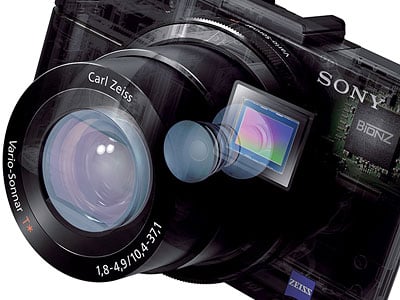
Lens. The Sony RX100 II's 3.6x optical zoom lens is unchanged from that in the original RX100, and still bears Carl Zeiss Vario-Sonnar T* branding. 35mm-equivalent focal lengths range from a 28mm-equivalent wide angle to a 100mm-equivalent telephoto. Across this range, the maximum aperture falls from a bright f/1.8 at wide angle to f/4.9 at telephoto. The latter is rather dim, albeit understandably so, given the lens and sensor sizes. Focusing is possible to as close as 1.9 inches at wide angle, or 21.6 inches at telephoto/
The lens' optical formula includes seven elements in six groups, of which four elements are aspherics, and one of these is an advanced aspheric. There's also a seven-bladed rounded aperture, and a T* coating which reduces ghosting and flare.
Stabilization. Sony has included the same Optical SteadyShot lens-based image stabilization in the RX100 II as in the RX100. For video capture, the system provides a greater corrective range; Active Mode, in Sony parlance.
While the SteadyShot system hasn't changed, the greater sensitivity of the image sensor in the RX100 II means that -- all other things being equal -- you should need to rely on image stabilization less often in the first place.
Focusing. Autofocus, too, is another area in which the new sensor in the Sony RX100 II should have a positive impact. Like almost all compact cameras, the RX100 relies on contrast detection autofocus, which takes data from the image sensor and uses it to determine the point of focus. By providing a cleaner image with lower noise levels, the Sony RX100 II's image sensor gives the autofocus algorithms more to work with, and the company predicts around a 10% improvement in autofocus speed as a result of this.
Just like the earlier model, the Sony RX100 II still offers up an autofocus assist lamp to help out with focusing on nearby subjects in low-light conditions. The AF system provides 25 autofocus points, plus center spot, flexible spot, and tracking modes, including face tracking. You can also focus manually, with both peaking and an optional AF operation to get you in the ballpark (otherwise known as Direct Manual Focus.)

Viewfinder. Unlike the RX100, the Sony RX100 II can accept an external, electronic viewfinder. It's not included in the kit, but the optional viewfinder accessory will give the RX100 II a more SLR-like feel when in use. Since it shares the same shoe used for flash strobes, you're limited to using the internal flash if framing through the EVF.
The accessory is the same one offered for the flagship RX1 camera, the Sony FDA-EV1MK. It's very crisp for an EVF finder, thanks to its 0.5-inch Organic LED-based display with a very high resolution of 2,359,000 dots. In reviewing the RX1, we also felt the EVF accessory was noticeably better in terms of its dynamic range than many, although highlight and shadow detail still gets lost.
However, it's going to be a much tougher sell for RX100 II owners, thanks to its high cost. When you've just purchased a US$2,800 RX1, it's much easier to justify spending another US$450 (16%) on a viewfinder, but when the viewfinder alone costs only 40% less than your camera did, it's a bit more of a stretch to tell yourself it's something you really need.
Tilting display. For that reason, we think most RX100 II owners will want to stick with the LCD monitor, instead. It's the same VGA, RGBW WhiteMagic unit used in the original RX100, which is great news because it pairs good resolution with excellent outdoor visibility -- even under sunlight. (And indoors, the design saves power, something that helped the original RX100 turn in pretty respectable battery life.)
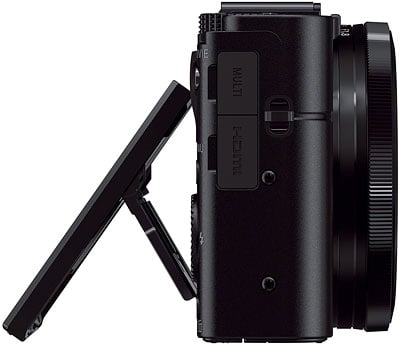
There's an important change in the RX100 II's panel, though. (Or rather, in the way in which it's mounted.) It is now articulated to allow tilting upwards by 84 degrees, or downward by 45 degrees. That's great for shooting from the hip, low to the ground, or over your head, and makes the RX100 II significantly more versatile than its predecessor. With the original RX100, you were limited to point-and-hope shooting, if you couldn't see the LCD panel properly, making accurate framing and level horizons something of a pipe dream.
Twin dials. Just like its predecessor, the RX100 II sports a twin-dial design with a ring around the lens barrel acting as the front ring. As well as the generous selection of functions that could already be controlled with this front ring, there's now a step zoom control that quickly adjusts the focal length in five steps -- 28, 35, 50, 70, and 100mm, in 35mm-equivalents -- without you needing to precisely adjust the ring's position. If you want to mimic the shooting style of multiple prime lenses, this is going to be pretty handy.
Flash. Another area of change from the original RX100 is in the new camera's flash options. There's still a small popup strobe that's unchanged from that in the RX100, but the new image sensor should see it's useful range extended somewhat by dint of the fact that you can increase the ISO sensitivity while retaining the same noise levels of the earlier camera.

It was already a great flash at wide angle, but was -- and still is -- pretty weak for telephoto shooting. Using the maximum ISO 12,800-equivalent sensitivity, range is rated at slightly over 98 feet (30m) at wide-angle and 37 feet (11.3m) at telephoto. Using ISO Auto, that falls to 49 feet (15m) at wide angle, and a little under 19 feet (5.7m) at telephoto. At ISO 100, it's the equivalent of just 8.7 feet (2.7m) at wide angle, and 3.3 feet (1m) at telephoto.
But if you like flash photography, you're going to have a lot more fun with the RX100 II thanks to the new Multi Interface Shoe, a Sony-proprietary intelligent flash hot shoe that's based on the standard ISO 518 hot shoe. This accepts strobes including the HVL-F20M, HVL-F60M, and the new HVL-F43M. (This last is, essentially, an HVL-F43AM with the new Multi Interface Shoe mount, and an LED video light.) You can also mount older strobes including the HVL-F20AM and HVL-F43AM using an ADP-MAA Multi-Interface Shoe Adapter.
Sony doesn't state flash sync speed of the DSC-RX100M2.
Accessory Terminal. As noted, the RX100 II's flash hot shoe also doubles as an accessory terminal that accepts a variety of accessories. (Hence, the name Multi Interface Shoe). Not all of these will make sense -- for example, there's a Wi-Fi accessory, but this would duplicate the RX100 II's own built-in Wi-Fi radio -- but there are nevertheless quite a few options available beyond flash strobes. We've already mentioned the ADP-MAA shoe adapter and FDA-EV1MK electronic viewfinder. Other accessories you can attach include the HVL-LEIR1 video light, ECM-XYST1M stereo microphone, and CLM-V55 clip-on LCD monitor.
Exposure. The Sony DSC-RX100 II includes the usual array of operating modes -- Program, Aperture-priority, Shutter-priority, and Manual -- that you'd find on a consumer-oriented SLR or system camera. It also offers the single-shot Intelligent Auto and multi-shot Superior Auto modes often found on Cyber-shot models, and a Memory Recall function that lets you save three settings groups for quick access. And, of course, there's a generous selection of user-friendly Scene modes.
Metering modes include Multi-Segment, Center-weighted, and Spot. Shutter speeds range from 1/2,000 to 30 seconds, plus Bulb, although the longest time varies depending on exposure mode.

Auto on steroids. Like its predecessor, the Sony RX100 II features a wide variety of Sony-specific tools aimed at making it easier to get great photos. (Or at least, what the camera feels to be great photos, greatness being a rather subjective thing.) Most are unchanged, but there's one new tool that builds on the existing ones. We've seen it previously in the Sony A58 Translucent Mirror camera and NEX-3N mirrorless, but before we get into that, let's quickly recap what's retained.
The Clear Image Zoom function is based on what Sony calls By Pixel Super Resolution algorithms. In essence, a digital zoom that tries to improve quality by using pattern matching. It still interpolates (read: guesses) missing data, but does so in a more intelligent manner. Those same pattern-matching, interpolating algorithms also come into play for Auto Portrait Framing, which uses face detection to locate your subject, and then recrops the image based on a rule-of-thirds algorithm for a more pleasing layout. After cropping, your image is interpolated back up to the same resolution as the original shot. Both your original and the new shot are saved separately, so if you don't like the results, nothing is lost.
The new feature is quite similar, but instead of using face detection, it has algorithms that attempt to identify the dominant object in a scene -- and then it does much the same thing as Auto Portrait Framing, applying a rule-of-thirds crop and resampling.
There's also still a Self Portrait Self-timer function, which automatically starts a countdown timer when either one or two faces are detected in the scene, saving you the trouble of pressing the shutter button at all. Since the tilting display still can't face forwards, though, you're flying blind with this function.
The RX100 II retains Sony's 13-option Picture Effects function for soft focus, watercolor, miniature, and many more effects, as well as the other creative functions we've come to expect: High Dynamic Range, Dynamic Range Optimizer, and 2D Sweep Panorama.

Level gauge. The RX100 II also retains its sibling's dual-axis level display function, which helps you avoid tilted horizons and converging verticals.
Movies. One last area in which Sony predicts a significant improvement thanks to its new sensor is in movie capture. The company promises a "profound impact" in low-light movie quality, something we'll be putting to the test.
Beyond the new sensor, the RX100 II's movie mode is largely unchanged from that of the RX100, but with one notable exception. Like the RX100, it can capture 1080p video with AVCHD version 2.0 compression at rates of 60i or 60p, but the RX100 II also adds a more film-like 24p mode. There's also HDV (Anamorphic HD) and VGA capture with MPEG-4 AVC compression at a rate of 30p, but strangely, still no 720p mode.
The video feature set remains quite rich compared to typical fixed-lens cameras, and even to some interchangeale-lens models. Manual exposure control is available, along with SteadyShot image stabilization and a wind noise reduction function. Audio is recorded with an onboard stereo microphone, situated on the top deck, straddling the flash hot shoe.

Wireless networking. The final significant upgrade in the Sony RX100 II is its new, built-in Wi-Fi and Near Field Communications radios. This is big news if you're a fan of social networking, because it means you can get your photos and videos off the camera via your smart device, without the need for third-party hardware.
And if you have an NFC-compatible device, you can even establish a connection without any intervention at all -- just enable NFC on the smart device if necessary, and then hold the two devices together briefly. This is enough for a Wi-Fi connection to be negotiated between both devices, and your data then transfers via that high-speed connection.
Unfortunately for iPhone and iPad users, Apple has yet to implement NFC in any of its devices, but many newer and more sophisticated Android and Windows Phone devices support NFC.
Once paired, you can not only transfer data between camera and smart device, but also remotely control the camera's shutter, and view a live view feed. That could prove very handy, whether you're looking to film skittish wildlife without getting too close yourself, or just want to confirm everybody's standing in the right place before tripping the shutter on a group portrait.

Wired connectivity. Two ports sit under flaps on the right side of the camera: a micro HDMI port for high-definition video output (formerly located right next to the tripod mount; the new location is much better), and what Sony dubs the Multi Terminal. The latter is both a USB port, and a wired remote control port compatible with the RM-VPR1 remote commander, and tripods such as the GP-VPT1, VCT-VPR1, VCT-VPR10, and VCT-VPR100 which feature built-in wired remotes.
There's also the aforementioned Multi Interface Shoe on the top deck, which allows a variety of accessories to be connected to the camera.

Power. Sony has retained the same NP-BX1 lithium-ion rechargeable battery type used in the original RX100. The company rates the RX100 II as good for 350 shots on a charge to CIPA testing standards, or for 80 minutes of video capture. The still image battery life is improved by around 6% from that stated for the original RX100.
Storage. The Sony RX100 stores data on SD, SDHC, or SDXC cards, or Sony's own Pro Duo / Pro HG Duo types. Eye-Fi cards are still supported, although the camera has its own built-in Wi-Fi connectivity.
Conclusion
| Pro: | Con: |
|---|---|
|
|
The original RX100 shook up the compact camera market, and the new Sony RX100 II continues in that mold, picking up our award for 2013 Best Pocket Camera of the Year. While superficially very similar to the original model, the new RX100 II brings a number of key enhancements.
The most obvious change is the addition of a 3-inch tilting LCD screen on the back. This uses the same "White Magic" technology as on the original (for better viewing in bright conditions), but the tilting configuration makes it much easier taking over-the-head or ground-level shots. A new Multi Interface Shoe supports not only an external flash, but a number of other accessories as well, including a stereo microphone and high-quality electronic viewfinder.
Perhaps the most important upgrade, though, is to the RX100 II's sensor, which now uses backside-illuminated technology, conservatively providing a full f-stop of improved high-ISO performance over its predecessor when combined with the Mark II's revised JPEG processing. In our testing, JPEGs from the RX100 II looked better at ISO 6400 than those from the original model at ISO 3200, however RAW files showed less improvement, around a third to half an f-stop. Still, any improvement over the RX100's already excellent high-ISO performance is welcome, and combined with a maximum aperture of f/1.8 at its widest-angle setting, the Sony RX100 II is truly a fantastic low-light performer.
The new sensor also seemed to help the Sony RX100 II's video quality, not only producing excellent video under low-light conditions, but also responding unusually well to abrupt changes in scene brightness, when panning from areas of shadow to bright sunlight and back again.
The Sony RX100 II carries forward a number of other excellent characteristics from its predecessor, including very fast autofocus and great shutter response, great low-light AF capability, fast shot to shot speeds, blazing ~10 fps JPEG continuous mode shooting, and fast buffer clearing. (Be sure to buy a really fast SD card for use with the RX100 II, it'll really help with buffer-clearing speed.)
On the downside, the Sony RX100 II is still slow to start up and shut down, its burst rate slows down with RAW files, it's a bit thicker and heavier than the original model, and is $100 more expensive, to boot. We also found the newly-added Wi-Fi connectivity a little difficult to set up, and the NFC capability that eases such connections obviously doesn't work on Apple phones & tablets, which lack the needed circuitry. (Clearly not Sony's fault, on that score.)
With the $100 price bump, the Sony RX100 II is now clearly in the cost bracket of many entry-level DSLRs. If you can afford it, though, we consider the added cost relative to the original RX100 (which remains available, as of this writing in December, 2013) to be well worth it. The Sony RX100 II literally has no close competitor in the premium compact camera market; it was an easy choice as a Dave's Pick, not to mention as our 2013 Pocket Camera of the Year.
Buy the Sony RX100 II from one of Imaging Resource's trusted affiliates:
(Your purchases help keep reviews like this one coming)
- Adorama: Sony RX100 II - US$698 with free shipping
- Amazon: Sony RX100 II - US$698 with free shipping
- B&H: Sony RX100 II - US$698 with free shipping
Follow Imaging-Resource.com on Twitter!
Pros
- New, 20.2MP, 1-inch type, backside illuminated (BSI) image sensor produces superb image quality, with particular improvements in low light and high ISO
- 3-inch tilting rear LCD screen handy for composing shots from difficult angles
- Fast all-around performer with quick autofocus and virtually no shutter lag
- New, multi-interface hotshoe for adding a strobe or optional electronic viewfinder
- Built-in Wi-Fi with NFC.
Cons
- Bigger and heavier than previous model
- More expensive than previous model
- Reduced burst performance when shooting RAW files
- Somewhat confusing menu structure and control layout
- Wi-Fi features can be difficult to set up.