


Overview

Sony has done it once again: The company responsible for creating the 1"-sensor, fixed-lens camera market has taken it to the next level with a new model -- and the Sony RX100 V is truly a pocket powerhouse!
Almost identical to the RX100 IV in terms of body design, sensor resolution, lens and controls, the Sony RX100 V differentiates itself by providing greater full-res burst capture performance and burst depth than we've ever seen in such a pocket-friendly camera.
The Sony RX100 V is all about performance
For the fifth generation in the RX100-series, Sony has clearly focused on performance. The Sony RX100 Mark V is simply unrivaled in this area: It can shoot full-resolution images at a truly staggering 24 frames per second, and that's with autofocus and autoexposure adjustments between frames. (For bonus points, you can also enable silent shooting at this rate, so you won't even distract your subject.)
And that performance is not available just for a handful of frames, either: A roomy buffer allows space to store as many as 150 JPEG frames at full resolution, and even raw shooters should be able to manage an impressive 72 frames in each 24-fps burst. Even if you favor raw+JPEG capture, you should be able to shoot around 62 images in a burst, a fair bit more than twice as many as was possible with the RX100 IV. (And all of those figures are from our in-house testing, incidentally. Sony's own claim of 150 JPEG frames in a burst nicely matches our own findings.) See our Performance page for details.

A new hybrid autofocus system with more points than you can shake a stick at
Sony has achieved this level of performance in part thanks to a redesigned image sensor with a brand-new hybrid autofocus system. The RX100 V's new 20.1-megapixel image sensor might not offer any higher resolution than the previous generation, but it now includes a generous 315 on-chip phase-detection autofocus pixels. These cover 65% of the image frame, besting the recently-cancelled Nikon DL-series cameras by around 5%.
The on-chip phase-detection pixels are first used to quickly determine the required focus adjustment and direction. To complete the AF cycle, the system switches to using contrast-detection to fine-tune the precise point of focus. And you can manually adjust both the AF drive speed and tracking sensitivity.
The result, according to Sony, is "professional-level AF performance" capable of determining a focus lock in just 0.05 seconds. (Our own in-house testing using center-area autofocus at wide angle and telephoto positions turned in times of around 0.19 to 0.21 seconds, very respectable performance for such a compact camera.)

The Sony RX100 V is the latest to gain a high-speed LSI chip
Of course, the image sensor is only part of the story. The Sony RX100 V also derives some of its epic performance from a change in the way data from the sensor is handled. Just as in the A99 II interchangeable-lens camera, the Sony RX100 V now supplements its BIONZ X image processor with a new front-end LSI chip for even greater performance.
A little back-of-the-envelope math provides a testament to the power on offer. Since it can capture 150 images in a burst, each at full 20.1-megapixel resolution, that means that the RX100 V is handling some three gigapixels of raw sensor data in each burst. And with a claimed capture rate of 24 fps, each full burst is completed in just 6.25 seconds. That's a whopping 482.4 megapixels of data being processed each second!

Even more capable 4K and high-frame rate video capture
All of that performance isn't just harnessed for stills, either. The RX100 IV was already an exceptionally capable video shooter for a pocket-friendly camera, providing for both 4K ultra-high definition recording and up to a maximum capture rate of 1,000 frames per second at reduced resolution. Now, the Sony RX100 V follows with improvements on both fronts.
For one thing, when shooting 4K video you have access to the same new hybrid autofocus system used for still imaging. Also, 4K footage is captured with almost the full sensor width, without any line skipping or pixel binning. This means that the video is coming off the sensor at higher than 4K resolution, and then being downsampled to its final output resolution. And it's not by a small margin, either: 4K video is effectively oversampled by about 1.7 times. And compared side-by-side with 4K footage from the RX100 IV, the Sony RX100 Mark V's output is noticeably wider-angle at the same focal length.

At the same time, Sony has managed to double the maximum length of high frame-rate movies captured with the RX100 V. Where the RX100 IV had a maximum HFR capture time of either two or four seconds, the RX100 V is now be able to capture as much as eight seconds of HFR footage. And while that might not seem like much, it's important to bear in mind that depending on your recording and output frame rates, that's potentially as long as a five-minute output video with a 40x slow-motion effect.
All this, and the Sony RX100 V isn't even any bigger!
Perhaps most impressively of all, Sony has managed to cram in all of this extra performance with almost no increase in size and weight. At 4 x 2.4 x 1.6 inches, the Sony RX100 V is the exact same width and height as its predecessor, and an indistinguishable 0.02 inches (0.4mm) thicker than its predecessor. And its weight, too, is basically unchanged. It packs amazing performance into a body so small you can forget you're carrying it!

Most other features are similar to the preceding model
In most other respects, the Sony RX100 V is very much like the camera in whose footsteps it follows. It sports the same ZEISS Vario-Sonnar T*-branded lens, for example, with focal lengths ranging from 24-70mm equivalents and a bright maximum aperture of f/1.8-2.8 across the zoom range. It also retains the same high-resolution XGA electronic viewfinder, which is based around a 2.3-million dot Organic LED display, and whose eyepiece features a Zeiss T* coating.
Also making the leap from the RX100 IV to V is a 3.0-inch, 1.3-million dot LCD monitor. This still sits on an articulation mechanism which allows tilting upwards by 180-degrees for shooting from the hip or even selfie shooting, and downwards by 45 degrees for easier over-the-head shots. And like its predecessor, the Sony RX100 V also includes Wi-Fi wireless networking connectivity with a choice of either NFC pairing for Android devices, or QR code pairing for iOS and those few Android devices which lack an NFC antenna.

Updated VA version brings boosted performance and some VI features
In July of 2018, Sony quietly upgraded the Mark V's BIONZ X image processor to the same chip used in the Mark VI, and dubbed the camera the RX100 Mark VA (DSC-RX100M5A). The processor update brought along with it some of the performance enhancements, image quality tweaks and new firmware features found in the VI while keeping the rest of the hardware and battery life the same as the V.
See our Sony RX100 VA preview for more info, and our RX100 VI review for an indication of the performance, image quality tweaks and some of the new firmware features that the Mark VA inherits from the Mark VI.
In the Box
The Sony RX100 V retail box ships with the following items:
- Sony RX100 V camera
- NP-BX1/M8 lithium-ion rechargeable battery pack
- AC-UUD12 USB charger (charges battery in-camera)
- Wrist strap
- Shoulder strap adapter
- Micro USB cable
- Instruction manual
- Warranty card
Optics
Lens Test Results
Zoom
A shorter than average 2.9x zoom, with good far-field performance.
 |
 |
| 24mm eq. @ f/5.6 | 50mm eq. @ f/5.6 |
 |
 |
| 70mm eq. @ f/5.6 | 2x Clear Image Zoom |
 |
 |
| 2x Digital Zoom | 4x Digital Zoom |
The Sony RX100 V is equipped with a 8.8-25.7mm lens, offering a fairly limited optical zoom ratio of about 2.9x, translating to a 35mm-equivalent focal range of about 24-70mm. The lens is however very fast (bright), with a maximum aperture ranging from f/1.8 at wide angle to f/2.8 at telephoto, which is excellent for low-light shooting and provides reduced depth-of-field for better subject isolation. As is often the case with fast compact lenses, though, maximum aperture does fall-off rather quickly as you zoom, already reaching f/2.8 somewhere between 28 and 35mm equivalent. The following table reflects the maximum and minimum apertures as reported by the camera at some popular focal lengths:
|
Focal length (eq.)
|
24mm
|
28mm
|
35mm
|
50mm
|
70mm
|
|
Max. aperture
|
f/1.8
|
f/2.5
|
f/2.8
|
f/2.8
|
f/2.8
|
|
Min. aperture
|
f/11 at all focal lengths | ||||
Far-field performance is quite good at f/5.6 as shown above, with very good sharpness and contrast across most of the frame, low chromatic aberration (the RX100 V’s processor does a good job at suppressing it) though some softening and coma distortion can be seen in the corners at full wide angle. Performance at 50mm equivalent appears to be very good across the entire frame. Performance at full telephoto is also quite good with good sharpness and contrast across almost the entire frame, though some mild blurring and vignetting can be see in the extreme corners. The Sony RX100 V also offers Clear Image digital zoom at 2x, and standard digital zoom up to 4x magnification. Clear Image zoom is supposed to perform better than standard 2x digital zoom, but we didn’t see much difference with this subject matter. (Both performed well, although magnification from Clear Image zoom was a bit lower.) 4x digital zoom was a bit soft, but it seemed to perform better than average for that much digital magnification.
See below for lab results on macro performance, geometric distortion, corner softness, etc.
Macro
A larger than average sized minimum coverage area, with very good detail. Flash throttled down well, but the lens casts a shadow at minimum distance.
 |
 |
| Macro, f/8 | Macro with Flash |
The Sony RX100 V captured a larger than average sized minimum area measuring 3.83 x 2.55 inches (97 x 65 millimeters) at maximum wide angle. Sharpness over much of the frame is very good, but corners show quite a bit of softness even at f/8 (most lenses show some softening in the corners at macro distances). The flash did a good job throttling down, but the lens casts a bit of a shadow in the bottom half of the frame. You’ll likely want to use external lighting for the closest RX100 V macro shots.
Geometric Distortion
Very low distortion in camera JPEGs, but very high in uncorrected RAW files at wide angle.
| Camera JPEGs |
| Barrel distortion at wide angle is less than 0.1 percent |
 |
| Barrel distortion at telephoto is ~0.1 percent |
 |
Thanks to in-camera distortion correction, there’s almost no geometric distortion in the RX100 V’s JPEG files. At full wide angle, we measured well under 0.1% barrel distortion. At full telephoto, barrel distortion is just over 0.1%. This is the tendency for the lens to bend straight lines outward (like a barrel — usually at wide-angle) or inward (like a pincushion — usually at telephoto).
| Uncorrected RAW |
| Barrel distortion at wide angle is about 3.9 percent |
 |
| Complex pincushion distortion at telephoto is about 0.3 percent |
 |
To see how much correction is taking place in the camera, we converted RAW files from the above shots with dcraw, which does not correct for distortion. As you can see at wide angle, barrel distortion is extremely high, at about 3.9%, while telephoto shows low but complex “moustache-shaped” pincushion distortion at about 0.3%.
We expect to see significant distortion in uncorrected RAW files in fast, compact lenses like the RX100 V’s, as allowing this gives the lens designers greater flexibility in optimizing center sharpness and other aberrations, as well as in reducing cost, size, and weight. The downside is that the distortion correction contributes additional blurring to the corners of the frame where pixels are “stretched” during correction and where lenses are usually already a bit soft. Note that most RAW converters are capable of applying distortion correction automatically, as specified by the manufacturer in lens profiles embedded in RAW files.
Chromatic Aberration and Corner Sharpness
Very low to moderately low chromatic aberration in JPEGs. The lens produces some soft corners wide-open, though corner sharpness improves stopped-down.
|
Aperture: maximum
|
|
 |
 |
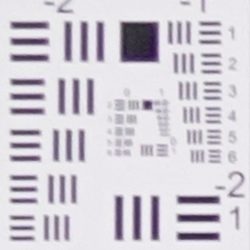
| Wide at f/1.8: Upper left C.A.: Moderately low Softness: Quite soft |
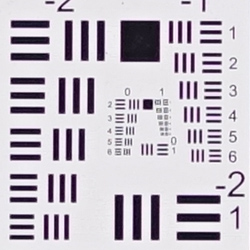
Wide at f/1.8: Center C.A.: Low Softness: Very sharp |
 |
 |
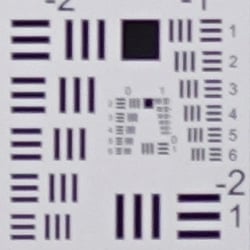
| Tele at f/2.8: Lower right C.A.: Low Softness: Soft |
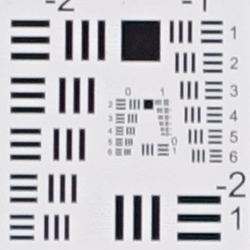
Tele at f/2.8: Center
C.A.: Very low |
Chromatic Aberration. Thanks to effective in-camera chromatic aberration suppression, there’s moderately low to low C.A. to be seen in the corners at either wide angle or telephoto in camera JPEGs. As expected, though, uncorrected RAW files (see below) show much more C.A. than seen above.
Corner Softness. Wide-open at full wide angle, the lens in our sample showed a little decentering, with the left-hand corners showing more softness than the right-hand ones. The center is very sharp, and softness from the worst-case corner (upper left) doesn’t extend very far into the frame. At full telephoto, it’s the lower-right corner that is the softest when wide-open, and the softness extends far into the frame from the bottom (the top corners are much better). The center is slightly soft at full telephoto.
Vignetting. There’s some mild vignetting (corner shading) at the telephoto end, as indicated by the darker corner crop compared to the center.
|
Aperture: f/5.6
|
|
 |
 |
| Wide at f/5.6: Upper left C.A.: Low Softness: Soft |
Wide at f/5.6: Center C.A.: Very low Softness: Quite sharp |
 |
 |
| Tele at f/5.6: Lower right C.A.: Very low Softness: Soft |
Tele at f/5.6: Center C.A.: Very low Softness: Sharp |
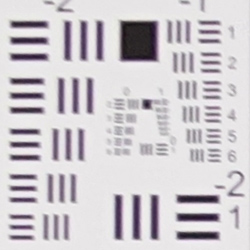
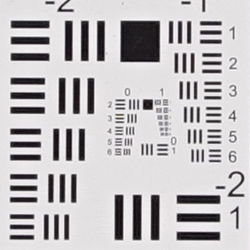
F5.6: Stopping down a few clicks improved corner sharpness, contrast and chromatic aberration slightly at wide angle, however corners were still much softer than the center. Sharpness in the center at wide angle remained about the same, however C.A. was reduced to almost nonexistent. Some corners improved at full telephoto when stopped down, but performance in the worse-case lower-right corner actually degraded a bit. Sharpness and C.A. in the center improved at full telephoto, though wide angle is still sharper. We can also still see some minor vignetting at full telephoto.
Chromatic Aberration Correction
| In-camera JPEG | Uncorrected RAW |
 |
 |
| Wide (f/5.6): Upper left CA: Low |
Wide (f/5.6): Upper left CA: Moderately high |
 |
 |
| Tele (f/5.6): Upper left CA: Low |
Tele: (f/5.6): Upper left CA: Moderately high |
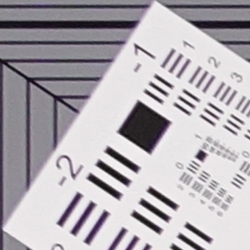
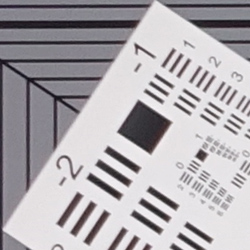
As you can see in the crops from uncorrected RAW images on the right (taken from ARW files converted with dcraw), the RX100 Mark V’s lens produces moderately high and bright chromatic aberration at both maximum wide angle and full telephoto. But the RX100 V’s processor does a great job suppressing lateral chromatic aberration in camera JPEGs (crops on the left). Note that most RAW converters should also automatically suppress C.A. when converting the RX100 Mark V’s ARW files.
Overall, good performance from the RX100 Mark V’s lens, especially considering how fast (bright) and wide it is.
Viewfinder Test Results
Coverage
Excellent accuracy from the LCD monitor and electronic viewfinder.
 |
 |
|
Wide, LCD
|
Tele, LCD
|
 |
 |
|
Wide, EVF
|
Tele, EVF
|
The Sony RX100 V’s LCD monitor tested at 100% coverage at full wide angle and at telephoto, while the EVF tested at just slightly lower than 100% coverage. This is excellent performance, especially considering the amount of geometric distortion correction taking place at wide angle.
The images above were taken from our standardized test shots. For a
collection of more pictorial photos, see our
Sony Cyber-shot DSC-RX100 V Photo Gallery
.
Exposure
Color
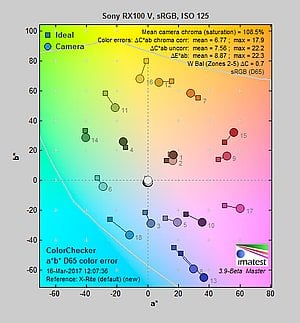
Saturation & Hue Accuracy
Slightly below average saturation levels and hue accuracy.
 |
||
|
ISO Sensitivity
|
||
|
In the diagram above, the squares show the original color, and the circles show the color that the camera captured. More saturated colors are located toward the periphery of the graph. Hue changes as you travel around the center. Thus, hue-accurate, highly saturated colors appear as lines radiating from the center. Mouse over the links to compare results at different ISOs, and click on the links for larger images.
|
||
Saturation. The Sony RX100 V pushes dark blues a lot while pushing strong reds, purples and some browns, but not as much as many cameras, and it actually undersaturates light green and yellow by quite a bit. The RX100 V’s overall mean color saturation of 108.5% (8.5% oversaturated) is a little lower than average these days, but the camera generally produces fairly pleasing colors in its images. As is usually the case, mean saturation drops as ISO rises as the camera suppressed chroma noise, to a minimum of 99.1% at maximum ISO. Most consumer digital cameras produce color that’s more highly saturated (more intense) than found in the original subjects. This is simply because most people like their color a bit brighter than life.
Skin tones. Here, the Sony RX100 V did fairly well, producing natural-looking Caucasian skin tones that were a bit on the warm side with Auto white balance in simulated daylight. We preferred Manual white balance, which produced more pinkish tones. Where oversaturation is most problematic is on Caucasian skin tones, as it’s very easy for these “memory colors” to be seen as too bright, too pink, too yellow, etc.
Hue. The Sony RX100 V shifts cyan toward blue a lot, but also shifts aqua toward cyan,, orange toward yellow, and yellow toward green by small to moderate amounts. The cyan to blue shift is very common among the digital cameras we test; we think it’s a deliberate choice by camera engineers to produce better-looking sky colors, and we don’t find the resulting color objectionable. The RX100 V’s handling of yellows and yellow-orange colors is one of its weaknesses: Yellows are rendered closer to a yellow-green, and significantly undersaturated as well. With a mean “delta-C” color error of 6.77 after correction for saturation at base ISO, hue accuracy is below average. Hue is “what color” the color is.
 |
 |
 |
| See full set of test images with explanations See thumbnails of all test and gallery images |
||
Sensor
Exposure and White Balance
Indoors, incandescent lighting
Auto setting produced reddish results, though Incandescent and Manual white balance worked well. Average exposure compensation required.
 |
 |
| Auto White Balance +0.3 EV |
Incandescent White Balance +0.3 EV |
 |
|
| Manual White Balance +0.3 EV |
Indoors, under normal incandescent lighting, color balance was warm and reddish with the Auto white balance setting. Results with the Incandescent setting were pretty good, just a touch yellow. Color balance with the Manual setting was quite accurate. (Note: The RX100 V also has a Kelvin Temperature White Balance option, however we did not test that mode.) The Sony RX100 V produced bright results (almost too bright) with +0.3 EV exposure compensation, which is about average required for this shot. (Our test lighting for this shot is a mixture of 60 and 100 watt household incandescent bulbs, a pretty yellow light source, but a very common one in typical home settings here in the U.S.)
Outdoors, daylight
Pleasing color and good exposure accuracy under harsh lighting.
 |
 |
| Manual White Balance, +0.3 EV |
Auto White Balance, 0 EV |
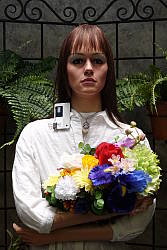
Outdoors, the Sony RX100 V performed well for its class. +0.3 EV exposure compensation was required to keep the mannequin’s face fairly bright in our “Sunlit” Portrait shot, which is actually a bit less compensation than most cameras require. Contrast is a quite high as you might expect under such harsh lighting, but despite the bright appearance, the camera did a good job, holding on to the majority of highlights. Manual color balance performed well in our “Sunlit” Portrait shot, though Auto white balance produced slightly warm and yellow skin tones. The Far-field shot with Auto white balance has very good color, just a touch cool. Default exposure is perhaps just slightly underexposed, but with almost no highlights blown, and while there are some very deep shadows, detail in the shadows is good for its class. However as expected, deep shadows do have moderate amounts luminance noise as well as some odd discoloration particularly in greens as the camera attempts to control chroma noise. Overall, though, very good performance in harsh lighting, especially considering DRO was off for these shots (see below).
See full set of test images with explanations
See thumbnails of all test and gallery images
Resolution
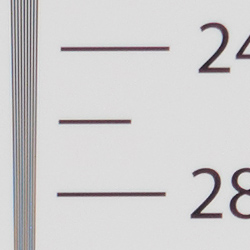
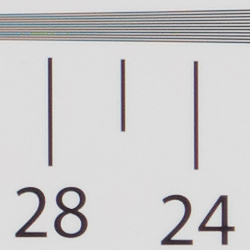
~2,550 lines of strong detail.
 |
 |
| In-camera JPEG: Strong detail to ~2,550 lines horizontal |
In-camera JPEG: Strong detail to ~2,550 lines vertical |
 |
 |
| ACR converted RAW: Strong detail to ~2,550 lines horizontal |
ACR converted RAW: Strong detail to ~2,550 lines vertical |
In camera JPEGs of our laboratory resolution chart revealed sharp, distinct line patterns up to just over 2,550 lines per picture height in the horizontal direction, and to just over 2,550 lines per picture height in the vertical direction. Some may argue for more, but aliasing artifacts start to interfere at that point. Complete extinction of the pattern didn’t occur until about 3,200 to 3,400 lines. Adobe Camera Raw produced similar results though complete extinction of the pattern didn’t occur before the limits of our chart and color moiré was more visible. Use these numbers to compare with other cameras of similar resolution, or use them to see just what higher resolution can mean in terms of potential detail.
Sharpness & Detail
Fairly sharp images with good detail, but area-specific noise reduction and sharpening can produce an overprocessed look, especially at higher ISOs.
 |
 |
| Good definition of high-contrast elements here with only minor sharpening haloes. |
Subtle detail: Hair Noise suppression tends to blur detail in areas of subtle contrast. |
Sharpness. The RX100 V produces fairly sharp looking images with fairly mild sharpening halos around high-contrast edges, but Sony’s area-specific noise reduction and sharpening algorithms can lead to some unnatural or slightly crude looking results at higher ISOs. Edge enhancement creates the illusion of sharpness by enhancing colors and tones right at the edge of a rapid transition in color or tone.
Detail. The crop above right shows fair detail for the class of camera, with moderate levels noise suppression in the darkest areas of the mannequins’s hair, and almost no chroma noise. Quite a few individual strands are smudged together in areas of low contrast at base ISO, though, but performance here is decent considering the size and resolution of the sensor. Noise-suppression systems in digital cameras tend to flatten-out detail in areas of subtle contrast. The effects can often be seen in shots of human hair, where the individual strands are lost and an almost “watercolor” look appears.
RAW vs In-Camera JPEGs
As noted above the Sony RX100 V produces fairly sharp and clean images, but fine detail can suffer as a result of aggressive default processing. Compare a base ISO in-camera JPEG to an Adobe Camera Raw conversion below to see what we mean.
|
Base ISO (125)
|
|
 |
 |
 |
 |
 |
 |
|
Camera JPEG, defaults
|
RAW via Adobe Camera Raw
|
In the table above, we compare an in-camera JPEG taken at base ISO using default noise reduction and sharpening (on the left) to a matching RAW file converted with Adobe Camera Raw 9.1 via DNG Converter 9.9 using default noise reduction with strong but tight unsharp masking applied in Photoshop (in this case 400% USM with a radius of 0.3 pixels and a threshold of 0).
As you can see, ACR produced quite a bit of additional detail that isn’t present in the JPEG from the camera. Fine detail in the mosaic crop for example is more realistic and refined-looking from the ACR conversion, while the in-camera JPEG is much cleaner and more contrasty, but isn’t quite as detailed or accurate. This is also true of the fabric crop, where ACR was able to resolve much of the thread pattern in the red-leaf swatch which the camera’s JPEG engine presumably treats as noise, and also does a better job reproducing fine detail in the pink fabric. But as is usually the case, more noise can be seen in the RAW conversion particularly in flat areas as shown in the bottle crop, thanks to ACR’s light default noise reduction. You can of course apply stronger noise reduction (default ACR NR used here) to arrive at your ideal noise versus detail tradeoff. Bottom line: You can do noticeably better than the camera with a good RAW converter, provided you’re willing to apply your own noise reduction and sharpening to taste.
ISO & Noise Performance
Good high ISO performance for a camera its size.
|
High ISO Noise Reduction = Default
|
 |
 |
 |
| ISO 80 | ISO 125 | ISO 200 |
 |
 |
 |
| ISO 400 | ISO 800 | ISO 1600 |
 |
 |
 |
| ISO 3200 | ISO 6400 | ISO 12,800 |
ISO 80 and 125 produce very similar results, with clean, detailed images containing almost no chroma noise. ISO 200 shows a very minor drop in image quality as noise reduction ramps, but fine detail is still very good. ISO 400 shows an additional small step down in detail with very good overall image quality. At ISO 800, luminance noise is more noticeable, accentuated by fairly aggressive sharpening, but chroma noise is still welll-controlled and fine detail is fair. ISO 1600 is noticeably softer thanks to stronger noise reduction and more visible luma noise, but chroma noise is still very low and there’s still some fine detail left. At ISO 3200, fine detail takes a larger hit, and the camera’s aggressive processing produces images with a somewhat crystalline look in some areas. Image quality drops off very quickly from here, with ISOs 6400 and 12,800 looking more like impressionistic paintings than photos, with an almost hammered looked to flatter areas. Chroma noise in the form of diffuse purple and/or yellow blotches is also visible in darker midtones and shadows.
High ISO performance is similar to the RX100 IV’s which is to say pretty good, but default noise reduction is a bit heavy-handed at moderate to high ISOs. We’re of course pixel-peeping to an extraordinary extent here, since 1:1 images on an LCD screen have little to do with how those same images will appear when printed. See the Print Quality section below for our evaluation of maximum print sizes at each ISO setting.
Note: We used to shoot this series at f/4 because of the relatively low light, but we now shoot it at f/5.6 or f/8 for 1″-type and larger sensors, as lens performance well away from center where we take the above crops is often not optimal at wider apertures. The added depth of field for a scene with this depth is also a better compromise than the potentially slightly sharper but shallower focus depth that a larger aperture would produce.
Extremes: Sunlit, dynamic range and low light tests
Pretty good dynamic range for its class. Good low-light performance, capable of capturing bright images in near darkness at all ISOs.
 |
 |
 |
| 0 EV | +0.3 EV | +0.7 EV |
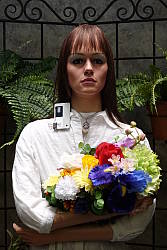
Sunlight. The Sony RX100 V did fairly well under the deliberately harsh lighting in the test above. To keep facial tones reasonably bright, +0.3V compensation was required, which led to some clipped highlights in the mannequin’s shirt and flowers, though not as many as we often see from smaller sensors. Some may prefer the +0.7 EV setting for its brighter overall exposure, but we found too many highlights were clipped. Detail is quite good in the shadows at +0.3 EV, though very deep shadows are a little grainy with some discoloration, but noise is well-controlled and still fairly fine-grained. Very good results in harsh lighting for such a compact camera, but consider using fill flash in situations like the one shown above; and it’s better to shoot in the shade when possible.
Because digital cameras are more like slide film than negative film (in that they tend to have a more limited tonal range), we test them in the harshest situations to see how they handle scenes with bright highlights and dark shadows, as well as what kind of sensitivity they have in low light. The shot above is designed to mimic the very harsh, contrasty effect of direct noonday sunlight, a very tough challenge for most digital cameras. (You can read details of this test here.)
| Face Detection | ||
 |
 |
 |
| Aperture Priority, 0 EV Face Detection Off |
Aperture Priority, 0 EV Face Detection On |
Auto Mode, 0 EV |
Face Detection. Like most cameras these days, the Sony RX100 V has the ability to detect faces (up to 8 in a scene), and adjust exposure and focus accordingly. As you can see from the examples above, face detection improved exposure in Aperture Priority at f/8, producing a slightly brighter face than without it by reducing the shutter speed from 1/80 to 1/60s. Full Auto mode is a also bit better than Aperture Priority without face detection, however it is still a bit dim. It selected a larger aperture of f/4 while using a relatively fast shutter speed of 1/160s, and automatically applied DRO (see below) to reduce overall contrast.
|
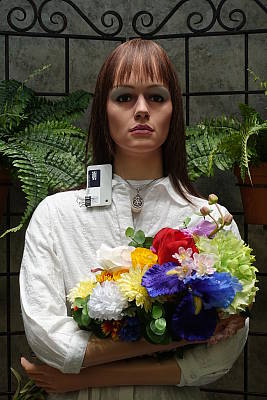
Outdoor Portrait DRO Comparison
|
|
 |
DRO Setting: |
 |
|
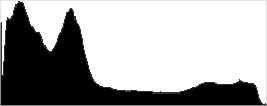
Dynamic Range Optimization is Sony’s name for their dynamic range enhancement technology. DRO divides the image into small areas, analyzes the range of brightness of each area, and adjusts the camera’s image processing parameters accordingly to make the best use of the available dynamic range. Auto DRO is enabled by default on the Sony RX100 V. You can also set the level manually, from 1 (“weak”) to 5 (“strong”), or turn it off. As one would expect, DRO is only available for JPEG files.
The above thumbnails and histograms show the effects of the various levels of DRO on our “Sunlit” Portrait shot with no exposure compensation. Mouse over the links on the right to load the associated thumbnail and histogram, and click on the link to visit the full resolution image. As you can see from the thumbnails and associated histograms, increasing DRO progressively boosts shadows and midtones while leaving highlights essentially intact, though boosting shadows does make noise slightly more visible. The Auto setting did a pretty good job overall, and the five manual levels give quite a bit of control over the effect.

Above, you can see the effect of DRO settings on our Far-field shot. The default Auto setting produced a nicely balanced exposure, despite the harsh lighting. A useful feature.

High Dynamic Range. The Sony RX100 V’s HDR mode takes three images in rapid succession, one nominally exposed , one underexposed, and one overexposed, then combines them into one high dynamic range JPEG automatically. Lighter areas from the underexposed image are combined in-camera with darker areas from the overexposed image to produce an image with compressed tonal range. The camera then saves a single composite image, as well as the nominally exposed image. The overlaid images are micro-aligned by the camera, but it can only correct for so much movement. If it can’t micro-align successfully, an icon indicating HDR capture failed will appear. For best results, the subject should be static. There is also a manual mode where you can select 1 EV (“weak”) to 6 EV (“strong”) difference in exposures.
Mouse over the links above to load the associated thumbnail, and click on the link to visit the full resolution image. As you can see, the Auto setting did a decent job, similar to the 2 EV manual setting. Normally, the higher the manual setting, the more highlights are toned-down and shadows opened up, however the 5 EV setting oddly seemed to take a step back. As you can see, though, higher settings can produce flat and unnatural results. Watch out for ghost images and other artifacts from subject movement during the capture sequence, though, as can be seen in some of the shots above. (It seems the RX100 V attempts to avoid ghosting by including a moving subject from only one of the frames, however this isn’t always successful as you can in the 6 EV image.)
Dynamic Range Analysis (RAW mode)
While we once performed our own dynamic range measurements based on in-camera JPEGs as well as converted RAW images (when the camera was supported by Adobe Camera Raw), we’ve switched to using DxO Labs’ results from their DxOMark website. As technology advanced, the dynamic range of modern high-end cameras in some cases exceeded the range of the Stouffer T4110 density scale that we used for our own measurements. DxO’s approach based on RAW data before demosaicing is also more revealing, because it measures the fundamental dynamic range of the sensor, irrespective of whatever processing is applied to JPEGs, or to RAW data by off-the-shelf conversion software.
In the following, we use DxO’s “Print” dynamic range results, which are scaled based on camera resolution. As the name suggests, this scaling corresponds to the situation in which you print at a given size, regardless of how many megapixels the camera might have. (In other words, if you’ve decided to make a 13×19 inch print, that’s the size you’re printing, whether the camera’s resolution is 16 or 300 megapixels.) For the technically-minded, you can find a discussion of the reasoning behind this here on the DxOMark website. Also note that DxO Labs uses a signal-to-noise (SNR) threshold of 1 when defining the lower boundary of acceptable luminance noise in their dynamic range measurements, which corresponds to the “Low Quality” threshold of the Imatest software we used to use for this measurement.
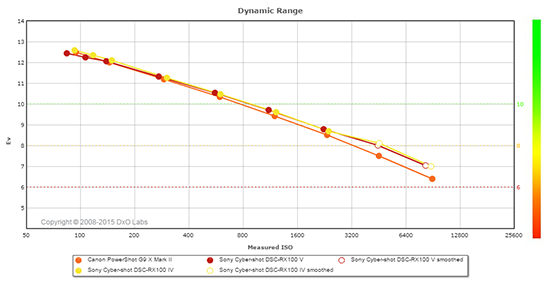 |
Here, we’ve decided to compare the RX100 V (in red) to its predecessor, the Mark IV (yellow) as well as to the Canon G9X II (orange), which also uses a 1″-type 20-megapixel BSI sensor. (As of this writing, DxOMark has not yet tested the Canon G7X II nor the Panasonic LX10 so we selected the G9X II because it’s Canon’s latest camera with a 1″-type sensor.) You can always compare other models on DxOMark.com.
As you can see from the above graph (click for a larger image), all three cameras produce very similar dynamic range scores with a peak of about 12.5 stops at base ISO. It’s interesting to note that DxO has detected that the Sonys are both applying some light spatial noise reduction to their RAW files at ISO 6400 and 12,800 as indicated by the “smoothed” data points, while the Canon does not, giving those cameras an edge in dynamic range at the highest ISOs, but at the cost of slightly reduced detail.
Overall, excellent dynamic range performance from the RX100 Mark V for a 1″-type sensor with essentially the same performance as its predecessor and the latest rival. Click here to visit the DxOMark page for the Sony RX100 V for more of their test results and additional comparisons.
| 1 fc 11 lux |
1/16 fc 0.67 lux |
1/16 fc No NR |
|
|---|---|---|---|
| ISO 125 |
 1s, f1.8 |
 13s, f1.8 |
 13s, f1.8 |
| ISO 3200 |
 1/25s, f1.8 |
 1/2s, f1.8 |
 1/2s, f1.8 |
| ISO 12800 |
 1/100s, f1.8 |
 1/8s, f1.8 |
 1/8s, f1.8 |
Low Light. The Sony RX100 V performed very well in our low-light tests thanks to its fast lens, capturing bright images at the lowest light level (1/16 foot-candle), even at the base sensitivity setting (ISO 125). As expected for a 1″-type sensor, noise is a little high at ISO 3200, but fairly fine-grained, while chroma noise is well-controlled with default noise reduction. The RX100 V’s highest single-shot ISO of 12,800 is quite grainy with noticeable noise reduction artifacts, but that’s no surprise.
Color balance is pretty good with Sony RX100 V’s Auto white balance setting, just a touch cool, even at highest ISO and lowest light level. We didn’t notice any significant issues with hot pixels, pattern noise or heat blooming. (Some hot pixels can be seen with long exposure noise reduction disabled (rightmost column), but that’s normal.)
LL AF: The camera’s AF system was able to focus unassisted down to about -2.7 EV on our low-contrast AF target, and down to about -4.2 EV on our high-contrast AF target, which is very good. And with its built-in AF assist lamp enabled, the RX100 V can autofocus in complete darkness as long as the subject is within range and has sufficient contrast.
How bright is this? The one foot-candle light level
that this test begins at roughly corresponds to the brightness of typical
city street-lighting at night. Cameras performing well at that level should
be able to snap good-looking photos of street-lit scenes.
NOTE: This low light test is conducted with a stationary subject,
and the camera mounted on a sturdy tripod. Most digital cameras will
fail miserably when faced with a moving subject in dim lighting. (For
example, a child’s ballet recital or a holiday pageant in a gymnasium.)
For such applications, you may have better luck with a digital SLR camera,
but even there, you’ll likely need to set the focus manually. For information
and reviews on digital SLRs, refer to our SLR
review index page.
Output Quality
Print Quality
Very good 24 x 36 inch prints at ISO 80 to 125; a nice 13 x 19 inch print at ISO 800 and a good 8 x 10 at ISO 3200.
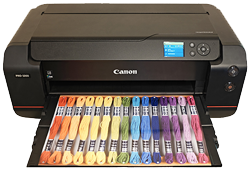 ISOs 80 to 125 deliver very good prints at 24 x 36 inches, with vibrant detail, rich colors and a nice overall “pop” to the printed image. Larger prints are certainly fine for wall display purposes up to 36 x 48 inches.
ISO 200 also yields a nice 24 x 36 inch printed image. There are only mild traces of visible noise in a few flatter areas of our Still Life test target, but it’s still a very good print with nice color and contrast overall.
ISO 400 begins to introduce a bit of softness in the red channel as well as a touch more noise in flatter areas of our test image. A reduction in print size to a still lofty 20 x 30 inches tightens things up nicely, and delivers a very good image.
ISO 800 is where most 1-inch-sensored cameras start to display signs of ISO strain in larger printed images, and the Sony RX100 V is no exception. A further size reduction to 13 x 19 inches allows for a very good print here and minimizes most noise reduction artifacts. There is a bit of mild noise in a few areas of our target, but plenty of fine detail and full color remains.
ISO 1600 delivers a 13 x 19 inch print that isn’t bad for this ISO and sensor size! It in fact almost passes our good grade, and is definitely usable for less critical printing applications. But in order to pass our official “good” seal we recommend remaining at 11 x 14 inches and below here. Most all contrast detail is now lost in our tricky red-leaf swatch, which is a typical phenomenon for all but the top cameras at this ISO, but otherwise this size yields a quality print.
ISO 3200 produces an 11 x 14 inch print similar to the 13 x 19 at ISO 1600, and one that almost passes our good grade. However, the 8 x 10 print here is quite good and, despite the obvious loss of contrast detail in our red-leaf swatch as well as the expected minor noise in a few areas of our target image, still looks quite good overall and delivers full color and nice detail.
ISO 6400 is a relatively difficult ISO for this sensor size to muster in prints, but you can still expect a good 5 x 7 for your family room. There is a bit of muting now in the colors, and the overall pop is not quite there, but it’s still a fairly good print.
ISO 12,800 turns in a 4 x 6 inch print similar to the 5 x 7 at ISO 6400, and one that just passes our good seal which is not bad at this ISO for a 1-inch sensor to be able to pull off.
The Sony RX100 Mark V turns in a solid performance in the print quality department for its sensor size, and doesn’t disappoint in the expectations we had for it. Several ISOs in the middle range almost bumped to a print size higher than its predecessor the RX100 IV, but in the end there hasn’t been any significant increase in overall print quality since the RX100 II. Indeed, the real technological advances have mostly come in the speed and video departments, which are certainly good reasons to upgrade. If you’re new to this line you can expect quality prints up to ISO 3200 for 8 x 10’s, which is a good limit to suggest for most all 1-inch-sensored cameras if you intend to print your photographs for anything but casual purposes.
The images above were taken from our standardized test shots. For a
collection of more pictorial photos, see our
Sony Cyber-shot DSC-RX100 V Photo Gallery
.
Not sure which camera to buy? Let your eyes be the ultimate judge!
Visit our Comparometer(tm)
to compare images from the Sony Cyber-shot DSC-RX100 V with those from other
cameras you may be considering. The proof is in the pictures, so let
your own eyes decide which you like best!
Performance
Timing and Performance
Incredible burst performance, but slow buffer clearing.
| Startup/Play to Record | ||
|---|---|---|
|
Power on |
~2.0 seconds
|
Time it takes for LCD to turn on |
|
Play to Record, |
~1.0 second
|
Time until first shot is captured. |
Startup to first shot time was about average for its class. Play to Record switching was quite fast.
| Shutter Response (Lag Time) | ||
|---|---|---|
|
Full Autofocus |
0.186 second
|
Time from fully pressing shutter button to image capture, zoom lens at wide angle position. |
|
Full Autofocus |
0.210 second
|
Time from fully pressing shutter button to image capture, zoom lens at telephoto position. |
|
Full Autofocus |
0.299 second
|
Time to capture while forcing flash to fire, zoom lens at medium focal length. |
|
Manual Focus |
0.020 second
|
For most cameras, shutter lag is less in manual focus than autofocus, but usually not as fast as when the camera is “prefocused”. |
|
Prefocused |
0.008 second
|
Time to capture, after half-pressing |
The Sony RX100 V’s full autofocus shutter lag when shooting the same target multiple times was very fast for a compact camera. The RX100 V’s full AF shutter lag clocked in at about 0.19 second at wide angle using center AF mode. Full AF shutter lag was just a little slower at full telephoto, at about 0.21 second, but that’s still quite fast. Enabling the flash raised shutter lag to 0.3 seconds, to account for the metering preflash.
Manual focus shutter lag was incredibly fast at 20 milliseconds, and prefocused shutter lag was even faster at only 8 milliseconds, one of the lowest shutter lag times we’ve measured in recent memory.
| Cycle Time (shot to shot) | ||
|---|---|---|
|
Single Shot mode |
< 0.3 second
|
Average time per shot. |
|
Single Shot mode |
< 0.3 second
|
Average time per shot. |
|
Early shutter |
No
|
Some cameras don’t snap another |
|
Continuous Hi |
0.04 second
(23.81 fps); 150 frames total; 108 seconds to clear* |
Time per shot, averaged over buffer size of 150 frames. Then slows to an average of 0.79s or 1.27 fps when buffer is full. |
|
Continuous Hi |
0.04 second
(24.10 fps); 72 frames total; 48 seconds to clear* |
Time per shot, averaged over buffer size of 72 frames. Then slows to an average of 0.69s or 1.46 fps when buffer is full. |
|
Continuous Hi |
0.04 second
(23.81 fps); 62 frames total; 60 seconds to clear* |
Time per shot, averaged over buffer size of 62 frames. Then slows to an average of 0.91s or 1.10 fps when buffer is full. |
|
Flash recycling |
3.1 seconds
|
Flash at maximum output. |
|
*Note: Buffer clearing times measured with a SanDisk Extreme Pro 95MB/sec UHS-I SDHC memory card. Slower cards will produce correspondingly slower clearing times. Slow cards may also limit length of bursts in continuous mode. ISO sensitivity also affects cycle times and burst mode performance, with higher ISOs generally increasing cycle times and reducing burst performance. |
||
Shot-to-shot cycle times were excellent in single shot mode, at less than 0.3 second for Large/Extra Fine JPEGs or RAW+Large/Fine JPEG files. Note that the Sony RX100 V does not support capturing JPEGs using highest quality Extra Fine compression when shooting with RAW files, dropping JPEGs down to Fine quality. We no longer test just RAW file cycle time in single-shot mode, as it’s usually somewhere in between JPEG and RAW+JPEG.
The Sony RX100 V’s Continuous Hi shooting mode burst rate was incredible, able to shoot best quality Large Extra Fine JPEGs and RAW+JPEG files at 23.8 frames per second and RAW files at 24.1 frames per second, and the Mark V supports continuous autofocus at those speeds! The RX100 V also offers Mid and Lo settings rated at 10.0 and 3.5 fps respectively, however we didn’t test those modes in the lab.
Buffer depths were outstanding at 150 best quality JPEGs, 72 RAW or 62 RAW+JPEG files before the camera slowed down. Buffer clearing was quite slow, though, taking a whopping 108 seconds after a max-length burst of best quality JPEGs, 48 seconds for a max burst of RAW files, and 60 seconds for a max burst of RAW+JPEG files with our fast 95MB/s UHS-I SDHC card. You can make some setting changes and review images which have been written to the card while the buffer is clearing, but you can’t access the main menu system at all until all images are flushed to the card. Unfortunately, the Sony RX100 V does not support faster UHS-II cards.
The built-in flash took an average of 3.1 seconds to recharge after a full-power discharge, which is good.
Bottom line, the Sony RX100 V’s performance was outstanding in most respects with fast AF, extremely low shutter lag and an incredible ~24 fps full-res burst rate no matter the file type (and continuous autofocus is supported!). Buffer clearing was however quite slow, taking up to 108 seconds after a max-length burst of Extra Fine JPEGs with a fast UHS-I card. It’s a shame Sony didn’t add faster UHS-II card support to the Mark V.
Battery
Battery Life
Poor battery life for its class.
| Operating Mode | Number of Shots |
|---|---|
|
Still Capture,
(LCD Monitor, CIPA standard) |
220
|
|
Still Capture,
(EVF, CIPA standard) |
210
|
The Sony RX100 V uses a custom NP-BX1 rechargeable lithium-ion battery for power, and the battery is charged in-camera via the USB port. CIPA battery life is rated much lower than its predecessors, at only 220 shots when using the LCD monitor, and 210 shots when using the electronic viewfinder. We strongly recommend you pick up a spare battery for extended outings.
The table above shows the number of shots the camera is capable
of (on a fully-charged rechargeable battery as appropriate), based on CIPA
battery-life and/or manufacturer standard test conditions.
(Interested readers can find an English translation of the CIPA DC-002 standards document here. (180K PDF document))
Image Quality
By Mike Tomkins | Posted: 12/29/2016
Below are crops from our laboratory Still Life target comparing the Sony RX100 V’s image quality to its predecessor, the RX100 IV, as well as both of its nearest 1-inch sensor-based compact camera rivals, the Canon G7X II and Panasonic LX10. For good measure, we’ve also compared it against a compact with an even larger sensor, the Panasonic LX100, as well as a similarly-priced mirrorless camera with a far larger sensor, the Sony A6300.
NOTE: These images are from best quality JPEGs straight out of the camera, at default settings including noise reduction and using the camera’s actual base ISO (not extended ISO settings). All cameras in this comparison were shot with our very sharp reference lenses. Clicking any crop will take you to a carrier page where you can click once again to access the full resolution image as delivered straight from the camera. For those interested in working with the RAW files involved, click these links to visit each camera’s respective sample image thumbnail page: Sony RX100 V, Sony RX100 IV, Canon G7X II, Panasonic LX10, Panasonic LX100 and Sony A6300 — links to the RAW files appear beneath those for the JPEG images, wherever we have them. And remember, you can always go to our world-renowned Comparometer to compare the Sony RX100 V to any camera we’ve ever tested!
Sony RX100 V vs Sony RX100 IV at Base ISO
 |
 |
 |
 |
 |
 |
|
Sony RX100 V at ISO 125
|
Sony RX100 IV at ISO 125
|
|
Given that they both share the exact same 1-inch sensor size, 20.1-megapixel resolution and BIONZ X image processor, you might expect the Sony RX100 V and its predecessor, the RX100 IV, to have identical image quality too. Even at base sensitivity, though, the RX100 V turns in the better performance of the pair. It’s just slightly (but noticeably) crisper in the mosaic label and fabric swatches, and yet the sharpening haloes are no more prominent in the bottle crop than those of the RX100 IV. The newer camera also renders the color of the difficult pink swatch more accurately than did its predecessor. |
|
Sony RX100 V vs Canon G7X Mark II at Base ISO
 |
 |
 |
 |
 |
 |
|
Sony RX100 V at ISO 125
|
Canon G7X Mark II at ISO 125
|
|
The Sony RX100 V also shares the same sensor size and nearly-identical resolution with the 20.2-megapixel Canon G7X II. Despite that outward similarity, Sony’s camera performs noticeably better at base sensitivity. In fairness to Canon, the G7X II has somewhat more modest sharpening haloes in the bottle crop. However, the Sony RX100 V’s mosaic label and fabric swatches are crisper, and it better holds onto the fine thread pattern in the pink swatch which is largely lost by the Canon. The RX100 V also renders the color of the pink swatch better, and shows more contrast in the difficult red swatch. |
|
Sony RX100 V vs Panasonic LX10 at Base ISO
 |
 |
 |
 |
 |
 |
|
Sony RX100 V at ISO 125
|
Panasonic LX10 at ISO 125
|
|
The Panasonic LX10, too, shares the same 1-inch sensor size and 20.1-megapixel resolution as the Sony RX100 V. Once again, though, we have to give the nod at base sensitivity to the Sony, although its a close-run thing. Just as in the comparison with the Canon G7X II above, the Panasonic LX10 shows less prominent sharpening haloes in the bottle crop, but is also less crisp than the RX100 V in the mosaic crop. The LX10 does well with the thread pattern in the pink swatch, but renders the color as rather too cool. However, while contrast is a little lower than that of the RX100 V in the red swatch, the Panasonic LX10 renders its color more realistically, with lower saturation than the Sony. |
|
Sony RX100 V vs Panasonic LX100 at Base ISO
 |
 |
 |
 |
 |
 |
|
Sony RX100 V at ISO 125
|
Panasonic LX100 at ISO 200
|
|
And so we come to the first comparison with a camera that doesn’t sport a 1-inch sensor. The Panasonic LX100 instead opts for a Four Thirds-format sensor with almost double the surface area of the imager in the Sony RX100 V, coupled with a much lower resolution of just 12.8 megapixels. At base sensitivity, this approach doesn’t yield dividends, with the Sony RX100 V showing significantly more detail in the mosaic label and fabric swatches. The RX100 V again renders the color of the pink swatch much more accurately too, although the LX100 manages better with the color of the red swatch and has less prominent sharpening haloes. |
|
Sony RX100 V vs Sony A6300 at Base ISO
 |
 |
 |
 |
 |
 |
|
Sony RX100 V at ISO 125
|
Sony A6300 at ISO 100
|
|
Finally, we’ve decided to pit the RX100 V against an APS-C sensor-based camera, specifically the Sony A6300. Both cameras have the same list price, but the A6300 isn’t going to fit in your pocket, and nor does it come with a lens at this price. However, if you can justify the added bulk and the cost of a lens or two, the Sony A6300’s larger, higher-resolution 24.2-megapixel image sensor gathers significantly more detail in both the mosaic label and fabric swatches. And it does so without having to rely on as much sharpening as the RX100 V, leading to less prominent haloes too. The RX100 V does a much better job with the color of the tricky pink swatch, though. |
|
Sony RX100 V vs Sony RX100 IV at ISO 1600
 |
 |
 |
 |
 |
 |
|
Sony RX100 V at ISO 1600
|
Sony RX100 IV at ISO 1600
|
|
But enough of the low-ISO comparisons. How does the Sony RX100 V perform as you crank up the sensitivity? At ISO 1600-equivalent, the Sony RX100 V’s early advantage has been reduced. Noise levels are pretty similar to those of the RX100 IV, and like that camera, the RX100 V’s noise reduction processing is a bit heavy-handed. That leaves a blotchy, mottled look for the mosaic label, and wipes out the thread pattern in the fabric swatches. The RX100 V does best its predecessor in terms of the color of the pink swatch, though, where the RX100 IV gives it a rather magenta hue. |
|
Sony RX100 V vs Canon G7X Mark II at ISO 1600
 |
 |
 |
 |
 |
 |
|
Sony RX100 V at ISO 1600
|
Canon G7X Mark II at ISO 1600
|
|
With the sensitivity dialed up a bit, the Canon G7X II turns in a performance that’s rather closer to that of the RX100 V, even if we’d still give a tip of the hat to the Sony. Both cameras are pretty similar on the noise and detail front, with the RX100 V perhaps having just a very slight edge. The G7X II’s mosaic label doesn’t look quite as mottled, but it has sacrificed more of the finer pattern between the dark mosaic tiles. Sony also does a bit better with the hue of the pink fabric swatch. |
|
Sony RX100 V vs Panasonic LX10 at ISO 1600
 |
 |
 |
 |
 |
 |
|
Sony RX100 V at ISO 1600
|
Panasonic LX10 at ISO 1600
|
|
The Panasonic LX10 turns in a noticeably less noisy image than its Sony and Canon rivals at ISO 1600-equivalent, as you can see in the bottle crop. However, in doing so it has sacrificed even more of the fine mosaic label detail than the Canon did, and has lost almost all detail in the red fabric swatch as well. |
|
Sony RX100 V vs Panasonic LX100 at ISO 1600
 |
 |
 |
 |
 |
 |
|
Sony RX100 V at ISO 1600
|
Panasonic LX100 at ISO 1600
|
|
It’s once the sensitivity has been raised to ISO 1600-equivalent that the larger sensor size of the Panasonic LX100 starts to come to the fore, as you can see from its less-noisy bottle crop. Its resolution disadvantage has also been largely negated, with its larger pixels not so prone to noise as those of the Sony RX100 V, and hence a lesser degree of noise reduction needed. It still can’t quite hold onto as much detail in the dark areas of the mosaic label but it’s a close thing. Sony definitely does a better job with the fabric swatches, though. |
|
Sony RX100 V vs Sony A6300 at ISO 1600
 |
 |
 |
 |
 |
 |
|
Sony RX100 V at ISO 1600
|
Sony A6300 at ISO 1600
|
|
Not surprisingly, the much larger sensor of the Sony A6300 puts it in a class of its own. Compared to all of these pants pocket-friendly (or coat pocket, for the LX100) cameras, the A6300 does better on almost every front. Noise levels are lower in the bottle crop, there’s far more fine detail and none of the noise reduction mottling in the mosaic label. The A6300 is also the only camera that could hold onto the thread pattern in the pink fabric swatch, and also does better than the rest with the red swatch. Really, the only thing preventing a perfect score is that the RX100 V does a better job with the color of the pink swatch. |
|
Sony RX100 V vs Sony RX100 IV at ISO 3200
 |
 |
 |
 |
 |
 |
|
Sony RX100 V at ISO 3200
|
Sony RX100 IV at ISO 3200
|
|
Finally, we come to ISO 3200-equivalent, and here the Sony RX100 V’s noise reduction does a somewhat better job than that of its predecessor. Not in the mosaic label or fabric swatches, where detail has been lost about equally by both cameras, but in the bottle crop. The RX100 V’s result is noticeable better here, with less of the mottled, noisy look shown by the RX100 IV. |
|
Sony RX100 V vs Canon G7X Mark II at ISO 3200
 |
 |
 |
 |
 |
 |
|
Sony RX100 V at ISO 3200
|
Canon G7X Mark II at ISO 3200
|
|
Things are much closer between the Sony RX100 V and Canon G7X II at ISO 3200-equivalent. Both cameras show similar noise levels and retain similar amounts of detail in the mosaic label and fabric swatches. The RX100 V still has a slight edge, though, with more contrast in the pink swatch and just slightly more of the finest details in the mosaic label retained. |
|
Sony RX100 V vs Panasonic LX10 at ISO 3200
 |
 |
 |
 |
 |
 |
|
Sony RX100 V at ISO 3200
|
Panasonic LX10 at ISO 3200
|
|
Panasonic’s more aggressive noise reduction shows itself again at ISO 3200-equivalent. In the bottle crops, the LX10’s image is noticeably less noisy. However, the Sony RX100 V’s mosaic label, while itself rather mottled, is noticeably better than the blotchy, muddy label in the LX10’s rendering. Sony still does better with the hue of the pink swatch, but in other respects the fabric swatches are pretty much a wash between the two cameras. |
|
Sony RX100 V vs Panasonic LX100 at ISO 3200
 |
 |
 |
 |
 |
 |
|
Sony RX100 V at ISO 3200
|
Panasonic LX100 at ISO 3200
|
|
By the time we reach ISO 3200-equivalent, the Panasonic LX100’s larger sensor and lower resolution are both really playing their part in keeping noise levels to a minimum. The LX100’s bottle crop is much cleaner than that from the RX100 V. And while it is still just a little behind the Sony in terms of detail, it’s only by a miniscule amount when one considers their difference in sensor resolution. Sony does still do a good bit better with the hue of the pink fabric swatch, though. |
|
Sony RX100 V vs Sony A6300 at ISO 3200
 |
 |
 |
 |
 |
 |
|
Sony RX100 V at ISO 3200
|
Sony A6300 at ISO 3200
|
|
Lastly, we come to the Sony A6300. Here, there’s simply a night and day difference: The APS-C sensor-based camera is better in almost every respect than its pocket-friendly sibling. The RX100 V does still do a better job with the hue of the pink fabric swatch, though. |
|
Sony RX100 V vs. Sony RX100 IV, Canon G7X Mark II, Panasonic LX10, Panasonic LX100, Sony A6300
 |
 |
 |
 |
 |
 |
 |
 |
 |
 |
 |
 |
 |
 |
 |
 |
 |
 |
| Sony RX100 V ISO 125 ISO 3200 ISO 6400 |
Sony RX100 IV ISO 125 ISO 3200 ISO 6400 |
Canon G7X Mark II ISO 125 ISO 3200 ISO 6400 |
Panasonic LX10 ISO 125 ISO 3200 ISO 6400 |
Panasonic LX100 ISO 200 ISO 3200 ISO 6400 |
Sony A6300 ISO 100 ISO 3200 ISO 6400 |
| Detail comparison. If you wanted proof that sensor size makes a difference, this comparison offers it in spades. The A6300, with the largest and highest-resolution sensor of the group, is well ahead of the rest even at base sensitivity, and holds onto that lead across the range. The Panasonic LX100, meanwhile, starts off at a disadvantage due to its lower resolution, but quickly catches up as we ramp the sensitivity. And finally, we come to the four 1-inch sensor cameras. The winner has to be the Sony RX100 V, with the Canon G7X II nipping at its heels. The Panasonic LX10 and Sony RX100 IV round out the field. | |||||
Sony RX100 V Print Quality Analysis
Very good 24 x 36 inch prints at ISO 80 to 125; a nice 13 x 19 inch print at ISO 800 and a good 8 x 10 at ISO 3200.
ISOs 80 to 125 deliver very good prints at 24 x 36 inches, with vibrant detail, rich colors and a nice overall “pop” to the printed image. Larger prints are certainly fine for wall display purposes up to 36 x 48 inches.
ISO 200 also yields a nice 24 x 36 inch printed image. There are only mild traces of visible noise in a few flatter areas of our Still Life test target, but it’s still a very good print with nice color and contrast overall.
ISO 400 begins to introduce a bit of softness in the red channel as well as a touch more noise in flatter areas of our test image. A reduction in print size to a still lofty 20 x 30 inches tightens things up nicely, and delivers a very good image.
ISO 800 is where most 1-inch-sensored cameras start to display signs of ISO strain in larger printed images, and the Sony RX100 V is no exception. A further size reduction to 13 x 19 inches allows for a very good print here and minimizes most noise reduction artifacts. There is a bit of mild noise in a few areas of our target, but plenty of fine detail and full color remains.
ISO 1600 delivers a 13 x 19 inch print that isn’t bad for this ISO and sensor size! It in fact almost passes our good grade, and is definitely usable for less critical printing applications. But in order to pass our official “good” seal we recommend remaining at 11 x 14 inches and below here. Most all contrast detail is now lost in our tricky red-leaf swatch, which is a typical phenomenon for all but the top cameras at this ISO, but otherwise this size yields a quality print.
ISO 3200 produces an 11 x 14 inch print similar to the 13 x 19 at ISO 1600, and one that almost passes our good grade. However, the 8 x 10 print here is quite good and, despite the obvious loss of contrast detail in our red-leaf swatch as well as the expected minor noise in a few areas of our target image, still looks quite good overall and delivers full color and nice detail.
ISO 6400 is a relatively difficult ISO for this sensor size to muster in prints, but you can still expect a good 5 x 7 for your family room. There is a bit of muting now in the colors, and the overall pop is not quite there, but it’s still a fairly good print.
ISO 12,800 turns in a 4 x 6 inch print similar to the 5 x 7 at ISO 6400, and one that just passes our good seal which is not bad at this ISO for a 1-inch sensor to be able to pull off.
The Sony RX100 Mark V turns in a solid performance in the print quality department for its sensor size, and doesn’t disappoint in the expectations we had for it. Several ISOs in the middle range almost bumped to a print size higher than its predecessor the RX100 IV, but in the end there hasn’t been any significant increase in overall print quality since the RX100 II. Indeed, the real technological advances have mostly come in the speed and video departments, which are certainly good reasons to upgrade. If you’re new to this line you can expect quality prints up to ISO 3200 for 8 x 10’s, which is a good limit to suggest for most all 1-inch-sensored cameras if you intend to print your photographs for anything but casual purposes.
Field Test
A pocket-friendly powerhouse: This unassuming little compact offers unbelievable performance
By Mike Tomkins | Posted: 12/18/2016

Four years ago, Sony reinvented the compact camera with the RX100, a pocket-friendly beauty with a sensor far larger than those typical of its rivals. Although it wasn’t perfect — no camera ever is — I fell in love with the RX100 almost instantly, and quickly bought one with my own hard-earned money just as soon as we’d completed our review.
Fast-forward to the present day, and the compact camera series that changed everything has now reached its fifth-generation, courtesy of the Sony RX100 V. Interestingly, Sony still continues to sell all four previous RX100-series models, allowing users to pick and choose the camera which best fits their needs and budget.
What separates the Sony RX100 V from the crowd?
So what separates the Sony RX100 V from its siblings? Take a look at the Sony RX100 IV and V side by side, and you’d be hard-pressed to tell the difference. Both cameras share the exact same body and control layout. They also share the same sensor size and resolution, and use the same lens, display and popup electronic viewfinder.
The differences are all to be found under the hood, where it really counts. The RX100 IV was no slouch on the performance front, but the Sony RX100 V is simply in a class of its own. Sony rates the RX100 V as capable of 24 full-res frames per second capture for as long as 2.5 to 6.3 seconds per burst, depending on your chosen filetype(s). And that speed is available even with continuous autofocus adjustments between frames.
That kind of full-resolution performance would be impressive even from a DSLR or mirrorless camera; it’s simply unheard of in a pocket-friendly compact camera. To say that I was keen to get my hands on the Sony RX100 V so I could experience it for myself would be the understatement of the century.
 |
|
70mm-equivalent, 1/2,000 sec. @ f/3.5, ISO 160 |
As I just noted, externally the Sony RX100 V is almost identical to its immediate predecessor, the RX100 IV. The same body is also shared with the RX100 III, and even if you go all the way back to the original RX100 and RX100 II, the basic control layout was essentially the same, although those models were just a touch slimmer and lacked the built-in electronic viewfinder of later models. (The RX100 II also sported a flash hot shoe, something not found on other RX100-series models since then.)
Just as with its predecessors, the Sony RX100 V is fairly comfortable in-hand, but lacks any form of handgrip on its front surface. I’m personally fine with this — I’ve never dropped an RX100-series camera, or even come close to doing so really — but I know some RX100-series shooters prefer to add an accessory handgrip of some kind for a little extra purchase, since the body has quite a smooth, slippery finish.
 |
|
24mm-equivalent, 1/50 sec. @ f/2.8, ISO 125 |
The good news is that since the body design is unchanged, any grip that fits the RX100 III or IV should also work with the Sony RX100 V. There are at least a couple to choose from, including Sony’s own polycarbonate AG-R2 grip and Richard Franiec’s popular precision-machined aluminum grips. At one point, Fotodiox even made a chunky cherry wood grip, although I believe this has since been discontinued. And there are probably some more I’m not personally aware of from the likes of eBay et al.
In most respects, I’m vey happy with the Sony RX100 V retaining its predecessor’s physical design and interface almost unchanged. There’s one feature I really miss compared to some of its rivals, though.
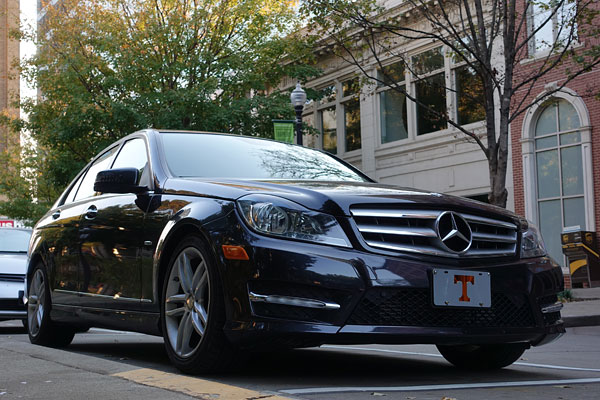 |
|
54mm-equivalent, 1/60 sec. @ f/4, ISO 125 |
The LCD monitor is crisp and colorful, and has fairly good daylight visibility as well. I also appreciate its tilting articulation mechanism, which can be flipped up 180 degrees for selfies, and is also great for shooting from the hip or over your head. (Although I’d definitely prefer a side-mounted tilt/swivel mechanism, which would be even more versatile.)
But what the Sony RX100 V lacks, just as did all of its predecessors, is a touch-screen overlay on the monitor. Quite frequently, I found myself attempting to set the focus point with a tap on the screen, before catching myself and remembering that I had to use the four-way controller to adjust the focus point location. Here’s hoping this friendly, intuitive feature arrives in a future model soon!

Although its body design is unchanged, here and there you will find the occasional tweak to the Sony RX100 V’s user interface. One of these, in particular, quickly caught my attention straight away, after trying just one or two burst of high-speed capture.
There’s now a small countdown displayed at top left of the live view feed, whether you’re framing shots through the viewfinder or on the rear-panel LCD monitor. This lets you see exactly how many shots have been captured, but are still waiting to be transferred from the camera’s buffer memory to the flash card.
It’s a small change, but one that I really appreciate. Doubly so because while the Sony RX100 V’s performance is epic in most respects, its card write speeds are still rather on the slow side. Coupled with the extremely high burst speed and depth, it’s possible to find yourself waiting for quite a while for the buffer to clear. (Even with one of Sony’s own high-speed 95MB/second SD cards which meets UHS Speed Class 3 standards, I found it could take as long as 70 seconds to write the buffer to the flash card.)
That can be frustrating if, say, you want to dive into the menu system quickly to tweak a setting before shooting some more, as although you can shoot more frames, review those which have already been written to storage, or access the function menu while the buffer is partially filled, you can’t access the main menu system at all. At least you now have an idea of how long you’ll have to wait, though.
Just remember not to switch the camera off or retract the viewfinder while the countdown is underway: I did this once or twice without thinking about it, and then found myself instantly regretting my decision since the camera then can’t be powered back on until the buffer has been completely cleared
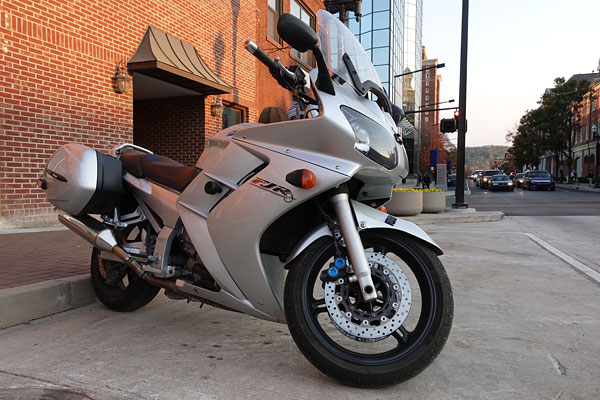 |
|
24mm-equivalent, 1/100 sec. @ f/4, ISO 125 |
Reflexes, schmeflexes: The Sony RX100 V’s stunning performance can take timing out of the equation
When you stop to think about it for a moment, the amazing performance on offer in the Sony RX100 V might initially seem like overkill. This is a pocket-friendly camera with a short 24-70mm equivalent zoom lens, and with no way to change it for another optic. Even if you crank the zoom to the 70mm telephoto end, you’ll need to be pretty close to your subject to get a tightly-framed shot. That’s going to rule the RX100 V out for a lot of sports shooting: You can’t just run onto the field of play to get a tighter-framed shot of the action, after all.
But to my mind, sports shooting isn’t what this camera is aimed at, despite its stunning performance. Sony didn’t give you 24 frames-per-second full-res capture so you could get the perfect shot of Roger Federer’s tennis backhand or a LeBron James slam-dunk. The Sony RX100 V is more about keeping up with your kids, pets and fast-paced daily life than it is about sports, per se.
 |
|
70mm-equivalent, 1/200 sec. @ f/10, ISO 160 |
Here, telephoto reach is less of an issue, and that incredibly high-speed capture will alow you to place less of an emphasis on your timing and reflexes. With 24 frames per second, you’ll be able to step through your shots to find the perfectly-timed frame, and then throw the others away.
Pros don’t usually shoot this way not only because their reflexes are well-honed in their day job, but also because it would take far too long to sort through the many thousands of images that a spray-and-pray approach would capture within just a single sports event. But sorting through 20 or 30 shots to find the perfectly-timed capture of your child breaking through the finish line on their school sports day or your pet dog leaping skywards to catch a frisbee… Well, that’s a much less daunting proposition, and a much better argument for such spectacular performance in a pocket-sized camera.
 |
|
70mm-equivalent, 1/2,000 sec. @ f/3.2, ISO 160 |
One of the things which really grabbed my attention when the Sony RX100 V was first announced was that it was able to provide continuous autofocus adjustments between exposures, even when shooting at its maximum rate of 24 frames per second. For a compact camera, I found this simply astounding. Now I’ve shot with the RX100 V in the real world, I better understand how it’s all possible.
Of course, a big part of the equation was obvious from the get-go: The Sony RX100 V packs in a speedy new hybrid autofocus system, which pairs both contrast-detection as in past RX100-series models with new on-chip phase-detection autofocus pixels. The extra information from the phase-detect pixels lets the RX100 V determine both the approximate distance and direction in which focus must be adjusted before it even starts to move the focus elements in the lens. Contrast-detection only kicks in at the end of the autofocus cycle, fine-tuning the initial adjustment that was triggered by the phase-detection pixels.
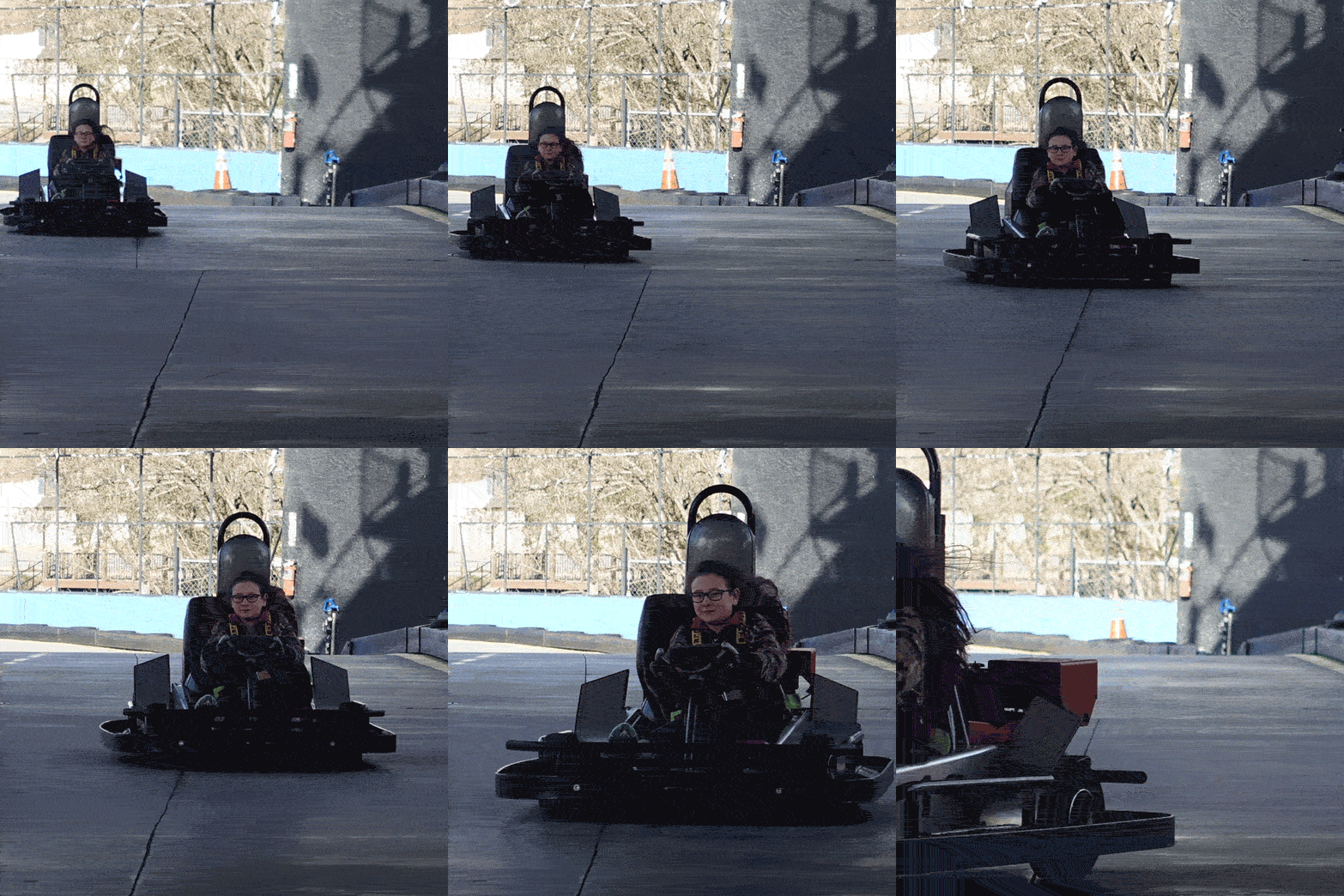 |
|
DSLR-demolishing performance in a pocket-friendly body: The Sony RX100 V can shoot at a spectacular 24 frames per second The GIF is set to play back at approximately |
The result is a focus system that’s exceptionally swift by compact camera standards, but as it turns out, there’s also a little more to the story, although it didn’t occur to me until I headed up to nearby Pigeon Forge, Tennessee for some go-kart action shots.
Although its sensor is far larger than those of bargain-basement compacts, it’s still a good bit smaller than those in even sub-frame DSLRs and most mirrorless cameras. With all else being equal, a smaller sensor size means a more generous depth of field, something you may well have noticed when shooting photos with your smartphone. (These have absolutely tiny sensors, and can render fairly close and distant subjects sharply at the same time.) And that same effect is in play with the RX100 V, as well, just not to quite the same extent.
Its more generous depth of field at any given focal length and aperture means that it doesn’t necessarily have to be quite so precise as a DSLR or mirrorless camera would have to be in the first place. Stepping through a lengthy burst series and paying attention to the background instead of my subject, I could see that the RX100 V wasn’t tracking my subjects quite as accurately as an enthusiast DSLR would.
 |
|
70mm-equivalent, 1/2,000 sec. @ f/2.8, ISO 250 |
As the go-kart consistently came towards me, the fencing in the background would occasionally become sharper, not more blurred as it should if it was tracking the kart perfectly from one frame to the next. But because its sensor was smaller, the go-kart always remained well within the available depth of field at all times.
The combination of the hybrid AF system and this happy side-effect of the 1-inch sensor size meant that I found the RX100 V easily up to the task of keeping the go-karts well focused from start to finish of a multi-second burst, even as they were racing directly towards me at ~30 miles per hour.
Of course, you’ll still want to shoot short bursts where possible, anticipating the action as much as you can — and not just because you’ll need to sort through all of those images later. (Choosing the best from a short burst of images is pretty quick; choosing the best from dozens of bursts, especially for longer bursts, can get pretty tedious.)
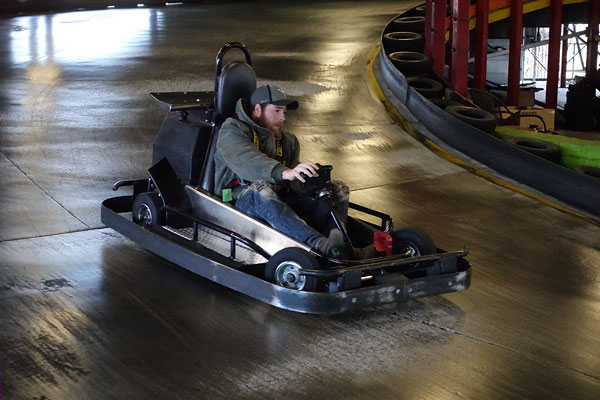 |
|
67mm-equivalent, 1/1,000 sec. @ f/2.8, ISO 6400 |
Perhaps an even bigger reason, though, is that the Sony RX100 V can tear through battery life surprisingly quickly if you’re shooting lots of high-speed bursts and 4K video. My go-kart shoot nicely illustrated this. In all, I shot for perhaps 90 minutes before the camera first showed a critically low battery warning — and this after having fully charged it the night before.
That might seem an exceptionally short battery life, and I must admit it surprised me too — until I paused to consider just how many shots I’d taken in such a short space of time. In all, I grabbed about 35 bursts of the go-karts, most with somewhere from 10-20 frames apiece; some of them with many more. And I also shot a couple of dozen 4K or high-frame rate movies.

The realization that I’d shot close to 1,000 full-res still frames and close to three gigabytes of video in just 90 minutes, and with such a compact camera, simply floored me. Given its trim body and small battery size, it’s hardly surprising that the battery can be drained so quickly when you use the RX100 V to its maximum.
In fact, what I’d shot was far, far in excess of Sony’s own 210-220 shot rated battery life. But then that’s measured to CIPA testing standards, which require that manufacturers regularly rack the zoom between shots and fire the flash on every second shot, none of which I was doing. My minimal zoom use and total lack of flash usage offset the much greater number of shots I was capturing.
And I will say that battery life was perfectly sufficient for a day’s shooting, so long as I wasn’t capturing much video or a lot of lengthy bursts. Bring a spare battery or two — they’re tiny, so it’s easy to slip a couple of spares in your pocket — and I doubt you’ll have any battery life concerns.
The Sony RX100 V offers great still image quality, just like its predecessors
Great image quality from a pocket-friendly camera has long been the hallmark of the RX100 series, and the Sony RX100 V is no different in this respect.
Photos taken in daylight are packed with fine detail, and while the greater depth of field provided by the 1-inch sensor size means that it’s harder to blur backgrounds than it would be with a larger-sensored DSLR or mirrorless camera, it’s also significantly easier than it would be with a smartphone or small-sensored compact camera.
 |
|
24mm-equivalent, 1/60 sec. @ f/2.8, ISO 125 |
Colors are attractive and pretty lifelike, and automatic white balance does a great job with most subjects. I did notice a tendency to overexpose just a little for my tastes, but one or two clicks of negative exposure compensation — or just shooting in raw format — is enough to resolve this. And unlike many compact cameras, which typically have limited burst speed and depth in raw format, if they even provide the option at all, the Sony RX100 V shoots just as swiftly with raw capture enabled as without. It also provides very generous raw file burst depths.
Once the sun goes down, the RX100 V is also an uncommonly good available light shooter for such a compact camera. I felt noise levels were acceptable at sensitivities up to ISO 3200-equivalent pretty much all of the time, and even at ISO 6400 unless my subject was packed with lots of really fine, subtle detail like hair or grass. ISO 12,800-equivalent was a step too far for my tastes, but usable in a pinch — just be aware that color tends to get a bit muted by this point, and much of the finer detail will be lost to noise reduction.
 |
|
24mm-equivalent, 1/40 sec. @ f/2.8, ISO 125 |
Switching to video, I shot with the Sony RX100 V at a variety of resolution and frame-rate choices. At the maximum 4K resolution, quality is superb, but you’ll need a big screen, a fairly close viewing position or both to make the best of it.
I’ve got a 55-inch Sony 4K TV myself, and according to the viewing distance calculator over at Reference Home Theater, someone with 20/20 vision would want to be seated about four feet from the screen to be able to resolve its full detail. That’s clearly not a realistic position, and in fact my sofa’s about 12 feet from the screen. At that distance and with my eyesight, I can certainly see more detail than with a Full HD video. If I get up and walk closer to the screen, though, it’s obvious I’m still missing out, and I’ll probably rearrange my living room soon to make better use of the 4K resolution.
From about six or eight feet, which seems more reasonable to me, the Sony RX100 V’s 4K output is incredibly lifelike. Textures that are lost to Full HD are crisp and convincing in 4K. You almost get the feeling you’re looking out of the window, rather than at a screen — at least, so long as the scene doesn’t have too much contrast between highlights and shadows, as my TV isn’t a true HDR unit.
Dropping down to Full HD, image quality is still very good. Here, the Sony RX100 V is capable not just of 60 frames per second capture, as is pretty common these days, but also of 120 fps capture. That gives you a couple of choices: You can either drop the frame-rate in post processing for a slow-motion effect without sacrificing on resolution (with a 24p playback rate, you’d have a 5x slow-motion effect), or you can play at the native frame-rate for smoother motion.
As it happens, my TV has a native 120Hz refresh rate, so I went the latter route — and I have to say that while I couldn’t see a big difference between 60p and 120p video, the latter did seem a little smoother. And even if I halved the frame-rate to 60p for a 2x slow-motion effect, the RX100 V’s output at 1080p was still stutter-free. Nice!
Of course, if you’ve read our review of the Sony RX100 IV, you’ll know that camera introduced a High Frame-Rate video mode which allowed capture at much, much higher frame-rates, all the way up to a staggering 1,000 frames per second maximum. This feature remains in the Sony RX100 V, but with one important change: The newer model can record for twice as long per clip.
By default, the RX100 IV allowed capture of two seconds per clip, or four seconds if the quality was reduced. In the Sony RX100 V, you can now record four seconds per clip by default, or eight seconds with the quality reduced. That’s potentially a very useful change, although not in the way you might expect.
In my review of the Sony RX10 II, which sports the same high frame-rate capabilities as the RX100 IV, I noted that the short clip length limits weren’t a concern. That was because once slowed down, even such short clips could have very long run times: A two-second real-world clip would be 20 seconds long after a 10x slow-motion effect. With the maximum four second clip-length and a 40x slow-mo effect, you could be looking at close to a three-minute video. That’s unlikely to hold anybody’s attention no matter the subject, and yet now the RX100 V doubles those limits.
But where that extra clip length comes in handy is that it saves you having to time your shots so carefully. With a longer clip length, you can start a little early in anticipation of the action, yet still have plenty of time to record it all before the moment is gone. Then you simply cut the boring bits in post-processing, and keep the shorter, interesting portion of the video.
As in the RX100 IV, the Sony RX100 V offers great image quality at its slowest HFR capture rate of 240 fps, which yields anything from a 4x to a 10x slow-motion effect, depending upon your output frame-rate. That’s because it’s actually recording at 1,824 x 1,026 pixels, pretty close to a standard Full HD feed.
If you increase the capture frame-rate to 480 fps, the quality degrades significantly thanks to a 1,676 x 566 pixel capture resolution, though. And at the maximum 960 fps rate, this falls all the way to 1,136 x 384 pixels, for a rather low-res (if still usable) image. And if you opt for clip length over image quality, the resolution drops still further.
Oh, and at all of these resolutions, one frustration from the Sony RX100 IV remains. Regardless of the capture resolution, your output files are rendered at Full HD resolution. That’s achieved courtesy of an upsampling step performed once capture is completed, and there’s no way around this step. Unfortunately, it takes quite a while to render each clip, potentially causing you to miss more action while you’re waiting for the previous clip to render.
You *can* cancel this step part-way, but if you do so you’ll lose whatever portion of your video hadn’t already been rendered. I’d really like to see Sony make this optional, and allow users to do the upsampling themselves in post-processing, if they want to. Upsampling in-camera wastes possible shooting time, battery life and storage space, and I can’t think of a good reason not to let the user simply save each clip at its real capture resolution, avoiding these problems.
But even with that said, this is a really fun feature, and with its new, greater clip length, now even more so than ever!
 |
|
39mm-equivalent, 1/40 sec. @ f/2.8, ISO 2500 |
Like its predecessors since the RX100 II, the Sony RX100 V includes both Wi-Fi and Near-Field Communications radios, allowing for wireless remote control and image transfer with a minimum of fuss. I’ve tried most of the Wi-Fi implementations out there, and in my opinion Sony’s is among the best, especially if you’re an Android user.
At its most basic, the Sony RX100 V’s Wi-Fi setup really couldn’t be any simpler if you’re an Android user. To transfer a single image, you simply review it in Playback mode on the camera, and then bump your phone’s NFC antenna logo against that on the left side of the RX100 V’s body. The camera and phone will automatically connect to each other via Wi-Fi, transfer that single image, and then disconnect again, all without you needing to touch a single control or acknowledge a single prompt.

Transferring multiple images — or single images, if you’re an iPhone user — takes a little more effort, but it’s still pretty straightforward. First, you pair your phone and camera, either automatically with the same NFC antenna bump for Android devices, or by briefly scanning a QR code shown on the RX100 V’s display using the built-in camera on your iPhone. Then you select the Send to Smartphone menu item in the RX100 V’s Wi-Fi menu, choose whether to select which images to transfer from the camera itself or from the smartphone, choose your images, and start the transfer. Again, pretty easy.
Finally, you can control the camera remotely. Out of the box, the Sony RX100 V’s Smart Remote Embedded app will let you control the camera’s optical zoom and exposure compensation, and then trip the shutter remotely. While the remote live view feed is active, you can also switch between single-shot or self-timer drive modes, and adjust settings like ISO sensitivity, autofocus, metering, white balance, flash and more from the camera’s menu system, but not from your phone. Nor can you touch the live view feed on your phone to focus or trip the shutter.
You can, however, replace the Smart Remote Embedded app with a much more capable, newer version called Smart Remote Control. This upgrade is free of charge, and while I’d like to see Sony simply install it right out of the box, it’s not that much hassle to upgrade it yourself. You will need to create a Sony Entertainment Network account first, and then you’ll want to pair the camera to an Internet-connected Wi-Fi network. (If your router has a WPS button, this couldn’t be much easier: Simply tell the camera to pair via WPS, then press the button on your router and wait a few seconds.)
Once the camera is online, you can then log into your Sony Entertainment Network account, which is rather tedious to do with its clumsy on-screen keyboard, but which only has to be done once if you remember to tell the camera to save your login for future use. You’re then shown a list of featured PlayMemories camera apps, and courtesy of tabs at screen left, can switch to view all apps.
 |
|
54mm-equivalent, 1/60 sec. @ f/2.8, ISO 10,000 |
Here, you’re given the chance to upgrade the Smart Remote app to its newer version, as well as to install a couple of dozen more apps, including several foreign-language keyboards. Upgrade the Smart Remote app and you’ll be able to control all of the main exposure variables remotely, touch to focus or trip the shutter, and change the white balance, drive mode (including continuous burst shooting), the focus mode, and clear image / digital zoom, all remotely from your phone screen.
You can only change exposure modes from the camera body, but once changed the relevant exposure variables are available to change from the phone, too. You can even decide whether to prioritize live view feed quality or speed. This upgraded Smart Remote app is far more powerful, and I recommend upgrading to it as soon as you get your camera and phone paired.
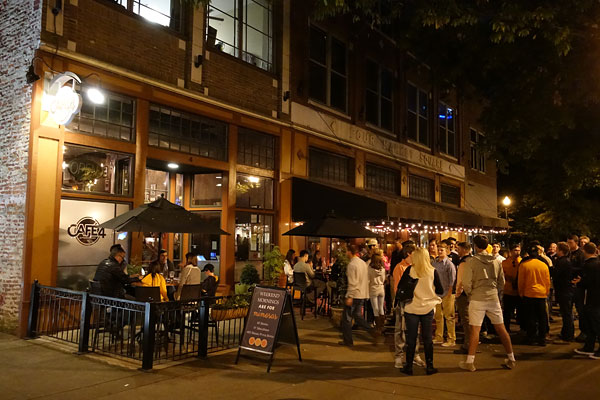 |
|
31mm-equivalent, 1/40 sec. @ f/2.5, ISO 5000 |
As for the remaining apps, some (such as photo retouching, picture effects and a beta of an app which lets you trip the shutter with a hand gesture) can be downloaded free of charge. Almost half of the available apps, including time lapse, multiple exposure, light painting and more are paid apps, though, with fairly steep pricetags of US$5-10 apiece, far more than you’d pay for similar single-function apps on your smartphone. If you decide to purchase all of the paid apps, you’ll need to spend another US$85 over the purchase price of your camera, based on current pricing and availability.
With that said, though, you don’t need to buy all of them by any means, and it does let you extend the functionality of your camera to fit your own needs, paying only for the apps which interest you personally. Really, I think the biggest drawback of these apps is that they have a completely separate, siloed menu system. (And that’s true of the Smart Remote app too, unfortunately.)

What do I mean by that? Well, as an example, consider this: You might have been shooting in raw format all day with your camera. If you then fire up the Smart Remote app, you might expect that you’ll continue to shoot in raw format — that’s how the camera was last set up, after all. But no: The file format in the Smart Remote app is set in its own separate menu, and doesn’t in any way relate to that set in other operating modes.
In fact, raw-only shooting isn’t even available with Smart Remote. Instead, you have a choice of JPEG or raw+JPEG shooting, and once you finish using Smart Remote, you’ll be back to whichever file format you’d been shooting in originally, once more.
The other reason I find these siloed menus unintuitive is that it can be confusing to remember how to access a given app’s functionality, if you don’t use it frequently. For example, with my own Sony RX10 II which I picked up a couple of years ago, I’ve found myself hunting through the menu system for ages trying to remember how to shoot a time-lapse, and knowing I’d done so before, so it must be possible. But because I had to actually fire up the time-lapse app and then use its own siloed menu to configure it, I couldn’t see any references to time-lapse photography elsewhere in the menu system.
Thankfully I realized my mistake eventually, but as I’ve said before, I’ll say again: Sony really needs to rethink these siloed app menus and simply combine the app functionality with the standard menu system once a given app is installed.

And so as I close out my field test, I come to perhaps the most contentious point of all: The pricetag. And make no bones about it, by compact camera standards, the Sony RX100 V is an expensive camera at around US$1,000 list. The real question is whether it can justify that pricetag.
For my money, the answer to that would be an unqualified yes. As I’ve said more than once in this field test, the Sony RX100 V is simply unrivaled. There is no other camera out there which will give you the same combination of image quality and performance, and yet which will slip into a pants pocket and remain there, almost forgotten, until the moment you need it most.
And it also bears repeating that where most camera manufacturers tend to see each new camera release as an opportunity to phase out an older model, the entire Sony RX100 lineup remains available at retail today. If the RX100 V’s pricetag is beyond what you can personally justify, there’s likely a model which does meet your needs at a lower cost.
But for those of us who want the most camera in the smallest possible space, right now, well… that would be the Sony RX100 V, and its spectacular capabilities more than justify the pricetag!
 |
|
25mm-equivalent, 1/30 sec. @ f/2, ISO 1250 |
Flash
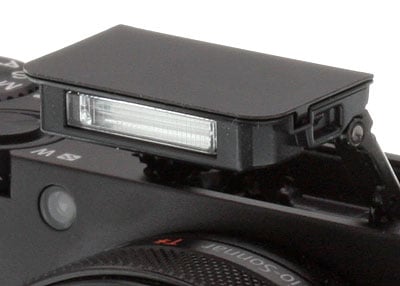
Flash Test Results
Coverage, Exposure and Range
A weak flash with somewhat narrow coverage. Typical for a compact, but range is helped by the fast lens.
 |
|
| Coverage, Wide Angle |
Coverage. Flash coverage was somewhat uneven at wide angle, leaving very dark corners and edges in our flash coverage test image. Narrow coverage at wide angle isn’t unusual, though, and some of the corner darkening is likely from the lens itself. We no longer test flash coverage at telephoto, as it is invariably better, making wide angle the worst case scenario.
 |
| Normal Flash, Auto ISO 640 +0.7 EV |
Exposure. Our Indoor Portrait test scene came out quite dim in our normal flash test at f/4 and Auto ISO, but with +0.7 EV flash exposure, the resulting image is well exposed however the camera had to boost ISO to 640 for that result. The shutter speed selected was 1/80s, which is good and should help avoid motion blur for most portraits.
| Manufacturer-Specified Flash Range |
|---|
| Telephoto |
 21.3 feet Auto ISO 1600 |
Manufacturer Specified Flash Range Test. The Sony RX100 V’s flash range is rated 10.2m or 33.5 feet at wide angle, and 6.5m or 21.3 feet at telephoto, with ISO sensitivity set to Auto. 33.5 feet is too long for our lab but at the range specified at full telephoto above, the Sony RX100 Mark V produced a reasonably well-exposed flash target, though it boosted ISO to 1600 to achieve that result. We shoot this test shot using the manufacturer-specified camera settings, at the range the company claims for the camera, to assess the validity of the specific claims.
Technical Info
by Mike Tomkins |
Posted 10/06/2016
Sensor
For the fifth straight generation, resolution from the Sony RX100 V’s 20.1-megapixel, 1″-type, backside-illuminated image sensor is all but unchanged from that of the previous model, suggesting that Sony is happy with the sweet spot it has found in terms of resolution and sensor size.
However, it’s not the exact same sensor used in the RX100 IV. This time around, Sony has added on-chip phase detection autofocus pixels, allowing for a super-speedy new hybrid autofocus system, which we’ll come back to momentarily.
As in earlier models, the Sony RX100 V’s Exmor RS-branded image sensor has a 3:2 aspect ratio. The total pixel count is unchanged from that of the RX100 IV, at 21.0 megapixels. Compared to prior models, it’s just fractionally higher than their 20.9-megapixel total counts.

Processor
Output from the Sony RX100 V’s brand-new image sensor is handled by the current-generation BIONZ X-branded image processor, which was also used by the earlier RX100 III and IV. However, unlike those cameras the RX100 V also sports a new front-end LSI chip which helps raise performance to even higher levels. If this feature seems familiar, that’s because we saw it first in the interchangeable-lens Sony A99 II, incidentally.
Sensitivity
Together, the pairing of image sensor and processor produce the exact same ISO sensitivity range offered by the RX100 III and IV.
For still imaging, the Sony RX100 V offers everything from ISO 125 to 12,800 equivalents by default, with the option to extend the lower end of the range to ISO 80 / 100 equivalents. Movie capture allows the same standard sensitivity range, but not the extended sensitivities.
You can also reduce noise levels for relatively static subjects using a Multi-Frame Noise Reduction function. When enabled, this allows a maximum sensitivity of ISO 25,600 equivalent.

Performance
While the sensitivity range hasn’t changed, there’s been a gigantic step forwards in terms of burst capture performance. (And the RX100 IV was already much faster than earlier models, so that’s really saying something.)
Where Sony rated the RX100 III for a modest 2.9 frames per second, and the RX100 IV for a more reasonable 5.5 frames per second, the RX100 V is now capable of a truly stellar 24 frames per second capture. That’s more than four times the performance of its predecessor, and it’s important to note that this manufacturer-supplied performance rating — which was borne out by our lab testing — includes both autofocus and autoexposure adjustments between frames.
In fact, to give you an idea of the magnitude of the improvement here, it’s worth considering the fact that even with autofocus locked from the first frame, the RX100 IV was still a full eight frames per second slower than the RX100 V’s performance rating with continuous autofocus tracking active!

Lens
Once again, Sony has retained the same ZEISS Vario-Sonnar T*-branded, 2.9x optical zoom lens featured in the RX100 III and IV for the followup RX100 V. It’s very bright, with a maximum aperture of f/1.8 at wide angle, falling to f/2.8 by the telephoto position. It’s also a bit shorter than the lenses of the RX100 and RX100 II, however, with a 35mm-equivalent focal range of 24-70mm.
Just as in the earlier cameras, it has a 10-element, nine-group design with nine aspheric elements, including one crafted from two Advanced Aspheric elements cemented together. There’s also a seven-bladed aperture iris, a Zeiss T* coating, and a built-in, three-stop neutral density filter that can be automatically or manually enabled or disabled.
Stabilization
Also just as in the RX100 III and IV, the Sony RX100 V’s lens also includes SteadyShot optical image stabilization for still images. When shooting movies, the more powerful Intelligent Active SteadyShot stabilization is used, and it’s coupled with electronic compensation as well.
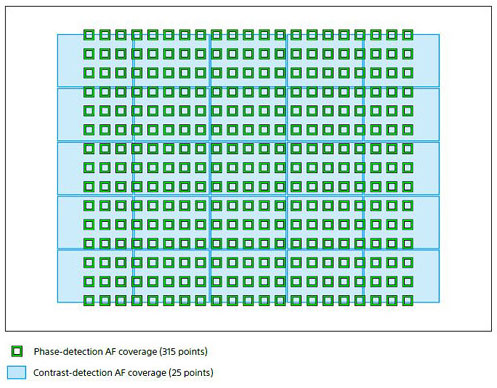
Focusing
The Sony RX100 V uses a new hybrid autofocus system, pairing both on-chip phase-detection AF pixels with a contrast-detection AF system. The former is used to determine the distance and direction of adjustment required to achieve an approximate focus lock, and then the latter steps in to fine-tune the focus adjustment.
In total, the phase-detection system sports a generous 315 focus points covering 65% of the image frame. In addition, there are 25 contrast-detection AF points.
The Sony RX100 V has a minimum focusing distance of five centimeters at wide angle, or 30 cm at the telephoto position, just as in the RX100 III and IV. Autofocus options are the same as in the RX100 IV, with a choice of Wide, Center, and small, medium or large Flexible Spot autofocus modes, as well as an Expanded Flexible Spot AF mode. And of course, you can still opt for single, continuous or Direct Manual Focus servo modes, as well as fully-manual, fly-by-wire autofocus.

Viewfinder
Like the RX100 III and IV before it, the Sony RX100 V has a clever popup electronic viewfinder that adds relatively little to the size of the camera body, but which adds much to its versatility. The display used in this viewfinder is the exact same model as in the RX100 IV. It’s deployed using a switch on the left side of the body (when viewed from the rear), and based around a 0.39-inch Organic LED panel with a resolution of 2,359,296 dots, which equates to a 1,024 x 768 pixel array.
When the viewfinder is raised, the camera will power itself on automatically if need be. You then manually pull the rear element of the finder backwards a little to lock it in position. Sony rates the viewfinder at 100% coverage with 0.59x magnification and a 20mm eyepoint. It also has a five-step auto / manual brightness control, and a -4 to +3 diopter adjustment for eyeglasses wearers.
Monitor
On the rear side of the Sony RX100 V is a 3.0-inch, 4:3 aspect Xtra Fine TFT LCD panel. It has the same dimensions and dot count — 1,228,800 dots — as that used in the RX100 III and IV, and is quite likely the very same panel. It also still has a five-step brightness adjustment plus a Sunny Weather mode for better visibility in direct sunlight. As in the RX100 IV (and unlike the RX100 III), there is no Auto brightness setting, however.
Articulation
As in its recent predecessors, the Sony RX100 V’s LCD monitor is mounted on an articulation mechanism. It’s not our favored side-swivel design, which is by far the most versatile option, but it’s still much more useful than a fixed-position LCD. It allows the display to be tilted upwards a full 180 degrees for selfie shooting, or downwards by 45 degrees for shooting over your head.

Exposure
Exposure modes in the Sony RX100 V are much as they were in the RX100 IV, but with one small change: There are now four Memory Recall modes instead of three, allowing you to save one additional group of settings, with a proviso: the first three Memory Recall modes can be stored in-camera, but four MR modes can be stored on the current memory card. Operating modes include Auto (either Intelligent Auto or Superior Auto), Program, Aperture / Shutter Priority, Manual, Scene, Panorama, High Frame-Rate, Movie and the aforementioned Memory Recall modes.
Exposures are determined using multi-pattern, center-weighted or spot metering modes, and shutter speeds range from 30 to 1/2,000 seconds with a mechanical shutter, or as fast as 1/32,000 second with an electronic shutter. There’s also a bulb mode function limited to a maximum of 30 seconds, and you can tune metered exposures with +/-3EV of exposure compensation in 1/3 EV steps.
Flash
If you need a little more light cast on your subject, a built-in flash strobe is provided. It’s exactly the same as that in the RX100 III and IV, with a range of 0.4 to 10.2 meters at wide-angle, or 0.4 to 6.5 meters at telephoto using auto ISO sensitivity.

Creative
We mentioned the panorama mode of the RX100 V a moment ago, but there are quite a few other creative options to choose from, as well. Most of them will be immediately familiar to Sony camera owners, including dynamic range optimization, multi-shot modes like Handheld Twilight and Anti Motion Blur, bracketing for exposure, white balance and DRO, and so on. And of course, you can tune images to your tastes with picture effects and creative styles.
Movie
Just as did its predecessor, the Sony RX100 V has received a significant upgrade in the movie department.
You can still record 4K videos (3,840 x 2,160 pixels at up to 30 frames per second), but these now gain the benefit of the new hybrid autofocus system, and they also now use almost the entire sensor width with no pixel binning or line skipping. That translates to a 1.7x oversampling of the image, which is downsampled automatically as it is captured to 4K resolution. As in the RX100 IV, 4K footage is limited to just five minutes per clip, likely due to the difficulty of getting heat out of such a small body.

The Sony RX100 V also retains its predecessor’s high frame-rate modes, but clip length has been doubled from either two or four seconds to four or eight seconds. NTSC / PAL mode sensor readouts as follows:
-
1,824 x 1,026 pixels
-
240 / 250 fps (quality priority, four-second clip length)
-
-
1,676 x 566 pixels
-
480 / 500 fps (quality priority, four-second clip length)
-
240 / 250 fps (shoot time priority, eight-second clip length)
-
-
1,136 x 384 pixels
-
960 / 1,000 fps (quality priority, four-second clip length)
-
480 / 500 fps (shoot time priority, eight-second clip length)
-
-
800 x 270 pixels
-
960 / 1,000 fps (shoot time priority, eight-second clip length)
-
HFR clips are upsampled to Full HD size (1,920 x 1,080) before being saved in XAVC S format with selectable playback speed options of 60p, 30p or 24p (50p or 25p in PAL mode).
The four and eight-second capture length limits may not seem like much, but keep in mind capturing eight seconds at 960 fps with a playback rate of 24 fps results in over five minutes of playback.
Standard speed movies include stereo audio, recorded courtesy of an on-board microphone on the top deck of the RX100 V.

Wireless connectivity
Like its predecessor, the Sony RX100 V includes both Wi-Fi and NFC wireless connectivity, allowing file transfer and remote control with Android or iOS smart devices, not to mention easy bump-pairing with Android. For iOS devices, or those rare Android devices without NFC connectivity, QR code pairing is also possible.
Wired connectivity
As well as its wireless connectivity, the Sony RX100 V also sports both a Type-D Micro HDMI port for high-def video output, and a Multi Terminal Micro USB port that provides a USB 2.0 High Speed data connection to your computer. The Multi Terminal also supports an optional RM-VPR1 wired remote control and tethered remote shooting from a Windows or Mac computer running Sony’s Remote Camera Control utility.
Storage
Images and movies are stored on a single slot compatible with either Secure Digital or Memory Stick Duo cards, and this is also compatible with SDHC, SDXC and UHS-I SD cards, not to mention PRO Duo, Pro Duo High Speed or PRO HG MS Duo cards. However, UHS-II cards are not supported, and so will fall back to UHS-I operation at reduced speeds.
Note that if you plan to capture XAVC S video clips, a Class 10 SDHC or SDXC card is required, and if you want to record 100 Mbps video, a UHS Speed Class U3 card is required.

Power
Power comes courtesy of a rechargeable NP-BX1 lithium-ion battery pack, the same type used in all earlier RX100-series cameras, and the battery is charged in-camera via the Multi Terminal Micro USB port. Sony rates battery life as 220 shots using the LCD monitor, or 210 shots with the electronic viewfinder, to CIPA standards. That’s a fair bit less than the RX100 (330 shots), RX100 II (350 shots), RX100 III (320 shots) and RX100 IV (280 shots), so you’ll definitely want to pick up a second battery pack.
Conclusion
by Mike Tomkins | Posted: 05/02/2017
It’s been five years now since Sony first wowed us with its RX100, a pocket-friendly compact camera that defied convention with a far larger than average 1-inch type image sensor. In the years since then, that trendsetting camera has spawned an entire series with which it shares its name, not to mention some challengers from rivals Canon and Panasonic.
Yet in a world where we now have a good bit of competition for cameras based around the 1-inch sensor size, the Sony RX100 V somehow still manages to stand unchallenged, offering performance that’s simply in a different class from its rivals. And for good measure, it also manages to pack in not just high-speed still capture, but also high-quality 4K video capture and a raft of incredibly fun high frame-rate video capture modes.
|
|
|
70mm-equivalent, 1/2,000 sec. @ f/3.5, ISO 160 |
With a maximum burst capture speed of 24 frames per second even while allowing for autofocus and autoexposure adjustments in between each frame, performance is clearly the big selling point for the Sony RX100 V. And yet this is very much not a sports-oriented camera, a fact which can leave you wondering just whom its target customer is. With a relatively short 2.9x zoom lens as dictated by its pocket-friendly design, you really need to be close to the action if you want great shots out of the RX100 V — far closer than you’ll manage at most sporting events without special access.
But here’s the thing — performance of this magnitude isn’t just a boon when shooting pro sports. It can also prove very helpful to have a little something extra on tap, even if you’re “just” the family documentarian, constantly reaching into your pocket to grab a snapshot of the kids and pets, or perhaps recording your own family’s sporting endeavors for posterity.
Do you really need 24 full-resolution frames a second just to show little Billy’s amazing slide into home at the ball game? No, but that’s not really the point. Once you have all those full-res frames of the game-winning slide, you can sort through them post-capture to choose just the very best one or two frames, discarding those where the pose wasn’t just right, or home plate was just a little too far away, or someone stepped in front of the camera at just the wrong moment. Instead of coming home with just a so-so shot or two of the action, those 24 full-res frames each second will buy you extra chances at getting the great shot you were really after, something that’s truly worthy of putting up on the wall or in the family album.
 |
|
34mm-equivalent, 1/2,500 sec. @ f/2.8, ISO 6400 |
And once you’ve shot with a camera this swift, believe me when I say that you won’t want to go back to the old way of trying to hone your reflexes, frequently coming oh so heartbreakingly close to a great shot, but all too often missing that perfect moment. The performance on tap in the Sony RX100 V would be special even in a hefty interchangeable-lens camera. It’s simply unheard of in something that you can slip almost forgotten into a pants pocket, and it is incredibly liberating to have all of that power on tap when you need it.
And the RX100 V is a pretty swift camera in most other respects too, although in the absence of UHS-II card support, its sedate write speeds are still something of a weak spot. On the plus side, there is now at least an indication of how many frames remain in the buffer at any given moment, so you can get a sense of how long you have left before the buffer clears if you’re stuck waiting to enter the menu system.
|
|
|
54mm-equivalent, 1/60 sec. @ f/4, ISO 125 |
Most likely, the prospective Sony RX100 V buyer won’t already own the preceding RX100 IV model, as while the new RX100-series flagship boasts much greater performance and adds on-chip phase-detection autofocus capability, it is in most other respects quite similar to that camera. But if you’re upgrading from an earlier RX100-series model, you’ll be pleased to hear that the RX100 V sports the same basic layout as every other model in the line right back to its very start. You’ll feel right at home from the get go, but with a much more powerful camera in your hands than was previously the case.
If you’ve not shot with an earlier RX100-series model, what you need to know about the Sony RX100 V is that it’s small enough to slip into all but the tightest of pants pockets, yet fairly comfortable in-hand with the main controls all quite well-placed, considering the challenges of fitting close to 20 controls on such a small body. And the RX100 V is pretty intuitive in operation for the most part as well, although with so many features the lengthy menu system can be a bit intimidating initially.
|
|
|
70mm-equivalent, 1/200 sec. @ f/10, ISO 160 |
The built-in, popup viewfinder is a nice touch, and while shooting at arm’s length feels more natural in a body this small most of the time, it is really nice to be able to raise that finder to your eye when you want to get a better sense of framing, or when harsh, direct sunlight makes the main LCD too hard to view properly. Really, the only thing you might find offputting ergonomically is that the Sony RX100 V (like its siblings) has a pretty smooth, featureless front surface that can feel worryingly slippery in-hand. Thankfully, both first and third-party handgrip accessories are readily available to address this concern.
Also relatively little-changed from the RX100 IV is the Sony RX100 V’s image quality. That’s great news, as while it’s not perfect — there are some noticeable color shifts by default, white balance can be a tad warm indoors and there’s a slight tendency to overexpose — the RX100 V and its predecessors share very good image quality by compact camera standards. Especially so when compared to small-sensor, entry-level point-and-shoot cameras. Sure, once you raise the sensitivity some you’ll start to see higher noise levels and the aftereffects of noise reduction algorithms, but you won’t find much better quality elsewhere without stepping up to a larger sensor size — and most likely, a much larger camera as well.
|
|
|
24mm-equivalent, 1/60 sec. @ f/2.8, ISO 125 |
And the Sony RX100 V doesn’t just give you great stills, but also extremely high-quality 4K video. Here, it has a couple of key advantages over the preceding RX100 IV, both achieved thanks to the fact that it now uses the entire sensor width without pixel binning or skipping when recording 4K clips. For one thing, ultra high-def video quality is now even better, and for another there’s now no longer a significant crop when shooting 4K video, making wide-angle footage easier to achieve.
Given the harsh thermal constraints of such a pocket-friendly design, it’s impressive that Sony has been able to provide oversampled 4K capture in-camera. Getting so much data off the sensor, processed and stored in real time generates a significant amount of heat, and extricating it from a small, smooth, pocket-friendly body must have presented quite a challenge for Sony’s engineers.
Unfortunately, there’s a five minute clip length limit which is almost certainly a result of that challenge. For the typical RX100 V owner, that’s probably just fine. After all, you’ll likely get better results shooting your family videos as a succession of short clips than as huge, lengthy videos that will require a lot of editing work to make manageable later on. But if you do need the ability to shoot lengthy 4K footage uninterrupted, you’ll want to consider a different camera.
|
|
|
67mm-equivalent, 1/1,000 sec. @ f/2.8, ISO 6400 |
Once you’re done shooting and are ready to start sharing, the Sony RX100 V’s in-camera Wi-Fi and NFC radios make light work of getting content off the camera and (via your smartphone or tablet) online, where friends and family can enjoy it all too. That’s doubly true for Android users, where sharing individual images can be as simple as just tapping your phone and camera together while looking at the image you want to share on the RX100 V’s display.
And you can also control the Sony RX100 V remotely via Wi-Fi, which can prove very handy if you want to avoid shaking the camera in low light, avoid disturbing your subject, or even if you just want to get yourself into the shot. It’s a little frustrating that you need to sign up for a free account with Sony, connect to a Wi-Fi network, log into the account using a seriously fiddly on-screen keyboard from the camera, and then download an updated version of the requisite PlayMemories camera app to do so, though. We’d have liked to have seen the fully-featured remote control app installed on the camera out of the box in place of the existing, cut down version, especially given that the fully-featured version is available free of charge anyway.
But be that as it may, we think Sony’s Wi-Fi implementation is among the best out there right now, and it’s a nice touch that the camera’s feature set can be extended using the PlayMemories apps in the first place.
|
|
|
39mm-equivalent, 1/40 sec. @ f/2.8, ISO 2500 |
Really, if the Sony RX100 V has an Achilles Heel, it has to be its battery life. That’s quite easy to understand when you look at not just how pocket-friendly this camera is, but also how small its battery pack must be to allow for that pocket-friendliness. To CIPA testing standards, battery life has fallen significantly since the RX100 IV, and is now well below average for its class.
Of course, the CIPA standard isn’t necessarily the best indicator of battery life for a camera like this. If you shoot bursts of images liberally, you’ll likely achieve many times more shots on a charge than the CIPA figures would suggest to be possible, because those figures were determined with liberal flash use, frequent zoom adjustments and power cycles, and a whole lot of sitting around burning power through the LCD or viewfinder without actually shooting anything.
But while you may achieve a whole lot more frames on a charge than the CIPA figures would suggest, you’ll likely also find yourself shocked by just how quickly you can drain the battery when shooting lots of bursts or 4K video with the Sony RX100 V. It’s no exaggeration to say that even with a brand-new, fully-charged battery, it’s quite easy to completely deplete its charge in a matter of just 90 minutes to two hours.
|
|
|
31mm-equivalent, 1/40 sec. @ f/2.5, ISO 5000 |
Thankfully, the batteries used are so slim and light that it’s easy to carry a few spares in a pocket, but we’re starting to think that Sony might be well advised to considering splitting the RX100-series into two distinct lines — one aimed at maximum pocketability, and another aimed at performance first and foremost. The latter could still be quite pocket-friendly, but with the addition of a shallow grip could at once remove the need for a third-party accessory grip and could provide more room for a larger, longer-lasting battery pack.
But quibbles about battery life aside, there’s no question that the Sony RX100 V is a really fun camera to shoot with. As we noted at the outset, it is simply unrivaled in the current camera market. No camera even remotely as small as this one can provide such jaw-dropping performance, let alone fit in a pants pocket as the RX100 V happily does.
With no realistic competition from its rivals right now, Sony finds itself in a seller’s market, able to ask whatever it feels appropriate in terms of pricing without needing to concern itself with its rivals’ pricing. And make no bones about it: For a compact camera, the Sony RX100 V’s US$1,000 price tag is a very steep one indeed. But if you can justify that cost, the RX100 V will help you to get photos that no other pocket-friendly compact could have managed. No question about it: This one’s a very clear Dave’s Pick, and we’re more than a little misty-eyed at the prospect of having to give it back now our review is over! 😉
|
|
|
25mm-equivalent, 1/30 sec. @ f/2, ISO 1250 |
Pros & Cons
Image Quality
- Slightly improved image quality and high ISO performance
versus the (already impressive) Mark IV version
- JPEGs can look overprocessed at higher sensitivities, with heavy-handed noise reduction
- Slightly below average saturation levels and hue accuracy
- Warm auto white balance indoors
- Slight tendency to overexpose
Performance
- Crazy fast full-resolution burst speeds up to 24fps *with* continuous autofocus and autoexposure adjustments!
- Deep buffers despite incredible burst speeds, even if you’re a raw shooter (!!)
- Fast single-shot AF (but tested 30ms slower than Mark IV at wide angle, 18 ms faster at tele)
- Very low shutter lag of eight milliseconds, one of the lowest we’ve tested
- Up to 1/32,000s shutter speed with electronic shutter
- No UHS-II support and slow card write speeds means potentially lengthy waits for the buffer to clear
Video
- In-camera, ultra high-def 4K video recording
- Clean HDMI output while recording 4K internally
- Super-fast high-speed video modes now have much longer recording limits
- Short five-minute clip length limit for 4K movies
- Still forces you to upsample high frame-rate videos in-camera, wasting time, power and storage space and potentially missing the next shooting opportunity while you do so
User Experience
- Familiar design is just about pants pocket-friendly for true take-anywhere convenience
- Built-in three-stop ND filter
- Fun and useful multi-shot modes
- In-camera wireless networking technology makes sharing quick and intuitive, especially on Android
- Extensible through Sony’s PlayMemories camera apps (although many do come with a pricetag)
- Still no touch screen 🙁
- PlayMemories apps are siloed from the rest of the user interface, which can prove confusing
- Poor battery life
to CIPA standards (but expect to far exceed CIPA’s frame counts if shooting lots of bursts, albeit changing batteries every couple of hours if shooting bursts or 4K video liberally) - Menu system can’t be accessed or camera powered back up after shutdown unless the buffer has first finished clearing
- Extremely expensive for a pocket-friendly compact (but essentially unrivaled)
Optics
- 24-70mm zoom lens has good performance and a very bright f/1.8-2.8 max. aperture
- Extremely swift new hybrid autofocus system with 315 phase-detection AF points
- Limited zoom range doesn’t give much telephoto reach
- Macro performance not quite as good as some competitors
Flash
- Built-in, popup flash strobe is with you whenever the camera is
- Nicely meets Sony’s stated range, albeit at ISO 1600
- Popup flash is weak (as is typical in compacts) with somewhat narrow, uneven coverage
- No external flash connectivity