
Overview
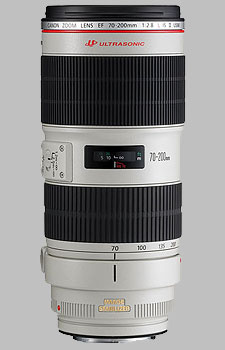
Canon announced its update to the 70-200mm ƒ/2.8L IS leading up to CES2010. A go-to lens for most Canon professionals, the new version of the telephoto zoom lens features a revision to the optical design (using 5 UD glass and 1 fluorite glass element) and a slightly closer minimum focusing distance (1.2 meters instead of 1.3).
The EF lens is compatible with both sub-frame and full-frame sensor camera bodies, and uses a constant ƒ/2.8 aperture across all focal lengths. On a sub-frame body, the effective field of view for the lens is 112-320mm; on a body such as the Canon 1D mark IV, with its APS-H-sized sensor, the lens provides an effective field of view of 91-260mm.
The lens ships with the ET-87 petal-shaped lens hood, a lens case, and tripod mount. The lens is available now for around $2,450.
August 30, 2010: We’ve added our new image stabilization test for this lens.
Sharpness
Beginning with the lens mounted on the sub-frame 20D, we noted excellent results for sharpness at all focal lengths, even wide open at ƒ/2.8. Performance at ƒ/2.8 is not tack-sharp, but it’s quite close at around 1.5 blur units. Stopping down to ƒ/4 provides a marginal increase in performance, and at 100mm and ƒ/4 it is indeed about as sharp as our testing can measure. There are tiny gains from ƒ/5.6 onward, but the focal range between 135mm and 200mm never hits 1 blur unit; by ƒ/11, diffraction limiting begins to set in, and impacts on overall sharpness. At this point it’s more notable at 200mm, where we see 1.5 blur units; at the other focal lengths, we still note excellent sharpness results, between 1 and 1.5 blur units.
Stopping down further impacts significantly on sharpness, until we see between 2-2.5 blur units at ƒ/22, and around 4 blur units, fully stopped down at ƒ/32.
The full-frame 5D is even more demanding on the lens. Wide open at ƒ/2.8, the lens shows its best performance at 70mm, with a generous sweet spot of 1-1.5 blur units in the center of the frame, degrading slightly to some corner softness; around 2 blur units. From 100mm and up we note increasing corner softness and a lessening of that sharp sweet spot until it’s just over 1.5 blur units in the center and 2 in the corners at 200mm.
Stopping down provides additional sharpness, but never does the lens reach absolute, 1-blur unit “tack” sharpness across the frame (it comes very close, for instance 70mm at ƒ/8). Still, it’s very sharp indeed. At ƒ/16 diffraction limiting has set in, with the lens providing a consistent 1.5 blur units across the frame. At ƒ/22 the lens shows 2 blur units across the frame, and interestingly, at ƒ/32 it shows 3 blur units across the frame (as opposed to the 4 blur units we noted with the 20D at that aperture).
Chromatic Aberration
You have to peep very closely to the 100% crops of our sample images to detect any chromatic aberration at all with the Canon 70-200mm ƒ/2.8 II; that fluorite element is clearly earning its keep. In short, there is hardly any to speak of, and where it does show is in the corners at either 70mm or 200mm.
Shading (”Vignetting”)
On the sub-frame 20D, corner shading isn’t really an issue with this lens. The only light falloff to speak of is found at 200mm and ƒ/2.8, where the corners are just over a quarter-stop darker than the center. Not much to write home about.
On the full-frame 5D, it’s another story however, with significant corner shading when the lens is used wide open. It’s slightly more forgiving at 70mm; at 100mm and greater, using the lens at ƒ/2.8 produces corners which are almost a full stop darker than the center. This reduces to a half-stop, a third of a stop and a quarter-stop at ƒ/4, ƒ/5.6 and ƒ/8 respectively. When used at 70mm, this light falloff reduces earlier, with the corners being only a third of a stop darker than the center at ƒ/4, and less than a quarter-stop darker at ƒ/5.6.
Distortion
Results for distortion are typical of telephoto zoom lenses, with some barrel distortion at the wider end, and pincushion distortion at the telephoto end. The point of convergence (where there is neither type of distortion) is balanced nicely at around 105mm. As you would expect the distortion isn’t as significant with the lens mounted on the sub-frame 20D; it shows just +0.25% barrel distortion in the corners at 70mm and -0.2% pincushion distortion in the corners at 200mm. With the lens mounted on the full-frame 5D, it’s a bit more prominent, with +0.5% barrel distortion in the corners at 70mm, and -0.5% pincushion distortion in the corners at 200mm.
Autofocus Operation
As an L-class lens with Canon’s USM focusing technology, there aren’t many lenses which will keep up with the focusing speed of the EF 70-200mm ƒ/2.8L IS II USM. It takes well less than a second to go through the focusing range. The lens makes almost no noise as it does this. As well, autofocus results can be overridden at any time by simply turning the focusing ring. The autofocusing speed can also be improved by restricting the focusing distance: a switch allows the user to select between two focusing ranges, either 1.2m to infinity or 2.5m to infinity. The front element of the lens does not rotate during focusing, making life that little bit easier for polarizer users.
Macro
While the lens isn’t intended as a macro lens, its minimum close-focusing distance has been improved, at just 1.2 meters (just under four feet). The magnification is 0.21x.
Build Quality and Handling
Like all the white-body L-series Canon lenses, build quality on the EF 70-200 mm ƒ/2.8L IS II USM is exceptional, incorporating seals for weather and dust-resistance. It’s built like a tank, and frankly weighs like one as well. This is a very heavy lens (over three pounds), not one that you’re going to want to hand-hold all day. Combined with its image stabilization, a monopod with a ball head would be a great way to work with this lens. If you do have to handhold it though, the IS works very well. Canon claims four f-stops of shake reduction, and we will be hopefully be producing some evidence to discuss the accuracy of this claim in the near future.
There are several control and information points on the lens that are worth noting. In addition to the focus and zoom rings, there are four command switches. From top to bottom, you have the focus limiter switch (described previously) and a switch to enable or disable autofocus on the lens (“AF / MF”); there are then two switches to control image stabilization. The first activates or deactivates the system (“ON / OFF”) and the second selects the image stabilization mode, mode 1 (for stabilization both horizontal and vertical motion) and mode 2 (for stabilizing just vertical motion, suitable for panning shots). A window provides distance information in feet and meters, and while there is no depth-of-field scale, there is an infrared index.
The focusing ring is quite large (slightly larger than the previous version, in fact), composed of rubber with small ribs about 1 3/4 inches wide. The ring provides excellent manual focusing fidelity, with a slightly smooth resistance and plenty of travel. The ring ends in soft stops on both ends of the focusing spectrum, and will focus past infinity.
The zoom ring is composed of rubber with large ribs, about 1 1/4 inches wide. The ring takes about seventy degrees of turning action to go from 70mm to 200mm, and again, the ring is very smooth, firm but not too tight; it requires two fingers to move. Zoom creep isn’t a problem with this lens, and there is no lens extension during zoom operations.
The ET-87 lens hood is petal-shaped, attaches via a bayonet mount, and adds about three and a half inches to the overall length of the lens. The interior of the hood is flocked to reduce any stray light, and there’s a locking mechanism to keep the hood attached to the lens. It’s a pricey item: around $75 to replace.
The lens features Image Stabilization, and you can see our IS Test for more details there.
Alternatives
Canon EF 70-200mm ƒ/2.8L IS USM ~$1,900
The twenty-four hundred dollar question is whether or not the new lens is worth the upgrade from the old. Without question, the new lens is sharper than the old, but the gain is mostly at 70mm. The old version of the lens was very sharp indeed. Thanks to the fluorite lens elements, chromatic aberration is reduced to minimal levels, but the old lens didn’t really suffer from CA. The other characteristics – distortion and corner shading – are essentially the same. Canon claims an extra stop of image stabilization with the new lens.
Canon EF 70-200mm ƒ/2.8L USM ~$1,200
If you can live without image stabilization, Canon also offers the previous model in a non-IS version. The lens proved to be slightly sharper than the previous IS-version, but the new IS 70-200mm f/2.8 lens is sharper than them both (at double the price, you’d hope it would be). CA, distortion and corner shading are at about the same level.
Sigma 70-200mm ƒ/2.8 EX DG OS HSM APO ~$2,500
We haven’t yet tested this new lens from Sigma, and it doesn’t yet seem to be shipping. At the price point suggested by Sigma, it will have to be a very good lens indeed to justify an off-brand purchase by Canon users. Non-OS lenses from Sigma in this focal length range have been very sharp, with HSM motors providing very fast autofocus results.
Tamron 70-200mm ƒ/2.8 Di LD IF Macro SP AF ~$730
Tamron also offers a 70-200mm alternative, though Vibration Control (VC) technology hasn’t yet been added to this lens. Even so, it’s one of the sharper 70-200mm offerings, though chromatic aberration is more evident. Distortion and corner shading are about the same.
Conclusion
This one’s fairly straightforward: if you were looking, you probably were already thinking about getting this lens, and there’s nothing to fault it. If absolutely need image stabilization and the sharpest, best image quality in a 70-200mm zoom, it’s money well-spent. However, if you are less picky, you probably won’t be disappointed with the tried-and-true original version of the 70-200mm f/2.8 IS, either. Canon’s made some impressive fine-tuning adjustments to the lens, but unlike other manufacturers, no one was really complaining about the original version of the lens so much that it needed a refresh.
Sample Photos
The VFA target should give you a good idea of sharpness in the center and corners, as well as some idea of the extent of barrel or pincushion distortion and chromatic aberration, while the Still Life subject may help in judging contrast and color. We shoot both images using the default JPEG settings and manual white balance of our test bodies, so the images should be quite consistent from lens to lens.


As appropriate, we shoot these with both full-frame and sub-frame bodies, at a range of focal lengths, and at both maximum aperture and ƒ/8. For the ”VFA” target (the viewfinder accuracy target from Imaging Resource), we also provide sample crops from the center and upper-left corner of each shot, so you can quickly get a sense of relative sharpness, without having to download and inspect the full-res images. To avoid space limitations with the layout of our review pages, indexes to the test shots launch in separate windows.
Description
(From Canon lens literature) Improving upon one of the most celebrated lenses in the Canon EF line is no easy feat, but Canon has done just that. The all-new EF 70-200mm ƒ/2.8L IS II USM increases the speed, performance and optical quality of the EF 70-200 ƒ/2.8L IS USM while maintaining all of the characteristics that have made it a legend for professionals and advanced amateurs alike.
The EF 70-200mm ƒ/2.8L IS II USM features one fluorite and five UD elements for increased optical quality and reduced chromatic aberration. It has a minimum focusing distance of 1.2m/3.9 ft. at all zoom settings, which is useful for photographers in smaller spaces trying to get closer to a subject.
It features a next-generation Optical Image Stabilizer, providing up to 4 stops of correction at all focal lengths. And as with all L-series lenses, the EF 70-200mm ƒ/2.8L IS II USM is dust- and moisture-resistant and designed for use in the challenging environments typical of rigorous professional use.
Lab Test Results
Our standard lens lab tests, shot on full-frame and sub-frame bodies. Pick a focal length and aperture to see the result.
Sharpness (blur index)
Blur across the frame: lower and flatter is sharper. Change focal length and aperture to see how it improves when stopped down.

Chromatic aberration
Colour fringing in the corners at each focal length.

Vignetting (corner shading)
How much darker the corners are than the centre, by aperture and focal length.

Geometric distortion
Barrel (positive) or pincushion (negative) distortion across the zoom range.

Image Stabilization
Canon has been through a number of generations of image stabilization systems now, and the maturity of their technology shows in the 70-200mm f/2.8 IS II’s performance. At 70mm with an already fairly steady shooter, we found that it delivered a bit over three stops of shake reduction. At the wider end of its range, IS performance degrades relatively gradually, in that the percentage of sharp shots decreases steadily over a range of 3-4 stops of shutter speed. This means you may still get a small percentage of “keepers” even at shutter speeds more than 3 stops beyond your normal “safe” hand-holding range. This contrasts with some lenses and camera bodies that seem to maintain a high percentage of good shots to a certain shutter speed range, and then run out of steam fairly quickly. As we’ll see below, this lens more closely follows this second behavior at the 200mm end of its range.
 |
| Mouse over this chart to show results with IS activated. |
At 200mm, the shake reduction was comfortably four stops, Canon’s claimed level of performance. It’s actually fairly rare to see lenses delivering the full amount of shake reduction claimed by their manufacturers, so the Canon 70-200mm f/2.8 IS II is a rare bird, indeed. Our main lens tester Rob is a very stable shooter, but the size and weight of this lens took a toll even on him, as witness that only 50% of his shots were acceptably sharp at 200mm and 1/160 second with the IS turned off. With the IS on, though, 70% of his shots were tack-sharp and an additional 10% acceptably sharp at 1/10 second. That deserves repeating: 80% of shots were sharp at 200mm, handheld at 1/10 second. That’s just flat-out amazing. When it does finally run out of motion-compensation ability, though, it happens fairly rapidly: The percentage of keepers went from 80% at 1/10 second to just 20% at 1/5 second.
 |
| Mouse over this chart to show results with IS activated. |
IS systems tend to provide more benefit to less-stable shooters than very steady ones, so most users will see the same or greater amounts of shake reduction as we measured here. You can read more about our IS test methodology here: SLRgear IS Test Methodology, v2.
Reader Reviews
- Image quality
- 10/10
- Build quality
- 10/10
- Recommend it
- 100%
- 10/10Recommendedby caMARYnon · November 3 2014 · paid $2500
Pros: IQ, IS, AF, BQ, Bokeh
Cons: weight
Nothing new to add.
- 10/10Recommendedby mariuspavel · July 19 2014 · paid $2499
Pros: super sharp, IS, build quality
Cons: price and weight
Without a second thought this is the lens to have. A must have for any professional photographer looking to max out his or her arsenal. A key piece of glass that will not only expand your skills but increases your overall performance as a photographer. Great in low light, ideal for concert photographers, incredible bokeh. Grab this lens ASAP. Check photos with this lens here - www.mariuspavel.ro/trash-dress/
- 10/10Recommendedby rifqi36 · October 28 2013 · paid $2251
Pros: BOKEH + DETAIL + FOKUS PALING CEPAT
Cons: BERAT BOSS
SANGAT BAGUS SANGAT COCOK UNTUK YANG PENCINTA TELEPHOTO...
DAN RECOMENDED BANGET KALAU YANG PUNYA BUDGET BANYAK
HARGA RP. 24.799.000
Waktu Gw Beli Kemaren,,,,
- 10/10Recommendedby waro52 · November 12 2012 · paid $2200
Pros: sharpness, contrast, color fidelity, Canon L quality
Cons: weight
Another awesome 70-200 zoom from Canon. I think this lens is sharper than my f4 IS version, which is incredible. For indoor sports it focuses quickly with no mircoadjustment needed on either of my bodies. The only bummer is it's weight. Small price to pay for the images it produces.
- 10/10Recommendedby Pino · February 29 2012 · paid $2350
Pros: not too heavy for walking in the forest
not too heavy for walking in the forest ,even with the extender. With extender monopod recommended.
Verry fast and sharp AF even with the extender X2.
Used for nature and close ups.
http://www.panoramio.com/user/971669
http://www.hdr-photgraphy.be
- 10/10Recommendedby ddoy2k · November 9 2010 · paid $1200
Pros: Solid as a Rock
Cons: Bulgy
I got this lens as a second hand from a friend for 1/2 the price [$1,200] as if it were brand new [$2,400]. I am only an amateur but the photos taken from this lens give everyone the impression that I am a professional. Just having the lens attached to my 7D make me look like a professional. Three weeks ago, I assisted the main photographer at a wedding and the newlywed couple told me after seeing my work that they were going to use 70% of my photos for their wedding album so that gotta tell you something positive about the lens. This lens is a MUST have for portrait and wedding photography. Customers and clients are always expecting more for their money, and this lens will not fail you. Expect to receive comments like, "WOW", "AMAZING", and "GREAT" shots from friends and families when using this lens. Let the lens do the work, and you get the credits.
- 10/10Recommendedby Xven · July 19 2010 · paid $2
Pros: Sharp, sharp and sharp
Cons: Heavy, expensive
I started with a 70-200 F4 IS three years ago and back then I choose the F4 version over the F/2.8 because the F4 was sharped, lighter and cheaper. Few weeks ago I went out and spend a lot of money on the new F/2.8 version. It is still heavy and it is still expensive (even more today then ever), but it is also sharper - a lot more sharper. I'll claim it is like the F/4 version - but at F/2.8. I managed to sell my used F/4 for $70 then I gave and putting additional $1100 for the F/2.8 I have a dream lens. If you are looking for something light - don't go for this baby - it is very heavy, and the sharpness is almost the same with the F/4. But if you want the extra step, the latest in IS (now up to spec with the F/4) and the latest in sharpness, this is the lens to go for. In terms of money it is too expensive, and the best value for money is IMHO the F/4 version. But if just just the BEST, this is it.
- 10/10Recommendedby bangkokuwa · May 26 2010 · paid $2100
Pros: super fast AF, super sharp wide open, amazing CA control .
Cons: a bit busy bokeh.
it is simple , it is the best zoom ever made in any mount available today.
I replaced my f4LIS with this one , I use 5D2 as my main cam and 7D as a back up and for action or reach limited applications.
I also have the Nikon D700 and D300s, I also had the AFS70-200f2.8GEDVR2 , it was a really good lens also , but the Canon was simply better , sharper at wide open ,with a bit less CA to deal with.
So, I sent back my Nikon vR2 and kept this amazingly sharp Canon zoom.
To be honest , the only real reason why we choose a f2.8 zoom over the perfectly fine f4LIS version is good wide open performance at f2.8, so I do not care if this or the Nikon sharp at f5.6 but at f2.8 it must be better than my f4LIS at f4 , and it is better than the f4LIS at f2.8.
So, I have no regret choosing this over the Nikon VR2.
But that said , if I could wait it , I would wait the Sigma FLD to be out and compare this lens to the Sigma , and then decide which 70-200f2.8 lens to keep.
Any way , I think I go wide with my D700 and long with my 7D and 5D2.
it is the best zoom ever made and replaced my 3 primes in its range effectively ,so it is worth every penny.
Show all 10 reader reviews
- 9/10Recommendedby chrisjoerg · May 20 2010 · paid $2380
Pros: superb image quality - even wide open, IS, build quality, autofocus
Cons: price, a little posh, white, makes you dislike other lenses ;-)
Finally I grasped the nettle, spent a lot of money and got it! And? Wonderful!
I upgraded from the 70-200 f4 IS and it's definitly worth the money.
Backgroud blur / bokeh is amazing, images are pin sharp, even @ f/2.8 - and that's what I bought it for.
Didn't have much time to leran using it properly, but here are some first impressions:
First impressions of the new Canon EF 70-200mm f/2.8L IS II USM:
http://www.christianjoerg.de/joomla/index.php/equipment/canon-lenses
The only problem is, that you really start to avoid other lenses (maybe except some primes). The image quality is so good, that I don`t want to use my 24-105 f4 L no more. I always think: "Can I do the shot with 70mm+ focal length?" But I can accept this... ;-)
www.christianjoerg.de
[email protected]
- 10/10Recommendedby MalteR · April 27 2010 · paid $2950
Pros: perfectly sharp, ultra fast AF, built like a tank, strong IS
Cons: a bit heavy
I just got the chance to try out that lens and, folks, i found nothing to critizise at all. This one is simply outstanding in every aspect.
When i first used it on a 5D Mk II, i was wondering why it felt so heavy, there is obviously more mass in front than in the 70-200/4IS. But if you manage to hold it properly, you wont get any problem.
Weight/price is the only point against that lens at all. It is perfectly sharp at all apertures and all focal lengths, on the level of a superb prime (like my 100/2.0). Contrast, Bokeh, Abberations - simply outstanding. The AF is the fastest i have ever experienced in a tele zoom, and finds its target immediately. The IS seems to be even superior to the ones in the 70-200/ 4.0 IS oder the 70-300/4-5.6IS.
Reader reviews were submitted by Imaging Resource readers and are shown as written.