
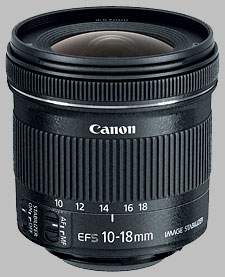
Overview
In what could be considered one of the best deals for Canon APS-C shooters, the new Canon EF-S 10-18mm ƒ/4.5-5.6 IS STM ultra wide-angle zoom lens is small, lightweight, very affordable and, as it turns out, quite the solid performer.
Canon already released an APS-C ultra wide-angle zoom lens — the EF-S 10-22mm ƒ/3.5-4.5 USM — back in 2004, and earned a lot of praise for its image quality. However, it’s significantly larger, heavier and pricier than this new 10-18mm lens, albeit a little faster with the ƒ/3.5-4.5 aperture range. As a compromise for the slower apertures, the Canon 10-18 features an IS system — rated up to 4-stops at 18mm — and combined with Canon’s STM focusing, this new lens should make it a hit with those looking for a small, fast-focusing lens as well as with HD-DSLR video shooters.
The 10-18mm, however, it not meant as a replacement to the 10-22mm. The small, lightweight build makes is a perfect pairing with Canon’s smaller, more entry-level DSLRs like the Rebel T5i or SL1, making a much more compact and convenient pairing when traveling. Based on our test results below, however, the new budget-friendly Canon 10-18mm lens is going to give the older 10-22mm lens a run for its money.
The Canon EF-S 10-18mm ƒ/4.5-5.6 IS STM is currently available for purchase at the low price of $299 (ships with front and rear caps; a lens hood and soft carry bag can be purchased separately), and can be purchased at one of our trusted affiliates: Amazon, Adorama and B&H. Purchasing this lens, or any other item, at one of these retailers helps support this site and keep these reviews coming!
Sharpness
Despite the appearance of a rather basic lens with a very affordable price tag, the Canon 10-18mm lens is an extremely sharp lens — even wide-open and at its widest focal length. At 10mm, the lens displays very sharp centers with only a hint of corner softness. In fact, it’s practically as sharp at ƒ/4.5 as it is stopped down to ƒ/8! And it’s the same story in terms of sharpness at the other focal lengths as well — very sharp images from wide-open to around ƒ/11. Past ƒ/11, you can start to see diffraction take its toll on image sharpness, especially at the longer focal lengths. All in all, this is an impressive lens in terms of sharpness at all focal lengths, and even more so given its amazing price.
Chromatic Aberration
The new Canon 10-18mm lens includes one UD element in its optical construction to help combat chromatic aberration. However, despite this, CA is still noticeable at all focal lengths — both wide open and stopped down to ƒ/8 — though only in the corners, which isn’t all that uncommon with ultra-wide lenses. Corner CA shows up as light green and purple fringing, which while present, should be easily correctable in post-processing. The center areas of our test shots, however, display practically zero CA.
Shading (”Vignetting”)
Like other ultra wide-angle lenses, vignetting is quite common, and on the Canon 10-18mm it is noticeable, particularly at the wider focal lengths. Wide open at 10mm, corner shading is over a full stop darker, and vignetting drops down 0.75EVs at ƒ/5.6 before finally reducing past 0.5EVs at ƒ/11 and onwards. The other focal lengths fair better at vignetting control, with wide-open shots showing maximum corner shading at a little under 0.75EVs. Stopping down to ƒ/8 keeps vignetting right around 0.25EVs for all focal lengths except 10mm.
Distortion
As with vignetting, having some geometric distortion is not uncommon for wide-angle and ultra wide-angle lenses. The Canon 10-18mm is not “off the charts” with barrel distortion, however, with 10mm displaying under +0.5% of average barrel distortion. Out in the corners, distortion is more obvious however at just over +1% at 10mm. As you zoom to longer focal lengths, distortion, as you would expect, decreases significantly. At 14mm, the average distortion is practically zero (and only slight maximum distortion out in the corners), but past that focal length, distortion is . negligible.
Focus Operation
Thanks to its STM motor, rear focusing system, high-speed CPU and an improved autofocus algorithm, the Canon 10-18mm lens focuses incredibly fast and very quietly. It took well under a second to focus from minimum focusing distance to infinity. Focus accuracy using our Canon 7D test camera was also very good, with no hunting, and it accurately locked onto the subject quickly.
For manual focusing, like other Canon DSLR lenses, simply flip the AF/MF switch on the left side of the lens (there’s also manual focus override available while in AF mode). The thin focusing rings sits near the front end of the lens. Manual focusing is a focus-by-wire system due to the STM focus motor, meaning the ring rotates freely without stops at min. and max. focus distances, and the camera must be powered on in order to actually adjust focus.
Macro
While this is obviously not designed for standard macro photography, the Canon 10-18mm does let you focus quite closely to subjects with a minimum focusing distance of 22cm (8.7 in.) for a 0.15x magnification ratio (1:6.7) when zoomed to 18mm.
 |
| Macro at 18mm |
Build Quality and Handling
For $299, the Canon 10-18mm lens wasn’t going to be a premium, rugged, all-metal, weather-sealed lens. Typical of most EF-S lenses, it is indeed constructed almost entirely out of polycarbonate plastic, including the lens mount in this case. However, that’s not necessarily a bad thing. Avoiding metal construction, Canon saved a lot of weight, which, as Canon indicated, does make it a great companion lens with smaller DSLRs such as the T5i and SL1. The small size and weight also make it an easy lens to carry around when traveling. While the 10-18mm is certainly small by DSLR lens standards, it still accepts rather common 67mm filters, and does include Canon’s new pinch-style lens cap. (Nice!)
Despite being mostly plastic, the lens still has a high-quality feel with a nice smooth black finish and a wide rubber-coated ribbed zoom ring (and thinner ribbed-rubber focus ring); much like the newer Canon EF-S 18-55mm ƒ/3.5-5.6 IS STM kit lens. It still feels very solid in the hand, and the zoom action is very smooth without any wobbling from the interior barrel that extends ever so slightly when zooming. The two external switches — the AF/MF switch and IS toggle switch — are firm to move and shouldn’t get accidentally switched easily.
The rest of the exterior is rather unassuming. There’s no focus distances markings or depth of field scale, and only a simple focal length indicators and 10, 12, 14, 16, and 18mm. The rest of the markings are various branding and model name labels.
On the interior, the optical layout, as I mentioned earlier, includes one UD element for chromatic aberration control, and there are 13 additional elements, including one aspherical element, in a total of 11 groups. The elements feature multi-layer lens coatings for improved contrast, color balance and reduce ghosting. And there’s also a 7-bladed circular aperture diaphragm for smooth background blur.
Alternatives
The most obvious competitor to the new 10-18mm is Canon’s older EF-S 10-22mm ƒ/3.5-4.5 USM lens. At about $600, it’s certainly much more expensive, as well as larger and heavier. The aperture is faster at both ends with an ƒ/3.5-4.5 range, which helps explain the larger size. Performance-wise, the two lenses are very evenly matched. It depends really on what you feel is more important: the slightly longer reach and the brighter aperture (10-22) or compactness, image stabilization and a bargain price (10-18).
There are other third-party alternatives to the 10-18mm lens as well. Sigma has a couple of offerings, in fact, with a 10-20mm ƒ/3.5 EX DC HSM and a 8-16mm ƒ/4.5-5.6 DC HSM. The 10-20mm lens has a constant ƒ/3.5 aperture, and both vignetting and distortion are slightly better than the Canon 10-18mm lens. However, corner sharpness and CA performance are not as good, nor is price at around $650.
The Sigma 8-16mm ƒ/4.5-5.6 DC HSM is another APS-C ultrawide lens. Like the Sigma 10-20mm, it’s also around $650, but provides a wider angle of view, without getting into fisheye range. It’s also a solid performer in terms of sharpness, CA and vignetting, however distortion is high, especially at 8mm.
Lastly, there’s a Tamron 10-24mm ƒ/3.5-4.5 Di II LD SP AF option, that provides a similar 10mm focal length at the wide end, but also a slightly longer 24mm at the longer end for a bit more versatility than the Canon option. The brighter aperture range is also nice, especially with the lack of IS. The biggest downside, apart from the $500 price, is rather lackluster performance in the sharpness category, particularly with corner sharpness, and even when stopped down. CA and vignetting are also rather high.
Conclusion
With various other options from other manufactures, as well as another entry from Canon, APS-C shooters are certainly not without options for ultra wide-angle zoom lenses. The latest entry into this the category — the Canon EF-S 10-18mm ƒ/4.5-5.6 IS STM — is the best bang for you buck for this type of lens. Extremely sharp with excellent AF performance, the $299 Canon 10-18mm is a steal. Of course, you get what you pay for, as they say. This lens is made almost entirely of plastic, including the lens mount, but the upside is big savings in size and weight… and price. This compact lens is the perfect option for Canon Rebel users, or any other APS-C Canon photographer, in need of a high quality, ultra-portable, and ultra-affordable ultra wide-angle zoom.
Product Photos
 |
 |
 |
Sample Photos
Click here for Real-world Gallery Images on our Flickr page!
The VFA target should give you a good idea of sharpness in the center and corners, as well as some idea of the extent of barrel or pincushion distortion and chromatic aberration, while the Still Life subject may help in judging contrast and color. We shoot both images using the default JPEG settings and manual white balance of our test bodies, so the images should be quite consistent from lens to lens.


As appropriate, we shoot these with both full-frame and sub-frame bodies, at a range of focal lengths, and at both maximum aperture and ƒ/8. For the ”VFA” target (the viewfinder accuracy target from Imaging Resource), we also provide sample crops from the center and upper-left corner of each shot, so you can quickly get a sense of relative sharpness, without having to download and inspect the full-res images. To avoid space limitations with the layout of our review pages, indexes to the test shots launch in separate windows.
Description
(From Canon lens literature) Created to be a great companion lens for the Canon EOS 70D, EOS Rebel T5i, EOS Rebel SL1 and other EOS Digital SLR cameras with APS-C size image sensors, the EF-S 10-18mm ƒ/4.5-5.6 IS STM lens expands Canon’s line of Stepping Motor (STM) lenses. For entry-level users, this affordable wide-angle lens offers the ability to shoot creative, high-quality images and video in tight indoor locations such as a cozy corner table in a restaurant or unique vacation photos where the subject is close up, yet the surrounding area can still fill the frame.
The EF-S 10-18mm ƒ/4.5-5.6 IS STM ultra wide-angle zoom lens features a compact and lightweight design with an Optical Image Stabilizer for shake correction up to four shutter speed steps, enabling handheld shooting in low light. The lens’ stepping motor and newly designed focus mechanism are ideal for Canon EOS Movie Servo AF (available on EOS 70D, EOS Rebel T5i and EOS Rebel SL1 cameras) to provide smooth, quiet and continuous autofocusing during video shooting, as well as when taking photos.
The EF-S 10-18mm ƒ/4.5-5.6 IS STM ultra-wide zoom lens features one UD lens element to help reduce chromatic aberration throughout the zoom range for excellent image quality with high resolution and contrast. It also features enhanced multi-layer lens coatings to help ensure superb color balance while minimizing ghosting and flare, while a seven-blade circular aperture creates beautiful, soft backgrounds.
Compared to the EF-S 10-22mm ƒ/3.5-4.5 USM wide-angle lens, the EF-S 10-18mm ƒ/4.5-5.6 IS STM ultra wide-angle zoom lens is nearly 20% smaller and 38% lighter. When combined with a compact digital SLR, such as the Canon EOS Rebel SL1 camera, the smaller size makes it very convenient to carry with the camera when traveling. The compact four-group zoom optical system provides a maximum magnification of 0.15x at the telephoto end. The wide-angle zoom range of the new EF-S 10-18mm ƒ/4.5-5.6 IS STM is a perfect complement to the currently available EF-S 18-55mm IS and EF-S 55-250mm IS STM zoom lenses.
Lab Test Results
Our standard lens lab tests, shot on a sub-frame (APS-C) body. Pick a focal length and aperture to see the result.
Sharpness (blur index)
Blur across the frame: lower and flatter is sharper. Change focal length and aperture to see how it improves when stopped down.

Chromatic aberration
Colour fringing in the corners at each focal length.

Vignetting (corner shading)
How much darker the corners are than the centre, by aperture and focal length.

Geometric distortion
Barrel (positive) or pincushion (negative) distortion across the zoom range.

Image Stabilization
Most people tend to think of image stabilization as being mainly for telephoto lenses. While it’s true that their longer focal lengths tend to magnify the effects of camera shake, image stabilization can provde a very useful assist at wider angle focal lengths as well; anyone who’s ever tried to blur the image of a waterfall, while keeping the surrounding landsape tack-sharp knows exactly what I’m talking about.
At 10mm, we see about 1-1.5 stops of improvement:
 |
| Mouse over this chart to show results with IS activated. |

Zoomed in to 18mm, we see around 2-2.5 stops of improvement:
 |
| Mouse over this chart to show results with IS activated. |

The IS worked quite well, though we didn’t see the 4-stop improvement that Canon advertised. However, Rob our lens technician, has very steady hands, so your experience with IS may vary.
IS systems tend to provide more benefit to less-stable shooters than very steady ones, so most users will see the same or greater amounts of shake reduction as we measured here. You can read more about our IS test methodology here: SLRgear IS Test Methodology, v2.
Reader Reviews
- Image quality
- 9.3/10
- Build quality
- 9/10
- Recommend it
- 100%
- 10/10Recommendedby Philnick · July 31 2022 · paid $300
Pros: A bargain compared to the 10-22mm, and a great performer.
I stalled on buying the 10-22mm for years due to its high price tag, so I jumped at this when it came out.
Discovered that its images were pretty distorted, with straight lines being curved - as I should have expected if I'd had any experience with lenses this wide - and I almost abandoned it, but when I got DxO's ViewPoint and used it on the images this lens produced I discovered that it cleared up the curvature of straight lines and made it into a great Cinerama lens with lines being straight where they should be.
Excellent detail and colors, as well.
- 10/10Recommendedby Perry Rhodan · October 12 2016 · paid $249
Pros: Price, IQ, size and it has IS and STM!
Cons: Nothing for this price.
For the 249 I paid it is a steal! Incredible value. The hood should be used for best results.
Using it on the 80D, 100D and now also the M50 and M5. It is ons of my all time favourites. Even nicer than my 9-18 mft from Olympus. For the size on my M-bodies I will check out the 11-22M also.
- 8/10Recommendedby arldite1066 · November 20 2014 · paid $435
Pros: very sharp for price, light weight
Cons: non metal lens mount
Initial test show it to be a very capable lens for the price.
Reader reviews were submitted by Imaging Resource readers and are shown as written.