
Overview
Canon released the latest version of its 55-250mm kit lens at the end of 2013, marking the third iteration of the product. However it’s not a replacement for the 55-250mm EF-S IS II, as both are still available for sale. Notable improvements include incorporating the new STM stepping motor autofocus system, for near-silent and fly-by-wire focusing; as well, internal focusing has been added, which means the lens now has full-time manual override for focusing. The lens also has a newly designed high speed CPU, improved AF algorithm and rear focusing.
The 55-250mm isn’t a ”constant” lens, in that as you increase the focal length, both the minimum and maximum aperture sizes decrease. The following table reflects the change in aperture size with focal length:
| Focal Length | 55mm | 70mm | 100mm | 135mm | 200mm |
| Largest aperture | ƒ/4 | ƒ/4.5 | ƒ/5 | ƒ/5.6 | ƒ/5.6 |
| Smallest aperture | ƒ/22 | ƒ/29 | ƒ/29 | ƒ/32 | ƒ/32 |
The Canon 55-250mm ƒ/4-5.6 does not ship with a lens hood; an optional circular-style lens hood is available separately. The lens takes 58mm filters, and is available for $300.
Sharpness
The 55-250mm ƒ/4-5.6 is impressively sharp for a ”kit” lens, even when set to its widest apertures. Canon has definitely improved upon its previous 55-250mm offerings, where there was some corner softness at its widest apertures; with the STM version of the 55-250mm, it’s super-sharp, even when used wide open.
With an exception, of course — provided you use the lens below the 200mm focal length. At 200mm and above, the lens starts out with some prominent corner softness at ƒ/5.6, and stopping down doesn’t actually improve image quality, unfortunately.
Image quality becomes softer at ƒ/16 with the introduction of diffraction limiting. Results at ƒ/22 are acceptable, but anything smaller than that and the image becomes quite soft indeed.
Chromatic Aberration
The Canon EF-S 55-250 ƒ/4-5.6 IS STM has some small issues with chromatic aberration, but nothing like we’ve seen in other lenses in this price point. Generally, you get your best performance in the mid-range of the lens — anything over the 55mm point and below 200mm. Outside of this, you’ll note some color bleed in the corners, in areas of contrast; in particular, magenta-green fringing.
Shading (”Vignetting”)
At any focal length with an aperture setting below ƒ/8, we note some level of corner shading, but not an extreme amount (it’s fairly typical of lenses in this category). The worst is seen at the 250mm setting at ƒ/5.6, where the extreme edges of the image will be about two-thirds of a stop darker than the center of the image.
Distortion
As with the previous iteration of this lens, distortion is handled very well across the impressive zoom range. The 55-250mm produces a distortion profile which is fairly typical for this class of lens; barrel-distortion at the wide end (55mm), with increasing pincushion distortion as the lens is set to a larger focal length. Barrel distortion isn’t a big issue: 0.5% maximum corner distortion at 55mm. This distortion is fairly linear until there is effectively no distortion at 100mm, and is easily corrected in image post-processing.
The story changes after 100mm, where average distortion retains its barrel character, but maximum distortion is visible in the corners as pincushion distortion. At its most visible there is -0.25% pincushion distortion at 250mm in the corners. This style of distortion is a bit more difficult to correct in post-processing.
Autofocus Operation
The Canon EF-S 55-250 ƒ/4-5.6 IS STM employs an autofocus system called a “Stepping Motor,” which allows the lens to provide smooth and quiet autofocus operation, particularly during video capture. The lens took well under a second to focus from infinity to close-focus. The lens offers full-time manual operation, a difference from the previous model. You can override autofocus results at any time by just turning the focus ring. Attached 58mm filters will not rotate during focus operations, making life easier for polarizer users.
Macro
With a minimum close-focus range of 85cm (2′ 8″) and a magnification ratio of 0.29x, the 55-250mm provides respectable performance in the macro category.
Build Quality and Handling
At just over 13 ounces, the Canon EF-S 55-250mm ƒ/4-5.6 IS STM makes a light package for the versatile range of focal lengths it offers. To accomplish this the lens is largely plastic, though it is of a high-quality construction. Both the lens mount and the 58mm filter threads are plastic. There is no flexing or rattling when using the lens: the exterior of the lens has a spatter-painted appearance, while the lens barrel, visible when the lens extends towards 250mm, is smooth. The only information available on the lens are marked focal lengths: there are no distance scales or depth-of-field indicators.
The lens design consists of 15 elements in 12 groups, with 1 UD element. The aperture is made up of seven curved diaphragm blades to produce pleasing a out-of-focus background. The lens only has two switches to speak of: one to enable or disable autofocus (”AF/MF”) and one to activate or deactivate image stabilization (”Stabilizer ON/OFF”). There is a very slight sound when image stabilization is active, but mostly only audible when your ear is next to the lens.
The prominent zoom ring, taking up half the lens body, takes a half-turn to go through its entire range of focal lengths. The ring is fairly stiff and resistant to zoom creep. The design of the lens is such that as the lens extends its focal length the barrel physically extends, adding a further 1 3/4” to the overall length at 250mm.
The half-inch-wide focusing ring is mounted near the front of the lens, with a plastic ridged knurl that is easy to turn. With the new STM focusing system, the lens focuses electrically, meaning there is no direct mechanical connection between turning the ring and the resulting focus. The focusing ring will turn forever in either direction, and offers a good amount of resistance for manual focus.
One of the advantages of this lens is its image stabilization feature, which works very well for this lens. Check out our IS Test tab above to see our results.
The optional ET-63 circular lens hood is available for the lens at around $30.
Alternatives
Sigma and Tamron used to market competitors in the 55-200mm range, but these products have since been discontinued.
Canon EF-S 55-250mm ƒ/4-5.6 IS II ~$250
At the time of writing, you can still pick up the previous version of the 55-250mm lens, which is still very good. You’ll want it if primarily if you’re a purist who doesn’t believe in fly-by-wire focusing. Otherwise, the new lens is better in almost all respects.
Sigma 50-200mm ƒ/4-5.6 DC OS HSM ~$?
It’s been discontinued, but if you’re determined to save money on a lens in this category, this would be where went – the lens features Sigma’s OS stabilization technology, but in the end wasn’t great optically.
Conclusion
Canon has updated this lens well, primarily in the focusing category with both internal focusing and the STM motor. The pricing hasn’t changed much, so if you’re looking for a good telephoto addition to your bag, you really can’t go wrong here.
Product Photos
 |
 |
 |
 |
Sample Photos
Click here for Real-world Gallery Images on our Flickr page!
The VFA target should give you a good idea of sharpness in the center and corners, as well as some idea of the extent of barrel or pincushion distortion and chromatic aberration, while the Still Life subject may help in judging contrast and color. We shoot both images using the default JPEG settings and manual white balance of our test bodies, so the images should be quite consistent from lens to lens.


As appropriate, we shoot these with both full-frame and sub-frame bodies, at a range of focal lengths, and at both maximum aperture and ƒ/8. For the ”VFA” target (the viewfinder accuracy target from Imaging Resource), we also provide sample crops from the center and upper-left corner of each shot, so you can quickly get a sense of relative sharpness, without having to download and inspect the full-res images. To avoid space limitations with the layout of our review pages, indexes to the test shots launch in separate windows.
Description
(From Canon lens literature) Canon U.S.A., Inc., a leader in digital imaging solutions, is proud to introduce the new EF-S 55-250mm ƒ/4-5.6 IS STM telephoto zoom lens. Created to be the perfect companion lens for the EOS 70D, EOS Rebel SL1 and EOS Rebel T5i Digital SLR cameras, the EF-S 55-250mm ƒ/4-5.6 IS STM lens expands Canon’s line of Stepping Motor (STM) lenses to six models – the EF-S 18-135mm ƒ/3.5-5.6 IS STM, the EF 40mm ƒ/2.8 STM, EF-S 18-55mm ƒ/3.5-5.6 IS STM, EF-M 18-55mm ƒ/3.5-5.6 IS STM, EF-M 22mm ƒ/2.0 and the new EF-S 55-250mm ƒ/4-5.6 IS STM lens. Canon’s Stepping Motor lenses allow for the capture of high-quality still and video images and reduce motor noise from the lens so cameras, such as the new EOS 70D, will capture the sound of the video scene being recorded without the interruption of noise by the focusing motors.
The EF-S 55-250mm ƒ/4-5.6 IS STM telephoto zoom lens offers high magnification in a compact and lightweight EF-S telephoto zoom lens with an Optical Image Stabilizer for up to 3.5* equivalent stops for shake correction. The lens’ stepping motor and newly-designed focus mechanism support Canon EOS Movie Servo AF (available on select EOS cameras) to provide smooth and quiet continuous autofocusing during video shooting, as well as when shooting photos.
“The addition of the EF-S 55-250mm ƒ/4-5.6 IS STM lens to the STM family of lenses strengthens Canon’s support for the growing number of photographers and video enthusiasts utilizing DSLRs to not only shoot high-quality still images but video too,” said Yuichi Ishizuka, executive vice president and general manager, Imaging Technologies & Communications Group, Canon U.S.A. “Noise reduction in movie mode is essential and video aficionados will particularly find the silent and smooth auto-focus capabilities of this new lens outstanding.”
The EF-S 55-250mm ƒ/4-5.6 IS STM telephoto zoom lens features one UD lens element, reducing chromatic aberration throughout the zoom range for excellent image quality with high resolution and contrast. It features enhanced lens coatings to help ensure superb color balance while minimizing ghosting and flare and a 7-blade circular aperture creates beautiful, soft backgrounds. For outstanding performance, a new compact six-group zoom system provides a maximum magnification of 0.29x at the telephoto end. Full-time manual focus is available in AF mode. The front element does not rotate during focus, which is beneficial when using polarizing filters. Minimum focusing distance is 2.79 ft./0.85m. The lens’ rear focusing system, high-speed CPU and improved AF algorithm allow for high-speed autofocusing.
* Based on CIPA (Camera & Imaging Products Association) standards. Testing performed using EOS 7D at focal length of 250mm (400mm in 35mm equivalence).
Lab Test Results
Our standard lens lab tests, shot on a sub-frame (APS-C) body. Pick a focal length and aperture to see the result.
Sharpness (blur index)
Blur across the frame: lower and flatter is sharper. Change focal length and aperture to see how it improves when stopped down.

Chromatic aberration
Colour fringing in the corners at each focal length.

Vignetting (corner shading)
How much darker the corners are than the centre, by aperture and focal length.

Geometric distortion
Barrel (positive) or pincushion (negative) distortion across the zoom range.

Image Stabilization
Most people tend to think of image stabilization as being mainly for telephoto lenses. While it’s true that their longer focal lengths tend to magnify the effects of camera shake, image stabilization can provide a very useful assist at wider angle focal lengths as well; anyone who’s ever tried to blur the image of a waterfall, while keeping the surrounding landscape tack-sharp knows exactly what I’m talking about.
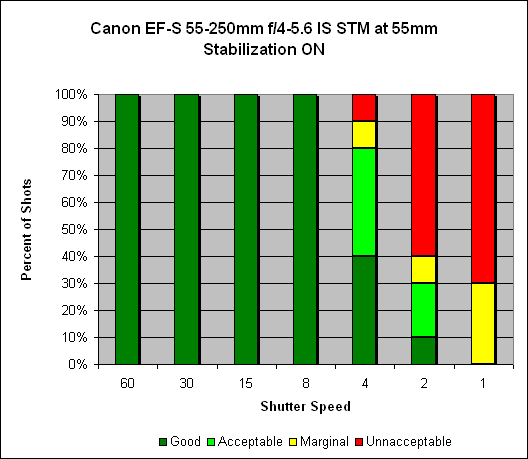
At the 55mm end, Canon’s IS image stabilization system works pretty well, offering around three stops of hand-holding stability. Unsurprisingly, we get 100% hand-holding sharpness at the 1/60s mark with IS turned off, but with IS turned on, that stability goes as slow as 1/8 of a second.
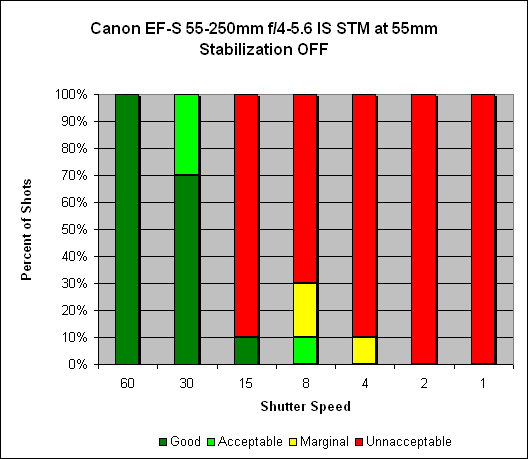 |
| Mouse over this chart to show results with IS activated. |
Performance at the 250mm end is very good, offering four stops of hand-holding stability: here we have 100% hand-holding sharpness at 1/125s, but we get almost 100% hand-holding sharpness at 1/8s with IS engaged.
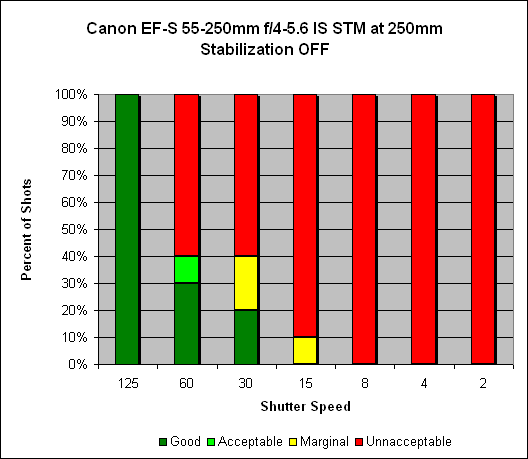 |
| Mouse over this chart to show results with IS activated. |
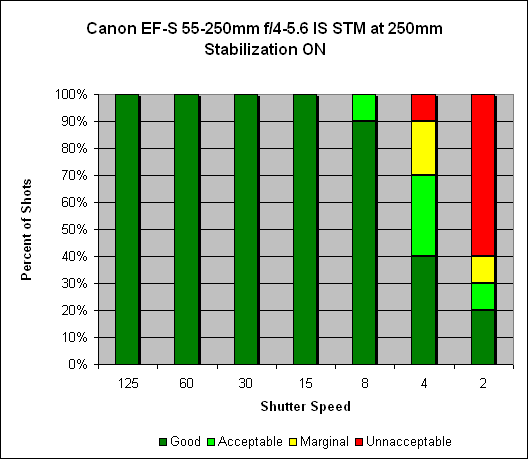
IS systems tend to provide more benefit to less-stable shooters than very steady ones, so most users will see the same or greater amounts of shake reduction as we measured here. You can read more about our IS test methodology here: SLRgear IS Test Methodology, v2.
Reader Reviews
- Image quality
- 9/10
- Build quality
- 10/10
- Recommend it
- 100%
- 9/10Recommendedby pglickenhaus · July 20 2015 · paid $138
Pros: sharp, silent and built solid
Cons: Really nothing so far!
I purchased this used on Ebay for 138.00. I have used the ISII version of this lens. While I was impressed with that lens I must say this one is even sharper. I purchased this STM model to complement the kit 18-55stm that came with my SL1. Focusing motor is absolutely silent which helps when shooting video. Sharpness is very good from 55-250, exceptional at about 100mm. I am loving this lens!
Reader reviews were submitted by Imaging Resource readers and are shown as written.