

Overview
The Fujinon 18-135mm ƒ/3.5-5.6 was released in 2014, the first lens in the X-mount system that one might consider to be an “all-in-one” style lens. With the APS-C sensor present in Fuji’s X-series of camera, the lens provides an effective field of view of around 28-200mm.
The 18-135mm isn’t a ”constant” lens, in that as you increase the focal length, the maximum aperture size decreases (the minimum aperture of ƒ/22 stays constant). The following table reflects the change in maximum aperture size with focal length:
| 18mm | 23mm | 35mm | 55mm | 70mm | 135mm |
| ƒ/3.5 | ƒ/4 | ƒ/4.3 | ƒ/5 | ƒ/5.3 | ƒ/5.6 |
| Min. ƒ/22 at all focal lengths | |||||
The lens is available now, comes with a round lens hood, takes 67mm filters, and retails for around $700.
Sharpness
We’ve seen sharper lenses in the Fuji lineup: making a lens with a big range of focal lengths and image stabilization is a game of compromise, and in this case, sharpness has been somewhat sacrificed. It’s also worth noting that in our review sample of this lens, we see some slight de-centering.
Wide open, we see a decent region of sharpness in the center of the frame, with some significant corner softness; as the lens is zoomed in towards 135mm, this area shrinks considerably. By 55mm, overall sharpness isn’t anything special; at 70mm and longer, there is some significant softness in the corners.
Stopping down to a smaller aperture helps, but it’s no amazing transformation. Rather, no combination of aperture and focal length will provide you with what we’d call tack-sharp results; the closest you’ll get is very good results at 55mm and ƒ/8, but with these settings, you’ll be wanting to shoot either with strobes, or in daylight.
Diffraction limiting sets in at ƒ/11, but you won’t notice it until at least ƒ/16. Shooting at ƒ/16 or ƒ/22 produces a generalized softness across the frame.
Chromatic Aberration
The Fujinon 18-135mm lens performs well in this category, albeit a bit strangely. At 18mm, we note some chromatic aberration, which gets quite prominent at 23mm and 55mm, and then is well-controlled at 70mm and longer.
Shading (”Vignetting”)
Corner shading is extremely well-controlled, and improved by the in-camera correction; at the 18mm setting there are some apertures that produce slightly more than a quarter-stop of corner darkening; otherwise, corner darkening is negligible.
Distortion
Distortion is also remarkably well-controlled, no doubt assisted by in-camera correction. There is some light barrel distortion below 23mm, but above this, distortion is very slight indeed.
Autofocus Operation
The Fujinon 18-135mm uses an electrical autofocus system, which is very fast. The design is fly-by-wire, so there is no direct connection between the focusing ring and the autofocus system: autofocus results are very quick, and almost totally silent. Also, attached 67mm filters will not rotate.
Macro
The lens isn’t designed for macro work, but it does produce results which aren’t awful. The lens produces 0.27x magnification (1:3.7) at a minimum close-focusing distance of 45 centimeters (just under eighteen inches) when the camera is set to its macro mode.
Build Quality and Handling
The XF 18-135mm ƒ/3.5-5.6 R LM OIS WR is a well-built lens, with an all-metal barrel construction and textured in a satin black finish. For a telephoto zoom lens, it isn’t all that heavy (just over 17 oz.), but mounted on the smaller X-mount bodies it does make for a package that’s not quite as svelte as you might have envisioned. The lens features optical image stabilization, which is activated or deactivated with a dedicated ”OIS” switch. Weather sealing is prominent in more than 20 areas of the lens.
There are three rings for this lens: a zoom ring, a focusing ring, as well as an aperture ring, which is something of a rarity in modern digital camera lenses — though it’s been a standard feature on Fuji’s X-mount glass. The aperture ring sits closer to the lens body, around 3/8” wide. The lens features a selector, which allows the user to choose between auto-aperture mode, or manual aperture selection (you just have to remember that the “A” stands for Automatic, not aperture).
The zoom ring is about an inch wide, with deep rubber ribs running parallel to the length of the lens. The zoom action is very smooth, going from 18mm to 135mm in a ninety degree turn, with only a minor amount of force required to transition between focal lengths. The lens extends as it is zoomed out, adding two and a half inches to its overall length. Zoom creep was not a factor in our testing with this lens. The lens features an interesting ventilator system which removes dust and moisture as the the lens is zoomed.
The focusing ring is about 3/4” wide, made of polycarbonate with deep grooves that offer excellent tactile feel. The lens uses a fly-by-wire system in its lens focusing operation, so the focusing ring is not actually directly connected to the lens elements in a mechanical way. Rather, turning the focusing ring moves the elements electronically. In practice this means the focusing ring will turn forever in either direction, and you’ll have to rely on the on-screen readouts to know if you have reached minimum or maximum focus.
There are no distance scales or depth-of-field information on the lens, but the X-E1 test camera we used offers a distance scale on its LCD or viewfinder readout.
Optical Image Stabilization is claimed by Fuji at 5 stops, but our testing showed only a single stop of improvement at 18mm and just over 3.5 stops at 135mm. This is still very good performance. Be sure to check our IS Test tab for more detailed information.
The petal-shaped lens hood is made of plastic and attaches via standard bayonet mount. The hood is 1 3/4” long.
Alternatives
Fuji’s X-mount system is still (at the time of writing) in its relative infancy, and Fuji itself is still just starting to roll out a large set of lenses. More problematic for users looking for alternatives, is that Sigma and Tamron have not yet shown any interest in producing lenses in the X-mount.
Fujinon XF 18-55mm ƒ/2.8-4 R LM OIS ~$700
It’s not as versatile in terms of focal lengths, but it’s slightly faster in terms of apertures; it’s a sharper lens, but the 18-135mm handles chromatic aberration slightly better.
Conclusion
Some photographers don’t want to have to deal with switching between prime lenses, so this lens fills that niche very nicely; however, prime lens shooters are accustomed to images which this lens can only produce in certain circumstances. That’s not to say it’s a poor lens – it’s actually quite good – but Fuji’s set their own bar a quite high, and while the lens offers convenience, it doesn’t offer the same optical quality present in other Fujinon lenses.
Product Photos
 |
 |
 |
 |
 |
 |
Sample Photos
Click here for Real-world Gallery Images on our Flickr page!
The VFA target should give you a good idea of sharpness in the center and corners, as well as some idea of the extent of barrel or pincushion distortion and chromatic aberration, while the Still Life subject may help in judging contrast and color. We shoot both images using the default JPEG settings and manual white balance of our test bodies, so the images should be quite consistent from lens to lens.


As appropriate, we shoot these with both full-frame and sub-frame bodies, at a range of focal lengths, and at both maximum aperture and ƒ/8. For the ”VFA” target (the viewfinder accuracy target from Imaging Resource), we also provide sample crops from the center and upper-left corner of each shot, so you can quickly get a sense of relative sharpness, without having to download and inspect the full-res images. To avoid space limitations with the layout of our review pages, indexes to the test shots launch in separate windows.
Description
(From Fujifilm lens literature) The Fujinon high-magnification zoom lens, XF18-135mmF3.5-5.6 R LM OIS WR, covers a wide range of shooting scenarios, from wide angle (27mm equivalent) to telephoto (206mm equivalent). This lens boasts the world’s most advanced 5.0-stop image stabilization technology and a dust-proof structure with weather resistant sealing applied to more than 20 different areas of the lens.
The XF18-135mmF3.5-5.6 lens has high-performance glass that includes 4 aspherical and 2 ED lenses with multi-layer HT-EBC that effectively reduces lens flare and ghosting. It offers rapid auto focus speeds (max. 0.10 seconds) and silent operation thanks to the low noise linear motor technology. When combined with the X-T1, the camera and lens weigh a mere 930g so they make an ideal weather-sealed combination for travel that offers improved flexibility and increased photo opportunities.
FUJINON XF18-135mmF3.5-5.6 (27-206mm) R LM OIS WR key features:
- FUJIFILM X-Mount is compatible with all FUJIFILM interchangeable system cameras
- Weather-resistant design with more than 20 sealing points
- 0.10 seconds autofocus speed and nearly silent operation
- Powerful optical image stabilization minimizes shake and blur in low light
- Two high-precision gyro sensors with quartz oscillators to detect movement from high frequency to low frequency
- Air ventilator in the interior of the bottom of the lens barrel effectively prevents dust particles and moisture from getting into the lens, and allows for smooth operation and improved feel when adjusting the zoom
- Optical system uses 4 high-precision aspherical lenses and 2 anomalous dispersion glass lenses that maximize performance of the FUJFILM X-Trans sensor
- HT-EBC multi-layer coating to minimize ghosting
- Seven-blade aperture diaphragm that helps create smooth and round bokeh effects
- Advanced 5.0-stop image stabilization system that improves movement detection in the low-frequency band
- Minimum working distance of 45cm
The FUJINON XF18-135mmF3.5-5.6R LM OIS WR lens will be available in July 2014 for US$899.95 and fits all FUJIFILM X-Series interchangeable lens cameras.
Lab Test Results
Our standard lens lab tests, shot on a sub-frame (APS-C) body. Pick a focal length and aperture to see the result.
Sharpness (blur index)
Blur across the frame: lower and flatter is sharper. Change focal length and aperture to see how it improves when stopped down.

Chromatic aberration
Colour fringing in the corners at each focal length.

Vignetting (corner shading)
How much darker the corners are than the centre, by aperture and focal length.

Geometric distortion
Barrel (positive) or pincushion (negative) distortion across the zoom range.

Image Stabilization
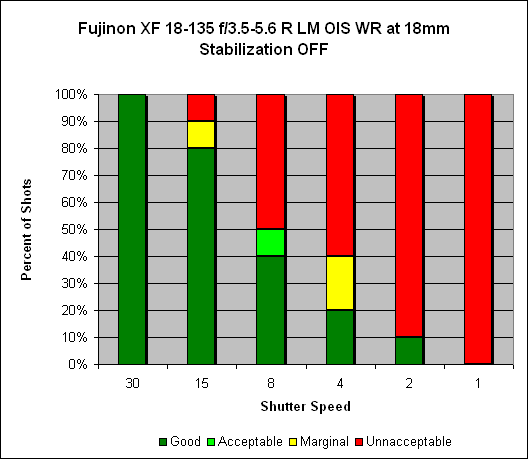
Most people tend to think of image stabilization as being mainly for telephoto lenses. While it’s true that their longer focal lengths tend to magnify the effects of camera shake, image stabilization can provde a very useful assist at wider angle focal lengths as well; anyone who’s ever tried to blur the image of a waterfall, while keeping the surrounding landsape tack-sharp knows exactly what I’m talking about.
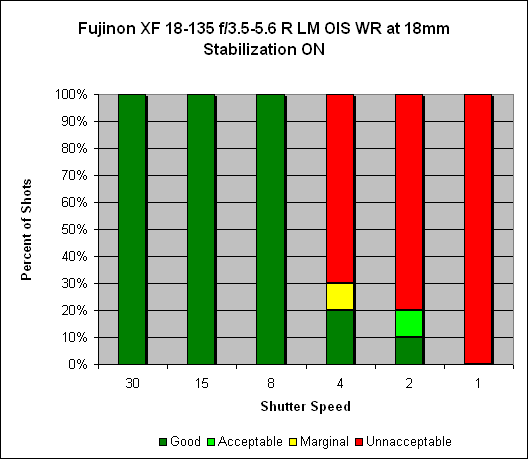
At 18mm, we don’t see a huge amount of improvement – just a single stop of hand-holding performance. We see 80% of shots are sharp at the 1/15s shutter speed when OIS isn’t active; this falls into line with the one-over-shutter speed rule of thumb. When OIS is engaged, we see 100% of shots are sharp at 1/8s; but there is essentially no improvement beyond that.
 |
| Mouse over this chart to show results with IS activated. |
Zoomed in to 135mm, we see better performance from this lens’ OIS system. Hand-held without the system active, we see 100% of shots are sharp at 1/125s and worse results from there; when OIS is activated, we can shoot as slowly as 1/15s and still get 100% sharp images, even 60% sharp at 1/8s. Thus, we’re satisfied to report about 3 1/2 stops of hand-held improvement.
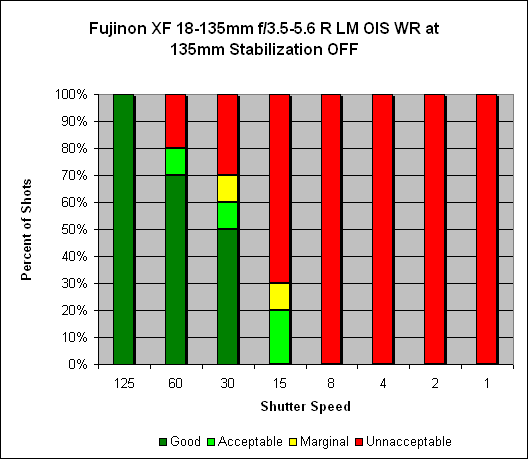 |
| Mouse over this chart to show results with IS activated. |
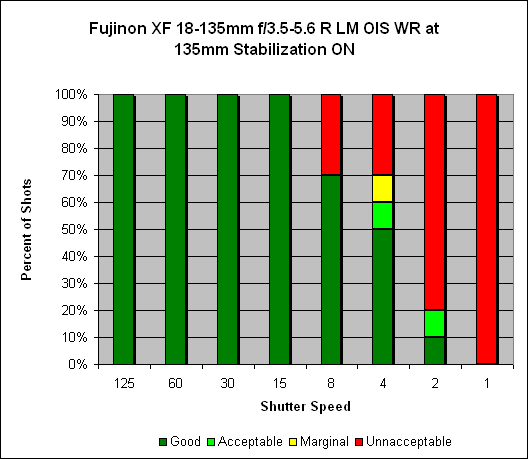
IS systems tend to provide more benefit to less-stable shooters than very steady ones, so most users will see the same or greater amounts of shake reduction as we measured here. You can read more about our IS test methodology here: SLRgear IS Test Methodology, v2.
Reader Reviews
- Image quality
- 9.3/10
- Build quality
- 10/10
- Recommend it
- 100%
- 10/10Recommendedby SteveHugh · December 27 2015 · paid $899
Pros: fast and accurate autofocus, sharp
Cons: none
Haven't used it much yet various other compared to a couple of examination tries. Fairly sharp across the aperture and also zoom array, limited the aperture to around f4 to f16.
I don't fire rapid action so the autofocus was great for me, quite quickly adequate and exact. Not so sure for any event photographer like pros.
The lens has a little bit of weight and also mass, however it in fact boosted the handling of my Fufifilm X-E1, I could hold it by the barrel and also it stopped me from unintentionally mushing up switches with my hand and altering settings unintentionally the means I do when using the 18-55 lens I have.
Possibly some OCD slipping in below, however the cam and also lens do not rest level when taken down, the lens barrel's size keeps the nose in the air a little bit.
- 10/10Recommendedby rdonson · January 14 2015 · paid $799
Pros: Image Quality, build quality, OIS, WR
Cons: None really
I use this with my Fuji X-T1 and process images with LR 5.7 following Pete Bridgwood's RAW guidance. I've been very impressed with this camera and with this lens.
I initially purchased this lens in combination with the X-T1 and my intended use was for walkarounds where size and weight gave it a significant advantage over my Canon DSLRs.
I find myself using my Canon DSLRs now only when the situation calls for specific use of one of the L glass lenses I have.
This lens has consistently provided sharp images with great color and the OIS has surprised me repeatedly. I do NOT see a distinct difference between this lens and most of the Canon L glass I own.
I do NOT miss this lens having f/2.8 as that would likely add a great deal of weight and bulk to the lens. With the high ISO capabilities and the quality of this lens I'm quite satisfied.
- 8/10Recommendedby pacslr14 · July 27 2014 · paid $1073
Pros: Range, Price
Cons: Size when extended
Very good lens for streetphotography. Unfortunately only F 3.8 max.
Weather Resistance is perfect. Very well built.
Slight chromatic aberations (especially on the tele side) in Raw
Reader reviews were submitted by Imaging Resource readers and are shown as written.