

Overview
The Nikon 10-30mm ƒ/3.5-5.6 PD-Zoom Nikkor VR is the new kit lens for the 1-series of camera, introduced in March of 2014. The lens features a power drive zoom and is smaller than the current 10-30mm lens. As well, it does not have a lens cap, but has a built-in lens cover like many point and shoot cameras.
The lens was designed to fit the Nikon CX mount, offering the equivalent of a 27-81mm field of view, thanks to the 1-series sensor’s crop factor of 2.7x. This lens isn’t a “constant” lens, in that as you increase the focal length, the maximum aperture size decreases, however the minimum aperture remains at f/16. The following table reflects the change in aperture available for the lens:
| Focal length | 10mm | 20.6mm | 30mm | ||
| Largest aperture | ƒ/3.5 | ƒ/4.8 | ƒ/5.6 | ||
| Smallest aperture | ƒ/16 | ||||
Because the new lens features a built-in lens cap, this precludes the use of filters. As well, a lens hood is not available. The lens is available now for around $300, or as part of a Nikon V3 kit.
Sharpness
The Nikon 10-30mm ƒ/3.5-5.6 PD-Zoom VR offers exceptional sharpness, even when used at its widest apertures. There are just traces of corner softness which are ameliorated as the lens is stopped down. Optimal sharpness is obtained at the ƒ/8 aperture, where images are essentially tack-sharp across the frame.
Diffraction limiting for this lens sets in at ƒ/11, but it’s not really noticeable until the lens is stopped down to its smallest aperture of ƒ/16. It’s worth noting that the lens can’t be stopped down to ƒ/22 – probably owing to its miniscule size.
Chromatic Aberration
CA is nicely controlled by this lens, especially when the lens is zoomed out from 10mm. According to our tests there is some prominent chromatic aberration at the 10mm setting when the lens is fully stopped down towards ƒ/16, but this is exhibiting as a loss of detail rather than color separation; I’m assuming we have some in-camera processing to thank for that.
Shading (”Vignetting”)
We do note some corner shading in testing this lens, but it’s not excessive; the worst performance shows as corners that are over 3/4 EV darker than the center. At any other setting, even just stopped down one stop, there’s practically no corner shading. However, it never really goes away; there is always at least a corner-to-center differential of 1/4 EV.
Distortion
Somewhat surprisingly there is some very prominent distortion present in images shot with this lens. Most mirrorless bodies incorporate some form of post-processing to compensate for distortion, but we’re not seeing that here. Below the 16mm focal length we note some impressive barrel distortion in the corners – almost +1% – and after the 20mm mark, this turns into pincushion distortion, about -0.8%.
Autofocus Operation
The Nikon 10-30mm PD-Zoom ƒ/3.5-5.6 focuses very quickly and near-silently, taking less than a second to focus from infinity to close-focus. Point to point focusing is a bit faster. It’s worth noting at this point that there is no manual focusing ring – it’s possible to focus manually, but that’s done via a camera control.
Macro
Magnification is only 0.21x, and minimum close-focusing distance is 20cm (around eight inches), providing mediocre performance for macro work.
Build Quality and Handling
The Nikon 10-30mm ƒ/3.5-5.6 PD-Zoom VR is a small zoom lens, mating very nicely with our V3 test body and providing a stable, if small and light, shooting platform. The lens is available (in some regions) in a variety of colors.
For a kit lens, the design is fairly substantial: 9 elements in 7 groups, including 1 ED and 4 aspherical elements. The lens also features seven rounded diaphragm blades to make up the aperture.
The zoom ring is the only control on the lens, and it’s actually an electronic coupling to the lens; turning the ring one way tells the lens to zoom in, and turning it the other tells it to zoom out. The lens responds to the amount of turning you apply to the ring: turn it a little, and it zooms slowly; turn it a lot, and it will zoom as fast as possible. It’s also noteworthy that the zoom operation is nearly silent, which is great for movie making.
There is no manual focusing ring on this lens. Manual focusing is possible, if cumbersome: you have to control manual focusing from the camera. You do this by pushing the AF button to get to the focus menu, then select MF, then you can zoom to the focal length you want, then push the OK button, and finally you can use the scroll wheel on the back of the camera to adjust focus. A focus distance indicator is on the LCD to help you. The focus adjustment is pretty coarse.
Nikon has assumed that shooters of this camera system may not be interested in filters, so they have done away with a filter ring in favor of an automatic lens cap solution. Turning on the camera automatically opens the built-in lens cap and extends the lens. Turning off the camera retracts the lens and closes the built-in lens cap.
The lens features Vibration Reduction (VR). In our testing we found that this system works very well, offering around three stops of hand-holding improvement.
Alternatives
While the AW series lens (11-27.5mm) is technically in the same lens mount, we haven’t included it as an alternative because the only feature benefit is the all-weather capability, which wouldn’t carry over onto a camera that isn’t the AW1.
Nikon 10-30mm ƒ/3.5-5.6 1 Nikkor VR ~$-
The previous kit lens, it was also as sharp as the current lens, but doesn’t offer the power zoom or automatic lens cap functionality. However, it offered slightly better results for corner shading and distortion.
Conclusion
It’s nice to see kit lenses which punch above their weight level, and it’s certainly what we’re seeing in this case. The lens is definitely not for the photographer purist – manual focusing is a cumbersome experience, and there is no ability to attach filters. If those features aren’t important to you, then you’re in for a treat.
Product Photos
 |
 |
 |
 |
Sample Photos
Click here for Real-world Gallery Images on our Flickr page!
The VFA target should give you a good idea of sharpness in the center and corners, as well as some idea of the extent of barrel or pincushion distortion and chromatic aberration, while the Still Life subject may help in judging contrast and color. We shoot both images using the default JPEG settings and manual white balance of our test bodies, so the images should be quite consistent from lens to lens.


As appropriate, we shoot these with both full-frame and sub-frame bodies, at a range of focal lengths, and at both maximum aperture and ƒ/8. For the ”VFA” target (the viewfinder accuracy target from Imaging Resource), we also provide sample crops from the center and upper-left corner of each shot, so you can quickly get a sense of relative sharpness, without having to download and inspect the full-res images. To avoid space limitations with the layout of our review pages, indexes to the test shots launch in separate windows.
Description
(From Nikon lens literature) You can’t predict life’s special occasions, but you can be prepared with the right camera and lens. The 1 NIKKOR VR 10-30mm ƒ/3.5-5.6 PD-ZOOM lens (27-81mm equivalent) is your portable companion. More compact than the current 10-30mm lens, the 1 NIKKOR VR 10-30mm ƒ/3.5-5.6 PD-ZOOM features a Power-Drive zoom, perfect for shooting smooth video.
Lab Test Results
Our standard lens lab tests, shot on a sub-frame (APS-C) body. Pick a focal length and aperture to see the result.
Sharpness (blur index)
Blur across the frame: lower and flatter is sharper. Change focal length and aperture to see how it improves when stopped down.

Chromatic aberration
Colour fringing in the corners at each focal length.

Vignetting (corner shading)
How much darker the corners are than the centre, by aperture and focal length.

Geometric distortion
Barrel (positive) or pincushion (negative) distortion across the zoom range.

Image Stabilization
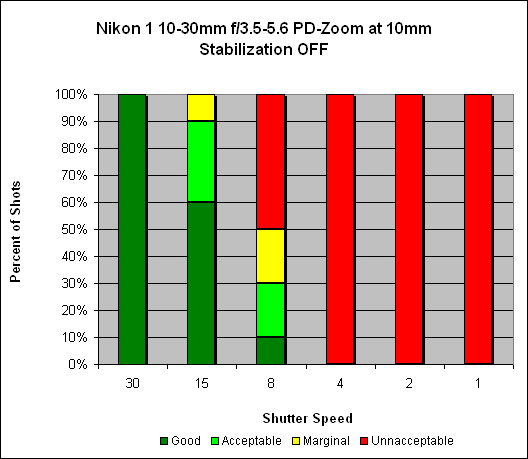
Most people tend to think of image stabilization as being mainly for telephoto lenses. While it’s true that their longer focal lengths tend to magnify the effects of camera shake, image stabilization can provide a very useful assist at wider angle focal lengths as well; anyone who’s ever tried to blur the image of a waterfall, while keeping the surrounding landscape tack-sharp knows exactly what I’m talking about.
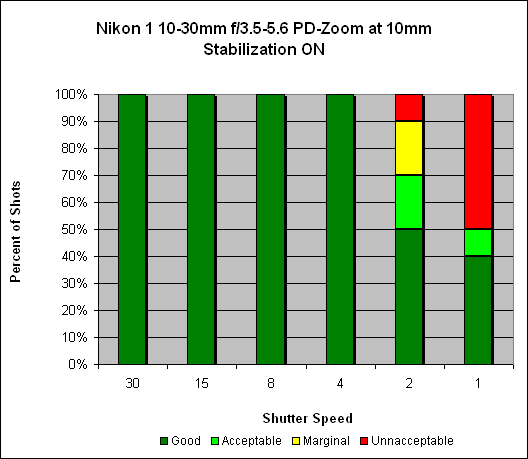
At the 10mm focal length setting, the 10-30mm does very well, offering around three stops of hand-holding improvement: without VR engaged, the lens can produce sharp images consistently at a shutter speed of a 1/30 of a second; with it engaged, it can consistently produce sharp images at 1/4s, even half the time at a half-second.
 |
| Mouse over this chart to show results with IS activated. |
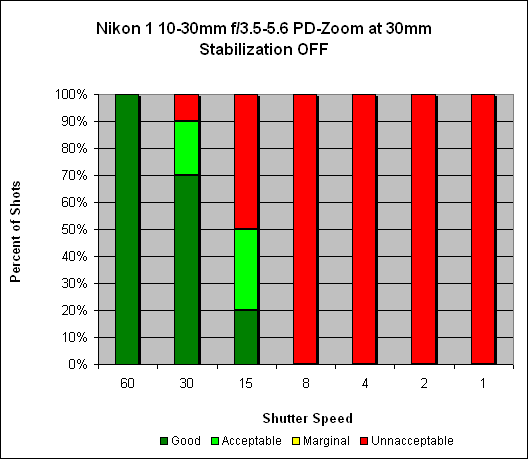
Zoomed in to 30mm, we also see around three stops of improvement. Without VR engaged, the lens can produce sharp images consistently at a shutter speed of a 1/60 of a second; with it engaged, it can consistently produce sharp images at 1/8s.
 |
| Mouse over this chart to show results with IS activated. |
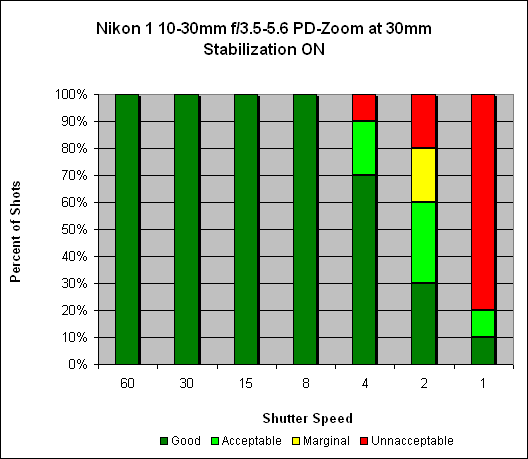
IS systems tend to provide more benefit to less-stable shooters than very steady ones, so most users will see the same or greater amounts of shake reduction as we measured here. You can read more about our IS test methodology here: SLRgear IS Test Methodology, v2.
Reader Reviews
- Image quality
- 2/10
- Build quality
- 2/10
- Recommend it
- 0%
- 2/10Not recommendedby Unexplored Ruins · November 7 2015
Pros: Built-in cover
Cons: no filter thread, extremely noisy AF, high distortion
Only got to try someone else's.
This is the kit lens that ships with newer "1" models. The pin-cushion distortion is very pronounced on the long end compared to the original 10-30mm manual zoom. The image looks like I'm looking at a dog bone.
It's heavily dependent on in-camera distortion correction found only on later model bodies that ship with this lens.
The PD features motorized zoom hence "power drive". the barrel ring issues directions electronically to zoom. Auto-focus is very loud. Don't even think about using it for any serious videos. You will hear the motor click so loudly in audio that it sounds like you're running your finger nails over your keyboard.
It's not so bad that you couldn't use the bundled lens, but I definitely would not go buy one separately. If you have no plans on using other lenses, you might as well get a compact camera with a non removable lens.
Reader reviews were submitted by Imaging Resource readers and are shown as written.