
Overview
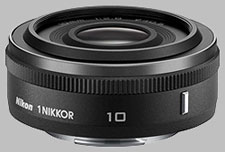
At 77 grams (just under 3 oz), the 10mm ƒ/2.8 1 Nikkor is the lightest lens Nikon currently produces, and probably one of the smallest. With just 6 elements in 5 groups, the lens produces an equivalent field of view of 27mm when mounted on a Nikon J1 or V1 camera.
The 10mm ”pancake” lens was built specifically for the Nikon CX mount, and will not fit on other Nikon cameras. It does not ship with the optional HN-N101 round lens hood. The lens takes 40.5mm filters, and is available now for around $250.
Sharpness
The 10mm ƒ/2.8 pancake lens produces very sharp images, even straight out of the gate at ƒ/2.8. Technically it’s not absolutely sharp at this aperture – there is some very light corner softness – but by ƒ/4, this has disappeared and the lens produces tack-sharp images. Equally good at ƒ/5.6 and just very slightly less so at ƒ/8, there’s only a slight amount of softness even fully stopped-down to ƒ/11.
Chromatic Aberration
Unfortunately, in so small a package, something’s got to give, and the lens shows some amount of chromatic aberration throughout its range of apertures. Fortunately this is mostly confined to the corners, where it is especially evident (showing as green-magenta fringing in areas of high contrast).
Shading (”Vignetting”)
When used wide open at ƒ/2.8, the 10mm pancake produces corners in images which are 2/3 of a stop darker than the center. Stopping down to any other aperture reduces this to just under a half-stop; but that’s as good as it gets.
Distortion
There is some prominent barrel distortion when using this lens: specifically, +0.5% in the corners. This is fairly noticeable if you put subjects on the edge of the frame, otherwise, not so much.
Autofocus Operation
The 10mm ƒ/2.8 1 Nikkor pancake uses a very fast focusing system, focusing from close-focus to infinity in well under a second, and doing so very quietly. Attached 40.5mm filters will not rotate during focus operations.
Macro
This lens is a very poor substitute for a macro lens – just 0.06x magnification, and a minimum close-focusing distance of 20cm (around 8 inches).
Build Quality and Handling
Small and light is the order of the day for this lens, which uses 6 elements in 5 groups, two of which are aspherical and use a super integrated coating to reduce flare. Using this lens with the Nikon J1 or V1 produces a camera you would have called a point-and-shoot in the early 2000’s, but in this case, with a 10-megapixel sensor and much better optics. Altogether, the J1 and 10mm ƒ/2.8 package weighs in at just under 18 oz, which makes a perfect walkaround combination.
The lens itself doesn’t have much to complicate it – in fact there are no control surfaces of any kind, not even a focusing ring. The ring that you see on the front of the lens is for show, it doesn’t turn – but it does provide another place to hold onto. All focusing operations are conducted from the camera, including manual focus. Other 1 system lenses employ optical stabilization, but unfortunately, there’s just no room left over in this lens to provide the same system here.
The HN-N101 lens hood is a small, round hood that screws onto the front of the lens to provide some additional resistance to flare. It’s an optional accessory and will run you about $20 if you feel it is necessary.
Alternatives
Right now, the only alternatives in the Nikon 1 system are other Nikon 1 lenses.
Nikon 1 10-100mm ƒ/4.5-5.6 PD-Zoom Nikkor VR ~$750
Three times the price, but ten times the range – the 10-100mm also offers VR. At the 10mm point, the prime is somewhat sharper at ƒ/4, but also offers the faster ƒ/2.8 aperture. At ƒ/5.6 and smaller, they’re equally tack-sharp. Otherwise, the 10-100mm is similar when it comes to distortion, corner shading and chromatic aberration.
Nikon 1 10-30mm ƒ/3.5-5.6 Nikkor VR ~$-
The odds are that if you’re a J1 or V1 owner, you already have this lens. It also features VR, and is as sharp as the 10mm prime at that focal length setting. Of course the 10mm prime goes one stop faster at ƒ/2.8. Otherwise, it’s a bit better for CA performance; corner shading and distortion are about the same.
Conclusion
While the Nikon 10mm ƒ/2.8 1 Nikkor seems to produce some very sharp images, it’s not without a cost in chromatic aberration, distortion and corner shading. All of these traits one might say are the hallmarks of a point-and-shoot camera lens, except those are usually fairly soft, too, which is not the case here. So if you’re not too fussy about optical performance in the corners of your images, for what the lens offers – an extremely light wide-angle platform – it’s a bargain, and well worth a very small space in your bag.
Product Photos
 |
 |
 |
 |
Sample Photos
The VFA target should give you a good idea of sharpness in the center and corners, as well as some idea of the extent of barrel or pincushion distortion and chromatic aberration, while the Still Life subject may help in judging contrast and color. We shoot both images using the default JPEG settings and manual white balance of our test bodies, so the images should be quite consistent from lens to lens.


As appropriate, we shoot these with both full-frame and sub-frame bodies, at a range of focal lengths, and at both maximum aperture and ƒ/8. For the ”VFA” target (the viewfinder accuracy target from Imaging Resource), we also provide sample crops from the center and upper-left corner of each shot, so you can quickly get a sense of relative sharpness, without having to download and inspect the full-res images. To avoid space limitations with the layout of our review pages, indexes to the test shots launch in separate windows.
Description
(From Nikon lens literature) Elegant, yet supremely compact, the 10mm CX-format single focal length wide angle lens (27mm equivalent in 35mm format) renders sharp photos for a variety of needs, including everything from landscapes to group shots. Even low light moments have details brought to life with the fast ƒ/2.8 aperture. The most compact of the 1 NIKKOR lens system, this ultra-portable wide angle is the one to keep with you always. Quality and integrity are hallmarks of the new 1 NIKKOR lens system.
Key Features:
- An elegant and thin wide-angle lens with super portability, perfect for daily casual snapshot and spectacular landscape
- Two aspherical lens elements
Lab Test Results
Our standard lens lab tests, shot on a sub-frame (APS-C) body. Pick a focal length and aperture to see the result.
Sharpness (blur index)
Blur across the frame: lower and flatter is sharper. Change focal length and aperture to see how it improves when stopped down.

Chromatic aberration
Colour fringing in the corners at each focal length.

Vignetting (corner shading)
How much darker the corners are than the centre, by aperture and focal length.

Geometric distortion
Barrel (positive) or pincushion (negative) distortion across the zoom range.

Reader Reviews
- Image quality
- 8/10
- Build quality
- 9/10
- Recommend it
- 100%
- 8/10Recommendedby photodivine · January 11 2016 · paid $200
Pros: small, light and cheap
Cons: for normal use only
I got a deal on a Nikon J1 used and was impressed by the quality and then bought a used 10mm lens and wow. A Thanksgiving day trip to Chicago and for grins I carried around the J1 with this pancake lens on it and now have 2 canvas prints on the wall and was amazed at the quality of the wide-angle 16 X 20 print of the river. I have trouble lugging my Canon DSLRs around but the J1 is a really great size and I couldn't believe the quality of the prints. I also have a Lumix GF3 micro 4/3's camera with a pancake and it does wonders also but the kicker with the J1 is they have a companion lens for close ups and Portraits -the 18.5 1 lens. While this pancake is excellent for landscapes it struggles with macros and other close ups (Or at least, I struggle getting it right.). But if you want the perfect 2 lens to use for the majority of your shots, pair this 10mm with the 18.5mm and the J1 will replace most DSLRs for carrying around. As for the GF3, I am sure they have a 50mm equivalent like the 18.5, but all I've found are double the price.
I'm very impressed by the J1 and from all accounts, it seems simpler and cleaner than the newer J3, but if you want a great starter introduction to landscape photography with excellent photos, find a deal on a J1 and pair it with this 10mm lens. Now that i also have the 18.5mm 1 lens, I'm happy.
http://www.hitsticker.com | http://www.printradiant.com
- 6/10Recommendedby Unexplored Ruins · November 7 2015 · paid $110
Pros: Size, weight distribution, durability
Cons: cost, image quality, mechanical noise, no VR
Pros: size and durability that comes naturally by giving up zoom. Good weight balance. The camera actually sits straight on the bottom. The kit lens is too nose heavy and the camera tips forward and rests on the lens barrel. Resists dust and mild water exposures much better than kit zoom. The kit zoom is really delicate and easily jams up from dust and mild rain exposures.
Cons:
Image quality. The aperture advantage over the 10-30mm that comes with the camera is only 2/3EV. Doesn't matter much to me. You will give up optical image stabilizer which is good for about 3 whole stops.
It's quite prone to flare when there's a bright light source like a light bulb just outside the field of view and more susceptible to ghosting than stock lens.
I noticed some purple fringing one day that i didn't used to get. So I compared it side by side with the 10-30 that came with the camera. A flashlight was used on the side to produce a glare. It's much more susceptible to flaring and ghosting than the kit lens and gives me lower image quality in the real world. I suppose I should give a hood a try but you really need to use the expensive proprietary hood to not lose the size advantage.
AF mechanism is louder than the kit lens and I can clearly hear it in the audio track on videos.
This lens:
https://farm6.staticflickr.com/5713/22512278535_a57a2bf119_b.jpg
10-30mm that came with the camera set on 10mm:
https://farm1.staticflickr.com/704/22523404491_37ac55422e_b.jpg
The price tag is too high for just duplicating what the kit lens can do with a huge compromise. You give up the zoom, VR and real life image quality. If you primarily shoot wide angle and you need the size and durability advantages, this is a must have. It's pointless if you don't.
- 10/10Recommendedby Tord · April 25 2015 · paid $250
Pros: Small, sharp and flare-resistant
Cons: Could be faster
This is a lens easy to forget, as it is so small, and discreet. My favourite, beside the 70-300CX!
To make mine even more versatile, I've added a wide adapter, turning my 10 to an 8/2.0!
I used a Panasonic DMW-GWC1 0.79X wide adaptor (bare, without the supplied mounts, using a 49-52 step ring to balance it, and then simply taped together), to convert it to a 8/2.0 lens, even better than the original!
The resulting lens is superb, with excellent DOF, extremely rugged, and easy to use!
- 10/10Recommendedby hekob · January 30 2013 · paid $175
Pros: tiny,sharp,weightless
Cons: needs smallish factory supplied hood
The only Nikon 1 lens to make the camera body truly stealthy and pocketable. Tack sharp at F/4-F/8. This wide angle pancake is the way to go for street photography, or any setting where the smallest form factor and lack of fiddling with a zoom will be to the photographer's advantage.
- 9/10Recommendedby Prime Minister · January 3 2013
Pros: Small, light, fast and silent autofocus, build quality
Cons: CA, soft corners
The build quality of this little lens is very good. The lens barrel and bayonet are made of metal. There are no external moving parts and although the lens is very small, it has a nice weight. It feels and looks clean and sturdy.
The ribbed ring provides good grip while attaching or removing the lens and when you are holding the camera. The chrome rib on the lens barrel is a useful help in attaching or removing the lens. I really like the design of this lens.
Autofocus is fast, accurate and silent. In good light it's lightning quick but even in low light the lens locks on reasonably quick. The equivalent focal length of 27mm allows hand held shooting at low shutter speeds.
Center sharpness and contrast are very good at f/2.8. At f/3.5 sharpness and contrast get a little better, but you really have to be pixel peeping. The corners are a little soft, but usable I think.
Unfortunately there's some clearly visible CA and barrel distortion. Some of it can be removed in post processing. Overall the image quality is very decent for a small lens like this.
If you like the Nikon 1 system, I think this lens is a vey nice addition. Together with the 18.5mm f/1.8 it forms an interesting set of primes.
- 9/10Recommendedby NWjon · November 20 2012 · paid $99
Pros: Sharp at f2.8, excellent micro-contrast and color transmission.
Cons: Not f/1.8
The modest price of Nikkor 10mm f2.8 belies it's excellent optical qualities that noticeably exceed those of the 10-30mm f/3.5-5.6 in all aspects. Sharpness across the frame is very good and distortion is nicely controlled. Micro-contrast is excellent where the 10-30mm is lacking.
If you don't have the 10mm f2,8 lens for your Nikon 1 camera, your missing out on the larger aperture that allows PDAF focusing in dim light, (3 EV), and the better image quality it affords over the 10-30mm lens.
Reader reviews were submitted by Imaging Resource readers and are shown as written.