

Overview
The Nikon 300mm ƒ/4E PF ED VR AF-S hit store shelves in February 2015: touted as the world’s lightest 300mm full-frame lens, it’s easy to see why, as it weighs only 755 grams (just over 26 oz).
The lens offers a variety of technical innovations, but the main attraction is its Phase Fresnel lens element, which eliminates the need to use a complicated arrangement of lens elements to correct chromatic aberration and reduce flare. Fewer elements means less weight and less required space to house them.
The lens is fully compatible with DX sensor bodies like the D7000, on which the lens provides an effective field of view of 450mm. The lens ships with a round hood, and is available now for around $2,000.
Sharpness
For a $2,000 lens, people are going to expect a lot from the Nikon 300mm ƒ/4 PF; it does live up to the expectations. It provides images of excellent sharpness, and interestingly it is optimized for shooting at the ƒ/4 setting: sharpness degrades slightly as the lens is stopped down.
Results for sharpness are more obvious on the sub-frame (DX) camera bodies, where the image is focused on the central (and best-performing) part of the lens. On the full-frame D800e body, we note that the sides are slightly less sharp than the center. It’s also worth noting again that stopping down doesn’t improve the results for sharpness: it’s very good, but the 300mm ƒ/4 PF doesn’t achieve the tack-sharp results we’ve seen in other lenses.
Diffraction limiting begins to set in at ƒ/11, but it’s more noticeable at ƒ/16 where generalized softness is visible across the frame of the image. It’s possible to stop the image down to ƒ/32, but at this setting we see a noticeable impact on sharpness.
Chromatic Aberration
The test results for the Nikon 300mm ƒ/4 PF with regard to chromatic aberration were very impressive – the lens is highly resistant, on both of our Nikon D7000 and D800e test bodies, across all apertures.
Shading (”Vignetting”)
There is some marginal corner shading when the lens is used on the D7000 at ƒ/4. It’s a bit more significant when the lens is used on the full-frame D800e: at ƒ/4, the extreme corners are almost 1/2 of a stop darker than the center. This is mitigated as the lens is stopped down: At any other aperture, corner shading is insignificant.
Distortion
There’s essentially no distortion to speak of when using the 300mm ƒ/4 on the D7000. On the full-frame D800e, there is a tiny touch of pincushion distortion in the corners, but not enough to get excited about.
Autofocus Operation
The 300mm ƒ/4 PF uses an AF-S designation and is relatively fast to autofocus, racking through its close-focus to infinity distance and back, in just over one second. Our testing shows that the lens focuses mechanically. The filter ring of the lens does not rotate while focusing, and the lens is also very quiet during focus operations; as well, full-time manual focusing is available, by just turning the focus ring at any time.
Macro
While the Nikon 300mm ƒ/4 PF isn’t the first lens you’d think of for macro work, it’s not to shabby in this department. With a minimum close-focusing distance of 1.4m (around 4 1/2 feet), the lens provides a magnification ratio of .24x. The lens is also compatible with all of Nikon’s standard teleconverters.
Build Quality and Handling
The real story behind the 300mm ƒ/4 PF is its innovation in comparison to the previous 300mm ƒ/4 AF-S: it weighed 1,440 grams (over 50 oz) and was three inches longer than the new PF version. The previous lens wasn’t as complicated, however: it used only 10 elements in 6 groups, where the new PF version uses 16 elements in 10 groups. In the following lens block diagram, the green element is the Phase Fresnel element, and the yellow is the ED element.

The 300mm ƒ/4 PF is well-built, with durable plastic components and a metal lens mount. A rubber gasket shrouds the lens mount, protecting the lens from dust and moisture. The lens barrel is composed of a black semi-roughed finish, and the rubber focus ring shows a ridged pattern that is easy to grip. The lens features nine rounded diaphragm blades to make up the aperture for pleasing out-of-focus results. Nikon also uses a new aperture control system (the “Electromagnetic Diaphragm Mechanism”) which replaces the swishy mechanical control lever that you’ve seen on the back of every Nikon lens. We’ve done some testing and can confirm it will work on Nikon cameras back as far as about 2007.
Some concern has been noted about the Phase Fresnel lens element producing an odd bokeh, or poor performance with regard to lens flare: here are our lens technician Rob’s comments from shooting his sample photos with the lens. “Flare is not an issue on this lens. Even with the lens hood off I did not see any odd reflections from the PF element.” Regarding bokeh, here is a sample image which will give you an indication of how it performs.

The focus ring is an inch wide, with raised rubber ribs for texture. The ring turns nicely; it is well-dampened, if just slightly stiffer than necessary. There are no hard stops at either close-focus or infinity, though there is a slight increase in resistance to let you know you’ve reached a limit.
The lens ships with the HB-73 lens hood, a circular-style bayonet-mounted hood that adds 2 1/2 inches to the lens’ overall length when mounted. The lens reverses for storage on the lens. An optional RT-1 tripod collar is available for the lens for approximately $170 (this collar is also compatible with Nikon’s 70-200mm ƒ/4 lens).
Nikon claims to provide four and a half stops of hand-holding improvement, which is an impressive claim: our testing backs this up. Check out our IS Test tab for greater detail.
Finally, Nikon had some issues on the first lenses having a problem using VR at certain speeds on certain cameras (D800, D800E, D810, or D810A). There is a fix for it. The vibration reduction on our review copy of the lens worked perfectly, so it must have been fixed before we received it. A firmware update is available for users who are affected by this problem. For more information, visit this Nikon Support Page.
Alternatives
Nikon 300mm ƒ/4D ED-IF AF-S ~$1,300
At the time of writing, the older Nikon 300mm ƒ/4 is still available on store shelves: we haven’t reviewed this lens.
Nikon 300mm ƒ/2.8G ED AF-S VR II ~$5,000
This was the original choice if you needed Vibration Reduction in a 300mm focal length; it also got you all the bells and whistles Nikon could offer, as well as a ƒ/2.8 aperture.
Sigma 300mm ƒ/2.8 EX DG HSM APO ~$3,400
Sigma’s offering in the 300mm prime market isn’t as sharp as the Nikon 300mm ƒ/4 PF, and it doesn’t offer optical image stabilization; it does offer a faster ƒ/2.8 aperture.
Conclusion
It’s nice to see innovation hard at work, and the resulting reduction in size and weight is welcome for users who were tired of lugging around the 3+ lbs. 300mm ƒ/4 AF-S. If there are any shortcomings with the new PF version, it is that it is not capable of the tack-sharp results we’ve seen in other Nikon offerings, but on further analysis of the numbers, the results are still very sharp indeed.
Product Photos
 |
 |
 |
 |
 |
 |
 |
Sample Photos
The VFA target should give you a good idea of sharpness in the center and corners, as well as some idea of the extent of barrel or pincushion distortion and chromatic aberration, while the Still Life subject may help in judging contrast and color. We shoot both images using the default JPEG settings and manual white balance of our test bodies, so the images should be quite consistent from lens to lens.


As appropriate, we shoot these with both full-frame and sub-frame bodies, at a range of focal lengths, and at both maximum aperture and ƒ/8. For the ”VFA” target (the viewfinder accuracy target from Imaging Resource), we also provide sample crops from the center and upper-left corner of each shot, so you can quickly get a sense of relative sharpness, without having to download and inspect the full-res images. To avoid space limitations with the layout of our review pages, indexes to the test shots launch in separate windows.
Description
(From Nikon lens literature) Nikon has introduced the AF-S NIKKOR 300mm ƒ/4E PF ED VR, the world’s lightest 300mm full-frame fixed focal length AF lens, which is nearly 30% shorter and 1.5 lbs. lighter than its predecessor. Extremely easy to handle and built to suit the needs of serious photographers in the field, the new 300mm ƒ/4 lens utilizes Phase Fresnel optical technology to help correct chromatic aberration and reduce the overall size and weight of the lens, making it easy to pack for any assignment. Capable of producing tack-sharp images and beautiful background blur at a distance, Nikon’s newest FX-format lens also features four and a half stops of VR image stabilization, a VR Sport mode, VR tripod detection as well as several of the latest NIKKOR optical technologies including electromagnetic aperture control, a Silent Wave Motor for quiet AF operation, ED glass for further controlling chromatic aberrations and Nano Crystal Coat for superior image quality.
The AF-S NIKKOR 300mm ƒ/4E PF ED VR lens will be available in early February for an SRP of US$1,999.95.
Lab Test Results
Our standard lens lab tests, shot on full-frame and sub-frame bodies. Pick a focal length and aperture to see the result.
Sharpness (blur index)
Blur across the frame: lower and flatter is sharper. Change focal length and aperture to see how it improves when stopped down.

Chromatic aberration
Colour fringing in the corners at each focal length.

Vignetting (corner shading)
How much darker the corners are than the centre, by aperture and focal length.

Geometric distortion
Barrel (positive) or pincushion (negative) distortion across the zoom range.

Image Stabilization
Most people tend to think of image stabilization as being mainly for telephoto lenses. While it’s true that their longer focal lengths tend to magnify the effects of camera shake, image stabilization can provde a very useful assist at wider angle focal lengths as well; anyone who’s ever tried to blur the image of a waterfall, while keeping the surrounding landsape tack-sharp knows exactly what I’m talking about.
For the 300mm f/4 PF, we see, frankly, amazing performance. With VR deactivated, we see Rob is able to get 100% sharp shots at 1/250s shutter speed, which holds true to the “one over shutter speed” rule of thumb. With VR activated, he’s able to get 100% sharp shots as slow as 1/15s, and even 80% sharp at 1/8s. To get to the 1/15s level is four stops of hand-holding improvement.
 |
| Mouse over this chart to show results with IS activated. |
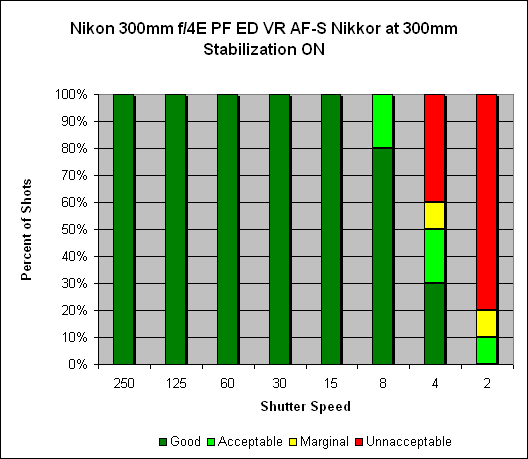
IS systems tend to provide more benefit to less-stable shooters than very steady ones, so most users will see the same or greater amounts of shake reduction as we measured here. You can read more about our IS test methodology here: SLRgear IS Test Methodology, v2.
Reader Reviews
- Image quality
- 9.6/10
- Build quality
- 8.8/10
- Recommend it
- 100%
- 9/10Recommendedby AndyF · December 1 2018
Pros: Light, compact, great VR.
Cons: None really. Could be a hair sharper but it's still very sharp.
Yesterday, I got a second hand copy of this lens for 1200 GBP and it exceeds expectations.
No sign of the widely reported issues with VR at slow-ish shutter speeds on my D810 - the serial number indicates it was built after the recall.
So yes, it's a lovely lens to use and I'd definitely recommend it - but if you have an older DSLR just make sure it can drive the electronic aperture.
- 10/10Recommendedby lblignaut · July 15 2016
Pros: Light and compact. Portable. Sharp and focuses fast. VR works well.
Cons: Be careful with back lighting.
This is a truly wonderful lens. I hand held it at f/5.6 and 1/50 with a D7100 and the result was a sharp image. I use it as a walkabout lens because it is so portable. My 70 - 300 f/4.5 - f/5.6 VR stays at home. I prefer fixed lenses. Be careful with the background. It is f/4, not f/2.8. It does not like back light. These shortcomings are minor because I can work around it. That is also the beauty of primes because it demands that you think about what you are doing. The additional crop factor on the D7100 makes this a 600 lens. Add a TC 1.4 and you have an 800 lens. The world is waiting.
- 9/10Recommendedby thejohnz · October 26 2015 · paid $1999
Pros: Small size, light weight, very high IQ
Cons: VR can be a problem if one is not careful (read my review)
I purchased this lens directly from the Nikon store in April of 2015. My reason to purchase from Nikon directly was availability and confidence that the VR issues with this lens had been corrected. I own a lot of Nikon equipment. This lens was of great interest as a replacement for the Nikkor 300mm F2.8. I loved this 6.4 pound lens, but the weight and size was becoming a real issue for me.
Upon receiving the Nikkor 300mmF4 VR lens, I checked it out first for sharpness and focus, then for any VR problems.
Let me first say that this lens is sharp, sharp, sharp even wide open. It totally equals its larger F2.8 cousin at every aperture except of course F2.8. This lens also focuses accurately and quickly.
At first, I thought I did not have a VR problem. It was only after many shots I notice a problem. I would get a double horizontal line between shutter speed of 1/80th to 160th second. Please note that this was only noticeable on horizontal lines, not vertical lines. The degree of what I called astigmatism, was from 2 to 4 pixels. This occurred on all my camera bodies (D800, D750, and D7200). Iso Values higher than 1600 often masked the problem. To make the problem most visible, I would photograph road signs. The abrupt white to black transition on the sign printing made an easy way to evaluate the degree of the problem.
After my May trip to South Africa and the Kruger National Park, I sent the lens back to Nikon with detailed photos of the problem. The lens was returned a week later with a statement saying that the lens was within their specifications. No detailed analysis was provided.
After some thought, I tried a different approach to the problem. I did a lot of internet research as to Nikon VR systems in general. One thing stood out in my research. The weak point of most VR systems is around 1/125th second exposure. Why, I am not sure. Interaction with the mirror, shutter, or something else? Also, the low weight of this lens coupled with its high IQ is unique. Most all systems of equal quality would weight at least twice as much.
I tried various techniques such as gripping the lens and camera body tighter, bracing my arms, using a monopod, etc. all with no success.
By chance I then tried just holding the camera loosely and not gripping the lens at all. For the first time, I was able to get a good, sharp shot at 1/125th second. My success rate was about 33% of photos taken. My best result was with the D7200, even though this camera magnifies the telephoto ability of this lens to 450mm.
Although this seemed counter to what one should expect, it did start to make sense when I researched further. Thom Hogan had a great article that helped explain the workings of VR and the problems with tripod mounting and shutter speeds in the 1/125th range.
During these experiments, I was also corresponding with a well known Canadian nature photographer, who was not having any problems with this lens in regards to VR. I did discover that he used the extra grip attachment on all his Nikon cameras, whereas, I did not. The grip attachment for the D7200 was recently on sale, so I thought I would give it a try.
I can now tell you that, with the Nikon MB-D16 grip attached to the D7200, the 300mmF4 VR worked flawlessly at 1/125th second as well as all other shutter speeds in the questionable rearm of 1/80th to 1/160th. Only one caveat here: you still must keep your hands completely off the lens itself.
Why the extra grip works so well I do not know. It could be the extra mass, or the better balance, or the extra area for your hands. All I know is that it works well, even when I attach the TC-14EII teleconverter.
I am now so pleased with this lens. For bird photography, I use this lens with the 1.4 teleconverter on a D7200 with the extra grip attached. That gives me a hand holdable 630mm (35mm equivalent) F5.6 lens in a combo that only weighs 2 pounds! This allows for quick response, which is really useful on birds in flight. This lens with the teleconverter attached is still very sharp and only bettered by Nikon’s best 10# primes. The images I get are stunning. In some ways I can do better than those guys with the 10# lenses. I have no need for a tripod, monopod or any other contraption to hold the lens, making it much easier to find and keep a flying bird on target.
The light weight and size of this lens coupled with the excellent optics makes this lens revolutionary. I always take it on trips, walks, hikes etc. No longer do I miss shots due to leaving my telephoto lenses at home.
I hope others can benefit from my experience and can repeat the results I found above.
- 10/10Recommendedby ppk · August 20 2015 · paid $1999
Pros: light, fast focus, sharp, a status symbol...
Cons: its expensive..
I never had a status symbol kind of lens. Always bought nice mid range zooms and have tolerated the weak telephoto sharpness in every single lens. And I have had many lenses... Traded 80-400 and 18-300 in on this one. The 300 is premium. Fast, light, sharp, and takes great 300 mm photos without compromise. if you want the best... get it. The downside is it will make all your other lens look weak, heavy and old.
- 8/10Recommendedby Airy · May 10 2015 · paid $2240
Pros: Good IQ in general, efficient AF tracking, reasonable weight and size
Cons: Botched VR
The fresnel lens allows a compact construction and light weight, so finally we got a 300/4 lens that is a good travel companion (esp. with smaller FX cameras such as Nikon Df or D750).
There are few signs revealing the fresnel technology - shooting into the blazing sun will get you some psychedelic highlights in the overexposed parts ; contrast is slightly less than with conventional lenses, but that's all very acceptable.
Very useful lens for birding, as AF precision is very good (AF tracking is very efficient, even with the Df). Also, MF action is smooth and adequaltely short for shooting birds through foliage or twigs.
VR disappoints big time. While I could get sharp handheld shots at 1/20s (nice), in the 1/60 - 1/125s region, you will hardly get any sharp shot with VR on, unless maybe you would use the "Quiet" mode on the camera. Trouble was signaled with D800, but it is also there with the Nikon Df. Sharpness loss expresses itself in the form of double edges, so there is nothing to mitigate here. Note: my copy is a late ser. No. where the VR issue was supposedly corrected.
Not sure I'll keep it - sure there is more to a tele lens than just VR, but I sometimes need the feature, and above all I feel cheated here.
--- Edit ---
Well, I kept it. It happens to be an excellent portrait lens... I have used it for close-up shots of street musicians, for instance, with excellent results.
Concerning VR, I'd recommend switching to manual mode, 1/30s, in low light, and let AutoISO tune the exposure. I consistently get sharp (and low noise) shots that way, with static subjects of course.
Reader reviews were submitted by Imaging Resource readers and are shown as written.