

Overview
(From Olympus lens literature) Part of our renowned Digital Specific Lens (TM) line, the 14-54mm is a portable, high-quality Digital Zuiko wide-angle zoom that provides edge-to-edge sharpness and superb color reproduction. The fast f/2.8-3.5 aperture makes it ideal for low-light situations while rendering a bright viewfinder image in the camera for easy focus and composition.
Since Olympus digital SLR cameras employ the four-thirds imaging sensor, any lens attached to the body will have an effective focal length (in 35mm terms) of double the listed length. Thus, for this particular lens, it will exhibit an effective focal length of 28-108mm. The lens takes 67mm filters, and comes with a petal-shaped lens hood. It’s available now for around $450.
This lens isn’t a “constant” lens, in that as you increase the focal length, the maximum aperture size decreases. The following table reflects the change in maximum aperture:
| Focal length | 14mm | 18mm | 25mm | 35mm | 54mm |
| Max. aperture | ƒ/2.8 | ƒ/2.9 | ƒ/3.1 | ƒ/3.2 | ƒ/3.5 |
These figures just correspond to the focal lengths marked on the lens; in actual usage, the widest aperture adjusts quite precisely in conjunction with the focal length setting. As you zoom in and out at the widest aperture, you can see the aperture changing in one-tenth increments.
Sharpness
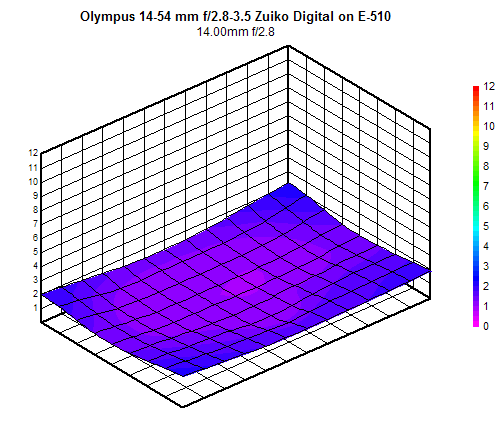
The Zuiko digital lens design seeks to improve image clarity by aligning the light rays as they approach the sensor; in the case of the 14-54mm, this concept succeeds extremely well. On most wide-angle lenses, corner softness is the most common issue, but even at the widest and fastest configuration of this lens (14mm at ƒ/2.8) corner softness is barely noticeable and the lens is very sharp. Stopped down to just ƒ/4, corner softness is negligible and sharpness is excellent across the frame.
On the telephoto end, the lens is not at its sharpest wide open at ƒ/3.5, but it is hard to find fault with the lens’ sharpness here – it barely exceeds 2 blur units on our scale from 1 to 12. Sharpness improves as the aperture is stopped down, and by ƒ/5.6 sharpness is uniformly excellent. Diffraction starts to set in around ƒ/16, with the worst results shown at ƒ/22; however, the worst from this lens is better than the best from others we’ve seen, with the image produced never exceeding 4 units on our blur scale.
Chromatic Aberration
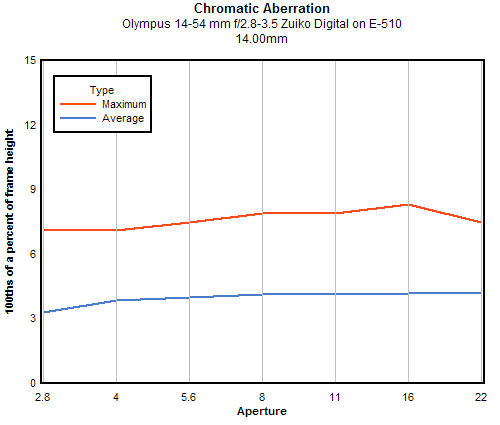
If this lens has any faults, they might be apparent in its performance with regard to chromatic aberration. In the lab we do record CA when this lens is set to its widest angle, but even here the effect is not incredibly significant (you’ll see it if you zoom in, but on average print sizes, there aren’t enough pixels printed to show it). Chromatic aberration virtually disappears as you approach 35mm in focal length, and returns as you hit the telephoto end at 54mm. One note to the chromatic aberration in this lens is that it is fairly static across apertures – changing to a faster aperture is not going to produce more CA (but changing to a smaller aperture isn’t going to reduce it, either).
Shading (”Vignetting”)
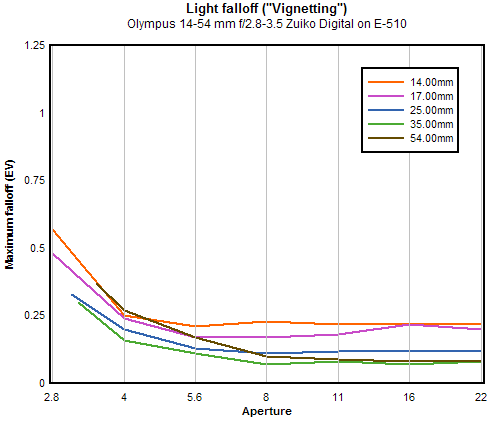
The 14-54mm has excellent performance with regard to vignetting. It’s really only a factor when the focal length is set to a wider angle (17mm and below) and the aperture is set to anything faster than ƒ/4. Outside of these conditions, light falloff is negligible; in the worse case scenario, 14mm at ƒ/2.8, you’re looking at just over a half-stop differential in light in the corners. Happily, most imaging software can correct for shading issues.
Distortion
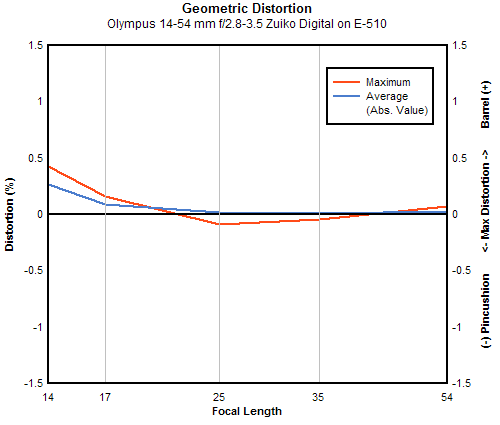
Distortion is handled excellently with this lens. Typical with wide-angle lenses, there is some barrel distortion when the lens is set to a wider angle (below 22mm), but even here, the maximum variation is less than 0.5%. Curiously, there is some slight pincushion distortion only at the mid-range level (25mm) but you’d have to look pretty closely at your images to detect it.
Autofocus Operation
The 14-54mm autofocuses quickly, but not as quietly as we would have liked. It’s not a subtle noise, but it’s a small price to pay for excellent autofocussing performance. Point-to-point focusing is very quick and the noise is not so obvious in these cases; it’s only when the lens racks through the entire focus range that the serious motor noise comes into play.
Macro
The focus range scale on the lens shows a closest-focus distance of 22 centimetres (just over 8.5 inches), and our results bear this out, providing satisfactory results for macro use. It’s worth noting that the close-focus range is taken from the image sensor, not the end of the lens, as this produces a practical close-focus range (from the far end of the lens) of just under 2 inches.
Bokeh
Click on these thumbnails for full-size samples:
 |
| 54mm, ƒ/3.5 |
 |
| 54mm, ƒ/8 |
 |
| 54mm, ƒ/22 |
Build Quality and Handling
The 14-54mm is solidly built. It still seems to be finished with a fair number of plastic parts, but at 435 grams (just over 15 ounces), there’s a lot of glass and metal under the shell. The lens mount is metal, compared to the plastic of less expensive Olympus glass. The fit and finish of this lens is superb; there zoom and focus dials rotate with a velvety smoothness, and the textures have an excellent traction. Setting it apart from less expensive Olympus lenses is a distance scale.
Mounted on the E-510, the camera balances extremely well. The front filter doesn’t turn while focussing or zooming, and a quarter turn on the zoom dial covers the entire focal range.
Alternatives
Unforunately, your options are a bit limited with the Olympus lens system, as four-thirds system lenses are still relatively new and only Sigma is producing third-party lenses to fit.
Olympus 14-35mm f/2 ED SWD Zuiko Digital ~$?
At the time of this review, it’s not yet on the store shelves; for what would be a premium price, you probably won’t get much better quality than this 28-70mm 35mm-equivalent lens. It won’t zoom out quite as far, but with a constant ƒ/2 aperture, you won’t get a faster lens in this focal range.
Olympus 14-45mm f/3.5-5.6 Zuiko Digital ~$139-200
This lens was the original kit lens for the Evolt E-330, which has arguably been replaced by the 14-42mm Zuiko. Corner softness is a problem with this lens, obvious at wide angles and apertures; chromatic aberration is also readily apparent until you zoom out further than 18mm. Vignetting and distortion are also worse, but not by much.
Olympus 14-42mm f/3.5-5.6 Zuiko Digital ~$249
The original kit lens for the E-410 and E-510, this is the lens from which most Olympus dSLR users would be considering an upgrade. It’s less expensive, but in this case you do get what you pay for as the 14-42mm isn’t quite the wonder-lens with regard to sharpness, distortion and vignetting. It has a slightly better profile with regard to chromatic aberration, and it is much lighter (190g), but this shows off the fact that it isn’t made with the same attention to fit and finish as you find with the 14-54mm.
Panasonic 14-50mm f/2.8-3.5 ASPH Leica D VARIO-ELMARIT ~$900
With on-board stabilization and an aperture control ring on the lens, with 16 elements in 12 groups, this high-quality optic should be an excellent performer. Check this review from cameralabs.com for how the lens-based stabilization works on an Olympus E-510.
Sigma 18-50mm f/2.8 EX DC ~$109 (f/2.8: $419)
The only non-Olympus lens in this category, we haven’t yet tested it but it has received above-average user reviews. For the budget option, this could be a strong contender. Sigma also produces a constant ƒ/2.8 version of this lens, which fits the four-thirds lens system.
Conclusion
The 14-54mm f/2.8-3.5 is the ultimate walk-around lens for the Olympus four-thirds system. While not as versatile as a superzoom (54mm isn’t very long, as far as telephoto lenses go, even with the 2x crop factor) the optical quality is truly remarkable. Combined with excellent resistance to distortion and shading, and a respectable chromatic aberration profile (you have to look hard to find CA in images produced by this lens), this lens does the job, and does more than well enough to justify the reasonable price demanded for it.
Sample Photos!
Sample photos are available of two laboratory test targets to help in our readers’ evaluation of the lenses we test. The VFA target should give you a good idea of sharpness in the center and corners, as well as some idea of the extent of barrel or pincushion distortion and chromatic aberration, while the Still Life subject may help in judging contrast and color. We shoot both images using the default JPEG settings and manual white balance of our test bodies, so the images should be quite consistent from lens to lens.
As appropriate, we shoot these with both full-frame and sub-frame bodies, at a range of focal lengths, and at both maximum aperture and f/8. For the “VFA” target (the viewfinder accuracy target from Imaging Resource), we also provide sample crops from the center and upper-left corner of each shot, so you can quickly get a sense of relative sharpness, without having to download and inspect the full-res images. To avoid space limitations with the layout of our review pages, indexes to the test shots launch in separate windows.
To see the sample shots from this lens captured with this lens on our test body, just click on either of the thumbnails below, and scroll as needed in the window that appears.


Lab Test Results
Our standard lens lab tests, shot on a sub-frame (APS-C) body. Pick a focal length and aperture to see the result.
Sharpness (blur index)
Blur across the frame: lower and flatter is sharper. Change focal length and aperture to see how it improves when stopped down.
Chromatic aberration
Colour fringing in the corners at each focal length.
Vignetting (corner shading)
How much darker the corners are than the centre, by aperture and focal length.
Geometric distortion
Barrel (positive) or pincushion (negative) distortion across the zoom range.
Reader Reviews
- Image quality
- 8.9/10
- Build quality
- 9.6/10
- Recommend it
- 94%
- 9/10Recommendedby squirelonsteroids · October 30 2016 · paid $400
Pros: A workhorse
Cons: nothing at this price point
At the price point of this lens, especially today, there is nothing to complain. The lens is great. It is weather sealed, and on OM-D E-M1 produce dramatically sharper images than on old bodies, due to low-pass filter.
It focuses fine on all bodies, and on it works great. It is very precise and fast.
It is optically better than 14-54 mk2.
- 8/10Recommendedby MichaelShea · April 27 2014 · paid $331
Pros: Edge to edge sharpness in middle of zoom range, great build, lovely colour rendition
Cons: No real advantages over cheaper offerings at wide end, some chromatic aberrations visible
This will be a short review aimed predominantly at potential second-hand buyers for the micro four thirds system. Let me straight away state that I can thoroughly recommend the lens for stills photography of static subjects. I'm not qualified to comment on results that you might expect from video, sports etc.
No doubt the mark 2 version of the lens represents an improvement in terms of auto-focusing speed. But as far as accuracy is concerned, this lens is very good indeed and far better incidentally than most of the digital Pentax K-mount lenses I've used. If you have an object showing clear vertical markings, that should guarantee complete accuracy. Otherwise, you might want to consider manual focus adjust. Many of my early pictures have featured golden sand containing very little obvious contrast and yet my failure rate has been minimal.
Now that's out of the way, let's concentrate on the image quality. This is simply first rate. At anything between around 18-40mm, the results are at least as good as any prime lens I've used on my various MFT cameras. Peak results are probably between 20-30mm, where edge to edge sharpness is outstanding from f4-8. At all zoom settings and apertures, colour is stunning and up with the very best traditions of Olympus digital lenses. Olympus four thirds lenses make Panasonic cameras colour and contrast output look interesting and that is no mean feat.
An unknown feature for me until I took delivery of my lens copy was its close-focusing abilities, which are bordering on macro standard. I'm not saying you should forget about any dedicated macro lenses you already own, but if you are considering a macro and not committed to a particular preferred focal length, this is worth considering in its own right.
The build quality is of semi-professional standard. It repels dust and grime and feels as tough as old boots. It balances quite well on my Panasonic Lumix G5 camera (S-AF) and even better on my G1 (manual focus only). If you have become accustomed to small size and light weight, you should probably look elsewhere. But if you are like me, the universal zoom range is sufficient to make this the only lens you are likely to need for most of your photography.
Because this lens has been superseded by a newer model, it is easy to obtain second-hand copies at bargain prices. If the middle of the zoom range is roughly your typical focal length of choice, or if you are procrastinating about a zoom for (micro) four thirds that is a cut above the flimsy plastic kit offerings, look no further. This is an excellent choice.
- 10/10Recommendedby logbi77 · March 7 2009 · paid $300
Pros: Fast Focus, Build, Weather-Sealed, Relatively Cheap
Cons: Not Constant 2.8
This lens is a great lens. I bought this lens used, and it is quite good in terms of image quality, sharp across the frame. It is also relatively cheap and better in comparison to the other manufacturer's offerings in relation to focal length (28-108mm FF equivalent). The only lens I think that is being offered by others are the nikon 18-70mm 3.5-4.5 and the sigma 17-70mm 2.8-4.5. But then, these offering from other manufacturer's are a bit slower and don't have stabilization, as opposed to the e-520 which has its stabilization on the body. Overall, a great walk-around lens, and for the price, few lenses could match it.
- 9/10Recommendedby kubler · November 14 2008 · paid $400
Pros: Well built, sharp & good contrast
Cons: none
Excellent walk-around lens, sits on my E-510 most of the time. The f2.8 is satisfactory most of the time, focusing even at low light levels has not been a problem like the 14-42 kit lens. Overall, a vast improvement.
- 9/10Recommendedby MartinM · November 12 2008 · paid $310
Pros: Sharp, fast AF, good focal length
Cons: a bit heavy, old lens cap
Noting to complain at all. This lens first perfect on my e520. Although it does not support contrast AF, the way i use it, OVF, does not matter.
Its really sharp and the IQ is outstanding.
Compared to the 12-60 it is very affordable adn offers almost the same focal length
The weight and the lens cap is something that i don't like.
- 10/10Recommendedby swintonphoto · October 28 2008 · paid $420
Pros: Excellent max aperture, excellent build quality, excellent image quality
Cons: None.
I have been using this lens for a year and a half and I couldn't be happier. It brings incredibly sharp results and has a great max aperture. Considering the wide max aperture, the lens is surprisingly small. While it is much larger than the kit lenses, it is small compared to similar lenses by other manufacturers. It is very well built, with weather sealing. Just holding the lens you can feel the quality of the build. It also auto-focuses very quickly.
My images vastly improved in quality when I purchased this sharp lens. It also has virtually no distortion at either end.
I have used this with my E-500 and my E-510 and have had fantastic results. It stays on my camera 80% of the time.
If I had to buy a normal-range zoom again, I would buy this one in a heartbeat. A must for any serious photographer.
- 6/10Not recommendedby Magnus · January 9 2008 · paid $600
Pros: Build Quality
Cons: Softness Wide open, slow AF
Lens delivers good results at 5,6 - 11 and this at f4.0 .... well so did my Oly kit lens. I bought this for the speed but 2.8 changes to 3.5 rather quickly and shooting 14mm or 54mm at highest aperature doesn't produce any crispness. Certainly not compared to the price difference of the kit and this.
Another con, is the autofocussing, trying to autofocus wide-angle outdoor shots is almost impossible.
I am very disapointed with this lens which is the least performing part of my 7-14 14-54 and 50-200 set. I use it however sinve there is no alternative whatsoever, but I would of expected an overall higher quality lens.
I obviously found this out upon purchase but thought it had something to do with camera setting perhaps.... this is not the case, it's clearly the lens.
The lens is good, but certainly not worth the money.
- 8/10Recommendedby ailame · December 22 2007
Pros: this Oly kit lens is much much better than kit lenses provided with other manufactures
Cons: bit soft when open at its max
Universal and reliable lens I carry with me all the time. At wide open side (f2.8-3.5) it delivers less then crispy-sharp results. However, starting f4-5 the output becomes to be comparable to fix focus 50mm f2.0. So if light conditions allows it I always close it a bit.
There is huge difference in AF performance when used with E-1 versus E-3. It is relatively slow with E-1 in general but in low light conditions it very difficult to use... cost me a lot of patience and lost shot opportunities. However, the very same lenses mounted on E-3 truly excels. Lightning fast, precise... even in almost no light. Though this changes come more as attribute of camera then lenses still, this proves that lenses are capable of professional performance.
Show all 17 reader reviews
- 10/10Recommendedby kmyren · January 31 2007 · paid $499
Pros: Better glass then the kit lens. Almost everything about this lens is prefect and how it interacts with the E-500
Cons: Nothing so far - taking a lot od pictures using different setting
I purchased the E-500 after a lot of research and testing. Being relatively new to DSLR I still have lots of questions. I have learned to carry a small note pad to take notes and it really helps me get better. Now you add Photoshop in the mix and set up some projects and you can create great looking pictures. But I have to say that out of the box this lens is really worth the extrs $$$$
- 10/10Recommendedby pflugshaupt · January 5 2007 · paid $600
Pros: image quality, build quality
Cons: shades the pop-up flash on the E-400 at widest angles or up close
Having bought the lens with a E-400 body, I'm very happy with it. Image quality is excellent and I really like the feel and handling of the lens.
One small problem is that the E-400's pop-up flash gets shaded by the lens at wide angles (less than 18mm) and/or close up. This is due to the greater bulk of it compared to the E-400's kit lens, for which the pop-up flash is obviously made. I can live with that since I hardly use flash, and I can still use the pop-up flash as a fill-in in most conditions.
- 10/10Recommendedby KenH · January 2 2007 · paid $499
Pros: Good walk about lens
Cons: None
This is a good walkabout lens with decent image qualities
This is a good lens to add to your Zuiko collection.
- 9/10Recommendedby llbeanie1 · January 1 2007
great lens and build quality
- 7/10Recommendedby cra3y · November 24 2006 · paid $500
Pros: Build quality, weather seals, compact size compared to FF lenses
Cons: Slow AF, soft wide open at full aperture
This is mainstream lens that should be used for everyday photos. Compact size and lightweight are the major advantages.
Build quality is very and weather seals are main advantages, but AF performance is still poor compared to others (Canon/Nikon)
This lens is perform well, but it won't resolve 1200 lw/ph with E300 (imatest resolution target shot at raw processed byc dcraw and lightroom with no sharpening at all). This lens satisfied E1 sensor resolution but do not exceed E300/E500/E330 sensors.
- 10/10Recommendedby thePrince · November 24 2006 · paid $800
Pros: Build quality, sharpness
Cons: Rather expensive (in Greece, at least)
Bought it 6 months ago, brand new, to replace the 14-45 on my E-300. This lens pushes this camera to its limits. Almost zero barrel / pincushion distortion / vignetting, great sharpness and fast. Can also focus at 0.22mm. A very good walkaround lens.
- 9/10Recommendedby ExCibular · December 9 2005 · paid $500
Pros: Fast, build & optical quality, ideal focal range
Cons: none
Very well build lens that is very good in terms of sharpness. AF is fast and allows you to focus in darker circumstances. Moreover, the focal range is very good, a little wide and some short tele, very good walkaround lens.
- 9/10Recommendedby mfs · October 23 2005 · paid $500
Pros: light weight, sharpness, fast
Cons: none
This is a good all around performer which has good to excellent sharpness. It is again limited by the E-1's relatively low resolution, and noisy sensor.
Hopefully, the E-1's sucessor will better demonstrate this lens's performance.
- 9/10Recommendedby Jay · October 23 2005
Pros: Moderate size, F2.8 at wide end, good sharpness and contrast
This is the standard lens with the E-1 and fulfills that function very nicely -- good wide angle range and moderate telephoto.
This lens delivers the shot, every time, and with its splash proof construction you can keep shooting even when it starts to rain!
Reader reviews were submitted by Imaging Resource readers and are shown as written.