

Overview
(From Olympus lens literature) Capture beautiful details with impeccable accuracy with this ultra-lightweight Macro lens. Take pictures of flowers, coins, stamps and more from less than 6 inches to infinity – with dramatic results. Designed exclusively for digital photography, this lens delivers rich, accurate colors and high contrast from edge-to-edge, and is ideal to use for macro shots and even standard landscape and portrait shots, as well. And because it weighs less than 6 ounces, carrying it is just as appealing as using it.
Introduction
The Olympus lens lineup has two macro lenses: the 35mm and the 50mm. The 35mm ƒ/3.5 is listed in the ”Standard” lineup, developed for cost performance and portability. Available for $200.
Since Olympus digital SLR cameras employ the four-thirds imaging sensor, any lens attached to the body will have an effective focal length (in 35mm terms) of double the listed length. Thus, for this particular lens, it will exhibit an effective focal length of 70mm. The lens takes 52mm filters, but does not come with a lens hood (nor does Olympus make one for this lens).
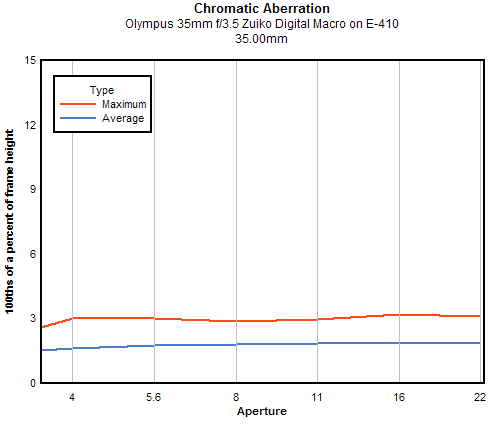
Chromatic Aberration
With a maximum deviation of 3/1000ths of a percent, chromatic aberration is a non-issue for this lens. Interestingly, our chart shows the best performance with the lens wide open at ƒ/3.5, but overall the numbers are so small you would need to print very large photographs and look at them with a magnifying glass to see any evidence of CA.
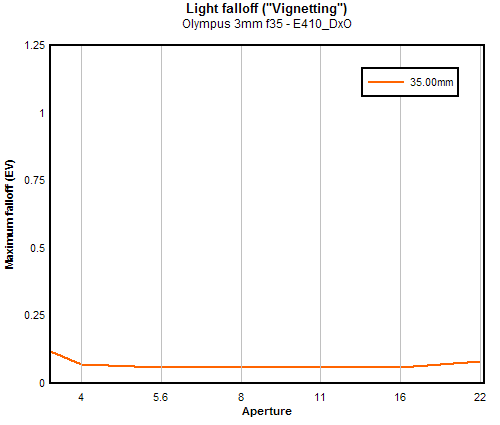
Shading (”Vignetting”)
Another non-issue; even wide-open at ƒ/3.5, you’re looking at less than 1/8th of a stop of light loss in the corners.
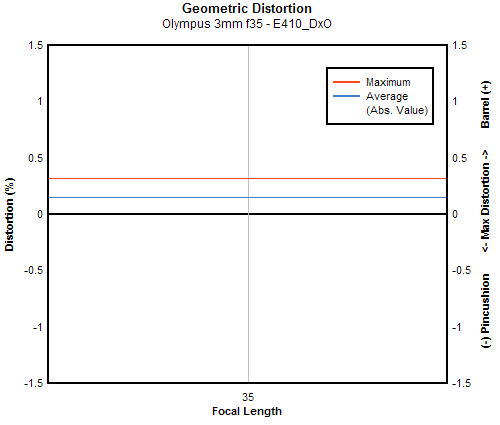
Distortion
Because the lens is fixed at 35mm, the distortion is also fixed. The maximum distortion is 0.3% (in the corners) where the minimum is distortion is around 0.1%. In other words, fairly negligible, and if it does bend the straight lines in your architectural photography, you can correct them in your favorite image processing software.
Autofocus Operation
The 35mm ƒ/3.5 Zuiko is not a snappy autofocus lens, but in reality, it doesn’t need to be. Racking through its entire focus range in just over two seconds, it makes a substantial amount of noise; this is not a subtle lens. Oddly enough, the seeking is not consistent; it can rack quicker than two seconds, but I couldn’t reliably figure out when it would decide to do a ”quick” focus as opposed to a standard rack focus. That said, it performs respectably well in low-light, but your success in low-light autofocusing will depend largely on the subject being focussed on.
Macro
With a close-focusing distance of just under 15 centimetres (6 inches) from the image sensor, the 35mm ƒ/3.5 focuses on objects literally millimetres away from the end of the lens. At this range the lens achieves 200% image magnification when considered in 35mm film terms.
In practice, with a 35mm macro lens you will have to be pretty close to your subject to get the 1:1 (2:1) magnification, enough to scare the bugs away, so it could be worth it to keep that in mind.
Bokeh
 |
| 35mm, ƒ/3.5 |
|
| 35mm, ƒ/8 |
 |
| 35mm, ƒ/22 |
Build Quality and Handling
The 35mm ƒ/3.5 is a lens out of Olympus’s budget category, so it lacks the heavier construction of their High-Grade or Super High-Grade lenses; the focus and filter rings are made of plastic. However, the lens mount is made of metal, and the focus ring is well geared; turning it is smooth as silk. Absent is a focus-distance indicator and any kind of depth-of-field scale, but a magnification scale is helpfully indicated on the barrel. Weighing in at 165 grams (just under 6 oz), you hardly even know it’s attached to the body.
A hood is not listed as an accessory for this lens, however when you look at the design of the lens, the glass seems shrouded by the barrel to a large extent, making a lens hood unnecessary.
Alternatives
Olympus 50mm f/2 Zuiko Digital Macro ~$425
A slightly more expensive Olympus macro option, the 50mm gives the same excellent results for resistance to chromatic aberration, distortion and vignetting, but is a tad sharper at smaller apertures (ƒ/16-22). The 35mm has a much higher magnification ratio, but the larger maximum aperture of the 50mm will bring in a lot more light.
Sigma 24mm f/1.8 EX DG Aspherical Macro ~$340
Available in the four-thirds mount, this lens offering from Sigma doesn’t give you a comparable focal length, but it does offer a faster nine-bladed aperture. We haven’t reviewed this lens as of the date of this review, but the one user review we have does praise its image quality, while commenting negatively on its large size and weight.
Sigma 105mm f/2.8 EX DG Macro ~$350
Another Sigma offering in the four-thirds camp, the 105mm f/2.8 uses an eight-bladed aperture, offering respectable sharpness results that match the Olympus 35mm from f/5.6 and up. Chromatic aberration, Distortion and Vignetting are excellently handled, and in macro use, the 150mm offers 1:1 magnification. It’s a heavier lens though, weighing in at 457 grams (16 oz).
Sigma 150mm f/2.8 EX DG HSM APO Macro ~$540
The sharpness results for this lens tell the whole story; tack sharp almost all the way across from f/2.8 to f/22. Excellent results for chromatic aberration and distortion-free images; some slight vignetting at f/2.8. It’s quite heavy for macro use at 895 grams (almost 32 oz) and you’ll be mounting the lens on a tripod, but if you’re in the market for a 300mm-equivalent macro lens, this is your option. Close-focusing to 38 cm (16 inches), the lens can achieve 1:1 magnification.
Conclusion
For an entry-level macro lens in the Olympus system, you can’t go wrong with the 35mm ƒ/3.5. Amazing sharpness and resistance to chromatic aberration, distortion and vignetting, the lens is feather-light and is designed well enough that it doesn’t even need a lens hood. If you’re dying for a focus-distance indicator or a longer focal length, it’s probably worth it to buy the 50mm ƒ/2, but there’s absolutely nothing wrong with the 35mm ƒ/3.5. With its huge magnification rating (without an extension tube), it does an excellent job with macro work, and at an effective 70mm focal length, would make a respectable portrait lens, too.
Sample Photos!
Sample photos are available of two laboratory test targets to help in our readers’ evaluation of the lenses we test. The VFA target should give you a good idea of sharpness in the center and corners, as well as some idea of the extent of barrel or pincushion distortion and chromatic aberration, while the Still Life subject may help in judging contrast and color. We shoot both images using the default JPEG settings and manual white balance of our test bodies, so the images should be quite consistent from lens to lens.
As appropriate, we shoot these with both full-frame and sub-frame bodies, at a range of focal lengths, and at both maximum aperture and f/8. For the ”;VFA”; target (the viewfinder accuracy target from Imaging Resource), we also provide sample crops from the center and upper-left corner of each shot, so you can quickly get a sense of relative sharpness, without having to download and inspect the full-res images. To avoid space limitations with the layout of our review pages, indexes to the test shots launch in separate windows.
To see the sample shots from this lens captured with this lens on our test body, just click on either of the thumbnails below, and scroll as needed in the window that appears.


Lab Test Results
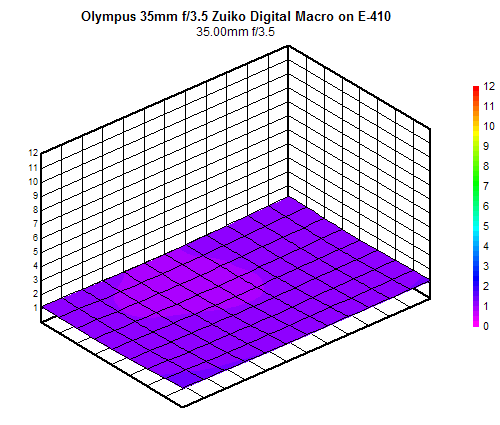
Our standard lens lab tests, shot on a sub-frame (APS-C) body. Pick a focal length and aperture to see the result.
Sharpness (blur index)
Blur across the frame: lower and flatter is sharper. Change focal length and aperture to see how it improves when stopped down.
Chromatic aberration
Colour fringing in the corners at each focal length.
Vignetting (corner shading)
How much darker the corners are than the centre, by aperture and focal length.
Geometric distortion
Barrel (positive) or pincushion (negative) distortion across the zoom range.
Reader Reviews
- Image quality
- 9.6/10
- Build quality
- 8/10
- Recommend it
- 100%
- 10/10Recommendedby aliolt · July 5 2013 · paid $75
Pros: Sharp, light, small, quite good built quality
Cons: slow focus time
Must have lens.
- 9/10Recommendedby Yemm66 · November 6 2011 · paid $140
Pros: Clarity, color reproduction, Light Weight, Sharpness
Cons: Slow focus at times, Hunts for focus
This is the more cost effective Olympus macro lens available for the four thirds system. It is astonishingly sharp with outstanding color reproduction. I can't emphasize enough how wonderful the color is from this lens. Images are very sharp with little, if any, distortion, pincushion, or chromatic aberration. The only knock I can give this lens is it's focus hunting. It can be quite annoying, but is only a problem in macro mode. Regular focusing is pleasant and relatively quick. Great choice for someone who doesn't have the cash to lay down on the pricier 50mm f/2.0 model. Buy it. It's worth the money!
- 9/10Recommendedby Kaiser Soze · May 16 2009 · paid $230
Pros: Sharp, Light, small, with excellent magnification
Cons: Could be faster, noisy when focusing
Best dollar for dollar macro available for any system.
Sharp images with good contrast and clean bokeh.
- 9/10Recommendedby swintonphoto · October 28 2008 · paid $200
Pros: 1:1 macro, razor sharp, lightweight
Cons: Slower auto-focus, plastic body
This lens is an amazing bargain for its image quality. Razor sharp - as sharp a lens as I have ever used. It is a true 1:1 macro lens, and does a fantastic job for me as my macro. It also does very well as a portrait lens at the equivalent focal length of 70mm. It's max aperture is quite large considering its affordable price and compact size. It's only real limitations are the slower auto-focus (though this is rarely a problem for me) and plastic build.
I absolutely love this lens. I use it for macro, portraits, and any time I just want a lightweight compact lens to carry around. I would highly recommend this - for the price it is a no-brainer.
- 8/10Recommendedby raymacey · January 30 2006 · paid $255
Pros: Extremely light weight
Cons: f/3.5 is as wide as it goes
A wonderful addition to my collection, makes a great portrait lense with the bonus of macro capabilities. Extremely light weight.
Reader reviews were submitted by Imaging Resource readers and are shown as written.