
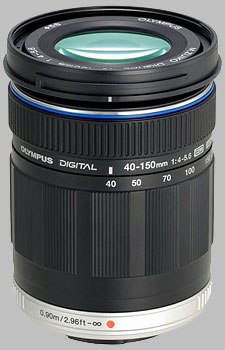
Overview
Olympus has produced a 40-150mm zoom lens for some time, but not in the M.Zuiko mount; introduced near the end of 2010, the Olympus 40-150mm ƒ/4-5.6 M.Zuiko makes an excellent companion to the 14-42mm kit lens.
The Olympus 40-150mm ƒ/4-5.6 M.Zuiko produces an effective field of view of 80-300mm when mounted on a compatible camera body. The micro four-thirds format will restrict compatible bodies to micro four-thirds mounts only; anything else would cause vignetting.
This lens isn’t a ”constant” lens, in that as you increase the focal length, the widest aperture is restricted (showing a higher f-number). The following table reflects the changes:
| Focal length |
40mm | 49mm | 70mm | 100mm | 150mm |
| Max. aperture |
ƒ/4 | ƒ/4.2 | ƒ/4.6 | ƒ/5 | ƒ/5.6 |
| Min. aperture |
ƒ/22 at all focal lengths | ||||
The Olympus 40-150mm ƒ/4-5.6 zoom lens takes 58mm filters and is available in a package with the E-PL2 camera, or separately for around $300.
Sharpness
The 40-150mm ƒ/4-5.6 offers very good performance, more to the wider range of its focal lengths than the telephoto.
Used wide open at its wider angle (ƒ/4 and 40mm), the lens offers decently sharp performance, with some light corner softness in the lower right hand side; given that this corner softness will change its position between settings, it’s not unreasonable to assume this sample of the lens shows some signs of de-centering. Stopping down at 40mm produces an slight improvement in sharpness, getting almost tack-sharp if not for the right side. Sharpness performance is essentially as good at ƒ/5.6 as it is at ƒ/8, and diffraction limiting sets in after that; a reduction in sharpness isn’t really evident until ƒ/16.
The mid-range of the lens (49-70mm) is where this lens really shines best, offering good performance wide open (except for a slightly soft left corner), and tack-sharp performance when stopped down to ƒ/5.6. Again, performance is excellent all the way to ƒ/11, where diffraction limiting has set in.
The telephoto end of the lens (100-150mm) feels somewhat tacked on, as the dramatic sharpness noted in the mid-range isn’t really apparent here. Sharpness is still very good, but doesn’t hit the sharpest levels found at wider focal lengths. At 100mm the lens still produces very sharp results at ƒ/8; at 150mm, the best it can produce is found at ƒ/8, but it’s just not as sharp.
Fully stopped-down performance isn’t great, but not as terrible as we’ve seen in some other lenses, probably because the lens is limited to ƒ/22 at all focal lengths.
Chromatic Aberration
There’s some light magenta-blue fringing in areas of high contrast, noticeable most at the wide end (40mm). In the mid-range CA is fairly controlled, and only slightly evident at the telephoto end (150mm).
Shading (”Vignetting”)
Corner shading isn’t a real problem with this lens; the most noteworthy lens setting that produces any light falloff at all would be 150mm at ƒ/5.6, where the extreme corners are 1/3EV darker than the center. At any other setting, the falloff is less than that.
Distortion
There’s some light distortion evident in photographs taken with the 40-150mm; some barrel (bloated) distortion less than 70mm, and pincushion (squeezed) distortion between 70mm and 150mm. There is a nice point of parity just shy of 70mm where there is essentially zero distortion.
Autofocus Operation
The Olympus 40-150mm ƒ/4-5.6 M.Zuiko is very fast to autofocus, taking less than a second to go through its entire focusing range. The lens adopts the new MSC (Movie & Still Compatible) design, making it ideal for use in both still and video applications. The front element does not rotate when focusing, making life that much easier for polarizer users.
Macro
The lens isn’t a dedicated macro lens, producing just 0.16x magnification. The minimum close-focusing distance is just under three feet (96cm). However, Olympus seems to have noted the absence of any macro options for the PEN series, and has developed a bayonet-mount macro adapter, the Macro Lens Converter (MCON-58). Using this adapter reduces the minimum close-focusing range to just 24cm (around 9 inches) on certain lenses (possibly including this one, but Olympus’ press information doesn’t make it clear); there doesn’t seem to be any information at the time of writing concerning what magnification is offered by the adapter.
Build Quality and Handling
The Olympus 40-150mm ƒ/4-5.6 M.Zuiko is an all-plastic lens, quite small given the design parameters of the micro four-thirds system. The lens features a matte black finish with a silver band by the lens mount. A silver-barrelled version is also available. The plastic filter threads take 58mm filters, and the body mount is also plastic. There is no distance scale, and neither is there a depth-of-field scale.
The zoom ring is an inch wide, plastic with alternating raised ribs sections that run lengthwise to the lens. The ring turns about 90 degrees through its range of focal lengths, and is quite easy to turn. There is some significant lens extension as the lens is zoomed out towards the tele end; specifically, the lens almost doubles its length from 3 1/4” to 5 3/4” when zoomed out to 150mm. Zoom creep isn’t a factor with this lens.
The focus ring is located at the end of the lens, an indented plastic ring that’s a half-inch wide. The ring is a fly-by-wire design, controlling focus electronically, so there are no hard stops at either the infinity or close-focus ends. It’s not the most friendly of manual focus designs, but the 100% magnification on the LCD really helps nail an accurate focus. Given that focus is electronically controlled, you can assign the direction of focus to be either left or right. The front element doesn’t turn during focusing operations.
Our sample didn’t ship with the LH-61D lens hood, which is a circular-shaped, bayonet mounted model that appears to be able to reverse onto the lens for storage.
Alternatives
Olympus 40-150mm ƒ/4-5.6 ED Zuiko Digital ~$280
The existing Olympus 40-150mm is usable on the E-P1 with an adapter, and while we can’t guarantee the performance (not having used this lens/adapter combination ourselves) the micro four-thirds 40-150mm does appear to be noticeably sharper than the four-thirds version, and CA is noticeably less prominent as well. However, we might well be looking at an apples-to-oranges comparison here, as the use of an adapter could significantly affect how the image is created in a regular four-thirds camera.
Panasonic 45-200mm ƒ/4-5.6 MEGA O.I.S. LUMIX G VARIO ~$300
The Panasonic 45-200mm offers similar performance to the Olympus 40-150mm, with the addition of a slightly longer telephoto end. While CA is very slight on a Panasonic body, it’s possible that when mounted on an Olympus body CA could be more prominent (as could distortion), as these results are adjusted automatically by the cameras.
Olympus 75-300mm ƒ/4.8-6.7 ED M.Zuiko Digital ~$900
The 75-300mm was announced with the original PEN (E-P1), and while we haven’t yet tested it, it definitely makes an interesting alternative if you’re looking for a telephoto option for your micro-four-thirds body.
Conclusion
The Olympus 40-150mm ƒ/4-5.6 M.Zuiko fared well in our tests, offering excellent performance up to 100mm, and above-average performance at 150mm. For the PEN system user looking for a portable telephoto option to supplement the 14-42mm kit lens, they should look no further.
Product Photos
    |
Sample Photos
The VFA target should give you a good idea of sharpness in the center and corners, as well as some idea of the extent of barrel or pincushion distortion and chromatic aberration, while the Still Life subject may help in judging contrast and color. We shoot both images using the default JPEG settings and manual white balance of our test bodies, so the images should be quite consistent from lens to lens.


As appropriate, we shoot these with both full-frame and sub-frame bodies, at a range of focal lengths, and at both maximum aperture and ƒ/8. For the ”VFA” target (the viewfinder accuracy target from Imaging Resource), we also provide sample crops from the center and upper-left corner of each shot, so you can quickly get a sense of relative sharpness, without having to download and inspect the full-res images. To avoid space limitations with the layout of our review pages, indexes to the test shots launch in separate windows.
Description
(From Olympus lens literature) The new M.ZUIKO DIGITAL ED 40-150mm is not only near-silent, it is also light, compact and extremely fast to focus — perfect for shooting portraits or other subjects in the middle distance. Its trademark Micro Four Thirds portability and superb optical performance are ideal for capturing spontaneous, high-quality still photos or movies. Olympus’ near-silent focusing technology ensures the new lens can record HD movies with excellent sound, eliminating the whir that can otherwise ruin movie playback.
The M.ZUIKO DIGITAL ED 40-150mm f4.0-5.6 will be available in November 2010 for an estimated street price of $299.99, in black or silver.
Lab Test Results
Our standard lens lab tests, shot on a sub-frame (APS-C) body. Pick a focal length and aperture to see the result.
Sharpness (blur index)
Blur across the frame: lower and flatter is sharper. Change focal length and aperture to see how it improves when stopped down.

Chromatic aberration
Colour fringing in the corners at each focal length.

Vignetting (corner shading)
How much darker the corners are than the centre, by aperture and focal length.

Geometric distortion
Barrel (positive) or pincushion (negative) distortion across the zoom range.

Reader Reviews
- Image quality
- 8.4/10
- Build quality
- 6.4/10
- Recommend it
- 86%
- 7/10Recommendedby transiently · November 10 2020 · paid $130
Pros: Very good optics. Small and light. Works well with my 2 element Canon Close-up lens.
Cons: Cheap construction gives a zoom control which lacks smoothness and consistency and doesn't inspire confidence for longevity. Purple fringing is not well-supressed when shooting against the light.
A handy little lens with surprisingly good optics. It is fully suitable for critical use at all its focal lengths. Contrast is not particularly high and reduces a bit towards 150mm. I don't particularly care about the plastic mount, but the construction feels nasty and the zoom doesn't turn smoothly. I later bought an earlier example of this lens, before it was restyled, and that lens has a smoother zoom and optics which produce identical results for me.
With my Lumix GX80 camera I compared it with the Lumix 45-150 OIS lens and had a slight preference for the optics of this one, which also - believe it or not - focused more consistently and with less hesitation than the Lumix, which was, however, smoother to operate.
NB These lenses will excite/be excited by shutter shock from Olympus bodies made before they finally sorted out the problem (c.2014?). Olympus shooters may only get the best out of them by using cameras with electronic shutters.
- 9/10Recommendedby sandstone · June 10 2015 · paid $250
Pros: remarkably good performance for size/weight; very lightweight
Cons: slow, best performance at 150 at f8
This lens packs a tremendous amount of quality for something so light and inexpensive. At 45 mm, stopped down a bit, it's hard to tell any difference from my 45 mm f 1.8 prime. Even at full telephoto results are excellent at f 7.1, f8; a little soft but very acceptable at f 5.6. Minor issues with chromatic aberration, nothing major. Overall an excellent lens for MFT.
- 8/10Recommendedby indysteve · October 1 2014 · paid $110
Pros: great IQ at midrange. light, cheap
Cons: build quality, kinda soft at long end although can be stopped down for acceptable IQ
great little telephoto for the $
- 4/10Not recommendedby Ocean · December 30 2012 · paid $250
Pros: ???
Cons: to expensive for the quality, CA, no metall, cheap plastics
small and handy but I am not used to the extreme cheap-construction Level without lens hood and every few month I got dust between the lenses
Optics are good - the first half year, with a bit to much CA. With weekly practice it's getting worse.
The price is to high, it's just a cheap-starter Zoom.
Olympus can do much better.
- 7/10Recommendedby awalzem · June 28 2012 · paid $160
Pros: cheap, light, at some focal lengths very sharp, due to length can have nice blur at times, although sometimes rough
Cons: feels flimsy, zooms out ridiculously long, AF (on E-PM1) useless for moving objects
Just got this a couple of days ago. It's great for portraits, and for nearer objects at mid focal range, it's terrifically sharp. However, zoomed out on distant objects, I found it didn't resolve very well. Shooting moving objects didn't work at all, even at very high shutter speeds, but that could be my camera's AF. Still, as a budget long zoom and portrait lens, it's a winner.
- 10/10Recommendedby Perry Rhodan · June 24 2012 · paid $159
Pros: Sharp, compact, quick, light, handling overall, price, silent and did I say sharp
Cons: non
Incredible value. Now using it on my EM10 it is even better value. Great must have lens for a steal. Bought a second one for 144 EU. hehe.
- 9/10Recommendedby asulea · May 29 2011 · paid $260
Pros: very good image quality, light, no distortions, good price.
Cons: No.
Very good image, light, cheap. A real lens for MFT !
Reader reviews were submitted by Imaging Resource readers and are shown as written.