
Overview
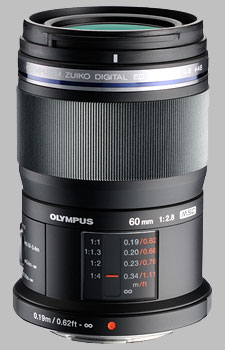
In the leadup to Photokina 2012, Olympus announced the 60mm ƒ/2.8 macro lens for micro four-thirds. Small and light, the lens produces an effective focal length of 120mm when mounted on mFT camera bodies, with a 1:1 working distance of around 8 inches.
The lens features a constant ƒ/2.8 aperture, though working at distances closer than a foot, the effective aperture will be impacted: the following chart gives an idea of what the effective aperture will be at a given reproduction ratio.
| Reproduction ratio | Effective ƒ/stop |
| 1:4 | ƒ/3.8 |
| 1:2 | ƒ/4.5 |
| 1:1.3 | ƒ/5.2 |
| 1:1 | ƒ/5.6 |
The Olympus 60mm ƒ/2.8 Macro does not ship with a lens hood: the LH-49 is sold separately for around $50. The lens takes 46mm filters and is available now for around $500.
Sharpness
The Olympus 60mm ƒ/2.8 macro is impressively sharp. Even wide open at ƒ/2.8, the image produced is extremely sharp, with only the faintest corner softness visible; at ƒ/4, image are tack-sharp from edge to edge. At ƒ/8 diffraction limiting begins to set in, but there is no practical impact on image sharpness until ƒ/16 where we note some light generalized softness across the frame. However, images are still very sharp at this aperture.
Chromatic Aberration
The lens is very well-designed to resist chromatic aberration, especially at the widest apertures. Stopping down will produce slightly more chromatic aberration, peaking at the ƒ/8 mark and smaller. It’s visible as magenta-green fringing in areas of high contrast, confined mostly to the corners of the image.
Shading (”Vignetting”)
There is just a trace of corner shading when the lens is used at the ƒ/2.8 setting – the extreme corners are almost a 1/3 EV darker than the center. At any other setting, corner shading is not an issue with this lens.
Distortion
The Olympus 60mm ƒ/2.8 shows no distortion.
Autofocus Operation
The Olympus 60mm ƒ/2.8 macro uses Olympus’ MSC (Move-Still-Compatible) technology, making the lens fast and near-silent to autofocus; the lens focuses between close-focus and infinity in around a second. Autofocus results can be overridden at any time by simply turning the focusing ring, and attached 46mm filters will not rotate during focus.
Macro
As the intended purpose for this lens, it’s no surprise that Olympus has put some heavy thought into how to best optimize the lens for macro work.
The macro specifications are easy enough: the lens will provide a full 1:1 reproduction at its closest focus point of 7.5 inches (19 cm). The lens features a scale showing the active size of reproduction: as the lens is focused closer to its close-focusing distance (7.5 inches), a red marker on the reproduction scale moves closer to 1:1. It’s a vertical scale, unlike most depth-of-field scales which show a readout from left to right.
Build Quality and Handling
The Olympus 60mm ƒ/2.8 Macro is a solid little lens which does not add much weight to the camera. The lens has 13 elements in 10 groups: of these, one is an ED lens, two are HR lenses and one is an E-HR lens element. The lens features a seven-bladed circular aperture which stops down to ƒ/22, and as previously mentioned, takes 46mm filters. The lens is marked as splashproof, providing some level of weather resistance.
The lens features a four-position focus limiter switch. The options are 0.4m to infinity, 0.19m to infinity, 0.19 to 0.4m or by twisting the switch toward the 1:1 symbol it will focus the lens to its closest focus, giving you a 1:1 reproduction ratio. The switch is spring-loaded and will return the switch to the 0.19m-0.4m position. It takes a little getting used to, but after a little while with the lens it becomes quite intuitive. The focusing scale also takes some getting used to, as the distance indicator moves forward and backward rather than side to side as most lenses do.
The focusing ring is about 7/8” wide, made of plastic with thin ribs. It uses an electrical system for adjusting focus, so there are no stops of any kind to indicate that the lens has arrived at its closest point of focus or infinity focus. There is no lens extension during focus: the actual focusing action is silky smooth, and works very well.
We couldn’t find much information about the optional LH-49 lens hood, other than it it appears to be around 2” long, and costs $50. Other special accessories include the FR-2 adapter ring for the RF-11 ring flash or the STF-22 twin flash.
Alternatives
Unfortunately, at the time of writing (December 2012) third-party lens manufacturers such as Sigma and Tamron have only recently gotten on board the four-thirds train, so alternatives in the four-thirds macro market are a bit slim.
Panasonic 45mm ƒ/2.8 ASPH MEGA OIS Leica DG MACRO-ELMARIT ~$680
We haven’t yet tested this lens: it offers built-in optical image stabilization as well as full 1:1 reproduction.
Olympus 50mm ƒ/2 Zuiko Digital Macro ~$500
With the appropriate adapter, one can mount regular four-thirds lenses on a micro four-thirds camera, making this an attractive option for macro shooters. It doesn’t offer quite the same reproduction ratio (only 1:2 instead of full 1:1) but its performance, even wide open at ƒ/2, was extremely sharp.
Conclusion
The Olympus 60mm ƒ/2.8 lens offers a very light and portable macro solution, with excellent results for sharpness, and resistance to chromatic aberration, corner shading and distortion. It’s also very competitively priced: there aren’t many options in this category of lens, but for right now, with a lens this good, there don’t need to be.
Product Photos
    |
Sample Photos
The VFA target should give you a good idea of sharpness in the center and corners, as well as some idea of the extent of barrel or pincushion distortion and chromatic aberration, while the Still Life subject may help in judging contrast and color. We shoot both images using the default JPEG settings and manual white balance of our test bodies, so the images should be quite consistent from lens to lens.


As appropriate, we shoot these with both full-frame and sub-frame bodies, at a range of focal lengths, and at both maximum aperture and ƒ/8. For the ”VFA” target (the viewfinder accuracy target from Imaging Resource), we also provide sample crops from the center and upper-left corner of each shot, so you can quickly get a sense of relative sharpness, without having to download and inspect the full-res images. To avoid space limitations with the layout of our review pages, indexes to the test shots launch in separate windows.
Description
(From Olympus lens literature) The M.ZUIKO DIGITAL ED 60mm f2.8 lens features excellent close-up capability with 1X** magnification and a focusing distance of 19cm. Its dust-and-splash-proof construction enables the user to shoot macro images in a wide range of conditions, including in the rain or near the water, in addition to traditional landscape and portrait photography.
To ensure the best possible imaging quality, 13 lens elements are incorporated in 10 groups of lenses within the M.ZUIKO DIGITAL ED 60mm f2.8 with extensive use of special glass materials such as ED (Extra-low Dispersion), HR (High Refractive index) and E-HR (Extra-High Refractive index) elements to completely eliminate the chromatic aberrations often noticeable with telephoto macro lenses. This optical design ensures consistently clear, sharp, high-contrast imaging performance.
Ideal for capturing brilliant still images and high-definition (HD) videos, the M.ZUIKO DIGITAL ED 60mm f2.8 employs an Olympus developed MSC (Movie & Still Compatible) autofocusing mechanism that features an inner focus system to drive quick and quiet focusing. A shooting distance and magnification indicator window enhance macro shooting control and precision.
A focus limit switch sets the focusing range to enable faster focusing. Three modes are available, including close-up (focusing distance between 19 and 40 cm), normal (focusing distance from 19 cm to infinity) and far view (focusing distance from 40 cm to infinity). The 1:1 mode shifts focusing to 1:1 with one-touch operation. Simply setting the mode according to the application makes it easy for users to shoot quickly and comfortably with various shooting styles and at a range of distances.
The optional LH-49 Lens Hood designed exclusively for the M.ZUIKO DIGITAL ED 60mm f2.8 blocks harmful rays of light and can be safely stored without detaching it from the lens. The lens eliminates the hassle of attaching and detaching the hood before and after every shooting session, but also providing effective protection for the lens body. The FR-2 Macro Ring enables compatibility with the RF-11 Ring Flash and the STF-22 Twin Flash Set.
* Equivalent to a 120mm lens for 35mm cameras
** Equivalent to 2X magnification of 35mm cameras.
Lab Test Results
Our standard lens lab tests, shot on a sub-frame (APS-C) body. Pick a focal length and aperture to see the result.
Sharpness (blur index)
Blur across the frame: lower and flatter is sharper. Change focal length and aperture to see how it improves when stopped down.

Chromatic aberration
Colour fringing in the corners at each focal length.

Vignetting (corner shading)
How much darker the corners are than the centre, by aperture and focal length.

Geometric distortion
Barrel (positive) or pincushion (negative) distortion across the zoom range.

Reader Reviews
- Image quality
- 9.9/10
- Build quality
- 8.9/10
- Recommend it
- 100%
- 10/10Recommendedby Perry Rhodan · December 14 2022 · paid $400
Pros: Well it is super sharp and handles like a real macro should. Very nice lens hood. Works like a dream for stacked macro's on the em1mk3
Cons: None
Bought this as the fifth olympus lens. And I really like macro so it should have been my first or second. This is a seriously nice macro lens. Not much much to be said. Perhaps only this, the AF improved considerably going from em10 bodies to the em1mk3. Soooo much better.
- 10/10Recommendedby Felixley · March 25 2018 · paid $700
Pros: simply superb lens compared to 35mm lenses 2:1 magnification
Cons: Pre-selection of distance-range
Superb lens not only in the macro world, but also excellent for portrait, landscape and pictures at night.
Excellent performance wide open, at f : 4 the micro-contrast is even better.
Pre-selection of the distance-range seems strange at first, needs a little time to get used to - however very fast and reliable (even in the world of macro!).
- 10/10Recommendedby ezed999 · August 22 2013
Pros: compact, sharp, light weight
Cons: None for my purposes
I took the Olympus 60 Macro with me on a recent safari to Botswana. (Used the OM-D and also took a Pana 100-300, a Pana 20 and an Olympus 12.) The 60 proved surprisingly useful. Besides nice macro shots, it also was sharp enough to crop in Lightroom to nearly 1:1 and show a mid-distance, car-spotlight-illuminated leopard. Manually focused, it's whiskers and eyes were tack sharp. As it is dust and splash resistant, I also was able to take it to Victoria Falls and not worry about the spray.
- 10/10Recommendedby aostling · February 18 2013 · paid $500
Pros: unbeatable image quality
Cons: none
The sharpness and contrast of this lens continues to amaze me. The E-PL5 has enough pixels that I find myself cropping (in post-processing) with no sensible loss of detail. It's sort of like having the ultimate macro zoom.
The detail is just as impressive when shooting landscapes. The focal length (120mm equiv) is well-suited to my Arizona desert scenery. When rains come I'll put a bag around my camera and let the lens protrude, knowing it will love the wet.
No lens hood is necessary. A hood would interfere with close-up natural lighting. There is no trace of flare, thanks to what I assume is efficient anti-reflection blacking on the interior lens barrel.
The focus limiting switch is an ingenious addition to the design, effectively eliminating any tendency of the drive motor to hunt for focus.
It is simply the best lens I have ever owned.
- 10/10Recommendedby Prime Minister · December 21 2012
Pros: Image quality, size, weight, price, autofocus, weather sealing, silent
Cons: None
Even wide open at f/2.8, the image quality of this lens is excellent. Good contrast and an amazing amount of detail. I have no complaints at all about the image quality. This lens just delivers the goods.
For normal portrait or landscape work the autofocus is silent, quick and accurate but it's also very usable when shooting macro. Of course manual focus is possible too. The large smooth turning focus ring works like a charm.
The lens has a useful distance scale with a limiter switch on the side. I find this switch a bit difficult to turn though. But maybe if it had less resistance, it would be too easy to accidentally move it.
I did not give ten points for the build quality of this lens, because it's not build like the 12mm f/2 or the 75mm f/1.8. If it was, the price tag would probably be double of what it costs now. The use of plastic does keep the weight down and of course that is one of the benefits of this micro 4/3 system. For the money, it's build quality is fine.
If you need a macro lens for your micro 4/3 camera with this focal length, look no further.
- 10/10Recommendedby Romboutroemer · October 25 2012 · paid $775
Pros: Sharpness, colour, size
Cons: Focus by wire
Superb little macro lens. Incredibly sharp with great colours and microcontrast. Next to the Pl 25/1.4 the second Mft lens where i am completely satisfied with.
- 10/10Recommendedby boatdetective · October 23 2012 · paid $600
Pros: Light, compact, sharp
Cons: AF at max magnification iffy
Truly excellent macro- and I've been shooting forensic stuff for over 20 years. This is a very, very light lens compared to my Nikon 105 and doesn't give up anything in performance. You have to get used to the unky switch on the side, which allows you to get all the way down to 1:1. However, it's not bad. At this magnification, you must switch the camera over to manual focus (typical of any critical macro work). Once you get the hang of it, you'll find this lens very impressive indeed.
Reader reviews were submitted by Imaging Resource readers and are shown as written.