

Overview
The Panasonic 14-140mm ƒ/4-5.8 was released with the GH-1 as its kit lens. The lens is significant in that it features an HD designation, incorporating a new drive motor that allows for ”fast and accurate contrast auto focus.” The lens can also be purchased separately from the GH-1 kit. Mounted on the GH-1, the 14-140mm produces an effective field of view of 28-280mm in 35mm film camera terms.
The 14-140mm isn’t a ”constant” lens, in that as you increase the focal length, the maximum aperture size decreases, however the minimum aperture stays the same. The following table reflects the change in aperture with focal length:
| Focal Length (mm) | 14-17 | 18-24 | 25-31- | 32-47 | 48-69 | 70-140 |
| Largest aperture | ƒ/4 | ƒ/4.3 | ƒ/4.7 | ƒ/5 | ƒ/5.5 | ƒ/5.8 |
| Smallest aperture | ƒ/22 at all focal lengths | |||||
The Panasonic 14-140mm ƒ/4-5.8 uses 62mm filters, and comes with a petal-shaped lens hood.
Sharpness
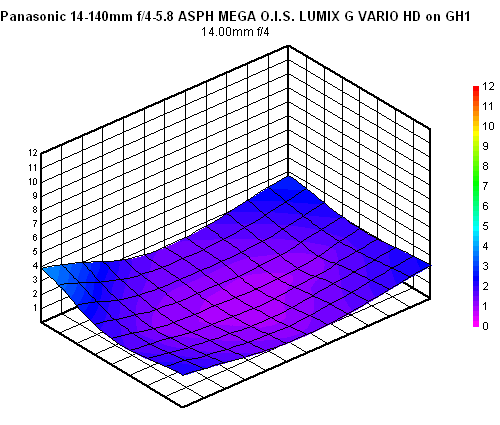
When used at its widest aperture, the 14-140mm exhibits some mild corner softness when used at either wide-angle (14-18mm) or at telephoto (100-140mm). For the rest, the image is remarkably sharp, even at the widest aperture, with performance of less than 2 blur units. Wide open you’ll see the best performance using the lens at around 50mm (ƒ/5.5 at this focal length), with a sharpness rating of just over 1 blur unit.
There’s not much of an increase in sharpness performance by stopping down to ƒ/5.6 – by 50mm that’s practically the maximum aperture anyway – but at 14-18mm the corners become a bit less soft. At ƒ/8 there’s a bit more improvement in the corners, and at 50mm it’s tack-sharp.
Diffraction limiting seems to set in at ƒ/11, with a slight across-the-board decrease in image sharpness. Performance in the mid-range (24-100mm) is still good, and even at ƒ/16 we still note performance in the range of 2 blur units. The corners of wide-angle and telephoto suffer again at ƒ/11 and smaller, and at ƒ/22, everything is slightly soft with ratings of around 3-5 blur units.
So, in the focal length extremes (wide-angle and telephoto) there’s some slight softness in the corners, but this is somewhat mitigated by stopping down to ƒ/5.6 or ƒ/8. In the mid-range the lens produces excellent results, even when used wide open.
Chromatic Aberration
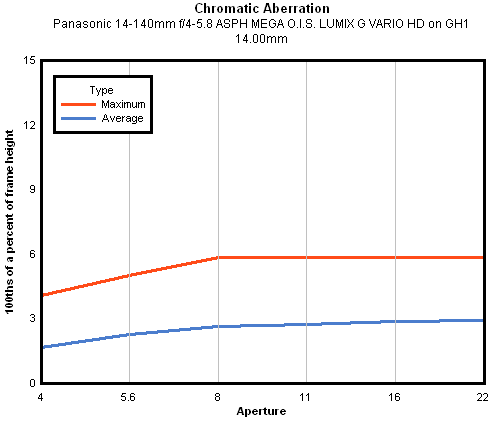
On the whole, chromatic aberration is well-controlled; average performance (CA visible throughout the image) is very low, and maximum CA is only visible in the corners with the lens’ focal length set to below 70mm (where it’s still well-controlled) or to 140mm, where it’s fairly noticeable. It’s easier just to look at our sample images to see the CA effect, but for the most part, it isn’t really an issue.
Shading (”Vignetting”)
The GH-1 continues to foil our software in order to calculate results for corner shading. From a visual examination of our sample images, the trend of mid-range performance seems to continue – I don’t see any corner shading when the lens is used around the 50mm mark, but there is some slight shading at either the wide-angle end or at full telephoto. In either case, there doesn’t appear to be enough falloff to write home about.
Distortion
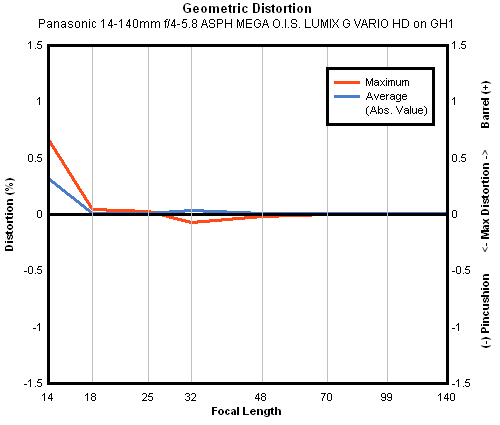
We know that the G1 and GH1 cameras apply some post-processing to correct for distortion, which explains the dramatic results we see for distortion. In particular, while there is some barrel distortion when used at wide angle (14-18mm), distortion completely disappears between 18-140mm.
Autofocus Operation
The GH-1 uses an electrical autofocus system, enabling fast and silent focusing. The lens was able to focus between infinity, close-focus and back again in under a second, and small focus changes happened extremely quickly. This is very impressive performance, especially considering it’s a contrast autofocus detection method.
Macro
Macro performance is quite good, with a maximum 0.4x magnification rating (1:2.5 reproduction ratio). The lens’ minimum close-focusing distance is 50 cm (just over a foot and a half).
Build Quality and Handling
Panasonic has led the way with micro-four-thirds lenses, and miniaturization is the name of the game. For a zoom lens with a 10x rating the lens is quite small, and comparatively light – it weighs just 460 grams (just over a pound). The lens is constructed of dense plastic, with an grey / black matte finish. The lens mount is metal, and the 62mm filter threads are plastic.
The lens has few controls to speak of, other than the zoom and focus rings. A single switch is available, which controls the Mega Optical Image Stabilization (”Mega O.I.S.”), turning it on or off. The lens has no distance scale or depth-of-field markings.
The zoom ring is the larger of the two, a thick rubber with raised rubber ridges. It is 7/8” wide and is mounted closer to the lens mount. It has about 40 degrees of turning action between wide-angle and full telephoto, and doing so will extend the lens 2 3/8”, almost doubling the length of the lens to 5 1/8”. Add on the petal-shaped lens hood (1 5/8”) and you have a possible total length of 6 3/4”. The lens doesn’t have any problems with zoom creep, and the zoom action is nicely cammed, providing a smooth turn that has just the right level of firmness. The petal-shaped lens hood reverses onto the lens for storage.
The focus ring is composed of plastic with raised ribs, and is 1/2” wide. The focus ring will turn forever in either direction, with no hard stops to indicate a focus limit. Thus it’s hard for us to determine how many degrees of ”focus action” are available in manual focus, though manual focus is handled extremely well by the camera. Just turning the focus ring brings up a magnified view section on the LCD, which assists greatly.
Panasonic has built Mega Optical Image Stabilization into the lens, useful for countering the effects of shaky hands holding the camera.
Alternatives
Panasonic 14-150mm ƒ/3.5-5.6 ASPH Leica D VARIO-ELMAR ~$1,000
The regular four-thirds variant of this lens, the 14-150mm also features optical image stabilization, and should be usable on the GH-1 with the four-thirds to micro-four-thirds adapter. The lens is just slightly faster (ƒ/3.5-5.6 instead of ƒ/4-5.8), but is also slightly larger and heavier. We haven’t yet tested this lens.
Olympus 18-180mm ƒ/3.5-6.3 Zuiko Digital ~$450
This lens should be usable on the GH-1 with the use of an adapter. Though it won’t provide quite the wide-angle performance, it does offer greater telephoto capability, at the cost of a slightly slower lens in terms of aperture performance. The lens weighs about the same, but doesn’t feature image stabilization. We haven’t yet tested this lens.
Conclusion
Panasonic has done well with this lens. The ability to autofocus during movie mode was an absolute must for the saleability of the GH-1, which required a fast, silent autofocus mechanism; in this capacity, the 14-140mm delivers handily. Optically, the lens is no slouch, providing pleasantly sharp images in almost any situation, and when used in the mid-range (24-100mm) and stopped down slightly, images are very sharp indeed. In the extreme ends – wide-angle or full telephoto – the lens shows slight faults: some chromatic aberration, distortion and corner softness, but nothing to the extreme. The only reservation I might have about the lens is its aperture capacity: by 50mm, its maximum aperture is ƒ/5.6, meaning the heavy lifting for low-light images will be done by the camera with higher ISO settings. Used with reasonable light levels, this really isn’t a factor.
Sample Photos
The VFA target should give you a good idea of sharpness in the center and corners, as well as some idea of the extent of barrel or pincushion distortion and chromatic aberration, while the Still Life subject may help in judging contrast and color. We shoot both images using the default JPEG settings and manual white balance of our test bodies, so the images should be quite consistent from lens to lens.


As appropriate, we shoot these with both full-frame and sub-frame bodies, at a range of focal lengths, and at both maximum aperture and ƒ/8. For the ”VFA” target (the viewfinder accuracy target from Imaging Resource), we also provide sample crops from the center and upper-left corner of each shot, so you can quickly get a sense of relative sharpness, without having to download and inspect the full-res images. To avoid space limitations with the layout of our review pages, indexes to the test shots launch in separate windows.
Description
(From Panasonic lens literature) Panasonic has introduced two new lenses for its LUMIX G Micro System – the innovative digital interchangeable lens camera system – the LUMIX G VARIO HD 14-140mm/F4.0-5.8 ASPH./MEGA O.I.S. and the LUMIX G VARIO 7-14mm/F4.0 ASPH. Both lenses are compatible with the newly announced LUMIX DMC-GH1 digital camera, which can record High Definition (HD) AVCHD 1080/24p video, and its award-winning sister camera, the LUMIX DMC-G1 digital camera.
“Panasonic is excited and proud to expand our LUMIX G Micro System – with the addition of these two new Micro Four Thirds lenses, as well as the LUMIX DMC-GH1, which can record superb High Definition video, “said David Briganti, National Marketing Manager, Imaging, Panasonic Consumer Electronics Company. “We firmly believe that consumers of all skill levels can benefit from the advanced features we are able to pack into these new compact lenses and camera bodies.”
The new LUMIX G VARIO HD 14-140mm/F4.0-5.8 ASPH./MEGA O.I.S., available as part of the kit with the DMC-GH1, or separately, incorporates an inner focus direct-drive linear motor for focusing. This allows fast and accurate contrast auto focus (AF) to operate smoothly and silently – a necessity for video recording. Adopting the Micro Four Thirds System standard, the new LUMIX G VARIO HD 14-140mm/F4.0-5.8 ASPH./MEGA O.I.S. offers a long zoom of 14-140mm (35mm camera equivalent: 28-280mm), suitable for a wide range of shooting situations – from scenery to portraits to telephoto shots – all possible with a compact and lightweight lens.
The LUMIX G VARIO HD 14-140mm/F4.0-5.8 ASPH./MEGA O.I.S. uses four aspherical lenses and two ED lenses to achieves dramatic downsizing – despite its powerful 10x optical zoom – and still minimizes distortion and chromatic aberration. Panasonic’s Mega O.I.S. (Optical Image Stabilization) is incorporated in the lens, making it easy to shoot clear shots even in telephoto shooting or in low-light situations – as this feature minimizes blur caused by hand shake.
Panasonic’s other new lens, the ultra-wide-angle zoom interchangeable lens LUMIX G VARIO 7-14mm/F4.0 ASPH features an astonishingly wide-angle zoom range of 7-14mm (35mm camera equivalent; 14-28mm). Its compact and lightweight size makes it easy for users to carry while they are on the go. Taking advantage of its 114-degree wide-angle view, users can fit more subjects in a frame – even when the shooting distance is limited, for example, while shooting indoors. This expansive view gives users great flexibility and a rich perspective when shooting photos or video.
The high-performing, yet lightweight LUMIX G VARIO 7-14mm/F4.0 ASPH. achieves its compact size by incorporating two aspherical lenses and four ED lenses in a unit of 16 elements in 12 groups. The resolution of the images is high, even at its wide-end and features F4.0 brightness through its entire zoom range thanks to a large diameter glass-molded lens embedded within the body.
When both of these news lenses are mounted on the LUMIX DMC-GH1, users can take advantage of the advanced contrast AF system including Face Recognition, offering a variety of convenient and fun shooting. Seven aperture blades give the aperture a rounded shape that, when shooting at a larger aperture, produces an attractive smoothness in out-of-focus areas. Featuring highly-durable metal mounts, the new lenses use multicoated lens elements to reduce ghosting and flares, helping to deliver a positive user-experience – whether shooting HD videos or taking beautiful digital photos.
Lab Test Results
Our standard lens lab tests, shot on a sub-frame (APS-C) body. Pick a focal length and aperture to see the result.
Sharpness (blur index)
Blur across the frame: lower and flatter is sharper. Change focal length and aperture to see how it improves when stopped down.
Chromatic aberration
Colour fringing in the corners at each focal length.
Geometric distortion
Barrel (positive) or pincushion (negative) distortion across the zoom range.
Reader Reviews
- Image quality
- 8.3/10
- Build quality
- 8.9/10
- Recommend it
- 100%
- 6/10Recommendedby bananitax · December 12 2024
https://hotnessrater.com/community/members/popeyye.21213/about
- 10/10Recommendedby langier · December 15 2014 · paid $365
Pros: SIze and range
Cons: The rubber focus ring is sloppy and and be a PIA, could use a little more range
This is one of two lenses that I use on a regular bases with my GX7 bodies. I've had mine for a year and bought it used and in great condition.
I've used this lens for many things, from landscape to portraits to general shooting. Compared to my full-frame and DX all-in-one lenses, this one is better constructed and is pretty sharp throughout its range.
I've used it in low-light and the stabilization seems to help in hand-holding.
All in all, this is a great basic lens for an M43 system where speed isn't needed. What would make it even better is to either be a couple of mm wider (12mm) or perhaps a little longer, more than 150mm, but wider would be my choice.
The only issue I've had with this lens is that the rubber focus grip became sloppy in some hot weather and is still loose months later. It sometimes becomes an issue when I need to zoom and the rubber is askew.
- 9/10Recommendedby halfmac · December 13 2011 · paid $450
Pros: Small for reach, Great for video outdoors, Good walk around lens
Cons: Slow aperture, heavy compared to other m4/3 lenses
Lens is Sharp and takes very good stills but needs a lot of light because of the starting aperture at F4.0
Much Better than the kit lens for video because it is silent while focusing. Lens IS helps a lot too especially for the E-PL1 which only has in body IS which doesn't help with video.
Disadvantages are it's a heavy lens and not especially suited for small cameras like GF1 or EP series because of the bulkiness. It balances much better on the GH1.
- 10/10Recommendedby trentdp · August 10 2011 · paid $640
Pros: Excellent build and ergonomics
Cons: A little soft at 140
The IQ from 14-100 range is very good as indicated by the tests at this site. I agree with comments of other raters. This is the supreme 10XZoom lens for M4/3 cameras for video recording as nothing else compares with it's smooth/silent AF during video and relatively quick acquire of focus. It is a bit heavy on the smaller cameras but great balance on the G1, GH1 and GH2. It gets a bit front heavy even on the new G3 and all the Olympus M4/3 cameras. Many reviewers consider the lens a good fit on the GF1 and GF2 but a little out of proportion on the GF3.
It is my perfect vacation lens.
- 7/10Recommendedby SETI · March 12 2011 · paid $700
Pros: Silent work,good construction,sunshade
Cons: soft,price
Great lens for video ! Absolutely silent, fast. But not as good for still pictures - need to use f/9 to achieve best results
Best regards. Dmitry
http://www.flickr.com/photos/photodrug/
- 8/10Recommendedby Ocean · July 31 2010
Pros: small, good build, sun shade, no CAs, very sharp for a zoom
Cons: heavy, thick, OIS could be better, no really good near performance
better than Olympus 14-150 mm, but heavy and expensive
- 10/10Recommendedby m43 · April 27 2010 · paid $600
Pros: Good Sharp Lens for stills and good especially for Video
Cons: Heavy for Micro Four Thirds, largest aperture is F4 so needs a lot of light
Lens is Sharp and takes very good stills but needs a lot of light because of the starting aperture at F4.0
Much Better than the kit lens for video because it is silent while focusing. Lens IS helps a lot too especially for the E-PL1 which only has in body IS which doesn't help with video.
Disadvantages are it's a heavy lens and not especially suited for small cameras like GF1 or EP series because of the bulkiness. It balances much better on the GH1.
Reader reviews were submitted by Imaging Resource readers and are shown as written.