

Overview
Probably the most frequently-used lens in any professional photographer’s bag is a 70-200mm ƒ/2.8, and Panasonic has created a product which fills this gap in its Micro Four-Thirds camera series: the 35-100mm ƒ/2.8 POWER OIS LUMIX G X VARIO HD.
The lens produces an effective 70-200mm field of view, when you consider the 2x crop factor of the Micro Four-Thirds sensor; it’s also equipped with all the bells and whistles, including optical image stabilization, a nano-surface coating to reduce ghosting and flaring, and a near-silent autofocus motor designed to work seamlessly with HD movie capture.
The lens ships with a round lens hood, takes 58mm filters, and is available now for around $1,500.
Sharpness
In a word: sharp.
Right out of the gate at ƒ/2.8, and the lens produces edge-to-edge, tack-sharp results, at any focal length. While stopping down technically produces slightly sharper results, you’d be hard-pressed to see it with the naked eye or pixel-peeping a test chart.
Technically, diffraction limiting begins to set in ƒ/8, but again, the sharpness is just so good at this lens that you probably won’t see it until ƒ/22, where we note generalized softness across the frame.
Chromatic Aberration
You’ll see lower results for chromatic aberration on other lenses, but there’s nothing here to really get worried about; CA is well-controlled, only showing some very slight magenta fringing in areas of contrast, in the extreme edges of the frame.
Shading (”Vignetting”)
There’s some slight corner shading when the lens is used at the ƒ/2.8 setting — the corners are between a third and a half-stop darker than the center of the frame. At any other aperture setting, corner shading is minimal.
Distortion
There’s definitely some distortion correction going on in the Panasonic camera, as our test results show no relevant distortion at all, despite the focal length.
Autofocus Operation
The 35-100mm ƒ/2.8 X offers very fast autofocus results, motivated by an in-lens electrical motor that’s very fast and very quiet. The lens took well under a second to focus from minimum distance to infinity. Filters attached to the front element of the lens won’t rotate, making life a little easier for polarizer users. Also, focusing produces very little noise, making it very useful during movie capture.
Macro
The lens isn’t designed as a macro lens, and produces poor results in this category, offering just 0.10x magnification at a minimum close-focusing distance of 85cm (2.8 feet).
Build Quality and Handling
Compared to most Micro Four-Thirds lenses, the Panasonic 35-100mm ƒ/2.8 is fairly heavy – just over 12 ounces. This is however much lighter than a conventional APS-C or full-frame equivalent lens (the Nikon 70-200mm ƒ/2.8 weighs 54 ounces, or 4 1/2 times heavier, for example). The lens offers a clean design dominated mostly by its massive zoom ring. The optical design of the lens is fairly complicated: 18 elements in 13 groups, with 2 ED lenses and one Ultra ED lens. Seven rounded aperture blades are used with the expectation of creating pleasing out-of-focus elements. The lens mount is metal, and the 58mm filter threads are plastic. The lens also offers a rubber grommet at the mount end for protection from water and dust.
The lens has few controls to speak of, other than the zoom and focus rings. A single switch is available, which controls the Image Stabilization (”Power O.I.S.”), turning it on or off. The lens has no distance scale or depth-of-field markings. The lens features an internal focus design, meaning the lens does not extend during focusing, and it does not change its size while being zoomed in from 35mm to 100mm.
The zoom ring is the (much) larger of the two, a thick rubber with raised rubber ridges. It is 1 1/2” wide and is mounted closer to the lens mount. The lens doesn’t have any problems with zoom creep, and the zoom action is nicely cammed, providing a smooth turn that has just the right level of firmness. It provides around 70 degrees of turning action to go from 35mm to 100mm
The focus ring is composed of plastic with raised ribs, and is 1/2” wide. The focus ring will turn forever in either direction, with no hard stops to indicate a focus limit. Thus it’s hard for us to determine how many degrees of ”focus action” are available in manual focus, though manual focus is handled well by the camera.
Panasonic has built Image Stabilization into the lens, useful for countering the effects of shaky hands holding the camera. Check out our IS Test tab for more detailed results.
The H-HS35100 lens hood that ships with this lens is a (comparatively) long round hood which attaches to the end of the lens via a bayonet mount. The hood is 2.5” in length and can be reversed onto the front of the lens for easy storage.
Alternatives
Given the relative newness of the Micro Four-Thirds lens mount, it’s not surprising that there isn’t a plethora of alternatives for this unit; you can certainly get there with a third-party adapter, opening up options from almost every other manufacturer, but you lose key features such as autofocus and image stabilization.
Olympus 35-100mm ƒ/2.0 ED Zuiko ~$2,500
At the time of writing, this is the only lens that is out-of-the box comparable with the Panasonic 35-100mm ƒ/2.8 for Four-Thirds DSLRs. It’s longer, heavier, and almost twice as expensive, but offers a full stop of greater light-gathering ability with its ƒ/2 aperture. We have not yet reviewed this lens.
Conclusion
There’s a lot to like in the Panasonic 35-100mm ƒ/2.8: it’s super sharp and offers professional results at slightly less than you might pay for a comparable full-frame lens. Perhaps its most attractive feature is its slim frame, but then, that’s one of the chief selling points of the whole Micro Four-Thirds endeavor.
Product Photos
 |
 |
 |
 |
 |
Sample Photos
Click here for Real-world Gallery Images on our Flickr page!
The VFA target should give you a good idea of sharpness in the center and corners, as well as some idea of the extent of barrel or pincushion distortion and chromatic aberration, while the Still Life subject may help in judging contrast and color. We shoot both images using the default JPEG settings and manual white balance of our test bodies, so the images should be quite consistent from lens to lens.


As appropriate, we shoot these with both full-frame and sub-frame bodies, at a range of focal lengths, and at both maximum aperture and ƒ/8. For the ”VFA” target (the viewfinder accuracy target from Imaging Resource), we also provide sample crops from the center and upper-left corner of each shot, so you can quickly get a sense of relative sharpness, without having to download and inspect the full-res images. To avoid space limitations with the layout of our review pages, indexes to the test shots launch in separate windows.
Description
(From Panasonic lens literature) Panasonic is proud to announce a new digital interchangeable telephoto zoom lens LUMIX G X VARIO 35-100mm / F2.8 / POWER O.I.S. (H-HS35100) (35mm camera equivalent: 70-200mm) based on the Micro Four Thirds standard.
Crystallizing Panasonic’s optical technologies, the “X” lens features superb image rendering for lifelike textures, crisp edge-to-edge contrast, a unique Nano Surface Coating for minimal ghost and flare and natural atmospheres with remarkable transparency.
Featuring F2.8 high speed at entire zoom range, the new LUMIX G X VARIO 35-100mm / F2.8 / POWER O.I.S. lens offers a practical way of use with its versatile zoom range from a portrait or close-up shot with beautiful defocused background or a zoom shot of moving subject such as sports, birds and animals utilizing a fast shutter speed. This constant aperture can be practically used for video recording, too.
Comprising of 18 lenses in 13 groups, the lens system realize uniform descriptiveness with its excellent contrast from the center to the corners, equable brightness at entire zoom range and high resolution. Notably, an UED (Ultra Extra-Low Dispersion) lens and 2 ED (Extra-Low Dispersion) lenses minimize chromatic aberration and distortion. Despite its high optical performance, LUMIX G X VARIO 35-100mm / F2.8 / POWER O.I.S. boasts outstanding compactness and light-weight with approx. 99.9 mm in length and approx. 360g in weight for high mobility.
Panasonic’s Nano Surface Coating technology is adopted to minimize the reflection at entire visual light range (380nm-780nm) by applying the extra-low refractive index coating with nano-sized structure on the surface of the lens. It results in the super clear picture with dramatic reduction of ghost and flare.
The POWER O.I.S. (Optical Image Stabilizer) which is newly integrated in the LUMIX G X VARIO 35-100mm / F2.8 / POWER O.I.S. effectively compensates for not only small, fast movement but also large, slow one making it easy to shoot super clear shots even in low-lit situations such as in night time or indoors.
It incorporates a superior inner focus system which enables excellent resolution and contrast from full life-size magnification to infinity. The overall length of the lens is fixed either in zooming or in focusing thanks to its unique mechanism. The inclusion of stepping motor makes the focusing action smooth and silent for use in both photo and video recording. When mounted on the Digital Single Lens Mirrorless (DSLM) cameras of LUMIX G, users can take advantage of the high-speed, high-precision Contrast AF system.
Designed to stand against splash / dust with a rubber ring on the reliable metal lens mount, the sophisticated metallic-finished look of the LUMIX G X VARIO 35-100mm / F2.8 / POWER O.I.S. suits the profile of stylish camera body of LUMIX G. Seven blades give the aperture a rounded shape that produces an attractively smooth defocus effect in out-of-focus areas when shooting at larger aperture settings.
Lab Test Results
Our standard lens lab tests, shot on a sub-frame (APS-C) body. Pick a focal length and aperture to see the result.
Sharpness (blur index)
Blur across the frame: lower and flatter is sharper. Change focal length and aperture to see how it improves when stopped down.

Chromatic aberration
Colour fringing in the corners at each focal length.

Vignetting (corner shading)
How much darker the corners are than the centre, by aperture and focal length.

Geometric distortion
Barrel (positive) or pincushion (negative) distortion across the zoom range.

Image Stabilization
Most people tend to think of image stabilization as being mainly for telephoto lenses. While it’s true that their longer focal lengths tend to magnify the effects of camera shake, image stabilization can provde a very useful assist at wider angle focal lengths as well; anyone who’s ever tried to blur the image of a waterfall, while keeping the surrounding landsape tack-sharp knows exactly what I’m talking about.
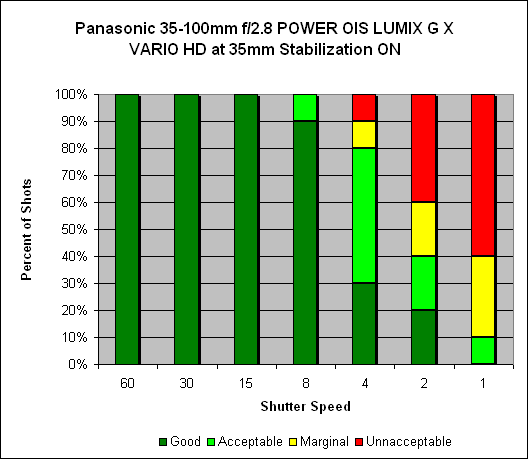
At 35mm, we see a general improvement in hand-holding ability, but nothing seriously eyebrow-raising – perhaps a single stop of improvement. This isn’t hugely surprising, given that image stabilization systems are more noteworthy on telephoto results rather than wide angle, however, at an equivalent of 70mm, you might expect to see a little bit more performance. That said, getting 90% sharp shots at 1/8 of a second is pretty impressive.
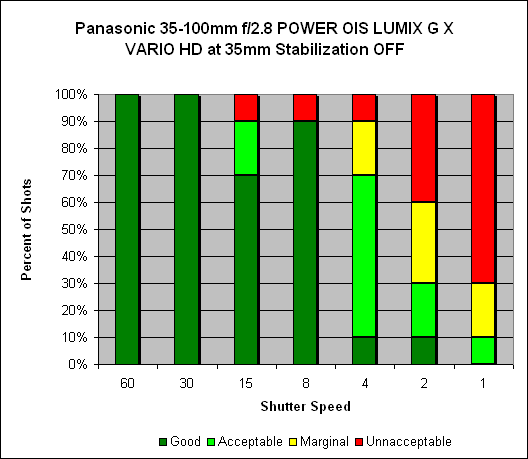 |
| Mouse over this chart to show results with IS activated. |
Zoomed in to 100mm, we see a bit better showing – perhaps 2 1/2 stops of hand-holding improvement. Since the camera-lens combination is already fairly easy to hold, it’s not surprising that even with the stabilization system disengaged we’re showing 100% sharp shots at 1/60 of a second. This is improved to 100% sharp shots at 1/15 of a second – a very nice showing considering an effective 200mm field of view. Now just get your subject to be still for 1/15 of a second, and you’re in business!
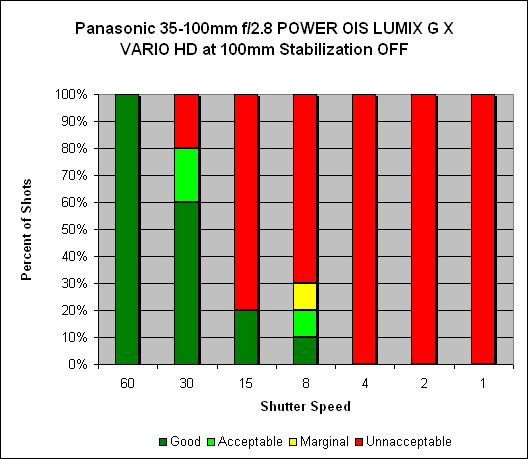 |
| Mouse over this chart to show results with IS activated. |
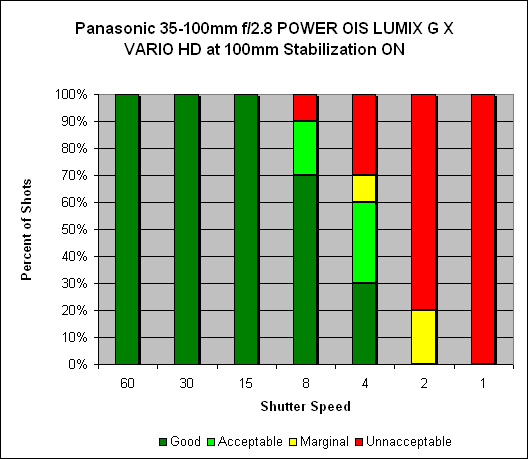
IS systems tend to provide more benefit to less-stable shooters than very steady ones, so most users will see the same or greater amounts of shake reduction as we measured here. You can read more about our IS test methodology here: SLRgear IS Test Methodology, v2.
Reader Reviews
- Image quality
- 9/10
- Build quality
- 9/10
- Recommend it
- 67%
- 10/10Recommendedby lalitjee · November 24 2014 · paid $1335
Pros: lightweight,sharp small size
Cons: not so far
a very well balanced lens on Olympus Em 1,love this combination
- 7/10Not recommendedby mgauss · September 7 2014
Pros: great lens
Cons: do not like cheap rubber on the metal body, would like metal ridges
do not like rubber, gets sticky and it smells
- 10/10Recommendedby asulea · August 10 2014 · paid $1100
Pros: ligth-weight, very sharp, fast autofocus, excellent contrast & colors, OIS,etc.
Cons: No
Sharp edge to edge at any focal length, very fast autofocus, excellent contrast and colors, small and light-weight. The lens has internal focus and zoom (not change its size).
I use the lens on Olympus OMD E-M1 and the results is real profesional.
Reader reviews were submitted by Imaging Resource readers and are shown as written.