
Overview
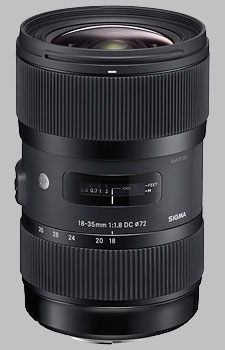
The Sigma 18-35mm ƒ/1.8 DC HSM “A” lens is a wide-angle to standard zoom lens designed for APS-C “crop”-sensor cameras. Part of Sigma’s new “Art” series, it is the first zoom lens anywhere to feature a constant ƒ/1.8 aperture. This gives shooters the ability to not only photograph in much darker conditions but also produce a much shallower depth of field, compared to all other zoom lenses that only open up to ƒ/2.8 or smaller. This makes it especially noteworthy among its competitors.
On a camera with a 1.5x crop factor, the Sigma 18-35mm ƒ/1.8 features an approximate field of view range equivalent to a 27mm-52.5mm on a 35mm camera, making it a versatile all-around lens that encompasses a useful range of wide-angle to normal focal lengths. As mentioned, unlike a lot of zoom lenses for APS-C cameras, the aperture of the Sigma 18-35 stays constant throughout the zoom range with maximum and minimum apertures being ƒ/1.8 to ƒ/16, respectively.
The lens does not feature image stabilization like some of its rivals (e.g. Canon 17-55 ƒ/2.8 IS USM), but the wide ƒ/1.8 aperture helps compensate for that allowing shutter speeds more than twice as fast in low light. The Sigma 18-35 has separate zoom and focusing rings, as well as marked focal lengths (18, 20, 24, 28, 35mm) and a focusing scale.
*Note that this lens review is based on a pre-production model.
New: Check out some real-world sample photos taken by our lens specialist Rob over our Flickr page!
Sharpness
This is an amazingly sharp lens, even wide open at ƒ/1.8, which is typically not the case with very wide-aperture lenses. At 18mm and ƒ/1.8, the Sigma shows very little corner softness and a good portion of the center and middle of the frame are very sharp indeed. As we’ve seen time and again, very wide-aperture lenses (> ƒ/2.8) can often show significant corner softness when used at their widest apertures, but the Sigma 18-35 not one of them. In this respect, it beats even many fast prime lenses in its focal length range.
Stopping down at the wide end, between ƒ/2 and ƒ/2.8 appears to be the sweet spot, in terms of center sharpness. At ƒ/2.8, the overall frame appears extremely sharp. Even stopping all the way down to ƒ/16, diffraction limiting is really quite minimal. As you can see in the Blur Index graph at right, variances in sharpness remain minimal at all apertures as you zoom out to 35mm. Even at 35mm at ƒ/16, diffraction effects are not significant. Overall, sharpness results for this lens are nothing short of stunning.
Chromatic Aberration
The Sigma does quite well in controlling chromatic aberration. As expected, we saw more CA at the wide-angle focal lengths, but it drops significantly in both the corners and across the frame as you zoom to 35mm. At 18mm, the corners show two times more CA compared to the average across the frame(about one 600th of a percent of the frame height vs. a 300th), but as you zoom to the longer focal lengths, the difference between the corners and average shrinks appreciably.
Shading (”Vignetting”)
We also see well-controlled vignetting with the Sigma 18-35mm lens. While there is still some vignetting at apertures wider than ƒ/4, it’s not extreme and the amount of vignetting is consistent across all focal lengths. At all focal lengths, there’s about a half to just shy of two-thirds of a stop of light loss. Vignetting decreases notably when you hit ƒ/2.8 with less than or equal to a fourth of a stop of light loss. When stopped down to ƒ/4 and beyond, vignetting at all focal lengths is barely noticeable.
Distortion
Just like CA and vignetting, distortion is nicely controlled, although not eliminated altogether. We see a bit of barrel distortion at focal lengths wider than 24mm, but less than we might normally expect from a zoom. At 18mm, there is about 0.5% of barrel distortion in the corners while only 0.3% for the average across the frame. At 24mm, the average distortion approaches 0%, yet we start to see a bit of pincushion distortion starting to appear in the corners. Oddly, as focal length increases from 24-35mm, the average shows a very slight increase in overall barrel distortion, while the corners experience a noticeable increase in pincushion. However, the pincushion distortion at 35mm is not extreme – we measured less than -0.5%.
The odd behavior of distortion that’s positive (barrel) overall but negative (pincushion) in the corners is doubtless due to the correction built into the lens design: It’s not uncommon to see second-order distortion that varies from pincushion to barrel across the frame on highly-corrected lens designs, usually at wide-angle focal lengths. (We’ve also heard this called “mustache distortion”, because straight lines near the edge of the frame are sometimes rendered in a wavy, mustache sort of shape.)
Autofocus Operation
The Sigma 18-35mm lens autofocuses very quickly, racking from closest focus to infinity in about 1 second, thanks to its electronic Hyper Sonic Motor. In basic usage, autofocus was fast, locked onto targets easily and didn’t hunt while focusing. Small changes in focus happen very quickly and the AF motor is almost silent.
In the pre-production model of the lens we tested, we were warned that some of the features of this lens were not finished yet. According to Sigma, the firmware in the lens we tested was not finalized, and therefore AF speed and accuracy might not be as precise as in the final retail version. When our lens specialist Rob took the lens out for a spin around town, he did in fact note some focusing bobbles, particularly at ƒ/1.8. Given that Sigma had warned us that the lens’s firmware wasn’t final, we’ll wait for a production sample before commenting on AF performance.)
Nevertheless, this new lens is part of Sigma’s Global Vision design and is compatible with the new Sigma USB dock, so you can customize any AF microadjustments your copy may need. To see the new Sigma USB Dock and software in action, check out this video from Sigma: https://vimeo.com/64665246.
Macro
This lens isn”™t specifically built for macro, with maximum magnification of 0.23x and a minimum close-focusing distance of around 11 inches.
Build Quality and Handling
The build quality of this lens seems excellent. Sigma touts the use of “Thermally Stable Composite” material for most of the lens construction to reduce weight while increasing the lens’s durability. The lens feels very solid and, despite Sigma’s claim of weight-saving construction, there’s a nice heft to it: 809 grams (1.78 lbs). The lens mount and surrounded area are made of metal.
The lens features an aspherical element with “Special Low Dispersion” glass that helps compensate for aberrations. It also features Sigma’s “Super Multi-Layer Coating” to help reduce flare and ghosting and increase contrast. A 9-blade rounded diaphragm aperture contributes to nice, creamy background blur or “bokeh.”
Despite Sigma alerting us that the prototype’s fit and finish aren’t up to final production standards, the zoom and focus rings are buttery smooth, with nice, wide rubbery-ribbed grips. The zoom ring is very well dampened, with a firm feel when rotating the ring that stops short of seeming stiff. There’s about 45 degrees of rotation from 18 to 35mm, a pretty short throw, but it didn’t feel tweaky in use. The barrel doesn’t extend while zooming, so there is no chance of zoom creep. The focusing ring at the far end of the lens has about 120 degrees of rotation and will rotate continuously, although there are soft stops indicating the approximate near and infinity focusing limits. The focus indicator ring will rotate slightly past the close and infinity focusing mark indicated on the lens. The zoom ring is about 3/4 inch wide, and the focus ring is larger at about an inch. There’s also a nice array of fine non-rubbery ridges on the underside of the lens barrel between the rings for added grip. The lens also features a mechanical manual focusing switch, located on the left side of the lens barrel.
The matte black finish of the lens gives it a nice stealthy look, which is nice, given that this lens is not that stealthy in size. It’s not a compact lens by any means, with an overall length of 4.8 inches. The petal-shaped lens hood adds almost another 2 inches in the length. Size wise, the lens is similar in length to a Canon 16-35mm ƒ/2.8L or 17-40mm ƒ/4L lens, but slightly skinnier.
The included matching black plastic lens hood also feels very solid and locks into place with light yet satisfying and secure snap. The front of the lens accepts large 72mm filters, and the front element does not rotate during focusing or zooming, facilitating the use of filters such as circular polarizers.
Alternatives
There are a nice handful of alternative lens to the Sigma 18-35mm ƒ/1.8 lens, although at this time there aren’t any that come close to matching the combination of specs and price of the Sigma.
The prime competitor to this lens for Canon users would be Canon’s own EF-S 17-55mm ƒ/2.8 IS USM lens. It features a larger range of focal lengths, going all the way to 55mm, as well as featuring image stabilization. The downsides are that is has a narrower maximum aperture at ƒ/2.8 and a much higher price tag with a current street price of around $1200.
For Nikon users, there is the similarly-spec’d 17-55mm ƒ/2.8G ED-IF AF-S DX lens, featuring an identical focal length range, ƒ/2.8 aperture and Vibration Reduction, but again with a much higher price at $1400 and the same smaller maximum aperture. Nikon also has another option with the 12-24mm ƒ/4G IF-ED AF-S DX zoom lens, featuring a wider, yet shorter zoom range, going all the way down to 12mm but stopping at 24mm. Also, compared to the ƒ/1.8 aperture of the Sigma lens, the Nikon 12-24 DX lens features a paltry ƒ/4 constant aperture, more than two stops slower. And even with these limitations, this lens is more expensive than the Sigma, coming in at $1000.
Another alternative is the Tamron SP AF 17-50mm ƒ/2.8 XR Di II LD, which has a similar focal range, but again only an ƒ/2.8 aperture. It is significantly less expensive at $500. There is also an image stabilized version of this lens for $650. Either of these lenses are decent enough wide zooms, but they aren’t remotely in the same performance realm with the Sigma.
Conclusion
The Sigma 18-35mm ƒ/1.8 DC HSM “Art” lens packs a big punch in features and image quality without a big punch to the wallet. Shockingly sharp images at all apertures, even at ƒ/1.8, with excellent flatness of field and good control over chromatic aberration, distortion and vignetting make this lens a no-brainer for users of APS-C cameras looking to upgrade from their kit lens. The Sigma 18-35mm ƒ/1.8 DC HSM “A” is not only by a wide margin the best constant-aperture/wide-aperture wide-angle zoom lens we’ve ever tested, it easily beats most prime lenses within its focal length range. Furthermore, the Sigma 18-35mm ƒ/1.8 DC HSM “A” has excellent build quality, with smooth zoom and focus actuation and a nice, hefty heft to it that brings to mind the feel of high-end professional-level zoom lenses. With a super-fast constant ƒ/1.8 aperture that produces surprisingly great images, packaged with excellent build quality, and at the same time having a price that dramatically undercuts the competition, the new 18-35mm ƒ/1.8 DC HSM “A” is sure to become a top seller for Sigma. (As we said at the top, if you want one of these any time this year, you’d better get in line quick.)
Product Photos
 |
 |
 |
 |
 |
Sample Photos
New: Check out some real-world sample photos taken by our lens specialist Rob over on our Flickr page! Note, though, that the prototype’s AF firmware isn’t final, so most of the samples are a little soft. They’re useful for evaluating CA and distortion, but we’d suggest not judging sharpness from them. Our very carefully (manually) focused lab shots show the lens to be quite sharp, with an amazingly flat field for such a large-aperture lens, let alone a zoom, but we don’t feel that the real-world examples show this particularly well.
Our VFA target should give you a good idea of sharpness in the center and corners, as well as some idea of the extent of barrel or pincushion distortion and chromatic aberration, while the Still Life subject may help in judging contrast and color. We shoot both images using the default JPEG settings and manual white balance of our test bodies, so the images should be quite consistent from lens to lens.


As appropriate, we shoot these with both full-frame and sub-frame bodies, at a range of focal lengths, and at both maximum aperture and ƒ/8. For the ”VFA” target (the viewfinder accuracy target from Imaging Resource), we also provide sample crops from the center and upper-left corner of each shot, so you can quickly get a sense of relative sharpness, without having to download and inspect the full-res images. To avoid space limitations with the layout of our review pages, indexes to the test shots launch in separate windows.
Description
(From Sigma lens literature) Sigma Corporation of America, a leading researcher, developer, manufacturer and service provider for some of the world’s most impressive lines of lenses, cameras and flashes, has announced the Sigma 18-35mm F1.8 DC HSM Art lens, the market’s first zoom lens to achieve a maximum aperture F1.8 throughout the entire zoom range.
This revolutionary, wide aperture, standard zoom lens is created for DSLR cameras with APS-C size sensors, which translates to a focal range of 27-52.5mm on a 35mm camera. With a minimum focusing distance of 11 inches, and a maximum magnification ratio of 1:4.3, the 18-35mm is ideal for landscapes, portraits, still-life, studio, close-up and casual photography.
“Exceptionally fast apertures were previously unavailable in zoom lenses, so photographers turned to several prime lenses in a session to get bright images at various focal lengths. We’re incredibly excited to be the first manufacturer to bring the F1.8 standard zoom to the market and to provide photographers with a new level of creativity and convenience, with the outstanding image quality at the core of the new Sigma Global Vision,” said Mark Amir-Hamzeh, president of Sigma Corporation of America.
Amir-Hamzeh added that because developing a large aperture wide angle zoom lens can prove to be technologically and optically challenging, often resulting in various distortions, aberrations and field curvature, Sigma has tapped into its long history as a lens pioneer to overcome those issues in this new generation lens.
“Our experience with the wide angle designs of our 12-24mm F4.5-5.6 II DG HSM and our 8-16mm F4.5-5.6 DC HSM, and our research and development in our Aizu factory have prepared us for this technological advancement,” he said. “Our wide, glass-molded aspherical lens and the incorporation of Special Low Dispersion (SLD) glass have optimized power distribution of the optical elements and compensated for various aberrations, as well as curvature of field at the widest angle. We’re extremely proud of this achievement.”
The 18-35mm is the latest addition to the company’s Art line of lenses, designed under the new Global Vision. The Global Vision lenses have a sleek new design with the manufacturing year stamped on the barrel, and are categorized by use into one of three groups: Art, Contemporary and Sports. The Art category delivers high-level artistic expression through sophisticated and abundant expressive power.
The new 18-35mm lens incorporates Sigma’s improved AF/MF switch and the use of Thermally Stable Composite (TSC) compound material, which has a high affinity to metal parts, consistently performs well at extreme temperatures, and reduces the size and weight of the lens. It is also compatible with Sigma’s new USB Dock, which will be available in coming months, enabling photographers to update lens firmware and adjust focus parameters from their computers.
Convenient handling is achieved with internal focusing and zooming, which prevents changes to the size of the lens. Additionally, the front part of the lens does not rotate, so special filters like circular polarizers can be used.
The 18-35mm lens’ Super Multi-Layer Coating reduces flare and ghosting and provides sharp and high contrast images, even in backlit conditions. The petal-type hood that is supplied with the lens will provide extra protection from flare and ghosting. Sigma’s Hyper Sonic Motor (HSM) ensures a silent, high-speed AF function and the optimized auto focus algorithm results in smooth focusing and full-time manual focusing capability. Lastly, the nine-blade, rounded diaphragm creates an attractive, round bokeh at large-aperture settings.
The Sigma 18-35mm f/1.8 DC HSM “A” lens is Sigma’s answer to a high-performance APS-C lens that features an unparalleled constant f/1.8 aperture in a zoom lens – the first of its kind. Part of Sigma’s “Art Series” lenses, the 18-35mm f/1.8 zoom lens the next lens in Sigma recent “Global Vision” design strategy. The lens is supplied with a lens hood and soft case for a street price of $799, and available for Canon, Nikon and Sigma mounts.
Lab Test Results
Our standard lens lab tests, shot on a sub-frame (APS-C) body. Pick a focal length and aperture to see the result.
Sharpness (blur index)
Blur across the frame: lower and flatter is sharper. Change focal length and aperture to see how it improves when stopped down.

Chromatic aberration
Colour fringing in the corners at each focal length.

Vignetting (corner shading)
How much darker the corners are than the centre, by aperture and focal length.

Geometric distortion
Barrel (positive) or pincushion (negative) distortion across the zoom range.

Reader Reviews
- Image quality
- 9.8/10
- Build quality
- 9.7/10
- Recommend it
- 100%
- 9/10Recommendedby Sirius-B · March 30 2021 · paid $650
Pros: Spectacular optical performance. Excellent build quality.
Cons: Limited zoom range. AF may need fine tuning.
Excellent lens. Using it for astrophotography. Wide open it is very sharp across much of the field of view, except for the corners where some coma (sea gull wings) is visible. By f/2.8 it disappears and the lens is sharp also in the corners. This zoom is sharper at f/1.8 than most (APS-C/DX) zooms at f/2.8. Excellent build quality. Some minor cons: limited zoom range (not a good option as a general walk around zoom), autofocus may need fine tuning (well worth it). I give it 9/10 only because of possible autofocus issues (this is inherent to Sigma Art lenses - some are perfect, some need significant adjustment out of the box), as this is something a buyer needs to be aware of. Highly recommended.
- 9/10Recommendedby newborncamera · March 24 2021 · paid $300
Pros: Sharp. Good wide to normal focal range. Very adaptable with varios cameras thru means of adapters and speedboosters. Cheap when used due to popularity. Very good build quality. Only small adjustments needed.
Cons: Lens hood mount too tight. Needed to lubricate with lip gloss just so i could mount hood smoothly.
Well not much to say really. Everyone already covered much about this lens.
This lens is very well known for its versatility by its own or with speedboosters and adapters.
Where do i start.
Got this lens mainly for M4/3 system adaptation with Viltrox ef-m2ii speedbooster with panasonic GH4, G7 and Gx80. The lens functions much like a native lens including the manual focus override.
Zoom ring is smooth. Focus ring is smooth and not choppy.
Image quality is next to perfect, bokeh, speed aperture yeah just about everything about this lens is almost perfect.
It even works like a stabilizer due to its sheer weight and length that even with GH4 i could do 1/5 second SHARP handheld!!
Works wonders with sony a7s and sigma MC-11 aswell though eye autofocus doesnt work.
I also use it in fullframe mode in the A7s from 28-35mm on the lens. It has some vignetting on the extreme four corners at f1.8 but not much. Any FF lens in FF cameras will have some vignetting. Check out zeiss 55mm1.8 and has heavy vignetting in FF mode wide open.
Use this in apsc mode with the sony yeilds no vignetting. Gives me 27mm-52mm FF equivalent.
Also only needed small adjustments on infinity range with the sigma dock. All other ranges gives me good AF performance accuracy.
One bad thing is the too tight of a lens hood mount. I had to smear some lip gloss around the lens hopd mount just to make it smooth the lens hood dont get stuck.
Never had this problem with my sigma art lens 24mm 1.4.
Id rate the overall 9 of 10 since nothing is perfect.
Build quality is top notch but gives 8 due to the lens hood being too tight of a fit. Others are also exepriencing thesame issue.
For image quality id give a solid 9.
Update:
i just found out that this sigma lens does not allow AF-C with viltrox speedbooster EF-M2 II. It just stops at one shot and not even in focus. AF-S works fine and accurate.
- 10/10Recommendedby flyingdutchman · February 23 2020 · paid $540
Pros: Excellent image quality, excellent build quality
Cons: Weight
I needed good low light performance at shorter focal lengths. Given the fact that there's very little choice in reasonably fast primes for APS-C, I have considered the EF-S 17-55/2.8 which has a wider zoom range and IS, but is one stop slower and has lousy bokeh. Eventually I found the Sigma for sale locally and had the possibility to try it out before committing my hard earned cash. It was love at first sight, having read the reviews I knew it should be an excellent piece of glass but it still exceeded my expectations.
All aspects of image quality easily match or exceed those of primes in its range, and the build quality is second to none. Zoom and focus rings are smooth and well damped, with a lovely feel. AF is quick, accurate and almost silent.
The Sigma is a large and heavy lens, and carrying it around is a nice workout. On the plus side, you'll get like 1 stop of stabilization for free due to sheer inertia ;)
- 10/10Recommendedby Iron_Man · February 10 2019 · paid $800
Pros: - sharp from f/1.8, no need to stop down - build quality - price unbeatable
Cons: - weight
All the praise you read about this lens is deserved. It replaces all the primes in this range. Extremely sharp from f/1.8, and I *mean* extremely! Bought it use on my D500 after buying it at the end of 2017 and reading reviews on a French forum and talking with other fellow French photographers. It's sharper than my 35mm f/1.8 G DX, sharper than my 17-55mm f/2.8 DX and pretty much every other lens I own, except maybe my 200mm Micro f/4 D, and I'm not so sure about that! Only drawback is that I had to fine tune the A/F with the dock on my particular camera. Time consuming but worth it, believe me! Engineers at SIGMA really did their homework and are now competing with the best in the league, while keeping prices at an acceptable level! Bravo!
- 10/10Recommendedby jamhoward · January 21 2019 · paid $600
Pros: The best optical quality you can get at all focal lengths.
Cons: Weight and limited zoom range.
I can only say that I think this lens was designed by aliens. I originally bought it to use on my 7d Mark II but am currently using it with the MC-11 adapter on a Sony a6500 as well. This is the sharpest zoom lens I have ever seen and beats most of my prime lenses. Remarkably, the performance of this lens with the MC-11 adapter is just about as good as it is natively on the 7d Mark II. Since the a6500 has in body image stabilization, the lens can effectively function in almost darkness without image blur.
The only limiting factor for this lens is that it is big and heavy, but this lens replaces the need for any primes in the 18-35mm range. Most of the time you will not need the features that this lens has to offer, but when you do, nothing can replace it.
- 10/10Recommendedby PooMcHsu · April 25 2016
Pros: Good Build quality, Sharp, reasonable price, soft velvety background blur.
Cons: Bit heavier then I expected.
This lens is SHARP! It's a must have lens for anyone does indoor photography. When it's wide open at F1.8, background blur (I refused to use the word bokeh; much like I now refuse to drink IPA. Both are sooo over used and abused) is soft ad velvety. I rented this lens to take with me on a oversea trip to Asia. I had tons fun with it. It works very well as a street photography lens mounted on a APS-C body. Background blur is so soft and smooth that it isolate the object very well. AF works well as expected. I did not experience any front/back focus issue as mention in other review on internet. OK, when it comes it's weight, it's not light. But this is a very unique lens. There is nothing like this out there!
- 10/10Recommendedby larslentz · May 23 2015 · paid $799
Pros: sharp, low-cost
I get incredible image quality from this lens. While I cannot zoom in as it is only 17-35 in range, that doesn't matter because the sharp images I get are worth it. It does weigh a bit more than other lenses, but it has great construction and the weight of it conveys that feeling when you're shooting with it. The sharpness sweet spot starts at about f/2.8, but even wide open at f/1.8, I get excellent results. I would highly recommend this lens as a replacement for any kit lens. It is made only for APS-C cameras, so keep that in mind if you have a full-frame camera it will not work well. By having the f/1.8 maximum aperture, it levels out the playing field for APS-C cameras and puts them on par with a full-frame cameras using f/2.8 lenses. This is due to double the light being let in by this f/1.8 lens. Overall, this is a fast, sharp, well-made lens and you would benefit your photography to purchase it!
- 9/10Recommendedby Nikonuser · May 13 2014 · paid $850
Pros: Sharp, price f1.8
Cons: Weight
I replace my Tamron 17-50 f2.8 by this lens and I do not regret. It is sharp and on my D7100 it is a perfect match. The only negative comment, it is a big and heavy lens compare to my Tamron.
Show all 9 reader reviews
- 10/10Recommendedby nicohoho · December 15 2013 · paid $900
Pros: cheaper, solid, sharp, open
Cons: Didin't find yet! Maybe not "tropicalized"
One of my best lens, even if clearly not the most expansive one. You can shoot at stars and get sharp stars everywhere, even in the far corners at f/1.8 (not exactly punctual, but very close to and better than whatever I saw before at such aperture). It is sharper than the Zeiss Distagon 25mm at f/2.8. I also realize that the contrast I get from pictures with this lens is larger than with all my other lenses. This clearly appears when I develop my picture in Lightroom v.3.6: the "black level" that is set by default at 5 (and is usually fine) must be set near zero. The focal length may seem too short for portraits, but I got great shots (I modestly think) with this Sigma 18-35 on my D300 (full-length portrait particularly). Indeed at full aperture, the DOF is only a few inches at one meter. For me the bokeh is quite nice, even if the light spots are a bit triangular in the corners.
Reader reviews were submitted by Imaging Resource readers and are shown as written.