

Overview
Tamron released the SP 150-600mm zoom lens near the end of 2013, and it’s far and away the longest optic offered by the company. The lens is available in Canon, Nikon and Sony lens mounts, and includes Tamron’s VC (Vibration Compensation) style of image stabilization. (The Sony version excludes this feature, as its cameras have image stabilization built-in.)
On a Canon sub-frame body like the 7D this will equate to an equivalent 35mm field of view of 240-960mm: on a similar Nikon or Sony digital body this equates to 225-900mm. This lens isn’t a “constant” lens, in that as you increase the focal length, both the maximum and minimum aperture sizes decrease. The following table reflects the change in apertures as you zoom the lens:
| Focal length (mm) | 150 | 200 | 300 | 400 | 500 | 600 |
| Largest aperture | ƒ/5 | ƒ/5 | ƒ/5.6 | ƒ/5.6 | ƒ/6.3 | ƒ/6.3 |
| Smallest aperture | ƒ/32 | ƒ/36 | ƒ/40 | ƒ/40 | ƒ/40 | ƒ/40 |
The lens ships with a round-shaped lens hood, a tripod mount, takes giant 95mm filters, and is available now for around $1,000.
Sharpness
The lens offers decent performance, but it never achieves tack-sharp images at any focal length and zoom combination. It does best on a sub-frame camera like the Canon 7D, where the camera’s sensor is trained on the best parts of the lens.
On the 7D, the best performance is obtained at ƒ/8, either at the 150mm or 200mm zoom setting, where the image is almost tack-sharp across the frame. On the full-frame Canon 1Ds mkIII, we note much more corner softness: it’s hard to nail down the optimum settings here, because you’re trading off corner softness for central sharpness. On the average though, I would say that 300mm at ƒ/11 gives you your best performance on the 1Ds mkIII.
You don’t buy a lens like this without seeing how it performs at its longest reach: the answer is, not bad. Image sharpness suffers lightly as the lens is zoomed in past 300mm, until it offers only above-average results for sharpness at its sweet spot of ƒ/11.
Avoid stopping down smaller than ƒ/22 if you can: diffraction limiting makes this lens pay a heavy price on image sharpness, especially above the ƒ/36 aperture.
Chromatic Aberration
The lens tolerates chromatic aberration fairly well, it is really only problematic at the edges of its zoom range: at 150mm, and 600mm. In these case you’re looking at magenta-cyan fringing, on areas of high contrast, in the corners.
Shading (”Vignetting”)
Corner shading is not a factor when the 150-600mm lens is mounted on the sub-frame Canon 7D. On the full-frame Canon 1Ds mkIII however, there is some light corner shading (around a half-stop) when the lens is used at ƒ/8 or larger.
Distortion
The Tamron SP 150-600mm produces some pincushion distortion in the corners on both the 7D and the 1Ds mkIII; it’s much more prominent on the latter. Specifically, you get about -0.5% distortion in the corners, no matter what focal length you set.
Autofocus Operation
Autofocus is conducted electronically, without the use of a mechanical screw. It takes less than one second to focus from infinity to closest focus, and it’s very quiet as it does so. The lens can be focused mechanically in manual focusing mode. The front element doesn’t rotate during focus operations, making the use of a polarizing filter that much easier.
Macro
You get average macro performance with this lens, with 0.2x magnification and a minimum close-focusing distance of 2.7 meters (just under 9 feet).
Build Quality and Handling
The Tamron SP 150-600mm ƒ/5-6.3 Di VC USD is probably the largest lens Tamron produces, weighing in at just under 2 kilograms (around four and a half pounds). The lens mount is metal, the 95mm filter ring is plastic, and there are weather seals integrated into the lens design. The lens offers a windowed distance scale, marked in feet and meters. Tamron’s current implementation of autofocus means you can autofocus and turn the focusing ring to adjust focus manually at any time. A standard accessory of the lens is a removable tripod ring.
The lens has 20 elements in 13 groups with 3 LD glass elements and uses Tamron’s eBand coating and their conventional BBAR coatings (Broad Band Anti-reflection). The diaphragm has 9 circular blades which retains its nearly circular shape down to two stops from its maximum aperture.
Tamron has elected to swap the position of the zoom and focus rings: where most other manufacturer’s zoom rings come first, and the focus ring further away from the body, it’s the opposite for this Tamron.
The zoom ring is a generous 2 1/2 inches wide with a deep ridged, rubber coating. The ring has a long throw – it takes about 170 degrees to turn through the entire zoom range. The lens does extend as you zoom in towards 600mm, adding around three extra inches to its overall length.
The focusing ring is an inche wide and also rubber-coated, with deep rubber ribs. Since the lens now uses an electrical focusing system there are no hard stops on either end of the focus throw and the ring will turn forever in either direction.
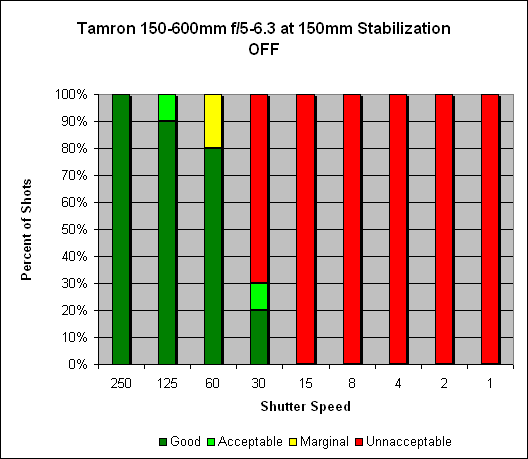
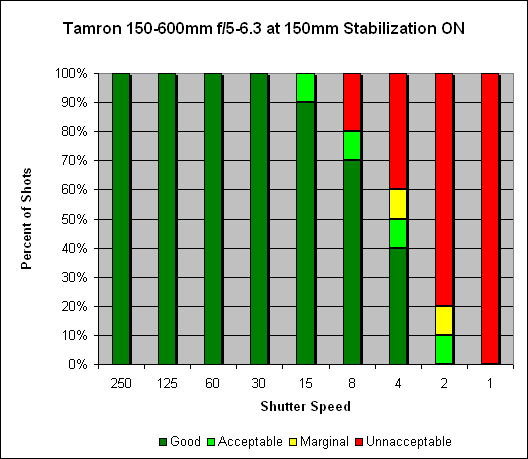
The lens features Tamron’s three-coil Vibration Control (VC) image stabilization system, offering just over three stops of hand-held improvement at 150mm, and around 2 1/2 stops at 600mm. It’s worth looking at our IS Test tab for greater detail.
The front threads on the lens take a 95mm filter, and are plastic. However, the front mount doesn’t rotate while focusing or zooming, so good news for polarizer users. The HA011 lens hood works well to prevent lens flare, and reverses on the lens for storage. The interior of the lens hood is matte black, and ribbed. Using the hood will add over 4 inches to the overall length of the lens.
The Tamron 150-600mm ships with a removable tripod mount, but there is an optional Model A011TL tripod mount with a longer foot that provides more mounting options.
Alternatives
Canon EF 100-400mm ƒ/4.5-5.6L IS USM ~$2,100
The Canon lens is optically better – sharper, and less prone to distortion and chromatic aberration – but you’d expect that, in an L-class lens that’s almost twice the price. The Canon lens also offers image stabilization, a slightly faster aperture, but it doesn’t zoom in as far.
Nikon 80-400mm ƒ/4.5-5.6G ED VR AF-S ~$2,400
The Nikon lens is much sharper than the Tamron, but again, at the price point you’d expect that. As with the Canon, it provides image stabilization, but doesn’t match the Tamron for its zoom range.
Sony 70-400mm ƒ/4-5.6G SAL-70400G ~$2,200
The Sony lens offers excellent performance – better than the Tamron, but like Canon and Nikon, that comes with a much more expensive price tag. Also like the previous alternatives, the Sony lens doesn’t match the Tamron for its zoom range.
Sigma 150-600mm ƒ/5-6.3 DG HSM OS “C” ~$1,000
Perhaps the most directly comparable alternative, Sigma’s offering in this area is so close in performance to Tamron it’s hard to tell them apart. Sigma’s OS image stabilization system produces slightly better results, but has some quirks to it the Tamron doesn’t. The Sigma is available in Canon, Nikon and Sigma mounts, so Sony users are out of luck.
Conclusion
If you aren’t looking at the Sigma 150-600mm “C” in another tab right now, you probably should be: the lenses are very comparable, and are definitely competing for the same market. The Tamron is an exceptional lens for the price point, but its slow aperture range limits it to photography accompanied by natural light, tripod use, high ISO settings, or a combination of the three. There’s a reason the pro lenses cost so much for those wider apertures, but if you aren’t shooting situations where you need that kind of gear then the Tamron 150-600mm SP offers an excellent platform for shooting extreme telephoto shots.
Product Photos
 |
 |
 |
 |
 |
|
Sample Photos
The VFA target should give you a good idea of sharpness in the center and corners, as well as some idea of the extent of barrel or pincushion distortion and chromatic aberration, while the Still Life subject may help in judging contrast and color. We shoot both images using the default JPEG settings and manual white balance of our test bodies, so the images should be quite consistent from lens to lens.


As appropriate, we shoot these with both full-frame and sub-frame bodies, at a range of focal lengths, and at both maximum aperture and ƒ/8. For the ”VFA” target (the viewfinder accuracy target from Imaging Resource), we also provide sample crops from the center and upper-left corner of each shot, so you can quickly get a sense of relative sharpness, without having to download and inspect the full-res images. To avoid space limitations with the layout of our review pages, indexes to the test shots launch in separate windows.
Description
(From Tamron lens literature) Cutting-edge eBAND Coating*1 and three LD (Low Dispersion) glass elements deliver superior imaging performance, while the latest built-in VC (Vibration Compensation)*2 system broadens users’ horizons in achieving sharper handheld photographs.
This all-new ultra-telephoto zoom lens features VC (Vibration Compensation)*2 image stabilization, speedy, precise USD (Ultrasonic Silent Drive)*3, state-of-the-art eBAND (Extended Bandwidth & Angular-Dependency) Coating*1, which significantly reduces the unwanted light reflections that cause flare and ghosting, and, in addition a sophisticated and stylish new external finish.
Its 4x ultra-telephoto zoom capabilities, with a focal length range from 150mm to 600mm, enhance the creative potential of telephoto photography, a captivating feature for all photographers, particularly nature, wildlife, and sports shooters.
Product Highlights
- 4x ultra-telephoto zoom lens with a focal length range of 150mm to 600mm
The focal length range of this lens was extended by 50mm on the wide-angle side and 100mm on the telephoto side compared to the existing model (Model A08), making it possible to take even more striking photographs of birds, wildlife, sports, and other distant subjects. Mounted on APS-C DSLR cameras, it has a stunning equivalent focal length range of 233mm to 930mm, almost to 1000mm. - World class image quality
Employing 20 elements in 13 groups and boasting an advanced optical design, it delivers a superior balance of resolution and contrast for sharp, clear images. The front group contains three LD (Low Dispersion) glass elements (two in the first group, one in the third) for enhanced optical correction effectiveness, enabling the lens to thoroughly compensate for on-axis aberrations at the telephoto end.
The lens also adopts eBAND Coating*1, developed from state-of-the-art coating technologies, and conventional BBAR (Broad-Band Anti-Reflection) Coating to greatly suppress ghosting and flare even when shooting under adverse lighting conditions. - Achieves a 600mm focal length in a compact easy-to-handle package
Ingenious optical design features minimize the movement of lens groups within the lens when zooming. This reduces the amount of barrel extension needed to cover the complete focusing range, making the entire lens more compact. - Beautiful background blur effects
Adopting a 9 blade circular diaphragm enables users to create beautiful background blur effects (bokeh), which provide even greater potential for creative expression. This circular diaphragm retains a nearly circular shape even at two stops down from its maximum aperture. - VC (Vibration Compensation)*2 mechanism creates greater opportunities for sharper handheld photography.
Tamron’s proprietary VC (Vibration Compensation) image stabilization system uses a three-coil system, delivering significantly sharper images and creating greater opportunities for handheld ultra-telephoto photography. - Comfortable autofocus
Tamron’s new SP 150-600mm F/5-6.3 Di VC USD features a USD (Ultrasonic Silent Drive) ultrasonic motor drive*3 for swift and accurate AF response, it delivers high torque, very fast response times, and very low noise. The full-time manual focus mechanism allows users to make fine manual focus adjustments at any time even when AF is engaged. - New elegant, high-class external finish
Tamron has upgraded the cosmetic design and finish of this lens to create a more sophisticated, high-end look in keeping with the demands of discerning full-frame DSLR users.Employing a sophisticated linear pattern rubber grip on the zoom and focus rings and an attractive and stylish tungsten silver name-brand ring, this newly designed model accentuates its visceral presence with understated elegance and class.
- Easy-to-use tripod mount
The tripod mount has been completely redesigned to provide superior stability, durability, ease of use, and portability. - Comes with “SILKYPIX Developer Studio for Tamron”, RAW image development processing software for Tamron’s SP lenses
*1 The eBAND (Extended Bandwidth & Angular-Dependency) Coating is a new nanotechnology-based coating technique developed by Tamron to reduce unwanted reflection.
*2 VC (Vibration Compensation) is Tamron’s proprietary image stabilization mechanism.
*3 USD (Ultrasonic Silent Drive) is Tamron’s proprietary ring-type ultrasonic motor.
Lab Test Results
Our standard lens lab tests, shot on full-frame and sub-frame bodies. Pick a focal length and aperture to see the result.
Sharpness (blur index)
Blur across the frame: lower and flatter is sharper. Change focal length and aperture to see how it improves when stopped down.

Chromatic aberration
Colour fringing in the corners at each focal length.

Vignetting (corner shading)
How much darker the corners are than the centre, by aperture and focal length.

Geometric distortion
Barrel (positive) or pincushion (negative) distortion across the zoom range.

Image Stabilization
Most people tend to think of image stabilization as being mainly for telephoto lenses. While it’s true that their longer focal lengths tend to magnify the effects of camera shake, image stabilization can provde a very useful assist at wider angle focal lengths as well; anyone who’s ever tried to blur the image of a waterfall, while keeping the surrounding landsape tack-sharp knows exactly what I’m talking about.
At 150mm, we see Tamron’s Vibration Control (VC) system produce just over three stops of hand-holding improvement:
 |
| Mouse over this chart to show results with IS activated. |
Zoomed in to 600mm, we see around two and a half stops of hand-holding improvement:
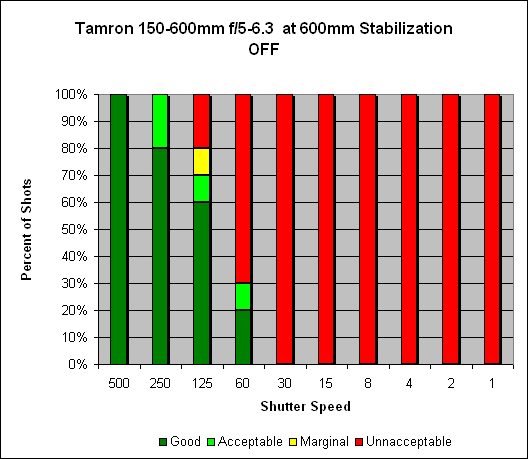 |
| Mouse over this chart to show results with IS activated. |
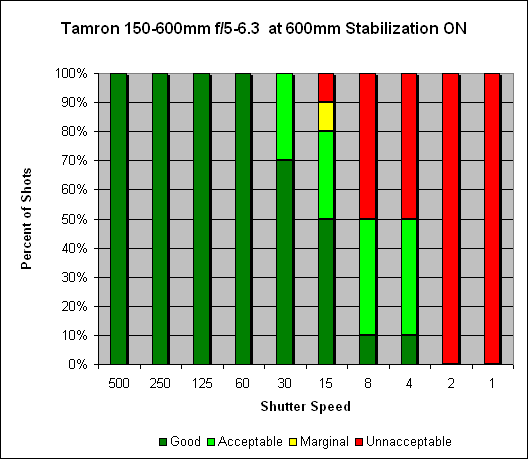
IS systems tend to provide more benefit to less-stable shooters than very steady ones, so most users will see the same or greater amounts of shake reduction as we measured here. You can read more about our IS test methodology here: SLRgear IS Test Methodology, v2.
Reader Reviews
- Image quality
- 8.9/10
- Build quality
- 7.6/10
- Recommend it
- 100%
- 9/10Recommendedby Christo55 · March 29 2016 · paid $1100
Pros: Zoom range, high resolution, good contrast and color, good focus speed, good bokeh
Cons: weight, size, maximum aperture
Another impressive lens from Tamron, this is one of the lower priced options for wildlife photographers in need of a quality mega-tele zoom. It offers very good image quality wide open to about 500mm. At 600mm, f/9 to f/11 seems optimum for maximum resolution. Wide open is still acceptable for some subjects. Focus speed is very good, moving subjects can be sharply resolved with practice. Handling in general is quite easy, while heavy and long, I can hand hold the lens for several minutes. The use of a monopod or tripod is recommended for support if used for extended periods.
Two issues reported with this lens have been minor dust accumulation on interior lens elements and intermittent focus. For the dust, the lens does extend and will move air in and out which can introduce dust. Like all photo equipment, try to keep the lens as clean as reasonably possible to mitigate the intrusion of dust. Minor dust is really more of an annoyance than an issue of for image quality. The intermittant focus seemed to have been related to the electrical contacts with the body. I returned the lens to Tamron for dust removal and check up, the lens was cleaned and it has worked flawlessly since then.
- 9/10Recommendedby alan jones · January 26 2016 · paid $1342
Pros: sharp at 600 F8 even wide open OK equal to the 100-400L mk 1
Cons: for the price none
Hi Ive only written this as i would kindly suggest that SLR gear did not have a good copy of the Tamron 150-600 as sharpness is very good on my copy i use it on a 7D2 so my commment are on a crop sensor which avoids the softer edges of the lens and its excellently hand holdable at 960mm easily !! I have tested mine against the canon 100-400L mk1 and it matches it easily my wife uses a 7d2 and a canon 100-400L mk2 lens which is a brilliant lens and it does outperform the tamron at 150-400MM but only slightly the main differences between the two is the canon has better colour and contrast and very very slightly sharper (on7d2 dont forget) i add colour and contrast to my 150-600!! when using the MK2 with a 1.4x T/C the Tamron wins very slightly at 560-600MM i am very happy with my Tamron For the record the 100-400 L mk1 does not performs well with a 1.4tc its soft conversely the Canon 100-400 MK 2 performs excellently with the 1.4x t/c mk3 night and day difference between the 2 L lenses Hope this helps someone
- 8/10Recommendedby davescliches · January 25 2016 · paid $932
Pros: Price usability weight performance
Cons: onion bokeh in specular highlights
First off, I needed a second copy the first was de-centered, "as per your tested sample"......the second copy I received was spot on and indeed sharper across the range....I am sure a better centered test example would provided a improved the reviewers conclusions!
For BIF when panning @600mm it's best not to use VC it just blurs the image, at lower FLs VC works better, for stationary targets the VC is an asset.
At shorter FLs the lens is very decently sharp on APSc and very sharp on full frame (swop reach for magnification/perceived sharpness...DXO) above 450mm things look ls good on the APSc sensor but better on full format.
A lot of birders will use the 600mm FL and I found F9-11 gives sharpest results.
AF is great, fast and accurate.
Important fact!!!!
At "600mm" this lens is very sharp at shorter shooting distances and less sharp at longer distances towards infinity, at MFD the lens is sharp at F6.3.
"Onion bokeh" is a problem when shooting against sparkling water and specular highlights, (economic lens grinding smoothness)..Shoot as close to as possible for sharpest results.
The lens's general handling is excellent, for hand-heldshooting I remove the tripod foot.
I have seen a spec of dust or two which comes and goes, no big deal.
The lens has a dust seal around the bayonet but has "no" further sealing.
https://www.flickr.com/photos/124690178@N08/
- 9/10Recommendedby AndyF · December 19 2015 · paid $750
Pros: Excellent VR - Hand-holdable @600, affordable, good contrast & colour, smooth bokeh.
Cons: None at this price!
Bought second-hand for £500 ($750) two weeks ago, and I must say it is far better than I was expecting! I already had the superb Tamron 24-70 (A007) so my expectations were pretty high in any case.
On the full frame D810 auto-focus is virtually instant and accurate. IQ is very good throughout the focal range with apertures between f/8 and f/11.
On the D300S you get a mind-boggling 225-900mm equivalent range, auto-focus is a tad less reliable than on the D810 but still acceptable.
I'm unlikely to be using this lens on a tripod when I'm out and about so I've rotated the mounting foot to the 12 o'clock position where it serves as a comfortable, well-balanced, carrying handle.
This lens is definitely a keeper!
- 7/10Recommendedby olafmaisonneuve · November 4 2014
Hi,
I bought that lens for my Nikon 610. Used it 4 times. Had a filter in front element. Realize after less then a month it has already particle in front element. Return it to Amphis by Purolator (41,00 $ shipping) and they told me , it need to be cleaned and will cost me 225,00 $ ! and clenaning is not under warranty ? Well I presume the particle was already in the lens when I get it ? I had a Tamron 70-300mm since 10 years without any problem. That lens is a vacuum cleaner ??? In Photonews (belong to then) It is written dust and moisture resistance... A product should last more that a month without any dust...come on ? Value of the lens decrease with dust ? What will be the quality of the picture in a year of use ? Waiting for a positive answer from Amphis Canada to solve my problem. I own Nikon since 1974 and lens and never have any problem with lens (Tokina,Tamron or Nikkor) !
- 8/10Recommendedby Magal · October 2 2014
Pros: Image sharpness, zoom range, sharp at 600 [stepped down], VC
Cons: Dust under front element, VC useless for airshow display use.
As regards image quality, the results can be stunning but you have to get used to its characteristics to achieve them. VC takes about a second to kick in but when it does it's top notch. Panning shots with VC on presented no problems in the horizontal but any other angle threw it off, such that air display shots were better off without VC. AF is quick and silent and on the whole very accurate.
Zoom and focus rings turn very smoothly with just about the right amount of damping; pity the sealing is not up to the same standard, seeing that dust soon appeared under the front element. As already stated, image quality can be stunning, with very good contrast, punchy colours and excellent sharpness. It gives best results in the mid aperture range - f8 to f11 and unlike most zooms, stays sharp even at 600 within this aperture range. Very low CA and low vignetting on APS-C size sensor.
All in all, considering what it costs, I'm pretty happy with this lens and would recommend it any time.
- 9/10Recommendedby GWK · April 8 2014 · paid $1170
Pros: Good build, sharp photos and solid AF
Cons: AF can be slow and the VC takes 1 sec to take full effect
Only had this lens for a week. I am using it with a Canon 50d so the slow AF may, at least in part due to it. I calibrated the AF micro adjustment to the lens and it made a noticeable difference.
Images have been very good, although at the moment my poor image rate is double that I normally have. Probably due to the need to be careful about depth of field issues with at 600mm lens.
While the VC is slow to start, it is very effective and it makes it practical to use this lens handheld.
Overall, the images are as sharp as those I get with a Canon 70-300mm f5.6L.
Reader reviews were submitted by Imaging Resource readers and are shown as written.