Nikon Coolpix S200 Exposure
Color
Saturation & Hue Accuracy
Good overall color, though some oversaturation in strong reds, blues, and greens.
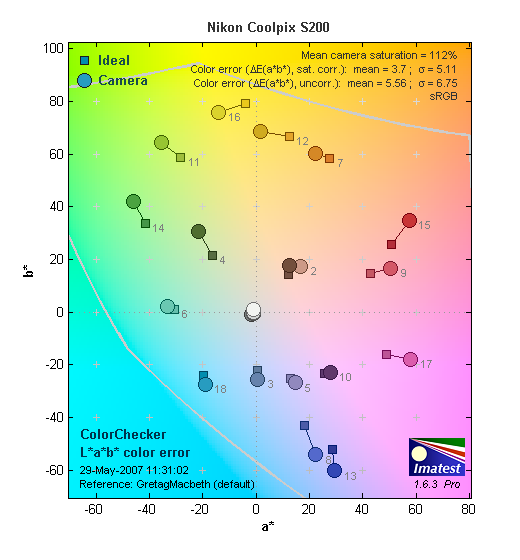 |
| In the diagram above, the squares show the original color, and the circles show the color that the camera captured. More saturated colors are located towards the periphery of the graph. Hue changes as you travel around the center. Thus, hue-accurate, highly saturated colors appear as lines radiating from the center. |
Saturation. The Nikon Coolpix S200 produced good overall saturation, with slight oversaturation in the strong reds, blues, and greens. Most consumer digital cameras produce color that's more highly saturated (more intense) than found in the original subjects. This is simply because most people like their color a bit brighter than life.
Skin tones. The S200 produced good skin tones. Where oversaturation is most problematic is on Caucasian skin tones, as it's very easy for these "memory colors" to be seen as too bright, too pink, too yellow, etc.
Hue. The S200 pushed some reds a little toward orange, and oranges toward yellow, but overall color looked good and realistic. Hue is "what color" the color is.
 |
 |
 |
Sensor
Exposure and White Balance
Indoors, incandescent lighting
Good color balance with the Manual white balance option, about average positive exposure compensation required.
 |
 |
| Auto White Balance +1.0 EV | Incandescent WB +1.0 EV |
 |
|
| Manual White Balance +1.0 EV |
Color balance indoors under incandescent lighting was warm and pinkish in Auto white balance mode, and the Incandescent setting resulted in stronger yellow color balance. However, the Manual option produced nearly accurate results, if slightly greenish. The Nikon Coolpix S200 required a +1.0 EV exposure compensation adjustment for a bright exposure, though the highlights on Marti's shirt are bordering on too hot. Overall color looks pretty good, though the blue flowers came out a bit purple. (Many digital cameras push the blue flowers toward a darker, more purple hue.) Our test lighting for this shot is a mixture of 60 and 100 watt household incandescent bulb, a pretty yellow light source, but a very common one in typical home settings here in the US.
Outdoors, daylight
Good color balance, very bright colors. Better than average exposure accuracy.
 |
 |
| Auto White Balance, +0.3 EV | Auto White Balance, Auto Exposure |
The Nikon S200's Outdoor shots generally showed accurate exposure with pretty good highlights. Shadow detail was limited, with some visible noise suppression. Exposure accuracy overall was quite a bit better than average, the camera requiring less exposure compensation than we're accustomed to seeing with consumer digicams.
See full set of test images with explanations
See thumbnails of all test and gallery images
Resolution
High resolution, 1,300 lines of strong detail.
 |
 |
| Strong detail to 1,300 lines horizontal | Strong detail to 1,300 lines vertical |
Our laboratory resolution chart revealed sharp, distinct line patterns from the Nikon Coolpix S200 down to about 1,300 lines per picture height, with extinction at around 1,900 - 2,000. Use these numbers to compare with other cameras of similar resolution, or use them to see just what higher resolution can mean in terms of potential detail.
See full set of test images with explanations
See thumbnails of all test and gallery images
Sharpness & Detail
Fairly sharp images, though significant blurring of detail from noise suppression.
 |
 |
| Good definition of high-contrast elements. Some visible edge enhancement as well. | Subtle detail: Hair Noise suppression tends to blur detail in areas of subtle contrast, as in the darker parts of Marti's hair here. |
Sharpness. The Nikon Coolpix S200's images are slightly soft at wide angle, somewhat sharper at telephoto. In high-contrast subjects such as the crop above left, edge enhancement artifacts are noticeable. Edge enhancement creates the illusion of sharpness by enhancing colors and tones right at the edge of a rapid transition in color or tone.
Detail. The crop at far right shows some evidence of noise suppression, even at ISO 50, but it's not bad here at the center in this light. The darker areas of Marti's hair show limited detail, though the Nikon S200 does capture quite a bit of fine detail in the brighter strands of hair. Noise-suppression systems in digital cameras tend to flatten-out detail in areas of subtle contrast. The effects can often be seen in shots of human hair, where the individual strands are lost and an almost "watercolor" look appears.
ISO & Noise Performance
Moderate noise at the normal sensitivity settings, much higher noise at the higher settings.
 |
 |
 |
| ISO 50 | ISO 100 | ISO 200 |
 |
 |
 |
| ISO 400 | ISO 800 | ISO 1,000 |
Noise levels are moderate at the Nikon S200's lower sensitivity settings, with significant loss of detail due to noise reduction already at ISO 200. At ISO 400 and above, noise pixels are bright, which throws off the color balance a bit, and the grain pattern eliminates much of the finer details. Yellow blotches actually pepper the shadows in the hair and neck throughout all these indoor shots, and get bigger as you move up, becoming quite noticeable at ISO 200 and above.
Extremes: Sunlit and low light tests
High resolution with pretty good overall detail, though limited shadow detail. Limited low-light capabilities, though capable of capturing bright images under average city street lighting and slightly darker conditions.
 |
|
 |
| Default Exposure | +0.3 EV | +0.7 EV |
Sunlight. The Nikon Coolpix S200 had a little trouble with the deliberately harsh lighting in the test above, producing high contrast and a dim overall exposure. Detail is limited in the shadow areas, partly from some noise suppression. There's a bit of a tradeoff between the two images that are closest to the correct exposure. Though some areas are still a little dark at +0.3 EV, I preferred it to the image at +0.7 EV, which had too many blown highlights for my preference. Also note that the image labeled "Default" above contains an error in exposure, in which the default exposure is actually brighter than the +0.7 EV image. (In "real life" though, be sure to use fill flash in situations like the one shown above; it's better to shoot in the shade when possible.)
Note: Because digital cameras are more like slide film than negative film (in that they tend to have a more limited tonal range), we test them in the harshest situations to see how they handle scenes with bright highlights and dark shadows, as well as what kind of sensitivity they have in low light. The shot above is designed to mimic the very harsh, contrasty effect of direct noonday sunlight, a very tough challenge for most digital cameras. (You can read details of this test here.)
| 1 fc 11 lux |
1/2 fc 5.5 lux |
1/4 fc 2.7 lux |
1/8 fc 1.3 lux |
1/16 fc 0.67 lux |
|
|---|---|---|---|---|---|
| ISO 50 |
 1 sec f3.1 |
 1 sec f3.1 |
 1 sec f3.1 |
 1 sec f3.1 |
 1 sec f3.1 |
| ISO 100 |
 1 sec f3.1 |
 1 sec f3.1 |
 1 sec f3.1 |
 1 sec f3.1 |
 1 sec f3.1 |
| ISO 200 |
 1 sec f3.1 |
 1 sec f3.1 |
 1 sec f3.1 |
 1 sec f3.1 |
 1 sec f3.1 |
| ISO 400 |
 0.8 sec f3.1 |
 1 sec f3.1 |
 1 sec f3.1 |
 1 sec f3.1 |
 1 sec f3.1 |
| ISO 800 |
 0.4 sec f3.1 |
 0.7 sec f3.1 |
 1 sec f3.1 |
 1 sec f3.1 |
 1 sec f3.1 |
| ISO 1000 |
 0.3 sec f3.1 |
 0.6 sec f3.1 |
 1 sec f3.1 |
 1 sec f3.1 |
 1 sec f3.1 |
| ISO 400 (NS) |
 0.4 sec f3.1 |
 0.5 sec f3.1 |
 0.5 sec f3.1 |
 0.5 sec f3.1 |
 0.5 sec f3.1 |
Low light. The Nikon Coolpix S200 performed poorly in our low light tests. Since the longest shutter speed is one second, higher ISO sensitivity was needed to produce bright results at lower levels, resulting in rather noisy images. At ISO 200, the Nikon S200 was able to capture a reasonably clean shot at one foot-candle (about as bright as the average city street-lighting at night). At ISO 800, the camera captured bright results down to the 1/4 foot-candle light level, but with unacceptable levels of noise as a consequence. The camera's autofocus system also struggled in low light, working down to just above the 1/2 foot-candle light level unassisted, and there is no focus assist lamp to improve matters. Do keep in mind though, that the longer shutter times associated with the Night modes demand the use of a tripod or other camera support to get sharp photos. (A useful trick is to just prop the camera on a convenient surface, and use its self-timer to release the shutter. This avoids any jiggling from your finger pressing the shutter button, and can work quite well when you don't have a tripod handy.)
How bright is this? The one foot-candle light level that this test begins at roughly corresponds to the brightness of typical city street-lighting at night. Cameras performing well at that should be able to snap good-looking photos of street-lit scenes.
NOTE: This low light test is conducted with a stationary subject, and the camera mounted on a sturdy tripod. Most digital cameras will fail miserably when faced with a moving subject in dim lighting. (For example, a child's ballet recital or a holiday pageant in a gymnasium.) For such applications, you may have better luck with a digital SLR camera, but even there, you'll likely need to set the focus manually. For information and reviews on digital SLRs, refer to our SLR review index page.
Flash
Coverage and Range
A slightly weak flash, our standard shots required less-than-average positive exposure compensation.
 |
 |
| 38mm equivalent | 114mm equivalent |
 |
 |
| Normal Flash +0.7 EV | Slow-Sync Flash +0.7 EV |
Coverage. Flash coverage was uneven at wide angle, though it was more uniform at telephoto. In the Indoor test, the Nikon Coolpix S200's flash underexposed our subject at its default setting, requiring a less-than-average +0.7 EV exposure compensation adjustment to get reasonably bright results. The camera's Slow-Sync flash mode also produced good results with +0.7 EV exposure compensation, though the background incandescent lighting results in a strong orange-yellow cast.
| Flash Range: Wide Angle | |||||
|---|---|---|---|---|---|
| 6 ft | 7 ft | 8 ft | 9 ft | 10 ft | 11 ft |
 1/60 sec f3.1 ISO 100 |
 1/60 sec f3.1 ISO 100 |
 1/60 sec f3.1 ISO 100 |
 1/60 sec f3.1 ISO 100 |
 1/60 sec f3.1 ISO 100 |
 1/60 sec f3.1 ISO 100 |
| 12 ft | 13 ft | 14 ft | 15 ft | 16 ft | |
 1/60 sec f3.1 ISO 100 |
 1/60 sec f3.1 ISO 100 |
 1/60 sec f3.1 ISO 100 |
 1/60 sec f3.1 ISO 100 |
 1/60 sec f3.1 ISO 100 |
|
| Flash Range: Telephoto | |||||
|---|---|---|---|---|---|
| 6 ft | 7 ft | 8 ft | 9 ft | 10 ft | 11 ft |
 1/120 sec f5.9 ISO 100 |
 1/120 sec f5.9 ISO 100 |
 1/120 sec f5.9 ISO 100 |
 1/120 sec f5.9 ISO 100 |
 1/120 sec f5.9 ISO 100 |
 1/120 sec f5.9 ISO 100 |
| 12 ft | 13 ft | 14 ft | 15 ft | 16 ft | |
 1/120 sec f5.9 ISO 100 |
 1/120 sec f5.9 ISO 100 |
 1/120 sec f5.9 ISO 100 |
 1/120 sec f5.9 ISO 100 |
 1/120 sec f5.9 ISO 100 |
|
ISO 100 Range. At wide angle, shots at ISO 100 are bright out to a distance of about 8 feet, decreasing in brightness from that point on. At full telephoto and ISO 100, even the 6-foot shot is a little dim, and the images darken from there. A typical result for a compact model.
| Manufacturer-Specified Flash Range | |
|---|---|
| Wide Angle | Telephoto |
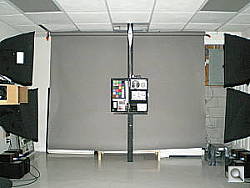 15.1 feet Auto ISO 620 |
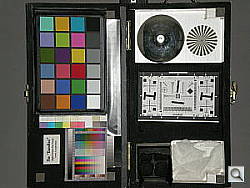 8.2 feet Auto ISO 370 |
Manufacturer Specified Flash Test. In the shots above, the S200 seems to perform exactly as Nikon says it will, producing good exposures (in fact, slightly overexposed) at the rated distances with its ISO set to Auto. However it had to boost sensitivity quite a bit to IS0 620 at wide angle and ISO 370 at telephoto to do so.
Note: Our standard test method for flash range uses a fixed setting of ISO 100, to provide a fair basis of comparison between cameras. We've now also begun shooting two shots using the manufacturer-specified camera settings, at the range the company claims for the camera, to assess the validity of the specific claims.
Output Quality
Print Quality
Good print quality, good color, usable 11x14 inch prints. Quality degrades quickly as ISO increases, however.
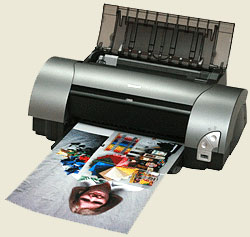 The Nikon Coolpix S200 had enough resolution to make crisp 8x10 inch prints. At 11x14, its prints were a bit softer, but more than adequate for wall or table display at ISO 50, though the softness in the corners does indeed show up at this size. ISO 100 shots look better at 8x10, and ISO 200 photos are noticeably soft printed at 8x10 inches, but it's not until 5x7 that it ceases to matter. This is an unusually fast drop off in quality. ISO 400 images look fine at 5x7, and ISO 800 images do too, with slightly less vibrant color. ISO 1,000 images are only passable at 5x7, yet not bad at 4x6, again with more subdued color.
Color under ISO 400 is bright and punchy, with significant boost in the reds, though that vibrance drops abruptly at ISO 800 and 1,000, which produce flatter images.
Note: Testing hundreds of digital cameras, we've found that you can only tell just so much about a camera's image quality by viewing its images on-screen. Ultimately, there's no substitute for printing a lot of images and examining them closely. For this reason, we now routinely print sample images from the cameras we test on our Canon Pro9000 studio printer, and on the Canon iP5200 here in the office. (See the Canon Pro9000 review for details on that model.)
The images above were taken from our standardized test shots. For a collection of more pictorial photos, see our Nikon Coolpix S200 Photo Gallery .
Not sure which camera to buy? Let your eyes be the ultimate judge! Visit our Comparometer(tm) to compare images from the Nikon Coolpix S200 with those from other cameras you may be considering. The proof is in the pictures, so let your own eyes decide which you like best!
 Fujifilm GFX 50S Review
 Fujifilm X-T3 Review
 Olympus E-M5 III Review


Follow Imaging Resource