


Overview
Sony T77 Overview
by Mike Pasini
and Stephanie Boozer
Review Date: 12/18/08
The Sony Cyber-shot DSC-T77 is a replacement for last year's DSC-T70 model, and features a higher-res 10-megapixel sensor coupled to a more powerful Carl Zeiss Vario-Tessar branded 4x optical zoom with a roomy 16:9 aspect-ratio 3.0-inch touch-screen LCD.
The DSC-T77's 35-140mm 35mm equivalent lens gains a little extra reach at both ends of the zoom range, and incorporates Sony's Super Steady Shot optical image stabilization to minimize blur caused by camera shake at slow shutter speeds. This despite a body that's said to be the slimmest of any Sony digicam, at less than 0.6-inch (15mm). Other Sony T77 features include ISO sensitivity to a maximum of ISO 3,200, a Memory Stick Duo/PRO Duo card slot plus 15MB of built-in memory, and power from a proprietary lithium-ion rechargeable battery. The Sony T77 also offers USB 2.0 Hi-Speed connectivity for connection to a personal computer, and high definition video connectivity for viewing on the latest HD televisions.
The Cyber-shot T77 includes Sony's face-detection technology, which is capable of detecting eight faces simultaneously, and is linked not only to the camera's autoexposure and autofocus systems as in most similar systems, but also to white balance and flash metering as well. This allows the camera to ensure proper flash exposure and pleasing flesh tones. The Sony T77's face detection system also provides both an updated Smile Shutter function, and the existing child/adult priority mode, as well as a new anti-blink function in portrait mode that automatically captures two images and then discards any with the subjects' eyes closed. If eyes are closed in both photos, the Sony T77 warns of this so you can retake the photo.
The Sony T77 features Sony's Bionz image processor, first seen in the company's Alpha dSLRs. Sony says Bionz offers improved image quality, faster response times, and better battery life in its compact cameras. Also on offer is an updated intelligent scene recognition function, which can now automatically select from eight different scene modes including macro, portrait, and landscape.
The Sony Cyber-shot DSC-T77 ships from September 2008 priced at US$300, and body color choices include brown, green, pink, and silver.
Sony T77 User Report
by Mike Pasini
The T77 is a close relative to the T700, which I recently reviewed. Close relatives often have quite different personalities, despite a strong resemblance to each other. But that's not the case with these two.

Front. The lens cover has been shifted down, turning the camera on.
The Sony T77 offers everything we liked about the T700 while stripping only a few of the more exotic features like the T700's 4GB of built-in memory and reducing the 3.5-inch LCD to 3.0 inches. Those are tradeoffs we can live with -- especially since Sony knocks $100 off the price.
There are very few features missing, though. One is the scrapbook function that can assemble multiple similar images into JPEGs with backgrounds as easily as running a slide show. That one pinches me a little, but I can live without it.

Back. The back of the camera with its large LCD and the stylus.
So if you were a little hesitant about the more extreme features (and higher price) of the T700, you'll love the more conventional Sony T77.
Design. We often label this part of our report "Look and Feel" but the Sony T Series merits the more elegant "Design." It isn't just pretty, it's functional. The slim case makes sense and the big screen has important work to do, too.
This all starts with the lens cover, which slides down to power the camera on and powers the camera off when you slide it up. The smart thing about this approach is that you don't have to look for a Power button before you can shoot with the T77. If you're tracking your subject, the last thing you want to do is leave it for a moment to find some Power button to turn on the camera.

Controls. All the physical controls are in the top right corner. Note the thumb grip.
You can get directly into Playback mode by pressing the Playback button on the beveled edge of the top panel. But to turn the Sony T77 off, you have to find the tiny Power button on the top edge. Pressing the Playback button again just reminds you to lower the lens cover to start shooting.
Next to that tiny, slightly recessed Power button is the elongated and slightly raised Shutter button. And to its right is the small tab of the Zoom lever. Those are the only buttons on the Sony T77.
There is next to no travel on the Sony T77's Zoom lever (almost like a joystick) but it was fairly responsive. None of these ultracompact zoom controls are really smooth, taking a lot of fun out of using them. But this one is better than most.
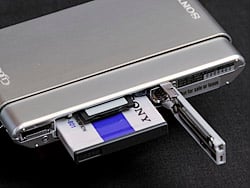
Bottom. The Memory Stick PRO Duo and the proprietary lithium-ion battery are both compact. See the tripod socket? It's nested beneath the battery door hinge.
That's because the 3.0-inch 16:9 LCD is also touch-sensitive. A stylus with a small nipple at one end is provided to keep the Sony T77's screen free of smudges, but a finger works well, too. It does smudge pretty miserably, but it remains readable in sunlight. And when it's on, you aren't really distracted by the smudges.
Despite the LCD's dominance of the back panel, the Sony T77 actually has something of a thumb grip back there. The right-hand edge has a quarter inch area with two ridges that are just enough to hold the camera securely. And the camera strap eyelet has a nice wide curve to it, giving your thumb even more support.
The lens itself is a Carl Zeiss Vario-Tessar 35-140mm 4x optical zoom with optical SteadyShot image stabilization, which is very handy at slow shutter speeds. I can't confirm it's the same optical design as the T700, but it certainly seemed as if it were.

Shooting. The touchscreen in Record mode with the four corner buttons and icons along the sides and bottom that can be touched to change settings.
The Touch-Screen. Here's a tip for using the Sony T77's touchscreen: turn off the function guide (Home, Setup) as soon as you can. While the explanations can be helpful, you'll quickly get annoyed with the need to tap the OK button to dismiss some of them.
Sony uses the four corners of the touchscreen as buttons to the Home, Menu, and Display menus (the top right is unused). But between them, Sony has ringed the screen with icons for various functions available in any particular mode.
The top of the Sony T77 screen shows the battery status, image size, stabilization status, and the number of shots remaining on which memory device.

Setting EV. Here we've tapped EV in the bottom right to get the EV display with its big Plus and Minus buttons.
But you can't just tap the image size icon to change resolution. Nope, you have to hit the Menu corner button to bring up the shooting menu. Which is odd, because the way you change the Flash mode is by tapping the flash icon on the right panel. And the way you change the Sony T77's shooting modes is by tapping the mode icon on the left panel. And, just for the hat trick, the way you change ISO is by tapping the ISO icon on the bottom of the screen. Pretty nuts.
Once you tap into another menu, the right top corner comes alive with a big cancel button until you select a different setting and it turns into a big OK button. You can tap any of the Sony T77's listed options or the cancel button to return to shooting mode.

Calendar Display. You can view captured images in a Calendar format.
I really liked having almost every option on the screen at once. It's a lot easier than trying to remember if it's the Function button or the Menu button that has the control you want to change. The icon display does clutter the Sony T77's screen, sometimes making it difficult to compose the shot. But you can turn off that display, just showing the image, if you promise to turn it back on to use the touchscreen.
And like any touchscreen camera, it turns a one-handed operation into a two-handed operation. I didn't mind that as much as I usually do, but I didn't fiddle with the settings on the Sony T77 as much as I usually do either.

Smiles. Because the T77 recognizes smiles, it can also display images with smiling faces. And you can distinguish between adults and children, too.
That may be the secret to why I enjoyed using the Sony T77 and T700 touchscreens more than most. The cameras don't require (or encourage) much, uh, participation from the photographer.
Modes. Under the Mode icon, there are 10 shooting modes including Landscape, Soft Snap, Twilight Portrait, Twilight, Scene Selection, Auto, Program Auto, Easy, High Sensitivity, and Movie mode. That's the order they appear on the Sony T77's menu, oddly enough.
Under Scene modes, you can access Gourmet, Beach, Snow, Fireworks, Underwater, and Hi-Speed Shutter.
But the Sony T77 can intelligently detect a few scenes all by itself. Eight of them, in fact: Backlight, Backlight Portrait, Twilight, Twilight Portrait, Twilight using a Tripod, Portrait, Landscape, and Macro. And man do I love an auto macro even if it takes a little longer to find focus. The Sony T77 has two intelligent scene modes. In Auto iSCN mode, the camera takes a single shot using the optimal settings. In Advance iSCN mode, the camera takes a picture with the current settings and only if necessary takes a second picture with optimized setting.
Perhaps even more important than all that, though, is the Bionz image processor's Dynamic Range Optimization. Time and again we've seen this feature save an otherwise lost shot, salvaging highlights that would normally be blown out or holding onto shadow detail that would normally be lost.
The Sony T77 can recognize up to eight faces, controlling flash, focus, exposure, and white balance to optimize skin tones and deal with red-eye. And it can distinguish between adults and children so you can tell it which faces to watch for a smile, grin, or laugh, too. But it also features an anti-blink function that will take two shots in Portrait mode, saving the one with less squinting.

High Quality Movie. A 6MB file lasting 5 seconds. Zoom was functional. (Click to view/download MPEG file.)
Movie mode is limited to 640 x 480 at 30 or 16.6 frames per second and 320 x 240 at 8.3 fps. There's no HD on the Sony T77. You can shoot clips up to 10 minutes in length, maximum. And you can use the optical zoom, too.
Sony hasn't neglected to give you some pretty good options. You can tag images as Favorites making them available for quick retrieval. But you don't have to go to that much effort. You can simply use a Calendar View to find each shoot by date or a Date View to see every image shot on a particular day.
You can also tap into the Sony T77's ability to distinguish adults from children by filtering your collection by faces. Options include finding images with people's faces in them, finding children's faces, finding infant's faces, finding smiling faces. And it's quick. We shot a birthday party one evening and filtered the results by smiling faces just to make it look like everyone had a good time.
We also tried the infants and children filters. The youngest child showed up as the single infant when she was being held by her grandmother. That shot also showed up in the collection of children images.
And, of course, there's a slide show option (with music), which is something Sony does very well, automating pan and zooms.


Zoom Range. 35mm to 140mm to 2x digital zoom.
Sony also includes a Picture Motion Browser (don't ask me why they named it that), a Windows application that can with which you can organize and view your full collection your computer. You can set labels and ratings, get map views with GPS data (which the Sony T77 does not record), retouch and edit images, and share and archive them.
Storage and Battery. The Sony T77 is powered by a 3.6-volt, 680mAh lithium-ion battery. The LCD represents an unusual battery drain but we were able to shoot with flash without running out of power at an evening party.
In addition to the 15MB internal memory, the Sony T77 supports Memory Stick Duo and Pro Duo media.
My low-compression 10-megapixel shots ranged from 2.9MB to 3.5MB per image. Those are 3,648 x 2,736 pixel images.
Performance. With a Bionz image processor, you expect high performance marks and the Sony T77 delivers. It scores above average on combined wide-angle and telephoto autofocus lag, prefocus lag, and cycle time.
And it's above average for USB speed, LCD size, and flash cycling (which, considering the short range of the flash is no compliment).
It scores average marks for its 4x optical zoom and 5.26 ounce weight, neither of which are faults.
But in that department, the 2.3-second startup and 1.8-second shutdown times are just average (a good deal faster than the T700, though).
Playback. Sony doesn't provide a cable to connect the T77 directly to your HDTV. All you get is the octopus cable with AV and USB connections. That's a pity (which we've been complaining about all year) because it shoots in 16:9 mode at a resolution greater than any HDTV and direct output from the Sony T77 would be a lot of fun not only at your house but when you visit others, too.
You can order a composite cable as an accessory (VMC-MHC1) or a Cyber-shot Station cradle (CSS-HD2). But you shouldn't have to.
Image Quality. In my review of the T700, I found image quality suffered from technical defects like oversaturation of reds and blues as well as chromatic aberration. But I also confessed to liking the pictures the T700 captured.

Brilliant Red. The trouble is that it's in the shade.
The Sony T77, which shares the same lens, sensor, and image processor as the T700, impressed me much the same, as you might expect. While this isn't top-drawer image quality, it isn't far behind. And hardly an issue for the snapshooter.
Still, let's nit pick at bit, shall we?
The Still Life shot at ISO 100 shows pronounced blurring as you move away from the center of the image. The blurry area of the image is actually quite large, in fact. Almost all lenses on compact digicams show blurring in the corners but it usually stays in the corners. Look at the yarns in this shot starting with the white one. That's just gone. But the next three aren't sharp either. You've got to work your way back to the purples and blues before the blurring starts to let up.
You'll see the same problem with the crayons. Those on the left side are blurrier than those on the right.

Blooming Hydrant. It's almost glowing.
The Samuel Smith label is another story. At first I suspected the image had been blurred by camera movement. But both the ISO 80 and ISO 100 shots show the same artifact: a blurred edge at the top of the label. The same blurring appears in the green field of the label, appearing almost like double vision. I suspect the Bionz processor is not handling this sharp edge very well.
In the Multi Target test you can see strong chromatic aberration along the bottom of the image. The arrows show several pixels of bright coloration but even higher and more toward the middle of the image you'll see it in the scale below the Q-60 target.
The sharpness targets in the middle of that image look pretty good, though. The Sony T77 delivers about 1,600 lines of horizontal resolution and a bit less, perhaps 1,500, vertically. Again, though, peeking at the corners, you can see the capture is not nearly as sharp.
The gallery shots show the tendency to oversaturate reds in the fire alarm shot. It's hard to believe the alarm is always in the shade. It looks like the sun is beating down on it.

Super SteadyShot. Just 1/13 second at ISO 400 did the trick. But detail is soft.
The Bionz processor and its dynamic range optimization tends to do a very nice job on the hydrant shot. But this time, not so hot. There's noticeable blooming of the bright hydrant into the dark foliage behind it. It almost appears to be glowing. Still there's more highlight detail than usual in the shot. And the shadows are not plugged up.
My shots of Tim Lincecum warming up for the Giants' last game of the year are a lot better than the shots I got of J.T. Snow with a Fujifilm S2000HD the night before. But the green-checked shirt of former Giants CEO Peter McGowan signing autographs is a nightmare. Other detail in that image -- shot at only ISO 125 -- is blurred beyond recognition, too. Like hair. The overall shot isn't bad, but on close examination, you have to scratch your head. This is ISO 125?
Higher ISOs, it almost goes without saying, were disappointingly devoid of detail and color. The dolls, shot at ISO 1,600 and 3,200, were just not good images. The Sony T77 did a little better with the Alfa stick shift knob at ISO 400 and 800 as far as color goes but not detail, a familiar Sony complaint. Just compare the green snake in each of the image. You can tell by the intensity of the color which shot was ISO 400, 800, and 3,200; the green fades as the ISO goes up.
Again, this is not a lot different from the T700. But the bias toward color and disregard of detail are not a compromise acceptable to everyone.
Appraisal. The casual photographer will appreciate this slim camera for its fun touchscreen and vibrant color. It's easy to take along and fun to shoot with. You don't pay too dearly for the subcompact size, as images are of good quality, and Sony's image-enhancement features, like Dynamic Range Optimization, help improve your results in tough situations. And who can argue with stylish looks combined with practical design? It is a Sony after all.
Sony T77 Basic Features
- 10.1 megapixel Super HAD 1/2.3-inch CCD sensor
- 4x optical zoom (35-140mm 35mm equivalent)
- 2x digital zoom
- 3.0-inch LCD with 230,000 pixels
- ISO sensitivity from 80 to 3,200
- Shutter speeds from one to 1/1,000 second
- Aperture ranges from f/3.5 to f/10
- Memory Stick Duo and PRO Duo memory card support
- Custom 3.6-volt lithium-ion battery
Sony T77 Special Features
- Bionz image processor
- Available in silver, black, green, pink, and brown
- Smile Shutter technology
- Face Detection technology
- Double anti-blur solution with Super SteadyShot optical image stabilization
- Intelligent Scene recognition
- Dynamic Range Optimizer
- Auto Macro
- Function Guide
- In-camera retoucing
- Image management
- HD output with optional cable
In the Box
The Sony T77 ships with the following items in the box:
- T77 body
- Rechargeable Battery Pack
- Battery Charger
- Multi Connector Cable
- Wrist Strap
- Paint Pen
- CD-ROM
- Station Plate F
Recommended Accessories
- Large capacity Memory Stick Duo PRO. (Memory Stick PRO versions can handle high-res movie data and give faster download times.) They should be used for all current Sony cameras.
- Extra battery pack for extended outings
- Small camera case for outdoor and in-bag protection
Sony T77 Conclusion
| Pro: | Con: |
|---|---|
|
|
If you look too closely at the Sony T77's images, you might conclude that this slim little camera isn't for you. There's corner softness, chromatic aberration, and noise at higher ISOs. But add in the fact that the Sony T77 is a very slim camera with a 10-megapixel sensor, and you can begin to forgive its flaws--flaws shared by just about every other slim point and shoot camera (and few are this slim). And the corner softening isn't as bad as most other pocket cameras, such that you won't notice it when printing at 8x10.
The Sony T77 is $100 less than the T700 (an earlier Dave's Pick), but just as capable. It simply eliminates the huge internal memory and uses a slightly smaller LCD, which is still generous by today's standards. The touchscreen interface is easy to use and works well; we're not sure it's necessary, but it does remove the need for buttons on the back, which allows a wider screen than would normally be possible. The front slider is convenient and well-made, and we just love how the whole package looks and works. The Sony T77's images are pleasing, and we were especially impressed with how it handled our extreme sunlight test, with Standard DRO making a great shot out of a terrible situation with no exposure adjustment, one of the few cameras we've tested that essentially overcame the challenges of our test. That's high praise. Ultimately, it's the great experience of shooting with the T77 that earns it a Dave's Picks.
Optics
Sony Cyber-shot DSC-T77 Optics
Lens
Zoom
A fairly standard 4x optical zoom lens, about average for the subcompact camera category. Better than average performance with the digital zoom.


The Sony Cyber-shot DSC-T77's 4x optical zoom lens covers a range equivalent to a 35-140mm zoom on a 35mm camera, slightly more than the 3x you typically find in subcompact cameras like the T77. At full wide-angle, detail is pretty good at the center of the frame, though some blurring is noticeable in the corners (strongest in the top corners). There's also a small amount of coma distortion around the leaves against the sky, and a little chromatic aberration visible in areas of high contrast. At full telephoto, blurring is less visible in the corners of the frame, and only a little chromatic aberration is still present around the white trim on the house. The camera's 2x digital zoom did a good job of preserving detail despite the digital enlargement. Subcompact cameras tend to sacrifice optical quality for compactness, a factor that is at work here, but performance is good for standard snapshots.
Macro
A very small macro area with good detail and high resolution at the center of the frame. Flash performance is better than average this close, but still uneven.


The Sony Cyber-shot DSC-T77's macro setting performed well, capturing a minimum area of only 0.94 x 0.70 inches (24 x 18 millimeters). Detail and resolution were both very good at the center of the frame, with good definition in the fibers of the dollar bill. The corners get a little blurred, though, losing some of the fine details. Most cameras have some softening in the corners in macro mode, especially sub-compacts: The Sony T77 really outperforms its class in this shot. The DSC-T77's flash throttled down fairly well for the macro area, though the exposure is uneven with shadows in the corners.
Distortion
About average barrel distortion at wide angle, high pincushion at telephoto.
| Barrel distortion at 35mm eq. is 0.8% |
 |
| Pincushion at 140mm eq. is 0.6% |
 |
The Sony Cyber-shot DSC-T77's 0.8% barrel distortion at wide angle is actually average compared to other consumer digital cameras, though that's still more distortion than the editors here at IR like to see. At the telephoto end, the DSC-T77's 0.6% pincushion distortion is much higher than average, and quite noticeable in its telephoto images. Distortion is the tendency for the lens to bend straight lines outward (like a barrel -- usually at wide angle) or inward (like a pincushion -- usually at telephoto).
Chromatic aberration
Moderate levels at both wide angle, a bit less at telephoto, though with bright coloration at each setting.


Chromatic aberration is moderate at wide angle, but a bit lower at telephoto. These days, we're using 8x10-inch prints as the metric by which to gauge chromatic aberration, since high-megapixel cameras render direct pixel-peeping less significant to the average user. Looking at prints from the Sony T77, we can easily see thin colored fringes on high-contrast elements near the edges of the frame, extending perhaps 30% of the way toward the center of the image. They're definitely visible, but also far from the worst we've seen: Overall, a good performance for a subcompact camera. (This distortion is visible as a slight colored fringe around the objects at the edges of the field of view on the resolution target.) Effects are noticeable in several of the DSC-T77's images, especially around areas of high contrast.
Corner Sharpness
Stronger blurring in the corners at full wide angle, with a modest amount
at full telephoto.


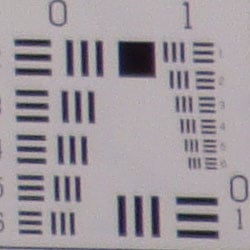

The Sony Cyber-shot DSC-T77 produced soft corners of the frame at full wide-angle, with the strongest blurring in the upper left corner as compared to the center of the frame. The lower right corner was quite sharp, suggesting that the sensor chip on our sample is slightly tilted. (Unfortunately, a common occurrence with digicams.) At full telephoto, blurring was much less in the corners of the frame, with the strongest instance in the lower right corner. Again, the Sony T77 did better than average for a subcompact camera.
Viewfinder
Coverage
Very good accuracy from the LCD monitor.


The Sony Cyber-shot DSC-T77's LCD monitor showed about 103% coverage accuracy at wide angle, and about 99% at telephoto. Great results overall, the inaccuracy seen is really just the effect of barrel and pincushion distortion bending the target lines out of or into the frame.
The images above were taken from our standardized test shots. For a collection of more pictorial photos, see our Sony Cyber-shot DSC-T77 Photo Gallery .
Exposure
Sony Cyber-shot DSC-T77 Exposure
Color
Saturation & Hue Accuracy
Acceptable good color and hue accuracy, but both under- and over-saturation, as well as a few hue shifts. (Reds look hot, greens a little dull, both in the studio and outdoors. Cyan shifts pretty far towards blue.)
 |
| In the diagram above, the squares show the original color, and the circles show the color that the camera captured. More saturated colors are located towards the periphery of the graph. Hue changes as you travel around the center. Thus, hue-accurate, highly saturated colors appear as lines radiating from the center. |
Skin tones. Here, with the color balanced properly for the light source, the Sony T77's skin tones had a slight pink cast and added warmth, though most consumers should find skin tones fairly pleasing. Where oversaturation is most problematic is on Caucasian skin tones, as it's very easy for these "memory colors" to be seen as too bright, too pink, too yellow, etc.
Hue. The Sony T77 showed several small color shifts relative to the correct mathematical translation of colors in its subjects. Most noticeable were cyans, pushed toward blue, and reds toward orange. Hue is "what color" the color is.


Sensor
Exposure and White Balance
Indoors, incandescent lighting
Rather warm color with both the Auto and Incandescent white balance settings. Slightly higher than average positive exposure compensation required.


Color balance indoors under incandescent lighting was rather warm with both the Auto and Incandescent white balance settings. It would probably be acceptable to many users, but we'd like to see a bit less coloration from the lighting in this shot. It was a bit of a toss-up which white balance setting produced the most accurate results; in the end, we felt that the more yellow cast of the Incandescent setting matched the mood of the scene a little better. The DSC-T77 required a +0.7 EV exposure compensation boost to get a good exposure, which is a bit higher than average for this shot. Our test lighting for this shot is a mixture of 60 and 100 watt household incandescent bulbs, a pretty yellow light source, but a very common one in typical home settings here in the U.S.
Outdoors, daylight
High default contrast, but generally good exposure and color.

Outdoors, the Sony Cyber-shot DSC-T77 produced moderately high contrast under harsh lighting, with strong highlights and deep shadows, especially in the FAR shot at right. Overall exposure isn't too bad, and midtones on the face in the outdoor portrait are at least distinguishable. Color balance is pretty good as well, though reds are quite strong in the portrait shot, and the blue sky is more blue than in real life. (Actual sky colors tend more toward cyan than a pure blue.) Though the shadow areas are quite dark, detail is still good in many areas. The Cyber-shot DSC-T77 does feature a Dynamic Range Optimizer, which can help even out the exposure at its Standard setting. However, the Plus setting goes a little too far and boosts the overall exposure just a little too much. (See below for examples, under the "Extremes" section.)
See full set of test images with explanations
See thumbnails of all test and gallery images
Resolution
High resolution, 1,600 lines of strong detail.


Our laboratory resolution chart revealed distinct line patterns down to about 1,600 lines per picture height in both directions. Extinction occurred right at 2,000 lines. Use these numbers to compare with other cameras of similar resolution, or use them to see just what higher resolution can mean in terms of potential detail.
See full set of test images with explanations
See thumbnails of all test and gallery images
Sharpness & Detail
Better than average for a subcompact: Fairly sharp images overall, albeit with some edge enhancement artifacts in some areas, and strong noise suppression in the shadows.


Sharpness. The Sony Cyber-shot DSC-T77 captures a lot of fine detail, though edge enhancement artifacts are visible on high-contrast subjects such as the crop above left. Resolution of fine detail is better than average for a subcompact, but not as good as you'd get in the best mid-sized cameras. Edge enhancement creates the illusion of sharpness by enhancing colors and tones right at the edge of a rapid transition in color or tone.
Detail. The crop above right shows fairly high noise suppression, with the darker areas of hair showing limited detail. Individual strands lose definition as the shadow area increases. Noise-suppression systems in digital cameras tend to flatten-out detail in areas of subtle contrast. The effects can often be seen in shots of human hair, where the individual strands are lost and an almost "watercolor" look appears.
ISO & Noise Performance
Moderate noise at the normal sensitivity settings; strong noise and noticeable noise suppression at the higher settings.
 |
 |
 |
| ISO 80 | ISO 100 | ISO 200 |
 |
 |
 |
ISO 400 | ISO 800 | ISO 1,600 |
 |
ISO 3,200 |
The Sony Cyber-shot DSC-T77 produced moderate noise at its ISO 80 setting. Beginning at ISO 100, the camera's noise suppression system kicks in, slightly blurring detail in its efforts to minimize the appearance of noise grain. The effect only becomes stronger as sensitivity increases. Beginning at ISO 800, noise suppression efforts can no longer contain the noise, graininess becomes visible. The result is a blurry image with increased noise grain and affected color balance. By ISO 3,200, the image is really unusable, even for snapshot prints. See our Output Quality section below to see how ISO affects printed results.
Extremes: Sunlit and low light tests
High resolution with strong overall detail, and extreme lighting situations are helped by DRO, on by default. Limited low-light capabilities, requiring a significant boost in ISO to get bright exposures even under average city street lighting.


Sunlight. The Sony Cyber-shot DSC-T77 produced a pretty well-balanced shot at the default exposure, thanks to the camera's DRO feature, set to "Standard" by default. Some might choose the +0.3 setting for its greater overall contrast, but we're not happy with how much the shirt blows out at that setting. Normally we also say: "In real life, be sure to use fill-flash in situations like the one shown above. It's better to shoot in the shade when possible." But the Sony T77's DRO handles this scene so well, we don't think it applies. Kudos to Sony for the T77's excellent handling of this very difficult shot.


Dynamic Range Optimizer. The Cyber-shot DSC-T77 features an adjustable Dynamic Range Optimizer option, with Standard and Plus settings. With the Standard mode, the overall exposure does appear a little more even, with toned down contrast. However, at the Plus setting, the overall exposure is boosted noticeably. (The Sony T77's DRO option seems to just boost brightness by a variable amount, ranging from a lot in shadow areas, to a little in the highlights. The best way to use it for subjects like this one (with lots of highlight detail) is to dial down the overall exposure slightly to preserve more highlight detail then shoot with DRO Plus, to bring up the shadow detail.)
Because digital cameras are more like slide film than negative film (in that they tend to have a more limited tonal range), we test them in the harshest situations to see how they handle scenes with bright highlights and dark shadows, as well as what kind of sensitivity they have in low light. The shot above is designed to mimic the very harsh, contrasty effect of direct noonday sunlight, a very tough challenge for most digital cameras. (You can read details of this test here.)
| 1 fc 11 lux |
1/2 fc 5.5 lux |
1/4 fc 2.7 lux |
1/8 fc 1.3 lux |
1/16 fc 0.67 lux |
|
|---|---|---|---|---|---|
| ISO 80 |
 1 sec f3.5 |
 1 sec f3.5 |
 1 sec f3.5 |
 1 sec f3.5 |
 1 sec f3.5 |
| ISO 100 |
 1 sec f3.5 |
 1 sec f3.5 |
 1 sec f3.5 |
 1 sec f3.5 |
 1 sec f3.5 |
| ISO 200 |
 1 sec f3.5 |
 1 sec f3.5 |
 1 sec f3.5 |
 1 sec f3.5 |
 1 sec f3.5 |
| ISO 400 |
 0.5 sec f3.5 |
 1 sec f3.5 |
 1 sec f3.5 |
 1 sec f3.5 |
 1 sec f3.5 |
| ISO 800 |
 1/4 sec f3.5 |
 0.5 sec f3.5 |
 1 sec f3.5 |
 1 sec f3.5 |
 1 sec f3.5 |
| ISO 1600 |
 1/6 sec f3.5 |
 1/4 sec f3.5 |
 0.6 sec f3.5 |
 1 sec f3.5 |
 1 sec f3.5 |
| ISO 3200 |
 1/15 sec f3.5 |
 1/6 sec f3.5 |
 0.3 sec f3.5 |
 0.8 sec f3.5 |
 1 sec f3.5 |
Low light. The Sony Cyber-shot DSC-T77 had some trouble in low lighting, thanks to its maximum one second shutter time. At the lower ISO settings, images were quite dark even at the brightest test light level, up until about ISO 400. To get brighter images at any of the darker light levels, the camera required almost the highest boost of sensitivity, at 1,600. Thus, you'll need the flash for any night shots with the DSC-T77. The camera's autofocus system was only able focus down to just above the 1/8 foot-candle light level unassisted, but focused in total darkness with the AF assist enabled.
How bright is this? The one foot-candle light level that this test begins at roughly corresponds to the brightness of typical city street-lighting at night. Cameras performing well at that level should be able to snap good-looking photos of street-lit scenes.
NOTE: This low light test is conducted with a stationary subject, and the camera mounted on a sturdy tripod. Most digital cameras will fail miserably when faced with a moving subject in dim lighting. (For example, a child's ballet recital or a holiday pageant in a gymnasium.) For such applications, you may have better luck with a digital SLR camera, but even there, you'll likely need to set the focus manually. For information and reviews on digital SLRs, refer to our SLR review index page.
Flash
Coverage and Range
Limited flash range, with a tendency to underexpose. Our standard shots required a high intensity boost, and even then produced dark exposures.


Coverage and Exposure. Flash coverage was dim and a bit uneven at wide angle, but such results are pretty average. At full telephoto, the flash couldn't match the camera's 4x optical zoom. In the Indoor test, the Sony DSC-T77's flash underexposed our subject at its default setting quite a bit, and even with the High Intensity boost, produced a dim image. The camera's Slow-Sync flash mode performed much better, producing a bright image at its default intensity level. Color balance is warm from the background lighting, with a strong yellow cast, but results are usable.
| Flash Range: Wide Angle | |||||
|---|---|---|---|---|---|
| 6 ft | 7 ft | 8 ft | 9 ft | 10 ft | 11 ft |
 1/40 sec f3.5 ISO 100 |
 1/40 sec f3.5 ISO 100 |
 1/40 sec f3.5 ISO 100 |
 1/40 sec f3.5 ISO 100 |
 1/40 sec f3.5 ISO 100 |
 1/40 sec f3.5 ISO 100 |
| 12 ft | 13 ft | 14 ft | 15 ft | 16 ft | |
 1/40 sec f3.5 ISO 100 |
 1/40 sec f3.5 ISO 100 |
 1/40 sec f3.5 ISO 100 |
 1/40 sec f3.5 ISO 100 |
 1/40 sec f3.5 ISO 100 |
|
| Flash Range: Telephoto | |||||
|---|---|---|---|---|---|
| 6 ft | 7 ft | 8 ft | 9 ft | 10 ft | 11 ft |
 1/40 sec f4.6 ISO 100 |
 1/40 sec f4.6 ISO 100 |
 1/40 sec f4.6 ISO 100 |
 1/40 sec f4.6 ISO 100 |
 1/40 sec f4.6 ISO 100 |
 1/40 sec f4.6 ISO 100 |
| 12 ft | 13 ft | 14 ft | 15 ft | 16 ft | |
 1/40 sec f4.6 ISO 100 |
 1/40 sec f4.6 ISO 100 |
 1/40 sec f4.6 ISO 100 |
 1/40 sec f4.6 ISO 100 |
 1/40 sec f4.6 ISO 100 |
|
ISO 100 Range. At both wide angle and telephoto at ISO 100, flash shots were already dim at 6 feet, with decreasing intensity from that point on.
| Manufacturer-Specified Flash Range | |
|---|---|
| Wide Angle | Telephoto |
 9.8 feet Auto ISO 800 |
 7.9 feet Auto ISO 640 |
Manufacturer Specified Flash Test. In the shots above, the Cyber-shot DSC-T77 performs almost as Sony says it will, though it had to boost the ISO to 800 at wide angle and to 640 at telephoto. Such high ISOs will definitely degrade image quality on flash shots at anything other than very close distances. Our standard test method for flash range uses a fixed setting of ISO 100, to provide a fair basis of comparison between cameras. We've now also begun shooting two shots using the manufacturer-specified camera settings, at the range the company claims for the camera, to assess the validity of the specific claims.
Output Quality
Print Quality
Good print quality, good color, sharp 13x19 inch prints, very usable to 16x20 inches for wall display. ISO 800 images are soft but usable at 8x10, ISO 1,600 shots are usable to 5x7. Color suffers somewhat at higher ISOs.
 The Sony DSC-T77 did fairly well in our output quality tests, its images proving quite usable for wall display as large as 16x20 inches, and 13x19-inch prints were decently sharp. As always, quality degrades at higher ISO settings, but the T77 delivered images that could make soft but very usable 8x10 inch prints. Above ISO 800, image quality drops quickly, with ISO 1,600 shots usable only to 5x7 inches, and ISO 3,200 ones rough even at 4x6 inches. As the ISO is increased, the Sony T77's images become noticeably less saturated looking. At ISO 800, colors are less saturated than at lower ISOs, but still look pretty natural. At ISO 1,600 and 3,200, the color is noticeably flatter and more muted.
Color-wise, the Sony T77's printed output looked good, with most colors bright but believable looking. The exception was strong reds, which looked a little hot, but this seems to be a common tendency with digicams these days. Hue seemed pretty accurate, though we did notice the cyan-toward-blue color shift we noted earlier in some of our test images.
Testing hundreds of digital cameras, we've found that you can only tell just so much about a camera's image quality by viewing its images on-screen. Ultimately, there's no substitute for printing a lot of images and examining them closely. For this reason, we now routinely print sample images from the cameras we test on our Canon Pro9000 studio printer, and on the Canon iP5200 here in the office. (See the Canon PIXMA Pro9000 review for details on that model.)
The images above were taken from our standardized test shots. For a collection of more pictorial photos, see our Sony Cyber-shot DSC-T77 Photo Gallery .
Not sure which camera to buy? Let your eyes be the ultimate judge! Visit our Comparometer(tm) to compare images from the Sony Cyber-shot DSC-T77 with those from other cameras you may be considering. The proof is in the pictures, so let your own eyes decide which you like best!
Performance
Sony Cyber-shot DSC-T77 Performance
Timing and Performance
Slightly slow to about average speed for a consumer digital camera.
| Startup/Shutdown |
||
| Power on |
2.3 seconds | Time it takes for LCD to turn on and capture the first picture. (No lens to deploy in the T77.) |
| Shutdown |
1.8 seconds | No lens to retract, this is the time until it's OK to remove the memory card. |
| Buffer clearing time |
2 seconds (2 seconds buffer clearing in single-shot LF JPEG) |
Worst case buffer clearing time. -- This is the delay after a set of shots before you can remove the card. Some cameras won't retract their lenses and shut down until the buffer is cleared. |
|
*Note: Buffer clearing times measured with a SanDisk Extreme III 2 GB Pro Duo memory card. Slower cards will produce correspondingly slower clearing times. Slow cards may also limit length of bursts in continuous mode. ISO sensitivity also affects cycle times and burst mode performance, with higher ISOs generally increasing cycle times and reducing burst performance. |
||
About average times here.
| Mode Switching | ||
|---|---|---|
| Play to Record, |
1.7 seconds | Time until first shot is captured. |
| Record to play |
1.3 seconds | Time to display a large/superfine file immediately after capture. |
| Display |
1.7 seconds | Time to display a large/superfine file already on the memory card. |
Mode switching times are a little sluggish, there's a noticeable delay when you switch to playback mode to see your images, and the 1.7 seconds it takes to capture an image after being in playback mode is longer than average too.
| Shutter Response (Lag Time) | ||
|---|---|---|
| Full Autofocus Wide |
0.35 second | Time from fully pressing shutter button to image capture, zoom lens at wide angle position. |
| Full Autofocus Tele |
0.43 second | Time from fully pressing shutter button to image capture, zoom lens at telephoto position. |
| Prefocused |
0.008 second | Time to capture, after half-pressing and holding shutter button. |
| Continuous AF |
0.34 second |
This mode usually shows no speed
increase with our static subject; we have no way to measure performance
with moving subjects. |
| Manual Focus |
0.34 second |
For most cameras, shutter lag
is less in manual focus than autofocus, but usually not as fast as
when the camera is "prefocused." |
| Full Autofocus
FLASH |
0.66 second |
Time to capture
while forcing flash to fire. |
Shutter response is excellent at both wide angle and telephoto, at 0.35s and 0.43s respectively, and "prefocusing" the camera by half-pressing and holding down the shutter button before the final exposure results in a lag time of only 0.008 second. Manual focus is a little slower than you'd expect, however, and enabling the flash also slows things down. (The camera fires a pre-flash for metering before the main exposure, which takes a little time.) Even the slower shutter response with flash enabled is better than some cameras manage without the flash, though.
| Cycle Time (shot to shot) | ||
|---|---|---|
| Single Shot mode Large Fine JPEG |
1.80 seconds | Time per shot, averaged over 20 shots. |
| Single Shot mode |
2.00 seconds | Time per shot, averaged over 20 shots. |
| Early shutter |
No | Some cameras don't snap another shot if you release and press the shutter too quickly in Single Shot mode, making "No" the preferred answer. |
| Continuous mode |
0.62 second (1.62 frames per second); 20+ frames total; 1 second to clear* |
Time per shot, averaged over 20 shots. (The camera seemed able to continue shooting more or less indefinitely, with a fast enough memory card.) |
| Continuous mode |
0.62 second (1.62 frames per second); 20+ frames total; 1 second to clear* |
Time per shot, averaged over 20 shots. (The camera seemed able to continue shooting more or less indefinitely, with a fast enough memory card.) |
| Flash recycling |
5 seconds | Flash at maximum output. |
| *Note: Buffer clearing times measured with a SanDisk Extreme III 2 GB Pro Duo memory card. Slower cards will produce correspondingly slower clearing times. Slow cards may also limit length of bursts in continuous mode. ISO sensitivity also affects cycle times and burst mode performance, with higher ISOs generally increasing cycle times and reducing burst performance. |
||
Shot-to-shot cycle times are a little slower than average, at about 1.80 seconds for large/fine JPEGs, and markedly slow for 640 x 480 JPEGs at 2.00 seconds. Still, not bad for a subcompact camera. The Sony Cyber-shot DSC-T77's Continuous modes perform about average, capturing about 1.62 frames per second regardless of the resolution. The flash takes about 5 seconds to recharge after a full-power shot, which is better than average, but then you'd hope so, given the very limited range the flash has.
| Download Speed | ||
|---|---|---|
| Windows Computer, USB 2.0 |
10,795 KBytes/sec | Typical Values: |
Connected to a computer or printer with USB 2.0, download speeds are very good.
Bottom line, the Sony Cyber-shot DSC-T77 drags its feet a little in some areas, such as mode switching and cycle times, but its shutter lag is really excellent. This camera should handle average shooting scenarios adequately, but wouldn't be a good match for fast-paced action, where you need to grab a number of shots very quickly. That said, its excellent shutter response would be a real help in capturing images of squirmy kids or catching a fleeting expression in candid photography.
Battery and Storage Capacity
Battery
Slightly below average battery life.
| Operating Mode | Number of Shots |
|---|---|
|
Lithium-ion Rechargeable Battery,
(CIPA standard) |
220
|
The Sony Cyber-shot DSC-T77 uses a custom rechargeable lithium-ion battery for power, and ships with a charger. Battery life is a little shorter than average, though that's to be expected on a camera this slim. We recommend you pick up a spare battery and keep it freshly charged and on-hand for extended outings.
(Interested readers can find an English translation of the CIPA DC-002 standards document here. (180K PDF document))
Storage
The Sony Cyber-shot DSC-T77 accepts Memory Stick PRO Duo memory cards, and includes about 15MB of internal memory.
| Image Capacity with 1GB Memory Card |
Fine | |
|---|---|---|
| 3,648
x 2,736 |
Images |
253 |
| File Size |
4.0 MB |
|
| 2,592
x 1,944 |
Images |
402 |
| File Size |
2.5 MB |
|
| 2,048
x 1,536 |
Images |
645 |
| File Size |
1.6 MB |
|
| 640
x 480 |
Images |
5,996 |
| File Size |
171 KB |
|
We strongly recommend buying a large capacity Memory Stick PRO Duo at least a 1GB card, preferably a 2 or 4GB one, to give yourself extra space for extended outings and video. (Check the shopping link above, cards are really cheap these days, so no reason to skimp.)