


Overview

---
Special update: The Canon 5DS R was named Best Professional Camera in our 2015 Camera of the Year awards!
---
When a simple 50-megapixel full-frame sensor just won't cut it, Canon introduced a sibling to the 5DS, called the Canon 5DS R, that uses a special canceled-out optical low-pass filter in order to capture even more sharpness and detail from the massive 50-megapixel sensor. Similar to the design idea of the Nikon D800E, the 5DS R sensor's OLPF is effectively cancelled out by using two modified low-pass filters where the second counteracts the effect of the first.
However, with great resolution, comes great responsibility, one could say. Traditionally, the optical low-pass filter serves a very useful purpose; that is, helping prevent the appearance of unsightly and potentially image-ruining artifacts in the form of moiré, "jaggies" and other aliasing artifacts. Often seen in tightly-spaced, repeating patterns such as fabrics, brickwork and meshes, an OLPF introduces a very subtle blurring effect to help avoid these artifacts, though at the expense of some image sharpness.
For some photographers, especially those who don't photograph subjects with moiré-inducing patterns, the ability to capture the most detail and sharpness possible outweighs the risk of aliasing and moiré effects. For example, landscape photographers concerned with getting the sharpest images possible before post-processing, would be interested in the 5DS R as nature and landscapes don't typically include moiré-inducing patterns. On the other hand, a fashion photographer, who still needs large image files for magazines, might opt for the 5DS as certain fabrics could generate moiré patterns.
Why not just use a sensor without a low-pass filter to begin with? Well, with a normal sensor and its usual set of filters (i.e. IR/UV cut filter and low-pass filter) in front, there is a certain thickness to the sensor assembly. The camera chassis is therefore designed to incorporate this precise thickness to ensure the light coming through the lens hits the sensor at the proper distance. Had Canon chose to use a sensor simply without an OLPF, the sensor assembly would be slightly thinner and would necessitate a different internal construction or the use of shims. With the dual-OLPF cancellation method, Canon was able to keep the thickness of the sensor assembly identical and therefore use the exact same body construction for both models -- and subsequently avoid higher costs of designing and manufacturing two different assemblies. Also, modern lenses are designed with filter stacks in mind, yet another reason to go with the cancelling OLPF scheme to keep the optical path identical.

Apart from the low-pass filter cancellation feature, the Canon 5DS R is identical in design and specs to the 5DS. The massive 50.6-megapixel, Canon-designed, full-frame sensor makes the 5DS and 5DS R the highest resolution full-frame DSLRs in the world. Combined with dual DIGIC 6 processors like the 7D Mark II, this latest full-frame camera offers a substantial increase in sheer resolution over both the 5D Mark III and the previous 1Ds Mark III cameras. Targeting advanced amateurs and professionals that demand high image quality with a critical eye for out-of-camera sharpness, the 5DS R is also going after a chunk of the medium format market. Not only is the 5DS R smaller and lighter than most digital medium format cameras, but also the vast selection of lenses for the Canon EF mount provides immense creative options.
Using a nearly identical body design as the 5D Mark III -- save for the model badging -- the big story lies under-the-hood with both hardware and firmware changes compared to the 5D Mark III. It should be pointed out, however, that the 5DS and 5DS R do not replace the 5D Mark III. Each camera serves very different types of photographers with different use-cases and includes their share of advantages and disadvantages depending on the style of photography.
The 5DS R sensor has a pixel pitch of 4.14 microns, whereas the 5D Mark III's sensor has a pixel pitch of 6.25 microns giving the Mark III an advantage in terms of per-pixel noise. Given the massive 50-megapixel resolution is spread over the area of a 35mm full-frame CMOS chip, the pixel pitch of the sensor in the 5DS R is actually comparable to that of the 20-megapixel APS-C 7D Mark II. This should give the 5DS R a level of noise performance similar to that of the 7D Mark II. Interestingly, Canon is aware of this potential limitation, and as such, has limited the high ISO of the 5DS R to 6400 (with an expandable high to 12,800 and low of 50).

The relatively limited ISO sensitivity range is indicative of the intended use-case of this type of camera, compared to a more general-purpose camera such as the 5D Mark III, which has a much wider ISO range. The Canon 5DS R is designed for maximum performance in high-resolution still images, particularly at lower ISOs. Landscape and architectural photography, where one would often use a tripod, are two primary use-cases for the 5DS R. That being said, Canon states that the noise performance is still superior to that from the 5D Mark II, while the dynamic range performance is on par with the 5D Mark III.
The new Canon 5DS R borrow heavily from the 7D Mark II in terms of under-the-hood technological improvements. In addition to the dual DIGIC 6 image processor configuration, the Canon 5DS R utilizes the newer 150,000-pixel RGB + IR metering sensor introduced on the 7D Mark II. This is a notable improvement from the iFCL 63-zone dual-layer metering sensor used on the 5D Mark III (and the 1D X's 100,000-pixel RGB sensor). The new system on the 5DS R recognizes 252-zones, whereas the earlier 5D3 used a 63-zone system.
The Canon 5DS R also shares the enhanced iTR AF (aka "Intelligent Tracking & Recognition AF") from the 7D Mark II. Unlike the 7D Mark II, however, the 5DS uses the same 61-point AF point array as the 5D Mark III and 1D X, yet this is combined with the more robust metering system introduced with the 7D2, which allows for the enhanced iTR AF capabilities. The 5DS R uses the 150K-pixel metering system to combine face detection and color information with the phase-detect AF sensor to help track subject movement.


Given the massive 50-megapixel image files, it's no surprise that continuous burst performance is a bit lower than the more manageable 22.3MP 5D Mark III, for example. The 5DS R can shoot up to five frames-per-second according to Canon (we got between 4.8 and 4.9fps in the lab), whereas the 5D Mark III clocks-in at 6fps. Buffer depth is good at 28 frames when shooting best quality JPEGs, but drops to 15 frames for RAW, and 11 for RAW+JPEG. See our Performance page for details.
The 5DS R also introduces a host of new tweaks and improvements over the 5D Mark III, including the creation of timelapse movies in-camera, which itself is a first for the Canon EOS line. Within the menus, you can setup how many frames to capture and the interval between frame capture and the 5DS will produce a movie file right in the camera after all shots are recorded. According to Canon, the timelapse feature ranges from one second and up to a maximum of 99 hours, 59 minutes, 59 seconds. The playback rate of the resulting timelapse video depends on the video mode set in the menu. In NTSC mode, the playback rate is 29.97fps (30p), while in PAL mode, the playback rate is 25fps.
Also, in what we believe is another EOS camera first, Canon has added crop shooting modes for both 1.3x and 1.6x crop factors. It's an interesting addition to a camera that has not been specifically designed for wildlife or sports photography, in which a longer "reach" with the narrower field of view or smaller, quicker-to-write file sizes are potentially advantageous. Nevertheless, for a camera with such a massive resolution, it'll be pumping out huge file sizes -- especially when shooting RAW -- so, for situations were full resolution files are not needed, the option to crop down a bit for smaller files can be very useful. With the 1.3x crop mode -- effectively the FOV of the Canon's unique APS-H sensor size -- the images will be about 30.5-megapixels and the 1.6x crop for an APS-C FOV will be about 19.6-megapixels. As with other Canon EOS cameras, there are also variable quality/resolution sizes for JPEG files as well as M-RAW (28MP) and S-RAW (12.4MP) options.

The Canon 5DS R also adds a USB 3.0 port, a notable improvement to the USB 2.0 port on the 5D3. For studio and other tethered shooting situations, the significantly faster transfer rate that USB 3.0 offers will undoubtedly help speed up workflow with the 5DS R's massive 50MP files. Other connectivity options include an N3-type wired-remote terminal, a flash PC-sync socket, a 3.5mm external stereo microphone jack and a mini (Type-C) HDMI port. The camera is also compatible with Canon's infrared RC-1, RC-5 and RC-6 remote controllers. There's no built-in Wi-Fi, but the 5DS R does support Eye-Fi cards, as well as Canon's WFT-E7 (Ver.2) Wireless File Transmitter and GP-E2 GPS Receiver.
The viewfinder itself also get a slight upgrade. While the focusing display with the 61-point AF system remains the same as the 5D Mark III, the 5DS R gains AF point illumination during AI Servo AF like the 1D X and the text display now matches that from the new 7D Mark II. Also with the new crop modes, framing guides will be displayed in the viewfinder to help with composition and framing.
For landscape photography, long exposures and other types of shots where detail is critical and the reduction of any sort of vibration is crucial, mirror lockup has been a key feature for photographers. The Canon 5DS R, not surprisingly, includes the standard two-press method, in which you press the shutter button once to lock up the mirror and then a second time to capture the photo. However, there could still be some residual vibration in the camera or tripod from the shutter movement and from the photographer physically touching the camera, and so Canon has included a shutter delay feature. You can now set a timed delay between when you press the shutter button to lock up the mirror and when the camera takes the photo. You only have to press the shutter button once and you can allow the vibrations to die down before the photo is captured.

Vibrations are further controlled with a newly designed mirror mechanism. In the 5D Mark III, the mirror mechanism was spring-driven, and as such, it could induce a lot of vibration at the top of its travel. With the 5DS R, however, the mechanism is motor-driven, which allows the speed to be controlled, and the mirror's speed is actually slowed down just before it hits the top of its travel. The chassis of the camera and the tripod socket have also been carefully tweaked for improved stability.
On the firmware side, the Canon 5DS R brings over the flicker detection from the 7D Mark II to help time shots properly to counteract the fluctuating brightness of certain types of artificial lighting. Canon has also improved Auto White Balance performance. Previously, the sensor was limited to color temperatures ranging from around 3000 Kelvin to 7000 Kelvin, and so extreme color temperatures were still captured incorrectly. With the 5DS R, the ability to select ambience priority or white priority, the latter of which will give a much more neutral white balance at extreme color temps.
Fans of the "Q" Button for Canon's Quick Control interface now gain the ability to customize the layout and what settings and other information is displayed.

Canon has also introduced a new Picture Style adjustment option called Fine Detail, which expands the customizability of image sharpness, for both still and video. Essentially functioning similar to Photoshop's Unsharp Mask, you can now tweak and control the strength, fineness and threshold, rather than just having simple 0-7 increments as on Canon's other DSLRs. It works so well that the majority of our lab images were shot with it.
Speaking of video, this is an area with differs radically between the 5DS R, the 5DS, and the 5D Mark III. The short of it is: if you're serious about video or a multimedia producer who needs expanded video options, the 5DS/S R are not the cameras for you. The Canon 5DS R is focused primarily as a still photography tool. And while it does have the ability to record video, the options for movie recording, such as resolution and frame rate, focus and audio recording are very limited compared to Canon's other current line of HD-DSLRs. For example, video resolution is maxed out at 1080/30p, despite the dual DIGIC 6 processors that allow for 1080/60p in cameras like the 7D Mark II. Furthermore, the 50-megapixel sensor is not a Dual Pixel AF sensor, so Movie Servo AF will not be as fast and smooth as on the 7D Mark II and 70D. There is also no headphone jack, but at least there's an external microphone input.

Like the 5D Mark III, the 5DS R includes dual card slots -- one CompactFlash (UDMA 7) and one Secure Digital -- however, unlike the Mark III, the SD slot in the 5DS R is UHS-I compliant. Also, given the same body design as the 5D Mark III, all the standard Canon accessories, such as batteries and vertical grip, are compatible with the 5DS R. And as with the 5D Mark III, the estimated shutter durability is rated at 150,000 cycles.
The Canon 5DS R's battery life is CIPA-rated to 700 shots per charge using the optical viewfinder, and 220 shots when using Live View, and battery life can be doubled with two LP-E6 batteries installed in an optional BG-E11 battery grip. The 5DS R is also compatible with Canon's ACK-E6 AC Adapter kit.
Available since June 2015, the Canon 5DS R is priced as a body-only configuration at an MSRP of US$3,899, which is a $200 premium over the AA-filtered 5DS.
In the Box
The retail package contains the following items:
- Canon EOS 5DS R camera body
- EG Eyecup
- Body cap
- LP-E6N lithium-ion battery pack
- LC-E6 battery charger
- IFC-150U II Interface Cable
- Cable protector
- EW-EOS5DSR Wide Neckstrap
- EOS Digital Solutions Disk
- Manuals and warranty info
Recommended Accessories
- Large capacity, high-speed CompactFlash or SDHC/SDXC memory cards
- Extra LP-E6N battery pack
- Lenses
- Flash
- Large camera bag
Optics
The Canon 5DS R is usually sold body-only, so we have no "kit" lens optical test results to share here.
Below are our Canon 5DS R viewfinder accuracy test results.
Viewfinder Test Results
Accuracy
Excellent accuracy from the optical viewfinder and from the LCD in Live View mode.


We measured the Canon 5DS R's optical viewfinder's coverage at just over 99% which is very close to Canon's 100% coverage specification, especially when taking test tolerances into account. The resulting image was however slightly shifted vertically with respect to the sensor, which is unfortunately quite common with optical SLR viewfinders. Live View mode using the LCD monitor in record mode resulted in essentially 100% coverage.
The images above were taken from our standardized test shots. For a collection of more pictorial photos, see our Canon EOS 5DS R Photo Gallery .
Exposure
Color
Saturation & Hue Accuracy
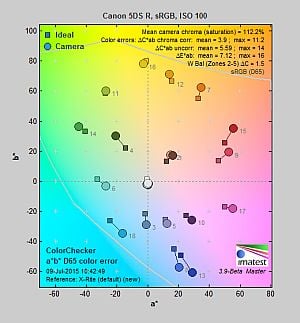
Fairly typical saturation levels with excellent hue accuracy.
 |
||
|
ISO Sensitivity
|
||
| In the diagram above, the squares show the original color, and the circles show the color that the camera captured. More saturated colors are located toward the periphery of the graph. Hue changes as you travel around the center. Thus, hue-accurate, highly saturated colors appear as lines radiating from the center. Mouse over the links above to compare ISOs, and click to load a larger version. | ||


Saturation. The Canon 5DS R produces images with fairly typical saturation levels. Reds, oranges, dark greens and dark blues are pushed a little, while aqua and yellow are slightly muted. The mean saturation of 112.2% (12.2% oversaturated) at base ISO of 100 is close to average, but it gradually increases with ISO (most cameras decrease saturation with ISO), peaking at 114.4% at ISO 12,800, though that's a relatively small boost. Overall colors are pleasing and vibrant, without being too overdone. Most consumer digital cameras produce color that's more highly saturated (more intense) than found in the original subjects. This is simply because most people like their color a bit brighter than life.
Skin tones. The Canon 5DS R produces nice, natural-looking Caucasian skin tones in our tests when using Manual white balance, though with a bit of an orange push. When using Auto white balance, skin tones were a little too cool. Where oversaturation is most problematic is on Caucasian skin tones, as it's very easy for these "memory colors" to be seen as too bright, too pink, too yellow, etc.
Hue. As we've come to expect from Canon, the 5DS R's hue accuracy is excellent when manual white balance is used (as it is for these results), and much better than average. There are the usual shifts in cyan toward blue (though actually quite small), red toward orange, orange toward yellow, and yellow toward green, but all are fairly minor. Average "delta-C" color error at base ISO is only 3.9 which is excellent (smaller numbers are better). Delta-C color error increases with ISO, but remains better than average even at the highest ISOs. Hue is "what color" the
color is.


Sensor
Exposure and White Balance
Indoors, incandescent lighting
Auto and Incandescent settings both struggled with household incandescent lighting, though Manual white balance worked well. Higher than average exposure compensation required.


Indoors, under incandescent lighting, the Canon 5DS R's Auto and Incandescent white balance settings struggled, producing very warm orange/yellow color casts. Unfortunately, this is not uncommon among cameras we've tested, but disappointing nonetheless especially for a pro model. The Canon 5DS R does however have a White Priority option for Auto white balance that should result in more neutral color balance, however we did not test that mode in the lab. The Manual setting produced the most accurate results, though just slightly cool with a small nudge towards green. The Canon 5DS R required +1.0 EV exposure compensation for this shot, which is higher than the +0.3 EV average among the cameras we've tested, though that could be because we use a third-party lens (Sigma 70mm f/2.8 Macro) for these shots. (Our test lighting for this shot is a mixture of 60 and 100 watt household incandescent bulbs, a pretty yellow light source, but a very common one in typical home settings here in the U.S.)
Outdoors, daylight
Good color, though a tendency towards slightly cool color balance with somewhat high contrast under harsh lighting. Average exposure accuracy.
Outdoors, the Canon 5DS R tended toward a slightly cool color balance with Auto white balance, though overall color is generally very good. We preferred Manual white balance for our "Sunlit" portrait shot above left, and the Canon 5DS R required +0.7 EV exposure compensation to keep the mannequin's face bright, which is about average. The Canon 5DS R's default contrast is a little high, producing some washed-out highlights and dark shadows under the deliberately harsh lighting of the shot above left, though the camera's Auto Lighting Optimizer and Highlight Tone Priority settings help with high contrast scenes like these. See below for examples of this. The Far-field shot (above right) is also a bit cool, and exposure quite conservative, with the camera underexposing to avoid blowing highlights which resulted in some very dark shadows. Shadow detail is very good, though deep shadows are a bit noisy for a full-frame camera.
See full set of test images with explanations
See thumbnails of all test and gallery images
Resolution
Over 4,000 lines of resolution.


Our laboratory resolution chart shows the Canon 5DS R's JPEG images contain sharp, distinct line patterns past the limits of our chart both horizontally and vertically, though some aliasing in the form of luminance moiré can be seen starting at about 3,300 to 3,400 lines per pixel height. Still, the aliasing is fairly minor and all lines in the pattern can be clearly distinguished at the 4,000 line limit of our chart. An Adobe Camera Raw converted .CR2 file shows similar resolution, but with a lot more false colors than the camera produced. Use these numbers to compare with other cameras of similar resolution, or use them to see just what higher resolution can mean in terms of potential detail.
See full set of test images with explanations
See thumbnails of all test and gallery images
Sharpness & Detail
Excellent sharpness and detail with a sharp lens. Minor detail loss due to noise reduction processing even at low ISOs.


Sharpness. The Canon 5DS R's 50.6-megapixel sensor captures excellent detail when coupled with a good lens, though as is usually the case with Canons, the 5DS R's default sharpening settings generate obvious sharpening halos around high-contrast edges. But the 5DS R allows much more control over sharpening than previous EOS models, so we've shot most of our lab shots with the new Fine Detail Picture Style preset, which, as you can see above left, produces excellent sharpness with much fewer sharpening artifacts than the default Standard Picture Style. See below for a comparison between the two presets. Edge enhancement creates the illusion of sharpness by enhancing colors and tones right at the edge of a rapid transition in color or tone.
Detail. The crop above right shows some minor detail loss due to noise suppression in darker areas and in areas with low contrast, perhaps just a little more than we're accustomed to seeing from a full-frame DSLR at base ISO. Still, a very good performance for a 50.6-megapixel model, with very low chroma noise. Noise-suppression systems in digital cameras tend to flatten-out detail in areas of subtle contrast. The effects can often be seen in shots of human hair, where the individual strands are lost and an almost "watercolor" look appears.


Aliasing Artifacts. As mentioned previously the Canon 5DS R captures incredibly sharp, detailed images thanks to its very high resolution and lack of an optical low pass filter, but that means it's also more susceptible to moiré, "jaggies" and other aliasing artifacts than cameras with an appropriate OLPF when used with a sharp lens.
As you can see in our Still Life shots above, far more obvious moiré patterns can be seen in the Samuel Smith bottle label taken with the 5DS R (left) than with the 5DS (right), and you can see more moiré in some other shots as well, such as in the window shades of our Far Field shots. Is the extra sharpness offered by the 5DS R worth the risk of increased aliasing? Only you can decide, as that depends a lot on the subject matter you typically shoot. Most natural subjects won't produce many aliasing artifacts due to their more random or irregular shapes. If on the other hand you shoot a lot of man-made subjects like buildings and clothing, you'll likely appreciate the 5DS' better resistance to aliasing.
With the increasing trend of using either a very weak or no optical low pass filter, quite a few cameras produce similar artifacts these days, though. Techniques than can be used to reduce aliasing include shooting at a smaller aperture so that lens diffraction acts as an anti-alias filter, defocusing slightly, shooting at higher ISOs, and post-processing particularly with RAW files.
In-Camera JPEGs: Standard vs Fine Detail Picture Style setting
As mentioned, the Canon 5DS R and 5DS offer a new Picture Style preset called Fine Detail. Below is a comparison with the Standard, default Picture Style.
|
Base ISO (100)
|
|
 |
 |
 |
 |
 |
 |
|
Camera JPEG, defaults
|
Camera JPEG, Fine Detail
|
In the table above, we compare the Canon 5DS R's default Standard Picture Style setting to its new Fine Detail preset at base ISO. The 5DS R offers users much more flexibility in sharpening than prior EOS models, allowing you to adjust not only the "Strength" (from 0 to 7) but also the "Fineness" (1 to 5) and "Threshold" (1 to 5) operators. We believe these parameters correlate to unsharp mask options for strength, radius and threshold available in photo editing software such as Photoshop, although we don't know what the equivalent units might be.
The Fine Detail Picture Style preset boosts the Sharpness Strength operator one notch (to 4 out of 7) while dialing down the Fineness (1/5) and Threshold (1/5) operators to their minimum compared to Standard which defaults to Sharpness 3/7, Fineness 4/5 and Threshold 4/5. The result is significantly improved rendering of fine detail along with less obvious sharpening halos than the default Standard setting, however noise is more visible as well. There also appear to be minor differences in color and contrast, even though those settings are identical between these two Picture Styles presets.
RAW vs In-Camera JPEGs
As noted above the Canon 5DS R produces sharp JPEG images with phenomenal detail, especially when using the Fine Detail Picture Style preset. Let's see how an Adobe Camera Raw conversion compares:
|
Base ISO (100)
|
|
|
 |
|
 |
|
 |
|
Camera JPEG, Fine Detail Picture Style
|
RAW via Adobe Camera Raw
|
In the table above, we compare a best quality in-camera JPEG taken at base ISO using default noise reduction and the Fine Detail Picture Style preset (on the left) to the matching CR2 file converted with Adobe Camera Raw 9.1 using default noise reduction with some moderate but tight unsharp masking applied in Photoshop (200%, radius of 0.3 pixels, and a threshold of 0).
Looking closely at the images, we can see the camera's Fine Detail Picture Style comes pretty close to matching the amount of detail offered by Adobe Camera Raw using its default noise reduction, though the Adobe Camera Raw conversion does still manage to eke out slightly better detail, likely due to more sophisticated demosaicing and higher default contrast. The conversion does however show higher noise in the shadows and flat areas, so overall the camera does a more balanced job. All in all, really excellent results, so much so that we're not sure why Canon doesn't make Fine Detail Picture Style the default, other than to remain consistent with other EOS models.
ISO & Noise Performance
Excellent noise versus detail tradeoff up to ISO 1600.
|
Default High ISO Noise Reduction
|
||
 |
 |
 |
| ISO 50 | ISO 100 | ISO 200 |
 |
 |
 |
ISO 400 | ISO 800 | ISO 1600 |
 |
 |
 |
ISO 3200 | ISO 6400 | ISO 12,800 |
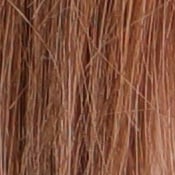
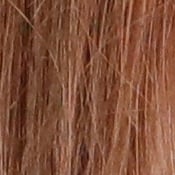
Images are quite clean at ISOs 50 through 200, with just a tiny amount of luminance noise seen in the shadows, and very little chroma noise. Some blurring of fine low-contrast detail is already visible at base ISO, though, as mentioned previously. Noise "grain" is slightly more evident at ISO 400 in the shadows, but detail remains very strong despite some minor blurring due to noise reduction. ISO 800 and 1600 are of course a little noisier, but fine detail is still very good with a noise grain that's quite fine and chroma noise well under control. At ISO 3200 the image becomes noticeably grainier resulting in a more evident drop in image quality, though fine detail is still very good and chroma noise remains well-controlled. ISO 6400 is quite grainy with minor chroma noise, but there is still quite a bit of fine detail left because the noise grain is still quite tight and film-like. Noise and the effects of noise reduction working hard to keep it under control become more apparent at ISO 12,800 with heavier luminance noise, stronger blurring and some obvious chroma blotching. Still, detail is not too bad at this sensitivity.
Overall, high ISO performance is actually not bad considering the resolution. The camera does not however offer ISOs any higher than 12,800 equivalent, which is a stop or more lower than some competing models.
See the Print Quality section below (when available) for our evaluation of maximum print sizes at each ISO setting.
A note about focus for this shot: We used to shoot this image at f/4, however depth of field became so shallow with larger, high-resolution sensors that it was difficult to keep important areas of this shot in focus, so we have since started shooting at f/8, the best compromise between depth of field and sharpness.
Extremes: Sunlit, dynamic range and low light tests
Extremely high resolution with strong overall detail, but somewhat high default contrast and unremarkable dynamic range. HTP and ALO options do a great job of dealing with tough lighting. Very good low-light performance.


The Canon 5DS R produced moderately high contrast with some washed-out highlights and deep shadows under the deliberately harsh lighting of the test above. The mannequin's face was too dim at the default and +0.3 EV settings and too many highlights were blown with +1.0 EV, so we preferred the image with +0.7 EV exposure compensation overall. This resulted in some clipped highlights in the shirt and flowers, a bit more than we're used to seeing from a full-frame sensor lately, indicating mediocre dynamic range compared to the best of recent competitors. Shadow detail was however pretty good, though very deep shadows have moderately high amounts of both chroma and luma noise. Bottom line: while dynamic range isn't bad, the Canon 5DS R didn't do as well with this difficult shot compared to some recent state-of-the-art full-frame cameras, though its higher resolution helps to offset noise in the shadows when producing prints of equal size.
Because digital cameras are more like slide film than negative film (in that they tend to have a more limited tonal range), we test them in the harshest situations to see how they handle scenes with bright highlights and dark shadows, as well as what kind of sensitivity they have in low light. The shot above is designed to mimic the very harsh, contrasty effect of direct noonday sunlight, a very tough challenge for most digital cameras. (You can read details of this test here. In actual shooting conditions, be sure to use fill flash in situations like the one shown here; it's better to shoot in open shade whenever possible.)
Highlight Tone Priority
The Canon 5DS R's Highlight Tone Priority (HTP) option did an excellent job of preserving highlight detail, though shadows were also affected, as shown below. (Mouse over the Off and On links to load the corresponding thumbnail, histogram and crops.)
|
Highlight Tone Priority (+0.3EV)
|
|
|
|
|
| Highlights |  |
| Shadows (Levels boosted to reveal noise.) |
 |
| Histogram |  |
Both shots above were captured at the same exposure, the only difference being that HTP was enabled for the second shot which necessarily increases the ISO to 200; part of how HTP works. The result is evident in the crops, histograms and thumbnails above, clearly showing the superior highlight preservation when HTP is enabled, though shadow brightness is also affected somewhat. If you look closely at shadows (the levels in shadow crops above are heavily boosted to reveal noise that would be difficult to see otherwise), you'll notice an increase in noise is the price you pay when ISO is boosted from 100 to 200. Except in the very deepest shadows, though, overall noise is low enough at ISO 200 that this is really a negligible trade-off for all but the most critical applications.
Automatic Lighting Optimization
Like previous Canon EOS models, the 5DS R offers three selectable levels of Automatic Lighting Optimization (ALO), plus Off. In fully automatic mode (Scene Intelligent Auto) ALO is automatically enabled and it's available in P, Tv, Av, M and B exposure modes. Mouse over the links below to load the associated thumbnail and histogram, and click on the links to load full resolution images.
|
Automatic Lighting Optimization (+0.3 EV)
|
|
 |
|
 |
|
As you can see above, ALO has the effect of shifting shadows and mid-tones in the histograms to the right, brightening shadows and indeed most of the image without shifting the highlights as much. ISO is not boosted for ALO so increased noise is not an issue, though it may be slightly more visible in shadows that have been boosted significantly.
High Dynamic Range
The Canon 5DS R's HDR feature takes three continuous shots at different exposures and merges them together to create an image with wider tonal range than would be possible with a single exposure. There are three strength settings available (+/-1EV, +/-2EV,+/-3EV), plus Auto. And there are 5 possible Effect settings: Natural (default), Art Standard, Art Vivid, Art Bold and Art Embossed. The source images captured are not saved, and RAW mode is not supported. (Mouse over the links below to load the corresponding thumbnail.)
As you can see, the HDR shots above (Natural effect) have improved dynamic range with preserved highlights and shadows that have been opened up with lower noise, with the Auto setting producing results very similar to +/2 EV. Do however note that a significant part of the image has been cropped away in the alignment process, and that the resulting images aren't quite as detailed overall, because the cropped image is resampled to full 50-megapixel image size. Also be aware that ghosting can occur when elements of the scene move during the sequence capture, as can be seen with the moving people and greenery in some of these shots.
Dynamic Range Analysis (RAW mode)
While we once performed our own dynamic range measurements based on in-camera JPEGs as well as converted RAW images (when the camera was supported by Adobe Camera Raw), we've switched to using DxO Labs' results from their DxOMark website. As technology advanced, the dynamic range of modern high-end cameras in some cases exceeded the range of the Stouffer T4110 density scale that we used for our own measurements. DxO's approach based on RAW data before demosaicing is also more revealing, because it measures the fundamental dynamic range of the sensor, irrespective of whatever processing is applied to JPEGs, or to RAW data by off-the-shelf conversion software.
In the following, we use DxO's "Print" dynamic range results, which are scaled based on camera resolution. As the name suggests, this scaling corresponds to the situation in which you print at a given size, regardless of how many megapixels the camera might have. (In other words, if you've decided to make a 13x19 inch print, that's the size you're printing, whether the camera's resolution is 16 or 300 megapixels.) For the technically-minded, you can find a discussion of the reasoning behind this here on the DxOMark website. Also note that DxO Labs uses a signal-to-noise (SNR) threshold of 1 when defining the lower boundary of acceptable luminance noise in their dynamic range measurements, which corresponds to the "Low Quality" threshold of the Imatest software we used to use for this measurement.

Here, we decided to compare the Canon 5DS R's dynamic range to the venerable 5D Mark III, and also to Nikon's top DSLR at time of writing, the D810. Note that the 5DS R and 5DS have identical dynamic range results. You can always compare other models on DxOMark.com.
As you can see from the above graph (click for a larger version), the Canon 5DS R's normalized dynamic range is improved over the 5D Mark III at low ISOs, with a peak range of about 12.4 EV versus 11.7 EV at base ISO. But that improvement can be attributed to the 5DS R's higher resolution, which has the advantage of reduced noise when normalized. Unnormalized screen results (at 100%) show that dynamic range at base ISO remains unchanged, and the 5D Mark III's dynamic range is actually higher at ISO 800 and above, thanks to its larger pixels.

The Nikon D810 does significantly better at lower ISOs even though it has lower resolution, producing a peak dynamic range of about 14.8 stops at base ISO, a whopping 2.4 EV better. However at ISO 800 and above, all three cameras perform very similarly when normalized. Click here to visit the DxOMark page for the Canon 5DS R for more of their test results and additional comparisons.
| 1 fc 11 lux |
1/16 fc 0.67 lux |
1/16 fc No NR |
|
|---|---|---|---|
| ISO 100 |
 2s, f2.8 |
 30s, f2.8 |
 30s, f2.8 |
| ISO 3200 |
 1/15s, f2.8 |
 1s, f2.8 |
 1s, f2.8 |
| ISO 12800 |
 1/64s, f2.8 |
 1/4s, f2.8 |
 1/4s, f2.8 |
Low Light. The Canon 5DS R performed well in our low-light tests, capturing bright images at the lowest light level (1/16 foot-candle), even at base ISO (100). As expected, noise increases as ISO goes up and light levels go down, but noise is very fine-grained at ISO 3200. As you'd expect, noise is a little high at the maximum ISO of 12,800, particularly when noise reduction is minimized (extreme right column in the table above), however it's still quite fine-grained with a low chroma component (with default noise reduction enabled), leaving good detail for the sensitivity.
We noticed a few hot pixels here and there, but nothing out of the ordinary. We didn't see any signs of heat blooming though some minor horizontal banding (fixed pattern noise) appears in very deep shadows.
Color balance was once again a bit cool with the Canon's 5DS R's Auto white balance setting, though white balance warmed up at lower light levels.
When using the optical viewfinder and phase-detect AF, the Canon 5DS R's autofocus system was able to focus on the subject down to below our 1/16 foot-candle limit unassisted with an f/2.8 lens, which is excellent. And it was able to focus in complete darkness with AF assist enabled. In Live View mode, the Canon 5DS R was able to focus down to just above the 1/16 foot-candle light level, which is also excellent for a DSLR in Live View mode.
As always, keep in mind that the longer shutter speeds here demand the use of a tripod to prevent any blurring from camera movement. (A useful trick is to just prop the camera on a convenient surface, and use its self-timer to release the shutter. This avoids any jiggling from your finger pressing the shutter button, and can work quite well when you don't have a tripod handy.)
How bright is this? The one foot-candle light level that this test begins at roughly corresponds to the brightness of typical city street-lighting at night. Cameras performing well at that level should be able to snap good-looking photos of street-lit scenes.
NOTE: This low light test is conducted with a stationary subject, and the camera mounted on a sturdy tripod. Most digital cameras will fail miserably when faced with a moving subject in dim lighting. (For example, a child's ballet recital or a holiday pageant in a gymnasium.) Digital SLRs like the Canon 5DS R do much better than point & shoots, but you still shouldn't expect a quick autofocus lock with moving subjects.
Output Quality
Print Quality
Fantastic, highly-detailed prints up to 30 x 40 inches all the way up to ISO 800; Very good 20 x 30 at ISO 3200; Impressive 8 x 10 inch print at ISO 12,800.
 ISO 50 through 800 prints, shockingly, all look fantastic up to 30 x 40 inches, or larger depending on how far you want to push the sensor's resolution -- at 50 megapixels, the camera should have little trouble with even larger prints. Beginning at expanded ISO 50, images are strikingly crisp with sharp fine detail. Even as the sensitivity rises to ISO 800, noise is practically nonexistent. Upon very close inspection, there is a very minimal hint of noise-related softness in certain areas of our test target print, but nothing nearly significant enough to warrant a decrease in print size.
ISO 1600 images still display lots of fine detail, but there is, at last, some visible, finely-grained noise in shadow areas, yet impressively large 24 x 36 inch prints are the top size for this ISO. Larger 30 x 40 inch prints would be acceptable for less critical applications or wall display.
ISO 3200 prints top out at 20 x 30 inches. Shadow noise is slightly more apparent, and troublesome lower contrast areas like the red-leaf fabric swatch in our test target, for example, appear soft with smudged detail.
ISO 6400 images look great up to 13 x 19 inches. As expected, noise is more visible now, but it otherwise remains very finely-grained and not all that detrimental to the overall print. Prints are still impressively detailed at this ISO sensitivity.
ISO 12,800 prints reach the limit at a very respectable 8 x 10 inches. Detail is still very good, especially in higher contrast areas, and colors are vibrant.
Wow. Color us impressed. We expected the Canon 5DS R and its OLPF-less 50-megapixel sensor to have a good showing at base ISO, but we weren't expecting the camera to maintain 30 x 40 prints -- the maximum print size we test -- all the way up to ISO 800. Detail is fantastic and noise is practically nowhere to be seen. There's a hint of it in the shadows at ISO 800, but nothing objectionable. Print sizes start to decrease at ISOs beyond 800, but not by much. ISO 1600 tops out at 24 x 36 inches, and ISO 6400 manages a fine 13 x 19 inch print. Even the camera's maximum expanded ISO of 12,800 offers a very usable 8 x 10 inch print. Impressive indeed.
The images above were taken from our standardized test shots. For a collection of more pictorial photos, see our Canon EOS 5DS R Photo Gallery .
Not sure which camera to buy? Let your eyes be the ultimate judge! Visit our Comparometer(tm) to compare images from the Canon EOS 5DS R with those from other cameras you may be considering. The proof is in the pictures, so let your own eyes decide which you like best!
Performance
Timing and Performance
Mixed performance for a prosumer DSLR.
| Startup/Play to Record | ||
|---|---|---|
|
Power on |
~0.5 second
|
Time it takes to turn on and capture a shot. |
|
Play to Record, |
~0.3 second
|
Time until first shot is captured. |
Powering on and taking a shot was fairly quick for a DSLR, at about 0.5 second. Switching from Play to Record mode and taking a shot was slightly faster, at about 0.3 second.
| Shutter Response (Lag Time) | ||
|---|---|---|
| Optical Viewfinder | ||
|
Full Autofocus |
0.268 second
|
Time from fully pressing shutter button to image capture. All AF timing measured with Sigma 70mm f/2.8 Macro lens. |
|
Full Autofocus |
N/A
|
Time to capture while forcing flash to fire. Preflash metering pulses from flash often slow shutter response. |
|
Manual Focus |
0.189 second
|
For most cameras, shutter lag is less in manual focus than autofocus, but usually not as fast as when the camera is "prefocused". |
|
Prefocused |
0.057 second
|
Time to capture, after half-pressing and holding shutter button. |
| Live View | ||
|
Prefocused |
0.092 second
|
Time to capture, after half-pressing and holding shutter button. |
In terms of the Canon 5DS R's ability to determine that it's properly focused when shooting the same target multiple times using the optical viewfinder with our Sigma 70mm f/2.8 lens, its full autofocus shutter response was a little slow for a pro DSLR. We measured 0.268 second for full AF lag using single point (center) AF, which is closer to consumer DSLR AF speed. Note that the Sigma 70mm f/2.8 is a fast lens when it comes to autofocus speed when tested this way, but as a sanity check, we also tested full AF lag with a Canon 24-70mm f/2.8 II lens, and got nearly identical results (only 0.0018 second faster).
Shutter lag using manual focus was fair at 0.189 second, also a little on the slow side. However, "Prefocusing" the camera by half-pressing and holding down the shutter button before the final exposure was quite fast at only 0.057 second.
The Canon 5DS R's prefocused shutter lag time in Live View mode was 0.092 second, which is very fast for a DSLR. Note that we no longer test full AF lag in Live View mode for DSLRs, because the lens used makes such a huge difference that comparing is pointless. We'll try to comment on real-world Live View AF performance in our shooter's reports.
To minimize the effect of different lens' focusing speed, we test AF-active shutter lag with the lens already set to the correct focal distance.
| Cycle Time (shot to shot) | ||
|---|---|---|
|
Single Shot mode |
< 0.3 second
|
Time per shot, averaged over a few frames. |
|
Single Shot mode |
< 0.3 second
|
Time per shot, averaged over a few frames. |
|
Early shutter |
No
|
Some cameras don't snap another shot if you release and press the shutter too quickly in Single Shot mode, making "No" the preferred answer. |
|
Continuous High mode |
0.21 second (4.84 frames per second);
28 frames total; 6 seconds to clear* |
Time per shot, averaged over 28 shot buffer capacity, then slowed to an average of 0.31s or 3.21 fps when buffer was full. |
|
Continuous High mode |
0.21 second (4.86 frames per second);
15 frames total; 12 seconds to clear* |
Time per shot, averaged over 15 shot buffer capacity, then slowed to an average of 0.59s or 1.71 fps when buffer was full. |
|
Continuous High mode |
0.21 second (4.88 frames per second);
11 frames total; 14 seconds to clear* |
Time per shot, averaged over 11 shot buffer capacity, then slowed to an average of 0.76s or 1.32 fps when buffer was full. |
|
Flash recycling |
N/A
|
Flash at maximum output. |
|
*Note: Buffer clearing times measured with a SanDisk Extreme Pro 100MB/s UDMA 7 CompactFlash card. Slower cards may produce correspondingly slower clearing times. Slow cards may also limit length of bursts in continuous mode. ISO sensitivity and noise reduction settings can also affect cycle times and burst mode performance.
|
||
Single-shot cycle times were so fast that they were difficult to accurately measure as they depend on the tester's nimbleness and ability to maintain an optimum rhythm. (Note that we no longer test single-shot mode with just RAW files, as the results are usually somewhere in between JPEG and RAW+JPEG modes.)
Full-resolution continuous high mode speeds were decent for a full-frame DSLR with such high resolution, though the 5DS R's burst speed certainly won't compete with sports-orientated DSLRs. We measured about 4.8 frames-per-second when shooting best quality JPEGs, and closer to 4.9 fps for RAW and RAW+JPEG files. That's pretty close to Canon's 5.0 fps spec. The 5DS R also has low-speed and silent continuous shooting modes which are both rated by Canon at 3.0 fps, however we did not test those modes in the lab.
Buffer depth for best quality JPEGs was good at 28 frames before the camera started slowing down. When shooting RAW files, buffer depths dropped to 15 RAW frames and 11 RAW+JPEG frames.
Buffer clearing times were good considering the resolution, ranging from 6 seconds after 28 best quality JPEGs, to 14 seconds after a burst of 11 RAW+JPEG frames with a fast UDMA 7 CompactFlash card.
Bottom line, the Canon 5DS R offers mixed performance, ranging from mediocre autofocus and burst speeds to very fast prefocused shutter lag. Still, decent performance overall for its intended market.
Battery
Battery Life
Below average battery life for pro DSLR.
| Operating Mode | Number of Shots |
|---|---|
|
Still Capture,
(CIPA standard, Optical Viewfinder) |
700
|
|
Still Capture,
(CIPA standard, Live View LCD) |
200
|
The Canon 5DS R uses a custom LP-E6 rechargeable lithium-ion battery for power, and ships with a dedicated battery charger. Battery life is below average for a professional DSLR using the optical viewfinder, CIPA-rated at 700 shots per charge (and keep in mind the 5DS R has no built-in flash, which is normally enabled for 50% of shots during CIPA battery life testing). And of course Live View mode draws more power reducing battery life considerably. We recommend you pick up a spare battery and keep it freshly charged and on-hand, or consider purchasing the BG-E11 battery grip which doubles battery life with a second battery installed.
The table above shows the number of shots the Canon 5DS R is capable of (on a fully-charged rechargeable battery), based on CIPA battery-life and/or manufacturer standard test conditions.
(Interested readers can find an English translation of the CIPA DC-002 standards document here. (180K PDF document))
Image Quality
Below are crops from our laboratory Still Life target comparing the Canon 5DS R's image quality to its OLPF-equipped sibling, the 5DS and to the Canon 5D Mark III, as well as against several of the highest resolution cameras we've tested to date: the Nikon D810, Pentax 645Z and Sony A7R Mark II.
NOTE: These images are from best quality JPEGs straight out of the camera, at default settings including noise reduction and using the camera's actual base ISO (not extended ISO settings). All cameras in this comparison were shot with our very sharp reference lenses. Clicking any crop will take you to a carrier page where you can click once again to access the full resolution image as delivered straight from the camera. For those interested in working with the RAW files involved: click these links to visit each camera's respective sample image thumbnail page: Canon 5DS R, Canon 5DS, Canon 5D Mark III, Nikon D810, Pentax 645Z and Sony A7R Mark II -- links to the RAW files appear beneath those for the JPEG images, wherever we have them. And remember, you can always go to our world-renowned Comparometer to compare the Canon 5DS R to any camera we've ever tested!
Canon 5DS R vs Canon 5DS at Base ISO
 |  |
 |  |
 |  |
Canon 5DS R at ISO 100 | Canon 5DS at ISO 100 |
As expected, image quality is very similar from these two close siblings, however the 5DS R's lack of an optical low-pass filter does produce slightly better sharpness than the 5DS. But more aliasing artifacts are visible as well, such as the stronger moiré patterns in the Samuel Smith bottle label logo (click on the crops to access the full resolution images). | |
Canon 5DS R vs Canon 5D Mark III at Base ISO
|  |
|  |
|  |
Canon 5DS R at ISO 100 | Canon 5D Mark III at ISO 100 |
The 5DS R's 50-megapixel resolution advantage over the 22-megapixel 5D Mark III is clearly on display here (pun intended), with the 5DS R capturing significantly more detail. The 5DS R's Fine Detail Picture Style setting is also very evident, rendering the image with fantastic sharpness and clarity without the unsightly sharpening halos seen around high contrast edges from the 5D Mark III. | |
Canon 5DS R vs Nikon D810 at Base ISO
|  |
|  |
|  |
Canon 5DS R at ISO 100 | Nikon D810 at ISO 64 |
|
The resolution advantage compared to the 36-megapixel Nikon D810 isn't quite as stark as the previous comparison, but the 5DS R easily resolves more fine detail with fewer sharpening artifacts to boot, though the Nikon's rendering looks a little more contrasty and vibrant. Moiré patterns are much more evident from the AA-filterless D810 in the red-leaf fabric as well, though that's because the pattern's frequency happens to match the D810's resolution better, and we'd expect to see the subtle moiré patterns in the 5DS R image to become stronger at a different distance. | |
Canon 5DS R vs Pentax 645Z at Base ISO
|  |
|  |
|  |
Canon 5DS R at ISO 100 | Pentax 645Z at ISO 100 |
In terms of raw pixel count, the resolution from the 51-megapixel Pentax 645Z is closely matched to the Canon, but its 4:3 aspect ratio gives it more of an advantage here over the 3:2 5DS R (we frame this shot vertically, and the Pentax's vertical resolution is 6192 pixels vs 5792 pixels for the Canon, about 7% higher). The Pentax also doesn't have an optical low-pass filter but has larger pixels thanks to its medium-format sensor, giving it an overall edge in detail here especially when combined with Pentax's more aggressive processing. The 5DS R produces more accurate colors and fewer sharpening artifacts, but the 645Z is still the king among cameras we've tested thus far in terms of resolving power. Still, it's amazing the Canon 5DS R is able to challenge this medium-format camera! | |
Canon 5DS R vs Sony A7R II at Base ISO
|  |
|  |
|  |
Canon 5DS R at ISO 100 | Sony A7R II at ISO 100 |
The 42-megapixel Sony A7R II compares well to the 50-megapixel 5DS R, but as expected, the Canon resolves a bit more detail in most areas. Both do a great job with sharpening, producing very crisp images with few sharpening artifacts, however the Canon image looks perhaps a touch more natural with slightly lower contrast and more accurate color. It's really a personal preference, though, as both cameras produce truly outstanding image quality at base ISO. | |
Canon 5DS R vs Canon 5DS at ISO 1600
 |  |
 |  |
 |  |
Canon 5DS R at ISO 1600 | Canon 5DS at ISO 1600 |
Like we saw at base ISO, the two close siblings show very similar results at ISO 1600, however the AA-filter-less 5DS R still produces slightly better detail and sharpness, but the subtle moiré patterns in the red-leaf fabric are a little more visible. | |
Canon 5DS R vs Canon 5D Mark III at ISO 1600
|  |
|  |
|  |
Canon 5DS R at ISO 1600 | Canon 5D Mark III at ISO 1600 |
The resolution disparity between these two models is still quite stark here at ISO 1600, with the 5DS R easily continuing to out-resolve the 5D Mark III despite the image degradation due to noise and noise reduction processing. Unsurprisingly, noise is quite a bit higher from the 5DS R, however the 5D Mark III appears to be applying slightly more aggressive default noise reduction. | |
Canon 5DS R vs Nikon D810 at ISO 1600
|  |
|  |
|  |
Canon 5DS R at ISO 1600 | Nikon D810 at ISO 1600 |
At ISO 1600, the 5DS R continues to out-resolve the D810, though luminance noise from the Canon is higher. The 5DS R however seems to do a bit better at controlling chrominance noise, while still doing a slightly better job at rendering the red-leaf pattern. (The much stronger moiré pattern is interfering quite a bit in the D810 image.) | |
Canon 5DS R vs Pentax 645Z at ISO 1600
|  |
|  |
|  |
Canon 5DS R at ISO 1600 | Pentax 645Z at ISO 1600 |
The Pentax 645Z still manages to produce slightly better detail overall at this sensitivity, thanks in part to its larger pixels and the lower noise they produce, however the Pentax's default noise reduction softens the image a bit more than the Canon's, and smears the pattern in our tricky red-leaf fabric. The Canon continues to offer more accurate colors. | |
Canon 5DS R vs Sony A7R II at ISO 1600
|  |
|  |
|  |
Canon 5DS R at ISO 1600 | Sony A7R II at ISO 1600 |
This comparison is harder to call. The 5DS R still captures marginally better detail at ISO 1600, but it produces a noisier image. The Sony image is cleaner, however its noise reduction processing generates slightly unnatural artifacts in flat areas while the Canon's noise "grain" is more consistent and film-like. The Sony's rendering of the red-leaf pattern is also softer, but it does a little better with the pink fabric. Both cameras produce subtle moiré patterns in the red-leaf fabric, but the 5DS R's is more visible (again, the appearance of moiré patterns will vary with subject and distance, as well as lens and aperture). | |
Canon 5DS R vs Canon 5DS at ISO 3200
 |  |
 |  |
 |  |
Canon 5DS R at ISO 3200 | Canon 5DS at ISO 3200 |
Once again, the two siblings produce very similar results at ISO 3200, but the 5DS R still has a slight edge in sharpness at the expense of more aliasing artifacts. | |
Canon 5DS R vs Canon 5D Mark III at ISO 3200
|  |
|  |
|  |
Canon 5DS R at ISO 3200 | Canon 5D Mark III at ISO 3200 |
The 5D Mark III produces a much cleaner image at ISO 3200, though the 5DS R is still able to hold onto better detail in most areas, but it's really smearing the red-leaf fabric at this sensitivity. (When eyeballing their raw files without noise reduction applied on screen at 100%, the 5D Mark III looks to have roughly a one stop advantage over the 5DS R in terms of noise at higher ISOs.) | |
Canon 5DS R vs Nikon D810 at ISO 3200
|  |
|  |
|  |
Canon 5DS R at ISO 3200 | Nikon D810 at ISO 3200 |
Noise levels are higher from the Canon at ISO 3200, and while the 5DS R continues to out-resolve the D810, at least in higher-contrast detail, its default high ISO noise reduction produces more unwanted artifacts than the Nikon's, and blurs our red-leaf fabric much more as well. | |
Canon 5DS R vs Pentax 645Z at ISO 3200
|  |
|  |
|  |
Canon 5DS R at ISO 3200 | Pentax 645Z at ISO 3200 |
Both cameras here produce significant amounts of noise "grain", with the Canon producing slightly more. The Pentax's processing produces a more natural-looking image in most areas, particularly in the mosaic crop, but the Canon still delivers more accurate colors. Both cameras struggle with the red-leaf fabric, however the Pentax manages to resolve the thread pattern much better, though contrast is a bit better from the Canon. | |
Canon 5DS R vs Sony A7R II at ISO 3200
|  |
|  |
|  |
Canon 5DS R at ISO 3200 | Sony A7R II at ISO 3200 |
At ISO 3200, the Sony produces a cleaner, more contrasty image than the Canon, though the 5DS R's noise "grain" remains more consistent and natural-looking. But this time the Sony arguably does a better job at rendering fine detail than the Canon in most areas. And the Sony clearly wins in the red-leaf fabric. | |
Canon 5DS R vs. Canon 5DS, Canon 5D Mark III, Nikon D810, Pentax 645Z, Sony A7R II
 |  |  |  |  |  |
 |  |  |  |  |  |
 |  |  |  |  |  |
| Canon 5DS R ISO 100 ISO 3200 ISO 6400 | Canon 5DS ISO 100 ISO 3200 ISO 6400 | Canon 5D Mark III ISO 100 ISO 3200 ISO 6400 | Nikon D810 ISO 64 ISO 3200 ISO 6400 | Pentax 645Z ISO 100 ISO 3200 ISO 6400 | Sony A7R II ISO 100 ISO 3200 ISO 6400 |
| Detail comparison. High-contrast detail is also important, pushing the camera in different ways, so we like to look at it, too. Here, the others in this group produce better contrast than both the 5DS R and 5DS, but all easily resolve the fine lines inside the lettering and show very little degradation as ISO sensitivity rises to 6400. Sharpening halos are more evident from the 5D Mark III, D810 and 645Z, though, particularly at base ISO. | |||||
Fantastic, highly-detailed prints up to 30 x 40 inches all the way up to ISO 800; Very good 20 x 30 at ISO 3200; Impressive 8 x 10 inch print at ISO 12,800.
ISO 50 through 800 prints, shockingly, all look fantastic up to 30 x 40 inches, or larger depending on how far you want to push the sensor's resolution -- at 50 megapixels, the camera should have little trouble with even larger prints. Beginning at expanded ISO 50, images are strikingly crisp with sharp fine detail. Even as the sensitivity rises to ISO 800, noise is practically nonexistent. Upon very close inspection, there is a very minimal hint of noise-related softness in certain areas of our test target print, but nothing nearly significant enough to warrant a decrease in print size.
ISO 1600 images still display lots of fine detail, but there is, at last, some visible, finely-grained noise in shadow areas, yet impressively large 24 x 36 inch prints are the top size for this ISO. Larger 30 x 40 inch prints would be acceptable for less critical applications or wall display.
ISO 3200 prints top out at 20 x 30 inches. Shadow noise is slightly more apparent, and troublesome lower contrast areas like the red-leaf fabric swatch in our test target, for example, appear soft with smudged detail.
ISO 6400 images look great up to 13 x 19 inches. As expected, noise is more visible now, but it otherwise remains very finely-grained and not all that detrimental to the overall print. Prints are still impressively detailed at this ISO sensitivity.
ISO 12,800 prints reach the limit at a very respectable 8 x 10 inches. Detail is still very good, especially in higher contrast areas, and colors are vibrant.
Wow. Color us impressed. We expected the Canon 5DS R and its OLPF-less 50-megapixel sensor to have a good showing at base ISO, but we weren't expecting the camera to maintain 30 x 40 prints -- the maximum print size we test -- all the way up to ISO 800. Detail is fantastic and noise is practically nowhere to be seen. There's a hint of it in the shadows at ISO 800, but nothing objectionable. Print sizes start to decrease at ISOs beyond 800, but not by much. ISO 1600 tops out at 24 x 36 inches, and ISO 6400 manages a fine 13 x 19 inch print. Even the camera's maximum expanded ISO of 12,800 offers a very usable 8 x 10 inch print. Impressive indeed.
Field Test Part I
Field Test Part II
Cranking up the ISO and checking out timelapse video

Big sensor...but small pixels
With the Canon 5DS R's massive allotment of megapixels, its ability to capture lots and lots of detail is no surprise. However, the flip-side to the ultra-high-resolution 50.6MP full-frame sensor is very tiny individual pixels. In what's basically the polar opposite of the low-resolution Sony A7S II, whose full-frame, 12-megapixel sensor has extremely large individual pixels, the Canon 5DS R has rather limited high ISO capabilities as a result -- at least for a full-frame camera.
In fact, Canon's even explicitly stated that the pixel pitch of the 5DS R's 50.6MP full-frame sensor is more comparable to the Canon 7D Mark II, with its 20.2MP APS-C sensor, than with the earlier 5D Mark III. With this, the high ISO performance should be similar to the 7D Mark II. Bottom line, though, is that I went into this Field Test with the understanding that the Canon 5DS R probably wouldn't have stunning low-light performance, as it's not designed to for that. Its primary focus is on high-resolution images at lower ISOs; similar to many medium format cameras. Nevertheless, the standard, native range of the camera's ISO scale tops out at 6400, which gives it some decent capabilities in lower light situations.

In this second (and final) installment of my 5DS R Field Test, I took the camera out for some evening shooting as well as an early morning hike to test the camera in indoor, dark and dim-light conditions. Additionally, video recording features is another aspect I focused on with this Field Test. Like high ISOs, video is not one of this 5DS and 5DS R's primary selling points (i.e. no framerates higher than 30p, no Dual Pixel CMOS AF, and no headphone jack). However, it does introduce a new in-camera timelapse movie mode, which is a first for an EOS camera.
Okay, let's get started.

Despite tiny pixels, high ISO performance holds strong
With the high ISO performance of the Canon 5DS R pegged to be similar to the 7D Mark II, right off the bat, you're starting with rather decent low light performance, all things considered. Sure, the 5DS R is a full-frame camera, and with a pixel pitch similar to that of an APS-C camera, it will be at a disadvantage against other full-frame cameras with larger pixel sizes (i.e. Canon 5D Mark III, Sony A7S, etc). Now, that being said, the Canon 7D Mark II, for an APS-C camera, gets very nice marks from us for high ISO performance. And with that in mind, the 5DS R shouldn't get dinged with a big disadvantage for poor low-light performance, in my book.
I took the 5DS R out for an evening shoot in the city as well as an early morning hike through a heavily shaded forest. I found the high ISO image quality -- even at the maximum native ISO of 6400 -- to be quite good, by and large. I admit, at ISO 6400, images become quite noisy and grainy when you pixel-peep at 100 percent magnification, and fine detail is degraded and softened due simply to noise and/or NR processing. However, the 5DS R images still retain a lot of fine detail, even at this high ISO level or after a bit of noise reduction in Adobe Lightroom. I was also pleased with the level of fine detail in the JPEG counterparts processed with the camera's default noise reduction (with the Picture Style set to "Fine Detail").
I own an original Canon 7D, and I have shot with that camera for a long time, particularly at nighttime sporting events with ISO levels pushing 3200 and higher. Editing high ISO shots from the 5DS R reminded me a lot of the look and feel of the noise and detail performance of Canon's APS-C camera...but more on that later.

During the nighttime outing, I was photographing right around sunset and shortly afterwards. On a number of earlier shots with the sky still rather bright, the camera's auto-exposure managed to get the sky properly exposed, leaving the foreground buildings and other objects darker and underexposed. Despite the higher ISO, I was pleased with the amount of detail I could lift out of the shadows with minor adjustments in post-processing to the 5DS R's RAW files. These boosted shadow areas obviously became even noisier (which was to be expected), and despite the rather heavier application of noise reduction in Lightroom in these cases -- but without pushing the NR slider too far -- I was still impressed with the amount of detail retained in these particular images.


During my morning hike, capturing better-lit, more well-exposed photos was far easier, though I still ended up using higher ISOs due to the heavy shade under the trees. Again, despite the higher ISOs used here, I was impressed with the detail in the images. For example, this image below of a spider and his…breakfast was shot at ISO 3200. It has an impressive amount of detail, and noise does not appear overly problematic -- and this is without any luminance noise reduction applied (default Adobe Lightroom color noise reduction applied, however).


5DS R vs 7D Mark II: ISO 6400 Comparison
With Canon's claim of similar high ISO noise performance to the 7D Mark II, I was curious to see if this was, in fact, the case. We happen to have a 7D Mark II here at IR, and I was able to shoot a few side-by-side shots at the same high ISO. I used the 1.6x crop mode on the 5DS R to help match a similar resolution to the 20-megapixel 7D Mark II (the 1.6x crop mode on the 5DS R creates a 19.6-megapixel JPEG, but leaves a full-size RAW file). Upon close inspection, you can see the noise characteristics are very similar, if not nearly identical. The fine detail from the 5DS R edges out the 7D Mark II, however, even in this 19.6-megapixel crop.
Canon 5DS R High ISO Comparison (Click images for full-res) |
 |
24-70mm f/2.8L II: 70mm, f/5.6, 1/1000s, ISO 6400 |
 |
100% Crop: 5DS R, "Fine Detail" Picture Style, 1.6x Crop Mode |
 |
100% Crop: 5DS R, Standard Picture Profile, 1.6x Crop Mode |
 |
100% Crop: 7D Mark II, Standard Picture Profile |
Very good high ISO image quality despite sensor resolution
All in all, I'm pretty pleased with the high ISO performance of the 5DS R. The limited ISO range can make it more difficult to get shots in really low light, or if you're trying to maintain a fast enough shutter speed when hand-holding longer lenses, but I did not find myself in those situations very often -- and I typically try to avoid shooting over ISO 6400 regardless of the camera I'm using.
Are there better cameras out there for low light? Sure. The Canon 5D Mark III and Sony A7R II both offer an expanded ISO range of up to 102,400 and the Sony A7S (I and II) has expanded ISO sensitivities that climb to 409,600! If you're looking for a top-notch high ISO camera, the Canon 5DS R (or plain 5DS) probably isn't the camera for your needs. However, the 5DS R is surely capable of making pleasing, usable images in less than favorable lighting.

Video features lag behind other EOS models somewhat
As with most cameras these days, the Canon 5DS R is able to shoot video in addition to stills. The 5DS R comes with most of the bells and whistles for video recording, though its video feature set isn't as robust as other Canon HD-DSLRs such as the 5D Mark III and 7D Mark II. Again, Canon's primary focus for this high-res EOS camera is for still images.
High quality video, but lacking 1080/60p
While the 5DS R shares a similar dual DIGIC 6 image processor configuration as the 7D Mark II, it doesn't include the increasingly popular 1080/60p frame rate -- video tops-out at 30 frames per second for 1080p video. You can shoot 720/60p, however, if you don't mind the drop in resolution. And despite the higher resolution sensor, 4K video is not offered on the 5DS R (nor is available on any current EOS DSLR aside from the massively expensive EOS 1D C).
Canon 5DS R Sample Video #1 1,920 x 1,080, H.264, Progressive, 30 fps, ALL-I Download Original (541.2MB MOV) |
Quality-wise, 1080p footage looks really nice to my eyes. Details are very crisp, and colors 'pop' with a nice vibrancy using default Picture Style settings. Unlike other "video-heavy" cameras, such as the Panasonic GH4 or new Sony A7R II, the 5DS R does not offer dynamic range-improving or contrast-reducing picture settings out of the box -- like Panasonic's Cinelike-D or new V-Log options or Sony's S-Log2 profiles. You can, however, enhance the dynamic range of video footage somewhat by installing the Technicolor CineStyle picture profile -- despite it being designed back for the 5D Mark II. You can also use the in-camera Picture Style settings to tweak the image manually to a degree.
The lack of 1080/60p is certainly a big downside for some, though I found that in my typical use-case, shooting calmer, slow-moving subjects and with little-to-no camera movements, the lack of this faster framerate wasn't much of an issue. However, if I was to film fast action, sports or other fast-moving subjects where I'd want to re-time and slow down footage in post, the lack of 60fps is problematic -- or at least problematic if I also wanted higher resolution 1080p footage.
Canon 5DS R Sample Video #2 1,920 x 1,080, H.264, Progressive, 30 fps, ALL-I Download Original (248.7MB MOV) |
Moiré not an issue for video, but rolling shutter is
Other factors that can effect video image quality are moiré and rolling shutter. The latter of these two I was able to observe and test quite easily. The 5DS R unfortunately displays quite apparent rolling shutter with both 1080/30p and 1080/24p video, as well as with 720/60 to a lesser, but still visible extent. So be careful how quickly you pan the camera.
Moiré, on the other hand, is surprisingly well controlled, I found -- despite the lack of an optical low-pass filter on this "R" model. In casual shooting, I did not come across moiré or aliasing artifacts. I then intentionally tried shooting video on subjects that have induced moiré in the past on other cameras, such as the fine-patterned fabric of a chair, rooftop shingles and a metal mesh table. With all of these subjects, I could not see any moiré or aliasing artifacts in the resulting video 1080/30p clips. I also shot a video of the metal mesh table at 720/60p, and here I was able see some moiré pattern artifacts and banding. Perhaps with just the right subject matter, the right distance and the right focal length, moiré and aliasing could appear in Full HD videos. However, for average, real-world video at 1080p resolution, the 5DS R handles moiré and aliasing quite well.
Missing video features: Dual-Pixel CMOS AF, clean HDMI, headphone jack & more
The Canon 5DS R does offer full-time autofocus in video mode, but unlike the 7D Mark II (and even the lower-tier 70D), it doesn't offer Canon's nice Dual Pixel CMOS AF on-sensor phase-detect autofocus system. While AF speed in live view or in video isn't nearly as speedy or "snappy" as it is on Dual Pixel-capable cameras, AF is fairly smooth, especially when making small distance changes to focus. Larger AF adjusts from near to far subjects or vice versa can appear abrupt but otherwise quite quick with little to no hunting or "wobbling" on subjects with good contrast. I did find that with Movie Servo AF enabled, it is quite easy to see the AF system constantly making small adjustments (especially with handheld video or with moving subjects) as it tries to keep the subject in focus, which may not be that aesthetically pleasing.
Canon 5DS R Sample Video #3 1,920 x 1,080, H.264, Progressive, 30 fps, ALL-I Download Original (356.7MB MOV) |
To further separate the 5DS R from more video-centric Canon models, the 5DS R lacks clean HDMI output, zebras and focus peaking as well as a headphone jack for monitoring audio (there is a mic jack though). For casual video shooters, these two features maybe not be cause for concern, but for more high-end productions, these can be crucial features -- especially that headphone jack.

Simple, easy, built-in timelapse is a first for an EOS camera
Now, while the 5DS R seems somewhat lacking in the video department, Canon did add a unique video feature not found on any other EOS camera to date: timelapse. In addition to the built-in intervalometer, which takes continuous still images at a set rate for a predetermined length of time, the new timelapse movie mode captures and creates a finished timelapse video clip all in-camera.
Canon 5DS R Timelapse Sample Video 1,920 x 1,080, H.264, Progressive, 30 fps Download Original (109.6MB MOV) |
Similar to the setup for the intervalometer mode, timelapse movie mode lets you define the interval between each shot and the number of shots to take during this session. The camera helpfully provides the corresponding amount of time needed to capture the full amount of frames, the resulting playback time of the movie clip and how much record time is left on the memory card(s). To get started, you then adjust your exposure and take a test shot or so, and then finally press the Start/Stop button to begin the capture process.

The entire process is smooth and simple, but you just need to keep in mind that timelapse sequences can take a long time, multiple days even. I did a simple 300 frame timelapse at one frame every minute, which took five hours. Another factor to consider is battery life. Using a single fully-charged battery, I nearly depleted the battery after my five hour timelapse. For anything longer, it would be best to either use a battery grip for double the battery capacity or better yet a Canon DC Coupler, which lets you simply plug the camera into a power outlet.
Interestingly, after the sequence is complete, the camera creates the timelapse video in-camera, but does not provide the raw individual frame images; all you get is a single 1080/30p video. One of the main benefits to timelapse is that by using still image frames, you can create videos with resolutions many times larger than standard typical video clips. In the case of the 5DS R, if you want full-resolution 50-megapixel timelapse video, you'll need to use the intervalometer function and process the individual frames into a video in post-production.

Canon 5DS R Field Test Summary
Simply put, the Canon 5DS R is an impressive camera. It's certainly familiar territory for anyone used to Canon EOS DSLRs: identical controls, size and ergonomics, as well as menus, to other high-end EOS cameras, namely the 5D Mark III. Image quality at low ISOs is amazing, with a stunning amount of fine detail. And, even with supposedly less than optimal high ISO performance for a full-frame camera, the 5DS R does a respectable job in my opinion in terms of well-controlled noise and good detail. For really low light situations, the maximum expanded ISO of just 12,800 can be a limiting factor, however.
Overall, the image quality is great, and the build quality is fantastic -- it feels like a tank, which has both positives (solid) and negatives (heavy). Plus, the highly versatile and powerful 61-point AF system performs very well, and though it's a bit limited in terms of high-end video features, the new timelapse movie mode is simple and fun to use. The Canon 5DS R is a pricey proposition, however, at almost $4,000, and it offers way more megapixels that most mere mortals need to contend with. But, if you're a professional photographer or an advanced enthusiast looking to capture landscapes, portraits, and even certain wildlife, at the utmost resolution with your quiver of Canon EF lenses, then the Canon 5DS R will certainly fit the bill.
Field Test Part II
Big sensor, big resolution, big responsibility

Canon's niche-market DSLRs
The Canon 5DS R and 5DS cameras are perhaps two of the most specialized, or niche-market DSLRs that Canon's ever produced (well, perhaps not counting a couple of astrophotography-specific variants of their 20D and 60D). Canon's wide-ranging traditional DSLR models varied along the price scale in terms of size, build and level of features and performance, but were ultimately well-suited for general use and with a variety of subject matter. These two full-frame 50.6-megapixel monsters, on the other hand, with their massive image resolutions as well as limited high ISO performance and video capabilities are focused squarely on a few avenues -- namely, professional-level landscapes, portraiture or other studio-based and/or commercial applications, which all typically demand large print sizes and lots and lots of detail.
As a long-time Canon user, needless to say, I was very excited to try out the new Canon 5DS R camera. If you're familiar with Canon's enthusiast-level and prosumer DSLRs, such as the 7D Mark II or better yet, the 5D Mark III, you'll feel right at home with the 5DS R (and standard "S" model as well) since it looks and feels identical to the Mark III.
Familiar territory with the 5D Mark III's design
Having shot with the 7D Mark II and 5D Mark III, as well as both of these cameras' predecessors, I was very familiar with the 5DS R's controls and ergonomics. The camera's large-ish body fits and feels great in my hands, and the controls are generally right where I want them. My only nit-pick, really, in terms of a change I'd like to see -- on this camera and Canon's other models -- would be a rear control dial up near where your thumb rests on the back of the camera. I like the large Quick Control Dial for scrolling though images and navigating menus, but when the camera is up at my eye, a secondary control wheel right near your thumb would be fantastic, I think, and would add just a bit more comfort and ease of use while shooting.

Apart from that minor detail, I have no big qualms about the control scheme of the 5DS R. The buttons are large and easy to press. I liked the new AF area-selection thumb lever that Canon added around the multi-directional joystick button on the 7D Mark II. While the "M-Fn" button near the shutter release serves the same purpose by default, the thumb lever is quite convenient and frees-up the programmable M-Fn button for other functions. I would have liked this on the 5DS R, but I can live without it.
Also, as a left-eye dominant photographer, I appreciate the slightly larger size of Canon's bigger EOS bodies as well as the more pronounced eyecup and dedicated AF-ON button that's a bit further to the right than on some other cameras I've used. This helps avoid having my thumb pressed right up against my face if I choose to use back-button focus, which I often do.
For landscape shooting, I often use a tripod and would have loved a tilting LCD screen, but for this class of camera, I wouldn't have expected such a feature -- more wishful thinking, I'd say. Built-in Wi-Fi would have been another wonderful feature to have, as well -- but again, a feature I wouldn't have expected for a camera of this category. The cool built-in 1.6x and 1.3x crop modes let you get some extra "reach" from your telephoto lenses, making the 5DS and 5DS R cameras quite versatile for wildlife photography. Having built-in Wi-Fi in this situation would make it simple work to set up some remote shooting without any extra equipment such as cable releases or wireless radio triggers.

At this stage of my 5DS R Field Test, I've primarily shot during daytime hours, so I'll focus on the image quality performance at low to mid-ISOs for now. I'll then come back with a Part II installment after spending some time shooting higher ISOs, as well as video. The 5DS and 5DS R models, with so many pixels crammed onto their 35mm full-frame sensor, have a pixel pitch of about 4.1 microns, which is similar to the 20.2MP APS-C sensor inside the 7D Mark II. The 5D Mark III on the other hand has a pixel pitch of about 6.3 microns. What this boils down to is a disadvantage to high ISO performance for these new 50.6-megapixel cameras compared to its 5D Mark III sibling, all else being equal. Canon has thus stated that the high ISO performance of the 5DS and 5DS R cameras are similar to the 7D Mark II.
Detail, detail and more detail!
For now though, let's take a look at the Canon 5DS R's image quality at low ISOs, its strength. For my shooting, I opted for the "R" model without an optical low-pass filter (or rather a dual filter construction that effectively cancels out the low-pass filter effect, a la the Nikon D800E) since given the camera's massive megapixel count and focus on image detail, I wanted to see just how impressive and detailed the images could be with this line of cameras. And after reviewing the images, simply put, the Canon 5DS R is ridiculous -- in a good way. The detail that can be captured by this camera is amazing!
If you nail it.
Extreme resolution requires added focus on technique
The extreme resolution of the 5DS R comes with its unique caveats. It makes it all the more critical to really nail focus, and use really sharp lenses to get the most out of the sensor. Viewing images at 100%, there's so much resolution that you can really tell even if you miss focus ever so slightly. The depth of field physically does not change as you increase in megapixels, but if you're viewing images at 100 percent on-screen, the perceived depth of field is much more apparent. In other words, at 1:1 on a high-resolution 50MP image, you can much more easily see precisely where the image is in focus and where it's not. Shooting with lenses and apertures that create razor-thin depth of field really forces you to watch your technique to insure crisp images that are in-focus where you want them to be.


Watch that shutter speed
And speaking of technique, the high-resolution sensor also changes the game regarding the long-standing 1/focal length shutter speed "rule" -- a.k.a. the Reciprocal Rule -- which states that the minimum shutter speed required to avoid camera shake when shooting handheld is 1/focal length (i.e. 1/50s for a 50mm lens). With the Canon 5DS R, the individual pixels are so small that a much smaller amount of movement poses a risk for per-pixel blurring, so you'll need to account for this with a faster shutter speed -- perhaps even 1/(2x focal length).
Putting the big sensor to work with L-series lenses
Despite the added concerns with getting critical focus and using faster shutter speeds, I decided to challenge myself and borrow a Canon 400mm f/2.8L IS II lens -- a nice long telephoto lens capable of a razor-thin depth of field. What fun! I also brought along a couple sharp zooms, the Canon 24-70mm f/2.8L II and 16-35mm f/4L IS for some nice versatility. In addition to the 400mm lens, the other two zooms I used proved to be great to use as well. With the 24-70mm for example, even at f/4.0, I was struck by just how shallow the depth of field appeared at 70mm, as indicated in the palm frond photo above. This very sharp lens proved to be a great match to the 5DS R and delivered some very highly-detailed photos.

The Canon 400mm f/2.8L IS II might be the heaviest, largest lens I've shot with for any length of time, but this ultra-sharp super telephoto optic and the 5DS R is a very cool, very impressive combo. As someone who loves photographing nature and wildlife, this lens and camera combo is fantastic, if quite a bit heavier and more of a challenge to shoot with than my trusty 7D + 400mm f/5.6L.

Wonderful images at low to mid ISOs
Using a super-sharp lens, the 5DS R can capture stunning detail at lower to mid-ISOs. I was able to capture crisp details, such as individual hairs on the face of a deer, details of the scales on a small lizard (anole) and the distinct barbs of birds' feathers! Color reproduction at default settings looked pleasing and realistic, and dynamic range, while not remarkable, seemed quite adequate for my needs, letting me pull out shadow details and rein in bright highlights as needed.


Now, I mentioned earlier that in my experience with the 5DS R so far, I've shot mainly at lower ISOs. I was shooting during daytime and outdoors, so most of the time I was between ISO 100 and 400. There were a few times that I bumped sensitivity up to ISO 800, and only a couple times to ISO 1250. I was hesitant to bump up the ISO higher than necessary, as I was already aware of the camera's relatively limited high ISO performance compared to the 5D Mark III, for example. That said, given Canon's statement that the 5DS R's noise performance is similar to the 7D Mark II's, and I don't have any issue shooting around ISO 800-1600 on that camera (and even with my personal original 7D for that matter), I found the 5DS R to be perfectly capable at handling these moderately high ISOs.
Images here are packed with crisp, fine detail and the background noise appears finely-grained and well-controlled. Looking at the RAW files in Adobe Lightroom, which applies a little color noise reduction by default, I found that well-exposed ISO 800 shots needed little to no luminance noise reduction for my taste. It was only when viewing at 100% that I could see the background and shadow noise.

Moiré: are you sure you want the "R"?
Ah, the one caveat to the "R" model of the 5DS cameras. Like the earlier Nikon D800E, Canon has not removed the optical low-pass filter, but rather used the second layer to cancel out the subtle blurring effect of the first layer. What you gain from this is additional very fine detail resolving power, but you risk unsightly and often difficult-to-remove moiré and other aliasing artifacts.


Typically, moiré patterns and false color artifacts pop-up in man-made objects with lots of fine, repeating patterns like metal meshes in fences, brick walls and certain fabric patterns. For those shooting architectural images or fashion photography, the Canon 5DS might therefore be the better choice. For natural subjects, like wildlife and landscapes for example, you can expect moiré to be less of an issue. For the most part, this was my experience as well with the 5DS R. I did, however, come across moiré artifacts a couple times, such as in the above shot of a bright red cardinal (look at the very fine, parallel strands of its feathers), and another in an ultra-wide landscape shot on the deck railing of some far-off houses.


Full-frame with a twist: crop modes
While the 5DS R seems clearly focused as a landscape or portraiture camera, there's a unique feature not yet seen on other Canon DSLRs that make it a great wildlife camera, too -- built-in crop modes. While Nikon shooters have long had a similar feature in their full-frame DSLRs, and now even in some of the APS-C ones, the 5DS R and 5DS are the first Canon EOS cameras to have such a feature. You can set the camera to both a 1.3x (APS-H) or 1.6x (Canon's APS-C) size, and the viewfinder will then display a frame line border to help you compose your "cropped" shots.
A point of difference, though, between Nikon's and Canon's crop modes: crop-sensor lenses. With Nikon's crop-mode on their full-frame cameras, mounting a DX-format lens is possible and will automatically enable the FX camera's DX-format crop mode. On the other hand, with the Canon 5DS and 5DS R cameras, Canon's EF-S crop-sensor lenses are still incompatible and cannot not be mounted to these bodies.
 |
A screenshot from Adobe Lightroom displaying the crop tool overlay. This was the "as-shot" crop of the RAW included in the file's metadata. With the 5DS R's in-camera crop modes, you can re-adjust the composition or even un-crop shots using the RAW files, since it captures and records the full-resolution 50MP image. |
I put "cropped" in quotes because the 5DS/R does something quite useful with its crop mode. If you're shooting RAW+JPEG, the camera will spit out a cropped, lower resolution JPEG file. If you load the RAW file into an editor, such as Adobe Lightroom, it will appear already cropped as well, however, you still have the full, 50.6MP image at your disposal. If you open the crop tool in Lightroom, for instance, you have the full image to play with. You can "un-crop" or reposition the crop as you see fit to adjust the composition if you happen to mis-frame a shot by accident. I think this is really handy. You can obviously compose for your cropped shot in-camera, but if you happen to get the composition a bit off -- which can happen, especially if you're shooting a burst of frames of a bird in flight or aircraft flying by, for example -- you then have the flexibility to adjust the composition in post-production.
 |
Using the 1.6x crop mode, the 5DS R provides a 5424x3616-resolution cropped JPEG, but leaves the full 8688x5792-resolution RAW file intact should you want or need to make adjustments. Canon 400mm f/2.8L IS II: 400mm, f/2.8, 1/2000s, ISO 250, 1.6x Crop Mode (See also: RAW file) |
Tried-and-true, high-performance autofocus
While the exterior design mimics the 5D Mark III to a "T," in terms of the autofocus system, the 5DS R blends some new technology from the 7D Mark II with the highly flexible 61-point array of the 5D Mark III and 1D X cameras. Using the enhanced iTR AF (aka "Intelligent Tracking & Recognition AF") from the 7D Mark II, the Canon 5DS R combines the 150K-pixel metering system with its AF system for some really nice, fast and accurate AF Servo performance for moving subjects. Despite the weight of the 5DS R and 400mm f/2.8L II lens, I was able to capture birds in flight and some passing fighter jets quickly and accurately. Of course, there were a few shots here and there in the burst of frames that weren't in focus, but it wasn't any more than I've typically experienced shooting similar subjects with other prosumer DSLRs.

Not the quickest burst speeds, but usable
The burst rate for this 50MP behemoth is understandably not the quickest of the bunch at just 5fps (and our IR lab tests show about a 4.8fps burst rate for JPEGs and 4.9fps for RAWs and RAW+JPEG modes), but I found it perfectly acceptable for general shooting of moving subjects, even with relatively fast moving subjects such as pelicans in flight. I often find myself shooting subjects like this in small bursts anyway, and I didn't find the ~5fps rate to be objectionable. With fast-paced sports I'd prefer a faster burst rate, and in that case, a Canon 5DS R at 50 megapixels a pop would not be my camera of choice anyway.

Given my preference for shooting in shorter bursts of frames, I never ran into issues with buffer performance, even while shooting RAW+JPEG. In our lab tests, the 5DS R managed 11 frames in RAW+JPEG mode before the buffer filled, but can manage about 4 more for just RAW mode, and around 28 frames total for JPEG-only mode.
The dual card slot feature was very convenient, and allowed me to separate RAW files to one card and JPEGs to another. (You can also have it sequentially record images to fill one card and then move to the other, or copy to both simultaneously.) I was primarily using either a 600x or 1000x CF card for RAWs and 45MB/s SD cards (the fastest I own) for the JPEGs. Using this setup, I found it took about 7-8 seconds for the camera to finish clearing a full buffer of images. It rarely "choked-up" significantly, though, after the buffer initially filled, and I could keep on shooting more frames after just a short initial pause while the camera continued to write earlier images to the memory cards. I do wish the 5DS R used dual card slots of the same type, be it CF or SD -- though I'd prefer CF since I already own so many of them -- for simplicity's sake as well as using pairs of cards of the same specs/speed.

Canon 5DS R Field Test, Part I - Summary
All in all, the Canon 5DS R is beast of a camera...in a good way. The camera feels great, is built well, and stays true to Canon's familiar 5D Mark III design and control layout. At low to mid ISO sensitivities, the camera produces some amazing photos with a stunning amount of detail. And while the low-pass filter canceling design of the "R" model supposedly allows for more detail resolving power, I'd need to shoot the 5DS and 5DS R side-by-side (hint hint -- stay tuned) to see if the "R" is really worth the extra $200 and the risk of moiré.
Watch this space for my Field Test Part II where I'll explore the 5DS R's high ISO performance as well as the camera's video quality and feature set, which like high ISO, is not necessarily this camera's strong suit according to Canon. If you have any question or comments for things you'd like to see me test for my upcoming Part II, be sure to leave a comment below!
High ISO Noise Reduction
Canon 5DS R High ISO Noise Reduction
The Canon 5DS R's four High ISO Noise Reduction settings ("High, "Standard", "Low" and "Off") provide good flexibility in choosing how you want to make the trade-off between subject detail and noise levels. The camera also offers a Multi Shot Noise Reduction option which takes 4 shots, and then aligns and merges them into one image to average out noise.
See for yourself how the Canon 5DS R's "Standard" and "Off" High ISO NR settings compare to RAW without noise reduction under daylight-balanced lighting. (Note that these RAW images also have no sharpening applied, so they're a little softer than camera JPEGs at low ISOs.) Click on any of the crops below to see the corresponding full-sized image. Since the Canon 5DS R user manual states noise reduction is applied at all ISOs, we've included crops from the base ISO on up.
| High ISO Noise Reduction Comparison Daylight-balanced illumination |
|||
|
"Standard"
|
"Off"
|
RAW (no NR)
|
|
|
I
S O 5 0 |
 |
 |
 |
 |
 |
 |
|
 |
 |
 |
|
|
"Standard"
|
"Off"
|
RAW (no NR)
|
|
|
I
S O 1 0 0 |
 |
 |
 |
 |
 |
 |
|
 |
 |
 |
|
|
"Standard"
|
"Off"
|
RAW (no NR)
|
|
|
I
S O 2 0 0 |
 |
 |
 |
 |
 |
 |
|
 |
 |
 |
|
|
"Standard"
|
"Off"
|
RAW (no NR)
|
|
|
I
S O 4 0 0 |
 |
 |
 |
 |
 |
 |
|
 |
 |
 |
|
|
"Standard"
|
"Off"
|
RAW (no NR)
|
|
|
I
S O 8 0 0 |
 |
 |
 |
 |
 |
 |
|
 |
 |
 |
|
|
"Standard"
|
"Off"
|
RAW (no NR)
|
|
|
I
S O 1 6 0 0 |
 |
 |
 |
 |
 |
 |
|
 |
 |
 |
|
|
"Standard"
|
"Off"
|
RAW (no NR)
|
|
|
I
S O 3 2 0 0 |
 |
 |
 |
 |
 |
 |
|
 |
 |
 |
|
|
"Standard"
|
"Off"
|
RAW (no NR)
|
|
|
I
S O 6 4 0 0 |
 |
 |
 |
 |
 |
 |
|
 |
 |
 |
|
|
"Standard"
|
"Off"
|
RAW (no NR)
|
|
|
I
S O 1 2 8 0 0 |
 |
 |
 |
 |
 |
 |
|
 |
 |
 |
|
The Canon 5DS R's default "Standard" High ISO NR setting provides a very good tradeoff between noise and detail at low to moderate ISOs and does a great job at suppressing chroma noise, but it struggles to maintain lower contrast detail at higher ISOs, especially in our red-leaf fabric (as many cameras do). We'd probably shoot with lower settings at higher ISOs and reduce noise ourselves with post-processing (or just shoot RAW). Note how the "Off" setting doesn't disable noise reduction entirely even at low ISOs.
High Res
Canon 5DS R vs the world
By Dave Pardue and Dave Etchells | Posted 03/20/2015; Updated 11/03/2015 with production unit crops
While common knowledge to a lot of our readers it bears noting that for a given size sensor, a higher pixel count means higher resolution, but at the expense of smaller pixels and generally poorer high ISO performance. As stated in the overview, the 5D Mark III has pixels with more than twice the area of those in the 5DS and 5DS R (6.25 microns on a side, vs 4.14 microns, a difference in area of 2.28x). While the 5D MKIII's sensor technology is older, that's a pretty dramatic size difference, which helps explain why Canon chose to limit the native ISO for these new models to ISO 6400. (There is an extended setting of ISO 12,800 as well, though, which we'll take a look at below, plus a very welcome multi-shot noise reduction setting.)
Given that the biggest focus of the new 5DS/S-R is resolution rather than low-light performance, the comparisons below will focus on base ISO performance against the Nikon D810 and medium-format Pentax 645Z. We're also adding a comparison against the special "high res shot" mode on the Olympus E-M5 II which outputs 40MP JPEG files and 64MP (!) RAW files, though only from a tripod while shooting stationary subjects. (That's a significant limitation, yet is precisely how many landscape, architectural and product photographers shoot, so we felt it was a worthwhile comparison to make.) And lastly, we'll show a few comparisons for higher ISO performance against the 5D MK III and the D810 as well as the 7D Mark II, which has essentially the same pixel size.
Taken together, we'll look at cameras both above and below the 5DS R's price point, as well as competing full-frame models and an example of Canon's latest sensor tech in the sub-frame world. The following are 1:1 crops from our lab Still Life target; differences in apparent size is due to the difference in resolution across the models shown.
[Important note: All 5DS R crops were shot with Canon's new Fine Detail Picture Style setting unless otherwise noted, which tightens-up the sharpening kernel quite a bit and does in fact provide much crisper-looking images. To see how it compares to the default Standard Picture Style, click here.]
 |
 |
Nikon D810 at base ISO |
Canon 5DS R at base ISO |
At base ISO, the 50 megapixel Canon 5DS R's image is larger than that of the 36 megapixel Nikon D810, but it's hard to tell whether there's really more data there or not, given the difference in scale and differences in in-camera sharpening. The D810's image here looks more crisp to the eye, but the D810 also applies more sharpening to its JPEGs by default. |
|
 |
|
Olympus E-M5 II "high res mode" at base ISO |
Canon 5DS R at base ISO |
The 40MP JPEG from the Olympus E-M5 II here is the output from their special "high resolution shot" mode, which utilizes pixel shift technology to produce a much larger image than a standard shot from the 16MP chip. This mode can only be used for shooting still subjects with a tripod, but since landscape and architectural photographers often shoot that way we thought it'd be interesting to show this comparison here. |
|
 |
|
Pentax 645Z at base ISO |
Canon 5DS R at base ISO |
They say it's hard to beat the king, and the 51.4MP medium format Pentax 645Z is simply stunning in its ability to bring fine detail to life. Of course, it's more than twice the price and is substantially larger as well, but it serves as a useful reference point. |
|
Moving now to ISO 6400 comparisons, which is the 5DS R's maximum native (non-expanded) ISO. We'll first show comparison crops using the full 1:1 resolution, and then show a side-by-side with the 5DS R downsampled so that noise is compared at the same apparent viewing size.
 |
 |
Canon 5D MK III at ISO 6400 |
Canon 5DS R at ISO 6400 |
Even allowing for the obvious discrepancy in size due to resolution differences, the 5D III does indeed handle noise better than the 5DS R, doubtless due in large part to the difference in pixel size mentioned earlier. If good low light performance is more important to you than massive resolution, you may want to explore the differences further in our Comparometer. |
|
|
 |
Canon 5D MK III at ISO 6400 |
Canon 5DS R at ISO 6400 |
These crops show the 5DS R's image downsampled to match the resolution of the 5D III, to help compare noise vs resolution at the same image size. The 5D III still has the edge in the noise department, but wow, the 5DS definitely puts it to shame in the detail department! |
|
 |
|
Canon 7D MK II at ISO 6400 |
Canon 5DS R at ISO 6400 |
As mentioned earlier, the Canon 7D Mark II's pixel pitch is about the same as that of the 5DS R. The roughly similar noise levels seen above are what we'd expect as a result. The performance isn't bad, but it's more in the realm of sub-frame cameras, vs full-frame ones. |
|
|
 |
Canon 7D MK II at ISO 6400 |
Canon 5DS R at ISO 6400 |
Here's the same comparison with the 5DS R downsampled to match the 7D Mark II's pixel dimensions. This comparison basically shows the advantage of the greater sensor area of the 5DS R. Pixel-level noise is roughly similar at 1:1, but when downsampled to the same pixel count, the larger sensor wins handily. |
|
 |
|
Nikon D810 at ISO 6400 |
Canon 5DS R at ISO 6400 |
This is perhaps a more telling comparison, as the Nikon D810 is a full-frame camera with only 30% fewer pixels. The D810 clearly seems to have an edge at high ISO settings. |
|
|
 |
Nikon D810 at ISO 6400 |
Canon 5DS R at ISO 6400 |
Here's the same comparison, with the 5DS R downsampled to match the D810's pixel resolution. Noise levels are a bit closer in lighter areas, but the D810 still wins in the shadows. (This crop also shows more clearly why the D810 images in these comparisons look sharper to the eye. Note the sharpening halos around the type on the bottle label in the D810 crop; the 5DS R's images have much less of that present.) |
|
The 5DS R tops out at ISO 6400 natively, with an extended high setting of 12,800. It does have a multi-shot noise reduction setting, though, that we found interesting. While it's only usable on a tripod with stationary subjects (like the Olympus E-M5 MkII's super-resolution mode), it has a pretty dramatic impact on noise levels Here's a quick look:
| Canon 5DS R - Multi-Shot Noise Reduction | |
 |
 |
Canon 5DS R at ISO 12,800 (single shot) |
Canon 5DS R at ISO 12,800 (multi-shot NR) (Pre-production beta prototype shot. Sorry, we forgot to retake this one so it may not fully represent final image quality.) |
Wow! Is that 50 megapixels at ISO 12,800? Can you say "night landscape photography"? While the requirement for stationary camera and subjects is limiting, this certainly strikes us as a great feature to have onboard! (Note that you must disable RAW capture in order to use this setting; it's JPEG-only.) |
|
Conclusion
The Canon 5DS R: a specialty EOS camera
Offering a whopping 50 megapixels in resolution, the Canon 5DS R (and its nearly-identical sibling) is one unique Canon DSLR. While other EOS cameras can generally be considered more or less suitable for a wide variety of subjects, with manageable image resolutions, file sizes as well as expansive ISO ranges, the 5DS R, on the other hand, introduces a streak of specialty into the EOS family by going the opposite route.
The camera's huge resolution, along with this "R" version's canceled-out optical low-pass filter, makes it particularly well-suited for high-end portraiture work, landscape and other editorial photography tasks which demand extraordinary image detail -- and are typically shot at lower ISO sensitivities. The 5DS R feels, operates and handles much like any other EOS camera, and it can certainly handle general-use photography despite its niche-market persona. However, given its ultra-high resolution sensor, in a way, the camera blurs the line between a full-frame DSLR and a medium format camera. In a sense, the 5DS R is the "medium-format" camera for those Canon shooters who've invested heavily in Canon lenses and want that familiar, classic Canon EOS operability and size.
Straightforward design offers easy operation and familiarity
There's not much to say about the design and ergonomics of the 5DS R that hasn't already been said about the earlier 5D Mark III, since they are practically identical in design, controls, button layout and other physical exterior features. The 5DS R is comfortable and altogether familiar territory for seasoned Canon shooters. As a camera geared toward professional photographers, ease of use and familiarity is an important factor; in a professional environment, if you upgrade cameras to the 5DS R, there's little to no learning curve to get up and running.
50-megapixel sensor captures stunning, impressive detail
Not surprisingly, the big story for the Canon 5DS R is image quality, and specifically image quality at low ISOs. This camera absolutely thrives at base ISO. Images are packed with detail; letting the avid pixel-peeper grin in delight as he or she zooms-in to check the crispness of that eyelash, lock of hair, or scales on a lizard, for example.
Like other Canon DSLRs we've tested, the 5DS R's hue accuracy and color handling is excellent when using manual white balance. Skin tones appear natural and pleasing, and color saturation is even-handed and not overdone. Despite the full-frame sensor, however, the dynamic range of the 5DS R still lags behind competing high-resolution models from Nikon and Sony, though we did find a slight improvement compared to the 5D Mark III.
The 5DS R also introduces a new "Fine Detail" Picture Style, which offers more fine-grained control of in-camera image sharpening in a similar vain to that of Adobe's Unsharp Mask tool. Using this preset, the 5DS R's JPEG images really pop with much more sharpness and detail compared to the Standard Picture Profile and with minimal sharpening artifacts. Though RAW capture may be the preferred workflow for many prospective 5DS R owners, for JPEG workflows, the new Fine Detail Picture Style is a fantastic addition.
Despite limited high ISOs, 5DS R proves quite capable
While the Canon 5DS R really shines at low ISOs and despite its full-frame sized sensor, the camera is not as versatile for high ISO performance as the 5D Mark III. In fact, according to Canon, the 5DS R shares similar high ISO and noise performance to the 7D Mark II, which has an APS-C sensor -- the 50.6MP sensor shares a similar pixel-pitch to the 7D Mark II's 20.2MP chip.
Compared to other full-frame cameras, such as the 5D Mark III, this is one of the 5DS R's major limiting factors in terms of general-use versatility. Limited to an expanded ISO of just 12,800, while the "Mark III" tops out at ISO 102,400, the Canon 5DS R is not designed for handheld low-light performance. That being said, the 5DS R showed rather decent performance at higher ISOs, despite the resolution. It wouldn't be our first choice to use for a low-light indoor shoot or at a nighttime sporting event, but the 5DS R can handle higher ISO situations rather well, all things considered.
Big resolution means big responsibility on shooting technique
Though the 5DS R handles just like a 5D Mark III, the 5DS R warrants a bit more caution and more focus on your technique to ensure crisp, sharp, properly focused photos due to the higher-resolution sensor. There's so much resolution that you can really tell even if you miss focus ever so slightly when viewing images at 100% magnification, so nailing correct focus is key.
The increased resolution also often necessitates a faster shutter speed than the usual "1/focal length" rule of thumb. The pixels on the sensor are so tiny that a much smaller amount of movement poses a larger risk for per-pixel blurring than on other full-frame cameras with larger pixels.
Lastly, this "R" version of the Canon 5DS-series lacks an optical low-pass filter (or rather has a canceled-out low-pass filter). You gain an increase in very fine detail, but run the risk of moiré interference patterns and other aliasing artifacts. For the majority of the shooting we did with the 5DS R, both inside the lab and out, moiré wasn't much of an issue, though we did come across it every once in a while on certain subjects, so bare this in mind. If you shoot a lot of architecture or fashion, for instance, the regular 5DS might be the way to go to help avoid dreaded moiré.
Not the speediest camera around, but far from sluggish
Given its high resolution, it's not surprising to find the burst rate isn't as fast as other sports-oriented DSLRs. That being said, we found the burst rate to match up quite closely to Canon's claimed 5fps spec, which isn't all that bad considering the camera's resolution. Buffer depths and clearing times were also very respectable given the 50MP sensor.
As for autofocus performance, the 5DS R shares the same 61-point AF array as the 5D Mark III and 1D X but adds in the 7D Mark II's enhanced iTR AF (aka "Intelligent Tracking & Recognition AF") for improved subject tracking. In our lab tests, the AF performance clocked-in at speeds more in-line with consumer-level DSLRs, with full AF lag single point (center) AF measuring similar to that of the 7D Mark II, for example. In real-world scenarios, though, we found the AF to be more than capable with tried-and-true DSLR autofocus performance, plus the vast array of AF points makes composing shots very easy, putting focus right where you need it.
Limited video features, no 60fps, but fun built-in timelapse mode
Like high ISOs, video is not one of the 5DS R's hallmark features. Canon designed this camera with still photography in mind. Nevertheless, the 5DS R captures very good 1080/30p video, and despite the lack of an optical low-pass filter, moiré and aliasing artifacts did not appear during our testing -- though rolling shutter effects were quite apparent.
The lack of 60p video is glaring in this day and age, especially for such a high-end camera and one using Canon's latest DIGIC 6 image processor. For more advanced videographers, the lack of a headphone jack, Dual Pixel CMOS AF (or any on-sensor phase detect), and clean HDMI output may very well be deal-breakers to using the 5DS R as a video camera.
Canon 5DS R Timelapse Sample Video 1,920 x 1,080, H.264, Progressive, 30 fps Download Original (109.6MB MOV) |
The one trick up its sleeve for video is a new in-camera timelapse movie mode. Similar to the built-in intervalometer, the setup is quick and easy to pick the specific interval and number of shots to record. However, despite the camera capturing 50MP stills, the resulting timelapse video is only in 1080p, which is disappointing. Furthermore, the camera doesn't keep any of the individual still frames, so you can't go back to create a higher-resolution timelapse if you wanted to -- you'll need to manually create a timelapse using the intervalometer instead.
Summary: The Canon alternative to medium format
All said and done, despite its limited high ISO sensitivities, its limited video capabilities, and increased technical skill involved with getting sharp, properly focused images, the Canon 5DS R is an all-around impressive camera. The 5DS R is Canon's highest-resolution EOS body to date, and it can capture some seriously impressive, incredibly detailed, ultra sharp photographs.
Its high price point and aforementioned limited features put the 5DS R squarely into a niche category. If you want a more all-around, general use full-frame Canon DSLR with a more versatile ISO range and more video capabilities, the 5D Mark III is the better bet. However, for portrait, editorial, landscape or nature photographers looking for extreme image detail in a tried-and-true Canon DSLR package -- and don't want or need the increase in bulk and expense of a digital medium format system -- the Canon 5DS R will fit the bill. All told, the Canon 5DS R gets the nod as a Dave's Pick in our book.
Pros
- Highest resolution Canon DSLR camera yet
- Phenomenal resolution and sharpness
- Excellent print quality performance
- New Fine Detail Picture Style offers excellent image quality with very fine details and low sharpening artifacts
- Decent high ISO performance for the resolution
- Excellent color and hue accuracy with manual white balance
- Improved normalized dynamic range compared to 5D Mark III
- Excellent optical viewfinder accuracy
- Decent burst speed with good buffer depths and clearing times considering the resolution
- Able to autofocus in very low light
- Design & controls identical to 5D Mark III
- Excellent build quality
- Built-in intervalometer & timelapse movie mode
- Dual memory card slot (CF/SD), though two of the same type would be preferable
Cons
- Battery life could be better
- AF speed tested closer to consumer-level DSLRs
- Dynamic range still significantly lower than competing models from Nikon and Sony
- ISO range tops-out at 12,800
- Lack of OLPF means subject to more aliasing artifacts with some subjects
- Goes without saying, but need very sharp glass and excellent technique to take full advantage of the sensor's resolution
- Default Auto and Incandescent white balance settings struggle in tungsten lighting
- No built-in flash
- Auto white balance has a tendency toward slightly cool colors outdoors
- No 60p option for video
- No clean HDMI output
- No headphone jack
Follow Imaging-Resource.com on Twitter!