
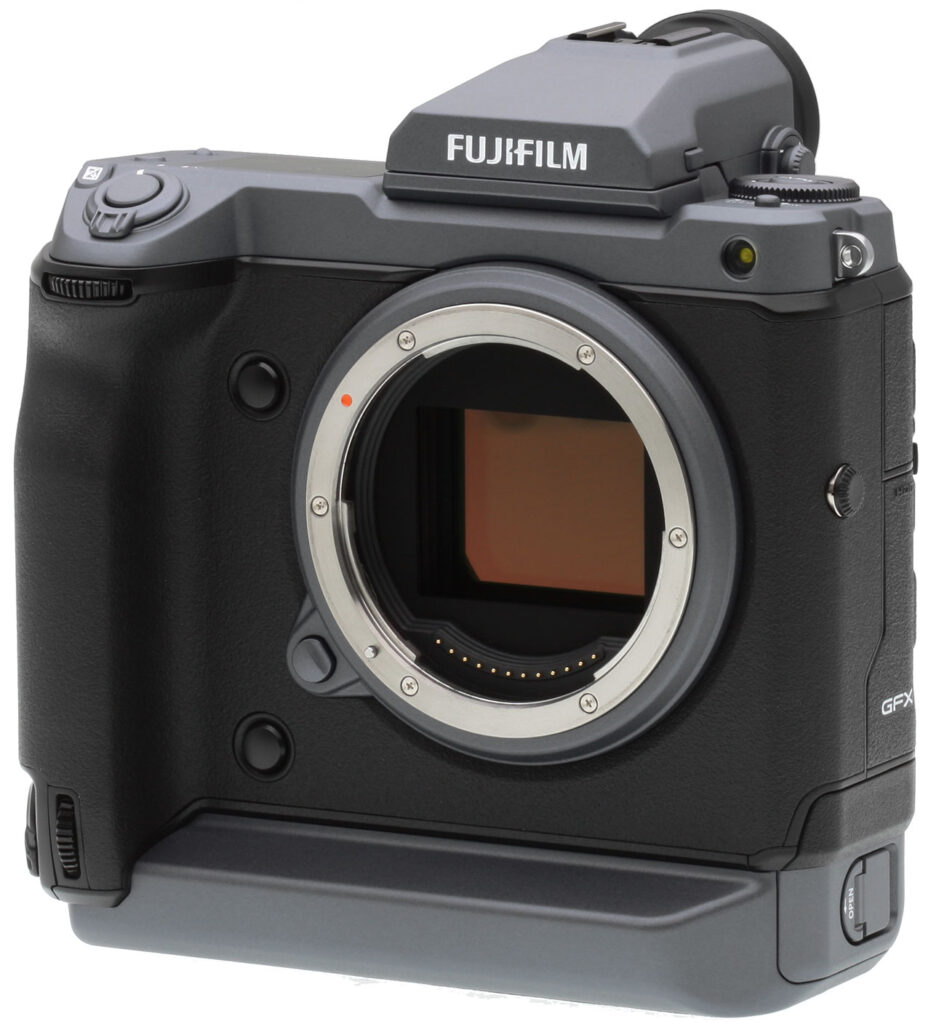


Overview
Head with us to the Outer Banks of North Carolina, where we put the Fujifilm GFX 100 to the real test! (This project was made possible thanks to support from Fujifilm) |
by Jeremy Gray
Originally posted: 05/23/2019

In September 2018, Fujifilm announced the development of the GFX 100, a new 100-megapixel camera in their medium-format mirrorless GFX camera system. While a fair bit of information was available back then, Fujifilm has now fully revealed the new camera, complete with many details we were not privy to last year.
There are many "world's firsts," including the first mirrorless camera with a 100-megapixel BSI image sensor, the first medium-format camera with in-body image stabilization and the world's first 4K-capable medium-format mirrorless camera. We now know more about each of these key features, plus much more.
Key Features
- 102-megapixel BSI CMOS sensor
- Native ISO range of 100-12,800, expandable to 50-102,400
- 16-bit raw files
- 3.76 million PDAF pixels covering nearly 100% of the image area
- Improved autofocus performance and speed
- 5.0 fps burst mode
- 5-axis in-body image stabilization
- X-Processor 4
- Integrated vertical grip
- Weather-sealed magnesium alloy body
- Dual UHS-II SD card slots
- Top and rear sub displays
- 3-way tilting touchscreen LCD
- 5.76M-dot OLED electronic viewfinder
- 4K/30p video recording and Eterna Film Simulation
- Built-in Wi-Fi and Bluetooth
Body & Design: Integrated vertical grip, new displays and a revised control layout
By opting for a shape similar to a DSLR camera, the Fuji GFX 100 features a design more similar to the original GFX 50S than the recent GFX 50R camera. However, the GFX 100 incorporates a built-in vertical grip, whereas the GFX 50S' grip attachment was offered as an optional accessory. This design change has multiple impacts, including doubling the battery capacity of the GFX 100 when compared to a non-gripped 50S or 50R and allowing for a new sub-display on the rear of the camera.

Like the GFX 50S before it, the GFX 100 has a removable electronic viewfinder. When the EVF is detached, the camera is shorter and has less maximum depth. In total, the EVF-less GFX 100 is 5.67 inches tall (144 millimeters) and has a maximum depth of 2.96 in. (75.1mm). The width, 6.15 in. (156.2mm), remains unchanged, as one would expect. With the EVF attached, the GFX 100 is 6.44 in. (163.6mm) tall and 4.05 in. (102.9mm) deep. With a pair of batteries and a memory card, the GFX 100 weighs 46.6 ounces (1,320 grams). With the EVF attached, the weight increases to 49.4 oz. (1,400g).
Despite its larger sensor, the mirrorless GFX 100 is not substantially different in size from flagship full-frame DSLRs. Take the Nikon D5, for example, which is marginally wider, slightly shorter and only a little bit thinner than the GFX100 with its EVF attached. Their weights are 15 grams different. It's a similar story with the Canon 1DX Mark II, which is about the same width, slightly taller and a bit thinner than the GFX 100, while weighing over 100 grams more.

Like the GFX 50S, the GFX 100 utilizes a 3.2-inch touchscreen display which tilts in three directions (up around 90 degrees, down about 45 degrees and to the side for portrait orientation by about 45 degrees). Unlike the GFX 50S, the battery compartment in the GFX 100 has been revised to eliminate the bulge that was behind the GFX 50S' display. The touchscreen LCD has 2.36 million dots, the same resolution as the 50S.
The EVF-GFX2 electronic viewfinder is a new OLED design, featuring 5.76 million dots and 0.86x (35mm equivalent) magnification. The GFX 50S' OLED EVF had 3.6 million dots and roughly the same magnification (0.85x). Eyepoint is 23mm and there's a diopter adjustment from -4 to +2m-1. The new EVF is compatible with the same optional EVF-TL1 Tilt Adapter as the 50S.

When looking at the rear of the camera, there are a few notable changes to the control layout when compared to the GFX 50S. For starters, the oft-criticized location of the playback button has moved from the top left of the camera to the bottom right of the display. Further, the four directional buttons (which can conveniently be assigned to act as four separate function buttons) have been removed entirely, leaving a large area for grip. Previously unmarked buttons are now labeled for AF-ON and AE-L functionality. Like the GFX 50S' vertical grip, the built-in vertical grip of the GFX100 incorporates mirrored controls, meaning that it should operate in essentially the same way and offer similar controls regardless of shooting orientation. Plus, there's a new 2.05-inch 256×64-dot Monochrome OLED sub-display below the primary rear display, which delivers various shooting information.
While the rear of the GFX100 has undergone some revisions, the top of the camera is dramatically different. There is still a large status display on the top, but the dials of the GFX 50S are basically gone. There's a drive mode dial to the left of the viewfinder, but no dedicated shutter speed or ISO dials. The top status LCD offers a virtual dial mode to digitally mimic the now-absent dials.

The GFX 100 has been designed for use harsh conditions and incorporates weather sealing in 95 locations throughout the magnesium alloy camera body and detachable EVF. Further, the camera features a "double-structure" design, which separates the lens mount, image stabilization mechanism and image sensor from the main body panels. Fujifilm states that this design provides more precision and robustness while offering additional protection to critical components.
Sensor and Shooting Modes: New 102-megapixel BSI CMOS sensor aims to impress
Arguably, the star of the show is the new image sensor. After all, if you're investing in a medium-format camera system, you must be seeking out the best in image quality. The GFX 100 features a newly-developed 102-megapixel backside-illuminated CMOS image sensor. The sensor size is 43.8 x 32.9 millimeters, which is about 1.7 times the area of a full-frame sensor but smaller than the medium-format sensors in Phase One and Hasselblad's high-end systems, which are roughly 54 x 40mm. To help ensure sharp images, the GFX 100's sensor omits an optical low-pass filter.

The new sensor is the world's first 100-megapixel BSI CMOS sensor in a mirrorless camera. Beyond megapixel count, another important improvement is that the GFX 100 can capture 16-bit raw files, something that the 14-bit GFX 50S/R cameras do not offer. (14-bit raw files are still available.) Despite the denser pixel arrangement, the 102-megapixel sensor offers the same native ISO range of 100-12,800 as the GFX 50S/R. The range can be extended to as low as ISO 50 and as high as ISO 102,400.
In terms of shooting modes and features, the GFX 100 offers the same assortment of modes and Film Simulations (16 in total) as the other GFX cameras, including the recent monochrome Acros Film Simulation and Fujifilm's new Color Chrome Effect. The GFX 100 does incorporate the Eterna Film Simulation, although that is oriented more toward video, and we will discuss video shortly. The metering system remains a 256-zone system which offers multi, spot, average and center-weighted metering modes. Auto ISO functionality also remains unchanged, offering three custom Auto ISO ranges with user-selectable settings. The GFX 100 continues to utilize a focal plane shutter, with a maximum flash sync of 1/125s. The overall shutter speed range remains unchanged at 60 minutes to 1/4,000s using the mechanical shutter or EFCS, with speeds as fast as 1/16,000s using the electronic shutter.

Although not exclusive to the GFX 100, it is worth pointing out that the camera can be shot tethered with Capture One. The compatibility with GFX cameras was only recently added to Capture One software but is of substantial interest for studio photographers in particular. Capture One also now supports Fujifilm's Film Simulations, which is a nice touch.
Performance: Over 3 million PDAF pixels cover nearly the entire sensor
While we lauded the GFX 50's excellent autofocus coverage, its speed left a lot to be desired. The GFX 100 hopes to change that with its new phase-detect hybrid autofocus system. Its 102-megapixel sensor includes 3.76 million phase-detection autofocus pixels which offer "near 100 percent coverage." Fujifilm promises improved focusing accuracy and speed, particularly with respect to subject tracking and shooting low-contrast subjects. When compared to the GFX 50R, the GFX 100 can focus up to 210 percent quicker. Further, face/eye detect autofocus performance is said to be improved.

Continuous High burst mode is rated at 5.0 fps (up from 3.0 fps on the 50S), with claimed buffer depths of 41 JPEGs, 14 losslessly compressed raw or 13 uncompressed raw files. (See our Performance testing results.) When shooting with the electronic shutter, the top burst rate drops to 2.9 fps. A Continuous Low mode is also available rated at 2.0 fps for unlimited JPEGs, 20 losslessly compressed raw or 15 uncompressed raw files. Note that while the GFX 100 can capture 16-bit raw files in single-shot mode, in continuous mode it records 14-bit files.
Five-axis image stabilization enables 102-megapixel handheld shooting
The GFX100 notably offers in-body image stabilization, yet another "world's first" for a medium-format mirrorless camera. The GFX 100 has built-in five-axis image stabilization which works in conjunction with dedicated dual processors and gyroscopic accelerometers. The system promises up to five and a half stops of shake correction. The camera's entire focal plane shutter unit is suspended using four springs, which act to minimize the effect of shutter shock. Fujifilm promises that despite its 100-plus megapixel resolution, the GFX 100 will be able to be used handheld. There is a clear focus here on stability.
Video: DCI 4K, 4:2:2 10-bit uncompressed video, Eterna Film Simulation and more

Video features and performance were shortcomings with the GFX 50S/R cameras, but the GFX 100 hopes to change that. For starters, it can record 4K video, both DCI 4K (4,096 x 2,160) and 4K UHD (3,840 x 2,160), whereas the GFX 50 cameras top out at Full HD (1,920 x 1,080) resolution. The GFX 100 records 4K video at up to 30 frames per second using the full sensor width, includes the cinema-oriented Eterna Film Simulation and can record in F-Log Rec 2020. Other movie functions include Zebra setting, Zebra level, Time code setting, Tally light and Movie silent control.

Further, the GFX 100 can output 4K 4:2:2 10-bit uncompressed video to an external HDMI recorder while simultaneously capturing 10-bit 4:2:0 video to an SD card. Recording formats include MPEG-4 AVC / H.264 and HEVC / H.265 with 24-bit Linear PCM stereo audio using 48KHz sampling in a MOV container. 4K video is limited to about 60 minutes per clip, while Full HD is limited to about 80 minutes.
Presumably the improved autofocus performance for stills photography will apply to video recording as well, but we won't know for sure until we get our hands on a production-level camera and put it through its paces. Nonetheless, video has gone from being an afterthought with the GFX 50 cameras to a point of emphasis for the GFX 100.
Storage, Ports, Power and Connectivity

The GFX 100 incorporates dual SD card slots, like the GFX 50 cameras. Both slots are UHS-II compatible, but the omission of XQD and/or CFExpress is nonetheless interesting. UHS Speed Class 3 or higher is recommended for recording video and Video Speed Class 60 or higher is needed for 4K video at the highest offered bit rate (400Mbps).
The camera includes a USB Type-C (USB 3.2 Gen1) port which supports in-camera charging and power delivery (USB PD Rev 2.0 Ver 1.3), an HDMI Micro (Type D) port, 3.5mm microphone and headphone jacks and a 2.5mm remote release jack. There is also a 15V DC IN connector.

A dedicated flash hot shoe is provided on the main body with contacts for the EVF, and a PC sync terminal is provided as well. The detachable EVF also features a hot shoe.
The GFX100 also includes built-in Wi-Fi and Bluetooth LE, and is the first GFX body to support the IEEE 802.11ac 5GHz (Wi-Fi 5) standard.
Power is supplied by a pair of lithium-ion batteries, the same NP-T125 battery packs as the GFX 50 cameras, and the GFX 100 is CIPA-rated for up to 800 shots when using the LCD, which is effectively double the battery life of the GFX 50 cameras (there are two batteries in the camera rather than one). When recording video, the battery life is approximately 170 minutes of 4K footage, or up to 240 minutes of Full HD footage.

GFX 100 versus GFX 50S/R
The Fujifilm GFX 100 has numerous new features which significantly outpace the pair of GFX 50 cameras. The most obvious change is the image sensor itself, which features almost twice the megapixel count, up from 51.4 to 102 megapixels. It is not only sheer resolving power which has changed, the GFX 100 can also record 16-bit raw files, whereas the GFX 50 cameras produce 14-bit raw files.

With respect to autofocus, the GFX 50S/R utilized a 425-point contrast-detect autofocus system, which covered quite a bit of the image area. However, the GFX 100 significantly ups its game by incorporating 3.76-million phase-detect autofocus pixels in its hybrid autofocus system. Further, the PDAF pixels cover "nearly 100% of the image area" and promise up to 210% faster autofocus performance, particularly in low-contrast situations.
Burst performance has improved as well, rated at up to 5.0 fps versus 3.0 fps despite the larger files.

The GFX 100 features a design more similar to the GFX 50S than the 50R, although it is significantly different from both. For starters, the GFX 100 has a built-in vertical grip, which allows for the addition of a second battery (and twice the battery life) and a new rear sub display. The GFX 100 maintains a large top display, like the GFX 50S, but has ditched the top dials which adorn both GFX 50 cameras. Like the 50S, the GFX 100's electronic viewfinder is detachable and its rear 3.2-inch touchscreen tilts in three directions. The GFX 100 does offer an improved EVF resolution and we are curious to see how the new EVF performs in the real world, as we did have some issues with the EVF performance on the GFX 50S, both in terms of appearance and overall usability.
There are additional significant new features. The GFX 100 can record 4K video (DCI 4K and 4K UHD) video at up to 30 frames per second, a resolution that the GFX 50 cameras did not offer. The GFX 100 also incorporates a five-axis in-body image stabilization system, a world's first feature for a medium-format mirrorless camera.

Fuji GFX100 Pricing and Availability
The Fujifilm GFX 100 went on sale in June 2019 at a suggested retail price of $9,999.95 USD and $13,299.99 CAD. For reference, the GFX 50S launched in 2017 at $6,499.95 USD and the GFX 50R launched last year with a suggested retail price of $4,499.99, although both cameras are currently available at lower prices.
In the Box
The Fujifilm GFX 100 retail box (as reviewed) contains the following items:
- FUJIFILM GFX 100 Medium Format Mirrorless Camera (Body Only)
- EVF-GFX2 Interchangeable Electronic Viewfinder
- 2x FUJIFILM NP-T125 Rechargeable Lithium-Ion Battery
- FUJIFILM BC-T125 Battery Charger
- Plug Adapter
- FUJIFILM BCP-002 Body Cap
- Shoulder Strap
- 2x Metal Strap Clip
- Clip Attaching Tool
- 2x Protective Cover
- Cable Protector
- Hot Shoe Cover
- Connector Cover
- Sync Terminal Cover
- Limited 1-Year Warranty
Performance
Timing and Performance
Very good overall performance for its class, with some notable improvements over the 50S.
| Startup/Play to Record | ||
|---|---|---|
|
Power on |
~1.3 seconds
|
Time it takes to turn on and capture a shot. |
|
Play to Record, |
~1.0 second
|
Time until first shot is captured. |
Powerup to first shot was sluggish compared to most DSLRs at about 1.3 seconds, the same as the 50S. Switching from Play to Record mode and taking a shot took about one second which is relatively slow, requiring one shutter press to get out of review mode and another to take the shot, though that's slightly improved over the 50S.
| Shutter Response (Lag Time) (EFCS (default) / Mechanical Shutter / Electronic Shutter) |
||
|---|---|---|
|
Full Autofocus, |
0.159/0.197/0.708
second |
Time from fully pressing shutter button to image capture, with the lens already at the proper focal distance setting. (All timing performed with the Fujinon GF 63mm f/2.8R WR lens.) |
|
Manual Focus |
0.111/0.158/0.706
second |
For most cameras, shutter lag is less in manual focus than autofocus, but usually not as fast as when the camera is "prefocused". |
|
Prefocused |
0.105/0.136/0.689
second |
Time to capture, after half-pressing and holding shutter button. |
In terms of the GFX100's ability to determine that it's properly focused when shooting the same target multiple times (with no change of focus setting between iteration, to remove the impact of lens AF speed), its full autofocus shutter response was quite fast for a mirrorless camera, thanks to its new hybrid AF system. The GFX100's full-autofocus shutter lag (with the subject at a fixed distance) was 0.159 second in Single-point (center) AF-S mode using the default Electronic First Curtain Shutter mode. That's much improved over the 50S which tested at 0.476 second with its contrast-detect AF system.
When manually focused, the GFX100's shutter lag time dropped to 0.111 second, which is not bad, and also quite an improvement over the 50S' 0.270 second.
The GFX100's prefocused shutter lag of 0.105 second was a bit faster than the 50S' 0.108 second, but that's still slower than most cameras.
As you can see in the table above, we also tested the fully mechanical shutter mode which was slightly slower than EFCS, and the fully electronic shutter which was significantly slower.
To minimize the effect of different lens' focusing speed, we test AF-active shutter lag with the lens already set to the correct focal distance.
| Cycle Time (shot to shot) | ||
|---|---|---|
|
Single Shot mode |
0.41 second
|
Time per shot, averaged over a few frames. |
|
Single Shot mode |
0.56 second
|
Time per shot, averaged over a few frames. |
|
Early shutter |
No
|
Some cameras refuse to snap another shot if you release and press the shutter too quickly in Single Shot mode, making "No" the preferred answer. |
|
CH Burst mode |
0.20 second
(5.03 fps); 47 frames total; 17.5 seconds to clear* |
Time per shot, averaged over buffer length of 47 frames, then slows to an average of 0.51s or 2.0 fps when buffer is full. |
|
CH Burst mode |
0.20 second
(5.01 fps); 21 frames total; 7.5 seconds to clear* |
Time per shot, averaged over buffer length of 21 frames, then slows to an average of 0.51s or 2.0 fps when buffer is full. |
|
CH Burst mode |
0.20 second
(5.00 fps); 13 frames total; 11.1 seconds to clear* |
Time per shot, averaged over buffer length of 13 frames, then slows to an average of 0.69s or 1.5 fps when buffer is full, with a lot of variation. |
|
CL Burst mode |
0.50 second
(2.00 fps); Unlimited(?) frames; 1.6 seconds to clear* |
Time per shot, averaged over 40 frames, with no apparent buffer limit. |
|
CL Burst mode |
0.50 second
(1.99 fps); 26 frames total; 11.1 seconds to clear* |
Time per shot, averaged over buffer length of 26 frames, then slows to an average of 0.64s or 1.6 fps when buffer is full. |
|
CL Burst mode |
0.50 second
(1.99 fps); 24 frames total; 11.2 seconds to clear* |
Time per shot, averaged over buffer length of 24 frames, then slows to an average of 1.55s or 0.64 fps when buffer is full with a lot of variation. |
|
*Note: Buffer clearing times measured with a Sony 64GB SF-G UHS-II SDXC card (R:300MB/s, W:299MB/s). Slower cards will produce correspondingly slower clearing times. Slow cards may also limit length of bursts in continuous mode. ISO sensitivity and noise reduction settings can also affect cycle times and burst mode performance.
|
||
Single-shot cycle time was about 0.4 second when shooting Large Super Fine JPEGs and about 0.6 second when shooting lossless compressed RAW + LSF JPEG files. Again, this is an improvement over the 50S' 1.0 second for both.
The GFX 100's top continuous CH burst mode speed is rated at 5.0 fps, and our lab results confirmed that. That's quite good considering the sensor size and resolution. Note that mechanical shutter mode is needed at 5.0 fps (electronic shutter is limited to 2.9 fps and EFCS is limited to 2.0 fps).
Buffer depths at 5 fps were roughly similar to the 50S' at 3 fps in our tests, despite the higher speed and much larger files. The GFX 100's buffer depth in CH burst mode was 47 best quality JPEGs, 21 losslessly compressed RAW and 13 lossless RAW+JPEG frames, compared to the 50S' 40, 21 and 11 frames respectively. The GFX 100's spec'ed buffer depth is 41 JPEGs or 14 lossless RAW, so the GFX100 performed better than Fuji's claims in the lab. We didn't test uncompressed RAW files, however Fuji claims their buffer depth is only one less at 13 frames in 5 fps mode.
Continuous L mode is rated at 2.0 fps and that was confirmed in the lab as well. Buffer depths in this slower mode were unlimited best quality JPEGS, 26 lossless RAW or 24 lossless RAW+JPEG frames.
Buffer clearing times were reasonable with a fast Sony SF-G64 UHS-II SDXC card, taking between 7.5 and 17.5 seconds to clear after a max-length 5 fps burst depending on the file type. And the GFX 100 allows you to change settings and view just-shot images while the buffer is clearing.
Bottom line: the Fuji GFX 100's performance is much improved over the 50S' in terms of autofocus speed, cycle times and burst rate, though unsurprisingly, buffer clearing is much slower yet still reasonable given the massive file sizes.
Battery Life
Very good battery life for a large sensor mirrorless camera.
| Operating Mode | Battery Life Normal / Boost |
|---|---|
|
Still Capture,
(EVF, CIPA standard) |
740 / 560 shots
|
|
Still Capture,
(LCD Monitor, CIPA standard) |
800 / 700 shots
|
The Fuji GFX 100 uses two custom NP-T125 10.8V 1250mAh rechargeable lithium-ion battery packs for power (the same battery pack the 50S and 50R use), and comes with two dedicated battery chargers. In-camera charging via USB-C is supported as is USB Power Delivery, and the camera also has a 15V DC input jack.
The GFX 100 is CIPA-rated for 740 shots per charge when using the EVF or 800 shots with the LCD monitor in Normal mode, which is quite good for a large sensor mirrorless camera thanks to the dual battery packs. In Boost mode which increases EVF frame rate and/or AF speed, the ratings drop to 700 and 560 shots respectively, which is still pretty good.
The table above shows the number of shots the camera is capable of on fully-charged battery, based on CIPA battery-life and/or manufacturer standard test conditions. While real-world battery life tends to be much better for mirrorless cameras, CIPA-rated battery life is still very useful for comparison purposes.
(Interested readers can find an English translation of the CIPA DC-002 standards document here. (180K PDF document))
Field Test
This medium-format camera of many "world's firsts" is expensive, but delivers great quality and performance

In 2017, Fujifilm launched their brand-new mirrorless medium-format GFX camera system with the GFX 50S camera. With a launch price of $6,500 USD, the camera was expensive, but it was also a good value for a medium-format camera system. Since then, I have spent a lot of time using the GFX 50S camera and have come to appreciate its numerous strengths while sometimes being more frustrated with its shortcomings. The GFX 50S delivers fantastic image quality and a pleasant overall user experience, but its autofocus performance has been a key area of weakness.
Doubling down on the excellent image quality is the new GFX 100. As its name conveys, the camera incorporates a 102-megapixel image sensor, which not only doubles the megapixel count of the GFX 50S (and GFX 50R) camera, but the sensor also comes equipped with a new hybrid phase-detect autofocus system. The 100-plus megapixel sensor and its 3.76 million phase-detect autofocus pixels are far from the only new features in the GFX 100. It is also the world's first mirrorless medium-format camera to include in-body image stabilization and 4K/30p video.

These new features have resulted in an increase in price to $10,000 USD. This is a lot of money for a camera, but on the other hand, you get a lot of performance for the money. Plus, compared to traditional digital medium format camera systems, the GFX 100 is quite affordable. Let's take a closer look to see how the 102-megapixel sensor performs, evaluate the overhauled autofocus system and learn more about the exciting new GFX 100.
Key Features and Specs
- Medium-format mirrorless camera
- 102-megapixel backside-illuminated CMOS image sensor
- Native ISO range of 100-12,800
- 16-bit raw files
- 3.76 million phase-detect autofocus pixels covering nearly the entire image area
- Improved autofocus performance and speed
- Five-axis in-body image stabilization
- Weather-sealed camera body
- Integrated vertical grip
- 5.76-million dot OLED electronic viewfinder
- Tilting touchscreen display
- 4K/30p video recording and Eterna Film Simulation
Camera Body & Handling: An interesting new design results in good usability
The GFX 100 incorporates a significantly different and more streamlined design than the GFX 50S. For starters, gone is the unsightly and intrusive battery compartment bulge behind the display on the GFX 50S. Also, unlike either of the GFX 50 cameras, the GFX 100 has an integrated vertical grip. One of the impacts of this inclusion is that the camera can hold a pair of batteries, effectively doubling its battery life. Further, it allows for mirrored controls when shooting vertically-oriented images. You will also quickly notice that the GFX 100 opts for a two-tone black and gray design, rather than the solid black coloring of the GFX 50 models. Personally, I'm not a fan of the two-tone look, but I'm sure some people will be and, ultimately, it doesn't matter very much.
What does matter significantly is the overall control layout and feel of the GFX 100. The front grip feels nice. It's a decent size, it has a good gripped surface and is a fairly deep shape. The integrated vertical grip, however, does not feel nearly as nice. It isn't covered with a grippy surface at all, which is an odd design choice in terms of usability and comfort, and it is much smaller/thinner than the optional vertical grip which I use with my GFX 50S. With that said, the mirrored controls for the vertical grip are nice and work well.
Another big change is that the GFX 100 ditches the dedicated ISO and shutter speed dials which are found on the top of the GFX 50S camera. Instead, the top display is larger than the one found on the GFX 50S and the extra screen real estate allows for what Fujifilm calls "virtual dials." Basically, by pressing a button next to the display, you can view dual shutter speed and ISO dials on the top display. When used in conjunction with the command dials, you can quickly adjust the settings with instant visual feedback. I don't prefer this approach versus having physical dials, but it's a fine compromise. It may be a big ask, but I do wish that given the relative prominence of the top display, that it incorporated touchscreen such that you could easily adjust any shooting setting via the display.
|
| While the GFX 100 lacks some of the dedicated top dials of the GFX 50S, it does offer a larger top display, which can be used to show virtual shutter speed and ISO dials, a live histogram or an array of shooting settings. In this product image, we see the lattermost display setting. |
The display's larger size does have some nice bonuses, however, including the ability to show a real-time histogram while you are shooting. You can also view a fuller breakdown of your shooting settings than you could on the GFX 50, and this can all be customized in the camera's menus. Overall, the display is clear and effective, even if I prefer physical dials.
Looking at other aspects of the camera's control layout, there are a variety of interesting changes to note. Like the GFX 50R, the GFX 100 ditches the four-way directional buttons which were found on the GFX 50S. I really liked the four-way directional buttons because I was able to assign different functions to them, such as direct access to Film Simulations, the self-timer and more. Fujifilm has worked around this by allowing you to assign four functions to different directional swipes (left/right/up/down) on the touchscreen. A great button layout change is that the GFX 100's playback button is on the right side of the camera, so you can easily reach it with your right hand to review images as you are shooting. In fact, all essential controls are within reach of your right hand while shooting.
|
| The back of the GFX 100 is dramatically different when compared to the GFX 50S and most of the changes are for the better. A big change also comes in the form of a new, higher-resolution and more responsive electronic viewfinder, which is excellent. |
The GFX 100 features a new electronic viewfinder, which is a very welcome change as the GFX 50's EVF had some issues with artifacts, sluggishness and an overall unnatural-feeling user experience. The new EVF has 5.76 million dots and 0.86x magnification and is very sharp. It also doesn't display the same shimmering appearance that plagued the GFX 50S and 50R's EVFs. It's a massive improvement overall. Further, the new EVF, which is detachable, is compatible with the existing tilt adapter.
The rear display tilts in three directions, upward, downward and about 45 degrees to the side. This triaxial touchscreen is the same as the one found on the GFX 50S. It's plenty sharp, responsive and works reasonably well in bright lighting conditions. Below the touchscreen is a new customizable sub display. With default settings, the rear sub display shows shooting mode, aperture, shutter speed and ISO on its top row and exposure compensation, film simulation and white balance along the bottom.
Overall, the weather-sealed magnesium alloy body is well-designed and feels good to use. Some of the design changes are not impressive to me as a GFX 50S user, such as the lack of dedicated dials on the top of the camera, but most changes are improvements. While the vertical grip is not as comfortable as the optional one for the GFX 50S, it does allow the GFX 100 to be thinner and lighter overall. The new electronic viewfinder is a big improvement, as is the control layout on the back of the camera. It's not a perfect camera body, but overall, it's a better design than the GFX 50S.
Image Quality: 102MP of excellent medium-format image quality
The Fuji GFX 100 incorporates a 102-megapixel backside-illuminated CMOS image sensor. This is a big step up from the 51-megapixel sensor found in the GFX 50S and 50R cameras not only in terms of megapixel count, but also with respect to the overall sensor design. The CMOS sensor in the GFX 50 cameras was not backside-illuminated and was very similar in tech to the quite aged sensor found in the Pentax 645Z medium-format camera.

 |
| Fujifilm GF 250mm f/4 lens, 250mm (198mm equiv.), f/4, 1/320s, ISO 250. 100 percent crop of the above image. This image has been converted and processed to taste in Adobe Camera Raw. Click for the full-size image. Click here for the RAW file. |
The "medium-format camera" waters are a bit murky, as there are basically two dominating sensor sizes in the market. There's a smaller sensor, which is what the GFX and Hasselblad X1D camera systems utilize, and then larger medium-format sensors like what is found in cameras such as the Phase One IQ4 digital back series. Specifically, the GFX 100's sensor is 43.8 x 32.9 millimeters in size, which is about 1.7 times the area of a full-frame image sensor, but quite a bit smaller than the 54 x 40mm sensor found in the more expensive Phase One system.
While the size gap between the Fuji GFX and Phase One systems has not been closed with the GFX 100, the new Fuji camera does close the image fidelity gap some by offering 16-bit raw image capture, something that its 50S/R siblings are unable to do.
Despite upping the megapixel count, the GFX 100 offers the same native ISO range as the GFX 50 cameras: 100-12,800. The camera's ISO range can be extended down to ISO 50 and expanded upward to ISO 102,400.
Sharpness & colors
If you are interested in purchasing the GFX 100, the prevailing motivation for your interest is likely image quality. The GFX 100 produces incredible images with fantastic sharpness. The medium-format sensor – which lacks an optical low pass filter – produces very detailed images and is able to capture small, fine details in complex scenes with ease, particularly at or near base ISO.
Take for example the image below, which is a focus-stack of numerous images captured at f/8 with a 100 ISO. You can easily pick out very fine details in the moss, bark and rocks. And thanks to the 102-megapixel image, which is 11,648 x 8,736 pixels, making a very large print is no problem whatsoever. In fact, a 300 ppi resolution print at original size is 38.8 inches x 29.1 inches.
 |
| Fujifilm GF 32-64mm f/4 lens at 35mm (28mm equiv.), f/8, 9s, ISO 100. This is a focus stack comprised of six separate images shot with the above settings. This image has been converted and processed to taste in Adobe Camera Raw. Click for the full-size image. Click here for one of the original RAW files. |
 |
| Fujifilm GF 32-64mm f/4 lens at 35mm (28mm equiv.), f/8, 9s, ISO 100. 100 percent crop from the above image. This is a focus stack comprised of six separate images shot with the above settings. This image has been converted and processed to taste in Adobe Camera Raw. Click for the full-size image. Click here for one of the original RAW files. |

 |
| Fujifilm GF 250mm f/4 lens, 250mm (198mm equiv.), f/5.6, 1/250s, ISO 800. 100 percent crop from the above image. This image has been converted and processed to taste in Adobe Camera Raw. Click for the full-size image. Click here for the RAW file. |

 |
| Fujifilm GF 32-64mm f/4 lens at 64mm (51mm equiv.), f/8, 1/30s, ISO 100. 100 percent crop of the above image. This image has been converted and processed to taste in Adobe Camera Raw. Click for the full-size image. Click here for the RAW file. |

 |
| Fujifilm GF 32-64mm f/4 lens at 55mm (43mm equiv.), f/8, 1/125s, ISO 100. 100 percent crop of the above image. This image has been converted and processed to taste in Adobe Camera Raw. Click for the full-size image. Click here for the RAW file. |
The primary takeaway is that when shooting at low ISOs, the GFX 100 produces very sharp images. Having used the GFX 50S as my primary landscape camera since it released, I can confidently say that the resolution step up to the GFX 100 is noticeable. The move to 16-bit files also results in what I consider to be improved tonal transitions and color rendition, however, this difference is more subtle. Speaking of color, the GFX 100 does a very good job here, producing images with quite accurate colors.


High ISO
At high ISOs, the GFX 100 is not quite as impressive, but within the context of it being a 102-megapixel image sensor, the high ISO performance is certainly still very good. Images can quickly get pretty noisy. There are a couple of caveats here though. One, the quality of the noise is pretty good. What I mean by this is that the grain is quite fine, consistent and not riddled with ugly color and chroma noise. Two, by downsizing the image to a smaller (but still large) size, you can create a cleaner-looking print, even at high ISOs.


 |
| Fujifilm GF 250mm f/4 lens with GF 1.4x teleconverter, 350mm (277mm equiv.), f/5.6, 1/160s, ISO 6400. 100 percent crop from above modified image with +2 EV exposure. Click for the full-size image. Click here for the RAW file. Despite being shot at ISO 6400 and then processed for an additional two stops of exposure, this image retained acceptable fidelity despite the visible noise and the decrease in fine detail. |
If you are spending $10,000 for the GFX 100, it's unlikely you are intending to shoot very often at high ISO settings. However, I am impressed by the camera's performance in low light and would confidently use it up to ISO 1600 and perhaps even as high as ISO 6400 in some situations.
Raw file flexibility
Like the GFX 50S/R cameras before it, the GFX 100 truly shines when you process its raw files. Support for the GFX's raw files have never been better, including reliably good support in Adobe Camera Raw and more recent support in Capture One software. While the camera produces strong JPEG image files, you can extract even more detail and produce images with expanded dynamic range when you process a raw file. I was able to do a considerable amount of finessing with the GFX 100's raw files without introducing unwanted noise, banding or other types of file degradation.

When it comes to dynamic range, we can look at the great charts from Photons to Photos to evaluate the GFX 100. Compared to the GFX 50S/R, the GFX 100 offers equal or better performance across the board, with the largest performance gains for the GFX 100 coming between ISO 800 and 1600, where the gain is about a full stop. At base ISO, the GFX 100 offers about 12.2 EV of dynamic range versus 11.9 EV with the GFX 50S. For reference, the full-frame Nikon D850 offers 11.6 EV of dynamic range at its base ISO of 64 and the 151-megapixel Phase One IQ4 150MP medium-format digital back delivers 13.1 EV at its base ISO. This shows that the GFX 100 is closer in terms of dynamic range to high-resolution full-frame cameras than it is to large medium-format cameras such as the IQ4 150MP.


 |
| Fujifilm GF 32-64mm f/4 lens at 44mm (35mm equiv.), f/8, 1/5s, ISO 100. 100 percent crop of the above image. This image has been converted and processed to taste in Adobe Camera Raw. Click for the full-size image. Click here for the RAW file. Despite an increase in the shadow detail, the image remains very clean. |
Overall, the GFX 100 offers good dynamic range and very flexible raw files, even when recovering lost details in shadows and highlights. I found it easy to create the final images that I wanted, even when the lighting conditions were unfavorable.
Overall
The Fuji GFX 100 delivers excellent image quality across the board. Its resolving capabilities are very good, for starters, and the camera's ability to produce smooth tonal transitions, pleasing colors and good quality at high ISO settings are also very impressive.
Shooting Experience
While the improved image quality with the GFX 100 is nice, perhaps an even bigger difference between the GFX 100 and the GFX 50S/R cameras comes when considering the overall shooting experience. In terms of autofocus, performance and ease of use, the GFX 100 is improved, particularly with respect to autofocus. Simply put, it is a significant evolution for the GFX system.

Autofocus
The GFX 50S's autofocus performance was something of a mixed bag. It had pretty good autofocus coverage across the sensor, especially considering the large size of the sensor, but the camera's contrast-detect focusing system offered lackluster speeds in most situations. The overall shooting experience ended up feeling quite sluggish due to the camera's mediocre autofocus performance. The GFX 100, on the other hand, performs much better.

 |
| Fujifilm GF 250mm f/4 lens with GF 1.4x teleconverter, 350mm (277mm equiv.), f/5.6, 1/1000s, ISO 1250. 100 percent crop of the above image. This image has been converted and processed to taste in Adobe Camera Raw. Click for the full-size image. Click here for the RAW file. Despite the objects obscuring the subject, the GFX 100 quickly locked onto the deer's face. |
Not only does the GFX 100 offer even better autofocus coverage, covering nearly the entire image area, but it features a new phase-detect hybrid autofocus system, which includes 3.76 million phase-detect autofocus pixels. The autofocus system is more accurate than the one found in the GFX 50S/R cameras and proved noticeably faster in every situation in which I used the GFX 100.
A particular area in which autofocus is much improved is when shooting low-contrast subjects and working in low light. Whereas the GFX 50 cameras often hunted in these situations, the GFX 100 proved much more capable of not only acquiring focus, but locking on, even when a subject was moving.

 |
| Fujifilm GF 250mm f/4 lens with GF 1.4x teleconverter, 350mm (277mm equiv.), f/5.6, 1/640s, ISO 200. 100 percent crop of the above image. This image has been converted and processed to taste in Adobe Camera Raw. Click for the full-size image. Click here for the RAW file. The GFX 100's autofocus accuracy proved to be very good, especially in situations where absolute precision was required. |
With that said, to say that the GFX 100's autofocus performance is on-par with a high-end full-frame mirrorless camera would be a slight stretch. It's a big improvement over the lower-megapixel GFX cameras, yes, but it is still not a fast-paced action camera.
Performance
Despite its high megapixel count, the GFX is a pretty nimble camera. It can shoot at 5 frames per second, which is faster than the GFX 50 cameras, but it can only do so for a short period of time. During my own testing with a Lexar 2,000x UHS-II SD card, which has 300 MB/s speeds, I was able to capture about 14 raw images before the buffer filled. Buffer clearing took a bit less than 20 seconds with uncompressed raw files and just over 10 seconds with compressed raw files. It's also worth noting that while the GFX 100 can capture 16-bit raw files, but when shooting continuously, the bit depth drops to 14-bit. For more detailed testing results, check out our lab tests.

The main takeaway then is that X-Processor 4-powered GFX 100 can shoot faster than the GFX 50 cameras but is limited quite a bit by its buffer depths. With that said, the viewfinder performance when shooting continuously is not bad, although the blackout is still problematic, and the camera's overall performance is generally good. Menus are snappy, playback is pretty quick, and the camera is plenty fast when powering on. The GFX 50 occasionally felt slow when going through standard operating procedures, but the GFX 100 feels more responsive during normal use.
Overall
With its good control layout, much-improved autofocus performance and strong all-around imaging performance, I have never been more easily able to use a medium-format camera in a wide variety of situations. Whether you are working slowly with a tripod or walking around with the GFX 100, it's very simple to use the camera and capture highly-detailed images.

Video
The GFX 50S and 50R cameras were almost exclusively designed around still photography. The GFX 100, on the other hand, incorporates video features and performance much more in line with modern cameras. It may not be a true hybrid camera, but it comes remarkably close for a medium-format camera.
Fujifilm GFX 100 4K Video #1 4096 x 2160 video at 29.97 fps, 1/60s, f/8, ISO 400. Shot with GF 250mm lens with 1.4x TC. Download Original (927 MB .MOV File) |
The GFX 100 can record 4K video, in both DCI 4K and 4K UHD resolutions, at up to 30 frames per second. While some mirrorless cameras can do 4K/60p, the GFX 100's offerings are basically in line with most modern full-frame cameras. Further, it can record log (F-Log Rec 2020), externally record 4:2:2 10-bit uncompressed via HDMI and record in H.265 codec.
Fujifilm GFX 100 4K Video #2 3840 x 2160 video at 23.98 fps, 1/60s, f/4, ISO 6400. Shot with GF 32-64mm f/4 lens. Download Original (927 MB .MOV File) |
Fujifilm GFX 100 4K Video #3 3840 x 2160 video at 23.98 fps, 1/60s, f/4, ISO 6400. Shot with GF 32-64mm f/4 lens. Download Original (779 MB .MOV File) |
Fujifilm GFX 100 1080p60 Video 1920 x 1080 video at 59.94 fps, 1/60s, f/4, ISO 6400. Shot with GF 32-64mm f/4 lens. Download Original (314 MB .MOV File) |
With respect to performance, the GFX 100 not only offers good 4K video quality, even in low light, but its autofocus performance is so much better. Autofocus during video is fast and the camera does a great job of not making unnecessary minor adjustments after it has locked on, something that the contrast-detect autofocus system in the GFX 50 cameras struggled with significantly. In the autofocus test video below, you can see that the camera not only adjusts focus pretty quickly, but it does so with a good level of smoothness. You can even adjust the tracking adjustment speeds if you'd like, but the video below was recorded with default autofocus settings.
Fujifilm GFX 100 4K Video #4 4096 x 2160 video at 24 fps, 1/120s, f/4, ISO 250. Shot with GF 250mm lens. Download Original (1.64 GB .MOV File) |
The GFX 100 has a somewhat different ISO range when recording video than it does when shooting still images, going from ISO 200 to 25,600. At low ISO settings, the video quality is very nice, with good colors, tones and detail. As you increase the ISO, quality remains quite good, although the noise can become a bit distracting. It's also worth noting that the GFX 100 incorporates the cinema-oriented Eterna Film Simulation that Fuji introduced with the Fujifilm X-H1 APS-C camera.
Overall, the GFX 100 not only delivers significantly better video quality and performance than the GFX 50S/R, but it also offers video features that compare favorably with what a number of full-frame mirrorless cameras offer, which is particularly impressive given that the GFX 100 is the first medium-format mirrorless camera to offer 4K recording.
In the Field
In the field, the GFX 100 performs very well overall. Compared to the GFX 50S/R, it offers numerous improvements. The increase in image quality aside, the GFX 100 is a more well-rounded, versatile and flexible camera. A big reason for this is the new autofocus system, which is considerably faster and more responsive.

The improved electronic viewfinder also helps the shooting experience feel more fluid. The bump in resolution is nice, but the overall performance of the EVF is really the key. Issues with shining edges and artifacts are gone, the frame rate is more stable, and the refresh rate is better. With that said, the blackout time when shooting is still a bit too long for my taste, especially when trying to shoot quickly.
The camera body in general is something of a mixed bag. I really like that the camera features a built-in vertical grip, as I shoot in portrait orientation quite often. I also like that the camera is smaller and lighter than a GFX 50S with the optional vertical grip attached. There are also some intelligent additions, such as the rear sub display and improved battery compartment location. With that said, I miss the dedicated shutter speed and ISO dials of the GFX 50S.

Returning to image quality, the large 102-megapixel backside-illuminated sensor is superb. It produces very detailed 16-bit raw files across an impressive range of ISO settings. There is a lot of flexibility afforded to you by the sensor, not only in terms of what type of detail you can capture, but also by how pliable the raw files are during post-processing.
The sensor is also stabilized with the camera's new five-axis image stabilization system, which makes the GFX 100 the most hand-holdable medium-format camera available on the market. You can truly walk around with the GFX 100 and shoot it like it's an APS-C or full-frame camera except you return home with medium-format images. While I do often shoot with a tripod, it is far from necessary with the GFX 100 in many cases, and I found myself shooting handheld more than I have with my GFX 50S.
Landscapes with the GFX 100: An excellent camera for landscape photography
When shooting landscape images, much of the appeal of the GFX 100 is due to the camera's image quality. The 16-bit raw files are very detailed, with impressive dynamic range and a ton of flexibility during post-processing. However, the camera is also a reasonable size and weight for a medium-format camera and is weather-sealed, making it a good option for shooting in adverse conditions. Further, the improved autofocus performance is very noticeable when capturing landscape images, particularly in low light conditions. The GFX 100 was able to focus in situations that my GFX 50S never could.
 |
| Fujifilm GF 32-64mm f/4 lens at 52mm (41mm equiv.), f/8, 8.5s, ISO 100. This is a focus stack comprised of seven separate images shot with the above settings. This image has been converted and processed to taste in Adobe Camera Raw. Click for the full-size image. Click here for one of the original RAW files. |
While not exclusive to the GFX 100 model, the camera also incorporates numerous useful features and shooting modes which may prove beneficial to landscape photographers. On the body itself, the tilting display is very nice when working on a tripod from a low angle. When looking at available shooting features, the GFX's in-camera focus stacking, which was added to the GFX 50S via a firmware update post-release, is very nice for times when you want to have a lot of depth of field. Further, the various bracketing features, which are available from the dedicated drive mode dial, are useful.

If you want to do nightscape photography with the GFX 100, it performs quite well here too. Despite its high megapixel count, the GFX 100 delivers good image quality at high ISOs, such as ISO 6400. The quality of the noise, even at high ISOs, is quite nice and has a fine-grained look to it. If you don't like the noise, an easy way to create a smoother final image is to simply downsize the file, something that is easy to do with 102-megapixel images. I continue to hope Fujifilm releases a fast wide-angle prime lens, as the GF 23mm f/4, while great, is not quite as fast as I'd like for night shooting.

When shooting at night or for times when you simply want to fine-tune focus manually, it's worth pointing out that the GFX 100 lets you zoom in quite a bit on the live view to check focus, which proved useful on numerous occasions. You can do this easily by clicking the rear command dial.
Overall, the GFX 100 is a great landscape camera. I already consider the GFX 50S to be one of the better options for landscapes due to its excellent image quality and nice features, but the GFX 100 improves the image quality while also improving all-around performance.


Wildlife photography with the GFX 100: A surprisingly solid option
The GFX 50S/R's utility as wildlife cameras were severely hampered by lackluster autofocus performance, particularly with respect to focusing speed. By the time the camera acquired focus, the ideal moment was often gone. Further, the GFX system lacks a really long lens. The GF 250mm with its optional 1.4x teleconverter is a great lens, but not all that long. The GFX 100 addresses both of these issues with varying success.

Firstly, autofocus performance is much better. I was able to focus on an animal and capture a shot (or burst) before the opportunity was lost. Even in low light and with a moving subject, continuous autofocus performance proved reliable in many cases. Now, the GFX 100 does not match a Sony A7 III, Nikon Z6 or even the Canon EOS R in terms of overall autofocus performance, but it's a heck of a lot closer to those cameras than the GFX 50 cameras are. Further, the GFX 100 also has a nice trick up its sleeve in the form of in-body image stabilization, which not only successfully lets you shoot at slower shutter speeds, but it also does a great job of keeping the viewfinder stable while framing and tracking subjects.

With respect to long lens selection, the GFX lens system is still limited to the 250mm f/4 lens (197.5mm equivalent), and with the 1.4x teleconverter, you have a 350mm f/5.6 lens (276.5mm equivalent) combination. This is not very long but can work for wildlife photography. However, in most cases, you will need to crop. This is an area where the GFX 100 performs much better than the GFX 50 due to its higher pixel count. There is plenty of resolution to allow for much heavier cropping. For example, I cropped the below image to an 8-megapixel image area. While 8 megapixels doesn't sound like much, it's basically a 4K image and is fine for making small prints.

 |
| Fujifilm GF 250mm f/4 lens with GF 1.4x teleconverter, 350mm (277mm equiv.), f/5.6, 1/1000s, ISO 500. This image has been cropped to 8 megapixels and processed to taste in Adobe Camera Raw. Click for the full-size image. Click here for the RAW file. |
As I discussed earlier, the GFX 100 offers good shooting speeds. While there is the caveat that continuous shooting knocks raw file quality down to 14-bit depth versus 16 bits, that's not a big deal in most cases. Both in my own experience and with our lab testing, the GFX 100 delivered 5 frames per second continuous shooting, successfully meeting its spec. Further, its buffer depths could get up to nearly 50 with JPEG shooting and just over 20 with raw shooting. This is not a lot, and may not work well for something like sports photography, but does work pretty well for wildlife shooting. Further, buffer clearing times aren't bad, which can be important for a continued series of action shots.


While the GFX 100 is not an ideal wildlife camera, it does offer numerous features that make it a viable option for photographing wildlife. The improved autofocus and the cropping flexibility of the 102-megapixel sensor make it a much better wildlife camera than either of the GFX 50 cameras.
Fuji GFX 100 Field Test Summary
A significant step up from the GFX 50 cameras, the GFX 100 does nearly everything very well
What I liked:
- The new electronic viewfinder is excellent
- Significantly improved autofocus performance
- Excellent image quality
- A ton of useful features, including image stabilization
- Vastly better video performance and features than the GFX 50 cameras
 |
| Fujifilm GF 32-64mm f/4 lens at 32mm (25mm equiv.), f/8, 1.5s, ISO 100. This is a focus stack comprised of nine separate images shot with the above settings. This image has been converted and processed to taste in Adobe Camera Raw. Click for the full-size image. Click here for one of the original RAW files. |
What I didn't like:
- GFX system still has holes in the lens lineup
- Revised body design is not a unanimous improvement
- While performance is good overall, buffer depths are a bit shallow
- Flash sync can be limiting for some photographers
- Although a good value, $10,000 is still a lot of money for a camera body
The Fujifilm GFX 100 is an excellent camera in many respects. The 102-megapixel sensor delivers fantastic image quality across the board. Further, the camera body itself incorporates numerous improvements and nice features, including a very good electronic viewfinder. The primary weaknesses of the GFX 50 cameras, including poor autofocus performance, outdated video features and a lack of image stabilization, have been addressed very well by the GFX 100.
However, the GFX 100 is an expensive camera. Relative to other medium-format options, it is not particularly pricey, and in fact in some ways is a very good deal, but relative to high-resolution full-frame cameras, the GFX 100 is expensive. Whether the camera is right for you is a personal decision, but for those who take the plunge, you will get an amazing image-creating tool. The image quality is very tough to beat, and unlike the GFX 50 cameras, this image quality does not come at the expense of performance and features.

Conclusion
The Fuji GFX 100 is one of the most unique and ambitious new cameras to come out in 2019. The third offering in Fujifilm's GFX medium-format mirrorless system, the GFX 100 dwarfs not only the other GFX cameras in physical size but also with regards to image quality, AF performance, video features and build quality. Heck, the GFX 100 out-specs most other modern mirrorless cameras in several areas. In fact, the GFX 100 takes aim at those professional and high-end photographers who often reach for gripped, flagship DSLR cameras from Canon and Nikon. Taking the medium-format camera into totally new areas, this model moves beyond the usual slow, methodical photographic genres typically associated with medium-format cameras.
It's more than just a high-resolution camera aimed at landscapes, portraits or studio work. The GFX 100 blends its high-resolution sensor with high-performance capabilities and durable construction that make the camera surprisingly well-suited for some types of action, sports and other fast-paced endeavors -- subjects not traditionally favorable for medium-format cameras. What's more, it's also packed with video features not typically available in this kind of camera. In simpler terms, the GFX 100 is highly versatile in multiple ways.
However, it's not all sunshine and roses. As with most good products, there are a few rough spots. Size and weight, as well as performance limitations, native lens selection and, of course, price are important considerations that might make some take pause when deciding if this is the right camera for them. The GFX 100 is undoubtedly the most versatile medium-format camera to date, but it's not the best or most ideal camera for every type of photographic situation.
Read on to get our final thoughts on the unique Fuji GFX 100 mirrorless camera...
Design & Build Quality
With a design more akin to a fixed-grip, flagship DSLR, the big Fuji GFX 100 feels and handles more like a Canon 1D X Mark II or Nikon D5, for example, than the earlier GFX models or other cameras within Fujifilm's lineup. The camera features thorough, robust weather sealing, a quality that is expected for a camera of this class. While we never subjected our review unit to overly harsh conditions, the build quality of this camera feels extremely nice -- sturdy and robust, yet surprisingly lightweight for a camera of this size and class.
While the integrated vertical grip is nice to have, it feels somewhat unrefined compared to the camera's standard horizontal/primary handgrip. The main handgrip is fairly deep, with ergonomic contouring and wrapped in a grippy material. The vertical grip, on the other hand, is thin, not as deep nor contoured in any way, and isn't covered in a grippy material at all. It's a strange design choice to leave the vertical grip in this seemingly unfinished state. It does however hold two battery packs, leading to very good battery life for a mirrorless camera.
Square-ish gripped shape aside, the GFX 100 also sports a control layout that's more familiar to DSLR shooters, opting to do away with the characteristic shutter speed and ISO dials found on most other Fuji cameras, including the GFX 50S. Instead, most exposure parameters are controlled with front and rear control dials, with various settings displayed on a large top-deck display. It's an interesting design shift, making the GFX 100 more similar to flagship DSLR cameras rather than maintain some characteristic features of previous Fujifilm cameras. However, considering a big target customer segment are those flagship DSLR users, it's not a totally surprising design choice.
In other aspects, physical controls are plentiful and offer a lot of user customization. Strangely, though, many of the buttons, dials and particularly the joystick controls look and feel rather small and even tiny in comparison to the large camera body. There's a lot of empty space, especially on the rear of the camera. They all work fine, don't get us wrong, but having slightly larger buttons would be a welcomed tweak and would improve overall usability.
While we enjoy using the dual joystick controls -- one for horizontal use and another for the vertical orientation -- we are scratching our heads at the omission of the handy four-way directional buttons found on the GFX 50S and many other Fuji X-series cameras. The 4-way controls make menu navigation easier and also allow for additional custom button functions. The camera body is certainly large enough to accommodate them. In lieu of these buttons, Fuji offers customizable touchscreen swiping controls. It's a quirky design, and the touchscreen functions might be troublesome for those shooting out in the cold with gloves.
While the rear touchscreen display is more or less identical to the one on the GFX 50S, including its "triaxial" tilting mechanism, the detachable EVF on the GFX 100 gains a nice upgrade. It's slightly larger and offers a higher resolution panel. Our reviewer found the EVFs on earlier GFX cameras would, at times, feel sluggish and had some artifacting issues. These all appear remedied with the updated EVF inside the GFX 100.
Image Quality & Video
As the "100" in the name suggests, the heart of the Fuji GFX 100 centers on its 102-megapixel BSI medium-format image sensor. As Fujifilm's top-of-the-line GF-series camera, the GFX 100 is capable of capturing incredibly detailed images. The 100MP files coming out of the camera offer incredible resolving power, especially at lower ISO levels, beautiful color rendition and excellent dynamic range for lots of tonal adjustment possibilities in post-production, especially when using the new 16-bit raw file option. While the camera's sensor isn't a "full-size" medium-format sensor, compared to the likes of many Hasselblad or Phase One systems, the chip inside the GFX 100 is still significantly larger than full-frame 35mm sensors (it's the same size as the 50MP sensor in the other GFX cameras), and offers imaging performance that should please those photographers who want the ultimate image quality.
One of the major new features in the GFX 100 is its in-body image stabilization, a first for a GFX series camera and medium-format cameras in general. The camera's 5-axis image stabilization is a stunning engineering feat given the size and mass of the sensor and the precision required to keep its 102-megapixel images sharp. Engineering marvel aside, the inclusion of an IBIS system in the GFX 100 is a critical feature, especially when it comes to versatility, as it lets you shoot handheld and capture tack-sharp shots with this ultra-high-res camera in situations not typically possible. It takes medium format off the tripod and truly into the field. Plus, the image stabilization system is also extremely welcomed when combined with the GFX 100's healthy array of video features.
Perhaps the one downside we observed with the GFX 100's image quality is its high ISO performance. It is by no means bad or disappointing, but it's not industry-leading either. As we've seen before, the higher the resolution of the sensor, the smaller the pixels, and so high ISO performance can suffer somewhat as a result. That said, high ISO image quality from the GFX 100 is quite good and the noise characteristics are pleasing with a fine-grained appearance and a low chroma component. However, images can get noisy pretty quickly as you raise the ISO. The maximum native ISO is just 12,800 which is expandable up to 102,400, but, as our reviewer found, the camera does its best up to ISO 1600, and perhaps even up to ISO 6400 in some situations or with careful post-processing. Of course, the severity of the noise can be lessened by resizing images to lower resolutions. However, you're paying for 100MP with this camera, and you likely want to maintain the best image quality possible.
Not only is the GFX 100 a stellar camera for stills, but it's also quite impressively spec'ed for video shooting. Unlike most medium-format cameras, the GFX 100 is surprisingly full-featured when it comes to video capture, offing high-end capabilities such as 4Kp30, Cinema 4K, Log recording and 4:2:2 10-bit uncompressed output via HDMI. Quality-wise, the video from the GFX 100 looks really nice, with very good detail, colors and tones. AF performance for video is pleasing, too, with quick yet smooth focus adjustments thanks to its phase-detect AF system.
Autofocus & Performance
Not only is the GFX 100 a high-resolution camera, but it's also a rather nimble camera -- a characteristic not usually associated with a medium-format camera. One of the major new features is its hybrid phase-detect AF system, a first for a GFX-series camera. As a result, the autofocusing performance is vastly improved, particularly with continuous focusing, compared to the other two GFX models, both of which use contrast-detect AF systems that beget fairly sluggish AF speeds.
In our lab testing, the GFX 100's single-shot AF performance was quite fast for a mirrorless camera, and as expected, tested much faster than the GFX 50S. In field-testing, both single-shot AF and continuous AF performed very well, proving a much more capable focusing system than that of the GFX 50S. The hybrid AF system of the GFX 100 offers better AF precision, faster speeds and improved AF point coverage across the sensor area. However, despite noticeable AF improvements compared to its contrast-detect GFX counterparts, the GFX 100's AF system still isn't as fast as those of high-end full-frame mirrorless cameras. The AF system is a big improvement, no doubt, and the camera is much better at focusing on moving subjects, but the GFX 100 still isn't up to snuff for challenging fast-paced action-centric subjects.
When it comes to burst shooting, again, the GFX 100 is much more capable in this area than previous GFX models, and compared to most other medium-format cameras, too. That said, this camera still isn't a "speed demon" by any means. At its fastest, the camera can "only" shoot continuously at 5fps, which is pretty underwhelming compared to most modern full-frame DSLRs and mirrorless cameras. Keep in mind, however, that the GFX 100 is cranking through 100-megapixel images from a larger sensor, so 5fps is actually rather impressive for this camera in and of itself.
Compared to other GFX models, the GFX 100 is indeed faster and more nimble, but compared to flagship high-performance DSLRs and mirrorless cameras, the GFX 100 lags behind in AF performance, burst speeds and buffer performance given the high MP count.
Summary
The Fuji GFX 100 is indeed a very surprising camera in multiple ways. With its 100MP medium-format sensor, it offers absolutely outstanding image quality performance, making it a wonderful camera for those who need the ultimate in quality and resolution from their photographs. However, it's more than just a high-res camera. From its tall, gripped body design, its phase-detect AF system, effective IBIS, burst capabilities (within reason) and its well-rounded video features, the GFX 100 is a high-res camera that's also highly versatile.
However, despite its improved autofocus and better performance over previous GFX models, if you shoot lots of wildlife, sports or other action subjects, the GFX 100 isn't really the most appropriate camera for those endeavors. The native GF lens lineup is still rather limited, especially for telephoto and supertelephoto options. The GFX 100's top 5fps burst rate is rather paltry compared to most other high-end, modern (albeit smaller-sensor) cameras on the market. And its $10,000 price tag is another major consideration. Yes, the GFX 100 is significantly more affordable than traditional medium-format cameras, but if you need greater speed, better autofocus, more lens options and don't necessarily need 100MP worth of image data, then you're camera budget is likely better spent on something else.
In the end, the Fuji GFX 100 is a very unique camera, offering an enticing combination of image resolution and performance that simply isn't found elsewhere on the market. It's not without some flaws, of course, but for a first attempt at a camera with these unique features, specs and capabilities, Fujifilm really set the bar at a new level.
The Fujifilm GFX 100 definitely gets the nod as a Dave's Pick in our book.
Pros
- Outstanding image quality
- 16-bit raw files (in single-shot mode)
- Good high ISO performance
- Excellent dynamic range
- 5-axis in-body image stabilization is very good
- Hybrid AF system with phase-detect is fast, precise & works well for C-AF
- Much better AF performance than previous GFX models
- Weather-sealed magnesium alloy body
- Dual UHS-II SD card slots
- Large, crisp EVF with improved performance over earlier GFX models
- Fast burst shooting for its class
- Excellent video quality
- 4K video up to 30p
- Lots of advanced video features
- Good battery life
- Supports USB charging and USB Power Delivery
Cons
- 5fps continuous shooting limits usability for sports/action
- Bit depth drops to 14 bits for continuous shooting modes
- High ISOs are good for 100MP MF sensor, but not industry-leading
- Vertical grip feels shallow, uncontoured and not covered in grip material
- Buffer depths are fairly shallow
- Flash sync limited to 1/125s
- GF lens lineup still pretty limited, especially with telephoto options
- $10,000 is a good value for a medium-format camera, but expensive compared to potentially competing flagship DSLRs