


Overview

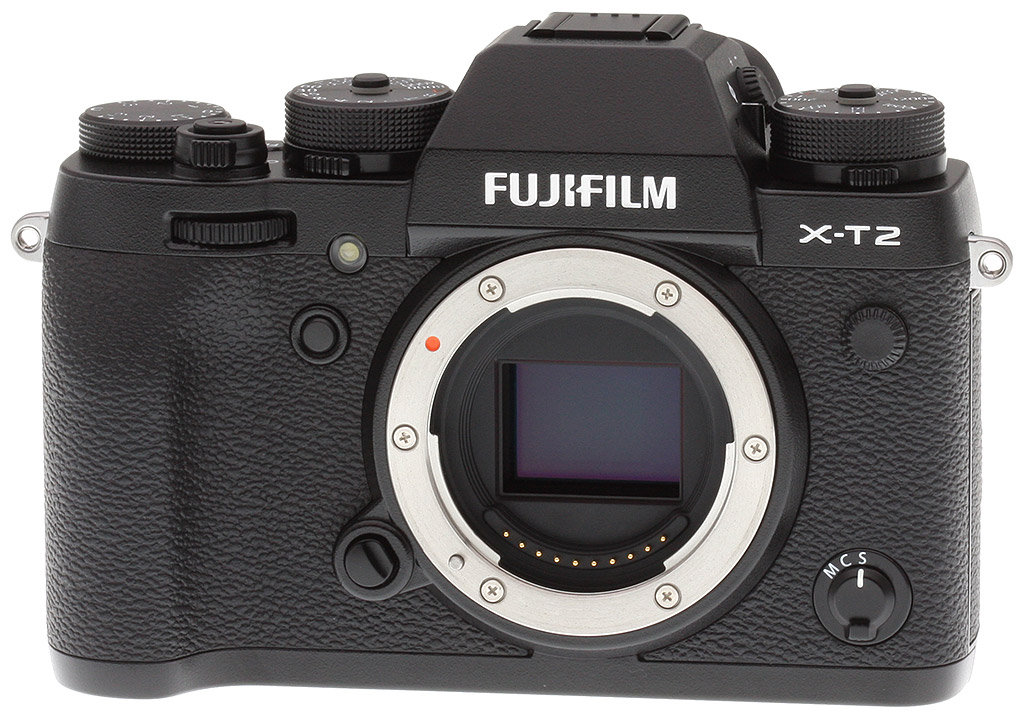
The bigger, better Fuji X-T1 successor is here! Say hello to the aptly-named Fujifilm X-T2. Sporting both cosmetic improvements as well as a variety of under-the-hood advancements -- a number of which are shared with the X-Pro2 -- the classic SLR-styled X-T2 packs in the performance, build quality and high-end features that should make both advanced enthusiasts and professionals alike take notice.
X-T2 gains "latest generation" X-Trans sensor capable of 4K video
Let's begin with the heart of the matter: the sensor. Like its X-Pro2 sibling, the X-T2 features a 24.3-megapixel X-Trans CMOS III APS-C image sensor. Up from a 16.3-megapixel X-Trans sensor in the X-T1, the X-T2 offers a sizeable jump in image resolving power. As with other X-Trans sensors, the X-T2's has the characteristic non-Bayer-style color filter array, which is designed to combat moiré and other aliasing artifacts without the use of an optical low-pass filter.
The X-T2 is the first X-series camera to offer 4K video recording. Offering Ultra HD 3840 x 2160 video at both 24p and 30p (as well as 25p for PAL regions), the X-T2 offers more for the multimedia creators out there than other Fuji cameras from years past. Further, the X-T2 can make use of its characteristic array of film simulation modes for video as well, including 4K video.

Stay sharp: more AF points & a focus on AF performance
Like the X-T1, this newer model sports on-chip phase-detect autofocus sensors, but the X-T2 features a dramatic increase in the overall number of AF points for its hybrid phase/contrast detect AF system: 325 points, to be exact. The central 169 points have phase-detect pixels, which cover approximately 40 percent of the sensor area, while nearly 65 percent of the total sensor offers contrast-detect AF. The number of Zone Focusing points has been increased as well, from 49 points originally in the X-T1 to a healthy 91, with 49 of those offering phase-detection (versus only 9 on the X-T1).
Thanks to the X-T2's updated image processor, the X-Processor Pro -- which it also shares with the X-Pro2 -- and new AF algorithms, the camera reportedly offers vastly improved autofocus performance. The X-T2 is said be able to focus in only 0.06 seconds in "Boost" mode, according to Fuji, which is down from the 0.08s claimed speed of the X-T1.

With the new focusing algorithms and faster processor, Fuji states that not only can the X-T2 focus better on small objects, low-contrast subjects and other items with very fine details, it also refocuses more frequently, thereby offering more accurate predictive AF for better subject tracking.
Fuji has focused (pun intended) on improving continuous AF performance in the X-T2. New and improved C-AF-specific algorithms are said to help with focus accuracy for tracking moving subjects. Users are now also given some C-AF fine-tuning options, where they can customize the C-AF performance parameters to suit the subject at hand, such as tracking acceleration and deceleration, how long the camera maintains focus on a subject, and a parameter called Focus Zone Characteristic. The camera also offers a set of five AF presets for various shooting scenarios, which sounds similar to Canon's various autofocus "Case" presets found in a number of their recent EOS models. Like the Canon system, users of the X-T2 can further tweak and customize these AF focus presets as needed.
Fuji states that the X-T2's contrast-detect capabilities have been improved as well. Sensor readout performance has been increased -- 2x compared to the X-T1 and earlier Fuji models -- which should increase AF speed. The camera is also said to be capable of focusing in very dim conditions, down to -3EV.

X-T2 offers greater responsiveness & faster shooting
In addition to focus performance improvements, Fuji says the X-T2 gets a number of other performance boosts across the board, including faster start-up time which is reportedly shortened to just 0.3 seconds from 0.5s on the X-T1.
The top mechanical shutter speed has increased from 1/4,000s to 1/8,000s, and X-sync speed has increased from 1/180s to 1/250s. Top electronic shutter speed remains at 1/32,000s.
Continuous shooting for both phase-detect single-AF and predictive C-AF with the mechanical shutter hits up to 8fps for full-resolution images, which is unchanged from the predecessor, but up to 14fps is possible with the electronic shutter. However, by adding on the accessory Vertical Power Booster Grip, you can increase the burst rate to 11fps with the mechanical shutter in Boost mode. Cycle time, shutter lag and viewfinder blackout time are also said to be improved in Boost mode when using the optional grip. (More on this Booster Grip later.)
Rated buffer depths are generous, at 83 JPEGs, 33 lossless compressed RAW or 27 uncompressed RAW frames at 8fps. At 11fps, the rated buffer depths are 73, 30 and 27 frames respectively, and at 14fps, buffer depths are 42, 28 and 25 frames respectively.
Although the electronic viewfinder in the X-T2 appears to use the same 0.48-inch 2.36 million dot OLED panel as before, along with the same manufacturer-rated 100% coverage, 0.77x magnification (35mm equivalent), 23mm eyepoint and -4 to +2m-1 diopter adjustment, it improves on the earlier camera in a number of ways.
The X-T2 now features a 5fps Live View mode to make tracking moving subjects easier. And there's also a bigger eyecup.
While viewfinder lag time is still specified at 0.005 seconds, the standard refresh rate of 60 frames per second can now be increased up to 100fps in Boost mode without the need for the battery grip. Fuji says a reduction in false color in the EVF is also a benefit of Boost mode.

High quality images but a seemingly limited ISO range
The image quality from the X-T1 was excellent, for both low and higher ISOs, from RAWs files and even JPEGs straight out of the camera. The native ISO range of 200-12,800, when compared to a number of recent cameras feels a bit limited, but the X-T2's ISO can be expanded down to ISO 100 and up to ISO 25,600 or 51,200 as selected in the menu for the camera's 'H' setting on the ISO dial.
As with other Fuji cameras, the X-T2 features a number of in-camera film simulations such as Provia, Velvia, and Astia, as well as new filter offerings like Classic Chrome and Acros, for rich, deep monochrome images. Of course, film simulations are for JPEG images only, but fear not RAW shooters; the X-T2 offers in-camera RAW processing, which let's you process files with image settings and film simulations as you want, all in-camera. As mentioned earlier, film simulations and filters are also available while shooting video, including in 4K.
Additional shooting options include interval timer shooting for in-camera timelapse photography, with intervals of one second up to a full 24 hours for an unlimited number of frames -- basically until your memory cards are full. The X-T2 also features a sweep panorama mode and a multiple exposure setting as well as a variety of bracketing options.

The X-T2 is more video-friendly, including 4K!
As stated earlier, the X-T2 now offers a more advanced array of video features, including 4K Ultra HD recording. According to Fuji, 4K video requires a UHS Speed Class 3 or faster memory card, and continuous 4K video recording is limited to just 10 minutes with the standard camera body. Add on the optional Vertical Power Booster Grip, however, which supports up to two additional battery packs, and continuous 4K recording can be extended to 30 minutes. The X-T2 also offers Full HD video up to 60p (as well as 50p/25p for PAL), with continuous recording limited to 15 minutes. 720p video is also available at up to 60p, for a maximum of 29 minutes.
Videos are recorded in MOV format using MPEG-4 AVC / H.264 compression with 48KHz linear PCM stereo sound. Bitrates are 100Mbps for 4K and Full HD, and 50Mbps for HD. 4K mode has a 1.17x crop, while Full HD and HD are 1.0x.
Other video features are fairly straightforward. Single-shot, continuous AF and manual focus are all available in movie mode, and with on-sensor phase-detect AF, focus adjustments is smooth and quick without much hunting. Stereo audio is available from either on-board microphones or through an external microphone via the newly-added standard 3.5mm mic jack. Audio levels are adjustable in 20 increments, and on-screen left and right channel audio levels can be displayed before and during recording.
One thing of note, that's also mentioned below in our Hands-On Tour, is that while the X-T2 body itself gains a standard 3.5mm mic jack, as opposed to the dual-function 2.5mm mic-and-remote jack of the X-T1, the X-T2 also supports a headphone jack...if you purchase the Vertical Power Booster Grip. If your workflow requires headphones to monitor audio during a shoot, be sure to budget for that grip.
The camera records video to either the SD card(s) or can output a clean video signal via HDMI, at up to 4K resolution, should you want to capture a video signal with an external recording device.

Standard issue Wi-Fi connectivity with remote control features
As with its predecessor, the X-T2 features built-in wireless connectivity for easy sharing and transferring of photos. Wireless connectivity is Wi-Fi-based (no NFC connectivity yet), so both Android and iOS have a level playing field in this regard. Using the Fuji companion app, users also have rather robust remote control shooting capabilities, including the ability to adjust exposure compensation, aperture, ISO, white balance, and self-timer functions.
Pricing & Availability
On sale since September 2016, the Fujifilm X-T2 body-only is priced at US$1,599.95 or in a kit bundled with the XF18-55mm lens for US$1,899.95. Both configurations include the EF-X8 flash.
In the Box
The Fujifilm X-T2 body-only retail kit (as reviewed) contains the following items:
- X-T2 Mirrorless Digital Camera (Body Only)
- NP-W126S Li-Ion Battery Pack
- BC-W126 Battery Charger
- EF-X8 Flash
- Body Cap for Fujifilm X-Mount Cameras
- X-T2 Cover Kit
- Shoulder Strap
- Strap Clip
- Clip Attaching Tool
- Protective Cover
- Vertical Power Booster Grip Connector Cover
- Sync Terminal Cover
- Limited 1-Year Warranty
- Camera instruction manual
Recommended Accessories
- Large capacity SDHC/SDXC memory card. 32GB should be a minimum, and we highly recommend a fast UHS-II card.
- At least one spare NP-W126S Li-Ion Battery Pack
- VPB-XT2 Vertical Power Booster Grip
- RR-90 Remote Release
- Fujinon lenses, particularly the XF 18-55mm f/2.8-4 R LM OIS Lens
- Medium camera bag
Optics
The Fujifilm X-T2 is sold body-only, so we have no "kit" lens results for you here. We do however present our viewfinder accuracy tests below.
Viewfinder Test Results
Accuracy
Good accuracy from the electronic viewfinder and LCD monitor.

The Fuji X-T2's electronic viewfinder and LCD monitor proved fairly accurate, both showing just over 98% coverage, though that's a bit short of Fuji's 100% spec.
The images above were taken from our standardized test shots. For a collection of more pictorial photos, see our Fujifilm X-T2 Photo Gallery .
Exposure
Color
Saturation & Hue Accuracy
Typical saturation levels with excellent hue accuracy.
 |
||||
|
ISO Sensitivity
|
||||
| 1600 | ||||
| 51200 | ||||
| In the diagram above, the squares show the original color, and the circles show the color that the camera captured. More saturated colors are located toward the periphery of the graph. Hue changes as you travel around the center. Thus, hue-accurate, highly saturated colors appear as lines radiating from the center. Mouse over the links to compare ISOs, and click for larger versions. | ||||
Saturation. The Fuji X-T2 produces images with fairly bright, pleasing colors using the standard film simulation (Provia) at default settings. The camera pushes most colors by small amounts, dark red, orange and dark green by moderate amounts, but undersaturates aqua by just a bit. Default mean saturation at the base ISO of 200 was 112.2% (12.2% oversaturated), which is close to average these days. You can of course tweak saturation and/or select a different film simulation mode if the default is not to your taste. Mean saturation fell only slightly as ISO increased, ending up at 107.8% at the maximum extended ISO. Most consumer digital cameras produce color that's more highly saturated (more intense) than found in the original subjects. This is simply because most people like their color a bit brighter than life.
Skin tones. The Fuji X-T2 rendered pleasant Caucasian skin tones that were just a touch on the pinkish side when white balance was adjusted to match the light source at base ISO, because of the moderate push in reds. Results were quite pleasing, though, with a healthy look. (Here, too, the X-T2's saturation and/or film mode options may come into play for some users, letting them tweak the color of skin tones if they find the default rendering a bit too saturated for their personal tastes. Note that Fujifilm claims their Astia film simulation produces "true-to-life" skin tones.) Where oversaturation is most problematic is on Caucasian skin tones, as it's very easy for these "memory colors" to be seen as too bright, too pink, too yellow, etc.
Hue. The Fuji X-T2 produced only a few color shifts relative to the ideal reproduction of hues, and has excellent hue accuracy overall, with less of an orange to yellow shift compared to its predecessor, and no yellow to green shift that we often see. The largest shift is in cyan toward blue, however we think it's a deliberate choice by camera engineers to produce better-looking sky colors. Average "delta-C" color error after correction for saturation at base ISO was only 3.36 (lower numbers are better), which is excellent, and hue accuracy remained better than average across the ISO range. Hue is "what color" the
color is.


Sensor
Exposure and White Balance
Indoors, incandescent lighting
Auto and Incandescent white balance were quite warm, but very good results with the Manual setting. Above average exposure compensation required.


Indoors, under typical incandescent lighting, color balance was quite warm using the Auto setting, with a fairly strong red/pink cast. Results with the Incandescent white balance setting were also very warm, with a strong yellow/orange cast. The Manual white balance setting was quite accurate, though. The Fuji X-T2 required +0.7 EV exposure compensation here, while most cameras need about +0.3 EV for this scene. Our test lighting for this shot is a mixture of 60 and 100 watt household incandescent bulbs, a pretty yellow light source, but a very common one in typical home settings here in the U.S.
Outdoors, daylight
Very good color and exposure outdoors.
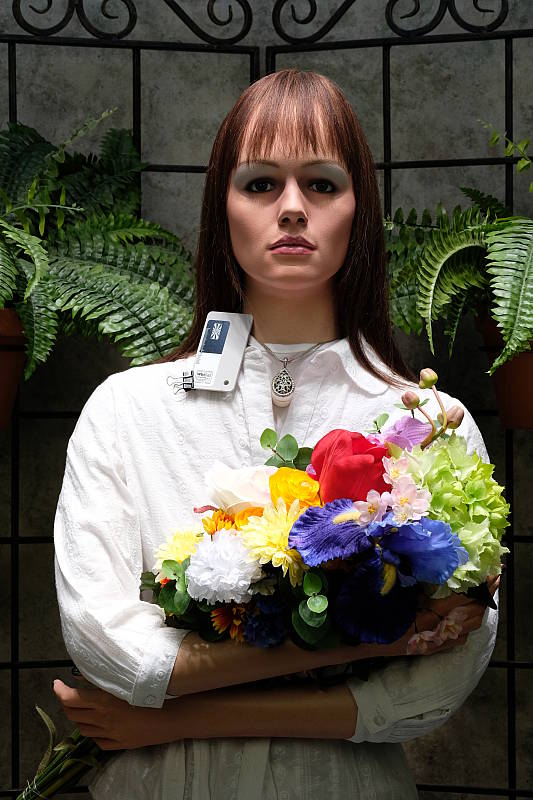
Outdoors, the Fuji X-T2 produced very nice color at default settings. The X-T2's default exposure was pretty good for our "Sunlit" Portrait shot when using Manual white balance, just a bit hot (interestingly Auto and Daylight white balance weren't quite as bright even though WB was all that was changed). This is much better than average exposure accuracy, though, as most cameras need +0.7 EV to keep the face bright for this shot, but it did lead to a lot of blown highlights in the mannequin's shirt and flowers. Skin tones were pleasing, with a healthy-looking pinkish cast that's not too overdone with Manual white balance, and Auto wasn't much different (just a touch cooler though as mentioned not quite as bright for some reason). The Fuji X-T2 did a great job with our high-contrast Far-field shot, clipping very few highlights at default exposure, however there are some very dark shadows. Deep shadows generally contain good detail, but are a bit noisy, posterized and are abruptly clipped to black. Color was very pleasing with the Auto white balance setting. See the "Extremes: Sunlit..." section below to see how the X-T2's Highlight/Shadow Tone and D-Range settings deal with harsh lighting like this.
See full set of test images with explanations
See thumbnails of all test and gallery images
Resolution
~2,900 lines of strong detail from JPEGs, about the same from ACR converted RAW.




Our in-camera JPEG resolution chart shot revealed sharp, distinct line patterns up to just over 2,900 lines per picture height in the horizontal direction, and to just over 2,900 lines per picture height in the vertical direction as well. Some may argue for higher numbers, but lines begin to merge and are not very distinct at higher resolutions. Complete extinction of the pattern didn't occur before the 4,000 line limit of our chart in both directions. Adobe Camera Raw wasn't able to extract any additional resolution, however it did produce lower amounts of luma moiré near the limits of resolution. As expected, ACR produced low amounts of chroma moiré even though it normally produces higher from Bayer-filtered cameras, thanks to the X-Trans sensor's irregular color filter pattern. Use these numbers to compare with other cameras of similar resolution, or use them to see just what higher resolution can mean in terms of potential detail.
See full set of test images with explanations
See thumbnails of all test and gallery images
Sharpness & Detail
Slightly soft images at default settings, with only minor edge-enhancement artifacts appearing around high-contrast subjects. Mild noise suppression is visible in the shadows at base ISO.


Sharpness. The Fuji X-T2 captures slightly soft images by default, though there are still some minor edge enhancement artifacts visible along high-contrast edges such as the relatively thin sharpening "halos" around the lines and letters of the bottle label above left. Default sharpening seems to be a touch stronger than some prior X-Trans models, but still quite conservative compared to most cameras. Edge enhancement creates the illusion of sharpness by enhancing colors and tones right at the edge of a rapid transition in color or tone.
Detail. The crop above right shows low levels of luminance noise suppression, as the darker areas of the model's hair still show a very good amount of detail. Some individual strands do merge together when local contrast is low and as shadows deepen, but performance here is excellent for an APS-C sensor. The Fuji X-T2 also does a great job at keeping chrominance noise low, better than most Bayer-filtered cameras, but it can struggle to resolve fine detail or accurate color in certain fine subject matter because of its unique color filter arrangement. Noise-suppression systems in digital cameras tend to flatten-out detail in areas of subtle contrast. The effects can often be seen in shots of human hair, where the individual strands are lost and an almost "watercolor" look appears.
RAW vs In-Camera JPEGs
As noted above, the Fuji X-T2 produces slightly soft JPEG images but with very good detail at default settings. Let's see how an Adobe Camera Raw conversion with relatively strong unsharp mask sharpening compares.
|
Base ISO (200)
|
|
 |
 |
 |
 |
 |
 |
|
Camera JPEG, defaults
|
RAW via Adobe Camera Raw
|
In the table above, we compare an in-camera JPEG taken at base ISO (200) using default noise reduction and sharpening (on the left) to the matching RAW file converted with Adobe Camera Raw 9.1 via DNG Converter 9.8 using default noise reduction with quite strong but tight unsharp masking applied in Photoshop. (We've found that the X-T2's RAW files are softer than previous generation Fuji X-series models, at least when converted in ACR, so we needed to use fairly strong sharpening to get images to look reasonably crisp. In this case, we used USM of 400%, radius of 0.3 pixels, and a threshold of 0.)
Adobe Camera Raw does a very good job here, but doesn't extract significantly more detail than the camera does, though contrast and subtle detail in the our red-leaf fabric is noticeably better. There is a touch more detail in the mosaic crop and perhaps slightly more accurate colors, but nothing really to write home about. The strong sharpening required to keep images reasonably sharp does tend to exacerbate noise, though, as can be seen in the background of the first set of crops, however that can be mitigated by experimenting with the sharpening settings, or using some luminance noise reduction. Bottom line: Fuji's in-camera processing is excellent, and there isn't much advantage to shooting RAW in terms of detail reproduction, at least with Adobe Camera Raw and at low ISOs.
ISO & Noise Performance
Excellent high ISO performance for an APS-C sensor.
|
Default High ISO Noise Reduction
|
 |
 |
 |
| ISO 100 | ISO 200 | ISO 400 |
 |
 |
 |
| ISO 800 | ISO 1,600 | ISO 3,200 |
 |
 |
 |
| ISO 6,400 | ISO 12,800 | ISO 25,600 |
 |
||
| ISO 51,200 | ||
The Fuji X-T2's images are quite clean with good detail up to ISO 800, with low, fine-grained luma noise and almost no chroma noise. At ISO 1,600, noise reduction efforts are a little stronger as you'd expect, but fine detail is still very good with almost no chroma noise. ISO 3,200 shows a stronger increase in noise and blurring, but fine detail remains pretty good, again with almost no chroma noise. At ISO 6,400 luminance noise becomes more noticeable along with noise reduction artifacts, though noise still fairly fine-grained, and chroma noise is still well-controlled. Image quality drops off more rapidly at ISO 12,800 and above, with progressively more visible noise grain, stronger blurring and more noticeable noise reduction artifacts. Fine detail at ISOs 25,600 and 51,200 is quite soft with heavy luminance noise accentuated by sharpening artifacts, as well as chrominance noise in the form of large but fairly subtle yellow and purple blotches. Still, noise performance in high ISO JPEGs is excellent, among the best we've seen from an APS-C sensor.
We're pixel-peeping to the extreme here though, which isn't always representative of what you see in prints. As always, see the Print Quality section below for maximum recommended print sizes at each ISO.
Extremes: Sunlit, dynamic range and low light tests
Mediocre dynamic range in JPEGs at default settings. Very good low-light performance.


Sunlight. The Fuji X-T2 struggled with the harsh lighting of this test at default settings at the base ISO of 200 (which should be best case). We preferred the default exposure overall, because the exposure at +0.3 EV exposure compensation was too bright with far too many clipped highlights. Even at default exposure (0 EV), quite a few highlights were blown in the mannequin's shirt and flowers. There are quite a few dark shadows as well, and very deep shadows are somewhat posterized and clip to black rather abruptly, likely in an attempt to hide noise. Overall, the Fuji X-T2's JPEGs performed below average here without any highlight and shadow adjustments, nor any dynamic range enhancement (see below).
The good news is the blown highlights and clipped shadows in the above test scene were easily recoverable in the RAF RAW files, even at +0.7 EV, so dynamic range captured in the X-T2's RAW files appears to be excellent.
Because digital cameras are more like slide film than negative film (in that they tend to have a more limited tonal range), we test them in the harshest situations to see how they handle scenes with bright highlights and dark shadows, as well as what kind of sensitivity they have in low light. The shot above is designed to mimic the very harsh, contrasty effect of direct noonday sunlight, a very tough challenge for most digital cameras. (You can read details of this test here.)
Contrast Adjustment
The Fuji X-T2 does not offer a traditional contrast adjustment. Instead, it offers Shadow and Highlight Tone settings, which let you adjust contrast in highlights and shadows independently. There are seven settings each on the X-T2, ranging from -2 to +5.
| Far-field Highlight and Shadow Tone Comparison | |||||||
 |
|||||||
|
Highlight:
|
-2 | -1 | 0 | +1 | +2 | +3 | +4 |
|
Shadow:
|
-2 | -1 | 0 | +1 | +2 | +3 | +4 |
Shadow and Highlight Tone. Above you can see the effects the seven settings for Highlight and Shadow Tone control on our high-contrast Far-field shot. Mouse over the links to load the associated thumbnail and click on the links to visit the full resolution image.
Note how the Highlight settings mainly affect the brighter portions of the image, while the Shadow settings impact the darker areas. Both settings can be used simultaneously, giving more flexibility to tune the tone curve at both ends compared to a single contrast setting.


D-Range is Fuji's name for their dynamic range enhancement technology. D-Range designed to preserve hot highlights, by exposing for highlights and then boosting mid-tones and shadows. There are three levels: DR100 100% (default), DR200 200%, DR400 400%, as well as an Auto mode which can select DR100 or DR200. DR200 is available at ISO 400 and above, while DR400 is available at ISO 800 and above, so all the examples above were taken at ISO 800. Mouse over the links above to load the corresponding thumbnail image. Click on the links to get to the full resolution images.
As you can see the images above, the Fuji X-T2's higher D-Range settings were effective at toning down highlights in our Far-field shot. As they say, though, there's no free lunch, because improved highlight retention comes at a cost of increased noise. This is because the camera's sensitivity needs to be raised to take advantage of the D-Range feature, though that's not much of penalty because the X-T2's high ISO performance is so good. (Note that the Fuji X-T2 does not offer a multi-shot in-camera HDR mode.)
Dynamic Range Analysis
A key parameter in a digital camera is its Dynamic Range, the range of brightness that can be faithfully recorded. At the upper end of the tonal scale, dynamic range is dictated by the point at which the RGB data "saturates" at values of 255, 255, 255. At the lower end of the tonal scale, dynamic range is determined by the point at which there ceases to be any useful difference between adjacent tonal steps. Note the use of the qualifier "useful" in there: While it's tempting to evaluate dynamic range as the maximum number of tonal steps that can be discerned at all, that measure of dynamic range has very little relevance to real-world photography. What we care about as photographers is how much detail we can pull out of the shadows before image noise becomes too objectionable. This, of course, is a very subjective matter, and will vary with the application and even the subject matter in question. (Noise will be much more visible in subjects with large areas of flat tints and subtle shading than it would in subjects with strong, highly contrasting surface texture.)
What makes most sense then, is to specify useful dynamic range in terms of the point at which image noise reaches some agreed-upon threshold. To this end, Imatest computes a number of different dynamic range measurements, based on a variety of image noise thresholds. The noise thresholds are specified in terms of f-stops of equivalent luminance variation in the final image file, and dynamic range is computed for noise thresholds of 1.0 (low image quality), 0.5 (medium image quality), 0.25 (medium-high image quality) and 0.1 (high image quality). For most photographers and most applications, the noise thresholds of 0.5 and 0.25 f-stops are probably the most relevant to the production of acceptable-quality finished images, but many noise-sensitive shooters will insist on the 0.1 f-stop limit for their most critical work. A full discussion of all the data Imatest produces is really beyond the scope of this review: Visit the Imatest website for details of what the program measures, how it performs its computations, and how to interpret its output.
Note: Recently, we've switched to using DxOMark's dynamic range results because some cameras were exceeding what could measured with a Stouffer T4110 step chart, but DxOMark does not publish results for Fuji X-Trans sensors, probably because they don't support RAW files from those sensors which require more complex demosaicing than standard Bayer-filtered models. So, here we're showing our Imatest results at base ISO (best case). Note that Imatest's Quality Level threshold of Low corresponds to DxOMark's dynamic range signal-to-noise (SNR) threshold of 1.0.
The Fuji X-T2 shares its sensor with the X-Pro2, so here we present our Imatest dynamic range test results from the X-Pro2:
 JPEG. The graph at right (click for a larger version) was generated using Imatest's dynamic range analysis for an in-camera Fuji X-Pro2 JPEG file with a nominally-exposed density step target (Stouffer T4110). At default settings and native base ISO of 200, the results show 9.04 f-stops of total dynamic range, however the range at the "Low" quality threshold is still 9.04 stops and at the "High" threshold, it drops down to only 7.0 stops. These scores are below average for an APS-C model and confirm the mediocre dynamic range in JPEGs mentioned previously, but keep in mind we didn't enable any of the Fuji X-Pro2's dynamic range enhancement features for this test. The gaps in the density response chart at the low end also reflect the posterization seen in very deep shadows of the X-Pro 2's JPEGs.
 RAW. The graph at right is from the same Stouffer T4110 stepchart image captured as a raw (.RAF) file, processed with Adobe Camera Raw using the Auto setting, then tweaked from there for best results. As can be seen, the score at the highest quality level increased significantly compared to the in-camera JPEG, from 7.0 to 9.22 f-stops, and total dynamic range improved even more from 9.04 to 13.1 f-stops. At the "Low" quality level (matching DxOMark's threshold), total dynamic range is still available (13.1 f-stops). These results are very similar to the Imatest scores Fuji's previous generation 16-megapixel X-Trans sensor scored. This is good performance for an APS-C sensor, if not quite as good as the best which can exceed 14 f-stops, but keep in mind these results are not normalized to a standard print size like the scores we use from DxOMark, which would give a higher resolution 24-megapixel sensor like the X-Pro 2's a noise advantage over the previous 16-megapixel sensor when normalized.
| 1 fc 11 lux |
1/16 fc 0.67 lux |
1/16 fc No NR |
|
|---|---|---|---|
| ISO 200 |
 1.3s, f2.8 |
 20s, f2.8 |
 20s, f2.8 |
| ISO 3200 |
 1/13s, f2.8 |
 1.3s, f2.8 |
 1.3s, f2.8 |
| ISO 12800 |
 1/50s, f2.8 |
 0.3s, f2.8 |
 0.3s, f2.8 |
Low Light. The X-T2 performed very well in our low light tests, able to capture bright images down to the lowest light level we test at. The darkest level equates to about 1/16 the brightness of average city street lighting at night, so the Fuji X-T2 should be able to take well-exposed photos in almost any environment in which you can see well enough to walk around in.
Using the default high ISO noise reduction setting, noise is quite low at ISO 200 and very well-controlled at ISO 3200. The maximum native ISO of 12,800 is of course noisier, but the noise "grain" is very fine and the images are still very usable. (Apologies for the blurring in some of the images; we believe a tripod leg was bumped during some exposures and we had to return the camera before we could reshoot this series.)
We didn't notice any significant issues with hot pixels, heat blooming or banding (fixed pattern noise).
Automatic color balance performed well in low light, just a touch cool at one foot-candle shifting to a bit warmer at 1/16 foot-candle.
Low Light AF. The Fuji X-T2's hybrid autofocus system was able to focus in extremely low light. With our low-contrast AF target, the camera was able to focus down to well below the 1/16 foot-candle light level unassisted with an f/2.8 lens, down to about -4.0 EV. With our new high-contrast AF target, the X-T2 was able to autofocus down to about -4.5 EV unassisted, which is excellent. The Fuji X-T2 also has a built AF assist lamp, which lets it autofocus in complete darkness as long as the subject is in range and has sufficient contrast.
How bright is this? The one foot-candle light level that this test begins at roughly corresponds to the brightness of typical city street-lighting at night. Cameras performing well at that level should be able to snap good-looking photos of street-lit scenes.
NOTE: This low light test is conducted with a stationary subject, and the camera mounted on a sturdy tripod. Most digital cameras will fail miserably when faced with a moving subject in dim lighting. (For example, a child's ballet recital or a holiday pageant in a gymnasium.) Thanks to its larger sensor and Hybrid AF, compact system cameras like the Fuji X-T2 tend to do better than point & shoots, but you still shouldn't expect a quick autofocus lock with moving subjects.
Output Quality
Print Quality
Excellent 30 x 40 inch prints at ISO 100/200; a good 13 x 19 inch print at ISO 3200; and a good 4 x 6 inch print at ISO 51,200.
 ISOs 100 and 200 deliver excellent prints at 30 x 40 inches and higher, until you run out of available resolution. These prints at base and extended low ISO display very rich color and terrific fine detail. They are in fact among the most natural-looking prints we've seen from any camera we've tested.
ISO 400 yields an outstanding print at 24 x 36 inches while still preserving top-notch fine detail. Wall display prints at this ISO are fine at 30 x 40 inches as well.
ISO 800 prints are surprisingly good at 24 x 36 inches. They're not quite as tack sharp as the ones at ISO 400, but they still very much pass our "good" rating. For most critical printing purposes we recommend a reduction to 20 x 30 inches here for ensuring maximum fine detail.
ISO 1600 images at 20 x 30 inches are quite good for this ISO sensitivity setting. Close examination reveals a mild trace of noise in flatter areas of our test target, but fine detail and full color reproduction are still very good here.
ISO 3200 produces a 16 x 20 inch print that almost passes our good standard. Similar issues exist as found in the 20 x 30 inch print at ISO 1600, but there is now a noticeable softening in the red channel in general, and a trace more noise in a few areas of our target. While that size is certainly usable for less critical applications, we'll call the 13 x 19 inch prints good here.
ISO 6400 is the common turning point for image quality in most APS-C cameras these days, but the X-T2 fares about as well here as the best we've seen, delivering a very nice 11 x 14 inch print with virtually no discernible issues or noise reduction artifacts. For such a lofty ISO this is a nice, large and vibrant print.
ISO 12,800 pushes the envelope for what an APS-C camera can achieve at this sensitivity. Like its rangefinder brother the X-Pro2, the X-T2 can deliver an 8 x 10 inch print that easily passes our good seal of approval. And just how big a deal is that? Let's just say you won't find many other cameras delivering that print size at this ISO without stepping up to a full-frame model.
ISO 25,600 delivers a very good 5 x 7 inch print with good colors and good fine detail as well, with virtually no noise present anywhere in the image. Once again, this really is quite a feat for an APS-C camera.
ISO 51,200 prints are quite usable at 4 x 6 inches, making the entire ISO range from the X-T2 usable in the print quality department. (No wasted ISO settings are provided here!)
The Fuji X-T2 was honored on our site with a Camera of Distinction award for the Best Overall cameras from 2016, and with good reason. We now know that its print quality more than bolsters this honor, and we're frankly pretty amazed by just how well it performs here. Only a precious few APS-C cameras can match it in the print quality department, while none thus far can exceed it for print sizes as ISO rises nor the sheer quality of the printed imagery.
The images above were taken from our standardized test shots. For a collection of more pictorial photos, see our Fujifilm X-T2 Photo Gallery .
Not sure which camera to buy? Let your eyes be the ultimate judge! Visit our Comparometer(tm) to compare images from the Fujifilm X-T2 with those from other cameras you may be considering. The proof is in the pictures, so let your own eyes decide which you like best!
Performance
Timing and Performance
Excellent performance in the lab.
| Startup/Play to Record | ||
|---|---|---|
| Power on |
~1.0 second
|
Time it takes to turn on and capture a shot. |
|
Play to Record, |
~1.0 second
|
Time until first shot is captured. |
Power on to first shot was slightly faster than average for a mirrorless camera, but not as fast as most DSLRs. It's also difficult to accurately time, as there is a shutter pre-press penalty. Play to Record wasn't bad, but also had a pre-press penalty.
| Shutter Response (Lag Time) | ||
|---|---|---|
|
Full Autofocus, |
0.053 second
|
Time from fully pressing shutter button to image capture, with the lens already at the proper focal distance setting. (All timing performed with the Fujinon 60mm f/2.4 Macro lens. ) |
|
Full Autofocus |
0.196 second
|
Time from fully pressing shutter button to image capture. (Bundled flash in Auto mode.) |
| Manual Focus |
0.052 second
|
For most cameras, shutter lag is less in manual focus than autofocus, but usually not as fast as when the camera is "prefocused". |
|
Prefocused |
0.033 second
|
Time to capture, after half-pressing and holding shutter button. |
The Fuji X-T2's full autofocus shutter lag was much faster than average for a mirrorless camera in our lab tests. The Fuji X-T2 produced a full-autofocus shutter lag (with the subject at a fixed distance) of only 0.053 second using Single Point AF mode (center) with the Fujinon 60mm f/2.4 Macro lens. That's faster than most pro DSLRs! Enabling the flash in TTL Auto mode increased full AF shutter lag to 0.196 second due to pre-flash metering, but that's still very fast.
Manual focus shutter lag was just slightly lower than full AF without the flash, with an average of only 0.052 second. Prefocused shutter lag was very low at only 0.033 second. Excellent performance.
Note: Mechanical shutter and Boost mode were used for these measurements unless otherwise noted.
To minimize the effect of different lens' focusing speed, we test AF-active shutter lag with the lens already set to the correct focal distance.
| Cycle Time (shot to shot) | ||
|---|---|---|
| Single Shot mode |
< 0.3 second
|
Time per shot, averaged over a few frames (we no longer test for buffer depths in single-shot mode). |
|
Single Shot mode |
< 0.3 second
|
Time per shot, averaged over a few frames (we no longer test for buffer depths in single-shot mode). |
| Early shutter |
Yes
(Intermittent) |
Some cameras don't snap another shot if you release and press the shutter too quickly in Single Shot mode, making "No" the preferred answer. |
|
Continuous High |
0.12 second
(8.16 fps); 55 frames total; 5 seconds to clear* |
Time per shot, averaged over buffer length of 55 frames. Then slows to an average of 0.20s or 5.03 fps when buffer is full. |
| Continuous High |
0.12 second
(8.16 fps); 48 frames total; 4 seconds to clear* |
Time per shot, averaged over buffer length of 48 frames. Then slows to an average of 0.20s or 5.06 fps when buffer is full. |
|
Continuous High |
0.12 second
(8.11 fps); 35 frames total; 7 seconds to clear* |
Time per shot, averaged over buffer length of 35 frames. Then slows to an average of 0.25s or 4.07 fps when buffer is full. |
|
Continuous High |
0.07 second
(13.66 fps); 32 frames total; 6 seconds to clear* |
Time per shot, averaged over buffer length of 32 frames. Then slows to an average of 0.22s or 4.55 fps when buffer is full. |
| Continuous High |
0.07 second
(13.66 fps); 26 frames total; 5 seconds to clear* |
Time per shot, averaged over buffer length of 26 frames. Then slows to an average of 0.20s or 4.97 fps when buffer is full. |
|
Continuous High |
0.07 second
(13.64 fps); 25 frames total; 7 seconds to clear* |
Time per shot, averaged over buffer length of 25 frames. Then slows to an average of 0.29s or 3.45 fps when buffer is full. |
| Flash Recycling |
3.2 seconds
|
Flash at maximum output (bundled flash). |
|
*Note: Buffer clearing times measured with a 64GB Lexar Pro 2000x UHS-II SDXC card. Slower cards will produce correspondingly slower clearing times. Slow cards may also limit length of bursts in continuous mode. ISO sensitivity and noise reduction settings can also affect cycle times and burst mode performance.
|
||
Single-shot cycle times were so fast with either the mechanical or electronic shutter that they were difficult to accurately measure as they depend on the tester's dexterity and ability to maintain an optimum rhythm, especially given the intermittent pre-press penalty. (Note that we no longer test single-shot mode with just RAW files, as the results are usually somewhere in between JPEG and RAW+JPEG.)
The Fuji X-T2's Continuous High burst mode speed with the mechanical shutter was quite good, at just over 8.1 frames per second no matter the file type, slightly exceeding Fuji's spec. With the optional VPB-XT2 grip and two batteries, Fuji rates the maximum frame rate with mechanical shutter at 11 fps, however we weren't able to test that in the lab.
Fuji rates the X-T2's burst speed at 14 frames per second using electronic shutter. In the lab, the camera managed just over 13.6 fps, which is pretty close to the spec and amazingly fast.
Full-resolution buffer depths were excellent at 8 fps with our fast 64GB Lexar Pro 2000x UHS-II SDXC card, with buffer depths of 55 best quality JPEGs, 48 losslessly compressed RAW files, and 35 RAW+JPEG files before the camera slowed in our tests. Buffer-full rates weren't bad either, at about 5 fps for JPEG or RAW files, and about 4 fps for RAW+JPEG.
Unsuprisingly, buffer depths fell in the faster 14 fps electronic shutter mode, but were still quite good at 32, 26, and 25 frames respectively.
Buffer clearing was quick, taking only 4 to 7 seconds to clear after a max-length burst depending on the mode and file type, and the camera lets you adjust settings as well as view just-shot images while the buffer is clearing.
Recycling the bundled flash after full-power discharges took an average of 3.2 seconds, which is good.
Bottom line, the Fuji X-T2's performance is excellent with a decent startup time, super fast autofocus, very low shutter lag, fast cycle times, and very fast bursts modes with generous buffer depths and fast buffer clearing when using a fast UHS-II card.
Battery
Battery Life
Fair battery life for a mirrorless camera.
| Still Capture with XF 35mm f/1.4 lens |
Battery Life, Shots Normal / Boost |
|---|---|
|
Electronic Viewfinder
|
330 / 200
|
|
LCD Monitor
|
340 / 260
|
The Fuji X-T2 uses a custom NP-W126S (or lower capacity NP-W126) rechargeable lithium-ion battery pack for power, and comes with both a single battery and a dedicated charger, although in-camera charging via USB is also supported.
Fuji provides battery life numbers for when using the electronic viewfinder and LCD monitor (without using the bundled flash), as well as for Normal and Boost modes. CIPA-rated battery life is fair for a high-performance mirrorless camera, but no where near a typical prosumer DSLR. As is usually the case, we strongly recommend at least getting a second battery for your X-T2, and suggest you consider purchasing the optional VPB-XT2 battery grip. The grip can roughly triple battery life by utilizing two batteries in addition to one in the body.
The table above shows the number of shots the camera is capable of (on a fully-charged rechargeable battery), based on CIPA battery-life and/or manufacturer standard test conditions.
(Interested readers can find an English translation of the CIPA DC-002 standards document here. (180K PDF document))
Image Quality
Below are crops from our laboratory Still Life target comparing Fuji X-T2 image quality to its predecessor, the X-T1, as well as against several recent premium interchangeable lens cameras: the Nikon D500, Olympus E-M1 II, Sony A6500 and Sony A7 II. The Sony A7 Mark II is the only full-frame model in this comparison and doesn't really compare performance-wise, however we decided to include it because at the time of writing it is selling for less than the X-T2, and because of Fujifilm's claim that their X-Trans sensors produce image quality that can rival full-frame Bayer-filtered sensors.
NOTE: These images are from best quality JPEGs straight out of the camera, at default settings including noise reduction and using the camera's actual base ISO (not extended ISO settings). All cameras in this comparison were shot with our very sharp reference lenses. Clicking any crop will take you to a carrier page where you can click once again to access the full resolution image as delivered straight from the camera. For those interested in working with the RAW files involved, click these links to visit each camera's respective sample image thumbnail page: Fuji X-T2, Fuji X-T1, Nikon D500, Olympus E-M1 II, Sony A6500, and Sony A7 II -- links to the RAW files appear beneath those for the JPEG images, wherever we have them. And remember, you can always go to our world-renowned Comparometer to compare the Fuji X-T2 to any camera we've ever tested!
Fujifilm X-T2 vs Fujifilm X-T1 at Base ISO
 |  |
 |  |
 |  |
Fujifilm X-T2 at ISO 200 | Fujifilm X-T1 at ISO 200 |
The 24-megapixel Fuji X-T2 clearly resolves more detail in most areas than the 16-megapixel X-T1, but its predecessor does better with the subtle detail in our tricky red-leaf fabric. (The X-T2 manages to resolve some of the fine thread pattern which the X-T1 doesn't, interfering with the leaf pattern, as well as producing lower contrast.) Noise levels appear comparable here at base ISO, just slightly lower from the X-T1. Interestingly, colors are more pleasing from the X-T2, as the X-T1 exhibits slight shifts from orange to yellow and yellow to green. Default sharpening appears to be a little higher from the X-T2 as well. | |
Fujifilm X-T2 vs Nikon D500 at Base ISO
|  |
|  |
|  |
Fujifilm X-T2 at ISO 200 | Nikon D500 at ISO 100 |
Here we compare the Fuji X-T2 to the 20.7-megapixel APS-C Nikon D500 at base ISO. (The Nikon D500 is more expensive than the X-T2, but represents the current state-of-the-art in high performance APS-C DSLRs.) The 24-megapixel X-T2 does resolve a bit more more detail than the Nikon, however the D500 produces a crisper image with higher contrast which is especially noticeable in the red-leaf swatch, though sharpening halos are definitely more evident. Noise levels are low from both cameras here at base ISO, however keep in mind the higher base ISO of the Fuji. Both cameras offer great color, though the Fuji's is more accurate overall. | |
Fujifilm X-T2 vs Olympus E-M1 II at Base ISO
|  |
|  |
|  |
Fujifilm X-T2 at ISO 200 | Olympus E-M1 II at ISO 200 |
Above we compare the Bayer-filtered Micro Four Thirds Olympus E-M1 Mark II to the X-Trans-filtered APS-C X-T2. You would think the 24-megapixel X-T2 would have a noticeable resolution advantage over the 20-megapixel E-M1 II here, but both cameras have similar resolutions on the vertical axis (4000 vs 3888 pixels) which is how this scene is framed, so the resolution difference is very minor and mostly boils down to different demosaicing algorithms and processing. Luminance noise appears higher from the Fuji, but chrominance noise is higher from the Olympus. The Olympus produces a crisper image with higher contrast, though default sharpening also appears to be higher. The X-T2 resolves more fine detail in our red-leaf swatch even though contrast is lower, while the E-M1 II renders it smoother but with less detail, however the Olympus does better with thread pattern in the pink fabric. | |
Fujifilm X-T2 vs Sony A6500 at Base ISO
|  |
|  |
|  |
Fujifilm X-T2 at ISO 200 | Sony A6500 at ISO 100 |
Here we compare APS-C sensors of the same pixel count and aspect ratio, with the main difference being X-Trans vs Bayer filtering, and of course in-camera processing. The Sony produces a much crisper, sharper image yet its sharpening algorithm produces less noticeable halos around high-contrast edges. Contrast is also higher from the Sony, especially in the red-leaf swatch, however it does contain obvious moiré patterns while the Fuji image does not. Luma noise is a bit higher from the Fuji, but again, chroma noise is much lower. Color is more pleasing from the Fuji, with less orange to yellow and yellow to green shift, but the Sony preserves more of the subtle coloration caused by offset printing in the mosaic label. | |
Fujifilm X-T2 vs Sony A7 II at Base ISO
|  |
|  |
|  |
Fujifilm X-T2 at ISO 200 | Sony A7 II at ISO 100 |
Above we compare the 24-megapixel APS-C X-T2 to the 24-megapixel full-frame Sony A7 II. This isn't really a fair comparison, but the A7 II body is currently available for less than the X-T2 and Fuji has claimed their X-Trans APS-C sensors offer image quality comparable to full-frame cameras. Results are similar to the A6500 comparison with the Sony producing a sharper, crisper image but with lower noise and even more noticeable moiré patterns in the red-leaf swatch. Again, the Sony reproduces some of the offset printing colors in the mosaic crop and resolves much more of the thread pattern in the pink fabric, but overall color is warmer and generally more pleasing from the Fuji. | |
Fujifilm X-T2 vs Fujifilm X-T1 at ISO 1600
 |  |
 |  |
 |  |
Fujifilm X-T2 at ISO 1600 | Fujifilm X-T1 at ISO 1600 |
The resolution advantage of the X-T2 is still evident in most areas at ISO 1600 while producing better color and similar noise levels, but the X-T1 continues to do a better job rendering our tricky red-leaf fabric. | |
Fujifilm X-T2 vs Nikon D500 at ISO 1600
|  |
|  |
|  |
Fujifilm X-T2 at ISO 1600 | Nikon D500 at ISO 1600 |
Here at ISO 1600, the Nikon's rendering is much softer than it was at base ISO, while the X-T2's is only slightly softer, and the Fuji continues to resolve more detail in most areas. While contrast is still higher in the red-leaf swatch, the D500's default noise reduction has blurred away more fine detail than the X-T2. Luminance noise is however a bit higher from the X-T2, which is to be expected due to its smaller pixels. | |
Fujifilm X-T2 vs Olympus E-M1 II at ISO 1600
|  |
|  |
|  |
Fujifilm X-T2 at ISO 1600 | Olympus E-M1 II at ISO 1600 |
The Fuji X-T2 starts to pull away from the Olympus E-M1 II here at ISO 1600, with much lower chroma noise and fewer noise reduction artifacts, though luma noise is higher and coarser. While contrast and sharpness are a bit better from the Olympus, the E-M1 II's default noise reduction starts to distort and smear subtle detail in the mosaic crop and especially in the red-leaf fabric. | |
Fujifilm X-T2 vs Sony A6500 at ISO 1600
|  |
|  |
|  |
Fujifilm X-T2 at ISO 1600 | Sony A6500 at ISO 1600 |
The Sony A6500 continues to produce a sharper, crisper, more contrasty image at ISO 1600, and the offset printing coloration in the mosaic crop is no longer present in the A6500 image, suppressed by the Sony's high ISO noise reduction. The Sony also appears to do better in the red-leaf swatch, however much of the fine detail is distorted and false. The A6500 definitely does better with detail in the pink fabric, though, however the X-T2 continues to deliver better overall color. | |
Fujifilm X-T2 vs Sony A7 II at ISO 1600
|  |
|  |
|  |
Fujifilm X-T2 at ISO 1600 | Sony A7 II at ISO 1600 |
Unsurprisingly, the full-frame Sony A7 II out-performs the X-T2 here at ISO 1600, with a cleaner, punchier, more detailed image overall, although moiré patterns and somewhat heavy-handed noise reduction interfere with subtle detail in the red-leaf swatch. | |
Fujifilm X-T2 vs Fujifilm X-T1 at ISO 3200
 |  |
 |  |
 |  |
Fujifilm X-T2 at ISO 3200 | Fujifilm X-T1 at ISO 3200 |
Similar to the comparison of these two siblings at ISO 1600, the X-T2 still manages to resolve more high-contrast detail and renders more pleasing colors, but the X-T1 does noticeably better in our difficult red-leaf swatch, while producing slightly lower luma noise levels. Both cameras produce remarkably low chroma noise for this ISO. | |
Fujifilm X-T2 vs Nikon D500 at ISO 3200
|  |
|  |
|  |
Fujifilm X-T2 at ISO 3200 | Nikon D500 at ISO 3200 |
Once again, we see the Fuji X-T2 hold onto more detail than the Nikon D500 here at ISO 3200, though the D500 continues to produce higher contrast with more obvious sharpening halos. Luma noise levels are again a bit higher from the X-T2 but chroma noise is lower, and overall the X-T2 produces the better image here. | |
Fujifilm X-T2 vs Olympus E-M1 II at ISO 3200
|  |
|  |
|  |
Fujifilm X-T2 at ISO 3200 | Olympus E-M1 II at ISO 3200 |
The Fuji X-T2 is the overall winner here at ISO 3200, with better detail and fewer noise reduction artifacts than the Olympus E-M1 II. Luminance noise from the X-T2 does appear a little higher, but chrominance noise is lower, and the Fuji hangs on to more fine detail in most areas. | |
Fujifilm X-T2 vs Sony A6500 at ISO 3200
|  |
|  |
|  |
Fujifilm X-T2 at ISO 3200 | Sony A6500 at ISO 3200 |
The Sony A6500 still produces a crisper, contrastier image with more punch here at ISO 3200, however noise levels in flatter areas are higher. Again, the red-leaf pattern may look more detailed from the Sony, but much of that detail is false, and the Fuji still produces more pleasing colors. | |
Fujifilm X-T2 vs Sony A7 II at ISO 3200
|  |
|  |
|  |
Fujifilm X-T2 at ISO 3200 | Sony A7 II at ISO 3200 |
Like the A6500, the A7 II produces a sharper, more contrasty image than the X-T2 here at ISO 3200. Noise levels are indeed lower from the full-frame Sony, though less natural-looking noise reduction artifacts can be seen in flatter areas. Overall, we think the Sony A7 II still comes out ahead here when viewed at 100% like this, but there is no denying the X-T2 does amazingly well for an APS-C sensor. | |
Fujifilm X-T2 vs. Fujifilm X-T1, Nikon D500, Olympus E-M1 II, Sony A6500, Sony A7 II
 |  |  |  |  |  |
 |  |  |  |  |  |
 |  |  |  |  |  |
| Fujifilm X-T2 ISO 200 ISO 3200 ISO 6400 | Fujifilm X-T1 ISO 200 ISO 3200 ISO 6400 | Nikon D500 ISO 100 ISO 3200 ISO 6400 | Olympus E-M1 II ISO 200 ISO 3200 ISO 6400 | Sony A6500 ISO 100 ISO 3200 ISO 6400 | Sony A7 II ISO 100 ISO 3200 ISO 6400 |
| Detail comparison. High-contrast detail is also important, pushing the camera in different ways, so we like to look at it, too. The X-T2 does well here against its predecessor, able to fully resolve the line pattern inside the lettering even at ISO 6400 which the lower-resolution X-T1 had difficulty with. The X-T2 compares well to the Olympus E-M1 II too, with the latter's image quality dropping off more quickly as ISO rises. The APS-C Nikon D500 and Sony A6500 both produce higher contrast across ISOs, but detail isn't significantly better from the Sony and the Nikon isn't able to resolve quite as much detail as the X-T2. The Sony A7 II is the overall winner here with great contrast and the least image degradation as sensitivity climbs, though that's not a surprise given its full-frame sensor. | |||||
Excellent 30 x 40 inch prints at ISO 100/200; a good 13 x 19 inch print at ISO 3200; and a good 4 x 6 inch print at ISO 51,200.
ISOs 100 and 200 deliver excellent prints at 30 x 40 inches and higher, until you run out of available resolution. These prints at base and extended low ISO display very rich color and terrific fine detail. They are in fact among the most natural-looking prints we've seen from any camera we've tested.
ISO 400 yields an outstanding print at 24 x 36 inches while still preserving top-notch fine detail. Wall display prints at this ISO are fine at 30 x 40 inches as well.
ISO 800 prints are surprisingly good at 24 x 36 inches. They're not quite as tack sharp as the ones at ISO 400, but they still very much pass our "good" rating. For most critical printing purposes we recommend a reduction to 20 x 30 inches here for ensuring maximum fine detail.
ISO 1600 images at 20 x 30 inches are quite good for this ISO sensitivity setting. Close examination reveals a mild trace of noise in flatter areas of our test target, but fine detail and full color reproduction are still very good here.
ISO 3200 produces a 16 x 20 inch print that almost passes our good standard. Similar issues exist as found in the 20 x 30 inch print at ISO 1600, but there is now a noticeable softening in the red channel in general, and a trace more noise in a few areas of our target. While that size is certainly usable for less critical applications, we'll call the 13 x 19 inch prints good here.
ISO 6400 is the common turning point for image quality in most APS-C cameras these days, but the X-T2 fares about as well here as the best we've seen, delivering a very nice 11 x 14 inch print with virtually no discernible issues or noise reduction artifacts. For such a lofty ISO this is a nice, large and vibrant print.
ISO 12,800 pushes the envelope for what an APS-C camera can achieve at this sensitivity. Like its rangefinder brother the X-Pro2, the X-T2 can deliver an 8 x 10 inch print that easily passes our good seal of approval. And just how big a deal is that? Let's just say you won't find many other cameras delivering that print size at this ISO without stepping up to a full-frame model.
ISO 25,600 delivers a very good 5 x 7 inch print with good colors and good fine detail as well, with virtually no noise present anywhere in the image. Once again, this really is quite a feat for an APS-C camera.
ISO 51,200 prints are quite usable at 4 x 6 inches, making the entire ISO range from the X-T2 usable in the print quality department. (No wasted ISO settings are provided here!)
The Fuji X-T2 was honored on our site with a Camera of Distinction award for the Best Overall cameras from 2016, and with good reason. We now know that its print quality more than bolsters this honor, and we're frankly pretty amazed by just how well it performs here. Only a precious few APS-C cameras can match it in the print quality department, while none thus far can exceed it for print sizes as ISO rises nor the sheer quality of the printed imagery.
Field Test Part I
Field Test Part II
Taking the new flagship Fuji into the eye of the storm
By Dave Pardue | Posted: 09/15/2016
They were calling it Tropical Depression 9, and it was already starting to intimidate the Gulf of Mexico. I was packing for the Atlantic Coast to try out the new Fuji X-T2, the highest-end camera I'd yet to have the privilege of Field Testing, and was feeling a bit intimidated myself. The X-T2 is reportedly sporting a hugely improved C-AF system complete with new custom presets, and I wanted to try and bring our readers the full picture.
I'd shot extensively with the predecessor X-T1, primarily for gallery samples of many of the recent Fujinon XT lenses that have come our way, including the latest long zooming XT 100-400mm f/4-5.6. I've grown to very much love the X-T1, have learned to utilize most of its capabilities as well as dodge some of its quirks, but I knew that it wasn't quite up to fully competing against enthusiast DSLRs in the C-AF world of sports and wildlife. It was good, but simply not as good as the best in that class.
With that in mind, I got the nod to head to an area deep in the Carolina low country, replete with a wealth of National Wildlife Refuge sanctuaries, with the goal of putting the X-T2 through its paces in a real-world and challenging environment. But a funny thing happened on the way to the Atlantic Coast, as TD-9 morphed into Hurricane Hermine, and the eye of the storm took a path towards me.

(Images have been resized to fit this page, and some have been cropped and/or adjusted in post-production, primarily to balance shadows and highlights when needed. Clicking any image will take you to a carrier page with access to the unedited full resolution image, as well as access to EXIF data. RAW files for most images are available for download and personal use from our Fuji X-T2 gallery page.)
Thursday September 1st, early evening: I arrived at the coast in somewhat ominous weather conditions. The winds were not yet overly strong but were building steadily, and the air was laced with that expectant feel of something coming in. Before the winds get any stronger, let's take a brief look around at the look and feel of this new Fuji and some of the ergonomic changes and additions to the exterior and the various controls.
Fuji X-T2 - Initial impressions on handling and feel
 |
The Fuji X-T2 shown here with the optional portrait grip, which can hold not one but two additional batteries! Attached is the new Fujinon XF 16-55mm f/2.8 WR, making the entire rig weather-resistant. The optional grip is simply a must for the type shooting this camera is designed for, a point we'll explore more in just a bit. [All product shots in this report were taken with a Fuji X-100S.] |
Beginning with a bit of lineage, the first time I held a Fuji X100 in my hands several years ago I just stood there in awe. After wondering why there was no mode dial for a few minutes (where is it?) and then realizing the incredible simplicity of the retro-inspired but logical formula of simple shutter speed, aperture and ISO dials, I was hooked and reeled right in. The X-Pro series followed suit, and then the DSLR-styled X-T series, too. All eschewing the mode dial for an even simpler old-school analogue feel. Some turned up their noses, while others fell in love, and I was among the latter.
 |
If you're new to the Fuji X-series, feast your eyes on old-school analogue meets the digital realm. The exposure triangle is all in view (aperture on the lens) and all three have an auto setting. Your modes therefore come by deciding which dials are in auto, and which are not, while the EV dial to the right works on your behalf as a quick change operator unless all three exposure dials are set to manual settings. Under the ISO dial is the drive dial (shown below), and under the shutter speed dial is the metering dial. Most of your shooting parameters can indeed be controlled from this top deck alone, with the turn of a few knobs. |
Fuji X-T1 vs Fuji X-T2
At first glance the X-T2 doesn't look all that different then the X-T1, but it is. It's thicker and beefier, more stable and comfortable to hold, without being too far down the beefy road. It's taller as well with the new battery grip on-board, and makes a much more stable companion to the larger lenses such as the 50-140mm f/2.8 or the new 100-400mm long zoom. The battery grip also extends the front hand grip, which the previous battery grip didn't do. In addition, both the ISO and shutter dials are larger and taller, and have more firmness at the detent positions and thus are less likely to be bumped while not locked. Lastly, the locking mechanisms are improved as well.
 |
Beefier and bolder: A similar form factor but taller and thicker, with a more pronounced eye piece and a battery grip that extends the hand grip. Larger shutter speed and ISO dials also add to the refinement, in addition to an old-school shutter with a manual release connection. The lack of a dedicated movie button is also in line with the retro feel, as a movie setting has now been added to the drive dial. Just set it to movie mode and use the shutter button to start rolling. This top deck is simple, elegant, and most definitely refined. |
My least favorite thing about the X-T1 has also been improved. The 4-way directional buttons were simply too shallow and sparse, something I'm sure most X-T1 owners would concur on, and this makes them difficult to operate. Those on the X-T2 protrude substantially more, and have a much more reassuring "click" when depressed. I would actually love to have a little more protrusion from these buttons, but for now, this improvement is a notable and welcome one for me.

The EVF eye piece also protrudes and surrounds the eye much more effectively than the one on the X-T1, and you can imagine the difference this makes in gale-force winds and blowing sand. Once again, I wouldn't mind even more of a protrusion, but this one is enough to make a big difference in the elements, and even in harsh sunlight.
Then, of course, there's one quite significant addition to the line in the form of an AF joystick, seen just below the "Q" button (quick menu for common settings adjustments). This joystick is handily located near your thumb and can adjust the AF point or points as your eye is nestled snugly in the EVF. Once I used it for the first time it became an absolute necessity, and I can't imagine going back, especially while out shooting fast-moving wildlife. I'll talk much more about that in my next Field Test, but for many wildlife sequences I kept it in 9-point zone AF and used the joystick to move the zone around as needed -- what a simple and effective experience that is!
Fujifilm X-T2 - Sub-dials and Advanced modes

As mentioned earlier, the ISO and shutter speed dials sit atop two additional physical dials in the form of the drive mode and the metering mode, respectively. For the X-T2, each dial has one additional setting compared to the X-T1, adding "movie" to the drive dial and one additional metering setting -- center-weighted -- to that dial. I find the drive dial to be the most frustrating mechanism on the X-T2, as it's simply clumsy to rotate in my opinion. The metering dial is also a bit clumsy, but because I use the drive dial often, it's the one that's most annoying to me.
I'm not sure what to suggest as a better option, but these two dials could use some additional engineering. When turned all the way to the left or right, other obstacles make it hard to access the lever, and I find it hard to get them locked into their desired location. This is not a huge gripe nor a deal breaker for me, and perhaps it's simply paying the price for having so many dials at our disposal in one area, but I'm guessing that if the levers used to turn the dials were perhaps a bit thicker and a bit more extended, and the dials perhaps a bit stiffer to turn, then this gripe would be all but remedied.
I do, though, love the settings themselves as well as the physical access to them, and as mentioned, I use the drive dial often. The most common three for me are Still, Continuous Low and Bracketing (usually for Film Simulation Bracketing for certain subjects like portraits - more on that in the second Field Test). But for this storm shoot, I also found myself using the Advanced setting in order to access the Dynamic Tone Curve. Yes, anyone who abhors filters will turn up your nose at this idea, but for this shooting situation I found it quite useful. The light was ebbing and flowing as fog and rain bands came and went, and in order to capture certain shots that "felt" like the way it felt in that moment, I found the Dynamic setting to be just the trick. I'll discuss this a bit more in several shots below.
Additional ergonomic and functional enhancements

Returning to the new and improved battery grip, the addition of both a function button and a Q button (quick info) near the portrait shutter release are hugely welcome additions. Because your thumb is still within easy reach of the (also improved) 4-way control buttons, pressing Q here allows very quick access to common settings, and the programmable function button allows for even faster on-the-fly adjustments while in portrait orientation. The grip also allows for the new "boost" mode which can draw energy from more than one battery and increase overall performance in several key areas. (More on that in Field Test Part II!)
I prefer the SD card cover on the X-T1 for its simplicity and easy opening, and have gotten rather used to it over the past few years, but the one on the X-T2 is more secure. You can't just slide the door and easily open it, but must engage a little latch, which I find clumsy since I don't have finger nails to speak of. I suppose after shooting in a storm I can allow myself to get used to the new one, being not quite as easy to access but most likely better at protecting the valuable SD cards and card slots in heavy winds and spitting rain!
Fuji X-T2 - Newly designed menu system
As with the X-Pro2, Fuji has redesigned the menu system for the X-T2. In many ways it seems a step up for organization, grouping things like IQ and AF into their own categories, but I do have a few reservations. For one, it took me forever just to find "format" for the memory cards! On virtually every camera made (including the X-T1) you simply go to "tools" and then find "format" (or similarly named). On the X-T2, I finally had to push *every single button in the menu system* in order to find it (remember, we reviewers often don't yet have the manuals, as they aren't yet written). It's located under tools (good) but then under "User Settings". (Hmmm... I don't find formatting a memory card to be the least bit related to "user settings" myself.)
Next, should you want to have access to the highest extended ISO of 51,200 you will need to tell the camera that "H" (high) on the ISO dial is 51,200 instead of the default 25,600. I have no problem with this, but it sure was hard to find that setting. I expected to find it somewhere near the rest of the ISO settings, right? Wrong... it's down in tools under "Button/Dial Setting". I also found it cumbersome to find the Film Simulation Bracketing settings, as for me it would be intuitive if they were housed with the "Film Simulation" menu, but they're to be found under the "Shooting Settings" menu in "Drive Setting" (this is also where you assign the "Advanced" setting on the dial, which is a bit more intuitive). Perhaps one or more of these gripes will be remedied with a firmware upgrade.
Dawn and the storm arriving
Friday September 2nd, dawn: After I arrived at the South Carolina coast on Thursday evening, the wind continued to build through the night. By morning the storm had made landfall along the Florida gulf, and was beginning to show its teeth along the Atlantic side as well. Shortly after dawn the sky actually started to darken, the winds started lashing and rain was coming in brief spurts. With that in mind, and before we brave the elements, let's take a closer look at one of the most critical components of this system.
 |
1/500s / f/8 / ISO 200 / 24mm eq. (XT 16-55mm f/2.8 WR lens) |
Just after dawn, before the sky started to darken from the heavier storm bands. This tidal foam usually heads towards the shoreline, but in this case the strong southerly winds were pushing it sideways towards the north. |
What exactly is weather resistance?
There's an international standard in order to closely specify just how dust and/or splash-proof any given device is rated to be, dubbed as an 'IP' code in much of the world, and yet there are no direct measurements as yet for actual IP ratings for cameras. Due to this unfortunate lack of a standardized test, each camera company is more or less free to claim some form of "weather resistance" or similar term if they choose, whether they actually provide gaskets and seals or not, and then it's up to us camera reviewers and you enthusiastic buyers out there to report what we find in our own experiences to the camera community at large.
Given our own experiences at IR, and those of some of our trusted colleagues and readers, I already felt a high degree of trust in Fuji's weather resistant claims for the X-T2. It sports 63 points of weather sealing, and they rate the camera as "ready for anything," which is certainly a bold statement. I've certainly had the X-T1 out in small showers on occasion, with no hitch whatsoever, and of course the WR lenses are also similarly sealed (as are the most recent battery grips and teleconverters). It was with this level of confidence that I decided to brave this tropical system, which was still a powerful storm by the time it reached my locale and still packing sustained winds varying between 30 and 50mph, (and even higher gusts) along with all the sand and salt and spray that comes with it along the coast.
Friday September 2nd, mid-morning: I finally had the chance to shoot a tropical storm system up close and personal, but the wind was exceptonally loud and I was so nervous about the whole thing (for myself and the camera) that I wasn't thinking about that at the time, only about the elements and how to get the shots without fouling the lens and overly exposing the camera to damage. Fortunately, the eye of the storm was still south by at least 100 miles and predicted to steer west of my general area. It was time to head out and start firing.
 |
1/1000s / f/11 / ISO 640 / 202mm eq. (XT 50-140mm f/2.8 WR lens) |
Alien world: This is not sea foam but sand blowing at 35+ mph. Advanced mode on the dial was set to the Dynamic Tone Curve employed to create a look more closely resembling the way the scene "felt" at the time. A word of caution though, as you're unable to save a RAW file while in this mode, and it also tends to create a somewhat or stippled or mottled look in some areas of the image such as the clouds. |
Friday September 2nd, late-morning: I headed inside for a quick rest stop and one last cup of needed coffee, but saw on the NOAA hurricane advisory that the eye had turned easterly and was heading my way. I guessed I had perhaps an hour left before it was on top of my position.
 |
1/1000s / f/8 / ISO 320 / 210mm eq. (XT 50-140mm f/2.8 WR lens) |
Angry seas: Facing east towards the incoming waves, but the gusts are blowing them towards the north. I was in knee-deep water here, the deepest I felt comfortable going. The camera did get splashed on occasion, especially if I was looking through the EVF and a rogue wave caught me from the blind side. This image once again used the Dynamic Tone Curve in order to impart a look similar to the feel of the scene at the time. |
Friday September 2nd, early afternoon: After a few hours shooting on the beach in intermittent wind-blown sand and rain, the conditions changed radically in what felt like less than a minute. The wind speed doubled as the heavy rains and gusts came in, and I headed behind the dunes with the X-T2 tucked under my shirt. From the relative shelter under a black pine I grabbed a quick series of shots including this one below, and then turned and ran for better shelter.
 |
1/1250s / f/5 / ISO 200 / 392mm eq. (XT 100-400mm f/4-5.6 WR lens) |
The Storm: When tropical storm force winds turn into hurricane force gusts, the sea looks like this. |
Within minutes of the winds increasing, the power went out, even before I was able to get the batteries onto a charger. Did the extra two batteries in the grip matter to me then? Who knew how long the power would be out? I'd never been so relieved by a camera feature before, as I knew those extra batteries might need to carry me not only through the evening but possibly even into the next day. Again, if you opt for this camera system, go ahead and treat yourself to the additional portrait grip and that third spare battery. The first time you need it, you'll be awfully glad you did.
Aftermath
Hurricane Hermine headed north along the Atlantic coastline, and the Fuji X-T2 and I headed back out to capture the aftermath. There was still a great deal of steady wind as well as some blowing sand and spray, but the rain and the heavier gusts had passed. For some time there were only a few other people out there, and we looked at each other like shipwreck survivors as we passed, that haunted, bonded-by-survival look. There was a surreal feeling of still being in fairly strong winds, while knowing that the worst had passed. It's something I'll never forget, but am glad to have these images to remind me.
 |
1/500s / f/2.8 / ISO 200 / 24mm eq. (XT 16-55mm f/2.8 WR lens) |
That which survives: Even after 36 hours of heavy and relentless wind most of the local fauna was still in tact. There was scattered debris, but no larger branches that I saw, and it gave me a new appreciation for the adaptation needed to survive on the coast. |
 |
1/1000s / f/8 / ISO 200 / 24mm eq. (XT 16-55mm f/2.8 WR lens) |
Oddities: In all my years of going to the coast I've never seen anything quite like this. The extreme winds had flattened and sculpted the tidal foam into a 3-foot-wide carpet that extended for as fas as the eye could see. |
 |
1/1000s / f/8 / ISO 400 / 24mm eq. (XT 16-55mm f/2.8 WR lens) |
Storm relics: The 16-55mm f/2.8 assisted in the ability to showcase this additional interesting find. |
Fujifilm X-T2 - Simply wonderful colors
Let the debate rage on regarding the merits of Fuji's capturing and rendering of colors. Perhaps without being in the same location shooting the same scene with competing systems, no two people can accurately judge and argue the differences. All I can tell you is that Fuji's colors are the most pleasing to my eye, and that different film simulation modes offer an incredible palette of color and tonal options for various scenes and subject types. To put it simply, there's no other system that offers more pleasing colors in various situations for my personal taste than does the Fuji X-Trans sensor in combination with its Film Simulation modes.


 |
1/250s / f/8 / ISO 800 / 24mm eq. (XT 16-55mm f/2.8 WR lens) |
The sky's on fire: While I did have Velvia film simulation engaged for this shot, I actually reduced a bit of saturation for this edit. The sky looked like this to the eye, and I like the contrast of the orange and blue near the top of the image. |
 |
1/60s / f/9 / ISO 800 / 83mm eq. (XT 16-55mm f/2.8 WR lens) |
The End: One of the last storm bands to pass overhead, near the last light of a very long day. |
Fuji X-T2 - Part I Summary

Is the Fuji X-T2 in fact weather-resistant? I took it into a tropical storm on the Atlantic Coast and while I did my best to protect it, shielding it with my body or a shirt when I was on the move, in the actual shooting it got lashed by strong winds, spurting rain, sea spray and blowing sand. If these sound like an exaggeration, just walk onto any beach in a tropical storm and try to stand or keep your eyes open. (Those of you who've done it already know well what I mean.)
There are only a handful of camera bodies I've shot with that I'd feel comfortable taking into that environment, and even less so for most complete rigs that include the accompanying lenses and peripherals like battery grips. This X-T2 rig proved a beast, shrugging off the worst of Hermine and continuing to fire with unabated reliability. And when the power died in my dwelling, that third battery in the grip became a comforting safety net indeed. In addition, improved ergonomics and the new AF joystick are welcome features, and the camera is simply beefier and more stable than its predecessor, especially when supporting longer lenses.
Part II of this report is now complete, centering around the following day, after the storm had passed well clear, when all the wildlife returned and the nature preserves opened back up. In other words... C-AF time!
Fuji X-T2 Field Test Pt II • Gallery • Lab Samples
(Special note: My apologies on having almost all portrait-orientation images for this Field Test! I was focused so much on the storm that I wasn't thinking the usual thoughts about variety, and I kept my hands tightly wound on the portrait battery grip and shutter. Not to worry, as there are some landscape shots in the X-T2 gallery, and I shot plenty of landscape orientation the following day for the C-AF testing and Field Test Part II, coming soon.)
Field Test Part III
Toting 4 high-end zooms into the wild for C-AF exploration
By Dave Pardue | Posted: 11/09/2016
For those of you who've read my first X-T2 Field Test centered around the storm Hurricane Hermine, which made her way along the eastern seaboard just a few months ago, you'll only need to fast-forward a day in time to begin this second part of the X-T2 shooting journey with me. I'd gone to the coast to find wildlife in secluded national sanctuaries, and found a hurricane instead. (Oh well, roll with it!) But the storm was here and gone in a veritable blink, and the wildlife and natural fauna returned to do their thing. So, I shook off several fitful nights of sleep and headed out into the welcome return of the sun.
 |
1/1000s / f/8 / ISO 250 / 24mm eq. / XF 16-55mm f/2.8 WR |
The day after the storm, and life resumes for the survivors. |
(Images have been resized to fit this page, and some have been cropped and/or adjusted in post-production, primarily to balance shadows and highlights where needed. Clicking any image will take you to a carrier page with access to the unedited full resolution image, as well as access to EXIF data. RAW files for most images and edited versions are available for download and personal use from our Fuji X-T2 gallery page.)
Nobody buys a flagship, high-performance camera unless they intend to pair it up with high-quality lenses based on their own shooting needs. The Fuji X-T2 is the "DSLR-styled" family member of the higher-end Fuji line, being geared more towards sports and wildlife than its rangefinder-styled X-Pro2 brother, and therefore screams at you to mate it with comparable zoom lenses. Seeking both wildlife and nature across several national wildlife preserves in the Southeastern US, I was grateful to have access to this treasure trove of high-end zooms lenses.
 |
Equipment check at the Pinckney Island National Wildlife Refuge in South Carolina and a good time for a Fuji X-series family photo. From left to right, the XF 10-24mm f/4; XF 50-140mm f/2.8 WR; XF 16-55mm f/2.8 WR (mounted on the X-T2); and the XF 100-400mm f/4 WR. (Image captured with a Fuji X100S.) |
So here I was surrounded by several enormous wildlife reserves all teaming with an abundance of interesting species to photograph, along with capable glass for all manner of situations near and far. And as you may recall from the first Field Test, I was also packing seriously good battery life given the extra two batteries housed in the new portrait battery grip. Add to this that all but the 10-24mm f/4 are weather-sealed, including the booster grip, and I felt really primed and ready for action. And yet, there was one notable exception to that positive feeling...
Since the advent of mirrorless cameras, both end-users and us reviewers alike keep asking the same question over and over again: "When will enthusiast mirrorless cameras really be able to pull off continuous AF like the enthusiast-grade DSLRs?" Popular cameras like the Fuji X-T1, the Olympus E-M1 and the Sony A6300, all of which I've had ample shooting experience with personally, certainly offer good C-AF performance, but we've found that none of them quite reach the C-AF performance heights of competing enthusiast DSLRs like the Canon 7D II and now the newer Nikon D500. They're getting ever closer, yes, but still not quite on par with them in the more demanding fields of sports and wildlife.
Fuji is claiming that's now changed, and that true enthusiast DSLR-quality C-AF performance is now here in a mirrorless body in the form of the X-T2. Did they finally hit that hallowed mark? Read on for all the images and details from my experience thus far, but let me start the summary of my conclusions now and say that for the first time in my mirrorless shooting experience I came away extremely pleased with my keeper ratio. This has to date only happened for me when shooting DSLRs, so it was an eye-opening experience to say the least.
 |
1/1600s / f/6.4 / ISO 400 / 256mm eq. / XF 100-400mm f/4.5-5.6 WR |
One of many keepers I got on a shooting day in wildlife sanctuaries, this shot of a soaring Great Egret is notable in that there are plenty of distractions in the background that could easily confuse a C-AF system. The X-T2 remained nicely locked onto this graceful subject throughout the burst series without missing a beat or getting confused by the background, as seen in the animation across several frames below. This has not been my "typical" experience with mirrorless cameras in general, where a missed shot or two here and there is more the general expectation. |
Fuji X-T2 - Advanced parameters and the new custom C-AF presets
So what's changed with this model? Well, plenty! As you've likely seen in our overview for this camera the number of overall AF points has increased a great deal, including 169 points with phase-detect pixels, and also a big increase in zone focusing points, offering 49 with phase-detection to the X-T1's 9 PDAF points. Combined with a new processing engine shared with the X-Pro2, the overall AF system is reported to also be a good deal faster in general.

Equally as interesting to me are the all-new focusing algorithms housed within the X-T2, and a hugely expanded array of presets and customization potential. Using three basic parameters of Tracking Sensitivity (to adjust which subject the camera locks onto); Speed Tracking Sensitivity (to adjust how the camera behaves based on changes in a subject's speed); and Zone area Switching (to select which part of a zone should receive focus priority) you're now afforded a wealth of combinations and permutations to dial-in just how you'd like the C-AF to function on behalf of your current shooting needs.

You can then choose from 5 different presets (Multi-purpose, Ignoring obstacles, Accelerating/decelerating subjects, Subjects that suddenly come into the frame, and Erratically moving subjects) or choose Preset 6 and create your own by tweaking and fine-tuning the three parameters mentioned above. For my shooting needs on this particular day, I focused primarily on the Multi-purpose preset ("A standard setting for moving subjects in general") as it seemed to provide the best settings for flying birds and alligators on-the-move. Once we acquire another X-T2 sample we'll take an expanded look at some of the more specific-use presets on our C-AF test course.

Below are examples pulled from additional bird sequences from this first day of C-AF exploration with the X-T2.
 |
1/1250s / f/4.5 / ISO 200 / 150mm eq. / XF 100-400mm f/4.5-5.6 WR |
A shot from another series I got where the Egret travels from one tree line to another. Historically, with mirrorless cameras in this type shooting situation, I've encountered very mixed results and experienced frustration with a lot of "hunting" going on with the C-AF system, watching the subject swim in and out of focus. For most of the sequences I attempted on this day of shooting, including the one above, virtually all images were captured in tight focus. |
 |
1/2000s / f/5.6 / ISO 250 / 214mm eq. / XF 100-400mm f/4.5-5.6 WR |
An image from yet another successful series shooting a Great Egret, and this one with ample background elements that I've found tend to confuse typical mirrorless C-AF systems. This was not so with the X-T2 from my experiences thus far. |
 |
1/1600s / f/5.6 / ISO 320 / 222mm eq. / XF 100-400mm f/4.5-5.6 WR |
Here's another sample from a burst series of a fishing Snowy Egret to show a subject slightly further in the distance, and yet again with plenty of background elements that might otherwise confuse a C-AF system. I've included several full burst series in the Fuji X-T2 gallery. |
So there's an initial sampling with birds in flight. Time now to change locations and get a bit deeper into the wilds, so let's pack up and hit the road. We'll take the back roads and avoid the interstate... making our way from Pinckney Island over to the Savannah National Wildlife Refuge, a home to some rather prehistoric-looking fellows. A quick stop for some more iced tea, and we'll be ready to roll!
 |
"Alligator Alley" in the Savannah National Wildlife Refuge |
As you near the Atlantic Coast, the border of South Carolina and Georgia is divided down the center of the Little Back River, which winds its way through the Savannah National Wildlife Refuge and an area that's now commonly known as "Alligator Alley". If you find yourself in the neighborhood, just look for Highway 170, the North Coastal Highway, and ease your way into the heart of the refuge and your alligator search will be underway. Please don't forget an enthusiast-grade camera like the X-T2 and a quality zoom lens or two... as neither your compact camera nor your smartphone will deliver the goods out in these parts. (Thanks to our lens specialist Rob Murray for turning me onto this area!) |
 |
1/640s / f/5.6 / ISO 800 / 306mm eq. / XF 100-400mm f/4.5-5.6 WR |
Gorgeous, dangerous, almost prehistoric. |
 |
1/1250s / f/5.6 / ISO 800 / 600mm eq. / XF 100-400mm f/4.5-5.6 WR |
I made a critical error in judgment that I am remiss to share as it could have easily turned into a fatal one. I was very much enjoying my shooting experiences with the X-T2 on this particular day that I forgot to "mind my surroundings" (as "Ducard" (Liam Neeson) is fond of saying in "Batman Begins"). I was shooting the alligators from just a foot off the bank of an estuary to get these shots, and then noticed a gorgeous blue heron perched just to my right (images below). So, I swung the camera in that direction and the bird seemed to put on a show for me, posing this way and that, and I was mesmerized by the whole experience (and, as mentioned earlier, was exhausted from fitful sleep through the storm). I have no idea how many minutes I photographed that bird, but suddenly realized I'd not taken my eye off the EVF for some time. I looked down and my new pal, the alligator, had reversed direction and was a bit closer to me. (OK - at 600mm eq. he wasn't right on top of me, but closer than I would have generally preferred!) He didn't seem like he was poised to come after me, but he certainly seemed to have his "eye" on me. I captured the above image, chastised myself for foolishness and scurried back up the bank. Next time I'll try and remember to mind my surroundings! |
That's an initial sampling from my experience thus far with the X-T2's C-AF capabilities. We no longer have a sample unit of the camera, but intend to get another one at some point for further investigation of the presets and customizable settings in order to bring you more details and compare it more directly to other competing systems in both the mirrorless and DSLR camps. I can wholeheartedly say, in the meantime, that my experiences out in the field were unlike any I've yet experienced with a mirrorless system to date. This left me feeling very encouraged by the potential for mirrorless systems in the tricky fields of sports and wildlife going forward, and I can't wait to get another sample in for further testing and for indoor sports season.
Fuji X-T2 - Image quality out in the field
Shooting moving subjects had proven both enjoyable and relieving with the X-T2 and its majorly improved C-AF system, but I needed a break from all that and went searching for more tranquil shooting situations back at Pinckney Island. It's later in the afternoon, and things are starting to slow down -- a good time to slow my own pace as well.
 |
1/320s / f/11 / ISO 200 / 22mm eq. / XF 10-24mm f/4 R |
I love the Fuji 10-24mm f/4 ultra-wide-angle zoom lens. I'd gotten the chance to shoot it on the X-T10 for this article late last year, but was excited to now be shooting it on a flagship model. Second only to having a long zoom lens, a good ultra-wide-angle view is a key component to being out in the wild. This image, like the earlier "family photo" of the gear, was taken at the Pinckney Island wildlife refuge, which offers spectacular views to accompany the wildlife themselves. |
 |
1/640s / f/5.4 / ISO 200 / 502mm eq. / XF 100-400mm f/4.5-5.6 WR |
I was only about 14 feet from this flower, so the depth of field is ultra-thin at this focal length and aperture combination. It makes for a compelling background, which was likely only about 8 feet behind and yet melts entirely away. |
 |
1/2500s / f/2.8 / ISO 200 / 210mm eq. / XF 50-140mm f/2.8 WR |
Turning now to the venerable Fujinon XF 50-140mm f/2.8 WR lens, an exceptional model that was honored with a well-deserved "Lens of Distinction" in our 2015 Lens of the Year awards, and one that pairs nicely on this latest flagship model. |
Fuji X-T2 - It's for the birds
I found several areas where I was able to nestle myself in between bushes or trees and not create too much timidity for the "locals" as it were, and primarily using the XF 100-400mm f/4, I was able to get several shots unlike any I'd yet been able to capture. This was the most peaceful and enjoyable part of my field trip to the coast with this excellent camera and lens system, and I'm grateful to the creatures below for their hospitality and for patiently allowing me into their tranquil worlds.
 |
||
1/1250s / f/5.6 / ISO 320 / 468mm eq. / XF 100-400mm f/4.5-5.6 WR |
||
This Double-crested Cormorant seemed to love having his picture taken. Oh, I'm sure I'm imagining that, but he did seem to "smile" at me several times. Either way, from me to him or her, thanks for the lovely poses! |
||
 |
 |
 |
 |
||
1/1000s / f/5.6 / ISO 200 / 600mm eq. / XF 100-400mm f/4.5-5.6 WR |
||
This is the Blue Heron I was referring to above who was perched on a crossway above the estuary while I was photographing the alligators. The light was very nice, and I could have stayed there photographing him or her for an hour. What a beautiful bird as seen through this lens! |
||
 |
 |
 |
 |
[1:1 crop from the center image above] |
The detail: For a better look at the X-T2's potential sharpness in the field paired with the XF100-400mm WR, here's a full resolution crop. The 24.3MP resolution sensor certainly offers a great deal more cropping potential than the 16.3MP X-T1. (Note: All images for this Field Test were taken handheld and using the O.I.S. enabled on the lenses.) |
 |
1/2000s / f/5.6 / ISO 200 / 468mm eq. / XF 100-400mm f/4.5-5.6 WR |
Depth in the field: I love the subject-to-background (and foreground!) isolation potential available with longer lenses like the XF 100-400mm WR. Once again, at this relatively close distance (roughly 12-15 feet) to these Great Egrets the depth of field is very shallow indeed. It makes for compelling images if the S-AF is accurate, and I've found it to be top notch and consistent on the X-T2. |
 |
1/1000s / f/5.6 / ISO 200 / 600mm eq. / XF 100-400mm f/4.5-5.6 WR |
Going all the way: This is the closest any of the Great Egrets allowed me to come, and the relatively near background simply fades away as a result of the close proximity to the subject (perhaps 10 feet or so) at this fully zoomed focal length and widest available aperture. Click the image to examine the original as delivered by the camera, and then click again to see it at full resolution strength and survey the details. |
 |
1/2000s / f/5.6 / ISO 200 / 600mm eq. / XF 100-400mm f/4.5-5.6 WR |
Comic relief: If you've followed both my Field Tests closely you're now aware of how exhausted I was after enduring and shooting in the storm from Field Test 1, still only one day removed from the last of its remains at this point. Watching this guy attempt to eat this fish was the perfect antidote. He adeptly caught it, tossed it into the air and simply couldn't get it down his gullet. It was clearly "more than he could chew" as it were. He tried three times, and I was laughing so hard I almost missed the chance at a shot. This resized image is zoomed in a good bit from the original, as I wanted to give you a closer look at the light comedy. And as you can see in one of the smaller images below, he did at last find a suitably sized dinner for himself. |
 |
||
1/1600s / f/5.6 / ISO 200 / 600mm eq. / XF 100-400mm f/4.5-5.6 WR |
||
I was glad to come across this unusual White Ibis while shooting, as they are certainly a rather more exotic species than I'm used to running across in the suburban neighborhoods north of Atlanta, GA. Another White Ibis can be seen in the first image below, in association with a Snowy Egret and a Great Egret. (A relative seabird trifecta!) And this time the Great Egret had captured a dinner he was actually able to swallow and enjoy. |
||
 |
 |
 |
 |
1/125s / f/2.8 / ISO 6400 / 75mm eq. / XF 50-140mm f/2.8 WR |
A crescent moon and Jupiter posing in conjunction for this image taken at day's end with the 50-140mm f/2.8. I needed ISO 6400 here in order to achieve a reasonably fast shutter speed at max aperture, and the X-T2 handled that relatively high gain setting quite well. This was processed from the out-of-camera JPEG, and shows only mild noise in areas of the sky. The RAW file for this and most images in this report are available for download and processing in our Fuji X-T2 gallery. |
Fuji X-T2 Field Test - Part II Summary

A high-end camera needs to be weather-sealed, and the X-T2 more than proved its mettle in that regard in our Field Test Part I. It also needs to have high-caliber C-AF chops out in the field, and thus far that's exactly what I've encountered -- excellent results, and noticeably better continuous autofocus performance than any mirrorless camera I've shot with before.
High-end cameras also need terrific image quality, and once again, terrific image quality is what I've consistently found from the X-T2 across a variety of subject matter. And lastly, a high-end camera needs a comparable lens ecosystem, and it's my personal belief that Fuji tops the bill in that regard. Zooms or primes, the Fujinon system is my favorite line of lenses, and the X-T2 is the most versatile X-series camera with which to pair them.
Stay tuned for Part III of this Field Test, where I'll explore more custom settings in the C-AF department, more high ISO images, delve into 4K video and pair the camera with several quality Fujinon primes for portraits.
Fuji X-T2 Field Test Part I • Fuji X-T2 Gallery
Field Test Part IV
Of portraits and performance
By Dave Pardue | Posted: 04/03/2017
Shortly after posting Field Test Part II, our X-T2 sample was abruptly confiscated from us by our friends at Fuji, in order to give other reviewers out there a shot at the camera. I went into a state of shock for some time, having really bonded with the camera and was eager to continue with our testing, but with no sample at my disposal all I could do was stare at the lenses on the shelf. This waiting further fueled my inner fire to finally get another sample, because I was yearning to try it out in the portrait world. My repeated requests were finally answered. What makes the X-T2 so special as a portrait-shooting companion? A variety of interweaving factors, and we'll take a closer look at many of them here.

(Images have been resized to fit this page, cropped and/or altered in post-production, primarily to balance shadows and highlights as needed. Clicking any image will take you to a carrier page with access to the original, full-resolution image as delivered by the X-T2. For additional images and EXIF data please see our Fuji X-T2 Gallery page.)
Fuji X-T2: Portraits
Everyone has their favorite type of shot they like to shoot, and mine are of the portrait variety. Not just people, but the notion of trying to capture the essence of something, anything. It's a very hard field to master, and I consider myself a learning amateur when compared to professional portrait photographers. But the X-T2 brings a lot of fire-power to the table in this regard and can certainly give a jump-start to budding amateurs like myself and to professionals alike.
For starters, and as we've discussed in other sections of this review, the autofocus engine has been beefed up considerably, and while that's not the most critical aspect to portrait work, it is certainly an important component to achieving success in the field. (See more details on autofocus testing in the next section down below.) Next up is the incredible lens selection at your disposal, and we'll look at a variety of options here in both prime and zoom varieties where portraits are concerned. And rounding out the overall package are the various film simulation modes and the beefier battery grip designed for steady shooting with virtually any lens, including the hearty and venerable Fujinon XF 50-140mm f/2.8.

XF Portrait Ecosystem: 2 bright primes, 2 versatile zooms and 2 lovely film simulations
Once again, the lens selection available in the XF system is perhaps the single biggest draw for me regarding the flagship Fuji X-T2 and other camera bodies in the line. Beginning with the XF 56mm f/1.2 (and the APD version), you get the classic 85mm eq. focal length with an incredibly bright aperture for super-shallow depth of field potential. Then there's the newer XF 90mm f/2, which yields the also-classic "longer" portrait focal length of 135mm eq. Each lens is capable of gathering a lot of light while also offering terrific subject-to-background isolation, and can certainly bring potential "pop" to your subjects.

 |
1/125s / f/2 / ISO 800 / 135mm eq. / XF 90mm f/2 lens |
Raising Gain: As we've seen in the Print Quality section of this review, ISO 800 puts very little strain on the overall image quality delivered by the Fuji X-T2, still allowing for a robust 24 x 26 inch print at this setting. As the XF 90mm f/2 does not have on-board IS, this allowed me to use a 1/125s shutter speed here at dusk. |
Moving onto the XF 50-140mm f/2.8, this lens allows for an ever greater range, while still providing a reasonably bright aperture for most purposes, though this lens is obviously more versatile in daylight situations than the even brighter primes mentioned earlier. And don't forget the super-wide XF 10-24mm f/4, which can be used to capture objects in dramatic fashion when desired. Wider angles tend to distort human faces, but can lend a dynamic perspective to objects such as this 1700's-era pistol replica perched atop some driftwood below.

 |
1/1700s / f/2.8 / ISO 200 / 210mm eq. / XF 50-140mm f/2.8 lens |
Film Simulation fondness: I've found Pro Neg Std to be by far the best portrait film simulation for skin tones and a generally pleasing result overall. Pro Neg Hi and Classic Chrome can also yield outstanding portrait results for people. For my tastes both Astia and Velvia bring too much red into the skin tones, although those simulations can be terrific for portrait purposes other than those of the people variety. |
Fuji X-T2: Continuous Autofocus Performance
In Part II of our Field Testing for the Fuji X-T2, I took a deep dive into the C-AF world while venturing through several nature preserves along the South Carolina coast and came away more impressed with my keeper ratio than I'd ever experienced previously with a mirrorless camera. This led to my desire to explore it in a more controlled environment, and we'd fortunately just created a standardized C-AF test course to do just that. Our idea was to emulate a running back heading towards the photographer in the end zone, both running straight at the camera and also zig-zagging to emulate a player avoiding an opponent. Both are designed to tax a camera's C-AF system and bring to light just how good the camera is at staying with the subject in a controlled yet real-world scenario.
As also mentioned in that Field Test, the new custom presets are a helpful addition for quickly dialing in your desired shooting conditions, in order to capture various types of motion for sports or wildlife. For the sake of this test we're using Custom Preset 1, designed for an athlete moving in a more or less steady fashion without too much interference from opponents. We hope to be able to test some of the more complex preset varieties down the line, such as capturing a snow skier suddenly entering the frame or something moving more erratically across the frame. But this test gives a clear view of what to expect for a variety of traditional sports such as football, soccer and track.
 |
1/1600s / f/2.8 / ISO 200 / 210mm eq. / XF 50-140mm f/2.8 lens |
Freezing the action: This is a still frame extracted from the burst series below, shot in Continuous High at 8fps with C-AF single point and using the mechanical shutter. |
Continuous High mode allows for 8 frames-per-second with the mechanical shutter and continuous autofocus, which is what we've used for this test. Adding the optional booster grip allows for 11fps using mechanical shutter, but we weren't given the grip on this second time with the camera. You can shoot up to 14fps with the electronic shutter should you need even faster bursts, but there are some inherent potential issues with using electronic shutter, especially while photographing moving subjects.
In analyzing the images across three passes on our C-AF test course with my editorial partner William Brawley, we found the camera did a very good job at keeping pace with the test subject, our longtime senior lens technician Rob Murray. Rob's traveling at a controlled 12mph, again designed to yield an average speed for a player in a game. We found the algorithms for this preset were fairly aggressive in trying to remain with Rob to the point that, for any image that it trailed him slightly, it would sometimes overshoot and jump in front of him for the next frame, but usually would then lock right back onto him.
It's safe to report that we had no passes where we experienced a 100% keeper ratio, but in our collective experience here at IR that's rare for virtually any camera except the top-of-the-line sports DSLRs like the Canon 1DX II and Nikon D5, and even they have "misses" from time to time. I gather all sports photographers have their own idea of what constitutes an acceptable keeper ratio, but for this test in good lighting conditions, it's a safe bet that the roughly 80% keepers that we experienced will satisfy most discerning shooters. The camera does lose focus for a few noticeable frames towards the end of the burst before reacquiring focus for the last few frames in this series, although by that point the depth of field is quite shallow, therefore making slight misses appear more pronounced.
Of course, once again, this is with good lighting and no other "players" entering the frame. But there are sufficient objects in the near ground and background available to confuse the camera, and during our tests, the X-T2 never once attempted to lock onto anything else. The worst image we came away with was only off by a few feet in front of or behind our subject, and at least 80% were of the caliber of the still images displayed below for both straight-on and zig-zag passes.

We used single point AF mode for these tests but also had good experience using zone AF in Field Test II while shooting birds in flight. In each case we found the X-T2's ability to lock onto a subject and keep it in focus for a burst to be quite good, with little in the way of unwanted hunting or losing focus and finding the background. Indeed, both this camera and the Olympus E-M1 Mark II represent big leaps forward for the mirrorless camp in terms of C-AF, and we look forward to taking our Panasonic GH5 to this same course to see how it performs in this department as well, so stay tuned for more on that to come.
Fuji X-T2: 4K video comes to the X-series

The X-T2 is the first X-series camera to offer Ultra-HD 4K video, and utilizing the power of the new internal processing chip, it can even render those large files while using the on-board film simulations. Because adding visual effects to video clips is a lot more time-consuming and processor-intensive on a computer than simply adding them to still images, this is a welcome feature, especially for X-shooters who've come to know and love the various simulations for still photography.
In addition to 4K (30p/24p) and Full HD (60p/30p/24p), standard HD 720p is also available (60p/30p/24p). As the cinematically-friendly frame rate of 24p (25p for you PAL shooters out there) is available at both 4K Ultra HD and 1080P Full HD resolutions, that's what I've chosen to shoot with for a few clips to display below. Both were shot with the Fujinon 18-55mm f/2.8-4 OIS lens with stabilization enabled, and using the versatile Classic Chrome film simulation.
(As these are heavily compressed by YouTube, feel free to download the full resolution files as delivered straight from the Fuji X-T2 in order to accurately gauge image quality.)
Fuji X-T2 Ultra HD 4K / 24p sample video 3840 x 2160, 24 fps, Classic Chrome film simulation Download Original (245.6MB MOV) |
Fuji X-T2 Full HD 1080 / 24p sample video 1920 x 1080, 24 fps, Classic Chrome film simulation Download Original (337.4MB MOV) |
For any X-T1 shooters new to this camera, you may have already noted the lack of a dedicated video button. Instead, you simply dial in the video icon on the drive dial and then use the shutter button to trigger the start and stop of your video clips. I find this a nice touch, and it also prevents the accidental triggering of video while shooting stills. Note that you will need a UHS Speed Class 3 card for 4K video, and in order to shoot for longer than 10 minutes you'll need the optional booster grip, which extends the 4K recording duration to 30 minutes.
And so my time with the Fuji X-T2 comes to an end, at least for the field testing part. It's been an enjoyable journey and a worthy camera to get to know. The X-T2 was already awarded several well-deserved 2016 COTY Awards by us here at IR, including a Camera of Distinction award for the Best Overall camera of 2016, so there's not much left to say except "Wow... what a camera."
When combined with the Fujinon lens selection, this eco system offers a terrific option for portraits, landscapes and wildlife shooters alike. Its weather sealing is robust, and its C-AF chops are miles ahead of its predecessor -- and have finally entered the ballpark with enthusiast DSLRs from this era. The retro styling, film simulations and beefed up battery grip all add to the overall package, and it's one I'd be thrilled to own.

Fuji X-T2 Image Gallery
Fuji X-T2 Field Test Part I: Into the Eye of the Storm
Fuji X-T2 Field Test Part II: Toting 4 high-end zooms into the wild
Flash
Fuji X-T2 Flash
Bundled Flash Test Results
Coverage, Exposure and Range
Good flash range and exposure, with slightly narrow coverage.
| Coverage |
 |
|
18mm
|
Coverage. Flash coverage is just a little narrow and uneven with an 18mm lens, leaving slightly dim corners and vertical edges in our flash coverage test image, though we've certainly seen a lot worse. (Note: this shot taken with the X-T1 since coverage is independent of camera model.)
| Exposure |
 |
|
Normal Flash
f/4, Auto ISO (800), +0.3 EV |
Exposure. Our Indoor Portrait test scene was well exposed with +0.3 EV flash exposure compensation using Auto ISO, though the camera boosted ISO to 800. The camera used a typical 1/60s shutter speed, but because of the somewhat high sensitivity, white balance was warm and pinkish from the ambient room lighting.
| Manufacturer-Specified Flash Range |
 9.0 feet f/4, ISO 200 |
Manufacturer Specified Flash Test. The Fuji X-T2's bundled EF-X8 flash is rated with a Guide Number of 8m at ISO 100 or 11m at ISO 200. That works out to a range of about 9 feet at f/4 using ISO 200. In the test shot above, the X-T2 performs as Fuji says it will, producing a well-exposed flash exposure at the rated distance with ISO set to 200. (Note: this shot taken with the X-T1.)
Technical Info
Hands-on with the bigger, better Fuji X-T2

The Fuji X-T2 looks similar, but offers numerous fixes & tweaks
There's no doubt that the original Fuji X-T1 is an amazing camera. It's wonderful to look at, for starters, with its compact, thoroughly retro-inspired design. Its ergonomics are quite nice as well, with a good handgrip shape and excellent, tacky grip material. Then, add on the grip attachment, and things are even better in terms of grip and balance, especially with larger lenses.
On the surface, the Fujifilm X-T2 appears to be more or less identical to the original: the same DSLR-esque shape, similar top-deck array of control dials with the characteristic Fuji non-PASM dial layout, and a large electronic viewfinder. As before, the X-T2 is also meant to be rugged. It's fully dust- and moisture-resistant with a die-cast magnesium body. According to Fuji, there are 63 points of weather sealing, and the camera is freeze-resistent to 14°F (-10°C) like its predecessor.
However, upon a closer inspection, it's clear that there are a lot of small yet important new features and improvements to the design and the controls that make the Fuji X-T2 more user-friendly as well as much more appealing to the advanced enthusiast and professional photographer.
I was fortunate enough to have some hands-on time with a pre-production prototype, but the firmware is, at this time, far from complete, so we can't test the camera nor comment on its performance or AF capabilities yet. However, I can give you a rundown of the camera's new and improved ergonomics, design and its beefier vertical grip accessory.

The X-T2 is a bit larger, while the controls get refinements
Without the grip attached, right off the bat, one might be hard-pressed to see much difference between the new camera and the old one. The X-T2 is however slightly larger in terms of body thickness, but the overall shape and handgrip contour has not changed to a noticeable degree. The handgrip is very comfortable and somewhat deeper -- along with a sizable thumb notch on the back -- to provide a solid, secure grip without being overly large. Without the grip, the X-T2 still feels very compact and lightweight, and maintains a more "bar-like" profile of a slim, sleek mirrorless camera rather than a bulkier "L-shaped" design of a DSLR.

The top-deck controls of the Fuji X-T2 are laid out much like that of the original model, although noticeably absent is the red movie record button. Instead, Fuji has now added a dedicated Movie Mode option on the drive mode dial that sits under the ISO selection dial. As such, while in movie mode, you simply start and stop video recording with the shutter release button. No idea why the change here, as there appears to be plenty of room on the top deck of the camera to keep a record button in its former location, but perhaps it's to avoid accidental triggering of video recording.

Redesigned locking ISO, Shutter Speed dials now make sense
The other primary differences, or should I say, improvements to the top-deck controls are that not only are the ISO and shutter speed dials larger in diameter and a bit taller, but their locking switches have a bit more travel and provide a much more tactile 'click' when locking or unlocking them. It's much easier to see at a glance whether or not your dials are locked. Furthermore, the shutter speed dial also no longer auto-locks into place when rotated into the 'Auto' setting, which I quite like. Both the ISO and shutter speed dial can rotate freely while unlocked (unlike the ISO dial on the X-T1), and they only lock into place when you explicitly press the lock button -- no need to hold the lock button to rotate the ISO dial anymore!
Lastly, we noted that the exposure compensation dial on the X-T1 was easily bumped. On the X-T2, the EV dial is ever so slightly stiffer to rotate, though that could simply be due to the newness of the camera. But, it also sits a bit further back from the edge of the camera, which makes it feel less likely to get rotated accidentally.

One minor issue I encountered regarding the top control dials is with the two small, layered dials underneath the ISO and shutter speed dials. While it's a handy use of space, these small dials can be very difficult to rotate. Both dials now have more modes on them (a movie mode on the left one, and an additional metering mode -- center-weighted -- on the right), and my colleagues and I found that the small tabs used to rotate these dials (see photo on the right) can be be a bit clumsy to operate. For one, they can get crammed up against the EVF housing, which can make these dials frustrating to adjust especially if you don't have long fingernails.
Improved rear controls borrowed from the X-Pro2
The back of the camera includes one of my favorite new features of the X-T2, a multi-directional joystick button, just like on the X-Pro2. Not only can you use this joystick control to navigate menus, but also, more importantly, you can quickly and easily change the focus point immediately. Out in the field, this is such a handy, time-saving feature that lets you quickly compose your shots and get focus squared away in a moment's notice. The joystick control also clicks inwards as a button, letting you quickly adjust the size of the focus area by rotating the front or rear command dial.
The front and rear command dials also serve double duty as pushable buttons, just like on the X-Pro2. The rear command dial/button in particular now replaces the dedicated 'Focus Assist' button of the X-T1. That button was swapped for the 'Q' quick menu button, which then made room for the new joystick control. Pressing the rear command dial now offers an instant magnified view of the scene for precise focus control.
The four directional buttons on the back also get a subtle redesign and are now raised a bit more out away from the back of the camera. On the X-T1, these buttons were practically flush against the camera, and as such, were a bit frustrating to use. The new ones here are much easier to press and provide some noticeable tactile feedback, which to us is a very welcome change indeed.
Big, bright EVF and unique two-way tilting LCD
Continuing the exploration of the rear of the camera, the first thing you'll probably notice is the EVF and its slightly redesigned eyecup. The EVF itself feels just as big and as crisp as the X-T1's, with the same 0.77x magnification. It's gorgeous: bright, easy to read and very large. The rubbery eyecup now has a wider, flared design that offers a bit more protection against outside light and glare, which is nice.

The next major big feature is the all-new articulated LCD screen, though it's quite a bit different than other articulated screens I've come across. First, it offers more or less the same degree of vertical tilt as the X-T1's LCD screen, however the X-T2's screen now also offers a sideways tilt. Sideways? Yep, you now can have an upward-tilting screen for low-angle shooting in portrait orientation! Perhaps a bit gimmicky at first thought, but I can see it being quite useful for low-angle full-body portrait shots or better yet, wide-angle architectural photography. When using the camera with the grip, this new screen design makes a lot of sense.
Bigger, but new vertical grip has better grip, holds more batteries

OK, let's talk about the awesome grip accessory. On the X-T1, I think it's almost a necessary feature, not because the camera itself is too small, but rather that it just adds that much more to hold onto while not making the camera body that much larger, heavier or bulkier. It's a bit of a different story with the Fuji X-T2, though. The grip accessory is much more "large and in charge" this time around. Not only is it simply thicker along the vertical grip area -- which makes the camera much more secure to hold -- it also adds some additional grip and thickness up along the camera body itself for when you're holding it horizontally.

Altogether, it makes the X-T2 package quite a bit bulkier and handle much more like a regular DSLR...for better or worse, depending on your point of view. If you're trying to keep things light and compact, the X-T2's new battery grip might not be the way to go, but if you shoot with a lot of telephoto lenses, especially with the new 100-400mm, the grip is a welcomed addition.
I, personally, would probably deal with the extra bulk of the grip given its other big advantages: battery life and increased performance. While the X-T1's grip offered a spot for a second battery to be used in conjunction with the one already in the camera, the X-T2's battery grip can carry two additional battery packs, for a total of three -- yes, three -- batteries all at once. Given the rather poor battery life from mirrorless cameras in general compared to their DSLR counterparts, this is very helpful. (The CIPA battery life rating for the X-T2 with a single battery is only 340 shots per charge, but up to about 1,000 shots are possible when using three batteries.)
The camera indicates the capacity level of each battery separately, which is quite handy, and the grip has built-in charging capability, allowing you to fully charge two batteries at the same time in about two hours with the supplied AC adapter.

The final little tidbit to share about the new grip is that, as expected, it offers most of the same right-hand controls and buttons as you'd find while holding the camera horizontally. The new joystick control and pressable front and rear command dials are all there. The grips offers a couple of unique additional buttons, including a dedicated performance mode switch to toggle between Normal and Boost performance modes as well as a DC-In power port, which lets you power the camera directly without the need to use up your batteries.
As mentioned previously, the grip also provides a 3.5mm headphone jack, which is certainly a nice amenity for video shooters. It should be noted, however, that the X-T2 body itself does not have a headphone jack of its own, so you'll need to pick up the grip accessory if you want this feature.
Ports, slots & jacks: Standard mic jack, dual SD card slots

Speaking of ports, let's finish up the X-T2 tour with a look at the camera body's various ports and storage media. Ports are all located behind a door on the left-hand side of the camera just as with the predecessor, but there are a number of changes.

For starters, the X-T2 gets an upgrade to USB 3.0 over the USB 2.0 port of the X-T1. Also, there's now a standard 3.5mm microphone input and a standalone 2.5mm wired remote jack, which replaces the combined 2.5mm mic/remote port of the X-T1. HDMI, while still present, is now in the form of a Micro (Type-D) HDMI port rather than the Type-C Mini HDMI connector of the original model.
For storage media, the Fuji X-T2 features a much-welcomed setup that's sure to please pros and enthusiast alike: dual SD card slots. As opposed to the single card slot of the original camera, the X-T2 provides two UHS-II compatible card slots. The SD card slots sit behind a locking, spring-loaded card door that's released by a small switch. I find this a nice improvement over the slide-to-open card door of the X-T1, which can be opened easily by accident, though one of my colleagues disagrees and misses the older one.
The Fuji X-T2 feels bigger and better than ever
All told, by look and feel alone, the Fujifilm X-T2 seems to be a fantastic, much-improved flagship camera. With a focus on small details and ergonomic improvements rather than an all-new design, the Fuji X-T2, for the most part, addresses the original model's shortcomings while remaining wholly familiar and easy to use for long-time Fuji photographers -- but given all the new features and performance specs, the X-T2 might just draw even more seasoned DSLR shooters into the mirrorless world.
Conclusion

Following in the footsteps of the popular Fuji X-T1 was no easy task, but the designers and engineers at Fuji have excelled in splendid fashion with the professional-grade, powerhouse Fuji X-T2.
Sharing the flagship spotlight with its rangefinder-styled brother, the Fuji X-Pro2, the X-T2 is the DSLR-styled member of the family and very much designed with sports and wildlife shooting in mind, especially when combined with the new booster battery grip. Over the course of several different sample models, we put the X-T2 solidly through its paces in our test lab, and took it to some fairly harsh and exotic destinations for extended shooting out in the real world.
Ultimately, we came away thoroughly impressed with this capable and hearty flagship mirrorless camera from Fuji.
Fuji X-T2: Poised for Wildlife
The combination of the 24mp X-Trans sensor, the increased sophistication of the onboard continuous autofocus system and the available Fujinon lens arsenal make wildlife shooting an obvious choice with the Fuji X-T2. We took this rig along with the booster battery grip and a bevy of Fujinon zooms on a tour of several wildlife sanctuaries and came away thrilled with the results for both image quality and performance in the field.
Fuji X-T2: Portrait & Fashion Photography

Fuji X-series cameras have found their way into the hands of many a seasoned portrait and fashion photographer for good reason, and the X-T2 takes it a few steps further. The higher resolution sensor along with the outstanding image quality we found in the analysis of our test images further bolsters the validation in choosing this camera for portrait and fashion shooting. For a more detailed look at portrait shooting with the X-T2 across multiple lenses please see our third Field Test.
And if you need large print sizes even as the ISO climbs, in a camera less bulky than a full frame DSLR rig, we'll let our Print Quality Analysis summary speak for the camera in this regard: "Only a precious few APS-C cameras can match the X-T2 in the print quality department, while none thus far can exceed it for print sizes as ISO rises nor the sheer quality of the printed imagery."
X-Trans: A sensor engineered for capturing rich colors

Ah, the debates of the X-Trans sensor continue to this day, and will continue for as long as Fuji puts them into the heart of their APS-C cameras. This interesting departure from traditional Bayer filter array sensors found in most modern digital cameras was "inspired by film" according to Fuji themselves. When coupled with Fuji's Film Simulation Modes found in-camera, the results are reported to deliver a more natural, film-like image with all other factors being equal. In addition, the sensor is designed to avoid moiré while not needing an optical low-pass filter.
The argument that this sensor design when combined with the Film Simulation Modes is "better" or simply "different" is both an academic and an artistic one, and the debate rages on even in the halls of our organization. The fact is that we have some big Fuji fans here at IR, and still others who could take the X-series or leave it, which is certainly interesting. As this reflects the enthusiast and professional photography community at large, we certainly prefer having both "camps" on our staff. You are, therefore, on your own in deciding if this decidedly different approach suits your taste and style, as it most certainly does for at least some of the review staff at IR.

Overall performance significantly amped from the X-T1
Mirrorless cameras have strived for the better part of a decade to catch up with competing DSLRs in the C-AF arena. Top-tier DSLRs still rule the professional sports market, but the lines continue to blur in the enthusiast world, and the X-T2 along with its rangefinder-inspired brother the X-Pro2 have helped to continue that trend. In our various testing we found the C-AF to be significantly better than the system found in the X-T1, and to now belong in the same ballpark as competing DSLRs in this enthusiast price range.
In addition, the customization options within the X-T2's C-AF menu are now much more sophisticated, allowing for a deeper level of tweaking depending on what you happen to be shooting on any given day. In short, for real world shooting as well as in our performance testing in the lab, we found the X-T2's overall performance to be excellent.
The X-T2 now also comes equipped with 4K video shooting, and while Fuji cameras have not generally been the top-tier choice for multimedia creators, there are some other perks to using the X-T2 for video, such as the ability to use the onboard Film Simulations during video capture.

Fuji X-T2: Reigning in the natural world
Landscape photographers will find much to love in the Fuji X-T2, especially when paired with a capable wide angle zoom lens like the XF 10-24mm f/4 OIS. The versatile Film Simulation modes certainly add to the creative palette, and the much higher resolution sensor gives more flexibility with ample freedom to crop images as needed.

Fujinon lens selection enhances the X-series ecosystem
A camera body is the beginning of a professional or enthusiast photography ecosystem, but the available lens selection is as important to the overall system as the body itself. We at IR find the Fujinon lens selection to be excellent in its offerings and diversity, as well as their build quality, making this a major part of why a dedicated photographer may consider a camera body like the X-T2.
Fuji X-T2: Excellent weather sealing tested by us in harsh environments
A professional-grade camera must be properly weather-sealed for extended reliability in the field, and we're talking weather sealing of the caliber that can withstand more than a casual spring shower. We took the Fuji X-T2 right into the heart of a hurricane, and it not only fired reliably but also kept on firing long after the storm had passed. This included not only the camera body but the booster battery grip and several of the Fujinon lenses that braved the storm with us as well. (In this case, the XF 16-55mm f/2.8 and the XF 100-400mm f/4.5-5.6.)
In truth, there are not many other mirrorless cameras that we would risk taking into the heart of a hurricane.

Fuji X-T2 Review Summary
Honored in our 2016 COTY awards as a Camera of Distinction in the Best Overall category for good reason, the Fuji X-T2 is a professional powerhouse with ample capabilities across the board. It's a DSLR-styled mirrorless camera that melds both the DSLR and mirrorless worlds, and offers enough external controls to please any retro-fanatic. And if you're a professional photographer needing the best in weather sealing, the X-T2 has you more than covered there.
Under the hood, the X-T2 sports the latest-generation 24.3mp X-Trans sensor, and we found the resulting image quality both in the lab and out in the field to rival or top most any APS-C camera out there. The autofocus engine has also been heavily amped from the original X-T1, bringing its C-AF chops more in line with its modern DSLR rivals, and we've seen solid evidence of this performance in controlled tests and out in the field. Add in the awesome available Fujinon lens line, and the Fuji X-T2 becomes an obvious choice as a terrific all-around professional-grade camera. A Dave's Pick? You bet!

Pros
- Robust weather sealing
- Enhanced C-AF custom presets
- Film simulation modes very useful
- In-camera RAW processing a plus
- Excellent image quality from both JPEGs and RAW files
- Superb high ISO performance for an APS-C camera, among the best we've seen
- Very good dynamic range
- Excellent hue accuracy
- Incredibly fast hybrid autofocus system
- Able to autofocus in extremely low light
- Low shutter lag
- Very quick shot to shot times
- Fast 8fps mechanical shutter burst mode, very fast 13.6fps with e-shutter
- Generous buffer depths and faster buffer clearing when using a fast UHS-II card
- Higher resolution EVF and LCD monitor
- Dual SD card slots (and both support UHS-II)
- Mechanical shutter speeds up to 1/8000s, electronic up to 1/32,000s
- 1/250s x-sync speed
- PC-Sync socket
- External 3.5mm mic jack
- Able to capture RAW files throughout the extended ISO range
- Separate highlight and shadow contrast control
- D-Range feature works well to preserve highlights in JPEGs
- USB 3.0 port
- Shoots 4K video up to 30p, and Full HD up to 60p
- Internal USB charging is supported even though dedicated battery charger is included
- Optional Booster Grip allows for two extra batteries & higher performance
Cons
- Precise manual focus is tricky with fly-by-wire focusing, plus focus can change unexpectedly when adjusting other unrelated settings
- Shutter pre-press penalty
- Battery life is only decent, but with the grip you can have a total of three batteries at once
- Auto and incandescent white balance struggle in tungsten lighting
- No built-in flash (but small hot-shoe flash is bundled in box)
- Video quality still not on par with competing cameras in this class