


Overview
---

"Compact yet powerful" is how Nikon describes their new entry-level DSLR, the D3400. Equipped with always-on Bluetooth Low Energy (BLE), the D3400 is always ready to help you share your memories. While aimed at new DSLR users and budding photographers, Nikon hopes that the D3400 will be able to help users grow through the use of its Guide Mode. What other features and performance does this budget-friendly DSLR offer? Let's find out!
Nikon D3400 continues to offer 24 megapixels, EXPEED 4 processor
The D3400's imaging performance starts with its 24.2-megapixel APS-C (DX-format) CMOS sensor, likely a tweaked version of the sensor used by its predecessor. Image processing is handled by the Nikon EXPEED 4 processor (also seen in the D3400's predecessor as well as numerous other more expensive models in Nikon's lineup, including the D810 and D750). Native ISO sensitivity range is now 100 to 25,600 (the D3300 offered the same overall sensitivity range, but you needed to use an expanded ISO above 12,800).
Nikon did not make note of any changes to the camera's imaging pipeline compared to the D3300, so we expected image quality to be identical, however we were pleasantly surprised that dynamic range has improved. The sensor otherwise performs on par with the D3300's which is to say very well, however Nikon's default JPEG processing has also changed, mostly for the better. Visit our Image Quality Comparison page for see how the D3400 stacks up against its predecessor and a few competitors.

Still compact, but the D3400 body has undergone a few changes
Save for the shutter release button changing from silver to black, you'd be hard-pressed to point out many differences between the D3400 and the D3300 it succeeds. Both cameras share the same button layout, single command dial set-up, lack of a top info screen and a 3-inch non-tilting 921k-dot TFT-LCD rear display. The D3400 is a small DSLR (hence the lack of top display), with the exact same compact dimensions as its predecessor, but it weighs a bit less at 13.9 ounces (395 grams) for the body only, compared to 14.5 ounces (410 grams) for the D3300.
Given its similarity, our thoughts on the D3400's body essentially mirrored the ones we had about the D3300, which is to say that it offers solid build quality but limited external controls. Aimed at new DSLR users, it's understandable that the external controls are minimal, but more advanced users may wish that Nikon had made some changes for the D3400, including a second command dial and maybe an additional function button or two.

There are a few differences between the D3300 and D3400 worth pointing out. Unlike its predecessor, the D3400 does not include a built-in ultrasonic sensor cleaning system, however it still supports Nikon's Image Dust Off Reference Photo feature for software removal of dust spots, and mirror lock-up is still provided for manual sensor cleaning. The Nikon D3300's external stereo microphone jack and accessory terminal have been removed as well.
Like its predecessor, the D3400's shutter offers a top shutter speed of 1/4000s and a max flash sync of 1/200s. The pentamirror viewfinder provides the same 95% frame coverage and 0.85x magnification according to Nikon.

Nikon SnapBridge comes to Nikon's new entry-level DSLR
One of the defining characteristics of the D3400 is its connectivity features. Unlike the D3300, the D3400 includes Bluetooth Low Energy (BLE) functionality, which allows it to be always connected with Nikon SnapBridge on your smartphone. When connected, the camera can sync all of the images you capture with your compatible smart device and automatically transfer photos, or selected photos, to your Nikon Image Space, which is the company's free online image sharing and storage service. Unlike the SnapBridge-compatible Nikon D500, the D3400 cannot be controlled remotely using the SnapBridge application. However, the camera can still be remotely triggered via an optional ML-L3 infrared remote.
Note: Nikon SnapBridge support was originally only available for the Android version of the app, but iOS support has since been added in Nikon D3400 firmware v1.1.

11-point autofocus system and 420-pixel RGB metering sensor
Autofocus is still provided by Nikon's Multi-CAM 1000 autofocus sensor with TTL phase detection (the same as the one found in the D3300) and has a rated effective detection range of -1 to 19 EV. The 11-point autofocus sensor includes 3D-Tracking and single point autofocus. The sensor includes a single cross-type AF point. When shooting in Live View, which uses contrast-detect AF across the frame, the camera also offers Face-Priority autofocus.
Metering is accomplished through the use of a 3D color matrix metering II 420-pixel RGB sensor. Metering modes include matrix, center-weighted (weight of 75% given to an approximately 8mm circle in the center of the frame) and spot metering (3.5mm circle which is centered on the selected focus point). The metering range is 0 to 20 EV for matrix and center-weighted modes and 2 to 20 EV for spot metering. Exposure compensation of up to +/-5 EV is available. Like the D3300, no AE bracketing is available on the D3400.

EXPEED 4-powered D3400 offers same burst speed as predecessor
Given that the D3400 has a very similar sensor and the same processor as the camera it is replacing, it is unsurprising that its top continuous shooting speed rating has held steady at 5 frames per second for both JPEG and RAW files. Buffer depths when shooting JPEGs is a very generous 100 frames, however when shooting RAW or RAW+JPEG files, buffer depths fall dramatically to 12 and 6 frames respectively. That's still good for an entry-level DSLR, though, and an improvement over the D3300's 7 and 5 frames respectively. RAW shooting is limited to 12-bit compressed NEF files as with the D3300. See our Performance test results for details.
Fewer special effects, but still offers Nikon's helpful "Guide Mode"
The D3400's mode dial still provides quick access to Program, Shutter-priority, Aperture-priority and Manual exposure modes in addition to Guide Mode, Auto, Auto Flash Off, Scene modes (Child, Close-up, Landscape, Night Portrait, Portrait, Sports) and Special Effects. The latter provides access to Night Vision, Super Vivid, Pop, Photo Illustration, Toy Camera Effect, Miniature Effect, Selective Color, Silhouette, High Key and Low Key as offered on the D3300, however Color Sketch, HDR Painting and Easy Panorama modes are no longer available.
For those not familiar, Nikon's Guide Mode is an “intuitive and informative” shooting mode that helps the user select the best settings for a given situation. As the name suggests, the camera guides the user through various settings with examples to help them understand what makes it a good option for the shooting scenario. In addition to shooting, there are also guides for retouching photos, viewing and deleting photos, and general setup of the camera.

Nikon D3400 doesn't offer 4K video, mic input removed
Capable of recording 1080p resolution video at up to 60 frames per second, the D3400 shares its video capture specs with the D3300. Video files are recorded in MOV file format with H.264/MPEG-4 advanced video coding. When recording at highest quality, the maximum clip length is 20 minutes. At normal quality you can record up to 29 minutes and 59 seconds of continuous video.
On the camera body side of things, the D3400 has a movie record button placed on the top of the camera next to the shutter release that allows you to start and stop video recording in any mode. (There's no dedicated movie shooting mode on the camera's mode dial.) The built-in microphone has adjustable sensitivity, but it's still monaural rather than stereo which is a bit disappointing given the D3300's external stereo microphone jack has been removed.
Improved battery life, fewer connections
Powered by the same EL-EL14a rechargeable lithium-ion battery pack, the D3400 can capture up to a whopping 1,200 shots per charge (CIPA rated), which is a marked improvement over the already generous 700 shots the D3300 was capable of with the same battery. Part of the improvement comes courtesy of a weaker built-in flash, though. The D3300's flash was rated with a Guide Number of 12m / 39 ft (ISO 100), while the D3400's GN is only 7m / 22 ft.
The camera records to an SD/SDHC/SDXC card with UHS-I support via a single SD-card slot, and includes High-Speed USB 2.0 and HDMI Type-C ports. As mentioned above, now gone are external mic and accessory ports, and composite A/V output has also been dropped.

New optics announced with D3400, including new AF-P 70-300mm
Alongside the D3400 DSLR, Nikon announced a handful of new lenses. Technically the pair of AF-P DX Nikkor 18-55mm f/3.5-5.6G lenses -- one with VR (Vibration Reduction) and one without -- were announced back in January at CES 2016, but Nikon took the opportunity to call attention to them again as the D3400 is sold in the US with the stepping motor-equipped AF-P 18-55mm VR kit lens.
The AF-P designation means that these lenses are designed to provide faster autofocus and smoother focus performance when in Live View. The focus is also "whisper quiet," lending itself nicely to video recording. And indeed, our testing has confirmed these claims are true. If purchased separately, the non-VR lens has an SRP of about US$200 and the VR version adds $50, bringing the SRP to about US$250.
Nikon notes that because AF-P lenses incorporate a stepping motor, the number of compatible cameras is limited. And even for compatible cameras, a firmware update may be required. The D3400 is however compatible with AF-P lenses straight out of the box.
Not previously announced, Nikon also introduced two new AF-P DX Nikkor 70-300mm f/4.5-6.3G ED telephoto zoom lenses, again one with VR and one without. Thanks to its smaller APS-C (DX) image circle and slightly slower maximum aperture of f/6.3 at the tele end, the lens has been reduced in size and weight compared to Nikon's AF-S 70-300mm f/4.5-5.6 VR lens, shedding over ten ounces, 0.3 inches of diameter and nearly an inch of length. If you want the VR version, it'll cost you around US$400. For $50 less, you can get the new optic without VR capabilities.

In the Box
The Nikon D3400 retail kit w/ AF-P 18-55mm lens (as reviewed) contains the following items:
- D3400 DSLR Camera Body
- AF-P DX NIKKOR 18-55mm f/3.5-5.6G VR Lens
- EN-EL14a Rechargeable Li-Ion Battery for Select Nikon Cameras
- MH-24 Quick Charger for EN-EL14 Battery
- UC-E17 USB Cable
- BF-1B Body Cap
- DK-25 Rubber Eyecup
- AN-DC3 Strap
- Warranty cards
Recommended Accessories
- Large capacity SDHC/SDXC memory card. 16GB Class 10 should be a minimum, UHS-I compliant card recommended.
- Extra EN-EL14a Rechargeable Li-Ion Battery
- Nikon Speedlight external flash
- Small or medium-sized DSLR bag
Optics
The Nikon D3400 ships with the new Nikkor AF-P DX 18-55mm f/3.5-5.6G VR kit lens which features a stepper motor for quieter, smoother and faster continuous autofocus. We haven't reviewed this new kit lens as of this writing, so below we present some D3400 test results with it. (Stay tuned for a full test.) Other images for our D3400 test results were captured with the sharp AF-S Micro Nikkor 60mm f/2.8G prime lens.
Kit Lens Test Results
Zoom
A typical 3.1x zoom ratio for a DSLR kit lens, with mixed performance.


As previously mentioned, the Nikon D3400 comes bundled with the new Nikkor AF-P DX 18-55mm f/3.5-5.6G VR kit lens. This 3.1x zoom lens has a 35mm-equivalent focal length of about 27-83mm because of the D3400's 1.5x APS-C "crop factor."
Sharpness and contrast are excellent across most of the frame at full wide angle and f/8, however corners show some moderately high chromatic aberration and extreme corners show some minor blurring. Optical performance at a medium focal length of 35mm (52mm eq.) unfortunately isn't as good, with somewhat soft results across the frame, although chromatic aberration is very low. Performance at full telephoto is decent at f/8, with good sharpness and contrast across much of the frame, however the lens is not as sharp as at wide angle, particularly on the right-hand side of the frame. See below for our studio test results.
Macro
A slightly smaller-than-average macro area, with good detail overall. Flash throttled down well.


The Nikon D3400 captured a slightly smaller-than-average macro area (meaning it can focus closer than average) with the AF-P 18-55mm VR kit lens, measuring 2.22 x 1.48 inches (56 x 38 millimeters). Performance is good, just a touch soft across most of the frame, and there's not much additional softness in the corners. (Most lenses have more softening in the corners at macro distances.) The Nikon D3400's built-in flash throttled down well at minimum distance, resulting in a well-exposed image with fairly even flash coverage.
Geometric Distortion
Higher-than-average barrel distortion at wide angle from the 18-55mm kit lens.
| Barrel distortion is ~1.3% at 18mm |
 |
| Pincushion distortion is ~0.1% at 55mm |
 |
The Nikon AF-P 18-55mm VR kit lens produced about 1.3 percent barrel distortion at wide angle, which is higher-than-average and quite noticeable in its images. At the telephoto end pincushion distortion is just under 0.1 percent, which is hardly noticeable. This is the tendency for the lens to bend straight lines outward (like a barrel -- usually at wide-angle) or inward (like a pincushion -- usually at telephoto).
Auto Distortion Control
Very low geometric distortion when Auto Distortion Control is enabled.
| Barrel distortion at 18mm is ~0.2% |
 |
| Barrel distortion at 55mm ~0.1% |
 |
The Nikon D3400 offers an Auto Distortion Control feature to reduce geometric distortion automatically with most modern Nikkor lenses. As you can see it worked quite well with the 18-55mm lens, reducing barrel distortion at wide angle to only about 0.2%, and overcorrecting pincushion at telephoto slightly to about 0.1% barrel distortion. Note that some of the image is cropped away in the process at wide angle, though. Since this option is database driven, it's only available for Nikkor D, E and G-type lenses with certain optics such as Fisheye and Perspective Control lenses excepted. Auto Distortion Control is Off by default.
You can also apply Auto or Manual Distortion Control to JPEGs after the fact in the camera's Retouch menu, and Manual mode works with images from any lens.
Chromatic Aberration and Corner Sharpness
Low to moderately high C.A. in JPEGs, higher in uncorrected RAW files. Corners are soft when wide open, but improve when stopped down.
| Maximum Aperture | |
 |
 |
| Wide, f/3.5: Lower left C.A.: Moderately high Softness: Soft |
Wide, f/3.5: Center C.A.: Very low Softness: Quite sharp |
 |
 |
| Tele, f/5.6: Upper right C.A.: Low Softness: Soft |
Tele, f/5.6: Center C.A.: Very low Softness: Sharp |
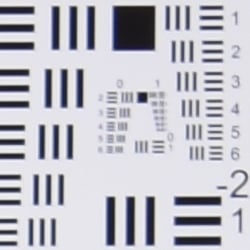
Chromatic Aberration. Chromatic aberration in the form of fairly bright blue and yellow fringing is moderately high in the corners at the full wide-angle, despite being suppressed by the D3400's image processor. (See below for crops from uncorrected RAW files.) At full telephoto, chromatic aberration is low and hardly visible. (This distortion is visible as a slight colored fringe around the objects at the edges of the field of view on the resolution target.)
Corner Sharpness. The AF-P 18-55mm VR kit lens produced somewhat soft corners at full wide angle when wide-open at maximum aperture, although corner performance is better than average for an inexpensive kit lens. All four corners show a similar amount blurring with the bottom right showing just a bit more, and softness doesn't extend very deep into the frame. The center is however quite sharp. At full telephoto, all four corners are also somewhat soft. The center is pretty sharp, though not quite as sharp as at wide angle.
Vignetting. There is some fairly strong vignetting (corner shading) at the wide end of the zoom and some mild vignetting at the telephoto end, as indicated by the darker corner crops. (Note that the D3400 has built-in shading correction for JPEGs with Off, Low, Normal (default) and High settings, and these images were taken with it set to Off.)
| f/8 Aperture | |
 |
 |
| Wide, f/8: Lower left C.A.: Moderately high Softness: Fairly sharp |
Wide, f/8: Center C.A.: Very low Softness: Very sharp |
 |
 |
| Tele, f/8: Upper right C.A.: Low Softness: Fairly sharp |
Tele, f/8: Center C.A.: Very low Softness: Sharp |
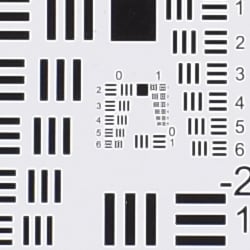
F8. Stopped-down to an aperture of f/8, corner performance improved at both wide angle and full telephoto with better sharpness and contrast, but chromatic aberration is still moderately high at wide angle. Center sharpness also improved, but full telephoto is still not as sharp as wide angle. Vignetting is negligible at wide angle and practically nonexistent at full telephoto.
Uncorrected Raw
Higher levels of C.A. in uncorrected Raw files.
| In-camera JPEG | Uncorrected Raw |
 |
 |
| Wide, f/8: Upper right CA: Moderately high |
Wide, f/8: Upper right CA: High |
 |
 |
| Tele, f/8: Upper right CA: Low |
Tele, f/8: Upper right CA: Moderate |
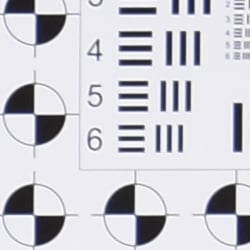
As you can see from the crops above comparing camera JPEGs (on the left) to uncorrected NEF files (right), lateral chromatic aberration is higher in uncorrected RAW files. Thus, the D3400's JPEG engine is indeed suppressing lateral chromatic aberration, but there is lot to contend with in the corners at wide angle which it failed to eliminate entirely. The camera was much more successful at suppressing the lower amounts of chromatic aberration at full telephoto.
Bottom line: Fair to very good optical performance for a kit lens but it's a bit surprising how much chromatic aberration is present in the corners at wide angle, and that Nikon doesn't correct for distortion by default in a consumer model these days.
Viewfinder Test Results
Coverage
Slightly better than average coverage accuracy from the optical viewfinder for an entry-level DSLR. Good accuracy from the LCD in Live View mode.


The Nikon D3400's optical viewfinder showed about 96 percent coverage with our Nikkor 60mm f/2.8 macro lens. This is better-than-average coverage for an entry-level digital SLR, exceeding Nikon's specification of 95%. However the viewfinder image is slightly shifted horizontally and vertically compared to the image sensor, which unfortunately is not that uncommon in consumer models. In Live View mode, the Nikon D3400's LCD showed about 99% coverage, which is good though we often see 100% coverage here.
The images above were taken from our standardized test shots. For a collection of more pictorial photos, see our Nikon D3400 Photo Gallery .
Exposure
Color
Saturation & Hue Accuracy
Slightly higher than average mean saturation with slightly below average hue accuracy.
 |
||
|
ISO Sensitivity
|
||
| In the diagram above, the squares show the original color, and the circles show the color that the camera captured. More saturated colors are located toward the periphery of the graph. Hue changes as you travel around the center. Thus, hue-accurate, highly saturated colors appear as lines radiating from the center. Mouse over the links to compare ISOs, and click on them for larger images. | ||
Saturation. The Nikon D3400 pumps dark blues quite a bit and most other colors by small to moderate amounts, but slightly undersaturates bright yellow, light green, and cyans. Mean saturation at base ISO is 113.0% or 13% oversaturated, a little higher than average, but as mentioned, much of that is because blues are pushed so much. And saturation levels remain fairly stable as sensitivity climbs, even at the highest ISOs. Overall, we found the D3400's default saturation levels pleasing to the eye. Most consumer digital cameras produce color that's more highly saturated (more intense) than found in the original subjects. This is simply because most people like their color a bit brighter than life.
Skin tones. The Nikon D3400's Caucasian skin tones looked just about right when using manual white balance in simulated daylight. A very good job here. Skin tones with auto white balance were a bit too flat and yellow. Where oversaturation is most problematic is on Caucasian skin tones, as it's very easy for these "memory colors" to be seen as too bright, too pink, too yellow, etc.
Hue. The Nikon D3400 did shift cyan toward blue by quite a bit at base ISO, with smaller shifts in reds, orange and magenta. (The cyan to blue shift is very common among the digital cameras we test; we think it's a deliberate choice by camera engineers to produce better-looking sky colors.) With an average "delta-C" color error of 6.27 after correction for saturation at base ISO, overall hue accuracy was a little lower than average (lower numbers are better), but still what we'd consider "good," and hue accuracy remained fairly stable across the ISO range. Hue is "what color" the
color is.


Sensor
Exposure and White Balance
Indoors, incandescent lighting
Good color with the Manual white balance setting, but overly-warm results with Auto and Incandescent. No exposure compensation required.


Indoors, under normal incandescent lighting, color balance was very warm and reddish with the Auto white balance setting. (We'd say unacceptably so, though unfortunately this is common.) The Incandescent setting was also too warm, with a strong yellow/green cast. The Manual setting produced the most accurate results by far, if just a touch cool. The Nikon D3400 required no exposure compensation here, while most cameras require about +0.3 EV for this shot. Our test lighting for this shot is a mixture of 60 and 100 watt household incandescent bulbs, a pretty yellow light source, but a very common one in typical home settings here in the U.S.
Outdoors, daylight
Excellent results under harsh lighting for its class.
Outdoors, the Nikon D3400 performed well, requiring +1.0 EV exposure compensation for our "Sunlit" Portrait shot to keep the face reasonably bright. (The average for this shot is +0.7 EV, so the D3400 required a bit more than average.) We preferred skintones from the Manual white balance setting as they were a little pinker and healthier-looking than Auto. Contrast is a little high as you might expect under such harsh lighting, but the camera did a very good job of holding onto detail in the highlights and shadows. The Nikon D3400 produced vibrant colors and a very good exposure without any exposure compensation in our Far-field scene (above right). Very few highlights were blown and shadow detail is quite good with relatively low noise. Overall, excellent performance for its class here.
See full set of test images with explanations
See thumbnails of all test and gallery images
Resolution
~2,750 to ~2,800 lines of strong detail.
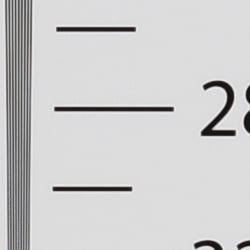



Our resolution chart revealed sharp, distinct line patterns up to about 2,800 lines per picture height in the horizontal direction, and to about 2,750 lines in the vertical direction. Some may argue for higher numbers, but lines begin to merge and aliasing artifacts start to interfere with detail at these resolutions. Extinction of the pattern didn't occur until around 3,600 to 3,800 lines. We weren't able to do significantly better with NEF files processed through Adobe Camera Raw. Color moire is however more evident in the ACR converted RAW files, however it's not as high as we'd expect for a camera without an optical low-pass filter. Use these numbers to compare with other cameras of similar resolution, or use them to see just what higher resolution can mean in terms of potential detail.
See full set of test images with explanations
See thumbnails of all test and gallery images
Sharpness & Detail
Sharp, crisp images with great detail, however edge-enhancement artifacts visible on high-contrast subjects. Moderate noise suppression visible at base ISO.


Sharpness. The Nikon D3400 produces images that are crisp and sharp when coupled with a sharp lens as used in the above left crop. Edge enhancement artifacts are however visible on high-contrast subjects such as the halos around the border and text, but default sharpening looks to be a very good compromise between crispness and sharpening artifacts for a consumer model. Edge enhancement creates the illusion of sharpness by enhancing colors and tones right at the edge of a rapid transition in color or tone.
Detail. The crop above right shows some mild to moderate noise suppression, as the darker and lower-contrast areas of the model's hair show some smudging where individual strands of hair merge. Still, a very good performance here considering the resolution and target market. Noise-suppression systems in digital cameras tend to flatten-out detail in areas of subtle contrast. The effects can often be seen in shots of human hair, where the individual strands are lost and an almost "watercolor" look appears.
Aliasing. You can see hints of aliasing artifacts in a number of our test shots, however the D3400 seems to do a pretty good job at suppressing moiré for a camera that doesn't have an optical low-pass filter.
RAW vs In-Camera JPEGs
As noted above, the Nikon D3400 does a great job at capturing lots of fine detail in its JPEGs, but more detail can often be obtained from carefully processing RAW files, while at the same time reducing sharpening artifacts. Let's have a look at base ISO:
| Base ISO (100) | |
 |
 |
 |
 |
 |
 |
|
Camera JPEG, defaults
|
RAW via Adobe Camera Raw
|
In the table above, we compare an in-camera JPEG taken at base ISO using default noise reduction and sharpening (on the left) to the matching RAW file converted with Adobe Camera Raw 9.1 via DNG Converter 9.7 (right) using default noise reduction with some strong but tight unsharp masking applied in Photoshop (300%, radius of 0.3 pixels, and a threshold of 0).
As is frequently the case, the demosaicing in Adobe Camera Raw and sharpening in Photoshop deliver finer detail than the camera, with fewer sharpening artifacts. Looking closely at the images, ACR extracts some detail that wasn't present in the camera JPEG, especially in the red-leaf swatch where the conversion was able to resolve some of the fine thread pattern, which the camera's JPEG engine tended to blur it away as if noise. The ACR conversion does however show more noise at default noise reduction settings than the camera at its default settings. All-in-all, though, the D3400 did a very good job at reducing noise while maintaining excellent detail in most areas of our target here at base ISO. Still, for maximum detail (and flexibility), using a good RAW converter does yield better results than in-camera JPEGs, as is usually the case.
ISO & Noise Performance
Excellent high ISO performance for its class.
| Noise Reduction = On (Default) | ||
 |
 |
 |
| ISO 100 | ISO 200 | ISO 400 |
 |
 |
 |
| ISO 800 | ISO 1,600 | ISO 3,200 |
 |
 |
 |
| ISO 6,400 | ISO 12,800 | ISO 25,600 |
Noise levels are quite low at ISOs 100 through 400 with excellent detail, though some very fine detail is lost to noise reduction even at base ISO. ISO 800 shows a very fine noise "grain" but detail is quite good, and chroma noise well-controlled. At ISO 1,600 noise levels increase with a touch more blurring in fine details and more visible grain, but detail is still pretty good and chroma noise remains low. Of course, ISO 3200 has higher luma noise but it's still fine-grained, detail is good and chroma noise is low. ISO 6400 shows much stronger luma noise and blurring, but there's some fine detail left, and chroma noise is remarkably low. Only at ISOs 12,800 and 25,600 does chroma noise become an issue with some minor purple and yellow blotchiness in darker areas, though it's still fairly well-controlled. Luma noise and blurring are quite strong at the top two ISOs, however the D3400 manages to hold on to nice color and contrast, allowing these ISOs to still be useful for small prints.
Overall, excellent noise performance for a 24-megapixel APS-C model, especially for an entry-level model. See our Print Quality analysis section below for recommended print sizes at each ISO.
A note about focus for this shot: We used to shoot this image at f/4, however depth of field became so shallow with larger, high-resolution sensors that it was difficult to keep important areas of this shot in focus, so we have since started shooting at f/8, the best compromise between depth of field and sharpness.
Extremes: Sunlit, dynamic range, and low light tests
Very good detail in both highlights and shadows, resulting in excellent dynamic range. Good low-light performance, capable of capturing bright images in near darkness though autofocus can struggle in very low light.


Sunlight:
The Nikon D3400 handled the deliberately harsh lighting in the test above well, though it did require higher than average exposure compensation. While contrast is a little high, shadow and highlight detail are both very good. The +1.0 EV exposure did the best job here, producing a fairly bright face without blowing out too many highlights in the white areas. Despite the bright appearance, there are relatively few clipped highlights in the mannequins's shirt. Some shadows are pretty dark, but contain good detail. Be sure to use fill flash in situations like the one shown above; it's better to shoot in the shade when possible.
Because digital cameras are more like slide film than negative film (in that they tend to have a more limited tonal range), we test them in the harshest situations to see how they handle scenes with bright highlights and dark shadows, as well as what kind of sensitivity they have in low light. The shot above is designed to mimic the very harsh, contrasty effect of direct noonday sunlight, a very tough challenge for most digital cameras. (You can read details of this test here.)
| Face Detection | ||
 |
 |
 |
| Off Aperture-priority 0 EV |
Auto mode (Portrait) 0 EV |
Live View with Face-priority AF 0 EV |
Here, we can see the effect of the Nikon D3400's full Auto mode as well as face detection AF enabled in Live View mode. As you can see from the shots above, full Auto mode deployed the flash, used a wider aperture (f/5) and produced a better exposed image than Aperture-priority with no exposure compensation. However be aware that because of the limited number and coverage of focus points when using the viewfinder (this is true for most DSLRs), the D3400's chosen focus point isn't optimal, as the mannequin's face is slightly out of focus. And in multiple trials, the camera often focused on the closer flowers. In Live View mode using Aperture-priority at f/8, Face-priority AF mode improved the exposure versus Aperture-priority with the optical viewfinder, selecting a slower shutter speed of 1/30s versus 1/60s to brighten the image (since the other two exposure variables of aperture and ISO were fixed). And the D3400 focused on the face since Live View mode uses contrast-detection AF which has much better coverage than the 11-point phase-detection AF employed when using the optical viewfinder.

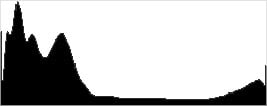
Nikon's Active D-Lighting
The shots above show the results with Active D-Lighting Off and On with +1.0 EV exposure compensation. (Like other entry-level Nikon models, the D3400 only has these two settings, while Nikon's more advanced models let you choose from a range of strengths of the effect.) This is different than the touch-up menu's D-Lighting, as it is performed during image capture instead of after. (It does affect only JPEG images though, Nikon very properly leaves raw file data strictly as it comes from the sensor.) Mouse-over the links to see the difference, and click on the links to load the corresponding full-resolution image.
As you can see from the images and histograms above, enabling Active D-Lighting resulted in much better highlight retention (less clipping) as well as slightly boosted shadows and midtones, however some highlights were still blown. The effect of Active D-Lighting will vary quite a bit with the subject and lighting: The camera decides what needs adjusting, and by how much, so the effect can vary quite a bit.


Above is another example of Nikon's Active D-Lighting at work, this time with our Far-field shot in bright daylight. Again, mouse-over the links to see the difference, and click on the links to load the full resolution images.
Dynamic Range Analysis (RAW mode)
While we once performed our own dynamic range measurements based on in-camera JPEGs as well as converted RAW images (when the camera was supported by Adobe Camera Raw), we've switched to using DxO Labs' results from their DxOMark website. As technology advanced, the dynamic range of modern high-end cameras in some cases exceeded the range of the Stouffer T4110 density scale that we used for our own measurements. DxO's approach based on RAW data before demosaicing is also more revealing, because it measures the fundamental dynamic range of the sensor, irrespective of whatever processing is applied to JPEGs, or to RAW data by off-the-shelf conversion software.
In the following, we use DxO's "Print" dynamic range results, which are scaled based on camera resolution. As the name suggests, this scaling corresponds to the situation in which you print at a given size, regardless of how many megapixels the camera might have. (In other words, if you've decided to make a 13x19 inch print, that's the size you're printing, whether the camera's resolution is 16 or 300 megapixels.) For the technically-minded, you can find a discussion of the reasoning behind this here on the DxOMark website. Also note that DxO Labs uses a signal-to-noise (SNR) threshold of 1 when defining the lower boundary of acceptable luminance noise in their dynamic range measurements, which corresponds to the "Low Quality" threshold of the Imatest software we used to use for this measurement.

Here, we're comparing the Nikon D3400 sensor's dynamic range to its predecessor's, the D3300, as well as to the Sony A6000's. (DxOMark has not tested the Canon T6 nor the Pentax KS-2 as of this writing, and the A6000 is selling for about the same price as D3400 at the time of writing.)
As you can see from the above graph (click for a larger image), the D3400's dynamic range is significantly higher than the D3300's at base ISO (13.85 EV vs 12.76 EV), and it remains higher throughout the ISO range, though the advantage is minimal at high ISOs. This is a pleasant surprise implying the D3400's sensor has likely been tweaked since the D3300.
The D3400's dynamic range is also better than the Sony A6000's which peaked at 13.14 EV at base ISO, with the Sony only catching up at surpassing the D3400 above ISO 6400.
Bottom line: Excellent dynamic range from the D3400 with a noticeable improvement over its predecessor. Click here to visit the DxOMark page for the Nikon D3400 for more of their test results and additional comparisons.
| 1 fc 11 lux |
1/16 fc 0.67 lux |
1/16 fc No NR |
|
|---|---|---|---|
| ISO 100 |
 2s, f2.8 |
 30s, f2.8 |
 30s, f2.8 |
| ISO 3200 |
 1/15s, f2.8 |
 1s, f2.8 |
 1s, f2.8 |
| ISO 25600 |
 1/125s, f2.8 |
 1/6s, f2.8 |
 1/6s, f2.8 |
Low Light
The Nikon D3400 performed well on the low-light test, capturing bright images at the lowest light level (1/16 foot-candle) even with the lowest sensitivity setting (ISO 100). Of course, noise is higher at ISO 3200 but it's not objectionable and very fine-grained. As expected, the maximum ISO of 25,600 is however quite noisy with noticeably less detail, and is probably best avoided except for small prints or web images.
We didn't notice any issues with hot pixels, banding (pattern noise) or heat blooming.
Color balance is good with the Auto white balance setting at one foot-candle, just slightly cool, though there's the shift towards magenta or purple at lower light levels that we often see from Nikons, with a very strong shift at the top ISO.
LL AF: The camera's phase-detection autofocus system was able to focus on our standard low-contrast AF target down to -0.5 EV (~0.18 foot-candle), and on our new high-contrast AF target down to -2.6 EV (~0.04 foot-candle) unassisted. That's not bad for its class, as its AF sensitivity is rated by Nikon down to -1.0 EV. The Nikon D3400 is able to focus in complete darkness with the AF assist enabled, as long as the target is in range and has sufficient contrast. In Live View mode, the camera's contrast-detect autofocus was able to focus on our low-contrast target down to -2.3 EV, and on our high-contrast target down to -2.7 EV, which is quite good.
Keep in mind that the longer shutter speeds here demand the use of a tripod to prevent any blurring from camera movement. (A useful trick is to just prop the camera on a convenient surface, and use its self-timer to release the shutter. This avoids any jiggling from your finger pressing the shutter button, and can work quite well when you don't have a tripod handy.)
How bright is this? The one foot-candle light level that this test begins at roughly corresponds to the brightness of typical city street-lighting at night. Cameras performing well at that level should be able to snap good-looking photos of street-lit scenes.
NOTE: This low light test is conducted with a stationary subject, and the camera mounted on a sturdy tripod. Most digital cameras will fail miserably when faced with a moving subject in dim lighting. (For example, a child's ballet recital or a holiday pageant in a gymnasium.) Digital SLRs like the Nikon D3400 do much better than point & shoots, but you still shouldn't expect a quick autofocus lock with moving subjects.
Output Quality
Print Quality
An excellent 30 x 40 inch print at base ISO; a nice 13 x 19 inch print at ISO 1600, and a good 5 x 7 at ISO 12,800.
 ISO 100 delivers excellent 30 x 40 inch prints and higher -- as large you need until you run out of resolution. Colors are vibrant, fine detail is sharp and crisp, and the image has a nice three-dimensional pop to it.
ISO 200 images are terrific at 24 x 36 inches, with very nice detail and wonderful color reproduction. The 30 x 40 inch prints here are certainly more than adequate for wall-display purposes as well.
ISO 400 prints also pass our good grade at 24 x 36 inches with nice detail and very little in the way of noise present. For your most critical applications, a reduction to 20 x 30 inches will further tighten up the fine detail and provide more crisp overall imagery.
ISO 800 produces 20 x 30 inch prints that almost pass our good grade, and are certainly fine for less critical applications. The 16 x 20 inch prints here tighten up nicely with good colors throughout, sharp detail and not much in the way of noise, other than a minor amount present in flatter areas of our target. There is a typical mild softening in the red channel and some detail lost in our tricky red-leaf swatch, but otherwise a nice overall print for this ISO.
ISO 1600 images really shine at 13 x 19 inches, with nice colors and good overall detail. A lot of subtle detail is now lost in our red-leaf fabric swatch, though, but this is common for most APS-C cameras by this ISO and higher. Noise is well-controlled here, with only a minor grain-effect in a few flatter areas, but overall a very nice print.
ISO 3200 yields a solid 11 x 14 inch print. There is a trace of noise apparent in the flatter areas of our Still Life target, but it's mild enough to allow this otherwise quality print to warrant our good seal. Colors are also still quite vibrant for this sensitivity.
ISO 6400 tends to be the turning point for quality across most APS-C cameras, but the D3400 produces one of the nicer 8 x 10's at this ISO that we've yet seen in this class and price range. If you like to print 8 x 10's but still need the higher shutter speeds in low light that ISO 6400 can provide, you're in solid hands with this camera.
ISO 12,800 delivers a nice 5 x 7 for such a lofty ISO and price range. Full color reproduction is present, good fine detail, and not much noise to speak of at this print size.
ISO 25,600 delivers a very nice 4 x 6 for this ISO! Colors are just a bit subdued compared to lower ISOs, but still a nice print.
The Nikon D3400 certainly delivers in the print quality department, and when you consider its sub-$500 street price, it jockeys to be the best all-around print camera as ISO rises for that price point. Starting with a large 30 x 40 inch print at base ISO, providing a solid 13 x 19 at ISO 1600, and still delivering a usable print all the way up to ISO 25,600, we'd say this is a very worthy camera for image quality at this price. Topping the already good D3300 for print sizes at a few ISOs, the D3400 furthers what we loved about its predecessor. Indeed, you are in good hands for printing with the Nikon D3400.
The images above were taken from our standardized test shots. For a collection of more pictorial photos, see our Nikon D3400 Photo Gallery .
Not sure which camera to buy? Let your eyes be the ultimate judge! Visit our Comparometer(tm) to compare images from the Nikon D3400 with those from other cameras you may be considering. The proof is in the pictures, so let your own eyes decide which you like best!
Performance
Timing and Performance
Pretty good overall performance for its class.
| Startup/Play to Record | ||
|---|---|---|
| Power on |
~0.5 second
|
Time it takes for camera to turn on and take a shot. |
|
Play to Record, |
~0.3 second
|
Time until first shot is captured. |
The Nikon D3400's startup time was good for a consumer DSLR, and switching from Play to Record and taking a shot was very fast.
| Shutter Response (Lag Time) | ||
|---|---|---|
|
Full Autofocus |
0.202 second
|
Time from fully pressing shutter button to image capture. (All AF timing measured with Nikkor AF-S 60mm f/2.8 Macro lens unless otherwise noted.) |
|
Full Autofocus |
0.218 second
|
Time from fully pressing shutter button to image capture, Auto Flash enabled. |
|
Manual focus |
0.104 second
|
For most cameras, shutter lag is less in manual focus than autofocus, but usually not as fast as when the camera is "pre-focused." |
|
Pre-focused |
0.080 second
|
Time to capture, after half-pressing and holding shutter button. |
|
Pre-focused |
0.280 second
|
Time to capture, after half-pressing and holding shutter button. |
The Nikon D3400's full autofocus shutter lag when shooting the same target multiple times was a touch faster than average for a consumer DSLR. The D3400 required about 0.202 second for full AF using the center focus point. Enabling the flash raised full AF shutter lag only slightly to 0.218 second, reflecting the added delay caused by the pre-flash metering.
Manual focus shutter lag was faster than AF lag as expected, at 0.104 second. When prefocused, shutter lag dropped to 0.080 second which is about average for a consumer DSLR.
The Nikon's prefocused shutter lag in Live View mode was a bit sluggish at 0.280 second, taking longer than full AF lag with the optical viewfinder. (We no longer routinely test full AF shutter lag in Live View mode for DSLRs, as it is usually very lens dependent.)
To minimize the effect of different lens' focusing speed, we test AF-active shutter lag with the lens already set to the correct focal distance.
As mentioned above, we no longer routinely test Full AF shutter lag in Live View mode because it is very lens dependent making comparisons between cameras tested with different lenses invalid, however we wanted to see how much faster Nikon's new AF-P 18-55mm VR kit lens is compared to the previous generation AF-S 18-55mm VR II kit lens.
Below are our Live View Full AF lag test results using Normal-area AF in Single-servo AF mode with the two kit lenses on the D3400:
| Live View mode Full AF lag AF-P 18-55mm f/3.5-5.6 VR vs AF-S 18-55mm f/3.5-5.6 VR II lens |
||
|---|---|---|
|
Full Autofocus |
0.636 second
|
Time from fully pressing shutter button to image capture. |
|
Full Autofocus |
1.307 seconds
|
Time from fully pressing shutter button to image capture. |
As you can see, the new AF-P kit lens is about twice as fast at focusing in Live View mode as the previous AF-S kit lens under the same conditions. Autofocus is also a lot quieter and smoother with the AF-P lens' stepper motor, however focus still hunts before settling down because the D3400 uses contrast detection which is an iterative process. This can be particularly annoying in continuous AF mode when shooting video as focus can hunt even with relatively stationary subjects. Still, the new AF-P kit lens offers a significant improvement in Live View AF performance.
| Cycle Time (shot-to-shot) | ||
|---|---|---|
|
Single Shot mode |
< 0.3 second
|
Time per shot, averaged over a few frames (we no longer test for buffer depths in single-shot mode). |
|
Single Shot mode |
< 0.3 second
|
Time per shot, averaged over a few frames (we no longer test for buffer depths in single-shot mode). |
|
Early shutter |
No
(Yes with Flash) |
Some cameras refuse to snap another shot if you release and press the shutter too quickly in Single Shot mode, making "No" the preferred answer. |
| Continuous mode |
0.20 second (5.10 frames per second);
100 frames total; 1 second to clear* |
Time per shot, averaged over 100 shot set limit. |
|
Continuous mode |
0.20 second (5.09 frames per second);
12 frames total; 3 seconds to clear* |
Time per shot, averaged over 12 frame buffer, then slows to an average of 3.3 fps when buffer is full. |
|
Continuous mode |
0.20 second (5.10 frames per second);
6 frames total; 4 seconds to clear* |
Time per shot, averaged over 6 frame buffer, then slows to an average of 2.0 fps when buffer is full. |
| Flash recycling |
2.0 seconds
|
Flash at maximum output. |
| *Note: Buffer clearing times measured with a SanDisk Extreme Pro 95MB/s UHS-I 8GB SDHC memory card. Slower cards will produce correspondingly slower clearing times. Slow cards may also limit length of bursts in continuous mode. ISO sensitivity and other settings such as Advanced D-Lighting or NR can also affect cycle times and burst mode performance. |
||
Shot-to-shot cycle times were very fast and difficult to measure accurately as they depend on the tester's dexterity and ability to maintain an optimum rhythm. (We no longer test just RAW file cycle time in single-shot mode, as it's usually somewhere in between JPEG and RAW+JPEG.)
Continuous mode speed was good for its class at about 5.1 frames per second no matter the file type, slightly exceeding Nikon's 5 fps spec. The D3400 does not offer a slower Continuous L mode.
Buffer depth in continuous mode was excellent when shooting just JPEGs at 100 Large/Fine JPEG frames, though with RAW files buffer depths were limited to only 12 RAW frames or 6 RAW+L/F JPEG frames. However, that's an unexpected and welcome improvement over the D3300's 7 and 5 frames respectively which was tested with the same SanDisk Extreme Pro UHS-I SDHC card (rated for 90MB/s writes and 95MB/s reads).
Buffer clearing was very quick with our fast UHS-I card, ranging from only 1 second after 100 JPEGs to 4 seconds after a max-length burst of RAW+JPEG files.
The D3400's built-in flash took an average of 2.0 seconds to recharge after full-power shots, which is quite fast.
Bottom line, the Nikon D3400's performance is generally quite good for its class. Startup time is good, as is AF speed and shutter lag. Single-shot cycle times are excellent, and burst performance is good for an entry-level DSLR, with a very generous JPEG buffer depth. Buffer depths with RAW files are limited compared to JPEGs, but improved over the D3300 which is a pleasant surprise.
Battery
Battery Life
Outstanding battery life for a compact DSLR.
| Operating Mode | Number of Shots |
|---|---|
|
Optical Viewfinder,
(CIPA standard) |
1,200
|
|
Live View LCD,
(CIPA standard) |
Unknown
|
The Nikon D3400 uses a custom rechargeable EN-EL14a lithium-ion battery for power, and ships with a dedicated charger. Battery life when using the optical viewfinder is outstanding for a consumer DSLR, though Nikon does not specify battery life for Live View mode, which will certainly be a lot lower. Some of the improvement over the D3300's 700 shot battery life is due to the D3400's weaker flash (which is fired for 50% of shots during CIPA battery life testing), however battery life is still exceptional. As is usually the case, though, we still recommend you pick up a spare battery and keep it freshly charged and on-hand for extended outings, or when using Live View a lot.
The table above shows the number of shots the camera is capable of (on either a fresh set of disposable batteries or a fully-charged rechargeable battery as appropriate), based on CIPA battery-life and/or manufacturer standard test conditions.
(Interested readers can find an English translation of the CIPA DC-002 standards document here. (180K PDF document))
Image Quality
Below are crops from our laboratory Still Life target comparing Nikon D3400 image quality to its predecessor, the D3300, as well as against several competing entry-level interchangeable lens models at similar price points: the Canon T6, Panasonic G7, Pentax K-S2 and Sony A6000. While we wouldn't call the Sony A6000 "entry-level," at the time of writing, it was available for about the same price as the Nikon D3400, so we decided to include it in this comparison.
NOTE: These images are from best quality JPEGs straight out of the camera, at default settings including noise reduction and using the camera's actual base ISO (not extended ISO settings). All cameras in this comparison were shot with our very sharp reference lenses. Clicking any crop will take you to a carrier page where you can click once again to access the full resolution image as delivered straight from the camera. For those interested in working with the RAW files involved: click these links to visit each camera's respective sample image thumbnail page: Nikon D3400, Nikon D3300, Canon T6, Panasonic G7, Pentax K-S2 and Sony A6000 -- links to the RAW files appear beneath those for the JPEG images, wherever we have them. And remember, you can always go to our world-renowned Comparometer to compare the Nikon D3400 to any camera we've ever tested!
Nikon D3400 vs Nikon D3300 at Base ISO
 |  |
 |  |
 |  |
Nikon D3400 at ISO 100 | Nikon D3300 at ISO 100 |
Above we compare the Nikon D3400 to its very popular predecessor, the D3300. As you can see, since the D3300's release in early 2014 Nikon has revised its default JPEG processing a bit to produce slightly punchier images by increasing contrast and sharpening. Colors are also more pleasing from the newer camera. The older D3300 does a bit better in our tricky red-leaf swatch, though, likely because default noise reduction has also been tweaked. | |
Nikon D3400 vs Canon T6 at Base ISO
|  |
|  |
|  |
Nikon D3400 at ISO 100 | Canon T6 at ISO 100 |
Here at base ISO, the Nikon D3400's 6-megapixel resolution advantage is apparent compared to the 18-megapixel Canon T6, with the Nikon being able to resolve noticeably more fine detail than the Canon. The Nikon also forgoes an optical low-pass filter which produces sharper images from its sensor (though with the risk more aliasing artifacts), despite both cameras applying generous amounts of sharpening. Colors are also a bit warmer and more vibrant from the Nikon, though the Canon's color is generally more accurate. | |
Nikon D3400 vs Panasonic G7 at Base ISO
|  |
|  |
|  |
Nikon D3400 at ISO 100 | Panasonic G7 at ISO 200 |
Here we compare the 24-megapixel APS-C Nikon D3400 to the 16-megapixel Micro Four Thirds Panasonic G7. The Nikon produces a noticeably crisper, more detailed and vibrant image than the Panasonic. Default sharpening is less aggressive from the G7 producing smaller, less noticeable sharpening halos than the D3400, but the G7 does have an optical low-pass filter which softens the image slightly to help avoid aliasing artifacts. Colors are more pleasing from the Nikon as well, however the G7 actually has more accurate color overall, except for a slight yellow to green shift. | |
Nikon D3400 vs Pentax K-S2 at Base ISO
|  |
|  |
|  |
Nikon D3400 at ISO 100 | Pentax K-S2 at ISO 100 |
Above we compare the D3400 to the 20-megapixel APS-C Pentax K-S2, which also doesn't have an optical low-pass filter (but has a trick on-demand AA filter simulator which has been turned off here for maximum sharpness). The 24-megapixel D3400 does capture a bit more detail in most areas, but resolving power is pretty similar between the two. And the K-S2 actually does much better in our red-leaf swatch, reproducing some of the fine thread pattern which the Nikon treats as noise and blurs away. Colors are arguably more pleasing from the Nikon especially in the pink fabric which is rendered too magenta by the K-S2, despite producing a lower mean saturation than the Pentax. | |
Nikon D3400 vs Sony A6000 at Base ISO
|  |
|  |
|  |
Nikon D3400 at ISO 100 | Sony A6000 at ISO 100 |
Unsurprisingly, the 24-megapixel APS-C Sony A6000 captures similar detail and its sharpening algorithm is more advanced than the Nikon's, producing almost no sharpening halos. The Nikon image is however slightly crisper with higher contrast. The Nikon's mean saturation is also a bit higher but it's the Sony that produces more accurate color overall here. | |
Nikon D3400 vs Nikon D3300 at ISO 1600
 |  |
 |  |
 |  |
Nikon D3400 at ISO 1600 | Nikon D3300 at ISO 1600 |
Above at ISO 1600, it's easy to see that the D3400's default noise reduction is more aggressive than its predecessor's, producing lower noise levels that are especially noticeable in flatter areas, but as a consequence fine detail in our troublesome red-leaf swatch suffers. The D3400 continues to produce a punchier image with higher contrast and more pleasing color. | |
Nikon D3400 vs Canon T6 at ISO 1600
|  |
|  |
|  |
Nikon D3400 at ISO 1600 | Canon T6 at ISO 1600 |
The Nikon D3400 produces a crisper, more vibrant image with lower noise levels and better detail than the Canon T6 here at ISO 1600. Both struggle to render fine, low-contrast detail in our tricky red-leaf swatch, but the Nikon manages to do a bit better there as well. | |
Nikon D3400 vs Panasonic G7 at ISO 1600
|  |
|  |
|  |
Nikon D3400 at ISO 1600 | Panasonic G7 at ISO 1600 |
The Panasonic G7's noise reduction does a pretty good job here at ISO 1600, actually leaving behind less noise than the D3400, though some unwanted NR artifacts can be seen. Detail, contrast, color and sharpness are however better from the Nikon, making it the winner in this comparison. | |
Nikon D3400 vs Pentax K-S2 at ISO 1600
|  |
|  |
|  |
Nikon D3400 at ISO 1600 | Pentax K-S2 at ISO 1600 |
Despite the slightly lower resolution, the Pentax K-S2 actually does better with fine detail in the mosaic crop. Noise levels are similar if not a bit lower from the Pentax (thanks to its larger pixels), however it blurs almost all detail away in our challenging red-leaf swatch, while color and contrast are still more pleasing from the Nikon. | |
Nikon D3400 vs Sony A6000 at ISO 1600
|  |
|  |
|  |
Nikon D3400 at ISO 1600 | Sony A6000 at ISO 1600 |
The Sony A6000's noise reduction algorithm leaves behind less noise than the Nikon, but it has a more processed look to it, while the Nikon's noise appears more natural and film-like. Fine detail is perhaps better defined from the Sony, but it's also more distorted by noise reduction. | |
Nikon D3400 vs Nikon D3300 at ISO 3200
 |  |
 |  |
 |  |
Nikon D3400 at ISO 3200 | Nikon D3300 at ISO 3200 |
As we saw at ISO 1600, the Nikon D3400 produces lower noise levels than the D3300 at ISO 3200 while doing a better job at holding on to high-contrast detail, but subtle low-contrast detail suffers in our tricky red-leaf swatch. | |
Nikon D3400 vs Canon T6 at ISO 3200
|  |
|  |
|  |
Nikon D3400 at ISO 3200 | Canon T6 at ISO 3200 |
The Nikon D3400 easily out-performs the Canon T6 here at ISO 3200, with a crisper image, more detail and lower noise. Colors are also more vibrant and pleasing from the Nikon, if not quite as accurate. | |
Nikon D3400 vs Panasonic G7 at ISO 3200
|  |
|  |
|  |
Nikon D3400 at ISO 3200 | Panasonic G7 at ISO 3200 |
Here too against the Panasonic G7, the Nikon D3400 produces a sharper, more detailed image with better color and contrast at ISO 3200. Noise levels are however lower from the Panasonic, but its more aggressive noise reduction generates more unwanted artifacts than the Nikon. | |
Nikon D3400 vs Pentax K-S2 at ISO 3200
|  |
|  |
|  |
Nikon D3400 at ISO 3200 | Pentax K-S2 at ISO 3200 |
Here at ISO 3200, the Nikon D3400 produces a somewhat crisper image with better contrast, though sharpening halos are more evident. The K-S2's luma noise is higher leading to a grainier image, but its chroma noise is lower which unfortunately blurs away pretty much all detail in our red-leaf swatch. The Nikon continues to produce more pleasing color. | |
Nikon D3400 vs Sony A6000 at ISO 3200
|  |
|  |
|  |
Nikon D3400 at ISO 3200 | Sony A6000 at ISO 3200 |
The Sony A6000 produces a cleaner image here at ISO 3200, however its noise reduction algorithm smears fine detail more than the D3400, and generates more unwanted artifacts that look unnatural in flatter areas. While contrast is better in the red-leaf swatch, details are quite distorted. Overall, we'd give the Nikon the edge here. | |
Nikon D3400 vs. Nikon D3300, Canon T6, Panasonic G7, Pentax K-S2, Sony A6000
 |  |  |  |  |  |
 |  |  |  |  |  |
 |  |  |  |  |  |
| Nikon D3400 ISO 100 ISO 3200 ISO 6400 | Nikon D3300 ISO 100 ISO 3200 ISO 6400 | Canon T6 ISO 100 ISO 3200 ISO 6400 | Panasonic G7 ISO 200 ISO 3200 ISO 6400 | Pentax K-S2 ISO 100 ISO 3200 ISO 6400 | Sony A6000 ISO 100 ISO 3200 ISO 6400 |
| Detail comparison. This is always an interesting table, and often yields somewhat different results than we see in the prior tables, as high-contrast detail is often rendered differently than other areas of our Still Life target. Here we can see all three 24-megapixel APS-C cameras do better than the rest, with the Sony A6000 leading the pack in terms of contrast, however the D3400 is a very close second while actually producing finer detail with fewer false colors than the Sony. The D3300 isn't quite as good at higher ISOs, but it's pretty close, although overall contrast is a bit lower. The Pentax K-S2 does quite well at base ISO, but it degrades more as ISO climbs, and struggles the most with false colors at ISO 6400. The Canon T6 does fairly well at base ISO, but it degrades the most as ISO climbs, coming in last at ISO 3200 and 6400. The Panasonic G7 starts out with the lowest contrast at base ISO, but detail is actually quite good and it doesn't degrade much as ISO climbs. | |||||
An excellent 30 x 40 inch print at base ISO; a nice 13 x 19 inch print at ISO 1600, and a good 5 x 7 at ISO 12,800.
ISO 100 delivers excellent 30 x 40 inch prints and higher -- as large you need until you run out of resolution. Colors are vibrant, fine detail is sharp and crisp, and the image has a nice three-dimensional pop to it.
ISO 200 images are terrific at 24 x 36 inches, with very nice detail and wonderful color reproduction. The 30 x 40 inch prints here are certainly more than adequate for wall-display purposes as well.
ISO 400 prints also pass our good grade at 24 x 36 inches with nice detail and very little in the way of noise present. For your most critical applications, a reduction to 20 x 30 inches will further tighten up the fine detail and provide more crisp overall imagery.
ISO 800 produces 20 x 30 inch prints that almost pass our good grade, and are certainly fine for less critical applications. The 16 x 20 inch prints here tighten up nicely with good colors throughout, sharp detail and not much in the way of noise, other than a minor amount present in flatter areas of our target. There is a typical mild softening in the red channel and some detail lost in our tricky red-leaf swatch, but otherwise a nice overall print for this ISO.
ISO 1600 images really shine at 13 x 19 inches, with nice colors and good overall detail. A lot of subtle detail is now lost in our red-leaf fabric swatch, though, but this is common for most APS-C cameras by this ISO and higher. Noise is well-controlled here, with only a minor grain-effect in a few flatter areas, but overall a very nice print.
ISO 3200 yields a solid 11 x 14 inch print. There is a trace of noise apparent in the flatter areas of our Still Life target, but it's mild enough to allow this otherwise quality print to warrant our good seal. Colors are also still quite vibrant for this sensitivity.
ISO 6400 tends to be the turning point for quality across most APS-C cameras, but the D3400 produces one of the nicer 8 x 10's at this ISO that we've yet seen in this class and price range. If you like to print 8 x 10's but still need the higher shutter speeds in low light that ISO 6400 can provide, you're in solid hands with this camera.
ISO 12,800 delivers a nice 5 x 7 for such a lofty ISO and price range. Full color reproduction is present, good fine detail, and not much noise to speak of at this print size.
ISO 25,600 delivers a very nice 4 x 6 for this ISO! Colors are just a bit subdued compared to lower ISOs, but still a nice print.
The Nikon D3400 certainly delivers in the print quality department, and when you consider its sub-$500 street price, it jockeys to be the best all-around print camera as ISO rises for that price point. Starting with a large 30 x 40 inch print at base ISO, providing a solid 13 x 19 at ISO 1600, and still delivering a usable print all the way up to ISO 25,600, we'd say this is a very worthy camera for image quality at this price. Topping the already good D3300 for print sizes at a few ISOs, the D3400 furthers what we loved about its predecessor. Indeed, you are in good hands for printing with the Nikon D3400.
Field Test
No major changes, yet still a great entry-level DSLR

Introduction
Currently available at a street price of about US$500 with the new AF-P 18-55mm kit lens (list price at launch was US$650), the Nikon D3400 represents an excellent value for photographers looking to get their feet wet with an interchangeable lens DSLR. With the D3400, Nikon has mostly stayed with what has worked -- and what didn't -- in its entry-level DSLR offering. In most ways, the D3400 is identical to its predecessor, the D3300. The D3400 interestingly represents a downgrade in a few notable areas compared to the D3300 and brings little new to the table.
Key Features
- Compact DSLR camera body
- 24.2-megapixel APS-C CMOS sensor with no optical low-pass filter
- Native ISO range of 100-25,600
- 11-point autofocus system
- 3-inch rear display
- Full HD video at 60 frames per second
- Built-in Bluetooth Low Energy (BLE) and SnapBridge compatibility
Compact DSLR camera body handles well, but it doesn't include a lot of physical controls, touchscreen
The Nikon D3400 looks essentially identical to the D3300, which isn't necessarily a bad thing, but it's a rather unremarkable camera body. Its grip is surprisingly large for what is otherwise a compact camera body and this helps make the D3400 comfortable to hold. It is small by DSLR standards, but not at the cost of comfort. However, there are some consequences associated with the small stature, such as the lack of a top display -- which is typical for the class -- and a single-dial control scheme. I am a huge proponent of twin command dials on cameras. Having quick, reliable access to both shutter speed and aperture, in addition to making other adjustments quickly, is a necessity on a more advanced camera body. As an entry-level model, many users won't be adversely affected by the single command dial, but for those looking to get into fully manual photography -- which is an excellent way to learn more about the camera -- the D3400 won't handle particularly well.
At three inches, the 921k-dot rear LCD is pretty large for the camera body. Unfortunately, it doesn't tilt nor is it a touchscreen display. Touchscreen displays can be very useful, and often prove intuitive, so it's an unfortunate omission. Buttons and controls are well-placed and the directional pad in particular feels nice and responsive. A dedicated ISO button would be very welcome, but overall no major complaints with the layout of the D3400.
The optical viewfinder is bright enough and it is large enough, however, it doesn't offer full frame coverage but rather approximately 95%, but that's also typical for entry-level DSLRs. It's always important to check the edges of the frame and the D3400's viewfinder doesn't show them, so you need to take extra care when composing shots.
The D3400 body weighs 13.9 ounces (395 grams) without battery, and has dimensions of 4.9 x 3.9 x 3.0 inches (124 x 98 x 76 millimeters). Its dimensions are the same as the D3300, but the D3400 weighs 0.6 ounces (15 grams) less. Part of the D3400's diet regimen was the removal of the ultrasonic sensor cleaning system, external microphone jack and accessory terminal. Overall, though, it's a solid camera body, particularly in the context of its entry-level status.
Nikon AF-P 18-55mm f/3.5-5.6G DX VR kit lens is small and capable
The Nikon D3400 can be purchased in two kits, one with the AF-P 18-55mm f/3.5-5.6G DX VR Nikkor lens and the other with that lens plus the AF-P 70-300mm f/4.5-6.3G ED Nikkor lens. I tested out the 18-55mm lens and was generally impressed. It's a kit lens that is part of a very affordable bundle, so it isn't going to blow you away with its sharpness, but it is nonetheless pretty good. Its 27-83mm equivalent focal length is versatile, the vibration reduction works well, and its new stepping AF motor is very quiet. It's lightweight, weighing only 7.2 ounces (205 grams) and is quite compact. It is soft in the corners and shows a fair bit of falloff when shooting wide open, but it should prove to be a capable starting lens for D3400 users.
Nikon D3400's 24MP sensor produces high-quality images
The Nikon D3400 includes the same 24.2-megapixel APS-C CMOS sensor that is found in the D3300. However, the native ISO range has changed from 100-12,800 (with 25,600 offered as an expanded setting) to 100-25,600. In any case, the higher end of the ISO range is best avoided so the change in the top end of the native ISO range doesn't matter much in any practical sense considering the sensor is the same.

Image quality: Photos are sharp, detailed
To get a good sense of the D3400's image quality, one need look no further than our Nikon D3300 review. The imaging pipeline is unchanged, which isn't necessarily a bad thing because the D3300 (and by extension the D3400) offers users good sharpness across a fairly wide range of ISO sensitivities.
Images are very sharp with lots of detail, thanks in part to the D3400's lack of an optical low-pass filter in front of its 24.2-megapixel sensor. Colors are a bit oversaturated in default JPEG images, but colors are mostly well-represented and pleasing. Dynamic range is good as well and RAW files allow for extensive highlight and shadow recovery.
 |
|
Nikon 200-500mm f/5.6E ED VR AF-S lens at 400mm (600mm equivalent), f/6.3, 1/500s, ISO 400.
You can see that the matrix metering struggled with the dark loon, but the D3400's RAW images allow for quite a bit of highlight recovery. Click for full-size image. |

Image quality at high ISOs: D3400 delivers strong results at higher ISOs for an APS-C camera
The Nikon D3400 is good at higher ISOs for an APS-C camera and very good for an entry-level camera. When looking at JPEG files, image quality is decent even at ISO 3200 and usable at smaller sizes at ISO 6400. ISO 12,800 is where I would steer clear of printing the images and ISO 25,600 is totally unusable in my opinion.
Nikon D3400 JPEG Noise Comparison 100% crops from center of JPEG images, default High ISO Noise Reduction (click for full-size images). |
|
 |
|
Base ISO Full Scene Nikon AF-S 24-70mm f/2.8G IF-ED lens at 70mm (105mm equivalent), f/9, 1/40s, ISO 100 |
|
 |
 |
ISO 100 |
ISO 200 |
 |
 |
ISO 400 |
ISO 800 |
 |
 |
ISO 1600 |
ISO 3200 |
 |
 |
ISO 6400 |
ISO 12,800 |
 |
|
ISO 25,600 |
|
RAW images look quite good up through ISO 3200 and although noise in shadow areas is getting quite high by this point, the camera still captures good colors and maintains fairly high contrast. ISO 6400 images have a lot of noise, but you could process them into something usable. As is the case with JPEG files, ISO 12,800 and ISO 25,600 do not look very good at all and are very noisy (in the case of JPEG files they were incredibly soft).
Overall, the Nikon D3400's performance at high ISOs is not only impressive for an APS-C camera, but particularly great considering its price point. For an entry-level camera to deliver image quality results that can stand up against cameras costing much more is quite the feat.

Dynamic range: Solid dynamic range for an APS-C sensor
Dynamic range has long been a relative strength of Nikon's DSLR cameras and the D3400 is no exception. It cannot deliver the results of some of its higher-end DX siblings, but it is nonetheless a camera that offers impressive dynamic range, particularly at lower ISO settings. Provided you're shooting at the lower end of the ISO range, the image files offer plenty of freedom for making exposure adjustments and recovering highlights and shadows in RAW images. Speaking of RAW files, the D3400 produces compressed 12-bit NEF RAW files.
Nikon D3400 user experience: metering and AF performance
The Nikon D3400 offers a mostly good user experience due to its reliable metering performance and adequate autofocus system. It offers consistently good performance and a wide variety of shooting modes, lending itself nicely to use by beginners and more advanced amateurs alike.

Despite lacking touchscreen capabilities, rear display proved useful in the field
I already touched on the single command dial design of the D3400, which is a disappointment, but otherwise it performs as needed for users looking to take more control of their camera. You're of course free to use the camera's fully automatic shooting mode, which works perfectly well, but it's important that users not be handicapped when wanting to take more control of their photography

By default, the Nikon D3400 shows a wide variety of shooting settings on the rear display, which basically acts as a more fanciful top display by showing your shutter speed, aperture (complete with a graphic that visually represents the physical aperture of the lens), shooting mode and more.
Metering performance is generally good
Equipped with a 3D Color Matrix Metering II 420-pixel RGB sensor, the Nikon D3400 is surprisingly good at exposure metering considering its relatively old metering sensor. It has long been surpassed in the technology department by more expensive DX cameras in Nikon's lineup, but it nonetheless delivers consistently good results. I didn't have any major issues with either exposure or white balance metering when using the D3400.
When using the matrix metering mode, the effective metering range is 0 to 20 EV. There's also center-weighted and spot metering, with spot metering being centered on the selected autofocus point and offering an effective working range of 2 to 20 EV. Having spot metering linked to the autofocus point is excellent. If you need exposure compensation, the camera offers up to +/-5.0 EV of it and has a dedicated button on the top of the camera for enabling compensation.

Autofocus is quick in ideal conditions, slow otherwise. 11-point AF system is somewhat limited.
As I mentioned, the autofocus system is pretty simple. It is the same Multi-CAM 1000 TTL phase-detection autofocus system found in the D3300 and it has a total of 11 AF points with only the center point being a cross-type sensor. 11 points is enough for a wide array of scenarios, but it lacks the precision and consistency of more advanced AF systems. In addition to being less precise, particularly when dealing with small or moving subjects, it is a bit slow. In good light, the D3400 focuses quickly enough, but it struggles noticeably in low light. This is perhaps unsurprising given its rated effective working range of -1 to 19 EV.

You can rely on fully automatic autofocus across the entire AF frame or just the center, but I preferred using a user-selected single AF point, which you can move around the frame with the directional pad on the back of the camera. The selected point lights up in the viewfinder, although it is displayed as a rather small red dot, so it can sometimes be hard to see when viewing a bright scene. If there's any advantage to an 11-point AF system, it may be that you can cycle through the AF points pretty quickly. Nonetheless, the lack of AF points can be problematic when trying to focus in on a precise area of the frame.
Continuous autofocus is available via AF-F mode (full-time autofocus) and it works okay, although the camera has a tendency to hunt in less than ideal conditions. Unfortunately, less than ideal is basically any scene that isn't bright and high-contrast. There's a subject tracking mode that works okay for large, slow-moving subjects but struggles with situations such as photographing birds. If you want to use the D3400 to grab some snaps of your kids playing sports or something like that, it'll be okay, but if you want to use it as a dedicated action camera or sports shooter, you might find yourself a bit disappointed.
Overall, autofocus is an area of weakness in this camera, just as it was with its predecessor, though that's typical for the class. That ought not to come as a surprise considering that Nikon didn't upgrade the AF system with this new release.

Performance is good for JPEG shooting, but RAW buffer depth is shallow
The long-in-the-tooth EXPEED 4 processor-based image pipeline found in the D3300 is again utilized for the D3400. What this means is that JPEG shooters can find something to like with the Nikon D3400 but RAW shooters may be wondering where their buffer has gone.
In either case, shooting RAW or JPEG, the D3400 shoots at up to 5 frames per second. It's a respectable continuous shooting speed. When shooting RAW, the buffer depth is problematic at less than ten frames and the buffer dips down to around five frames when shooting RAW + JPEG with the SanDisk Extreme 30MB/s UHS-I SDHC card I used. So you get about a second or two of continuous shooting before the camera's buffer fills up; that's not great, but typical for its class. The situation is less dire when shooting only JPEG files, as the buffer depth eclipses 50 frames in my tests.
Editor's Note: In our lab Performance tests, the Nikon D3400 managed 12 RAW and 6 RAW + JPEG frames before slowing down with a faster SanDisk Extreme Pro UHS-I SDHC card rated for 90MB/s writes and 95MB/s reads. So be sure to get the fastest UHS-I card you can afford if you want to maximize buffer depth when shooting RAW files.

Interestingly, an area where the D3400 improves upon its predecessor is battery life. Using the same EN-EL14a lithium-ion battery, the D3400 is rated for 1,200 shots per charge versus the 700-shot charge capability of the D3300.
The D3400's built-in flash has lost some power compared to its predecessor, which is one reason battery life is better. Its guide number is 7 meters at ISO 100 versus the 12-meter guide number of the D3300.
Shooting modes: All your standard modes plus some fun special effects filters
In addition to the Program (P), Aperture Priority (A), Shutter Speed Priority (S) and Manual (M) shooting modes, the D3400 also includes fully automatic shooting and a variety of scene and special effects modes. When using A and S shooting modes, the D3400's single command dial controls aperture and shutter speed respectively. When shooting in the fully manual mode, you need to hold a button down on the top of the camera while rotating the dial to adjust aperture, otherwise the command dial changes shutter speed.
On the mode dial itself, you can access Portrait, Landscape, Child, Sports, Close-up and Night Portrait scene modes. The Special Effects mode offers 10 different effects: Night Vision, Super Vivid, Pop, Photo Illustration, Toy Camera, Miniature, Selective Color, Silhouette, High Key and Low Key. These modes and effects work fine, although some of the effects look very bad, in my opinion. Special effects are a matter of taste, so for users who enjoy them, the D3400 offers a good variety.

Bluetooth Low Energy: Nikon SnapBridge compatibility comes to the D3400, with limitations

The Nikon D3400 is equipped with Bluetooth Low Energy -- one of the camera's few additions relative to the D3300 -- and is SnapBridge-compatible, but there's a large caveat. Unlike the D500 which also has built-in Wi-Fi, the D3400 cannot be remotely controlled via SnapBridge, only taking advantage of BLE's persistent low-energy connection to transfer files and info.
The Nikon SnapBridge app is available for Android and iOS devices and is easy to set up and use. Once connected, you can set the D3400 to automatically transfer resized 2-megapixel JPEG images to your mobile device as they are taken, where they can be shared or uploaded to Nikon Image Space, the company's free online image sharing and storage service.
Other SnapBridge features supported include the ability to selectively transfer images, synchronize the camera's clock to your smart device, and provide the camera with the current GPS coordinates for geo-tagging images. But because the D3400 doesn't have Wi-Fi for greater bandwidth, remote control as well as transfer of full-resolution images, RAW files or movie files is not supported.
Once paired, automatic image transfers worked albeit slowly during my limited testing, but without remote control SnapBridge feels like a hampered wireless capability. Yes, the D3400 still supports Nikon's ML-L3 infrared remote trigger, but we wonder why Bluetooth remote support wasn't included.
Nikon D3400 video: Full HD quality is good, but no 4K video
To record video, you need to put the camera into Live View mode, and you press the dedicated record button on the top of the camera to start and stop recordings. Video specs are pretty much unchanged from the D3300, although as I mentioned earlier, the external mic input has been removed, which will surely be a disappointment to some especially since the built-in mic remains monaural.
The D3400's video resolution tops out at 1920 x 1080 (Full HD) and framerate is capped at 60fps (progressive). It's become increasingly common for cameras to include to 4K video recording capabilities, but the D3400 sticks with Full HD, which is a little surprising these days. The lack of high-speed video recording is also a bit disappointing, though at least 60p is available.
Nikon D3400 1080p Video Sample, 1920 x 1080, 60p, ISO 178 Download Original (94.2 MB .MOV File) |
Overall video quality is pretty good, but audio is mono and the quality is not great. Live View AF has improved with the new AF-P 18-55mm kit lens but continuous autofocus performance still isn't very good, which given the camera's contrast-detect-only autofocus in Live View mode, is not really a surprise. Although the new AF-P kit lens offers quieter, smoother and somewhat faster autofocus than its AF-S counterpart thanks to its new stepping AF motor, autofocus still regularly hunts and comes in and out even when the subject begins in focus.
While the D3400 is capable of recording video, it would be a mistake to consider it a multimedia device. It technically is, but it is not ideal for recording video. I do appreciate the location of the movie record button on the top of the camera and the ease with which you can capture decent video files, but the D3400's video capabilities remain somewhat limited.
Nikon D3400 1080p Handheld Panning Video Sample, 1920 x 1080, 60p, ISO 635 Download Original (116 MB .MOV File) |
Like the D3300, the D3400 offers Full HD 1920 x 1080 at 60p, 30p or 24p (50p and 25p in PAL mode). It also shoots HD 1280 x 720 at 60p or 50p, but drops the D3300's 640 x 424 standard-def mode. Videos are recorded using H.264/MPEG-4 compression with linear PCM audio, saved in a MOV container.
The only other movie settings available are High and Normal quality, microphone sensitivity (including Auto and Off settings), and you can enable wind noise reduction, all unchanged from on the D3300. ISO and shutter speed are normally automatic regardless of the current exposure mode or ISO setting, though like the D3300, there is a dedicated Manual Movie Settings mode which lets you set ISO and shutter speed in addition to the aperture (which needs to be selected before entering Live View mode).
Nikon D3400 1080p High ISO Video Sample, 1920 x 1080, 60p, ISO 3592 Download Original (123 MB .MOV File) |
In High quality mode, Full HD clips are still limited to only 10 minutes at 60p , or 20 minutes at 30p and 24p. Switching to Normal quality gets you up to 20 mins at 60p, and 29:59 mins at lower framerates or resolution. Note that internal temperature may reduce maximum recording times, as is true for many cameras.
Nikon D3400 Live View AF Old AF-S 18-55mm vs new AF-P 18-55mm lens |
Single-servo (AF-S) or Full-time (AF-F) continuous autofocus are available while recording movies, as is manual focus. You can magnify the preview up to 8.3x to check focus before recording starts, but not during recording, and focus peaking is not supported. When using autofocus, Face-priority, Wide-area, Normal-area and Subject-tracking AF options are available. Nothing has changed here from the D3300, however as mentioned the new AF-P kit lens does offer quieter, smoother and faster autofocus during movie recording, though it's not silent and can still hunt.
Nikon D3400 Field Test Summary
The Nikon D3400 is an excellent entry-level camera, offering great image quality and value for its class.
What I like:
- Comfortable, compact DSLR camera body
- Impressive image quality from APS-C (DX) sensor
- Reliable single-shot autofocus (although occasionally slow)
- New kit lens has faster, quieter and smoother AF operation
- Represents a great value for beginners
What I dislike:
- Viewfinder doesn't offer full coverage of the frame (typical for class)
- Rear display doesn't tilt or include touchscreen functionality
- Video specs are underwhelming
- Very limited wireless functionality
- Is barely an upgrade to the D3300 and is in some ways a downgrade

The Nikon D3400 is a camera that is a good option for beginners who want to buy their first Nikon DSLR as it combines really good image quality with reliable performance. It is basically a D3300 with slightly fewer features and a new badging, plus BLE. Fortunately, it is building upon a pretty solid foundation.
It won't win any awards for speed or sophistication, but it isn't meant to. The D3400 is designed to be accessible to beginners but powerful enough to grow in functionality alongside its users. Although slightly hampered by its compact body in terms of available controls, the D3400 is capable of keeping up with you as you work on your craft. Ultimately, the Nikon D3400 is a capable entry-level DSLR at a good price point.

Flash
Nikon D3400 Flash

Built-in Flash Test Results
Coverage, Exposure and Range
A weak pop-up flash with narrow coverage. Average exposure compensation required.


Coverage. Flash coverage was very narrow at wide angle (18mm), with very dark corners and edges. Coverage at telephoto is much more even, as expected. (Apologies for the dark images, they were shot at ISO 100 instead of the usual ISO 200, however they are still useful for assessing flash coverage.)

Exposure. When it came to exposure, the D3400's built-in flash underexposed our Indoor Portrait subject at its default setting, requiring +0.7 EV flash exposure compensation, which is about average for this shot. Color balance is a little warm, but otherwise the flash performed surprisingly well here given how weak the flash it, and the camera used a reasonably fast 1/60s shutter speed which should help avoid subject motion blur for most portraits.
| Manufacturer-Specified Flash Range | |
|---|---|
 6.6 feet Wide: f/3.5, ISO 100 |
 4.1 feet Tele: f/5.6, ISO 100 |
Manufacturer Specified Flash Range. The Nikon D3400's flash is rated with a Guide Number of only 7/23 (m/ft) at ISO 100. That works out to about 6.6 feet at f/3.5 and 4.1 feet at f/5.6, the maximum apertures of the kit lens at wide and telephoto. As you can see in the flash range test shots above taken with those parameters, the Nikon D3400 produced dim images, indicating the flash output rating is somewhat optimistic.
Note: Here we shoot with manufacturer-specified camera settings, at the range the company claims for the camera, to assess the validity of the specific claims. The specified range has been calculated for the sensitivity, lens and aperture used in the test shot above.
Conclusion
New entry-level DSLRs rarely represent substantial upgrades over their predecessors and the Nikon D3400 is no different in that regard. However, the D3400 is a very capable camera and is well-suited for new photographers, not only because of its user-friendly design and strong performance, but also because it is an excellent value with kits currently selling for under US$500.
Nikon D3400 body is user-friendly but limited
As an entry-level, compact DSLR, the D3400 should be easy to use, yet still offer plenty of control over critical camera settings. The Nikon D3400 strikes the balance quite well, offering a simple user interface and control scheme while still allowing users to comfortably operate the camera in various manual modes.
The Nikon D3400 is compact for a DSLR, weighing in at 13.9 ounces (395 grams) body-only with dimensions of 4.9 x 3.9 x 3.0 inches (124 x 98 x 76 millimeters). It does weigh slightly less than the Nikon D3300 and part of the reason why is because the D3400 doesnt have the built-in sensor cleaning system that its predecessor did.
A disappointing aspect of the D3400's body, at least for me, is its optical viewfinder, which while bright and moderately large, doesn't offer 100% viewfinder coverage. It's not unusual for a DSLR in this class to offer around 95% viewfinder coverage as the D3400 does (it actually tested at bit higher at closer to 96%), but I found it nonetheless frustrating when a distracting element shows up on the edge of your image that I couldn't see through the viewfinder. On the other hand, that does allow the camera to be smaller and less expensive than one with a 100% viewfinder, and it gives newbies a bit of margin in framing which can be cropped away later if need be. It's worth pointing out that even Live View won't offer you a full 100% coverage, as we tested it to provide about 99% coverage instead. This is a bit unusual, as we often see the LCD offer full frame coverage.
Overall, though, the D3400 has a good entry-level compact DSLR body. It offers user-friendly controls in a relatively compact form factor without making too many sacrifices.
D3400 provides great image quality for an entry-level APS-C DSLR
Image quality is where the Nikon D3400 separates itself from its entry-level DSLR peers. At base ISO (100), the D3400 delivers an excellent 30 x 40 inch print with crisp detail and vibrant colors. At ISO 200 and 400, quality remains excellent as the D3400 can produce a great 24 x 36 print. Increasing ISO to 800 meant decreasing print size to 16 x 20 to get an acceptable print, but that's still good for an APS-C sensor. Even at ISO 3200, a high ISO for the sensor size, you can produce a good 11 x 14 print. In fact, if you are making small prints, such as 4 x 6, you can use the D3400 all the way to its max ISO of 25,600; an impressive feat for this sub-$500 DSLR. Importantly, despite many aspects of the camera being unchanged compared to its predecessor, the D3400 did better than the D3300 in our print quality analysis. It is worth noting that the D3400's native ISO is 100 to 25,600 whereas the D3300 offered ISO 25,600 only in an expanded ISO mode.
Regarding other aspects of image quality, the D3400 performs quite well across the board. Average mean saturation is slightly higher than average while mean hue accuracy is slightly lower, but it did a good job with Caucasian skin tones. Resolution was very good, partially due to the D3400's lack of an optical low-pass filter (OLPF). Despite it not having an OLPF, it didn't display as much color moiré as we expected. Images display great detail, although there are some edge-enhancement artifacts around areas of high-contrast.
Overall, image quality performance is very good for the Nikon D3400 considering its class, especially with regard to sharpness and high ISO performance. The camera also exhibits excellent dynamic range, which has long been a staple of Nikon's DSLR line. Compared to the D3300, dynamic range improvements are especially evident at base ISO with the D3400 offering nearly 14 EV of dynamic range versus the D3300's nearly 13 EV. The D3300 already offered good image quality, but the D3400 has made noticeable strides in multiple key areas.
User experience is positive despite simplistic autofocus
We found that the Nikon D3400 offers a strong user experience in most regards. Its menu system is quite intuitive, its controls all work well and the camera offers a variety of shooting modes and features to help new photographers capture their best images. Given its entry-level status, it's expected that there will be some compromises to be found with the D3400, but none of them are deal breakers.
Metering and autofocus performance is reliable, but not remarkable
Despite packing somewhat old metering and autofocus systems, the Nikon D3400 proved reliable in the field, although far from spectacular, particularly in the autofocus department. The metering system relies on a 420-pixel RGB sensor but it performed quite well. The D3400's spot metering is linked to the AF point as well, which is nice.
The autofocus system has only 11 AF points and they don't cover a large area of the frame. Further, when an AF point is activated, it illuminates red, but the red is sometimes difficult to see in bright light. The AF system is moderately quick and it's quite accurate, although it is limited by its lack of AF points, especially when using continuous autofocus. The D3400 is not particularly good at tracking moving subjects, although it can handle large, slow-moving subjects okay with its subject tracking AF mode.

Autofocus is an area of weakness for the D3400 compared to higher-end models, but it is nonetheless good for its class and price point. It would be unfair to expect it to be a true standout considering its price.
Good performance for its class, although RAW buffer is shallow
With its entry-level DSLR status, the Nikon D3400 offers good overall performance. It has very fast startup times, slightly faster than average shutter lag and good autofocus times. However, live view autofocus was generally slow, with an important exception. The Nikon D3400 comes with a new AF-P kit lens which is designed to offer faster autofocus in live view and when recording video and our testing results backed up the claim of improved performance relative to its AF-S predecessor. In fact, the AF-P kit lens was about twice as fast when focusing in live view compared to its predecessor.
Similarly positive is the Nikon D3400's continuous shooting performance. It is an entry-level camera, so its performance should be considered in that context. With a fast memory card, which was a SanDisk Extreme Pro 95MB/s UHS-I 8GB SDHC card in our tests, the D3400 slightly exceeded Nikon's specification of 5 frames per second continuous shooting speeds, managing to shoot at 5.1fps. When shooting JPEG images, the D3400 could capture up to 100 frames and clear the buffer in one second. When shooting RAW images, the buffer was much smaller at only 12 frames, but speed was still around 5.1fps and the camera cleared its buffer in three seconds. If you want to capture both RAW and JPEG images, the buffer will shrink to a half a dozen frames and clear in four seconds. Although buffer depth when shooting RAW files is still not generous, it is improved over the D3300 which managed only 7 RAW files and 5 RAW+JPEG files with the same card.
Battery life is an area of great strength for the D3400, especially for a compact DSLR. The camera is rated to capture up to 1,200 shots using its proprietary EN-EL14a lithium-ion battery. This is a 500-shot improvement over its predecessor, the D3300. With that said, some of this improvement is due to the D3400 having a weaker built-in flash. Nonetheless, it offers outstanding battery life for a compact DSLR.
Overall performance is quite impressive with the Nikon D3400. Its RAW buffer depth may not be deep, but it maintains decent shooting speeds and the buffer clears quite quickly with a fast SD card.
Video performance is only decent, but the new AF-P kit lens improves AF performance
The D3400 shares its video specs with the D3300, which is to say that the Nikon D3400 doesn't offer a lot in the video department. In fact, compared to its predecessor, the D3400 is more limited as it lacks an external mic input. The D3400 can record Full HD (1920 x 1080) video at up to 60 frames per second. There is no 4K UHD or high-speed video recording options on the camera. Overall video quality is decent, although it isn't anything to write home about. Relying on a contrast-detect autofocus system means that the D3400 has slow autofocus performance when recording video and tends to hunt and jitter as the camera sometimes keeps trying to refocus even after focus is initially acquired. With that said, video AF performance, like live view AF, is much better when using the new AF-P kit lens than with the AF-S lenses we tested with the D3400.
Nikon D3400 SnapBridge functionality is limited
The Nikon D3400 is equipped with Bluetooth Low Energy -- one of the camera's few additions relative to the D3300 -- and is SnapBridge-compatible, however functionality and performance are quite limited. Because the D3400 doesn't have built-in Wi-Fi, remote control via the SnapBridge app isn't supported, and only downsized 2-megapixel images can be transferred rather slowly to your mobile device because of the limited bandwidth.
Nikon D3400 offers great image quality and is a very good entry-level DSLR

The Nikon D3400 doesn't represent a particularly impressive upgrade from its predecessor, the D3300, but it is still an excellent value at current prices, a strong overall performer and a great entry-point for budding photographers looking to acquire their first DSLR. With the new AF-P kit lens, the D3400 proved to be a capable camera in multiple ways, from stills to video, and can capture impressive images across a wide range of situations.
Available at the time of publishing for under US$500 with its AF-P 18-55mm VR kit lens, the Nikon D3400 represents the best the image quality you can get for under $500, earning it an easy Dave's Pick. In fact, we've voted the Nikon D3400 the Best Entry-level DSLR for 2016.
Pros
- Compact DSLR camera body
- Great image quality for its class
- Sharp, punchy JPEG images
- Improved dynamic range over its predecessor
- Excellent high ISO performance for APS-C
- New AF-P 18-55mm kit lens has faster, quieter and smoother AF operation
- Quick startup
- Low shutter lag
- Relatively fast single-shot autofocus
- 5fps burst mode with deep JPEG buffers
- Improved RAW buffer depths with a fast card (though still not generous)
- User-friendly controls and menus
- Outstanding battery life
- Built-in Bluetooth LE for SnapBridge support (but see related Con)
- Excellent print quality
- Value for money at current street prices
Cons
- Some features dropped from D3300 (ultrasonic sensor cleaning, headphone jack, accessory port, Easy Panorama, etc.)
- Weaker flash than predecessor
- New kit lens has mixed optical performance with high chromatic aberration and geometric distortion at wide angle
- Viewfinder is not 100% (typical for the class, though)
- 11-point AF system isn't good at tracking moving subjects
- No AE bracketing support
- Live View continuous AF still isn't very good, although new AF-P kit lens is an improvement over AF-S version
- Underwhelming video performance
- SnapBridge features and performance are limited because of lack of Wi-Fi
Follow Imaging-Resource.com on Twitter!