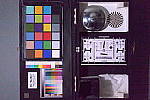
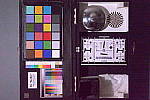
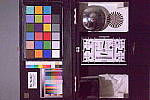
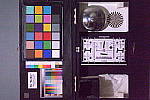
Black Friday 2026: camera deals are going live nowSee the best deals →

Nikon Df Review – Test Shots

Add us on

Digital Cameras – Nikon Df Test Images

Not sure which camera to buy? Let your eyes be the ultimate judge!
Visit our Comparometer(tm)
to compare images from the Nikon Df with those from other
cameras you may be considering. The proof is in the pictures, so let
your own eyes decide which you like best!

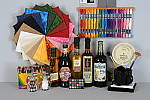
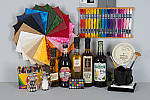
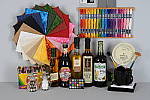
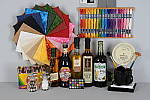
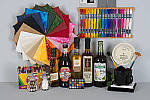
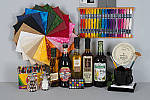
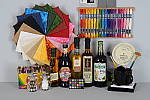
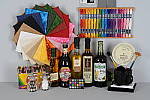
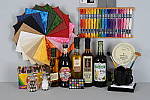
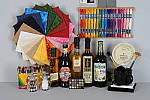
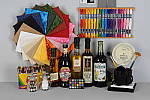
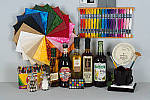
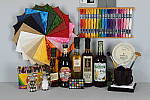
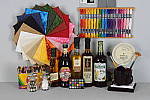
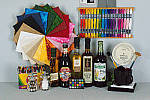
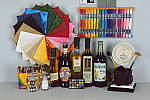
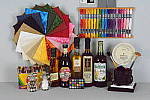
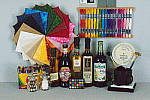
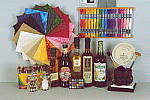
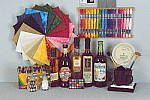
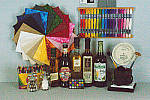
Still LifeDf Sample images image 1

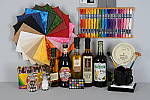
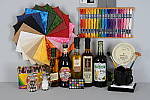
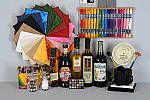
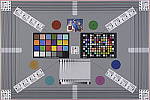
This is our new “Still Life” test target. We’re combining
some of the elements from previous shots (DaveBox and Res Chart) into
this and the “Multi Target” shot below, plus added a number
of elements that are very revealing of various camera characteristics
and foibles.

Here’s what to look for in this target:

  • Tone-on-tone detail & noise suppression:
    The cloth swatches in the pinwheel were chosen because they show a lot
    of tone-on-tone detail, across a broad range of colors. This is just
    the sort of detail that noise suppression processing tends to flatten
    out. If you look at the detail in these swatches as the ISO increases,
    you’ll see just where different cameras start to lose subtle detail.
    — The white and tan swatches and the dark swatches tend to be particularly
    revealing of this. The label of the vinegar bottle (second from the
    right) is another great place to look for lost detail from noise suppression,
    as the image of the person at the top of the label is actually a depiction
    of a mosaic. The dark colors in the background and in the figure’s clothes
    contain detail that’s very quickly lost when a camera’s noise suppression
    system kicks in. Cameras with really high-quality, low-noise sensors
    that require little noise suppression will be able to hold onto the
    detail in these areas, many others will show only a uniform swath of
    smudged color.

    Another place where you’ll quickly see the effects of over-aggressive
    noise suppression is in the white salt grains of the salt grinder in
    lower left. Cameras are often more conservative about suppressing noise
    in highlight areas (because our eyes tend to see less of it there),
    but many cameras seem to have a hard time holding onto the subtle shadings
    that distinguish the salt grains from each other, particularly at higher
    ISO levels.

  • Fine Detail: You’ll find a lot of fine detail
    in the label of the beer bottle on the right, in its fine cursive text,
    but the other bottle labels hold a lot of fine detail as well. Fine
    text is often a good visual indicator of resolution, because our brains
    have an excellent idea of what the text should look like, so
    are very quick to notice even minor loss of detail.

    For really fine detail, look to the circular scale/calculator on the
    right side of the scene. Some of the fine lines there are extremely
    fine indeed. Looking at results from many different cameras with this
    target, we found that camera noise-suppression systems often confuse
    the fine lines with image noise, and so flatten them out. There’s also
    a nice range of fine text sizes in this chart as well, once again great
    visual cues for resolution and detail.

  • Highlight Detail: Three elements in this scene
    show off (or show up) a camera’s ability to hold onto highlight detail.
    As mentioned above, the salt grains (and reflections of the studio lights)
    in the salt mill are examples of fairly subtle highlight detail that
    cameras’ anti-noise processing sometimes obliterate. The folded white
    cloth under the mug on the right side of the frame likewise shows a
    lot of white-on-white detail that is easy to lose, particularly if a
    camera’s tone curve is too contrasty. As it turns out though, the most
    sensitive test of a camera’s highlight abilities seems to be the hank
    of white embroidery thread in the upper right corner. These fibers are
    unusually bright and reflective, so its easy for a camera to blow out
    detail in them.

  • Shadow Detail: Several elements of this subject
    are useful for evaluating shadow detail, particularly the black mug
    and the pieces of folded black velvet, both under and inside the mug.
    The bottoms of the beer bottles also provide some gradations of deep
    shadow, and the clump of peppers in the bottom of the pepper oil bottle
    had a fair bit of detail that’s far down at the shadow end of the tone
    curve.

    We were actually surprised when we constructed this scene just how dark
    the velvet and sides of the beer bottles ended up being. Even with the
    bright studio lights shining directly on it, the velvet in particular
    stays way, way down at the shadow end of the tone curve. With most cameras
    and on most monitors, the velvet will simply appear as an unrelieved
    swatch of black. To see whether it contains deep detail or not, in most
    cases you’ll have to open the file in an image editor and boost the
    brightness dramatically, to bring the detail up into a visible range.

  • Preservation of “Shape” in Strong Colors:
    As you approach the extremes of a camera’s color gamut (its range of
    recordable colors), it becomes more and more difficult for the camera
    to show fine gradations of tone, because one or more of the RGB color
    channels are close to saturation. It’s not uncommon to see a brightly
    colored piece of clothing or a vibrant flower appear in digicam photos
    as just a blob of color, because the camera ran up against the limits
    of its color gamut. The brightly colored embroidery threads in the upper
    right portion of the Still Life target are good examples of situations
    where this might happen. Pay particular attention to the bright red
    and dark blue colors here, as these are both colors near the edge of
    the typical sRGB color gamut.

  • Color accuracy and white balance: It’s pretty
    small in there, but we’ve included a mini-MacBeth chart, which displays
    very carefully controlled color swatches. Our Multi Target (see below)
    sports a full-sized MacBeth chart, but the one here serves as a good
    check of color balance and rendition, and is also useful for checking
    white balance on this particular shot.

  • Image noise and detail vs ISO: As mentioned above,
    this target contains many elements useful for evaluating detail loss
    to anti-noise processing. We’ll therefore always shoot a full set of
    test images of this target across each camera’s ISO range, for every
    camera we test. (See below.)
ISO Series NR = Normal (Default)
50 100 200 400 800 1,600 3,200
6,400 12,800 25,600 51,200 102,400 204,800
ISO Series NR = Off
50 100 200 400 800 1,600 3,200
6,400 12,800 25,600 51,200 102,400 204,800

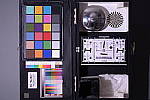
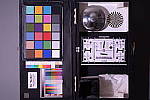
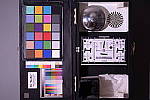
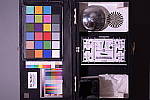
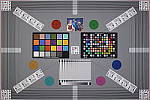
Multi TargetDf Sample images image 2

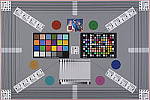
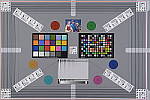
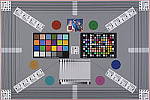
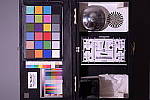
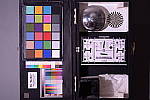
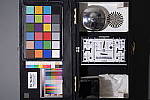
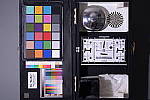
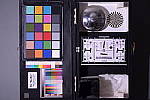
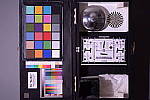
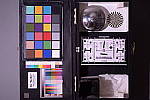
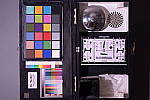
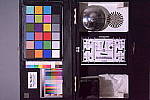
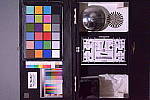
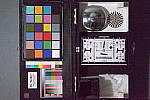
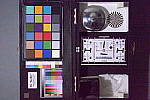
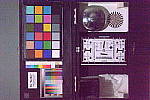
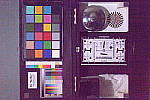
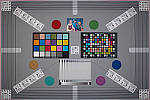
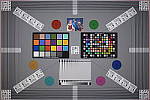
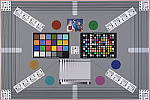
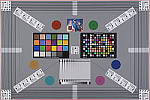
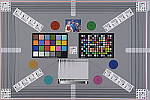
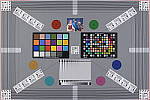
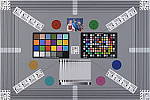
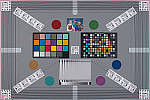
Our new “Multi Target” was first put into use in April, 2009, replacing the earlier “interim” design. This target incorporates a number of elements that combine aspects of the previous Multi target, as well as the previous Viewfinder Accuracy or “VFA” chart. Here’s some of what you’ll find in this target:

Framing marks: This chart evolved from the earlier Viewfinder Accuracy chart, so one of its major uses is to measure viewfinder accuracy. (See notes in the Viewfinder Accuracy section, at the bottom of this page, for more information on this.)

USAF resolution targets: An important use of this target is in evaluating lens quality, looking how well sharpness holds up as you move from the center to the corners of the frame. The little “USAF” resolution targets arranged at the center, in the corners, and along the diagonals are very useful for making fine judgements about blur, flare and aberrations in the image. We generally show crops of a USAF chip from a corner of the target and from the center, to show how lenses hold sharpness at wide and telephoto focal lengths.

Alignment “bullseyes:” We find these graphics from the graphic arts world (used to align sheets of film in the old film-based prepress days) very useful for seeing chromatic aberration in lenses. The bold black/white elements are good for seeing the colored fringes caused by CA in the corners of the frame.

MacBeth ColorChecker Chart: This is about as common a color standard as you can get these days, very widely available for only mildly exorbitant cost, and quite well controlled in its production. It thus serves as a good basis of comparison between cameras and between test setups. Imatest also understands the MacBeth colors very well, and uses them to produce its color accuracy map that we feature in all our reviews.

MacBeth ColorChecker SG Chart: The ColorChecker SG chart provides a wider range of colors, to give a more detailed map of a camera’s color handling. We haven’t begun using this chart in the color-accuracy graphs we routinely offer, but expect to do so at some point in the future. In the meantime, we sometimes refer to this chart internally, to get a more complete idea of what a camera’s color map looks like.

Log C/F Target: The progressive resolution pattern located just below the center of the target is a Log C/F (logarithmic contrast vs spatial frequency) chart. Digital camera noise reduction routines work by looking at levels of local contrast, flattening-out detail at progressively lower spatial frequencies as the local contrast decreases. (This is very commonly seen in human hair, grass, foliage, and other subjects with subtly-contrasting fine detail.) This chart lets Imatest analyze just how a camera makes the tradeoff between contrast, detail, and image noise.

Color Starbursts: The six circular starburst elements arranged around the target are intended to reveal de-mosaicing artifacts and color-dependent resolution issues. The six starbursts provide examples of each combination of RGB colors intersecting each other. (That is, red, green, and blue against black, plus red against green, green against blue, and blue against red.) Given that the most common sensor RGB color filter pattern (the so-called Bayer) pattern has twice as many green pixels as red or blue, you’ll generally see that the green/black starburst shows the best resolution, while the blue/red one shows the worst. The effects of different sensor geometries and color filter array patterns will be revealed here.

Musicians Image: Synthetic test patterns only tell you so much. While we have a lot of pictorial images in our other test targets, we thought it would be useful to include a small “natural” image here as well.

ISO Series
50 100 200 400 800 1,600 3,200
6,400 12,800 25,600 51,200 102,400 204,800

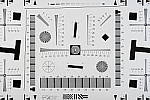
Resolution TargetDf Sample images image 3

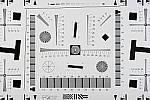
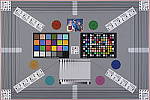
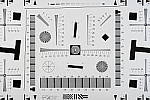
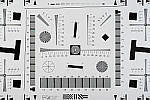
Part of the impetus in developing the new Multi Target in April 2009 was to switch to using a new 2x target for the resolution measurements, since the original ISO 12233 chart we’d used since the site first began in 1998(!) had become inadequate for testing the highest-resolution cameras. We’d for quite some time had a “homemade” 2x target, employing a shrunk version of the ISO 12233 chart, shot at 1/2 size. The resolution numbers on that chart all needed to be doubled to convert to the actual values, though, so we decided to go with a commercial 2x target to eliminate possible confusion on the part of our readers. Numbers on this new 2x resolution chart now read directly in hundreds of lines/picture height. (Because almost all of the area of this new resolution chart is now meaningful for resolution measurements, there was no longer space on it to overlay the MacBeth and other color targets on our prior Multi chart; hence the simultaneous change in our Multi target.)

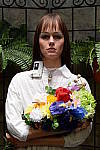
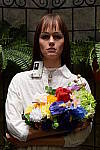
“Sunlit” Portrait:
(This is our “Outdoor” Portrait test – read more about it
here.)

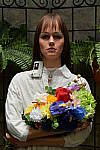
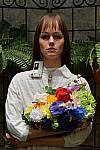
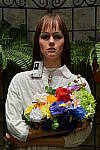
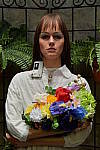
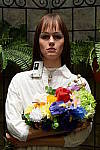
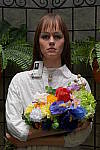
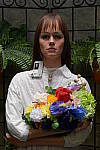
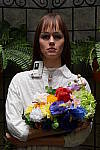
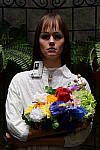
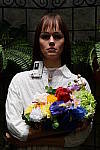
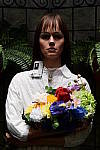
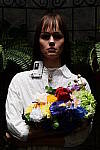
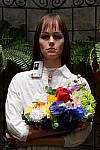
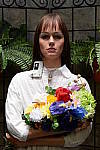
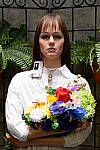
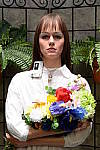
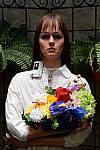
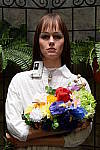
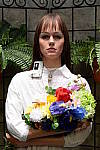
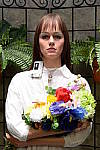
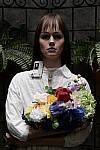
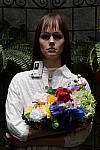
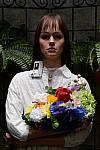
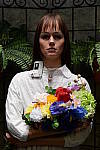
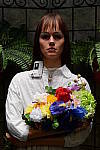
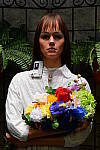
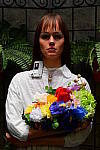
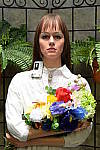
Df Sample images image 4

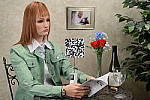
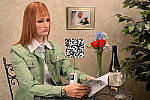
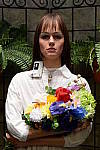
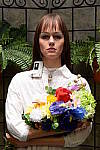
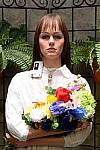
The lighting in this shot is deliberately awful, about what you’d expect from noontime sunshine here in the Atlanta, GA area. (In fact, the color balance has been chosen to pretty well match the hazy sunshine here in mid-August.)

The reason for the harsh lighting is to provide a real “torture
test” of how cameras handle conditions of extreme contrast; and in
particular, how well they do holding onto highlight detail.

Look for:

  • Overall color: Matching summer sunlight here in the South,
    the lighting in this scene is a bit more yellow-tinged than that in
    many parts of the country, or in the fall or winter. – So there may
    be an overall warm cast to the color. That said though, there’s a fair
    range of color represented in the bouquet, presenting a tough challenge
    for the cameras. For some reason, the blue flowers seem particularly
    hard to handle, with many cameras rendering them as purple. (In real
    life, they’re a light shade of navy blue, with just a bit of purple
    in them.)
  • Skin tones: The overall slight warm cast will tend to leave
    the model’s skin tones a bit on the warm side as well. Nonetheless,
    look to see if her skin seems overly pink or if they have a too-bright
    tinge of yellow: Some cameras oversaturate skin tones (make their color
    too intense), leading to an almost sunburned look. A little oversaturation
    can make for a more “healthy-looking” complexion, but it doesn’t
    take much variation for skin tones to look unnatural.
  • Highlight detail: When the model’s skin tones are at a more
    or less normal level of brightness, how much detail can you see in her
    shirt? Does it blow out entirely to white, or can you still see the
    creases and folds in the fabric?
  • Overall contrast: Most consumer digital cameras produce bright,
    contrasty images, because that’s what most consumers like. Unfortunately,
    under bright sunlit conditions, many such cameras produce images with
    little or no highlight detail, and dark, plugged-up looking shadows.
  • Shadow detail: The area under the flower bouquet is in quite deep shadow. Does the camera in question retain good detail here, with low image noise? To see, you may need to download the image and play with it in Photoshop(tm) or another imaging program. Brighten the image, and see how far detail extends into the shadows. Photo printers are generally much better at showing shadow detail than are CRTs or LCDs, so you’ll want a camera that preserves good detail here. The ability to boost brightness without encountering too much image noise is important if you ever have to “rescue” an underexposed image on the computer.
  • Detail in areas of subtle contrast: Most digital cameras employ
    some sort of noise-suppression to remove electronic noise from their
    images. Noise suppression is a good thing, but only if it’s not overdone.
    Too much noise suppression will “flatten out” subtle detail
    in areas of reduced contrast. You can often see this in hair, where
    the individual strands become blurred, and the image takes on an almost
    watercolor effect. Look at the detail in the model’s hair, and compare
    how it looks with different cameras in the Comparometer.

To view the entire exposure series, see files DFOUTBMP0.HTM through DFOUTBMP3.HTM on the thumbnail
index page
.

Contrast
Series
-3
Df Sample images image 5
-2
Df Sample images image 6
-1
Df Sample images image 7
Default
Df Sample images image 8
+1
Df Sample images image 9
+2
Df Sample images image 10
+3
Df Sample images image 11
Saturation
Series
-3
Df Sample images image 12
-2
Df Sample images image 13
-1
Df Sample images image 14
Default
Df Sample images image 15
+1
Df Sample images image 16
+2
Df Sample images image 17
+3
Df Sample images image 18
Active D-Lighting Series
Off
Df Sample images image 19
Low
Df Sample images image 20
Normal
Df Sample images image 21
High
Df Sample images image 22
Extra 1
Df Sample images image 23
Extra 2
Df Sample images image 24
Auto
Df Sample images image 25
HDR Series
1EV
Df Sample images image 26
2EV
Df Sample images image 27
3EV
Df Sample images image 28
Auto
Df Sample images image 29

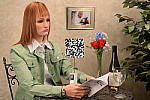
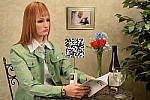
Indoor Portrait, No Flash:

Auto
White Balance
Df Sample images image 30
Incandescent
White Balance
Df Sample images image 31
Manual
White Balance
Df Sample images image 32
2,600 Kelvin
White Balance
Df Sample images image 33

The incandescent lighting used in most US homes actually has a very
strong yellow color to it. Our eyes have an amazing ability to ignore
color casts like this, something digital cameras struggle to emulate.

The incandescent lighting used for this shot is thus not only very common
here in the US, but also very difficult for most digital cameras to deal
with. While we probably want a little yellow color to remain in
the image (to convey some of the mood of the original scene), too much
will look unnatural and distort colors.

Most cameras’ auto white balance systems have a great deal of difficulty
with this shot, but many incandescent white balance settings struggle
as well. (It seems that many cameras’ incandescent settings are actually
calibrated to the tungsten lighting used in professional studio systems,
which isn’t nearly as warm-toned as typical household lighting.)

If you intend to do much shooting indoors after dark, pay careful attention
to this test, as cameras vary widely in this regard.

To view the entire exposure series, see files DFINBMM2.HTM through DFINBMP1.HTM on the thumbnail
index page
.

ISO Series:
“ISO equivalent” refers to a camera’s light sensitivity. ISO
200 represents twice the sensitivity of ISO 100, meaning that you can
use a shutter speed that’s twice as fast. Higher ISO settings are often
required to get any picture at all when shooting after dark, but even
in full daylight, using a higher ISO can help you freeze fast action.
The problem is, increasing a digital camera’s ISO also increases image
noise. In practical terms, this means that higher-ISO images often can’t
be used to produce prints as large as lower-ISO ones. The tricky thing
here is that high-ISO images often look much different when printed at
various sizes than they do when viewed on-screen. In particular, for any
level of image noise, you’ll often find that while noise is quite evident
at larger print sizes, as you reduce the size of the prints, there will
come a point where it suddenly ceases to be an issue. We routinely print
high-ISO photos from the cameras we test on our studio printer (currently
a Canon i9900) at a range of sizes, and report our findings. If you’re
interested in investigating the effect of image noise for yourself, don’t
judge cameras’ performance by how their images look on your CRT, viewed
pixel-for-pixel. Rather, download the test shots linked in the table below
and output them on your own printer, so you can see how prints of various
sizes will actually look.

One additional note about this particular test series though: Because
these images are shot under household incandescent lighting, the camera
has to boost its blue-channel signal quite a bit to get back to a neutral
color balance. Since the blue channel is generally the one with the most
noise, this makes this shot a real acid test of noise performance. Noise
levels in high-ISO shots taken under daylight conditions usually won’t
show as much noise. (See the “Far Field” test for examples of
high ISO shots captured in daylight.)

ISO Series
50 100 200 400 800 1,600 3,200
6,400 12,800 25,600 51,200 102,400 204,800

House Shot:

Df Sample images image 34

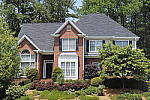
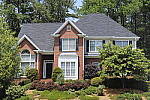
Like several of our tests, these images are actually photos of a high-resolution poster, shot under studio lighting. The shots for this camera were captured with our third-generation House poster, which was assembled from 45 separate 11-megapixel images, shot with a very high-quality lens, and then stitched together into a single image. The resulting image amounts to about 450 very high-quality megapixels. This should have sufficient detail to comfortably challenge cameras up to at least 80-100 megapixels. (And even with higher-resolution cameras, we believe that the camera lenses themselves would be more likely to limit resolution than would the detail in the poster.)

Why did we choose to shoot a picture of a picture? The idea was to show a typical subject (a house and surrounding foliage) in a way that would be absolutely consistent from camera to camera. Any outdoor subject is going to vary considerably from day to day, as the lighting changes with the weather, atmospheric conditions, and season. Shooting a poster lets us compare images from cameras shot weeks, months, or even years apart, with the sure knowledge that nothing has changed from one shot to another.

Things to look for here are fine detail, as seen in the foliage and tree limbs against the sky, sharpness in the corners, and the preservation of subtle detail in the shaded brick patterns. – Many cameras with overactive noise suppression severely blur the brick patterns that are in shadow.

Far-Field Test 2Df Sample images image 35

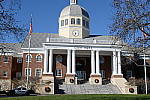
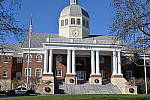
While the House poster in the shot above provides absolute repeatability from test to test, it doesn’t offer the range of brightness (dynamic range) that the original scene had, nor does it contain the nearly infinite range of fine detail found in nature. For these reasons, we shoot an outdoor photo of a building, to provide a more challenging (if more variable) subject for the cameras. Until Summer of 2011, we used the original house from the House poster for this “Far Field” shot, but the ever-encroaching trees made it less and less useful. The coup de grace for that subject was when the neighbor across the street relandscaped his yard so we could no longer shoot from our original position.

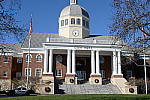
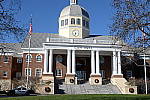
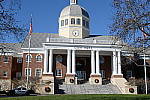
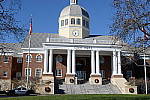
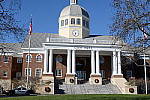
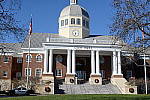
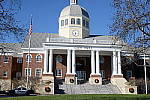
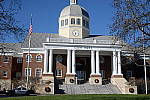
In place of the original house, we’ve switched to using the Roswell, GA City Hall building, which offers many of the elements of the original Far Field subject, but in a setting where we’re guaranteed access into the future, and without the threat of trees eventually obscuring the building. In this shot, we look at how the camera handles rendering of subtle detail (the bricks, both in the sunlight and in the deep shadows under the entryway roof), how it handles bright highlights (the white columns and reflections from the dome), and shadow detail (in the dark areas beneath the shrubs on either side of the steps).

Note though, that because this is shot outdoors, the character of the light is unavoidably going to change quite a bit, depending on the atmospheric humidity and the time of year. – You thus shouldn’t rely on it for absolute comparisons between cameras, since it’s unlikely that conditions will be exactly the same from one test to the next.

ISO
Series
50 100 200 400 800 1,600 3,200
Contrast
Series
-3
Df Sample images image 36
-2
Df Sample images image 37
-1
Df Sample images image 38
Default
Df Sample images image 39
+1
Df Sample images image 40
+2
Df Sample images image 41
+3
Df Sample images image 42
Auto
Df Sample images image 43
Active D-Lighting Series
Off
Df Sample images image 44
Low
Df Sample images image 45
Normal
Df Sample images image 46
High
Df Sample images image 47
Extra 1
Df Sample images image 48
Extra 2
Df Sample images image 49
Auto
Df Sample images image 50
HDR Series
Off
Df Sample images image 51
1 EV
Df Sample images image 52
2 EV
Df Sample images image 53
3 EV
Df Sample images image 54

“Davebox” Test Target

Because most of its various elements are now contained or represented in the combination of the Still Life and Multi Target shots, we no longer routinely shoot the Davebox by itself, as would normally appear in this space. (We do however, still use it for our low light test below.)

Low-Light Tests

Low light photography is an area where there are really enormous differences
between digital camera models. This test starts at a light level about
equivalent to typical city street lighting at night (one foot-candle),
and then progresses down from there, each successive test being at half
the light level of the preceding one. You may also see the effect of poor
low-light autofocus in some of these shots, although we use a different
test setup to check autofocus performance more directly. (The results
of which are reported on in the main Test Results section.) Things to
look for here include:

  • Exposure limit: What’s the darkest level a camera can handle
    at each ISO setting? If the leftmost images are reasonably bright, the
    camera should do fine with typical city night scenes. If you’re shooting
    in the more dimly-lit suburbs, you’ll need a camera capable of producing
    good images one, two, or three steps to the right of that.
  • Autofocus Limit: How dark can you shoot and still get well-focused
    pictures?
  • White Balance: Does the camera’s white balance suffer at low
    light levels? (Many do.)
  • Noise Levels: Look at the photos, print them on your own photo
    printer. How large a print can you make at acceptable quality levels,
    at various ISO settings and light levels?
  • Detail loss to anti-noise processing?: Do details in the white
    gauze and even in the lettering on the test targets suffer at lower
    light levels?

(Note: If you’d like to use a light meter to check light levels
for subjects you might be interested in shooting, a light level of one
foot-candle corresponds to a normal exposure of two seconds at f/2.8 and
ISO 100.)


1 fc
11 lux
1/2 fc
5.5 lux
1/4 fc
2.7 lux
1/8 fc
1.3 lux
1/16 fc
0.67 lux
1/16fc
No NR
ISO
50
Df Sample images image 55
3 s
f2.8
Df Sample images image 56
6 s
f2.8
Df Sample images image 57
13 s
f2.8
Df Sample images image 58
25 s
f2.8
Df Sample images image 59
30 s
f2.8
Df Sample images image 60
30 s
f2.8
ISO
100
Df Sample images image 61
2 s
f2.8
Df Sample images image 62
4 s
f2.8
Df Sample images image 63
8 s
f2.8
Df Sample images image 64
15 s
f2.8
Df Sample images image 65
30 s
f2.8
Df Sample images image 66
30 s
f2.8
ISO
200
Df Sample images image 67
1 s
f2.8
Df Sample images image 68
2 s
f2.8
Df Sample images image 69
4 s
f2.8
Df Sample images image 70
8 s
f2.8
Df Sample images image 71
15 s
f2.8
Df Sample images image 72
15 s
f2.8
ISO
400
Df Sample images image 73
0.5 s
f2.8
Df Sample images image 74
1 s
f2.8
Df Sample images image 75
2 s
f2.8
Df Sample images image 76
4 s
f2.8
Df Sample images image 77
8 s
f2.8
Df Sample images image 78
8 s
f2.8
ISO
800
Df Sample images image 79
1/4 s
f2.8
Df Sample images image 80
0.5 s
f2.8
Df Sample images image 81
1 s
f2.8
Df Sample images image 82
2 s
f2.8
Df Sample images image 83
4 s
f2.8
Df Sample images image 84
4 s
f2.8
ISO
1600
Df Sample images image 85
1/8 s
f2.8
Df Sample images image 86
1/4 s
f2.8
Df Sample images image 87
0.5 s
f2.8
Df Sample images image 88
1 s
f2.8
Df Sample images image 89
2 s
f2.8
Df Sample images image 90
2 s
f2.8
ISO
3200
Df Sample images image 91
1/15 s
f2.8
Df Sample images image 92
1/8 s
f2.8
Df Sample images image 93
1/4 s
f2.8
Df Sample images image 94
0.5 s
f2.8
Df Sample images image 95
1 s
f2.8
Df Sample images image 96
1 s
f2.8
ISO
6400
Df Sample images image 97
1/30 s
f2.8
Df Sample images image 98
1/15 s
f2.8
Df Sample images image 99
1/8 s
f2.8
Df Sample images image 100
1/4 s
f2.8
Df Sample images image 101
0.5 s
f2.8
Df Sample images image 102
0.5 s
f2.8
ISO
12800
Df Sample images image 103
1/60 s
f2.8
Df Sample images image 104
1/30 s
f2.8
Df Sample images image 105
1/15 s
f2.8
Df Sample images image 106
1/8 s
f2.8
Df Sample images image 107
1/4 s
f2.8
Df Sample images image 108
1/4 s
f2.8
ISO
25600
Df Sample images image 109
1/125 s
f2.8
Df Sample images image 110
1/60 s
f2.8
Df Sample images image 111
1/30 s
f2.8
Df Sample images image 112
1/15 s
f2.8
Df Sample images image 113
1/8 s
f2.8
Df Sample images image 114
1/8 s
f2.8
ISO
51200
Df Sample images image 115
1/250 s
f2.8
Df Sample images image 116
1/125 s
f2.8
Df Sample images image 117
1/60 s
f2.8
Df Sample images image 118
1/30 s
f2.8
Df Sample images image 119
1/15 s
f2.8
Df Sample images image 120
1/15 s
f2.8
ISO
102400
Df Sample images image 121
1/500 s
f2.8
Df Sample images image 122
1/250 s
f2.8
Df Sample images image 123
1/125 s
f2.8
Df Sample images image 124
1/60 s
f2.8
Df Sample images image 125
1/30 s
f2.8
Df Sample images image 126
1/30 s
f2.8
ISO
204800
Df Sample images image 127
1/1000 s
f2.8
Df Sample images image 128
1/500 s
f2.8
Df Sample images image 129
1/250 s
f2.8
Df Sample images image 130
1/125 s
f2.8
Df Sample images image 131
1/60 s
f2.8
Df Sample images image 132
1/60 s
f2.8

Viewfinder Accuracy

Viewfinder accuracy is an important parameter, especially for shots
where framing is critical. The optical viewfinders on most digital cameras
match the (poor) accuracy of those on film cameras, typically showing
only about 85% of the actual final frame area. It’s likely that this is
a deliberate design choice by the camera engineers, to help avoid users
accidentally cutting off the heads of their subjects. We disagree with
this approach, or at least feel that it should be mitigated a bit, perhaps
by increasing the accuracy to 90 to 95%.

Unlike the optical viewfinders, the LCD viewfinders on most digital
cameras tend to be quite accurate. There are exceptions though, and it’s
unfortunately not uncommon to find an LCD monitor that only shows 90%
or less of the final frame.

Things to look for on this test chart are:

  • Optical/Electronic viewfinder accuracy: When we shoot this target in the studio, we line things up so the center of the bright red outline on the target is just visible at the edges of the viewfinder frame. The resulting photo then very directly shows how accurate the viewfinder is. The fine black lines mark progressive increments of 1% of increased or decreased frame area. The bold black lines mark 5% increments. The lines let you get an approximate idea of frame accuracy visually, but we measure the actual pixel dimensions to derive the accuracy numbers we report in our reviews.
  • LCD monitor accuracy: This is the same test, but framed with the LCD monitor instead of the optical viewfinder. As mentioned above, LCD monitors are usually more accurate than optical viewfinders, especially in point & shoot digicams.

Digital Cameras – Nikon Df Test Images

Not sure which camera to buy? Let your eyes be the ultimate judge!
Visit our Comparometer(tm)
to compare images from the Nikon Df with those from other
cameras you may be considering. The proof is in the pictures, so let
your own eyes decide which you like best!

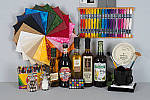
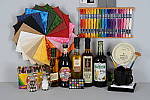
Still LifeDf Test Shots image 1

This is our new “Still Life” test target. We’re combining
some of the elements from previous shots (DaveBox and Res Chart) into
this and the “Multi Target” shot below, plus added a number
of elements that are very revealing of various camera characteristics
and foibles.

Here’s what to look for in this target:

  • Tone-on-tone detail & noise suppression:
    The cloth swatches in the pinwheel were chosen because they show a lot
    of tone-on-tone detail, across a broad range of colors. This is just
    the sort of detail that noise suppression processing tends to flatten
    out. If you look at the detail in these swatches as the ISO increases,
    you’ll see just where different cameras start to lose subtle detail.
    — The white and tan swatches and the dark swatches tend to be particularly
    revealing of this. The label of the vinegar bottle (second from the
    right) is another great place to look for lost detail from noise suppression,
    as the image of the person at the top of the label is actually a depiction
    of a mosaic. The dark colors in the background and in the figure’s clothes
    contain detail that’s very quickly lost when a camera’s noise suppression
    system kicks in. Cameras with really high-quality, low-noise sensors
    that require little noise suppression will be able to hold onto the
    detail in these areas, many others will show only a uniform swath of
    smudged color.

    Another place where you’ll quickly see the effects of over-aggressive
    noise suppression is in the white salt grains of the salt grinder in
    lower left. Cameras are often more conservative about suppressing noise
    in highlight areas (because our eyes tend to see less of it there),
    but many cameras seem to have a hard time holding onto the subtle shadings
    that distinguish the salt grains from each other, particularly at higher
    ISO levels.

  • Fine Detail: You’ll find a lot of fine detail
    in the label of the beer bottle on the right, in its fine cursive text,
    but the other bottle labels hold a lot of fine detail as well. Fine
    text is often a good visual indicator of resolution, because our brains
    have an excellent idea of what the text should look like, so
    are very quick to notice even minor loss of detail.

    For really fine detail, look to the circular scale/calculator on the
    right side of the scene. Some of the fine lines there are extremely
    fine indeed. Looking at results from many different cameras with this
    target, we found that camera noise-suppression systems often confuse
    the fine lines with image noise, and so flatten them out. There’s also
    a nice range of fine text sizes in this chart as well, once again great
    visual cues for resolution and detail.

  • Highlight Detail: Three elements in this scene
    show off (or show up) a camera’s ability to hold onto highlight detail.
    As mentioned above, the salt grains (and reflections of the studio lights)
    in the salt mill are examples of fairly subtle highlight detail that
    cameras’ anti-noise processing sometimes obliterate. The folded white
    cloth under the mug on the right side of the frame likewise shows a
    lot of white-on-white detail that is easy to lose, particularly if a
    camera’s tone curve is too contrasty. As it turns out though, the most
    sensitive test of a camera’s highlight abilities seems to be the hank
    of white embroidery thread in the upper right corner. These fibers are
    unusually bright and reflective, so its easy for a camera to blow out
    detail in them.

  • Shadow Detail: Several elements of this subject
    are useful for evaluating shadow detail, particularly the black mug
    and the pieces of folded black velvet, both under and inside the mug.
    The bottoms of the beer bottles also provide some gradations of deep
    shadow, and the clump of peppers in the bottom of the pepper oil bottle
    had a fair bit of detail that’s far down at the shadow end of the tone
    curve.

    We were actually surprised when we constructed this scene just how dark
    the velvet and sides of the beer bottles ended up being. Even with the
    bright studio lights shining directly on it, the velvet in particular
    stays way, way down at the shadow end of the tone curve. With most cameras
    and on most monitors, the velvet will simply appear as an unrelieved
    swatch of black. To see whether it contains deep detail or not, in most
    cases you’ll have to open the file in an image editor and boost the
    brightness dramatically, to bring the detail up into a visible range.

  • Preservation of “Shape” in Strong Colors:
    As you approach the extremes of a camera’s color gamut (its range of
    recordable colors), it becomes more and more difficult for the camera
    to show fine gradations of tone, because one or more of the RGB color
    channels are close to saturation. It’s not uncommon to see a brightly
    colored piece of clothing or a vibrant flower appear in digicam photos
    as just a blob of color, because the camera ran up against the limits
    of its color gamut. The brightly colored embroidery threads in the upper
    right portion of the Still Life target are good examples of situations
    where this might happen. Pay particular attention to the bright red
    and dark blue colors here, as these are both colors near the edge of
    the typical sRGB color gamut.

  • Color accuracy and white balance: It’s pretty
    small in there, but we’ve included a mini-MacBeth chart, which displays
    very carefully controlled color swatches. Our Multi Target (see below)
    sports a full-sized MacBeth chart, but the one here serves as a good
    check of color balance and rendition, and is also useful for checking
    white balance on this particular shot.

  • Image noise and detail vs ISO: As mentioned above,
    this target contains many elements useful for evaluating detail loss
    to anti-noise processing. We’ll therefore always shoot a full set of
    test images of this target across each camera’s ISO range, for every
    camera we test. (See below.)
ISO Series NR = Normal (Default)
50 100 200 400 800 1,600 3,200
6,400 12,800 25,600 51,200 102,400 204,800
ISO Series NR = Off
50 100 200 400 800 1,600 3,200
6,400 12,800 25,600 51,200 102,400 204,800

Multi TargetDf Test Shots image 2

Our new “Multi Target” was first put into use in April, 2009, replacing the earlier “interim” design. This target incorporates a number of elements that combine aspects of the previous Multi target, as well as the previous Viewfinder Accuracy or “VFA” chart. Here’s some of what you’ll find in this target:

Framing marks: This chart evolved from the earlier Viewfinder Accuracy chart, so one of its major uses is to measure viewfinder accuracy. (See notes in the Viewfinder Accuracy section, at the bottom of this page, for more information on this.)

USAF resolution targets: An important use of this target is in evaluating lens quality, looking how well sharpness holds up as you move from the center to the corners of the frame. The little “USAF” resolution targets arranged at the center, in the corners, and along the diagonals are very useful for making fine judgements about blur, flare and aberrations in the image. We generally show crops of a USAF chip from a corner of the target and from the center, to show how lenses hold sharpness at wide and telephoto focal lengths.

Alignment “bullseyes:” We find these graphics from the graphic arts world (used to align sheets of film in the old film-based prepress days) very useful for seeing chromatic aberration in lenses. The bold black/white elements are good for seeing the colored fringes caused by CA in the corners of the frame.

MacBeth ColorChecker Chart: This is about as common a color standard as you can get these days, very widely available for only mildly exorbitant cost, and quite well controlled in its production. It thus serves as a good basis of comparison between cameras and between test setups. Imatest also understands the MacBeth colors very well, and uses them to produce its color accuracy map that we feature in all our reviews.

MacBeth ColorChecker SG Chart: The ColorChecker SG chart provides a wider range of colors, to give a more detailed map of a camera’s color handling. We haven’t begun using this chart in the color-accuracy graphs we routinely offer, but expect to do so at some point in the future. In the meantime, we sometimes refer to this chart internally, to get a more complete idea of what a camera’s color map looks like.

Log C/F Target: The progressive resolution pattern located just below the center of the target is a Log C/F (logarithmic contrast vs spatial frequency) chart. Digital camera noise reduction routines work by looking at levels of local contrast, flattening-out detail at progressively lower spatial frequencies as the local contrast decreases. (This is very commonly seen in human hair, grass, foliage, and other subjects with subtly-contrasting fine detail.) This chart lets Imatest analyze just how a camera makes the tradeoff between contrast, detail, and image noise.

Color Starbursts: The six circular starburst elements arranged around the target are intended to reveal de-mosaicing artifacts and color-dependent resolution issues. The six starbursts provide examples of each combination of RGB colors intersecting each other. (That is, red, green, and blue against black, plus red against green, green against blue, and blue against red.) Given that the most common sensor RGB color filter pattern (the so-called Bayer) pattern has twice as many green pixels as red or blue, you’ll generally see that the green/black starburst shows the best resolution, while the blue/red one shows the worst. The effects of different sensor geometries and color filter array patterns will be revealed here.

Musicians Image: Synthetic test patterns only tell you so much. While we have a lot of pictorial images in our other test targets, we thought it would be useful to include a small “natural” image here as well.

ISO Series
50 100 200 400 800 1,600 3,200
6,400 12,800 25,600 51,200 102,400 204,800

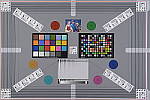
Resolution TargetDf Test Shots image 3

Part of the impetus in developing the new Multi Target in April 2009 was to switch to using a new 2x target for the resolution measurements, since the original ISO 12233 chart we’d used since the site first began in 1998(!) had become inadequate for testing the highest-resolution cameras. We’d for quite some time had a “homemade” 2x target, employing a shrunk version of the ISO 12233 chart, shot at 1/2 size. The resolution numbers on that chart all needed to be doubled to convert to the actual values, though, so we decided to go with a commercial 2x target to eliminate possible confusion on the part of our readers. Numbers on this new 2x resolution chart now read directly in hundreds of lines/picture height. (Because almost all of the area of this new resolution chart is now meaningful for resolution measurements, there was no longer space on it to overlay the MacBeth and other color targets on our prior Multi chart; hence the simultaneous change in our Multi target.)

“Sunlit” Portrait:
(This is our “Outdoor” Portrait test – read more about it
here.)

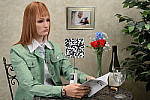
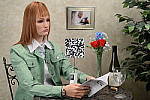
Df Test Shots image 4

The lighting in this shot is deliberately awful, about what you’d expect from noontime sunshine here in the Atlanta, GA area. (In fact, the color balance has been chosen to pretty well match the hazy sunshine here in mid-August.)

The reason for the harsh lighting is to provide a real “torture
test” of how cameras handle conditions of extreme contrast; and in
particular, how well they do holding onto highlight detail.

Look for:

  • Overall color: Matching summer sunlight here in the South,
    the lighting in this scene is a bit more yellow-tinged than that in
    many parts of the country, or in the fall or winter. – So there may
    be an overall warm cast to the color. That said though, there’s a fair
    range of color represented in the bouquet, presenting a tough challenge
    for the cameras. For some reason, the blue flowers seem particularly
    hard to handle, with many cameras rendering them as purple. (In real
    life, they’re a light shade of navy blue, with just a bit of purple
    in them.)
  • Skin tones: The overall slight warm cast will tend to leave
    the model’s skin tones a bit on the warm side as well. Nonetheless,
    look to see if her skin seems overly pink or if they have a too-bright
    tinge of yellow: Some cameras oversaturate skin tones (make their color
    too intense), leading to an almost sunburned look. A little oversaturation
    can make for a more “healthy-looking” complexion, but it doesn’t
    take much variation for skin tones to look unnatural.
  • Highlight detail: When the model’s skin tones are at a more
    or less normal level of brightness, how much detail can you see in her
    shirt? Does it blow out entirely to white, or can you still see the
    creases and folds in the fabric?
  • Overall contrast: Most consumer digital cameras produce bright,
    contrasty images, because that’s what most consumers like. Unfortunately,
    under bright sunlit conditions, many such cameras produce images with
    little or no highlight detail, and dark, plugged-up looking shadows.
  • Shadow detail: The area under the flower bouquet is in quite deep shadow. Does the camera in question retain good detail here, with low image noise? To see, you may need to download the image and play with it in Photoshop(tm) or another imaging program. Brighten the image, and see how far detail extends into the shadows. Photo printers are generally much better at showing shadow detail than are CRTs or LCDs, so you’ll want a camera that preserves good detail here. The ability to boost brightness without encountering too much image noise is important if you ever have to “rescue” an underexposed image on the computer.
  • Detail in areas of subtle contrast: Most digital cameras employ
    some sort of noise-suppression to remove electronic noise from their
    images. Noise suppression is a good thing, but only if it’s not overdone.
    Too much noise suppression will “flatten out” subtle detail
    in areas of reduced contrast. You can often see this in hair, where
    the individual strands become blurred, and the image takes on an almost
    watercolor effect. Look at the detail in the model’s hair, and compare
    how it looks with different cameras in the Comparometer.

To view the entire exposure series, see files DFOUTBMP0.HTM through DFOUTBMP3.HTM on the thumbnail
index page
.

Contrast
Series
-3
Df Test Shots image 5
-2
Df Test Shots image 6
-1
Df Test Shots image 7
Default
Df Test Shots image 8
+1
Df Test Shots image 9
+2
Df Test Shots image 10
+3
Df Test Shots image 11
Saturation
Series
-3
Df Test Shots image 12
-2
Df Test Shots image 13
-1
Df Test Shots image 14
Default
Df Test Shots image 15
+1
Df Test Shots image 16
+2
Df Test Shots image 17
+3
Df Test Shots image 18
Active D-Lighting Series
Off
Df Test Shots image 19
Low
Df Test Shots image 20
Normal
Df Test Shots image 21
High
Df Test Shots image 22
Extra 1
Df Test Shots image 23
Extra 2
Df Test Shots image 24
Auto
Df Test Shots image 25
HDR Series
1EV
Df Test Shots image 26
2EV
Df Test Shots image 27
3EV
Df Test Shots image 28
Auto
Df Test Shots image 29

Indoor Portrait, No Flash:

Auto
White Balance
Df Test Shots image 30
Incandescent
White Balance
Df Test Shots image 31
Manual
White Balance
Df Test Shots image 32
2,600 Kelvin
White Balance
Df Test Shots image 33

The incandescent lighting used in most US homes actually has a very
strong yellow color to it. Our eyes have an amazing ability to ignore
color casts like this, something digital cameras struggle to emulate.

The incandescent lighting used for this shot is thus not only very common
here in the US, but also very difficult for most digital cameras to deal
with. While we probably want a little yellow color to remain in
the image (to convey some of the mood of the original scene), too much
will look unnatural and distort colors.

Most cameras’ auto white balance systems have a great deal of difficulty
with this shot, but many incandescent white balance settings struggle
as well. (It seems that many cameras’ incandescent settings are actually
calibrated to the tungsten lighting used in professional studio systems,
which isn’t nearly as warm-toned as typical household lighting.)

If you intend to do much shooting indoors after dark, pay careful attention
to this test, as cameras vary widely in this regard.

To view the entire exposure series, see files DFINBMM2.HTM through DFINBMP1.HTM on the thumbnail
index page
.

ISO Series:
“ISO equivalent” refers to a camera’s light sensitivity. ISO
200 represents twice the sensitivity of ISO 100, meaning that you can
use a shutter speed that’s twice as fast. Higher ISO settings are often
required to get any picture at all when shooting after dark, but even
in full daylight, using a higher ISO can help you freeze fast action.
The problem is, increasing a digital camera’s ISO also increases image
noise. In practical terms, this means that higher-ISO images often can’t
be used to produce prints as large as lower-ISO ones. The tricky thing
here is that high-ISO images often look much different when printed at
various sizes than they do when viewed on-screen. In particular, for any
level of image noise, you’ll often find that while noise is quite evident
at larger print sizes, as you reduce the size of the prints, there will
come a point where it suddenly ceases to be an issue. We routinely print
high-ISO photos from the cameras we test on our studio printer (currently
a Canon i9900) at a range of sizes, and report our findings. If you’re
interested in investigating the effect of image noise for yourself, don’t
judge cameras’ performance by how their images look on your CRT, viewed
pixel-for-pixel. Rather, download the test shots linked in the table below
and output them on your own printer, so you can see how prints of various
sizes will actually look.

One additional note about this particular test series though: Because
these images are shot under household incandescent lighting, the camera
has to boost its blue-channel signal quite a bit to get back to a neutral
color balance. Since the blue channel is generally the one with the most
noise, this makes this shot a real acid test of noise performance. Noise
levels in high-ISO shots taken under daylight conditions usually won’t
show as much noise. (See the “Far Field” test for examples of
high ISO shots captured in daylight.)

ISO Series
50 100 200 400 800 1,600 3,200
6,400 12,800 25,600 51,200 102,400 204,800

House Shot:

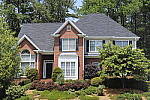
Df Test Shots image 34

Like several of our tests, these images are actually photos of a high-resolution poster, shot under studio lighting. The shots for this camera were captured with our third-generation House poster, which was assembled from 45 separate 11-megapixel images, shot with a very high-quality lens, and then stitched together into a single image. The resulting image amounts to about 450 very high-quality megapixels. This should have sufficient detail to comfortably challenge cameras up to at least 80-100 megapixels. (And even with higher-resolution cameras, we believe that the camera lenses themselves would be more likely to limit resolution than would the detail in the poster.)

Why did we choose to shoot a picture of a picture? The idea was to show a typical subject (a house and surrounding foliage) in a way that would be absolutely consistent from camera to camera. Any outdoor subject is going to vary considerably from day to day, as the lighting changes with the weather, atmospheric conditions, and season. Shooting a poster lets us compare images from cameras shot weeks, months, or even years apart, with the sure knowledge that nothing has changed from one shot to another.

Things to look for here are fine detail, as seen in the foliage and tree limbs against the sky, sharpness in the corners, and the preservation of subtle detail in the shaded brick patterns. – Many cameras with overactive noise suppression severely blur the brick patterns that are in shadow.

Far-Field Test 2Df Test Shots image 35

While the House poster in the shot above provides absolute repeatability from test to test, it doesn’t offer the range of brightness (dynamic range) that the original scene had, nor does it contain the nearly infinite range of fine detail found in nature. For these reasons, we shoot an outdoor photo of a building, to provide a more challenging (if more variable) subject for the cameras. Until Summer of 2011, we used the original house from the House poster for this “Far Field” shot, but the ever-encroaching trees made it less and less useful. The coup de grace for that subject was when the neighbor across the street relandscaped his yard so we could no longer shoot from our original position.

In place of the original house, we’ve switched to using the Roswell, GA City Hall building, which offers many of the elements of the original Far Field subject, but in a setting where we’re guaranteed access into the future, and without the threat of trees eventually obscuring the building. In this shot, we look at how the camera handles rendering of subtle detail (the bricks, both in the sunlight and in the deep shadows under the entryway roof), how it handles bright highlights (the white columns and reflections from the dome), and shadow detail (in the dark areas beneath the shrubs on either side of the steps).

Note though, that because this is shot outdoors, the character of the light is unavoidably going to change quite a bit, depending on the atmospheric humidity and the time of year. – You thus shouldn’t rely on it for absolute comparisons between cameras, since it’s unlikely that conditions will be exactly the same from one test to the next.

ISO
Series
50 100 200 400 800 1,600 3,200
Contrast
Series
-3
Df Test Shots image 36
-2
Df Test Shots image 37
-1
Df Test Shots image 38
Default
Df Test Shots image 39
+1
Df Test Shots image 40
+2
Df Test Shots image 41
+3
Df Test Shots image 42
Auto
Df Test Shots image 43
Active D-Lighting Series
Off
Df Test Shots image 44
Low
Df Test Shots image 45
Normal
Df Test Shots image 46
High
Df Test Shots image 47
Extra 1
Df Test Shots image 48
Extra 2
Df Test Shots image 49
Auto
Df Test Shots image 50
HDR Series
Off
Df Test Shots image 51
1 EV
Df Test Shots image 52
2 EV
Df Test Shots image 53
3 EV
Df Test Shots image 54

“Davebox” Test Target

Because most of its various elements are now contained or represented in the combination of the Still Life and Multi Target shots, we no longer routinely shoot the Davebox by itself, as would normally appear in this space. (We do however, still use it for our low light test below.)

Low-Light Tests

Low light photography is an area where there are really enormous differences
between digital camera models. This test starts at a light level about
equivalent to typical city street lighting at night (one foot-candle),
and then progresses down from there, each successive test being at half
the light level of the preceding one. You may also see the effect of poor
low-light autofocus in some of these shots, although we use a different
test setup to check autofocus performance more directly. (The results
of which are reported on in the main Test Results section.) Things to
look for here include:

  • Exposure limit: What’s the darkest level a camera can handle
    at each ISO setting? If the leftmost images are reasonably bright, the
    camera should do fine with typical city night scenes. If you’re shooting
    in the more dimly-lit suburbs, you’ll need a camera capable of producing
    good images one, two, or three steps to the right of that.
  • Autofocus Limit: How dark can you shoot and still get well-focused
    pictures?
  • White Balance: Does the camera’s white balance suffer at low
    light levels? (Many do.)
  • Noise Levels: Look at the photos, print them on your own photo
    printer. How large a print can you make at acceptable quality levels,
    at various ISO settings and light levels?
  • Detail loss to anti-noise processing?: Do details in the white
    gauze and even in the lettering on the test targets suffer at lower
    light levels?

(Note: If you’d like to use a light meter to check light levels
for subjects you might be interested in shooting, a light level of one
foot-candle corresponds to a normal exposure of two seconds at f/2.8 and
ISO 100.)


1 fc
11 lux
1/2 fc
5.5 lux
1/4 fc
2.7 lux
1/8 fc
1.3 lux
1/16 fc
0.67 lux
1/16fc
No NR
ISO
50
Df Test Shots image 55
3 s
f2.8
Df Test Shots image 56
6 s
f2.8
Df Test Shots image 57
13 s
f2.8
Df Test Shots image 58
25 s
f2.8
Df Test Shots image 59
30 s
f2.8
Df Test Shots image 60
30 s
f2.8
ISO
100
Df Test Shots image 61
2 s
f2.8
Df Test Shots image 62
4 s
f2.8
Df Test Shots image 63
8 s
f2.8
Df Test Shots image 64
15 s
f2.8
Df Test Shots image 65
30 s
f2.8
Df Test Shots image 66
30 s
f2.8
ISO
200
Df Test Shots image 67
1 s
f2.8
Df Test Shots image 68
2 s
f2.8
Df Test Shots image 69
4 s
f2.8
Df Test Shots image 70
8 s
f2.8
Df Test Shots image 71
15 s
f2.8
Df Test Shots image 72
15 s
f2.8
ISO
400
Df Test Shots image 73
0.5 s
f2.8
Df Test Shots image 74
1 s
f2.8
Df Test Shots image 75
2 s
f2.8
Df Test Shots image 76
4 s
f2.8
Df Test Shots image 77
8 s
f2.8
Df Test Shots image 78
8 s
f2.8
ISO
800
Df Test Shots image 79
1/4 s
f2.8
Df Test Shots image 80
0.5 s
f2.8
Df Test Shots image 81
1 s
f2.8
Df Test Shots image 82
2 s
f2.8
Df Test Shots image 83
4 s
f2.8
Df Test Shots image 84
4 s
f2.8
ISO
1600
Df Test Shots image 85
1/8 s
f2.8
Df Test Shots image 86
1/4 s
f2.8
Df Test Shots image 87
0.5 s
f2.8
Df Test Shots image 88
1 s
f2.8
Df Test Shots image 89
2 s
f2.8
Df Test Shots image 90
2 s
f2.8
ISO
3200
Df Test Shots image 91
1/15 s
f2.8
Df Test Shots image 92
1/8 s
f2.8
Df Test Shots image 93
1/4 s
f2.8
Df Test Shots image 94
0.5 s
f2.8
Df Test Shots image 95
1 s
f2.8
Df Test Shots image 96
1 s
f2.8
ISO
6400
Df Test Shots image 97
1/30 s
f2.8
Df Test Shots image 98
1/15 s
f2.8
Df Test Shots image 99
1/8 s
f2.8
Df Test Shots image 100
1/4 s
f2.8
Df Test Shots image 101
0.5 s
f2.8
Df Test Shots image 102
0.5 s
f2.8
ISO
12800
Df Test Shots image 103
1/60 s
f2.8
Df Test Shots image 104
1/30 s
f2.8
Df Test Shots image 105
1/15 s
f2.8
Df Test Shots image 106
1/8 s
f2.8
Df Test Shots image 107
1/4 s
f2.8
Df Test Shots image 108
1/4 s
f2.8
ISO
25600
Df Test Shots image 109
1/125 s
f2.8
Df Test Shots image 110
1/60 s
f2.8
Df Test Shots image 111
1/30 s
f2.8
Df Test Shots image 112
1/15 s
f2.8
Df Test Shots image 113
1/8 s
f2.8
Df Test Shots image 114
1/8 s
f2.8
ISO
51200
Df Test Shots image 115
1/250 s
f2.8
Df Test Shots image 116
1/125 s
f2.8
Df Test Shots image 117
1/60 s
f2.8
Df Test Shots image 118
1/30 s
f2.8
Df Test Shots image 119
1/15 s
f2.8
Df Test Shots image 120
1/15 s
f2.8
ISO
102400
Df Test Shots image 121
1/500 s
f2.8
Df Test Shots image 122
1/250 s
f2.8
Df Test Shots image 123
1/125 s
f2.8
Df Test Shots image 124
1/60 s
f2.8
Df Test Shots image 125
1/30 s
f2.8
Df Test Shots image 126
1/30 s
f2.8
ISO
204800
Df Test Shots image 127
1/1000 s
f2.8
Df Test Shots image 128
1/500 s
f2.8
Df Test Shots image 129
1/250 s
f2.8
Df Test Shots image 130
1/125 s
f2.8
Df Test Shots image 131
1/60 s
f2.8
Df Test Shots image 132
1/60 s
f2.8

Viewfinder Accuracy

Viewfinder accuracy is an important parameter, especially for shots
where framing is critical. The optical viewfinders on most digital cameras
match the (poor) accuracy of those on film cameras, typically showing
only about 85% of the actual final frame area. It’s likely that this is
a deliberate design choice by the camera engineers, to help avoid users
accidentally cutting off the heads of their subjects. We disagree with
this approach, or at least feel that it should be mitigated a bit, perhaps
by increasing the accuracy to 90 to 95%.

Unlike the optical viewfinders, the LCD viewfinders on most digital
cameras tend to be quite accurate. There are exceptions though, and it’s
unfortunately not uncommon to find an LCD monitor that only shows 90%
or less of the final frame.

Things to look for on this test chart are:

  • Optical/Electronic viewfinder accuracy: When we shoot this target in the studio, we line things up so the center of the bright red outline on the target is just visible at the edges of the viewfinder frame. The resulting photo then very directly shows how accurate the viewfinder is. The fine black lines mark progressive increments of 1% of increased or decreased frame area. The bold black lines mark 5% increments. The lines let you get an approximate idea of frame accuracy visually, but we measure the actual pixel dimensions to derive the accuracy numbers we report in our reviews.
  • LCD monitor accuracy: This is the same test, but framed with the LCD monitor instead of the optical viewfinder. As mentioned above, LCD monitors are usually more accurate than optical viewfinders, especially in point & shoot digicams.

All test shots

Nikon Df Thumbnails

Not sure which camera to buy? Let your eyes be the ultimate judge!
Visit our Comparometer(tm)
to compare images from the Nikon Df with those from other
cameras you may be considering. The proof is in the pictures, so let
your own eyes decide which you like best!

This page may take a long time to load, due to the many thumbnails!

All images copyright © 2014 by The Imaging Resource. All rights reserved.
Df All test shots image 1
DFFAR2ADL1.JPG
11,620,703 bytes
4928×3280
1/400 sec
f8.0
0.0 EV
50.0 mm focal length
ISO 100

Df All test shots image 2
Df All test shots image 3
DFFAR2ADL2.JPG
11,656,302 bytes
4928×3280
1/500 sec
f8.0
0.0 EV
50.0 mm focal length
ISO 100
Df All test shots image 4
Df All test shots image 5
DFFAR2ADL3.JPG
11,678,635 bytes
4928×3280
1/640 sec
f8.0
0.0 EV
50.0 mm focal length
ISO 100
Df All test shots image 6
Df All test shots image 7
DFFAR2ADL4.JPG
11,880,975 bytes
4928×3280
1/800 sec
f8.0
0.0 EV
50.0 mm focal length
ISO 100
Df All test shots image 8
Df All test shots image 9
DFFAR2ADL5.JPG
11,993,399 bytes
4928×3280
1/1250 sec
f8.0
0.0 EV
50.0 mm focal length
ISO 100
Df All test shots image 10
Df All test shots image 11
DFFAR2ADLA.JPG
11,613,013 bytes
4928×3280
1/400 sec
f8.0
0.0 EV
50.0 mm focal length
ISO 100
Df All test shots image 12
Df All test shots image 13
DFFAR2CON1.JPG
11,165,716 bytes
4928×3280
1/400 sec
f8.0
0.0 EV
50.0 mm focal length
ISO 100
Df All test shots image 14
Df All test shots image 15
DFFAR2CON2.JPG
11,400,300 bytes
4928×3280
1/400 sec
f8.0
0.0 EV
50.0 mm focal length
ISO 100
Df All test shots image 16
Df All test shots image 17
DFFAR2CON3.JPG
11,474,425 bytes
4928×3280
1/400 sec
f8.0
0.0 EV
50.0 mm focal length
ISO 100
Df All test shots image 18
Df All test shots image 19
DFFAR2CON4D.JPG
11,596,471 bytes
4928×3280
1/400 sec
f8.0
0.0 EV
50.0 mm focal length
ISO 100
Df All test shots image 20
Df All test shots image 21
DFFAR2CON5.JPG
11,724,254 bytes
4928×3280
1/400 sec
f8.0
0.0 EV
50.0 mm focal length
ISO 100
Df All test shots image 22
Df All test shots image 23
DFFAR2CON6.JPG
11,668,708 bytes
4928×3280
1/400 sec
f8.0
0.0 EV
50.0 mm focal length
ISO 100
Df All test shots image 24
Df All test shots image 25
DFFAR2CON7.JPG
11,818,479 bytes
4928×3280
1/400 sec
f8.0
0.0 EV
50.0 mm focal length
ISO 100
Df All test shots image 26
Df All test shots image 27
DFFAR2CONA.JPG
11,612,499 bytes
4928×3280
1/400 sec
f8.0
0.0 EV
50.0 mm focal length
ISO 100
Df All test shots image 28
Df All test shots image 29
DFFAR2HDR1.JPG
9,986,854 bytes
4928×3280
1/400 sec
f8.0
0.0 EV
50.0 mm focal length
ISO 100
Df All test shots image 30
Df All test shots image 31
DFFAR2HDR2.JPG
9,703,318 bytes
4928×3280
1/400 sec
f8.0
0.0 EV
50.0 mm focal length
ISO 100
Df All test shots image 32
Df All test shots image 33
DFFAR2HDR3.JPG
9,757,536 bytes
4928×3280
1/400 sec
f8.0
0.0 EV
50.0 mm focal length
ISO 100
Df All test shots image 34
Df All test shots image 35
DFFAR2HDRA.JPG
11,320,243 bytes
4928×3280
1/400 sec
f8.0
0.0 EV
50.0 mm focal length
ISO 100
Df All test shots image 36
Df All test shots image 37
DFFAR2I0050.JPG
DFFAR2I0050.NEF
11,495,956 bytes
4928×3280
1/200 sec
f8.0
0.0 EV
50.0 mm focal length
ISO 50
Df All test shots image 38
Df All test shots image 39
DFFAR2I0100.JPG
DFFAR2I0100.NEF
11,638,204 bytes
4928×3280
1/400 sec
f8.0
0.0 EV
50.0 mm focal length
ISO 100
Df All test shots image 40
Df All test shots image 41
DFFAR2I0200.JPG
DFFAR2I0200.NEF
11,823,940 bytes
4928×3280
1/800 sec
f8.0
0.0 EV
50.0 mm focal length
ISO 200
Df All test shots image 42
Df All test shots image 43
DFFAR2I0400.JPG
DFFAR2I0400.NEF
12,128,045 bytes
4928×3280
1/1600 sec
f8.0
0.0 EV
50.0 mm focal length
ISO 400
Df All test shots image 44
Df All test shots image 45
DFFAR2I0800.JPG
DFFAR2I0800.NEF
12,475,449 bytes
4928×3280
1/3200 sec
f8.0
0.0 EV
50.0 mm focal length
ISO 800
Df All test shots image 46
Df All test shots image 47
DFFAR2I1600.JPG
DFFAR2I1600.NEF
12,785,953 bytes
4928×3280
1/3200 sec
f11.0
0.0 EV
50.0 mm focal length
ISO 1600
Df All test shots image 48
Df All test shots image 49
DFFAR2I3200.JPG
DFFAR2I3200.NEF
12,586,585 bytes
4928×3280
1/3200 sec
f16.0
0.0 EV
50.0 mm focal length
ISO 3200
Df All test shots image 50
Df All test shots image 51
DFINBAM1.JPG
7,656,023 bytes
4928×3280
1/8 sec
f4.0
-0.3 EV
70.0 mm focal length
ISO 200
Df All test shots image 52
Df All test shots image 53
DFINBAM2.JPG
7,531,403 bytes
4928×3280
1/10 sec
f4.0
-0.7 EV
70.0 mm focal length
ISO 200
Df All test shots image 54
Df All test shots image 55
DFINBAP0.JPG
7,697,016 bytes
4928×3280
1/6 sec
f4.0
0.0 EV
70.0 mm focal length
ISO 200
Df All test shots image 56
Df All test shots image 57
DFINBAP1.JPG
7,675,402 bytes
4928×3280
1/5 sec
f4.0
+0.3 EV
70.0 mm focal length
ISO 200
Df All test shots image 58
Df All test shots image 59
DFINBI000050.JPG
DFINBI000050.NEF
6,934,642 bytes
4928×3280
0.5 sec
f4.0
-0.3 EV
70.0 mm focal length
ISO 50
Df All test shots image 60
Df All test shots image 61
DFINBI000100.JPG
DFINBI000100.NEF
7,126,679 bytes
4928×3280
1/4 sec
f4.0
-0.3 EV
70.0 mm focal length
ISO 100
Df All test shots image 62
Df All test shots image 63
DFINBI000200.JPG
DFINBI000200.NEF
7,484,371 bytes
4928×3280
1/8 sec
f4.0
-0.3 EV
70.0 mm focal length
ISO 200
Df All test shots image 64
Df All test shots image 65
DFINBI000400.JPG
DFINBI000400.NEF
7,985,338 bytes
4928×3280
1/15 sec
f4.0
-0.3 EV
70.0 mm focal length
ISO 400
Df All test shots image 66
Df All test shots image 67
DFINBI000800.JPG
DFINBI000800.NEF
8,339,522 bytes
4928×3280
1/30 sec
f4.0
-0.3 EV
70.0 mm focal length
ISO 800
Df All test shots image 68
Df All test shots image 69
DFINBI001600.JPG
DFINBI001600.NEF
8,956,855 bytes
4928×3280
1/60 sec
f4.0
-0.3 EV
70.0 mm focal length
ISO 1600
Df All test shots image 70
Df All test shots image 71
DFINBI003200.JPG
DFINBI003200.NEF
9,451,661 bytes
4928×3280
1/125 sec
f4.0
-0.3 EV
70.0 mm focal length
ISO 3200
Df All test shots image 72
Df All test shots image 73
DFINBI006400.JPG
DFINBI006400.NEF
10,138,896 bytes
4928×3280
1/250 sec
f4.0
-0.3 EV
70.0 mm focal length
ISO 6400
Df All test shots image 74
Df All test shots image 75
DFINBI012800.JPG
DFINBI012800.NEF
11,044,295 bytes
4928×3280
1/500 sec
f4.0
-0.3 EV
70.0 mm focal length
ISO 12800
Df All test shots image 76
Df All test shots image 77
DFINBI025600.JPG
DFINBI025600.NEF
12,016,526 bytes
4928×3280
1/1000 sec
f4.0
-0.3 EV
70.0 mm focal length
ISO 25600
Df All test shots image 78
Df All test shots image 79
DFINBI051200.JPG
DFINBI051200.NEF
14,411,976 bytes
4928×3280
1/2000 sec
f4.0
-0.3 EV
70.0 mm focal length
ISO 51200
Df All test shots image 80
Df All test shots image 81
DFINBI102400.JPG
DFINBI102400.NEF
13,778,594 bytes
4928×3280
1/4000 sec
f4.0
-0.3 EV
70.0 mm focal length
ISO 102400
Df All test shots image 82
Df All test shots image 83
DFINBI204800.JPG
DFINBI204800.NEF
14,257,410 bytes
4928×3280
1/4000 sec
f5.6
-0.3 EV
70.0 mm focal length
ISO 204800
Df All test shots image 84
Df All test shots image 85
DFINBK26M1.JPG
7,227,291 bytes
4928×3280
1/8 sec
f4.0
-0.3 EV
70.0 mm focal length
ISO 200
Df All test shots image 86
Df All test shots image 87
DFINBK26M2.JPG
7,157,087 bytes
4928×3280
1/10 sec
f4.0
-0.7 EV
70.0 mm focal length
ISO 200
Df All test shots image 88
Df All test shots image 89
DFINBK26P0.JPG
7,253,704 bytes
4928×3280
1/6 sec
f4.0
0.0 EV
70.0 mm focal length
ISO 200
Df All test shots image 90
Df All test shots image 91
DFINBK26P1.JPG
7,235,609 bytes
4928×3280
1/5 sec
f4.0
+0.3 EV
70.0 mm focal length
ISO 200
Df All test shots image 92
Df All test shots image 93
DFINBMM1.JPG
7,253,658 bytes
4928×3280
1/8 sec
f4.0
-0.3 EV
70.0 mm focal length
ISO 200
Df All test shots image 94
Df All test shots image 95
DFINBMM2.JPG
7,180,273 bytes
4928×3280
1/10 sec
f4.0
-0.7 EV
70.0 mm focal length
ISO 200
Df All test shots image 96
Df All test shots image 97
DFINBMP0.JPG
7,283,453 bytes
4928×3280
1/6 sec
f4.0
0.0 EV
70.0 mm focal length
ISO 200
Df All test shots image 98
Df All test shots image 99
DFINBMP1.JPG
7,273,381 bytes
4928×3280
1/5 sec
f4.0
+0.3 EV
70.0 mm focal length
ISO 200
Df All test shots image 100
Df All test shots image 101
DFINBTM1.JPG
7,590,271 bytes
4928×3280
1/8 sec
f4.0
-0.3 EV
70.0 mm focal length
ISO 200
Df All test shots image 102
Df All test shots image 103
DFINBTM2.JPG
7,477,785 bytes
4928×3280
1/10 sec
f4.0
-0.7 EV
70.0 mm focal length
ISO 200
Df All test shots image 104
Df All test shots image 105
DFINBTP0.JPG
7,657,957 bytes
4928×3280
1/6 sec
f4.0
0.0 EV
70.0 mm focal length
ISO 200
Df All test shots image 106
Df All test shots image 107
DFINBTP1.JPG
7,658,336 bytes
4928×3280
1/5 sec
f4.0
+0.3 EV
70.0 mm focal length
ISO 200
Df All test shots image 108
Df All test shots image 109
DFLL0000503.JPG
DFLL0000503.NEF
6,133,419 bytes
4928×3280
3 sec
f2.8
0.0 EV
70.0 mm focal length
ISO 50
Df All test shots image 110
Df All test shots image 111
DFLL0000504.JPG
DFLL0000504.NEF
6,230,565 bytes
4928×3280
6 sec
f2.8
0.0 EV
70.0 mm focal length
ISO 50
Df All test shots image 112
Df All test shots image 113
DFLL0000505.JPG
DFLL0000505.NEF
6,246,120 bytes
4928×3280
13 sec
f2.8
0.0 EV
70.0 mm focal length
ISO 50
Df All test shots image 114
Df All test shots image 115
DFLL0000506.JPG
DFLL0000506.NEF
6,253,857 bytes
4928×3280
25 sec
f2.8
0.0 EV
70.0 mm focal length
ISO 50
Df All test shots image 116
Df All test shots image 117
DFLL0000507.JPG
DFLL0000507.NEF
5,537,265 bytes
4928×3280
30 sec
f2.8
0.0 EV
70.0 mm focal length
ISO 50
Df All test shots image 118
Df All test shots image 119
DFLL0000507XNR.JPG
DFLL0000507XNR.NEF
5,644,951 bytes
4928×3280
30 sec
f2.8
0.0 EV
70.0 mm focal length
ISO 50
Df All test shots image 120
Df All test shots image 121
DFLL0001003.JPG
DFLL0001003.NEF
6,642,617 bytes
4928×3280
2 sec
f2.8
0.0 EV
70.0 mm focal length
ISO 100
Df All test shots image 122
Df All test shots image 123
DFLL0001004.JPG
DFLL0001004.NEF
6,725,089 bytes
4928×3280
4 sec
f2.8
0.0 EV
70.0 mm focal length
ISO 100
Df All test shots image 124
Df All test shots image 125
DFLL0001005.JPG
DFLL0001005.NEF
6,773,460 bytes
4928×3280
8 sec
f2.8
0.0 EV
70.0 mm focal length
ISO 100
Df All test shots image 126
Df All test shots image 127
DFLL0001006.JPG
DFLL0001006.NEF
6,825,046 bytes
4928×3280
15 sec
f2.8
0.0 EV
70.0 mm focal length
ISO 100
Df All test shots image 128
Df All test shots image 129
DFLL0001007.JPG
DFLL0001007.NEF
6,863,189 bytes
4928×3280
30 sec
f2.8
0.0 EV
70.0 mm focal length
ISO 100
Df All test shots image 130
Df All test shots image 131
DFLL0001007XNR.JPG
DFLL0001007XNR.NEF
6,922,891 bytes
4928×3280
30 sec
f2.8
0.0 EV
70.0 mm focal length
ISO 100
Df All test shots image 132
Df All test shots image 133
DFLL0002003.JPG
DFLL0002003.NEF
7,082,472 bytes
4928×3280
1 sec
f2.8
0.0 EV
70.0 mm focal length
ISO 200
Df All test shots image 134
Df All test shots image 135
DFLL0002004.JPG
DFLL0002004.NEF
7,060,409 bytes
4928×3280
2 sec
f2.8
0.0 EV
70.0 mm focal length
ISO 200
Df All test shots image 136
Df All test shots image 137
DFLL0002005.JPG
DFLL0002005.NEF
7,117,623 bytes
4928×3280
4 sec
f2.8
0.0 EV
70.0 mm focal length
ISO 200
Df All test shots image 138
Df All test shots image 139
DFLL0002006.JPG
DFLL0002006.NEF
7,172,875 bytes
4928×3280
8 sec
f2.8
0.0 EV
70.0 mm focal length
ISO 200
Df All test shots image 140
Df All test shots image 141
DFLL0002007.JPG
DFLL0002007.NEF
7,189,090 bytes
4928×3280
15 sec
f2.8
0.0 EV
70.0 mm focal length
ISO 200
Df All test shots image 142
Df All test shots image 143
DFLL0002007XNR.JPG
DFLL0002007XNR.NEF
7,353,400 bytes
4928×3280
15 sec
f2.8
0.0 EV
70.0 mm focal length
ISO 200
Df All test shots image 144
Df All test shots image 145
DFLL0004003.JPG
DFLL0004003.NEF
7,586,295 bytes
4928×3280
0.5 sec
f2.8
0.0 EV
70.0 mm focal length
ISO 400
Df All test shots image 146
Df All test shots image 147
DFLL0004004.JPG
DFLL0004004.NEF
7,580,328 bytes
4928×3280
1 sec
f2.8
0.0 EV
70.0 mm focal length
ISO 400
Df All test shots image 148
Df All test shots image 149
DFLL0004005.JPG
DFLL0004005.NEF
7,576,680 bytes
4928×3280
2 sec
f2.8
0.0 EV
70.0 mm focal length
ISO 400
Df All test shots image 150
Df All test shots image 151
DFLL0004006.JPG
DFLL0004006.NEF
7,635,354 bytes
4928×3280
4 sec
f2.8
0.0 EV
70.0 mm focal length
ISO 400
Df All test shots image 152
Df All test shots image 153
DFLL0004007.JPG
DFLL0004007.NEF
7,646,873 bytes
4928×3280
8 sec
f2.8
0.0 EV
70.0 mm focal length
ISO 400
Df All test shots image 154
Df All test shots image 155
DFLL0004007XNR.JPG
DFLL0004007XNR.NEF
7,985,624 bytes
4928×3280
8 sec
f2.8
0.0 EV
70.0 mm focal length
ISO 400
Df All test shots image 156
Df All test shots image 157
DFLL0008003.JPG
DFLL0008003.NEF
8,176,178 bytes
4928×3280
1/4 sec
f2.8
0.0 EV
70.0 mm focal length
ISO 800
Df All test shots image 158
Df All test shots image 159
DFLL0008004.JPG
DFLL0008004.NEF
8,268,528 bytes
4928×3280
0.5 sec
f2.8
0.0 EV
70.0 mm focal length
ISO 800
Df All test shots image 160
Df All test shots image 161
DFLL0008005.JPG
DFLL0008005.NEF
8,241,030 bytes
4928×3280
1 sec
f2.8
0.0 EV
70.0 mm focal length
ISO 800
Df All test shots image 162
Df All test shots image 163
DFLL0008006.JPG
DFLL0008006.NEF
8,211,586 bytes
4928×3280
2 sec
f2.8
0.0 EV
70.0 mm focal length
ISO 800
Df All test shots image 164
Df All test shots image 165
DFLL0008007.JPG
DFLL0008007.NEF
8,212,490 bytes
4928×3280
4 sec
f2.8
0.0 EV
70.0 mm focal length
ISO 800
Df All test shots image 166
Df All test shots image 167
DFLL0008007XNR.JPG
DFLL0008007XNR.NEF
8,600,004 bytes
4928×3280
4 sec
f2.8
0.0 EV
70.0 mm focal length
ISO 800
Df All test shots image 168
Df All test shots image 169
DFLL0016003.JPG
DFLL0016003.NEF
8,477,061 bytes
4928×3280
1/8 sec
f2.8
0.0 EV
70.0 mm focal length
ISO 1600
Df All test shots image 170
Df All test shots image 171
DFLL0016004.JPG
DFLL0016004.NEF
8,640,051 bytes
4928×3280
1/4 sec
f2.8
0.0 EV
70.0 mm focal length
ISO 1600
Df All test shots image 172
Df All test shots image 173
DFLL0016005.JPG
DFLL0016005.NEF
8,677,895 bytes
4928×3280
0.5 sec
f2.8
0.0 EV
70.0 mm focal length
ISO 1600
Df All test shots image 174
Df All test shots image 175
DFLL0016006.JPG
DFLL0016006.NEF
8,653,407 bytes
4928×3280
1 sec
f2.8
0.0 EV
70.0 mm focal length
ISO 1600
Df All test shots image 176
Df All test shots image 177
DFLL0016007.JPG
DFLL0016007.NEF
8,541,498 bytes
4928×3280
2 sec
f2.8
0.0 EV
70.0 mm focal length
ISO 1600
Df All test shots image 178
Df All test shots image 179
DFLL0016007XNR.JPG
DFLL0016007XNR.NEF
9,172,843 bytes
4928×3280
2 sec
f2.8
0.0 EV
70.0 mm focal length
ISO 1600
Df All test shots image 180
Df All test shots image 181
DFLL0032003.JPG
DFLL0032003.NEF
9,038,498 bytes
4928×3280
1/15 sec
f2.8
0.0 EV
70.0 mm focal length
ISO 3200
Df All test shots image 182
Df All test shots image 183
DFLL0032004.JPG
DFLL0032004.NEF
9,187,087 bytes
4928×3280
1/8 sec
f2.8
0.0 EV
70.0 mm focal length
ISO 3200
Df All test shots image 184
Df All test shots image 185
DFLL0032005.JPG
DFLL0032005.NEF
9,214,710 bytes
4928×3280
1/4 sec
f2.8
0.0 EV
70.0 mm focal length
ISO 3200
Df All test shots image 186
Df All test shots image 187
DFLL0032006.JPG
DFLL0032006.NEF
9,294,624 bytes
4928×3280
0.5 sec
f2.8
0.0 EV
70.0 mm focal length
ISO 3200
Df All test shots image 188
Df All test shots image 189
DFLL0032007.JPG
DFLL0032007.NEF
9,169,135 bytes
4928×3280
1 sec
f2.8
0.0 EV
70.0 mm focal length
ISO 3200
Df All test shots image 190
Df All test shots image 191
DFLL0032007XNR.JPG
DFLL0032007XNR.NEF
10,360,160 bytes
4928×3280
1 sec
f2.8
0.0 EV
70.0 mm focal length
ISO 3200
Df All test shots image 192
Df All test shots image 193
DFLL0064003.JPG
DFLL0064003.NEF
9,610,688 bytes
4928×3280
1/30 sec
f2.8
0.0 EV
70.0 mm focal length
ISO 6400
Df All test shots image 194
Df All test shots image 195
DFLL0064004.JPG
DFLL0064004.NEF
9,785,492 bytes
4928×3280
1/15 sec
f2.8
0.0 EV
70.0 mm focal length
ISO 6400
Df All test shots image 196
Df All test shots image 197
DFLL0064005.JPG
DFLL0064005.NEF
9,852,436 bytes
4928×3280
1/8 sec
f2.8
0.0 EV
70.0 mm focal length
ISO 6400
Df All test shots image 198
Df All test shots image 199
DFLL0064006.JPG
DFLL0064006.NEF
9,936,887 bytes
4928×3280
1/4 sec
f2.8
0.0 EV
70.0 mm focal length
ISO 6400
Df All test shots image 200
Df All test shots image 201
DFLL0064007.JPG
DFLL0064007.NEF
9,914,708 bytes
4928×3280
0.5 sec
f2.8
0.0 EV
70.0 mm focal length
ISO 6400
Df All test shots image 202
Df All test shots image 203
DFLL0064007XNR.JPG
DFLL0064007XNR.NEF
11,623,972 bytes
4928×3280
0.5 sec
f2.8
0.0 EV
70.0 mm focal length
ISO 6400
Df All test shots image 204
Df All test shots image 205
DFLL0128003.JPG
DFLL0128003.NEF
10,684,841 bytes
4928×3280
1/60 sec
f2.8
0.0 EV
70.0 mm focal length
ISO 12800
Df All test shots image 206
Df All test shots image 207
DFLL0128004.JPG
DFLL0128004.NEF
10,911,053 bytes
4928×3280
1/30 sec
f2.8
0.0 EV
70.0 mm focal length
ISO 12800
Df All test shots image 208
Df All test shots image 209
DFLL0128005.JPG
DFLL0128005.NEF
11,018,724 bytes
4928×3280
1/15 sec
f2.8
0.0 EV
70.0 mm focal length
ISO 12800
Df All test shots image 210
Df All test shots image 211
DFLL0128006.JPG
DFLL0128006.NEF
11,098,137 bytes
4928×3280
1/8 sec
f2.8
0.0 EV
70.0 mm focal length
ISO 12800
Df All test shots image 212
Df All test shots image 213
DFLL0128007.JPG
DFLL0128007.NEF
11,037,557 bytes
4928×3280
1/4 sec
f2.8
0.0 EV
70.0 mm focal length
ISO 12800
Df All test shots image 214
Df All test shots image 215
DFLL0128007XNR.JPG
DFLL0128007XNR.NEF
13,118,957 bytes
4928×3280
1/4 sec
f2.8
0.0 EV
70.0 mm focal length
ISO 12800
Df All test shots image 216
Df All test shots image 217
DFLL0256003.JPG
DFLL0256003.NEF
11,798,478 bytes
4928×3280
1/125 sec
f2.8
0.0 EV
70.0 mm focal length
ISO 25600
Df All test shots image 218
Df All test shots image 219
DFLL0256004.JPG
DFLL0256004.NEF
12,017,995 bytes
4928×3280
1/60 sec
f2.8
0.0 EV
70.0 mm focal length
ISO 25600
Df All test shots image 220
Df All test shots image 221
DFLL0256005.JPG
DFLL0256005.NEF
12,115,949 bytes
4928×3280
1/30 sec
f2.8
0.0 EV
70.0 mm focal length
ISO 25600
Df All test shots image 222
Df All test shots image 223
DFLL0256006.JPG
DFLL0256006.NEF
12,153,128 bytes
4928×3280
1/15 sec
f2.8
0.0 EV
70.0 mm focal length
ISO 25600
Df All test shots image 224
Df All test shots image 225
DFLL0256007.JPG
DFLL0256007.NEF
12,122,062 bytes
4928×3280
1/8 sec
f2.8
0.0 EV
70.0 mm focal length
ISO 25600
Df All test shots image 226
Df All test shots image 227
DFLL0256007XNR.JPG
DFLL0256007XNR.NEF
14,535,912 bytes
4928×3280
1/8 sec
f2.8
0.0 EV
70.0 mm focal length
ISO 25600
Df All test shots image 228
Df All test shots image 229
DFLL0512003.JPG
DFLL0512003.NEF
13,785,093 bytes
4928×3280
1/250 sec
f2.8
0.0 EV
70.0 mm focal length
ISO 51200
Df All test shots image 230
Df All test shots image 231
DFLL0512004.JPG
DFLL0512004.NEF
13,997,926 bytes
4928×3280
1/125 sec
f2.8
0.0 EV
70.0 mm focal length
ISO 51200
Df All test shots image 232
Df All test shots image 233
DFLL0512005.JPG
DFLL0512005.NEF
14,195,249 bytes
4928×3280
1/60 sec
f2.8
0.0 EV
70.0 mm focal length
ISO 51200
Df All test shots image 234
Df All test shots image 235
DFLL0512006.JPG
DFLL0512006.NEF
14,269,769 bytes
4928×3280
1/30 sec
f2.8
0.0 EV
70.0 mm focal length
ISO 51200
Df All test shots image 236
Df All test shots image 237
DFLL0512007.JPG
DFLL0512007.NEF
14,214,091 bytes
4928×3280
1/15 sec
f2.8
0.0 EV
70.0 mm focal length
ISO 51200
Df All test shots image 238
Df All test shots image 239
DFLL0512007XNR.JPG
DFLL0512007XNR.NEF
13,819,417 bytes
4928×3280
1/15 sec
f2.8
0.0 EV
70.0 mm focal length
ISO 51200
Df All test shots image 240
Df All test shots image 241
DFLL1024003.JPG
DFLL1024003.NEF
14,200,151 bytes
4928×3280
1/500 sec
f2.8
0.0 EV
70.0 mm focal length
ISO 102400
Df All test shots image 242
Df All test shots image 243
DFLL1024004.JPG
DFLL1024004.NEF
13,569,890 bytes
4928×3280
1/250 sec
f2.8
0.0 EV
70.0 mm focal length
ISO 102400
Df All test shots image 244
Df All test shots image 245
DFLL1024005.JPG
DFLL1024005.NEF
13,771,677 bytes
4928×3280
1/125 sec
f2.8
0.0 EV
70.0 mm focal length
ISO 102400
Df All test shots image 246
Df All test shots image 247
DFLL1024006.JPG
DFLL1024006.NEF
13,682,935 bytes
4928×3280
1/60 sec
f2.8
0.0 EV
70.0 mm focal length
ISO 102400
Df All test shots image 248
Df All test shots image 249
DFLL1024007.JPG
DFLL1024007.NEF
13,685,989 bytes
4928×3280
1/30 sec
f2.8
0.0 EV
70.0 mm focal length
ISO 102400
Df All test shots image 250
Df All test shots image 251
DFLL1024007XNR.JPG
DFLL1024007XNR.NEF
13,668,981 bytes
4928×3280
1/30 sec
f2.8
0.0 EV
70.0 mm focal length
ISO 102400
Df All test shots image 252
Df All test shots image 253
DFLL2048003.JPG
DFLL2048003.NEF
13,696,772 bytes
4928×3280
1/1000 sec
f2.8
0.0 EV
70.0 mm focal length
ISO 204800
Df All test shots image 254
Df All test shots image 255
DFLL2048004.JPG
DFLL2048004.NEF
13,963,702 bytes
4928×3280
1/500 sec
f2.8
0.0 EV
70.0 mm focal length
ISO 204800
Df All test shots image 256
Df All test shots image 257
DFLL2048005.JPG
DFLL2048005.NEF
14,267,338 bytes
4928×3280
1/250 sec
f2.8
0.0 EV
70.0 mm focal length
ISO 204800
Df All test shots image 258
Df All test shots image 259
DFLL2048006.JPG
DFLL2048006.NEF
14,393,765 bytes
4928×3280
1/125 sec
f2.8
0.0 EV
70.0 mm focal length
ISO 204800
Df All test shots image 260
Df All test shots image 261
DFLL2048007.JPG
DFLL2048007.NEF
14,155,009 bytes
4928×3280
1/60 sec
f2.8
0.0 EV
70.0 mm focal length
ISO 204800
Df All test shots image 262
Df All test shots image 263
DFLL2048007XNR.JPG
DFLL2048007XNR.NEF
14,927,123 bytes
4928×3280
1/60 sec
f2.8
0.0 EV
70.0 mm focal length
ISO 204800
Df All test shots image 264
Df All test shots image 265
DFMAC.JPG
DFMAC.NEF
8,767,046 bytes
4928×3280
1/125 sec
f8.0
0.0 EV
50.0 mm focal length
ISO 200
Df All test shots image 266
Df All test shots image 267
DFOUTBADL1.JPG
6,423,917 bytes
3280×4928
1/60 sec
f8.0
0.0 EV
70.0 mm focal length
ISO 100
Df All test shots image 268
Df All test shots image 269
DFOUTBADL2.JPG
6,593,794 bytes
3280×4928
1/80 sec
f8.0
0.0 EV
70.0 mm focal length
ISO 100
Df All test shots image 270
Df All test shots image 271
DFOUTBADL3.JPG
6,823,111 bytes
3280×4928
1/100 sec
f8.0
0.0 EV
70.0 mm focal length
ISO 100
Df All test shots image 272
Df All test shots image 273
DFOUTBADL4.JPG
7,041,247 bytes
3280×4928
1/125 sec
f8.0
0.0 EV
70.0 mm focal length
ISO 100
Df All test shots image 274
Df All test shots image 275
DFOUTBADL5.JPG
7,941,730 bytes
3280×4928
1/200 sec
f8.0
0.0 EV
70.0 mm focal length
ISO 100
Df All test shots image 276
Df All test shots image 277
DFOUTBADLA.JPG
6,827,137 bytes
3280×4928
1/80 sec
f8.0
0.0 EV
70.0 mm focal length
ISO 100
Df All test shots image 278
Df All test shots image 279
DFOUTBAP0.JPG
DFOUTBAP0.NEF
5,806,215 bytes
3280×4928
1/100 sec
f8.0
0.0 EV
70.0 mm focal length
ISO 100
Df All test shots image 280
Df All test shots image 281
DFOUTBAP1.JPG
DFOUTBAP1.NEF
6,011,407 bytes
3280×4928
1/80 sec
f8.0
+0.3 EV
70.0 mm focal length
ISO 100
Df All test shots image 282
Df All test shots image 283
DFOUTBAP2.JPG
DFOUTBAP2.NEF
6,186,949 bytes
3280×4928
1/60 sec
f8.0
+0.7 EV
70.0 mm focal length
ISO 100
Df All test shots image 284
Df All test shots image 285
DFOUTBAP3.JPG
DFOUTBAP3.NEF
6,401,766 bytes
3280×4928
1/50 sec
f8.0
+1.0 EV
70.0 mm focal length
ISO 100
Df All test shots image 286
Df All test shots image 287
DFOUTBCON1.JPG
6,426,091 bytes
3280×4928
1/80 sec
f8.0
+0.3 EV
70.0 mm focal length
ISO 100
Df All test shots image 288
Df All test shots image 289
DFOUTBCON2.JPG
6,313,389 bytes
3280×4928
1/80 sec
f8.0
+0.3 EV
70.0 mm focal length
ISO 100
Df All test shots image 290
Df All test shots image 291
DFOUTBCON3.JPG
6,195,860 bytes
3280×4928
1/80 sec
f8.0
+0.3 EV
70.0 mm focal length
ISO 100
Df All test shots image 292
Df All test shots image 293
DFOUTBCON4D.JPG
5,959,197 bytes
3280×4928
1/80 sec
f8.0
+0.3 EV
70.0 mm focal length
ISO 100
Df All test shots image 294
Df All test shots image 295
DFOUTBCON5.JPG
5,791,228 bytes
3280×4928
1/80 sec
f8.0
+0.3 EV
70.0 mm focal length
ISO 100
Df All test shots image 296
Df All test shots image 297
DFOUTBCON6.JPG
5,624,194 bytes
3280×4928
1/80 sec
f8.0
+0.3 EV
70.0 mm focal length
ISO 100
Df All test shots image 298
Df All test shots image 299
DFOUTBCON7.JPG
5,343,277 bytes
3280×4928
1/80 sec
f8.0
+0.3 EV
70.0 mm focal length
ISO 100
Df All test shots image 300
Df All test shots image 301
DFOUTBDP0.JPG
6,263,369 bytes
3280×4928
1/60 sec
f8.0
0.0 EV
70.0 mm focal length
ISO 100
Df All test shots image 302
Df All test shots image 303
DFOUTBDP1.JPG
6,444,000 bytes
3280×4928
1/50 sec
f8.0
+0.3 EV
70.0 mm focal length
ISO 100
Df All test shots image 304
Df All test shots image 305
DFOUTBDP2.JPG
6,589,547 bytes
3280×4928
1/40 sec
f8.0
+0.7 EV
70.0 mm focal length
ISO 100
Df All test shots image 306
Df All test shots image 307
DFOUTBDP3.JPG
6,593,864 bytes
3280×4928
1/30 sec
f8.0
+1.0 EV
70.0 mm focal length
ISO 100
Df All test shots image 308
Df All test shots image 309
DFOUTBHDR1.JPG
5,418,041 bytes
3280×4928
1/100 sec
f8.0
0.0 EV
70.0 mm focal length
ISO 100
Df All test shots image 310
Df All test shots image 311
DFOUTBHDR2.JPG
6,414,179 bytes
3280×4928
1/100 sec
f8.0
0.0 EV
70.0 mm focal length
ISO 100
Df All test shots image 312
Df All test shots image 313
DFOUTBHDR3.JPG
6,757,164 bytes
3280×4928
1/100 sec
f8.0
0.0 EV
70.0 mm focal length
ISO 100
Df All test shots image 314
Df All test shots image 315
DFOUTBHDRA.JPG
5,803,923 bytes
3280×4928
1/100 sec
f8.0
0.0 EV
70.0 mm focal length
ISO 100
Df All test shots image 316
Df All test shots image 317
DFOUTBK50P0.JPG
6,226,557 bytes
3280×4928
1/60 sec
f8.0
0.0 EV
70.0 mm focal length
ISO 100
Df All test shots image 318
Df All test shots image 319
DFOUTBK50P1.JPG
6,397,282 bytes
3280×4928
1/50 sec
f8.0
+0.3 EV
70.0 mm focal length
ISO 100
Df All test shots image 320
Df All test shots image 321
DFOUTBK50P2.JPG
6,526,656 bytes
3280×4928
1/40 sec
f8.0
+0.7 EV
70.0 mm focal length
ISO 100
Df All test shots image 322
Df All test shots image 323
DFOUTBK50P3.JPG
6,539,438 bytes
3280×4928
1/30 sec
f8.0
+1.0 EV
70.0 mm focal length
ISO 100
Df All test shots image 324
Df All test shots image 325
DFOUTBMP0.JPG
6,239,823 bytes
3280×4928
1/60 sec
f8.0
0.0 EV
70.0 mm focal length
ISO 100
Df All test shots image 326
Df All test shots image 327
DFOUTBMP1.JPG
6,390,720 bytes
3280×4928
1/50 sec
f8.0
+0.3 EV
70.0 mm focal length
ISO 100
Df All test shots image 328
Df All test shots image 329
DFOUTBMP2.JPG
6,517,949 bytes
3280×4928
1/40 sec
f8.0
+0.7 EV
70.0 mm focal length
ISO 100
Df All test shots image 330
Df All test shots image 331
DFOUTBMP3.JPG
6,553,725 bytes
3280×4928
1/30 sec
f8.0
+1.0 EV
70.0 mm focal length
ISO 100
Df All test shots image 332
Df All test shots image 333
DFOUTBSAT1.JPG
5,577,635 bytes
3280×4928
1/80 sec
f8.0
+0.3 EV
70.0 mm focal length
ISO 100
Df All test shots image 334
Df All test shots image 335
DFOUTBSAT2.JPG
5,704,721 bytes
3280×4928
1/80 sec
f8.0
+0.3 EV
70.0 mm focal length
ISO 100
Df All test shots image 336
Df All test shots image 337
DFOUTBSAT3.JPG
5,875,915 bytes
3280×4928
1/80 sec
f8.0
+0.3 EV
70.0 mm focal length
ISO 100
Df All test shots image 338
Df All test shots image 339
DFOUTBSAT4D.JPG
6,023,261 bytes
3280×4928
1/80 sec
f8.0
+0.3 EV
70.0 mm focal length
ISO 100
Df All test shots image 340
Df All test shots image 341
DFOUTBSAT5.JPG
6,061,229 bytes
3280×4928
1/80 sec
f8.0
+0.3 EV
70.0 mm focal length
ISO 100
Df All test shots image 342
Df All test shots image 343
DFOUTBSAT6.JPG
6,243,249 bytes
3280×4928
1/80 sec
f8.0
+0.3 EV
70.0 mm focal length
ISO 100
Df All test shots image 344
Df All test shots image 345
DFOUTBSAT7.JPG
6,306,760 bytes
3280×4928
1/80 sec
f8.0
+0.3 EV
70.0 mm focal length
ISO 100
Df All test shots image 346
Df All test shots image 347
DFOUTB_FACE.JPG
6,606,190 bytes
3280×4928
1/30 sec
f8.0
0.0 EV
70.0 mm focal length
ISO 100
Df All test shots image 348
Df All test shots image 349
DFhHOUSE.JPG
DFhHOUSE.NEF
14,271,733 bytes
4928×3280
1/25 sec
f5.6
0.0 EV
70.0 mm focal length
ISO 100
Df All test shots image 350
Df All test shots image 351
DFhRES.JPG
DFhRES.NEF
4,613,924 bytes
4928×3280
1/40 sec
f5.6
0.0 EV
70.0 mm focal length
ISO 100
Df All test shots image 352
Df All test shots image 353
DFhRES_ACRu250r03.JPG
5,466,275 bytes
4928×3280
1/40 sec
f5.6
0.0 EV
70.0 mm focal length
ISO 100
Df All test shots image 354
Df All test shots image 355
DFhSLI000050NR0.JPG
DFhSLI000050NR0.NEF
8,794,451 bytes
4928×3280
1/10 sec
f8.0
0.0 EV
70.0 mm focal length
ISO 50
Df All test shots image 356
Df All test shots image 357
DFhSLI000050NR2D.JPG
DFhSLI000050NR2D.NEF
8,771,153 bytes
4928×3280
1/10 sec
f8.0
0.0 EV
70.0 mm focal length
ISO 50
Df All test shots image 358
Df All test shots image 359
DFhSLI000050_ACR.JPG
8,985,602 bytes
4928×3280
1/10 sec
f8.0
0.0 EV
70.0 mm focal length
ISO 50
Df All test shots image 360
Df All test shots image 361
DFhSLI000100NR0.JPG
DFhSLI000100NR0.NEF
8,712,118 bytes
4928×3280
1/20 sec
f8.0
0.0 EV
70.0 mm focal length
ISO 100
Df All test shots image 362
Df All test shots image 363
DFhSLI000100NR2D.JPG
DFhSLI000100NR2D.NEF
8,695,718 bytes
4928×3280
1/20 sec
f8.0
0.0 EV
70.0 mm focal length
ISO 100
Df All test shots image 364
Df All test shots image 365
DFhSLI000100_ACR.JPG
9,312,524 bytes
4928×3280
1/20 sec
f8.0
0.0 EV
70.0 mm focal length
ISO 100
Df All test shots image 366
Df All test shots image 367
DFhSLI000100_ACRu250r03.JPG
10,341,823 bytes
4928×3280
1/20 sec
f8.0
0.0 EV
70.0 mm focal length
ISO 100
Df All test shots image 368
Df All test shots image 369
DFhSLI000200NR0.JPG
DFhSLI000200NR0.NEF
8,979,505 bytes
4928×3280
1/40 sec
f8.0
0.0 EV
70.0 mm focal length
ISO 200
Df All test shots image 370
Df All test shots image 371
DFhSLI000200NR2D.JPG
DFhSLI000200NR2D.NEF
8,908,111 bytes
4928×3280
1/40 sec
f8.0
0.0 EV
70.0 mm focal length
ISO 200
Df All test shots image 372
Df All test shots image 373
DFhSLI000200_ACR.JPG
9,826,448 bytes
4928×3280
1/40 sec
f8.0
0.0 EV
70.0 mm focal length
ISO 200
Df All test shots image 374
Df All test shots image 375
DFhSLI000400NR0.JPG
DFhSLI000400NR0.NEF
9,421,324 bytes
4928×3280
1/80 sec
f8.0
0.0 EV
70.0 mm focal length
ISO 400
Df All test shots image 376
Df All test shots image 377
DFhSLI000400NR2D.JPG
DFhSLI000400NR2D.NEF
9,223,115 bytes
4928×3280
1/80 sec
f8.0
0.0 EV
70.0 mm focal length
ISO 400
Df All test shots image 378
Df All test shots image 379
DFhSLI000400_ACR.JPG
10,638,950 bytes
4928×3280
1/80 sec
f8.0
0.0 EV
70.0 mm focal length
ISO 400
Df All test shots image 380
Df All test shots image 381
DFhSLI000800NR0.JPG
DFhSLI000800NR0.NEF
9,795,476 bytes
4928×3280
1/160 sec
f8.0
0.0 EV
70.0 mm focal length
ISO 800
Df All test shots image 382
Df All test shots image 383
DFhSLI000800NR2D.JPG
DFhSLI000800NR2D.NEF
9,602,014 bytes
4928×3280
1/160 sec
f8.0
0.0 EV
70.0 mm focal length
ISO 800
Df All test shots image 384
Df All test shots image 385
DFhSLI000800_ACR.JPG
11,691,818 bytes
4928×3280
1/160 sec
f8.0
0.0 EV
70.0 mm focal length
ISO 800
Df All test shots image 386
Df All test shots image 387
DFhSLI001600NR0.JPG
DFhSLI001600NR0.NEF
10,484,386 bytes
4928×3280
1/320 sec
f8.0
0.0 EV
70.0 mm focal length
ISO 1600
Df All test shots image 388
Df All test shots image 389
DFhSLI001600NR2D.JPG
DFhSLI001600NR2D.NEF
9,983,462 bytes
4928×3280
1/320 sec
f8.0
0.0 EV
70.0 mm focal length
ISO 1600
Df All test shots image 390
Df All test shots image 391
DFhSLI001600_ACR.JPG
13,148,640 bytes
4928×3280
1/320 sec
f8.0
0.0 EV
70.0 mm focal length
ISO 1600
Df All test shots image 392
Df All test shots image 393
DFhSLI003200NR0.JPG
DFhSLI003200NR0.NEF
11,335,621 bytes
4928×3280
1/640 sec
f8.0
0.0 EV
70.0 mm focal length
ISO 3200
Df All test shots image 394
Df All test shots image 395
DFhSLI003200NR2D.JPG
DFhSLI003200NR2D.NEF
10,332,363 bytes
4928×3280
1/640 sec
f8.0
0.0 EV
70.0 mm focal length
ISO 3200
Df All test shots image 396
Df All test shots image 397
DFhSLI003200_ACR.JPG
14,795,421 bytes
4928×3280
1/640 sec
f8.0
0.0 EV
70.0 mm focal length
ISO 3200
Df All test shots image 398
Df All test shots image 399
DFhSLI006400NR0.JPG
DFhSLI006400NR0.NEF
12,138,543 bytes
4928×3280
1/1250 sec
f8.0
0.0 EV
70.0 mm focal length
ISO 6400
Df All test shots image 400
Df All test shots image 401
DFhSLI006400NR2D.JPG
DFhSLI006400NR2D.NEF
10,618,505 bytes
4928×3280
1/1250 sec
f8.0
0.0 EV
70.0 mm focal length
ISO 6400
Df All test shots image 402
Df All test shots image 403
DFhSLI006400_ACR.JPG
16,699,057 bytes
4928×3280
1/1250 sec
f8.0
0.0 EV
70.0 mm focal length
ISO 6400
Df All test shots image 404
Df All test shots image 405
DFhSLI012800NR0.JPG
DFhSLI012800NR0.NEF
13,001,701 bytes
4928×3280
1/2500 sec
f8.0
0.0 EV
70.0 mm focal length
ISO 12800
Df All test shots image 406
Df All test shots image 407
DFhSLI012800NR2D.JPG
DFhSLI012800NR2D.NEF
11,129,954 bytes
4928×3280
1/2500 sec
f8.0
0.0 EV
70.0 mm focal length
ISO 12800
Df All test shots image 408
Df All test shots image 409
DFhSLI012800_ACR.JPG
19,572,803 bytes
4928×3280
1/2500 sec
f8.0
0.0 EV
70.0 mm focal length
ISO 12800
Df All test shots image 410
Df All test shots image 411
DFhSLI025600NR0.JPG
DFhSLI025600NR0.NEF
13,953,591 bytes
4928×3280
1/2500 sec
f11.0
0.0 EV
70.0 mm focal length
ISO 25600
Df All test shots image 412
Df All test shots image 413
DFhSLI025600NR2D.JPG
DFhSLI025600NR2D.NEF
11,640,862 bytes
4928×3280
1/2500 sec
f11.0
0.0 EV
70.0 mm focal length
ISO 25600
Df All test shots image 414
Df All test shots image 415
DFhSLI025600_ACR.JPG
23,370,676 bytes
4928×3280
1/2500 sec
f11.0
0.0 EV
70.0 mm focal length
ISO 25600
Df All test shots image 416
Df All test shots image 417
DFhSLI051200NR0.JPG
DFhSLI051200NR0.NEF
13,870,928 bytes
4928×3280
1/2500 sec
f16.0
0.0 EV
70.0 mm focal length
ISO 51200
Df All test shots image 418
Df All test shots image 419
DFhSLI051200NR2D.JPG
DFhSLI051200NR2D.NEF
12,995,883 bytes
4928×3280
1/2500 sec
f16.0
0.0 EV
70.0 mm focal length
ISO 51200
Df All test shots image 420
Df All test shots image 421
DFhSLI051200_ACR.JPG
27,155,567 bytes
4928×3280
1/2500 sec
f16.0
0.0 EV
70.0 mm focal length
ISO 51200
Df All test shots image 422
Df All test shots image 423
DFhSLI102400NR0.JPG
DFhSLI102400NR0.NEF
15,327,036 bytes
4928×3280
1/2500 sec
f22.0
0.0 EV
70.0 mm focal length
ISO 102400
Df All test shots image 424
Df All test shots image 425
DFhSLI102400NR2D.JPG
DFhSLI102400NR2D.NEF
15,325,370 bytes
4928×3280
1/2500 sec
f22.0
0.0 EV
70.0 mm focal length
ISO 102400
Df All test shots image 426
Df All test shots image 427
DFhSLI102400_ACR.JPG
30,825,309 bytes
4928×3280
1/2500 sec
f22.0
0.0 EV
70.0 mm focal length
ISO 102400
Df All test shots image 428
Df All test shots image 429
DFhSLI204800NR0.JPG
DFhSLI204800NR0.NEF
13,376,514 bytes
4928×3280
1/4000 sec
f22.0
0.0 EV
70.0 mm focal length
ISO 204800
Df All test shots image 430
Df All test shots image 431
DFhSLI204800NR2D.JPG
DFhSLI204800NR2D.NEF
14,785,443 bytes
4928×3280
1/4000 sec
f22.0
0.0 EV
70.0 mm focal length
ISO 204800
Df All test shots image 432
Df All test shots image 433
DFhSLI204800_ACR.JPG
34,376,665 bytes
4928×3280
1/4000 sec
f22.0
0.0 EV
70.0 mm focal length
ISO 204800
Df All test shots image 434
Df All test shots image 435
DFhVFAB.JPG
DFhVFAB.NEF
7,183,428 bytes
4928×3280
1/250 sec
f1.8
0.0 EV
50.0 mm focal length
ISO 100
Df All test shots image 436
Df All test shots image 437
DFhVFAB_DCR.JPG
6,960,541 bytes
4940×3292
1/250 sec
f1.8
0.0 EV
50.0 mm focal length
ISO 100
Df All test shots image 438
Df All test shots image 439
DFhVFAB_VC0.JPG
DFhVFAB_VC0.NEF
7,080,843 bytes
4928×3280
1/250 sec
f1.8
0.0 EV
50.0 mm focal length
ISO 100
Df All test shots image 440
Df All test shots image 441
DFhVFAI000050.JPG
DFhVFAI000050.NEF
7,336,915 bytes
4928×3280
1/20 sec
f5.6
0.0 EV
70.0 mm focal length
ISO 50
Df All test shots image 442
Df All test shots image 443
DFhVFAI000100.JPG
DFhVFAI000100.NEF
7,562,017 bytes
4928×3280
1/40 sec
f5.6
0.0 EV
70.0 mm focal length
ISO 100
Df All test shots image 444
Df All test shots image 445
DFhVFAI000200.JPG
DFhVFAI000200.NEF
8,037,844 bytes
4928×3280
1/80 sec
f5.6
0.0 EV
70.0 mm focal length
ISO 200
Df All test shots image 446
Df All test shots image 447
DFhVFAI000400.JPG
DFhVFAI000400.NEF
8,604,997 bytes
4928×3280
1/160 sec
f5.6
0.0 EV
70.0 mm focal length
ISO 400
Df All test shots image 448
Df All test shots image 449
DFhVFAI000800.JPG
DFhVFAI000800.NEF
9,036,569 bytes
4928×3280
1/320 sec
f5.6
0.0 EV
70.0 mm focal length
ISO 800
Df All test shots image 450
Df All test shots image 451
DFhVFAI001600.JPG
DFhVFAI001600.NEF
9,743,264 bytes
4928×3280
1/640 sec
f5.6
0.0 EV
70.0 mm focal length
ISO 1600
Df All test shots image 452
Df All test shots image 453
DFhVFAI003200.JPG
DFhVFAI003200.NEF
10,238,658 bytes
4928×3280
1/1250 sec
f5.6
0.0 EV
70.0 mm focal length
ISO 3200
Df All test shots image 454
Df All test shots image 455
DFhVFAI006400.JPG
DFhVFAI006400.NEF
10,868,048 bytes
4928×3280
1/2500 sec
f5.6
0.0 EV
70.0 mm focal length
ISO 6400
Df All test shots image 456
Df All test shots image 457
DFhVFAI012800.JPG
DFhVFAI012800.NEF
11,402,964 bytes
4928×3280
1/2500 sec
f8.0
0.0 EV
70.0 mm focal length
ISO 12800
Df All test shots image 458
Df All test shots image 459
DFhVFAI025600.JPG
DFhVFAI025600.NEF
12,010,781 bytes
4928×3280
1/2500 sec
f11.0
0.0 EV
70.0 mm focal length
ISO 25600
Df All test shots image 460
Df All test shots image 461
DFhVFAI051200.JPG
DFhVFAI051200.NEF
13,603,414 bytes
4928×3280
1/2500 sec
f16.0
0.0 EV
70.0 mm focal length
ISO 51200
Df All test shots image 462
Df All test shots image 463
DFhVFAI102400.JPG
DFhVFAI102400.NEF
13,639,602 bytes
4928×3280
1/2500 sec
f22.0
0.0 EV
70.0 mm focal length
ISO 102400
Df All test shots image 464
Df All test shots image 465
DFhVFAI204800.JPG
DFhVFAI204800.NEF
14,714,793 bytes
4928×3280
1/4000 sec
f22.0
0.0 EV
70.0 mm focal length
ISO 204800
Df All test shots image 466
Df All test shots image 467
DFhVFAL.JPG
7,582,427 bytes
4928×3280
1/40 sec
f5.6
0.0 EV
70.0 mm focal length
ISO 100
Df All test shots image 468
Df All test shots image 469
DFhVFAO.JPG
7,391,122 bytes
4928×3280
1/40 sec
f5.6
0.0 EV
70.0 mm focal length
ISO 100
Df All test shots image 470
Df All test shots image 471
DFhVFAS.JPG
DFhVFAS.NEF
7,758,734 bytes
4928×3280
1/15 sec
f8.0
0.0 EV
50.0 mm focal length
ISO 100
Df All test shots image 472
Df All test shots image 473
DFhVFAS_DC1.JPG
DFhVFAS_DC1.NEF
7,271,871 bytes
4928×3280
1/15 sec
f8.0
0.0 EV
50.0 mm focal length
ISO 100
Df All test shots image 474
Df All test shots image 475
DFhVFAS_DCR.JPG
8,040,954 bytes
4940×3292
1/15 sec
f8.0
0.0 EV
50.0 mm focal length
ISO 100
Df All test shots image 476
Df All test shots image 477
DFhVFA_ADOBE.JPG
DFhVFA_ADOBE.NEF
7,185,517 bytes
4928×3280
1/40 sec
f5.6
0.0 EV
70.0 mm focal length
ISO 100
Df All test shots image 478

All images copyright © 2014 by The Imaging Resource. All rights reserved.