
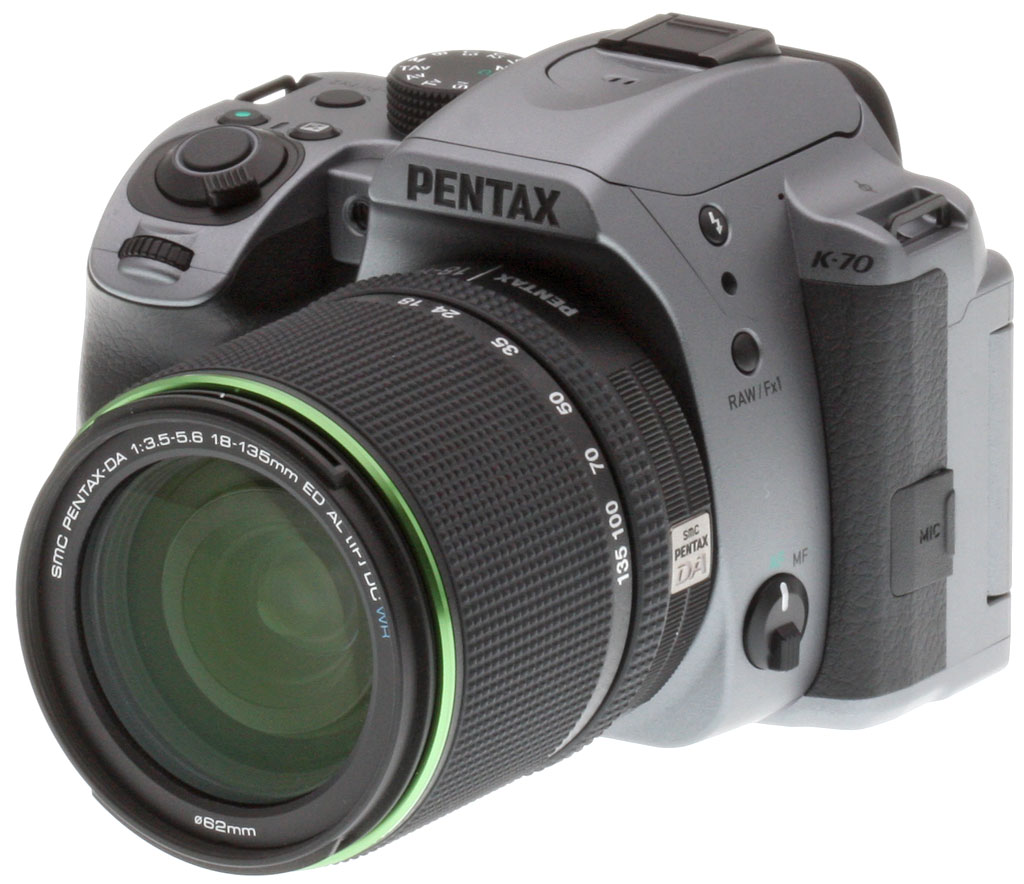


Overview
For the last couple of years, the entry-level point in Ricoh's DSLR lineup has been occupied by the company's K-S series, first with 2014's K-S1, and later with 2015's followup K-S2. Both cameras featured controversial love-it-or-hate-it styling, but beneath their rather divisive skins you could expect to find unusually comprehensive feature sets. And both also debuted brand-new features for the company's cameras.

That, as we found out in an interview early in 2015, was no mere coincidence. Within Ricoh, the K-S series was seen as a proving ground for new innovations. And these weren't cameras aimed at existing Pentaxians, but rather were designed to bring in users from other brands -- or perhaps those considering stepping up to an interchangeable-lens camera for the first time.
K-S series innovations paired with more grown-up K-series styling
Now, the brand-new Pentax K-70 arrives to take those features into a more mainstream camera, as hinted at by a return to the company's long-running K-* branding. Thanks to more conventional styling and some very worthwhile upgrades, the K-70 appeals not just to the younger crowd who've yet to purchase their first Pentax camera, but also to Pentaxians looking to upgrade from an earlier model.
Gone are the flashing lights of the K-S1, as well as the two-tone body and unusual top-deck materials and textures of the K-S2. In their place, the brand-new body of the Pentax K-70 sports a more mature aesthetic in one of two traditional body colors -- either black or silver. Both variants are wrapped in black leatherette trim, giving the K-70 an altogether more serious look.

A familiar control layout and comprehensive weather-sealing
Although the Pentax K-70 forgoes the more eyecatching aesthetic of the K-S2, the basic control layout is very similar to that camera. The K-70's body is weather-sealed for resistance to rain, snow and dust, just like that of the K-S2 before it, and it's also freezeproof to 14°F (-10°C).
The main controls -- particularly the Mode dial -- have been tweaked for better handling when wearing gloves. (The new Mode dial is both taller, and returns to a diamond-knurled finish that makes for an easier grip when turning the dial.)

The Pentax K-70's new imaging pipeline boasts higher resolution and sensitivity
With the K-70, Ricoh brings its entry-level APS-C cameras right up to date thanks to an overhauled imaging pipeline. Gone is the 20-megapixel sensor of the K-S series cameras, replaced by a 24.24-megapixel sensor that puts the K-70 in the same league as the flagship K-3 and K-3 II siblings, resolution-wise.
As in both the K-3 and K-3 II, the Pentax K-70 also opts for 14-bit readout, instead of the 12-bit readout of its predecessors. And as is par for the course these days, there's no anti-aliasing filter, with Pentax's clever on-demand AA Filter Simulation function instead provided to help combat moiré when needed.

Performance, too, has been improved since the K-S2
Unlike the flagship models, though, the K-70 retains the same PRIME MII image processor which was used in the earlier K-S1 and K-S2. Burst performance was measured in our lab at just a hair over six frames per second, more akin to the 5.4-5.5 fps of the K-S1 and K-S2 than the 8.3 fps of the K-3 and K-3 II.
In one respect, though, the Pentax K-70 bests not only the K-S1 and K-S2, but also both of its flagship APS-C siblings. Where those cameras all topped out at ISO 51,200-equivalent, the K-70 has a maximum sensitivity of ISO 102,400-equivalent.

Finally, on-chip phase-detect and full-time movie AF come to Pentax!
It might not be part of the innovation-oriented K-S series, but as the spiritual successor of the K-S1 and K-S2, the Pentax K-70 boasts other firsts for a Pentax DSLR, too. Perhaps the most exciting of these is a new hybrid autofocus system that, for the first time in a Pentax camera, couples contrast-detection autofocus with on-sensor phase detection pixels.
Although it can be a bit prone to hunting, this change still makes for better and faster autofocus in live view. It also means that for the first time in a Pentax DSLR, the K-70 will offer full-time continuous autofocus during movie capture -- and that's potentially a big deal in a camera aimed at consumer use. (However, it's not as big a deal as it could have been, as we found the K-70's movie AF, too, was too-easily confused and rather prone to hunting.)

Refined aperture-control for movies, too, but no true 4K capture yet
Speaking of movies, there's another intriguing note in the launch of the Pentax K-70: Ricoh tells us that there's a new aperture-control function which, it says, will "automatically assure a proper exposure level even in fluctuating lighting conditions during movie recording". This function only works with one lens at launch -- the simultaneously-announced HD PENTAX-DA 55-300mm F4.5-6.3ED PLM WR RE zoom lens -- but we'd expect to see further Pentax lenses gaining this capability in the future. Sadly, this lens was not available to us during our review of the K-70, and so we've been unable to test it.
As for what the aperture-control function is doing, we're guessing that it allows for automatic aperture changes during video capture as dictated by changes in scene brightness, perhaps if the shutter speed and/or sensitivity stray beyond certain limits. Press materials for the lens itself suggest that aperture control noise is minimal and shouldn't be picked up too much by the K-70's onboard stereo microphone. Hopefully the updated mechanism also allows for more gradual aperture changes to reduce the impact on the recorded video.

Sadly -- but not surprisingly -- there's no native 4K video capture in the Pentax K-70, though. Instead, regular video tops out at 1080p30 or 1080i60 max. (1,920 x 1,080 pixels; 30 frames per second progressive-scan or 60 interleaved fields per second.) Your only option for native 4K video with the K-70 is to shoot a time-lapse video, something Pentax DSLRs have offered for a few years now.
The Pentax K-70 also sports all the sensor-shift goodness we've come to expect
Ricoh has not surprisingly retained its in-body Shake Reduction system for the Pentax K-70, and along with it the raft of clever alternate uses for the system that we've seen in past models. The system is said to have a 4.5-stop corrective strength, which puts it in the same class as the flagship APS-C model, the K-3 II, a fair bit better than the three-stop correction of the K-S2, but not quite as good as the five-stop correction provided in the full-frame Pentax K-1.

As well as helping to fight blur from camera shake, the system is also used to provide for the aforementioned AA Filter Simulation function, and to correct for tilted horizons automatically. It's also used for the detail-boosting, multi-shot Pixel Shift Resolution function which debuted in the Pentax K-3 II, but with the inclusion of the motion correction function which was added in the K-1. This won't allow handheld shots, but should be able to account for moving subjects within the scene. (These won't gain the benefit of added sharpness, but the rest of the frame will.)
And if you own the company's optional O-GPS1 accessory, the Pentax K-70 will also be able to freeze star trails, too.

The K-70 uses a brand-new cable-switch for remote shutter release
Speaking of optional accessories, there's a brand-new one being offered alongside the Pentax K-70. The CS-310 Cable Switch is the only wired cable release compatible with this camera, and it connects using the built-in microphone jack on the left side of the camera body. It has a one meter-long cable, and offers an alternative to using an infrared remote control or capturing via Wi-Fi from your smartphone. This, again, was not available to test during our review of the camera, unfortunately.

Many other Pentax K-70 features carry over from the K-S2
There are certainly plenty of new or updated features in the Pentax K-70, but a fair few also carry through unchanged from the preceding K-S2 model. These include the near-100% glass pentaprism viewfinder with 0.95x magnification, a side-mounted tilt/swivel LCD monitor, and a SAFOX X phase-detect autofocus system with 11 points, of which nine are cross-types. Also retained are the 77-segment metering system, top shutter speed of 1/6,000-second, and built-in Wi-Fi wireless networking to put images on your phone as quickly as possible.
Optics
The Pentax K-70 is available body-only, or bundled with the DA 18-135mm f/3.5-5.6 ED AL DC WR lens. See our full Pentax 18-135mm f/3.5-5.6 ED AL DC DA WR review here.
Below are our K-70 viewfinder accuracy test results.
Viewfinder Test Results
Coverage
Excellent accuracy from both the optical viewfinder and LCD.


The Pentax K-70's optical viewfinder exhibited just under 100% coverage in our test, and in Live View mode, the LCD displayed just over 100% coverage. Excellent results here, especially for the price.
The images above were taken from our standardized test shots. For a collection of more pictorial photos, see our Pentax K-70 Photo Gallery .
Exposure
Color
Saturation & Hue Accuracy
High mean saturation, with average hue accuracy.
 |
|||
|
ISO Sensitivity
|
|||
| In the diagram above, the squares show the original color, and the circles show the color that the camera captured. More saturated colors are located toward the periphery of the graph. Hue changes as you travel around the center. Thus, hue-accurate, highly saturated colors appear as lines radiating from the center. Mouse over the links to compare ISOs, and click on links for larger charts. | |||
Saturation. The Pentax K-70's default image tone setting of "Bright" pushes most colors by quite a bit at base ISO, especially blues, dark greens, dark reds and purples. Mean saturation at ISO 100 is 119.9% or 19.9% oversaturated. That's about 10% higher than most other brands at default settings. Overall, colors are very bright and punchy, a trait we've come to expect from Pentax. Mean saturation remains higher than average throughout most of the ISO range, peaking at 120.3% at ISO 25,600, and falling to a minimum of 111.5% at the maximum ISO of 102,400. You can of course always select a different image tone preset and/or turn down saturation and contrast settings to suit your own tastes. Most consumer digital cameras produce color that's more highly saturated (more intense) than found in the original subjects. This is simply because most people like their color a bit brighter than life.
Skin tones. Caucasian skin tones from the Pentax K-70 were a touch yellow using Manual white balance in our test shots, however Auto white balance produced a slightly more pinkish, "healthier" appearance. Good results here. Where oversaturation is most problematic is on Caucasian skin tones, as it's very easy for these "memory colors" to be seen as too bright, too pink, too yellow, etc.
Hue. The Pentax K-70's mean "delta-C" color error of 5.41 after correction for saturation at ISO 100 is about average for a DSLR these days. Most noticeable were moderate shifts in orange toward yellow and cyan toward blue, with minor shifts and some reds, yellows, and greens. (The cyan to blue shift is very common among the digital cameras we test; we think it's a deliberate choice by camera engineers to produce better-looking sky colors.) Mean color error peaks at a maximum of 5.82 at ISO 12,800, though that's quite good for such a high ISO. Hue is "what color" the color is.


Sensor
Exposure and White Balance
Indoors, incandescent lighting
Very warm results with Auto white balance, but good color with Incandescent and Manual white balance settings. Average exposure compensation required.


The Pentax K-70's Auto white balance setting had a difficult time with the very warm color of the household incandescent bulbs used in this shot, producing a very warm image with a fairly strong red-orange tint when using the default "Strong" Correction option. The"Subtle" Correction setting produced even warmer results, as expected. Results with the Incandescent setting are actually pretty good, though, just slightly warm. The Manual setting produced the most accurate color balance, though just a touch cool. Note that a Kelvin setting is available, as well as Color Temperature Enhancement (CTE) white balance option which exaggerates the temperature of ambient light. The Pentax K-70 required +0.3 EV exposure compensation for a good exposure, which is average for this shot. Our test lighting for this shot is a mixture of 60 and 100 watt household incandescent bulbs, a pretty yellow light source, but a very common one in typical home settings here in the U.S.
Outdoors, daylight
Very bright, slightly cool colors with about average exposure accuracy.
The Pentax K-70 handled tough outdoor lighting under harsh sunlight fairly well, producing very bright though slightly cool colors. +0.7 EV exposure compensation was required to keep the mannequin's face bright, which is about average for this scene. Skin tones were just a touch warm and yellow using Manual white balance, so we preferred Auto white balance for our "Sunlit" Portrait shot here. Default contrast is quite high, though, resulting in quite a few harshly clipped highlights in the mannequins's shirt and some of the flowers, as well as some lost shadows below the flowers and in the background, though all but the deepest shadows were quite clean for an APS-C sensor. Our Far-field shot was slightly overexposed at default 0 EV, leading to some blown highlights, again with punchy, slightly cool color. Although quite a few highlights are blown, there are still some very dark shadows thanks to the high contrast. Shadows are detailed and fairly clean for an APS-C sensor, though very deep shadows are monochromatic. Still, good results overall here.
See full set of test images with explanations
See thumbnails of all test and gallery images
Native Resolution
~2,700 lines of strong detail from JPEGs, about the same from converted RAW files.


Our laboratory resolution chart reveals fairly sharp, distinct line patterns down to about 2,700 lines per picture height in the horizontal direction, and to about 2,700 lph in the vertical direction in a best quality JPEG, though some aliasing can be seen at around 2,300 - 2,400 lph. Complete extinction of the pattern didn't occur until just before 3,300 lines in both directions. An Adobe Camera Raw conversion yielded the same numbers, though individual lines were more crisp up to the same resolution, and complete extinction of the pattern was extended up to the 4,000 line limit of our chart. The ACR processed RAW images do however show a lot more color moiré, as they often do. (Note that AA Simulation was set to its default of off, for maximum resolution.) Use these numbers to compare with other cameras of similar resolution, or use them to see just what higher resolution can mean in terms of potential detail.
Pixel Shift Resolution Mode
~2,850 lines of strong detail from JPEGs (ACR does not support K-70's PSR mode as of this writing).


The Pentax K-70's Pixel Shift Resolution mode yielded slightly higher resolution from in-camera JPEGs at about 2/850 lph horizontally and 2,850 lph vertically, but there were strong aliasing artifacts in the form of moiré patterns starting as early as 2,200 or 2,300 lines. Luminance noise also appears to be higher, as can be seen when looking closely at the white parts of the chart.
Adobe Camera Raw does not yet support the K-70's PSR mode, so we'll do a conversion and add results here after it adds support.
See full set of test images with explanations
See thumbnails of all test and gallery images
Sharpness & Detail
Sharp images with excellent detail, though with moderate edge-enhancement on high-contrast subjects. Minor noise suppression visible at base ISO.


Sharpness. The Pentax K-70 produces sharp images with excellent detail at default settings. Images are somewhat oversharpened as edge enhancement artifacts are visible on high-contrast subjects such as the sharpening halos around the lettering and border in our Mas Portell bottle label above left, but overall results are still quite good with crisp looking images. Edge enhancement creates the illusion of sharpness by enhancing color and tonal differences right at the edge of a rapid transition in color or tone.
Detail. The crop above right shows only minor detail loss due to noise suppression. Individual strands are still distinguishable even in the lighter shadows, though they begin to merge as shadows deepen, and in places where the tone and color of adjacent strands is very close. Still, very good performance here, and chroma noise appears very low. Some individual strands of hair do show aliasing artifacts in the form of "jaggies", however the K-70's selectable AA filter should help prevent those from occurring when enabled (AA Filter Simulation was disabled by default). Noise-suppression systems in digital cameras tend to flatten-out detail in areas of subtle contrast. The effects can often be seen in shots of human hair, where the individual strands are lost and an almost "watercolor" look appears.
Anti-aliasing Filter Simulator
During the exposure, the Pentax K-70's anti-shake actuator can oscillate the sensor assembly microscopically in either a linear (Type 1) or circular (Type 2) motion, simulating the effects of an anti-aliasing (or optical low-pass) filter. To see the effect on image sharpness and aliasing artifacts, roll over the links in the table below to compare settings:


As you can see above, AA Filter Simulation Type 1 blurs fine detail slightly, while Type 2 offers a slightly stronger effect, which should go a long way to reduce aliasing artifacts and moiré as can be seen in the center of the starburst crop. The crop on the right is a real-world example that shows moiré reduction in the blinds and also a slight reduction overall sharpness. Note that the AA Filter Simulator is not available in burst mode and some scene modes, or during Bulb or HDR capture, and the full effect cannot be achieved at shutter speeds faster than 1/1000s. Pentax has however provided a very useful AA filter bracketing mode, which will take 3 shots with the different AA filter settings in case you're not sure which setting to use, or want to selectively merge different exposures to reduce aliasing in specific areas.
Pixel Shift Resolution
As mentioned above, the Pentax K-70's Pixel Shift Resolution mode captures greater detail with fewer aliasing artifacts. Let's see how it compares to a normal mode JPEG with our Still Life target at base ISO:
| Base ISO (100) | |
 |
 |
 |
 |
 |
 |
|
Normal Camera JPEG
|
Pixel Shift Resolution JPEG
|
As you can see, the Pixel Shift Resolution JPEG (on the right) captures finer detail with fewer aliasing artifacts, though contrast is a little lower. Notice how small details are rendered better in the mosaic crop, and the lack of moiré patterns in the red-leaf swatch. PSR mode does however generate some "fine-grained" but fairly bright luminance noise as seen in the background in the top bottle crop, obscuring some of the subtle texture.
Like the Pentax K-1, the K-70 offers optional Motion Correction in PSR mode, but we found it doesn't always work well, generating combing and ghosting artifacts around moving objects as can be seen in our Far-field PSR image with it enabled. Thus, it's still best to use it for entirely static objects.
For a lot more on Pentax's PSR technology, see our detailed K-3 II and K-1 Pixel Shift Resolution writeups.
RAW vs In-Camera JPEGs
The Pentax K-70 does a great job at capturing lots of fine detail in its normal JPEGs, but more detail can often be obtained from carefully processing RAW files, while at the same time reducing sharpening artifacts. Take a look below, to see what we mean:
| Base ISO (100) | |
|
 |
|
 |
|
 |
|
Camera JPEG, defaults
|
RAW via Adobe Camera Raw
|
In the table above, we compare an in-camera JPEG taken at base ISO using default noise reduction and sharpening (on the left) to the matching RAW file converted with Adobe Camera Raw 9.7 using default noise reduction with some strong but tight unsharp masking applied in Photoshop (300%, radius of 0.3 pixels, and a threshold of 0).
As is usually the case, Adobe Camera Raw delivers finer detail than the camera's processing, and its light default noise reduction does better with our difficult red-leaf swatch, resolving more of its fine thread pattern which the camera mostly blurred away as noise, as well as producing higher contrast in the leaf pattern. ACR also did a better job with color, rendering the pink fabric closer to reality instead of the more magenta interpretation of the camera, as well as not boosting other colors as much as the camera. Adobe Camera Raw also produced finer detail in the mosaic crop, but left behind more noise, as seen in flatter areas such as in the bottle and background in the first pair of crops. Overall, though, the Pentax K-70 does a very good job with its JPEGs, but as is usually the case you can extract even more detail (with more accurate color and fewer sharpening artifacts) with a good RAW converter.
ISO & Noise Performance
Excellent high ISO performance for an APS-C model.
| Noise Reduction = Auto (Default) | ||
 |
 |
 |
| ISO 100 | ISO 200 | ISO 400 |
 |
 |
 |
| ISO 800 | ISO 1600 | ISO 3200 |
 |
 |
 |
| ISO 6400 | ISO 12,800 | ISO 25,600 |
 |
 |
|
| ISO 51,200 | ISO 102,400 | |
The Pentax K-70's images are very clean and detailed from ISO 100 through 800, with very low chroma noise and just a touch of luma noise becoming more visible in the shadows and darker midtones as ISO increases, accompanied by just a slight increase blurring due to noise reduction. Detail is still very good at ISO 1600, with a tight film-like noise "grain", low chroma noise and very little fine detail lost to noise reduction (except in reds). At ISO 3200, there's increased blurring and more visible noise "grain" particularly in the shadows, but fine detail is still quite good, and chroma noise remains low. ISO 6400 shows stronger luminance noise, though there's still a good amount of usable detail left and chroma noise is well-controlled. ISO 12,800 is quite grainy but chroma noise is still fairly low and there is some usable detail detail left. Image quality at ISO 25,600 and above falls off more quickly, with much stronger luminance noise, and much less detail than at lower sensitivity levels. Chroma noise in the form of yellow and purple blotches starts to become an issue at ISO 25,600 and is pretty bad at the maximum ISO of 102,400.
Overall, though, high ISO noise performance is excellent for a 24-megapixel APS-C camera, especially for one in its price range.
Note that these images were shot using the Pentax K-70 "Auto" noise reduction setting. The Pentax K-70 offers an unusually flexible amount of control over noise reduction applied to its JPEGs. In addition to "Auto", you can adjust how much NR is applied ("Off", "Low", "Medium" or "High") at all ISOs, or you can select "Custom" which allows you to choose from the same four options at each ISO sensitivity setting (in whole EV increments). Of course, the impact of noise and detail loss are highly dependent on the size the photos are printed at, and pixel-peeping on-screen has surprisingly little relationship to how the images look when printed: See the Print Quality section below for recommended maximum print sizes at each ISO.
Extremes: Sunlit, dynamic range, and low light tests
High contrast can lead to blown highlights but shadow detail is excellent. Very good low-light performance, capable of capturing bright images in near darkness.


Sunlight:
The Pentax K-70 struggled a bit in the deliberately harsh lighting in the above test, thanks to its high default contrast. The +0.7 EV exposure did the best job here, as we thought +0.3 and 0 EV were too dim in the face. That led to quite a few blown highlights in the mannequin's shirt and bright flowers at +0.7 EV, however very good detail was preserved in the shadows with relatively low levels of noise. Note that these shots were captured with the Pentax K-70's D-Range control set to "Off."
The good news is that highlights are easily recoverable from the matching DNG RAW file even at +1.0 EV, so the K-70's sensor appears to have very good dynamic range. Also, the K-70's Highlight Correction feature (available at ISO 200 and above) is quite effective at avoiding blown highlights. See below.
Because digital cameras are more like slide film than negative film (in that they tend to have a more limited tonal range), we test them in the harshest situations to see how they handle scenes with bright highlights and dark shadows, as well as what kind of sensitivity they have in low light. The shot above is designed to mimic the very harsh, contrasty effect of direct noonday sunlight, a very tough challenge for most digital cameras. (You can read details of this test here. In actual shooting conditions, be sure to use fill flash in situations like the one shown here; it's better to shoot in open shade whenever possible.)
| Face Detection (0 EV) | ||
 |
 |
 |
| Off Aperture-priority 0 EV |
Auto mode (Portrait) 0 EV |
Live View with Face-detection AF 0 EV |
Face Detection
Here, we can see the effect of the Pentax K-70's full Auto mode as well as face detection AF enabled in Live View mode. As you can see from the shots above, full Auto which selected Portrait Scene mode produced a better exposed face and background, however it blew quite a few highlights in the mannequin's shirt. It selected an aperture of only f/3.2 with a shutter speed of 1/250s but kept ISO at 200 and used Auto white balance producing more pinkish skin tones. Face-detection AF mode also improved the exposure versus Aperture-priority without blowing as many highlights, selecting a slower shutter speed of 1/50s versus 1/100s to brighten the image (since the other two exposure variables of aperture and ISO were fixed).
D-Range Settings
The Pentax K-70 offers four Shadow Correction levels (Auto, Low, Medium and High, plus Off) as well as two Highlight Correction levels (Auto and On, plus Off). As the name implies, Shadow Correction works to raise shadow levels while attempting to keep highlights and midtones as they are, and inversely, Highlight Correction attempts to reduce highlights without darkening shadows and midtones. Both can be used simultaneously. See the images below to see their effect on our high-contrast "Sunlit" Portrait test shot.
|
Outdoor Portrait D-Range Examples
|
|||
 |
Shadow Off |
||
| Shadow Low |
|||
| Shadow Medium |
|||
| Shadow High |
|||
| Shadow Auto |
|||
| Highlight Off |
|||
 |
Highlight On |
||
| Highlight Auto |
|||
Mouse over the links to see how the various settings for D-Range affects our "Sunlit" Portrait shot, and click on a link to get to the full-res image. (The effect can be a little subtle in shots like those above, so we decided to use a mouse-over to better show how each setting compares to Off.)
Shadow Correction. Above, we see a progressive lightening of shadows and midtones as the Shadow Correction setting is increased, with only a small impact to highlights. And in this case, the Auto setting produced results very similar to the manual Low setting. If you look closely at the shadow detail, you will notice an increase in noise as the setting is turned higher, but that's to be expected and noise levels are still pretty low.
Highlight Correction. Highlight Correction worked as expected when highlights are blown, with On and Auto producing virtually identical results here (compare Highlight On or Highlight Auto to D-Range Off), toning highlights down to protect them while keeping shadows and midtones roughly the same. Note that Highlight Correction is not available at ISOs below 200, so this series was shot at ISO 200.
HDR Capture
The Pentax K-70 has a High Dynamic Range (HDR) capture mode where the camera takes three images (underexposed, normal, and overexposed) in quick succession and combines them in-camera into one image. If performed properly, this method should result in much higher dynamic range, without the additional noise penalty that comes with boosting sensitivity or lightening shadows. (In fact, it can reduce shadow noise by combining shadows from the overexposed shot.)
There are five HDR settings available in the K-70: Auto, HDR 1/2/3 providing three blend settings, and Advanced. Each setting has three possible exposure ranges (±1 EV, ±2 EV (default), and ±3 EV). There's also an optional Auto Align feature for use when shooting without a tripod, which is enabled by default on the K-70.
|
Far-field HDR Examples
|
|||
 |
|||
| HDR Auto | |||
Mouse-over the links above to compare thumbnails, and click on them to access full-resolution versions. (We used with the default +/- 2EV exposure range.)
The Auto setting worked reasonably well on our Far-field test shot, reducing highlights and bringing out shadow detail while maintaining a natural, non-HDR look. HDR 1 mode produced a relatively realistic image though with an obvious HDR-ish look, HDR 2 produced a stronger HDR effect, HDR 3 resulted in a very unnatural almost cartoonish image, and HDR Advanced produced very strong and ugly halos. As with most HDR systems there is a slight focal-length crop with Auto Align active, and watch out for ghosting that can occur when subjects move between exposures although the K-70 does attempt to avoid that..
Interestingly, some earlier Pentax DSLRs like the K-3 supported RAW files in HDR mode, bundling the individual captures into one large file to be processed later by their Digital Camera Utility software which can blend or extract the separate RAW files. However, RAW file support for HDR mode is not supported on the K-70 (but can be easily achieved using individual files and exposure bracketing.)
Dynamic Range Analysis (RAW mode)
While we once performed our own dynamic range measurements based on in-camera JPEGs as well as converted RAW images (when the camera was supported by Adobe Camera Raw), we've switched to using DxO Labs' results from their DxOMark website. As technology advanced, the dynamic range of modern high-end cameras in some cases exceeded the range of the Stouffer T4110 density scale that we used for our own measurements. DxO's approach based on RAW data before demosaicing is also more revealing, because it measures the fundamental dynamic range of the sensor, irrespective of whatever processing is applied to JPEGs, or to RAW data by off-the-shelf conversion software.
In the following, we use DxO's "Print" dynamic range results, which are scaled based on camera resolution. As the name suggests, this scaling corresponds to the situation in which you print at a given size, regardless of how many megapixels the camera might have. (In other words, if you've decided to make a 13x19 inch print, that's the size you're printing, whether the camera's resolution is 16 or 300 megapixels.) For the technically-minded, you can find a discussion of the reasoning behind this here on the DxOMark website. Also note that DxO Labs uses a signal-to-noise (SNR) threshold of 1 when defining the lower boundary of acceptable luminance noise in their dynamic range measurements, which corresponds to the "Low Quality" threshold of the Imatest software we used to use for this measurement.
Unfortunately, DxOMark has not tested the Pentax K-70 yet. We'll revisit and fill in this section once they do.
| 1 fc 11 lux |
1/16 fc 0.67 lux |
1/16 fc No NR |
|
|---|---|---|---|
| ISO 100 |
 2.5s, f2.8 |
 40s, f2.8 |
 40s, f2.8 |
| ISO 3200 |
 1/13s, f2.8 |
 1.3s, f2.8 |
 1.3s, f2.8 |
| ISO 102400 |
 1/400s, f2.8 |
 1/30s, f2.8 |
 1/30s, f2.8 |
Low Light. The Pentax K-70 performed well in terms of image quality in our low-light tests, capturing clean, well-exposed images at the lowest light level (1/16 foot-candle) with the lowest sensitivity setting (ISO 100). As you'd expect, noise is higher at ISO 3200 but it appears very well-controlled and fine-grained. Unsurprisingly, the maximum ISO of 102,400 is quite noisy with noticeably less detail and lots of chroma blotching, and is best avoided except perhaps in emergencies.
Color balance with Auto white balance was quite good which isn't always the case, with just a slightly cool bias that becomes slightly cooler as light levels drop.
We did not detect any significant issues with hot pixels, with just a few appearing when noise reduction is minimized and long exposure noise reduction is turned off (right-most column), where you can expect to seem them. Only minor heat blooming can be seen at the highest ISO, along with some very minor horizontal banding (fixed pattern noise) with almost none detectable at base ISO even in very deep shadows.
LL AF: The Pentax K-70's phase-detection autofocus system was able to focus unassisted on our low-contrast AF test target down to the 1/16 foot-candle light level (-2.0 EV) using an f/2.8 lens, which is quite good. And with our new high-contrast AF target, the K-70 was able to autofocus down to -4.5 EV, which is excellent for its class. The K-70 has an AF assist lamp which will let you autofocus in complete darkness, as long the subject is within range and has sufficient contrast. The K-70 couldn't autofocus as low in Live View mode, only able to focus down to about 1/4 foot-candle (-0.3 EV) on our low-contrast target, and to just below 1/16 foot-candle (-2.3 EV) with our high-contrast AF target, but that's not bad for a DSLR in Live View mode.
(Keep in mind that the longer shutter speeds here demand the use of a tripod to prevent any blurring from camera movement. A useful trick is to just prop the camera on a convenient surface, and use its self-timer to release the shutter. This avoids any jiggling from your finger pressing the shutter button, and can work quite well when you don't have a tripod handy.)
How bright is this? The one foot-candle light level that this test begins at roughly corresponds to the brightness of typical city street-lighting at night. Cameras performing well at that level should be able to snap good-looking photos of street-lit scenes.
NOTE: This low light test is conducted with a stationary subject, and the camera mounted on a sturdy tripod. Most digital cameras will fail miserably when faced with a moving subject in dim lighting. (For example, a child's ballet recital or a holiday pageant in a gymnasium.) Digital SLRs like the Pentax K-70 do much better than point & shoots, but you still shouldn't expect a quick autofocus lock with moving subjects.
Output Quality
Print Quality
Terrific 30 x 40 inch prints at ISO 100/200; a good 13 x 19 inch print at ISO 1600; a nice 5 x 7 inch print at ISO 6400.
 ISO 100/200 both provide terrific printed images at 30 x 40 inches and larger -- as large as you want to print until the resolution tops out. These images showcase crisp fine detail and rich color reproduction, with a nice vibrance throughout the image.
ISO 400 prints at 30 x 40 inches are fine for less critical applications and wall display prints. For more critical applications we recommend 24 x 36 inches as the optimal large size here, and this size provides an excellent printed image all around.
ISO 800 images pass our good seal at 16 x 20 inches, although there is a mild amount of noise present in flatter areas of our test target at this size, and most contrast detail is now gone in our tricky red-leaf swatch. Larger prints here may be OK for less critical applications, but overall noise levels prevent us from awarding them our good seal.
ISO 1600 produces a 13 x 19 inch print that passes our good rating. All contrast detail is now lost in our red-leaf swatch, but otherwise the noise levels are fairly well-controlled for this ISO at this size, with plenty of fine detail remaining.
ISO 3200 prints just pass our good seal at 11 x 14 inches. These prints exhibit similar issues as found in the 13 x 19 inch prints at ISO 1600, but general color and fine detail is still good here. For most critical applications, we recommend remaining at 8 x 10 inches and under here.
ISO 6400 yields 8 x 10 inch prints that are certainly fine for less critical applications, but there's simply too much overall softening apparent in certain areas of the print to pass our good rating. A size reduction to 5 x 7 inches does the trick for achieving a generally good overall print.
ISO 12,800 images at 5 x 7 inches are similar to the 8 x 10's at ISO 6400 -- good for less critical applications but not quite up to our good standard due to issues with softness and a mild muting of colors overall. The 4 x 6's here are fine for most purposes, so we can call them good here.
ISO 25,600 produces a 4 x 6 inch print that almost passes our good grade, and you may be able to get away with them for less critical applications.
ISO 51,200/102,400 settings do not provide usable prints and we recommend avoiding these settings for most printing purposes.
The Pentax K-70 is an entry-level camera that offers print quality that is markedly above typical entry-level results. Base ISO and ISO 200 prints are stunning in their fine detail, thanks in large part to the lack of an optical low-pass filter, and the camera is capable of providing usable prints a good ways up the ISO spectrum. In general, as with most cameras these days in the APS-C world, we recommend remaining at ISO 3200 and below for your critical printing needs, especially for anything up to 8 x 10 inch prints. Moving to ISO 6400 and higher simply allows too much noise and general softening to enter the picture, but you can expect very solid results from this camera in the print quality department at ISO 3200 and below.
The images above were taken from our standardized test shots. For a collection of more pictorial photos, see our Pentax K-70 Photo Gallery .
Not sure which camera to buy? Let your eyes be the ultimate judge! Visit our Comparometer(tm) to compare images from the Pentax K-70 with those from other cameras you may be considering. The proof is in the pictures, so let your own eyes decide which you like best!
Performance
Timing and Performance
Good overall performance for its class.
| Startup/Play to Record | ||
|---|---|---|
| Power on |
~1.0 second
|
Time it takes for camera to turn on and take a shot. |
|
Play to Record, |
~0.2 second
|
Time until first shot is captured. |
The Pentax K-70's startup time was a little slow for a DSLR, but switching from Play to Record and taking a shot was quite fast.
| Shutter Response (Lag Time), Optical Viewfinder | ||
|---|---|---|
|
Full Autofocus |
0.126 second
|
Time from fully pressing shutter button to image capture. (All AF timing measured with a Pentax 35mm f/2.8 lens). |
|
Full Autofocus |
0.143 second
|
Time from fully pressing shutter button to image capture, Auto Flash enabled. |
|
Manual focus |
0.095 second
|
For most cameras, shutter lag is less in manual focus than autofocus, but usually not as fast as when the camera is "pre-focused." |
|
Pre-focused |
0.093 second
|
Time to capture, after half-pressing and holding shutter button. |
| Shutter Response (Lag Time), Live View mode | ||
|
Pre-focused |
0.272 second
|
Time to capture, after half-pressing and holding shutter button. |
The Pentax K-70's full autofocus shutter lag when shooting the same target multiple times was faster than average for a consumer DSLR. The K-70 required only 0.126 second for full AF using the center focus point with a Pentax 35mm f/2.8 lens. Enabling the flash raised shutter lag only slightly to 0.143 second, reflecting the added delay caused by the metering preflash. Manual focus shutter lag was even faster than autofocus as expected, at 0.095 second. When prefocused, shutter lag only dropped a bit to 0.093 second which is a tad slower than average for a consumer DSLR, but still quite responsive.
When prefocused in Live View mode, shutter lag was 0.272 second, which is not bad. We no longer test full AF lag in Live View mode, because contrast-detect AF speed tends to be very lens dependent for DSLRs.
To minimize the effect of different lens' focusing speed, we test AF-active shutter lag with the lens already set to the correct focal distance.
| Cycle Time (shot-to-shot) | ||
|---|---|---|
|
Single Shot mode |
< 0.3 second
|
Time per shot, averaged over a few frames (we no longer test for buffer depths in single-shot mode). |
|
Single Shot mode |
< 0.3 second
|
Time per shot, averaged over a few frames (we no longer test for buffer depths in single-shot mode). |
|
Early shutter |
No
|
Some cameras refuse to snap another shot if you release and press the shutter too quickly in Single Shot mode, making "No" the preferred answer. |
| Continuous H mode |
0.17 second (6.06 frames per second);
47 frames total; 20 seconds to clear |
Time per shot, averaged over 47 frame buffer, then slows to an average of 0.23 second or 4.35 fps when buffer is full. |
|
Continuous H mode |
0.17 second (6.06 frames per second);
11 frames total; 14 seconds to clear |
Time per shot, averaged over 11 frame buffer, then slows to an average of 0.56 second or 1.79 fps when buffer is full. |
|
Continuous H mode |
0.17 second (6.06 frames per second);
9 frames total; 16 seconds to clear |
Time per shot, averaged over 9 frame buffer, then slows to an average of 1.11 seconds or 0.90 fps when buffer is full. |
| Flash recycling |
2.3 seconds
|
Flash at maximum output. |
| *Note: Buffer clearing times measured with a SanDisk Extreme Pro 95MB/s UHS-I SDHC memory card. Slower cards will produce correspondingly slower clearing times. Slow cards may also limit length of bursts in continuous mode. ISO sensitivity and other settings such as highlight/shadow corrections or NR can also affect cycle times and burst mode performance. |
||
Single-shot cycle times were so fast that they were difficult to accurately measure as they depend on the tester's dexterity and ability to maintain an optimum rhythm, so your results may vary. (Note that we no longer test single-shot mode with just RAW files, as the results are usually somewhere in between JPEG and RAW+JPEG.)
Continuous H mode speed was good at about 6.1 frames per second regardless of file type, just over Pentax's 6.0 fps spec. There is also a Continuous L mode rated at 3.0 frames per second, but we did not test that mode.
Buffer depth in Continuous H mode was very good when shooting just JPEGs at 47 Large Best Quality JPEG frames before the camera slowed, though with RAW files buffer depths were much shallower at 11 RAW frames or 9 RAW+L/B JPEG frames. This is typical of DSLRs in its price range, though. Also note that our test target was designed to be difficult to compress, so shooting typical subjects may yield deeper buffers.
Buffer clearing was sluggish even with our fast UHS-I SDHC card, taking 20 seconds to clear after a max-length burst of JPEGs, 14 seconds after a burst of RAW frames and 16 seconds after a max-length RAW+JPEG burst. The K-70 does however let you change settings, take additional shots or view just-shot photos while the buffer is clearing.
The K-70's built-in flash took an average of 2.3 seconds to recharge after full-power shots, which is quite fast.
Bottom line, the Pentax K-70's performance was generally good for its class in our tests. Startup was a little slow for a DSLR, but AF speeds were very fast, single shot cycle-times, burst speeds and flash recycle times were all good. Buffer depths with RAW files were somewhat shallow but that's not unusual for its class, however buffer clearing was on the slow side.
Battery
Battery Life
Poor battery life for a DSLR.
| Operating Mode | Number of Shots |
|---|---|
|
Optical Viewfinder,
(CIPA standard) |
410
|
The Pentax K-70 uses a custom rechargeable D-LI109 lithium-ion battery for power, and ships with a dedicated charger. Battery life when using the optical viewfinder is well below average for a DSLR, and Pentax does not specify battery life for Live View mode, which will certainly be a lot lower. We strongly recommend you pick up a spare battery and keep it freshly charged and on-hand for extended outings.
The table above shows the number of shots the camera is capable of (on either a fresh set of disposable batteries or a fully-charged rechargeable battery as appropriate), based on CIPA battery-life and/or manufacturer standard test conditions.
(Interested readers can find an English translation of the CIPA DC-002 standards document here. (180K PDF document))
Image Quality
Below are crops from our laboratory Still Life target comparing Pentax K-70 image quality to its spiritual predecessor, the K-S2, as well as its more expensive sibling the K-3 II. For good measure, we've also compared it against both of its nearest DSLR rivals, the Canon T6i and Nikon D5500, as well as a similarly-priced mirrorless camera, the Sony A6000.
NOTE: These images are from best quality JPEGs straight out of the camera, at default settings including noise reduction and using the camera's actual base ISO (not extended ISO settings). All cameras in this comparison were shot with our very sharp reference lenses. Clicking any crop will take you to a carrier page where you can click once again to access the full resolution image as delivered straight from the camera. For those interested in working with the RAW files involved, click these links to visit each camera's respective sample image thumbnail page: Pentax K-70, Pentax K-S2, Pentax K-3 II, Canon T6i, Nikon D5500 and Sony A6000 -- links to the RAW files appear beneath those for the JPEG images, wherever we have them. And remember, you can always go to our world-renowned Comparometer to compare the Pentax K-70 to any camera we've ever tested!
Pentax K-70 vs Pentax K-S2 at Base ISO
 |  |
 |  |
 |  |
Pentax K-70 at ISO 100 | Pentax K-S2 at ISO 100 |
Despite its slightly greater 24.2-megapixel resolution on paper, the Pentax K-70 turns in a very similar performance to the 20.1-megapixel K-S2 at base sensitivity. There's perhaps just slightly more detail in the K-70's mosaic label and fabric swatch, but the difference is slight. As is typical of Pentax's default settings, both cameras give the pink fabric swatch a magenta hue | |
Pentax K-70 vs Pentax K-3 II at Base ISO
|  |
|  |
|  |
Pentax K-70 at ISO 100 | Pentax K-3 II at ISO 100 |
Likewise, the comparison against the K-3 II is much as we'd expect: With near-identical sensor resolution, neither camera has a clear edge in the detail department. (The K-3 II's result looks just fractionally crisper, but that seems to be down to slightly stronger default sharpening.) And again, there's the magenta hue to the pink fabric swatch for which Pentax is well-known. | |
Pentax K-70 vs Canon T6i at Base ISO
|  |
|  |
|  |
Pentax K-70 at ISO 100 | Canon T6i at ISO 100 |
Finally, we come to rather more interesting comparison. At base sensitivity, the Canon T6i and Pentax K-70 derive similar levels of detail from their 24.2-megapixel image sensors, although higher default sharpening from the K-70 gives it a crisper look. Canon wins on color, though, especially on the difficult pink and red swatches. It's perhaps just a touch warm in the pink swatch still, and its colors perhaps are slightly more muted than the typical consumer's tastes, but they're certainly more true-to-life than those of the Pentax at default settings. | |
Pentax K-70 vs Nikon D5500 at Base ISO
|  |
|  |
|  |
Pentax K-70 at ISO 100 | Nikon D5500 at ISO 100 |
The Nikon D5500, too, has more realistic color at default settings than does the Pentax K-70. (They're not quite as good as those of the Canon, though, tending a little warmer in the pink swatch.) Like those of the T6i before it, the D5500's images look a little less crisp than those of the K-70, but that's down to higher sharpening from the Pentax. Look at the finer details, especially in the pink fabric swatch, and it appears that the D5500 is actually holding onto more detail. | |
Pentax K-70 vs Sony A6000 at Base ISO
|  |
|  |
|  |
Pentax K-70 at ISO 100 | Sony A6000 at ISO 100 |
The best of the bunch at base sensitivity, though, has to be the Sony A6000. Sure, it's pink swatch is rather too warm compared to the Canon T6i, but it is still closer than the Pentax K-70's magenta rendering. And the Sony definitely holds onto the most detail of the group, despite lower levels of sharpening. (Note the absence of halos in the bottle crop, where the Pentax cameras and Canon T6i in particular show noticeable halos around the printing on the label.) And for bonus points, the A6000 also has the best contrast in the difficult red fabric swatch. | |
Pentax K-70 vs Pentax K-S2 at ISO 1600
 |  |
 |  |
 |  |
Pentax K-70 at ISO 1600 | Pentax K-S2 at ISO 1600 |
With the sensitivity bumped up to ISO 1600 equivalent, we see similar noise levels from the Pentax K-70 and K-S2. The K-70 retains just a little more detail in the mosaic label, and both cameras struggle badly with the red fabric swatch, losing almost every hint of detail. It's close, but if we had to choose, we'd give a slight edge to the K-70 here. | |
Pentax K-70 vs Pentax K-3 II at ISO 1600
|  |
|  |
|  |
Pentax K-70 at ISO 1600 | Pentax K-3 II at ISO 1600 |
Now here's a turnup for the books: With the sensitivity raised to ISO 1600-equivalent, the more affordable Pentax K-70 actually outperforms its flagship sibling in terms of noise levels (as shown in the bottle crop) and perhaps just slightly in detail too (per the mosaic label crop). The K-3 II does just fractionally better with the fabric swatches at this sensitivity, but it's a close thing. Apparently if you're a Pentaxian and high-sensitivity performance is your main deciding factor, you might want to consider the entry-level K-70 over its enthusiast-grade sibling. (Of course, the K-3 II will still outperform the K-70 in many other respects.) | |
Pentax K-70 vs Canon T6i at ISO 1600
|  |
|  |
|  |
Pentax K-70 at ISO 1600 | Canon T6i at ISO 1600 |
At ISO 1600-equivalent, we see two very different approaches from Canon and Pentax. The K-70 has a pretty clear edge in both noise levels and detail, as you can see in the bottle and mosaic label crops. The T6i, though, clearly wins in terms of color and in its handling of that difficult red fabric swatch. | |
Pentax K-70 vs Nikon D5500 at ISO 1600
|  |
|  |
|  |
Pentax K-70 at ISO 1600 | Nikon D5500 at ISO 1600 |
It's a similar story against the Nikon D5500, too. The Pentax K-70 clearly trails in the fabric swatches, but holds onto a good bit more fine detail in the mosaic label. Noise levels are pretty similar between the pair, though, as you can see in the bottle crop. | |
Pentax K-70 vs Sony A6000 at ISO 1600
|  |
|  |
|  |
Pentax K-70 at ISO 1600 | Sony A6000 at ISO 1600 |
Once again, though, we find ourselves favoring the Sony A6000 even if it's not quite as resounding a victory as at base sensitivity. The A6000's noise reduction is a bit heavy-handed, showing some unnatural mottling in the mosaic label and pink fabric swatch, and to a lesser extent in the bottle crop as well. But the Sony still holds onto some fine thread patterns in the pink fabric swatch, has a good bit of contrast in the red swatch, and has fairly good color as well. | |
Pentax K-70 vs Pentax K-S2 at ISO 3200
 |  |
 |  |
 |  |
Pentax K-70 at ISO 3200 | Pentax K-S2 at ISO 3200 |
Interesting results if we dial up the sensitivity, then, but what if we go a step further? At ISO 3200, the Pentax K-70 looks to have more of an edge over its lower-res sibling, with both somewhat lower noise levels in the bottle crop, and a bit more detail in the mosaic label. Both cameras have now lost almost all detail in the difficult red fabric swatch, and still show a very magenta rendition of the pink swatch. | |
Pentax K-70 vs Pentax K-3 II at ISO 3200
|  |
|  |
|  |
Pentax K-70 at ISO 3200 | Pentax K-3 II at ISO 3200 |
The trend continues in our comparison of the K-70 against its flagship sibling, the K-3 II. There's a pretty clear difference in noise levels between the pair, not to mention detail levels thanks to the effects of noise reduction. Where the K-3 II's image is starting to look rather mottled and ropey, the K-70 holds onto a fair bit more detail with lesser noise levels. The K-3 II does hold onto a tiny bit of red fabric swatch detail which the K-70 has lost, however. | |
Pentax K-70 vs Canon T6i at ISO 3200
|  |
|  |
|  |
Pentax K-70 at ISO 3200 | Canon T6i at ISO 3200 |
And again, we see the trend continued with the Canon T6i: The Pentax K-70 has noticeably lower noise levels and holds onto much more fine detail, but the Canon Rebel has better color and manages to retain a bit of contrast in the red fabric swatch. | |
Pentax K-70 vs Nikon D5500 at ISO 3200
|  |
|  |
|  |
Pentax K-70 at ISO 3200 | Nikon D5500 at ISO 3200 |
Of this group, the Nikon D5500 probably shows the most balanced approach at this higher sensitivity. Its color is noticeably more realistic than that of the Pentax, and it manages to hold onto a bit of detail in the red fabric swatch. The K-70 does better with the fine details in the mosaic label, and it's pretty much a wash in terms of noise levels between this pair. | |
Pentax K-70 vs Sony A6000 at ISO 3200
|  |
|  |
|  |
Pentax K-70 at ISO 3200 | Sony A6000 at ISO 3200 |
Once again, the Sony A6000 shows that it has far higher default noise reduction. At first glance its bottle crop is cleaner, but then you notice an unnatural mottled, blotchy look that sometimes sees color bleeding across the boundary between bottle and background. The Pentax K-70 does far better with the mosaic label, but despite its blotchniness, the Sony manages better with the fabric swatches, although here too you can see colors bleeding between the two adjacent swatches. | |
Pentax K-70 vs. Pentax K-S2, Pentax K-3 II, Canon T6i, Nikon D5500, Sony A6000
 |  |  |  |  |  |
 |  |  |  |  |  |
 |  |  |  |  |  |
| Pentax K-70 ISO 100 ISO 3200 ISO 6400 | Pentax K-S2 ISO 100 ISO 3200 ISO 6400 | Pentax K-3 II ISO 100 ISO 3200 ISO 6400 | Canon T6i ISO 100 ISO 3200 ISO 6400 | Nikon D5500 ISO 100 ISO 3200 ISO 6400 | Sony A6000 ISO 100 ISO 3200 ISO 6400 |
| Detail comparison. As usual, we like to see how these cameras handle high-contrast detail, too, and so we turn to our Samuel Smith beer label for an assessment. The Nikon D5500 probably turns in the best performace, with good contrast and reasonably crisp red text across the sensitivity range. Second place probably goes to the Sony A6000, although at the highest sensitivity the red text loses some definition. Next up is realistically a four-way tie between the Canon and Pentax cameras, although if we had to call winners and losers, we'd probably give the edge to the T6i and K-70, with the K-S2 hot on their heels and the K-3 II just slightly behind. | |||||
Terrific 30 x 40 inch prints at ISO 100/200; a good 13 x 19 inch print at ISO 1600; a nice 5 x 7 inch print at ISO 6400.
ISO 100/200 both provide terrific printed images at 30 x 40 inches and larger - as large as you want to print until your resolution tops out. These images showcase crisp fine detail and rich color reproduction, with a nice vibrance throughout the image.
ISO 400 prints at 30 x 40 inches are fine for less critical applications and wall display prints. For your more critical applications we recommend 24 x 36 inches as the optimal large size here, and this size provides an excellent printed image all around.
ISO 800 images pass our good seal at 16 x 20 inches, although there is a mild amount of noise present in flatter areas of our test target at this size, and most contrast detail is now gone in our tricky target red swatch. Larger prints here may be OK for less critical applications, but overall noise levels prevent us from awarding them our good seal.
ISO 1600 produces a 13 x 19 inch print that passes our good rating. All contrast detail is now lost in our target red swatch, but otherwise the noise levels are fairly well-controlled for this ISO at this size, with plenty of fine detail remaining.
ISO 3200 prints just pass our good seal at 11 x 14 inches. These prints exhibit similar issues as found in the 13 x 19 inch prints at ISO 1600, but general color and fine detail is still good here. For your most critical applications, we recommend remaining at 8 x 10 inches and under here.
ISO 6400 yields 8 x 10 inch prints that are certainly fine for less critical applications, but there's simply too much overall softening apparent in certain areas of the print to pass our good rating. A size reduction to 5 x 7 inches does the trick for achieving a generally good overall print.
ISO 12,800 images at 5 x 7 inches are similar to the 8 x 10's at ISO 6400 - good for less critical applications but not quite up to our good standard due to issues with softness and a mild muting of colors overall. The 4 x 6's here are fine for most purposes, so we can call them good here.
ISO 25,600 produces a 4 x 6 inch print that almost passes our good grade, and you may be able to get away with them for less critical applications.
ISO 51,200/102,400 settings do not provide usable prints and we recommend avoiding these settings for most printing purposes.
The Pentax K-70 is an entry-level camera that offers print quality that is markedly above typical entry-level results. Base ISO and ISO 200 prints are stunning in their fine detail, thanks in large part to the lack of an optical low-pass filter, and the camera is capable of providing usable prints a good ways up the ISO spectrum. In general, as with most cameras these days in the APS-C world, we recommend remaining at ISO 3200 and below for your critical printing needs, especially for anything up to 8 x 10 inch prints. Moving to ISO 6400 and higher simply allows too much noise and general softening to enter the picture, but you can expect very solid results from this camera in the print quality department at ISO 3200 and below.
Field Test
Mid-range features at an entry-level price: Is Ricoh's latest DSLR right for your camera bag?
By Mike Tomkins | Posted: 10/15/2016
 202mm-equivalent, 1/250 sec. @ f/5.6, ISO 200
I've been a big fan of Pentax's cameras for the best part of a decade now, ever since the launch of the flagship Pentax K-7 all the way back in early 2009. After my review of that camera, I bought into the Pentax brand myself, jumping ship from Canon and replacing my gear with Pentax equivalents.
I've stayed with the brand ever since, and while there are more than a few reasons for that -- not the least of which being that I now have a significant investment in Pentax glass -- the company's reputation for offering exceptional value for money is perhaps the key.
The Pentax K-70 is no different in this respect. Affordably priced at US$650 body-only, it includes some really important features which its nearest rivals from the likes of Canon and Nikon lack. Since I like to get a feel for how cameras compare before I head out for a review, let's start with a quick comparison against the K-70's closest competitors.
Pentax K-70 vs. Canon T6i
In Canon's lineup, the closest rival is probably the EOS Rebel T6i. Both cameras have similar pricing as of this writing: US$650 list for the Pentax, and US$750 list for the Canon.
For the extra cash, the T6i does include a couple of significant features its Pentax rival lacks. It features a touch-screen display, for example, and has a more sophisticated autofocus sensor with 19 cross-type AF points, where the K-70 has a total of 11 AF points, nine of which are cross-types. The T6i is also a fair bit lighter body-only, and includes an NFC antenna for quick-and-easy Wi-Fi pairing with Android phones, where the K-70 requires that you pair manually.
In most other respects, though, it is the Pentax K-70 which has the edge despite its lower list price. For one thing, the K-70 has twin control dials instead of the T6i's single dial. That makes for a more intuitive shooting experience, with dedicated dials for shutter speed and aperture control. It also has a bright, clear and accurate glass pentaprism viewfinder, where the T6i opts for a lower-cost pentamirror viewfinder. And where the Pentax K-70 includes comprehensive weather sealing for dust and moisture resistance, as do many of its available lenses and accessories, the Canon T6i isn't weather-sealed.
The Pentax K-70's sensitivity range is far wider as well, and its top shutter speed of 1/6,000-second will better freeze the action than will the 1/4,000-second shutter of the T6i. The K-70 also shoots both JPEG and raw images around 1.2 frames per second faster than its Canon rival, yet offers an even deeper raw buffer depth. (Canon answers this with an unlimited JPEG buffer depth, but with the K-70 offering a 47-frame buffer depth, it's no slouch in this area either.)

And all of this is before we even get into the features enabled by the Pentax K-70's in-body image stabilization, which the Canon T6i forgoes in favor of lens-based stabilization. All of your lenses will be stabilized without extra cost on the Pentax, and that's not all. It can also use its sensor-shift mechanism to increase per-pixel image sharpness for static scenes; combat moiré and false color artifacts without a resolution-robbing optical low-pass filter; and automatically prevent tilted horizons or allow subtle fine-tuning of composition. With an optional GPS receiver accessory, the system can even be used to freeze star trails, a handy trick for astrophotographers.
Pentax K-70 vs. Nikon D5500
Compared to the Nikon D5500, meanwhile, the Pentax K-70 again has a lower list price by some US$100, with the Nikon listing for US$750 body-only.
 117mm-equivalent, 1/400 sec. @ f/10, ISO 200
Like the Canon T6i, the D5500 bests its Pentax rival with a touch-screen display. It also has an even more point-dense 39-point autofocus system, a whopping 28 more than the K-70. The majority of these are linear points, however; the D5500's nine cross-type points are equally matched by those of the Pentax K-70. In fairness, though, the Pentax includes on-sensor phase detection autofocus pixels, a feature the D5500 lacks; that should give the Pentax the edge in live view shooting.
The Nikon is also much lighter than the Pentax, provides almost double the battery life, and has a significantly deeper 100-shot JPEG buffer. (Although as noted previously, the K-70's 47-shot buffer is still pretty respectable, especially given that it's shooting at around 1.1 frames per second faster than the Nikon.)
But just as in the Canon comparison above, there's a whole laundry list of features offered by Pentax but missing in its Nikon rival. Just as with Canon, Nikon forgoes twin control dials, a pentaprism viewfinder or weather sealing, allowing the Pentax alone to shine in this area. And the K-70 also has a wider sensitivity range, a faster top shutter speed, and the aforementioned greater burst-shooting performance. Plus all of those features provided by in-body image stabilization, as we noted in our comparison against Canon. Nikon, likewise, opts for in-lens stabilization rather than in-body.
The Pentax K-70 heads out for a real-world shoot
But enough of the paper comparisons: The spec sheets can only tell us so much, and it's how these cameras shoot in the real world which really serves to differentiate them. To find out how the Pentax K-70 performs in day-to-day shooting, I grabbed a fully charged battery and Ricoh's smc PENTAX-DA 18-135mmF3.5-5.6ED AL[IF] DC WR travel zoom lens, a pairing which provides a generous zoom range that hits all the bases when traveling light.

In-hand, the Pentax K-70 is pretty comfortable to hold for the most part, a trait which it shares with most of its recent siblings. With my larger-than-average hands, I did note one slight form-over-function quirk, however. (I'm 6'1" tall, so unless you're similarly lofty this likely won't concern you.)
The K-70 is comfortable to hold, but the SR badge gets in the way for larger hands
I found that the small, hard plastic "SR" badge reflecting the K-70's Shake Reduction image stabilization system was poorly placed, pressing uncomfortably into the tip of my little finger with my hand wrapped around the grip. It's easy enough to just curl that finger underneath the body, and that's precisely what I did, but were that badge not there I could have easily fitted all my fingers comfortably on the grip.

In other respects, the K-70's plastic body is a pleasure to hold, however. The small protrusion just right of the thumb grip, in particular, ensures a very solid grip without taking up too much space, which is important on a smaller camera like this. And with the sole exception of the tilt / swivel LCD monitor, whose articulation mechanism definitely has a little play to it, the remainder of the K-70's body feels sturdy and solid. There's not a hint of creak or panel flex to be found anywhere.
The controls are well positioned, too, and most of them are fairly comfortable in use, even if they don't exude quite the same feeling of quality as on higher-end Pentax models. The majority of buttons have good feel, although I found the four-way controller buttons a little too deeply profiled for my comfort, and the Raw / Fx button was too spongy. All three control dials had a good, firm click detent that was enough to prevent accidental control changes without being hard to turn if shooting single-handed.
 27mm-equivalent, 1/40 sec. @ f/3.5, ISO 800
A superb pentaprism finder that puts rivals pentamirrors to shame
One of the nicest features of the Pentax K-70 is its viewfinder, which stands head and shoulders above the dim, tunnel-like finders of many entry-level DSLRs. Thanks to its pentaprism design, the K-70's viewfinder is both brighter and clearer than those of rivals. It's also significantly more accurate, with close to 100% viewfinder coverage where the Canon T6i and Nikon D5500 offer 94% and 95% coverage, respectively. (All figures having been measured in our lab.)
Given that the viewfinder is perhaps the most significant reason for choosing a DSLR over a mirrorless camera, I really can't overstate the importance of having a good one. There's no question that the Pentax K-70 scores a win in this area, as only its siblings can offer this feature at such an aggressive price-point. If you want a pentaprism finder from Canon or Nikon, you're going to need to opt for an older camera or spend a good bit more money. Possibly even both.
A versatile tilt/swivel LCD helps users take advantage of fast AF in live view mode
On the rear of the Pentax K-70, you'll find a three-inch LCD monitor mounted on an articulated tilt/swivel mechanism. Given the K-70's newfound on-chip phase detection autofocus, the tilt/swivel design -- which is now commonplace in entry-level DSLRs -- proves to be much more useful than in the past.
Last year, I reviewed the Pentax K-S2, which was the company's first DSLR to feature a tilt/swivel screen. I did use the articulation some of the time when shooting in live view mode, but mostly only for relatively static subjects as it relied on slower contrast-detection autofocus.

With the K-70, there are an unspecified number of phase-detection AF points on the sensor. This allows for much quicker focusing in live view mode, making framing on the LCD a much more useful proposition. With the 18-135mm kit lens, the K-70 seemed to focus almost as quickly in live view mode as it did when shooting through the optical viewfinder.
With that said, AF tracking performance in live view mode isn't yet up to the best I've seen from competitors, but it's certainly good enough to be routinely usable unless you're shooting sports or other very active subjects. I did occasionally notice some occasional hunting or focus racking, but not enough to be too bothersome.

And because of this more capable live view autofocus, I found myself using the articulated LCD monitor a whole lot more frequently.
I didn't shoot much in the way of selfies, by the way -- I'm no fashion plate, and prefer to be behind the camera -- but if you're a selfie fan then a nice benefit of a tilt/swivel mechanism like this over the more commonplace tilt-only designs found on many cameras is that it is selfie-friendly, allowing the LCD to face forwards for selfie shooting. You just have to remember to look away from the LCD right before you press the shutter button, so you're not looking off to one side in all of your selfies.
 132mm-equivalent, 1/160 sec. @ f/5.6, ISO 1600
What I did find myself doing pretty frequently was to close the LCD facing inwards, another feature which tilt-only articulation can't provide. Being able to close the screen in this manner adds a little protection against minor knocks and scrapes, and also helps to keep the screen free from smudges as well.
Good performance for its class, but battery life is a weak spot
After a while spent shooting around my hometown of Knoxville, Tennessee with the Pentax K-70, I came away pretty impressed with its performance, bearing in mind its entry-level class and pricetag.
In most respects, the K-70 is a reasonably swift camera, although there is the occasional area of weakness. It's buffer clearing could certainly be faster, and it's perhaps just a little on the slow side to start up, a problem which is compounded by a rather abbreviated battery life, since I didn't feel comfortable leaving the camera powered on all the time. (I only had one battery pack on hand, so running out of charge would've meant some downtime waiting for the battery to be recharged using an inverter in my car.)
To CIPA testing standards with 50% flash usage, Ricoh rates the Pentax K-70 as capable of around 410 shots on a charge when using the optical viewfinder. By way of comparison, the Canon T6i manages some 440 shots (around 7% better than the K-70), while the Nikon D5500 will still be up and running for its 820th shot, literally double what the K-70 can manage.
But in other respects, the K-70's performance is mostly on par with its peers, if not better. It focuses quickly when shooting through the optical viewfinder, and matches its manufacturer-claimed burst shooting performance of six frames per second, a full 1.1 to 1.2 frames per second faster than its nearest Canon and Nikon rivals.

And despite shooting faster than either the T6i or D5500, it also provides deeper raw file burst depths than both. Switch to JPEG mode, and while it does have a more abbreviated buffer depth than the D5500, it will still manage a generous 47 frames or seven and three quarter seconds of non-stop burst shooting.
The Pentax K-70 yields great-quality still images
And image quality is great by entry-level standards, as well. Although the available 18-135mm kit lens is a bit of a mixed bag -- it can be pretty sharp when stopped down, but suffers from soft corners at wide or tele, vignetting at wide-angle, and strong chromatic aberration at telephoto -- the Pentax K-70 itself is capable of capturing loads of fine detail with a suitably-good lens.
With the exception of when shooting at night under Knoxville's city street lighting, which most cameras struggle with, white balance was good in my experience. And as is typical for Pentax, images were quite punchy at default settings, a look which entry-level photographers tend to favor. (You can, of course, dial back the saturation and contrast, and tweak the look of images to your tastes, if you prefer more natural-looking colors.)

Exposure accuracy was fairly good as well, with the metered exposure being closest to my recollection of the scene in probably 95% of shots, other than those which would fool most any camera's metering system. With that said, the K-70 wasn't quite as accurate as the flagship Pentax K-3 in this regard, likely due to the K-70's use of a much less fine-grained 77-segment metering sensor.
I was quite impressed with the K-70's high-sensitivity image quality, as well. All the way up to ISO 6400-equivalent, grain was tight and film-like, and I wouldn't hesitate to shoot at sensitivities within this range. Even ISO 12,800-equivalent was very usable, although the grain does become quite noticeable by this point. ISO 25,600-equivalent, in fact, could even prove useful in a pinch and for smaller print sizes. That's pretty amazing, for such an affordable entry-level camera.
 79mm-equivalent, 1/100 sec. @ f/4.5, ISO 1600
It's worth noting that ISO 12,800 is the maximum sensitivity even offered by the Canon T6i and Nikon D5500, and on the Canon you'll need to enable ISO expansion to access it, suggesting that the company isn't satisfied with image quality at this highest sensitivity. The Pentax K-70 will let you roam even higher, but personally I thought image quality wasn't sufficient to justify shooting at ISO 51,200 or 102,400-equivalents unless you have no other choice in terms of a slower shutter speed or flash usage.
Video capture is adequate for short clips, but movie AF still needs improvement
All things considered then, the Pentax K-70 has really rather impressed me, in terms of its abilities as an affordable, entry-level DSLR for still image shooting. Movie capture, though, is an area in which Pentax has long lagged its rivals -- but it was also one in which I was expecting to see a significant improvement given the newly-available on-chip phase detection autofocus pixels.
Unfortunately, after having played with it for a while, it strikes me that Pentax still has some work to do in this area. Yes, the new phase-detection autofocus is much snappier in live view shooting, but in movie mode I found it had a tendency to hunt a little -- certainly enough to be noticeable -- when close to the point of focus, and to lose focus altogether too easily, sometimes racking through the whole focus range.
If you're shooting relatively less active subjects in your movies, or are willing to control focus manually, this isn't such an issue. However, movie image quality isn't quite up to the best of the K-70's rivals, especially if image stabilization is enabled. That's because although it has an in-body mechanical stabilization system, that's disabled in movie mode, just like all other recent Pentax DSLRs.
Daytime video with continuous autofocus active, 1,920 x 1,080 pixels @ 60 fields per second
|
It's likely a decision made to reduce both ambient noise levels and perhaps concerns about cooling the sensor and stabilization assembly as well, but I really wish Pentax would give its users the option of enabling mechanical stabilization as an alternative to the digital stabilization currently used, which tends to induce a somewhat nauseating jello-like effect in your stabilized movies. Especially since external microphone connectivity is available, which would allow K-70 owners to negate any ambient noise concerns.
Nor are more advanced features like 4K ultra-high definition or high frame-rate capture, clean HDMI output, and audio levels control or monitoring available in the K-70. In fairness, though, these aren't features which are common in entry-level DSLRs, although some mirrorless or fixed-lens cameras at this price-point can offer them.
Dusk / night video with continuous autofocus active, 1,920 x 1,080 pixels @ 30 frames per second (top) / 60 fields per second (bottom)
|
As-is, I think the K-70's movie capture is enough to allow for short movie clips, but only if they're not your primary focus. If movie capture is of great importance to you, though, you'll likely either want to consider a second camera, or a rival platform.
Wi-Fi is the K-70's Achilles' heel, but it can be worked around with third-party solutions
And so we come to the last point I want to address: Wi-Fi connectivity for wireless sharing of your images. This was a feature first introduced on last year's Pentax K-S2, but one which I said in my review of that camera was not yet ready for prime time. My concerns mostly revolved around pairing issues, slow image transfer and an unintuitive, slow and clumsy smartphone app.
 202mm-equivalent, 1/200 sec. @ f/5.6, ISO 25,600
Sadly, a year later, Ricoh has addressed none of these issues in the Pentax K-70. Even the app itself seems not to have been improved in the least, and in terms of the camera's hardware capabilities, wireless communication has actually been downgraded somewhat. For the K-70, Ricoh has removed the NFC radio which the K-S2 used for (in theory) faster pairing with Android devices.
Admittedly, I found that the feature didn't really work as advertised in that camera, and typically had to pair manually regardless, so the removal of NFC from the K-70 isn't a deal-breaker. I'd rather have seen Ricoh fix it in this newer camera than remove it altogether, though, as NFC is a big part of why I love the Wi-Fi feature set of Sony cameras so much -- it makes it really quick and intuitive to transfer and share a handful of images at a time, just as consumers are likely to want to do.
Basically all of my complaints about the K-S2's Wi-Fi features are also applicable to the K-70, though, and that's disappointing. The problems started when it came time to pair with my Sony Xperia Z2 smartphone, a fairly recent Android model with a powerful quad-core processor and Google's Android Marshmallow, the most recent version that's broadly available.
With no NFC radio or QR code support in the Pentax Image Sync app, you have to pair completely manually, entering an eight-character alphanumeric password. By default, the last six characters of the password are also shown in the network name, making it completely pointless in terms of security -- someone wanting to maliciously pair with your camera (if such a person exists) merely has to guess the remaining two characters to gain access.

Of course, realistically the chances of anyone doing so are basically nil. But given that there's no security advantage to this clumsy password anyway, I really don't see why something easier to remember wasn't chosen as the default, saving you having to dig through the menu system to find the hard-to-remember default password.
When you first open the Image Sync app -- which is locked in portrait orientation at all times, even on tablets or when trying to view landscape-orientation images or the live view feed -- you're prompted to connect to the camera, or to indicate that you've already connected manually. If you opt to connect to the camera, you have to choose yours from a list of model numbers, then enter the password to connect.

On choosing the K-70 repeatedly, closing the app and even restarting my phone or power-cycling the camera in between times -- and having quadruple-checked I was using the right password -- the Image Sync app was never once able to bring up a connection to the camera. Every time, it would wait for 20-30 seconds, then complain that the connection couldn't be established. The only way I was ever able to use the app was by pairing manually through Android's own Wi-Fi dialogs using the exact same password that wouldn't work in Ricoh's own app.
Once connected, Image Sync works much as it did with the K-S2, right down to the same incredibly unintuitive user interface. There's absolutely no help provided, you're just thrown in at the deep end, and even figuring out how to transfer an image from camera to smartphone is a challenge.
 72mm-equivalent, 1/100 sec. @ f/4.5, ISO 25,600
If you're a K-70 owner trying to figure out the process, I'll give you some much-needed help: After tapping the list icon and selecting some images, you're meant to guess that the next step is to press-and-hold on the screen until a bizarre circular array of buttons -- most of them grayed out or blank -- appear around your touch point. Then you tap on one which looks vaguely reminiscent of a Wi-Fi logo, and your transfer will start.
It's at this point which you should go and make yourself a coffee and perhaps a small meal. Image transfer is unbelievably slow, taking a minute-plus to transfer each full-res JPEG image from the Pentax K-70, when rival cameras are able to accomplish the same task in just a few seconds. If you've selected a raft of images to transfer, you could find yourself waiting for a very long time indeed, and there's not even an indication of how far the transfer has progressed, just how many images are waiting to transfer. As for movies, while you can also send these via Wi-Fi (a fairly rare feature), don't expect to do so unless you want to wait around even longer. And there's no way to cancel an ongoing transfer without simply force-closing the app, or at least I could find no way to do so.
Realistically, the slow transfer speed means that you'll want to rely on transferring downsampled images. On the K-S2, the only way to do so was to use the Facebook button from that circular array, and images had a fixed (and extremely low) resolution of 576 x 386 pixels, which will likely make your DSLR-captured images look worse than those shot on your smartphone.
Why am I repeating what the K-S2 did, though? Well, that's because I was never able to successfully transfer an image to Facebook using the Image Sync app and Pentax K-70 body. No matter what I did or which image I chose, the Facebook button remained stubbornly grayed out. Only once did I ever see that button show without being grayed out, and when I pressed it, I was prompted to choose my Wi-Fi network on which to transfer the image to Facebook. I did so, and after a 20-30 second wait, the Image Sync app suddenly threw me back to the thumbnail view without ever having transferred anything. I tried going back and selecting the very same image, but the Facebook button was once again grayed out, without any rhyme or reason.

And it's not just in image transfer that the app is slow. Generating thumbnails when you first connect to the camera is also slow, even when the phone and camera are almost touching each other. Frequently, I could see the tiny thumbnails being generated one by one, with each taking anywhere from half a second to a full second apiece. And you can't even just wait a minute or so and then come back to the app, because it only generates the thumbnails a page at a time, once you scroll down the list to reveal the next page. Leave it sitting idle for 30 seconds, then scroll down another page, and you're forced to wait while the next group of thumbnails render. If you have hundreds or thousands of images on-camera, even just browsing the thumbnails is an absolutely infuriating experience.
And once you've transferred some full-res images, you'll find that the Image Sync app is also painfully slow at letting you interact with them. Industry-standard operations like drag-to-pan or pinch-to-zoom are supported, but they're ludicrously slow even on what was, just two years ago, a powerful, flagship smartphone. If you pinch or drag on the screen, the app will frequently lock up for a second or two, then suddenly change the zoom or pan long after you've already let go of the screen. Open the exact same image in a different application on the phone -- Sony's Album app in my case, for example -- and these same interactions are completely smooth and seamless, so it's definitely not the phone's fault.

As in my K-S2 review, the Image Sync app used with the Pentax K-70 shows you a pannable / zoomable (but still fairly-low res) still image if you tap on a movie file without first transferring it to the camera. Once downloaded, though, that image is replaced with a generic movie icon. There's nothing to suggest it to be possible, but if you tap on that icon the Image Sync app will at least attempt to open the image in another app on your phone.
The list of apps shown, though, won't necessarily be able to deal with the file. For example, in my case one of the suggested apps was Ricoh's own Theta S app, but if I selected this it would simply complain that it needed to be fed a spherical image and then exit. And of course, since you're only seeing generic icons, there's no way to know which movie you're going to be opening ahead of time, if you've forgotten which you downloaded.
 117mm-equivalent, 6 sec. @ f/8, ISO 100
Then there's the remote live view functionality. This, too, refused to work for me initially -- no matter what I did, with the camera connected and lens cap removed, I was never shown a live view feed. Until, that is, I tried taking a photo using the on-screen shutter button in the Image Sync app. Then, the app complained that I first needed to change the drive mode to single-shot. (That being the case, the app or camera should really have selected that mode for me ahead of time, but of course they didn't.)
Once I'd changed the drive mode, there was still no live view feed, but this time pressing the shutter button on-screen captured a photo -- and immediately that I'd done so, the live view feed suddenly sprang to life, sort of. The live view did at least work, but even with phone and camera just inches apart, the feed was jerky and regularly locked up for multiple seconds at a time.
I tried separating phone and camera, and as I walked just a few feet away from the latter with my body in between both devices, the live view feed vanished and the camera disconnected. I tried again, but this time backing away to ensure my body didn't interfere -- and even then, I could only get six feet away from the camera before the live view feed froze for so long that I finally gave up.
So if anything, the Wi-Fi feature set of the Pentax K-70 is even less useful than it was on the K-S2, and it was already pretty weak then. And it's not just me who thinks so. I noted in my K-S2 review that the Image Sync app for Android had a pretty poor 2.5/5 average score from users. A year later, there are now five times as many reviews, and the rating overall has actually fallen another tenth of a point to 2.4/5 as of this writing. Far and away the most common rating is a single star, something that should long since have told Ricoh that some work is needed to make Image Sync usable.
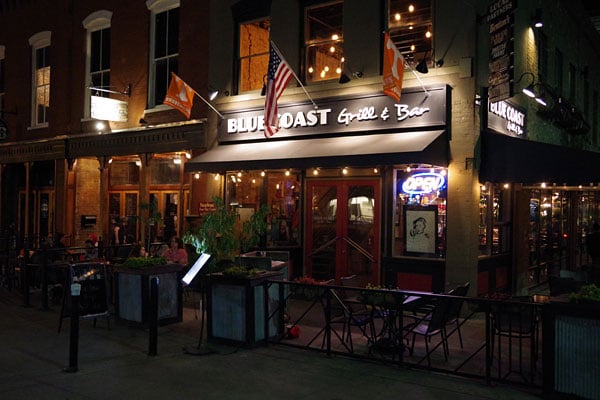
Of course, that's on the Android platform, as was all of my testing. I didn't have access to an iOS device during my review, and the camera had to be returned to Ricoh before I had a chance to have my colleagues in Atlanta try it with iOS for me. (They did last time, with the K-S2, though, and found many of the same concerns as on the Android version.) And the rating from users for the iOS version is no better than that on Android, so I doubt the platform will make terribly much difference to Image Sync's usability.
In my K-S2 review, I noted that many -- perhaps even all -- of these concerns are fixable if Ricoh improves its app and perhaps updates the camera's firmware. However, given that there's been no progress in the app over the last year, I can't offer that same optimism in this review. Expect the app as it is now to remain much the same over the life of your Pentax K-70, and you'll not be setting yourself up for disappointment.

As-is, I would recommend simply telling yourself that the K-70 isn't a connected camera out of the box. Far better options are available, whether you choose to use Pentax's optional FluCard Wi-Fi equipped SD card accessory, or a third-party product like Eye-Fi's Mobi card series. Neither is going to provide as seamless an experience as a robust in-camera Wi-Fi implementation, but they'll both handily outperform what's possible with the built-in Wi-Fi of the K-70.
 42mm-equivalent, 1/60 sec. @ f/4, ISO 3200
Closing thoughts on the Pentax K-70
And now as I reach the end of my field test, I find myself experiencing a certain sense of déjà vu. A year ago, I wrapped up my second field test of the earlier K-S2 by noting that from my Wi-Fi experiences, you might think I didn't like the camera. Once again, Wi-Fi concerns have presented themselves, and once again, I have to say that despite these issues I do think that the Pentax K-70 is a great value for the money.
So long as in-camera Wi-Fi and superb movie autofocus aren't your priorities, the K-70 is an excellent camera which can provide superb image quality and at least fairly good movie clips as well, once digital stabilization is disabled. And in a lot of ways -- those which will matter to more experienced shooters, such as a pentaprism viewfinder, twin control dials, weather-sealing and so on -- the K-70 will give you important features you simply won't find from current rivals at this price-point.
Would I consider buying a K-70 myself, were I in the market for an affordable entry-level DSLR? Absolutely! I just wouldn't touch its Wi-Fi mode, and would look into a third-party solution to help put my photos on Facebook. If you're an entry-level Pentaxian wanting an upgrade, or you're looking to step up to your first DSLR, I would recommend that you do the same!
Flash
Pentax K-70 Flash

Built-in Flash Test Results
Coverage, Exposure and Range
A fairly powerful pop-up flash with somewhat narrow coverage.

Coverage. Flash coverage was a bit narrow at wide angle (18mm), with dark corners and edges, though we've seen narrower. Intensity also varies vertically, however we doubt that would be noticeable in most real-world shots. We no longer test coverage at telephoto, as it's invariably much better.

Exposure. When it came to exposure, the K70's built-in flash exposed our Indoor Portrait subject well with +0.3 EV flash exposure compensation, which is better than the +0.7 EV flash compensation normally required for this shot. Auto white balance is quite cool, though.
| Manufacturer-Specified Flash Range |
|---|
 7.0 feet ISO 100, f/5.6 |
Manufacturer Specified Flash Range. The Pentax K-70's flash is rated with a Guide Number of 12/39 (m/ft) at ISO 100. That works out to a range of about 7 feet at f/5.6. As you can see in the flash range test shot above taken with those parameters using the kit lens, the Pentax K-70 produced a slightly dim exposure (underexposed by about 0.3 EV), indicating the flash output rating is perhaps a bit optimistic. (Note: When we used manual flash at max power, our flash target was well-exposed likely because there is no pre-flash metering which partially drains the flash capacitor, however our standard for this test is auto flash.)
Note: Here we shoot with manufacturer-specified camera settings, at the range the company claims for the camera, to assess the validity of the specific claims. The specified range has been calculated for the sensitivity and aperture used in the test shot above.
Technical Info
by Mike Tomkins | Posted: 06/09/2016
Sensor
At the core of the Pentax K-70 digital SLR is a brand-new 24.24-megapixel, APS-C sized CMOS image sensor, up from the 20.12-megapixel chip of the K-S2. For the first time in a Pentax camera, the sensor includes on-chip phase-detect autofocus pixels.
Total resolution of the K-70's sensor is 24.78 megapixels. With dimensions of 23.5 x 15.6mm, it's just ever so slightly lower in effective resolution terms than the sensor used in the APS-C flagship Pentax K-3 and K-3 II, but has a fractionally higher total pixel count. (The K-3 siblings share a 24.35-effective / 24.71-total megapixel count.)
Just as in most DSLRs these days, there is no optical low-pass filter in the Pentax K-70. This means that per-pixel sharpness is maximized, but moiré and false color effects could be an issue with certain subjects. However, the presence of Pentax's clever anti-aliasing filter simulation function, first introduced on the K-3 DSLR, means that if you have a problem with moiré or false color you can simply reshoot with the function enabled to avoid the problem.
Raw files shot with the Pentax K-70 have a 14-bit depth as in Pentax's flagship models, rather than the 12-bit depth of Pentax's past entry-level and mid-range models.
Processor
Like the Pentax K-S1 and K-S2 before it, the Pentax K-70 processes its images and movies using a PRIME M II-branded image processor. That's an upgrade from the PRIME M processor featured in the earlier K-30 / K-50 / K-500 DSLRs and K-01 mirrorless camera, but less powerful than the PRIME III processor used in the APS-C flagship K-3 and K-3 II, not to mention the PRIME IV chip used in the full-frame Pentax K-1.
ISO
Surprisingly, the Pentax K-70 bests all of Ricoh's Pentax DSLRs at the APS-C sensor size in terms of ISO sensitivity, on paper at least. Where the company's other current APS-C models have a sensitivity range of ISO 100 to 51,200 equivalents, the K-70 manages a wider ISO 100 to 102,400-equivalent range. And the whole of that range is available by default, with no ISO expansion function needed to access the highest or lowest sensitivity options. An Auto ISO function is also provided.
Burst
Ricoh rates burst performance of the K-70 in continuous mode at 6.0 frames per second, with a burst depth of 40 large/fine JPEG, 10 raw, or nine raw+JPEG frames. By way of comparison, the earlier K-S2 was manufacturer rated just fractionally slower at 5.5 frames per second, with a somewhat lesser burst depth of 30 JPEG or nine raw frames, despite the older model having a ~17% lower total pixel count.
Not surprisingly, though, the K-70 is still eclipsed by the APS-C flagship K-3 II, with burst shooting at a manufacturer-claimed 8.3 frames per second, and a buffer depth of 60 JPEG or 23 raw frames.
Optics
As you'd expect in a Pentax APS-C format DSLR, the K-70 accepts K-mount lenses -- whether intended for a full-frame or APS-C image circle -- thanks to the KAF2 bayonet mount on its front deck. Where some affordable DSLRs opt for a less durable plastic lens mount, the K-S2's mount is crafted from stainless steel.
Both screw-drive lenses and those with internal autofocus motors are accepted, and you can also use older Pentax screw-mount lenses or larger-format 645 and 67 lenses with the appropriate adapters. Pentax's power zoom lenses -- of which there are only a few older models, all long-discontinued -- are supported in most respects, but the power zoom-related functionality won't be operational on this body.
And for the first time, a new KAF4 lens variant is also compatible, allowing for a new aperture control method. Instead of the earlier mechanical aperture coupling, an electromagnetic actuator in the lens itself is used to control the iris. Certain other earlier Pentax DSLRs can also use KAF4 lenses on current firmware, but the K-70 is the first to do so right out of the box. The change should allow for both smoother and quieter aperture control, although the lens wasn't available to test during our review, so we haven't been able to confirm the improvements for ourselves.
Weather sealing
Impressively for an affordable camera like this, the Pentax K-70 is fully weather-sealed, providing a similar level of dust and water-resistance to the flagship K-3 DSLR. There are around one hundred seals throughout the K-70's body, and a healthy selection of weather-sealed lenses and accessories are also available, making this a great choice if you plan on shooting in rainy or dusty environments.
Kit lens
The Pentax K-70 is available either body-only, or with a bundled kit lens. If you choose the kit option, you'll get your K-70 along with the smc Pentax DA 18-135mm f/3.5-5.6 ED AL [IF] DC WR, a versatile travel zoom that should satisfy consumer photographers, even if it's rather soft in the corners wide-open. It's certainly a better option than the smc Pentax DA-L 18-50mm F4-5.6 DC WR RE lens which shipped in the K-S2's kit, as we found that optic to be rather handicapped by its finicky retraction mechanism.
Shake reduction
As you'd expect on a Pentax-branded DSLR, image stabilization is handled in the camera body courtesy of a movable platter on which the image sensor is mounted. The system used in the Pentax K-70 is said to have a 4.5-stop corrective ability to CIPA testing standards.
If you're an astrophotography fan, you'll be pleased to hear that the system works with the Astrotracer function of Pentax's optional O-GPS1 GPS unit, slowly moving the sensor during exposure to prevent star trails from forming during long exposures. It's also used to correct for tilted horizons automatically, and for the aforementioned antialiasing filter simulation function.
Dust removal
It's also used for one more feature, too, although we'd have preferred it not be. Even with the best weather sealing in the world, dust is going to get into your camera during lens changes, so some method of removing dust from the sensor is a must. Unlike higher-end DSLRs -- not to mention the preceding K-S2 -- which use a dedicated piezoelectronic element to shake dust free from the sensor, the -70 instead relies on the sensor shift mechanism to do the same job. That approach is not typically very effective, in our experience, and so we'd suggest having a sensor cleaning kit on standby for those times when some more stubborn dust particles adhere to the sensor cover glass.
Viewfinder
Another relatively unusual feature at this pricepoint -- at least, compared to rivals, as past mid-range Pentax models have been similarly generously specified -- is the inclusion of a glass pentaprism viewfinder with a manufacturer-rated 100% coverage. Compared to the pentamirror finders of most DSLRs at this pricepoint, the K-70's finder should prove noticeably brighter and more accurate.
The Pentax K-70's viewfinder has 0.95x magnification, just as in the K-S1, K-S2, K-3 and K-3 II, and an eyepoint of 22.3mm from the center of the viewfinder lens. A built-in dioptric adjustment is available within a -2.5m to +1.5m-1 range, and an interchangeable Natural-Bright-Matte III focusing screen is provided.
Note that unlike some competitors, Ricoh hasn't included a proximity sensor adjacent to the viewfinder, so you'll want to disable the LCD monitor manually before raising the camera to your eye.
Articulated LCD
On the rear panel of the Pentax K-70 is a 3.0-inch, 3:2-aspect LCD monitor with a total resolution of around 921,000 dots. It uses an air-gapless design with a resin layer that fills the space between the LCD panel and the cover glass, providing better contrast and lower glare.
As in the K-S2, this LCD monitor is mounted on a side-mounted, tilt/swivel articulation mechanism. This allows it to be seen from most angles -- including in front of the camera itself for selfie shooting -- or to be closed facing inwards towards the camera body for an extra modicum of protection from minor knocks, scrapes and smudges.
The display provides a +/-two-step adjustable outdoor view setting for greater brightness under sunlight. And for night viewing, it provides an unusual Night Vision LCD function which uses only red light, attempting to disturb your night vision as little as possible.
Focus
As in the K-S2 before it, the Pentax K-70 sports a SAFOX X autofocus sensor with a total of 11 autofocus points, of which the central nine points are cross-types that are sensitive to both horizontal and vertical detail. For good performance even in low-light shooting, it's sensitive all the way down to -3EV. A dedicated LED autofocus assist light is also provided.
In continuous-servo mode, you can choose a single point to focus, and then optionally allow the camera to roam to any of eight surrounding points, handy so that you don't lose focus if you slip off your intended subject briefly.
As well as the standalone phase-detect AF sensor, the K-70 also boasts on-chip phase detect pixels on the image sensor, a first for a Pentax camera. These are used in concert with contrast detect algorithms to provide a more responsive hybrid autofocus system, for use either in live view mode or when shooting movies. And thanks to this system, the K-70 is also the first Pentax DSLR to provide full-time autofocus during movie capture. (Continuous AF is however not available for shooting stills in live view mode.)
Exposure and Creative options
The Pentax K-70 is capable of shutter speeds as fast as 1/6,000 second, and meters exposures using a 77-segment multi-pattern metering sensor, just like the K-S2 before it. (The metering sensor has a working range of EV 0 to 22, using a 50mm f/1.4 lens at ISO 100-equivalent.)
Exposure compensation is available within a +/- 5EV range in either 1/3 or 1/2 EV steps. A built-in, popup flash strobe is included in the design, as is a hot shoe for external strobes. Flash sync is at 1/180 second, and flash exposure compensation is within a -2 to +1EV range in 1/3 EV steps.
Exposure modes on offer include Program, Aperture-priority, Shutter-priority and Manual as you'd find on almost any DSLR, although true to Pentax form, they're called P, Av, Tv and M, rather than the more usual P, A, S and M. There are also the usual Pentax-specific modes you'd expect to see present -- Sv (Sensitivity priority) and TAv (Shutter and Aperture priority) -- plus a Bulb position.
Beginners can keep things friendly with both Auto and Scene-mode shooting, the latter providing a selection of 19 scene types, again unchanged from the K-S2. More advanced shooters can recall favorite settings with three User modes, one more than was offered by the K-S2.
The extra User mode offered in the Pentax K-70 replaces the K-S2's Auto HDR mode on the Mode dial, but HDR shooting is still possible through the menu system. If you want to fine-tune the look of your images for creative effect, a total of 13 custom image modes are provided in the K-S2. There are also nine digital filter functions which provide more eyecatching results.
Also available are a Cross Process function, an adjustable +/-four-step Clarity control, and a skin tone correction tool. And of course, you can also have the K-70 automatically correct for lens distortion, vignetting, lateral chromatic aberration and diffraction with first-party lenses, as well as correcting highlights and shadows to reduce the impact of blocking or clipping. You can also look forward to using both an interval timer and multiple exposure function.
Movie
The Pentax K-70 is the company's most video-capable DSLR to date in at least one respect: As we've already mentioned, it's the company's first APS-C camera to provide full-time autofocus during video capture. That's achieved thanks to the new Hybrid autofocus system, coupling both on-chip phase-detect pixels and contrast-detect algorithms operating on the image data.
There's still no native 4K capture, though, with the K-70 instead able to record Full HD (1,920 x 1,080 pixel) video at rates of 30, 25, or 24 frames per second using MPEG-4 AVC / H.264 compression. Unlike the K-S2, it also allows shooting at 60 or 50 interlaced fields per second, but it's not immediately clear if this is still operating on 30 fps sensor data, or if the interlaced mode is captured at a higher rate. Of course, if you prefer to trade off some resolution for a higher frame rate, rates of 50 or 60 frames per second are alternately available at HD (1,280 x 720 pixel) resolution.
And while it can't record 4K ultra-high def movies ordinarily, the Pentax K-70 is able to create 4K time-lapse movies in-camera. It also offers an unusual "Star Stream" movie mode, which merges multiple frames to create moving star trails in your final video.
Movies other than 4K interval and star stream types include stereo audio, either from a built-in stereo mic or a 3.5mm microphone jack in the left side of the camera body, a relatively unusual option in an affordable DSLR.
Wi-Fi (but no NFC)
The Pentax K-S2 was the company's first DSLR to include in-camera Wi-Fi wireless networking connectivity, a feature that's retained for the followup K-70. What isn't retained is the NFC function, a decision which will have no impact whatsoever on iOS users (since Apple steadfastly refuses to let third parties use the NFC radios in its phones), but it's rather a shame for Android folks. The NFC antenna in the K-S2 made pairing much quicker and easier; Pentax K-70 users will need to pair manually instead.
Through a free "Image Sync" app for both Android and iOS smartphones and tablets, the K-70 can be controlled remotely, complete with a live view feed and the ability to adjust variables such as shutter speed, aperture and ISO sensitivity. It's a much more integrated solution than in Pentax DSLRs prior to the K-S2, which at best have offered compatibility with Eye-Fi cards for image transfer, or with Pentax-branded Flucards for image transfer and remote control.
Connectivity
Wired connectivity in the K-70 includes USB 2.0 High Speed data, a Type-D Micro HDMI high-definition video output, and the aforementioned 3.5mm microphone jack and flash hot shoe. The microphone jack doubles as an input for an optional CS-310 cabled remote release.
Storage
Images and movies are stored on Secure Digital cards, courtesy of a single SD card slot that is compatible with SDHC, SDXC and UHS-I cards.
Both Pentax's proprietary PEF raw format and Adobe's standardized DNG raw format are supported in-camera. As mentioned previously, the K-70 now supports 14-bit raw capture, a step up from the 12-bit raws of its predecessor.
Power
Power comes courtesy of a proprietary D-LI109 lithium-ion battery pack, the same type used in the earlier Pentax K-S2, K-S1 and K-50, among others. Battery life is rated at 410 shots on a charge to CIPA testing standards, unchanged from the earlier cameras. Like the K-S2 before it, the Pentax K-S2 is no longer compatible with AA batteries, so you'll want to look to the earlier K-50 instead if you need support for these in the camera body. (And the K-3 / K-3 II can also accept AA batteries courtesy of their optional portrait / battery grip.)
Conclusion
by Mike Tomkins
If you've been following our site for a while, you'll likely know that I'm a big fan of Ricoh's Pentax brand, and its excellent K-series line of DSLR cameras. The company has produced some really impressive products in the last seven and a half years since it launched the K-7, the first Pentax camera I bought for myself. And with the arrival of the Pentax K-70, it brings some unique features and even some firsts for the Pentax brand at a seriously aggressive pricepoint.
Good handling in a solid, well-built (if perhaps a little heavy) body
One of the strengths of Pentax's DSLRs have been their great ergonomics, and even if it's not quite up to the flagship K-3 and K-3 II in this area, the Pentax K-70 still has very good ergonomics for an entry-level model. Most controls are comfortable and well-positioned, and I never found myself making accidental settings changes with the K-70.
It's perhaps a little heavier than typical of this class, but if you stop to take a look at its feature-set, the reason why becomes immediately apparent. There is a spectacular amount of tech and many worthwhile features in the Pentax K-70, and some of these simply aren't available from any DSLR rival at this pricepoint.
For example, you'll be framing your photos through a bright, clear and exceptionally accurate pentaprism viewfinder crafted from a hefty chunk of glass. The Pentax K-70's rivals offer more limited (and much less bright) pentamirror viewfinders.
There's also comprehensive dust and moisture-resistant sealing throughout the Pentax K-70's design, and that's doubly impressive when you consider that a tilt/swivel LCD monitor is included. Not just that, there are also twin control dials which make changes to the main exposure variables extremely quick and intuitive.
Excellent image quality which can actually best the flagship K-3 II
With that said, there are a couple of areas in which the K-70 still lags its nearest rivals. For example, its autofocus system offers fewer focus points than do similarly-priced cameras like the Canon T6i or Nikon D5500. And its 77-segment metering system, too, is getting rather long in the tooth.
But despite these more dated aspects of its design, the Pentax K-70 impresses in the image quality department. I found its autofocus when shooting through the viewfinder to be pretty swift and accurate, even if it lacks the point density of some rivals. And although its exposure metering wasn't quite as rock solid as that of, say, the flagship Pentax K-3 II, it was still pretty decent in my experience, nailing the correct exposure most of the time and almost never needing more than perhaps a couple of clicks (+/-2/3 EV) of exposure compensation.
Now, if you're planning to shoot a lot of sports or very active subjects, or if top-notch exposure metering is a must, I'd still suggest that you look at the Pentax K-3 or K-3 II instead, as while list pricing is higher, both of these cameras will offer even more bang for the buck. But in an entry-level body -- and bearing in mind the likely subjects of a less experienced photographer -- I think that the Pentax K-70 will prove to be plenty of camera.
In one respect at least -- its high sensitivity image quality -- the Pentax K-70 actually bests its flagship siblings. Crank up the ISO sensitivity, and you'll find you can shoot great images at all the way up to ISO 12,800-equivalent. Perhaps even ISO 25,600-equivalent in a pinch!
And down towards the lower end of the scale, the Pentax K-70's images show great, punchy color that most consumers will appreciate, along with boatloads of fine detail. (More experienced shooters can dial back the defaults for a more natural look, of course.) Enable the K-70's Pixel Shift Resolution function for relatively static scenes like landscapes or still lifes, and you'll be able to get even more detail in your shots, too.
Good performance for its class, but battery life is a weak spot
In most respects, once you power up the Pentax K-70 it's a very responsive camera indeed. It's perhaps a little slow to start up though, and buffer clearing speeds could be a bit quicker, but a generous buffer depth means this isn't really so much of an issue unless you're shooting very lengthy bursts.
And there's more performance on offer here than in either of its nearest Canon or Nikon rivals, with our lab testing bearing out Ricoh's claimed burst performance of six frames per second nicely. Autofocus performance is also better than average for its class, perhaps in part because of its lower-than-average point density.
Really, the main weak spot on the performance front is battery life. Here, Ricoh's Pentax K-70 does lag both the Canon T6i and Nikon D5500, and the latter in particular will manage almost twice as many shots on a charge as does the K-70. But these are pretty small batteries, so just pack a couple of spares or slip them in a pocket, and you'll be good to go once the juice runs out.
Video capture is improved, but still not recommended for more than brief clips
Among the company firsts offered by the Pentax K-70 is full-time movie autofocus. The hybrid system offered up by Ricoh uses an unspecified number of phase-detection AF points on the image sensor itself, and in our testing worked reasonably well in live view mode. It also made movie capture more satisfactory by consumer standards, but the company still has a while to go before we'd recommend its DSLRs for movie use.
Perhaps the main reason for this is that while full-time movie AF is now available, it's still easily confused and has a tendency both to hunt around the point of focus, and occasionally to rack through the focus range in seek of a a focus lock. It's still good enough that many consumers will likely put up with it rather than try to pull focus manually, but it needs to be better still before its ready for prime time.
And in other respects, too many features offered by DSLR or mirrorless camera rivals simply can't be found here. There's no 4K ultra high-def capture, no high framerate video, no clean HDMI output and no way to control audio levels, for example. And as in the company's other recent DSLRs, the K-70 also disables its sensor shift image stabilization system during video capture, substituting for it with a digital system that tends to give your movie clips an unsightly, jello-like wobble.
It's probably best to consider the K-70 a Wi-Fi ready camera, rather than a Wi-Fi equipped one
Perhaps the Pentax K-70's Achilles Heel, though, is its in-camera wireless networking setup. Gone is the NFC radio of the earlier K-S2, so pairing is more of a hassle than it needs to be on Android devices. (iOS users have never gotten to enjoy NFC pairing in the first place, but that's Apple's fault.)
And in other respects, the Pentax K-70's Wi-Fi feature set is much like that of the earlier K-S2, right down to all the bugs, quirks and foibles we reported upon in our review of that camera. The freely-available Image Sync app for Android and iOS is poorly rated, slow and incredibly unintuitive, and if anything we had even more trouble getting it to work with the K-70 than we did with the earlier camera.
That's a great shame, but alternatives are available, both in the form of Ricoh's own rebadged Pentax FluCard devices, and rivals like Eye-Fi's Mobi Wi-Fi equipped SD cards. (And it's possible that your mileage may vary from our own experiences when it comes to Wi-Fi, too. Since publishing our field test a couple of weeks back, we've heard from several readers who've told us that they've been able to get Wi-Fi working themselves, after a bit of effort.
But then, for a camera aimed at entry-level, inexperienced photographers, you shouldn't have to struggle to get the feature to work in the first place. It should be quick-and-simple to get things running as soon as you take the camera out of the box.
Don't let Wi-Fi and video concerns dissuade you: This camera is one heck of a value!
With all of that said, don't let our concerns about Wi-Fi and video autofocus color your thoughts about the Pentax K-70 too much, at least not unless these are critical features for you. No camera is really perfect, and especially not at this price point. But in terms of the features which will appeal to traditional still photographers, the Pentax K-70 stands head and shoulders above the crowd.
We've hemmed and hawed for quite some time as to whether to award the Pentax K-70 a Dave's Pick despite its Wi-Fi shortcomings. But while Wi-Fi is important in this connected age, those core features of the K-70 -- pentaprism finder, twin control dials and weather-sealing -- struck us as doubly important to the shooting experience, and they're just not available from Ricoh's DSLR rivals at this pricepoint.
And as noted previously, the Wi-Fi issues can be worked around with optional Wi-Fi equipped SD cards for relatively minimal cost, if getting images onto your phone is important to you. That final point helped make the decision for us: This is a heck of a lot of camera for the money if stills are your main focus, and for that reason the Pentax K-70 just squeaks a Dave's Pick award in spite of our reservations about its Wi-Fi capability.
Pros
- Punchy, vibrant images straight out of the camera
- Superb image quality with Pixel Shift Resolution enabled
- Excellent high ISO performance for an APS-C sensor
- Very good dynamic range
- Fast autofocus
- Good burst framerate of just over 6fps
- Generous JPEG buffer
- Full-time movie autofocus for the first time in a Pentax DSLR
- External mic jack caters to off-camera audio capture
- Great bang for the buck
- More traditional, mainstream design than the entry-level K-S series
- Ergonomics are mostly very good
- Able to autofocus in very low light
- Very flexible noise reduction options
- Comprehensive dust / weather-sealing and freezeproofing
- Twin control dials
- Tilt/swivel LCD monitor can point forwards, making it useful for selfie shooting
- On-chip phase detection AF for live view and movies
- On-demand AA filter simulator works well
- AA bracketing helps take the guesswork out of knowing whether you should use AA filter simulation or not
- Horizon Correction can automatically detect and fix subtly-tilted horizons at capture time
- Useful Highlight and Shadow Correction options
- Decent in-camera HDR mode
- One extra user mode for a total of three
- Provides a choice of proprietary PEF or open-standard DNG raw formats
- Built-in Wi-Fi wireless networking support (but see related cons)
- Can freeze star trails in long exposures with optional O-GPS1 GPS receiver accessory
- Night Vision LCD function uses red light only for minimal disruption of your night vision
- Pentax K-mount offers best backwards lens compatibility in the business
- Bright, sharp and accurate lass pentaprism viewfinder, where all entry-level DSLR rivals use dimmer, less attractive pentamirror finders
- Excellent coverage from optical viewfinder despite the entry-level price
- In-body stabilization with every lens, and it now has flagship-class 4.5-stop corrective strength
- First Pentax DSLR with support for electronic aperture control right out of the box
- Built-in, popup flash included
- Built-in flash is tall enough to clear larger lenses
- Hot shoe for external strobes
Cons
- Warm Auto white balance in tungsten lighting
- Default sharpening, saturation and contrast may be a bit too high for some (but they can always be turned down)
- Slow buffer clearing
- A little sluggish to power up for a DSLR
- Movie AF is too-easily confused and rather prone to hunting (but for entry-level users, still likely better than pulling focus by yourself)
- Mechanical shake-reduction is disabled for movies, leaving only a jello-prone digital shake reduction function in its stead
- No 4K ultra high-def video capture (except for time-lapse movies)
- No high framerate capture
- No clean HDMI output
- No audio level control or way to monitor levels
- Rather heavy by entry-level DSLR standards
- 11-point autofocus system feels rather dated these days
- Likewise, so does the 77-segment metering system
- No touch-screen
- No proximity sensor next to the viewfinder, so you'll need to disable the LCD manually if you find it distracting
- No NFC radio for quick-and-easy pairing with Android devices
- Controls feel a bit cheaper than in flagship models (but not unduly so considering the price)
- Four-way controller buttons are too deeply sculpted for good comfort
- Raw/Fx button is spongy with poor button feel
- Shake Reduction badge can be uncomfortable on the fingertips if you have large hands
- Below average battery life for a DSLR
- Pentax's smaller market share means less third-party support
- Pixel Shift Resolution Motion Correction doesn't work well
- Wi-Fi wireless communication was slow, limited in range and hindered by an extremely buggy, unintuitive app
- 18-135mm kit lens is rather soft in the corners wide-open, and prone to vignetting at wide angle / chromatic aberration at telephoto
- Relies on sensor shake instead of a piezoelectric element for dust removal, which is rather ineffectual
- Built-in flash has somewhat narrow coverage and uneven output