


Overview
Overview and Hands-on Preview by William
Brawley
Field Test by Eamon Hickey
Preview posted: 02/11/2014
Last edited: 05/01/2019

---
In our 2014 Best Mirrorless Camera for Under $1,000 article, we chose the Sony A6000 as one of our top picks. At the time it was on an incredible sale but now over two years later it's still widely available for a similar low price, making for a fantastic deal while it lasts! But for those with bigger budgets and who want 4K video capture or even more performance and features, consider the newer Sony A6300 or A6500.
---
The well-received Sony NEX-6 not only gets refreshed with the NEX "de-branding" we expected, but also upgraded with some very significant performance enhancements in the new Sony Alpha 6000 (from here on out called the A6000). Looking like a blend of three cameras -- the NEX-6, NEX-7 and Alpha 7 -- the new A6000 sits squarely in Sony's compact system camera lineup aimed at step-up users, advanced hobbyists and enthusiasts looking for DSLR quality and performance in a much smaller, lighter package.
Although we're not sure of the fate of the Sony NEX-7, for which users have been aching for an update, it seems all but replaced by the introduction of the Sony A7. However, for those who aren't ready to jump to full-frame or want a smaller, lighter camera and for a significantly lower price, the A6000 offers photographers a number of improvements, inside and out, over both the NEX-6 and NEX-7 that should satisfy users just stepping up to a more advanced camera as well as seasoned photographers demanding advanced performance and control.

What's New. On the inside, the Sony A6000 features a big sensor upgrade over the NEX-6 with a newly developed 24.3-megapixel EXMOR APS HD CMOS sensor coupled with Sony's BIONZ X image processor which was borrowed from the A7/A7R lineup. This pairing increases the ISO range of 100-25,600 (up to 51,200 equivalent with Multi-Frame Noise Reduction and up to 12,800 for video), and the processor aims to increase detail and improve noise reduction performance as well as reduce the effects of diffraction when shooting at smaller apertures.
Not only does the A6000 aim for stellar image quality, but it also knocks the ball out of the park in terms of autofocus performance -- performance that Sony claims beats even mid-level DSLRs. Thanks to improvements to their Fast Hybrid AF system, the A6000 is claimed to unseat the briefly-reigning king of AF, the Fujifilm X-T1 with its 0.08 sec AF speed, with the ability to autofocus in only 0.06 seconds! (Note, though, that AF speeds cited by manufacturers often don't include actually capturing a photo, so their claims are not directly comparable to our lab measurements.) Sony says the A6000 also provides a performance boost for Fast Hybrid AF in movie recording.

The A6000 also has another trick up its proverbial sleeve that fans of fast action will enjoy: 11fps continuous shooting with AF tracking. This is a significant upgrade to the NEX-6's solid 10fps continuous shooting via the use of Speed Priority Continuous mode, which locked focus on the first frame of shooting. If your subject's distance moved at all, you may have been out of luck to get an in-focus shot during the burst.

The A6000 provides a significant increase in the AF coverage on the sensor for both contrast-detect and phase-detect AF compared to the NEX-6. Now, AF coverage spans approximately 91% of the height and 92% of the width of the sensor (up from 47% x 52% on the NEX-6). The sensor is nearly covered by AF points: there are now 179 phase-detect AF points within that coverage area as well as 25 contrast-detect points. This delivers tons of flexibility in composition by allowing you a lot of freedom to place the focus point where you need it.
The A6000 also features a variety of other AF enhancements such as lock-on AF for tracking moving subjects, Eye-AF for quick focusing on the subjects' eyes, as well as Flexible Spot AF with adjustable "spot" sizing.
Like the NEX-6, the new A6000 includes built-in Wi-Fi connectivity for use with Sony's PlayMemories Mobile app for iOS and Android devices. However, like Sony's other recent cameras, the A6000 also includes NFC support for quick and easy pairing of smartphones -- Android-only for the foreseeable future, however.
Hands-On: Design and Build. Users of the NEX-6 and NEX-7 should feel right at home with the new A6000, as Sony's kept with many of the same design concepts that advanced users enjoy such as the built-in EVF, Multi-Interface Shoe, pop-up flash, and a dedicated PASM mode dial.

In the hand, the A6000 feels noticeably chunkier and beefier than the NEX-6, though, it's actually a bit lighter at 285 grams compared to 287 grams (body-only). The A6000's solidness is very reminiscent of the Sony A7 and A7R with its more angular, sharp-edged design. In fact, the A6000 looks and feels like an A7 with the pentaprism-shaped EVF hump chopped off. The NEX-6 was comprised of a metal and polycarbonate plastic design, and the A6000 follows suit, however the new model feels more metallic, in a way, with a smooth, black paint job that lacks any sort of texture or speckled finish like the NEX-6.

Looking at a side-by-side top-down comparison of the A6000 and the NEX-6, you can easily see that the A6000 is quite a bit thicker than its predecessor, however it's practically the same height and length, and therefore the sheer portability isn't really affected. With the Sony 16-50mm kit lens, it's a nice, lightweight and compact package with easy to reach controls and a rubberized covering on the handgrip.


EVF & LCD. Like the NEX-6 before it, the Sony A6000 features a built-in EVF and tilting LCD screen. The specs for the EVF in the A6000, however, are different from its predecessor with a smaller, seemingly lower-resolution OLED display. Carrying the Tru-Finder branding, the 0.39-inch 1,440K-dot OLED EVF does look noticeably smaller than the 0.5-inch 2,359K-dot OLED EVF of the NEX-6 on the outside.

However, comparing the two side-by-side, the A6000's EVF is the clear winner as it produces much more accurate colors and easy to discern details. Both cameras' EVFs provide 100% coverage, but the A6000's offers slightly lower magnification at 1.07x versus 1.09x for the NEX-6. Still, the view inside the A6000's EVF is bright and large.
The LCD, however, is a holdover from the NEX-6, with a 3-inch tilting TFT LCD display with 921,600-dot resolution and similar angles of articulation (up 90-degrees, down 45-degrees), making it easier to take shots from difficult or awkward angles. The A6000 does provide peaking for critical focus as well as zebra overlays for over-exposed areas.


Menus. With the A6000, gone are the bright, colorful, icon- and scrolling-heavy menus of the NEX line of cameras. Instead, Sony's brought over the same user interface from the A7/R and RX-series cameras. Just like with the A7 line, the A6000 provides a simpler, easier-to-navigate menu system that features all the button, dial and on-screen "Quick Navi" configuration you could want -- to help you avoid digging into said menus while you're out shooting.

Controls. Like we mentioned above, users of the NEX-6 and NEX-7 should feel right at home with the A6000's control layout. Particularly on the rear of the camera, the button layout is nearly identical to the NEX-6, but with the labeling scheme straight from the A7. The A6000 does add an additional custom function (C2) button at the lower right corner, and switches the playback button for the menu button.
Also gone are the two unlabeled buttons that change function corresponding to on-screen options. They've now been replaced by a dedicated Function (Fn) button, which brings us a table of settings and options for quick adjustments, and the playback mode button.
The top dial controls display a hybrid of NEX-6 and NEX-7 designs. The full PASM dial is carried over from the NEX-6, with the inclusion of Memory Recall and Movie Mode options. This dial feels nice and stiff, and while it's not a locking mode dial, as we've seen introduced on more cameras lately, it doesn't feel as if it could be easily bumped and rotated unintentionally.
From the NEX-7, we have a secondary label-less dial that serves as the aperture control (by default), as well as a way to scroll through menus. This dial is easier to rotate than the mode dial -- as it should be -- but resists rotation enough to avoid an accidental light bump or brush. You can also customize the function of this dial to serve as the shutter speed adjustment, with the rear 4-way scroll dial on the back of the camera being used for aperture adjustment. (As expected, this dial serves as shutter control by default in Manual Exposure mode.)

HD Video Recording. The A6000 features the same basic set of Full HD video recording features including 1,920 x 1,080 resolution video with 60p, 60i and 24p frame rate options in AVCHD format along with lower resolutions in MP4 format, and provides support for full PASM exposure modes. The dedicated video recording button allows for motion picture capture in any exposure mode for quick, one-press video recording, although there is a dedicated Movie Mode.
Despite lots of advanced video recording amenities for the image side of things like focus peaking, zebras and an adjustable AF drive speed, there are only basic stereo audio recording features such as the ability to disable audio recording, and an optional wind-cut filter. Like the NEX-6, audio levels are not adjustable, nor is there a standard 3.5mm jack for external microphones. The A6000 does however support Sony's hot-shoe-mounted ECM-XYST1M stereo mic, which includes adjustable recording directions, a low-cut filter, fuzzy windscreen cover and a mic-out jack for use with cameras that don't have Sony's proprietary Multi Interface Shoe. Thus, videographers wanting more professional-level audio quality have the option of going with the Sony external mic or must resort to external audio recorders and synchronize the audio in post production.

Power, Storage and Connectivity. Users upgrading from an NEX-series camera or looking to add the A6000 to their stable beside the A7/R will be pleased to hear that Sony has kept the same battery format for this new model. The NP-FW50 InfoLithium rechargeable battery pack is CIPA-rated to provide around 360 shots per charge when using the LCD monitor which is the same as the NEX-6, though the A6000's battery life when using the EVF is rated at 310 shots, a significant improvement over the 270 shots the NEX-6 provided with its EVF. Like its predecessor the Sony A6000's battery is charged in-camera via USB, with an AC adapter and USB cable provided in the bundle.

As with previous Sony models, the A6000 uses a dual-format card slot that accepts both Secure Digital cards (SD, SDHC and SDXC) and MemoryStick cards (PRO Duo, Pro-HG Duo and PRO-HG HX Duo).
As mentioned above, the A6000 features both Wi-Fi and NFC connectivity for smart device pairing and control. For wired connection, the A6000 includes an HDMI connection (Micro HDMI, Type-D) -- which can provide clean HDMI output for video recording -- and a multi-use Micro USB port for file transfer or for use with remotes, like the optional Sony RM-VPR1 controller.
Also mentioned previously is the A6000's Multi Interface Shoe which not only supports standard flashes, it integrates 21 additional pins for adding accessories to the camera, such as the aforementioned Sony ECM-XYST1M external mic.
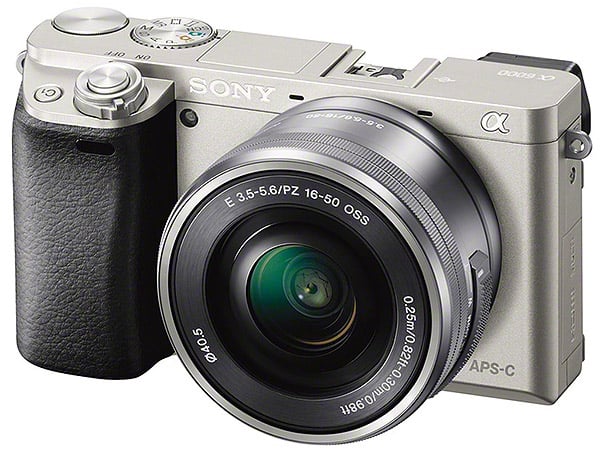
Pricing and Availability. The Sony A6000 is a stellar upgrade to not only the NEX-6, but also the NEX-7 with its high-resolution 24.3MP sensor, blazingly-fast AF and much-improved burst shooting with AF tracking. The A6000 launched in April 2014 in both a kit configuration with the Sony 16-50mm Power Zoom lens for around US$800, and as a body-only option for around US$650, in both an all-black color and a silver version (with corresponding silver 16-50 kit lens).
Place your order with a trusted Imaging Resource affiliate now:
- Sony A6000 body-only, black: ADORAMA | AMAZON | B&H
- Sony A6000 body-only, silver: ADORAMA | AMAZON | B&H
- Sony A6000 with 16-50mm lens, black: ADORAMA | AMAZON | B&H
- Sony A6000 with 16-50mm lens, silver: ADORAMA | AMAZON | B&H
In the Box
The Sony A6000 retail kit package (as reviewed) contains the following items:
- Sony Alpha ILCE-6000 camera body
- SELP-1650 16-50mm E-mount Power Zoom lens
- NP-FW50 rechargeable Li-ion battery
- AC-UB10 AC adaptor
- Shoulder strap
- Micro USB cable
- Lens cap
- Eyepiece cup
- Instruction Manual
- Wi-Fi Connection/One-touch (NFC) Guide
Recommended Accessories
- Large capacity SDHC/SDXC memory card. 16GB Class 10 should be a minimum.
- BC-TRW Dedicated Battery Charger (~US$50)
- HVL-F60M External Flash/Video Light (~US$550)
- ECM-XYST1M External Stereo Microphone (~US$140)
- LA-EA4 A-mount to E-Mount Adapter (~US$350)
- Additional lenses
Optics
Below are the results of our optical tests with the Sony A6000 and the bundled Sony E PZ 16-50mm f/3.5-5.6 OSS kit lens. The test images shown on most other pages of these test results were taken with very sharp references lenses, so we use this page to explore kit lens performance.
Kit Lens Test Results
Optical Zoom
A typical zoom ratio of ~3.1x for a kit lens, with decent performance.


The Sony A6000 is available bundled with the PZ 16-50mm F3.5-5.6 OSS E-mount "kit" lens. This lens possesses a typical optical zoom ratio for a kit lens of about 3.1x with a 35mm-equivalent focal range of about 24-75mm.
Sharpness and contrast at full wide angle (16mm) are decent at f/8 over most of the frame, and chromatic aberration isn't an issue (the camera suppresses), however some flare is slightly visible around the building's white surfaces. It's difficult to judge corner performance here because of the depth in this scene so we'll do that in more detail below, but extreme corners are soft at f/8. At medium focal length (32mm), the lens performs quite well at f/8 with good sharpness and contrast, though some corner softness can still be seen. At full telephoto (50mm), overall performance is quite good with very good sharpness in the center and only minor softness in the extreme corners.
The Sony A6000's 2x Clear Image digital zoom actually worked fairly well, better than just standard digital zoom (which goes up to 4x), but still produces some loss in fine detail, as well as some interpolation artifacts and more visible noise.
See sections below for comments on macro performance, geometric distortion, corner softness, performance wide open, chromatic aberration, etc.
Macro
Slightly larger than average minimum coverage area, with good detail. Flash throttled down well.


As with zoom performance, the Sony A6000's macro performance will depend entirely on the lens mounted. However with the E-mount 16-50mm kit lens set to 50mm, the A6000 captures a minimum area measuring 3.62 x 2.41 inches (92 x 61 millimeters), which is slightly larger than average for a kit lens. Sharpness is quite good in the center at f/8, though the corners and edges of the frame are softer. (Most lenses have some softening in the corners at macro distances.) Some corner shading is also noticeable. The flash did a very good job throttling down at minimum distance, resulting in a good exposure. The flash also had no trouble clearing the lens as there is no detectable shadow, though coverage is slightly uneven and narrow.
Geometric Distortion
Much lower than average geometric distortion at wide angle and telephoto in JPEGs, but the A6000 always applies distortion correction to JPEGs when the 16-50mm kit lens is mounted.
| Barrel distortion at 16mm is ~0.2 percent |
 |
| Pincushion distortion at 50mm is negligible |
 |
In-camera JPEGs taken with 16-50mm kit lens show only about 0.2 percent complex barrel distortion at wide angle, which is much lower than average and only slightly noticeable. At the telephoto end, there's hardly a pixel's worth of pincushion distortion. This is the tendency for the lens to bend straight lines outward (like a barrel -- usually at wide-angle) or inward (like a pincushion -- usually at telephoto).
Chromatic Aberration, Corner Sharpness & Vignetting
Low levels of C.A. (the camera suppresses it). The lens produces some soft corners.
| Aperture: maximum | |
 |
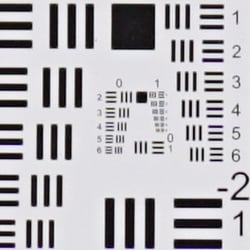 |
| 16mm@f/3.5: Lower left C.A.: Low Softness: Quite soft |
16mm@f/3.5: Center C.A.: Very low Softness: Sharp |
 |
 |
| 50mm@f/5.6: Upper left C.A.: Moderately low Softness: Fairly sharp, but hazy |
50mm@f/5.6: Center C.A.: Low Softness: Fairly sharp |
Chromatic Aberration. Chromatic aberration in the corners with the A6000's 16-50mm kit lens at wide angle (16mm) is fairly low, and the center of the image shows very little C.A. The camera does a pretty good job at suppressing much of the lateral C.A. produced by the lens (see below). At full telephoto (50mm), C.A. is moderately low in the corners, though the center shows a bit more than at wide angle (possibly the result of a slight focus difference), however it's still quite low.
Corner Softness. Wide open at full wide angle, the 16-50mm lens that came with our A6000 is soft in all four corners, with the bottom left being the softest. Some softness extends fairly deep into the frame, however the center is quite sharp and contrasty. At full telephoto, resolution in the corners is actually pretty good, but they suffer from reduced contrast and haze which makes them look a bit soft. Contrast improves as you move toward the center, which is fairly sharp.
Vignetting. Moderate vignetting (corner shading) is noticeable at full wide angle, as indicated by the darker corner crop. Vignetting is not as noticeable at full telephoto.
| Aperture: f/8 | |
 |
 |
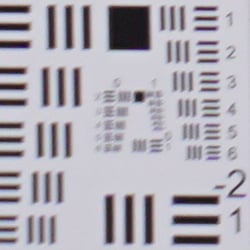
| 16mm@f/8: Lower left C.A.: Low Softness: Soft |
16mm@f/8: Center C.A.: Very low Softness: Sharp |
 |
|
| 50mm@f/8: Upper left C.A.: Low Softness: Minor blurring |
50mm@f/8: Center C.A.: Very low Softness: Sharp |
F8. "Stopped-down" to f/8, some corners got a little sharper while others got softer at wide angle, but in general they are still on the soft side, while the center remained sharp. At full telephoto, corner sharpness and especially contrast improved compared to f/5.6, and the center became sharp. Chromatic aberration and vignetting also improved.
Lens Corrections
The Sony A6000 includes the ability to automatically compensate for geometric distortion, chromatic aberration, and lens shading (vignetting), as images are captured.
Geometric Distortion
| Uncorrected barrel distortion at 16mm is ~3.1 percent |
 |
| Pincushion distortion at 50mm is ~0.3 percent |
 |
Above, you can see the uncorrected geometric distortion from the 16-50mm kit lens is very high at wide angle, with about 3.1% barrel distortion. Very high barrel distortion at wide angle is common for Micro Four Thirds lenses, but the 16-50mm is the first E-mount lens we've seen with it this high, and the amount of correction required explains some of the corner softness we see at wide angle. At the telephoto end, pincushion is fairly low at 0.3%, but still higher than the corrected JPEG image.
The default Distortion Correction setting is normally Off for the A6000, but is forced to Auto when the 16-50mm lens is mounted, so we used RawDigger to convert the RAW file without corrections applied. Thus, like most Micro Four Thirds lenses, it appears that Sony designed this lens with higher geometric distortion at wide angle to make it more compact, and is correcting it in firmware.
Chromatic Aberration
| CA Correction Auto | CA Correction Off |
 |
 |
| 16mm@f/3.5: Upper left C.A.: Low |
16mm@f/3.5: Upper left C.A.: High and bright |
 |
 |
| 50mm@f/5.6: Upper left C.A.: Very low |
50mm@f/5.6: Upper left C.A.: Very low |
Above, you can see fairly high and bright lateral chromatic aberration at wide angle with Chromatic Aberration Compensation disabled, though the difference at telephoto is minimal because C.A. is low at telephoto to begin with. The default for this setting is Auto.
Lens Shading
 |
 |
||
| 16mm@f/3.5 | 50mm@f/5.6 | ||
| Lens Shading Correction: | Off | ||
Mouse-over the links above to see the difference Lens Shading Compensation makes when wide open (the worst-case scenario for most lenses). As you can see, particularly at wide angle, corners are brightened without affecting brightness in the center when enabled, though some fall-off is still left behind in the corrected images. The default setting is also Auto. Please note that like other Sony models, the A6000 "bakes" shading correction into RAW files, so be sure to turn Lens Shading Compensation off if you plan to correct your RAW files in a converter or editor.
Overall, not a bad performance for an inexpensive kit lens. It's a good start and a great value when bought as part of a kit, but to get the most out of the Sony A6000's 24-megapixel resolution, enthusiasts will likely want to invest in some better glass. See our full review of another copy of Sony E 16-50mm PZ lens on SLRgear.com.
Sony A6000 Viewfinder Accuracy
Viewfinder Test Results
Coverage
Excellent accuracy from the EVF and LCD monitor.


The Sony A6000's electronic viewfinder and LCD monitor both show slightly over 100% coverage in record mode in our tests. This is excellent performance, though not a surprise given the image is derived from the main imaging sensor.
The images above were taken from our standardized test shots. For a collection of more pictorial photos, see our Sony Alpha ILCE-A6000 Photo Gallery .
Exposure
Color
Saturation & Hue Accuracy
Typical saturation levels and hue accuracy.
 |
||
|
ISO Sensitivity
|
||
| In the diagram above, the squares show the original color, and the circles show the color that the camera captured. More saturated colors are located toward the periphery of the graph. Hue changes as you travel around the center. Thus, hue-accurate, highly saturated colors appear as lines radiating from the center. Mouse over the links to compare ISOs and click on the links for larger images. | ||
Saturation. The Sony A6000's overall default color saturation is oversaturated by 11% at base ISO, which is about average these days. Saturation remains consistent up to ISO 1600, but starts falling off at higher ISOs, ending up at 98.3% at ISO 25,600. Reds and dark blues are boosted the most, but not as much as we often see. Most other colors are pushed just a bit or pretty close to ideal, though yellow, light green and cyan are slightly undersaturated. Overall, saturation levels are pleasing to our eyes at low to moderate ISOs, and you can of course tweak them more to your liking. Most consumer digital cameras produce color that's more highly saturated (more intense) than found in the original subjects. This is simply because most people like their color a bit brighter than life.
Skin tones. The Sony A6000 does fairly well with Caucasian skin tones when using manual white balance in simulated daylight. Brighter flesh tones have a healthy pinkish tint, though darker areas are nudged toward orange. With auto white balance, results are still good, though slightly warmer. Where oversaturation is most problematic is on Caucasian skin tones, as it's very easy for these "memory colors" to be seen as too bright, too pink, too yellow, etc.
Hue. Like many cameras, the Sony A6000 shifts cyan toward blue, red toward orange, orange toward yellow and yellow toward green, however shifts are minor to fairly moderate. (The cyan to blue shift is very common among the digital cameras we test; we think it's a deliberate choice by camera engineers to produce better-looking sky colors.) With an average "delta-C" color error of 5.72 after correction for saturation at base ISO, overall hue accuracy is about average, with accuracy only moderately changing at higher ISOs. Hue is "what color" the color is.
Saturation Adjustment
The Sony A6000 has a total of seven saturation settings available, three above and three below the default saturation. This covers a pretty wide range of saturation levels. Saturation also has almost no effect on contrast, which is how it should work, but not always a given.
| Saturation Adjustment Examples | ||||
 |
 |
 |
 |
 |
| -3 | -1 | 0 | +1 | +3 |
The table above shows results with five of the seven saturation settings, including the default and the two extremes. Click on any thumbnail above, then click again to see the full-sized image.


Sensor
Exposure and White Balance
Indoors, incandescent lighting
Warm cast with Auto, good with Manual, but too cool with Kelvin white balance settings. Average exposure compensation required.


Indoors, under normal incandescent lighting, color balance is a bit warm and orange with the Auto white balance setting, though results here are better than average. Results with the Incandescent setting are better but still a touch warm. The Manual setting is quite accurate, just slightly on the cool side. The 2,600 Kelvin setting which should roughly match the color temperature of our lights is too cool and bluish. The Sony A6000 required +0.3 EV positive exposure compensation here, about average for this shot. (Our test lighting for this shot is a mixture of 60 and 100 watt household incandescent bulbs, a pretty yellow light source, but a very common one in typical home settings here in the U.S.)
Outdoors, daylight
Very good results under harsh lighting, with good handling of contrast, color, and exposure.
Outdoors, the Sony A6000 performed very well. +0.3 EV exposure compensation was required to keep the mannequin's face bright in our "Sunlit" Portrait shot, which is better than average among the cameras we've tested. (Most cameras require about +0.7 EV here.) Contrast is a little high as you might expect under such harsh lighting, but despite the bright appearance, only a few highlights were blown, even without the help of DRO (see below). Shadow detail is quite good except in very deep shadows were they exhibit noise and posterization, but that's to be expected and shouldn't be a problem unless trying to recover a severely underexposed image. Both Auto and Manual white balance produced decent skintones, but we preferred Manual for its slightly pinker response. Default exposure is quite good for our Far-field shot, just a touch underexposed but with almost no highlights blown (just specular highlights) or shadows lost, again with DRO disabled. The Far-field shot with Auto white balance has very good color, just a touch on the cool side. Overall, a very good performance in harsh lighting, especially considering DRO was off for these shots.
See full set of test images with explanations
See thumbnails of all test and gallery images
Resolution
Very high resolution, ~2,800 to 2,900 lines of strong detail from both JPEGs and RAW files.
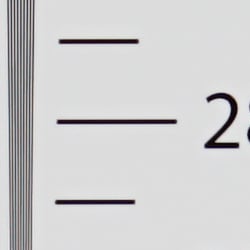
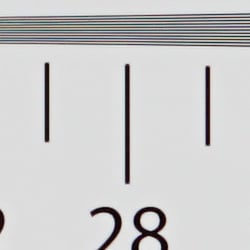

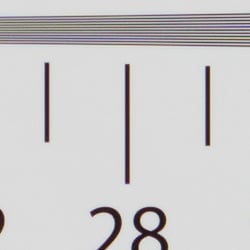
In-camera JPEGs of our laboratory resolution chart reveal sharp, distinct line patterns down to about 2,900 lines per picture height in the horizontal direction, and about 2,800 lines in the vertical direction. Some may argue for higher numbers, but aliasing artifacts start to interfere at this resolution. Complete extinction of the pattern doesn't occur until about 3,500 to 3,600 lines. Some color moiré is evident in JPEGs, though that's not uncommon. Adobe Camera Raw wasn't really able to extract more lines of resolution here from a matching RAW file, and it generated stronger color moiré (different colors as well), so the Sony A6000 does a good job holding on to high contrast detail at base ISO in its JPEGs. Use these numbers to compare with other cameras of similar resolution, or use them to see just what higher resolution can mean in terms of potential detail.
See full set of test images with explanations
See thumbnails of all test and gallery images
Sharpness & Detail
Excellent default sharpness, with very minor sharpening artifacts. Mild to moderate noise suppression visible in the shadows and areas of low contrast.


Sharpness. The Sony A6000 captures very sharp, crisp images at lower ISOs, with few visible edge enhancement artifacts. We normally see some fairly bright sharpening halos around high-contrast elements such the lettering and lines in our bottle labels, but the A6000's sharpening algorithm is very good at making details pop without obvious sharpening artifacts. Excellent results here, at least at low ISOs. Edge enhancement creates the illusion of sharpness by enhancing colors and tones right at the edge of a rapid transition in color or tone.
Detail. The crop above right shows mild to moderate noise suppression in the darker areas of the mannequin's hair. A number of low-contrast strands are smudged together, though higher contrast strands are still distinct. There's also very little noise, particular chroma noise which we often see in hair. Overall, pretty good results here especially for a 24-megapixel APS-C sensor, though chroma noise reduction takes its toll on fine low-contrast detail. Noise-suppression systems in digital cameras tend to flatten-out detail in areas of subtle contrast. The effects can often be seen in shots of human hair, where the individual strands are lost and an almost "watercolor" look appears.
RAW vs In-Camera JPEGs
As noted above, the Sony A6000 produces in-camera JPEGs with lots of crisp detail and few sharpening artifacts, at least at low ISOs. Additional detail can often be obtained from carefully processing RAW files with a good converter, though. Let's see how base ISO compares here:
| Base ISO (100) | |
 |
 |
 |
 |
 |
 |
|
Camera JPEG, defaults
|
RAW via Adobe Camera Raw
|
In the table above, we compare an in-camera JPEG taken at base ISO using default noise reduction and sharpening (on the left) to the matching RAW file converted with Adobe Camera Raw 8.3 using default noise reduction with some strong but tight unsharp masking applied in Photoshop (250%, radius of 0.3 pixels, and a threshold of 0).
Looking closely at the images, ACR extracts additional detail that isn't present in the JPEG from the camera, particularly in the red-leaf swatch where the thread pattern is likely treated as noise by the JPEG engine. The fine detail in the mosaic is also slightly improved, but as is often the case, more noise can be seen in the bottle crop. You can of course apply stronger noise reduction (default ACR NR used here) to arrive at your ideal noise versus detail tradeoff. That being said, the Sony A6000's in-camera JPEG processing (at least at low ISOs) is very good with generally excellent detail and very few sharpening artifacts, though default noise reduction is a touch heavy-handed particularly in the red channel here.
ISO & Noise Performance
Very good noise versus detail performance at low to moderately high ISOs, but high ISOs look noisy and overprocessed.
|
Default High ISO Noise Reduction
|
 |
 |
 |
| ISO 100 | ISO 200 | ISO 400 |
 |
 |
 |
| ISO 800 | ISO 1,600 | ISO 3,200 |
 |
 |
 |
| ISO 6,400 | ISO 12,800 | ISO 25,600 |
The Sony A6000's JPEG images are very clean up to ISO 400, though as mentioned, fine detail in the hair is already a little smudged at base ISO. There are minor demosaicing errors in the hair above the mannequin's forehead, though that's pretty common these days, especially with a sharp lens. We start to see some minor softening at ISO 400 where stronger noise reduction kicks in, but fine detail is very good and chroma noise very low. ISO 800 is a bit softer, but fine detail is still very good. ISO 1,600 is slightly softer and although fine detail is still good, flatter areas start to look a bit overprocessed with a somewhat painted look to them, and high contrast edges start to become a little rough or indistinct. ISO 3,200 shows even more of the processed look with almost an almost hammered look to flat areas, but the image still has some good detail left. Image quality falls off rapidly from there, though. ISO 6,400 shows a sudden increase in luminance noise long with significant blurring of fine detail, as well as some chroma noise in the form of purple and yellow tinted patches. Noise and the effects of noise processing are stronger still at ISO 12,800 as you'd expect, and ISO 25,600 is very noisy with lots of noise reduction and sharpening artifacts, as well as strong chroma blotching in shadows and midtones. Overall, though, these are pretty good results especially considering the A6000's price point and resolution, though advanced users will likely turn to RAW capture to avoid the overprocessed look at higher ISOs.
As always, see the Print Quality section below for maximum recommended print sizes at each ISO, as printed performance often doesn't correlate well to what's seen on-screen at 100%, and check out our Comparometer to see how the Sony A6000's JPEGs compare to other cameras we've tested.
A note about focus for this shot: We shoot this image at f/4, usually using one of three very sharp reference lenses (70mm Sigma f/2.8 macro for most cameras, 60mm f/2.8 Nikkor macro for Nikon bodies without a drive motor, and Olympus Zuiko 50mm f/2.0 for Four Thirds and Micro Four Thirds bodies). To insure that the hair detail we use for making critical judgements about camera noise processing and detail rendering is in sharp focus at the relatively wide aperture we're shooting at, the focus target at the center of the scene is on a movable stand. This lets us compensate for front- or back-focus by different camera bodies, even those that lack micro-focus adjustments. This does mean, though, that the focus target itself may appear soft or slightly out of focus for bodies that front- or back-focused with the reference lens. We know this; if you click to view the full-size image for one of these shots and notice that the focus target is fuzzy, you don't need to email and tell us. :-) The focus target position will have been adjusted to insure that the rest of the scene is focused properly.
Extremes: Sunlit, dynamic range and low light tests
Very high resolution with excellent highlight and shadow detail. Very good low-light performance, capable of capturing bright images in near darkness.


Sunlight. The Sony A6000 handled the deliberately harsh lighting in the test above very well. We preferred the +0.3 EV exposure here as the face is bright while almost no highlights were clipped in the white shirt. The default exposure is a tad dim in the face, while the +0.7 EV exposure is definitely too bright. As mentioned previously, contrast is a little high, but both highlight and shadow detail is very good at +0.3 EV.
For best results, be sure to use fill flash in situations like the one shown above; it's better to shoot in the shade when possible. See below for results with Dynamic Range Optimization and High Dynamic Range features enabled.
Because digital cameras are more like slide film than negative film (in that they tend to have a more limited tonal range), we test them in the harshest situations to see how they handle scenes with bright highlights and dark shadows, as well as what kind of sensitivity they have in low light. The shot above is designed to mimic the very harsh, contrasty effect of direct noonday sunlight, a very tough challenge for most digital cameras. (You can read details of this test here. In actual shooting conditions, be sure to use fill flash in situations like the one shown here; it's better to shoot in open shade whenever possible.)
Contrast Adjustment
We really like it when a camera gives us the ability to adjust contrast and saturation to our liking. It's even better when those adjustments cover a useful range, in steps small enough to allow for precise tweaks. Just as with its saturation adjustment, the Sony A6000's contrast setting meets both challenges.
|
Minimum Contrast
|
|
 |
 |
| Contrast set to lowest, 0 EV |
Contrast set to lowest, 0 EV |
At its lowest contrast setting, the A6000 does a really excellent job of toning down highlights and opening up shadows while maintaining natural-looking skin tones. Very good results here.
| Contrast Adjustment Examples | ||||
|
 |
 |
 |
 |
| -3 | -1 | 0 | +1 | +3 |
The table above shows five of the seven contrast setting, including the default and two extremes. It's pretty hard to evaluate small differences in contrast on small thumbnails like these, so click on any thumbnail to go to the full-size image.
One very nice feature of Sony's contrast adjustment is that it has very little effect on color saturation. Contrast and saturation are actually fairly closely coupled, it's a good trick to be able to vary one with out the other changing as well. As usual, Sony did a good job here.


Dynamic Range Optimization is Sony's name for their dynamic range enhancement technology. DRO divides the image into small areas, analyzes the range of brightness of each area, and adjusts the camera's tone curve and other processing parameters accordingly to make the best use of the available dynamic range. DRO does not boost ISO for the entire image like some systems, so increased noise is less of an issue, though existing noise may be more visible in raised shadows. Auto DRO is enabled by default on the Sony A6000. You can also set the level manually, from 1 ("weak") to 5 ("strong"), or turn it off. As one would expect, DRO is only applied to JPEG files however RAW files are tagged for similar processing by Sony's IDC software.
The above thumbnails and histograms show the effects of the available levels of DRO on our "Sunlit" Portrait shot with no exposure compensation. Mouse over the links to load the associated thumbnail and histogram, and click on the links to visit the full resolution image. As you can see from the thumbnails and associated histograms, DRO worked as expected, boosting shadows and mid-tones without blowing additional highlights, yielding more balance exposures. Auto DRO setting did a good job here, and the five manual levels give quite a bit of control over the effect.

Above, you can see the effect of DRO settings on our Far-field shot. The default Auto setting produced a nicely balanced exposure, despite the harsh lighting. A useful feature.


High Dynamic Range. The Sony A6000's HDR mode takes three images in rapid succession, one nominally exposed , one underexposed, and one overexposed, then combines them into one high dynamic range JPEG automatically (RAW images are not supported). Lighter areas from the underexposed image are combined with darker areas from the overexposed image to produce an image with compressed tonal range. The camera then saves a single composite image, as well as the nominally exposed image. The overlaid images are micro-aligned by the camera, but it can only correct for so much movement. If it can't micro-align successfully, an icon indicating HDR capture failed will appear. For best results, the subject should not move or blink, so it's not really intended for portraits. There is also a manual mode where you can select 1 EV ("weak") to 6 EV ("strong") difference in exposures.
Mouse over the links to load the associated thumbnail and histogram, and click on the links to visit the full resolution image. As you can see, the Auto setting did a decent job boosting shadows and mid-tones while reigning back highlights, however we prefer the lower manual settings for this subject. The higher the manual setting, the more highlights are toned-down and shadows opened up, but higher settings can produce flat and unnatural results with this scene. Still, it's nice that Sony provides six manual levels, giving quite a bit of control over the effect.
Above, you can see the effect of HDR settings on our Far-field shot. Watch out for ghost images (or remnants from anti-ghost image processing) from subject movement during the capture sequence, though, as can be seen in some of the shots above. Still, Sony has one of the better in-camera HDR implementations we've seen.
Dynamic Range Analysis (RAW mode)
While we once performed our own dynamic range measurements based on in-camera JPEGs as well as converted RAW images (when the camera was supported by Adobe Camera Raw), we've switched to using DxO Labs' results from their DxOMark website. As technology advanced, the dynamic range of modern high-end cameras in some cases exceeded the range of the Stouffer T4110 density scale that we used for our own measurements. DxO's approach based on RAW data before demosaicing is also more revealing, because it measures the fundamental dynamic range of the sensor, irrespective of whatever processing is applied to JPEGs, or to RAW data by off-the-shelf conversion software.
In the following, we use DxO's "Print" dynamic range results, which are scaled based on camera resolution. As the name suggests, this scaling corresponds to the situation in which you print at a given size, regardless of how many megapixels the camera might have. (In other words, if you've decided to make a 13x19 inch print, that's the size you're printing, whether the camera's resolution is 16 or 300 megapixels.) For the technically-minded, you can find a discussion of the reasoning behind this here on the DxOMark website. Also note that DxO Labs uses a signal-to-noise (SNR) threshold of 1 when defining the lower boundary of acceptable luminance noise in their dynamic range measurements, which corresponds to the "Low Quality" threshold of the Imatest software we used to use for this measurement.

Here, we decided to compare the Sony A6000's dynamic range to its 16-megapixel predecessor, the NEX-6, and also to the 24-megapixel NEX-7 since it shares the same resolution (but not the same sensor). You can always compare other models on DxOMark.com.
As you can see from the above graph (click for a larger image), at low ISOs the Sony A6000's dynamic range is very similar to the NEX-6 (13.1 EV), however the NEX-7 performs very slightly better (13.4 EV). As sensitivity increases, though, the A6000 begins to pull ahead at ISO 400, however all three cameras perform similarly up to ISO 6,400. At ISOs 12,800 and 25,600, the A6000's dynamic range is about 3/4 EV higher than the NEX-6, and it performs a little better than the NEX-7 as well (which tops out at ISO 16,000). Overall, very good dynamic range performance from the Sony A6000. Click here to visit the DxOMark page for the Sony A6000 for more of their test results and additional comparisons.
| 1 fc 11 lux |
1/2 fc 5.5 lux |
1/4 fc 2.7 lux |
1/8 fc 1.3 lux |
1/16 fc 0.67 lux |
1/16fc No NR |
|
|---|---|---|---|---|---|---|
| ISO 100 |
 2 s f2.8 |
 4 s f2.8 |
 8 s f2.8 |
 15 s f2.8 |
 30 s f2.8 |
 30 s f2.8 |
| ISO 200 |
 1 s f2.8 |
 2 s f2.8 |
 4 s f2.8 |
 8 s f2.8 |
 15 s f2.8 |
 15 s f2.8 |
| ISO 400 |
 0.5 s f2.8 |
 1 s f2.8 |
 2 s f2.8 |
 4 s f2.8 |
 8 s f2.8 |
 8 s f2.8 |
| ISO 800 |
 1/4 s f2.8 |
 0.5 s f2.8 |
 1 s f2.8 |
 2 s f2.8 |
 4 s f2.8 |
 4 s f2.8 |
| ISO 1600 |
 1/8 s f2.8 |
 1/4 s f2.8 |
 0.5 s f2.8 |
 1 s f2.8 |
 2 s f2.8 |
 2 s f2.8 |
| ISO 3200 |
 1/15 s f2.8 |
 1/8 s f2.8 |
 1/4 s f2.8 |
 0.5 s f2.8 |
 1 s f2.8 |
 1 s f2.8 |
| ISO 6400 |
 1/30 s f2.8 |
 1/15 s f2.8 |
 1/8 s f2.8 |
 1/4 s f2.8 |
 0.5 s f2.8 |
 0.5 s f2.8 |
| ISO 12800 |
 1/60 s f2.8 |
 1/30 s f2.8 |
 1/15 s f2.8 |
 1/8 s f2.8 |
 1/4 s f2.8 |
 1/4 s f2.8 |
| ISO 25600 |
 1/125 s f2.8 |
 1/60 s f2.8 |
 1/30 s f2.8 |
 1/15 s f2.8 |
 1/8 s f2.8 |
 1/8 s f2.8 |
Low Light. The Sony A6000 was able to capture bright images down to the lowest light level we test at (1/16 fc) at all ISO settings. Noise is well-controlled up to ISO 3,200, though as expected, at higher ISOs images look overprocessed except when noise reduction is turned down to a minimum (far right column), but both luminance and chrominance noise are high and start to become objectional at ISO 6,400 at the lowest NR setting.
Auto white balance did a very good job here, producing a fairly neutral, just slightly cool color balance across ISOs and light levels.
We didn't detect any significant banding (pattern noise), heat blooming or hot pixel issues, even at the highest ISOs.
The Sony A6000's autofocus system was able to focus on our test subject down to just below the 1/8 foot-candle light level unassisted with an f/2.8 lens, which is good. And the A6000 was able to focus in complete darkness with its built-in focus assist lamp enabled (with the subject in range).
How bright is this? The one foot-candle light level that this test begins at roughly corresponds to the brightness of typical city street-lighting at night. Cameras performing well at that level should be able to snap good-looking photos of street-lit scenes.
NOTE: This low light test is conducted with a stationary subject, and the camera mounted on a sturdy tripod. Most digital cameras will fail miserably when faced with a moving subject in dim lighting. (For example, a child's ballet recital or a holiday pageant in a gymnasium.) Thanks to their larger pixels and in the case of the A6000, its Hybrid AF system, compact system cameras like the Sony A6000 tend to do much better than point & shoots, but you still shouldn't expect a quick autofocus lock with moving subjects. (A useful trick is to just prop the camera on a convenient surface, and use its self-timer to release the shutter. This avoids any jiggling from your finger pressing the shutter button, and can work quite well when you don't have a tripod handy.)
| Low Light (1 foot-candle) Multi-frame NR | |
 |
 |
| Default NR, 1/125s, ISO 25,600 | Multi-frame NR, 1/125s, ISO 25,600 |
 |
 |
Multi-frame Noise Reduction. This feature is similar to Sony's Hand-held Twilight mode which shoots a burst of four images with a single press of the shutter button and combines all four images into one composite image with reduced noise. But unlike Hand-held Twilight, Multi-frame NR gives you control over the ISO, aperture and shutter speed used, so you may still need to use a tripod depending on the exposure parameters you select. (We frankly don't see the value to this mode when using a tripod, as selecting a lower ISO and longer shutter speed will produce a cleaner image as well.) As you can see, the image captured with Multi-frame Noise Reduction (right) is cleaner than the standard image (left) despite both being shot at ISO 25,600. An added bonus is that ISO 51,200 equivalent is available with MF NR. As with HDR mode, though, static subjects are recommended for obvious reasons.
Output Quality
Print Quality
Excellent 30 x 40 inch prints at ISO 100/200; a nice 16 x 20 at ISO 1600; and a good 5 x 7 at ISO 12,800.
 ISOs 100 and 200 deliver excellent 30 x 40 inch prints with superb detail, contrast and color. Wall display prints look great up to a whopping 40 x 60 inches.
ISO 400 prints are quite good at 24 x 36 inches, again showing nice detail with the exception of typical softening in our difficult red swatch. Wall display prints are possible here up to 36 x 48 inches.
ISO 800 images look good at 16 x 20 inches. 20 x 30s aren't bad, and are definitely usable for less critical applications, but are a bit on the soft side to merit our "good" print standard.
ISO 1600 yields a good 16 x 20 inch print as well. There is a hint of luminance noise in flatter areas, but it's not bad at all. This is a great size to achieve at ISO 1600.
ISO 3200 prints a similar 13 x 19 as the 16 x 20 at ISO 1600, with only minor noise in the shadows behind our test target.
ISO 6400 is where the A6000 starts to show strain from noise processing, requiring a reduction in print size to 8 x 10 for a good overall print.
ISO 12,800 makes a nice 5 x 7 inch print, which is still a capable feat at this ISO.
ISO 25,600 prints a nice 4 x 6, which good color reproduction for such a high ISO.
The Sony A6000 succeeds the popular NEX-6 but sports a sensor with 24-megapixel resolution more in line with the flagship NEX-7. This resolution bump allows for excellent 30 x 40 inch prints at the lowest ISOs, something not achievable with sensors in the 16MP range due to the actual pixels becoming apparent beyond 24 x 36 inch prints. It also slightly outperforms the NEX-6 at ISO 400, but after that the recommended max print sizes are the same from ISO 800 through the rest of the range to ISO 25,600, indicating not much in the way of improvement in high ISO shooting performance over the NEX-6. However, two thumbs up to Sony for the ability to yet again achieve a good print at the highest ISO setting, as this is something not all manufacturers can claim due to the over-marketing of a camera's high-ISO capabilities (but we're not complaining because this is one of the reasons you count on us!).
The images above were taken from our standardized test shots. For a collection of more pictorial photos, see our Sony Alpha ILCE-A6000 Photo Gallery .
Not sure which camera to buy? Let your eyes be the ultimate judge! Visit our Comparometer(tm) to compare images from the Sony Alpha ILCE-A6000 with those from other cameras you may be considering. The proof is in the pictures, so let your own eyes decide which you like best!
Performance
Timing and Performance
Generally excellent performance, though startup is sluggish.
| Startup/Play to Record | ||
|---|---|---|
|
Power on |
~2.2 seconds
|
Time it takes to turn on and capture a shot. |
|
Play to Record, |
~0.8 second
|
Time until first shot is captured. |
The Sony A6000's startup time (power on to first shot) was slower than most CSCs, and much slower than most DSLRs. Switching from Play to Record mode and taking a shot was pretty fast, though.
| Shutter Response (Lag Time) | ||
|---|---|---|
|
Full Autofocus, |
0.150 second
|
Time from fully pressing shutter button to image capture, with the lens already at the proper focal distance setting. (All AF timing performed with Sony E 16-50mm kit lens.) |
|
Full Autofocus, |
0.151 second
|
Time from fully pressing shutter button to image capture, with the lens already at the proper focal distance setting. |
|
Full Autofocus, |
0.424 second
|
Time from fully pressing shutter button to image capture, with the lens already at the proper focal distance setting, TTL Auto flash enabled. |
| Manual Focus |
0.143 second
|
For most cameras, shutter lag is less in manual focus than autofocus, but usually not as fast as when the camera is "prefocused". |
|
Prefocused |
0.022 second
|
Time to capture, after half-pressing and holding shutter button. |
The Sony A6000's full-autofocus shutter lag (with the subject at a fixed distance) was only about 0.15 second in both Single-area (Center) and Multi-area (Wide) AF modes with the 16-50mm kit lens at a medium focal length. That's significantly faster than the NEX-6 (~0.26s) and even faster than most DSLRs, though not as fast as Sony's 0.06 second claim. We may look into AF performance a bit more to see if we can verify Sony's claim in a separate article, but the above results conform to how we test all our cameras.
Enabling the flash added significant delay for preflash metering, increasing lag to about 0.42s. When manually focused, the Sony A6000's shutter lag was about 0.14s, which is pretty good, though not as fast as some competitors. The A6000's prefocused shutter lag was only 22 milliseconds, much faster than most CSCs and faster than any DSLR -- we have the camera's lack of a mirror and electronic front curtain shutter (enabled by default) to thank for that.
To minimize the effect of different lens' focusing speed, we test AF-active shutter lag with the lens already set to the correct focal distance.
| Cycle Time (shot to shot) | ||
|---|---|---|
|
Single Shot mode |
0.51 second
|
Time per shot, averaged over 20 shots, 9 seconds to clear.* |
|
Single Shot mode |
0.48 second
|
Time per shot, averaged over 20 shots, 9 seconds to clear.* |
|
Single Shot mode |
0.44 second
|
Time per shot, averaged over 20 shots, 17 seconds to clear.* |
|
Early shutter |
No
|
Some cameras don't snap another shot if you release and press the shutter too quickly in Single Shot mode, making "No" the preferred answer. |
|
Continuous Hi Mode |
0.09 second (11.05 frames per second);
47 frames total; 22 seconds to clear* |
Time per shot, averaged over 47 frames, then slowed to an average of about 0.54s or 1.86 fps when buffer was full. |
|
Continuous Hi Mode |
0.09 second (11.05 frames per second);
22 frames total; 14 seconds to clear* |
Time per shot, averaged over buffer length of 22 frames, then slowed to an average of about 0.72s or 1.39 fps when buffer was full. |
|
Continuous Hi Mode |
0.09 second (11.05 frames per second);
21 frames total; 21 seconds to clear* |
Time per shot, averaged over buffer length of 21 frames, then slowed to 1.02s or 0.98 fps when buffer was full. |
|
Flash Recycling |
2.3 seconds
|
Flash at maximum output. |
|
*Note: Buffer clearing times measured with a SanDisk Extreme Pro 95 MB/sec UHS-I SDHC card. Slower cards will produce correspondingly slower clearing times. Slow cards may also limit length of bursts in continuous mode. ISO sensitivity and noise reduction settings can also affect cycle times and burst mode performance.
|
||
Single-shot cycle times were very good for a mirrorless ILC camera, at 0.51 second for large/fine JPEGs, 0.48 second for RAW files and oddly 0.44 second for RAW+JPEG frames.
Continuous Hi burst mode performance was excellent, at just over 11 frames per second regardless of file type, easily meeting Sony's 11 fps specification. And thanks to the A6000's Hybrid AF, continuous AF is available at this speed, though don't expect focus to track as well as a pro DSLR at that rate! There are also Mid (6 fps) and Lo (2.5 fps) settings, however we did not test those options.
Buffer depth for large/fine JPEGs in Continuous Hi mode was also excellent, at 47 frames before the camera slowed. Note that our test target for this was designed to be difficult to compress, so burst lengths should be longer with typical subjects. When shooting RAW files, buffer depth dropped to 22 frames, and to 21 frames with RAW+L/F JPEG files, which is still pretty generous. Buffer clearing after max-length bursts took some time even with a fast card, though, ranging between 14 seconds after a max-length burst of RAW files, to 22 seconds after a burst of large/fine JPEGs.
The built-in flash was able to recycle from a full discharge in 2.3 seconds on average, which is fast.
| Download Speed | ||
|---|---|---|
| Windows Computer, USB 2.0 |
18,855 KBytes/sec
|
Typical Values: |
Download speeds were very good, fast enough that you likely won't feel the need for a separate card reader, even with large memory cards. (Note that this test was performed with a SanDisk Pro 95MB/sec UHS-I SDHC card: Slower cards would likely show slower transfer times.)
Bottom line, the Sony A6000's performance was generally excellent in our tests, with blazing fast AF speeds, extremely quick prefocused shutter lag and a very fast burst mode that supports continuous autofocus. Startup time was sluggish, though, and while buffer depths were quite good, clearing after a max-length burst of 24-megapixel images can take some time even with a fast SD card.
Battery
Battery Life
Good battery life with the LCD for a Compact System Camera, though using the EVF reduces battery life.
| Operating Mode | Battery Life |
|---|---|
|
Still Capture,
(EVF, CIPA standard) |
310 shots
|
|
Still Capture,
(LCD, CIPA standard) |
360 shots
|
The Sony A6000 uses a custom NP-FW50 rechargeable lithium-ion battery pack for power, and comes with both a single battery and an AC adapter for charging in-camera via USB. Battery life is rated for 310 shots per charge when using the EVF, which is a bit low, especially when compared to DSLRs with optical viewfinders. Battery life when using the LCD is slightly above average for a mirrorless camera, though, at 360 shots. As is usually the case, we recommend getting a second battery for your A6000 if you plan any extended outings.
The table above shows the number of shots the camera is capable of (on a fully-charged rechargeable battery), based on CIPA battery-life and/or manufacturer standard test conditions.
(Interested readers can find an English translation of the CIPA DC-002 standards document here. (180K PDF document))
Image Quality
Is the A6000 really an NEX-6 and NEX-7 combined?
Posted: 04/11/2014
Sony has made it clear that the A6000 is their logical successor to the popular NEX-6, but they equipped it with a 24-megapixel sensor similar to the NEX-7, and have yet to announce whether or not that model will get a successor, so we've included both cameras here for direct comparison. We also included two worthy APS-C sensored cameras and one highly popular Micro Four Thirds model, the Panasonic GX7.
Thus, below are our Still Life test target crops comparing the Sony A6000 to the Fujifilm X-M1, Nikon D5300, Panasonic GX7, Sony NEX-6 and Sony NEX-7.
NOTE: These images are best quality JPEGs straight out of the camera, at default settings including noise reduction and using the camera's actual base ISO (not extended ISO settings). All cameras in this comparison were shot with our very sharp reference lenses. Clicking any crop will take you to a carrier page where you can click once again to access the full resolution image as delivered straight from the camera. And remember, you can always go to our world-renowned Comparometer to compare the Sony A6000 to any camera we've ever tested.
Sony A6000 versus Fujifilm X-M1 at base ISO
 |
 |
 |
 |
 |
 |
Sony A6000 at ISO 100 |
Fujifilm X-M1 at ISO 200 |
The increased resolution of the A6000's 24 megapixels certainly helps in comparison to the X-M1's 16, but it's also interesting to note how poorly the X-M1 handles the fabric swatches in comparison here at base ISO, losing a lot of contrast in the red and fine detail in the pink, while the A6000 delivers crisp detail in the fabrics as well as the mosaic tiles crop. |
|
Sony A6000 versus Nikon D5300 at ISO 100
|
 |
|
 |
|
 |
Sony A6000 at ISO 100 |
Nikon D5300 at ISO 100 |
At identical resolutions, these turn in similar performances here at base ISO, with the A6000 taking a slight nod for nice detail in the pink fabric, which the D5300 seems to miss a bit. The D5300 also shows a touch of moiré in the red-leaf swatch which isn't evident from the A6000. |
|
Sony A6000 versus Panasonic GX7 at base ISO
|
 |
|
 |
|
 |
Sony A6000 at ISO 100 |
Panasonic GX7 at ISO 200 |
The GX7 has the only Four Thirds sensor of the bunch here, and combined with its lower resolution of 16 mp, it can't quite compete at base ISO with the A6000 for fine detail and sharpness, taking a noticeable backseat in most of the target crop areas. |
|
Sony A6000 versus Sony NEX-6 at ISO 100
|
 |
|
 |
|
 |
Sony A6000 at ISO 100 |
Sony NEX-6 at ISO 100 |
Ah, we finally get to the heart of the matter, as the NEX-6 is the predecessor in the line to the A6000 despite having 8 more megapixels than the NEX-6. Other than the obvious difference in size when viewed at 100% though, the NEX-6 looks surprisingly good here. The A6000 is better in the pink fabric and produces fewer sharpening artifacts, but the NEX-6 looks great in most all other areas and holds its own. |
|
Sony A6000 versus Sony NEX-7 at ISO 100
|
 |
|
 |
|
 |
Sony A6000 at ISO 100 |
Sony NEX-7 at ISO 100 |
Another interesting comparison, as the NEX-7 is the flagship of this storied line, and from these comparisons you can certainly see why. There's better clarity and higher contrast from the NEX-7 in the first two crops though it shows more obvious sharpening halos, and slightly better reproduction of the difficult red fabric swatch. The A6000 does take the nod in the pink fabric swatch, but a slight nod to the NEX-7 all around. It will be interesting to see what happens below as ISO rises. |
|
ISO 1600 has become a much more prominent low light setting over the past few years as cameras have gotten better at dealing with noise reduction and other contributing factors, so these should prove particularly useful.
Sony A6000 versus Fujifilm X-M1 at ISO 1600
 |
 |
 |
 |
 |
 |
Sony A6000 at ISO 1600 |
Fujifilm X-M1 at ISO 1600 |
Fairly similar results here, with the X-M1 doing a good job at retaining clarity in the mosaic tiles of the bottle label, but losing contrast in the red fabric, and not doing a good job with the pink fabric. |
|
Sony A6000 versus Nikon D5300 at ISO 1600
|
 |
|
 |
|
 |
Sony A6000 at ISO 1600 |
Nikon D5300 at ISO 1600 |
The D5300 introduces quite a bit of grainy noise here, which could be OK for a film grain type look, but in general the A6000 images are preferable with lower noise and better clarity, though they do have a more "processed" look. |
|
Sony A6000 versus Panasonic GX7 at ISO 1600
|
 |
|
 |
|
 |
Sony A6000 at ISO 1600 |
Panasonic GX7 at ISO 1600 |
The smaller sensor of the GX7 starts to take its toll here, and displays more apparent noise and less clarity in finer detailed areas than the A6000, as well as beginning to entirely lose all detail in the red fabric swatch. |
|
Sony A6000 versus Sony NEX-6 at ISO 1600
|
 |
|
 |
|
 |
Sony A6000 at ISO 1600 |
Sony NEX-6 at ISO 1600 |
The NEX-6 does a remarkable job handling noise here in comparison, being a full generation older. It's a close call between these two here, though the A6000's higher resolution is still evident. |
|
Sony A6000 versus Sony NEX-7 at ISO 1600
|
 |
|
 |
|
 |
Sony A6000 at ISO 1600 |
Sony NEX-7 at ISO 1600 |
The NEX-7 shows its mettle here, and stands up quite well given it's from 2011. The A6000 performs slightly better in a few areas like the pink fabric swatch, but the NEX-7 takes the nod with better clarity in the mosaic tile area. |
|
ISO 3200 was once a bit on the high side for APS-C cameras, but that's beginning to change these days, so it merits close examination.
Sony A6000 versus Fujifilm X-M1 at ISO 3200
 |
 |
 |
 |
 |
 |
Sony A6000 at ISO 3200 |
Fujifilm X-M1 at ISO 3200 |
Similar results on display here, with both cameras performing fairly well for this sensitivity. A nod to the A6000 for being slightly crisper, but the Fuji generally looks more refined. |
|
Sony A6000 versus Nikon D5300 at ISO 3200
|
 |
|
 |
|
 |
Sony A6000 at ISO 3200 |
Nikon D5300 at ISO 3200 |
As with ISO 1600, fine grain noise in the D5300 yields a film grain effect. This may be usable in some situations, but not something you'd likely want every time. On the other hand, you can tell the Sony is working hard to produce a smoother looking image. |
|
Sony A6000 versus Panasonic GX7 at ISO 3200
|
 |
|
 |
|
 |
Sony A6000 at ISO 3200 |
Panasonic GX7 at ISO 3200 |
We've yet to see a Four Thirds sensor handle ISO 3200 as well as most APS-C sensors, and the GX7 is no exception. As a general rule, it's best to keep MFT cameras at ISO 1600 and below, at least for larger prints. |
|
Sony A6000 versus Sony NEX-6 at ISO 3200
|
 |
|
 |
|
 |
Sony A6000 at ISO 3200 |
Sony NEX-6 at ISO 3200 |
Once again the NEX-6 holds its own against its successor the A6000, even performing slightly better in the red swatch, though not quite as well in the pink swatch. If you're an NEX-6 owner hoping for vastly improved low light performance, you're not likely to find it with the A6000, although it has certainly improved in other areas like autofocus times. |
|
Sony A6000 versus Sony NEX-7 at ISO 3200
|
 |
|
 |
|
 |
Sony A6000 at ISO 3200 |
Sony NEX-7 at ISO 3200 |
Another close match here. Each are slightly better in certain areas, but a close race overall. With the A6000 being priced lower than the NEX-7, at least you know you're getting flagship quality at mid-level prices. |
|
Detail: Sony A6000 vs. Fujifilm X-M1, Nikon D5300, Panasonic GX7, Sony NEX-6 and Sony NEX-7
 |
 |
 |
 |
 |
 |
 |
 |
 |
 |
 |
 |
 |
 |
 |
 |
 |
 |
| Sony A6000 ISO 100 ISO 3200 ISO 6400 |
Fujifilm X-M1 ISO 200 ISO 3200 ISO 6400 |
Nikon D5300 ISO 100 ISO 3200 ISO 6400 |
Panasonic GX7 ISO 200 ISO 3200 ISO 6400 |
Sony NEX-6 ISO 100 ISO 3200 ISO 6400 |
Sony NEX-7 ISO 100 ISO 3200 ISO 6400 |
| Detail comparison. This is where the Sony A6000 shines the brightest in the image quality department, at wielding fine, high-contrast detail. It is superior to all but the D5300 at base ISO for incredible sharpness, and easily bests all the competition at ISO 3200 and 6400. Shooters of imagery requiring fine, high-contrast detail will certainly want to take note here. | |||||
Excellent 30 x 40 inch prints at ISO 100/200; a nice 16 x 20 at ISO 1600; and a good 5 x 7 at ISO 12,800.
ISOs 100 and 200 deliver excellent 30 x 40 inch prints with superb detail, contrast and color. Wall display prints look great up to a whopping 40 x 60 inches.
ISO 400 prints are quite good at 24 x 36 inches, again showing nice detail with the exception of typical softening in our difficult red swatch. Wall display prints are possible here up to 36 x 48 inches.
ISO 800 images look good at 16 x 20 inches. 20 x 30s aren't bad, and are definitely usable for less critical applications, but are a bit on the soft side to merit our "good" print standard.
ISO 1600 yields a good 16 x 20 inch print as well. There is a hint of luminance noise in flatter areas, but it's not bad at all. This is a great size to achieve at ISO 1600.
ISO 3200 prints a similar 13 x 19 as the 16 x 20 at ISO 1600, with only minor noise in the shadows behind our test target.
ISO 6400 is where the A6000 starts to show strain from noise processing, requiring a reduction in print size to 8 x 10 for a good overall print.
ISO 12,800 makes a nice 5 x 7 inch print, which is still a capable feat at this ISO.
ISO 25,600 prints a nice 4 x 6, which good color reproduction for such a high ISO.
The Sony A6000 succeeds the popular NEX-6 but sports a sensor with 24-megapixel resolution in line with the flagship NEX-7. This resolution bump allows for excellent 30 x 40 inch prints at the lowest ISOs, something not achievable with sensors in the 16mp range due to the actual pixels becoming apparent beyond 24 x 36 inch prints. It also slightly outperforms the NEX-6 at ISO 400, but after that the recommended max print sizes are the same from ISO 800 through the rest of the range to ISO 25,600, indicating not much in the way of improvement in high ISO shooting performance over the NEX-6. However, two thumbs up to Sony for the ability to yet again achieve a good print at the highest ISO setting, as this is something not all manufacturers can claim due to the over-marketing of a camera's high-ISO capabilities (but we're not complaining because this is one of the reasons you count on us!).
Field Test Part I
Sony A6000 Field Tests
Field Test Part II
Getting Things Fixed and Heavenly Light
by Eamon Hickey | Posted: 04/25/2014
When I reviewed the Sony NEX-6 last year, I liked a lot of things about its performance and image quality, but I had some pointed criticisms of its usability. Those usability faults were important enough to me that when I decided to buy a mirrorless interchangeable-lens camera a few months later, I left the NEX-6 off my shopping list. I ended up buying its older brother, a Sony NEX-7, which I've used with reasonable happiness for the last six months or so.
Now comes the Sony Alpha 6000 to my doorstep, and the first question I had was: did Sony fix what I thought was broken in the NEX-6? I'll tackle that issue in this first installment of my shooter's report, and then explore the camera's performance upgrades in later installments.
The fixes. My Sony A6000 came with a standard kit lens, the E PZ 16-50mm f/3.5-5.6 OSS. I also got the new FE 70-200mm F4 G OSS lens, which I'll put through its paces in later installments. I've taken them on walks in the New York Botanical Garden, in Washington Square Park, and along the shore of Eastchester Bay.
One of my major complaints about the NEX-6 was that it did not allow you to separate autofocus activation from the shutter-release button. In fact, this by itself disqualified the NEX-6 from my shopping list last year.
Verdict? Completely fixed on the Sony A6000.
 |
| E PZ 16-50mm F3.5-5.6 OSS, 25mm eq., f/8, 1/250s, ISO 100 |
|
Color rendition. A look at how the A6000 renders so-called "memory colors", like green grass and blue sky. [Brightened a touch from the original JPEG - click here for the original unedited file.]
|
My cameras are always set permanently to shoot this way, so the Sony A6000 was ready to go when I spotted a tug boat/barge about to steam in front of some "heavenly light" on Eastchester Bay one morning. Using the AEL button I autofocused on the boat once, then re-composed with the light rays positioned where I wanted them and waited for the boat to sail into the frame. I shot a series of pictures as the boat moved across the frame, safe in the knowledge that the camera would not mistakenly re-focus on the background or a foreground obstacle every time I pressed the shutter. In this particular case, random re-focusing might not have ruined the picture since the boat was almost at infinity anyway, but the principle holds: many times you are better off not having the camera re-focus every time you want to expose an image. That's why I always separate AF from the shutter release, and why I'm delighted that the A6000 implements this so well.
I also complained about the autoexposure compensation system on the NEX-6. Well, to be exact, I called it "bafflingly dumb". It couldn't be accessed directly — it called up a separate display mode — and the live histogram disappeared when you were setting a compensation value.
Verdict? Completely fixed on the Sony A6000.
 |
| FE 70-200mm F4 G OSS, 105mm eq., f/5.6, 1/400s, ISO 100 |
|
Catching the Light. Heavenly light streaming down on Eastchester Bay. [Edited from the original JPEG - click here for the original unedited file.]
|
Exposure compensation on the Alpha 6000 is directly accessible using the rear control dial, and the live histogram shows you what your adjustments are doing in real time. Fantastic! A complete no-brainer (most advanced live view cameras have worked like this for eons), but fantastic nevertheless. I used this when I happened upon a dog in Washington Square Park, evidently waiting with his luggage for the next train out of town. I had already noticed that the A6000's Multi-area meter tends towards underexposure, so I took half a second to spin the rear dial to +2/3 EV and got exactly the exposure I wanted.
Last year, I was equally baffled by the NEX-6's lack of user settings — the feature where a camera can memorize groups of settings that you program, and then quickly recall them when you need them.
Verdict? Almost completely fixed on the Sony A6000.
 |
| E PZ 16-50mm F3.5-5.6 OSS, 75mm eq., f/5.6, 1/500s, ISO 400 |
|
Traveling light. I like his taste in luggage. A quick +2/3 EV exposure compensation got this one right.
|
Total Recall. With the Memory Recall feature, you can memorize three different sets of camera settings and recall them reasonably quickly. It does take a turn of the mode dial, then three button presses, which is why I say "almost" completely fixed. I used this feature when I noticed a guy dozing on the subway one day. I had pre-programmed a low light/high ISO setup for just this situation. It took me not much more than a couple of seconds to select it and shoot — not quite as fast as some other systems, but 90% of what I want.
My last, more minor gripe about the NEX-6 was that it lacked a one-button toggle between manual focus and autofocus. This, too, is completely fixed on the Sony A6000. I’ve got mine programmed to use the C1 button for this feature.
In essence, Sony has nailed every one of my major usability complaints about the NEX-6. From my point of view, this makes the A6000 a huge step up from the NEX-6 even before we talk about performance, image quality, or anything else.
 |
| E PZ 16-50mm F3.5-5.6 OSS, 75mm eq., f/5.6, 1/250s, ISO 6400 |
|
High ISO performance. Waking up from a nap on the 6 train in Manhattan. [Default noise reduction.]
|
Other quick first impressions. I've shot more than 300 pictures with the A6000 so far, and as I already mentioned, one thing I've noticed is a modest but definite tendency for the Multi-area meter to underexpose. This is probably an intentional decision by Sony and not a big deal to me but something to note.
I'll have much more to say about performance, but I've also cocked a skeptical eyebrow once or twice regarding how long it takes for the camera to turn on and wake from sleep, especially with the power zoom SEL 16-50mm lens. It's nothing egregious for an electronic viewing camera, but this is one area where there's room for more improvements.
I know that autofocus performance is on nearly everybody's mind with the Sony A6000. So far, I only feel comfortable commenting on single AF in good light, which is extremely fast and sure. As just one point of comparison, the A6000's S-AF in sunlight is functionally indistinguishable from the Nikon D4S that I am also reviewing right now. But single AF on stationary subjects in good light is the easy job. If you can't do that, you might as well switch to making vacuum cleaners. In the coming days, I'll be looking for erratic, fast-moving subjects, not located at infinity, moving towards the camera not parallel to it, using the 70-200mm lens wide open not at f/11. Then we'll get a feel for what the A6000 can really do.
 |
| E PZ 16-50mm F3.5-5.6 OSS, 75mm eq., f/5.6, 1/60s, ISO 400 |
|
Kit lens magic. A water lily in the New York Botanical Garden shows mid-ISO color and detail.
|
Field Test Part III
Focusing on a world in motion
by Eamon Hickey | Posted: 05/23/2014
In this shooter's report installment I'll backtrack a little and talk about the Sony A6000's feel and handling, and then move on to a deeper discussion and real world testing of the highly touted AF performance.

Handling. When I first unpacked the Sony Alpha 6000, it felt immediately familiar. To me, its shape, size, and weight seem similar to the NEX-6 and NEX-7. That's also true of the way it feels in my hand, and that's a good thing. I find all three models very easy to hold securely, even with just a couple of fingers. I've now carried the A6000 for more than 15 hours on 12 different outings, and I have no complaints at all about its portability and comfort. As we noted above, it feels reasonably solid, but I felt a little cautious about torquing it too much when the large Sony FE 70-200mm F4 G OSS lens was mounted. [Note: Image comparisons beside the NEX-6 can be seen in our A6000 overview.]

In my first hour with the Sony Alpha 6000, I spent a fair bit of time checking out the buttons, dials, and menus. The control placement works very well for me. I can quite easily reach the AEL button (which I use for autofocus) and both control dials with my thumb, and the custom and function buttons are also readily accessible, meaning I can make fast settings changes. We mentioned the new menu system in our overview, and I'll just add that it's as big an improvement in use as you would hope. I'd give a lot to get my NEX-7 updated to the new menu layout.
Autofocus. In part 1 of this report, I noted that the Sony A6000's single-shot AF (AF-S) is lightning fast, as Sony claims. I found it quite quick and decisive even in moderately low light when I shot some pictures of a friend in a restaurant. In extremely dim light, the AF did slow down, taking half a second or a second to focus sometimes, and it failed to acquire focus on some low contrast subjects in that light. But in every other circumstance where I've used AF-S, it's been terrific.
The headline news on the Sony A6000, however, is its claimed improvements in continuous AF (AF-C) on moving subjects. To test those claims, I've shot almost 2,500 photos in more than 150 burst sequences of flying birds, dogs at play, soccer, flag football, sprinters, joggers, and bicyclists in light ranging from bright daylight to dark overcast. I happen to also be reviewing the Nikon D4S, which I shot side-by-side with the A6000 as a kind of benchmark to measure it against. On the spec sheet, they both claim to be able to do continuous follow focus at 11 frames per second. [Please read the important caveats and qualifications that I note at the end of this section.]
 |
| FE 70-200mm F4 G OSS, 202mm eq., f/4, 1/1000s, ISO 100 |
Framing speed. Judging by their scorching pace, this pair are current or former collegiate runners. East River Park, NYC. |
After some initial warm up shoots (the birds and the dogs were mostly a bust, but I learned a lot about the camera's AF system), I took the Sony A6000 out one afternoon to a soccer field in my neighborhood. It was fairly dark overcast -- about EV 8 or 9 (ISO 100). I shot everything with the FE 70-200mm lens, using f/4.0 in order to give the shallowest possible depth-of-field and thus better reveal focusing errors. The burst speed was set to Continuous Hi (11 fps) and Optical Steady-Shot was on (mode 1).
As I shot, I suspected that both the Wide and Zone AF area modes covered too much of the frame for soccer; they were being fooled into focusing on players who were behind or beside the player with the ball. I had Focus Lock-On activated, which is supposed to track a subject's position within the frame, passing it from focus point to focus point as it moves across the frame. It works pretty well when there is an individual object against a distant background, but it didn't seem to help much in the chaotic action of soccer. The Center AF area mode was fooled less often, but I had more trouble keeping it on target.
When I picked up the Nikon D4S to shoot with it for awhile, I noticed something else that seemed very odd. I was seemingly better at predicting the action with the D4S -- I was catching more peak moments. My strong sense is that the electronic viewfinder of the A6000, with its slight delay, was causing me to react late when the ball was passed and the action shifted. The optical viewfinder of the D4S has no equivalent delay, but on the other hand, the camera does blackout the viewfinder briefly for every frame. Whatever the precise cause, there was no question that I was slightly, but noticeably, faster at following changing action with the D4S. It's of no real concern to me overall, but if shooting sports for money was in my game plan (it's not), this would drop the A6000 off my shopping list.
 |
| FE 70-200mm F4 G OSS, 105mm eq., f/4, 1/1000s, ISO 3200 |
|
Using their heads in a pickup soccer game at Nike Field, Lower East Side, NYC. First shot is in focus, although I was already prefocused near this general spot on the field. Light level is dark & overcast -- (EV 8 or 9 at ISO 100).
|
 |
| FE 70-200mm F4 G OSS, 160mm eq., f/4, 1/1000s, ISO 3200 |
Flying for soccer glory in pickup game at Nike Field, Lower East Side, NYC. Light level is deep overcast -- (EV 8 or 9 at ISO 100). These two edited versions have been brightened, originals can be viewed in our image gallery. |
When I examined my pictures closely later, I saw that, yes, the Wide and Zone AF area modes were often fooled into focusing on the wrong subject. My first shot or three in any given sequence were also often not really sharp, although the camera would usually catch up in later frames. To tally up my approximate hit rate -- i.e. sharp shots vs. soft shots -- I didn't count aborted sequences or ones where I knew or strongly suspected that I had messed up. With those caveats stated, my hit rate in typical properly executed burst sequences was roughly 50%.
It's important to understand that number in context. A 50% hit rate at 11 frames-per-second works out to 5 or 6 sharp pictures per second. That's pretty good, and comparable or better than what most DSLR cameras in the A6000's price range can do.
Let me also note another important thing at this point: judging sharpness is partly subjective. I'm fairly sure I have a stricter standard for sharpness than many photographers. It's also important to remember that whether a photo is usably sharp depends a great deal on how large you plan to display it. A picture that is not pin sharp -- and would get a failing grade from me for this report -- will probably look fine in a smaller print or on Facebook. See the collage image of the runner that we've posted here for a sense of how I graded sharpness.

A few days after my soccer outing, I took a walk to East River Park and found a high school girls flag football game in full swing. The light was good -- sunny late afternoon, or about EV 14 (ISO 100). As before, I shot everything with the FE 70-200mm lens, wide open at f/4.0. Here again, the Sony Alpha 6000's available AF area modes were not ideal: both Wide and Zone area modes could be fooled by objects (i.e. players) I didn't want to focus on, and Center area was a little difficult to keep on target. When I looked at my images later, I tallied up 130 frames and a hit rate of around 40-50% in typical burst sequences. (I'm giving a rough number for hit rates in this report because even in a decently executed burst some misfocused images were probably my fault, not the camera's, and because the sharpness of many shots is arguable.)
Multi-player sports like soccer and football are where the smartest AF area modes that you see on higher-end (and some mid-level) DSLRs, and the sophisticated software algorithms that underlie them, are a big help. For both the soccer and the football, I used the smaller Dynamic AF area modes (d9 and d21) on the Nikon D4S, and it was much better at grabbing the player I wanted it to grab and then sticking with them. Because the action is so unpredictable, these sports also put a premium on initial focus acquisition -- i.e. when you swing the camera quickly to re-aim on a new point of peak action you want that first or second shot to be sharp. With the A6000, the first 2 to 3 frames of these sequences were frequently somewhat soft.
 |
| FE 70-200mm F4 G OSS, 184mm eq., f/4, 1/1000s, ISO 100 |
The ol' dipsy-doodle between defenders in high school flag football at East River Park, NYC. Part of a burst sequence where the hit rate was about 50%. |
After the football, I found some sprinters, joggers, and bicyclists to shoot in other areas of East River Park. Here the Zone AF area mode on the Sony A6000 worked well (no other players to distract it). The position, pace, and direction of the subjects were also more predictable. In total, I photographed almost 20 burst sequences of these subjects, with several comprising 35-40 frames. On these subjects, my hit rate in typical sequences was a bit higher on average -- ranging from 50-65% or so, burst to burst.
Here again, the first few frames in a burst sequence were often soft, even when I had carefully pre-focused for a second or two on the approaching runner or cyclist. I also noticed that the sharp and soft images seem to come in clusters. The camera will get 2 or 3 sharp in a row, then 2 or 3 soft, then back to sharp again. The collage image of the runner gives a sense of this. In a fairly small minority of my burst sequences, I saw 7 or 8 consecutive soft frames before the camera recovered. In a perfect world, I'd rather see a more random distribution of sharp and soft, or quicker recovery to sharp, so as not to have peak moments pass by with, say, 5 consecutive soft images.
 |
| FE 70-200mm F4 G OSS, 202mm eq., f/4, 1/2500s, ISO 500, 100% crop |
Shown above is one frame from an 11-frame collage at 100% for judging sharpness. Clicking on the image will bring you to a carrier page where you can access the full collage at 100%. This example is roughly typical of the average 50-50 hit rate I experienced with the A6000's AF-C mode. |
A quick side note: While shooting the bicyclists on the promenade at East River Park, I twice had a chance to put the custom settings memory function to work, both times when I looked up to notice ships passing on the river. As I jumped up from my bench and made the three-second dash to the promenade railing, it was very quick to switch from my "sports" AF-C, JPEG-only custom setup to my "standard" AF-S, RAW+JPEG setup and get the shot. I praised this feature in part 1 of this report, and this is the reason why.
 |
| FE 70-200mm F4 G OSS, 154mm eq., f/5.6, 1/1600s, ISO 200 |
|
Ship motoring by the 130-year-old Domino Sugar refinery, East River, NYC.
|
 |
| FE 70-200mm F4 G OSS, 300mm eq., f/4, 1/1000s, ISO 100 |
(Crazy?) man standing at the point where three barges are lashed together as a tugboat pushes them up the East River, NYC. |
On two later days, I went back to East River Park and shot another 70 sequences of soccer, sprinting, and bicycling to test some additional variables. Somewhat to my surprise, switching the drive mode to Continuous Mid, which shoots at about 6 frames per second, did not seem to affect my hit rate noticeably -- it remained about 40-60%, depending on the sport, yielding 2-4 sharp images per second. It also made soccer action, which requires frequent rapid re-aiming of the camera, harder to track (though it did not have that affect on sprinters and bicyclists).
So, in my tests, the faster Continuous Hi mode had a clear advantage, giving about twice as many sharp images in any given time period. Switching OSS off seemed to drop my hit rate modestly. I also tested Center AF area mode on sports that don't have multiple players (sprinters and bicyclists), but my hit rate was about the same as with the Zone AF area mode. I should also note that in my collection of more than 150 bursts, there are some outliers with no obvious explanation: two or three where the hit rate was 75% or better, and, conversely, maybe 8 or 10 where the hit rate was below 25%.
 |
| FE 70-200mm F4 G OSS, 205mm eq., f/4, 1/1000s, ISO 250 |
 |
| FE 70-200mm F4 G OSS, 202mm eq., f/4, 1/1000s, ISO 100 |
Solo moving subjects were easier targets for the A6000's continuous AF in general than team competitions. |
So what's the executive summary? My experience with the Sony Alpha 6000 is that it did a pretty decent job with multi-player fast action sports, but it would benefit from more sophisticated AF area modes and better initial focus acquisition. Still, I got many bursts of 8 to 12 images with 3 to 6 sharp shots. Not bad at all. For these sports, I would use Center AF area mode.
For action with fewer obstacles and steadier motion like running and bicycling, Zone AF area works fairly well, and the camera's hit rate went up a bit -- to about 50-60% in typical sequences -- although the first few frames of any given burst were still often soft, even with pre-focusing. But again, overall, this is very respectable for a camera at this price.
I won't belabor this, but I know many of you are curious, so I'll say that my success rate with the Nikon D4S was much, much higher. Its Dynamic AF area modes are much better for multi-player sports; it nails the first image nearly always; and on steady-state motion like bicycles, it almost never misses. But remember that the D4S would easily best a $650 Nikon DSLR, too. That the Sony A6000 can deliver 4-6 sharp images per second on a reasonably regular basis is very impressive for a mirrorless ILC camera costing 1/10th the price of the D4S.
Now some caveats you should keep in mind: Remember that I am one photographer. I have 25 years shooting experience, including action and sports with pro-level AF cameras and lenses, but I am not a pro sports photographer. The pros are a lot better than I am, trust me. I was working with one lens; other Sony lenses are undoubtedly different than the FE 70-200 (some will definitely be slower, others might be faster). I didn't test every sport or action subject and all have their unique characteristics. Even basketball and soccer differ from each other. Crucially, I didn't get to test indoor sports, where gym lighting can put extra stress on an AF system. [Editor's note: Our reviewer Dave Pardue shot the A6000 with this lens at an indoor hockey game and reports similar results with burst mode success -- citing that the first few frames were generally soft, and he got a success rate of ~35-45% of frames being sharp on average. A few of the sharper images are on display in our A6000 gallery.]

For installment 3 of this user report, I'll let go of my AF obsession (2500 frames? What was I thinking?), and look at the rest of the A6000's resume. In the meantime, be sure to add your comments and questions below.
Field Test Part IV
Completing the picture
by Eamon Hickey | Posted: 06/25/2014

Performance (other than AF). I spent a lot of time talking about autofocus performance in Part 2 of this report, but I wanted to add a few thoughts on the overall performance of the Sony A6000. The slow-ish wake-from-sleep time that I already mentioned has continued to annoy me a little, but it's something you can mostly learn to work around. In all my normal shooting with the camera, performance has otherwise been crisp -- controls respond immediately; there's practically no shot-to-shot delay; scrolling through menus or reviewing images is fast.
There is, however, one modest fly in the ointment: when the A6000's buffer fills up, it can take a long while to clear. And until it does, burst rate is greatly reduced and many of the camera's features are inaccessible. I ran into this a lot when shooting my long AF test bursts, especially when shooting in raw format. When I hit the buffer limit, I could still change certain settings like shutter speed and aperture, but I had to wait as long as a minute before I could access the menus. I was using a Class 10 SDHC card rated at only 15MB/s for writes, though. A faster one should reduce this time considerably, so buy the fastest card you can afford. (In the lab, maximum clearing time after a burst of 47 JPEGs was 22 seconds with a UHS-I SDHC card rated at 90MB/s for writes.)
EVF/LCD. Although I'm perfectly comfortable composing pictures with an LCD, I also really like having an eye-level viewfinder available to me (a big reason why I bought the NEX-7). I found both to work very well on the Sony A6000, and I used them both frequently. The LCD, of course, works great for any shot where it's useful to hold the camera low or at an odd angle, as I did for the picture below of a racecar in the lobby of Cooper Union (an engineering college). I also use the LCD anytime I'm shooting macro subjects. The A6000's LCD is sharp and about average for viewing in direct sunlight.
 |
| E PZ 16-50mm F3.5-5.6 OSS, 30mm eq., f/5.6, 1/15s, ISO 400 |
Framing options. Optical Steady Shot and the tilting LCD helped with a handheld, low angle shot in Cooper Union, NYC. |
In bright sunlight, and for all my sports shots, I used the eye-level EVF. In practice, the A6000's EVF worked as well for me overall as the higher-resolution EVF that I'm used to in my NEX-7, and it's noticeably less grainy in very low light. As I said in my NEX-6 review last year, it's hard to overstate the benefits of having two high quality viewing options and kudos to Sony for shoehorning them both into such a small package. It's a big part of this camera's compelling value equation.
Lenses. The Sony E PZ 16-50mm f/3.5-5.6 OSS kit lens covers a nearly perfect focal length range for me, and its compact size made it a breeze to carry around on the dozen or so excursions I've made with it. As I noted last year, I'm not in love with its power zoom, which can be a little difficult to control precisely, and the lens is not outstanding optically. But there's no doubt that it's a very competent, versatile and portable kit lens.

Because I did so much action photography, I also shot almost 3,000 pictures with the FE 70-200mm F4 G OSS. For a telephoto zoom with a moderately fast maximum aperture, it's actually reasonably light. In many hours of sports shooting, I found it easy to support on the fingertips of my left hand. As befits its US$1,500 price tag, the lens feels well built, with smooth zoom and focus actions. It autofocuses silently and very quickly, and, despite the widespread idea that big lenses are "unbalanced" on small cameras, I found it completely usable and comfortable on the A6000.


I don't yet have the benefit of a full lens test of the FE 70-200, so I don't want to make any firm statements about its optics. But looking over my real-world results with it, I'd say it meets any reasonable professional standard. In my shots of sprinters and runners that are correctly focused there are many good examples of its quality, with skin texture, tiny beads of sweat, and clothing details all clearly visible. The one caveat I would note is that I suspect a full lens test may show that the sharpness of the FE 70-200 drops somewhat out near its 200mm end, which is not uncommon for telephoto zooms.
 |
| E PZ 16-50mm F3.5-5.6 OSS, 31mm eq., f/5.6, 1/80s, ISO 400 |
 |
| E PZ 16-50mm F3.5-5.6 OSS, 24mm eq., f/7.1, 1/320s, ISO 100 |
Kit lens. A propeller from the ocean liner S.S. United States on the grounds of SUNY Maritime College shows low-ISO image quality with the 16-50mm. We also see nice dynamic range performance with this shot. |
Video. To get a feel for the Sony Alpha 6000's video capabilities, I took it on a walk to Tompkins Square Park where I found a pickup basketball game. The camera lets you control a lot of options for movie recording, including exposure mode, focus mode, and focus area. You can even manually select shutter speed, aperture and ISO. I set the camera for aperture-priority and auto ISO, and recorded a series of short clips. The footage looks excellent given the overcast conditions, and I couldn't hear any noise from the 16-50mm f/3.5-5.6 OSS lens, although there is a lot of ambient playground noise, which might have masked it. Later, I recorded a dozen or so clips of moving cars to see how the camera's continuous AF works in video mode. It's not that easy to judge the point of focus in video clips shot at wide-angle settings or relatively narrow apertures, but my impression is that the camera does an unusually good job of follow focusing in video mode. (Note that YouTube does a poor job compressing MTS files, so we've provided links to the original video files below.)
I didn't encounter it at all while shooting the relatively brief video clips I recorded, but an IR reader wrote in, asking about overheating problems with the A6000 when recording longer videos. She reported that the camera timed-out with an overheat warning after as little as 22 minutes of recording in 60P AVCHD 28Mbps mode, at a room temperature of about 70°F. The guys back at IRHQ checked into this a little, and found that they could get a bit more recording time with similar room temperature and camera settings, but our sample would still shut down after a total of about 33-34 minutes of recording. Once it's overheated, it can take a while to cool fully; letting it rest for 10 minutes or more may only get you an additional 15 minutes of recording again, but not another half-hour. The problem is much less severe when recording at lower frame rates, bit rates or lower resolution settings; at 24p and 17Mbps, the IRHQ guys recorded for two+ hours essentially non-stop, without encountering any overheating problems. So your mileage may vary, depending on ambient temperature and the frame rate/bit rate you're recording at, but the maximum recording time may be limited by heat-dissipation issues in the 60p/28Mbps mode.
It should be noted that the A6000 isn't the only interchangeable-lens camera that can overheat during extended video recording; IRHQ has seen this behavior before, but this was the first time we've received a reader complaint about it interfering with routine use, and so the first time we've taken the time to measure and verify it ourselves. We'll keep an eye on this issue with other cameras going forward, but for now, take note that you may only be able to get 20-30 minutes of recording time out of the A6000 in 60p/28Mbps mode.
Wi-Fi & Apps. Later that same day, I spent some time in my office trying out the Sony Alpha 6000's Wi-Fi/smartphone connectivity features. As was true when I reviewed the NEX-6, Sony's printed and on-screen instructions for using these features remain frustratingly obtuse -- a real throwback to the bad old days of crudely translated manuals. It's below the standard anyone should expect from a brand of Sony's admirable pedigree and accomplishment.
That said, I did figure out how to connect the A6000 to my iPhone 5. I took some test pictures using the remote control feature, which turns your smartphone into the camera's viewfinder and lets you trigger it remotely but offers almost no other functionality. (The Android app may offer more functionality, especially since Sony sells Android phones.) I also transferred images from the camera to my smartphone; the function works but, at least with an iPhone, requires a multi-step connection routine every time you use it. If my guesses about what the manual is trying to say are correct, it's easier to connect with an Android phone. The camera can also do NFC (Near Field Communication) connections with compatible Android phones, and the manual seems to indicate that this is a much quicker and simpler way to facilitate the transfer of images from camera to phone.
 |
| E PZ 16-50mm F3.5-5.6 OSS, 39mm eq., f/4.5, 1/60s, ISO 100 |
Panorama. Using the camera's automatic sweep panorama feature in Tompkins Square Park, NYC. (The tilt is photographer error.) |
Like other Sony cameras, the Alpha a6000 uses PlayMemories apps. I downloaded and installed the free Sync to Smartphone app, which automatically transfers any new images you've taken to your phone whenever you turn the camera off. Here again, the connection to an iPhone requires multiple steps (and Android may not), but it worked fine within that limitation. I can see this being a good app for someone who does tons of social networking with their photos.
 |
| Sigma 30mm F2.8 EX DN, 45mm eq., f/4, 1/40s, ISO 400 |
Getting creative. Using a Sigma 30mm f/2.8 DN lens in the garden to show mid ISO image quality. Processed from raw using Sony Image Data Converter and "autumn leaves" creative style. Click here for original camera JPEG. |
Summary. All in all, I think Sony has a real hit with the Alpha 6000. It offers a good, advanced user interface (with previous flaws now fixed), excellent versatility, very good overall performance, highly competitive autofocus for both stationary and moving subjects, excellent video capabilities and great images. What's more, it's all wrapped up in a very compact package at a terrific price, and that's a pretty compelling recipe.
Flash
Sony A6000 Flash

Built-in Flash Test Results
Coverage and Range
A fairly weak flash with very narrow and uneven coverage at wide angle. Our standard indoor portrait shot required more than average exposure compensation and still came out dim.


Coverage. Flash coverage is very narrow and uneven at wide angle (16mm), leaving very dark corners in our flash coverage test image. Coverage is more uniform at full telephoto (50mm), with less fall-off in the corners (though quite dim here at ISO 200).
Exposure. Our Indoor Portrait test scene came out dim even with +1.0 EV flash exposure compensation at ISO 200, and flash exposure compensation didn't make much difference. The average amount of flash exposure compensation required for this scene is +0.7 EV, so the A6000's flash system performed below average here. The camera's Slow-Sync flash mode produced very bright results with no flash exposure compensation, though with a strong orange cast from the ambient room lighting.
| Flash Range: Wide Angle | |||||
|---|---|---|---|---|---|
| 6 ft | 7 ft | 8 ft | 9 ft | 10 ft | 11 ft |
 1/60 sec f3.5 ISO 200 |
 1/60 sec f3.5 ISO 200 |
 1/60 sec f3.5 ISO 200 |
 1/60 sec f3.5 ISO 200 |
 1/60 sec f3.5 ISO 200 |
 1/60 sec f3.5 ISO 200 |
| 12 ft | 13 ft | 14 ft | 15 ft | 16 ft | |
 1/60 sec f3.5 ISO 200 |
 1/60 sec f3.5 ISO 200 |
 1/60 sec f3.5 ISO 200 |
 1/60 sec f3.5 ISO 200 |
 1/60 sec f3.5 ISO 200 |
|
| Flash Range: Telephoto | |||||
|---|---|---|---|---|---|
| 6 ft | 7 ft | 8 ft | 9 ft | 10 ft | 11 ft |
 1/60 sec f5.6 ISO 200 |
 1/60 sec f5.6 ISO 200 |
 1/60 sec f5.6 ISO 200 |
 1/60 sec f5.6 ISO 200 |
 1/60 sec f5.6 ISO 200 |
 1/60 sec f5.6 ISO 200 |
| 12 ft | 13 ft | 14 ft | 15 ft | 16 ft | |
 1/60 sec f5.6 ISO 200 |
 1/60 sec f5.6 ISO 200 |
 1/60 sec f5.6 ISO 200 |
 1/60 sec f5.6 ISO 200 |
 1/60 sec f5.6 ISO 200 |
|
ISO 200 Range. With the 16-50mm kit lens flash exposures at wide angle started out bright at 6 feet, and exposure was good out to about 9 feet, falling off from there. At full telephoto, flash exposures started out dim at 6 feet and became dark quite quickly.
| Manufacturer-Specified Flash Range | |
|---|---|
| Wide Angle | Telephoto |
 8.0 feet ISO 200 |
 5.0 feet ISO 200 |
Manufacturer Specified Flash Test. The Sony A6000's built-in flash is rated with a Guide Number of 6 meters or 19.7 feet at ISO 100. At ISO 200, that works out to about 8 feet at f/3.5 and 5.0 feet at f/5.6, the maximum apertures of the kit zoom lens. In the test shots above taken at those distances, the A6000's flash produced bright flash exposures (even slightly overexposed at wide angle), which confirms Sony's flash power rating is credible.
Our standard test method for flash range uses a fixed setting of ISO 200, to provide a fair basis of comparison between cameras. We also shoot two shots using the manufacturer-specified camera settings, at the range the company claims for the camera, to assess the validity of the specific claims.
High ISO Noise Reduction
Sony A6000 High ISO Noise Reduction
The Sony A6000 offers only three High ISO Noise Reduction settings: "Off", "Low" and "Normal" (default). The user manual doesn't say at what sensitivity High ISO Noise Reduction begins to be applied, so we've included crops from ISO 100 on up to find out.
See for yourself how the the default and lowest noise reduction settings compare to RAW files with no noise reduction or sharpening applied. Click on any of the crops below to see the corresponding full-sized image.
| High ISO Noise Reduction Comparison In-Camera JPEGs vs RAW Simulated Daylight |
|||
|
Normal
|
Off
|
RAW (No NR)
|
|
| I S O 1 0 0 |
 |
 |
 |
 |
 |
 |
|
 |
 |
 |
|
|
Normal
|
Off
|
RAW (No NR)
|
|
| I S O 2 0 0 |
 |
 |
 |
 |
 |
 |
|
 |
 |
 |
|
|
Normal
|
Off
|
RAW (No NR)
|
|
| I S O 4 0 0 |
 |
 |
 |
 |
 |
 |
|
 |
 |
 |
|
|
Normal
|
Off
|
RAW (No NR)
|
|
| I S O 8 0 0 |
 |
 |
 |
 |
 |
 |
|
 |
 |
 |
|
|
Normal
|
Off
|
RAW (No NR)
|
|
| I S O 1 6 0 0 |
 |
 |
 |
 |
 |
 |
|
 |
 |
 |
|
|
Normal
|
Off
|
RAW (No NR)
|
|
| I S O 3 2 0 0 |
 |
 |
 |
 |
 |
 |
|
 |
 |
 |
|
|
Normal
|
Off
|
RAW (No NR)
|
|
| I S O 6 4 0 0 |
 |
 |
 |
 |
 |
 |
|
 |
 |
 |
|
|
Normal
|
Off
|
RAW (No NR)
|
|
| I S O 1 2 8 0 0 |
 |
 |
 |
 |
 |
 |
|
 |
 |
 |
|
|
Normal
|
Off
|
RAW (No NR)
|
|
| I S O 2 5 6 0 0 |
 |
 |
 |
 |
 |
 |
|
 |
 |
 |
|
As you can see, the Sony A6000's High ISO Noise Reduction already has a noticeable effect at sensitivities as low as ISO 100, and the "Off" setting really isn't off (which is often the case), as the A6000 still applies obvious noise reduction. The "Off "setting leaves a lot more fine luminance noise behind (as well as chroma noise), but sharpening gives it a peppered look at higher ISOs.
You can see signs of Sony's revised area-specific noise reduction algorithm as it leaves high-frequency detail (and noise) around edges which can give them a somewhat rough, haloed look at higher ISOs, and it also tends to make flatter areas look almost painted or hammered at high ISOs.
Conclusion
| Pro: | Con: |
|---|---|
|
|
The Sony Alpha 6000 arrived on the scene as the hotly anticipated successor to the NEX-6 (and possibly the higher-end NEX-7, as well), and it boasts a raft of upgrades and refinements. Chief among them are a new 24-megapixel sensor and a much improved hybrid CDAF/PDAF autofocus system.
The A6000 bears a close family resemblance to the NEX-6 and NEX-7. While not made to quite the premium standard of the NEX-7, it still feels solid with a high quality fit and finish. Although it's not the smallest mirrorless interchangeable-lens camera, we found the A6000 to be nicely compact and portable -- easily carried in a jacket pocket with its slim kit lens. Like its predecessors, the A6000 features both a tilting rear LCD and an electronic viewfinder (EVF), and we love the viewing and composing versatility this provides, indoors and out.
Happily, Sony has made major improvements in the usability of the Alpha A6000 compared to previous NEX cameras. There's a new, much more efficient menu system and -- finally! -- the ability to memorize and recall banks of user settings. Several important shooting functions are now much more directly accessible, including exposure compensation and toggling between autofocus and manual focus. In short, for mid-level and advanced photographers, the usability of the A6000 is now on par with other good advanced cameras.
Perhaps the biggest advance in the Sony A6000 is its improved Fast Hybrid AF system. It boasts 179 phase-detect and 25 contrast-detect AF points, which together cover upwards of 90% of the full height and width of the frame. The camera focuses nearly instantaneously on stationary subjects and does a good job following moving subjects and sports action. While the system functions at 11 frames-per-second, we consistently got about 4-6 sharp frames-per-second in our test shoots of runners, bicycling, soccer, football, and more.
As we expect from Sony, the Alpha 6000 offers excellent movie recording features, including unusually extensive control over exposure parameters as well as good AF in movie mode. We were less impressed with the camera's Wi-Fi connectivity features and its PlayMemories apps, which are not well explained and which don't work anywhere near as seamlessly as we've come to expect from our lowly smartphone cameras.
All told, the Sony A6000 is a very versatile mid-level to advanced camera, able to handle everything from high-resolution landscape shooting to family vacations and fast-moving sports. It's easy to carry, a strong performer, a pleasure to use, and, best of all, at around US$800 with a lens, it's a pretty fantastic value.
You bet it's a bona fide Dave's Pick.
Place your order with a trusted Imaging Resource affiliate to help keep our reviews coming!
- Sony A6000 body-only, black: ADORAMA | AMAZON | B&H
- Sony A6000 body-only, silver: ADORAMA | AMAZON | B&H
- Sony A6000 with 16-50mm lens, black: ADORAMA | AMAZON | B&H
- Sony A6000 with 16-50mm lens, silver: ADORAMA | AMAZON | B&H
---
In our most recent Best Mirrorless Camera for Under $1,000 article, we chose the Sony A6000 as one of our top picks. At the time it was on an incredible sale, but even at list it's a fantastic choice. Read the article now to see how it compares in the 'under $1,000' bracket. We also featured the A6000 in a primer for capturing good indoor sports shots on a budget. Click here to see how it fared!
Pros
- Amazing image quality for the price
- Blazing-fast hybrid autofocus
- Swift burst shooting with generous buffer depths
- Good battery life with LCD monitor
- More compact than a DSLR
- In-camera Wi-Fi wireless networking
Cons
- Continuous autofocus can't match its burst rate
- High-ISO JPEGs can look overprocessed
- Sluggish startup
- No touch-screen display
- Wi-Fi can be a bit frustrating to use