
Overview
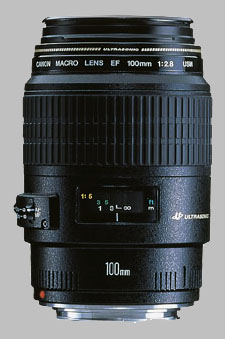
Put to market in 2000, the Canon EF 100mm ƒ/2.8 USM is one of three standard Canon full-frame macro lenses: the 50mm ƒ/2.5, 100mm ƒ/2.8, and 180mm ƒ/3.5. Two other macro options exist, the exotic MP-E 65mm ƒ/2.8, and the APS-C compatible EF-S 60mm ƒ/2.8.
The 100mm ƒ/2.8 macro was one of the first lenses we reviewed here at SLRgear, and in reviewing the updated version of this lens, we noted some inconsistencies in our data for this lens. Accordingly, we sent the old lens back to the test bench, which conveniently gives us an excellent basis for comparison for the new lens.
The EF 100mm ƒ/2.8 Macro USM was designed to cover a 35mm film frame, making it compatible with both APS-C subframe and full-frame digital camera bodies. When mounted to the former, the effective field of view is 160mm.
While an upgraded version of the 100mm ƒ/2.8 macro has been launched, this version continues to fill store shelves, with an approximate price of $600. The lens takes 58mm filters. The compatible lens hood, the ET-67, is a circular-shaped hood that does not ship with the lens, available separately for $55.
Sharpness
Mounted on the Canon 20D, the lens is very sharp, even wide open at ƒ/2.8. At this aperture setting there is a generous sweet spot of sharpness, showing at less than 1.5 blur units, with corners approaching but not reaching 2 blur units. Stopping down only improves these results, reaching absolute tack-sharpness at ƒ/5.6. The lens continues to be sharp all the way to ƒ/16, where diffraction limiting has set in, though even here we note sharpness results of 1.5 blur units across the frame. At ƒ/22 it’s a bit more obvious – 2.5 blur units across the frame – and fully stopped down at ƒ/32, things are quite soft, 4 blur units across the frame.
On the full-frame 5D, performance is equally good, though we see a bit more of the corners of the lens that aren’t exposed on the sub-frame sensor of the 20D. Wide open at ƒ/2.8, we still see the sharp sweet spot, but the area of sharpness isn’t as generous, covering only about the central third of the frame at 1.5 blur units. Corner sharpness at ƒ/2.8 is around 2 blur units, still quite good. Stopping down to ƒ/4 improves these results, and again by ƒ/5.6, it’s as good as the lens can deliver, but not quite tack-sharp across the frame. The central area of the frame is sharp, easily 1 blur unit, but the corners don’t fall below 1.5 blur units. This is me being extremely picky – 1.5 blur units is still extremely sharp.
Diffraction limiting sets in at ƒ/11, where we not approximately 1.5 blur units across the frame, and performance degrades only very slightly from there. It’s about the same at ƒ/16, not showing any real loss of sharpness until ƒ/22, where results are just over 2 blur units. Again, fully-stopped down we note significant softness – just shy of 4 blur units across the frame.
In summary, excellent results for sharpness, provided you stick to between ƒ/5.6 and ƒ/11 for maximum performance. Even ƒ/16 and ƒ/22 are very good, but I’d avoid ƒ/32.
Chromatic Aberration
Chromatic aberration is well-controlled with this lens, at every aperture setting, on either the 20D or the 5D. If you’re peeping very closely, you’ll see a slight increase in CA at the smaller end of the aperture spectrum (ƒ/32) but it’s only very slight.
Shading (”Vignetting”)
Corner shading is minimal on the 20D, the only noteworthy result found with the lens set to ƒ/2.8. In this case, the corners are a quarter-stop darker than the center; or, not very much.
On the 5D, it’s a little different. At ƒ/2.8, the corners are over three-quarters of a stop darker than the center. Light falloff improves as the lens is stopped down; a third of a stop at ƒ/4, and less than a quarter-stop at ƒ/5.6 and smaller.
Distortion
Distortion is negligible when the lens is mounted on the sub-frame 20D. On the full-frame 5D, it’s only slightly more significant, showing +0.2% barrel distortion in the corners. This distortion is easily correctable in post-processing software, if your straight lines must be absolutely straight.
Autofocus Operation
With Canon’s USM specification, the lens autofocuses quickly and quietly, taking about 1.25 seconds to focus from infinity to closest-focus. It’s not as fast as some of Canon’s L-class lenses, but then, that’s one of the things that makes them more expensive. Autofocus results can be overridden by simply turning the focus ring, and the front element doesn’t rotate while focusing.
Macro
Offering a full 1:1 (100%) macro reproduction is the chief function of this lens. With a minimum close-focusing distance of 31cm (just over one foot), there’s much less risk of shadowing the subject with the camera or your body, and if bugs are your game, you’re a bit less likely to scare them off.
Build Quality and Handling
While the lens is not part of Canon’s L-series, it’s still built very well, weighing in at 600 grams (just over 1.3 pounds). The lens shows a textured matte black finish, with plenty of room allocated to the focus ring and a distance scale. While the lens uses a fair bit of plastic construction the mount is metal, and it’s heavy enough to suggest that the structure of the lens is metal as well. The aperture is made up of eight aperture blades.
The distance scale is windowed and recessed, offering distance information in feet and meters, as well as the magnification rating offered at a given range. Beside the distance scale is a switch to enable or disable autofocus. No depth-of-field scale is offered, and neither is there an infrared index. Finally, there is a focus range limiter which improves focusing speed by physically limiting the range the lens can focus through: in this case, there are two settings: the complete range, from 0.31m to infinity, and a less-macro range, from 0.48m to infinity.
The focusing ring on the lens is considerable, a rubber ring with a texture of segmented raised ribs. The ring offers excellent manual focus control, with just the right amount of tension, but a smooth turning operation. The lens will focus slightly past infinity. The internal focusing operation means the lens doesn’t extend while focusing, and the front element doesn’t turn either.
The lens hood is an optional accessory for this lens, as is a tripod mounting ring. For even greater magnification, 12mm and 25mm extension tubes are available, however when these are used the lens will no longer focus at infinity. Canon also notes that teleconverters are not compatible with this lens.
Alternatives
Canon EF-S 60mm ƒ/2.8 Macro USM ~$450
For the APS-C camera uses in the Canon lineup, the EF-S 60mm offers an equivalent field of view of 96mm, or essentially similar to the EF 100mm. In our tests it’s on par or even better than the 100mm, but by ƒ/5.6, both lenses are exquisitely sharp. CA and corner shading are only marginally less optimal with the 60mm, and distortion is essentially zero. If you never plan on going full-frame, the 60mm ƒ/2.8 macro is an excellent alternative.
Canon EF 100mm ƒ/2.8L Macro IS USM ~$1,000
The newest version of the 100mm ƒ/2.8 macro has been refined, offering L-class quality and improvements in sharpness and light falloff. CA performance was already excellent in the non-IS version, and both have very little distortion to speak of. The real story is the addition of image stabilization, which means you might be able to leave your tripod at home. The new lens is a bit more expensive, and takes new filters: 67mm, instead of 58mm.
Sigma 105mm ƒ/2.8 EX DG Macro ~$450
The Sigma 105mm macro offers very similar performance for a bit less price: results for sharpness are almost the same, and CA performance is even better than the Canon. There’s also near-zero distortion and light falloff. If it matters to you, the Sigma stops down to ƒ/45, though it is very soft at that aperture. It’s a bit lighter, and also takes 58mm filters. The lens doesn’t offer USM-style focusing, so the focus experience will be a bit noisier.
Tamron 90mm ƒ/2.8 Di Macro 1:1 SP AF ~$430
The Tamron 90mm macro is also an excellent macro lens, offering extremely sharp results – we only note a slightly better sharpness result from the Canon at ƒ/2.8. After that, it’s essentially equal between the two lenses, though the Tamron shows less corner shading on full-frame. The Tamron takes smaller 55mm filters and weighs a little less as well, though it doesn’t offer USM-style focusing, so the focus experience will be a bit noisier.
Conclusion
I’ll stick with Dave’s original assessment of the lens to wrap this one up: Without a doubt, the Canon EF 100mm ƒ/2.8 Macro is a superb lens. It’s in a good focal length range for use as a portrait lens, but you may actually want to knock its sharpness down a bit after the fact in Photoshop(tm) to be kinder to your subjects. It may not be for everyone, but if you’re looking for a maximally sharp, high-quality lens in this focal length range, this is about as good as it gets. If you’re into macro photography, this is a superb tool, with the added benefit of a comfortable working range, thanks to its 100mm focal length.
Description
Autofocus lens for macro photography up to life-size (1x) magnification. Inner focusing affords a long working distance of 5.9in. (149mm) at 1x. A 3-group floating system results in excellent delineation at all focusing distances. Ring USM for silent and high-speed AF, and full-time manual focusing also provided.
Lab Test Results
Our standard lens lab tests, shot on full-frame and sub-frame bodies. Pick a focal length and aperture to see the result.
Sharpness (blur index)
Blur across the frame: lower and flatter is sharper. Change focal length and aperture to see how it improves when stopped down.

Chromatic aberration
Colour fringing in the corners at each focal length.

Geometric distortion
Barrel (positive) or pincushion (negative) distortion across the zoom range.

Sharpness (blur index)
Blur across the frame: lower and flatter is sharper. Change focal length and aperture to see how it improves when stopped down.

Chromatic aberration
Colour fringing in the corners at each focal length.

Vignetting (corner shading)
How much darker the corners are than the centre, by aperture and focal length.

Geometric distortion
Barrel (positive) or pincushion (negative) distortion across the zoom range.

Reader Reviews
- Image quality
- 9.5/10
- Build quality
- 8.5/10
- Recommend it
- 100%
- 8/10Recommendedby mariuspavel · July 19 2014 · paid $550
Pros: nice bokeh, sharp, price
Cons: AF sometimes blocks
I really don't have anything bad to say other than it's a very heavy lens, so my wrist gets tired quickly. Other than that, this is a perfect lens. Image quality is outstanding - no fringing or warping, and everything is crystal clear.
If I could have justified the extra cost I'd have gotten the IS version because image stabilization would be very nice for handheld shots. I tend to shoot 1 or 2 stops low just to increase the shutter speed, and then fix it later in Camera RAW.
Oh, the autofocus is pretty wonky at closeup. It has a very hard time getting a proper focus, and often the focus goes berzerk (on my old Canon 450d). Not a big deal since macro photography is best done manual focus anyways.
Some pics with this lens here - www.mariuspavel.ro/trash-dress-teodora-zsolt-fotografii-de-nunta-brasov/
- 10/10Recommendedby caMARYnon · October 25 2013 · paid $630
Pros: excellent IQ
Cons: some focus hunting in low light
A big cons is the lack of IS but not for macro work, for portraits.
Only for macro is just perfect.
- 10/10Recommendedby Rotremjr · January 18 2012
Pros: Excellent image quality
Cons: No lens hood provides
Pros:
-Excellent image quality. Even better on a full frame camera.
-IF focus system. The lens does not extend. The front element does not rotate.
- Smooth AF
-Excellent quality / price ratio.
Cons:
-Not solid as the first version, but strong enough still to resist a 2' fall (as hapened to me on a hard surface) without any lens shift.
-A little cyan color cast visible.
Samples:
http://s150.photobucket.com/albums/s111/Rotremjr/Fleurs/?action=view¤t=_MG_1899.jpg
http://i150.photobucket.com/albums/s111/Rotremjr/Fleurs/_MG_5928.jpg
http://i150.photobucket.com/albums/s111/Rotremjr/Fleurs/_MG_1950.jpg
- 9/10Recommendedby ken billington · December 6 2010
Pros: Fast focusing, non-extending or rotating, sharp images, excellent optical performance, practical minimum working distance (MWD) of 150mm.
Cons: Build quality not as solid as L-Series lenses, No image stabilization.
Advantages
1. Fast Focusing - Utilizing USM (Ultrasonic Motor), the Canon 100 Macro internally focuses very fast, quietly and very accurately.
2. Non-Extending or Rotating - When focusing at 1x subject distances, the lens does not extend, and the front element does not rotate.
3. Sharp Images - the Canon EF 100mm f/2.8 USM Macro Lens is sharp wide open. The tiniest details in your tiniest subjects will come to life with this lens.
4. Optical Performance - Flare is very well controlled. Color and contrast are excellent and distortion is negligible. Although vignetting is apparent at f/2.8, this rapidly disappears when the lens is stopped down.
5. Practical Minimum Working Distance (MWD) - The Canon EF 100mm f/2.8 USM Macro Lens gives an optimum MWD of 150mm. At the higher MWD of the Canon EF 180mm f/3.5 L USM lens (240mm), insects are not really close enough. At the lower MWD of the Canon EF-S 60mm f/2.8 Macro USM Lens (90mm), insects may scare and fly away prematurely.
Disadvantages
1. Build quality - this USM Macro lens has a reasonable build quality although it's not quite as solid as the L-Series lenses.
2. Image Stabilization - this lens does not feature the image stabilization present with the significantly more expensive Canon EF 100mm f/2.8 L IS USM Macro Lens.
Summary
The Canon EF 100mm f/2.8 USM Macro Lens is a very good choice for macro photography of butterflies, insects or flowers. It offers excellent optical performance and middle-of-the-road working distance, size and weight.
Check out my insect stock photos and images on http://kenbillington.ch/photobank/Insects/
- 10/10Recommendedby suttere · September 21 2010 · paid $580
Pros: sharpness, bokeh
Cons: missing image stbilisation
very sharp images. Need of tripod in many circumstances. natural bokeh.
- 10/10Recommendedby jt354 · May 9 2010 · paid $540
Pros: Everything
Cons: No 3-position focus limiter, incompatible with EF extenders, no tripod ring
The 100mm 1:2.8 macro is a nearly-perfect lens. On a crop-sensor 40D, it's tack sharp wide open with no apparent distortion and relatively low CA. It produces vibrant, contrasty images at all ranges from 1:1 to infinity focus. The focus ring is not L quality, but it is fairly smooth and has a great range of travel for precise adjustments. Internal focus is a nice bonus compared to the Sigma 105mm and Tamron 90mm macros. Autofocus is reasonably fast, and a focus limiter aids in focusing at portrait range and longer (.48m-infinity). Unfortunately, there is no way to limit focus to macro ranges (1:1-1:5), and the AF occasionally hunts when set to full range.
Construction quality is very good. The lens feels solid, has a metal mount (and probably metal internals), and balances well on Canon's larger bodies. Near the base is a cutaway for a tripod ring, which is not included and costs a fortune to buy aftermarket. A flange behind the rear element prevents the 100mm macro from mounting to EF teleconverters, and the lens also lacks the extra "extender" electrical contacts. Finally, it's cheaper than the Nikon version!
- 10/10Recommendedby uamsstudent · December 5 2009 · paid $450
Pros: Great Price & Unbelievably Sharp
Cons: None
I think that this lens is sharper than the "blur index" graph shows. It really is brutal when used for portraits. It is by far the sharpest lens that I have ever used.
- 10/10Recommendedby elho_cid · November 17 2009 · paid $500
Pros: USM AF, great image quality, build quality
Cons: big and heavy compared to some competition
This lens has unbeatable price/performance ratio. it is not only great macro lens, but its also very good on greater worging distances, doubling as a telephoto prime.
On close-up distance the reliable AF is very handy when shooting moving objects, such as kitten or puppies.
Tamron 90/2,8 is reported better, but I didn't like its out of focus rendering so much.
On my Pentax setup the DFA100 is lighter and performs as good optically, but lacks the USM.
Sigma 180 is sharp as well, but the CA is too high for my taste.
So the EF100 is my favorite macro lens.
Show all 33 reader reviews
- 10/10Recommendedby RadiantLite · June 12 2009 · paid $600
Pros: contrast, depth of field, built-quality, AF speed
I bought Canon Macro 100mm for fun, because of the deep cashback from live.com in the thanksgiving week. First I think if I don't like it, I will sell it, but the lens is just too amazing to be sold.
Canon Macro 100mm is quite affordable and do a fantastic job. No wonder a lot of professional use and recommend it. The lens is primarily use for macro, for small things. The lens have ability to focus really close to object so that the camera can capture a life size image.
The depth of field is very shallow, especially wide open at f/2.8 as you can see in some samples that I have uploaded. So, f/8 or higher is recommended if you want to capture a sharp object.
But the shallow depth of field is not bad thing for many people, it helps the photographer to point out where is the most interesting part of the picture.
The focal length of 100mm, make it ideal for portrait lens because it flattens out the facial features and blur the background making the subject more appealing especially girls portraits.
The color contrast is also very good, it turns everyday boring object becomes interesting.
Physically, the lens are slightly longer and heavier than most general purpose lens, the built quality is almost similar to 17-55mm f/2.8 IS USM and slightly better than 50mm, 85mm primes.
The focusing bar is big make manual adjustment becoming very easy (manual focus is important for Macro work to ensure accurate focusing, although the auto focus is very fast due to USM (UltraSonic Motor). We can adjust the focusing to macro range (close up) or standard to long range.
This lens focal length is bit too long for indoor shot and in crop sensor camera (Rebel series, and X0D series) but ideal for full frame camera (5D, 1D(s) series), but it is perfect for outdoor.
Other alternative for APC-S camera is the EF-S 60mm f/2.8 USM which is smaller more suitable indoor and have almost equal price and image quality. The drawback is the EF-S lens can't be use in full frame camera if you want to upgrade later.
For sample photos and other reviews, please visit
http://www.radiantlite.com
- 10/10Recommendedby bennike · March 25 2009 · paid $700
Pros: Razor Sharp Images and silent focus. I actually like the build quality as well
Cons: None so far
This lense has produced many excellent razor charp images for me. As a secondary use I have had some very pleasant surprises when using this for Portrait Photography.
- 10/10Recommendedby waro52 · December 31 2008 · paid $485
Pros: IQ, focusing speed,
Cons: none
I get more keepers with this macro than any other macro I have owned (50mm f2.5 canon and a nice old Zuiko). Fast focus, incredibly sharp at f/5.6 and good working distance make this a fun lens. The build quality is not at L quality but then, neither is the price. I played around with canon's 180L. The 180 is too heavy and I could not see an appreciable increase in image quality over this lens. I love this lens. It make day hiking an adventure both ways. On the way up to a lake I have on a 17-40 for scenics. On the way back this lens allows you to focus on flowers and insects. I used to put the camera away on the way home. No more.
- 8/10Recommendedby onlyone · June 1 2008 · paid $470
Pros: Sharp, Smooth and fast AF, Bokeh is fine
Cons: Missing len's hood, Plastic body
If you don't hope L lens, metalic body and hood in a box, buy this len, it can give you anything.
It's one of my favorite lens, especially in my Macro workshop, it gives me very sharp image and nice bokeh. Its USM give a very fast and accuracy AF, even in low light (but not too low). I pay around 16,000 ฿ (Thai baht) but it gave me much more.
Recommended lens !!!
- 9/10Recommendedby fergusonjr · October 12 2007
Pros: Super-sharp. Super-fast AF.
Cons: Plasticky body.
This is one of my favorite lenses. It's fantastically sharp -- its sharpness is especially evident because it's a Macro lens and it's able to reveal such fine details. The auto-focus is blazingly fast -- so fast it sometimes seems instantaneous.
The lens feels relatively well built, but the plastic body suggests low quality. It's probably fortunate that it doesn't have a metal body, as it would certainly be substantially heavier. Other than having a focus ring that doesn't feel particularly tight, the lens seems fairly solid.
A superb lens that delivers superb Macro photos!
- 10/10Recommendedby tmeldgaard · September 13 2007
Pros: sharpness, fastest focusing macro
Cons: missing lens hood, not L built, could have a nicer bokeh
Bought this lens mainly for its macro capabilities but realized that it is an amazing portrit lens as well. I love the fast focus when the limiter is on.
Bought a copy lens hood on ebay for almost free - highly recommended.
- 9/10Recommendedby hitendra · July 7 2007
Pros: Excellent image quality, superb balance, well built.
Cons: None
Here are some shots taken with it… judge it yourself...
http://www.hitendrasinkar.com/photoblog/index.php?x=browse&category=25&pagenum=1
- 9/10Recommendedby rainerknappe · May 22 2007 · paid $440
Pros: sharp, colours, blur & USM
Cons: I am still missing the lenshood!
One of the best Canon lenses! I own 6 macros - 4 Sigmas, 1 Tamron and this one. I made a lot of tests comparing it with the brother Sigma 105 - they are very close in optics, may be the Canon offers a little bit more saturated colours and a sweeter out-of-focus. Sharpness is brilliant as the Sigma and the USM is much quicker (but I nearly don´t use it, I like the MF traditionally). The Sigma is cheaper, nicer, not so heavy and has no cornershading at 2.8. Canon against Sigma - normally 5:4 - but the missing lenshood???, so 5:5.
- 10/10Recommendedby jdf · January 12 2007
Pros: Excellent image quality, USM
Cons: None
used it the very first time on a 350D, i was amazed how fast it was compared to a sigma 105 EX, it's very fast for a macro lens. it's Build is ok, and it's nice.
Image quality it provides is very good, some of the best lenses canon has.
The AF is very fast and precise as this is an USM lens.
If you are on "macro mode" it swings out to "normal" very fast!
- 10/10Recommendedby kzr63g · January 9 2007 · paid $850
Pros: Sharp from 2.8 Does not prolong when focusing. Relatively fast AF.
Cons: F 32 is not so sharp.
Used it for a long period of time.
Very satisfied.
Sharp from full opening. But could be better at 32 (I rarely use this f-stop).
Nice that this lense do not prolong when focusing.
A shade should have been included (you have to by extra).
Fast USM.
Internal focusing is something I like.
- 9/10Recommendedby ne1rom · January 7 2007
Pros: Sharp
Cons: none
It's not "L" so the construction quality could be better.
Image quality is excellent. Macro is almost scary :) No bug cant be safe ;)
I recommend the lens for FF and APS-C DSLR.
- 9/10Recommendedby adobo · January 6 2007 · paid $440
Pros: Good working distance, Canon makes good macro lenses..
Cons: I don't like the shape.. hehehe
Although relatively new (announced in 2000), for some reason, it feels like an "old design"... (for me)
But aesthetics aside.. Canon makes good macro lenses.. Internal focusing, sharp, front element doesn't rotate during focusing, did I say sharp?
Anyway, the EF-S 60 and EF-S 100 are almost equal in image quality.. I guess the only thing that you need to consider is whether you want a:
Lighter, slightly-cheaper lens (EF-S 60mm) (crop body only btw)
vs.
Longer working distance, requires higher shutter speed because of focal length, and full-frame compatibility (EF 100mm)
Btw.. This is a fun lens.. you won't run out of things to photograph once you grab this one :)
And this could also be used for portraits :) (so maybe you can sell your 50mm f/1.8 II)
- 9/10Recommendedby SteveR12682 · December 30 2006 · paid $450
Pros: Extremely sharp
Cons: Larger and heavier than similar lenses
This lens is a great lens, both for macro as well as general shooting. It is larger and heavier than other macro lenses in the 90 to 105 range, but the internal focusing and USM are definitely worth it.
- 10/10Recommendedby vladnotkin · December 20 2006 · paid $650
Pros: Fast Focus, Wonderful Image quality
Cons: None with the lens. Canon should have included Lens Hood.
I use this lens for all my macro photography, in fact, I use it 50% of the time during the summer month. The images are sharp, as sharp as they can be using Digital SLR, and the quality of picture is incredible.
When working within the 12 inches of the subject, I find that I need to switch focus to manual mode, but my other L series lenses are no faster at focussing when working within the minimum focusing distance.
If you are looking for a macro lens, you can't go wrong with this one.
- 8/10Recommendedby SamuelMV · December 13 2006 · paid $500
Pros: sharpness, image quality, fast
Cons: big (especially with the hood attached), range in APS-C
I have used the 100mm USM 2.8 Macro for 1 year and a half. Its image quality is top notch, probably one of the best Canon lenses.
Thanks to the USM AF it's fast and silent, althought it's better to focus manually in macro photography (or focus using camera movements).
It has a switch to choose between two distance ranges for autofocus, which improves the versatility of this lens in non-macro photography.
When I switched from film to digital, I founded that the equivalent focal length (160 mm) was too far for my needs, so I ended selling it.
- 8/10Recommendedby Muiderburght · December 1 2006 · paid $600
Pros: sharp, close-up, internal focusing; quiet (USM)
Cons: slow focusing (macro range), very precise focusing (sometimes off)
Recently bought this lens. It was a bit of an impuls purchase. it's a lot of money for something that is this task specific and wont be on your camera all the time.
I actually use it for taking pictures of my kids. I like the sharpness and the close up pictures you can take with it. With non-macro lenses, you always have the face and some. With this lens, you can do eye-nose, foot or hand pictures.I guess a crop would work too :-)
In the store, I compared it to the Sigma 105 Macro. You can read my review there. This lens is just extremely quiet and has internal focusing compared to that one. Well worth the extra 100 bucks if you ask me. Of course, I already knew from SLRGear.com that the picture quality would be more than ok. Which I can only confirm. Most Canon prime lenses wont disappoint in that field and hence it wasnt a major focus at buying.
- 7/10Recommendedby BillDavenport · November 22 2006 · paid $400
Pros: Very nice image quality, good working distance
Cons: slow focus, low contrast
The only other macro lens I've had to compare it to is the 60mm Micro Nikkor which is the sharpest lens I've ever seen. The Canon isn't as sharp, doesn't and have the internal contrast of the Nikkor. It's image quality is nice but soft looking. The focus is slow and iffy especially compared to USM lenses
- 10/10Recommendedby tkgross · November 19 2006 · paid $470
Pros: Sharpness and working distance with 1.6 mulitplier lenses
Cons: Can't think of any
Sharpest lens I own. Pretty nice even as a walk around.
Equivalent 160mm keeps you a little furhter from the bees.
- 9/10Recommendedby Jarrad_Kevin · November 15 2006 · paid $500
Pros: Very Sharp, Macro Capability, USM
Cons: A little heavier than I'd like
Extremely sharp. Even wide open.
The AF is not slow at all, in my opinion. It's quite quick. Not quite as fast as the 85 1.8 or 24-70L, but close and noticeably faster than the 50 1.4. I use it even in some macro situations with great success. I wouldn't depend upon the AF in all macro situations, but it is useful when needed.
It's a hefty lens and doesn't feel as though it's lacking in build quality. It's a little heavier than I'd like, but it's not heavy enough to make you think twice about using it.
I'd love for it to be weather sealed, I'd love Image Stabilisation, but other than that it's just about all you could ask for in a macro lens.
Highly recommended.
- 9/10Recommendedby gadgetguy · November 14 2006
Pros: Sharp, beautiful bokeh, working distance
Cons: Heavy, slow focus
I use this lens in conjunction with a Sigma 50mm macro. Both are excellent optically, but I pull out the 100mm when I need the extra working distance (for shy subjects like bugs - especially on a 1.6 crop) or I need the narrower field of view.
The lens in exceptionally sharp and distortion-free. it is, however, relatively heavy and slow in autofocusing - especially when working way up close. in such cases, it's better to manually focus.
The focal length is not as practical as the 50mm macro (a little too long for me) but when you need the extra reach and full macro, it's hard to beat.
- 10/10Recommendedby tukaway · March 23 2006 · paid $450
Pros: Extremely sharp, beautiful bokeh, accurate focus
Cons: Occasional focus hunting when not used for macro work, IS would be helpful
This lens is remarkably sharp across every part of the frame. It may addict you to macro work. Bokeh is liquid smooth.
Perhaps this is unique to my copy, but I have found that when shooting at normal (non-macro) distances, the lens can tend to hunt a bit more than my other lenses when focusing in reduced light.
It's a specialized tool, and is truly excellent in its niche.
- 10/10Recommendedby snapper · November 18 2005 · paid $450
Pros: Reference level sharpness (L-like), good colors low distortion, reasonable speed and accurate focus
Cons: a little long, no I.S. - which would make it PERFECT
This is a great value. The sharpest lens in my bag. Dependable accurate focus, clarity - to be used when you want the best image quality you can get. Sometimes hunts in very low light. Takes the tamron SP 1.4x very nicely for 'Bigger Bees' - I cannot see any difference in quality with slightly slower focus. Very accurate focus nice big manual ring. I keep bringing it with me in the bag because I'll always see another bug/flower and this is the WAY to get 'em. Perfect for a your baby's face on a 20D.
Rugged and heavy.
- 10/10Recommendedby jyli19 · November 3 2005 · paid $430
Pros: excellents image quality, professional quality construction
Cons: Optional lens hood, pricy
Professional quality macro lens. Sharper than L series zooms. This lens proves to a be a workhorse for me, both macro work and normal shoot. Focus is very sensitive.
- 10/10Recommendedby mdbassman · November 2 2005 · paid $499
Pros: Wonderful-Sharp-Crisp
Cons: none
I love this macro lens! The images are sharp and the DOF is wonderful. It is a good all around lens also but I use it for 99.9% macro.
- 8/10Recommendedby photopilot377 · October 31 2005 · paid $400
Pros: Small, Light weight, quality images!
Cons: a bit long for APS sized sensors like the 20D & my 10D
I like it! My only gripe is that it becomes a little too long when used with the 10D/20D size sensor. I would love to test it on a FF body.
Reader reviews were submitted by Imaging Resource readers and are shown as written.