
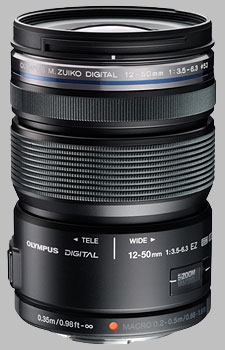
Overview
The Olympus M.Zuiko 12-50mm ƒ/3.5-6.3 was announced at the end of 2011. The lens was designed to fit the micro four-thirds mount, and offers a wide-to-short tele equivalent range of 24-100mm in 35mm film terms. In March 2012, Olympus offered a firmware update to version 1.1 for the lens, improving various aspects of the lens’ performance. This lens isn’t a “constant” lens, in that as you increase the focal length, the maximum aperture size decreases, though the minimum aperture size stays the same. The following table reflects the change in aperture available for the lens:
| Focal length | 12mm | 25mm | 50mm | ||
| Largest aperture | ƒ/3.5 | ƒ/5.1 | ƒ/6.3 | ||
| Smallest aperture | ƒ/22 | ||||
The lens takes 52mm filters, but does not ship with the LH-55B lens hood. The lens is available now for around $500.
Sharpness
The 12-50mm provides excellent results for sharpness: used wide open at 12mm, the lens provides a sharp center and just slightly soft corners; it’s basically as sharp as it will get at ƒ/3.5, only getting very slightly better when stopped down to ƒ/4. Stopping down any further doesn’t provide any further gains. In the mid-range of 25mm, the lens shows its best results: it’s tack sharp at 25mm and ƒ/5.1, and remains so until diffraction limiting begins to set in at ƒ/8. If there is a weakness to this lens, it would be at the 50mm point, where the lens isn’t as tack-sharp as other settings and the maximum aperture is a comparatively slow ƒ/6.3. It still provides very good, if not excellent results, and one only need to stop down to ƒ/8 to get a slight improvement.
Diffraction limiting sets in at ƒ/8 with this lens, but there is no noticeable impact on sharpness until ƒ/16, and more so at ƒ/22.
Chromatic Aberration
There is a bit of a story with chromatic aberration, and it is most obvious at 12mm, where the corner performance numbers are off the chart. It’s summarized with this crop from our viewfinder accuracy chart:

This ranks as some of the most dramatic chromatic aberration we’ve ever seen in a lens, and it’s important to note that this is with the camera’s automatic chromatic aberration correction operating. While in-camera CA correction can sometimes work wonders, in this case, the Panasonic GX1 test body could correct only some of it, leaving quite a bit in shots captured at 12mm. Your mileage may vary, depending on the camera body you’re using, but our admittedly elderly former test body (an Olympus EP-1) had more trouble knocking down the CA than did the GX1. Bottom line, unless your camera has some really major CA-reducing chops, you’re going to see a lot of CA in your shots taken at 12mm. The good news is that CA comes down to much more reasonable levels as you zoom towards longer focal lengths: as you can see in our sample images.
Shading (”Vignetting”)
Corner shading is only noticeable when the lens is used at its widest aperture (12mm), and even then, the extreme corners are only a third of a stop darker than the center. Stop down the lens slightly, and corner shading becomes negligible.
Distortion
Distortion is kept to a minimum, presumably with some help from an embedded lens profile. At the 12mm mark the lens provides some light barrel distortion, that disappears when the lens is zoomed in to the 25mm mark.
Autofocus Operation
The Olympus 12-50mm ƒ/3.5-6.3 M.Zuiko is very fast to autofocus, taking less than a second to go through its entire focusing range. The lens adopts the new MSC (Movie & Still Compatible) design, making it ideal for use in both still and video applications. The front element does not rotate when focusing, making life that much easier for polarizer users.
Macro
The lens offers a special macro focusing mode, which is accessible by pushing on the Macro button on the lens while pushing the zoom ring all the way forward. When in Macro mode the zoom is disabled and fixed to 43mm. The focus ring operates smoothly and is fly-by-wire; in this mode, the lens offers 0.36x magnification and a minimum close-focusing distance of 20cm, or 8 inches.
Build Quality and Handling
The Olympus 12-50mm ƒ/3.5-6.3 M.Zuiko is an all-plastic lens, quite long and skinny. The lens mounts well on the OM-D E-M5, and is available in a matte black finish. The plastic filter threads take 52mm filters, and the body mount is metal. There is no distance scale, depth-of-field scale or infrared index, however, when in E-Zoom mode the lens’ focal length will display on the camera LCD. The lens offers a button marked L-Fn, which allows the user to assign a function to the button from the camera; this functionality is supported in the OM-D E-M5 camera, but we’re not certain about other cameras.
The zoom ring is an inch and a quarter wide, plastic with alternating raised ribs sections that run lengthwise to the lens. The ring turns about 90 degrees through its range of focal lengths, and is quite easy to turn. There is no lens extension as the lens is zoomed out towards the tele end, thus, zoom creep isn’t a factor with this lens. The lens features Olympus’ new MSC technology, offering a very silent zoom operation which is very useful during movie capture.
As mentioned in the macro mode section, the zoom ring also moves forward and backward throughout three positions, which offer different functionality for the lens. In the rear position the lens offers standard mechanical zoom operation. If you push the zoom ring forward one position you are in E-zoom mode: This is the fly-by-wire zoom with two speeds, useful when you want to zoom smoothly while shooting video. If you push the zoom ring forward while holding down the MACRO button, you enter the dedicated Macro mode, where the lens is fixed to a zoom position of 43mm.
The focus ring is located at the end of the lens, an indented plastic ring that’s 3/8-inch wide. The ring is a fly-by-wire design, controlling focus electronically, so there are no hard stops at either the infinity or close-focus ends. Given that focus is electronically controlled, you can assign the direction of focus to be either left or right. The front element doesn’t turn during focusing operations.
Our sample didn’t ship with the LH-55B lens hood, which is a rectangular-shaped, bayonet mounted model that appears to be able to reverse onto the lens for storage. The lens hood will run you $25.
Alternatives
Olympus 12-60mm f/2.8-4 ED SWD Zuiko Digital ~$1,000
With a MMF-series adapter, it’s possible to mount regular Olympus four-thirds lenses on micro four-thirds bodies. This lens offers a significantly ”faster” optic, in the sense that the maximum aperture at all zoom settings is at least a stop faster; on the E-510 camera body, the lens performed extremely well, offering very sharp results and great results for CA, corner shading and distortion. However it is double the price, larger and heavier, and does not offer the advanced zoom features found in the 12-50mm EZ.
Panasonic 14-42mm f/3.5-5.6 ASPH MEGA OIS LUMIX G VARIO ~$180
Much less expensive than the Olympus 12-50mm, the Panasonic 14-42mm is the kit lens to the Panasonic G2. Not as wide or tele as the Olympus 12-50mm, the Panasonic 14-42mm offers a similar range of apertures and offers almost as good (if not better, stopped down) performance for sharpness. In other test categories it’s similar (except for CA performance at 12mm, where the Olympus is awful in the corners) but there is more technology packed into the Olympus.
Conclusion
As the kit lens for the OM-D E-M5, you couldn’t really ask for more; the lens offers excellent results for sharpness, corner shading and distortion. The only sore point for the lens is the extraordinary chromatic aberration noted at the 12mm mark, but happily, it’s really only noted in the extreme corners – it’s very well-controlled in the central region of the frame, and in other focal lengths. And because image stabilization is present in the camera, taking movies with this lens is a pleasure, coupled with the advanced power zoom functionality.
Our senior editor Shawn Barnett discussed the lens in his review of the OM-D E-M5, which you can read here.
Product Photos
 |
 |
 |
 |
 |
  |
Sample Photos
The VFA target should give you a good idea of sharpness in the center and corners, as well as some idea of the extent of barrel or pincushion distortion and chromatic aberration, while the Still Life subject may help in judging contrast and color. We shoot both images using the default JPEG settings and manual white balance of our test bodies, so the images should be quite consistent from lens to lens.


As appropriate, we shoot these with both full-frame and sub-frame bodies, at a range of focal lengths, and at both maximum aperture and ƒ/8. For the ”VFA” target (the viewfinder accuracy target from Imaging Resource), we also provide sample crops from the center and upper-left corner of each shot, so you can quickly get a sense of relative sharpness, without having to download and inspect the full-res images. To avoid space limitations with the layout of our review pages, indexes to the test shots launch in separate windows.
Description
(From Olympus lens literature) Olympus adds to its powerfully simple and growing PEN family with the first fully-compatible interchangeable Micro Four Thirds lens to incorporate an electronic motorized zoom. The M.ZUIKO DIGITAL ED 12-50mm F3.5-6.3 EZ (35mm equivalent 24-100mm) delivers smooth, quiet zooming that gives you versatility, portability and maximizes the performance of the Olympus PEN® compact system cameras.
The sophisticated new lens has a zoom ratio of approximately 4.2x, allowing photographers to capture anything from detailed, wide-angle group shots to medium telephoto-range images so you can get up close and personal for intimate portraits of children and pets – even indoors. The photographer can control the zooming speed by turning the barrel – slowly for drama, quickly for performance, or at an intermediate rate. Manual zooming is also available for those looking to take full control.
In macro mode, which can be set by pushing the zoom ring forward while depressing the macro button on the side of the lens, focusing is possible between 8 and 20 inches for close-up shooting with a maximum image magnification of 0.72X (35mm camera equivalent). The L-Fn (Lens Function) button suspends the autofocusing operation temporarily to avoid unintended focusing on obstacles that appear suddenly between the camera and the subject.
Perfect for brilliant still images and high-definition (HD) video capture, the Movie & Still Compatible (MSC) M.ZUIKO DIGITAL ED 12-50mm F3.5-6.3 EZ has also been enhanced with a linear motor that drives smooth and quiet autofocusing for stress-free shooting.
New lens elements and glass materials ensure the clearest possible imaging performance, and the proven dust and splashproof mechanism originally featured in the Four Thirds SHG (Super High Grade) series lenses is now incorporated for the first time in a Micro Four Thirds System lens. Multiple sealing rings, fitted throughout the lens body, prevent water splashes and dust from penetrating, making the M.ZUIKO DIGITAL ED 12-50mm f3.5-6.3 EZ a versatile zoom lens for the toughest conditions.
U.S. Pricing and Availability
M.ZUIKO DIGITAL ED 12-50mm f3.5-6.3 EZ:
Available Mid-January 2012
Estimated Street Price: $499.99
Lab Test Results
Our standard lens lab tests, shot on a sub-frame (APS-C) body. Pick a focal length and aperture to see the result.
Sharpness (blur index)
Blur across the frame: lower and flatter is sharper. Change focal length and aperture to see how it improves when stopped down.

Chromatic aberration
Colour fringing in the corners at each focal length.

Vignetting (corner shading)
How much darker the corners are than the centre, by aperture and focal length.

Geometric distortion
Barrel (positive) or pincushion (negative) distortion across the zoom range.

Reader Reviews
- Image quality
- 7.3/10
- Build quality
- 7.9/10
- Recommend it
- 88%
- 9/10Recommendedby PeterB666 · March 19 2017
Pros: Great value, very versatile, good macro for a zoom.
Cons: Slow at the long end.
This is a great little lens for the money. Readily available for under $300, I got mine as a kit lens with my first OM-D E-M5 and was expecting it to be crap after the reviews that I read.
I think it is superior to the standard 14-42mm kit zoom in every way. The 12mm wide end is useful and the 50mm does the job in most circumstance despite the slow f/6.3 aperture.
Having weather resistance in such a low-cost lens is impressive and the macro setting makes a dedicated macro lens redundant for most people.
Light weight and reasonable build quality top off what is a great value lens for the photo hobbyist on a limited budget.
- 6/10Not recommendedby Perry Rhodan · March 22 2016 · paid $230
Pros: Wethersealed. Cheap. Nice FL range. Fast AF.
Cons: Not the best IQ. Corners are soft at all apertures. Lots of ca. Slow opening.
Tried so much to like this lense. But in the end the rather nice macro and FL range were not enough. Mediocre IQ at best. If you like the 24mm (eq) get the pana 12 32.
- 7/10Recommendedby Thoppa · April 11 2014 · paid $250
Pros: Versatile - does it all.
Cons: Unspectacular - doesn't do anything very well
The power zoom and focal range make this a great video lens, and it also doubles as a decent macro lens too. Weather sealing is good but image quality for stills is a little disappointing and f/6.3 is just pitiful. So for stills, it doesn't satisfy me - thankfully, I have the 12-35 too.
I suppose it shouldn't matter, but think it is poorly proportioned - way too long and thin. They should have made it fatter and at worst f/5.6, and better f/4.5
It's very versatile but if you want a stills lens, look elsewhere or don't pay as much as me.
- 9/10Recommendedby rrwilliams64 · March 22 2014 · paid $200
Pros: Build quality, weather sealing, small size
Cons: slow at long end
Build quality, weather sealing, small size
- 9/10Recommendedby CyeJoeBob · March 24 2013
Pros: - sharp, low distortion, very flexible, good build quality, weather-sealed
Cons: - quiet big (8 cm long), only f/3,5-6,3
The weather sealing and the build quality is excellent for this price. One of the best Kit-Lenses that I ever had!
- 6/10Recommendedby Ocean · December 30 2012 · paid $300
Pros: Macro Mode, fast AF
Cons: cheap construction, only f:6,3, no IS, no Lens hood
small and handy but I am not used to the cheap-construction Level without lens hood
Optics are good with a bit to much CA.
Olympus can do much better.
- 9/10Recommendedby maskinmoller · September 21 2012
Pros: Useful 12mm wide end. Overall good sharpness. Macro function.
Cons: A bit slow aperture
Compared to other kit lenses I've owned from other systems this is the best so far!
Surely it doesn't match a prime lens for sharpness or shallow DOF, but what it does it does well.
Really find the macro function and 12mm wide end very useful.
Rating is only to be compared with other kit lenses. Not on the same scale as eg the Olympus 75/1.8
- 8/10Recommendedby halfmac · August 9 2012
Pros: Small, light, weather sealed, wide, macro, internal zoom & focus
Cons: slow tele aperture
The M.Zuiko Digital 12-50mm f3.5-6.3 EZ kit lens was a bit of a surprise. I did not think that I needed this lens but I do like it.
It is very small and light. It is also weather sealed like the camera and focuses very quickly. I like that the wide end is at 12mm. At f3.5 it is not that slow in aperture.
The implementing of the power zoom is well done.
The images are good. Stays on my camera a lot. Here in WA we get a lot of rain so this is a nice lens to have.
I also use the macro function quite often.
The lens did not come with a lens shade so I ordered one from a third party one. Come on Olympus, where is the shade? Thank you, Panasonic.
See my EM-5 review at: http://frugalfilmmakers.com/2012/07/10/i-could-not-resist-the-olympus-e-m5/
Reader reviews were submitted by Imaging Resource readers and are shown as written.