

Overview
The Panasonic 14-42mm ƒ/3.5-5.6 ASPH MEGA O.I.S. Lumix G Vario is an update to the original G1-system kit lens, slightly smaller and lighter, and with a 3mm reduction in its longest focal length. Actually introduced with the G2, we didn’t have an opportunity to test it when we reviewed that camera, but received a copy of this lens with the new G3 body. The new design removes the exterior switch to control image stabilization, making it controlled completely from the body; as well, it employs the newer continuously variable aperture, used to great effect in movie mode.
The 14-42mm ƒ/3.5-5.6 was designed exclusively for the micro four-thirds sensor size; it’s not clear whether the lens could be mounted on other Panasonic models with an adapter, or even if you would want to. The lens offers focal lengths equivalent to 28-84mm, in 35mm film terms.
The 14-42mm isn’t a ”constant” lens, in that as you increase the focal length, the maximum aperture size decreases, though the minimum remains the same. The following table reflects the change in aperture with focal length:
| Focal Length | 14mm | 18mm | 25mm | 36mm | 42mm |
| Largest aperture | ƒ/3.5 | ƒ/4.1 | ƒ/4.6 | ƒ/5.3 | ƒ/5.6 |
| Smallest aperture | ƒ/22 | ||||
The lens takes 52mm filters, and ships with the H-FS014042 petal-shaped hood. The lens is available as part of a G3 camera kit.
Sharpness
The Panasonic 14-42mm produces decently-sharp images when used at its widest aperture – better in the wide angle than at telephoto – but stop down even just to ƒ/4 or ƒ/5.6 and images are very sharp indeed.
Used wide open at wide angle (14mm @ ƒ/3.5), there’s a generous sweet spot of sharpness in the center, which is surrounded by light softness out to the edges. Interestingly, stopping down to ƒ/4 actually produces slightly worse sharpness – noticeable at the top of the frame – before becoming steadily sharper at ƒ/5.6 and tack-sharp at ƒ/8. Diffraction limiting sets in at ƒ/11, but you won’t notice it until ƒ/16 or even ƒ/22.
Zooming in a bit into the mid-range (18-25mm), the lens shows some light softness when used wide open, particularly at the top of the frame; otherwise, there is some generous sharpness. Stopping down to ƒ/5.6, especially at 18mm, where it becomes tack-sharp, improves this performance. At ƒ/8, it’s tack-sharp across the board, echoing the performance noted at the wide-angle setting, previously.
Used in the lens’ telephoto range (36-42mm), the wide-aperture setting is above-average, but not excellent. To get any real sharpness you’ll have to stop down to ƒ/8, where it’s like someone flicked a switch and the sharpness turned on; results are almost tack-sharp across the frame. Again, this excellent performance continues all the way to ƒ/16, and then there’s only light softness at ƒ/22.
Chromatic Aberration
Results for chromatic aberration testing were slightly higher than we’d prefer, mostly in the corners, but actually visible to some degree even in the centre. CA takes the form of magenta-blue fringing at edges of high contrast, and is more prominent when the lens is used in a wider aperture than a smaller one, so stopping down will minimize it to some degree (and provide you with sharp images, too).
It’s worth noting that we’re pretty sure the Panasonic G3 does some image post-processing to alleviate CA, shading and distortion.
Shading (”Vignetting”)
The most significant corner shading is produced at the widest angle and widest aperture setting: when set to 14mm and ƒ/3.5, the extreme corners will be 3/4 of a stop darker than the center. Otherwise, it’s not so bad; other focal lengths when used wide open produce about a half-stop differential. Stopping down reduces this shading considerably, until at ƒ/8, there is no shading to speak of.
Distortion
We know there’s some complicated post-processing under the hood of the G3 when we see its results for distortion; there hardly is any, especially between 18mm and 25mm. Otherwise, there is some very light barrel distortion at 14mm, and some very light pincushion distortion at 42mm.
Autofocus Operation
The Panasonic 14-42mm ƒ/3.5-5.6 is very quick to autofocus – the lens takes well under a second to slew through the entire range of focus. Small changes in focus are conducted extremely quickly, and there’s very little noise when the lens focuses.
Macro
Macro performance is above average, with a 0.3x magnification rating and a minimum close-focusing distance of 30cm (around one foot).
Build Quality and Handling
The Panasonic 14-42mm ƒ/3.5-5.6 lens is quite small and light, weighing in at just 165gm (just under six oz). This is 30gm lighter than the previous G-series kit lens, the 14-45mm. One must assume there is a bit more plastic in the lens to achieve this weight savings, as the lens uses the same optical formula as the previous 14-45mm lens – 12 elements in 9 groups, with a single aspherical element. The lens uses the same seven curved diaphragm blades to make up the aperture, but the metal body mount has been replaced with a plastic one. Where the 14-45mm lens used to have a switch on it to enable or disable the Mega O.I.S. image stabilization, this switch has been removed on the new 14-42mm lens, presumably because it was potentially confusing (Mega O.I.S. functions are controlled on the camera body). As well, there is no distance scale or depth-of-field scale on the lens; the only information is the focal length markings.
The focusing ring is plastic with raised ribs, just 1/4” wide. The ring will rotate forever in either direction with no hard or soft stops. The zoom ring is also plastic with raised ribs, about 3/4” wide. The zoom ring is smooth to turn, taking only two fingers to rotate, and offers around 80 degrees of turning action to run through the available range of focal lengths. There is some lens extension as the lens is zoomed in towards 42mm, about one inch. Zoom creep is not a factor with this lens.
The lens hood is a petal-shaped, bayonet-mounted design that is 1 1/2 inches long, adding about 1 1/4 inches when attached. The hood will reverse for storage on the lens.
Alternatives
Panasonic 14-45mm ƒ/3.5-5.6 ASPH MEGA O.I.S Lumix G VARIO ~$?
The previous kit lens, which this model replaces. The 14-45mm is an excellent lens, slightly sharper wide open, but softer when stopped down to ƒ/11 or smaller. CA is noteably better, but again, the lens might perform better on a Panasonic body rather than the E-P1 we tested it on. Distortion is slightly better on the 14-42mm; the 14-45mm reaches 3mm further, but weighs 30 grams heavier. Both lenses offer Mega O.I.S. optical image stabilization, but if it matters to you, there’s a switch on the 14-45mm to turn it off and on.
Panasonic 14-140mm ƒ/4-5.8 ASPH MEGA O.I.S. LUMIX G VARIO HD ~$650
If you’d rather have an all-in-one solution as opposed to the 14-42mm and 45-200mm combination, the Panasonic 14-140mm is an excellent choice; not quite as sharp as the 14-42mm when stopped down, but certainly very sharp through its impressive range of focal lengths.
Olympus 14-42mm ƒ/3.5-5.6 M.Zuiko ~$300
If you don’t mind going off the Panasonic reservation, the Olympus kit lens would be an option: even lighter than the Panasonic (112gm), owing to its simpler optical formula. The Olympus 14-42mm tested very well, offering slightly sharper performance than the Panasonic 14-42mm, and better results for corner shading and distortion (though these results will probably depend greatly on the camera it’s attached to). The Olympus lens doesn’t offer optical stabilization though, and the retracting lens design is either loved or hated.
Conclusion
Not much to add here that the tests don’t already show: good sharpness wide open, and excellent stopped down a little. Given that it’s the kit lens to a G3 package, you’ll probably find yourself with one of these lenses just by buying into the system, and then it’ll become a question of whether to stay with the kit lens, or buy something else. While you’re deciding, you should be able to make excellent photographs.
Product Photos
   |
Sample Photos
The VFA target should give you a good idea of sharpness in the center and corners, as well as some idea of the extent of barrel or pincushion distortion and chromatic aberration, while the Still Life subject may help in judging contrast and color. We shoot both images using the default JPEG settings and manual white balance of our test bodies, so the images should be quite consistent from lens to lens.


As appropriate, we shoot these with both full-frame and sub-frame bodies, at a range of focal lengths, and at both maximum aperture and ƒ/8. For the ”VFA” target (the viewfinder accuracy target from Imaging Resource), we also provide sample crops from the center and upper-left corner of each shot, so you can quickly get a sense of relative sharpness, without having to download and inspect the full-res images. To avoid space limitations with the layout of our review pages, indexes to the test shots launch in separate windows.
Description
(From Panasonic lens literature) The LUMIX G VARIO 14-42mm F3.5-5.6 ASPH MEGA O.I.S. lens incorporates Panasonic’s MEGA O.I.S. (Optical Image Stabilizer), which makes it easy to shoot clear photographs, even in low-lit situations, by suppressing the blur caused by a shaky hand. Adopting an inner-focus system driven by a stepping motor, the superior optical design realizes outstanding smoothness to support the high-speed AF (Auto Focus) system of LUMIX G cameras. When mounted on any of these cameras, this new lens allows users to maximize all of the AF system’s functions.
With its minimum focus distance of 30cm even at full zoom, this lens provides a maximum photographic magnification of 0.32x (35mm equivalent). Seven aperture blades make up a circular aperture diaphragm to produce an attractive smoothness in out-of-focus areas even when shooting at a large aperture. The LUMIX G VARIO 14-42mm F3.5-5.6 ASPH MEGA O.I.S. lens system uses multi-coated lens elements that reduce blur, helping to deliver superior performance. This new lens system also features excellent contrast even at its highest zoom level. The inclusion of an aspherical lens improves optical performance by minimizing distortion, even at the 28mm wide end.
The LUMIX G VARIO 14-42mm F3.5-5.6 ASPH MEGA O.I.S. lens will be part of the kit lens for the latest additions to the LUMIX G Series of digital cameras: the LUMIX DMC-G10 and LUMIX DMC-G2.
Lab Test Results
Our standard lens lab tests, shot on a sub-frame (APS-C) body. Pick a focal length and aperture to see the result.
Sharpness (blur index)
Blur across the frame: lower and flatter is sharper. Change focal length and aperture to see how it improves when stopped down.

Chromatic aberration
Colour fringing in the corners at each focal length.

Vignetting (corner shading)
How much darker the corners are than the centre, by aperture and focal length.

Geometric distortion
Barrel (positive) or pincushion (negative) distortion across the zoom range.

Image Stabilization
Most people tend to think of image stabilization as being mainly for telephoto lenses. While it’s true that their longer focal lengths tend to magnify the effects of camera shake, image stabilization can provde a very useful assist at wider angle focal lengths as well; anyone who’s ever tried to blur the image of a waterfall, while keeping the surrounding landsape tack-sharp knows exactly what I’m talking about.
Tested on a Panasonic Lumix G3 body, the Panasonic 14-42mm f/3.5-6.3 G IS’ performance was a little mixed, offering decent shake reduction, but with slightly unusual results at the telephoto end of its range.
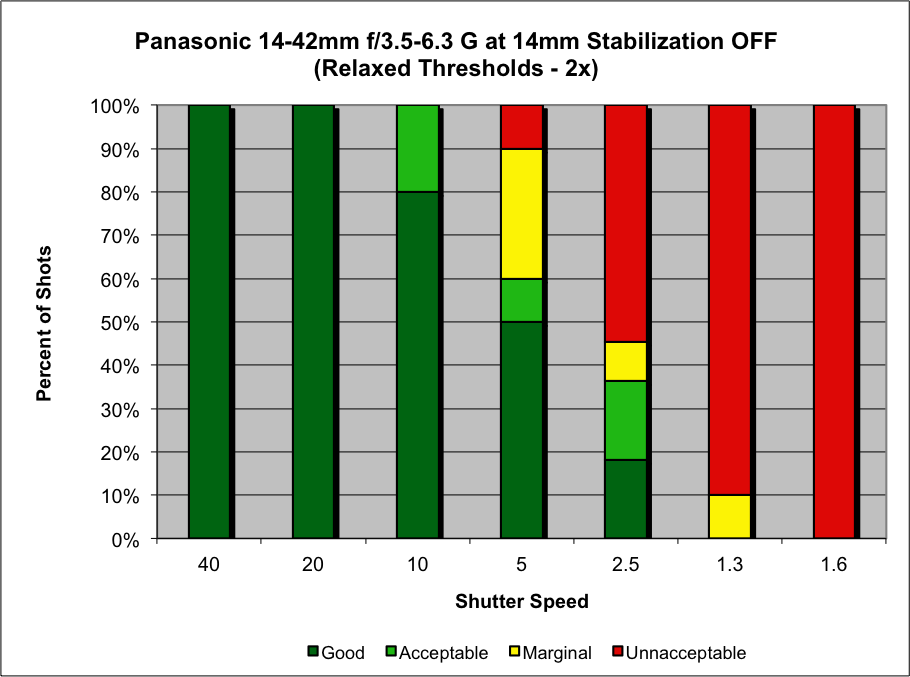
At 14mm, IS performance was pretty typical, offering roughly 1.5 to 2 stops of improvement vs our results with the IS disabled. With the IS system active, nearly 50% of our shots came out sharp at an impressively slow shutter speed of 1/2.5 second.
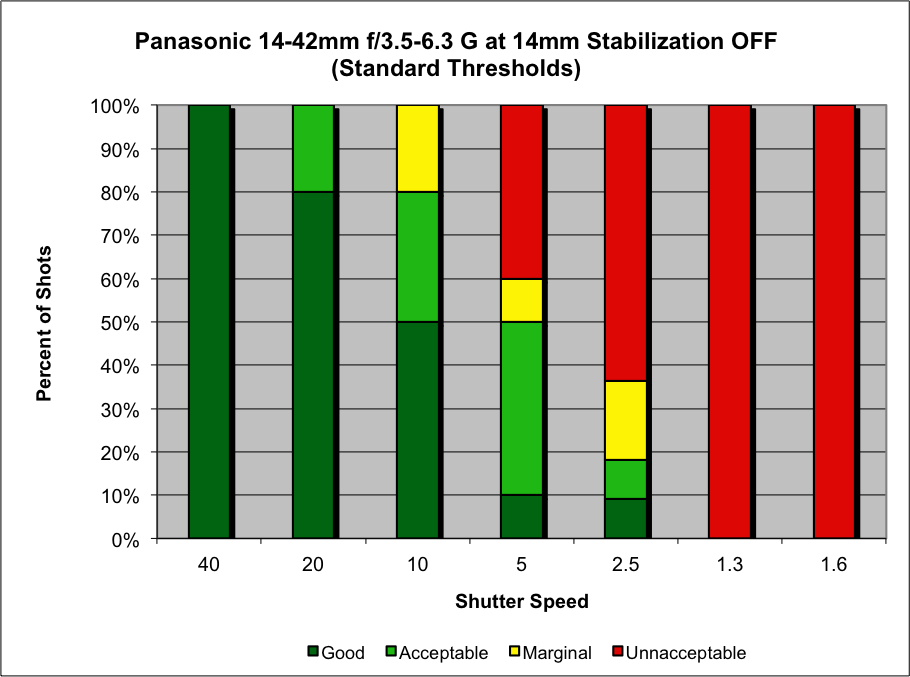 |
| Mouse over this chart to show results with IS activated. |
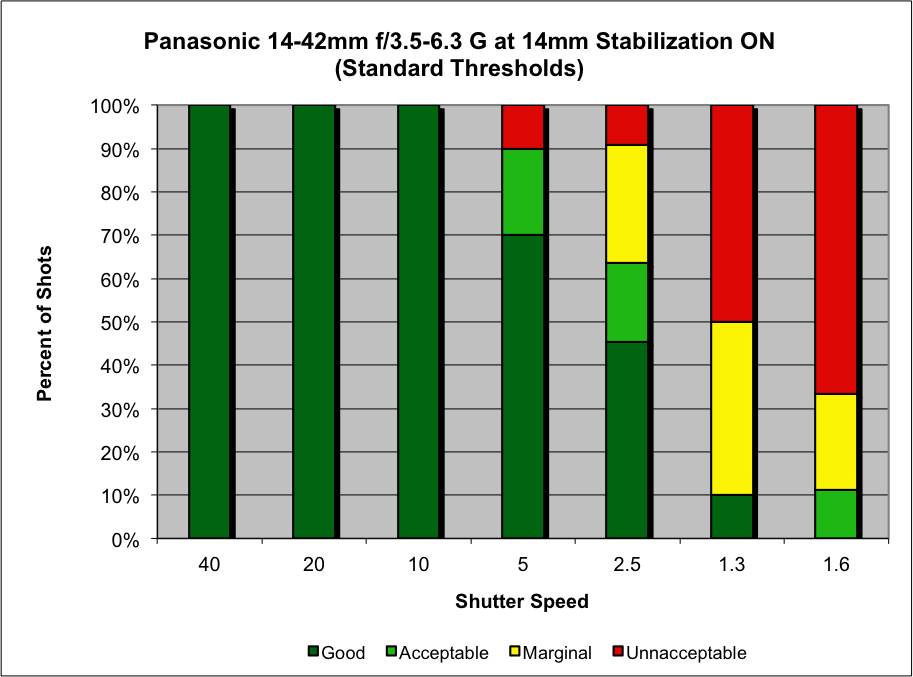
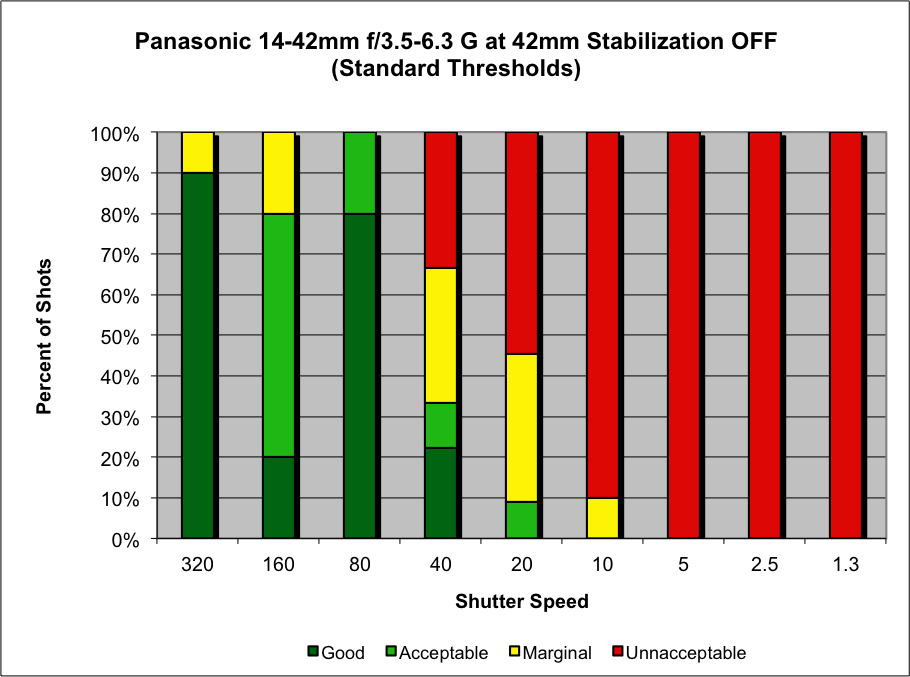
The results at 42mm were more dubious, with both IS-on and IS-off shots showing some blurring to surprisingly high shutter speeds:
 |
| Mouse over this chart to show results with IS activated. |
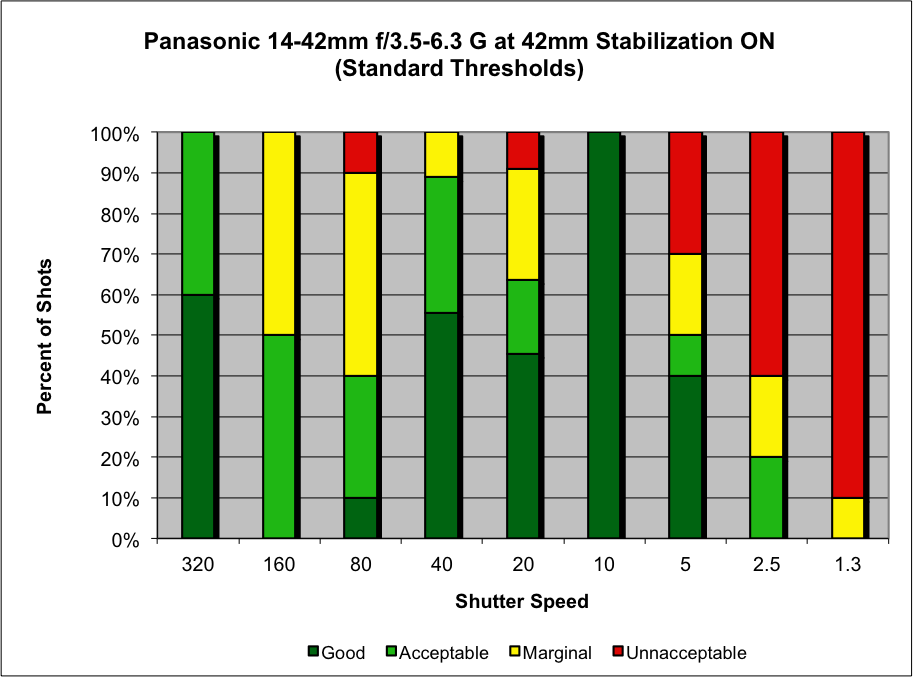
At 1/160 second and with IS on, 50% of our shots fell into the “marginal” category, the other 50% were just “acceptable”; none of the shots at that shutter speed achieved a “good” rating. This was actually a noticeably poorer result than we obtained with the IS turned off, although even our IS-off results were quite a bit worse than we’d normally expect for that shutter speed and focal length. We found this sufficiently unusual that we repeated the test several times, coming up with essentially the same results on each run.
If we could look past the poor results at higher shutter speeds, performance was actually pretty good at slower ones, to the point that 40% of our shots were sharp at an amazingly slow 1/5 second. In fact, if we looked just at the slower shutter speeds (1/40 and slower), the IS system provided a solid 3 to 3.5 stops of improvement over our unaided results.
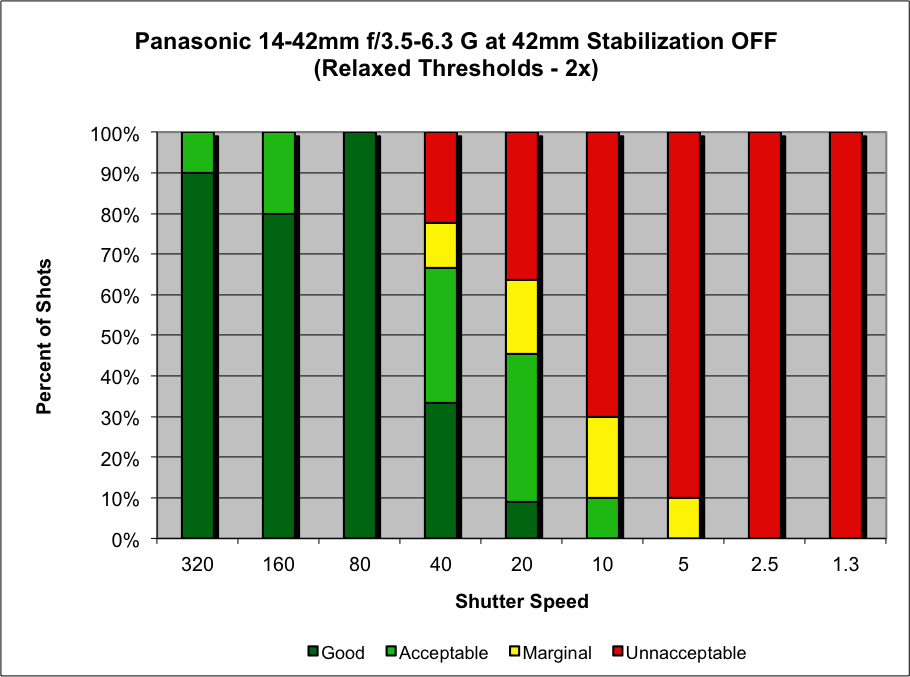
The odd results prompted us to wonder how things would look if we were to formally relax our blur standards a bit, accepting blur values twice as high as we normally do for each of the categories of Good/ Acceptable/ Marginal/ Unacceptable. The results of this recomputation are shown in the graphs below.
At 14mm, results with the relaxed blur thresholds look pretty similar to those with the standard thresholds, just with everything shifted to the right by a half-stop or so.
 |
| Mouse over this chart to show results with IS activated. |
At 42mm, though, things clean up a lot. There are still some shots that are just “acceptable” at high shutter speeds, even with the relaxed standards, but we can now see dramatically better performance with the IS enabled; a very solid 3 stops beyond the IS-off results.
 |
| Mouse over this chart to show results with IS activated. |
The bottom line, then, is that enabling IS with this lens will bring a slight but noticeable drop in maximum obtainable sharpness, even at higher shutter speeds where IS shouldn’t even be an issue. If you can tolerate that slight drop in best sharpness, though, the lens will deliver very good results down to almost silly-slow shutter speeds.
This of course begs the question of just what’s going on: Why did this lens’ IS system so clearly impact best-sharpness performance? A related question is why did we find slight blurring in the non-IS results at such high shutter speeds?
Our theory is that, in common with other Micro Four Thirds cameras we’ve tested, the Lumix G3’s shutter produces vibration that can cause blurring even at very high shutter speeds. The issue with Micro Four Thirds shutters (at least in cameras we’ve seen to date) is that the shutter has to snap closed before the exposure, and then open again for the exposure itself. This is in contrast to conventional focal plane shutters, which only have to move across the frame once per exposure. When a Micro Four Thirds shutter snaps closed to start the exposure, it can set off vibrations that affect the exposure. Because these vibrations can be at a fairly high frequency, they can cause blurring even at higher shutter speeds than one would expect. We’ve found that these vibrations can sometimes interact unfavorably with an IS system, with the IS system trying to correct for camera movement that isn’t actually happening.
We first encountered this phenomena in the original Olympus E-P1, where the vibration was enough to cause a doubling of fine image detail at certain shutter speeds. Olympus later patched the E-P1’s firmware to minimize the impact of shutter vibration on the IS system, which helped mitigate the problem. (You can read our exhaustive treatment of the Olympus E-P1 blur issue for a complete explanation of the phenomena.)
In the case of the Panasonic G3, the shutter-related vibrations were relatively small, so the decrease in sharpness in the IS-off case was fairly small also. Bottom line, if you only enable image stabilization when you actually need it (at slow shutter speeds) the Panasonic 14-42mm f/3.5-5.6 G provides a very useful level of shake reduction.
You can read more about our IS test methodology here: SLRgear IS Test Methodology, v2.
Reader Reviews
- Image quality
- 7.7/10
- Build quality
- 6/10
- Recommend it
- 100%
- 6/10Recommendedby bananitax · December 14 2024
https://e-drivers.com/author/muycerdi/
- 8/10Recommendedby Rotremjr · January 18 2012
Pros: Excellent sharpness from border to center between f/5.6 and f/8
Cons: Plastic mount, rough zoom.
Lens buyed in kit with camera.
An impressive image quality that can compete with some equivalent basic zoom lens kit provide with SLR (if we close at f/5.6 and f/8).
Color rendering of the images is excellent.
Excellent image quality in backlight condition.
O.I.S. more efficient with the last lens update (V1.1).
Samples (diaporamas) :
http://s150.photobucket.com/albums/s111/Rotremjr/Sol%20Rio%20de%20Luna%20y%20Mares/?albumview=slideshow
http://s150.photobucket.com/albums/s111/Rotremjr/Tulum/?albumview=slideshow
http://s150.photobucket.com/albums/s111/Rotremjr/Xel-Ha/?albumview=slideshow
- 8/10Recommendedby trentdp · August 10 2011 · paid $125
Pros: Very good sharpness at all focal lengths.
Cons: More cheaply constructed than 14-45 (plastic mount, rough zoom)
Considering this is now the standard lens with many of Panasonic's newer cameras, it is really very good in terms of Image Quality through the entire focal length range. For the average user, this will be a nice starter lens for both still and video recording. I use it on my GF2 which makes for a nice light weight combination with a good focal range. It is also a good choice on Olympus M4/3 cameras especially for video as it focuses very fast and silently. Unfortunately, the OIS does not work on Olympus cameras thus the camera IS has to be used. This is fine for still shots and great for continuous AF in video but be aware of the "digital IS" of Olympus cameras during video recording.
Reader reviews were submitted by Imaging Resource readers and are shown as written.