

Overview
Micro Four Thirds portrait and low-light shooters rejoice! There’s a new king of sharpness, bokeh and brightness in town and its name is NOCTICRON (actually, it’s Panasonic 42.5mm ƒ/1.2 ASPH POWER OIS Leica DG NOCTICRON, but that’s a mouthful). This new portrait prime, announced at CES 2014, is another lens forged in the partnership between Panasonic and Leica. The 42.5mm focal length equates to 85mm in standard full-frame 35mm terms, making it an ideal portrait lens. The super-wide ƒ/1.2 aperture provides for razor-thin depth of field shots and superb low-light shooting as well.
Despite the “Micro” in the Micro Four Thirds name, the Panasonic 42.5mm ƒ/1.2 is anything but. With 14 elements in 11 groups that have to provide an ƒ/1.2 aperture, plus an all-metal construction (including a large metal push-on lens hood, locked via a setscrew), this lens is a fairly beefy hunk of optics. That said, though, it feels right at home on the larger Micro Four Thirds cameras such as the GX7, GH3 and E-M1.
Other than high quality optics and beefy build quality, the Nocticron features Panasonic’s Power O.I.S. to help steady things at slower shutter speeds. Other niceties include a manual, click-detented aperture ring and Panasonic’s Advanced Nano Coating to help reduce ghosting and lens flare.
The Panasonic 42.5mm ƒ/1.2 ASPH POWER OIS Leica DG NOCTICRON ships with front and rear caps, lens hood and a soft case, and is currently available for pre-order for $1,599 (Amazon, Adorama, B&H) — making it squarely aimed at professionals and advanced enthusiast shooters.
Sharpness
If you want razor-sharp images, then the Panasonic 42.5mm ƒ/1.2 Nocticron lens delivers! Even wide open at ƒ/1.2, this lens produces stunningly sharp images with almost no softening in the corners. Stopping down to ƒ/4-ƒ/5.6 shows even sharper images with excellent corner-to-corner sharpness.
This lens is not only great for shallow depth of field and low-light work, but also studio shooting where you tend to stop down for maximum sharpness and a bigger depth of field ensuring your subject is tack sharp everywhere. When stopped down all the way to ƒ/16, softness from diffraction limiting is well-controlled. Note: No ƒ/22 or smaller apertures, so be careful when shooting in very bright conditions, particularly with video recording, as high shutter speeds can lead to very choppy-looking video.
Chromatic Aberration
Chromatic aberration is also very well controlled and very even acros–s the full aperture range — there’s no increase in CA when shooting wide open. While the average CA is not in the “world’s lowest CA ever” category, it sits nicely among other fast Micro Four Third prime lenses with excellent CA performance, such as the Panasonic 25mm ƒ/1.4 Leica and the Olympus 75mm ƒ/1.8.
Shading (”Vignetting”)
The Panasonic 42.5 ƒ/1.2 Nocticron does display some light falloff in the corners at the wider apertures, but it’s not severe vignetting by any means, compare to some we’ve seen. At ƒ/1.2, vignetting is under 0.75EV of light loss, and is quickly reduced once you stop down to ƒ/2.8 — to well under 0.25EV. From ƒ/2.8 — ƒ/16 the amount of vignetting stays pretty constant.
Distortion
As you would expect from a portrait lens, geometric distortion is extremely low with this new Panasonic optic. There’s just a hint of barrel distortion, but it’s practically imperceptible, even when looking at test chart images. Not only does this make the Panasonic 42.5mm lens excellent for portraiture, thanks to the well-controlled vignetting, it’s also a fantastic choice for those who like to shoot stitched panoramas.
Focusing
Autofocus on the Nocticron is powered by a stepping motor system, which focuses very quickly and quietly (though not nearly as silently as some other Panasonic lenses, like the little 12-32mm GM1 kit lens). In our tests, we found it to be very fast and accurate, taking well under one second to rack from minimum focusing distance to infinity, with no hunting for focus needed.
Of course, this lens supports manual focusing as well, and it’s a pleasure to use, with a nice, wide focus ring that’s buttery-smooth to rotate. The focus ring is electronic, and not a mechanical focus system seen on your typical DSLR lens; this means that the ring can rotate forever (no hard or soft stops at minimum focus and infinity). Since it’s electronic, how quickly you rack focus between near and far-away subjects depends on how fast or how quickly you accelerate the rotation of the focus ring. You can focus very precisely with small, slow rotations or quickly rack through the range with faster rotations.
Macro
This lens is not designed for macro shooting due to its 0.5m (1.64 ft.) minimum focusing distance that provides only a 0.1x magnification.
Build Quality and Handling
The build quality on the Nocticron is excellent. The barrel feels incredibly solid with an all-metal construction that houses a lot of glass: 14 elements in 11 groups including two aspherical elements, one Extra-low Dispersion lens and one UHR, or Ultra High Refractive Index, lens. The lens elements have also been treated with Panasonic’s Advanced Nano Surface Coating. The ƒ/1.2 ultra-wide aperture is enhanced with a 9-bladed circular aperture for smooth, creamy background blur.
The Panasonic 42.5mm ƒ/1.2 Nocticron is quite large and heavy for Micro Four Thirds standards, weighing in at 425g (15.04 oz.) with a filter diameter of 67mm. By comparison, the full-frame Nikon 58mm ƒ/1.4G lens weighs just 385g (13.6 oz.). Now, if you mount this lens on a tiny M43 camera like a GM1, for example, it might be a little awkward to shoot one-handed, but on larger bodies like the GH3 or E-M1, it’s very comfortable and well balanced.
Nevertheless, on these larger bodies, you’re reaching the realm of a DSLR-sized camera and lens combo, but I feel the target user of this lens (i.e. a professional or high-end enthusiast) would not be bothered by the extra weight and bulk — this lens is not designed to be a compact, go-everywhere kind of lens, it’s designed first and foremost to deliver fantastic, large-aperture performance, and you can”™t get that without a fair amount of glass and metal. If you’re a DSLR user, typical ƒ/1.2 lenses can be quite large and heavy, though, and the Panasonic 42.5mm ƒ/1.2 lens makes for a much lighter weight alternative. (Canon’s 85mm ƒ/1.2L II lens barges in at over 2lbs!)
Down to the fine detail: the metal barrel is finished in a nice semi-gloss, or almost-matte-like, black finish with laser-engraved branding and markings. Along the left side of the barrel are toggle switches for the Optical Image Stabilizer system and an AF/MF switch.
The manual aperture ring is quite thin at around 1/4th of an inch with small, carved ridges for an easy grip. It features 23 soft, clicking aperture settings, as well as an Auto setting on the left-most position of the ring for those times when you want the camera to electronically adjust the aperture. It should be noted that the aperture ring is entirely electronic, just like the focus ring.
The focus ring itself is much wider than the aperture ring, measuring around 5/8ths of an inch and has a similar ridged texture. Like I mentioned earlier, the focus ring is buttery smooth to rotate. If your Panasonic camera supports focus peaking, as many of the recent models do, the 42.5mm ƒ/1.2 Nocticron makes for an excellent video lens thanks to the smooth and wide focus ring that should make it easy to attach follow-focusing equipment. Unfortunately, it’s not a mechanical focusing system, so it would be fairly difficult to use a focus distance marking board with your follow-focus.
Alternatives
While the Panasonic 42.5mm ƒ/1.2 Nocticron is a fairly unique lens in the Micro Four Thirds system, Panasonic does offer a similar alternative in the Panasonic 45mm ƒ/2.8 ASPH MEGA OIS Leica DG MACRO-ELMARIT. This lens provides a little longer focal length (90mm equivalent) and much better macro shooting with a dedicated macro switch, but you sacrifice a lot of stops of light gathering capabilities with the significantly slower ƒ/2.8 constant aperture. However, it’s much lighter and way less expensive at around $900. We can’t comment on the optics of this lens however, as we have yet to test it.
Another fast, portrait-centric lens for the Micro Four Thirds mount is the well-regarded Olympus 75mm ƒ/1.8 ED M.Zuiko Digital lens. While it gives you a lot longer focal length (150mm equivalent), it’s much faster than the ƒ/2.8 mentioned above with a ƒ/1.8 constant aperture (though still not as bright as ƒ/1.2!). The Olympus lens is also excellent optically, with razor-sharp images, very low distortion, vignetting and CA. It’s also smaller, lighter and less expensive (~$900).
Last, but certainly not least, is perhaps the most suitable alternative: the highly praised Olympus 45mm ƒ/1.8 ED M.Zuiko Digital lens. This lens, too, shows excellent sharpness wide open with very low distortion, but does show more CA and, again, doesn’t have as wide an aperture — a full stop slower at ƒ/1.8. The biggest upside is the price: a staggeringly budget-friendly price of only $400!
Conclusion
The Panasonic 42.5mm ƒ/1.2 ASPH POWER OIS Leica DG NOCTICRON is a serious lens for serious shooters of the Micro Four Thirds system. It produces outstandingly sharp images — even wide open — with extremely low distortion and very well-controlled CA and vignetting.
On the physical side of things, the build quality is excellent thanks to its all-metal construction. The styling is all-Leica as well, with laser-engraved markings and branding, all in classic Leica typeface as well. The clicked, manual aperture ring is a nice touch — and a first for Panasonic prime lenses — giving photographers a nice tactile, retro feel. It’s a nice feature for quick aperture adjustments when using cameras that don’t include a typical aperture dial on the camera.
Speaking of “feel,” the focus ring on the Panasonic 42.5mm ƒ/1.2 Nocticron lens is exceptional, with buttery smooth action that makes it not only great to use for stills but for video shooting as well (GH3 shooters take note).
While the lens is definitely large and bulky compared to other Micro Four Thirds lenses, the ƒ/1.2 aperture is a unique feature that’s unrivaled between both Panasonic and Olympus lenses. If you need or want ƒ/1.2, chances are, you’ll be fine with the extra weight. And it’s still miles away from the massive heft of ƒ/1.2 DSLR lenses. Furthermore, on the larger M43 cameras like the GH3, it’s a very comfortable and balanced lens.
All in all, the Panasonic 42.5mm ƒ/1.2 ASPH POWER OIS Leica DG NOCTICRON is a phenomenal lens; one of the best we’ve ever tested. If you’re a professional photographer or advanced amateur who’s dumped the DSLR in favor of the smaller and lighter Micro Four Thirds system and are in need of a pro-level portrait or low-light lens, this is the lens for you. It’s definitely not your everyday pocket prime (the $1,600 price tag can attest to that) but I can definitely see this being the go-to lens for wedding, portrait and studio shooters, as well as concert photographers who need a fast-focusing, artistic lens with excellent bokeh and low-light capabilities all while producing stunningly sharp photos.
Product Photos
 |
 |
 |
 |
 |
Sample Photos
Click here for Real-world Gallery Images on our Flickr page!
The VFA target should give you a good idea of sharpness in the center and corners, as well as some idea of the extent of barrel or pincushion distortion and chromatic aberration, while the Still Life subject may help in judging contrast and color. We shoot both images using the default JPEG settings and manual white balance of our test bodies, so the images should be quite consistent from lens to lens.


As appropriate, we shoot these with both full-frame and sub-frame bodies, at a range of focal lengths, and at both maximum aperture and ƒ/8. For the ”VFA” target (the viewfinder accuracy target from Imaging Resource), we also provide sample crops from the center and upper-left corner of each shot, so you can quickly get a sense of relative sharpness, without having to download and inspect the full-res images. To avoid space limitations with the layout of our review pages, indexes to the test shots launch in separate windows.
Description
(From Panasonic lens literature) Panasonic is proud to introduce the new LEICA DG NOCTICRON 42.5mm / F1.2 ASPH. / POWER O.I.S. (H-NS043) interchangeable lens for the LUMIX G based on the Micro Four Thirds System standard. (35 mm camera equivalent: 85 mm). This incredible lens not only has a maximum aperture of F1.2, but it also incorporates optical image stabilization (POWER O.I.S.) along with full time Auto Focus. Certified by the world-renowned LEICA, exceptional high image quality is guaranteed as well as its sophisticated metal design. The name “NOCTICRON” was newly defined by Leica Camera AG for this lens that achieves a remarkably fast F1.2 aperture among Micro Four Thirds digital interchangeable lenses.
The new lens system is comprised of 14 elements in 11 groups and uses two aspherical lenses, one ED (Extra-low Dispersion) and one UHR (Ultra High Refractive Index) lens. The aspherical lenses suppress spherical aberration and distortion. The ED lens enables sharp, high contrast description without color bleeding to the corners while the UHR lens enables high optical performance that renders an image with uniformed descriptiveness from center to edges as well as downsizing of the lens unit.
The popular 42.5 mm medium-telephoto focal distance (Equivalent to 85 mm on a 35 mm camera) is perfectly suited for portraits with rich stereoscopic effect. Together with the high-speed aperture, users can utilize the beautiful soft focus for more impressive, creative shots. Nine blades give the aperture a rounded shape that produces an attractively smooth effect in out-of-focus areas when shooting at larger aperture settings. It also captures landscape with an extremely natural perspective. In addition, the aperture ring on the lens barrel allows direct, intuitive control over aperture settings.
Panasonic’s Nano Surface Coating technology has been adopted to the NOCTICRON 42.5mm / F1.2 ASPH. / POWER O.I.S. Reflection is dramatically minimized at entire visual light range (380nm-780nm) by applying the extra-low refractive index coating with nano-sized structure on the surface of the lens. It results in a super clear image with dramatic reduction of ghost and flare. Due to the shallow depth of field which is unique to the large aperture lens, even a slight handshake can potentially cause images to be out-of-focus. However, the POWER O.I.S. (Optical Image Stabilizer) which is integrated in the LEICA DG NOCTICRON 42.5mm effectively compensates for not only small, fast movement but also large, slow movement, making it easy to capture super clear shots even when shooting in low-lit situations such as in night time or indoors.
It incorporates superior inner focus system, which enables excellent resolution and contrast from close-up to infinity. The inclusion of newly developed stepping motor makes the focusing action smooth and silent for use in both still and video recording. Notably the performance of Auto Focus is far superior to the phase-difference AF when a fast lens with smaller F value is used. When mounted on LUMIX G cameras, users can take advantage of the high-speed, high-precision Contrast AF system.
The sophisticated metal design of LEICA DG NOCTICRON 42.5mm / F1.2 ASPH. / POWER O.I.S., including the hood, deserves to bear the prestigious LEICA name. A highly reliable metal mount is durable enough for repeated mounting of the lens.
• LEICA is a registered trademark of Leica Microsystems IR GmbH.
• NOCTICRON are registered trademarks of Leica Camera AG.
Lab Test Results
Our standard lens lab tests, shot on a sub-frame (APS-C) body. Pick a focal length and aperture to see the result.
Sharpness (blur index)
Blur across the frame: lower and flatter is sharper. Change focal length and aperture to see how it improves when stopped down.

Chromatic aberration
Colour fringing in the corners at each focal length.

Vignetting (corner shading)
How much darker the corners are than the centre, by aperture and focal length.

Geometric distortion
Barrel (positive) or pincushion (negative) distortion across the zoom range.

Image Stabilization
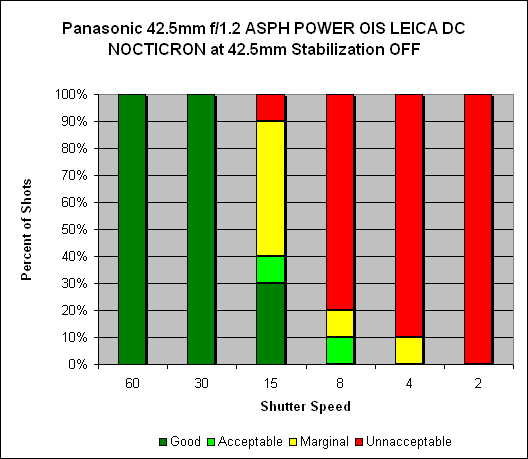
Most people tend to think of image stabilization as being mainly for telephoto lenses. While it’s true that their longer focal lengths tend to magnify the effects of camera shake, image stabilization can provde a very useful assist at wider angle focal lengths as well; anyone who’s ever tried to blur the image of a waterfall, while keeping the surrounding landsape tack-sharp knows exactly what I’m talking about.
 |
| Mouse over this chart to show results with IS activated. |
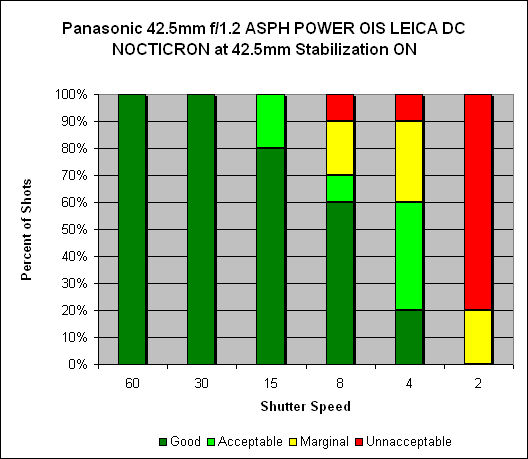
The Panasonic 42.5mm f/1.2 Nocticron’s Power O.I.S. system was useful, but not overly so. We saw about a 1-2 stop improvement with IS enabled for slower shutter speeds, however we don’t have a stated manufacturer spec for how many stops the IS system is supposed to compensate.
IS systems tend to provide more benefit to less-stable shooters than very steady ones, so most users will see the same or greater amounts of shake reduction as we measured here. You can read more about our IS test methodology here: SLRgear IS Test Methodology, v2.