

Overview
Tamron 150-600mm f/5-6.3 G2 Field Test
A great, affordable telephoto lens with impressive optics and build
By Jeremy Gray | Posted: 01/12/2017
 |
| 600mm (900mm equiv.), f/6.3, 1/640s, ISO 360. This image has been modified. Click for full-size image. |
Although the Tamron SP 150-600mm f/5-6.3 (Model A011) lens was released in December of 2013, not that long ago in terms of lenses, Tamron has opted to upgrade it to the new SP 150-600mm f/5-6.3 Di VC USD G2 lens (Model A022). The new version was redesigned from the ground up and features improvements to optics, autofocus, vibration compensation and more.
Considering its focal length range of 150-600mm (on a full-frame camera), the Tamron 150-600mm G2 lens is surprisingly lightweight. I tested the Nikon version, which weighs 70.2 ounces (1,990 grams). The Canon version is slightly heavier at 70.9 ounces (2,101 grams). It is a long lens though, especially when fully extended with the lens hood on. At its most compact, the 150-600mm is around 10 inches (257.7 millimeters) long.
 |
 |
| Tamron 150-600mm f/5-6.3 G2 mounted to a gripped Nikon D500: 150mm (top) vs. 600mm (bottom) |
While a fairly large lens, to be sure, it balances nicely on a DSLR with or without a battery grip — it’s slightly more front-heavy with a non-gripped DSLR, but not by a significant amount. the lens also feels comfortable to use due to its good design. The focus ring is closer to the camera body than the zoom ring, which I like, and the lens balances well when holding it under the zoom ring.
The zoom ring has markings at 150, 200, 250, 300, 350, 400, 450, 500 and 600mm. To go from 150 to 600mm is nearly a half rotation, which is very easy to accomplish in a single motion. For transport and storage, the lens can be locked at 150mm using a switch on the barrel of the lens. Furthermore, the zoom ring has an excellent new feature called “Flex Zoom Lock,” which lets you lock the focal length at any distance by simply sliding the zoom ring forward. This is a very handy feature if you find yourself shooting at a single focal length consistently or don’t want to encounter accidental zoom changes while out in the field.
 |
The rotational feel of the zoom ring is pretty smooth, but it does take a moderate amount of force. That’s an advantage in my book, in that it is easy to make fine focal length adjustments. On the other hand, the focus ring requires much less force to rotate, but it is not loose whatsoever and allows for similarly precise adjustments, even of very small increments. The lens also features a focal distance window, showing you where focus is set.

Tamron has also made improvements to the durability of the lens. It has a moisture-resistant construction, including leak-proof seals throughout the lens barrel. Based on Tamron’s published diagrams of the lens, it appears that there are six locations within the lens with weather sealing, which should be plenty to keep the lens safe from the elements. The metal-exterior lens certainly feels and looks to be durable. Its build construction looks to be very impressive for its price. While I will discuss it further in the section on the lens’s optical design, the front element of the lens is coated with a protective fluorine compound as well.
One aspect of the lens’s design which makes it much more user-friendly is that the tripod foot is not only textured, but it also has Arca-Swiss style dovetails built-in and is made of lightweight magnesium. Its use of an Arca-Swiss style interface means it will easily fit into many different tripod heads without any attachments or switching out the foot. It worked nicely with the gimbal head I use on my tripod when shooting with long lenses. I also found the tripod foot to be very stable. I could use live view to quickly check focus on my D800E even when the lens was at 600mm, this is not something I could do with some other long lenses I’ve used because the image has not been stable enough, due in part to weak tripod foot designs.
Overall, this is a well-constructed lens that feels very good in-use and has numerous design elements to help make it a rugged, durable lens, especially considering its cost. Not that it particularly matters, but I also think that the lens looks great.
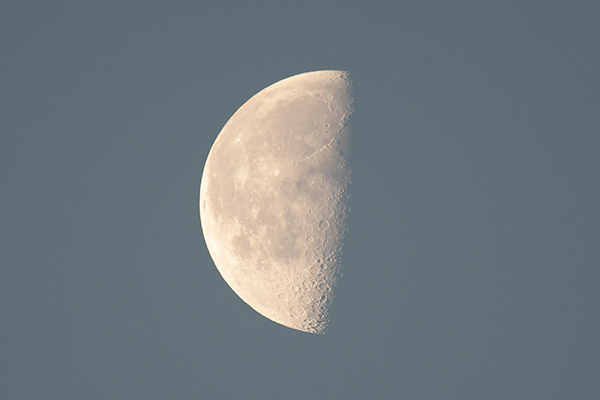 |
| 600mm (900mm equiv.), f/6.3, 1/250s, ISO 400. This image has been modified. Click for full-size image. |
The Tamron 150-600mm G2 lens has 21 elements in 13 groups. Three of the elements are low dispersion (LD) elements, which help eliminate chromatic aberrations. The lens also includes various anti-reflection technologies, including “extended bandwidth and angular dependency” (eBAND) and “broad-band anti-reflection” (BBAR) coatings, which aid in the suppression of internal reflections, helping to reduce ghosting and flare in images, particularly when shooting backlit subjects. Further, the front element of the lens has a fluorine coating, as I’ve mentioned, which helps protect the lens from water and oil, but also makes it easier to wipe clean and less susceptible to damage when cleaning when dust or fingerprints do find their way onto the glass.
When shooting the Tamron 150-600mm G2 wide open, it is not a particularly sharp lens. However, let’s keep that in context. It is also a lens that offers the 150 to 600mm focal length range on full-frame cameras for US$1,400. It isn’t fair to expect it to compete with prime lenses at similar focal lengths nor is it fair to expect it to compete with say, the Nikon 200-400mm f/4 VR II lens; it simply can’t. But when you stop the lens down, its performance be quite impressive indeed.
 |
| 340mm (510mm equiv.), f/6.3, 1/640s, ISO 360. In this 100% crop of a processed RAW image, you can see that the Tamron 150-600mm can resolve excellent detail, especially in the middle part of its focal length range. |
At 150mm, the lens is moderately sharp wide open, but stopping down to f/8 makes the lens very capable of resolving fine details, especially in the center area of the frame. The lens is quite sharp right to the edge of the frame when stopped down on a full-frame camera. The edges are a bit soft wide open at 150mm, but not dramatically and not nearly as noticeable on an APS-C camera.
 |
| 150mm (150mm equiv.), f/5.0, ISO 100. 100% center crop from JPEG image straight from the camera (Nikon D800E) Click for full-size image. |
At 300mm, the situation is similar, although the lens is sharp from the get-go, proving to be even sharper when stopped down. In my experience with the lens, anywhere from 200-450mm seems to be the sweet spot for sharpness. You can see how sharp the lens can be in the 100% crop below.
Now we come to the focal length that many users are most interested in shooting at, full telephoto. For a telephoto zoom lens, its longest focal length is where it will see the most action, after all it’s often being used to get as close as possible to a subject. In the case of wildlife photography, it’s unusual for me to zoom out when using a zoom lens. Unfortunately, at 600mm is where we see this lens’ weaknesses become most evident. Corner sharpness falls off dramatically at 600mm f/6.3 and center sharpness is considerably less than it is at 300mm.
 |
| 600mm (600mm equiv.), f/6.3, ISO 100. 100% center crop from JPEG image straight from the camera (Nikon D800E) Click for full-size image. |
 |
| 600mm (600mm equiv.), f/11, ISO 100. 100% center crop from JPEG image straight from the camera (Nikon D800E) Click for full-size image. |
When you stop the lens down, center sharpness improves quite a lot, but corner sharpness remains noticeably low. If you don’t have to shoot at 600mm but you need to be wide open, I recommend shooting at 400-500mm if possible, as the cost to resolution is noticeable at 600mm. With that said, for the money, you’ll be hard-pressed to find a better option to get a 600mm focal length than the Tamron 150-600mm f/5-6.3 G2 lens. It is very capable of capturing impressive, sharp images worth printing at large sizes at 600mm f/6.3. It is just that, as is the case with all photographic gear, there are tradeoffs. In this case, you trade critical sharpness for the extra reach.
 |
| 600mm (900mm equiv.), f/6.3, 1/640s, ISO 220. In this 100% crop of a processed RAW image, you can see that the Tamron 150-600mm can resolve good detail at 600mm, but it is noticeably less sharp than images shot at shorter focal lengths. |
On an APS-C sensor, the Tamron 150-600mm produces only minor vignette when shooting wide open across the focal length range. The vignette is more obvious at 150mm and 600mm than it is at 300mm, but it’s not bad. Stopping the lens down virtually eliminates any light falloff, but only for very few situations would I consider the vignette when shooting wide open to be problematic.
The situation is quite a bit different on a full-frame sensor. The vignetting is noticeably stronger across the focal length range and seems worst to me at 150mm, okay at 300mm and somewhere in between when shooting at 600mm. As was the case with the APS-C camera, stopping down does help, although there is still vignetting at f/8 when using the Tamron 150-600mm on a full-frame camera.
Overall, if you are using the Tamron 150-600mm f/5-6.3 G2 on an APS-C camera, light falloff is not a significant issue. When shooting with the telephoto zoom on a full-frame camera, however, you may need to perform lens corrections if you want to shoot wide open, depending on the subject. In either case, considering the focal length range and price of this lens, I found its handling of vignetting to be quite impressive.
 |
| 600mm (900mm equiv.), f/6.3, 1/640s, ISO 500. In this 100% crop of a processed RAW image (without chromatic aberration correction applied), you can see very minor fringing around high-contrast details. Whatever small amount of chromatic aberration this lens produces is very easily corrected during post-processing. Click for full-size image. |
The Tamron 150-600mm f/5-6.3 G2 handles chromatic aberrations very well. In fact, I had no major issues with aberrations during my time with the lens. Only in extreme scenarios, such as the case of white spots on a black bird, such as in the example crop above, did I see any CA, and even then, it was minor.
 |
| 600mm (900mm equiv.), f/6.3, 1/500s, ISO 900. This image has been modified. Click for full-size image. |
Having not used the original model A011 Tamron 150-600mm lens, I cannot comment on autofocus speeds of the new one compared to its predecessor, but I can say that the G2 version focuses quickly in good light, but leaves something to be desired in low light, due in large part to its maximum aperture. Particularly when shooting at 600mm, the lens can be sluggish when shooting in dim conditions. This isn’t a surprise or a knock on the lens, it is a consequence of its reliance on f/6.3 at its longer telephoto focal lengths.
The lens utilizes an Ultrasonic Silent Drive (USD) ring-type motor to drive its focus, which Tamron states offers “excellent responsiveness and control,” and I would agree with that description in most situations. I also found focus to be quite accurate, although it did occasionally struggle to react quickly to slight changes in a subject’s position, even when continually focusing. However, in a majority of cases, the lens nailed its focus.
 |
| 600mm (900mm equiv.), f/6.3, 1/640s, ISO 800. This image has been modified. Click for full-size image. |
When you want to fine-tune focus, especially when conditions are dim or challenging for the lens’ autofocus or the camera you’re using doesn’t offer precise enough AF point placement, the G2 version of the lens has full-time manual focus override, which is a great feature and works quite well thanks to the nice focus ring.
In my experience, autofocus was fastest throughout the 150-300mm range, slowing down slightly at 400mm, 500mm and then performing slowest at 600mm. Autofocus was very accurate throughout most of the range, although I did find that at the long end of the lens, I occasionally needed to trigger autofocus multiple times to get the lens to lock on a subject, particularly in low light.
The Tamron 150-600mm G2 lens has very good image stabilization. Not only does it work well, but it’s full-featured. There are three VC modes: standard, panning and one that prioritizes stabilization during capture but doesn’t worry about stabilizing the image through the viewfinder (in other words, Mode 3 will stabilize when you fully press the shutter button, but not stabilize while half-pressing). The standard mode balances stabilization of captured images and the viewfinder. By using the lens with the optional Tamron TAP-in Console, you can customize the standard (VC Mode 1) vibration compensation to prioritize stabilization during shooting or the viewfinder image.
The VC is rated for 4.5 stops of vibration compensation. In my experience, I could capture sharp images with VC on at 600mm (900mm equivalent on the D500) with shutter speeds as slow as 1/15s, although I achieved more consistent results at 1/30s. At the same focal length, turning off vibration compensation resulted in blurry images at shutter speeds slower than 1/500s.
The Tamron 150-600mm f/5-6.3 G2 is clearly well-suited for wildlife photography for a variety of reasons. It isn’t terribly heavy, which is great for when you need to be on the move, either hiking to a location or constantly moving around. A 600mm f/4 lens is going to be great optically, which is no surprise given the large price tags, but it is also going to be a hassle to move around from spot to spot. You can’t easily handhold a big, heavy lens like that, which means that you sometimes miss opportunities. I could comfortably handhold the Tamron 150-600mm for a considerable amount of time; the lens goes to show that you don’t need to have big, heavy glass to enjoy wildlife photography with a DSLR.
 |
| 450mm (600mm equiv.), f/6.0, 1/500s, ISO 2200. This image has been modified. Click for full-size image. |
If you want to shoot wildlife primarily at dawn or dusk, this probably isn’t the lens for you. However, given sufficient light, it autofocuses quickly enough for photographing many kinds of wildlife, including small, fidgety birds. The lens’s continuous autofocus performance was quite good with both Nikon cameras on which I tested the lens, although as I mentioned in the autofocus section above, it did occasionally struggle with quickly making small changes in focus. Further, when doing wildlife photography, I found myself at 600mm much of the time, which does have slower AF speeds than shorter focal lengths. If you’re fortunate enough to be photographing a cooperative subject, the G2 version of the Tamron 150-600mm can close-focus to 86.6 inches (2.2 meters).
For consistently having good wildlife photo opportunities, you must spend money on a telephoto lens. However, the Tamron 150-600mm G2 proves that you don’t need to spend thousands upon thousands of dollars for a good one. The Tamron 150-600mm provides you the opportunity to shoot sharp images at 600mm on a full-frame camera without breaking the bank.
1.4x Teleconverter: Good in bright light, but not very useful in most situations
There are two teleconverters available to use with the 150-600mm G2 lens: a 1.4x and 2.0x converter. I used the 1.4x teleconverter, and it worked quite well in good light, but it does make the lens an f/9 optic when shooting at 600mm, which is quite slow for wildlife photography, especially in any sort of dim light. It obviously decreases sharpness some, but it can perform quite well in the right situation. The 1.4x teleconverter costs around US$420 and the 2.0x teleconverter costs slightly more at $440.
 |
| 700mm (1050mm equiv.), f/9.0, 1/800s, ISO 360, 1.4x teleconverter. Click for full-size image. |
What I like:
- Versatile focal length, especially on an APS-C sensor
- Good optical performance across much of the range
- Reasonably compact and lightweight for what it is
- Very good vibration compensation performance
- Excellent price
- Good build quality for the cost
What I dislike:
- Sharpness decreases at the extreme telephoto end
- Max aperture is limiting in dim lighting conditions
- Autofocus can struggle with precision in certain situations
 |
| 460mm (690mm equiv.), f/6.3, 1/500s, ISO 125. This image has been modified. Click for full-size image. |
Photographers are regularly looking for the ultimate balance in performance and cost and like with all lenses, regardless of specs and price, compromises must be made. The Tamron 150-600mm f/5-6.3 G2 is no exception. It sacrifices maximum aperture for a smaller size, large zoom range and a lower price.
It offers a versatile focal length range that’s suitable for many different subjects, including wildlife and even certain sports. Capturing great photos of wildlife used to be very difficult to achieve without breaking the bank, but with the advances made in camera sensor technology, you no longer need to shoot at f/2.8 or f/4 to capture clean, sharp images at fast enough shutter speeds for freezing action. With that said, this lens is not well-suited for shooting indoor or night sports. The Tamron SP 150-600mm f/5-6.3 Di VC USD G2 lens costs around US$1,400, which is a very low price for what you are getting: A lens that offers good optical performance across much of its wide telephoto focal length range.
 |
| 600mm (900mm equiv.), f/6.3, 1/640s, ISO 400. This image has been modified. Click for full-size image. |
How much do you have to spend to get nominal increases in performance across the focal length range? A lot. For photographers using either full-frame or APS-C cameras who desire a lens with a lot of reach but don’t want to spend many thousands of dollars on a lens, I highly recommend giving the Tamron SP 150-600mm f/5-6.3 Di VC USD G2 lens a try, it’s an excellent blend of performance, versatility and value.
Description
(From Tamron lens literature) Tamron, a leading manufacturer of optics for diverse applications, announces the launch of the SP 150-600mm F/5-6.3 Di VC USD G2 (Model A022). This second generation “G2” lens builds upon the success of the SP 150-600mm F/5-6.3 Di VC USD (Model A011), which launched in December 2013 and continues to successfully meet photographers’ needs in the ultra-telephoto category. The new G2 version was developed to provide superior optical performance with today’s high resolution DSLRs and to add improvements to several features including speed and accuracy of AF and VC (Vibration Compensation). Also, several new features have been added: FLEX ZOOM LOCK mechanism, Fluorine Coating and optional teleconverters. The new lens delivers outstanding performance and a luxurious, upscale appearance, including a metal lens barrel.
Delivery of the new lens in Canon and Nikon mounts will start on September 23 in the Japanese market and soon thereafter in the U.S. market (Sony A-mount to be delivered at a later date) at a price of $1399.
PRODUCT HIGHLIGHTS
1. Optical design refreshed to achieve even higher performance
Three LD (Low Dispersion) lens elements completely eliminate axial and transverse chromatic aberrations. The design also features an upgraded optical construction (21 elements in 13 groups) and leverages improvements in manufacturing technology. As a result, the lens delivers high resolution, improved sharpness and overall better performance.
2. Tamron’s sophisticated eBAND Coating for eliminating ghosting and flare
eBAND (Extended Bandwidth & Angular-Dependency) Coating is a nano-structured layer deployed on the lens element surface. In addition to regular anti-reflection coatings, eBAND Coating offers higher light transmission and significant improvement in anti-reflection characteristics, especially against angulated incident rays. Combined with BBAR (Broad-Band Anti-Reflection) coatings, flare and ghosting are reduced to imperceptible levels.
3. MOD reduced to provide optimum tele-macro photography
Tamron’s advanced manufacturing technology has made it possible to reduce the MOD (Minimum Object Distance) to 86.6 in (2.2m), compared to 106.3 in (2.7m) for Model A011, and has allowed for the wonders of tele-macro photography with its 1:3.9 Maximum Magnification Ratio.
4. AF speed is faster and much more responsive with moving subjects
The Model A022 is equipped with a USD (Ultrasonic Silent Drive) ring-type motor that delivers excellent responsiveness and control. AF speed is significantly improved from the current model, and it enables accurate high-speed focus even when capturing moving subjects. When shooting with AF, the Full-time Manual Focus override allows you to instantly make fine-focusing adjustments manually, without having to switch between modes.
5. VC performance is now 4.5 stops and offers 3 modes optimized for different situations
The VC (Vibration Compensation) effectiveness is equivalent to 4.5 stops, based on image stabilization performance levels established by CIPA (Camera & Imaging Products Association) when using VC MODE 3. Model A022 now has three types of VC modes, and it is possible to choose the optimum VC mode according to the situation for taking a photograph, such as when panning. VC MODE 1 is the standard mode that strikes a great balance between the stability of the viewfinder image and the stabilization effects. VC MODE 2 is exclusively used for panning.VC MODE 3 prioritizes the stabilization of the captured images and forgoes the stabilization of the viewfinder image. A new VC Mode can be programmed with the optional TAMRON TAP-in Console™. You can overwrite VC Mode 1 with a new VC Mode that allows stabilization to be engaged constantly for videography purposes. In this mode, the LCD screen is used.
6. New FLEX ZOOM LOCK mechanism enables locking of the zoom ring at any position
The FLEX ZOOM LOCK mechanism quickly locks or unlocks the zoom at any position simply by sliding the zoom ring. Photographers can shoot from any angle without the zoom extending unintentionally. Additionally, the lens features the conventional Zoom Lock switch to prevent unwanted barrel extension during transportation.
7. Fluorine Coating and Moisture-Resistant Construction for a more user-friendly lens
The front surface of the lens element is coated with a protective fluorine compound that is water- and oil-repellent. The lens surface is easier to wipe clean and is less vulnerable to the damaging effects of dirt, dust, moisture and fingerprints. For greater protection when shooting outdoors, leak-proof seals throughout the lens barrel help protect your equipment.
8. Electromagnetic diaphragm system now used for Nikon-mount lenses
An electromagnetic diaphragm system, which has been a standard feature for Canon-mount lenses, is now employed in Nikon-mount lenses[1]. More precise diaphragm and aperture control is possible because the diaphragm blades are driven and controlled by a motor through electronic pulse signals.
9. Lightweight and easy-to-hold tripod mount is compatible with an Arca-Swiss style quick release plate
A new textured grip and Arca-Swiss style tripod interface enhances both speed and utility. And because the tripod mount is made of lightweight magnesium, it is much easier to carry.
10. Compatible with TAMRON TAP-in Console™, an optional accessory product
The optional TAP-in Console provides a USB connection to your personal computer, enabling you to easily update your lens’s firmware as well as customize features including fine adjustments to the AF and VC.
11. Teleconverters exclusively for the Tamron lens now developed
Two exclusive teleconverters[2], which perfectly match the optics of the new SP 150-600mm G2 (Model A022), offer 1.4x and 2x magnification, and provide a maximum zoom range up to 1200mm. These new teleconverters extend focal length of the master lens, making it possible to take pictures in farther ultra-telephoto ranges.
12. Based on the rigorous quality standards worthy of the SP series, this new lens is manufactured with thorough attention to details
For the SP series products in particular, Tamron has established rigorous design and quality standards. These standards apply to the optical design, mechanical design and the cosmetic appearance, as well as to such wide-ranging areas as the product’s robustness and improvements in various individual functions. Tamron thoroughly reviews of all of the design and manufacturing processes in order to offer products to customers with ever-higher precision and quality levels.
For the SP 150-600mm G2 (Model A022), the optical design was refreshed, mechanical parts were improved and a new exterior design was adopted. To maximize the optical performance intrinsic to this product, Tamron improved the accuracy of component parts and increased the precision of the overall zooming mechanism.
Design Concept
The new design adopted for the four SP series lenses already on the market is essentially the fusion of engineering and style, the pursuit of functional beauty and craftsmanship achieved by giving meticulous attention to minute details. Using metal as the exterior material creates a high-grade design based on the concept that emphasizes “Human Touch” characteristics, and significantly improves user-friendliness. The SP models feature a novel design for the switches, easy-to-read characters, an enlarged window over the distance scale and the adoption of organic forms easy for the photographer’s fingers to hold onto.
This design philosophy-the pursuit of functional beauty with a “Human Touch”-is applied even to the most minute details of the new SP 150-600mm G2 (Model A022) ultra-telephoto zoom. By using metal for the exterior material and adding new functions such as the FLEX ZOOM LOCK mechanism, the Model A022 achieves a size and weight that makes comfortable handheld shooting possible, with a slim and stylish appearance design to top it all off.
[1] Available only with cameras compatible with the electromagnetic diaphragm (D3100, D3200, D3300, D5000, D5100, D5200, D5300, D5500, D7000, D7100, D7200, D300, D300s, D600, D610, D700, D750, D800, D800E, D810, D810A, D3x, D3s, D4, D4s, Df, D500, D5). (As of September 1; Tamron)
[2] Additional information will be available on Tamron’s website at a later date.