

Overview
The Tamron 70-200 ƒ/2.8 Di VC USD SP telephoto zoom was announced in September 2012, becoming the third iteration of 70-200mm ƒ/2.8 zoom lens. The lens is available in Nikon, Canon and Sony lens mounts.
The lens features a constant ƒ/2.8 aperture across all focal lengths, and is designed to work on both sub-frame (APS-C) and full-frame 35mm image sensors. On sub-frame camera bodies the lens will have an equivalent field of view of either 112 – 320mm (Canon) or 105 – 300mm (Nikon and Sony).
The lens ships with a soft nylon case and a petal-shaped lens hood, and is available now for around $1,500.
Thanks very much to LensRentals.com for sending us this lens to test.
Sharpness
The Tamron ƒ/2.8 Di VC USD SP produces very good results for sharpness, though not quite as good as the previous version which did not have integrated vibration control.
Used wide open at ƒ/2.8, the lens produces a decent sweet spot of sharpness between 70mm and 100mm; zoomed in beyond that, images become slightly soft, and noticeably soft on the left hand side at 200mm. Stopping down to ƒ/4 alleviates this problem, but only slightly; you have to stop down as far as ƒ/8 to achieve the sharpest results this lens has to offer. Optimum performance for sharpness appears at 100mm and ƒ/8.
Diffraction limiting sets in at ƒ/11, though you won’t notice any impact on sharpness until ƒ/16 where images suffer only slightly from generalized softness across the frame. It’s a bit more noticeable at ƒ/22, and while stopping down to ƒ/32 is possible, it’s soft across all focal lengths.
Chromatic Aberration
Tamron has done a great job at controlling chromatic aberration with this lens; it’s barely noticeable at the wide and telephoto ends (70mm and 200mm, respectively) and in-between, it’s very slight indeed.
Shading (”Vignetting”)
With the Tamron 70-200mm ƒ/2.8 VC mounted on the sub-frame D7000, there’s a negligible amount of corner shading. However when the lens is mounted on the full-frame D800e, it’s a bit of a different story: at the ƒ/2.8 aperture, we note corners that are about 3/4 of a stop darker than the center of the image. Stopping down reduces this; by ƒ/5.6, there’s very little corner shading.
Distortion
The Tamron 70-200m ƒ/2.8 VC handles distortion very well; there’s very little to speak of with the lens mounted on the sub-frame D7000. Even on the full-frame D800e, barrel distortion at 70mm is only +0.25%, and pincushion distortion at 200mm is only -0.4%.
Autofocus Operation
Autofocus is conducted electronically, without the use of a mechanical screw. It takes less than one second to focus from infinity to closest focus, and it’s very quiet as it does so. The front element doesn’t rotate during focus operations, making the use of a polarizing filter that much easier.
Macro
The lens produces poor macro results: just 0.13x (1:8) reproduction, with a minimum close-focusing distance of over four feet.
Build Quality and Handling
Tamron has done an about-face with the design of this lens: the previous version was comparably lightweight in the realm of 70-200mm lenses, but with the introduction of the Vibration Control system, it’s back up to relatively the same weight as any other 70-200mm ƒ/2.8 lens. The lens mount is metal; the filter ring is plastic, and there are weather seals integrated into the lens design. The lens offers a windowed distance scale, marked in feet and meters. Tamron has abandoned its system for setting manual focus and replaced it with a conventional full-time manual focus system: that is to say, you can autofocus and turn the focusing ring to adjust focus manually at any time. A standard accessory of the lens is a removable tripod ring.
Tamron has elected to swap the position of the zoom and focus rings: where most other manufacturer’s zoom rings come first, and the focus ring further away from the body, it’s now the opposite for this Tamron.
The zoom ring is about an inch and a half wide with a ridged, rubber coating. The ring has a relatively short throw – it takes about 30 degrees to turn through the entire zoom range. Because the lens uses an internal zoom operation, the lens doesn’t extend and zoom creep isn’t an issue.
The focusing ring is about 3/4″ wide and also rubber-coated, with deep rubber ribs. Since the lens now uses an electrical focusing system there are no hard stops on either end of the focus throw and the ring will turn forever in either direction.
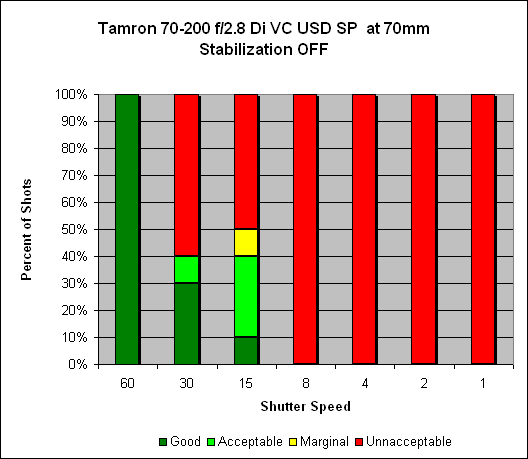
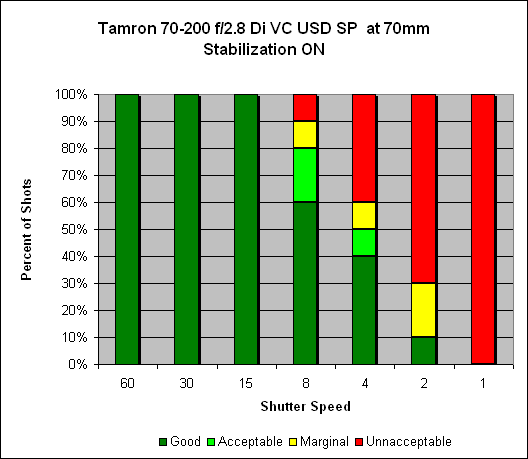
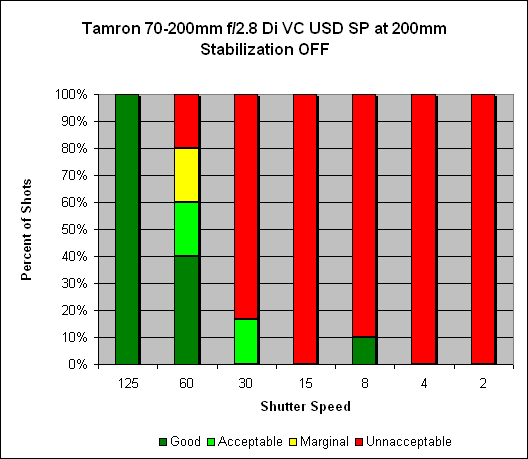
The lens features Tamron’s Vibration Control (VC) image stabilization system, offering 2.5 stops of hand-held improvement at 70mm, and around 3-3.5 stops at 200mm. It’s worth looking at our IS Test tab for greater detail.
The front threads on the lens take a 77mm filter, and are plastic. However, the front mount doesn’t rotate while focusing or zooming, so good news for polarizer users. The HA001 petal-shaped lens hood works well to prevent lens flare, and reverses on the lens for storage. The interior of the lens hood is ribbed. Using the hood will add almost 4 inches to the overall length of the lens.
Alternatives
Tamron 70-200mm ƒ/2.8 Di LD IF Macro SP AF ~$?
Tamron’s previous offering in the 70-200mm range actually produced slightly sharper results, at a lower price point, but didn’t include image stabilization. Some users might also find the manual focus switch slightly confusing.
Sigma 70-200mm ƒ/2.8 EX DG OS HSM APO ~$1,400
Sigma also produces a budget 70-200mm lens, and results for sharpness at ƒ/2.8 are similarly average; the lens handles slightly differently, but otherwise, they are very similar.
Canon EF 70-200mm ƒ/2.8L IS II USM ~$2,100
As one of Canon’s flagship lenses, it’s no surprise that the lens is significantly sharper than the Tamron – but also somewhat more expensive.
Nikon 70-200mm ƒ/2.8G ED VR II AF-S ~$2,400
Similarly to the Canon 70-200mm, the Nikon lens may cost significantly more, but it offers razor-sharp results at all the important apertures and focal lengths.
Sony 70-200mm ƒ/2.8 G SSM II ~$3,000
If you’re a Sony shooter, the Tamron is definitely an attractive option, if for price alone.
Conclusion
For shooters on a budget and who aren’t able to invest $2,000 on a professional 70-200mm lens, Tamron presents a solid, affordable option. There are definitely concessions to be made here, primarily in sharpness at the ƒ/2.8 setting, where the lens will probably spend most of its time.
An easy way to see if this lens is for you is to try it before you buy it – we test lenses often from Lens Rentals, including this one: LensRentals.com.
Product Photos
 |
 |
 |
 |
Sample Photos
Click here for Real-world Gallery Images on our Flickr page!
The VFA target should give you a good idea of sharpness in the center and corners, as well as some idea of the extent of barrel or pincushion distortion and chromatic aberration, while the Still Life subject may help in judging contrast and color. We shoot both images using the default JPEG settings and manual white balance of our test bodies, so the images should be quite consistent from lens to lens.


As appropriate, we shoot these with both full-frame and sub-frame bodies, at a range of focal lengths, and at both maximum aperture and ƒ/8. For the ”VFA” target (the viewfinder accuracy target from Imaging Resource), we also provide sample crops from the center and upper-left corner of each shot, so you can quickly get a sense of relative sharpness, without having to download and inspect the full-res images. To avoid space limitations with the layout of our review pages, indexes to the test shots launch in separate windows.
Description
(From Tamron lens literature) Tamron Co., Ltd. (President and CEO: Morio Ono / Headquarters: Saitama City), a leading manufacturer of optical equipment, announced the development of a full-size, high-speed telephoto zoom lens equipped with VC (Vibration Compensation) image stabilization, and USD (Ultrasonic Silent Drive) that achieves leading-edge image quality while boasting the most compact design in its class.
Product Features
- One special XLD (Extra Low Dispersion) *5 glass in concert with four LD (Low Dispersion) elements minimize chromatic aberrations. This combined with a new optical design that delivers high contrast and high resolution throughout the zoom range achieves leading-edge image quality.
- Tamron’s advanced multi-layer coating technology dramatically improves lens performance by reducing flare and ghosting for crisper, clearer images.
- The rounded diaphragm*6 affords the photographer spectacular blur effects, delivering the kind of rich expression only achievable with a high-speed telephoto zoom lens.
- The most compact*1 full-size, high-speed telephoto zoom lens with VC (Vibration Compensation)*2 image stabilization and USD (Ultrasonic Silent Drive)*3 in its class delivers superior mobility, enabling photographers to capture the previously unattainable.
- Features USD (Ultrasonic Silent Drive)*3 to power a speedy AF drive together with a continuous manual focus mechanism.
- The VC (Vibration Compensation)*2 image stabilization mechanism reduces camera shake to deliver sharp images.
- Moisture-resistant construction helps prevent moisture from penetrating the lens.
*1 For high-speed telephoto zoom lenses for full-size SLR cameras, equipped with VC image stabilization and USD. Current as of September 2012. (Source: Tamron)
*2 VC (Vibration Compensation) is Tamron’s proprietary image stabilization mechanism.
*3 USD (Ultrasonic Silent Drive) is Tamron’s proprietary ultrasonic motor drive.
*4 The Sony mount does not include VC, as Sony digital SLR bodies include image stabilization functionality. The Sony lens is designated as “SP 70-200mm F/2.8 Di USD”.
*5 The XLD (Extra Low Dispersion) glass is made from specialized high-grade glass, which offers greater chromatic aberration correction properties than LD (Low Dispersion) elements.
*6 This rounded diaphragm retains a nearly circular shape even when taken two stops down from its fully open state.
Image Stabilization
Most people tend to think of image stabilization as being mainly for telephoto lenses. While it’s true that their longer focal lengths tend to magnify the effects of camera shake, image stabilization can provde a very useful assist at wider angle focal lengths as well; anyone who’s ever tried to blur the image of a waterfall, while keeping the surrounding landsape tack-sharp knows exactly what I’m talking about.
At 70mm, we see around two and a half stops of hand-held image stabilization with VC activated. We can see that with the system disabled we get 100% sharp images at 1/60s, on par with the “one-over-focal length” rule of thumb; with the system activated, we get 100% sharp shots at 1/15s, and 60% sharp at 1/8s.
 |
| Mouse over this chart to show results with IS activated. |
Zoomed in to 200mm, we see around 3 and a half stops of hand-held improvement – with a bit of a caveat attached. With VC disabled, we’re already getting good hand-held performance – the rule of thumb holds we should be getting sharp shots starting at 1/200s, but Rob was getting 100% sharp at 1/125s – and with VC activated, we get sharp shots all the way down to 1/15s, and 50% sharp at 1/8s. The caveat is that only 50% of the shots at 1/15s are acceptably sharp. So as with most things in life – your mileage may vary.
 |
| Mouse over this chart to show results with IS activated. |
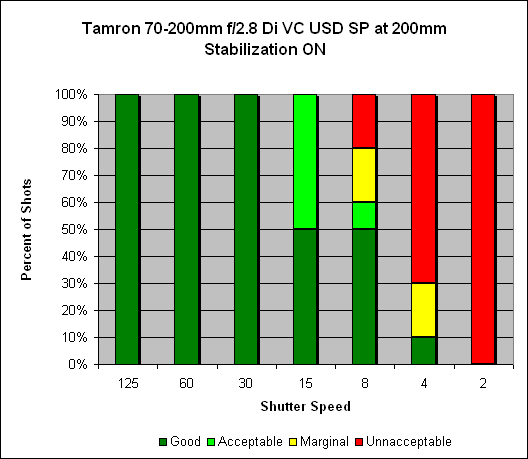
IS systems tend to provide more benefit to less-stable shooters than very steady ones, so most users will see the same or greater amounts of shake reduction as we measured here. You can read more about our IS test methodology here: SLRgear IS Test Methodology, v2.
Reader Reviews
- Image quality
- 9.5/10
- Build quality
- 9.3/10
- Recommend it
- 100%
- 10/10Recommendedby tokutomica · September 16 2015 · paid $1100
Pros: Very sharp, excellent VC
Cons: none
Before I bought this lens last year I owned a Nikkor 70-200 VRII, which disappointed me. I must have caught a cucumber. It was insanely sharp in the middle but deteriorated towards the edges very quickly. After many comparisons I eventually sold the Nikkor. Contrary to this test my copy is very sharp, even at 200mm and maximum aperture over a wide range. The image stabilization is a dream and the build quality, though not at the level of Nikon and Canon, is still very good. My own experiences are congruent with the tests of DXO and German COLORFOTO.
- 9/10Recommendedby nighthunter · December 26 2014
Pros: Seems to be well built
Cons: None so far
My first 70-200mm so cannot compare to Nikon or Canon Lens.
On the D800 feels well balanced.
Can see the VR kick in when 1/2 depressing focus button.Seems to focus quickly.
Images with the D800 and this lens.
https://www.dropbox.com/s/0cv68b6xettyblx/olivia%201.jpg?dl=0
- 10/10Recommendedby Cretu Stefan · December 17 2013
Pros: fast focus, optical quality, VC, focus ring in front
Cons: weight
An lens with exceptional optical quality is super sharp at 2.8.
Focus is almost instant and without noise.
Very good in low light. Colours are very good with a good contrast.VC does its job very well.
Some examples of photos you can see here
http://www.csdany.com/Private/Tamron-70200-VC-with-Nikon-D70/n-mvr3Z/i-MhnVDwX
- 9/10Recommendedby kamikaze99 · September 14 2013 · paid $1499
Pros: excellent performance, high quality build,super VC, great price
Cons: heavy
Just got this beauty, and man is it made like a tank, less weighty and almost the same length as the latest canon 70-200 f2.8 IS II). Sharpness is excellent, and better than my old Canon 70-200 f2.8 IS (the original). High contrast images and very fast focusing. Creamy bokeh.
VC is exemplary - I was able to consistently shoot sharp images at 1/25 sec at 200mm over 80% of the time at AI servo with my Canon 5D II.
Manual focusing is adequate, although the rubberized ring is too small, and opposite the direction of other canon zooms, which takes some getting used to. There are no settings for VC using a tripod, although I noticed no problems in this regard. Tamron could have offered a carrying case for this monster, as anything but a full sized camera bag will not accomodate this camera/lens combination. For those that want to lighten their load, I recommend you consider removing the collar ring.
DXOmark ratings confirm that sharpness is actually better than the canon 70-200mm f2.8 IS II except at 200mm, where it is slightly less sharp. Overall, I love this mama !!!
Reader reviews were submitted by Imaging Resource readers and are shown as written.