
DJI Launches the Osmo 360 II in China With 8K60p and Replaceable Lenses

Imaging Resource is reader-supported. When you buy through links on our site, we may earn an affiliate commission. How this works.
On this page
Table of Contents
 Dual 1-Inch Sensors and 8K60p Video
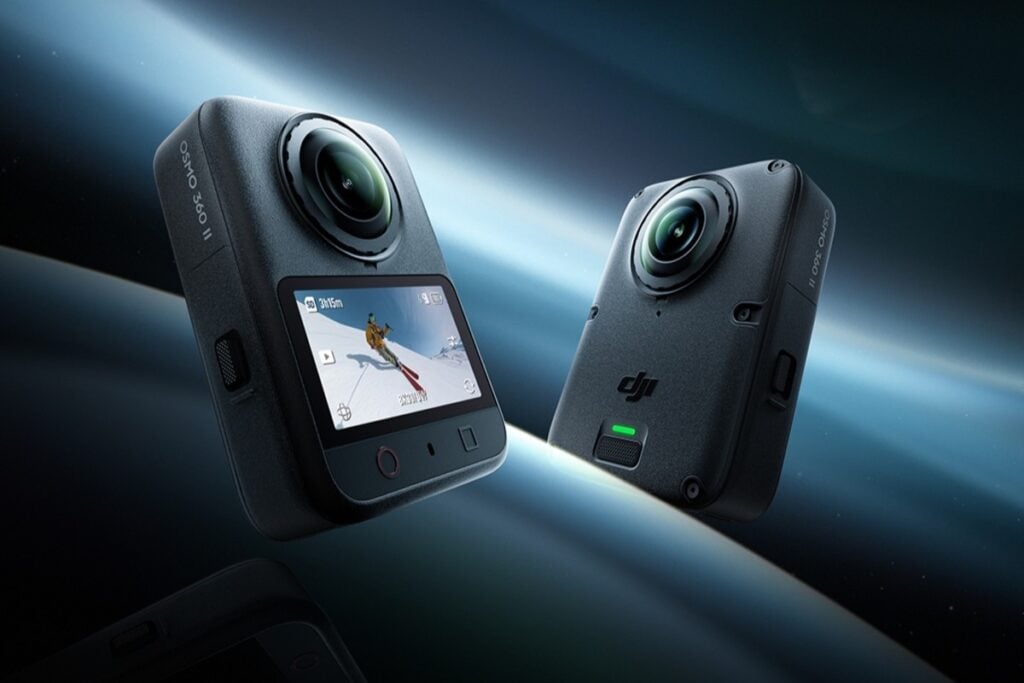
The DJI Osmo 360 II has officially arrived, although for now it is limited to the Chinese market. The new 360-degree action camera launches just one day after the Insta360 X6, setting up an interesting battle between the two companies’ latest flagship cameras.
The China-only launch isn’t particularly surprising given DJI’s recent approach to the US market following its ongoing FCC regulatory issues. DJI is expected to eventually bring the Osmo 360 II to other markets, but US availability remains uncertain.
Dual 1-Inch Sensors and 8K60p Video
At the heart of the Osmo 360 II are dual 1/1.1-inch sensors paired with f/1.9 lenses. The camera can record 360-degree video at up to 8K60p, while offering up to 14.5 stops of dynamic range when shooting in D-Log M.
The camera has an ISO range of 100-51,200 and can also capture 120-megapixel HDR panoramic stills. In single-lens mode, it can produce 30.72-megapixel photos.
For video, the Osmo 360 II supports 8K panoramic recording at up to 60fps, 6K panoramic recording at up to 60fps, and 4K single-lens recording at up to 60fps. Boost Video mode can push recording to 120fps at 4K and 2.7K in several aspect ratios.
Slow motion can reach 4K/240fps in panoramic mode. DJI Studio’s AI frame interpolation can also generate up to 8x slow motion from native 8K/60fps footage, effectively producing an output equivalent to 8K/480fps.
Improved Low-Light Performance
The Osmo 360 II gets a new AI SuperNight 2.0 mode for 8K60p recording. DJI says its new AI image noise reduction algorithm produces cleaner and brighter footage in low-light environments.
There is also a new Spotlight Follow mode that automatically tracks subjects in 360-degree video. Users can export the resulting subject-tracked 4K flat videos through the DJI Mimo or DJI Studio apps.
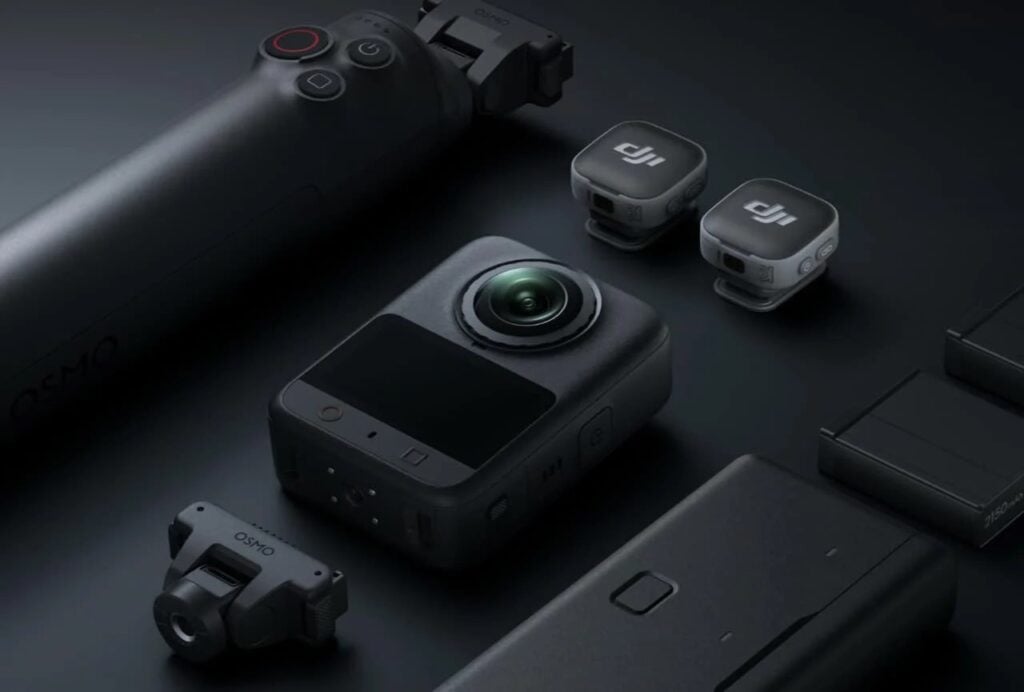
With the optional Osmo Vortex Rotating Handle, the camera can record 8K video at up to 120fps. It also supports 6K timelapse, although those files can only be exported through DJI Studio.
All video formats support 10-bit color, while D-Log M is available for video recording. D-Log M isn’t supported in Photo, Timelapse, or Endurance modes.
DJI’s RockSteady 3.0 and HorizonSteady stabilization systems are also included. When shooting in single-lens mode, HorizonSteady is available for standard 16:9 flat video at up to 60fps.
Replaceable Lenses
One of the more significant hardware changes is the ability to replace the Osmo 360 II’s lenses. This is particularly useful for an action camera with exposed lenses, where scratches and other damage can potentially render the camera difficult to use.
The lenses feature an ion-sputtered coating that DJI says survived 2,000 rubs with steel wool during laboratory testing without affecting image quality.
The Osmo 360 II measures 61 × 36.3 × 81mm and weighs 183g, keeping it relatively compact for a 360-degree camera.
Waterproofing and Audio
The camera has an IP68 rating for dust and water resistance and can be submerged to 10m without a dive case. With DJI’s Invisible Waterproof Case, the depth rating increases to 50m.
DJI recommends using the case for underwater shooting because the camera’s fisheye lenses can introduce image distortion underwater.
The Osmo 360 II has a 2-inch touchscreen with 800 nits of peak brightness and a four-microphone array with wind-noise reduction.
NFC Quick Connect is also supported for faster connections with the DJI Mimo app. Audio is recorded at 48kHz/16-bit AAC, with support for DJI OsmoAudio microphones including the DJI Mic 3 and DJI Mic Mini 2. The first-generation DJI Mic isn’t supported.
Bigger Battery and More Storage
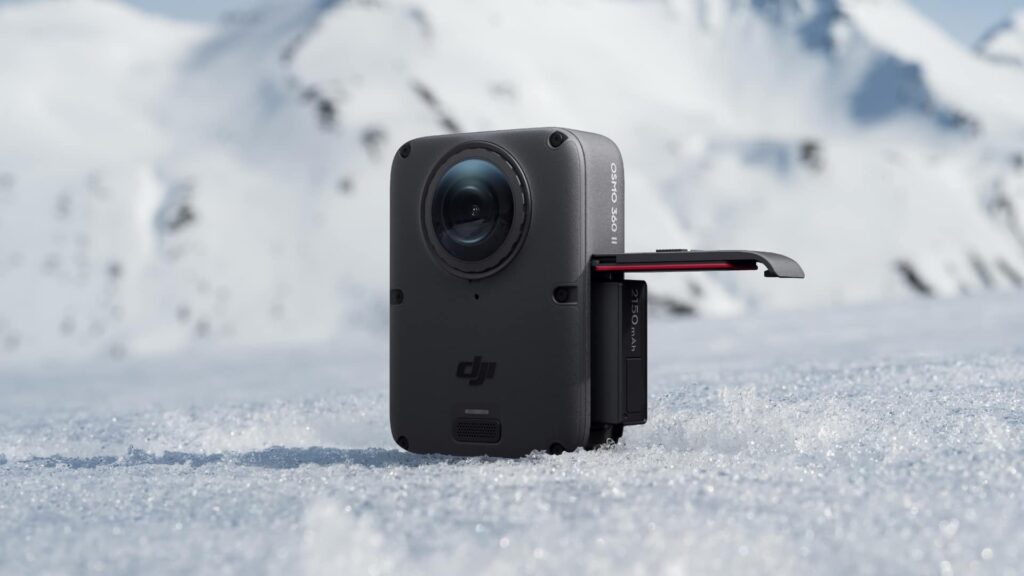
DJI has increased the battery capacity to 2,150mAh. The company rates it for up to 100 minutes of continuous 8K30p recording.
The battery can be charged to 80% in 22 minutes using a 30W or higher PD 3.0 charger. An optional Battery Extension Rod can add up to 180 minutes of additional runtime.
The Osmo 360 II can operate between -20°C and 45°C (-4°F to 113°F), while charging is supported between 5°C and 40°C (41°F to 104°F).
Storage has also received an upgrade, with 128GB of internal storage, of which 105GB is available to the user. A microSD card slot supports cards up to 1TB.
The camera uses the exFAT file system and supports JPEG and RAW photos as well as OSV and MP4 (HEVC) video.
Pricing and Availability
The DJI Osmo 360 II is priced at 3,899 HKD (around $499) for the standard bundle, while the Adventure Combo costs 4,699 HKD (around $599).
Those prices put the Osmo 360 II below the starting price of the Insta360 X6. However, that won’t mean much for US customers if DJI doesn’t bring the camera to the country.
DJI has not announced a global release date for the Osmo 360 II. The company’s Osmo Pocket 4P, for comparison, reached international markets around six weeks after its initial China launch. If DJI follows a similar schedule, the Osmo 360 II could potentially reach other markets before the end of September.
For now, though, the Osmo 360 II remains a China-only release, with US availability still uncertain.
More in News
 NewsViltrox Black Friday Sale Offers Up to 20% Off Lenses and Accessories13 Nov 2026
 NewsCosina Announces Voigtländer Nokton 35mm f/1.2 Aspherical for Sony E and Nikon Z13 Nov 2026
 NewsSony Registers New Camera, Sparking A7S IV Speculation12 Nov 2026
 NewsCampix Digital Camera Blows Past Kickstarter Goal With Its Retro Waist-Level Design12 Nov 2026
 NewsLeica Brings Rare Industrial Hammertone Finish to Two M-Series Cameras12 Nov 2026
 NewsBlack Friday camera deals 2026: best early discounts on cameras, lenses and more12 Nov 2026