


Overview

It's been a long four years for Sony A-mount fans, but the company is back with a new flagship model for its Alpha SLT-series camera line, and it's a beauty.
The first new Translucent Mirror camera launched since the Sony A68 made its debut almost a year ago, the Sony A99II reinforces the company's commitment to its SLR and SLT customers, including those shooting with older Konica and Minolta optics. And it does so at an important milestone: The tenth anniversary of the Sony Alpha camera line, which made its debut back in mid-2006 with the Sony A100, not long after the company acquired Konica Minolta's SLR camera business.
Sony A99II features a high-res, highly-sensitive 42-megapixel imager
At the heart of the A99II is a high-resolution, full-frame 42.4-megapixel CMOS image sensor using Sony's Exmor R backside-illumination technology. The sensor features a gapless design for maximum light-gathering efficiency, and includes on-chip phase detection autofocus pixels, which we'll come back to in a moment.

The sensor's sensitivity range encompasses ISO 100 to 25,600-equivalents by default, and can be expanded to cover everything from ISO 50 to 102,400-equivalents.
Fans of per-pixel sharpness will be pleased to note the absence of an optical low-pass filter in the design.
A99II offers more performance than you can shake a stick at!
The new sensor, Bionz X image processor and a new front-end LSI together allow extremely swift burst shooting from the A99II. At its fastest, you'll be able to capture as many as 12 frames per second with both autofocus and autoexposure adjustments between frames. Sony has finally addressed some of the concerns that inadequate write speed in its cameras left customers waiting after a burst of shots, as it noted that even in high-speed continuous shooting mode, the Sony A99 II will allow image review immediately after shooting.
Card write performance has been improved over prior models as well, but the A99 II still doesn't take advantage of faster UHS-II cards, which unfortunately means buffer clearing can still be rather slow. See our Performance page for details.

For an even better shooting experience, you may want to dial the burst capture rate back some. Sony notes that the A99 II has minimal display lag at a capture rate of eight frames per second, thanks to a reworked electronic viewfinder algorithm. Even slower burst rates of four or six fps are also available, if your subject doesn't warrant the camera's full performance.
With the Sony A99 II, the company debuts a new five-axis, in-body image stabilization system tailored specifically for A-mount cameras. Like that for mirrorless models which made its debut in the A7 II, the Sony A99 Mark II's image stabilization system can correct for X/Y translational motion, as well as for pitch, yaw and roll. And like the A7 II's system, it's said to have a 4.5-stop corrective strength.

A99II is weather-sealed and smaller than ever
The A99 II's brand-new body is said to be resistant to both dust and moisture, although Sony does note that it isn't guaranteed to be 100% dust or moisture-proof. Crafted from magnesium alloy and featuring a redesigned grip, the Sony A99II is a full 8% smaller than was its predecessor, and indeed is almost as small as the A77 II.
Among the changes to its body, the A99 II has a reworked the front-panel Silent Multi Controller dial. It now offers a user-selectable click detent, and can be used to control the aperture, shutter speed, ISO sensitivity, exposure compensation, autofocus area and mode, and more besides.
Like the A99 before it, the A99 Mark II sports dual SD card slots with UHS-I support, one of which is also compatible with Memory Stick Duo media. (As mentioned previously, it's a little surprising that faster UHS-II cards are still not supported, especially given the larger files.)
Oh, and Sony notes that as well as having redesigned the A99 II's body, it has also updated the menu design for better navigation.

The Sony A99 II is the company's first full-frame camera to sport its 4D Focus AF system, which pairs a 79 point (all cross-type) dedicated phase-detection autofocus sensor with a total of 399 on-chip phase detection points.
Ordinarily, the camera will operate using 79 hybrid AF points, pairing information from both the standalone sensor and the main imaging sensor. But of the 399 on-chip points, a total of 323 can be directly addressed as well, so you're not limited to just those points shared between the standalone and imaging sensors. (Presumably, the remaining 76 on-chip points which can't be directly addressed are used as assist points by the AF system.)
The A99II's autofocus system is rated to work down to an impressively dark -4 EV.

Just as in the A99, the A99 II's electronic viewfinder is based around a 1,024 x 768-pixel XGA Organic LED panel. Magnification has increased from 0.71x to 0.78x, though, so while the resolution is unchanged, the new finder will feel noticeably roomier.
To help keep it clear of fingerprints and smudges, the rearmost lens in the viewfinder has a fluorine coating. Sony has also applied Zeiss' T* coating to the viewfinder elements, helping to reduce glare and improve contrast.
The A99 II's three-inch, VGA (640 x 480 pixel) LCD monitor is not touch sensitive and retains the A99's three-way articulation mechanism that allows viewing from a wide variety of angles including in front of the camera. It's still a WhiteMagic-branded RGBW display with a dot count of 1,228,800. The extra white dot allows either greater brightness, or lower power consumption.

The A99II also sports a much more durable shutter mechanism than in its predecessor. (Not that the A99 was any slouch in the shutter life department, either!)
Where the original A99's shutter was rated for a lifetime of around 200,000 cycles, the Mark II now boasts a 300,000-cycle lifetime for its shutter mechanism.
Another tweak since the A99 is the addition of 100 / 120Hz flicker detection. When the camera notes the presence of flicker, it will time the shutter accordingly to ensure your image is captured at the peak brightness.
In the past, Sony offered two variants of the original A99 camera. One, the A99, forewent GPS connectivity; the other, the A99V, included a built-in GPS receiver. With Sony's main focus these days being on its mirrorless cameras, it doubtless can't justify having two nearly-identical products that differ only in the availability of GPS, though, and so the Sony A99 II can instead piggyback on your smartphone for geolocation information.

Location data is transferred via Bluetooth, so battery life of the camera hopefully shouldn't be affected too significantly. Of course, you'll be reducing your smartphone's battery life when using the function, as the phone's GPS receiver and Bluetooth radio will need to be active, but if you want geolocation without the need to fuss with external accessories, this is doubtless better than having no GPS access at all.
In addition to Bluetooth 4.1 support, the Sony A99 II also gets built-in Wi-Fi with NFC, both of which the A99 didn't have, and it retains the A99's infrared remote sensor. Wired connectivity options are similar, however the HDMI port now uses a smaller Micro Type-D connector instead of a Mini Type-C connector, and the USB 2.0 port also shrinks down to a Micro-B type connector from a Mini-B. The Sony A99 II continues to include a Multi Interface Hot Shoe, a DC input jack, a wired remote jack, a PC sync terminal, a 3.5mm external mic jack and a 3.5mm headphone jack.
Battery life is CIPA-rated at 490 shots per charge when using the LCD monitor or 390 shots when using the EVF using the same NP-FM500H lithium-ion battery pack as the A99. That's down just slightly from 500 and 410 shots respectively which is actually pretty amazing considering the massive increase in resolution and performance. That's significantly lower than most DSLRs, though, so you should definitely consider getting the optional VG-C77AM Vertical Battery Grip and a second battery to double battery life.

Sony A99II video: 4K capture in-camera is a first for the Sony A-mount
Perhaps the area in which we've progressed most of all since the original Sony A99 is in the video department. High-def is old hat; ultra high-def capture is where it's at these days. Tipping its hat to this fact, the Sony A99II is the first A-mount camera to feature 4K video capture.
The A99II can record 4K internally with full-pixel readout across the entire sensor width, and no pixel binning, hence quality should be good. Sony's XAVC S compression format is used, and the A99II can record at up to a 100Mbps bitrate.
Nor is 4K capture the only feather in the A99 II's cap. It can also record at anywhere from one to 120 frames per second in its Slow and Quick mode, with a total of eight capture rates offered between the maximum and minimum speeds. This allows anywhere from a 60x fast-motion to a 5x slow-motion effect. And Sony has also included support for clean HDMI output, time code, picture profiles, zebra-striping and S-Log / S-Log 2 / S-Log 3 gamma in the A99II.

Sony A99 II price and availability
The A99 II began shipping in the US market from November 2016 and is sold body only. List price is set at around US$3,200 in the US market, and around CA$4,000 in the Canadian market.
In the Box
The Sony A99 II retail box (as reviewed) contains the following items:
- Sony Alpha A99 II Body (ILCA-99M2)
- NP-FM500H InfoLithium Battery (7.2V, 1650mAh)
- BC-VM10A Battery Charger
- Body cap
- Shoulder strap
- Accessory shoe cap
- Eyepiece cup
- Micro USB cable
- Warranty card
Recommended Accessories
- Large capacity SDHC/SDXC memory cards. 32GB UHS-I should be a minimum.
- Extra battery pack NP-FM500H (~US$48)
- Sony Vertical Battery Grip (~US$298)
- Sony external flash (~US$150-US$550)
- Large DSLR bag
- An assortment of A-mount lenses if you don't already have some
Optics
The Sony A99 II is usually sold body-only, so we have no "kit" lens optical test results to share here. Below are our A99 Mark II viewfinder accuracy test results.
Viewfinder Test Results
Coverage
Very good accuracy from the EVF and LCD monitor.


The Sony A99 II's OLED electronic viewfinder and LCD monitor both show just over 99% coverage with our Carl Zeiss FE 85mm F1.4 ZA prime lens. Very good performance.
The images above were taken from our standardized test shots. For a collection of more pictorial photos, see our Sony Alpha ILCA-A99 II Photo Gallery .
Exposure
Color
Saturation & Hue Accuracy
Typical saturation levels and hue accuracy.
 |
|||
|
ISO Sensitivity
|
|||
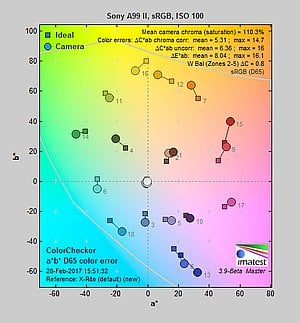
| In the diagram above, the squares show the original color, and the circles show the color that the camera captured. More saturated colors are located toward the periphery of the graph. Hue changes as you travel around the center. Thus, hue-accurate, highly saturated colors appear as lines radiating from the center. Mouse over the links to compare ISOs and click on a link for a larger version. | |||
Saturation. The Sony A99 II's mean default color saturation is 110.3% at base ISO or in other words, oversaturated by 10.3%. That's about average for cameras we've tested these days. Mean saturation remains very stable across up to ISO 1600, after which is begins to gradually drop as sensitivity rises to a minimum of 106.1% at maximum ISO. Reds, dark blues and dark green are boosted the most, which is again typical. Most other colors are pushed just a bit, though light green is slightly undersaturated, and yellow is moderately undersaturated. Overall, saturation levels are quite pleasing to our eyes, and you can of course tweak saturation if you wish. Most consumer digital cameras produce color that's more highly saturated (more intense) than found in the original subjects. This is simply because most people like their color a bit brighter than life.
Skin tones. The Sony A99 II does fairly well with Caucasian skin tones. Brighter flesh tones have a healthy-looking pinkish tint, though darker areas are nudged slightly toward orange. Still, pretty realistic results here. Where oversaturation is most problematic is on Caucasian skin tones, as it's very easy for these "memory colors" to be seen as too bright, too pink, too yellow, etc.
Hue. Like many cameras, the Sony A99 II shifts cyan toward blue, red toward orange, orange toward yellow and yellow toward green, but shifts are relatively minor. (The cyan to blue shift is actually fairly minor and very common among the digital cameras we test; we think it's a deliberate choice by camera engineers to produce better-looking sky colors. The yellow to green shift combined with its desaturation is however unfortunate, as it can produce somewhat dingy-looking yellows.) With an average "delta-C" color error of 5.31 after correction for saturation at base ISO, overall hue accuracy is about average, with accuracy only falling slightly at higher ISOs. Hue is "what color" the color is.


Sensor
Exposure and White Balance
Indoors, incandescent lighting
Warm casts with Standard and Ambience Auto white balance; Incandescent is pretty good, and Manual is very good. Less than average exposure compensation required.


Indoors, under normal incandescent lighting, color balance was a bit too warm and orange with the default Standard Auto white balance setting, though results with the White Auto setting were pretty good with just a slight magenta tint. The Ambience Auto white balance setting was very warm, as expected. Results with the Incandescent setting were quite good and only slightly warm and yellow. Results with the Manual setting were the most accurate, though just slightly cool. The Sony A99 II required no exposure compensation here, while +0.3 EV is about average for this shot. (Our test lighting for this shot is a mixture of 60 and 100 watt household incandescent bulbs, a pretty yellow light source, but a very common one in typical home settings here in the U.S.)
Outdoors, daylight
Very good handling of contrast, color, and exposure under harsh lighting.
Outdoors, the Sony A99 II performed extremely well. +0.7 EV exposure compensation was required to keep the mannequin's face reasonably bright in our "Sunlit" Portrait shot, which is about average among the cameras we've tested. Contrast is a little high as you might expect under such harsh lighting, but despite the bright appearance, the camera does a great job of holding onto detail in both the highlights and shadows, even without the help of DRO. We preferred Manual color balance for our "Portrait" shot, though Auto white balance produced very similar and pleasing results. Default exposure is pretty good in our Far-field shot; perhaps just a touch dim, but as a result almost no highlights were blown however there are some dark shadows that can be a little noisy and discolored at the lowest levels. The Far-field shot with Auto white balance has pleasing color, though a bit cool. Overall, very good performance in harsh lighting, especially considering DRO was off for these shots.
See full set of test images with explanations
See thumbnails of all test and gallery images
Resolution
~3,700 lines of strong detail from JPEGs, about the same from RAW files.


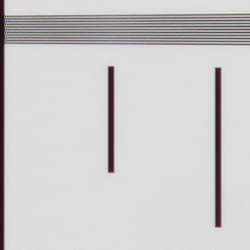
An in-camera JPEG of our laboratory resolution chart reveal sharp, distinct line patterns down to about 3,700 lines per picture height in the horizontal direction and to about 3,700 lines per picture height in the vertical direction, though some minor aliasing can be seen starting as low as about 2,800 lines. Complete extinction of the pattern didn't occur before the 4,000 line limit of our chart in both directions. Adobe Camera Raw wasn't really able to extract more resolution here from matching RAW files, but it produced more color moiré and false colors as it often does. Use these numbers to compare with other cameras of similar resolution, or use them to see just what higher resolution can mean in terms of potential detail.
See full set of test images with explanations
See thumbnails of all test and gallery images
Sharpness & Detail
Remarkable detail and sharpness, with very few sharpening artifacts. Mild noise suppression visible in the shadows and areas of low contrast.


Sharpness. The Sony A99 II captures incredibly sharp, crisp and detailed images overall, and it doesn't leave behind heavy sharpening halos around edges with high contrast that we often see around the lines and letters of our bottle label crop (above left). The A99 II's RAW images don't need a lot of sharpening because of the lack of an optical low pass filter, but Sony really has done an excellent job with the A99 II's low-ISO JPEG processing. Edge enhancement creates the illusion of sharpness by enhancing colors and tones right at the edge of a rapid transition in color or tone.
Detail. The crop above right shows fairly mild noise suppression in the darker areas of the mannequin's hair. A number of low-contrast strands are smudged together, though higher contrast strands are distinct, though as you can see some suffer from the "jaggies" and other aliasing artifacts (see below). Still, outstanding results here considering the resolution. Noise-suppression systems in digital cameras tend to flatten-out detail in areas of subtle contrast. The effects can often be seen in shots of human hair, where the individual strands are lost and an almost "watercolor" look appears.


Aliasing Artifacts. As mentioned previously the Sony A99 II captures incredibly sharp, detailed images thanks to its very high resolution and lack of an optical low pass filter, but that means it's also susceptible to moiré and other aliasing artifacts when used with a sharp lens. As you can see in our Still Life shots, moiré patterns can for instance be seen in the red-leaf fabric as well as in the Samuel Smith bottle label as shown in the crops above.
With the increasing trend of using either a very weak or no optical low pass filter, quite a few cameras produce similar artifacts these days, and the A99 II's JPEG processing engine actually does a good job at suppressing aliasing-related false colors in our Resolution target. But it's not fool proof as we've shown, and luminance moiré is much more difficult to deal with. That's something to be aware of especially if you shoot a lot of man-made subjects with repeating patterns, such as buildings, fabrics, etc. Techniques than can be used to reduce aliasing include shooting at a smaller aperture so that lens diffraction acts as an anti-alias filter, defocusing slightly, shooting at higher ISOs, as well as trying different RAW converters and processing tools.
RAW vs In-Camera JPEGs
As noted above, the Sony A99 II produces in-camera JPEGs with incredible amounts of crisp detail. Additional detail can often be obtained from carefully processing RAW files with a good converter, so let's have a look at base ISO:
| Base ISO (100) | |
 |
 |
 |
 |
 |
 |
|
Camera JPEG, defaults
|
RAW via Adobe Camera Raw
|
In the table above, we compare an in-camera JPEG taken at base ISO using default noise reduction and sharpening (on the left) to the matching RAW file converted with Adobe Camera Raw 9.1 via DNG Converter 9.9 using default noise reduction with some moderate but tight unsharp masking applied in Photoshop (250%, radius of 0.3 pixels, and a threshold of 0).
As you can see, the Adobe Camera Raw conversion renders a touch more detail than the camera, while higher contrast and saturation makes the in-camera image pop a bit more, but the ACR conversion also reveals a bit more luminance noise in flat areas. You can always turn up the luminance noise reduction (default of zero was used here), though noise levels are already quite low. Also note the moiré pattern in the red-leaf pattern in both images.
Bottom line: Although Adobe Camera Raw is able to extract a little more detail, there's really very little to complain about the Sony A99 II's JPEG engine at low ISOs. It provides a great balance of fine, crisp detail, low noise, and low sharpening artifacts straight out of the camera, and some may actually prefer it over the default ACR conversion.
ISO & Noise Performance
Very good high ISO performance.
|
Default High ISO Noise Reduction
|
 |
 |
 |
| ISO 50 | ISO 100 | ISO 200 |  |
 |
 |
| ISO 400 | ISO 800 | ISO 1600 |
 |
 |
 |
| ISO 3200 | ISO 6400 | ISO 12,800 |
 |
 |
 |
| ISO 25,600 | ISO 51,200 | ISO 102,400 |
The Sony A99 II's JPEG images are quite clean and extremely detailed at ISOs 50 though 400, with very little image degradation, and image quality drops in a nice, very gradual manner up to ISO 1600. ISO 3200 produces a more noticeable drop in image quality with higher luma noise and some minor noise reduction artifacts, however fine detail is still quite good, and chroma noise is very low. ISO 6400 shows more noise and artifacts from noise reduction, but fine detail is still pretty good, and the often more objectional chroma noise remains low. ISO 12,800 is significantly noisier and sharpening combined with strong noise reduction give the image a slightly hammered look in darker areas and shadows, and chroma noise is now visible in the form of subtle purple and yellow blotches, though fine detail is still fair. Image quality drops rapidly from ISO 25,600 on, though, with images that look almost like paintings with a stippled effect and strong chroma blotching becomes an issue as well.
Overall, the A99 II offers very good high ISO performance especially considering its resolution and pixel size. As always, see the Print Quality section below for maximum recommended print sizes at each ISO.
A note about focus for this shot: We used to shoot this image at f/4, however depth of field became so shallow with larger, high-resolution sensors that it was difficult to keep important areas of this shot in focus, so we have since started shooting at f/8, the best compromise between depth of field and sharpness.
Extremes: Sunlit, dynamic range and low light tests
Excellent highlight and shadow detail. Excellent low-light performance, capable of capturing bright images in near darkness.


Sunlight. The Sony A99 II handled the deliberately harsh lighting in the test above very well. We preferred the +0.7 EV exposure here, as the default 0 EV and +0.3 EV exposures are too dim in the face while the +1.0 EV exposure has a few too many blown highlights. Contrast is a little high, but shadow and highlight detail are both very good. Despite the bright appearance, few highlights are blown in the model's shirt and face at +0.7 EV, though the red channel is clipped in some of the flowers as is often the case, and in specular highlights where you'd expect clipping. There are some dark shadows however they have lots of detail, though very deep shadows are a bit noisy, posterized and discolored as expected. Overall, excellent performance here.
For best results, be sure to use fill flash in situations like the one shown above; it's better to shoot in the shade when possible. See below for results with Dynamic Range Optimization and High Dynamic Range features enabled.
Because digital cameras are more like slide film than negative film (in that they tend to have a more limited tonal range), we test them in the harshest situations to see how they handle scenes with bright highlights and dark shadows, as well as what kind of sensitivity they have in low light. The shot above is designed to mimic the very harsh, contrasty effect of direct noonday sunlight, a very tough challenge for most digital cameras. (You can read details of this test here. In actual shooting conditions, be sure to use fill flash in situations like the one shown here; it's better to shoot in open shade whenever possible.)
| Face Detection | ||
 |
 |
 |
| Aperture Priority, 0 EV Face Detection Off |
Aperture Priority, 0 EV Face Detection On |
Auto Mode, 0 EV |
Face Detection. Like most cameras these days, the Sony A99 II has the ability to detect faces (up to 8 in a scene), and adjust exposure and focus accordingly. As you can see from the examples above, face detection worked as expected in Aperture Priority at f/8, producing a much brighter image than without it by reducing the shutter speed from 1/30 to 1/15s (that's quite slow for handheld and the type of subject, but the camera had little choice since the aperture and ISO was manually selected). Full Auto mode did a bit better than Aperture Priority without face detection, though it's still too dim despite detecting a face. It selected a larger aperture of f/4.5 while maintaining a relatively fast shutter speed of 1/100s, and automatically applied DRO (see below) to reduce overall contrast.


Dynamic Range Optimization is Sony's name for their dynamic range enhancement technology. DRO divides the image into small areas, analyzes the range of brightness of each area, and adjusts the camera's image processing parameters accordingly to make the best use of the available dynamic range. Auto DRO is enabled by default on the Sony A99 II. You can also set the level manually, from 1 ("weak") to 5 ("strong"), or turn it off. As one would expect, DRO is only available for JPEG files.
The above thumbnails and histograms show the effects of the various levels of DRO on our "Sunlit" Portrait shot with no exposure compensation. Mouse over the links on the right to load the associated thumbnail and histogram, and click on the link to visit the full resolution image. As you can see from the thumbnails and associated histograms, increasing DRO progressively boosts shadows and midtones while leaving highlights essentially intact, though boosting shadows does make noise slightly more visible. The Auto setting did an okay job overall though results were still a bit too dim, and the five manual levels give quite a bit of control over the effect.

Above, you can see the effect of DRO settings on our Far-field shot. A useful feature that works well.


High Dynamic Range. The Sony A99 II's HDR mode takes three images in rapid succession, one nominally exposed , one underexposed, and one overexposed, then combines them into one high dynamic range JPEG automatically. Lighter areas from the underexposed image are combined in-camera with darker areas from the overexposed image to produce an image with compressed tonal range. The camera then saves a single composite image, as well as the nominally exposed image. The overlaid images are micro-aligned by the camera, but it can only correct for so much movement. If it can't micro-align successfully, an icon indicating HDR capture failed will appear. For best results, the subject should not move or even blink, so it's not really intended for portraits. There is also a manual mode where you can select 1 EV ("weak") to 6 EV ("strong") difference in exposures.
Mouse over the links to load the associated thumbnail and histogram, and click on the link to visit the full resolution image. As you can see, the Auto setting did a decent job, similar to the 3 EV manual setting. The higher the manual setting, the more highlights were toned-down and shadows opened up, but as you can see higher settings can produce flat and unnatural results with this subject.
Above, you can see the effect of HDR settings on our Far-field shot. Watch out for ghost images from subject movement during the capture sequence, though, as can be seen in some of the shots above. It appears that the A99 II attempts to eliminate them during the merging process, but isn't always 100% successful.
Dynamic Range Analysis (RAW mode). While we once performed our own dynamic range measurements based on in-camera JPEGs as well as converted RAW images (when the camera was supported by Adobe Camera Raw), we've switched to using DxO Labs' results from their DxOMark website. As technology advanced, the dynamic range of modern high-end cameras in some cases exceeded the range of the Stouffer T4110 density scale that we used for our own measurements. DxO's approach based on RAW data before demosaicing is also more revealing, because it measures the fundamental dynamic range of the sensor, irrespective of whatever processing is applied to JPEGs, or to RAW data by off-the-shelf conversion software.
In the following, we use DxO's "Print" dynamic range results, which are scaled based on camera resolution. As the name suggests, this scaling corresponds to the situation in which you print at a given size, regardless of how many megapixels the camera might have. (In other words, if you've decided to make a 13x19 inch print, that's the size you're printing, whether the camera's resolution is 16 or 300 megapixels.) For the technically-minded, you can find a discussion of the reasoning behind this here on the DxOMark website. Also note that DxO Labs uses a signal-to-noise (SNR) threshold of 1 when defining the lower boundary of acceptable luminance noise in their dynamic range measurements, which corresponds to the "Low Quality" threshold of the Imatest software we used to use for this measurement.

Here, we compare the Sony A99 II's dynamic range to its predecessor's, the A99 as well as to the Nikon D810's, the current full-frame dynamic range champion.
As you can see from the above graph (click for a larger image), the A99 II's dynamic range (orange) isn't quite as high as the A99's (yellow) at the lowest ISOs. The A99 II's dynamic range at its ISO 100 setting is 13.35 EV, while the A99 managed 13.95 EV at its lower base ISO of 50, and even at ISO 100, the A99 bests the A99 II by 0.3 EV. But look what happens above the ISO 400 setting -- the A99 II overtakes the A99, and offers about an EV advantage at most ISOs above 800, and almost two stops at the top shared ISO setting of 25,600.
The class-leading Nikon D810 (in red) easily outperforms the Sony A99 II at lower ISOs, with about a 1.4 EV advantage at base ISO (14.76 vs 13.35), but the Sony gradually catches up at about the ISO 800 setting, and then slightly exceeds or matches the Nikon at higher ISOs.
Bottom line: Excellent dynamic range from the Sony A99 II at higher ISOs, however it lags behind its predecessor and some other leading full-frame competitors at lower ISOs. Click here to visit the DxOMark page for the Sony A99 II for more of their test results and additional comparisons.
| 1 fc 11 lux |
1/16 fc 0.67 lux |
1/16 fc No NR |
|
|---|---|---|---|
| ISO 100 |
 2.5s, f2.8 |
 30s, f2.8 |
 30s, f2.8 |
| ISO 3200 |
 1/13s, f2.8 |
 1.3s, f2.8 |
 1.3s, f2.8 |
| ISO 25600 |
 1/100s, f2.8 |
 1/6s, f2.8 |
 1/6s, f2.8 |
Low Light. The Sony A99 II performed very well in our low light tests, producing usable exposures with very low noise down to the lowest light level we test at (1/16 fc) at base ISO of 100. Noise is very low at base ISO and still fairly low at ISO 3200, though as expected, at the highest native ISO of 25,600 noise is a bit high but images are still usable.
Banding in deep shadows (fixed pattern noise) is almost nonexistent and we didn't detect any issues with heat blooming or hot pixels. We did spot some slightly bright pixels in deep shadows especially when long exposure noise reduction is turned off (rightmost column above) where you'd expect to see them, though that's not unusual.
Auto white balance did a very good job here, producing a fairly neutral, just slightly cool color balance at one foot-candle that warmed up slightly at 1/16 foot-candle.
Low-light AF: The Sony A99 II's autofocus system was only able to focus on our low-contrast AF target down to -0.5 EV or about 1/6 foot-candle with an f/2.8 lens which isn't great, however it was about to focus down to -4.7 EV on our high-contrast AF target which is quite good. The Sony A99 II does not have a built-in AF assist illuminator, however it can make use of one provided by a compatible flash unit attached.
How bright is this? The one foot-candle light level that this test begins at roughly corresponds to the brightness of typical city street-lighting at night. Cameras performing well at that level should be able to snap good-looking photos of street-lit scenes. (A useful trick is to just prop the camera on a convenient surface, and use its self-timer to release the shutter. This avoids any jiggling from your finger pressing the shutter button, and can work quite well when you don't have a tripod handy.)
NOTE: This low light test is conducted with a stationary subject, and the camera mounted on a sturdy tripod. Most digital cameras will fail miserably when faced with a moving subject in dim lighting. (For example, a child's ballet recital or a holiday pageant in a gymnasium.) Thanks to its larger sensor and Hybrid AF, compact system cameras like the Sony A99 II tend to do better than point & shoots, but you still shouldn't expect a quick autofocus lock with moving subjects.
Output Quality
Excellent 30 x 40 inch prints all the way up to ISO 800; Very good 13 x 19 inch print at ISO 6400; Usable 5 x 7 at ISO 25,600.
 ISO 50 through 800 prints are amazing, with the Sony A99 II capable of providing huge prints up to 30 x 40 inches that are crisp, sharp and vibrant at any of these ISOs. ISO 50-200 images look nearly identical, while ISO 400-800 do show just a hint of shadow noise, but not nearly enough to affect print size. 30 x 40 is the largest print size we test, so it really depends on how much you're willing to push the sensor's resolution in creating larger prints. Overall, though, stunning print quality at these lower ISOs!
ISO 1600 images start to show a bit more shadow noise, which softens up some very fine detail. However, there's still an exceptional amount of detail throughout and pleasing colors in these prints, making for a healthy 24 x 36 inch print at this ISO.
ISO 3200 prints top-out at an impressively large 20 x 30 inches. Noise and the effects of default noise reduction are more apparent now in the shadow areas, but there's still a lot of fine, low-contrast detail, such as in our fabric swatches and even visible moiré patterns in one of the bottle labels.
ISO 6400 images show an increase in noise and noise reduction processing, which hurts fine detail for larger print sizes. However, the A99 II is still capable of nice prints at this ISO up to 13 x 19 inches.
ISO 12,800 prints offer an impressive level of detail up to 8 x 10 inches. Noise, especially in shadow areas, is much stronger now and prevents us from accepting larger print sizes.
ISO 25,600 images show pretty strong noise and a lack of fine detail up to any print size larger than 5 x 7 inches.
ISO 51,200 and 102,400 prints, unfortunately, are simply too soft and too noisy for us to consider usable for prints. Perhaps for less critical applications, a 4 x 6 at ISO 51,200 might be usable, but we'd recommend avoiding these two upper ISO settings for prints.
As with previous full-frame 42-megapixel Sony cameras, the A99 Mark II does extremely well in our print quality testing. From expanded low ISO 50 all the way up to ISO 800, you're pretty much free to print as large as you need to. The fine detail and pleasing colors look fantastic up to our maximum 30 x 40 inch print test -- the 42MP sensor really shows off its resolving power. Thanks to the large sensor and good image processing, the A99 II is also capable of excellent, impressively large prints, even as the ISO rises. ISO 3200 nets you up to 20 x 30 inch prints, while even ISO 12,800 works for a solid 8 x 10. For us, we'd recommend stopping at ISO 25,600 for prints, which tops-out at 5 x 7 inches, as the two higher ISOs available produce prints that are too noisy and too soft for our tastes.
The images above were taken from our standardized test shots. For a collection of more pictorial photos, see our Sony Alpha ILCA-A99 II Photo Gallery .
Not sure which camera to buy? Let your eyes be the ultimate judge! Visit our Comparometer(tm) to compare images from the Sony Alpha ILCA-A99 II with those from other cameras you may be considering. The proof is in the pictures, so let your own eyes decide which you like best!
Performance
Timing and Performance
Excellent performance overall, though buffer clearing is slow.
| Startup/Play to Record | ||
|---|---|---|
| Power on |
~1.2 seconds
|
Time it takes to turn on and capture a shot. |
|
Play to Record, |
~1.0 second
|
Time until first shot is captured. |
The Sony A99 Mark II's startup time (power on to first shot) was sluggish compared to most DSLRs. Switching from Play to Record mode and taking a shot was also a tad slow for its class.
| Shutter Response (Lag Time) | ||
|---|---|---|
|
Full Autofocus, |
0.111 second
|
Time from fully pressing shutter button to image capture, with the lens already at the proper focal distance setting. (All timing performed with a Sony 24-70mm f/2.8 ZA Zeiss lens.) |
| Manual Focus |
0.113 second
|
For most cameras, shutter lag is less in manual focus than autofocus, but usually not as fast as when the camera is "prefocused". |
|
Prefocused |
0.052 second
|
Time to capture, after half-pressing and holding shutter button. |
The Sony A99 Mark II's full-autofocus shutter lag (with the subject at a fixed distance) was fast, measuring only 0.111 second in Single-area (Center) AF mode with the Zeiss 24-70 f/2.8 kit lens at a medium focal length. It did however vary a bit in our tests, with about an 11% variation in speed over 10 trials.
When manually focused, the Sony A99 Mark II's shutter lag was about the same at 0.113 second, but with less variation. The A99 Mark II's prefocused shutter lag was only 0.052 second, very fast.
To minimize the effect of different lens' focusing speed, we test AF-active shutter lag with the lens already set to the correct focal distance.
| Cycle Time (shot to shot) | ||
|---|---|---|
| Single Shot mode |
< 0.3 second
|
Time per shot, averaged over a few frames (we no longer test for buffer depths in single-shot mode). |
|
Single Shot mode |
< 0.3 second
|
Time per shot, averaged over a few frames (we no longer test for buffer depths in single-shot mode). |
| Early shutter |
No
|
Some cameras don't snap another shot if you release and press the shutter too quickly in Single Shot mode, making "No" the preferred answer. |
|
Continuous Hi+ |
0.10 second
(10.53 fps); 61 frames total; 56 seconds to clear* |
Time per shot, averaged over 61 frames, then slowed to an average of about 1.04s or 0.96 fps when buffer was full. |
|
Continuous Hi+ |
0.09 second
(11.11 fps); 25 frames total; 34 seconds to clear* |
Time per shot, averaged over 25 frames, then slowed to an average of about 1.26s or 0.80 fps when buffer was full. |
|
Continuous Hi+ |
0.09 second
(10.93 fps); 59 frames total; 40 seconds to clear* |
Time per shot, averaged over 59 frames, then slowed to an average of about 0.75s or 1.33 fps when buffer was full. |
|
Continuous Hi+ |
0.09 second
(10.58 fps); 24 frames total; 62 seconds to clear* |
Time per shot, averaged over buffer length of 24 frames, then slowed to 2.54s or 0.39 fps when buffer was full. |
|
Continuous Hi+ |
0.08 second
(11.83 fps); 56 frames total; 56 seconds to clear* |
Time per shot, averaged over buffer length of 56 frames, then slowed to 1.01s or 0.99 fps when buffer was full with a lot of variation. |
|
Flash Recycling |
N/A
|
Flash at maximum output. |
|
*Note: Buffer clearing times measured with a SanDisk Extreme Pro 95 MB/sec UHS-I SDHC card. Slower cards will produce correspondingly slower clearing times. Slow cards may also limit length of bursts in continuous mode. ISO sensitivity and noise reduction settings can also affect cycle times and burst mode performance.
|
||
Single-shot cycle times were very fast, at less than 0.3s for both Large/Extra Fine JPEGs and RAW + Large/Fine JPEG frames. (Note that we no longer test single-shot mode with just RAW files, as the results are usually somewhere in between JPEG and RAW+JPEG modes. Also note that the A99 II cannot capture highest quality "Extra Fine" JPEGs together with RAW, dropping to "Fine" for best quality JPEGs when shooting RAW+JPEG.)
The Sony A99 II's top Continuous Hi+ mode was very fast at about 10.5 frames per second for best quality Large/Extra Fine JPEGs which is outstanding considering the resolution, though that's noticeably short of Sony's approx 12 frames per second max rating. When shooting just RAW files, the frame rate increased to 10.9 fps for compressed files and 11.1 fps for uncompressed files, but that's still short of 12 fps. When shooting uncompressed RAW + Large/Fine JPEGs, the frame rate was 10.6 fps but when shooting compressed RAW + Large/Fine JPEGs, the frame rate was 11.8 fps, pretty close to Sony's max spec. Note that the aperture is locked when the first shot is taken in Hi+ mode but continuous AF is still supported depending on the lens and aperture used (see the Sony A99 II user manual for details). The Sony A99 II also as Hi, Mid and Low continuous modes rated at 8, 6 and 4 fps respectively, however we did not test those modes in the lab.
Buffer depths were pretty good considering the burst rate and 42-megapixel resolution at 61 Large/ Extra Fine JPEGs, 25 uncompressed RAW and 24 uncompressed RAW + Large/Fine JPEG files before the burst rate slowed down. We also tested compressed RAW mode to see how much difference it made, but be aware Sony's compression is lossy. Buffer depths increased dramatically with compressed RAW, from 25 to 59 RAW frames and from 24 to 56 RAW + Large/Fine JPEG frames. Buffer-full rates were quite slow, though, ranging from only 0.39 fps for uncompressed RAW + Large/Fine JPEGs to 1.33 fps for compressed RAW.
Buffer clearing after max-length bursts was very slow with a fast UHS-I SDHC card, ranging from 34 seconds for a max-length burst of uncompressed RAW files, to 62 seconds for a max-length burst of uncompressed RAW + Large/Fine JPEGs. The A99 II does however let you view just-shot images and change some settings while it's writing to the card. While disappointing, Sony did however improve SD card write performance over the A7R II which uses a similar 42-megapixel sensor, roughly doubling the speed with the same fast UHS-I card in our tests. Still, it's unfortunate that Sony didn't add UHS-II support to the A99 Mark II as some UHS-II cameras have been clocked at over twice the write speed the A99 II is capable of.
| APS-C Crop Mode Burst Timing | ||
|---|---|---|
|
APS-C crop mode |
0.08 second
(11.83 fps); 124 frames total; 73 seconds to clear* |
Time per shot, averaged over 124 frames, then slowed to an average of about 0.67s or 1.50 fps when buffer was full. |
|
APS-C crop mode |
0.08 second
(11.83 fps); 59 frames total; 32 seconds to clear* |
Time per shot, averaged over 59 frames, then slowed to an average of about 0.58s or 1.72 fps when buffer was full with a lot of variation. |
|
APS-C crop mode |
0.08 second
(11.83 fps); 134 frames total; 41 seconds to clear* |
Time per shot, averaged over 134 frames, then slowed to an average of about 0.34s or 2.96 fps when buffer was full with a lot of variation. |
|
APS-C crop mode |
0.08 second
(11.83 fps); 57 frames total; 44 seconds to clear* |
Time per shot, averaged over buffer length of 57 frames, then slowed to 0.84s or 1.19 fps when buffer was full with a lot of variation. |
|
APS-C crop mode |
0.08 second
(11.83 fps); 119 frames total; 63 seconds to clear* |
Time per shot, averaged over buffer length of 119 frames, then slowed to 0.64s or 1.55 fps when buffer was full. |
|
*Note: Buffer clearing times measured with a SanDisk Extreme Pro 95 MB/sec UHS-I SDHC card. Slower cards will produce correspondingly slower clearing times. Slow cards may also limit length of bursts in continuous mode. ISO sensitivity and noise reduction settings can also affect cycle times and burst mode performance.
|
||
We also tested the A99 II's APS-C crop mode which yeilds very useful 18-megapixel images, to see how it affects burst speed, buffer depths and clearing times. As you can see from the table above, APS-C crop mode produced a very consistent 11.83 fps burst rate no matter the file type, with at least double the buffer depth compared to full resolution mode. Worst case buffer clearing was however even longer at a whooping 73 seconds after a max-length burst of Fine JPEGs.
Bottom line, apart from slow buffer clearing and sluggish power-on to first shot time, the Sony A99 Mark II's performance is excellent for a full-frame "DSLR", with fast AF, low shutter lag, very fast cycle times and incredible burst speeds for the resolution and sensor size.
Battery
Battery Life
Below average battery life for a "DSLR".
| Operating Mode | Battery Life |
|---|---|
|
Still Capture,
(EVF, CIPA standard) |
390 shots
|
|
Still Capture,
(LCD Monitor CIPA standard) |
490 shots
|
The Sony A99 Mark II uses a custom NP-FM500H rechargeable lithium-ion battery pack for power, and comes with both a single battery and a dedicated battery charger. While CIPA-rated battery life isn't bad for an EVF-equipped camera, it's well below average compared to traditional prosumer and pro DSLRs, especially when using the electronic viewfinder. We strongly recommend purchasing a second battery and consider getting the optional battery grip which doubles battery life with a second battery installed.
The table above shows the number of shots the camera is capable of (on a fully-charged rechargeable battery), based on CIPA battery-life and/or manufacturer standard test conditions.
(Interested readers can find an English translation of the CIPA DC-002 standards document here. (180K PDF document))
Image Quality
Below are crops from our laboratory Still Life target comparing the Sony A99 II's image quality to its predecessor's, the A99, as well as to its closest mirrorless sibling's, the A7R II. We've also compared it against the highest-resolution full-frame DSLRs from rivals Canon, Nikon and Pentax, namely the Canon 5DS R, Nikon D810 and Pentax K-1 respectively.
NOTE: These images are from best quality JPEGs straight out of the camera, at default settings including noise reduction and using the camera's actual base ISO (not extended ISO settings). All cameras in this comparison were shot with our very sharp reference lenses. Clicking any crop will take you to a carrier page where you can click once again to access the full resolution image as delivered straight from the camera. For those interested in working with the RAW files involved: click these links to visit each camera's respective sample image thumbnail page: Sony A99 II, Sony A99, Sony A7R II, Canon 5DS R, Nikon D810 and Pentax K-1 -- links to the RAW files appear beneath those for the JPEG images, wherever we have them. And remember, you can always go to our world-renowned Comparometer to compare the Sony A99 II to any camera we've ever tested!
Sony A99 II vs Sony A99 at Base ISO
 |  |
 |  |
 |  |
Sony A99 II at ISO 100 | Sony A99 at ISO 100 |
The 42-megapixel Sony A99 II's resolution advantage over its 24-megapixel predecessor's is easy to see here, as elements in the A99 II image appear larger as well as much more detailed. We do however see more aliasing artifacts from the A99 II such as the much stronger moiré patterns in the red-leaf swatch and elsewhere, though that's no surprise since unlike the A99, the Mark II doesn't have an optical low-pass filter. Also notice that the A99 Mark II's superior sharpening algorithm produces less visible sharpening halos around high-contrast elements than the older camera. The A99 II's image is also much crisper as well as more detailed. | |
Sony A99 II vs Sony A7R II at Base ISO
|  |
|  |
|  |
Sony A99 II at ISO 100 | Sony A7R II at ISO 100 |
The Sony A99 II and A7R II share similar if not identical sensors, so we wanted to see how they compare in terms of image quality. As expected, image quality is very similar between the two siblings, however the A99 II image is a little crisper at base ISO. We used very sharp prime lenses at f/8 for both cameras (the A-mount Zeiss 85mm f/1.4 for the A99 II and the E-mount Zeiss 55mm f/1.8 for the A7R II) which should perform similarly at f/8, yet the A99 II image appears sharper with slightly better contrast. This is mostly due to differences in processing , though, as unsharpened raw files show little difference. | |
Sony A99 II vs Canon 5DS R at Base ISO
|  |
|  |
|  |
Sony A99 II at ISO 100 | Canon 5DS R at ISO 100 |
With a resolution of about 50 megapixels, the Canon 5DS R is the only camera in this comparison to best the Sony A99 II in terms of sensor resolution. And as you'd expect, at base sensitivity the Canon DSLR does indeed resolve a bit more detail than the Sony SLT although contrast is higher from the A99 II. In other respects, the pair show only relatively minor differences. (Note that the Canon was shot with its Fine Detail Picture Style enabled which does a better job at sharpening without producing unsightly halos than its default Picture Style.) Canon has slightly more accurate color though, which coupled with its higher resolution gives it the edge at base sensitivity except in our tricky red-leaf fabric where the Sony retains better detail and contrast. | |
Sony A99 II vs Nikon D810 at Base ISO
|  |
|  |
|  |
Sony A99 II at ISO 100 | Nikon D810 at ISO 64 |
Placed head to head against the 36-megapixel Nikon D810, the Sony A99 II once again has a noticeable resolution advantage while producing far less obvious sharpening halos. It also handles the difficult red-leaf fabric swatch a bit better than does the D810, which also shows stronger moiré patterns. | |
Sony A99 II vs Pentax K-1 at Base ISO
|  |
|  |
|  |
Sony A99 II at ISO 100 | Pentax K-1 at ISO 100 |
The 42-megapixel Sony A99 II is able to capture more detail than the 36-megapixel Pentax K-1 here at base ISO, while at the same time producing fewer sharpening artifacts, lower noise, higher contrast, and more accurate color in the pink fabric. Both show some aliasing artifacts here because of their OLPF-less sensors, but the Pentax has its unique AA-filter Simulator turned off here for maximum sharpness, while the Sony doesn't offer that feature. | |
Sony A99 II vs Sony A99 at ISO 1600
 |  |
 |  |
 |  |
Sony A99 II at ISO 1600 | Sony A99 at ISO 1600 |
Here at ISO 1600, we continue to see the A99 II our-resolve the A99 while also producing less visible noise, better contrast in most areas, and much crisper detail. The A99 does produce slightly better contrast in our tricky red-leaf swatch, however it appears quite soft and blurry in comparison, while the A99 II still manages to resolve some of the fine thread pattern and generate obvious moiré patterns. | |
Sony A99 II vs Sony A7R II at ISO 1600
|  |
|  |
|  |
Sony A99 II at ISO 1600 | Sony A7R II at ISO 1600 |
Again, very similar image quality here between the two siblings, however the A99 II does better at preserving fine detail in our troublesome red-leaf swatch. This is due to differences in default noise reduction though, as the A7R II's lowest High ISO Noise Reduction setting shows a rendering that is much closer to the A99 II's in the red-leaf fabric, however, as expected it shows much higher noise than the A99 II in flatter areas. | |
Sony A99 II vs Canon 5DS R at ISO 1600
|  |
|  |
|  |
Sony A99 II at ISO 1600 | Canon 5DS R at ISO 1600 |
At ISO 1600, the Canon 5DS R still has a slight resolution edge over the Sony A99 II. Its less-aggressive noise reduction doubtless helps out here, but the other side of the coin is that the Canon's image looks noisier with lower contrast while at the same time blurring our red-leaf swatch more than the Sony. Which treatment is better likely depends on your personal tastes and workflow needs, but we're going to give the Sony A99 II the edge here except in terms of color. | |
Sony A99 II vs Nikon D810 at ISO 1600
|  |
|  |
|  |
Sony A99 II at ISO 1600 | Nikon D810 at ISO 1600 |
Moving on to the Nikon, the D810 shows similar noise levels to the higher-res A99 II, but its noise "grain" is more natural-looking and film-like than the Sony's. There's much more detail in the Sony A99 II's crops, though, and it also better holds onto contrast in the difficult red-leaf swatch. | |
Sony A99 II vs Pentax K-1 at ISO 1600
|  |
|  |
|  |
Sony A99 II at ISO 1600 | Pentax K-1 at ISO 1600 |
The Sony A99 II continues to capture more detail than the K-1 here at ISO 1600, with lower noise levels, better contrast and better color as well. The Sony also does much better in our tricky red-leaf fabric while the Pentax smears a lot of detail away. | |
Sony A99 II vs Sony A99 at ISO 3200
 |  |
 |  |
 |  |
Sony A99 II at ISO 3200 | Sony A99 at ISO 3200 |
Once again, the newer Sony A99 II easily out-performs the A99 here at ISO 3200 in term of image quality, with a much crisper, more detailed image, though luminance noise levels appear to be similar if not a bit higher from the newer model. | |
Sony A99 II vs Sony A7R II at ISO 3200
|  |
|  |
|  |
Sony A99 II at ISO 3200 | Sony A7R II at ISO 3200 |
The A99 II continues to produce a slightly crisper image than the A7R II along with much stronger moiré patterns in the red-leaf fabric, but image quality is otherwise very similar. | |
Sony A99 II vs Canon 5DS R at ISO 3200
|  |
|  |
|  |
Sony A99 II at ISO 3200 | Canon 5DS R at ISO 3200 |
The higher-res Canon 5DS R turns in a rather noisier bottle crop than that of the Sony A99 II, but that noise has a more film-like grain that's a bit more natural looking. However, the Canon's resolution advantage has all but vanished here at ISO 3200, and the Sony continues to do better in terms of contrast as well as fine detail in our troublesome red-leaf swatch. | |
Sony A99 II vs Nikon D810 at ISO 3200
|  |
|  |
|  |
Sony A99 II at ISO 3200 | Nikon D810 at ISO 3200 |
At ISO 3200, these two rivals produce similar noise levels however the Nikon's noise grain continues to be more film-like, but the Sony A99 II's mosaic and fabric swatch crops are crisper with more detail and better contrast than those from the Nikon. | |
Sony A99 II vs Pentax K-1 at ISO 3200
|  |
|  |
|  |
Sony A99 II at ISO 3200 | Pentax K-1 at ISO 3200 |
Again, the higher-resolution Sony A99 II continues to capture significantly more detail here at ISO 3200, while producing a crisper image with more accurate colors and lower noise, however noise reduction artifacts are more visible making its noise "grain" look less like film than the K-1's. The Sony does much better in the red-leaf and pink fabrics. | |
Sony A99 II vs. Sony A99, Sony A7R II, Canon 5DS R, Nikon D810, Pentax K-1
 |  |  |  |  |  |
 |  |  |  |  |  |
 |  |  |  |  |  |
| Sony A99 II ISO 100 ISO 3200 ISO 6400 | Sony A99 ISO 100 ISO 3200 ISO 6400 | Sony A7R II ISO 100 ISO 3200 ISO 6400 | Canon 5DS R ISO 100 ISO 3200 ISO 6400 | Nikon D810 ISO 64 ISO 3200 ISO 6400 | Pentax K-1 ISO 100 ISO 3200 ISO 6400 |
| Detail comparison. High-contrast detail is also important, pushing the camera in different ways, so we like to look at it, too. The Sony A99 II produces much higher contrast as well as better detail than its predecessor, especially as ISO rises. Unsurprisingly the A99 II and A7R II produce nearly identical result here, however contrast is a bit better from the A99 II. The Canon 5DS R doesn't produce as high contrast as the recent Sonys or Nikon especially as ISO is increased, but it clearly resolves more detail. The Nikon D810 performs well here at all three ISOs, though the higher resolution cameras do capture more detail. The Pentax K-1 performs better than the Sony A99, but otherwise lags the pack here with lower contrast and a lot of false colors. | |||||
Excellent 30 x 40 inch prints all the way up to ISO 800; Very good 13 x 19 inch print at ISO 6400; Usable 5 x 7 at ISO 25,600.
ISO 50 through 800 prints are amazing, with the Sony A99 II capable of providing huge prints up to 30 x 40 inches that are crisp, sharp and vibrant at any of these ISOs. ISO 50-200 images look nearly identical, while ISO 400-800 do show just a hint of shadow noise, but not nearly enough to affect print size. 30 x 40 is the largest print size we test, so it really depends on how much you're willing to push the sensor's resolution in creating larger prints. Overall, though, stunning print quality at these lower ISOs!
ISO 1600 images start to show a bit more shadow noise, which softens up some very fine detail. However, there's still an exceptional amount of detail throughout and pleasing colors in these prints, making for a healthy 24 x 36 inch print at this ISO.
ISO 3200 prints top-out at an impressively large 20 x 30 inches. Noise and the effects of default noise reduction are more apparent now in the shadow areas, but there's still a lot of fine, low-contrast detail, such as in our fabric swatches and even visible moiré patterns in one of the bottle labels.
ISO 6400 images show an increase in noise and noise reduction processing, which hurts fine detail for larger print sizes. However, the A99 II is still capable of nice prints at this ISO up to 13 x 19 inches.
ISO 12,800 prints offer an impressive level of detail up to 8 x 10 inches. Noise, especially in shadow areas, is much stronger now and prevents us from accepting larger print sizes.
ISO 25,600 images show pretty strong noise and a lack of fine detail up to any print size larger than 5 x 7 inches.
ISO 51,200 and 102,400 prints, unfortunately, are simply too soft and too noisy for us to consider usable for prints. Perhaps for less critical applications, a 4 x 6 at ISO 51,200 might be usable, but we'd recommend avoiding these two upper ISO settings for prints.
As with previous full-frame 42-megapixel Sony cameras, the A99 Mark II does extremely well in our print quality testing. From expanded low ISO 50 all the way up to ISO 800, you're pretty much free to print as large as you need to. The fine detail and pleasing colors look fantastic up to our maximum 30 x 40 inch print test -- the 42MP sensor really shows off its resolving power. Thanks to the large sensor and good image processing, the A99 II is also capable of excellent, impressively large prints, even as the ISO rises. ISO 3200 nets you up to 20 x 30 inch prints, while even ISO 12,800 works for a solid 8 x 10. For us, we'd recommend stopping at ISO 25,600 for prints, which tops-out at 5 x 7 inches, as the two higher ISOs available produce prints that are too noisy and too soft for our tastes.
Field Test Part I
Field Test Part II
The A-mount camera Sony shooters have been waiting for

The Sony A99 Mark II came as something of a surprise. Sony's seemingly steadfast focus on their mirrorless and premium fixed-lens cameras has only recently been interrupted by the A68 this past spring. Otherwise, while 2016 marks the tenth anniversary of the Alpha camera line, new A-mount cameras have been few and far between.
Following up on the original A99 four years later, the A99 II is poised to deliver high-end professional performance and overall top-notch image quality for A-mount users. If anyone thought that the Sony A-mount was dead, the A99 II is Sony's clear and decisive response to those fears. Now the question becomes, is the Sony A99 II simply a statement that the A-mount is still alive, or does it stand on its own as an excellent camera? Read on to find out.
- Professional DSLR camera body
- Magnesium alloy body
- Assignable front-facing Multi Controller
- 42.4-megapixel BSI CMOS full frame sensor
- ISO 100-25600 native ISO range
- Hybrid phase detection autofocus system with nearly 400 autofocus points
- Up to 12 frames per second continuous shooting
- In-body 5-axis image stabilization
- 4K UHD video recording
- US $3,200 price

Sony A99 II is a comfortable, well-designed camera body
The Sony A99 Mark II is eight percent smaller than its predecessor, but it retains a professional-quality construction and a wide array of controls. The camera includes a redesigned grip, which I found to be very comfortable to hold, even when using the A99 II with the rather heavy Sony 70-400mm f/4-5.6 G SSM II lens. It has dimensions of 5.6 x 4.1 x 3.0 inches (143 x 104 x 76 millimeters) and weighs 29.9 ounces (849 grams). Relative to its mirrorless siblings, the A99 II is large, but compared to other professional SLR cameras, it is reasonably sized.
Durability is a focus with the A99 II as well. The body is constructed from magnesium alloy and features various weather-sealing measures, particularly around buttons and controls. With that said, Sony won't go so far as to say that the camera is weather-sealed, only that it is dust- and moisture-resistant. Further, the A99 II features a revised shutter design, which compared to its predecessor, is rated for 50% more shutter actuations, offering reliable performance of at least 300,000 shutter actuations.

A positive aspect of its relatively large body is that the A99 II has a lot of space for physical controls. The top deck of the camera is particularly nice and well-suited for serious photography. Within easy reach of your shutter finger are dedicated buttons for ISO, exposure compensation, white balance and drive mode. You can also turn on a backlight for the large top display. There is also a Finder/Monitor button (aka EVF/rear display toggle) -- which I had to make regular use of, but more on that later -- yet I am unable to reach it easily with my index finger; users with longer fingers might find it easier to press. On the other side of the fairly short top of the camera (it has a low profile because it doesn't need the space for the components of an optical viewfinder found in traditional SLRs) is a locking mode dial that includes three custom mode slots.

Despite being an SLR-style camera, the A99 II is not a traditional "SLR" in that it uses a translucent mirror. Like other "SLT" models before it, this allows for interesting autofocus technology, but it also means that an optical viewfinder is not an option for the A99 II. Instead, the camera uses an electronic viewfinder. The EVF utilizes a 0.5-inch (1.3-centimeter) OLED display, which has 2.4 million dots of resolution. The viewfinder is the same size and resolution as the one found in the A99, but the A99 II's viewfinder has 0.78x magnification versus 0.71x found in the original A99. The EVF offers 100% coverage and works well in the field. I will discuss using the EVF in more detail in part II of my Field Test.
What is less impressive is the rear LCD display. The 3-inch display does have tilting capabilities, which worked well, even functioning as a selfie screen. However, despite a robust tilt/swivel mechanism and sharp display, the A99 II ultimately disappoints because like most other Sony cameras, it does not have touchscreen functionality.

Another interesting aspect of the back of the camera is its multi-selector. Rather than a traditional directional pad, the A99 II utilizes a joystick. At first I didn't care for it, but it grew on me with time. I still absolutely prefer a more standard directional pad with a center button, but the A99 II's joystick works well enough. Plus, it takes up very little space, so that leaves a good amount of room for the thumb grip. There is not much to say about the buttons on the camera, they all feel fine, but it is worth pointing out that some of them are concave and others are convex, which lets you differentiate buttons just by touch once you get used to the camera. This is a very nice touch.

Speaking of nice touches, the multi-controller on the front of the camera is very useful. By default, pressing it brings up AF drive mode. But if you hold down the button, you can cycle through a variety of settings, including focus area, shutter speed (if the shooting mode allows), aperture (if the shooting mode allows), exposure compensation, ISO, metering mode, white balance, creative style and picture effect. Further, you can change between the rotating dial clicking or offering smooth rotation by moving a switch around the dial. It's an awesome, functional button to have on the front of the camera.
In general, the A99 II is very customizable, and you can assign up to 65 different functions to the AEL, ISO, AF/MF, custom key and preview buttons.
Overall, the Sony A99 II is a very good camera body. The redesigned grip feels excellent, and the camera has ample physical controls that offer fast, customizable access to critical camera settings. The lack of a touchscreen is a disappointment, but other than that, I can't ask for much more in terms of design and ergonomics.
Sony A99 II's 42.4MP sensor excels across many situations
Using the same full-frame 42-megapixel backside-illuminated CMOS sensor as the A7R II, the Sony A99 Mark II produces superbly sharp, highly detailed images. Another reason for this excellent resolving capability is the lack of an optical low-pass filter (OLPF). While this does increase the risk of moiré artifacts, it also allows the camera to capture finer details. Further, the camera employs a BIONZ X image processing engine and a new front-end LSI, which allows for improved diffraction reduction, area-specific noise reduction and has been tuned specifically for the 42-megapixel sensor. The result is very sharp images at low ISOs and surprisingly pleasing images at high ISO settings, especially when downsampled.
Looking at a JPEG image straight from the camera, the camera produces very sharp images at default settings. Fortunately, the A99 II does not excessively sharpen JPEG images, resulting in clean files without nasty artifacts, even around high-contrast fine details.


However, I don't care for the A99 II's in-camera JPEG processing regarding other aspects of image quality. For starters, with Picture Style set to 'Standard,' the camera has slightly too much contrast for my tastes (this is certainly a personal preference, however). That's okay, but what is not is how the camera attempts to recover highlights in JPEG images. In the image below, you can see how the camera introduced false color in the highlights. The bright blobs of cyan are very distracting and this was a somewhat regular occurrence with JPEG files. (Editor's Note: This shot was taken at expanded ISO 50, which is essentially the camera's base ISO of 100 overexposed by a stop with brightness adjusted down a stop during processing. This leads to reduced headroom and often causes bright highlights to be harshly clipped in JPEGs, sometimes with odd coloration when one color channel clips before the others. With more sophisticated processing such as using Adobe Camera Raw to convert the matching RAW file, partially clipped highlights like these can usually be recovered without false colors.)


As good as the JPEG images look, the A99 II really shines when you process its RAW files. With precise, fine-tuned sharpening, you can bring out an incredible amount of detail in RAW files from the A99 II. Not only are the images very sharp, but with 42 megapixels of data to work with, it is a breeze to print large, detailed prints. If you want the sharpest Sony A-mount camera, you need not look further than the A99 Mark II.
As frustrating as default JPEGs can be in challenging situations -- and it is worth noting that in many situations, the A99 II produces excellent JPEG images -- the camera's sensor still captures a lot of detail, and its dynamic range is superb. I could process the RAW files of many images that had produced unsatisfactory JPEG images, into very pleasing final images, including nice highlight and shadow recovery. This is absolutely a camera which, while capable of capturing very nice JPEG files, is meant to be shot in RAW.


An interesting feature of the Sony A99 II is that its sensor is said to have a special coating to prevent dust and dirt from settling on the image sensor's surface. Further, the camera has built-in sensor cleaning that gives the A99 II one of the more violent shakes I've ever felt in a camera. Nonetheless, my experience with the special surface and built-in cleaning was not very good. After having changed the lens only a couple of times, the sensor was somehow very dirty -- which you can see on some of the earlier images in the gallery, including this one for example -- and I had to clean it manually. Interestingly, there's no way to lock the translucent mirror in the camera's settings, instead there is a physical switch on the mirror that you press to make the mirror flip up. The sensor is quite hard to reach, and it is not easy to clean. Obviously other users' experiences with the sensor may be different from mine, but I thought it was worth mentioning that the special sensor coating doesn't seem to be effective.
Excellent high ISO performance from the Sony A99 II
Excellent imaging performance continues even when increasing the ISO. When considering JPEG images with default settings and default noise reduction, the camera does an excellent job of balancing sharpness with noise reduction. Even up through ISO 1600, images are very sharp when viewed at full-size. Noise is well-suppressed, although there are some issues with artifacts around finer details. At ISO 3200, JPEG images become a fair bit noisier, but are still very good. ISO 6400 is what I consider to be the limit for using the files at their full size, but downsampling them -- and there are plenty of pixels to work with -- makes a big difference. The same can be said at ISO 12800, albeit to a lesser degree. At ISO 25600 -- the A99 Mark II's highest native ISO setting -- and beyond, images are too soft for me to recommend using them.
Sony A99 II ISO Comparison (JPEG) 100% center crops from JPEG images captured using default settings and 'Standard' Picture Style. (Click for full-size images.) |
|
 |
|
ISO 100 Full Scene |
|
 |
 |
ISO 50 (extended) |
ISO 100 |
 |
 |
ISO 200 |
ISO 400 |
 |
 |
ISO 800 |
ISO 1600 |
 |
 |
ISO 3200 |
ISO 6400 |
 |
 |
ISO 12800 |
ISO 25600 |
 |
 |
ISO 51200 (extended) |
ISO 102400 (extended) |
The situation remains excellent with RAW images, perhaps more so because of the ample flexibility of the RAW files. You can produce a clean file through ISO 6400 with relatively minimal noise reduction effort. With a precise approach, I could achieve acceptable results at ISO 12800 as well. At ISO 25600, it will take quite a bit more work to make a nice image because the files are so noisy and there's a significant loss of detail, contrast and saturation to contend with too.
Sony A99 II ISO Comparison (RAW) 100% center crops from RAW images processed with Adobe Camera RAW default settings. (Click to access the .ARW RAW files.) |
|
 |
 |
ISO 50 (extended) |
ISO 100 |
 |
 |
ISO 200 |
ISO 400 |
 |
 |
ISO 800 |
ISO 1600 |
 |
 |
ISO 3200 |
ISO 6400 |
 |
 |
ISO 12800 |
ISO 25600 |
 |
 |
ISO 51200 (extended) |
ISO 102400 (extended) |
Considering its megapixel count, the A99 II is a very impressive camera at high ISOs. Not only does it perform well when considering images in their full 42-megapixel glory, the high pixel count of the full-frame sensor also means that you can downsample files and achieve excellent results at higher ISOs, granted with smaller image files.
You will have to wait for full lab tests to know how the A99 II stacks up to the competition, but as someone who regularly shoots a similarly high-megapixel full-frame camera, a Nikon D800E, the A99 II stacks up very favorably against my Nikon.

Overall: The A99 II offers superb image quality
While the Sony A99 Mark II has many excellent features, one of the biggest is its 42-megapixel full-frame sensor. That is a lot of pixels to pack onto a sensor, and it would not be surprising to find that the resolving power comes with a cost to high ISO performance, but that is not the case with the A99 II. Not only does it excel at low ISOs, offering incredible clarity, color and dynamic range, but it also performs exceedingly well at high ISOs.
Sony A99 Mark II Performance: Fast shooting, slow buffer clearing
It is important to preface the discussion on the Sony A99 II's performance by reminding ourselves that the camera records 42-megapixel images, which is a ton of data. With that said, the camera still manages to capture full-resolution uncompressed RAW images with full autofocus and auto exposure adjustments between images at over 11 frames per second, according to our testing. Yes, the camera is rated for 12 fps, but the fact that a camera can record 42-megapixel RAW images at 11.1 fps is highly impressive.
What is less impressive is the A99 II's time to clear its buffer. The camera does not offer UHS-II support, which is a big disappointment given how long it takes to clear the buffer after a long burst. Per our testing results with one of the fastest UHS-I cards available (a SanDisk Extreme Pro 95 MB/sec UHS-I SDHC card rated for 90MB/s writes), if you capture a Continuous Hi+ burst of "Extra Fine" JPEG images, you can capture up to 61 frames at 10.5 fps before it slows down to about one fps, which is certainly impressive, but it takes nearly a minute (56 seconds) to clear the buffer. The situation is slightly different when recording only uncompressed RAW images with the buffer filling after only 25 frames but clearing in 34 seconds while also capturing images slightly faster at 11.1 fps. If you are okay with shooting compressed RAW images, the buffer depth increases to 59 frames while maintaining a relatively similar buffer clearing time of 40 seconds. You can capture RAW+JPEG at the same high speeds, but it is worth noting that if you want to capture RAW and JPEG images simultaneously, you cannot record Extra Fine JPEG files, being instead are forced to record JPEG images at the second-best quality setting (but this is consistent with other Sony cameras that offer Extra Fine JPEGs). I will further discuss my real-world experience with the A99 II and continuous shooting in part II of my Field Test.

The A99 II has four continuous shooting modes: Hi+, Hi, Mid and Low. Hi+ offers the fastest continuous burst rate, however, while Hi+ mode doesn't offer any sort of live view through the viewfinder or on the rear display, Hi does. The tradeoff is a four frames per second reduction in continuous shooting speed, but that might be worth it for certain situations, such as when you want to more easily keep a moving subject in frame. Mid and low modes offer shooting speeds of 6 fps and 4 fps, respectively, but offer no distinct advantages.
An improvement compared to some Sony cameras I have used in the past is that while the A99 II buffer is clearing, you can view the most recently-shot image as well as change (some) settings. Not all menus are accessible while the camera is writing to the card. For example, you cannot access the 'Function' menu while the camera is writing images. Considering how large files are and how frequently the A99 II is writing images while shooting, I like that the camera has a large card access LED on the back to let you know what's going on.
While there are aspects of the A99 II's performance that are very impressive, such as its shooting speeds, other characteristics are disappointing. Powering on the camera to first shot is a somewhat slow 1.2 seconds, which is behind the average DSLR. Further, battery life is less than 400 shots (390) when using the electronic viewfinder and 490 when using the LCD, far behind a typical professional DSLR.
Overall, the biggest issue with the A99 II's performance is its buffer clearing performance. The occasional slowdowns in the field, such as when the camera is writing files, can be frustrating as well. It is puzzling why Sony opted not to include UHS-II support in the A99 II as it would have surely helped accelerate buffer clearing. With all that said, the A99 II still offers very impressive overall performance. Being able to capture 42-megapixel uncompressed RAW images at over 11 fps, while just shy of the advertised burst rate, is excellent. I also appreciate the inclusion of the Hi shooting mode, offering live view in the EVF or monitor and a still speedy 8 fps capture speed.

I took the Sony A99 II out to Acadia National Park, and it impressed me greatly in the field. It was a frigid morning, and I needed to wear gloves. This is usually an issue when capturing photos, as I'm sure many cold-weather climate readers know, but the A99 II performed well while wearing gloves. Not a single time did I have to remove a glove to change a setting on the camera. This might be a small detail, but it matters a lot if you are regularly shooting in freezing temperatures.

A less positive realization when working with the A99 II in the cold, dim morning light was that the eye sensor for the electronic viewfinder can be finicky. I was attempting to compose my images using the rear display, but the shady conditions kept tricking the camera into thinking I was looking through the finder, turning off the rear display. Eventually I had to turn the eye sensor off and manually switch between the EVF and display using the top-deck toggle button.
I will be discussing the A99 II's autofocus performance in detail in part II of my Field Test, but a frustration arose very quickly when shooting in dim conditions or trying to focus on an area of the image in shade. Unless the scene is quite bright or light colored, it is difficult to see the selected AF point on the display (both on the rear monitor and the EVF). When using Flexible Spot AF, which offers up to 323 selectable AF points, there are a lot to cycle through. Unfortunately, the lines surrounding the selected point are only marginally thicker than the lines surrounding non-selected AF points and do not illuminate until you trigger autofocus, making the process of finding and shifting the selected AF point a frustrating process. The AF points are a medium-dark shade of gray, making them blend in with many of the scenes I found myself shooting. Eventually I had to set the A99 II to only utilize 63 AF points so I could cycle through the points quicker and also be able to find the selected point more easily.
What I like:
- Redesigned grip
- Excellent physical controls
- Fantastic RAW images from the 42.4-megapixel sensor
- Easy to use while wearing gloves
What I dislike:
- Joystick is not as reliable of an input method as a directional pad
- JPEG images don't look great with default settings
- AF points are difficult to see
- Buffer clearing is slow

The Sony A99 Mark II is a great camera, and it has impressed me thoroughly thus far. Its sensor is fantastic, even at high ISOs, and it offers a ton of dynamic range. It has also proven to be very easy to use, and its ample physical controls make changing critical settings a fast process. It handled the cold weather of the Maine coast very well too, being one of the few cameras I could easily use with gloves on.
In my upcoming Field Test Part II, I will be discussing the camera's metering, autofocus and video performance, among other things. So far so good with the Sony A99 Mark II. This is looking to be the camera A-mount users have been waiting for.
Field Test Part III
A99 II continues to impress thanks to excellent autofocus

In Part I, I discussed the Sony A99 Mark II's body design and image sensor's performance. In this second part of my Sony A99 II Field Test, I will be discussing more about the camera's performance, including metering, autofocus and video performance. I will also be discussing how the camera handles high-speed shooting in the context of wildlife photography.
Sony A99 II offers fast, accurate & dependable performance
I have used many Sony cameras, and a sore point for me has always been the camera's menu system. While the A99 II does not feature perfect menus -- if such a thing exists -- its menus are better than previous Sony cameras I've worked with. They have improved organization, which results in slightly faster menu navigation. Further, the camera uses a new font designed for improved legibility.

Alongside its decent, and improved, menus, the A99 II offers an excellent user experience in many regards, including its good in-body image stabilization, impressive electronic viewfinder, dependable metering performance, sophisticated autofocus system and more.
The A99 II's body-integrated 5-axis image stabilization system offers correction for X/Y motion, pitch, yaw and roll and provides up to 4.5 stops of correction. During my time with the A99 II, the image stabilization system worked well. When using the A99 II with the 16-35mm f/2.8 lens, I could get consistently sharp images with shutter speeds as slow as 1/5s at 35mm compared to 1/30s without image stabilization enabled. Results depend upon hand-holding technique, so other users may get different results, but the main conclusion is that the I.S. works and works well.
Unlike traditional SLR cameras, the A99 II uses a translucent mirror, necessitating an electronic viewfinder in lieu of an optical viewfinder. I discussed this briefly in Part I of my Field Test, but it is worth discussing the viewfinder further as an optical viewfinder is often regarded as one of the big differences between an SLR and a mirrorless camera. A translucent mirror camera, in this way, bridges the gap between SLR and mirrorless to some extent, which includes pros and cons.

The A99 II's viewfinder is a 0.5-inch 2.4M-dot XGA color OLED and has 0.78x magnification. It also includes a Zeiss T* coating for reduced glare and improved contrast in addition to a fluorine coating on the rearmost viewfinder lens to help keep it clean from fingerprints and smudges. In the field, it looks clear and has nice contrast. It also works quite well in low light and handles moving subjects well.
The Sony A99 II uses a 1,200-zone metering system. The available metering modes include evaluative multi-segment, center-weighted, spot, entire screen average and highlight (spot). By default, spot metering is not tied to the autofocus point but is rather locked to the center of the frame. However, this can be changed when using flexible spot autofocus by going into the camera's settings and enabling "focus point link." As a note about focus point link, it does not work as you might expect when using "lock-on autofocus flexible spot" mode. The focus point links to the spot metering at first, but when the subject moves, the metering area remains in its initial position, meaning if your subject moves into different light, exposure metering will not likewise adjust.

Overall, I found that exposure metering worked well in many cases, although I was not as impressed with white balance metering. Even when using the "ambience" white balance setting, which is designed to produce a warmer tone than "standard" white balance, I often found the white balance to be a bit too blue. This is not a big deal, however, as it is easy enough to adjust (especially if you shoot RAW), and it is a personal taste more than a fault with the camera. There's also a third automatic white balance setting, white, which produces "accurate white reproduction."
The Sony A99 II has a unique, advanced hybrid autofocus system that offers not only a big improvement over its predecessor in terms of technology and available autofocus points, but it is also the first full-frame Sony camera to feature Sony's new 4D Focus AF system. The hybrid system pairs a 79-point dedicated phase-detection AF sensor with 399 on-chip phase detection points, a total of 323 of which can be directly controlled by the user. The 399 focal-plane autofocus points perform vertical detection whereas the line-type dedicated phase-detection AF sensors handle horizontal detection, meaning that the 79 AF points covered by both sensors all act as cross-type points when hybrid AF is active.

As I mentioned in the first part of my Field Test, the sheer number of selectable autofocus points can at times be overwhelming, particularly when trying to cycle through points using the flexible spot autofocus mode. Fortunately, you can switch the number of selectable autofocus points to 63 (my personal preference) or 15 rather than select from all 323 selectable points.
In total, autofocus area modes include wide, zone, center, flexible spot, expand flexible spot and lock-on AF. The latter of which can be used with any of the focus area modes mentioned above to track a selected subject. All the focus modes work as expected, including the face and eye detection features.
In addition to a variety of focus modes, the A99 II naturally includes numerous autofocus drive modes as well, including AF-S, AF-C and AF-A in addition to DMF and MF manual focus options. AF-C worked very nicely in my experience, proving to be fast and accurate, even in difficult light or otherwise challenging situations. The camera, even when shooting at f/5.6 with the 70-400mm f/4-5.6 G2 was quick to make autofocus adjustments and often proved capable of keeping up with a moving subject.
Comparing the A99 II to other high-end SLR cameras I've used recently, including the Nikon D5 and D500 DSLRs, the A99 II's continuous autofocus performance felt very comparable. In terms of speed and accuracy, the A99 II felt capable of keeping up with the latest flagship Nikon cameras. I can't comment on how it compares to Canon DSLRs as I didn't have any on hand, but my point is that the A99 II's autofocus, both single-shot and continuous, is very good and certainly up to the tall task of competing with the excellent autofocus system in the latest Nikon DSLRs.

Part of the A99 II's excellent continuous autofocus performance is due to its revised autofocus algorithms, which are designed to offer better speed and subject tracking. When using lock-on autofocus, the A99 II proved to be a very capable camera for subject tracking, although if you're confident in your ability to keep a selected focus point, or group of AF points, over your subject, using a regular AF area mode and AF-C works very well too and is more consistent in my experience.
Low light autofocus is very impressive with the A99 II. The camera is rated to focus in conditions as dim as -4 EV, and I found it to perform excellently in low light. While autofocus speeds can get noticeably slower in dim conditions, of course, the camera didn't hunt very much and typically delivered a focused frame in short order.

With its sophisticated hybrid AF system, the Sony A99 II offers one of the better autofocus systems I've used. It is fast and accurate in a wide variety of shooting situations and offers very good continuous autofocus performance and subject tracking. My biggest issue with the autofocus performance of the A99 II came down to moving and viewing focus points. The joystick is not ideal for making fast, precise movements of the autofocus point, and the gray rectangles that show the focus points are very difficult to see in certain situations. Nonetheless, the A99 II offers very good autofocus performance overall.
It is worth noting that hybrid AF may offer less than 399 focus points or may not even be supported depending on the lens mounted, shooting mode and other settings. For all the nitty-gritty details that are way beyond the scope of this report, please refer to the A99 II Instruction Manual and Sony's A99 II Hybrid Phase Detection AF system support page.
With your standard assortment of P, A, S and M shooting modes, the Sony A99 II also includes additional shooting modes such as a panorama mode and various creative modes. The panorama mode shoots images at up to 8192 x 1856 pixels and does a pretty good job. For the best possible panorama results, however, you will want to shoot and stitch your own frames as the A99 II doesn't offer any user control over shooting settings nor does it allow you to shoot a RAW file panorama.

When recording JPEG images, you can also utilize an array of Picture Effects. The available effects include: Toy Camera, Pop Color, Posterization: Color, Retro, Soft High-Key, Partial Color (red, green, blue, yellow), High Contrast Mono, and Rich-Tone Mono. For a camera like the A99 II, I don't envision many photographers using the Picture Effects, but they're there if you want them.
When using other Sony cameras, I've regularly been frustrated with their wireless functionality. Some of the same annoyances persist with the Sony A99 II, but the connection process has been improved. With the RX100 IV and A6300 cameras, for example, I had to sign into my Sony account to download the camera remote application, but this was not required with the A99 II, thankfully. With that said, connecting my iPhone to the camera was still a bit frustrating as my phone refused to accept the password provided by the camera until I had used the QR code displayed on the camera to install a certificate to my phone. I've never had this issue before and it might have been a one-off, as I was able to connect again easily enough.
Once connected, I was greeted with a message that I should turn my phone's Bluetooth off for a better live view experience. Begrudgingly, I turned off Bluetooth (thereby disconnecting my smartwatch), and the live view did become smoother. In fact, with Bluetooth disabled, live view was very good. Unfortunately, there is not a lot of functionality with the default PlayMemories Mobile application. You can transfer images and remotely control the camera, but you can't use your mobile device's touchscreen to adjust autofocus, and you can't adjust settings such as file quality or exposure mode. Fortunately, you can change exposure mode, drive mode and more on the camera itself and these changes will be reflected in the mobile application, but it would be nice to be able to make those changes remotely. Further, for autofocus, you need to press the shutter release to focus, meaning you need to capture an image to trigger autofocus.

It is also worth noting that unlike the original A99, there is no built-in GPS, but rather GPS information can be linked via Bluetooth using a compatible smartphone with PlayMemories Mobile. Once your phone has been paired to the camera over Bluetooth, you can link location information to the A99 II and captured images. This somewhat elegant solution works very well in lieu of built-in GPS.
Overall, the wireless functionality is fine, but it is certainly limited compared to various competition. The lack of autofocus using the touchscreen is a big disappointment, but I am glad to see that Sony no longer forces consumers to sign up/sign in to a Sony account to download the functional remote application, at least not with the A99 II.
Sony A99 II Video: Excellent 4K quality, frustrating AF limitations
Capable of recording video at up to 4K UHD resolution, the Sony A99 II is a powerful camera for videographers. However, it does have a few quirks that make it a bit less user-friendly than other video-capable cameras I've shot with.
Let's discuss the positives first. The Sony A99 II can record 4K UHD video at up to 30 frames per second with a bitrate up to 100Mbps (with a compatible SD card), which is excellent. By default, the camera records in Super 35mm format and records a total 6K-worth of pixels before downsampling the video to 4K UHD. This means that while there is no pixel binning, you also cannot record the full frame in 4K UHD, but rather can only record a cropped frame. However, this can be disabled so that you can record a full-frame 4K UHD video. You can see comparison frames below.


Further, the A99 II offers additional videographer-friendly features such as S-Gamut and S-Log shooting, including 14 stops of latitude in the S-Log3 gamma setting. The camera also offers Clean HDMI output, zebra mode and has headphone and mic inputs.
Sony A99 II 4K UHD Video Sample #1 3840 x 2160, 24fps, 16-35mm, Super 35 Format, ISO 100. Download Original (222.3 MB .MP4 File) |
On the other hand, the A99 II has a few quirks. You cannot record video using AF-S, and yet if the camera is set to AF-S before you put it into video mode, the camera does not automatically switch it to AF-C, but rather just prevents you from recording video altogether. Further, you can only record in program auto mode with AF-C, otherwise you need to use manual focus. Suppose you want to record video with Aperture Priority or Shutter Priority (or full Manual mode), then you need to also use manual focus.
Sony A99 II 4K UHD Video Sample: Autofocus 3840 x 2160, 24fps, 16-35mm at 35mm, Program Auto. Download Original (192.9 MB .MP4 File) |
With that said, the continuous autofocus performance is quite good. It's not as good as it is when shooting stills, proving to be a bit slower, but it is still impressive. There is some hunting when shooting video of low-contrast subjects, as you can see as the camera fails to focus on the background in the video above, but focus is generally smooth and remains quite steady. This is an area of some weakness in other SLR cameras when recording video using continuous autofocus, as other cameras I have used tend to make very small adjustments to focus, even when locked onto a subject, which can be distracting.
Sony A99 II High ISO video sample 3840 x 2160, 24fps, ISO 3200. Download Original (50.3 MB .MP4 File) |
Similarly impressive is the camera's high ISO video performance. You can record video from ISO 100 to 25,600 -- the camera's native ISO range -- and it performs well across much of the range. Video files are still quite sharp and relatively noise-free up through ISO 1600, although some noise starts to creep in past 1600. At ISO 3200, noise, particularly in shadow areas, is quite high. I would feel comfortable recording 4K UHD video at up to ISO 6400 for non-critical purposes, but beyond that, the noise is excessive. Further, dynamic range performance starts to decrease around ISO 800 and colors get muted at higher ISOs.
Sony A99 II 4K UHD Video Sample #2 3840 x 2160, 30fps, 16-35mm lens at 35mm, Super 35mm format. Download Original (121.6 MB .MP4 File) |
For users who don't need autofocus with manual video modes but are content with either fully-automatic video shooting or fully-manual shooting, the A99 II has a lot to offer. Its 4K video quality is very good, and it is packed with an array of high-end, videographer-friendly features.
In the Field: Wildlife Photography with the Sony A99 II
I was able to use the Sony A99 II with the Sony 70-400mm f/4-5.6 G2 lens, which allowed me to do a lot of wildlife photography. This time of year, there aren't many large mammals to photograph around here, so birds were my primary subject. Birds are challenging for several reasons. They are small, so they really test a camera's autofocus accuracy, but they also tend to be quick and fidgety, which can pose a challenge for continuous autofocus performance.

Regarding autofocus, as mentioned earlier, worked really well. The A99 II captured sharp images, even when the birds were twitchy and filling a small portion of the frame. Ideally, the sharpest part of the image is the nearest eye, which is often very small. With so many AF points to choose from, the A99 II could regularly focus on the eyes. Unfortunately, as I've previously mentioned, moving the autofocus point around the frame using the joystick can be slow, and it is not easy to see which autofocus point is selected when using the flexible spot autofocus area.
Continuous autofocus worked very well, proving to be quick, accurate and very capable of maintaining focus, even in dim lighting conditions. However, the slow buffer clearing was particularly problematic when doing wildlife photography. I touched on the camera's slow buffer clearing in Part I, but I regularly had to wait upwards of a minute or two for the buffer to clear, which means that I am missing potential shooting opportunities. There is nothing more frustrating than shooting a burst of images and then pressing the shutter release and the camera isn't ready, especially after you've already waited 30 or more seconds. I should mention that I happened to be using a rather slow Sony SD card, with a read speed rated at 22MB/s and a write speed of only 10MB/s. A faster card would definitely improve the buffer situation with the A99 I, however, our lab tests -- which uses a SanDisk Extreme Pro card with 90MB/s write speed -- showed curiously slow buffer clearing speeds.

The Sony A99 II has all the makings of a great camera for action, sports and wildlife, except for when it comes to buffer clearing performance. The continuous autofocus performance is excellent, shooting speeds are very fast, image quality is superb and high ISO performance is impressive. However, ultimately, I spent a lot of time while photographing wildlife wishing the camera would get out of its own way. If you can accept the camera's buffer clearing sluggishness -- a fast memory card definitely helps, though -- then the A99 II has a lot to offer.
Sony A99 II Field Test Part II Summary
What I like:
- Good electronic viewfinder
- Excellent, sophisticated autofocus system
- Fast, dependable continuous autofocus
- Impressive 4K UHD video quality
What I dislike:
- Inconsistent metering performance
- Lack of autofocus in video exposure modes other than Program Auto
- Slow buffer clearing proved problematic in the field

In this part of my Field Test for the Sony A99 II, I have covered a lot of ground, including autofocus and video performance. As was the case in the first part of my Field Test, the A99 II performed very well with only a few shortcomings. The 4D Focus AF System is the star of the show here, as the A99 II's autofocus performance is superb. Fast, accurate and dependable in a variety of situations, it is well-suited for demanding photographers. The technology inside the camera is impressive to read about, but ultimately, it's what it does in the field that counts, and fortunately it delivers in most respects.
On the other hand, the video recording capabilities of the A99 II aren't all positive. The camera records very good 4K UHD video, and its autofocus continues to do well when recording motion pictures. However, the A99 II continues the frustrating tradition of not allowing you to record video with continuous autofocus in any mode other than Program Auto that's been present on previous A-mount SLTs. With that said, the A99 II includes a lot of videographer-friendly features, including s-Log recording, 100Mbps bitrates, Clean HDMI out and mic/headphone inputs.

Considering both parts of my Field Test, the Sony A99 II is a very impressive camera. Not only is its image quality excellent from its 42.4-megapixel full-frame CMOS sensor, but it offers very fast continuous shooting performance, excellent autofocus and solid 4K UHD video recording. This professional camera body has few weaknesses, and what troubled me might not bother someone else, such as the lack of a touchscreen and the gray autofocus points on the displays.
This pro camera delivers high-end results in its most important areas: image quality, speed and autofocus. Sure, it comes up short in terms of buffer clearing times, usability and arguably with regard to its video features, but ultimately the Sony A99 II is a clear declaration from Sony that not only is the A-mount not dead, but it's thriving.
High ISO Noise Reduction
Sony A99 II High ISO Noise Reduction
The Sony A99 II offers only three High ISO Noise Reduction settings: "Off", "Low" and "Normal" (default). The user manual doesn't say at what sensitivity High ISO Noise Reduction begins to be applied, so we've included crops from ISO 50 on up to find out.
See for yourself how the the default and lowest noise reduction settings compare to RAW files with no noise reduction or sharpening applied. Click on any of the crops below to see the corresponding full-sized image.
| High ISO Noise Reduction Comparison In-Camera JPEGs vs RAW Simulated Daylight |
|||
|
Normal
|
Off
|
RAW (No NR)
|
|
| I S O 5 0 |
 |
 |
 |
 |
 |
 |
|
 |
 |
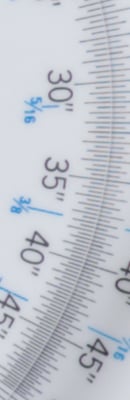 |
|
|
Normal
|
Off
|
RAW (No NR)
|
|
| I S O 1 0 0 |
 |
 |
 |
 |
 |
 |
|
 |
 |
 |
|
|
Normal
|
Off
|
RAW (No NR)
|
|
| I S O 2 0 0 |
 |
 |
 |
 |
 |
 |
|
 |
 |
 |
|
|
Normal
|
Off
|
RAW (No NR)
|
|
| I S O 4 0 0 |
 |
 |
 |
 |
 |
 |
|
 |
 |
 |
|
|
Normal
|
Off
|
RAW (No NR)
|
|
| I S O 8 0 0 |
 |
 |
 |
 |
 |
 |
|
 |
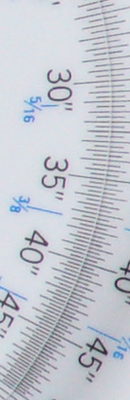 |
 |
|
|
Normal
|
Off
|
RAW (No NR)
|
|
| I S O 1 6 0 0 |
 |
 |
 |
 |
 |
 |
|
 |
 |
 |
|
|
Normal
|
Off
|
RAW (No NR)
|
|
| I S O 3 2 0 0 |
 |
 |
 |
 |
 |
 |
|
 |
 |
 |
|
|
Normal
|
Off
|
RAW (No NR)
|
|
| I S O 6 4 0 0 |
 |
 |
 |
 |
 |
 |
|
 |
 |
 |
|
|
Normal
|
Off
|
RAW (No NR)
|
|
| I S O 1 2 8 0 0 |
 |
 |
 |
 |
 |
 |
|
 |
 |
 |
|
|
Normal
|
Off
|
RAW (No NR)
|
|
| I S O 2 5 6 0 0 |
 |
 |
 |
 |
 |
 |
|
 |
 |
 |
|
|
Normal
|
Off
|
RAW (No NR)
|
|
| I S O 5 1 2 0 0 |
 |
 |
 |
 |
 |
 |
|
 |
 |
 |
|
|
Normal
|
Off
|
RAW (No NR)
|
|
| I S O 1 0 2 4 0 0 |
 |
 |
 |
 |
 |
 |
|
 |
 |
 |
|
As you can see, the Sony A99 II's default High ISO Noise Reduction is applied at all ISO sensitivities, and the "Off" setting really isn't off (which is almost always the case), as the A99 II still applies fairly strong noise reduction with that setting at high ISOs. The Normal setting does a very good job at removing almost all chroma noise, but it does start to impact fine detail in our difficult red-lead swatch already at moderate ISOs. The "Off" setting on the other hand preserves more detail but leaves a lot of chroma noise behind, and it also produces more objectionable luma noise in flatter areas with a peppered effect at moderate to high ISOs. Unlike the A99, though, the Sony A99 II's high ISO noise reduction does not suffer from the issue of blurring our red-leaf fabric more with the "Off" setting than the Normal setting at moderate to moderately high ISOs.
Conclusion
It took four years for Sony to release a new flagship A-mount camera, but the calls were answered with the Sony A99 Mark II. The A99 II, like its predecessor and other past A-mount cameras, comes equipped with a translucent mirror, making it more of a pseudo-DSLR than a traditional DSLR, but it is an A-mount camera through and through.
The camera packs a 42.4-megapixel full-frame CMOS image sensor that utilizes Sony's Exmor R backside-illumination technology. The end result is a camera that produces excellent image quality for its resolution across a wide range of ISO speeds. While the high-resolution sensor impressed us, what makes the A99 II unique in the market is its combination of resolution and speed. Equipped with a Bionz X image processor and new front-end LSI, the Sony A99 II can capture full-resolution images at nearly 12 frames per second, although our lab results showed the camera coming up just a bit short of spec -- still, very impressive.
Is the Sony A99 Mark II the camera that Sony A-mount shooters have been waiting for? Read on for our final word.
Image Quality: A99 II's sensor delivers great images across wide range of ISOs
JPEG images look excellent straight from the camera, although a bit oversaturated, which is standard for modern cameras. Detail is very good as is default noise reduction processing. The A99 II can render fine detail very well, thanks in part to its lack of optical low-pass filter (OLPF). Resolution doesn't change much when you process RAW files from the A99 II, but RAW files showcase excellent dynamic range.
The Sony A99 II fared very well in our print quality analysis. Its 42.4-megapixel full-frame sensor produces excellent 30 x 40 inch prints up to ISO 800. Colors are vibrant and details are sharp. There is some shadow noise at ISO 400-800, but not enough to drastically impact overall print quality. At ISO 1600, some fine details lose sharpness, but we could make a good 24 x 36 inch print nonetheless, which is impressive for a camera with this many megapixels. You can make a good 20 x 30 print at ISO 3200, which is great, and 13 x 19 prints still look good at ISO 6400. At ISO 6400, the amount of noise does increase quite a bit, which significantly hurts the ability of the camera to render fine detail.
Beyond ISO 12800, you won't be able to make good large prints. In fact, ISO 51,200 and 102,400 are far too noisy and soft to make any prints at all. Nonetheless, the A99 II provides a lot of flexibility with its excellent 42.2-megapixel sensor. You can make very large prints anywhere from ISO 50 (extended) to ISO 800 and continue to make pretty large prints up through ISO 6400.
Overall, despite packing 42.4-megapixels onto its full-frame sensor, the A99 II still offers very good high ISO performance. The camera is jam-packed with great features, but its sensor should be near the top of the list because it offers excellent image quality across a wide range of ISOs.
Sony A99 II's hybrid phase-detect autofocus delivers speed and accuracy
The Sony A99 II is the first full-frame Sony camera to include a 4D AF autofocus system. This hybrid phase detection autofocus system combines two separate autofocus technologies. The camera has a dedicated 79-point phase detection AF module and also 399 on-sensor phase detect autofocus points, the latter of which is similar to what is found in the Sony A7R II. In traditional DSLR cameras, a camera cannot utilize two autofocus systems simultaneously, but the SLT A99 II can thanks to its translucent mirror.
By combining the separate autofocus systems, the A99 II has 79 hybrid cross autofocus points the 79 points from the dedicated PDAF module overlapping with 79 of the 399 points on the sensor itself. The dedicated module has horizontal detection and the sensor points have vertical detection, so combining them creates cross detection AF points.
During our testing, we found the autofocus performance to be very impressive overall for both stationary and moving subjects. Using wide, zone, center, flexible spot, expand flexible spot and lock-on AF, the A99 II excelled in a variety of shooting and lighting conditions. Compared to our high-end, fast DSLR cameras, such as the Nikon D5, the Sony A99 II felt comparable in terms of overall speed and accuracy.
A99 Mark II performance: 42MP images at crazy-fast speeds
The A99 II offers excellent overall performance. Admittedly, it is a bit slower than many other DSLRs when powering on to first shot and when switching from playback to recording mode, but many other aspects of its performance are very quick. Full-autofocus shutter lag is only 0.11 seconds, which is fast for its class. Single shot cycle times were less than 0.3 seconds, which is fast as well.
What's most impressive about the A99 II is that it can shoot continuous compressed RAW images at nearly 11 frames per second with a total number of frames just under 60. Considering the A99 II's resolution, this is especially fast and a remarkable feat. It is worth pointing out that we were unable to achieve Sony's spec of 12fps shooting in the lab. Shooting uncompressed RAW images brings the speed down to 10.58fps and drops the buffer depth to 24 frames. Depending on the lens and aperture used, the A99 II can continuously autofocus at its max speed, too. You can learn more about potential continuous autofocus caveats here (PDF, page 39).
Buffer clearing, however, is an area of weakness for the A99 II and the only major negative mark on the A99 II's otherwise excellent performance report card. 61 Extra Fine JPEG images -- captured at 10.53fps -- takes 56 seconds to clear with our testing card, a pretty quick SanDisk Extreme Pro 95MB/sec UHS-I SDHC card. UHS-I is the kicker here, as UHS-II support would likely improve buffer clearing performance considerably. We have seen cameras that support UHS-II SD cards offer write speeds that more than double what the A99 II can achieve. Nonetheless, the A99 II does offer faster write performance than the Sony A7R II, which utilizes a 42-megapixel sensor as well.
Despite being a "DSLR" camera, the A99 II doesn't offer the great battery life we're used to observing. The A99 II utilizes an electronic viewfinder due to its translucent mirror design, which decreases its battery life relative to optical viewfinder-equipped DSLR cameras. Battery life using the viewfinder is 390 shots and 490 shots using the rear display. We recommend picking up a spare battery or using the optional battery grip to double the battery life.
Overall, while buffer clearing performance is slow, the camera is overall very fast. For a full-frame "DSLR" camera, the Sony A99 Mark II offers excellent performance across the board. Autofocus speeds are quick, shutter lag is low, the camera cycles quickly and it achieves great continuous shooting speeds considering its resolution.
Video: 4K video quality is good, but the A99 II has odd restrictions
Capable of recording 4K UHD video, the Sony A99 II can capture very high-quality video. It records 4K video at up to 30 frames per second with a bitrate up to 100Mbps (when using a compatible SD card). The camera offers two 4K recording modes. The default is Super 35mm format that records the central 6K-resolution-worth of pixels before downsampling to 4K UHD. If you want to record using the full sensor, you can do that too, but this latter mode has pixel binning.
Videographers will also be pleased to find that the A99 II has S-Gamut and S-log shooting modes, clean HDMI output, a zebra display mode and headphone/mic inputs. But the camera also has odd video recording limitations. You cannot record video when using AF-S nor can you record outside of program auto mode using AF-C. This means that if you want to record video in manual, aperture priority or shutter speed priority modes, you must manually focus. This is an odd restriction and one not placed on other Sony cameras, such as the A7R II.
Overall, video quality proved to be very good, although the interesting limitations of the Sony A99 II are worth considering if you intend to shoot a lot of video.
Bulkier than Sony's E-mount full-frame mirrorless cameras, the A99 II feels much more like a standard DSLR, with a large, chunky grip, for example. With that said, the camera is 8% smaller than the original A99. The A99 II is dust and moisture resistant, although Sony stopped short of calling it weather-proof. We found that the camera was very comfortable to hold, and we also enjoyed the wealth of physical controls, with many important functions within reach of your index finger, as well as lots of user customization to the buttons and dials.
While we like the A99 II's body overall, there were a couple of issues. The 3-inch rear display is sharp and works well, including its tilting functionality, but the lack of touchscreen functionality is notable. Further, the multi-selector joystick on the back of the camera takes the place of a traditional directional pad. The joystick works okay, but it proved to be not as consistent as a directional pad with a dedicated central button in order to accurately select and confirm what you want.
The Sony A99 II is an SLT camera rather than an SLR camera, which means that it uses a translucent mirror. As an SLT, the A99 II uses an electronic viewfinder in lieu of an optical viewfinder. The EVF is very good, offering a 0.5-inch OLED display with 2.4-million dots. The 0.78x magnification is improved over the EVF in the predecessor and the EVF itself worked well in the field. The one drawback to the A99 II's EVF is that it doesn't offer a live view of the scene when shooting in the fastest "Continuous High+" burst mode, which can make it difficult to accurately track fast-moving subjects.
The Sony A99 II features an updated 5-axis sensor-shift image stabilization system, similar to the one from the A7R II, and corrects for X/Y translational motion, as well as for pitch, yaw and roll. We found it to work very well with the two lenses we tested with the A99 II, the Sony 16-35mm f/2.8 and Sony 70-400mm f/4-5.6G SSM II.
Overall, we found that the Sony A99 II build quality and handling characteristics were very good. The weather-resistant body feels built to last and is oriented toward professional shooting with its ample physical controls and button layout.
Summary: A-mount lives! A99 II brings high-resolution, lots of speed
The Sony A99 II is a bold statement that the Sony A-mount is alive and well for enthusiasts and professionals alike. It is a remarkable technological achievement in multiple ways, from its ability to capture full-resolution 42.4-megapixel RAW images at nearly a dozen frames per second, to utilizing a super-quick, advanced hybrid autofocus system with tons of individual AF points.
However, it is also a camera that, despite how advanced many of its features are, felt occasionally stuck in the past. 4K UHD video recording is hampered and despite Sony's efforts, the menus and a few of the controls are somewhat clunky.
Overall, the Sony A99 II is an excellent full-frame "DSLR" camera that achieves some great feats. To be able to utilize hundreds of autofocus points while shooting 42.4-megapixel images at nearly 12fps is very impressive.
Pros
- Superb image quality at low to moderate ISOs straight out of the camera
- Very good high ISO performance, much improved over its predecessor
- Very high resolution
- Very good dynamic range, especially at higher ISOs
- Fast, sophisticated hybrid autofocus system
- Low prefocused shutter lag
- Outstanding ~11fps burst mode speeds
- Very good buffer depths considering burst speed and resolution
- 5-axis in-body image stabilization
- Electronic first curtain shutter option
- Flicker reduction feature
- 4K (UHD) in-camera video recording
- Full HD up to 120fps
- Uncompressed RAW option
- Comfortable camera body with good physical controls
- Durable, weather-resistant camera body
- Sharp electronic viewfinder with higher viewfinder magnification than its predecessor (0.78x vs 0.71x)
- Dual SD card slots
- Built-in Wi-Fi, NFC and Bluetooth
Cons
- Susceptible to aliasing artifacts (common issue these days)
- Dynamic range not as high as predecessor and some competing models at low ISOs
- Slow buffer clearing times
- No UHS-II support
- Struggled to autofocus on our standard low-contrast AF target below -0.5 EV (but could focus on our high-contrast AF target down to -4.7 EV)
- No built-in AF illuminator
- No touchscreen functionality
- Electronic viewfinder cannot keep up at fastest shooting speeds
- Multi-selector joystick is not a great replacement for a traditional directional pad
- Poor battery life compared to DSLRs without optional grip
- Odd focus quirks with video: AF-C only with Program Auto, or Manual Focus for other exposure modes.
- Improved but still limited remote shooting capabilities
- No built-in GPS (unlike its predecessor)
Follow Imaging-Resource.com on Twitter!