
Overview
Announced in September of 2014, the Panasonic 35-100mm ƒ/4-5.6 Mega O.I.S. Lumix G X Vario is a compact, Micro Four-Thirds-format telephoto zoom lens that provides an equivalent field of view of 70-200mm (in 35mm film terms).
The lens takes 46mm filters, ships with the H-FS35100 petal-shaped hood, and is available now for around $400.
Sharpness
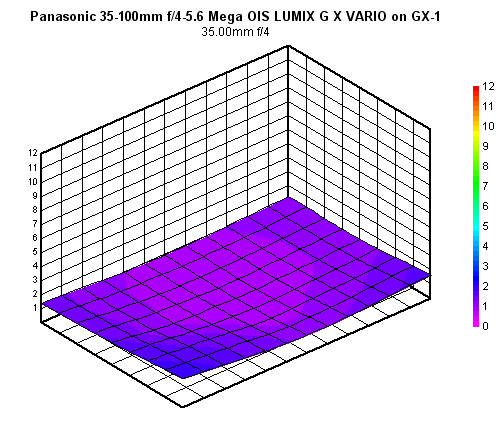
The Panasonic 35-100mm ƒ/4-5.6 is a decently sharp lens: our copy showed a slight amount of de-centering, but not so much as to get excited about. When using the lens in the widest apertures, we note excellent image sharpness mostly across the frame: at the wider angles we note a slight amount of corner softness, which is mitigated as the lens is stopped down. For example, at 50mm and ƒ/4.9, we see the image of that lens de-centering on the left-hand side of the frame; stopping down to ƒ/8 removes this corner softness entirely.
The lens’ best performance comes at 35mm and ƒ/8. Stopping down further doesn’t provide any noticeable further gains, due to diffraction limiting showing up at ƒ/11. It doesn’t really impact on sharpness until ƒ/16 or ƒ/22, where we note generalized image softness across the frame.
Chromatic Aberration
The lens provides excellent results for chromatic aberration: in-camera correction has taken away any color shifts, turning any aberration into slight reduction in sharpness. Take a look at our sample photos to see the effect, prominent mostly in the corners and on areas of high contrast.
Shading (”Vignetting”)
The only area of concern for the lens when it comes to corner shading is at the 35mm focal length when the lens is used wide open at ƒ/4. In this case we see corners which are a half-stop darker than the center; at any other setting, corner shading is negligible.
Distortion
The Panasonic 35-100mm ƒ/4-5.6 lens produces excellent results for distortion, with images that show no barrel or pincushion distortion at any focal length. There is no doubt some level of image post-processing applied within the camera, and in this case the results are excellent.
Autofocus Operation
The Panasonic 35-100mm ƒ/4-5.6 is very quick to autofocus – the lens takes well under a second to slew through the entire range of focus. Small changes in focus are conducted extremely quickly, and there’s very little noise when the lens focuses.
Macro
This Panasonic lens is clearly not designed as a macro lens, offering just 0.11x magnification and a minimum close-focusing distance of 90cm (around three feet) at 100mm. Close-focusing improves slightly to about 2 feet (61cm) at 35mm.
Build Quality and Handling
The Panasonic 35-100mm ƒ/4-5.6 lens is extremely small and light, weighing in at just 135gm (just under five ounces). The lens must use a fair amount of plastic to keep the weight down, but does employ a metal lens mount. It employs a mechanism similar to other Micro Four-Thirds lenses which allows the lens to retract for storage, and must be extended prior to use.
The optical layout is decently complex: 12 elements in 9 groups, including 1 aspherical and 2 ED elements, and the lens uses seven curved diaphragm blades to make up the aperture. The are no switches, distance scale or depth-of-field scale on the lens; the only information is the focal length markings. Lens-related functions like image stabilization are controlled from the camera body.
The 35-100mm ƒ/4-5.6 isn’t a ”constant” lens, in that as you increase the focal length, the maximum aperture size decreases, though the minimum remains the same. The following table reflects the change in aperture with focal length:
| Focal Length | 35mm | 50mm | 70mm | 100mm | |
| Largest aperture | ƒ/4 | ƒ/4.9 | ƒ/5.5 | ƒ/5.6 | |
| Smallest aperture | ƒ/22 | ||||
The focusing ring is plastic with raised ribs, just 1/4” wide. The ring will rotate forever in either direction with no hard or soft stops. The zoom ring is also plastic with raised ribs, about 3/4” wide. The zoom ring is smooth to turn, taking only two fingers to rotate, and offers only around 45 degrees of turning action to run through the available range of focal lengths. There is some lens extension as the lens is zoomed in towards 100mm, about one inch. Zoom creep is not a factor with this lens.
The H-FS35100 lens hood is a petal-shaped, bayonet-mounted design that is 1 1/4 inches long. The hood will reverse for storage on the lens.
The Panasonic 35-100mm ƒ/4-5.6G lens features Optical Image Stabilization (Mega O.I.S.) that, in our testing, provided three and a half stops of hand-holding stability at 35mm, and an impressive four and a half stops stops at 100mm. Be sure to check our IS Test tab for greater detail.
Alternatives
Panasonic 35-100mm ƒ/2.8 POWER OIS LUMIX G X VARIO ~$1,500
The 35-100mm ƒ/2.8 is much more expensive, but sports the constant ƒ/2.8 aperture which allows for more light-gathering ability, and a much larger size. Optically the lens is very good indeed, even used wide open at ƒ/2.8.
Olympus 40-150mm ƒ/4-5.6 ED M.Zuiko Digital ~$180
When it comes to this class of lens, there aren’t many other options to choose from in any of the Micro Four-Thirds camps: the Olympus 40-150mm isn’t directly equivalent, but provides a similar shooting experience. Optically the lens is about as good as the Panasonic, perhaps a bit worse for chromatic aberration, and your mileage may vary by mounting an Olympus lens on a Panasonic body.
Conclusion
Optically, the Panasonic 35-100mm Mega O.I.S. Lumix G X Vario is very good for the price – there are some very slight issues with corner softness and de-centering with our review copy, but nothing to write home about.
For what it does, the lens does it very well: the only performance item I might have a problem with is that the variable aperture reduces quite quickly. For example wide open at 35mm the maximum aperture is ƒ/4; zooming in to 50mm, your maximum aperture is ƒ/4.9. This will restrict your shooting style a bit; you’ll either be shooting outside, with a flash, or you’ll need to boost your ISO settings.
Panasonic has had a 35-100mm ƒ/2.8 zoom available for some time now, but the casual Micro Four-Thirds shooter could have been put off by its $1,500+ price tag. Panasonic has wisely provided a less expensive option that will match extremely well with the Panasonic 12-32mm ƒ/3.5-5.6.
Product Photos
 |
 |
 |
 |
 |
 |
 |
 |
 |
Sample Photos
Click here for Real-world Gallery Images on our Flickr page!
The VFA target should give you a good idea of sharpness in the center and corners, as well as some idea of the extent of barrel or pincushion distortion and chromatic aberration, while the Still Life subject may help in judging contrast and color. We shoot both images using the default JPEG settings and manual white balance of our test bodies, so the images should be quite consistent from lens to lens.


As appropriate, we shoot these with both full-frame and sub-frame bodies, at a range of focal lengths, and at both maximum aperture and ƒ/8. For the ”VFA” target (the viewfinder accuracy target from Imaging Resource), we also provide sample crops from the center and upper-left corner of each shot, so you can quickly get a sense of relative sharpness, without having to download and inspect the full-res images. To avoid space limitations with the layout of our review pages, indexes to the test shots launch in separate windows.
Description
(From Panasonic lens literature) Panasonic is proud to introduce a new digital interchangeable telephoto zoom lens, the LUMIX G VARIO 35-100mm / F4.0-5.6 ASPH. / MEGA O.I.S. (H-FS35100) based on the Micro Four Thirds system standard. Achieving high picture quality, the new LUMIX G VARIO 35-100mm / F4.0-5.6 ASPH. / MEGA O.I.S. designed in stunningly compact metallic profile with retractable structure despite a lens with this versatile focal distance of 35-100 mm (Equivalent to 70-200 mm on a 35mm camera). It is useful in shooting images including portrait or close-ups with impressively defocused background taking advantage of its high portability. The lens will be available in mid November at www.shop.panasonic.com and valued channel partners.
Comprised of 12 lenses in 9 groups, the lens system realizes uniform descriptiveness with its excellent contrast from the center to the corners, equal brightness at entire zoom range and high resolution. Notably, 2 ED (Extra-Low Dispersion) lenses minimize chromatic aberration. An aspherical lens helps achieve high optical performance while allowing dramatic downsizing of the lens unit.
The MEGA O.I.S. (Optical Image Stabilizer) effectively compensates for vibration making it easy to capture images clearly even if they are shot with small aperture.
It incorporates a superior inner focus system which enables excellent resolution and contrast from full life-size magnification to infinity. The inclusion of stepping motor makes the focusing action smooth and silent for use in both photo and video recording. When mounted on the Digital Single Lens Mirrorless (DSLM) cameras of LUMIX G, users can take advantage of the high-speed, high-precision Contrast AF system.
Seven blades give the aperture a rounded shape that produces an attractively smooth effect in out-of-focus areas when shooting at larger aperture settings. The new LUMIX G VARIO 35-100mm / F4.0-5.6 ASPH. / MEGA O.I.S. lens also features a highly reliable metal mount, and uses multi-coated lens elements that minimize ghosts and flare to further enhance its optical performance.
The LUMIX G VARIO 35-100mm / F4.0-5.6 ASPH. / MEGA O.I.S. in either silver or black color matches the LUMIX Digital Single Lens Mirrorless (DSLM) cameras, especially the new DMC-GM5 or DMC-GM1.
Lab Test Results
Our standard lens lab tests, shot on a sub-frame (APS-C) body. Pick a focal length and aperture to see the result.
Sharpness (blur index)
Blur across the frame: lower and flatter is sharper. Change focal length and aperture to see how it improves when stopped down.
Chromatic aberration
Colour fringing in the corners at each focal length.

Vignetting (corner shading)
How much darker the corners are than the centre, by aperture and focal length.

Geometric distortion
Barrel (positive) or pincushion (negative) distortion across the zoom range.

Image Stabilization
Most people tend to think of image stabilization as being mainly for telephoto lenses. While it’s true that their longer focal lengths tend to magnify the effects of camera shake, image stabilization can provde a very useful assist at wider angle focal lengths as well; anyone who’s ever tried to blur the image of a waterfall, while keeping the surrounding landsape tack-sharp knows exactly what I’m talking about.
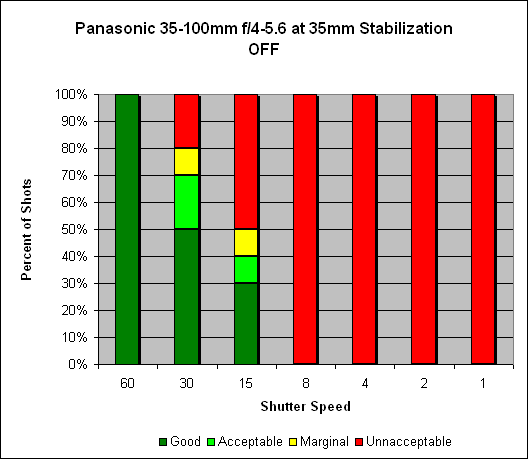
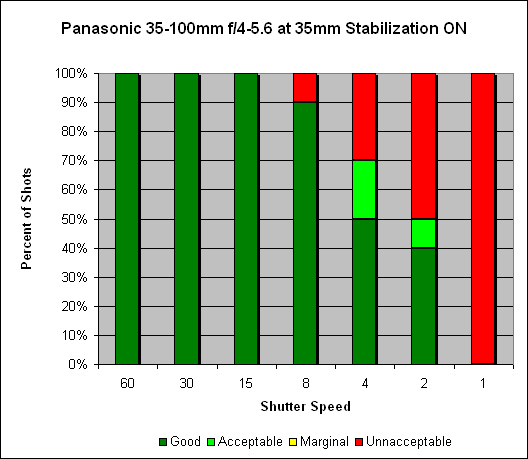
At 35mm, we see excellent performance from the Panasonic 35-100mm f/4-5.6 lens: without OIS enabled, the camera-lens combination manages to take 100% sharp shots at 1/60 of a second; this is a little faster than we would expect, but then, the smaller camera-lens packages are actually a bit harder to keep steady because they lack the inherent weight. Turning on Mega OIS really helps, getting 100% sharp shots at 1/15s and 90% sharp at 1/8s. This equates to around 2.5-3 stops of hand-holding improvement.
 |
| Mouse over this chart to show results with IS activated. |
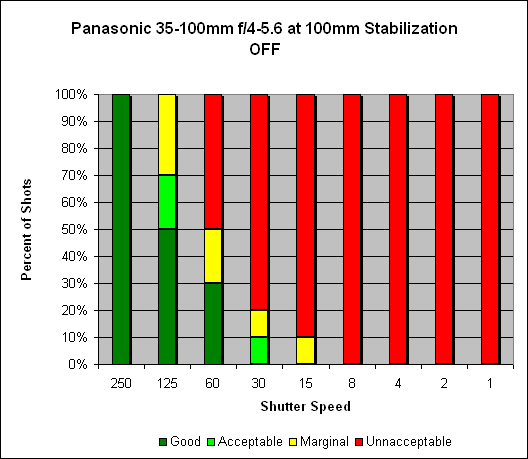
At the long end of 100mm, we’d normally expect to see 100% sharp shots at 1/125s (with the “one-over-focal-length” rule of thumb), but in this case we only see 100% sharp shots at 1/250s. Turn on Mega OIS however and we get some great hand-held performance: sharp shots all the way down to 1/15s, and 80% sharp at 1/8s, representing a hand-holding improvement of over 4 stops.
 |
| Mouse over this chart to show results with IS activated. |
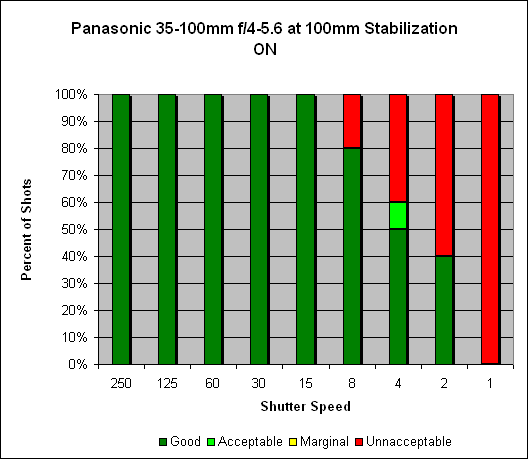
IS systems tend to provide more benefit to less-stable shooters than very steady ones, so most users will see the same or greater amounts of shake reduction as we measured here. You can read more about our IS test methodology here: SLRgear IS Test Methodology, v2.
Reader Reviews
- Image quality
- 8.5/10
- Build quality
- 8.5/10
- Recommend it
- 100%
- 9/10Recommendedby mactheweb · August 5 2016 · paid $250
Pros: Super light, good sharpness, good color. Small size.
Cons: Slow aperture. Lots of plastic.
This is a perfect compliment to the Panasonic GM5. It weighs less than 5 ounces and is small enough that it looks right on the GM5. The lens focuses quickly, at least as quickly as the camera allows. Images are sharp. Micro contrast is not as good as the as the 12-32mm kit lens, though that's surprisingly nice for such an inexpensive lens. With the tiny camera and kit lens this makes a super compact and light travel kit. When it's on sale it's a great deal. At full price it's decently priced for what it is.
- 9/10Recommendedby Prime Minister · December 19 2014 · paid $430
Pros: Incredibly compact and lightweight, sharpness, contrast, stabilisation, build quality
From the day this lens was announced, I was interested in it. I read some reviews and I saw the product photos online of course, but when I opened the small box and took the petite lens out of its plastic packaging, I was totally amazed by how small and lightweight this lens really is. The small box even seems slightly large for this lens. The first thing that came to my mind, was that if this lens delivered good image quality, it would be the perfect carry everywhere short telezoom. I haven't seen anything this compact ever, except for the Nikon 1, but that system uses a much smaller sensor.
The build quality seems very good. The rear element doesn't move in or out and the front doesn't rotate. The barrel, zoom ring, focus ring, filter thread and lens mount are all made of metal. The inner tube is plastic. The lens certainly doesn't feel cheap (and it isn't). Zooming in and out feels slightly rough but it's precise enough. The front element has the fairly standard 46mm filter thread, excellent. You don't have to push a button or lever to extend the lens, just turn the focus ring and you're good to go. It clicks nicely into place.
Autofocus is fast, silent and accurate. The optical image stabilisation works very well and I think it will give you two to three stops extra. I haven't used it extensively, but I didn't find it annoying or jumpy at all. Stabilisation seemed smooth and calm and it did its job well.
The image quality is surprisingly good. Now I know this is not a fast lens, but for normal daytime photography (or on a tripod) this lens shines. Photos made with this lens have good contrast and excellent detail. It's a little softer towards the edges, but nothing to worry about. There is some vignetting, but it's very minor. A few clicks in post processing fixes this. I haven't found any CA at all. If it's there, it's probably very little. Really good optical results for such a small lens. I mean, we're talking about a 70-200mm equivalent zoom lens that's hardly any bigger than the small Olympus 45mm f/1.8.
Nothing is perfect and I noticed that this lens suffers from shutter vibrations when used on a Panasonic GX7 and mostly from 70-100mm. However, that's only when you use the mechanical shutter. Images made with the electronic shutter are tack sharp at all settings. It's probably be the camera. The GX7 is known for its shutter shock issues. No problems at all on the GM5 body.
This lens stays in my collection. I definitely recommend it if you are looking for the smallest and lightest (slow) zoom possible without sacrificing image quality. It punches above its weight.
Update: After owning it a little longer, I grew even more fond of this lens. It's a really nice lens. Good reach, lots of detail and it's so lightweight and compact. I can see why this lens, the 12-32mm, a fast prime and a tiny camera body like the Panasonic GM5 is a perfect walk around camera kit.
Reader reviews were submitted by Imaging Resource readers and are shown as written.