


Overview

These days, the rugged, waterproof segment of the camera market is one of the few areas in which there's a good reason for buying a standalone compact camera. Over the last decade since Apple wowed us with its first iPhone, followed in short order by Google's Android, smartphones have demolished the rest of the compact market. But despite their clear strengths in portability, connectivity and performance, many smartphones aren't waterproof and even fewer are ruggedized. And even if it's built like a tank, you probably don't want to risk such an expensive device -- and one which touches on so many areas of your life -- as your smartphone.
But while the "take it anywhere" advantage of a compact ruggedized, waterproof camera over a smartphone is obvious, there hasn't been such a clear box ticked in the image quality department. Thanks to some big improvements made in smartphone cameras over the last few years coupled with the stagnation of the compact camera market right as it reached the peak of its ill-advised lust for the mighty megapixel, smartphones and compacts have been much of a muchness in terms of the end results.
Finally, a return to sanity on the megapixel front!
With the TOUGH TG-5, Olympus aims to change all of that by taking the rugged, waterproof camera upmarket. In the process, it's had to bump the price up a little, but at US$450 or thereabouts, the TG-5 is still quite reasonable and certainly more affordable than all but the most basic of unlocked smartphones. And it promises a big step forwards in image quality thanks to the pairing of three important bits of kit.

At the heart of the TG-5, there's a new 12-megapixel, backside-illuminated CMOS image sensor which marks a return to sanity on the resolution front. (There was never really any rational reason for the move to resolutions of 16-18 megapixels from such tiny sensors in past rugged cameras, beyond straightforward spec table one-upsmanship. We're thrilled to see Olympus leading the way back towards common sense in this area.)
The Olympus TG-5 pairs its new sensor with a bright lens and seriously powerful processor
Output from the new 12-megapixel chip heads thru the same dual quad-core TruePic VIII image processor used in the flagship (and very well-received) OM-D E-M1 II mirrorless camera, a fact which should make very clear just how serious Olympus is about maximizing the TG-5's image quality. And the final piece of the puzzle is a holdover from the previous Olympus TG-4: A 4x optical zoom lens with a bright f/2.0 maximum aperture at its 25mm-equivalent wide angle, falling to f/4.9 by the 100mm-equivalent telephoto position. As before, the lens design includes dual super aspherical, high dispersion and high refractive index lenses in its optical formula.

Put all of that together -- a new sensor with a more reasonable number of large, light-hungry photodiodes; a high-performance image processor with top-notch image processing algorithms; and a lens which at wide-angle at least is very bright -- and it's a safe bet that the Olympus TG-5 should best its predecessor in the image quality department, and hopefully its nearest rivals too. It should also allow for greater performance and lighter storage requirements, since there's less data to process and store for every image in the first place, coupled with lower noise levels that will allow for better compression.
An indication of Olympus' confidence in the strategy can be garnered from the fact that it has increased maximum sensitivity of the TG-5 to ISO 12,800-equivalent, where the TG-4 topped out at ISO 6400. And unlike the TG-4, the TG-5 can now shoot raw files in continuous mode, and the company has also added in-camera raw processing capability.

Performance has increased too. While the full-res burst capture rate is still 5 frames per second with mechanical shutter, the TG-5 can now shoot at 10 or 20 fps including raw files with the electronic shutter, or at 10 fps with e-shutter in Pro Capture mode. Buffer depth at 20 fps is claimed to be unlimited for large/normal JPEGs, and up to 14 frames for raw files. At 5 fps, raw buffer depth is said to increase to a claimed 49 frames.
The TG-5 is still built like a tank, too
Of course, there's a lot more to the Olympus TG-5 than just its imaging pipeline. Starting from the skin, the TG-5's newly-designed chassis should now be easier to grip, and more conducive to operation while wearing gloves. There's a new control dial on top for easier setting changes, and a larger zoom lever that's now wrapped around the shutter button. It's also said to respond more quickly to control adjustments.
And just like that of the earlier TG-4, it's impressively solid, said to be able to withstand 220 pounds (100 kg) of crushing force, is waterproof to 50 feet (15 m), and capable of surviving a drop from seven feet (2.1 m) onto an unspecified surface. It's also dustproof and freezeproof to 14°F (-10°C), and now sports a dual-pane cover glass over the lens to help avoid it fogging up when the temperature suddenly changes.

The Olympus TG-5 is even more location-aware than ever
The earlier TG-4 was already location-aware, sporting a built-in GPS receiver which was also compatible with Russia's GLONASS and Japan's QZSS system, both of which are alternatives to the US government's more widely-known GPS system. And it could derive compass information from the GPS track data as well, allowing capture direction to be recorded in your images, not just the capture location.
But that's not enough for the enthusiast-grade Olympus TG-5. The new camera sports what the company is referring to as the Field Sensor System, which pairs the GPS and e-compass features of the TG-4 with a new external temperature sensor which has been isolated from the camera's own internal warmth so as to allow air / water temperature measurement to an accuracy of 1.8°F (1°C). There's also a manometer which allows measurement of altitude to an accuracy of 33 feet (10 m) and underwater depth to an accuracy of 3 feet (1m).
All of this information can be displayed on-screen and recorded in-camera, and Olympus' free OI.Track app for Android or iOS phones and tablets can be used to display images alongside a map of the capture location or an altitude / water depth graph. It can also overlay GPS track log, distance, speed, altitude / depth, compass direction, azimuth and date/time information on videos which can be shared with friends and family.

A focus on the extremely up-close and personal
But what if you're more interested in getting really close to your subjects than in tracking your journey through each photo shoot? Well, the Olympus TG-5 has you covered here too, thanks to what the company is terming the Variable Macro System. This allows you to make the best of the TG-5's lens, which can focus to an extremely close 0.4 inches (1 cm) through most of its zoom range.
Enable super macro mode, and you can attain 7x magnification by pairing the lens' optical zoom -- curtailed just slightly at the wide end for a 30 to 100mm-equivalent focal length range -- with its super-close focusing capability in what Olympus is calling microscope mode. There's also microscope control mode, which adds digital zoom into the mix. You can either digitally zoom smoothly with the zoom rocker, or step between 1x, 2x and 4x digital zoom using the arrow pad.
And as if that wasn't already enough, the Olympus TG-5 also offers both focus stacking and focus bracketing functions. When using focus stacking, the camera will automatically shoot eight images with varying focus distance, and then use this data to output a single image with much greater depth of field. Those of you who want to be in control yourselves will instead opt for focus bracketing mode, which can capture as many as 30 images in a burst with variant focus distance. You get to choose both the focus step size between frames and the total number of shots in one of three levels.
The Olympus TG-5 is also uncommonly well-equipped in the focusing department for a rugged camera, offering not just face-detection AF and the ability to manually select from its 25 AF points. These come coupled with manual focusing complete with an enlarged focus assist function, plus a focus peaking tool that outlines high-contrast edges in white, black, red or yellow to indicate the point of focus.

And there's plenty else on the creative front, too
Nor is that all, either. The Olympus TG-5 sports quite a few other features that aren't typical of its point-and-shoot rugged cameras, such as a pro capture mode that can shoot bursts of frames constantly until you press the shutter button, then let you reach back in time as long as ten seconds before the shutter was tripped to find the perfect moment your reflexes weren't quite ready for.
And there's also a live composite mode that continuously records and combines images, discarding all but the brightest pixel for any given pixel location, and thereby allowing some really fun effects like light painting, or recording of light trails behind vehicles, fireworks, stars moving across the sky and the like. And as we mentioned previously, the TG-5 can also shoot HDR imagery in-camera, both underwater and above the surface.
Olympus has also retained the TG-4's dual custom modes, located prominently on the mode dial for quick recall and reuse of your favorite camera setups. And the company offers up a generous selection of 14 in-camera art filters, as well as offering a new grid display that will help you ensure your horizontals are level and your verticals not converging.

The Olympus TG-5 isn't just about stills, either
As well as all its still imaging features, the Olympus TG-5 also boasts the ability to record high definition and ultra-high definition footage in-camera, and in a nice touch, movie mode can now be accessed through the mode dial. Better still, for 4K (3,840 x 2,160 pixel) content, Olympus is using the entire sensor width without pixel binning or skipping, which should ensure that video quality is up to par in comparison with the TG-5's stills. At 4K resolution, there's a fixed 102Mbps bitrate and a choice of 25 or 30 frames per second capture rates. Drop the resolution to Full HD (1,920 x 1,080 pixels), and you'll have a choice of 25, 30, 50 or 60 fps capture. Finally, at HD (1,280 x 720 pixel) resolution, there's a choice of 25 or 30 fps capture. FHD and HD video allows bitrates from 52 to 18 Mbps.
You can also record time-lapse movies at 4K, FHD or HD resolution, and high-speed movies at FHD, HD or SD (640 x 360 pixel) resolution. 4K time-lapse clips have a fixed five frames per second frame rate, while FHD time-lapses also allow 10 or 15 fps, and HD movies add 30 fps to the mix. Full HD high-speed movies can be captured at 120 fps, while HD allows 240 fps and SD can reach a maximum of 480 fps capture.
All the requisite connectivity options, both wired and wireless
Of course, all the connectivity options you'd expect are presented and accounted for. The Olympus TG-5 can put images on your smartphone or tablet for sharing online via its built-in 802.11 b/g/n Wi-Fi wireless networking radio, and can also transfer data to your PC or Mac via a standard USB 2.0 Micro-B connector, or send it to a high-definition display via a Type-D Micro HDMI terminal.

A little less battery life, but it shares its battery with the TG-4
The Olympus TG-5 accepts the same LI-92B lithium-ion battery pack as its predecessor, which is a nice touch if you're considering upgrading from the TG-4. Battery life isn't quite as good as that of the earlier model, though, with a maximum of 340 shots on a charge to CIPA testing standards, down from 380 frames on the earlier camera.
A broad accessory ecosystem should keep enthusiasts happy
If that 50 foot depth rating we mentioned earlier isn't sufficient, incidentally, an optionally-available PT-058 underwater housing will allow use of the Olympus TG-5 down to depths of 147 feet (45 m). This is just one of many accessories that Olympus will be offering for the TG-5, as befits a camera so clearly aimed at enthusiast use. The discerning underwater shooter will be able to pair their TG-5 and PT-058 housing with PTWC-01 and PTMC-01 Underwater Wide and Macro converter lenses and a pair of UFL-3 external flash strobes. And to make the best of all this underwater gear, note that Olympus says the switch to a TruePic VIII processor should bring improved underwater image quality. You can still shoot regular snapshots, HDR imagery and macros underwater.

And once again, that's not all on the accessory front. Olympus is offering a new CSCH-126 silicone jacket to help protect your investment, and the TG-5 is also compatible with a range of existing accessories such as the wearable CSCH-123 sport holder, CSCH-121 mesh camera case which lets the camera air-dry, CHS-09 floating wrist strap, LG-1 LED light guide, FD-1 flash diffuser, and the CLA-T01 converter adapter through which the TCON-1 teleconverter (170mm-equivalent focal length), FCON-T01 fisheye converter (130-degree field of view) or PRF-D40.5 PRO protection filter can be attached to the TG-5 camera body. And a new accessory lock button ensures that the fisheye / tele converters, flash diffuser and light guide won't accidentally fall off the camera in transport.
TG-5 price and availability
The Olympus TG-5 went on sale June 2017 in the US market, with a choice of either black or red body colors to suit your tastes. US-market suggested retail pricing is set at around US$450 for the camera itself, as noted previously, while the new PT-058 underwater housing is priced at US$300, and the new CSCH-126 silicone jacket costs US$30.

In the Box
The retail package contains the following items:
- Olympus Stylus Tough TG-5 camera (in red or black)
- LI-92B Rechargeable lithium-ion battery pack
- F-5AC USB-AC power adapter
- USB cable
- Wrist strap
- Instruction manual and quick start Guide
Optics
Lens Test Results
Zoom
A 4x wide-angle zoom, with about average performance for its type.


The Olympus TG-5 is equipped with a 4.5-18mm lens, offering an optical zoom ratio of 4x, translating to a 35mm-equivalent focal range of about 25-100mm. The lens is quite fast (bright) at the wide end, with a maximum aperture ranging from f/2.0, however at the tele end maximum aperture is a bit dim at f/4.9.
The TG-5's lens features a 1-stop diaphragm plus 3-stop ND filter aperture mechanism, offering settings of f/2, f/2.8 and f/8 at full wide angle, and f/4.9, f/6.3 and f/18 at full telephoto. (The ND filter cannot be enabled with the diaphragm wide open.) The following table reflects the maximum and minimum apertures as reported by the camera at popular approximate focal lengths:
|
Focal length (eq.)
|
25mm
|
28mm
|
35mm
|
50mm
|
70mm | 85mm |
100mm
|
|
Max. aperture
|
f/2.0
|
f/2.2
|
f/2.6
|
f/3.2
|
f/4.0
|
f/4.5 |
f/4.9
|
|
Min. aperture
| f/8 (wide) / f/18 (tele) | ||||||
Far-field performance is about average for its type, which is to say decent but not great. At maximum wide angle, sharpness is quite good in the center, but corners are soft and there's some noticeable purple fringing, as well as flare and loss of contrast around bright objects. At medium focal length, the lens preforms well across the frame, but it's still not tack sharp. The lens isn't as sharp at full telephoto and there's still some noticeable purple fringing, but the corners are reasonably sharp. Unlike prior models, the TG-5 does not offer digital zoom in normal shooting modes.
See below for lab results on macro performance, geometric distortion, corner softness, etc.
Macro
A tiny minimum coverage area, with very good detail in the center. Flash throttled down well, but illumination was not even.


The Olympus TG-5 allows you to zoom to maximum telephoto ("4x") in Microscope mode with the subject essentially touching the front of the lens! This allowed it to capture a tiny minimum area measuring only about 0.36 x 0.27 inches (9.2 x 6.9 millimeters). Sharpness in the center of the frame is pretty good, however corners and edges are quite soft (most lenses show some softening in the corners at macro distances). The flash did a good job throttling down, though illumination was not even as the lens bezel was practically touching the subject.
Geometric Distortion
Very low distortion in camera JPEGs, but very high in uncorrected RAW files at wide angle.
| Camera JPEGs |
| Barrel distortion at wide angle varies from ~0.1 to ~0.3 percent |
 |
| Barrel distortion at telephoto is less than 0.1 percent |
 |
Thanks to in-camera distortion correction, there's very little geometric distortion in the TG-5's JPEG files, though what distortion there is asymmetrical. At full wide angle, we measured about 0.1% barrel distortion along the top edge, and about 0.3% barrel distortion along the bottom edge. At full telephoto, distortion was practically zero along the top edge, increasing to just under 0.1% along the bottom edge. Still, very low geometric distortion overall. This is the tendency for the lens to bend straight lines outward (like a barrel -- usually at wide-angle) or inward (like a pincushion -- usually at telephoto).
| Uncorrected RAW |
| Barrel distortion at wide angle varies from ~3.2 to ~3.4 percent |
 |
| Pincushion distortion at telephoto is about 0.9 percent |
 |
To see how much correction is taking place in the camera, we converted RAW files from the above shots with RawDigger, which does not correct for distortion. At wide angle, barrel distortion is very high, between 3.2 and 3.4% depending on which edge is measured, while telephoto has about 0.9% pincushion distortion at both edges.
We expect to see fairly significant distortion in uncorrected RAW files in fast, compact lenses, as allowing this gives the lens designers greater flexibility in optimizing center sharpness and other aberrations, as well as in reducing cost, size, and weight. The downside is that the distortion correction contributes additional blurring to the corners of the frame where pixels are "stretched" during correction and where lenses are usually already a bit soft. Note that most RAW converters are capable of applying distortion correction automatically, as specified by the manufacturer in a lens profile built into the TG-5's RAW files.
Chromatic Aberration and Corner Sharpness
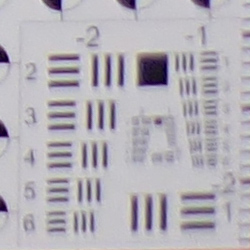
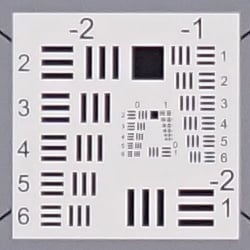
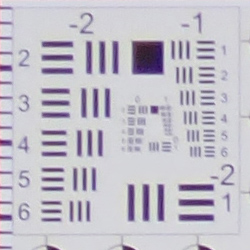
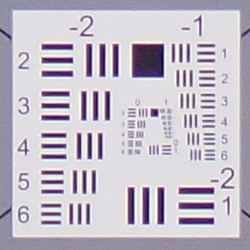
Moderate chromatic aberration in JPEGs. The lens produces some soft corners, though corner sharpness improves stopped-down.
|
Aperture: maximum
|
|
 |
 |
| Wide at f/2.0: Lower right C.A.: Moderate Softness: Very soft |
Wide at f/2.0: Center C.A.: Very low Softness: Very sharp |
 |
 |
| Tele at f/4.9: Upper left C.A.: Moderate Softness: Soft |
Tele at f/4.9: Center C.A.: Fairly low Softness: Fairly sharp |
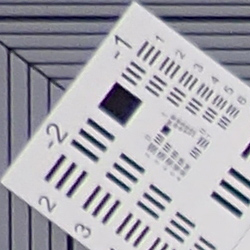
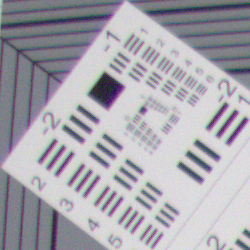
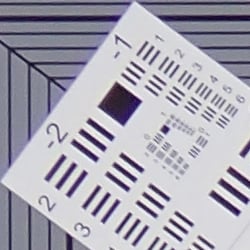
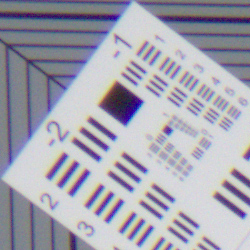
Chromatic Aberration. Thanks to in-camera chromatic aberration suppression in JPEGs, there's moderate lateral chromatic aberration in the corners at wide angle and at telephoto. At wide angle, there's moderate amounts of blue and yellow fringing while at telephoto, there is slightly milder magenta fringing. As expected, though, uncorrected RAW files (see below) show much more CA than seen above.
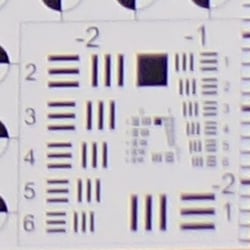
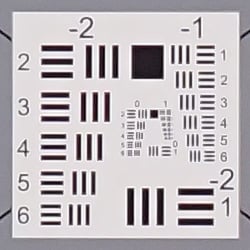
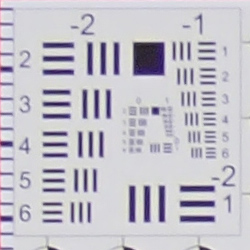
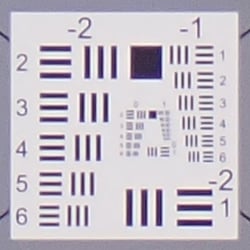
Corner Softness. Wide-open at full wide angle, the exhibits extreme corners that are quite soft, and some softening extends into the frame about a quarter of the way. Most of the frame is pretty sharp, though, including the center. Wide-open at full telephoto, corner sharpness is much better than wide angle, but still soft. The center is fairly sharp though not as sharp as wide angle, and exhibits lower contrast as well.
Vignetting. There's some moderate vignetting (corner shading) wide-open, shown by how much darker the corner crops above are than those from the center, at both wide angle and telephoto
|
Aperture: f/2.8 (W), f/6.3 (T)
|
|
 |
 |
| Wide at f/2.8: Lower right C.A.: Moderate Softness: Soft |
Wide at f/2.8: Center C.A.: Very low Softness: Very sharp |
 |
 |
| Tele at f/6.3: Upper left C.A.: Low Softness: Soft |
Tele at f/6.3: Center C.A.: Low Softness: Slightly soft |
Stopped-down: Stopping down to f/2.8 (one stop) improved corner performance at wide angle, however corners were still much softer than the center. Contrast and vignetting in corners improved along with sharpness, though chromatic aberration remained moderate. The center also became slightly sharper at f/2.8. While contrast, chromatic aberration and vignetting improved in the corners at full telephoto when stopping down one step, sharpness actually fell due to diffraction at f/6.3. Sharpness in the center also fell, but contrast and CA improved.
Note that "stopping down" further to the minimum "apertures" of f/8 at wide angle and f/18 at telephoto uses a 3-stop ND filter to avoid additional diffraction, but we found it reduced sharpness at the telephoto end in some real-world shots.
Chromatic Aberration Correction
| In-camera JPEG | Uncorrected RAW |
 |
 |
| Wide (f/2.8): Upper left CA: Moderate |
Wide (f/2.8): Upper left CA: High |
 |
 |
| Tele (f/4.9): Upper left CA: Moderate |
Tele: (f/4.9): Upper left CA: High |
As you can see in the crops from uncorrected RAW images on the right (taken from .ORF files converted with RawDigger which didn't correct for chromatic aberration), the TG-5's lens produces fairly high and bright chromatic aberration at maximum wide angle and at full telephoto with the fringing shifting from magenta/green to blue/yellow. The TG-5's processor does a decent job suppressing CA in camera JPEGs (crops on the left), though it does leave some behind and shifts the colors due to slight overcorrection.
Overall, about average optical performance for its class with good sharpness in the center at maximum wide angle but with soft corners, a noticeable drop in sharpness and contrast at full telephoto, and a lot of digital corrections applied to in-camera JPEGs.
Viewfinder Test Results
Coverage
Very good accuracy from the LCD monitor.


The Olympus TG-5's LCD monitor provided about 99% coverage at full wide angle and at full telephoto. This is very good performance, especially considering the amount of geometric distortion correction taking place.
The images above were taken from our standardized test shots. For a collection of more pictorial photos, see our Olympus Tough TG-5 Photo Gallery .
Exposure
Color
Saturation & Hue Accuracy
Below average saturation levels with about average hue accuracy.
 |
| In the diagram above, the squares show the original color, and the circles show the color that the camera captured. More saturated colors are located toward the periphery of the graph. Hue changes as you travel around the center. Thus, hue-accurate, highly saturated colors appear as lines radiating from the center. Click for a larger image. |
Saturation. The Olympus TG-5 pushes some colors likes strong reds and dark blues, but not as much as many cameras, and it undersaturates light green and aqua tones slightly, and yellow by quite a bit. The TG-5's mean color saturation of 103.1% (3.1% oversaturated) is quite a bit lower than average these days, and thus default color isn't as vibrant as most cameras. The TG-5 does not offer a saturation adjustment, however you can change Picture Mode from the default Natural setting to Vivid for brighter colors, in addition to various Scene and Filter modes. Most consumer digital cameras produce color that's more highly saturated (more intense) than found in the original subjects. This is simply because most people like their color a bit brighter than life.
Skin tones. The Olympus TG-5 did fairly well here when white balance was matched to the lighting, producing pleasant Caucasian skin tones with a healthy-looking pinkish tint. Where oversaturation is most problematic is on Caucasian skin tones, as it's very easy for these "memory colors" to be seen as too bright, too pink, too yellow, etc.
Hue. The Olympus TG-5 shifts cyan toward blue, purple toward red, orange toward yellow, and yellow toward green by small to moderate amounts, but most other shifts are very minor. (The cyan to blue shift is very common among the digital cameras we test; we think it's a deliberate choice by camera engineers to produce better-looking sky colors, and we don't find the resulting color objectionable.) The TG-5's handling of yellows is one of its weaknesses: Yellows are significantly undersaturated as well as being slightly shifted toward green, which can make them look a little dingy. With a mean "delta-C" color error of 5.74 after correction for saturation, overall hue accuracy is about average. Hue is "what color" the color is.


Sensor
Exposure and White Balance
Indoors, incandescent lighting
Default Auto setting produced overly cool results, and Incandescent was a bit too yellow. Manual (custom) white balance was pretty accurate. Average exposure compensation required.


Indoors, under normal incandescent lighting, color balance was cool and bluish with the default Auto white balance setting, though the TG-5 has a "Keep Warm Color" option which was quite warm. The Incandescent setting produced a slight yellow/green cast. The Manual setting was the most accurate and fairly neutral. The Olympus TG-5 required +0.3 EV exposure compensation, which is about average for this scene. (Our test lighting for this shot is a mixture of 60 and 100 watt household incandescent bulbs, a pretty yellow light source, but a very common one in typical home settings here in the U.S.)
Outdoors, daylight
Realistic looking colors overall, with good exposure.
Outdoors, the Olympus TG-5 performed well for its type, with natural if slightly subdued colors and good exposure in sunlit conditions. Skin tones are good but slightly warm and yellow with the Auto white balance setting in our "Sunlit" Portrait shot, so we preferred Manual white balance for its slightly pinker rendering. The Olympus TG-5 required +0.3 EV exposure compensation to keep the mannequin's face relatively bright, which is less than the average required (+0.7 EV) for this shot. Default contrast is a bit high and quite a few highlights were blown in the mannequin's shirt and flowers, while deep shadows are quite noisy and discolored, but that's typical for such a small sensor. The Far-field shot has very good exposure at default settings with almost no blown highlights, though again there are some dark shadows that are very noisy and discolored. Again, this is no surprise for a small 1/2.3"-type sensor.
Resolution
~2,150 lines of soft detail.
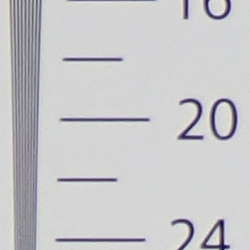
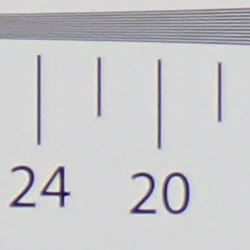
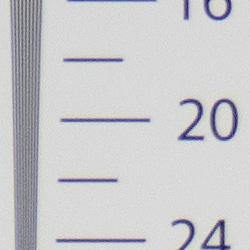
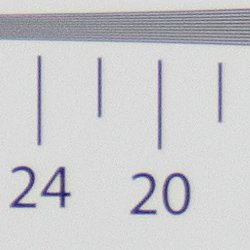
An in-camera JPEG of our laboratory resolution chart revealed soft but distinct line patterns up to about 2,150 lines per picture height in the horizontal direction, and to about 2,150 lines per picture height in the vertical direction. Complete extinction of the pattern didn't occur until about 2,400 lines in both directions. Adobe Camera Raw produced similar results, though with a lot more chromatic aberration and noise at default noise reduction settings. Use these numbers to compare with other cameras of similar resolution, or use them to see just what higher resolution can mean in terms of potential detail.
Sharpness & Detail
Images are somewhat soft at default settings, though with some visible sharpening artifacts. Moderate noise reduction even at base ISO reduces fine detail.


Sharpness. The Olympus TG-5 produces somewhat soft images as is often the case with this class of camera, though it tries to compensate with some aggressive sharpening which leaves visible sharpening halos around high-contrast edges. This is pretty typical of compact cameras, though, especially those with folded internal optics. Edge enhancement creates the illusion of sharpness by enhancing colors and tones right at the edge of a rapid transition in color or tone.
Detail. The crop above right shows moderate levels of noise suppression in the mannequins's hair, with many individual strands smudged together in areas of low contrast, even at base ISO. This is improved performance compared to its predecessor (TG-4), though, which showed even stronger noise reduction due to its smaller pixels. Noise-suppression systems in digital cameras tend to flatten-out detail in areas of subtle contrast. The effects can often be seen in shots of human hair, where the individual strands are lost and an almost "watercolor" look appears.
RAW vs In-Camera JPEGs
As noted above the Olympus TG-5 produces somewhat soft images that suffer loss of fine detail as a result of aggressive noise processing as well as less than stellar optics. Compare a base ISO in-camera JPEG to an Adobe Camera Raw conversion below to see what we mean.
|
Base ISO (100)
|
|
 |
 |
 |
 |
 |
 |
|
Camera JPEG, defaults
|
RAW via Adobe Camera Raw
|
In the table above, we compare an in-camera JPEG taken at base ISO using default settings (on the left) to a matching RAW file converted with Adobe Camera Raw 9.1 via DNG Converter using default noise reduction with strong but tight unsharp masking applied in Photoshop (in this case 400% USM with a radius of 0.5 pixels and a threshold of 0).
As you can see from the ACR conversion, you can extract a lot more fine detail from the TG-5's RAW files than what a camera JPEG contains, however there is quite a bit of noise already at base ISO, which is the challenge when dealing with RAW images from cameras with such a small 1/2.3"-type sensor. The TG-5's RAW images can also be quite soft depending on the focal length and aperture, requiring copious amounts of sharpening which tends to exacerbate noise. You can of course apply noise reduction (we converted with default noise reduction enabled above). Bottom line: You can extract much better detail than the in-camera JPEGs contain with a good RAW converter, provided you're willing to experiment and apply fairly strong noise reduction, sharpening and lens corrections.
ISO & Noise Performance
Improved high ISO performance compared to its predecessor, but not as much as we had hoped.
|
Default High ISO Noise Reduction
|
||
 |
 |
 |
| ISO 100 | ISO 200 | ISO 400 |
 |
 |
 |
| ISO 800 | ISO 1600 | ISO 3200 |
 |
 |
|
| ISO 6400 | ISO 12,800 | |
As you can see from the above crops, the Olympus TG-5 doesn't offer very good high ISO performance, and even at base ISO, a fair amount of fine detail is lost due to fairly aggressive default noise reduction. That's typical for such a small 1/2.3" sensor, however unlike its predecessor, high ISO noise reduction can be adjusted on the TG-5. Olympus calls high ISO noise reduction "Noise Filter", and there are 4 available settings on the TG-5: "Off", "Low", "Standard" and "High". The shots above used the default "Standard" setting.
As was true for the TG-4, you'll want to keep ISO sensitivity as low as possible with the TG-5, as image quality deteriorates very quickly as sensitivity rises above ISO 400. Still, when viewing crops at 100% like this, there is a noticeable improvement in detail retention, noise levels and even color compared to the TG-4. However, keep in mind the TG-5's lower 12 megapixel resolution versus the TG-4's 16MP, so the improvements didn't really yield any significant dividends in print sizes. See the Print Quality section below for details.
Extremes: Sunlit, dynamic range and low light tests
High contrast with limited dynamic range. Decent low-light performance for its class.


Sunlight
The Olympus TG-5 did fairly well for its class with this difficult shot, requiring +0.3 EV exposure compensation, which is less than the average amount of needed (+0.7 EV) to keep the mannequin's face bright in this harsh lighting. As mentioned previously, quite a few highlights were blown, though, and very deep shadows exhibit high levels of noise, blotchy discoloration and posterization. Still, performance here is above average for a pocket camera with such a small sensor.
Oddly, the TG-5 does not offer Olympus' useful Gradation feature found in their Micro Four Thirds cameras despite using the same TruePic VIII image processor found in their latest models.
Because digital cameras are more like slide film than negative film (in that they tend to have a more limited tonal range), we test them in the harshest situations to see how they handle scenes with bright highlights and dark shadows, as well as what kind of sensitivity they have in low light. The shot above is designed to mimic the very harsh, contrasty effect of direct noonday sunlight, a very tough challenge for most digital cameras. (You can read details of this test here. In actual shooting conditions, be sure to use fill flash in situations like the one shown here; it's better to shoot in open shade whenever possible.)
| Face Detection | ||
 |
 |
 |
| Off at 0 EV Aperture priority, f/4 |
On at 0 EV Aperture priority, f/4 |
Full Auto f/4 |
Face Detection. Like most cameras these days, the Olympus TG-5 has the ability to detect faces, and adjust exposure and focus accordingly. As you can see from the examples above, just enabling face detect AF did detect a face according to EXIF metadata, but oddly made little difference to exposure. Full Auto mode however enabled the flash and produced a better exposure.
|
Backlight High Dynamic Range Scene Mode
|
||
 |
||
Backlight HDR: |
||
Backlight HDR Scene Mode. Like the TG-4, the TG-5 offers a "Backlight HDR" scene mode which "captures multiple images and merges them into one, properly exposed image" according to Olympus. No details are given as to how many images are merged, and there are no options to adjust strength or exposure range. There is also a separate "Underwater HDR" scene mode, which we did not test.
Above, you can see the TG-5's Backlight HDR mode at work with our Far-field shot. (Mouse over the links to compare, and click on them to access full resolution images.) The resulting HDR image does have compressed highlights and reduced noise from merging multiple images, however shadows are actually a bit darker than with it disabled, and overall the image is underexposed. (Our Outdoor Portrait shot in HDR mode also turned out underexposed.) Given the feature's name, we suspect it will work better for heavily backlit scenes.
Low Light
Decent low-light capabilities for its class.
The longest shutter speed supported by the TG-5 is 4 seconds which is quite limiting, however the camera does have some scene modes which work well in low-light, including Handheld Star Light and Live Composite modes, the latter essentially giving you a bulb-mode-like capability up to three hours.
The Olympus TG-5 was able to autofocus down to -1.9 EV on our legacy low-contrast AF target and down to -4.2 EV on our newer high-contrast target unassisted, when shooting at wide angle and at f/2.0. This is excellent performance for a pocket camera. The TG-5 also has an AF assist LED which allows it to autofocus in complete darkness when the subject is in range and has sufficient contrast.
See below for test results with the built-in flash.
Flash Test Results
Coverage, Exposure and Range
A weak flash with narrow coverage, but range is helped by the fast lens.

Coverage. Flash coverage was quite uneven at wide angle, leaving very dark corners and edges in our flash coverage test image, and you can also see some unevenness in illumination vertically as well. Narrow coverage at wide angle isn't unusual, though, and some of the corner darkening is likely from the lens itself. We no longer test flash coverage at telephoto, as it is invariably better, making wide angle the worst case scenario.

Exposure. The TG-5 underexposed our standard flash portrait shot at f/4 and ISO 200, and dialing in flash exposure compensation made no difference to the exposure. You'll want to use a higher ISO and/or a wider aperture for most flash shots. (Note that the TG-5 does not have a flash hot-shoe, however its built-in flash can control compatible remote slave flashes.)
| Manufacturer-Specified Flash Range |
|---|
| Telephoto |
 10.2 feet f/4.9, 1/100s, ISO 1600 |
Manufacturer Specified Flash Range Test. The Olympus TG-5's flash range is rated at 7.9m / 25.9 ft at wide angle, and 3.1m / 10.2 ft at full telephoto at ISO 1600. In the above shot at the telephoto range, the TG-5 produced a reasonably bright flash target, indicating Olympus' flash range rating is credible. We shoot this test shot using the manufacturer-specified camera settings, at the range the company claims for the camera, to assess the validity of the specific claims.
Output Quality
Print Quality
A good 13 x 19 inch print at ISO 100, a good 8 x 10 at ISO 400, and a good 5 x 7 at ISO 800 and ISO 1600.
 ISO 100 prints are quite good at 13 x 19 inches. There is a nice amount of fine detail and the colors are well represented throughout. For a rugged camera with a small 1/2.3"-type sensor, we like what we're seeing here at base ISO with the prints. The 16 x 20 inch prints here can definitely be used for wall display purposes and less critical applications as well.
ISO 200 requires a reduction in print size to 11 x 14 inches in order to satisfy our requirements for passing the "good" seal. Most all contrast detail is now lost in our target's tricky red-leaf swatch, but otherwise this 11 x 14 inch print is quite good and pleasing in most respects.
ISO 400 yields a good print at the common size of 8 x 10 inches, with enough fine detail to pass our good grade while offering worthwhile color representation. The 11 x 14 inch prints here have a bit of noise in flatter areas of our test target, but are not too bad and can certainly be used for less critical purposes.
ISO 800 delivers a 5 x 7 inch print that very much passes our good seal. The 8 x 10's here are slightly muted, with a bit too much noise to pass muster, but a reduction to 5 x 7 tightens the overall print quality up nicely.
ISO 1600 also yields a 5 x 7 inch print that passes our good grade. Colors are still well represented across the spectrum and there is just enough detail to make the cut, with no apparent noise at this size.
ISO 3200 just passes the grade, delivering a good 4 x 6 inch print. It is ever-so-slightly muted due to "gain-strain" at this sensor size, but otherwise it passes the test.
ISOs 6400 and 12,800 do not yield usable prints and these gain settings are best avoided for all printing purposes.
The Olympus TG-5 performs as expected in the print quality department given the relatively small sensor. A very good 13 x 19 inch print can be attained while shooting at base ISO, and this is a nice feat in general for a rugged waterproof camera. And yet if you intend to print 8 x 10's you will for sure want to remain at ISO 400 and below, as anything higher will simply not yield good results while printing at 8 x 10 inches. Given the larger pixels courtesy of the move back to 12 megapixels from 16MP in the TG-4, we'd hoped for better high ISO performance as compared to the predecessor, but the sensor size really limits the performance potential above ISO 400, regardless of the slight increase in pixel size.
The images above were taken from our standardized test shots. For a collection of more pictorial photos, see our Olympus Tough TG-5 Photo Gallery .
Not sure which camera to buy? Let your eyes be the ultimate judge! Visit our Comparometer(tm) to compare images from the Olympus Tough TG-5 with those from other cameras you may be considering. The proof is in the pictures, so let your own eyes decide which you like best!
Performance
Tested with firmware version 1.1
Timing and Performance
Good to excellent performance for its class.
| Startup/Play to Record | ||
|---|---|---|
| Power on |
~1.3 seconds
|
Time it takes for LCD to turn on and lens to deploy and capture a picture. |
|
Play to Record, |
~0.7 second
|
Time until first shot is captured. |
Startup to first shot time was faster than average for its class, at a fairly quick 1.3 seconds. Play to Record mode switching was good at well under a second.
| Shutter Response (Lag Time) | ||
|---|---|---|
|
Full Autofocus |
0.175 second
|
Time from fully pressing shutter button to image capture, zoom lens at wide angle position. |
|
Full Autofocus |
0.188 second
|
Time from fully pressing shutter button to image capture, zoom lens at telephoto position. |
|
Full Autofocus |
0.248 second
|
Time to capture while forcing flash to fire, zoom lens at medium focal length. |
|
Manual Focus |
0.094 second
|
For most cameras, shutter lag is less in manual focus than autofocus, but usually not as fast as when the camera is "prefocused". |
| Prefocused |
0.047 second
|
Time to capture, after half-pressing and holding shutter button. |
The Olympus TG-5's full autofocus shutter lag when shooting the same target multiple times was fast for a rugged compact camera. The TG-5's full AF shutter lag clocked in at about 0.18 second at wide angle using center AF mode. Full AF shutter lag was just a bit slower at full telephoto, at about 0.19 second. Enabling the flash raised shutter lag to 0.25 seconds, to account for the metering preflash. Manual focus shutter lag was pretty quick at 94 milliseconds, and prefocused shutter lag was fast at 47 milliseconds though some compact cameras are even faster.
| Cycle Time (shot to shot) | ||
|---|---|---|
| Single Shot mode |
0.31 second
|
Average time per shot. |
| Single Shot mode |
0.33 second
|
Average time per shot. |
| Early shutter |
No
|
Some cameras don't snap another shot if you release and press the shutter too quickly in Single Shot mode, making "No" the preferred answer. |
|
Sequential High |
0.05 second
(20.0 fps); 21 frames total; 4.4 seconds to clear* |
Time per shot, averaged over 21 frame buffer, then slows down to 0.18s or 5.7 fps when buffer is full with a lot of variation. |
|
Sequential High |
0.05 second
(20.0 fps); 15 frames total; 4.1 seconds to clear* |
Time per shot, averaged over 15 frame buffer, then slows down to 0.33s or 3.0 fps when buffer is full with a lot of variation. |
|
Sequential High |
0.05 second
(20.0 fps); 11 frames total; 6.3 seconds to clear* |
Time per shot, averaged over 11 frame buffer, then slows down to 0.49s or 2.0 fps when buffer is full with a lot of variation. |
|
Sequential Low |
0.20 second
(5.0 fps); Unlimited (?); 4.0 seconds to clear* |
Time per shot, with no apparent limit other than available card capacity. |
|
Sequential Low |
0.20 second
(5.0 fps); 30 frames total; 4.3 seconds to clear* |
Time per shot, averaged over 30 frame buffer, then slows down to 0.30s or 3.3 fps when buffer is full with a lot of variation. |
|
Sequential Low |
0.20 second
(5.0 fps); 17 frames total; 5.9 seconds to clear* |
Time per shot, averaged over 17 frame buffer, then slows down to 0.51s or 2.0 fps when buffer is full with a lot of variation. |
| Flash recycling |
3.2 seconds
|
Flash at maximum output. |
| *Note: Buffer clearing times measured with a 64GB Lexar Pro 2000x UHS-II SDXC card. Slow cards may also limit length of bursts in continuous mode. ISO sensitivity also affects cycle times and burst mode performance, with higher ISOs generally increasing cycle times and reducing burst performance. |
||
Shot-to-shot cycle times were very fast in single shot mode, at about 0.3 second for Large/Super Fine JPEGs or RAW+LSF JPEG files. We no longer test just RAW file cycle time in single-shot mode, as it's usually somewhere in between JPEG and RAW+JPEG.
The Olympus TG-5's full-res Sequential High shooting mode (which uses an electronic shutter) was very fast at 20 frames per second (a 10 fps option is also available), and the JPEG buffer depth was 21 frames when shooting at the best quality Large/Super Fine setting. (Olympus claims unlimited buffer for Large/Normal JPEGs.) Unlike the TG-4, the TG-5 supports RAW and RAW+JPEG capture in sequential mode at up to 20 fps as well. Burst depths of course were less than JPEGs at 15 RAW and 11 RAW+LSF JPEG frames, but that's still not bad, especially for the class. In Sequential Low mode which uses the mechanical shutter, the TG-5 shoots at 5.0 fps. JPEG buffer depth was unlimited at this speed, while RAW and RAW+JPEG buffers increased to 30 and 17 frames respectively.
The TG-5 also offers a Pro Capture mode at 10 fps which begins to take photos as soon as you half-press the shutter release but discards them except for up to 4 frames just before fully pressing the shutter, and of course it keeps the ones captured while the shutter is fully depressed. This helps capture fleeting moments that would be difficult to react in time for.
Buffer clearing was pretty swift with our 64GB Lexar Pro 2000x SDXC card, taking at most 6.3 seconds after max-length bursts of RAW+JPEG frames, and you can adjust settings and take additional shots while it's clearing, though you can't view just-shot images until after they are flushed to the card.
The built-in flash took an average of 3.2 seconds to recharge after a full-power discharge which is not bad.
Bottom line, the Olympus TG-5's performance is good to excellent for its class with fast startup, fast AF, low shutter lag and very fast full-res burst modes at up to 20 fps even for RAW and RAW+JPEGs files, unlike the TG-4 which did not support RAW capture in burst mode.
Battery
Battery Life
Good battery life.
| Operating Mode | Number of Shots |
|---|---|
|
Still Capture
(CIPA standard, LCD Monitor) |
340
|
The Olympus TG-5 uses a custom LI-92B rechargeable lithium-ion battery for power (the same as the TG-4) and the battery is charged in-camera via the USB port. CIPA battery life is a little lower than the TG-4 but is still good for its class, at 340 shots per charge. Still, we recommend you pick up a spare battery for extended outings.
The table above shows the number of shots the camera is capable of (on a fully-charged rechargeable battery as appropriate), based on CIPA battery-life and/or manufacturer standard test conditions.
(Interested readers can find an English translation of the CIPA DC-002 standards document here. (180K PDF document))
Image Quality
We've decided to do something a little different here than our usual image quality comparisons, since we don't test many cameras with tiny 1/2.3"-type sensors these days (not many are being produced). So below we compare the TG-5's JPEG image quality to that of its predecessor's, the TG-4, at all shared ISO settings as the usual ISOs we compare don't perform well with tiny sensors. And below that, we compare the TG-5's default noise reduction to its lowest setting at all ISO settings, to give you an idea of how much noise is present.
NOTE: For those interested in working with the RAW files involved, click these links to visit each camera's respective sample image thumbnail page: Olympus TG-5 and Olympus TG-4 -- links to the RAW files appear beneath those for the JPEG images, wherever we have them. And remember, you can always go to our world-renowned Comparometer to compare the Olympus TG-5 to any camera we've ever tested!
Olympus TG-5 vs Olympus TG-4 at Base ISO
 |  |
 |  |
 |  |
Olympus TG-5 at ISO 100 | Olympus TG-4 at ISO 100 |
Here at base ISO where noise is lowest, we can see the TG-5 actually retains better detail in the mosaic crop even though its resolution is lower at 12MP instead of 16. Detail is pretty much a wash in our tricky red-leaf swatch, though, however the TG-5 does a little better in the pink fabric. Luminance noise is higher from the TG-5 as can be seen in flatter areas, however chrominance noise is very well-controlled from both cameras. Despite not being as saturated as most cameras, the TG-5 does show more pleasing, warmer colors and a slightly crisper image overall, however sharpening halos around high-contrast edges are more noticeable | |
Olympus TG-5 vs Olympus TG-4 at ISO 200
 |  |
 |  |
 |  |
Olympus TG-5 at ISO 200 | Olympus TG-4 at ISO 200 |
Both cameras show a step down in image quality already here at ISO 200 with higher noise and more smudging due to stronger noise reduction, however the TG-5 continues to offer slightly better detail and colors. | |
Olympus TG-5 vs Olympus TG-4 at ISO 400
 |  |
 |  |
 |  |
Olympus TG-5 at ISO 400 | Olympus TG-4 at ISO 400 |
Here at ISO 400, the trend continues with the TG-5 retaining more detail than the TG-4 with less smudging, however its area-specific noise reduction does appear to the blurring some areas in our mosaic crop more than others which looks a little strange. The noise "grain" from the TG-5 in flatter areas is much finer and more consistent, though. Color and contrast remain better as well, so overall the TG-5 comes out ahead again here. | |
Olympus TG-5 vs Olympus TG-4 at ISO 800
 |  |
 |  |
 |  |
Olympus TG-5 at ISO 800 | Olympus TG-4 at ISO 800 |
Both cameras really start to struggle here at ISO 800, with high noise and smudged details. The TG-5 still produces a finer, tighter noise "grain", lower chroma noise, as well as better color and contrast, but fine detail is also softer and more blurred. We'd still give the edge to the TG-5, but it's getting tough to pick a definitive winner here and at higher ISOs. | |
Olympus TG-5 vs Olympus TG-4 at ISO 1600
 |  |
 |  |
 |  |
Olympus TG-5 at ISO 1600 | Olympus TG-4 at ISO 1600 |
ISO 1600 looks like a mess from both cameras when viewed at 100% like this. Both luma and chroma noise are lower from the TG-5, however almost all fine detail has been more heavily blurred to the point that it looks out of focus. The TG-4 shows slightly better detail, but appears much noisier with rougher edges and noticeable chroma blotching. Color is cooler and much more desaturated from the TG-4 as well. | |
Olympus TG-5 vs Olympus TG-4 at ISO 3200
 |  |
 |  |
 |  |
Olympus TG-5 at ISO 3200 | Olympus TG-4 at ISO 3200 |
Similar to what we saw at ISO 1600, the TG-5 continues to produce lower noise and better color, but softer detail. Both are pretty awful at ISO 3200. | |
Olympus TG-5 vs Olympus TG-4 at ISO 6400
 |  |
 |  |
 |  |
Olympus TG-5 at ISO 6400 | Olympus TG-4 at ISO 6400 |
ISO 6400 is mushy mess with fine detail obliterated by very heavy noise and strong blurring. The TG-5 however still produces better color while the TG-4 has become very desaturated and dark, with an almost scorched look. | |
Overall, there is an improvement in image quality over the TG-4 with better detail at lower ISOs as well as better contrast and color across the ISO range, however we had hoped high ISO performance would be better given the TG-5's larger pixels and newer, more powerful image processor. Both cameras support RAW mode so you should be able to do better with them than in-camera JPEGs with some careful processing, but unlike the TG-5, the TG-4 does not support burst mode when shooting RAW files, so keep that in mind.
TG-5 Adjustable High ISO Noise Reduction
The Olympus TG-5 is the first in the series to offer adjustable high ISO noise reduction, which Olympus calls "Noise Filter". There are four available settings on the TG-5: "Off", "Low", "Standard" and "High". The crops below compare the default "Standard" noise reduction to the lowest "Off" setting.
Olympus TG-5 Default NR vs Lowest NR at Base ISO


Olympus TG-5 Default NR vs Lowest NR at ISO 200


Olympus TG-5 Default NR vs Lowest NR at ISO 400


Olympus TG-5 Default NR vs Lowest NR at ISO 800


Olympus TG-5 Default NR vs Lowest NR at ISO 1600


Olympus TG-5 Default NR vs Lowest NR at ISO 3200


Olympus TG-5 Default NR vs Lowest NR at ISO 6400


Olympus TG-5 Default NR vs Lowest NR at ISO 12800


As you can see from the crops above, the lowest noise reduction setting allows a lot more luma noise to remain, however it still does a pretty good job at controlling chroma noise. Fine detail is better preserved at the lowest setting with much less smoothing, but the amount of luma noise is so high that it's arguable it's a useful setting even at low ISOs, unless you're looking for a very grainy effect.
A good 13 x 19 inch print at ISO 100, a good 8 x 10 at ISO 400, and a good 5 x 7 at ISO 800 and ISO 1600.
ISO 100 prints are quite good at 13 x 19 inches. There is a nice amount of fine detail and the colors are well represented throughout. For a rugged camera with a small 1/2.3"-type sensor, we like what we're seeing here at base ISO with the prints. The 16 x 20 inch prints here can definitely be used for wall display purposes and less critical applications as well.
ISO 200 requires a reduction in print size to 11 x 14 inches in order to satisfy our requirements for passing the "good" seal. Most all contrast detail is now lost in our target's tricky red-leaf swatch, but otherwise this 11 x 14 inch print is quite good and pleasing in most respects.
ISO 400 yields a good print at the common size of 8 x 10 inches, with enough fine detail to pass our good grade while offering worthwhile color representation. The 11 x 14 inch prints here have a bit of noise in flatter areas of our test target, but are not too bad and can certainly be used for less critical purposes.
ISO 800 delivers a 5 x 7 inch print that very much passes our good seal. The 8 x 10's here are slightly muted, with a bit too much noise to pass muster, but a reduction to 5 x 7 tightens the overall print quality up nicely.
ISO 1600 also yields a 5 x 7 inch print that passes our good grade. Colors are still well represented across the spectrum and there is just enough detail to make the cut, with no apparent noise at this size.
ISO 3200 just passes the grade, delivering a good 4 x 6 inch print. It is ever-so-slightly muted due to "gain-strain" at this sensor size, but otherwise it passes the test.
ISOs 6400 and 12,800 do not yield usable prints and these gain settings are best avoided for all printing purposes.
The Olympus TG-5 performs as expected in the print quality department given the relatively small sensor. A very good 13 x 19 inch print can be attained while shooting at base ISO, and this is a nice feat in general for a rugged waterproof camera. And yet if you intend to print 8 x 10's you will for sure want to remain at ISO 400 and below, as anything higher will simply not yield good results while printing at 8 x 10 inches. Given the larger pixels courtesy of the move back to 12 megapixels from 16MP in the TG-4, we'd hoped for better high ISO performance as compared to the predecessor, but the sensor size really limits the performance potential above ISO 400, regardless of the slight increase in pixel size.
Field Test Part I
Field Test Part II
Megapixel sanity meets enthusiast features
By Dave Pardue | Posted: 06/02/2017

What a bold move by Olympus, going against the grain in the Great Megapixel Race with the 12mp TG-5. Yes, Sony did it with the full frame A7S series at 12mp, but they shielded themselves to a degree by the fact that buyers had choices for higher resolutions from them in the A7 and A7R lines as well. For Olympus, this is their only shot at luring potential buyers out there to invest in a tough camera, in an age where smartphones have already taken away so much of the compact camera market. A big gamble indeed.
We at IR have been very vocal about applauding any move away from the megapixel insanity, especially as relates to smaller sensor sizes. Complain all day if you want about how small a 1/2.3" sensor is, but the same crowd would complain a lot louder if the camera got too bulky as a result of a larger sensor. After all, these things also need room for protective seals and gaskets to keep the lethal water out, yet still fit snugly into a pocket, pouch or other water-bound carry-all. The Olympus TG-5 aims to be a complete waterproof, rugged solution for both novices and enthusiasts, and in addition to the healthy trimming down on the pixel count, it also comes sporting a number of rather interesting upgrades to the TG line.

Physically the TG-5 is quite similar in appearance to the TG-4 in most respects. The notable difference on the front of the camera is the very welcome new addition of a locking mechanism for the accessory mount surrounding the lens. This locks the accessory adapter into place just like interchangeable lenses lock into place, and prevents both the adapter and the supplied protective ring (used when no adapter is in place) from accidentally being unseated and lost. This is a nice touch.
 |
The TG-5 (below) retains much of the same external styling as the TG-4 before it, but adds a critical locking button to the accessory mount which keeps the adapter and accessories secure. |
On the top deck, the big newcomer is the control dial, a first for a rugged waterproof camera, as seen on the far right in the image below. This takes the place of the former zoom toggle, which now surrounds the shutter button. The one additional switch is the "log" lever, which engages the various built-in logging and tracking features such as GPS. And the one notable addition to the rear of the camera is adding the movie icon to the mode dial.
 |
The TG-5 (above) sports a welcome new control dial to the right, and moves the zoom lever to now surround the shutter button. A log on-off switch is also now added to the top deck. |
The control dial changes in operation depending on the mode the camera is in. For aperture priority it controls the aperture of course, and while in P, movie and microscope modes it controls the exposure value. Thanks to a helpful reader comment alerting us that it also assists with focus fine-tuning while in manual focus (I didn't yet have access to a manual during this first Field Test). Stay tuned for more to come, as I'll be exploring that a lot further now that we're aware of the manual focus aspect of its operation.
Another significant change from a user-standpoint can't be seen until you power on the camera, because the primary menu system has now been beefed up significantly. The former "compact camera" type system they've employed in the line up until now has been discarded and they've ported in the basic menu configurations from their higher-end PEN and OM-D cameras. Wow... what a nice surprise! Anyone familiar with Olympus cameras can now pick up the TG-5 and feel immediately comfortable, no big learning curve to speak of other than familiarizing yourself with things like the icons for engaging the optional accessories such as the teleconverters, of which we'll begin exploring below. (And for anyone new to Olympus menus, we find them somewhat odd and quirky but have grown to love them all the same, so just give it time and a sprinkle of patience for the first week or so.)
Olympus TG-5: Image Quality
This first sample we were treated to by Olympus has firmware version 1.0, and while we're told it's not from the final mass production line, it does appear armed with all the "right stuff" as a full review unit. As such, I couldn't wait to get it checked-in, charged up, and then out and about to start capturing images and giving it a shakedown cruise. I've shot extensively with the TG line since the TG-2 scored high marks in our Best Waterproof Roundup from 2013. It's interesting to note that the TG-2 was the last in the series to sport a 12mp sensor, and now here we are several models later back at that arguably more reasonable pixel count.
In addition to the sensible resolution, the camera shares the same "brain" (a.k.a. processor) as the one found in the flagship, award-winning E-M1 Mark II. Pairing these credentials with a bright f/2 aperture at the wide-angle yields the potential to deliver images that should, at least on paper, surpass anything delivered from the same sensor size before this. We've yet to put the camera through our rigorous lab testing, however, so time will tell there, but we now have plenty for you in the way of real world shots on both dry land and submerged.
As of the writing for this first Field Test there weren't any pools yet open to kids for the summer, but that allowed for some very calm pools in which to gauge underwater image quality. I'll circle back for the next Field Test with plenty from that chaotic side of life, but to get started down the image quality road, below are some underwater examples shot at wide angle (25mm eq.) and full telephoto (100mm eq.) at a variety of apertures and ISO settings.
 |
I.Q.: I shot this basic image at f/2, f/2.8 and f/8 to showcase the underwater IQ at each available aperture, while allowing the ISO to rise as needed. Click on any of the links for access to the full resolution version. |
(Images have been resized to fit this page, cropped and/or altered in post-production, primarily to balance shadows and highlights as needed. Clicking any image will take you to a carrier page with access to the original, full-resolution image as delivered by the TG-5. For additional images, access to RAW files and EXIF data please see our Olympus TG-5 Gallery page.)
For anyone wondering why lowering the resolution means potentially increasing the basic image quality, it all has to do with the size of the pixels, which are the actual mechanisms gathering the light for you. At this sensor size, the approximate pixel pitch is 1.54 microns, verses 1.34 microns for a 16mp sensor of the same physical size, such as that in the previous TG-4. Larger pixels are simply more efficient gatherers of light covering more surface area and can therefore detect more light without having to increase the ISO gain and risk introducing noise into your image.
I've personally found ISO 800 to be about as high as I can generally tolerate for most sensors this size, but the combination of larger pixels and a newer processor in the TG-5 could change that. I'm going to wait on that assessment until we have our lab First Shots series, as they level the playing field and allow controlled apples-to-apples comparisons, but in the meantime you'll find a variety of ISOs in our TG-5 Gallery. Below are a few to get you started, and as always clicking on an image will bring you more options and information.


 |
1/30s / f/2 / ISO 250 / 25mm eq. |
Bright & spacious: This is an indoor shot you won't see with many compact "tough" cameras, because the TG-5 allows for an f/2 maximum aperture -- far brighter than is typical for this market segment. This allows the ISO to remain comfortably low while allowing for a 1/30s shutter speed here, and also gives a bit of subject-to-background isolation to the image, even at this fairly wide focal length. |
TG-5: In a Flash
The Olympus TG-5 is very much aimed at enthusiast photographers, and for this reason I really wish it had full manual exposure control. It was the first waterproof camera to even have a mode dial and is now the first to add a control dial (!) which I really love. Perhaps they'll consider full manual control at some point down the line, but for now there are still ample options for enthusiast photographers to fine-tune their shots, more than with most any other rugged camera out there, and one of these options is now the ability to have fully manual flash control. (The TG-5 also offers flash exposure compensation of up to +/-2.0 EV in most shooting modes, whereas in the TG-4, flash compensation was oddly only available in underwater modes.)
This was welcome news to me, as I really love having full control over the flash value, which now goes all the way down to 1/64 power, so you can pretty much dial it in any way you need. I don't like being able to tell when flash was used in a shot, but do enjoy using it subtly to help balance foreground and background objects. The two images below are examples of using it manually to dial in just enough to bring some pop to the foreground subjects without being otherwise noticeable.
 |
1/200s / f/4.9 / ISO 200 / 170mm eq. [TCON-01 170mm eq. teleconverter attached] |
A splash of flash: This was taken just after dawn and I needed a bit more attention given to the roses in order to set them off. Dialing in just a little pop of manual flash helped out with that, where "auto" flash would have likely overpowered the foreground. This is also the first shot in this Field Test taken with the TCON-01 170mm eq. teleconverter, and we'll discuss that and the FCON-01 more down below. |
 |
1/640s / f/2 / ISO 100 / 25mm eq. |
Balancing act: In order to not have the sky blown out I used a touch of manual fill flash here and was able to keep the exposure good for the sky by dialing the exposure down to -1.3EV, although I could have done a better job with it by dialing up a touch more flash and dialing the EV down even further. This is where manual flash control combined with E.V. is so handy. |
Olympus RC flash mode
I was pleased to see "RC" as an option in the TG-5 flash menu. RC is the Olympus name for remote flash control, and I had only used it a few times before. We'd just received a sample copy of their flagship FL-900R flash unit, and I thought it'd be interesting to see if I could get this little tough camera to fire that nice, luxurious strobe, so I grabbed both and headed outside at dusk one evening.
I didn't have an instruction manual during this Field Test, but I was able to gather enough information from the TG-4 and 900R manuals to get myself in the ballpark. Then it was just a matter of remembering to swivel the flash body so that the front was facing towards the TG-5, so that it could "see" the RC signal being beamed over by the camera. Compose the shot, press the shutter, and what do you know... it worked!
 |
1/100s / f/4.9 / ISO 200 / 100mm eq. |
Remote flash from a tough camera: Using RC Mode I was able to trigger the Olympus 900R off-camera with the TG-5. It certainly worked for this shot, delivering far better results from a 45-degree angle towards the subject -- and employing a bit of bounce flash as well -- than what I could have achieved with the camera's built-in flash alone. |
The remote firing option is a nice addition to the camera's capabilities, but it did leave me yearning more for a manual exposure mode in the camera itself, and I'm not sure any reason why that shouldn't be possible at some point. The tricky balance between foreground and background imagery often demands fully manual control, but at least you now have an ample degree of control where flash value is concerned both on and off the camera.
[Note to readers: I had anticipated reporting the manual flash values for you after each selection above, but was disappointed to learn that our EXIF reader does not report these.]
TG-5: Image Stabilization
We'll take a deeper dive into the TG-series conversion lenses down below, but for an initial look at image stabilization on the TG-5, I've chosen this image which was shot using the optional TCON-01 teleconverter, which extends the available reach of the TG-5 to a generous 170mm eq. With this attached and the camera properly set to accommodate it (a setting in the menus), you're at full telephoto with a maximum aperture of f/4.9. This is wide enough to allow for at least some subject-to-background isolation depending on the shot, but is not bright enough to allow for fast shutter speeds at times such as dusk, when this image was taken. At a focal length of 170mm eq. and a shutter speed of 1/15s, I'm usually not steady enough to capture anything usable, but with the onboard sensor-shift I.S. enabled I was able to fare pretty well here. I didn't nail every shot that I attempted, as we're not talking about I.S. of the caliber found on a camera like the E-M1 II, but this is still a fairly good feat given the long focal length.
 |
1/15s / f/4.9 / ISO 800 / 170mm eq. [TCON-01 170mm eq. teleconverter attached / Partial Color mode] |
Busy bokeh: The foliage behind my feline companion here is only about ten feet away, and yet for this sensor size the subject-to-background isolation is really not bad. Unfortunately the bokeh itself is fairly busy and hectic, but with a small sensor, you certainly can't be expecting the creamy bokeh possible from a larger rig. Your best bet with this set-up is to create more distance between your subject and background, and I'll aim to have more of those examples in the next Field Test. I also used Partial Color mode here, and we'll discuss more about filters in another section below. |
TG-5: Sporting specialty modes in spades
If you like specialty modes you're in luck with the TG-5, as it is made for anyone who enjoys going the extra mile to capture a certain shot. The more I've used them over the years, the more I've come to enjoy them, and having even more now ported down to a tough camera is just fine by me. We'll take a look at a sampling of them here and see how they compare to their higher-end versions on the OM-D cameras as well.
Pro Capture
New to the table for the TG line is Pro Capture, and if you've yet to use it on the E-M1 Mark II (where it made its debut), it's quite a useful feature for capturing action. While in this mode, you simply half-press the shutter button and the buffer begins to acquire images, including RAW files, at 10fps. These aren't written to the card until you fully depress the shutter, at which time up to a full ten seconds of the buffered images are then written to the card. You can also choose to keep firing at that point, although once the buffer fills then it will operate as is consistent with normal burst mode.
The possibilities are varied, especially for anything where magic moments happen rarely. In these cases in the past you've been forced to take your chances and eat up precious card space, but with Pro Capture you're armed to capture the magic with very little wasted card space and also very little time wasted time going through images later. I was thrilled to see it ported down to a tough camera so quickly, and having now used it once, I am certain I'll turn to it again as it really is quite easy to use in the field.
 |
1/1000s / f/4 / ISO 100 / 40mm eq. |
The next Tom Brady?: Well, he is wearing New England Patriots' colors, so that's a start. This is the first time I'd gotten to try my hand at Pro Capture with the TG-5, and it was an interesting way to get started because he and I were doing passing drills. As such I was running laterally and half-pressing the shutter with one hand while also playing catch with the other. The one thing I wish you could enable is the ability to buffer continuously without having to half-press the shutter (or perhaps just half-pressing it once to acquire focus and exposure). Then, once the moment happens that you'd like to capture, you'd simply fully press the shutter release. I realize this would drain the battery a lot more quickly if you weren't paying attention and left it constantly buffering, but if it was something you could switch on and off then you'd learn quickly enough to "be careful" just how much you left in on while in that free-form buffering mode. But even having to half-press the shutter while buffering, the feature is simply terrific at allowing a shooter to continuously capture the action until just the right moment, at which time that moment is yours to acquire with hardly any waste of card space. A very neat feature indeed, and I can't wait to try it more for the next Field Test now that the local outdoor pools are finally open. |
Of course, the only real drawback to using Pro Capture is that you're obligated to use electronic shutter, which can potentially result in rolling shutter artifacts (the "Jello" effect seen on occasion in video). For this series he and I were both in constant motion, and I didn't notice any oddities of this kind in the images. I'll be shooting much more with this mode, including with faster subjects on the lake, and will report more on the rolling shutter potential in the second Field Test.
[You can view the entire Pro Capture burst series, unedited, in our Olympus TG-5 Gallery.]
In-camera RAW processing (Or, Slash meets the Mad Hatter!)
I was on a shoot with a higher-end rig early one morning, and when the session concluded I realized I had the TG-5 in the front seat of my car. ["Hang on... let me fire off just one or two more!" Quick -- fumble with exposure and enable a touch of flash so it's not just a silhouette.] If I'd had time I would have worked with RC mode and illuminated the shot with the Olympus 900R's (which I was using for the primary shot from earlier) but again, this was at the end of a long and grueling several-hour shoot, and I was desperate for more coffee. But... that just made the image all the better to use for trying the new in-camera RAW processing feature.
 |
1/2000s / f/2 / ISO 100 / 25mm eq. [Original JPEG] |
Wandering in West L.A.: Without access to Manual mode, the Exposure Compensation becomes critical for getting the sky just right. Exposing for the subject here would have blown out the sky entirely and the shot wouldn't be the same. I should have stopped down for several reasons but, again, this was just a quick snap. |
So the shot's not bad given the rapid-fire necessity, but having the RAW image allowed me to run it through the internal processing engine once again. You're given the option to choose any or all of the presets for picture modes, and you can literally ask the camera to spit out 17 different incantations of the same shot for you! It only takes a few seconds given the speed of this processor, so it's a pretty neat little trick for a compact camera to be able to pull off.
Because I've loved Dramatic Tone for years now, but had not yet tried the new Dramatic Tone II which is monochrome, I decided that it might yield the more otherworldly look that I had in my head.
 |
[Converted in-camera to Dramatic Tone II from RAW] |
Welcome to the Jungle: Dramatic Tone II gave this street shot some added flair and grit in a pinch, processed after-the-fact from the RAW file in-camera. |
The RAW processing in the TG-5 is limited to the internal presets, and isn't for enthusiast-level tweaking of parameters such as contrast or highlights. But it's still a nice feature to have and is especially useful for on-the-fly conversions before uploading to the online world.
[Extra credit: Once you acquire a TG-5, try this: Output 3-4 of your favorite picture mode presets from the same RAW file in-camera and then stack them in Photoshop or your favorite photo editor. You can then use various masking techniques to bring out parts of each outputted image that you like, easily blending them. I did this using a combination of Dramatic Tone I & II, and you can view the resulting image here.]
Focus Stacking
I got to try my hand at Focus Stacking for this article with the E-M1 once it was upgraded to firmware v4.0. I found it to be quite a handy and nifty little feature, and it certainly brought a great deal of possibilities to the macro game that formerly required intensive post-processing. In short, the camera snaps a series of the same image at varying focus points and then blends them, or stacks them, together in-camera for you and produces one presumably crisp image with a deeper depth of field. I say "presumably" because it's not a perfect science, and if the camera has to skip too far between focus points, it can leave little unfocused "ripples" in the image.
Fortunately with the E-M1 and now the E-M1 Mark II and a few additional OM-D bodies, you have some control over how the camera chooses these focus points, and can fine-tune the results all within the camera. The TG-5 doesn't come with any tweakable settings in this regard, and yet I was surprised at how good a job it did with focus stacking in general. I shot these handheld for reasons mentioned below, and have examples showing varying distances for comparison. The camera produces two images for you, one a single shot and the other "stacked" as seen below. In both images I've set the initial focus point on the shark's tooth.


Now let's get a little more up close and personal. Below is the same baby shark's tooth atop the shell, and as you can see from the relative scale above it is quite small, perhaps 7-8 millimeters wide at most. I have the camera lens almost touching the tooth here, and these were both handheld. Using a tripod proved cumbersome in this case, and you can't use the timer to trigger the shutter anyway (although I've no earthly idea why that's the case), so I've found handheld is the way to go with these. The camera does a good job of aligning the images for you, just remain as still as you can when firing.


TG-5 Conversion Lenses: Going wider and longer
Perhaps the true hidden jewels of the TG line are the optional teleconverter lenses. Of these, I've had the chance to shoot with the FCON-01 wide angle converter (18.5mm eq.) and the TCON-01 teleconverter (170mm eq.) across multiple TG cameras including for this article while paired with the TG-4. They're super-solidly built and make the line so much more enjoyable and compelling to shoot with. The feline shot from earlier in this Field Test used to showcase image stabilization was shot using the teleconverter, as well as the shot with roses and a goose for the flash section, and below is an example using the FCON-01.
 |
1/60s / f/2 / ISO 125 / 18.5mm eq. [FCON-01 18.5mm eq. fisheye converter attached] |
Sun streaming in : It took me a few passes to get the image I had in my head, but the real estate on the front of the FCON-01 (as seen in the first product shot at the start of this piece) allows an easy gauge for judging the water depth before firing the shutter. |
Of all the shots I've taken thus far with the TG-5, I believe this one showcases the power of the TG system perhaps more than any other. It's such a versatile system once you own the conversion lenses, and they're super-easy to attach. There's a converter ring that I tend to simply leave attached all the time, that's now secured with the new locking mechanism that I mentioned above. After that you simply screw on the lens of choice, let the camera know in the menus that it's affixed, and away you go.
Fun with filters
Yes, most enthusiast photographers shun filters, but I still very much enjoy Partial Color and Dramatic Tone, so I hope you enthusiasts out there won't begrudge me a few examples here. When the PEN E-PL7 came along, Olympus greatly expanded the available colors for this mode, and that expansion is now ported down to the TG-5 with 18 colors to choose from on a handy color wheel that you scroll as you make your selection while viewing the scene before you.
 |
1/100s / f/4.9 / ISO 200 / 100mm eq. |
Cat's Eyes : I admit this type shot looks superior on a larger sensored camera, but for the price and size the TG-5 image quality is really good! |

[Update 7-25-17: You can view additional examples of creative modes from the TG line in this article from the TG-4. I had earlier mentioned Fragmented mode in this Field Test, naturally assuming that it was still offered on the TG-5 as in previous versions as well as the younger sibling TG-870, but thanks to a helpful reader email I now know that they have removed it from this flagship line. (Thanks, Arne!)]
TG-5 Field Test Part I Summary
A return to a more reasonable resolution for this sensor size, a control dial, the processor from the flagship E-M1 II, the basic menu layout from their higher-end models, and even in-camera RAW processing have indeed taken the Olympus TG-5 into uncharted territory for a rugged, waterproof camera. In combination with features already intrinsic to the line, these are amenities that enthusiasts discuss and crave, not bells and whistles added on to sell more numbers to novice buyers. From my first impressions in the field, I can say that this is a bona fide enthusiast camera for the tough world.

Olympus TG-5:
Gallery • Best Prices
Field Test Part III
A solid waterproof camera with improved image quality & performance

In our first Olympus TG-5 Field Test, written by Dave Pardue, he looked at the camera's revised design, image quality, the optional converter lenses and much more. If you have yet to read his Field Test, it would be good to do so before reading this second Field Test.
In this Field Test, I will be focusing on the TG-5's overall performance, autofocus, video and sharing some general thoughts about using the TG-5 in the field.
Performance, Autofocus and Usability
The Olympus Tough TG-5 is powered by the TruePic VIII image processor. This is the same processor that powers other recent Olympus models, such as the OM-D E-M1 II flagship Micro Four Thirds camera. The new processor allows the TG-5 to have some features the TG-4 lacked, including in-camera RAW processing and the ability to continuously shoot RAW files.

When looking at performance, the TG-5 performs very well for its class. It has good startup time, focuses quite quickly and can cycle through single JPEG and RAW shots quickly. The camera shoots large/normal JPEG images at up to 20 frames per second for an unlimited amount of shots -- unlimited in a theoretical sense but limited in practicality by the capacity of your memory card -- and can record RAW images at the same impressive speed, albeit at a smaller buffer (15 frames in our lab testing). The JPEG and RAW buffers clear in about 4 seconds with a fast card, which is impressive and will allow you to keep up with action in the field.

In real-world use, the camera feels very snappy. The camera has good battery life as well; it's rated for 340 shots. Finally, although not necessarily a concern with a camera like the TG-5, it is worth pointing out that the camera has a mechanical shutter which tops out at 5 fps. When using the Sequential High shooting mode at 20 fps, the camera uses electronic shutter. When shooting with the mechanical shutter, the RAW buffer increases to around 30 frames.
Turning our attention now to autofocus. The camera relies upon a 25-point contrast-detect autofocus system. The system is pretty quick and generally reliable. Its performance does decrease a bit in low light, unsurprisingly, but it can focus in dim enough conditions to handle focus when shooting underwater, provided you don't take it too deep.

Another very good aspect of the autofocus system is its macro capabilities. Through much of the camera's focal length range, you can focus as close as 0.4 inches (1 centimeter). It can be tough to work from this distance, but it's neat that it is an option. The camera offers focus stacking and focus bracketing options and can also utilize a "microscope" focusing mode, which allows for even closer focus at the cost of image quality.
In addition to these neat tricks, the camera offers face detection and the ability to cycle through 25 different focus points. I will say that it's not easy to switch between individual focus points, but that's not a huge issue for a tough camera. To change a point focus in single-point AF mode, you have to press the Menu and OK buttons at the same time to access this menu option. The camera also offers manual focusing along with focus peaking; a nice touch.


Regarding usability, I do like the improved controls on the TG-5, including the revised mode dial. I am not a big fan of the camera's menu system though. It is confusing. For example, if you want to shoot in RAW image quality, you have to press OK button during shooting, to bring up the pop-up shortcut menu. It isn't in the standard camera menu. Another issue I have is that the rear LCD screen is not very sharp. The display offers only 460k dots, leaving the display looking a bit pixelated and not very sharp. The protective cover on the display is also very easy to scratch, which will inevitably happen if you pocket the camera like I did.
Overall, the camera performs well. It is quick, offers fast shooting and is responsive during shooting. Autofocus performance is also pretty good, particularly with respect to its close focus capabilities. The user experience is not perfect. The ergonomics are good, but the menus are obtuse, so your experience can range from very good to somewhat frustrating depending on what you are trying to achieve at any given time. If you are just focused on shooting, the TG-5 is pleasant to use. If you are trying to change numerous settings on the TG-5, however, it could prove to be a more annoying camera.
Image Quality
Image quality was discussed extensively in Dave Pardue's Field Test, but I wanted to share some of my own thoughts as well. It's something of an oddity for a new camera to release with less megapixels than its predecessor, but that's precisely what the TG-5 has done. Where the TG-4 relied on a 16-megapixel sensor 1/2.3-inch sensor, the TG-4 employs a new backside-illuminated 12-megapixel sensor. Frankly, this makes considerably more sense because it's a very small sensor and 16 megapixels is too many to retain good image quality. I enjoyed shooting with the TG-4 and found its low ISO images to be fine, but it struggled at higher ISO settings.


When you combine a more reasonable megapixel count and a powerful processor in the TG-5, the end result is impressive image quality for a waterproof pocket camera. The TG-5 still won't match the image quality of something like a Micro Four Thirds camera, of course, as there are severe physical limitations at play, but the important thing to note is that the TG-5 produces better-looking images than the TG-4.


With a camera such as the TG-5, image quality also depends on the built-in lens. The lens is one of the few aspects of the imaging pipeline that remains unchanged compared to the TG-4. The lens offers a 4x optical zoom, which goes from an 35mm-equivalent range of 25mm to 100mm. The maximum aperture starts at a bright f/2.0 and decreases to f/4.9 by 100mm, which isn't great, but the lens needs to be very compact so achieving f/2.0 is impressive even if the telephoto end is not as good. As was the case with the TG-4, I find the lens to work well still with the TG-5. There are some issues in the extreme corners and sometimes very odd flaring, which you can see manifest itself as purple flare in the center of the frame in different shots in the gallery, but the lens can produce pretty sharp images. There can also be rather significant issues with fringing.


Overall, I think that the TG-5's image quality is pretty good in general, and very good within the tough camera context. Less is more with the TG-5 when it comes to megapixels.
Video
The Olympus TG-5 has 4K UHD video recording (3,840 x 2,160 pixels), which is impressive. More impressive still is that the camera utilizes the full width of the sensor to record 4K video at up 30 frames per second. The camera records at a 102Mbps bit rate, which is pretty good too. That's some serious video recording capabilities for a sub-$400 underwater compact camera.
Olympus TG-5 4K Test Video #1 3840 x 2160 video at 30 frames per second Download Original (219.6 MB .MOV File) |
Olympus TG-5 4K Test Video #2 3840 x 2160 video at 30 frames per second Download Original (454.9 MB .MOV File) |
Unsurprisingly, however, the 4K video quality is not going to blow you away, but it can record 4Kp30 and do so underwater all while fitting in a pocket when you're done shooting. That said, the quality certainly isn't bad. Autofocus during video is something of a disappointment, though. The camera is prone to hunting for focus and even when focus is acquired, it can sometimes wobble, which is distracting. The image is also quite shaky if you zoom in or out during video recording. Further, there is some fairly substantial cropping with 4K video, so you won't be able to get a very wide image, even at the widest zoom setting.


If you want a faster frame rate, you can shoot at up to 60 fps in Full HD (1,920 x 1,080) and at 120 fps in a special high-speed mode. You can shoot at 240 fps in 1280 x 720 and at 480 fps in standard definition resolution.
Olympus TG-5 4K Test Video #3 3840 x 2160 video at 30 frames per second Download Original (188.2 MB .MOV File) |
Olympus TG-5 Field Test Part II Summary
A fun compact tough camera which delivers improved performance
What I liked:
- As tough as ever
- Improved image quality
- Better overall performance than the TG-4
- Reliable autofocus in many conditions
- Improved video features

What I didn't like:
- Autofocus can be a little slow in low light
- Built-in lens is impressively compact, but not very good optically
- Odd flare issues at times
The Olympus TG-5 improves upon its predecessor in numerous ways. It may not offer a lot of incentive for a TG-4 owner to upgrade, but it makes a compelling case for being an excellent tough camera. If you have an imminent vacation or just enjoy a lot of outdoor activities, the TG-5 is a great companion. It easily slips away into a pocket, is very durable, can be used in any weather -- and underwater -- and offers many nice photo and video features. It's an enjoyable camera to use and it will survive essentially any outdoor fun you want to experience.

Video
A video montage from Olympus' high-end waterproof camera
By Dave Pardue | Posted: 05/20/2019
One of my favorite pursuits as a camera reviewer is seeing how much quality I can squeeze from a certain class of camera. And of course one of my favorite life pursuits is just chasing my kids around in the summertime. With those two things in mind I strapped the little Olympus TG-5 to my side last summer with the intention of doing both.
Video is so much fun, but is also much more involved than still photography. High-end video shoots require loads of personnel and gear to pull off, and for good reason. But with ample southeastern U.S. sunshine and an Olympus TG-5, you can achieve very good quality footage considering the price, toss it on a timeline in an editor and come away with better results than I ever would have thought possible with a little waterproof camera. And as you'll see from some of the footage, you can even get decent results in nighttime/low light conditions.
How the TG-5 Sees Summer
I have 5 segments for you, or if you'd prefer you can watch the "Director's Cut" and take it all in down below. And, as we always try to do here at IR, I've provided the full resolution files for download so that you can see the full, uncompressed results, as they are really interesting to watch. Due to typical YouTube file compression, watching the uncompressed (downloaded) results are really the only way to see how good the camera can actually perform, and to be able to see what you'll be able to expect from your own footage.
In these videos, you'll see ample use of 120p "slo-mo" video, which for my taste works really, really well. You'll also see several examples of time-lapse footage on clouds, storms, sunrises and moonrises, which are also tremendously fun to explore. But mostly you'll see the TG-5 doing what it does best, which is being a solid side-kick to summer fun.
Part I: Pools and Lakes
This first section begins with a timelapse of a sunrise over the Atlantic Ocean. After this you'll see ample use of 120p underwater footage, which is the real strength of the TG-5. For the price of this camera, the quality of footage at 120p is fairly astonishing.
Part II: Rockets, cycling and chasing fish
This section begins with more 120p footage of a kid's rocket launch, and then switches to normal shooting speeds for bicycling through the Carolina Lowcountry. The image stabilization is good in some places, but can get a bit "off" a few times. I left these shaky clips in, as I wanted to present a full picture of the camera, both strengths and weaknesses. This segment ends with more 120p footage underwater, which of course is an obvious strength for the TG-5. I used the FCON-01 (19mm eq.) conversion lens here to broaden the views of the local fish.
Part III: The Beach!
Moving back to mostly "normal speed" footage here, we see some limitations of the TG-5 in the way of some choppiness and some shaky footage, but it's not too bad overall for this class. In other words, for less than $500, it's still quite good. And the timelapse of the midday summer storm is a fun addition. If you acquire a TG-5, don't forget to experiment with timelapse! It's super easy to use; just set it up based on the time duration, hit the shutter button and walk away.
Part IV: The Mountains
This clip further showcases the beauty of 120p from the TG-5. The footage both above and below the raging mountain stream is meant to really show the breadth of possibility for such a reasonably priced camera. I perhaps included a few too many clips near the raging waterfall, but it's mesmerizing to watch for me, so it was hard to remove any more. And the underwater footage came out better than I'd expected.
Part V: Summer Nights
Here we turn to low light, though that has traditionally been the domain of higher-end cameras. The brighter f/2 aperture of the TG series comes to our aid here as compared to most "tough" cameras, as do the range of manual controls. For my taste, the lower light footage is quite good for this class! We then end here where we started the first segment, this time with an evening moonrise timelapse off the Atlantic Ocean.
How the TG-5 Sees Summer: Full Version (all 5 segments)
Thanks for watching! I hope these examples have demonstrated at least some of the potential from this cool little camera, as well as a few limitations where it doesn't rival higher-end cameras. For the price, it's a very capable little rig, especially when paired with the optional FCON-01 (19mm eq.) conversion lens. Below are a few more notes from these videos.
TG-5 Video Shooting Notes:
Virtually all of the clips above are as delivered by the camera... only one or two short clips were brightened a tad, but most were left "as is" to show how the camera delivered them.
I chose to remain in 1920x1080, but of course the TG-5 also shoots in 4K. You can find some 4K clips in our TG-5 Field Tests.
Audio is not recorded when shooting in 120p, and so some of the audio you hear has been added in after the fact. This is just the nature of recording in slow motion, across various brands and models.
[All of the music in these pieces was written by yours truly, and if you like what you hear, please search for me on Spotify or elsewhere!]