


Overview
Panasonic G6 Preview
by Mike Tomkins
Posted: 04/23/2013
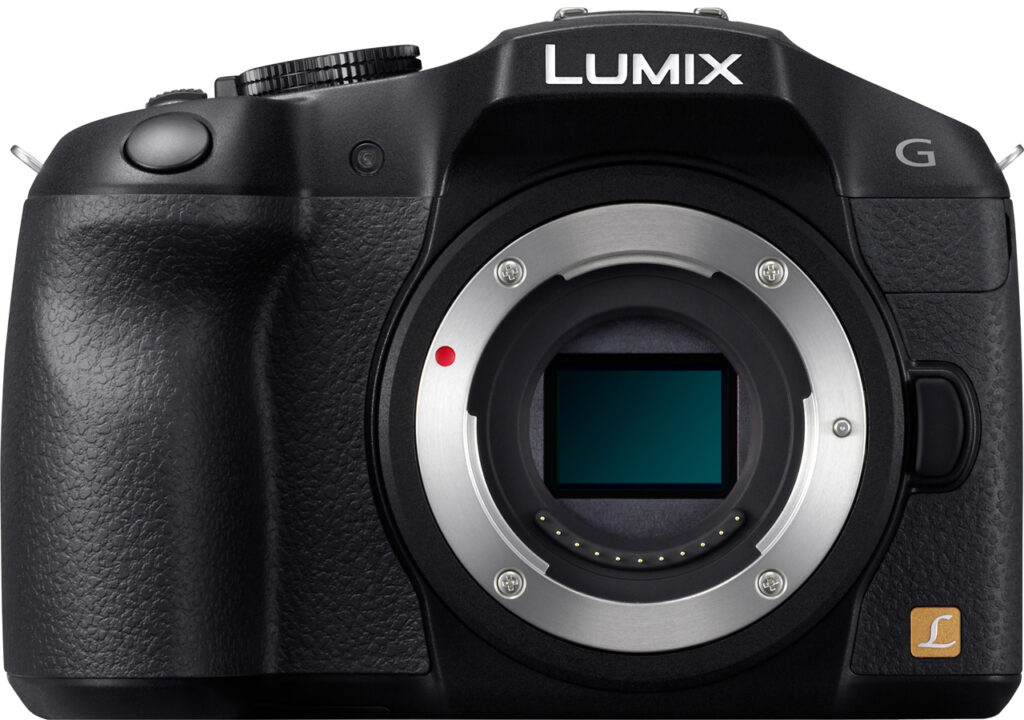
Last fall, Panasonic shipped the Lumix G5, a camera we rather liked thanks to refinements throughout its design. It might seem a little soon for a followup just six months later, but the successor to that Dave's Pick-winning camera is now here, and Panasonic has again been hard at work finding areas in need of a tweak. The Panasonic G6 shares a lot with its predecessor, including its image sensor, but boasts a new body with more external controls and improved ergonomics, plus a new image processor, LCD panel, and viewfinder. There are several changes in the camera's software, too, likely hailing from the new processor.
On the outside, the Panasonic G6's body has been completely restyled, with a more smooth, flowing aesthetic. The new design adds a couple of new buttons -- including a switch from a flash popup lever to a button -- and makes more of them configurable as Function buttons. The Mode dial is now larger to accommodate two extra positions: panorama and movie. Overall camera body size has also increased slightly in all directions, but weight has fallen ever so slightly.
On the inside, the Panasonic G6 pairs the exact same 16 megapixel image sensor used in the G5 with a new generation of Venus Engine image processor. The result is a camera that's slightly faster, easier on its battery, and has a greater available sensitivity range.
The base range of ISO 160 to 12,800 equivalents is unchanged, but there's now a new ISO 25,600 equivalent extended position. Burst shooting at full resolution is now possible at up to seven frames per second using single autofocus, up from 6 fps in the G5, and the Panasonic G6 also bests its predecessor by around a third of a frame per second in live view mode, where the rate is now 4 fps. Startup is now said to be half a second, where the earlier model required a full second. Of course, it's worth noting that all these figures are manufacture ratings, as we've not yet had a chance to put the Panasonic G6 thru our lab.
A couple of other improvements are likely also related to the greater processing power available from the new processor. Although it still uses contrast detection autofocusing, the Panasonic G6 now offers a wider working range of EV -3 to 18 at ISO 100, a significant improvement in low light from the EV 0 limit on the G5. The new model also has a much finer-grained 1,728 zone metering system, versus 144 zone on the earlier camera. Additionally, the Panasonic G6 now offers true 60 frames-per-second movie capture -- as opposed to 60p output from a lower sensor rate -- in MPEG-4 movie mode, although this was already true of its AVCHD mode.
On the rear panel, the Panasonic G6 sports both a new electronic viewfinder and touchscreen LCD panel. The EVF has the same resolution as in the G5, but it's now based around an Organic LED panel said to offer better color and contrast. The display, meanwhile, is still articulated, but now has a higher resolution of 720 x 480 pixels (1,036,800 RGB dots), and uses in-cell touch sensing for a slimmer overall package and reduced glare.
Panasonic has also revisited its connectivity options in the Lumix G6, both wired and wireless. In addition to the existing USB 2.0 High Speed, NTSC / PAL composite (or NTSC only, in North America), and Mini HDMI ports, the Panasonic G6 now sports both wired remote and external microphone connectivity. It also adds both 2.4GHz 802.11b/g/n Wi-Fi and Near Field Communications wireless connectivity, making it much easier to get your photos onto a smart device for instant sharing. Although it's tricky to make a direct comparison on an interchangeable-lens camera, battery life looks to have improved by around six or seven percent.
No information on pricing or availability had been disclosed at press time; Panasonic typically doesn't reveal this until around a month before cameras go on sale. You can however pre-order the Panasonic G6 kit with compact 14-42mm lens for US$749.99 with free shipping in the U.S. from Adorama.com.
Follow Imaging-Resource.com on twitter!
Performance
Timing and Performance
Generally good performance for a Compact System Camera.
|
Startup/Shutdown
|
||
|
Power on |
~0.9 second
|
Time it takes to turn on and capture a shot. |
|
Shutdown |
~2.4 seconds
|
How long it takes camera to turn off before you can remove the memory card. |
|
Buffer clearing time
|
3 seconds after
20 Large/Fine JPEGs* |
Worst case buffer clearing time. -- This is the delay after a set of shots before you can remove the card.
|
|
3 seconds after
7 RAW files* |
||
|
5 seconds after
7 RAW+ L/F JPEG files* |
||
|
*Note: Buffer clearing times measured with a SanDisk Extreme Pro 95MB/sec UHS-1 SDHC card. Slower cards will produce correspondingly slower clearing times. Slow cards may also limit length of bursts in continuous mode. ISO sensitivity and noise reduction settings can also affect cycle times and burst mode performance.
|
||
Startup time was a little faster than average for a Compact System Camera, but shutdown was a bit sluggish. Buffer clearing times were fast with a fast UHS-1 95MB/s card.
| Mode Switching | ||
|---|---|---|
|
Play to Record, |
~0.7 second
|
Time until first shot is captured. |
|
Record to Play |
~0.9 second
|
Time to display a large/fine file immediately after capture. |
|
Display |
~0.6 second
|
Time to display a large/fine file already on the memory card. |
Mode switching was quite fast.
| Shutter Response (Lag Time) | ||
|---|---|---|
|
Full Autofocus,
Single-area AF mode |
0.216 second
|
Time from fully pressing shutter button to image capture, with the lens already at the proper focal distance setting. (All AF timing done with the Panasonic 14-42mm II H-FS1442A kit lens at approximately 25mm.)
|
|
Full Autofocus,
Multi-area AF mode |
0.236 second
|
Time from fully pressing shutter button to image capture, with the lens already at the proper focal distance setting.
|
|
Full Autofocus,
Single-area AF mode, Flash enabled |
0.392 second
|
Time from fully pressing shutter button to image capture, with the lens already at the proper focal distance setting, auto flash enabled.
|
|
Continuous AF
|
0.209 second
|
This mode usually shows no speed increase with our static subject; we have no way to measure performance with moving subjects.
|
|
Manual Focus
|
0.082 second
|
For most cameras, shutter lag is less in manual focus than autofocus, but usually not as fast as when the camera is "prefocused".
|
|
Prefocused |
0.071 second
|
Time to capture, after half-pressing and holding shutter button. |
The Panasonic G6's contrast-detect autofocus is quick, faster than most consumer SLRs and CSCs. The G6's full-autofocus shutter lag (with the subject at a fixed distance) was only 0.216 second using single-area (center) AF with the 14-42mm II kit lens in our test. 23-area AF was slightly slower at 0.236 second. Enabling the flash increased lag quite a bit to 0.392 second, but that's still pretty good. When manually focused, the G6's lag time dropped to 0.082 second, which is quite good. The G6's prefocused shutter lag time of 0.071 second was good.
To minimize the effect of different lens' focusing speed, we test AF-active shutter lag with the lens already set to the correct focal distance.
| Cycle Time (shot to shot) | ||
|---|---|---|
|
Single Shot mode |
0.49 second
|
Time per shot, averaged over 20 shots with no signs of slowing, 2 seconds to clear*. |
|
Single Shot mode |
0.65 second
|
Time per shot, averaged over 15 shots, 3 seconds to clear*. |
|
Single Shot mode
RAW + L/F JPEG |
0.69 second
|
Time per shot, averaged over 10 shots, 3 seconds to clear*. |
|
Early shutter |
No
|
Some cameras don't snap another shot if you release and press the shutter too quickly in Single Shot mode, making "No" the preferred answer. |
|
Continuous H |
0.16 second (6.19 frames per second);
20+ frames total; 3 seconds to clear* |
Time per shot, averaged over 20 shots with no signs of slowing. |
|
Continuous H |
0.19 second (5.26 frames per second);
7 frames total; 3 seconds to clear* |
Time per shot, averaged over buffer length of 7 frames, then slows to an average of 0.53s or 1.90 fps. |
|
Continuous H |
0.19 second (5.26 frames per second);
7 frames total; 5 seconds to clear* |
Time per shot, averaged over buffer length of 7 frames, then slows to an average of about 1.06s or 0.95 fps. |
|
Flash Recycling |
4.1 seconds
|
Flash at maximum output. |
|
*Note: Buffer clearing times measured with a SanDisk Extreme Pro 95 MB/sec UHS-1 SDHC card. Slower cards will produce correspondingly slower clearing times. Slow cards may also limit length of bursts in continuous mode. ISO sensitivity and noise reduction settings can also affect cycle times and burst mode performance.
|
||
Single-shot cycle times are quite good. We measured 0.49 second for Large/Fine JPEGs, 0.65 second for RAW and 0.69 second for RAW+L/F JPEGs, though if you only shoot two or three shots, RAW and RAW+JPEG cycle times are closer to JPEG.
Continuous H (High Speed) mode is pretty fast at 6.2 frames per second when shooting full-resolution JPEGs, though this is a bit short of Panasonic's 7 fps claim. This drops to about 5.3 frames per second with RAW files, though. Note that Live View is not available during bursts in Continuous H mode. Continuous Medium and Low speed modes offer up to 4 and 2 frames per second respectively, while supporting Live View.
Full resolution buffer depth was excellent for Large/Fine JPEGs, at over 20 frames (we suspect there is no limit with typical scenes and a fast card -- our test scene is designed to be difficult to compress). However, when shooting RAW or RAW+JPEG files, buffer depth dropped to 7 frames. Buffer clearing times were quick, though, ranging from 3 to 5 seconds with our fast card.
The flash recycled after a full discharge in an average of 4.1 seconds, a little slower than average.
| Download Speed | ||
|---|---|---|
|
Windows Computer, USB 2.0 |
11,499 KBytes/sec
|
Typical Values: |
Download speeds were quite fast, quick enough that you probably won't feel the need for a separate card reader, even with large memory cards. (Note that this test was performed with a SanDisk Extreme Pro 95MB/sec UHS-1 SD card: Slower cards would likely show slower transfer times.)
Bottom line, the Panasonic G6's performance is generally good for a CSC. Startup time is good, autofocus is fast, cycle times and burst speeds are good, and buffer clearing was quick with a fast 95MB/s UHS-1 card. Our only real complaints are buffer depths are a little shallow for its class when shooting RAW files, and Live View is not available in Continuous H mode.
Battery Life
Average battery life for a Compact System Camera.
| Operating Mode | Battery Life |
|---|---|
|
Still Capture, CIPA standard
(LCD, H-FS1442A kit lens) |
350 shots
|
|
Still Capture, CIPA standard
(EVF, H-FS1442A kit lens) |
330 shots
|
The Panasonic G6 uses a custom rechargeable lithium-ion battery pack for power, and comes with both a single battery and a dedicated charger. The CIPA rated 330-350 shots per charge depending on whether the LCD Monitor or EVF is used is about average for a Compact System Camera, but much lower than a typical digital SLR when using the SLR's optical viewfinder. We strongly recommend getting a second battery for your G6 if you plan any extended outings.
The table above shows the number of shots the camera is capable of (on a fully-charged rechargeable battery), based on CIPA battery-life and/or manufacturer standard test conditions.
(Interested readers can find an English translation of the CIPA DC-002 standards document here. (180K PDF document))